




Abstract
In the realm of work environment improvements, the Nordic countries have led the way in demonstrating that employee participation is a key requisite for achieving improvements. Despite this, there is a lack of precision as to what ‘participatory’ in a participatory work environment intervention means. In this study, the authors present a conceptual model for participation in work environment interventions and apply it to protocols and manuals from eight participatory interventions to determine the form of participation used in each intervention. The authors suggest that the conceptual model can be applied in the design and assessment of participatory work environment interventions.
Keywords
Introduction
As the implications of unhealthy psychosocial working conditions have been known for decades (Karasek, 1979; Kivimäki et al., 2012; Theorell et al., 2015), designing ways to improve working conditions has increasingly been the focus of work environment research (Cox et al., 2010; Semmer, 2011). Though some argue for the efficacy of top-down implemented individual-level solutions such as counselling or stress management (Briner and Reynolds, 1999), there is general consensus that interventions based on employee participation targeting both work group and organizational levels are needed to achieve long-term solutions to improve working conditions (ETUC, 2004; EU-OSHA, 2000; ILO, 2001; Nielsen, 2013). The use of participatory approaches is also in line with research linking working conditions, work environment practices and employee participation (Busck et al., 2010; Hasle and Sørensen, 2013).
The use of employee participation as a key element in work environment policy is emphasized in the EU Framework Directive for Workplace Risk Management (European Commission, 1989) in that the ‘Employers shall consult workers and/or their representatives and allow them to take part in discussions on all questions relating to safety and health at work. This presupposes: the consultation of workers, the right of workers and/or their representatives to make proposals, [and] balanced participation in accordance with national laws and/ or practices’ (European Commission, 1989: 11). 1 This statement is ambitious with regard to involving employees in all matters concerning their health and safety at work. As the goal of work environment interventions (WEIs) is to address employees’ concerns and improve wellbeing, having employees participate in the assessment and development of solutions has become common practice (Aust and Ducki, 2004; Cox et al., 2000; Gupta et al., 2015). In a recent study, 65% of employees in EU countries responded that they had a role in the design and set-up of measures to address psychosocial risks. The rate was higher in the Nordic countries (76%) (Irastorza et al., 2016) suggesting that there lies a potential for inspiration for the rest of Europe. The aim of employee participation is to ensure that the activities to improve the work environment become as appropriate and implementable as possible and to give employees experiences of empowerment and collective efficacy in being able to improve their working conditions (Nielsen, 2013; Nielsen and Randall, 2012).
As the concept of participation is often used broadly in WEIs to label a wide range of diverse activities and processes, there are several arguments for why a conceptual model is needed. One argument for developing conceptual models of participation is to improve our understanding of what is meant by labelling an intervention as participatory. Second, it is relevant to assess participation across several dimensions to get a clearer picture of both the qualitative differences in forms of participation and quantitative differences in degree of participation across different WEI programmes. Third, related to WEI practice, a goal of this article is to provide clarity to the somewhat generic definitions of participation used by practitioners and legislative bodies. By designating and defining key components, and illustrating them with empirical examples from existing work environment interventions, a more comprehensive understanding of participation in work environment interventions is possible. Fourth, a related goal is to shed light on what characterizes highly, moderately and marginally participatory WEIs. This is particularly important if we want to become better at differentiating between the instances where employee participation is used as an integrated aspect of interventions and when it is used as merely a positive adjective or ‘buzzword’. Furthermore, to gain the positive effects of participation certain participatory mechanisms may need to be triggered.
To enable a more precise conceptualization of participation, our aim is to present a model comprising multiple dimensions of participation in WEIs. In addition, to increase our knowledge of different forms of WEI participation, and to assess the applicability of the model in practice, we apply the conceptual model to eight Nordic WEIs.
A four-dimensional conceptual model for participation
Though participation in WEIs is widely encouraged, it is a concept with a variety of different connotations and meanings. A generic definition of participation is ‘a process which allows employees to exert some influence over their work and the conditions under which they work’ (Heller et al., 2004: 15). Others have conceptualized participation as a matter of degree or as a hierarchy of practices (Arnstein, 1969; Pateman, 1976; Wilkinson and Dundon, 2010), with simple interaction and information dissemination at one end and actual power sharing and joint decision making at the other. Similar differentiation has been made between actual participation, defined on the basis of being bipartisan collaboration, and involvement, being managerially controlled involvement of employees in decision making (Hyman and Mason, 1995). On the basis of the participatory literature as well as WEI frameworks (Biron et al., 2016; Nielsen and Abildgaard, 2013; Randall and Nielsen, 2012), we propose that participation in relation to WEIs can be conceptualized along four dimensions. The dimensions (visualized in Figure 1) are: participation in relation to the content of the intervention; participation in relation to the process of implementing it; degree of involvement (direct versus indirect); and the goals of using a participatory approach.
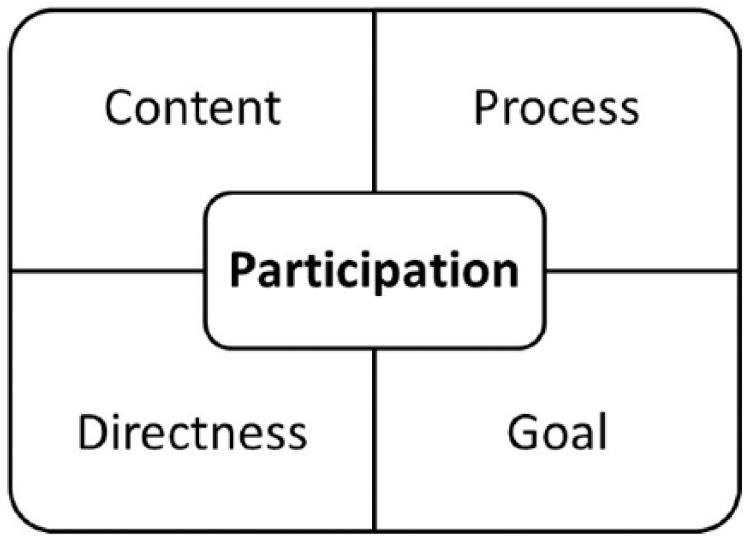
The conceptual model.
Process and content
There are several reasons for separating participation in terms of intervention process and intervention content. First, some interventions have a specific target content, e.g. to manage work stress (Randall et al., 2007), decrease hassles (Evans et al., 1999), or implement self-rostering (Garde et al., 2012), which means that employees may only have influence over how the goal is achieved, not the goal (content) itself. Second, others follow a structured process, such as Lean (Stenfors-Hayes et al., 2013) or health circles (Aust and Ducki, 2004) but include flexibility regarding content, e.g. what is to be improved (Nielsen and Miraglia, 2017).
Participation over the intervention process
Participation related to the intervention process ranges from employee-driven actions to standardized pre-planned activities. Hence a variety of potential configurations of employee participation in the intervention process exist. When employees and managers devise the intervention according to their desired degree and form of involvement, it potentially fosters the experience of agency and collective efficacy (Bandura, 2000).
Likewise, the likelihood of having an intervention process that fits the context potentially increases if the participants are empowered to adapt it to fit the local setting (Nielsen and Randall, 2015). The fit between the intervention and the organizational context has also been found to be crucial to achieve long-lasting and positive outcomes (cf. Nielsen and Randall, 2015). We will use the following operational definition of participatory influence over the intervention process: The extent to which participants have influence over the organization, amount and form of intervention activities.
Participation over the intervention content
Another central aspect of participation in interventions is the influence over their content, here defined as: The extent to which intervention participants have influence over the content of intervention activities. The tenet is that employees are experts in their specific working conditions and often know which areas hold potential for improvement better than experts (Czarniawska, 2014; European Agency for Safety and Health at Work, 2012). Similarly, studies show that there are considerable differences in which aspects of work are regarded as strenuous, and so making use of the expertise of employees is crucial for determining the content of risk assessment and action planning during work environment interventions (Nielsen et al., 2014). Accordingly, we propose that participation of employees in devising the content of the intervention (such as the goal of activities and what areas of work are targeted) is a central dimension in assessing employee participation in work environment interventions. To analyse these two dimensions and their interrelatedness we pose the first research question:
How is participation over content and process described in interventions, and how are the two dimensions linked?
Directness of participation
A core distinction of workplace participation is its degree of directness, ranging from direct participation to representative participation (Busck et al., 2010; Marchington, 2005). We define directness as: The degree to which employees are directly involved in activities or are represented by elected or appointed representatives. This concerns whether employees participate indirectly through formally elected representatives (often the safety representative or shop steward), through elected or selected regular worker representatives, or directly by taking part in activities themselves. Both direct and indirect forms of participation have had widespread use in workplaces, both in the Nordic countries and elsewhere (Busck et al., 2010).
There are several arguments in favour of direct participation. The democratic arguments typically relate to giving voice to marginalized employees (Dundon et al., 2004). It is also assumed to promote empowerment, which in turn fosters job satisfaction, self-determination and meaningfulness (Fernandez and Moldogaziev, 2013; Maynard et al., 2012). Likewise, at a collective level, having the entire work group participate directly in activities to improve working conditions could provide collective experiences of success and collective efficacy (Bandura, 2000) and potentially facilitate the development of sensemaking (Weick, 1995). In contrast, there have been examples where direct participation has become an instrument of collective control of employees (Barker, 1993), and the issue of how much autonomy is positive has been raised (Langfred, 2004). An alternative participatory scheme is representative participation, as known in collective bargaining (Marginson and Galetto, 2016) or workplace safety (Walters et al., 2012). One advantage is the reduction in cost and logistical issues compared to direct participation. But participation through representation relies on the legitimacy of the representatives who represent the body of workers (Contandriopoulos, 2004; Pitkin, 1967).
Despite the potential loss of perceived involvement in the intervention activities when delegating authority to representatives, it does have organizational potential for achieving changes on a larger scale than direct participation (cf. Heller et al., 2004). Concordantly, we propose that the degree of directness is an important parameter in the conceptual model of participation in work environment interventions. We formulate the second research question:
To what extent do WEIs use direct participation or participation through representation?
Goals with the participatory approach
The final dimension in our conceptual model is based on the fact that participation in WEIs varies not only on the basis of who the participants are, and what areas of the intervention participants can exert influence over, but also to what ends participation is used. Participation can be based on very different ambitions as to the degree and trajectory of employee influence. A core differentiation is between participation used as a means to achieve goals or as a process that is an end in itself. If seen as an end in itself, participatory interventions not only aim for participation during the intervention but also to more broadly promote participation in the workplace.
This is emphasized in the World Health Organization’s Ottawa Charter for Health Promotion (1986), which states that ‘health promotion works through concrete and effective community action in setting priorities, making decisions, planning strategies and implementing them to achieve better health. At the heart of this process is the empowerment of communities, their ownership and control of their own endeavours and destinies’ (World Health Organization, 1986: 3). The Ottawa Charter is frequently applied as a conceptual foundation that participation is important for implementation of work environment interventions and employee wellbeing (Aust and Ducki, 2004). In the current conceptual model, we define the means/ends dimension as: The extent to which participation is a means to implement an intervention or if it is also seen as an end in itself. This difference can be traced to the general literature on work organization and employee participation such as self-managing work teams (Barker, 1993; Cohen and Ledford, 1994), employee involvement (Heller, 1998) or transformational leadership (Bass and Riggio, 2012), where arguments regarding performance or effectiveness as well as empowerment and employee wellbeing are made. The Ottawa Charter for Health Promotion likewise stresses how participation can be both a means and an end in that it is both a way to involve participants in health promotion practices and also a central factor in health promotion. Taking responsibility for your own health can in itself be an important aspect of improving health and wellbeing (Bandura, 1977).
By adding the dimensions of directness and means/ends to those relating to intervention content and process, we aim to analyse links between different forms of participation and the ideological uses of participation. This leads us to pose the third and final research question:
To what extent do the interventions use participation as a means of implementation or as an end in itself, and how are these uses related to the other three dimensions of participation in the model.
Though the presented conceptual model is grounded in the participation literature and in work and organizational psychology, to validate and adapt it to practical reality, the model needs to be applied to specific cases of WEIs. We apply it to analyse eight Nordic work environment interventions and their use of participation, and focus on which roles and forms participation takes. To answer the research questions we assess how each dimension of the model applies to each intervention and focus on differences between intervention programmes and across dimensions to become more precise about what it means that an intervention is labelled as ‘participatory’. We hence aim to expand our understanding of the ‘how’, ‘why’ and ‘to what extent’ of participation in work environment interventions.
Methodology
This study is a multiple case study comparing participation in eight interventions. The interventions were selected on the basis of being conducted by researchers in a pan-Nordic research collaboration on work environment interventions, representing different intervention designs and participatory set-ups. We have employed a broad definition of ‘participatory intervention’ ranging from management-initiated activities in which employees take part, to full and equal sharing of authority and responsibilities. Though the interventions have a wide span of topic and designs, there are common denominators that make them comparable: (a) all programmes were initiated by management and HR, often in collaboration with employees and labour unions; (b) the primary participants are groups of employees; (c) the activities aim to increase employees’ health and wellbeing; (d) activities are anchored at the workplace; and (e) the programmes are time-limited projects. Some are alternatives to standard practice risk assessment while others are specific add-ons to current work environment activities in which the employees, in some form, participate. The final decision from the workplace to participate was in all interventions taken by management, but the involvement of employees and unions during and after the decision was taken differed.
Description of the interventions
The eHealth (eHealth) intervention consisted of workshops aimed to improve employees’ attitudes, competencies, skills and behaviours in information and communication technologies such as electronic health records (Mosson et al., 2010). It was directed towards staff in primary healthcare centres in Stockholm, Sweden. The workshops were conducted at every centre and all employees were invited to participate. Eight workshops were offered at each workplace. Approximately 10 employees participated in each workshop, and the workshops were repeated until all employees at each centre had attended. One employee at every centre was appointed as a process facilitator and was responsible for leading the workshops at the centre. The process facilitators were, in turn, coached by employees with a special assignment as instructors responsible for developing the intervention activities and materials. Time spent on the intervention was counted as working hours.
Work with flow (WWF) was conducted at white-collar organizations in the Stockholm region, Sweden. The intervention was a web-based system for occupational health management (Hasson et al., 2013). It covered individual, group and organization-level activities and encouraged employees and managers to jointly work on improving the work environment. The system provided surveys for continuous evaluation of one’s own health and the psychosocial work environment. Together with feedback on the results, the system provided suggestions for activities to improve wellbeing and work environment for the individuals and groups. Line managers and employees were encouraged to discuss the results of the surveys, make action plans and follow up changes on a regular basis. To assist the line managers, interactive self-learning exercises on how to manage employee development, problem solving, goal setting, communication and stress management were provided. At the organization level, the HR representatives and senior managers were able to follow work groups’ survey results.
A Change Workshop (CWs) process was conducted at the Finnish Specialist Centre on Forestry to support the organizational changes and the forming of new meaningful tasks. The CW process follows the activity theory based Change Laboratory methodology (Virkkunen and Newnham, 2013). The process aims to help participants examine the changing purpose and underlying structures of their work (Ala-Laurinaho et al., 2017). The process spanned six months and consisted of five CWs (three hours each) in between which participants held tasks like data collection or implementing development efforts at the workplace. During the process, participants analysed the changes and disturbances in their everyday work, and used these analyses to depict the developmental path of the organization and a future model of working. This was followed by planning and implementing development efforts towards the future model, and, finally, by evaluation and reflection of the process and the results. Participants were appointed representatives from different departments, geographical regions and hierarchical levels (employees, foremen/supervisors and managers).
Sound of Wellbeing (SOW) was initiated by a Health Trust in Norway in collaboration with professional artists (Vaag et al., 2013). Hospital management invited employees to participate, and participation was voluntary. The project aimed primarily at strengthening the workers’ work engagement, job satisfaction and psychosocial work environment, and in the long-term, reducing sickness absence and turnover. All hospital employees were invited to participate as singers, with each department forming their own choir. Three professional artists instructed, trained and accompanied the choirs. The project lasted three months with regular rehearsals outside the hospital premises after work hours. The project ended with a large concert where an award for ‘best choir’ was presented, and was repeated two years later.
Lean-health (LEAN) was conducted in a regional hospital in Sweden. The intervention dealt with integration of employee health promotion and health and safety work with continuous quality improvement work. The system for quality work was a Lean Management tool, Kaizen. Both employees and their line managers participated. They already knew the Kaizen tool as they had used it in other areas of work. Practically, the intervention involved two main components played out within the pre-established Kaizen system, and thus involved modification to the existing practice: (1) health promotion-related activities and improvements (including worker protection issues) were to be identified, raised and addressed on the Kaizen notes; and (2) all problems mentioned on the Kaizen notes, regardless of which area the problem/proposal concerned, were to be analysed from a health promotion and protection perspective. The fundamental principle was a high level of employee engagement, as in the existing Kaizen work. As the intervention primarily was a shift in topics in the Kaizen work, additional time allocation was negligible and activities were held during working hours.
Participatory intervention from an organizational perspective (PIOP) was an intervention among Danish postal service mail carriers aiming to improve their psychosocial work environment and their work environment management practices (Nielsen et al., 2013). Two postal areas in adjacent regions participated and implemented the PIOP intervention one after the other. The intervention principles were developed in collaboration between researchers, a consultant from the postal service and a steering committee of managerial and union representatives. A key element was that the intervention was not only to solve specific work environment problems but also to improve the way these issues are addressed. A series of components were outlined (a tailored screening approach, an audit of support systems), but their final form and participant groups were decided by employees and managers in the participating regions. The intervention largely used existing meetings and structures for manager–employee collaboration, and employee time spent on the intervention was compensated by a grant from a health prevention fund.
A participatory physical and psychosocial intervention for balancing the demands and resources among industrial workers (PIPPI) was an intervention implemented in three Danish industrial production plants (Gupta et al., 2015). PIPPI was a work group based intervention using extensive participatory problem identification, action planning and implementation to improve and prevent future decline in employee work ability. All members of a work group participated in three workshops lasting three hours each, and were compensated for time spent on the activities. PIPPI was built on the participatory principles of the PIOP project and was linked closely to the companies’ existing Lean management structures for continuous improvement. This was supplemented with a focus on ergonomic work environment issues, and likewise drew on experiences from the participatory ergonomics research.
Work environment health circles (WEHC) was an intervention carried out in four nursing homes in Denmark (Aust et al., 2009). Municipalities enrolled in the study and subsequently identified eldercare centres interested in participating. In WEHC, a representative group was established with participants from all departments/shifts, a shop steward, a safety representative and a line manager. The group, as representatives of the entire workplace, were elected by staff and helped by a process consultant to identify work environment problems and develop solutions. The intervention method originated from Germany and has been used extensively in industry and other settings (Schröer and Sochert, 2000). The Danish use of health circles has expanded from the first intervention study to be included as one of the methods in a government programme of subsidized work environment improvements (Smith et al., 2015). Time spent on the WEHC activities was counted as work hours.
Data sources
Written data sources from the interventions formed the core of the data used to identify the form of participation employed in the different interventions. We used a number of publications documenting the interventions, regarding the use of participation as well as which methods and tools were used. This included practitioner publications, manuals and scientific articles. In some cases longer manuals formally describing the methods were obtained (CW, PIOP, WEHC), and in other cases book chapters (SOW, PIOP, LEAN, WWF), methods sections from evaluation reports (eHealth) or scientific articles (PIOP, PIPPI, SOW, CW) were obtained. These formal documentation materials were supplemented with unpublished manuals, for instance instructions to facilitators (PIPPI) and log-data (SOW) obtained from the researchers who conducted the studies, and the researchers were asked about the unpublished details of their studies.
Analytical strategy
The analysis was done in five steps following a template analytical strategy (King, 2012; Saldaña, 2015). First, we collected the data from each intervention in the form of published design papers, manuals and instructions, as noted above. To capture any details that had not been included in the publications, researchers from each intervention project were asked to provide written statements about the theories of participation, as well as descriptions of the use of participation. Second, materials were analysed following a framework analysis strategy where the established dimensions of participation (content, process, directness and means/ends) served as analytic categories. Third, reports from the researchers were used to validate and nuance the interpretations of manuals and to illuminate elements that were unspecified in the written material. Fourth, we analysed the level or type of participation for the dimensions across the interventions. We applied three levels (high, moderate and marginal) in the dimensions of process and content, and three types for directness (representative, mixed and direct), whereas for the dimension of goal we divided the interventions into those predominantly applying participation as a means or as an end. Fifth and finally, the researchers were asked twice during the development of this article to validate the entire analysis to ensure that the presentation of participation in the interventions was precise.
Results
Participation over the process
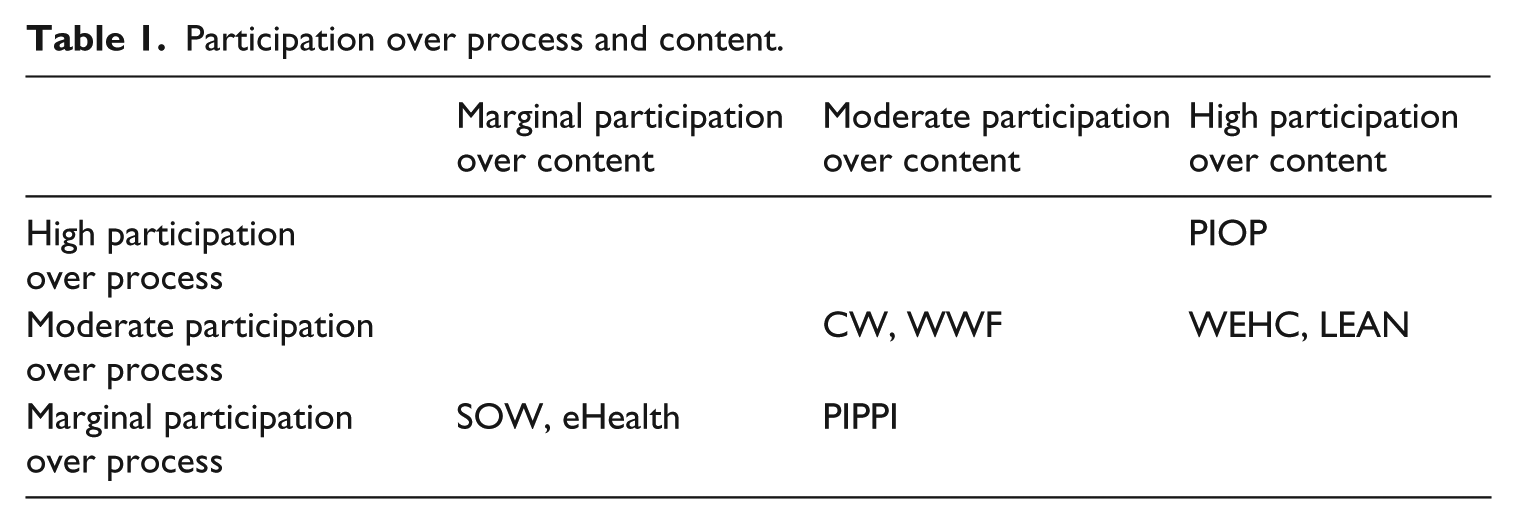
The only intervention with high participatory influence over the process was PIOP, which in its manual had clear instructions for supporting the participants in adapting the activities to fit in the daily routines and arenas. The form of activities and their organizational placement (for instance in the work teams or on regional level) was an area of open negotiation between managers and employees. Though some of the elements, such as the development of a tailored questionnaire (Nielsen et al., 2014), was carried out by researchers/consultants, the form of the general activities (action planning, prioritization) in the project was negotiated with the employees and managers in the participating areas.
Several of the interventions allowed for moderate participatory influence over the intervention process, but had intervention features that presented substantial limitations to the potential for participation. For instance, the WEHC had meetings with a fixed agenda, and pre-planned dialogue tools were to be used. The employees did, in contrast, have the freedom to elect which employees would serve as participants in the health circle. Similarly, in the LEAN project, there was mandatory use of Kaizen boards and working within an already established Lean framework of, for instance, short weekly meetings. The intervention used Kaizen as ‘a problem-solving model that is a structured way of getting more employees to participate, and every department has a great deal of freedom to form its Kaizen work as it sees fit’ (Stenfors-Hayes et al., 2013: 287).
The process of the CWs was guided by theoretical concepts from activity theory (Engeström, 1987; Engeström and Sannino, 2010; Vygotsky, 1978) to ensure a learning process where daily work situations were re-interpreted to generate new solutions to perceived problems. Depending on the outcomes of each CW, the following CW was planned to promote the next step of learning and development. Thus, the content produced by the participants influenced the process throughout. Though WWF was built on a principle of being an adaptive web-based system, the influence of participation over the process was explained as: ‘The tool is also adaptive in the sense that it is continuously modified based on the needs and preferences of the users. Each organization has the possibility to add and omit questions in the extensive survey. For instance, a work group with specific problems or positive goals can be offered additional questions for evaluation purposes’ (Hasson et al., 2013: 305). Though the individuals’ use of the web-based assessment tool was to some extent fixed, the steps taken by the work group to collectively address shared issues was highly flexible and participatory.
Some interventions had an entirely pre-planned format, and hence did not allow for any, or only a negligible degree of, employee influence over the process (form of workshops, etc.), which we label as marginal participation. In practice, the reasons for not allowing employees to influence these areas are different for each intervention. For example, the SOW, being a large-scale choir singing intervention, needed to be organized as a centrally planned activity, and PIPPI, being a standardized team-based intervention, followed clear written instructions for each activity, while eHealth was a pre-planned training programme. Hence employees in PIPPI, SOW and eHealth had little option to participate in how the intervention was designed and implemented.
Participation over the content
With regard to the content of the WEI activities, several could be labelled as highly participatory. The WEHC, PIOP and LEAN had no principal restrictions on the areas targeted and the activities developed. Common to these interventions is the assumption that the employees themselves are the most capable of determining what needs to change in order to improve their working conditions. In LEAN and WEHC workshops the employees would write notes on the issues relevant to their group after which a vote was held with stickers indicating which issues were most pressing to resolve and which were the easiest to resolve.
In this way the problem identification and prioritization were both participatory and transparent. In the WEHC manual it is emphasized that participation ‘means much more than just participating. The employees must have an active role in the processes, which to as great an extent as possible shall lead them to experience their contributions as leading to concrete improvements’ (Aust et al., 2009: 29, our translation). In the LEAN intervention it was likewise clearly stressed that the motivation behind having participants determine the content of the intervention was: The fact that the content is determined by the practitioners [i.e. participants], who understand best the needs and possibilities of the particular organization, makes it more likely that the content of change will be well suited to needs in the unit. Moreover, determining the content of change is likely to increase engagement and motivation to participate in change efforts. (von Thiele Schwarz et al., 2015: 223)
In PIOP the participants decided on ‘which of the themes [from a screening survey] are the most important for them to address, especially with regards to what is deemed qualitatively would lead to the greatest work life improvement’ (Nielsen et al., 2013: 342).
Another group of studies explicitly promoted the idea of having employees contribute to the content of the intervention, but had to some degree predefined what should be worked on – i.e. moderate participation. This was due to top-down decisions on what the companies, or researchers, wanted to achieve with the intervention and hence distinguishing them from the WEHC, LEAN and PIOP projects where no assumptions were made about what the employees would benefit most from. In PIPPI, a goal was to achieve improved work ability, reduced need for recovery and increased labour market retention; CW aimed to make the reorganization process in the company smoother by having employees focus on changes in work and disturbances and tensions in the current processes and work system. Finally, the WWF system provided suggested actions, but the participants were free to choose among these and to a large extent tailor the intervention, especially on group and organizational levels. Though all of these set-ups are reasonable and designed to achieve specific desired outcomes, from a participatory standpoint they limit the employees to participating in achieving predetermined goals and hence allow only moderate participatory influence over the activities.
A final group of studies did not allow for any, or only marginal, participation with regard to the intervention content. Participation was not used to develop content or specific organizational improvements but served as an implementation tool. These include the SOW and eHealth. In the SOW, the choir set-up did not allow for any influence on the content of the activity. Likewise the eHealth project was content-wise relatively fixed on specific themes for each training session. As the tools were developed in advance and the goal was to achieve a high degree of use, only minor local adjustment of content was possible, and was hence on this account participatory to a low degree.
To illustrate the links between employee participation over content and process in the interventions they have been visually represented in Table 1. In relation to research question 1, the results primarily show that the two areas of participatory influence are separate constructs but they appear to be, at least to some degree, linked. Especially, the ones having high participation over one dimension are predominantly participatory on the other, and the ones having marginal participation on one dimension have a tendency towards being low on the other. Likewise it appears that participation is more frequently allowed over the intervention content than the process.
Participation over process and content.
Directness of participation
Several versions of direct and representative strategies were used in the interventions. Both the WEHC and the CW interventions used representative participation, i.e. a sample of participants from the groups being targeted by the activities. For the WEHC, participants were elected at a meeting for the whole workplace so that each ward and shift was represented, and the participants were explicitly instructed to act as representatives for their colleagues when participating in WEHC meetings. The participants were asked to follow democratic principles of representative democracy during the meetings, seeking consensus (‘The participants in the health circle are to discuss and negotiate until agreement is reached on a solution’ [Aust et al., 2009: 28, our translation]). Between WEHC meetings the representatives would also be tasked with discussing solutions with their departments to maintain the link between the WEHC representatives and the whole workplace.
Likewise, CW workshops were held with representatives of the different service processes that were affected by the reorganization process. The participants also represented different hierarchical levels and geographical regions. During the workshops in-depth dialogue on organizational changes and analysis of potential solutions were the focus, which is why only a limited number of representatives were chosen to represent the large group of employees. In the last CW workshop the representatives presented the solutions they had identified to the senior management, leading to discussions and decisions about how to further refine the solutions and suggestions and how to implement them as part of the long-term development of the organization.
Others (PIPPI, SOW and LEAN), in contrast, used a direct participation strategy. The ideal of participation in these three interventions was that frontline employees were the primary participants as well as the recipients of the activities. For PIPPI and LEAN, the directness was in part inspired by principles from Lean management. All employees were involved in the improvement activities to ensure implementation in the entire workplace, both in regard to participating in the assessment and action planning as well in the implementation of solutions. This was done to ensure that participants experienced ownership in the improvement efforts. With SOW, the intervention was based solely on direct participation, i.e. taking part in the choir. This intervention was intended to strengthen the workers’ motivation, job satisfaction and psychosocial work environment by active involvement in the choral activities.
Others were not as clear-cut with regard to directness of participation. In the PIOP intervention, the freedom for participants to shape the format of participation led to different degrees of directness in the different groups. One group chose a participatory design using participation through representation with one representative per team participating in the central development activities, whereas in another group at least four participated from each team (both safety representative and shop steward and two to three regular employees), and a final group decided that all action planning was to be conducted at the team level and hence was directly participatory. Each intervention had a steering committee of senior managers, and central union representatives followed the process and ensured anchoring of the initiatives in the organization. This array of different forms of direct and indirect participation makes us categorize PIOP as a moderate, or more appropriately mixed, degree of directness. Both WWF and eHealth also used a mixed design with varying degrees of directness in different activities. To answer the second research question, there does not appear to be a clear link between directness of participation and degree of participation over content and process. In that sense, the degree of directness of participation in the interventions in the sample appears to be a methodological, and to some extent an ideological, choice (as in the case of the WEHC intervention) regarding how participation should be employed.
Participation as a means or an end
The final dimension in the model is the goal of participation. One end of this spectrum is to view participation in WEIs as a means to involve employees in activities and facilitate implementation. In this sample it specifically relates to the eHealth, SOW and WWF interventions. In SOW, participation in the choir was a means to improve wellbeing and not an attempt to increase the participatory influence of employees over their work. In the development of the WWF intervention, there was broad awareness of the potential of having a web-based intervention that was not specifically individualizing but also had activities targeting group level and managers to achieve an organizational effort (Hasson et al., 2013). In spite of these uses of participatory and collective implementation mechanisms, a book chapter on the intervention states clearly that ‘The project aims at improving organizational, group and individual wellbeing by improving the psychosocial work environment, optimizing work ability and job satisfaction as well as preventing ill health, sickness, presenteeism and long-term sick leave by offering a practical and interactive web-based tool’ (Hasson et al., 2013: 301), and hence does not treat participation as an explicit goal of the intervention. The exception would be if a work group themselves decided to address participation as a way to achieve wellbeing. Finally, the eHealth intervention’s main goal was predominantly to improve ehealth competency and use of ehealth systems.
At the other end of the spectrum, the CW, PIPPI, PIOP LEAN and WEHC interventions had a declared goal of using a participatory approach to specifically increase worker involvement and engagement in the shaping of the workplace. The theme of empowerment and long-term participatory practices is seen in several of the tools and activities. In the PIOP intervention a dialogue tool, called ‘the ownership model’ (see Nielsen et al., 2013: 334), was used in the steering committee meetings to put the shift of the intervention from researcher/consultant driven to workplace management/employee driven up for debate.
The reasoning behind explicitly debating ownership and suggesting a shift from expert-owned to a workplace-owned project is that ‘Real change and learning can only take place if it is initiated by the participants and they have gone through the process and acquired the necessary competencies to continually address the challenges they face at work. The ownership model helps to raise awareness of the level of ownership assumed by the steering group but can also help reveal discrepancies in perceptions of ownership among steering group members and thus it can open for a dialogue of what ownership means and how it should be operationalized in a particular project’ (Nielsen et al., 2013: 334–335).
In PIPPI, it was an ideological premise that the intervention was to increase awareness about work ability and work environment, on the one hand, and the fact that these were issues that to some extent could be shaped by employees, on the other. In LEAN, there was a clear ambition to get the employees’ perspective on the issues addressed by the intervention as this would improve the fit to the practical context and hence provide expert advice on which issues were most important to address and which solutions were the most relevant. The role of participation in the LEAN project was stated as ‘employee participation is important not only because participation in itself is related to improved employee health; it is also essential to the success of any intervention’ (Stenfors-Hayes et al., 2013: 295).
In the WEHC manual it was likewise clearly specified as the first theoretical principle of the method that the employees are experts on their own work environment, which meant ‘that their knowledge is to be respected. Using the knowledge of employees means also recognizing the experience that employees possess and accumulate’ (Aust et al., 2009: 27, our translation). Furthermore, it was a goal of this WEI that not only employee wellbeing and productivity were thought to be improved, but also that learning took place. In the manual it is stated that ‘through the change processes initiated via WEHC – especially the discussions about the daily work environment during the WEHC meetings and the actions that are initiated – a learning process will be set in motion which affects both the organization as well as the individual employee’ (Aust et al., 2009: 26, our translation). The learning perspective in the WEHC underlines that both the building of capabilities of employees and increased understanding of the employees as competent actors will be ‘especially relevant for future work environment activities and a vital resource in the development of the workplace and cooperation and collaboration’ (Aust et al., 2009: 26, our translation). The CWs had a triple goal concerning participation: first, to get the employees’ perspective on developing work and organization; second, to promote a new culture for participative work development and provide new means for it; and third, to support an expansive learning process among the participants and promote their transformative agency (Heikkilä and Seppänen, 2014; Vänninen et al., 2015) .
To answer the third research question, there appears to be overlap between interventions seeing participation as a goal and employing a high degree of employee influence over both content and process; while, in contrast, the three interventions that predominantly used participation as a means to achieve specific goals employed a lesser degree of influence over intervention content and process (see Table 2). This suggests that it is possible to differentiate between the more expansive ideological uses of participation as an end in itself from the more instrumental uses of participation as a means to achieve predefined goals.
Directness and goal of participation.
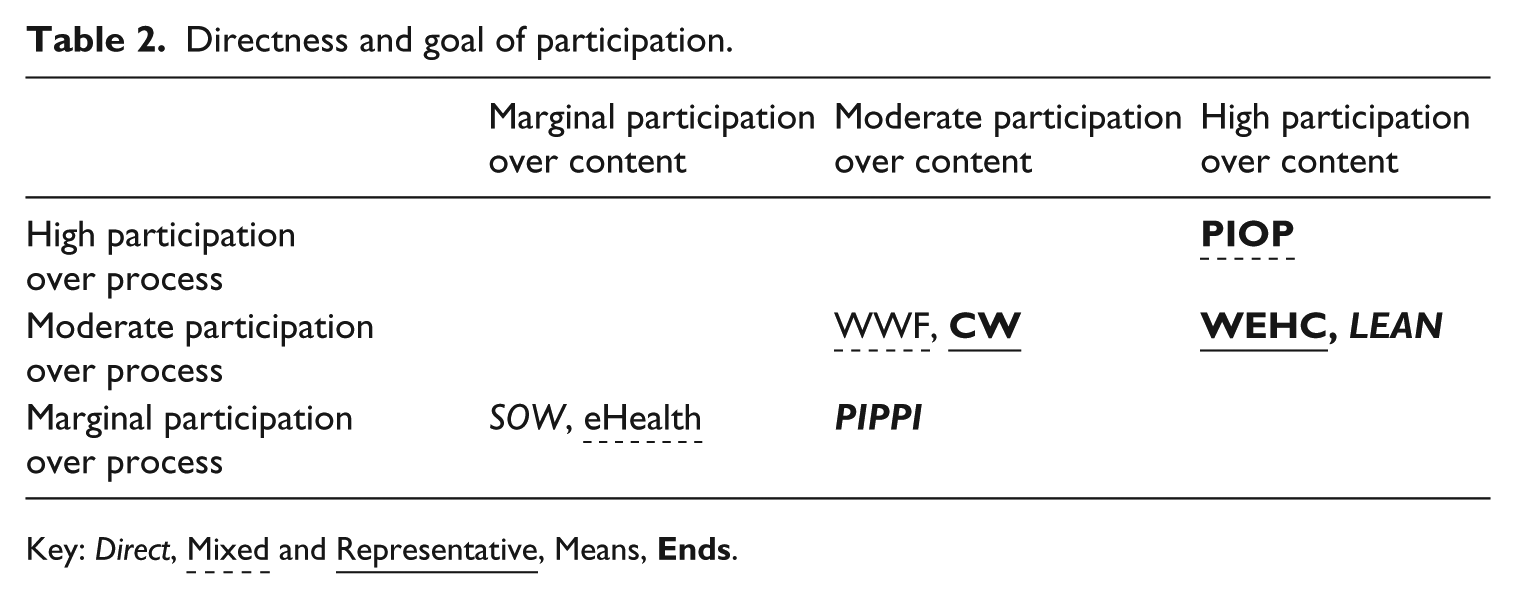
Key: Direct,
Discussion
The aim of the article was to expand our understanding of the ‘how’, ‘why’ and ‘to what extent’ of participation in WEI by first presenting a conceptual model of participation in WEI, and then assessing its usefulness by applying it to eight WEIs. The results suggest that the interventions differ according to the degree of participation (over content and process) as well as the character and form of participation (directness and means/ends). Although all the interventions analysed could be described as participatory, it is clear that what this entailed, as is illustrated in the four dimensions, differed substantially between the WEI programmes. The presented conceptual model helped us differentiate between participatory set-ups, which underlines the model’s importance and usefulness.
Though the form of participation is unique to each intervention, in applying the framework to the empirical studies an interesting tendency appeared. Half of the interventions involved more influence over content than process (these include WEHC, LEAN and PIPPI), whereas none utilized more influence over process than content. Several explanations are possible as to why influence over content is more common in our sample than influence over the process. First, in a workplace context where management often have formal decision authority, letting employees decide on which aspects of work to improve within a structured framework perhaps seems more manageable than allowing them to define the entire process. Second, a practical reason could be that scheduling and balancing intervention activities with daily work tasks require knowing the structure in advance (dates for meetings, number of participants, etc.), to avoid disturbances in the work processes. Third is the origin of the interventions, i.e. in consultancy and research practices. Consultants conducting improvements might be interested in providing services that can be presented to companies as a series of pre-planned components. Similarly, researchers, often influenced by the biomedical paradigm, aim to execute interventions that adhere to standardized procedures and follow randomized controlled trial methodology, such as the CONSORT statement (Schulz et al., 2010). These factors all likely counteract employees’ possibility to extend influence over the intervention process.
The goal of participation
In the WEIs, participation was used as both a means to implement measures to improve health and wellbeing and a means of introducing participatory activities to achieve a trajectory of increasing employee influence over working conditions. But participation in light of these two goals is not the same. The interventions that most clearly articulate ideals of employee empowerment and participation (i.e. the ‘participation as an end’ interventions, esp. PIOP, CW, WEHC and PIPPI) are all placed relatively high on participatory influence over content/process, whereas all those strictly using participation as means to implement a health promoting activity employed lesser degrees of participatory influence. For instance, in SOW participants had no influence on the overall planning of either activities or their content. But then again, the goal of SOW was not participation, understood as power sharing, but participation as a social health-promoting practice. Another difference is that the potential for participants to develop their understanding of how one can engage in the organization and influence its development is substantially more elaborated in the ‘ends’ WEIs than in the ‘means’ WEIs. This in turn is an argument for why an approach where participation is an end in itself in the long run might lead to a more healthy workplace, as empowered employees potentially can influence working conditions in a positive direction. Though the conceptual model would still need to be applied to a broader sample of WEIs to confirm these tendencies, there seems to be a relationship between having participation as a goal in itself and more comprehensive forms of participation.
Directness of participation
Though the sheer amount of employee participation assessed by how directly the employees were participating might initially seem like a relevant proxy for participation, this study suggests otherwise. The interventions with a substantial degree of participatory influence over content/process are spread out, having direct (PIPPI, LEAN), mixed (PIOP) and representative (WEHC, CW) organization of participation. Also, one must note that the process and content-wise marginally participatory SOW intervention is likely the one using the most direct participation of all the interventions (i.e. all employees are invited to participate in joint choir singing). This suggests that varying arrangements of participation through representation or direct participation are employed to achieve a participatory intervention and, based on our study, neither seems to inherently allow for more participatory influence over working conditions. It is worth noting that if the mechanism for increased wellbeing lies in employees taking an active part in improving their working conditions, using a subpopulation of representatives might diminish the effects of the intervention.
Implications for research and practice
Based on the mapping of WEIs onto the dimensions, we determined that there were clear differences in how each WEI related to each dimension. In light of this finding, we suggest that there is a need to distinguish between different dimensions of participation, in particular between participation as actively taking part in activities (participating) and participation as exerting influence over decision making regarding working conditions. Though many interventions are formally termed ‘participatory’, it is far too vague a term and needs specification.
An initial differentiation would be, based on the means/ends dimension, to label some interventions as either ‘aiming to improve employee participation’ or ‘using a participatory implementation strategy’. Furthermore, differentiating clearly between an intervention using the adjective ‘participatory’ to describe the character of the activities and one that uses participation to achieve implementation would be a way to operationalize the dichotomy between social interaction and actual participation found in the literature (Carpentier, 2016; Wilkinson and Dundon, 2010). We suggest that one should consider whether an intervention is primarily using employee participation as in ‘employees participate in activities’, or the intervention is in fact a participatory intervention, which implies that power redistribution is a long-term goal. If this latter differentiation is adhered to, it could potentially limit the use of the adjective ‘participatory’ when dealing with pseudo-participatory interventions.
There is also variation between the dimensions of participation. Some of them are similar to measurements of degree (process and content) whereas the others (directness and goal) have two pure categories at each end and a ‘mixed’ category in the middle. Though this is a somewhat specific observation relating to categorization, it adds to the finding that the forms are not identical and do not assess the same type of construct. Based on the comparative analyses across the WEI programmes, we suggest that for an intervention to be labelled participatory, employees must have substantial influence over the content and/or the process of the intervention. Additionally, using participation as a goal for the intervention rather than a means of implementation appears to be the clearest single indicator for an intervention being generally participatory. This assessment is in line with several of the classical theoretical and ideological frameworks of employee participation, from the Tavistock School (Miller and Rice, 1967; Rice, 1958; Thorsrud and Emery, 1966), organizational psychology (Katz and Kahn, 1978), as well as current research on participation and working conditions (Busck et al., 2010; Knudsen et al., 2011; Nielsen, 2013).
Apart from contributing to the definition and conceptual clarity of participatory interventions, the present study also provides some suggestions as to how aspects of participation differ across organizational contexts and with different types of interventions. Several of the interventions labelled as less participatory (especially SOW and eHealth) focus more directly on achieving specific effects in learning or behaviour, as opposed to the highly participatory interventions (WEHC, PIOP, PIPPI, LEAN) that have more diffuse goals in terms of improving employee health and wellbeing. Both aims are commendable but the results of this study demonstrate that they are easily juxtaposed. If specific aspects of work need to be improved and employees are asked to contribute to those specific aspects, the participatory space is already narrowing. This suggests that interventions that simply aim to implement specific solutions are less suitable for participatory practices than those more resembling organizational development (OD) (Cummings and Worley, 2014) initiatives. From the perspectives of OD and workplace learning, one could further suggest that increasing employee participation over the intervention process might be a way to help employees and managers learn how to become better at continuously developing their workplace (cf. Argyris, 1991). Again, the long-term commitment and explicit goal in some of the interventions to develop an organization based on employees and management working together to improve working conditions fits well with the ideas of OD (Cummings and Worley, 2014).
The present study supports the political school of participatory theory which emphasizes that participation practices necessarily involve some degree of power distribution (Pateman, 1976). Participation seen as the sheer practice of being part of activities (the sociological perspective as outlined by Carpentier, 2016) seems to explain the relevance and potential health-promoting effect of employees participating in activities, but the differentiation between participating in activities and exerting participatory influence over practice suggests that the inclusion criteria for an intervention being labelled participatory imply some degree of power redistribution.
Conclusion
In this article we demonstrated that the form, scope and depth of participation during work environment interventions differ. These differences in participation lead us to suggest being more precise about what is meant by an intervention being participatory, differentiating clearly between participation as a means to achieve other purposes and participation for the sake of also fostering more participatory organizational culture and practices in the future. Furthermore, we recommend the use of multi-dimensional conceptualizations, such as the proposed conceptual model, to assess and describe participation in work environment settings. This analysis of forms of participation presented in this article will hopefully help researchers and practitioners differentiate between participatory subtypes and more clearly articulate what is meant by an intervention being participatory. Such a more precise articulation of participation could potentially help us understand which types of participation are most effective in improving working conditions and enabling employees to have influence in their workplaces. Our concluding recommendations for a minimum level of what should be considered a participatory intervention are initiatives where employees have at least a moderate degree of influence over either the content or process, preferably both. Interventions using employee participation as a mechanism to achieve specific pre-set goals should in most cases not be considered as participatory interventions. Those that in contrast aim to increase employee participatory influence likely should be labelled participatory interventions. Initiatives that fall short of these criteria would, based on our article, be labelled ‘interventions using employee participation’ and not ‘participatory interventions’.
Footnotes
Declaration of conflicting interests
The authors declared no potential conflicts of interest with respect to the research, authorship, and/or publication of this article.
Funding
This work was funded by the Joint Committee for Nordic Research Councils for the Humanities and the Social Sciences (NOS HS) (grant number 219610/F10) and the National Work Environment Research Fund (grant no. 44-2014-03).