



Abstract
Employers, workers and governments all have a stake in improving intrinsic job quality since it can help to raise worker well-being and lower the social costs of ill-health. This article provides a unique insight into factors triggering changes to two key aspects of intrinsic job quality – the skills used and developed at work, and the pressures under which work is carried out. Using a rare two-wave panel dataset, the article assesses whether three predicted determinants – namely employee involvement, teamworking and computerisation – are good or bad for these aspects of intrinsic job quality.
Introduction
Quantifying working conditions solely on economic indicators, such as pay, can be misleading. This is reflected in the European Union’s ‘more and better jobs’ employment strategy and the International Labour Organization’s ‘Decent Work’ campaign (Burchell et al., 2014; Dieckhoff and Gallie, 2007; Muñoz de Bustillo et al., 2011). Both are based on the idea that satisfying workers’ needs cannot be achieved by providing good pay, promotion opportunities and job security alone. Intrinsic job quality also matters. However, what constitutes intrinsic job quality relates to long-standing philosophical approaches (Green, 2006). While some conceive intrinsic job quality in subjective terms by focusing, for example, on job satisfaction, in the past decade most studies have treated it as an objective concept, referring to the job characteristics that may, or may not, meet people’s needs. Authors in this tradition focus on the work itself and the environment in which it is carried out.
The European Foundation for the Improvement of Living and Working Conditions, for example, measures intrinsic job quality by focusing on skills use, work intensity, the social environment and the physical setting (Eurofound, 2012). The Organisation for Economic Co-operation and Development (OECD)’s ‘quality of the work environment’ index is similarly constituted (OECD, 2014: 83–88). We, too, follow this tradition by focusing on two of these four components. We do so because skills use is seen as central to the enhancement of self-realisation, fulfilment and identity-making at work. High work pressure, by contrast, is an important negative aspect of intrinsic job quality, often associated with job strain and stress leading to damaging effects on workers’ health and well-being (Niedhammer et al., 2014; Warr, 1997). What, then, are the factors which make these features of intrinsic job quality better or worse? This is the key overarching research question which motivates the article.
We are not alone in this endeavour (e.g. Hoque et al., 2014; Lopes et al., 2015). However, it is rare for longitudinal survey data on intrinsic job quality to be collected. Of course, some analysts do not use survey data at all, adopting instead a political economy approach to identify macro-level forces to explain observed trends. For example, Carré et al. (2012) highlight three trends which have worsened job quality: the shift to business strategies which emphasise cutting labour costs; the whittling away of labour standards; and the increased use of off-shoring. Empirical support for these explanations is taken from qualitative case studies of particular economic sectors such as call centres, retailing and car production (Álvarez Galván, 2012; Lambert and Henly, 2012; Rothstein, 2012).
Analysts who use survey data, on the other hand, have tended to focus their attention on the correlates of particular features of intrinsic job quality such as skills use, training, discretion and work intensity. Such analyses are based on cross-sectional techniques with occasional use of survey items collecting retrospective data on how particular features of work have changed over time. The data sources for this research include inter alia the European Working Conditions Survey, the Workplace Employment Relations Survey and the Skills and Employment Survey (Felstead et al., 2010; Gallie et al., 2004; Green, 2012; van Wanrooy et al., 2013).
The empirical basis of this article is the Skills and Employment Survey 2012 and, crucially, a follow-up survey of the same workers interviewed two years later using many of the same questions. This makes the article distinctive in that it examines the causal sequence linking changes in independent variables to changes in outcomes. More specifically, the article examines the determinants of two key aspects of intrinsic job quality, namely skills use at work and work pressure. In this regard, the ability to perform a range of tasks, and the ability to do so willingly and without undue pressure are central. Intrinsic job quality also includes other features of work which impact on the quality of the work environment. These include the anxiety about ill-treatment at work, unease about changes to tasks and responsibilities, and the flexibility of jobs to allow workers to juggle work and non-work commitments (Burchell et al., 2014). However, given the restricted availability of data in the two-wave panel, this article focuses on the determinants of skills use and work pressure. From here on, the term intrinsic job quality is used as shorthand for these two particular job features. Nevertheless, this is a limitation which future research might address.
Skills use refers to the level of skills required of workers to carry out their jobs, the extent to which workers use the skills and abilities they possess, and the extent to which workers receive training that develops job-related skills. Work pressure is the second aspect of intrinsic job quality examined here. This is measured by the degree to which workers voluntarily put more effort into their jobs than is required, the extent to which jobs require high levels of work intensity, and the extent to which the job is exhausting.
The reminder of the article is structured as follows. The second section outlines existing literature which suggests causal mechanisms driving up intrinsic job quality as well as some driving it down (Autor et al., 2003; Danford et al., 2004; Ramsay et al., 2000; Wood et al., 2012). These competing hypotheses draw on debates around the impact of greater employee involvement in decisions at work, the organisation of more workers into groups who have some control over the work process (i.e. teams) and the replacement of labour by digital technology (i.e. computers). The impact of these influences on intrinsic job quality is tested using data taken from a two-wave survey of workers carried out in 2012 and 2014 in Britain. In the third section, we outline the source of these data in more detail, the analytical methods, and the measures used to capture intrinsic job quality and its determinants. The section also reveals the extent to which intrinsic job quality varies over a two-year period. The fourth section uses panel methods to examine how three predicted determinants – namely employee involvement, teamworking and computerisation – are correlated with intrinsic job quality. By applying hybrid random effects models on the panel data, the article: (1) examines how changes in these factors are related to changes in intrinsic job quality; and (2) assesses whether the level of these factors is also associated with the level of intrinsic job quality. These are referred to as the within-person (or fixed) and between-person effects respectively. The within effects results give the change in intrinsic job quality that follows from a change in one of the explanatory variables, holding other observed and unobserved factors constant. In addition, the results allow us to assess whether similar effects are also recorded between-subjects, hence highlighting the scale of the biases involved in relying on analyses which do not control for unobserved heterogeneity. The fifth section concludes the article by highlighting the factors policy-makers and practitioners need to promote in order to raise intrinsic job quality as well as factors which can be beneficial in some respects but harmful in others. It also outlines a future research agenda based on the limitations of the present study.
Existing literature and hypotheses
The idea that effective human resource management practices can impact positively on the bottom line has attracted much attention (Boxall and Winterton, 2015). This ‘High Involvement Management’ (HIM) approach requires a shift from production systems based on hierarchical forms of control to systems that empower workers to participate in decision-making and encourage them to work with their peers. It is characterised by two conceptually distinct forms of employee involvement. First, there is role-based involvement. This focuses on the employee’s primary job tasks and responsibilities, and the extent to which these can be determined by the employee. Organisational involvement is the second aspect. This entails workers participating in decision-making beyond the confines of the job and includes decisions about how the organisation is run (Wood et al., 2012).
From a managerial point of view, the aim of involving employees more in both of these ways is to draw on their creative abilities, and hence increase business performance. On this basis, we hypothesise that greater employee involvement in the job and organisational decision-making will be associated with an increase in the skills used at work, a closer match between employees’ skills and those used in the job, and an increase in the provision of skills-enhancing training (Hypothesis 1).
Advocates of this paradigm make the additional argument that giving employees the opportunity to participate in substantive shopfloor and organisational level decisions incentivises them to put in extra effort beyond what is required (Appelbaum et al., 2000: 25–46). Such productive systems draw on ‘the latent knowledge of workers to reduce waste, to solve problems more quickly, and to balance the workload and regulate the production process’ (2000: 229). In other words, employees are incentivised to work both smarter and harder, not because they have to, but because they are willing to do so – going the extra mile to make the organisation succeed by expending greater ‘discretionary effort’. The optimistic hypothesis, then, is that HIM-style practices will be associated with higher levels of discretionary effort (Hypothesis 2).
However, labour process theorists offer counter-arguments. They suggest the effects on workers are negative (e.g. Harley, 1999; Ramsay et al., 2000). Such theorists base their analyses on the argument that there is a systematic trend in capitalism towards the intensification of work, whereby managers are driven to find new ways of making employees work harder. Viewed from this perspective, HIM provides employers with another way of intensifying labour, while pretending to empower workers. Labour process theory, then, predicts that HIM will have a detrimental impact on the worker experience with business gains coming ‘at the expense of stress, work intensification and job strain’ (Ramsay et al., 2000: 505). We therefore examine the determinants of required effort and work exhaustion to test the pessimistic hypothesis that HIM practices will raise both required effort and levels of work exhaustion (Hypothesis 3).
The use of teams is often taken to be a key component of HIM since it is argued they give employees a further opportunity to use their knowledge, skills and abilities beyond the confines of their own job to improve the performance of peers. Teams are defined as a group of employees ‘who meet with some regularity in order to work interdependently on fulfilling a specific task’ (Mueller et al., 2000: 1398–1399). It is further recognised that a team’s responsibilities can vary in scope and degree. Advocates of HIM argue that stronger teams will act to raise skill levels, make more effective use of workers’ skills, encourage employers to provide skills development training and make employees more willing to exercise discretionary effort (Hypothesis 4).
On the other hand, labour process theory suggests that performance gains come through enforced increases in effort and higher levels of work fatigue. This is because the use of teamworking represents a change in the means by which employers exercise control and not its negation (Edwards et al., 2002). Case study research, for example, demonstrates how teamworking can shift, at least some, surveillance roles from managers to co-workers, and that performance gains can be achieved through peer pressure (Baldry et al., 1998; Danford et al., 2004). Through this horizontal disciplinary gaze, team members are made aware of each other’s mistakes and performance levels, and are expected to identify, aid and ultimately sanction those who jeopardise the team’s performance (Bain and Taylor, 2000; Sewell and Wilkinson, 1992). We, therefore, test the pessimistic hypothesis that stronger teams raise levels of enforced effort and exhaustion (Hypothesis 5).
The impact that technological change has on the skill level of jobs has attracted the attention of social science scholars for many years. Much of the early interest was prompted by Braverman (1974), who argued that technological change was not neutral in its effects or in its design, but instead was used to remove ‘brain work’ from the shopfloor, relocate analysis of the work process to management, and instruct workers what is to be done, how and at what speed.
However, there is a competing school of thought which suggests that technological change requires the completion of more complex work tasks, hence pushing skill levels upwards (Blauner, 1964; Kerr et al., 1960). This perspective has received recent support from the theory of skills-biased technological change (SBTC). Early versions of the theory suggested that computerisation – that is, the process of replacing human labour with machines which perform ‘tasks that are deterministically specified by stored instructions … such as binary numbers’ (Autor et al., 2003: 1282) – is more effectively used by better educated workers, hence raising both their relative productivity and wages (Goos and Manning, 2007).
Initially, computers were only used by the most educated, but as the technology has matured they have been seamlessly incorporated into many devices. A more nuanced view of SBTC has therefore evolved. Rather than examining its impact on whole job types such as scientists and technicians, this approach suggests that information and communication technology (ICT) has a subtler impact on many jobs. It does so by a process of limited substitution whereby tasks which ‘can be accomplished by machines following explicit programmed rules’ are computerised, while tasks which are ‘not sufficiently well understood to be specified in a computer code and executed by a machine’ remain in human hands (Autor et al., 2003: 1283).
Faced with the falling price and rising power of computing capital, employers have responded by changing the task mix of jobs towards non-programmable tasks which only human labour can carry out, thereby driving average skill levels upwards. Based on this theory, then, we would expect increased levels of computer use – at the level of the job or the workplace – to be associated with increased skill levels exercised at work, better use of available knowledge and abilities, and an increased emphasis on skills development training (Hypothesis 6).
The effects of computers on intrinsic job quality are not, however, confined to skills. This is highlighted by the theory of effort-biased technological change (EBTC). According to this, ICT provides the opportunity to intensify work during the working day – raising its pace, minimising the gaps between work tasks and facilitating the extension of work activity beyond the conventional workplace (Felstead et al., 2005; Green, 2004). This opportunity could be taken up voluntarily or required by employers; either way, whether through choice or obligation, the result is work intensification. According to EBTC, then, both sources of work intensification are likely to be triggered by ICT.
The same outcome – work intensification – is predicted by labour process theory, but it is expected to come from ramping up required effort. The argument derives from the surveillance potential of computerisation and its controlling capabilities (Bain and Taylor, 2000; Sewell and Wilkinson, 1992). For these theorists, computers represent the electronic panopticon, the modern-day version of the architectural device used for the design of prisons in the mid-eighteenth century and subsequently used by Foucault (1977) as a metaphor for social surveillance. Furthermore, computerisation of the whole workplace allows performance levels of individual workers to be compared across as well as between departments and allows management to identify areas of slack in the organisation of labour.
Whether from the perspective of EBTC or from that of labour process theory, we would therefore predict that computerisation is associated with increased required effort levels and a rise in the work exhaustion rate; from the perspective of EBTC, there would also be a rise in discretionary effort (Hypothesis 7).
Data, analytical approach and measures
Data
The unique feature of this article is that it is based on a follow-up of workers interviewed for the Skills and Employment Survey 2012 (Felstead et al., 2015b). The original cross-sectional survey comprises 2782 interviews with workers aged 20–65. A total 1108 of the 2497 respondents from 2012, who were willing to be re-contacted, were re-interviewed using around half of the questions they were asked in 2012. Not all of those in the original sample were targeted for re-interview due to funding constraints. Nevertheless, 44% of those willing to be re-interviewed took part, with 95% being re-interviewed within two months of the second anniversary of their 2012 interview. The response rate to the 2012 survey was 49%, while it was 71% in the follow-up. Weights were constructed in order to correct for biases in the original selection into the 2012 survey. The panel weights also took into account sample attrition between waves and are used where specified. The results are based on 908 respondents who were employees in both surveys (or 1816 employee-years), with sample sizes falling where there are missing values. A profile of the weighted sample is shown in Table 1.
Profile of respondents.
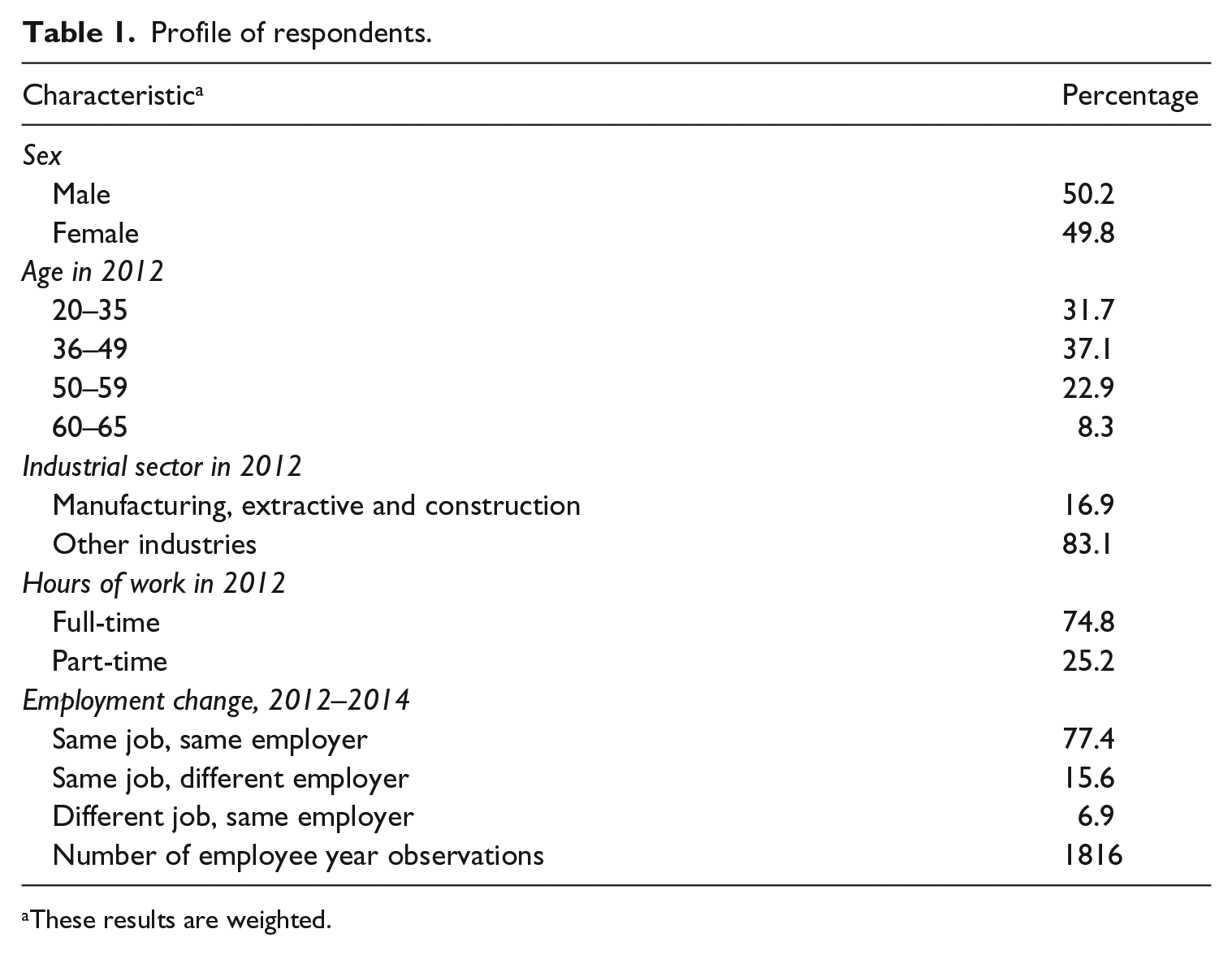
These results are weighted.
Analytical approach
Most previous studies (e.g. Felstead and Gallie, 2004; Green et al., 2001) have used cross-sectional data to examine the correlates of intrinsic job quality. A set of standard controls – such as sex, age, occupation and industry – which might also act as correlates of intrinsic job quality are entered into a series of regression models along with a set of explanatory variables. The aim is to isolate the associations of interest and test whether they are significantly related to the outcome variables ceteris paribus. However, this approach can only control for characteristics observed in the data. Cross-sectional analysis is therefore open to the criticism that there may be omitted characteristics which vary between individuals and confound the associations of interest. Hence, the resulting estimates may be biased. We avoid this problem by running a series of hybrid random effects models with robust standard errors on panel data.
Each individual in the data has two sets of records, one relating to the responses they gave in 2012 and another relating to responses given in 2014. In these circumstances, the use of either random effects (RE) or fixed effects (FE) models is the recommended approach (Firebaugh et al., 2013). However, both have strengths and weaknesses. The RE approach estimates the effect of time-invariant characteristics (such as sex) and time-varying features (such as greater employee involvement) on measures of job quality as reported by respondents in 2012 and 2014. The resulting estimations are based on two sources of variation: that occurring between people and that occurring within people at two time points.
By contrast, the coefficients produced by FE models are based solely on within-person variation, hence controlling for attitudinal and other unknown time-invariant differences between individuals. However, by focusing exclusively on within-person changes, FE models drop information on between-person variation and the explanatory value this may shed on the factors associated with higher or lower levels of job quality. In this article, we are interested in both; that is, those which may trigger moves up or down in job quality (i.e. within-person or fixed effects) as well as general differences between individuals that may be associated with higher or lower job quality (i.e. between-person effects).
Given these requirements, the recommended approach is to use hybrid random effect models (Allison, 2009). As in the FE model, time-varying independent variables are transformed into deviations from their person-specific means, but unlike the FE model the variable to be explained is not transformed in this way. In another departure, time-invariant variables are also included in the model along with the person-specific means for each of the time-varying variables. Such variables include controls which may also be associated with intrinsic job quality (see Table A1). These variables are: sex, age, hours of work, permanency, job tenure, occupation, industry and personality (since even objective reporting of features of the job may be influenced by the respondent’s outlook).
The hybrid model produces a set of ‘within’ and ‘between’ coefficients. By comparing these estimates we reveal what further insights controlling for time-constant unobserved heterogeneity (within-subject effects) can add to techniques which focus on between-subject effects, such as traditional cross-sectional analysis. However, one limitation of the model is that it does not eliminate completely the confounding effects of unobserved heterogeneity since it does not take into account unobserved time-varying items which may be correlated with the changes observed in the data. Having said that, repeating the analysis on different samples (such as those who neither changed job nor employer) suggests that a more complete model would confirm the findings reported below.
Measures
The article focuses on skills use and work pressure as two distinct aspects of intrinsic job quality, each measured by three indicators (see Table A2). The level of job skills required is our first measure and is derived from importance ratings given by respondents to 16 work activities. Our second measure focuses on the fit between job skills and workers’ own skills. Employers can also play an active role in developing employee skills through training. We therefore devise a skills development training indicator to capture the extent to which employer-provided training enhances skills for the job. This is our third measure of skills use and is based on four questions asked of training recipients.
The two-wave panel allows us to model how skills use varies between as well as within employees. Not surprisingly, the between-subject variation in the data is higher than the variation found within subjects. For example, the variation in exposure to skills development training experienced by an employee between 2012 and 2014 is about two-thirds of the variation between employees (see footnotes to Tables 2, panel a–c). That is, if two employees were to be randomly drawn from our panel data, the difference in the skills development training index would be one and a half times higher than the change a single employee is likely to experience over two years.
Intrinsic job quality transition matrices: skills use.
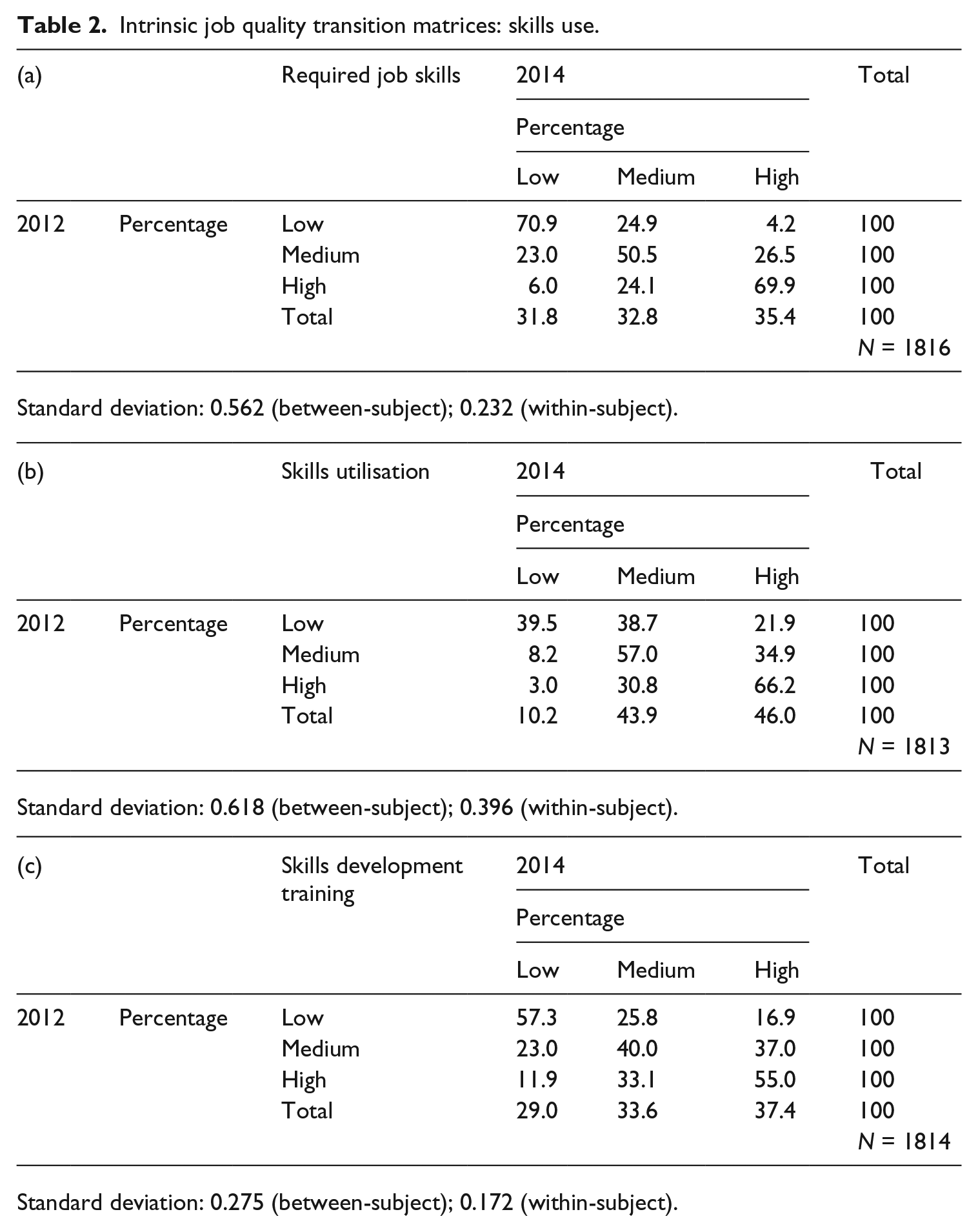
The use of transition matrices also demonstrates the scale of these movements. For two of our skills use measures we use quantile cut-points taken from the index scores for required job skills and skills development training for 2012 and 2014 to produce ‘low’, ‘medium’ and ‘high’ rankings. To ensure that each of the three cells has a reasonable number of observations for our single question indicator, we categorise the two disagree statements as ‘low’, and ‘agree’ and ‘strongly agree’ as ‘medium’ and ‘high’ respectively. Table 2 shows how employees in the panel shifted between these categories. As the leading diagonal demonstrates, most employees remained in the same category between 2012 and 2014. However, movements up and down the rankings were not uncommon. For example, around a quarter of those in jobs demanding ‘medium’ skills in 2012 were in jobs demanding ‘low’ skills in 2014, while a similar proportion moved in the opposite direction. The results also suggest an overall upward movement in effective skills use and skills development training with proportionately more of those in jobs demanding ‘low’ skills in 2012 moving to the ‘high’ skills category in 2014 than vice versa.
Work pressure is the second aspect of intrinsic job quality focused on here. We distinguish two types of effort: that which is discretionary and that which is a requirement of the job. A single survey item is used to indicate the former. Respondents were asked how strongly they agreed or disagreed that they were ‘willing to work harder than I have to in order to help this organisation succeed’. Required work effort, on the other hand, is a composite indicator derived from four separate survey questions on hard work, tension levels, the pace of work and working to tight deadlines. Our third indicator of work pressure is based on respondents’ self-reports of the consequences of work for their physical and mental well-being. While these responses include a subjective assessment, they provide the best available measure in the data.
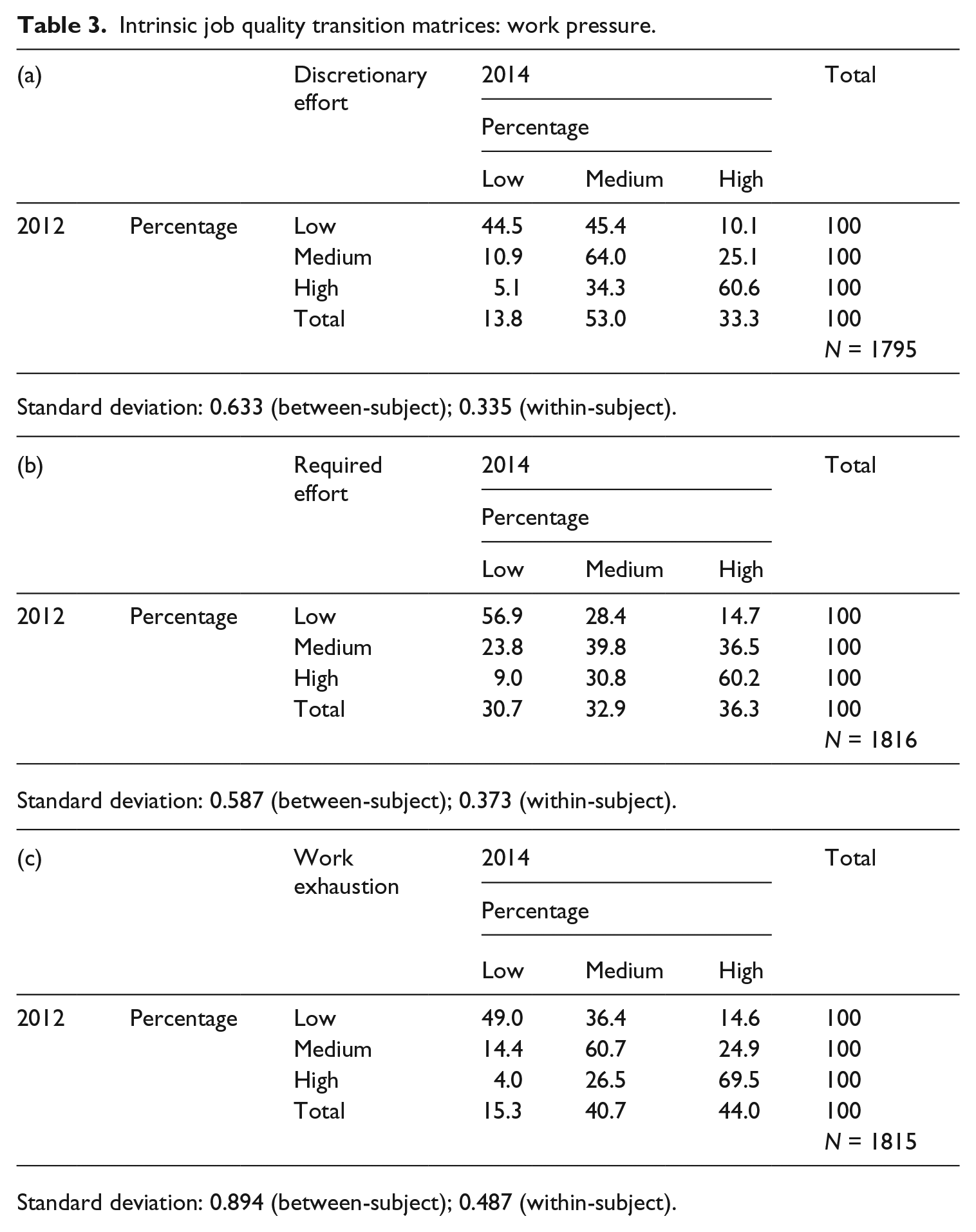
Since we have panel data we can decompose the average values of these three indicators into between-subject and within-subject variation. This analysis shows that the standard deviation of the latter is between half and two-thirds of the former. In other words, work pressure varies – not surprisingly – to a greater extent between employees than it does for an individual employee over a two-year period. Nevertheless, the transition matrices also show that a large minority of individual employees experience upward and downward movement in the pressures under which they work. These matrices are constructed as follows. In the case of discretionary effort, we collapse the four-way agreement scale into three. To ensure, as far as possible, reasonable cell sizes we categorise the two disagree statements as ‘low’, the ‘agree’ statement as ‘medium’ and the ‘strongly agree’ response as ‘high’. For the work exhaustion question, we take ‘hardly ever/never’ to be ‘low’, ‘sometimes’ to be ‘medium’ and ‘always/often’ to be ‘high’ – again, to ensure reasonable cell sizes. Finally, quantile cut-points are used to divide the required effort index for the 2012 and 2014 samples into three. The results show that many employees are positioned on the leading diagonals of Table 3 panels a–c – suggesting little change in the level of pressure under which they work. However, there are sizeable proportions of employees registered in off-diagonal positions which suggests that working life is deteriorating for some while improving for others, with the transitional matrices suggesting a downward bias (note the greater proportion of ‘low’ pressure workers in 2012 moving to ‘high’ pressure positions in 2014 than vice versa). This article examines explanations for these patterns.
Intrinsic job quality transition matrices: work pressure.
One of these explanations focuses on the role played by employee involvement, which is captured in four ways. First, we measure the extent to which employees exercise discretion over the tasks to be done, how they are to be done, to what standards and with what effort. Our second indicator of employee involvement takes data from a question which asks respondents whether they would have a say in decisions taken which might affect their work and if so what level of influence they might have. Thirdly, we construct an employee consultation measure by counting the number of issues over which employees are consulted. Fourthly, respondents were asked whether over the last year they had made one or more suggestions to management ‘about the ways of improving the efficiency with which work is carried out’. However, it must be pointed out that HIM comprises other features, such as performance-related pay, which are not available in the data.
Teamworking is also regarded as a possible trigger for movements in intrinsic job quality. In accordance with the conceptualisation of teams (e.g. Mueller et al., 2000) we categorise teams according to the degree to which they influence how tasks are carried out by team members and how the team is managed (Gallie et al., 2012). The resulting indicator varies according to the level of control teams are able to exercise.
The literature further suggests that the process of replacing human labour with digitally programmable machines (i.e. computerisation) plays an important role in determining the direction and scale of changes to intrinsic job quality. Respondents were asked about the level of workplace computerisation, and the extent and sophistication of their own computer use on the job. Two indicators of computerisation are therefore used in the analysis which follows.
Testing the hypotheses and making an empirical contribution
Skills use
Hypothesis 1 is that greater employee involvement will be associated with an increase in skills use as indicated by a rise in skill levels, a closer match between employees’ skills and those used in the job, and an increase in the provision of skills-enhancing training. Previous research (e.g. Boxall and Macky, 2014; Felstead and Gallie, 2004; Green et al., 2001) based on cross-sectional data supports this hypothesis. However, we go further by tracking how the responses given by the same employees – whose characteristics and attitudes are largely time invariant – change over a two-year period.
The results produced are confirmatory. All four indicators of employee involvement – changes in discretion levels, the extent of consultation, involvement in job changing decisions and the frequency with which employees make suggestions to management – are positively and significantly related to changes in the level of job skills. Thus, a rise in employee involvement induces a rise in skill levels and vice versa. The between-subject coefficients are also, in the main, positive, statistically significant and of similar magnitude to the within-subject coefficients. Taken together, these results suggest that higher levels of employee involvement promote higher job skills and vice versa. Furthermore, unobserved heterogeneity does not appear to bias the cross-sectional results since the coefficients for the within- and between-effects models are of similar magnitude and are not significantly different (columns 1 and 2, Table 4).
Skills use: between effects and within effects results.
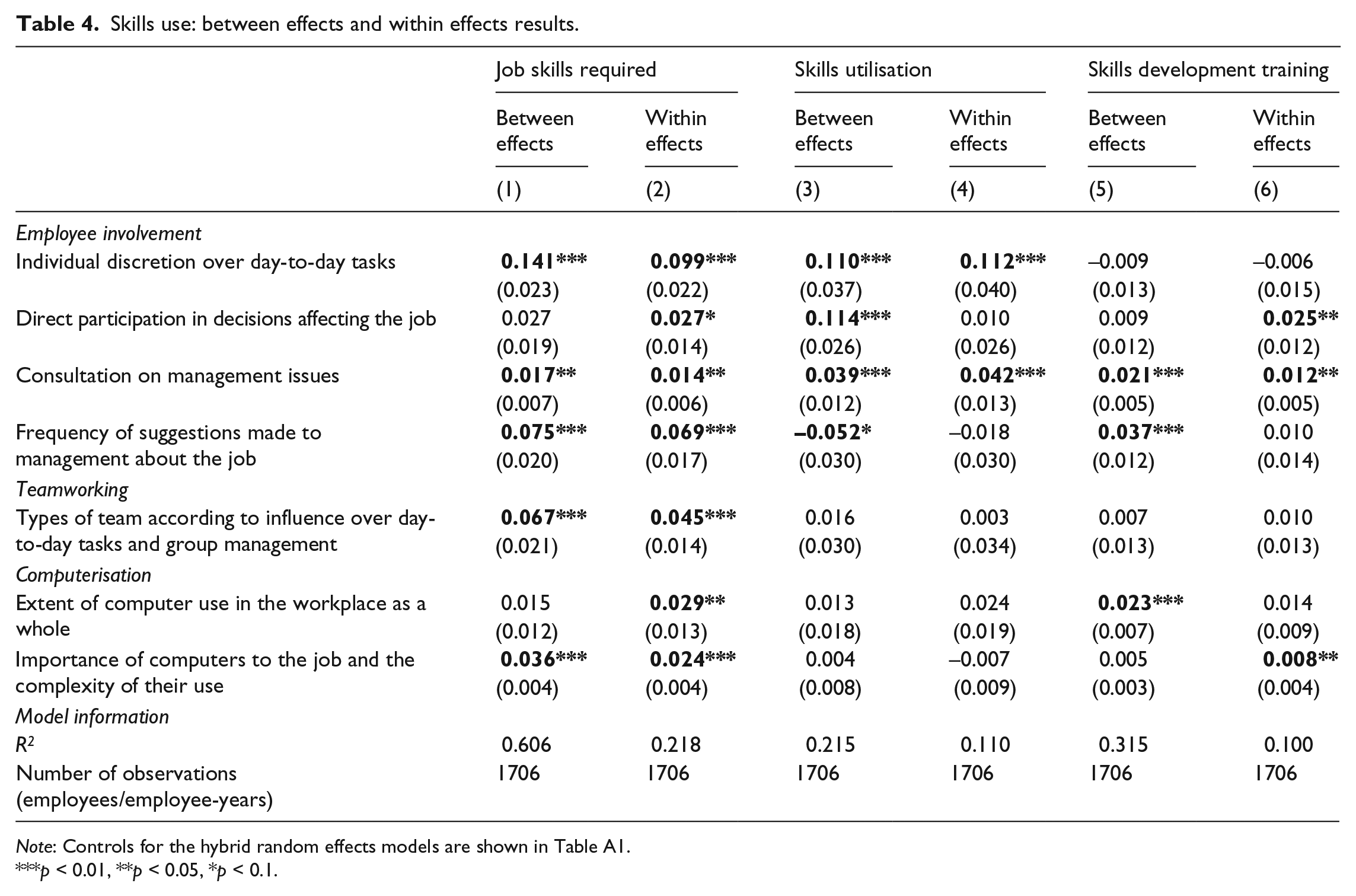
Note: Controls for the hybrid random effects models are shown in Table A1.
p < 0.01, **p < 0.05, *p < 0.1.
The results for effective skills use and skills development training follow a similar pattern. The between-effects coefficients suggest that members of the panel whose involvement levels are, on average, higher report better skills utilisation and better skills development training (columns 3 and 5, Table 4). Furthermore, the within-effects coefficients suggest that an increase (decrease) in employee involvement triggers greater (lesser) skills utilisation and skills development training according to two out of four involvement measures (columns 4 and 6, Table 4). Overall, the within-effects estimates confirm previous estimates from cross-sectional analyses and are not significantly different from the between-effects estimates in the models presented here.
The effect of teamworking is, however, not as strong. While it is has a positive and statistically significant effect on the level of jobs skills required of employees in both the panel estimates, it fails to have an impact on the other two measures of skills demand – skills utilisation and skills development training (columns 1 and 2, Table 3). This suggests that greater use of teamworking induces an increase in job skills and that this pattern is repeated between employees exposed to different levels of teamworking. These findings are in line with advocates of HIM who argue that organising work in this way promotes upskilling as outlined in Hypothesis 4, but better (or worse) skills utilisation and skills development training appear unrelated to team strength.
The results for proponents of skills-biased technological change are, on the other hand, a little stronger. An increase in either computerisation of the job or the workplace triggers a statistically significant rise in job skill requirements, with the between-subject effects similarly positive, if not always significant (columns 1 and 2, Table 4). Greater skills development training, however, is prompted by a rise in computerisation of the job, but a higher level of computerisation between panel members is not associated with better skills training (columns 5 and 6, Table 4). There is, therefore, reasonably strong – but not universal – evidence of skills-biased technological change in the panel data providing confirmation for Hypothesis 6.
Work pressure
The debate around the effect of employee involvement, teamworking and computerisation on the level and change on work pressure has generated much controversy. The crucial issue is whether increased effort levels are discretionary or enforced and whether employees feel more or less exhausted as a result. This is reflected in the hypotheses outlined earlier.
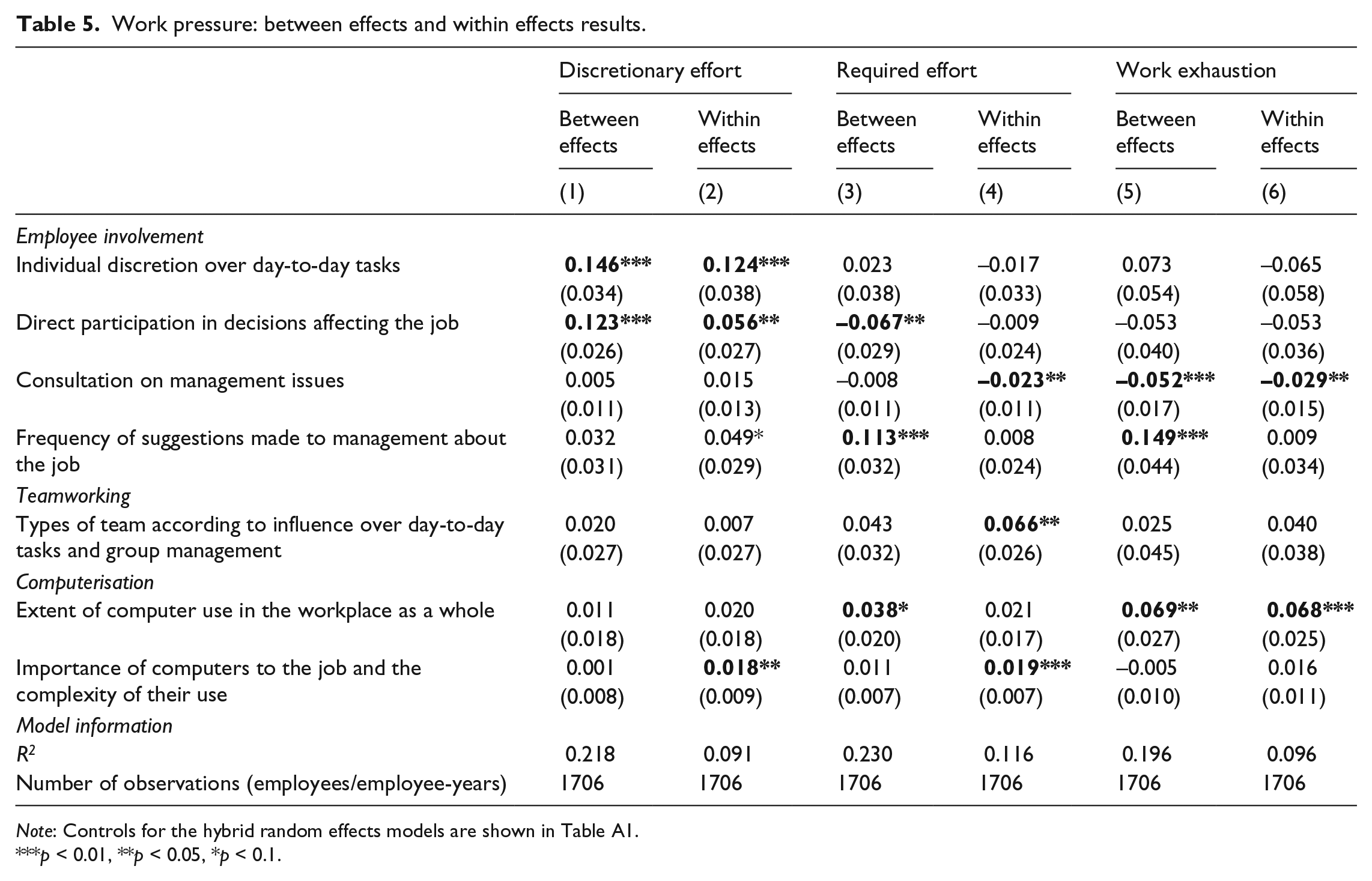
Advocates of HIM claim that some of its performance gains come from a greater willingness of employees to work harder by putting in extra effort beyond what is formally required (Appelbaum et al., 2000: 25–46). The panel data suggest that changes in two of these indicators – discretion over day-to-day tasks and direct involvement in organisational decisions affecting the job – trigger movements up and down in discretionary effort and therefore support Hypothesis 2. Furthermore, within- and between-effects are, again similar, thereby suggesting that an analysis based on a cross-sectional version of the data is prone to minimal bias (columns 1 and 2, Table 5).
Work pressure: between effects and within effects results.
Note: Controls for the hybrid random effects models are shown in Table A1.
p < 0.01, **p < 0.05, *p < 0.1.
The evidence that HIM raises or reduces required effort levels, on the other hand, is not that strong either way. Most of the coefficients in the models are not significant and where they are, they are neither wholly positive nor negative. This is contrary to labour process predictions that HIM will lead to enforced work intensification as outlined in Hypothesis 3.
In fact, we find a little more support for the optimistic HIM position that employee involvement dampens levels of work exhaustion. In the within-subject part of the hybrid model, three out of four of the employee involvement indicators are negatively related to work exhaustion with one being statistically significant (column 6, Table 5). This weakens the pessimistic predictions of labour process theorists that HIM is a means of sweating labour (e.g. Ramsay et al., 2000). Furthermore, a comparison of the two types of estimates suggests that the inability of between-subject models to counter the problem of unobserved heterogeneity may produce biased and therefore misleading results. One interpretation of these results, then, is that HIM prompts different types of effort to move in different directions. Required effort is pushed downwards while discretionary effort is pushed upwards, and with the changing source of pressure reported levels of work exhaustion fall.
Teamworking, too, divides academic opinion. On the one hand, some predict that teamworking enhances employees’ willingness to contribute to the collective effort (Hypothesis 4). On the other hand, there are those who suggest that the horizontal gaze of peers is another means of intensifying work (Hypothesis 5). There is a modicum of support for this position in the data. For example, a rise in the influence teams have over day-to-day tasks and management functions does trigger an increase in required effort (columns 3 and 4, Table 5). However, stronger work teams do not trigger a rise in work exhaustion and so Hypothesis 5 is only partly supported by the evidence.
By contrast, there is less disagreement among theorists on the predicted effects of technology on work intensity, and the findings are consistent with both EBTC and labour process theory. An increase in computerisation of the job is significantly associated with a rise in required work effort, while an increase in the extent of workplace computerisation triggers a rise in work exhaustion (columns 4 and 6, Table 5). These findings support Hypothesis 7. In addition, an increase in the extent of workplace computerisation is also associated with a rise in discretionary effort – in line with the specific and additional prediction of EBTC.
Conclusion
Despite the importance attached to securing ‘better jobs’ by policy-makers, such as the EU and the ILO, survey research has been unable to make definite statements about what factors lead to and cause upward and downward movements in intrinsic job quality. The root of this difficulty is the cross-sectional evidence base on which previous research is based. Statements regarding causality cannot be made using this type of data since unobserved characteristics between respondents may be driving correlations in observed outcomes. However, this article breaks new ground by presenting evidence drawn from a two-wave panel of workers interviewed in 2012 and then again in 2014. By focusing on how the working lives of individual employees change over this period as well as those for whom there is little change, the article largely overcomes this problem. The article, therefore, identifies factors which trigger rises and falls in the level of skills used and developed at work, and the pressures under which that work is carried out, and so provides a causal account of change.
The results of the paper are three-fold. First, while most of employees in the panel experienced little change in the skills they used at work or in the pressure under which they laboured, sizeable minorities experienced a worsening or an improvement in these conditions. In fact, if anything, there was a tendency for skills to improve and work pressure to rise over the two-year period. Were the time period between interviews longer, these changes may have been even more dramatic. Nevertheless, the findings suggest that many employees experience changes in the intrinsic quality of their jobs even over a relatively short period.
Second, the findings point to a number of causal explanations which have been highlighted by the literature. The introduction of HIM, for example, raises and develops the skill levels exercised by employees, but not at the cost of enforced work intensification. Instead, HIM increases employees’ willingness to go the extra mile, while also dampening levels of work exhaustion. The implication here is that employers who tap into workers’ creativity are rewarded with greater effort, elicited not by force but by consent. Moreover, HIM also lessens over-exertion which can lead to ill-health and costs for both workers and employers. However, the impact of increased use of teamworking and computerisation for intrinsic job quality is less clear-cut. While both prompt an upward movement in the abilities needed at work, this comes at the cost of increased enforced work effort. In the case of computerisation, there is evidence that both levels of discretionary effort and work exhaustion are also raised. This suggests that the effect of teamworking and computerisation on skills use and work pressure is two-faced. One interpretation is that to operate in a team and work with more sophisticated equipment requires workers with higher abilities, but both also serve to enhance levels of surveillance by employers and/or fellow workers.
Third, despite justifiable concerns that unobserved heterogeneity may confound the associations found in traditional cross-sectional analyses, our random effects estimates are broadly in line with those from the fixed effects models. This provides some reassurance that existing cross-sectional analyses may not be as suspect as feared. However, replication of this study will be needed to provide further confirmation.
Such future research will also need to address some of the current study’s drawbacks. The measures of intrinsic job quality are, for example, limited. Despite the multi-faceted nature of the concept, this article only examines skills use and work pressure, and does not cover issues such as the scheduling and location of work which are central to the work–life balance debate. Similarly, the article operationalises HIM using a limited set of indicators. In addition, improvements could be made to the design of similar panel studies in the future. This would include lengthening the gap between panel interviews and re-interviewing panellists on multiple occasions.
Despite these drawbacks the results underline the economic case for getting individual employees more involved in decisions about their jobs and the wider functioning of the organisation. They support the interest taken by policy-makers in the promotion and support of HIM (Belt and Giles, 2009). The results also reinforce the policy recommendation that direct intervention is needed to enhance employee voice. The 2002 EU Information and Consultation of Employees (ICE) directive, for example, was weakly translated into UK law, hence many of the original directive’s features were diluted (Dundon et al., 2014; Felstead et al., 2015a). The findings presented here suggest that an economic case can be made for greater employee involvement and that on this basis UK law needs strengthening. In addition, the results provide further evidence to employers of the business benefits of increasing employee involvement given that it elicits more from employees (Preenen et al., 2015). However, teamworking and computerisation need to be introduced with a view to mitigating some of the negative consequences. In particular, the intensifying aspects of both developments need to be tamed if their overall impact on intrinsic job quality is to be beneficial to both employees and employers.
Footnotes
Appendix
Measures, survey questions, response scales and calibration.
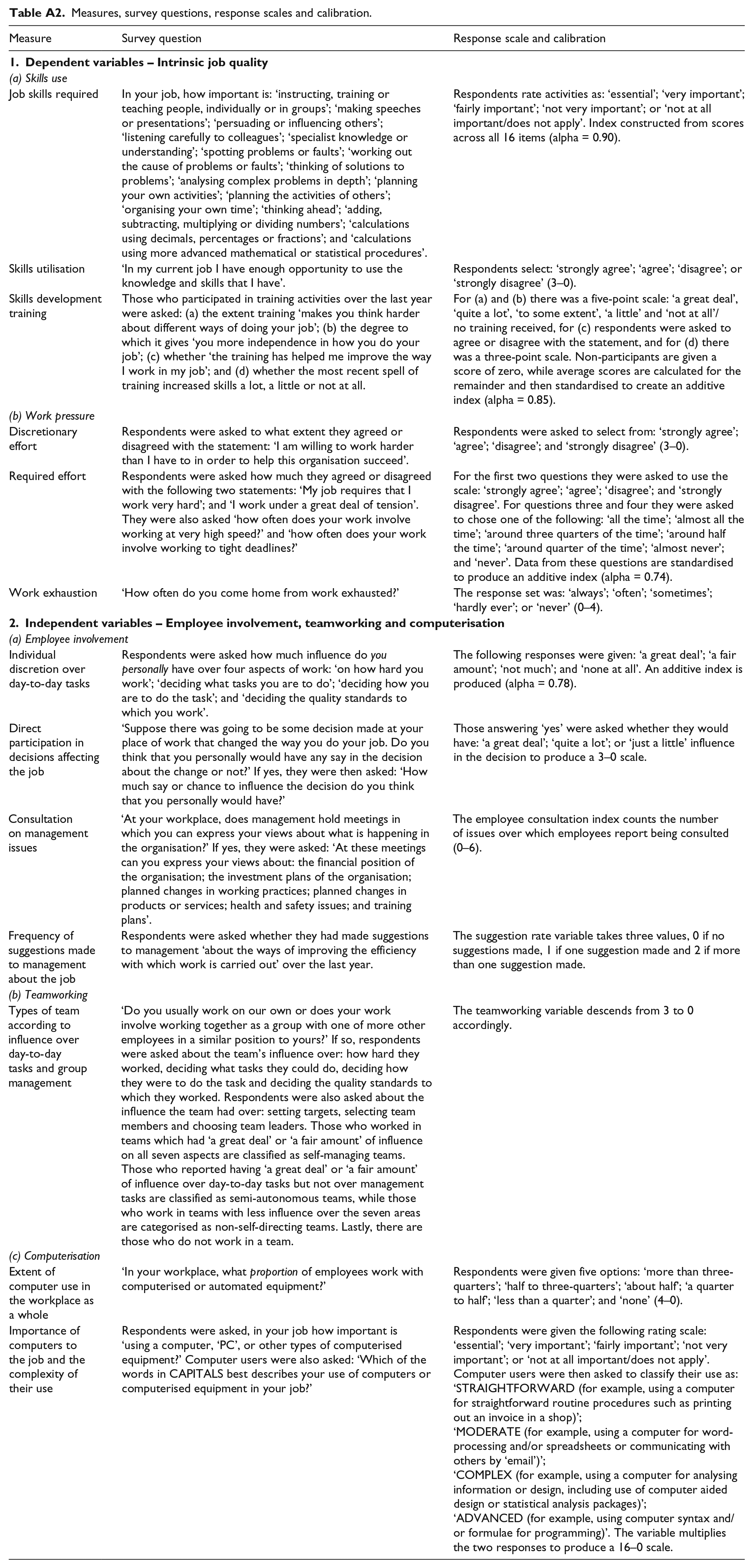
| Measure | Survey question | Response scale and calibration |
|---|---|---|
|
|
||
| (a) Skills use | ||
| Job skills required | In your job, how important is: ‘instructing, training or teaching people, individually or in groups’; ‘making speeches or presentations’; ‘persuading or influencing others’; ‘listening carefully to colleagues’; ‘specialist knowledge or understanding’; ‘spotting problems or faults’; ‘working out the cause of problems or faults’; ‘thinking of solutions to problems’; ‘analysing complex problems in depth’; ‘planning your own activities’; ‘planning the activities of others’; ‘organising your own time’; ‘thinking ahead’; ‘adding, subtracting, multiplying or dividing numbers’; ‘calculations using decimals, percentages or fractions’; and ‘calculations using more advanced mathematical or statistical procedures’. | Respondents rate activities as: ‘essential’; ‘very important’; ‘fairly important’; ‘not very important’; or ‘not at all important/does not apply’. Index constructed from scores across all 16 items (alpha = 0.90). |
| Skills utilisation | ‘In my current job I have enough opportunity to use the knowledge and skills that I have’. | Respondents select: ‘strongly agree’; ‘agree’; ‘disagree’; or ‘strongly disagree’ (3–0). |
| Skills development training | Those who participated in training activities over the last year were asked: (a) the extent training ‘makes you think harder about different ways of doing your job’; (b) the degree to which it gives ‘you more independence in how you do your job’; (c) whether ‘the training has helped me improve the way I work in my job’; and (d) whether the most recent spell of training increased skills a lot, a little or not at all. | For (a) and (b) there was a five-point scale: ‘a great deal’, ‘quite a lot’, ‘to some extent’, ‘a little’ and ‘not at all’/no training received, for (c) respondents were asked to agree or disagree with the statement, and for (d) there was a three-point scale. Non-participants are given a score of zero, while average scores are calculated for the remainder and then standardised to create an additive index (alpha = 0.85). |
| (b) Work pressure | ||
| Discretionary effort | Respondents were asked to what extent they agreed or disagreed with the statement: ‘I am willing to work harder than I have to in order to help this organisation succeed’. | Respondents were asked to select from: ‘strongly agree’; ‘agree’; ‘disagree’; and ‘strongly disagree’ (3–0). |
| Required effort | Respondents were asked how much they agreed or disagreed with the following two statements: ‘My job requires that I work very hard’; and ‘I work under a great deal of tension’. They were also asked ‘how often does your work involve working at very high speed?’ and ‘how often does your work involve working to tight deadlines?’ | For the first two questions they were asked to use the scale: ‘strongly agree’; ‘agree’; ‘disagree’; and ‘strongly disagree’. For questions three and four they were asked to chose one of the following: ‘all the time’; ‘almost all the time’; ‘around three quarters of the time’; ‘around half the time’; ‘around quarter of the time’; ‘almost never’; and ‘never’. Data from these questions are standardised to produce an additive index (alpha = 0.74). |
| Work exhaustion | ‘How often do you come home from work exhausted?’ | The response set was: ‘always’; ‘often’; ‘sometimes’; ‘hardly ever’; or ‘never’ (0–4). |
|
|
||
| (a) Employee involvement | ||
| Individual discretion over day-to-day tasks | Respondents were asked how much influence do you personally have over four aspects of work: ‘on how hard you work’; ‘deciding what tasks you are to do’; ‘deciding how you are to do the task’; and ‘deciding the quality standards to which you work’. | The following responses were given: ‘a great deal’; ‘a fair amount’; ‘not much’; and ‘none at all’. An additive index is produced (alpha = 0.78). |
| Direct participation in decisions affecting the job | ‘Suppose there was going to be some decision made at your place of work that changed the way you do your job. Do you think that you personally would have any say in the decision about the change or not?’ If yes, they were then asked: ‘How much say or chance to influence the decision do you think that you personally would have?’ | Those answering ‘yes’ were asked whether they would have: ‘a great deal’; ‘quite a lot’; or ‘just a little’ influence in the decision to produce a 3–0 scale. |
| (Continued) | ||
| Consultation on management issues | ‘At your workplace, does management hold meetings in which you can express your views about what is happening in the organisation?’ If yes, they were asked: ‘At these meetings can you express your views about: the financial position of the organisation; the investment plans of the organisation; planned changes in working practices; planned changes in products or services; health and safety issues; and training plans’. | The employee consultation index counts the number of issues over which employees report being consulted (0–6). |
| Frequency of suggestions made to management about the job | Respondents were asked whether they had made suggestions to management ‘about the ways of improving the efficiency with which work is carried out’ over the last year. | The suggestion rate variable takes three values, 0 if no suggestions made, 1 if one suggestion made and 2 if more than one suggestion made. |
| (b) Teamworking | ||
| Types of team according to influence over day-to-day tasks and group management | ‘Do you usually work on our own or does your work involve working together as a group with one of more other employees in a similar position to yours?’ If so, respondents were asked about the team’s influence over: how hard they worked, deciding what tasks they could do, deciding how they were to do the task and deciding the quality standards to which they worked. Respondents were also asked about the influence the team had over: setting targets, selecting team members and choosing team leaders. Those who worked in teams which had ‘a great deal’ or ‘a fair amount’ of influence on all seven aspects are classified as self-managing teams. Those who reported having ‘a great deal’ or ‘a fair amount’ of influence over day-to-day tasks but not over management tasks are classified as semi-autonomous teams, while those who work in teams with less influence over the seven areas are categorised as non-self-directing teams. Lastly, there are those who do not work in a team. | The teamworking variable descends from 3 to 0 accordingly. |
| (c) Computerisation | ||
| Extent of computer use in the workplace as a whole | ‘In your workplace, what proportion of employees work with computerised or automated equipment?’ | Respondents were given five options: ‘more than three-quarters’; ‘half to three-quarters’; ‘about half’; ‘a quarter to half’; ‘less than a quarter’; and ‘none’ (4–0). |
| Importance of computers to the job and the complexity of their use | Respondents were asked, in your job how important is ‘using a computer, ‘PC’, or other types of computerised equipment?’ Computer users were also asked: ‘Which of the words in CAPITALS best describes your use of computers or computerised equipment in your job?’ | Respondents were given the following rating scale: ‘essential’; ‘very important’; ‘fairly important’; ‘not very important’; or ‘not at all important/does not apply’. Computer users were then asked to classify their use as: ‘STRAIGHTFORWARD (for example, using a computer for straightforward routine procedures such as printing out an invoice in a shop)’; ‘MODERATE (for example, using a computer for word-processing and/or spreadsheets or communicating with others by ‘email’)’; ‘COMPLEX (for example, using a computer for analysing information or design, including use of computer aided design or statistical analysis packages)’; ‘ADVANCED (for example, using computer syntax and/or formulae for programming)’. The variable multiplies the two responses to produce a 16–0 scale. |
Acknowledgements
We are grateful to the referees for their swift and constructive comments on earlier drafts of this article.
Declaration of Conflicting Interests
The author(s) declared no potential conflicts of interest with respect to the research, authorship, and/or publication of this article.
Funding
The authors disclosed receipt of the following financial support for the research, authorship, and/or publication of this article: The Skills and Employment Survey 2012 was funded by the ESRC/UKCES Strategic Partnership (RES-241-25-0001), with additional support from the Wales Institute of Social and Economic Research, Data and Methods. The 2014 follow-up survey was also funded by the ESRC/UKCES Strategic Partnership (ES/I03792X/1).