




Abstract
The transposition of the 2002/14/EC Directive, establishing a general framework for information and consultation (I&C), has proven contentious in largely voluntarist systems of employment regulation. Receiving particular criticism is the employee ‘opt-in’ mechanism as a means to access I&C rights. For non-union employees in particular, the ability and potential to negotiate rights for I&C is widely seen to be problematic. This article uniquely examines the opt-in mechanism in the context of non-unionism, considering how non-union employers respond to non-union employees invoking their legislative rights to I&C. Drawing upon a case study conducted over four years in a large non-union multinational, the evidence shows how the opt-in and negotiation process function to the advantage of the employer rather than the intended regulatory impact to advance employee rights.
Introduction
Upon its introduction the 2002/14/EC Directive, 1 establishing a general framework for informing and consulting (I&C) employees, was perceived as potentially significant for the UK and Ireland given both countries’ absence of statutory consultation traditions (Keller, 2003). Yet when transposed in the predominately voluntarist employment relations systems of the UK and Ireland, the national regulations for I&C constituted a flexible interpretation of the European-wide Directive (Hall, 2010; Koukiadaki, 2010). Employers need not act unless 10% of their employees ‘opt-in’ to statutory procedures leading to a process of negotiated I&C agreements. Only where the regulations’ procedures are opted-in, but no agreement is reached after a specified period of negotiation, do statutory I&C provisions become enforceable and then only for workers in firms above a 50 employee threshold.
Commentary on the regulations in the UK and Ireland has pointed to the opt-in mechanism as diluting the impact of the European Directive (Ales, 2009; Ewing and Truter, 2005). Previews of the opt-in mechanism in both countries proposed that outside of trade union strongholds, employees in non-union firms would be unaware of I&C rights and the regulations would be planted into unfertile soil. Even for non-union employees who were aware of the regulations, it was maintained that few would risk opting-in for fear of employer reprisal (Dundon et al., 2006). It was suggested that where employees opted-in, they might face the hurdle of employer opposition and would have to fight to secure an I&C agreement: a sizeable task for non-union employees lacking access to independent representation (Koukiadaki, 2009; Wilkinson et al., 2007). The transposed regulations were therefore seen as a missed opportunity to align employee voice in both Ireland and the UK with continental European traditions, as well as close the ‘representation gap’ in the face of declining unionised voice (Gollan and Wilkinson, 2007; Hall, 2006).
There is little knowledge of employee opt-ins under the regulations in the UK and Ireland, transposed in 2004 and 2006 respectively. As such, there are only a small number of cases registered at the Central Arbitration Committee (CAC) in the UK and the Labour Court 2 in Ireland and these are not strictly opt-in cases, but rather employee-initiated disputes regarding the operation of existing agreements. However evidence on non-unionised workers actively seeking to opt-in and negotiate their rights to I&C, and how non-union employers might respond to such initiatives, is notably lacking. There is a knowledge gap in terms of how central features of I&C regulations function in this context. This article therefore addresses the unanswered, yet pertinent, question, how do non-union employers respond to non-union employees invoking their legislative rights to I&C? In itself the pursuit of such a question poses the challenge of sourcing an identifiable population of non-union employee opt-ins and negotiations. The methodology relies upon the identification of, and access to, a case study of an employer response to a non-union employee opt-in under the regulations. The case study is specifically an opt-in under the Irish transposition of the Directive, the Employee (Provision of Information and Consultation) Act 2006 (EPICA 2006). While a case specific to EPICA 2006 limits the transferability of findings to a consideration of the UK Information and Consultation of Employee Regulations 2004 (ICER 2004), there are fundamental similarities in design. Both provide for the employee-led opt-in and both require voluntary negotiations with the fall-back position of the ‘Standard Rules’. Both, as noted, are also situated in a predominately voluntarist employment relations context. The workplace processes of a non-union opt-in, even under the specifics of EPICA 2006, should therefore hold interest to scholarship concerned with similar trajectories under ICER 2004. At a wider level the study is also relevant to a consideration of how the I&C Directive has been transposed in different European contexts and because it offers contemporary insights into how non-union employees collectively attempt to use the law to advance their interests. It is therefore of interest to a general readership in evaluating whether the law acts as an effective substitute for enforcing worker rights in the absence of trade unionism.
The structure of this article is as follows: in the next section the article reviews the I&C employee opt-in mechanism, with emphasis on how employers might respond where it is pursued in a non-union context. A description of the research approach and the suitability of the case study to address the research question follows in the third section. The article presents the findings in the fourth section. The final section offers a discussion of the findings, pointing to how the opt-in mechanism functioned to the advantage of the employer rather than the intended regulatory impact to enable employee rights.
Literature review
The I&C Directive, when first introduced, was regarded as entailing substantial implications for the predominately voluntarist economies of the UK and Ireland (Sisson, 2002). Although provided for in the context of collective redundancies and transfers of undertakings, general rights to I&C had not been regulated by law in either country. ICER 2004 in the UK and EPICA 2006 in Ireland established, in firms with at least 50 employees, a statutory framework providing employee access to I&C rights. 3 The regulations are broadly similar in providing routes to establishing I&C agreements (see Table 1). First, 10% of employees can ask for negotiations to introduce I&C arrangements, the ‘opt-in’ mechanism (ICER 2004, Regulation 7; EPICA 2006, Section 7). Second, employers can start negotiations at their own initiative (ICER 2004, Regulation 14; EPICA 2006, Section 7). Third, where an employer fails to respond to a valid request for negotiations to introduce I&C arrangements or where negotiations fail to result in an agreement within six months of an initial request (with no agreement to extend negotiations), the default Standard Rules apply. This provides for an elected representative I&C forum prescribing the remit over which I&C is conducted (ICER 2004, Regulations 18–20; EPICA 2006, Section 10). 4
The ICE regulations transposed in Ireland and UK: an outline.
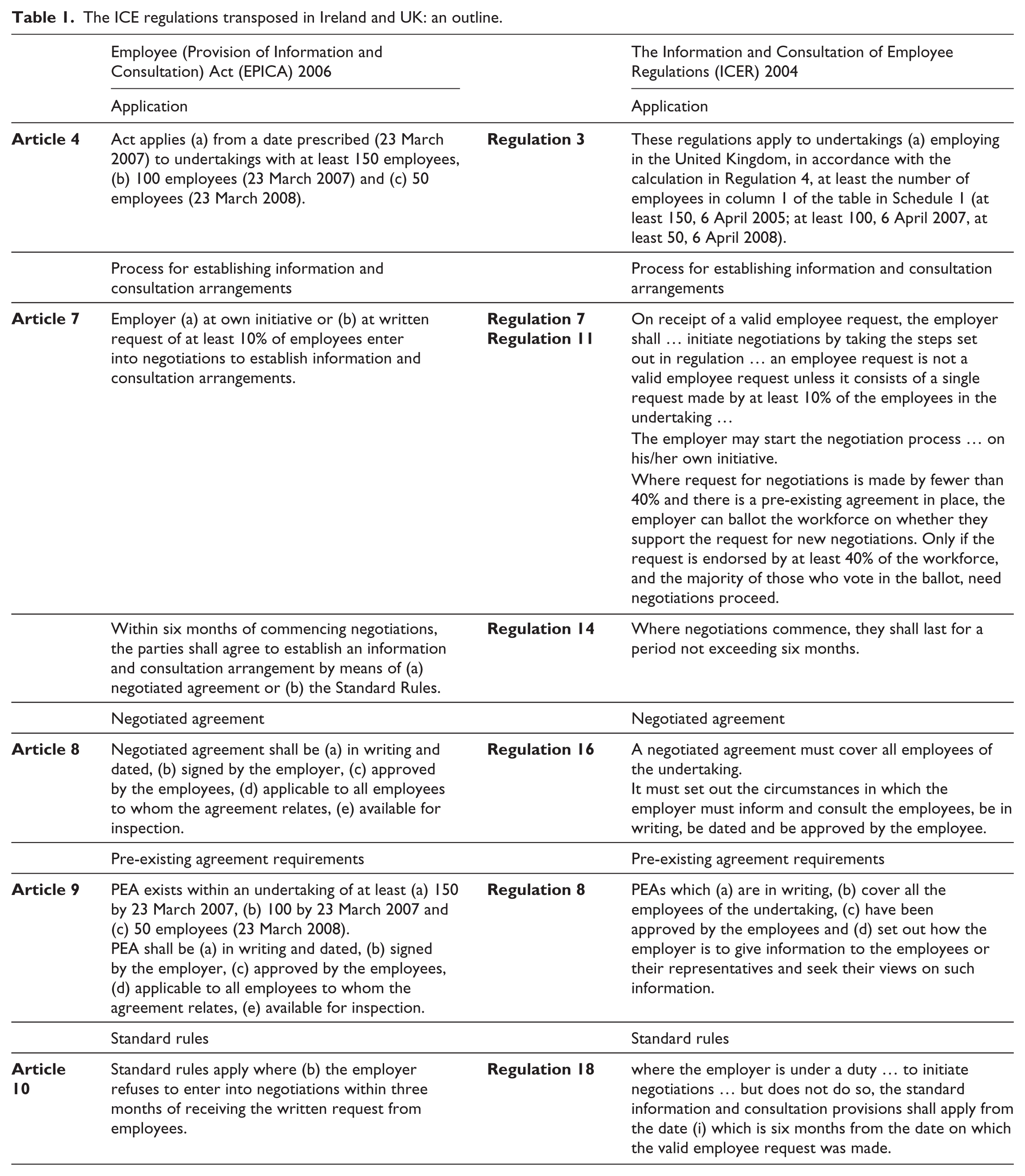
Both regulations provide for Pre-Existing Agreements (PEAs), enabling I&C arrangements to be formed voluntarily outside the statutory framework (ICER 2004, Regulations 8 and 9; EPICA 2006, Section 9). Some variation exists across jurisdictions in this regard. In the UK, no ‘cut-off point’ exists for employers to conclude PEAs, whereas in Ireland, PEAs had to be concluded no later than March 2008 on a phased basis contingent on firm size. In the UK, if a valid request is made by fewer than 40% of employees where a PEA exists, the employer may hold a ballot to ascertain employee endorsement of the request (ICER, Regulation 8). In Ireland, an employee request is null and void if a legitimate PEA is in place prior to the specified time lines (EPICA, Section 9). In both jurisdictions, the regulations do not proscribe an employer from introducing I&C arrangements unilaterally without workforce agreement. However such arrangements cannot prevent 10% of employees later opting to trigger negotiations for new I&C provisions.
Importantly, commentators propose that, in a context of non-unionism, the scope for employer unilateralism in relation to the regulations is high (Gollan, 2006). Empirical research illustrates that while in some cases there is a catalyst for employers to introduce (or revise existing) I&C arrangements, the legal framework is largely peripheral in practice (Hall et al., 2013). Employers are typically the dominant player and the managerial agenda determines the nature of I&C arrangements. In particular, Hall et al. (2013) found that employers tend to determine whether I&C is, in practice, active consultation or largely limited to downward communication.
Given the dominant role employers play in shaping a firm’s I&C arrangements generally, the requirement for employees to opt-in is a recurrent criticism of the Directive’s transposition in the UK and Ireland (Dundon et al., 2006; Ewing and Truter, 2005; Hall, 2005). It is proposed that as far as undertakings with no union presence, the 10% threshold of workforce support to opt-in is a difficult standard to meet in practice (Hall, 2005). The minimum number of signatures is 15, so in undertakings with fewer than 150 employees, the threshold exceeds 10%. Hall and Terry (2004) and Ewing and Truter (2005) consider the likelihood and extent of employees opting-in to I&C arrangements limited due to low awareness or inadequate understanding of rights, especially in smaller undertakings and those with no tradition of representation. Some scholars speculate that it might prove difficult to find employees prepared, or able, to take the lead in mobilising I&C requests, particularly in the face of employer hostility (Dundon et al., 2006). A lack of interest in I&C on the part of employees is also seen as a possibility, undermining attempts to opt-in (Hall, 2005). In the absence of independent support, mistakes in opt-in requests are probable due to a lack of employee understanding around threshold levels or other flaws in the application (Ewing and Truter, 2005: 630). A regulatory technicality may also undermine employees’ ability to secure gains via the opt-in clause as where errors occur, around failure to meet threshold levels for example, future applications to trigger the regulations are ruled out for two (Ireland) or three years (UK) (ICER 2004, Regulation 12; EPICA 2006, Section 7).
That errors might afflict attempts to utilise the regulations has been substantiated from cases registered at the CAC and Irish Labour Court, where several mistakes have been made by applicants (cf. in the UK, Archibald/Gardner Denver, IC/23/2009; Rodriguez/Ocado Limited, IC/24/2009; Selormey/Electronic Data Systems Ltd, IC/21/2008; UK Pye/Partnerships in Care Limited, IC/11/2007; and in Ireland, Lionbridge Technologies/A Worker, ICC/13/3). In cases which appear to be led by non-union workers, the ‘success’ rate is quite low: the claim is found by the CAC to be without merit (Demming/Coin Street Community Builders, IC/41/2012; Wincanton Container Logistics, IC/39/2011) or not relevant for a hearing under the regulations (Archibald/Gardner Denver Limited, IC/23/2009). In contrast, there is no evidence on cases where non-union employees successfully opt-in to invoke their legislative rights to I&C arrangements or on how employers respond to such occurrences. Yet this aside, assuaging the deficit is the existing literature on non-union employment relations. This offers insights into plausible trajectories in employer responses to non-union workers’ efforts at initiating new structures for voice. As such, three strands can be identified.
The first proposes that in the absence of independent resources, non-union employees find it difficult to influence organisational voice. As a result, they are vulnerable to what might be termed the ‘manipulative unilateralism’ of employers. Support for this position can be variously found in the literature examining non-unionised workers’ attempts to organise into unions (Bacon, 1999; Gall, 2004), participate in German works councils (Royle, 1999) and non-union employee representation (Gollan, 2007). Workers attempting to insert a measure of bilateralism into the non-union firm’s voice arrangements can fall victim to intimidation and suppression where employer hostility is present. While the regulations in both jurisdictions provide protection against victimisation for representatives (EICR 2004, Part VIII; EPICA 2006, Section 13), EPICA 2006 is silent on protection for the employees who seek to trigger negotiations, whereas, in contrast, these employees are protected under ICER 2004, Regulation 32(5). Requests for I&C might also be simply ‘bought off’ by improved terms and conditions (Roy, 1980). Aside from efforts to trigger I&C arrangements, the negotiation itself might be problematic as employers manipulate process and outcomes to preserve their prerogatives. The tactic of ‘bargaining [workers] to death’ (Roy, 1980: 414) in the form of ‘bad faith’ negotiation may be pursued, obstructing the signing of an agreement. Non-union employees may encounter ‘employer stonewalling’, where employers claim ostensibly legitimate obstacles by challenging the validity of the employee opt-in, or, for example, calling for ballots (Gall, 2004). Butler (2005) has maintained that in negotiating I&C arrangements, non-union employees may not be experienced enough to engage in the relevant issues. This is particularly likely where employees are confronted with a coterie of human resource specialists. Notably the regulations in both jurisdictions are silent on financial resources or specific rights to training for those engaged in negotiations. Nor do the regulations allow for external expert assistance when the original I&C arrangements are negotiated. Thus negotiated arrangements that are employer-driven or purely symbolic are likely (Gilman and Marginson, 2002).
A second strand within the literature on non-union voice suggests a trajectory of what might be termed ‘calculative bilateralism’ in relations between employer and employee. Non-union employees may find their request for I&C arrangements pragmatically, if reluctantly, conceded should the employer be concerned with staving off further unrest from the employee body or seek compliance with the regulatory requirements. Kaufman and Taras (2010) and Gollan (2010) identify such a possibility. This argument suggests that when employees seek the introduction of voice structures, they have expectations that they will be consulted and have influence. This expectation creates a form of leverage for non-union workers, since if the company reneges then morale may plummet and the risk of unionisation rises. The employer has to consider that to obstruct a request for voice carries a cost of jeopardising employee cooperation. To foster cooperation, the employer must ensure that employees see some ‘wins’ on their side. If not, the employer risks a widening ‘expectations–achievement gap’ creating employee frustration, erosion of trust and even bigger ‘losses’ for the employer in the future (Taras and Copping, 1998). In the context of I&C regulations, an employer may wish to enter into negotiations with employees who have opted-in thus minimising the risk of third-party intervention in the firm’s employment relations. Or the employer may reluctantly enter negotiations with the goal of ‘damage limitation’, cooperating with the request for negotiations so as to avoid the imposition of the default Standard Rules from a failure to negotiate.
While non-union employees can secure the introduction of I&C arrangements on the back of compromises associated with calculative exchanges, a third strand of literature points to where the employer is disposed to an I&C request. This might be where an employer seeks, what could be termed, sophisticated bilateralism in their relations with employees. That is, non-union employees seeking to opt-in will find a hospitable environment where their employer is disposed to being an ‘active consulter’ (Hall et al., 2013) and is willing to use the opportunity to proactively create arrangements that enable employee involvement. Employers will actively collaborate with an employee request to negotiate an I&C agreement as such arrangements align with a managerial desire to improve organisational performance by fostering greater commitment and unity of interest. In a study of I&C arrangements, Koukiadaki (2010) found such potential where both parties engaged meaningfully to integrate employee interests in decision-making. While one might expect employers of this type to pre-empt the necessity for such voice mechanisms, thereby negating the necessity of an opt-in request in the first instance, it may occur where employees request a shift from direct involvement schemes to more representative voice arrangements, as the regulations in both jurisdictions allow.
In aggregate, the literature on non-union voice is suggestive of variability in the trajectories that might characterise an employer response to an opt-in and negotiation attempt under the I&C regulations. The three trajectories noted above are purely ideal: overlap is likely in practice. While the trajectories identify some ways in which the regulations might influence workplace-level attempts to negotiate I&C agreements, they must be regarded, in the absence of evidence, as speculative and uncertain. For instance, it could be supposed that the regulations have little substantive influence apart from prompting the parties towards negotiations in light of a valid opt-in. In this context, employers may feel confident that the scope for voluntary agreements offers opportunities to act unilaterally. On the other hand, the employer may be fully aware of bargaining under the shadow of the law, be conscious of possible sanctions that might occur where voluntary arrangements fail and thus be encouraged towards bilateral solutions. In light of this uncertainty, the research seeks to determine, how do employers respond to non-union employees invoking their rights to I&C?
Research method
Seeking to empirically study an opt-in is challenging as an identifiable population is not strictly available. While the aforementioned CAC and Irish Labour Court databases provide a list of disputes in each jurisdiction, these are not necessarily instances of non-union opt-ins and negotiations. In the UK, of the 16 undertakings where I&C disputes are recorded, 10 are either union-organised or occurred in the context of already unionised firms. The remaining six are uncertain regarding union status, but might reasonably be assumed to be non-union as they were led by named individuals (rather than union representatives) and the reports give no account of union involvement. Yet five of these cases were considered invalid applications by the CAC and one was a dispute over the functioning of a valid PEA. In Ireland, of the six undertakings where I&C disputes were registered at the Labour Court, two were union-organised, one was a non-union dispute over the functioning of a PEA and three, which appear to be non-union, were considered invalid applications and dismissed by the Court.
In the difficulty of accessing a sample of a valid opt-in, the strategy was to rely on a convenience sample, identifying a known instance of non-union employees making a valid request and seeking to negotiate I&C arrangements in a non-union firm (the details of how the case was identified are below). While there are limitations to relying on a single case, the intention was to provide an illustrative example of an understudied dynamic; albeit mindful of case-specific variance potentially affecting observed processes and outcomes. The case study, as noted above, is an opt-in under the Irish transposition of the Directive, EPICA 2006.
The case
The case is based in a non-union firm, anonymised as CompanyA, a US-owned manufacturer. A profitable company, operating in an oligopolistic market, it has over 70 sites across five continents, employing 25,000 people. The company has three sites in Ireland employing over 4000. The focus of the study is its largest plant facility employing close to 3000, which is also CompanyA’s largest manufacturing site in its global plant network. It has a large, well-resourced personnel department, which has received awards from professional accreditors for its people-management practices. The work at the facility is mainly assembly line work.
CompanyA was first identified in 2008 through a larger research project concerned with potential responses to the I&C Directive. Access was not forthcoming from the employer however. Several months later, in the summer of 2009, the same organisation was reported in a media source as subject to an opt-in request. Follow-up contact was made with both the employer and the employee activists, of which there was a loose coalition of 14 at the campaign’s peak, involved in requesting I&C negotiations. The employer proved unwilling to participate. However the employees in question provided access to documents pertaining to the case and participated in meetings with the researchers.
Information sources: Documentary analysis
The documentary sources include: internal emails from the activists, employer emails to the employee body, intranet employer postings on the matter of I&C to the employee body, employer–activist written exchanges, minutes from employer–activist meetings and third-party communication with both employer and activists from state agencies. In total, 50 pieces of documentation of this sort were available. An exemplar of documentation is provided in Figure 1.
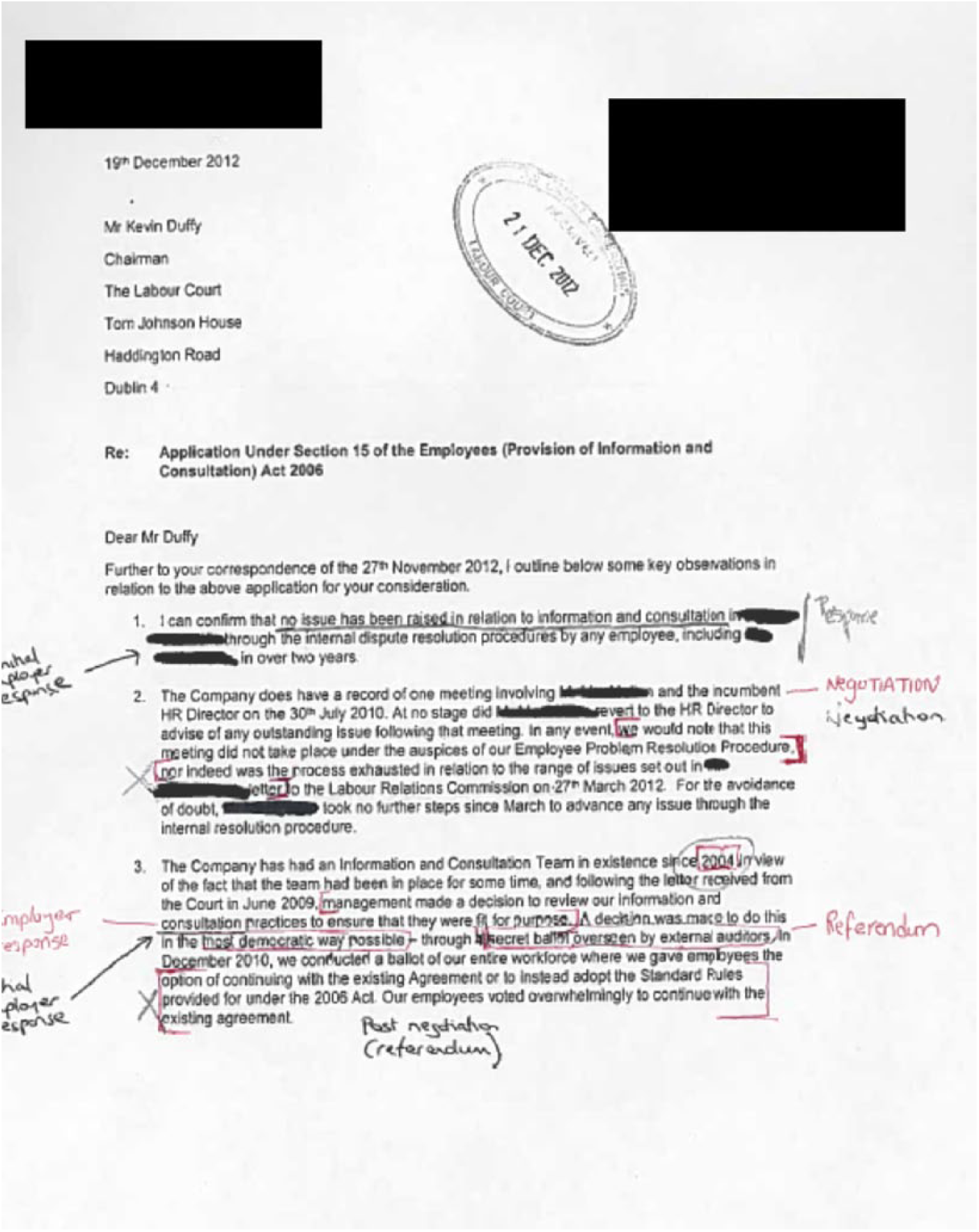
Exhibit 1: Document example: Employer correspondence with third-party body.
In using documentation to build a case study, Scott’s (1990: 6) criteria of authenticity, credibility and representativeness are used. These criteria are important given that the activists were the exclusive gatekeepers to the documents. In supporting authenticity, the researchers wers given access to original documents, enabling confirmation of the document source, e.g. employer documents with company watermark and third-party communications with signed and dated official stamps. Access to employer correspondence with the wider employee body, the employee activists and state dispute resolution bodies did provide, in the absence of direct employer access, some ‘employer voice’ on the case and supported a more balanced depiction of different viewpoints. We were able to sufficiently construct the employer arguments put forward at various points over the course of the opt-in dynamic (Exhibit 1 in Figure 1 is an example of employer documentation arguing the company’s position at one point in the case). While documents written by the employer and activists cannot be regarded as free from distortion, they can provide credible insights into the opt-in process. Collated, the available documents offer a representative and accurate picture of the opt-in process at CompanyA. While pertinent documents could have been withheld by the activists to portray their campaign favourably, no obvious gaps emerged in the analysis suggesting this to be so.
The analysis of documents followed a pattern of qualitative content analysis (Altheide, 1996). Documents were organised into an identifiable time sequence, using specified dates provided in letters, emails and meetings. Predefined thematic codes, derived from expectations around the prescribed legislative process, guided the analysis of this timeline. The predefined codes stemmed from what were expected to be important features of an opt-in request. These were (1) the organisation of the opt-in request, (2) the nature of the employer response to the opt-in request, (3) the nature of the negotiations that ensued, (4) the intervention (if any) of third-party supports and (5) identifiable outcomes of the process. This analysis followed Altheide’s (1996: 16) recommendation to have initial categories guide the examination, while being mindful that others could emerge in the analysis phase. The thematic predefined codes provided useful foci for interrogating the documentation and are largely retained below alongside case-specific themes that emerged from the analysis. Thematic analysis of documents was undertaken by three members of the research team to mitigate inaccuracies in interpretation of material.
Information sources: Interviews
Between 2009 and 2012, over 20 hours of unstructured meetings with the activists were conducted, as well as additional follow-up exchanges through telephone and email. There was a loose coalition of 14 activists at the campaign’s peak, and varying numbers of the 14 participated at various ad-hoc meetings, in telephone calls and in emails with the researchers. The activists were exclusively male, early to mid-twenties, with between three and five years’ work experience in the company. All were shift-work assembly line operatives. None had experience of union membership. Most of the contact was activist initiated and meetings were therefore often unplanned, spontaneous and unstructured. These meetings focused on how the campaign to opt-in and negotiate I&C arrangements was developing from an employee perspective. These were carried out by one researcher. Recognising the partiality of such information has meant that in the absence of employer participation, and to minimise biases that might arise from relying on activists’ primary accounts, only evidence that can be cross-checked against the documentation is utilised to strengthen reliability of the findings.
Findings
The findings from the case are presented below. To aid comprehension of what is a complex case, the thematic predefined codes alongside case specific themes that emerged from the analysis are used to frame the findings. To assist the reader, a graphic summary of the case timeline is offered in Figure 2.
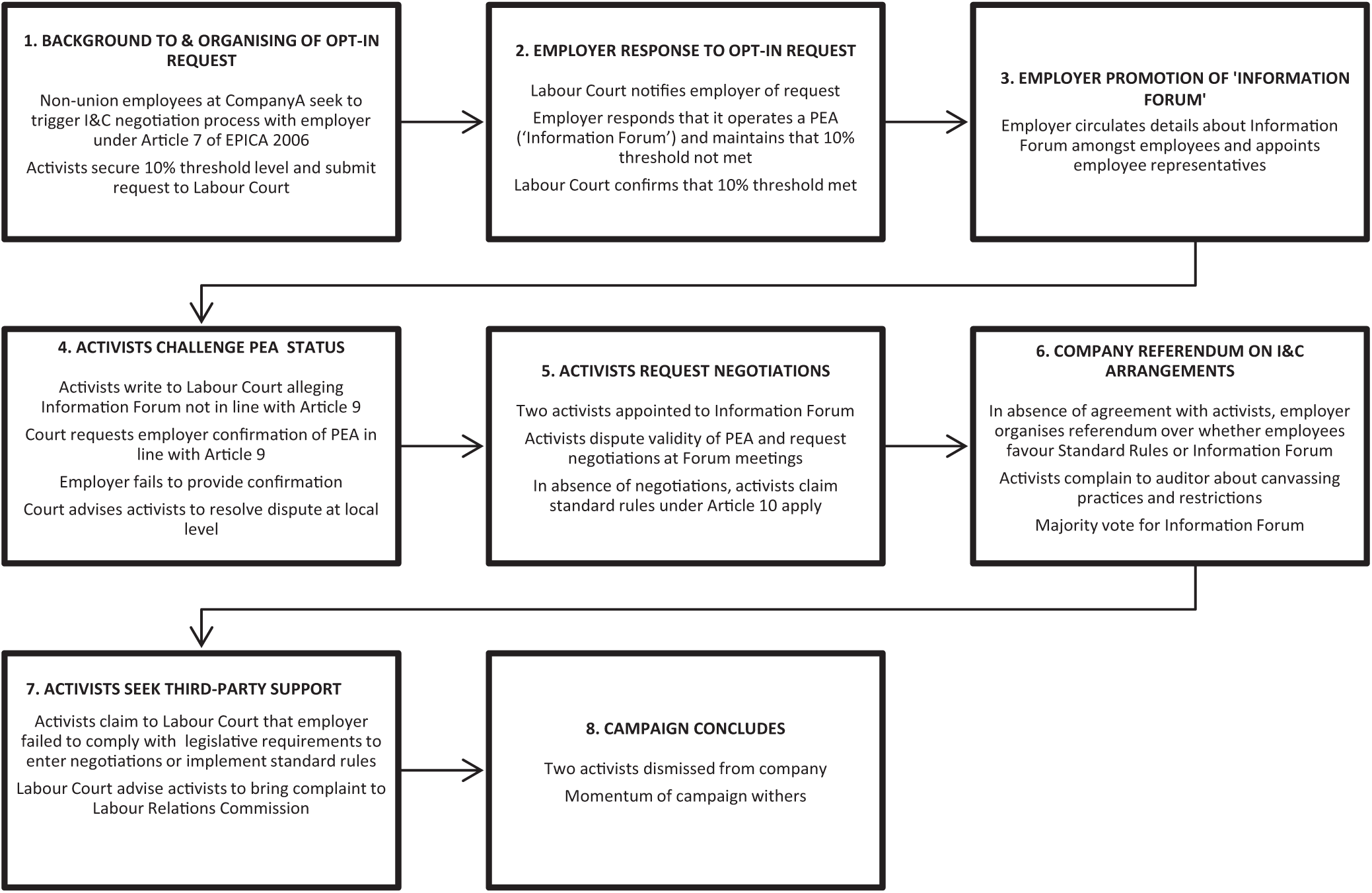
A flow chart of the opt-in process at CompanyA.
Background to opt-in request
The origin of the opt-in request at CompanyA stemmed from the activities of a small number of assembly workers on the shop-floor in 2009. Originally one member of this group (referred to as Employee A) became aware of EPICA 2006 through part-time study in a local university. In early 2009, this individual informed close work colleagues about the regulations, the possibilities for opting-in and relevant procedures. A loose group of 14 employees became a coalition of activists seeking an opt-in request, although three to four activists appear to have been most prominent. Perhaps contrary to the spirit of EPICA 2006, 5 this group’s interest in the legislation was articulated as a desire to ‘get back’ at the company, whose management style they regarded as authoritarian and punitive. There is some evidence to support this: for instance, employees being placed in repetitive work stations against their will, despite requesting lighter work due to repetitive strain injuries. One such case was taken against the company and won in a civil court. There were also complaints about bad posture in work chairs that caused back injury; again a successful civil action was taken by a former employee. Activists complained about regularly turning up for their shift to discover parts were not ready, leaving them without work to do; supervisors then insisted they go home early and take such time out of holiday entitlements. Consequently, the prospect of coercing management, through the law, to do something it would not otherwise do, appealed to the activists. Notably activists indicated in interviews an unwillingness to engage union advice or involvement, partly due to a belief that their employer would never negotiate with a union and partly because, in the words of one activist, ‘we wanted to do our own thing, rather than make it a union thing’.
Organising of opt-in request
In the initial phase of activist coalescence, some logistical problems prevailed as activists worked in different departments and shifts. Conscious to avoid managerial attention, intra-group communication was confined to outside of work meetings and email exchange with discussions held over the process for triggering negotiations, particularly how the 10% threshold might be secured. Despite taking precautions to remain unnoticed, the group proved unable to avoid supervisor attention. Within workgroups, rumours arose that the activists were involved in ‘union organising’ and it appears some co-workers reported this to supervisors, although activists professed ignorance when informally questioned. By the summer of 2009, the activists prepared to collect employee signatures in support of the opt-in. They concluded that 133 employee signatures were required – to be secured during shift-changeovers in cloak rooms, rather than approaching employees on the shop-floor. In cloak rooms employees were asked to sign, with their name and employee number, a petition supporting the creation of an ‘Information and Consultation Forum’. This activity was reported to have proceeded smoothly and within minutes.
The collection of signatures was forwarded to the Labour Court rather than directly to the employer. Within two weeks, the Court responded to the corresponding author for the group. The Court acknowledged receipt of the request, advised it had contacted the employer and was awaiting a response. In turn the Court notified CompanyA stating that it had received a request under EPICA 2006, Section 7 and requested confirmation that the threshold had been met. Further, the Court requested it: … would also be obliged if you could indicate if the Company intends to enter into negotiations with employees or their representatives to establish information and consultation arrangements in accordance with the Act. (Labour Court correspondence to CompanyA, June 2009)
Employer response to opt-in request
In response, the employer noted that ‘we were somewhat surprised to receive your letter’, claiming that CompanyA had a ‘joint information and consultative forum’ in place ‘predating the legislation’, in the form of an ‘Information Forum’ (CompanyA correspondence to Labour Court, July 2009). The company claimed the Forum had been set up in 2005 and ‘constituted in line with the legislation’. The employer advanced that ‘any perceived grievances relating to I&C have not been raised by employees directly with management’ or through the Forum. The company also advanced that it employed 2941 employees, and that ‘the number of 133 employees associated with this request does not constitute 10% or more of employees in the undertaking’; this misunderstood the 10% threshold was subject to a maximum of 100 employees, which, as the Court responded, had been attained (Labour Court correspondence to CompanyA, July 2009).
Employer promotion of ‘Information Forum’
In July, the activists claimed that a previously unheard of Information Forum appeared on the company intranet. The Forum appeared replete with a constitution and was claimed, in accompanying documentation, to be in place since 2006 (not 2005 as claimed in company correspondence to the Labour Court). Later company documentation from 2010 claimed the Forum was set up in 2004 (Senior Operations Director correspondence to Employee B, November 2010), while a revised version of the constitution appeared on the intranet in September 2009 removing the date the body was founded (Company memo 2009a). Notably documentary evidence, printouts from the company intranet, suggest that the Forum’s constitution went through three different versions in July 2009, as the remit, scope and function of the body were re-phrased. The Forum, in first appearing on the intranet, was presented as a body ‘to facilitate two way communication’ (Company memo 2009a). A week later this was revised to ‘facilitate communication of information and consultation’ (Company memo 2009b). The types of issues it was empowered to address changed in this time, as did the prescribed methods of I&C. Yet it was not signed by employee representatives nor indicated how it was approved by employees. Furthermore, the Human Resource Director circulated an email seeking new members, across departments, to sit on the forum ‘due to employees leaving CompanyA’ (Company memo 2009c). Subsequently, five individuals, none of whom were the activists, were managerially appointed to the Forum, meeting in September 2009 to discuss its workings. The activists claim these appointees were white-collar, clerical staff and not assembly workers. Documents of minutes support this view, indicating the five appointees were ‘business analysts’ or shop-floor supervisors.
Activists challenge PEA status
In the interim, the activists were provided with CompanyA’s response by the Labour Court. They in turn responded to the Court, challenging the validity of the Forum as a PEA, maintaining it did not exist until after the opt-in request had been submitted nor was it agreed by employees. In August 2009, the Court corresponded with the employer seeking evidence that the Information Forum constituted an agreed PEA, proposing that it ‘might be helpful if we could have a copy of the agreement, which could confirm that [it] complies with Section 9(2) of the Act’.
6
The Court further noted that: You will appreciate that the Court does not purport to have any statutory right to seek this information and we are asking that you might provide it for the purpose of assisting the employees concerned in deciding whether or not they wish to pursue the matter further. (Labour Court correspondence to CompanyA, August 2009)
Responding to the Court, CompanyA stated it had ‘taken this opportunity to re-communicate’ with the workforce on the Forum and was reviewing its activities. The employer added that the Forum had existed since January 2005 (CompanyA correspondence to Labour Court, August 2009). In response, the Court informed the employer that it had still not ‘provided any information concerning the circumstances in which, what you regard as a pre-existing consultation agreement came into being’ (Labour Court correspondence to CompanyA, September 2009). In the Court’s opinion, the company had not submitted proof to the Court that it had a valid PEA. However the Court observed that, …[the] Court’s role in the establishment of a negotiating forum is limited … The Court has carried out its function under Section 7 of the Act and accordingly, it has no further role in this matter at this time. (Labour Court correspondence to CompanyA, September 2009)
There was no response from CompanyA. Corresponding to the activists, the Court declared: In effect, the Court’s role … is limited … the Court’s function is merely to notify the Employer of the request and it is then a matter for the Employer to commence negotiations with a view to establishing a forum. If the Employer fails to do so, the general scheme of the Act seems to be that the Standard Rules set out at Schedule 1 of the Act apply. (Labour Court correspondence to activists, September 2009)
Consequently the activists, in a September email to the Human Resource Director, signed off by Employee A as the primary correspondent, declared their interest in negotiating I&C to management.
Activists request negotiations
By the middle of October, the activists claimed no response had been received from the employer. Believing the three month timeline to be expired, the activists again corresponded with the Court. They claimed the option of a negotiated agreement was closed off because the timeframe for commencing negotiations had expired under EPICA 2006: neither a valid PEA could be demonstrated to exist, nor had the parties introduced a negotiated agreement or indeed entered into negotiations. Consequently, the activists maintained the adoption of the Standard Rules was required. In response, the Court, observing its functions under the legislation, stated that ‘it is necessary that internal disputes resolution procedures be first utilised’ (Labour Court correspondence to activists, October 2009). 7
In November, Employee A was contacted by the Human Resource Director who indicated a willingness to discuss the opt-in request. Employee A, as the activists’ representative, was invited to write and submit their concerns about company I&C practices. The process was channelled through the employer’s individual grievance procedures. The activists’ submission (written by Employee A and agreed by the group) disputed the existence of a valid PEA. Meetings between Employee A, Employee B and the Human Resource Director occurred in December, but no consensus was reached over the disputed PEA. The employer maintained a PEA was in place and negotiations to create a new one were not necessary. Another request by the employer to resolve the matters in dispute was directed to four activists in the group (Employees A, B, C and D), who were then asked to participate in further discussions in January 2010. At this meeting, Employee A and Employee B were invited to sit on the Forum which had met once since its rejuvenation in July (and would meet on two further occasions in 2010). Both agreed to sit on the Forum on the understanding it would provide the opportunity to consider whether the body was in line with legislative requirements, and, if not, to assist in formalising arrangements in accordance with the Standard Rules. However, the employer, in later communications to Employee A and B, claimed that their participation on the Forum was to assist in ‘the improvement of the existing body rather than create a new one’ (Regional Human Resource Manager correspondence to Employee A, January 2010). This claim was disputed by the activists. The exchanges between the activists and the employer continued throughout 2010, whereby the former contended no valid PEA existed and the implementation of the Standard Rules was required. CompanyA sought to maintain the existing Information Forum, arguing that ‘because we believe we have a valid pre-existing agreement that has not been proven otherwise, the question of negotiating with employees does not arise’ (Senior Operations Director correspondence to Employee B, November 2010). At a meeting of the Forum in March 2010 the employer confirmed it ‘could not find’ a signed, dated copy of a PEA. However the Regional Human Resource Manager attending the meeting ‘gave several examples of how she felt there was a pre-existing agreement in place’ (Senior Operations Director correspondence to Employee B, July 2010; emphasis added).
Company referendum on I&C arrangements
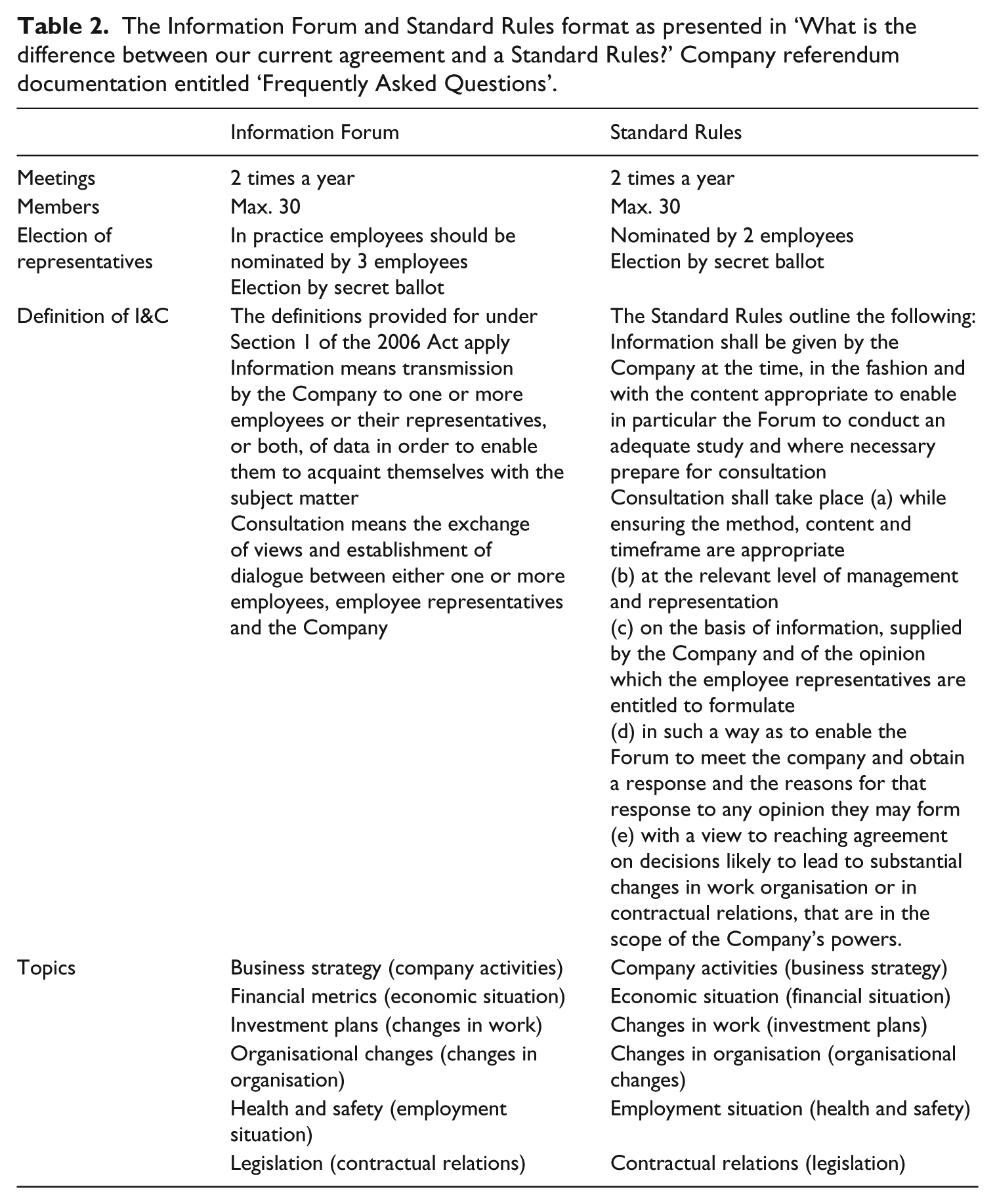
Employee A and B’s involvement on the Forum, which met twice in 2010, and their continued challenging of its legitimacy prompted the employer to seek a settlement of the dispute in late 2010. On the grounds that ‘it was not appropriate for any small group of individuals or indeed for the Company to decide what information and consultation arrangements should apply for the future’ (Company documentation correspondence to Rights Commissioner, February 2011), the employer declared a plant-wide referendum for December 2010 (to be overseen by an auditor, a consultant hired by the firm). The referendum was to allow employees either to continue with the existing Forum (whose constitution the employer had now drafted) or introduce the Standard Rules. Elections for representatives would occur concurrently with the referendum. The activists were opposed to the referendum, maintaining it sought to legitimise an invalid Forum, yet nonetheless proceeded to participate and contest. In the run up to the referendum, CompanyA drafted a circular to employees, entitled Frequently Asked Questions (FAQ), outlining a series of questions and answers on the purpose of the referendum, the election and the proposed differences between the Information Forum and the Standard Rules. As shown in Table 2, this suggests minor differences, although the definition of consultation is stronger in the Standard Rules in emphasising ‘with a view to reaching agreement’. This is absent from the Information Forum.
The Information Forum and Standard Rules format as presented in ‘What is the difference between our current agreement and a Standard Rules?’ Company referendum documentation entitled ‘Frequently Asked Questions’.
The activists would claim in correspondence to the referendum auditor, the Labour Court, the Labour Relations Commission (LRC)
8
and the Rights Commissioner
9
that CompanyA imposed electioneering rules, allowing only employees who sat on the Information Forum to canvass on behalf of either agreement. The activists claimed that this undermined canvassing for the Standard Rules as aside from Employee A and B, the remaining Forum participants were managerial appointees from September 2009. Furthermore, it was claimed employees could not canvass outside their own work station, limiting Employee A and B’s contact with other co-employees. Nor could employees canvass in the canteen or provide independent written documentation (aside from the Company’s FAQ). More contentiously, the activists claimed in correspondence to the Rights Commissioner that supervisors held meetings with small groups of employees on the morning of the referendum outlining why they should vote for the Information Forum: a vote for the Standard Rules would be viewed by headquarters as disloyal and affect future plant investment. While it is difficult to verify these claims, the consistency of such grievances being articulated to four different agencies suggests some plausibility. Furthermore the activists had no documentation of their own to provide in campaigning for the Standard Rules on the grounds that they were not allowed to disseminate material. The company’s FAQ is generally neutral in its presentation of the dispute, although misrepresentation is present. For example, the company claimed in Question 48: I heard that there was a case in the Labour Court about the Information Forum. What was this about? The company informed the Labour Court that it has long standing arrangements in place … since 2004. The Labour Court responded to the Company by confirming that the Labour Court accordingly had no further role in that request from the minority group of employees. (Frequently Asked Questions Internal Circular)
This distorts the Court’s decision to withdraw from the case as based on an invalid opt-in request, when it indicated it had no further role due to limited powers. The activists complained to the auditor about procedural imbalances in presenting their case for the Standard Rules: the auditor’s response was that the matter was not in its remit as its role was to oversee the ballot and count results (Auditor correspondence to activists, December 2010).
While Employee A and B were elected to act as representatives, some uncertainty appears to have existed regarding the final referendum results. The activists claimed that the reported result, presented on digital notice boards in the company, stated simply that the majority of those who voted, voted for the Information Forum. An attempt by the activists to secure figures on voting distributions from the employer was unsuccessful, as was a request to the auditor, who responded that their involvement in the case had ended and further issues should be addressed to the company (Auditor correspondence to activists, January 2011). The only documentary evidence on voting distribution available is a report by the company in later correspondence with the Rights Commissioner, which detailed the following pattern of votes in favour of the Information Forum:
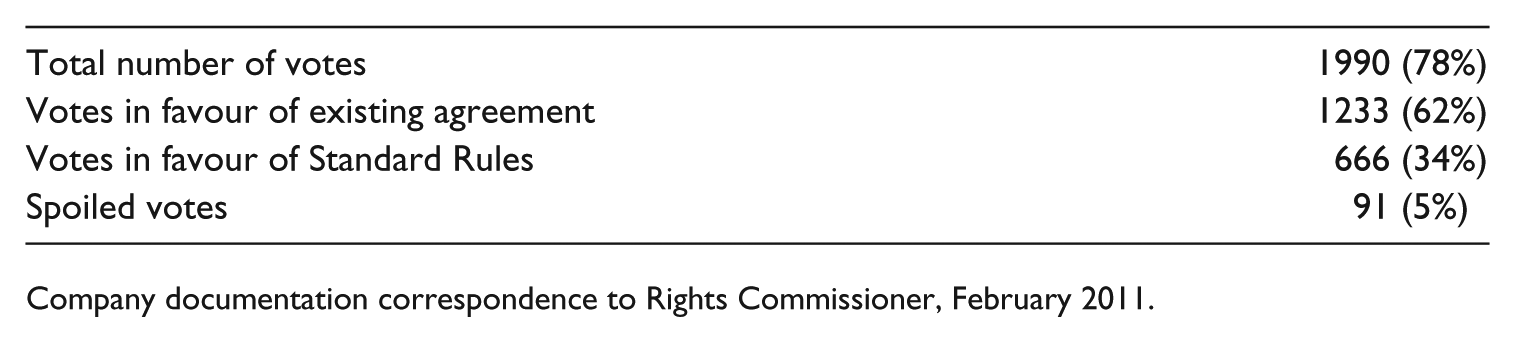
Company documentation correspondence to Rights Commissioner, February 2011.
Activists seek third-party support
Weeks prior to the referendum, the activists lodged a complaint to the Rights Commissioner. This was referred under Section 15 of the regulations (cf. note 8), relating to dispute resolution. The activists claimed that they had exhausted the internal procedures as advised by the Labour Court. Nonetheless this application was a mistake on the activists’ part as the Rights Commissioner’s role is confined to cases where representatives are penalised for I&C activities. In their complaint, written on behalf of the group by Employee B, it was claimed the employer had refused to enter negotiations within three months of receiving the request as required and was committing an offence under Section 19 of the Act.
10
CompanyA responded to the Rights Commissioner in December 2010, claiming internal dispute mechanisms had not been exhausted by the individual who wrote the letter, but confirming that the company was willing to resolve the issue. A hearing was subsequently held in February 2011. At the hearing the employer argued the claim was invalid, citing time limits under Schedule 3 of the 2006 Act, wherein a Rights Commissioner should ‘not entertain a complaint … after the expiration of the period of 6 months beginning on the date of the contravention to which the complaint relates’ (Company documentation correspondence to Rights Commissioner, February 2011). In asserting this claim, CompanyA argued Employee B had claimed that the dispute was ‘live since June 12th 2009’ and that this was 16 months prior to submission of the claim on 26 October. Further the Company argued: [Employee B] has not utilised the internal dispute resolution process … The internal process referred to within his document was on behalf of [Employee A] and not [Employee B]. (Company documentation correspondence to Rights Commissioner, February 2011)
The Rights Commissioner responded that it ‘lacked jurisdiction to hear the complaint’ (Rights Commissioner Decision, February 2011) on the grounds that the claim was brought under Section 15 and not Section 13 (the area of the legislation it is empowered to investigate). Now frustrated by the process, the activists, in a letter written by Employee C, contacted the Labour Court for assistance. Their letter was returned by the Court however as not specifying what section of the regulations Court assistance was sought. Composing a re-worked letter, the activists stated: We wish the Court, therefore, to … seek to make available the said agreement for inspection. Thus by doing this we can clarify once and for all if that said agreement … is a valid pre-existing agreement or is not. In making the request for the Court to act in this instance we do so as a sign of our frustration. Despite our best efforts in various negotiations and through a large exchange of correspondence with the HR Director, the company has not produced a copy of that agreement … (Activists’ correspondence to Labour Court, June 2011)
In response the Court stated that it was awaiting a response from the employer for clarification on particular points. This the employer duly did, responding that the dispute had been resolved internally and an I&C Forum, supported by the majority of the workforce, as per the December 2010 ballot, was in place (Company correspondence to Labour Court, July 2011). In turn, the Court advised the activists to seek the assistance of the LRC should it wish to pursue matters further (Labour Court correspondence to activists, August 2011).
Campaign concludes
Significantly, the activists were weakened in 2011 as two leading members were dismissed from the company. Early that year, disciplinary procedures were initiated against Employee A for failing to submit a sick note after a work absence. He was subsequently dismissed. In response, Employee A lodged a claim for unfair dismissal and victimisation – on the grounds of participating in the opt-in campaign – at the Employment Appeals Tribunal. 11 An out of tribunal financial settlement was later agreed with the company. Employee B was also dismissed in late 2011 for failing to provide documentation relating to a work absence. Similarly, Employee B brought a tribunal case for unfair dismissal and victimisation, again settled through an out of tribunal financial offer by the employer. The loss of two key activists seemed to hinder campaign momentum in 2012, although for a time remaining activists persisted, turning to the LRC for assistance. The LRC contacted the employer, indicating its willingness to resolve the dispute, but CompanyA declined, declaring that no dispute existed. The LRC subsequently notified the Labour Court that attempts to resolve the issues at local level had been exhausted. While this led to some further exchanges on the same issues in dispute, led by Employee D, CompanyA refused to entertain that a dispute existed. By the end of 2012, initiative among the activists had waned and, at time of writing, the campaign appeared to be finished. Remaining activists were discouraged by the dismissal of Employee A and B, concluding the costs of pursuing an application further outweighed the benefits. By the start of 2013, the campaign was inactive and was dropped.
Discussion
In assessing how employers respond to non-union employees invoking their rights to I&C, three strands of interpretation were inferred from the literature: manipulative unilateralism, calculative bilateralism and sophisticated bilateralism. The findings exhibited the trajectory of manipulative unilateralism insofar as activist efforts to opt-in fell foul of employer avoidance, suppression and substitution. When presented with a valid opt-in, the employer counter-advanced an internal forum as a PEA, the status of which appeared, on the basis of available evidence, unconvincing. This claim was utilised by the employer to obstruct attempts to negotiate I&C arrangements. In a context where the PEA claim was contested, the employer sought to co-opt activists on their preferred voice forum. When this failed to dampen the preferences of activists for negotiations, the employer sought retrospectively to legitimise their preferred forum through a referendum, the prior canvassing of which appeared biased by employer behaviour. While the outcome suggests the employer’s favoured arrangement might well have many similarities with the activists’ sought-after statutory variant, what remains more significant is how the employer evaded the triggered pathway to pursue their own ambitions without reference to legislative prescription. Indeed the design of the EPICA 2006 did little to deter the employer from circumventing regulatory requirements. For example, the Labour Court observed that it lacked authority to verify the PEA and was reliant on the goodwill of the employer. In the absence of verification, the employer was free, post the valid opt-in, to promote a preferred body and ignore requirements for negotiation. The fulfilment of legislative prescription was delegated to non-unionised employees. Despite meeting the first hurdle of formally opting-in, employees continued to carry the responsibility of manoeuvring complex legislation in a context of an employer unreceptive to regulatory influence and bilateral engagement. State assistance was arm’s-length, requiring, with no prescribed timelines, internal dispute resolution exhaustion and LRC assistance before a case could be heard at the Court. A protracted process of this sort sorely disadvantages employees, leaving them exposed to employer manipulation.
The case demonstrates that even where the regulations are self-consciously deployed by employees, the legal procedures designed to assist the process are porous and subordinated by employer preference. This outcome is possible for several contextual reasons. At source, EU-led regulations, like the Directive, have progressively been imbued with a degree of flexibility permitting member states greater latitude in transposition to fit national cultures (Gold, 2009). In Streeck’s (1995: 45–49) terms, what distinguishes contemporary EU social policy is its ‘low capacity to impose binding obligations on market participants, and the high degree to which it depends on various kinds of voluntarism … in the name of self-regulation’. The flexibility of the transposition process enabled Irish policymakers to design EPICA 2006 with a regulatory bias towards voluntary solutions at workplace level. Historically, the Irish system, like Britain, has relied upon voluntarism in regulating employment conditions: an arrangement traditionally favoured by organised labour given their antipathy to legal intervention and a preference for using labour market power to sanction wayward employers (Turner et al., 2013). Yet voluntarism imposes few regulatory constraints on employers and becomes a euphemism for employer dominance in conditions of union weakness and decline. Such voluntarism however has complemented a core plank of the Irish state’s trade policy pivoting around attracting foreign investment from multinationals, disproportionately from those of American origin (Lamare et al., 2013). Policymakers have thus opted to eschew labour market policies endangering the country’s attractiveness as an investment location for such firms: hence Ireland stands out uniquely in Europe in lacking statutory trade union recognition. US multinationals are well known for their antipathy to independent employee representation and their desire to exercise unfettered prerogatives at plant level (Edwards et al., 2005). While this preference is moderated where US subsidiaries locate in coordinated national and sectoral systems, liberal-market economies (LMEs), like Ireland, offer greater discretion to pursue preferred policies (Marginson et al., 2004). Consequently US multinationals have carved out a terrain of union-free plants in the Irish pharmaceuticals, electronics and software sectors: indeed their freedom to do so is presented as a unique selling point by Irish investment agencies abroad.
The state’s acquiescence to multinational preference is also evident in the access the latter have to high-level policy: Collings et al. (2008) note how the American Chamber of Commerce in Ireland and multinationals like Intel had extensive access to government in the period prior to the transposition of the I&C Directive, ensuring that the rights of employees under the EPICA 2006 were heavily imbued with employer influence and permissive of company-level flexibility. Trade unions on the other hand were isolated from these discussions, although it has been maintained that they remained tepid to the Directive, suspicious it might compete with collective bargaining (Dobbins, 2010). Rather unions have devoted resources to campaigning for statutory recognition rights. This combined result of EU regulatory voluntarism, state–multinational collusion and unions’ isolation from the regulatory space culminated in the porous I&C regulations evident in our case; providing ample scope for employer avoidance, light-touch oversight and legislative complexity that obstructs employee access to voice rights. In this context it is interesting to note survey evidence that reports how the I&C Directive has positively impacted on the number and type of voice structures within MNCs in the UK and Ireland (Lavelle et al., 2010; Marginson et al., 2010). These survey-based studies have found that MNCs, in response to the introduction of the regulations in both countries, established non-union indirect consultation structures where they did not previously exist. The case in this article suggests that this evidence should be interpreted with caution: our case employer could certainly report I&C arrangements in response to the regulations, but in reality such initiatives hardly appear consistent with the ‘spirit’ or content of the legislation.
A final implication which the case raises is whether the law can secure non-union employee access to I&C and indeed be an effective substitute for declining union influence. Pollert (2007), among others, has argued how knowledge and resource constraints tend to impede non-union workers accessing legal rights, an argument amply demonstrated in our case. Relatedly, Colling (2010: 328) has maintained that where the law imposes norms on employers inconsistent with their values, responses are likely to be characterised by, at best, ritualism (instrumental compliance to the letter of the law without necessarily carrying out its spirit) and, at worst, retreat (avoiding the law actively or simply ignoring it). The potential of independent employee opt-ins under the shadow of the law is likely an anathema to many non-union employers, and thus opportunistic avoidance is likely.
Given the probability that I&C rights fail to encroach into non-union workplaces, social institutions bridging this gap and providing ‘positive mediation’ between the law and the workplace would seem desirable (Dickens, 2012). Yet the institutional architecture required to give systematic force to legal standards is weak and fragmented in Ireland and indeed in LMEs generally. Evidence suggests that state enforcement agencies in LMEs, one obvious mediating agent, are burdened with tightening resources and case overload, weakening their capacity for effective oversight (Ahlering and Deakin, 2007; Teague, 2009). Furthermore, such bodies are highly dependent on the extent of support from the ruling political classes and invariably, in LMEs, are often assigned powers in law that are ‘light touch’.
Indeed it may seem curious to argue, but for the law to secure non-union employee access to I&C, the condition of non-unionism might first need to be addressed. Statutory employee rights, like consultation, are typically observed more widely in the sectors characterised by firm-level collective bargaining (Jenkins and Blyton, 2008) indicating a positive mediating effect. This may simply be because union representatives have the expertise to diffuse knowledge of legal standards within the workplace and exert power to coax employers to institute policies and procedures that give effect to statutes. Strengthening the institution of firm-level collective bargaining might be a prior condition for enforcing employee rights to I&C. Rather than it being a case of the law replacing declining collective bargaining as is sometimes assumed, the issue is, as Heery (2011) notes, one of recombination so that the former acts as a precedent, sanction and standard for the latter. In principle at least, Irish unions may have been right in their partial agnosticism to I&C legislation, opting to channel their energies towards securing legislative support for collective bargaining. In practice however, the same forces favouring dilution of the Directive have vigorously opposed any legal strengthening of collective bargaining in Ireland (D’Art and Turner, 2011). This suggests a ‘cold house’ for the percolation of I&C rights unless other conditions favouring union mobilisation, organising and recognition occur. In the absence of a supportive bulwark and the continuation of swathes of non-unionism, the insertion of I&C structures into union-free settings will likely produce ‘atomised islets of employee voice’ (Butler, 2005: 285), vulnerable to the kind of unilateral employer manipulation seen in our case.
Conclusion
This article contributes to an understanding of how employers might respond to non-union employees attempting to invoke their legal rights to I&C. The evidence demonstrates, in relation to EPICA 2006, that even where valid opt-ins are secured and the legislative framework is self-consciously initiated by employees, the regulatory pathway is porous and non-union employers can elude its ambit. This imposes a considerable burden on the agency of non-union employees to ensure regulatory requirements are upheld. In the Irish context, such outcomes were attributable to the wider institutional context of pliable EU regulatory transposition. We suggest that in the absence of regulatory institutions capable of performing positive mediation of the law, the likelihood of successful opt-ins under the regulations in the non-union sector will be low. In a non-union context, opt-ins may well occur under the shadow of the law, but this shadow is faint and easily penetrable by employer power.
Footnotes
Acknowledgements
The authors wish to thank the editor and the two referees for helpful comments on earlier drafts.
Funding
Funding for this study was received from the Economic and Social Research Council and the Irish Research Council (RES-062-23-1139).