




Abstract
The aim of this article is to examine the explanatory forces of power resources and institutional factors on whistle blowing activity, its effectiveness and reactions. The authors analyse survey material of 6000 Norwegian employees across sectors and industries, and find that individual power resources have little impact, but the organizational power resources of positions, and institutional factors matter. Departing from a Norwegian labour market model, this is a result that encourages continued focus on codetermination, democracy and openness.
Introduction
Compared to international research, research on whistle blowing in Norway shows a high proportion of whistle blowing activity, a high amount of positive reactions towards whistle blowing and high effectiveness (Skivenes and Trygstad, 2010, 2012). Our hypothesis is that the Working Environment Act (WEA, 2005), which encompasses the bulk of Norwegian industrial life, 1 as well as collective agreements and extensive cooperation between trade unions and employers’ organizations locally and nationally, have facilitated an institutional context for whistle blowing activity (cf. Skivenes and Trygstad, 2010). In this article we examine this hypothesis by contrasting the impact of individual power resources (education, seniority, hours at work, gender and the hierarchical position of the employee) versus institutional arrangements (employee is organized, presence of employee representatives at the workplace, role as a trade union representative or safety representative, collective agreements and whistle blowing procedures). We use data from one of the most extensive studies on self-reported whistle blowing in Norway including 6000 respondents across different sectors. 2 The main findings are in line with other Norwegian studies on whistle blowing in Norway (cf. Skivenes and Trygstad, 2012: 106–107):
34% of the employees had observed serious wrongdoing at the workplace in the last 12 months;
53% of them blew the whistle on the wrongdoing;
49% of the whistle blowing resulted in improvement in the wrongdoing;
54% of the whistle blowers reported positive reactions, and 35% did not experience any reactions.
The question we examine is to what degree these results can be explained by individual power resources, or by institutional arrangements. The article starts with a presentation of the main concepts and research on whistle blowing, followed by an outline of the Nordic labour market model and the Norwegian approach to whistle blowing. Theory and methodological issues are presented thereafter, followed by findings and a discussion section. Finally, we end the article with a few concluding remarks.
Definitions and research on whistle blowing
Whistle blowing is usually defined as ‘the disclosure by organization members (former or current) of illegal, immoral or illegitimate practices under the control of their employers, to persons or organizations that may be able to effect action’ (Near and Miceli, 1985: 4; Miceli et al., 2008; Near et al., 2004). The definition by Near and Miceli, from the Human Resources tradition, includes both internal as well as external whistle blowing, e.g. to report wrongdoing to authorities or media outside the organization. Also when the focus is on ‘public interest’ whistle blowing, e.g. reports of wrongdoing that clearly affect organizational or social interests wider than the personal or private ones, as in our study, the definition is useful. Whistle blowing is important for both ethical and efficiency reasons. From a welfare point of view, reporting may be vital to preserve the health and safety of both the workforce and the general public (cf. Green, 2012: 125). Seen as an argument for increased efficiency, people who report wrongdoing can assist their employers by offering solutions to work problems. Thus, whistle blowing can be viewed as part of a strategy to maintain and improve the quality of production processes (Baillien et al., 2011; Daugareilh, 2008; Miceli et al., 2008). Finally, whistle blowing could be regarded as an important democratic human right, i.e. the principles of justice and freedom of expression require that those who become aware of wrongdoing should have the opportunity to speak out without risk of reprisals (Eggen, 2009; cf. Skivenes and Trygstad, 2012).
Whistle blowing is, however, often perceived to be a hazardous form of action due to the dangers of retaliation when challenging a practice or powerful persons inside the organization (Miceli et al., 2008). In research on whistle blowing, the resource dependency theory of power (Pfeffer and Salanick, 1978) is often used to explain the outcome of a whistle blowing process (Miceli et al., 2012). This theory has been criticized for resting on the assumption that power is mobilized ‘in the face of conflict and opposition’ (Hardy and Leiba-O’Sullivan, 1998: 453). According to Lukes (2005), power is also exercised through hegemonic processes: legitimation of power through cultural and normative assumptions. Power can be used to ensure that conflicts never arise, at least not in ‘public’ – known inside or outside the organization; that wrongdoing remains under-reported – or if reported, not dealt with in an appropriate way. We believe that different labour market models will have distinct institutional mechanisms that may complicate or facilitate individual voice (Hagen and Trygstad, 2009; Trygstad and Bråten, 2011). These mechanisms can be considered resources for actors in certain positions. The idea of a just workplace, embedded in the Nordic labour market model, can be regarded as an institutionalized power base that gives trade union representatives and safety representatives access to resources by virtue of their roles (Engelstad, 1999; Hagen, 2010: 309). This may explain why some labour market models seem to facilitate whistle blowing, at the same time as some models may contribute to a culture of silence.
The empirical findings in studies on whistle blowing are contradictory (see Mesmer-Magnus and Viswesvaran, 2005; Miceli and Near, 2002, Miceli et al., 2008). 3 This is partly due to challenges involved in gaining access to adequate data on whistle blowing activities, and the problems involved in measuring the relation between wrongdoing, whistle blowing and sanctions. There is also use of different definitions of whistle blowing and wrongdoing. Even in Norway, with a short history of research on whistle blowing, there are challenges when comparing existing research. We have in previous studies shown how whistle blowing in Norway distinguishes itself from international findings, and in particular findings from the US (Skivenes and Trygstad, 2010), and present here the major research contributions on Norwegian whistle blowing consisting of eight larger studies (cf. Skivenes and Trygstad, 2012). A majority of Norwegian employees report misconduct, and usually they report it to their immediate supervisor (58%) or a trade union representative or a safety representative (18%) first. The majority of the employees notified openly and verbally (69%), while 27% reported the misconduct openly and in writing. Only 4% reported the wrongdoing anonymously (Trygstad, 2010: 62). The findings from the eight Norwegian studies, reviewed in Skivenes and Trygstad (2012), show that between 38% and 83% of the employees blow the whistle. Norway stands out also in terms of reactions, as a smaller proportion – between 7% and 18% – of the whistle blowers experience sanctions. The most common form of retaliation was strong dissatisfaction and verbal harassment from leaders; stagnation of career or wage; or that one simply became degraded. There are also some who lose their jobs, or are exposed to hidden sanctions, e.g. excluded from social interactions. Further, between 50% and 71% reported that the misconduct had been fully resolved or improved.
The Norwegian context
The Norwegian model of labour relations was shaped in the 1930s, although the first agreement – Verkstedsoverenskomsten – was reached in 1907 as the first modern collective agreement. The fundamental rights and duties that regulate company industrial relations are primarily found in the ‘basic agreements’. Each sector is covered by separate agreements, but the differences when it comes to codetermination and participation are few. The trade unions’ representatives, elected by the members, constitute the partner with whom management must negotiate at different levels in the company. However, the collective bargaining dimension is considered a key precondition for establishing balanced power relations and maintaining the ceiling of tripartite collaboration. In the public sector all employees are covered by a collective agreement, while 58% are covered in the private sector (average: 73%) (Nergaard, forthcoming). Hence, the density and the legitimacy among members are an important power resource (Hagen and Trygstad, 2009). In the public sector, 80% of the employees are members of a trade union, compare to 37% in the private sector (average: 52%).
According to the Norwegian Working Environment Act (WEA, 2005) all enterprises with 10 employees or more are obliged to have a safety representative at the workplace which shall be elected by and among the employees. Together, this gives trade unions, safety representatives and employees important roles as stakeholders in the organization. At a general level, there are well-established channels for representative and individual voices. In terms of whistle blowing, Norway is one of the few countries that display strong protection of whistle blowers, and Norwegian employees have the right to report wrongdoing externally under certain conditions (Lewis and Trygstad, 2009). In a historical perspective, it could be argued that statutory provisions have required employees to report wrongdoings in the organizations since 1956, when the provision of safety representatives was incorporated in the Norwegian Environment Act. The concept of ‘whistle blowing’ is, however, new, and the Norwegian WEA from 2005 states that an employee has ‘a right to notify concerning censurable conditions at the undertaking’, and covers both internal and external whistle blowing. Section 2-4(2) of the WEA from 2005 states that the employee must ‘follow an appropriate procedure in connection with such notification’ but, notwithstanding this, there is the right to notify in accordance with the duty to notify or the undertaking’s procedures for notification. Further, reporting wrongdoing to union representatives and/or the safety representative and to supervisory authorities, for example, the Labour Inspection Authority, is always regarded as appropriate. 4 Section 2-4(3) of the WEA from 2005 places the burden on the employer to prove that notification was not made in accordance with this section. Section 2-5 (WEA, 2005) prohibits retaliation against an employee who invokes or attempts to invoke Section 2-4. Irrespective of the fault of the employer, compensation is available if the court thinks it reasonable. The WEA strongly recommends that workplaces establish procedures for reporting misconduct. Section 3-6 (WEA, 2005) states that employers ought to ‘develop procedures for internal notification or implement other measures that facilitate notification concerning censurable conditions … if the circumstances in the undertaking so indicate’ (cf. Lewis and Trygstad, 2009). If the enterprise has an internal whistle blowing procedure (WEA, 2005: § 3-6), it is expected that a concern will be processed in accordance with that procedure. The presence of such procedures can make the whistle blowing process less arbitrary and may neutralize individual power resources in the sense that also employees who lack individual power resources such as education and positions may blow the whistle when observing wrongdoing. However, the institutionalized structures for participation and whistle blowing are not present throughout the Norwegian labour market. Some industries in the private service sector, characterized by few formal educational requirements, have low union density, they often do not fulfil the requirement of safety representatives at the workplace, and the possibility for individual and collective voice is poor compared to other parts of Norwegian working life (Berge et al., 2013; Bråten et al., 2013; Nergaard, 2014; Nergaard and Trygstad, 2013). Such differences may affect the willingness to report suspected wrongdoing, the reactions to it and the handling of the case.
Theoretical approach
We believe that different labour market models, with their institutions, industrial relations and work organizations, create different frameworks for whistle blowing (Skivenes and Trygstad, 2014). According to Appelbaum and Schmitt (2009) and Mahoney and Thelen (2010), different labour market models have different approaches to work design, human resource practices and collective representation. In a cross-national study of low-wage occupations in five industries 5 in six countries (Denmark, France, Germany, Netherlands, United Kingdom and the United States), Appelbaum and Schmitt argue that institutions (and their deterioration) play a large role in explaining differences between countries, and they distinguish between market employment regimes and inclusive employment regimes. 6 These two regimes or models differ in a systematic way in the extent of employees’ involvement in decision making, ranging from strongly institutionalized participation in inclusive systems to the exclusion of labour from a significant role in decision making in market regimes (Gallie, 2007: 17–19). We argue elsewhere that these characteristics influence the definitions of wrongdoing inside the organization (cf. Skivenes and Trygstad, 2014) and the questions like: who has authority to define an act as wrongdoing or not, and what is considered private or public interests. Norway can be considered an inclusive employment regime or model, but the strength of the model differs among workplaces, sectors and branches.
Studies argue that powerful organizational members are more likely to report observed wrongdoing than others (Miceli et al., 2008). They may feel that they are obliged to act, that they can get someone to listen, and that they will escape negative consequences such as retaliation (Miceli et al., 2008: 44). In a Norwegian context, however, research shows that also employees who do not occupy such power resources choose to report wrongdoing (Skivenes and Trygstad, 2006). In comparison with international prevailing practices, Norwegian employees tend to be granted wider responsibilities, which will serve to strengthen the commitment to report wrongdoing (Skivenes and Trygstad, 2014). In line with Miceli et al. (2012), we think it may contribute to ‘organizational justice’, which promotes internal whistle blowing (Miceli et al., 2012: 928). Skivenes and Trygstad (2010) have promoted a hypothesis about how institutional arrangements which can be found in the unionized part of the Norwegian labour market contribute to certain counterbalancing mechanisms that reduce the effect of individual power resources and make the opportunities for participation more egalitarian and democratic. For example, if the employees are covered by a collective agreement, trade union representatives will be present in the workplace and be consulted if problems occur. Hence, trade union representatives and safety representatives can be regarded as part of a social safety net that promotes engagement and voice, and vice versa (Hagen and Trygstad, 2009; Skivenes and Trygstad, 2012). In the following paragraphs, we present two explanatory approaches: individual power resources and institutional arrangements.
Individual power resources
Power resources can be material or immaterial, but they must be valued or seen as critical for other actors or groups in the system (Borum, 1995). The power resources possessed by different members of an organization determine (among other things) the individual’s freedom of action, their opportunities to make decisions, their influence on work operations and the leadership’s strategic choices.
Miceli et al. (2008) point out that empirical research has shown some tendency for whistle blowers to be more senior, and to have higher pay. Research has also suggested that employees with less at stake more frequently are inactive observers (Miceli et al., 2012). Those with little seniority, and part-time employees, may have less to lose if retaliated against due to whistle blowing, but at the same time they may be less capable of getting powerful others to act due to lower credibility or perceived value to the organization, and may care less about whether the wrongdoing is corrected or not (Miceli et al., 2008). We therefore include seniority as an indicator of individual power resources along with hours at work, since part-time employees may feel less committed to the organization. Further, education was positively correlated with whistle blowing in one large study (Miethe, 1999). International studies indicate that whistle blowers tend to be key employees who are highly skilled and part of the enterprise’s core activities (Glazer and Glazer, 1989; Rothschild and Miethe, 1999). Two explanations are highlighted. First, these employees will be more concerned with the reputation of the enterprise than their co-workers who are on a lower rung in the enterprise hierarchy, and this has an impact on the choice to give notification or not. Second, highly skilled employees are more often found in strategic positions, where they have a better opportunity to discover any wrongdoing. This indicates that whistle blowing may be correlated with level of education.
Although gender is a demographic variable it may also be treated as an indicator of power. In the literature, gender seems to have an impact on the whistle blowing process, but as pointed out by Miceli et al. (2012) – in an inconsistent way. Miethe (1999) found that men were more likely to blow the whistle, and Miceli and Near (1992) suggested that men would be more likely to report wrongdoing than women because men may occupy positions where more serious wrongdoing is more likely to be observed. Further, men may be more likely to be members of professions where whistle blowing is encouraged as part of a code of ethics, for example engineers or accountants. However, Mesmer-Magnus and Viswesvaran (2005) have opposite findings: women who witnessed unaddressed wrongdoing were slightly but significantly more likely to blow the whistle than men. In their latest study, Miceli et al. (2012) find that women were somewhat more likely to act on observed wrongdoing (Miceli et al., 2012: 949). Although gender equality has been highly emphasized both in politics and business in Norway for several decades, Norwegian working life is still rather gendered. Women are overrepresented in industries like nursing, health and care, while men are overrepresented in engineering and manufacturing (Statistic Norway, 2009). 7 In our study, there are significantly more men that are leaders, and the differences increase the higher up we go. Thus, even though gender in our previous studies had no significant impact on the whistle blowing activity, we include gender in our analysis.
The authority and responsibility that follows a position may reflect the power of the whistle blower, but position has showed inconsistent relationships to whistle blowing. Mesmer-Magnus and Viswesvaran (2005) found that job level was weakly related to both whistle blowing intent and actual whistle blowing. Further, a study of police officers and civilian employees in the state of Georgia found that supervisory status was a significant predictor of self-reported frequency of whistle blowing (Rothwell and Baldwing, 2007, in Miceli et al., 2008: 63). In this article we presume that the position as a middle manager contributes to report wrongdoing, and that it also may influence the way the concern is handled and the consequences of disclosing.
According to the WEA (2005), mangers, trade union representatives and safety representatives are given a special responsibility to contribute to a working environment free from harm and harassment, and the positions are given specific roles in a whistle blowing process (cf. Lewis and Trygstad, 2009). Thus, in our analysis we use seniority, hours at work, education, gender and the position as a middle manager as indicators of individual power resources and we test if they have an impact on whistle blowing activity and its consequences.
However, power resources can also be mobilized against the whistle blower, e.g. by the person responsible for the alleged wrongdoing. We believe that the power resources the person or persons responsible for the wrongdoing may have will have an effect on the choice of whether to blow the whistle or not. Further, Miethe (1999) finds that the risk of sanctions is strongly correlated with the threat posed by the whistle blower to the legitimacy of the organization. Skivenes and Trygstad (2010) find that the responsible person’s rank in the hierarchy has an impact on the choice to proceed with disclosure or not. An employee is more likely to report an issue if the person responsible is a colleague, rather than a manager. Thus the hierarchical position of the wrongdoer is important to include in the analysis.
Institutional arrangements
Our aim is to explore if institutional arrangements at the workplace matter in cases of wrongdoings, and if the mere presence of some structural arrangements at the workplace have an impact on whistle blowing activity and the consequences of disclosing misconduct. Indeed, collective agreements, trade union representatives, a safety representative and whistle blowing guidelines can neutralize power resources. The institutional arrangements provide both individual and collective rights to participate at the workplace. The organized part of Norwegian working life is characterized by a strong institutionalized framework, with laws and agreements that sustain a power balance between capital and labour, as well as workplace arrangements that maximize the opportunities for employees to participate and exert influence (Dølvik, 2007; Hagen and Trygstad, 2009). Norwegian employees also consider their influence on their own work situation as high, and Norwegian workplaces seem to be characterized by a culture of communication and participation that managers also regard as both real and beneficial (Hagen and Trygstad, 2009). At the same time, it cannot be taken for granted that the presence of trade union representatives or safety representatives will make a difference for those who act as whistle blowers. Thus, in our analysis we use seniority, hours at work, education, gender and the position as a middle manager as indicators of individual power resources and we test if they have an impact on whistle blowing activity and its consequences. In our analysis, our indicators for institutional structures encompass: if the employee is organized, presence of employee representatives at the workplace, role as a trade union representative or safety representative, collective agreements and whistle blowing procedures.
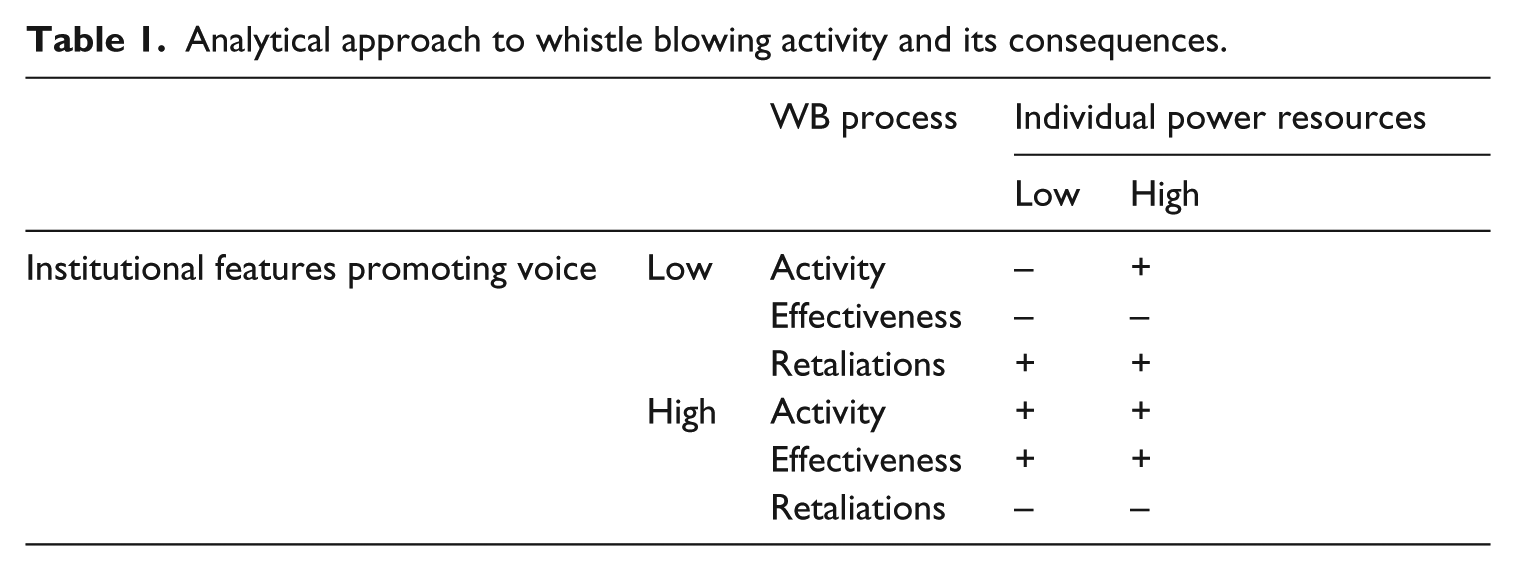
Our analytical perspective is shown in Table 1.
Analytical approach to whistle blowing activity and its consequences.
Methodology
This article is based on a questionnaire survey among 6000 Norwegian employees and managers. We have excluded all top managers because top managers will usually have the authority to address any wrongdoing themselves. This gives us a sample of 5556 respondents. The survey was implemented with the aid of Norstat’s web panel, which comprises approximately 81,000 persons, and is therefore not a purely random sample, such as those used by, for example, Statistic Norway’s labour force surveys (LFS). In February 2010 a random sample was drawn from the panel and used in the survey, and the response rate constituted 47%. Responses to the survey were biased in favour of employees with higher education, and thereby also in favour of public sector employees. It is reasonable to assume that this bias may affect the results, for example, the probability to blow the whistle. We therefore chose to apply corrective weighting to the net sample, based on the true distribution of Norwegian employees with regard to the education and employment sectors, as reflected in the 2009 LFS for the first quarter. The LFS is regarded as a blueprint of the composition of the workforce. The weighted sample adequately reflects Norwegian industrial life in terms of gender, sector, level of education and to some extent age, as the youngest age groups remain underrepresented. When compared to the data from the LFS, part-time employees and employees with loose ties to the labour market remain underrepresented in the study. In general, this indicates that the study on whistle blowers reflects the more well-established parts of industrial life to a higher extent than the LFS, and that groups that combine paid work and studies or other activities are underrepresented.
Definitions
A precondition for becoming a whistle blower is that there is an opinion that a situation of wrongdoing has occurred at the workplace. However, opinions may sometimes differ as to whether a situation or an issue in fact is censurable, and in the survey respondents were asked:
‘During the last 12 months have you witnessed, discovered or experienced wrongdoing that should have been corrected at your workplace? By wrongdoing we mean unethical and/or illegal incidents, occurrences or practices.’ We then presented a list of 16 different types of wrongdoing that are regarded as violation of laws or professional guidelines regulating Norwegian working life. In order to conduct a deeper analysis of the material we divided these 16 alternatives into five groups that comprise the following types of issues:
Financial issues: embezzlement, bribes/corruption, unregistered work/tax evasion, theft of enterprise property/assets;
User-/customer-related issues: disrespectful behaviour towards users, unwillingness to correct serious shortcomings of the service or product that could harm the user/customer, treatment of the user in contravention of prevailing regulations, infliction of violence on the user;
System failure issues: violations of health, safety and environmental regulations, use of illegal chemicals, emission of pollutants, use of intoxicants in the workplace;
Psycho-social working environment issues: bullying of colleagues or other employees, ethnic and sexual harassment of colleagues or other employees;
Other issues: this comprised a wide range of issues, such as issues related to working hours and lack of compensation for overtime, and issues pertaining to management, including disrespectful behaviour by managers and incompetent managers.
We asked the respondents to base their responses on the most recent wrongdoing they disclosed. Employees who had observed wrongdoing and not reported any issues were asked to base their responses on the most recent wrongdoing they observed, when responding to why they chose not to report the issue.
Whistle blowing procedures
We examined whether the existence of formal whistle blowing procedures has an impact on whistle blowing activity, the outcome of the case concerned and the treatment of the whistle blower. A total of 36% of the respondents answered affirmatively, 5% stated that such procedures are being prepared, another 31% answered negatively, while 27% did not know. In our analysis we exclude those who have answered negatively and those who didn’t know.
Dependent variables 8
Whistle blowing
Respondents who had observed wrongdoing in the preceding 12 months were asked whether they reported the wrongdoing to anyone inside or outside the organization. Whistle blowing was coded as (0) if an employee experienced wrongdoing and did not report it, and it was coded as (1) if the employee reported it to anyone with power to effect action.
Effectiveness
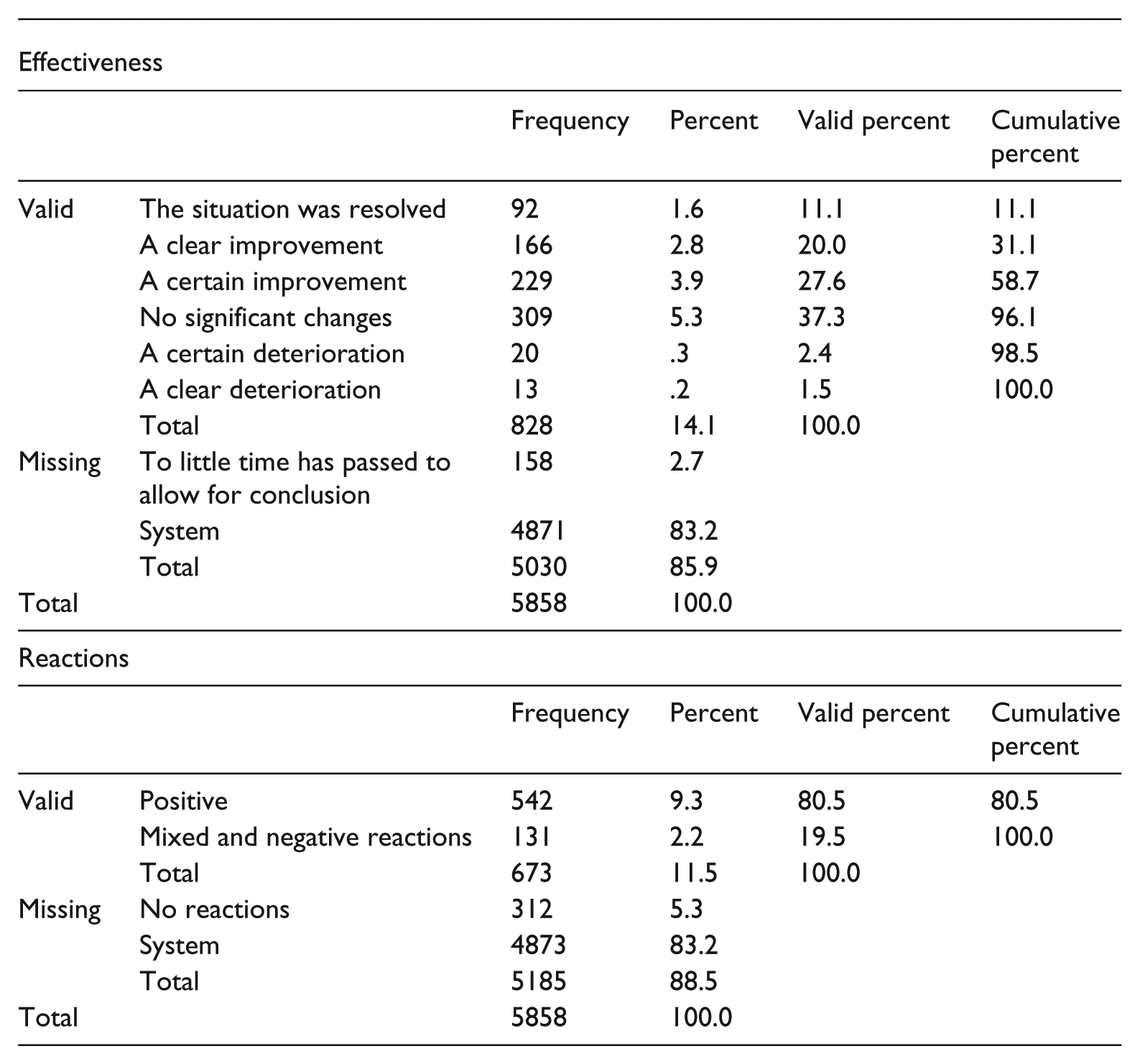
We asked the employees whether their report of wrongdoing had led to changes in the wrongdoing. The response alternatives were: (1) the situation was resolved, (2) a clear improvement occurred, (3) a certain improvement occurred, (4) no significant changes occurred, (5) a certain deterioration occurred, (6) a clear deterioration occurred and (7) too little time had passed to allow for a conclusion. Those who answered the last alternative were excluded from the regression analysis.
Reaction
The respondents were asked if they had experienced some sort of reaction to their whistle blowing. The alternatives included (1) unambiguously positive feedback, (2) no reactions, (3) mixed reactions, which include both positive and negative feedback, and (4) unambiguously negative reactions. In the regression analysis we have excluded those who reported (2), and merged (3) and (4). In our logistic analysis, unambiguously positive feedback is coded (0), mixed and unambiguously negative feedback is coded (1).
Independent variables 9
Individual power resources
Education is coded as: (1) elementary school, (2) upper secondary education, (3) college/university bachelor’s degree, and (4) college/university master’s degree or higher.
Seniority is a numerical variable measuring years in service.
Hours at work is coded: (0) full-time, (1) part-time.
Gender is coded: (0) woman, (1) man.
The position as a middle manager: middle manager is coded (1), others are coded (0).
Institutional arrangements
Organized: who are not, are coded (0), those who are, are coded (1).
Employee representative: the variable includes both those who are safety representatives and trade union representatives. Those who are employee representatives, are coded (1), others are coded as (0).
Employee representatives at the workplace: This variable includes both trade union representatives and safety representatives at the workplace. The presence of employee representatives at the workplace is coded: (0) no, (1) yes.
Collective agreements are coded: (0) no, (1) yes.
Formal whistle blowing procedures are coded: (0) no, (1) yes.
Control variables
Focal wrongdoing: the most recent wrongdoing observed and the most recent wrongdoing reported are dichotomous variables: financial issues: (0) not observed/not reported, (1) observed/reported; user-/customer-related issues: (0) not observed/not reported, (1) observed/reported; system failure: (0) not observed/not reported, (1) observed/reported; psycho-social working environment issues: (0) not observed/not reported, (1) observed/reported; other: (0) not observed/not reported, (1) observed/reported.
Responsible for the wrongdoing: the person perceived to be responsible for the misconduct is coded as: (1) subordinate, (2) colleague, (3) immediate supervisor, (4) other supervisor, (5) top management and (6) the board. There is also an ‘other’ category, which has been excluded from the regression analyses.
Number of employees in the enterprise is coded: (1) up to 5, (2) 5–9, (3) 10–19, (4) 20–49, (5) 50–99, (6) 100–199, (7) 200 and more.
Sector: employees working in the private sector are coded (0), those who work in the public sector are coded (1).
Findings
What is observed, and who are responsible?
A total of 34% (n =1871) have observed serious wrongdoing, and the most frequently reported issue is ‘violations of health, safety and environmental regulations’ (17%), followed by ‘disrespectful behaviour towards users/customers’ (12%) and ‘bullying of colleagues/co-workers’ (11%). At the other end of the scale we find ‘infliction of violence on users’, ‘receipt of bribes/corruption’, ‘embezzlement’ and ‘emission of harmful pollutants’, each accounting for 1%. Two percent responded ‘other’.
Thirty-nine percent said that a colleague was responsible for the most recent wrongdoing they had observed, followed by the immediate supervisor (32%), the top management (20%) and 16% responded ‘other supervisor’.
Whistle blowing activity
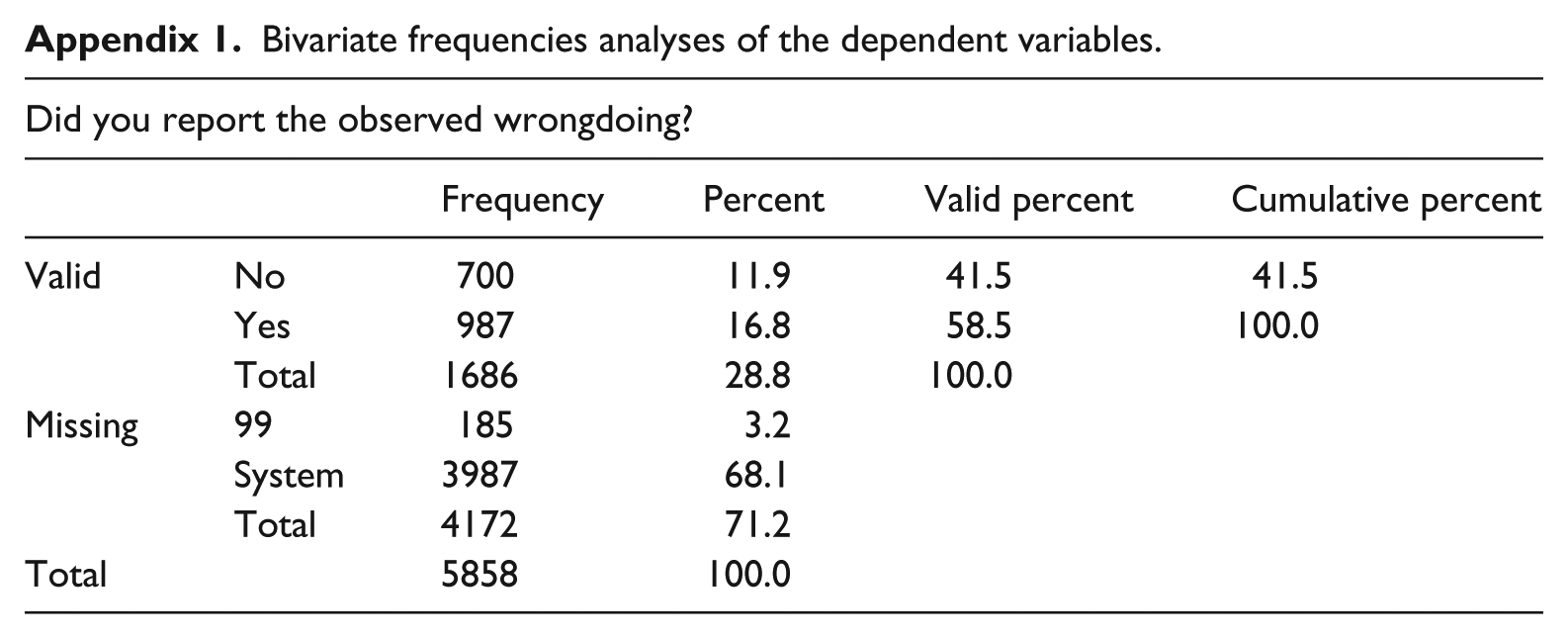
Among those who have discovered one or more acts of wrongdoing, a proportion of 53% (n = 987) state that they have reported the incident, primarily to someone inside the organization. 10 Nine percent did also report the wrongdoing to an external recipient. For various reasons 37% (n = 718) have chosen to remain silent. 11 The most reported reason for silence is fear of reprisals, and surprisingly we find that middle managers to a larger degree than others state that the reason for silence is that ‘the consequences would have been too unpleasant’ (Trygstad, 2010). Based on the most recent issue that was reported, we arrive at the following distribution of topical areas: financial issues: 6%; user-/customer-related issues: 35%; system failure issues: 38%; psycho-social working environment issues: 15%; other: 6%.
Employees follow regular reporting procedures when they disclose wrongdoing, or act in accordance with procedures described as appropriate in the WEA (2005). Almost seven out of 10 have notified their immediate supervisor of issues that they perceived as wrongdoing. Thereafter, safety representatives (24%) and trade union representatives (19%) have been notified, and 17% responded that they have used the enterprise’s internal whistle blowing procedures. Relatively many have also reported matters to a management level above the immediate supervisor (16%) or to the top management (14%). Only a few have involved agencies outside the enterprise, such as the Labour Inspection Authority (2%), other inspectorates (1%), the police (1%) or the media (0.5%).
What influences the choice of reporting or not?
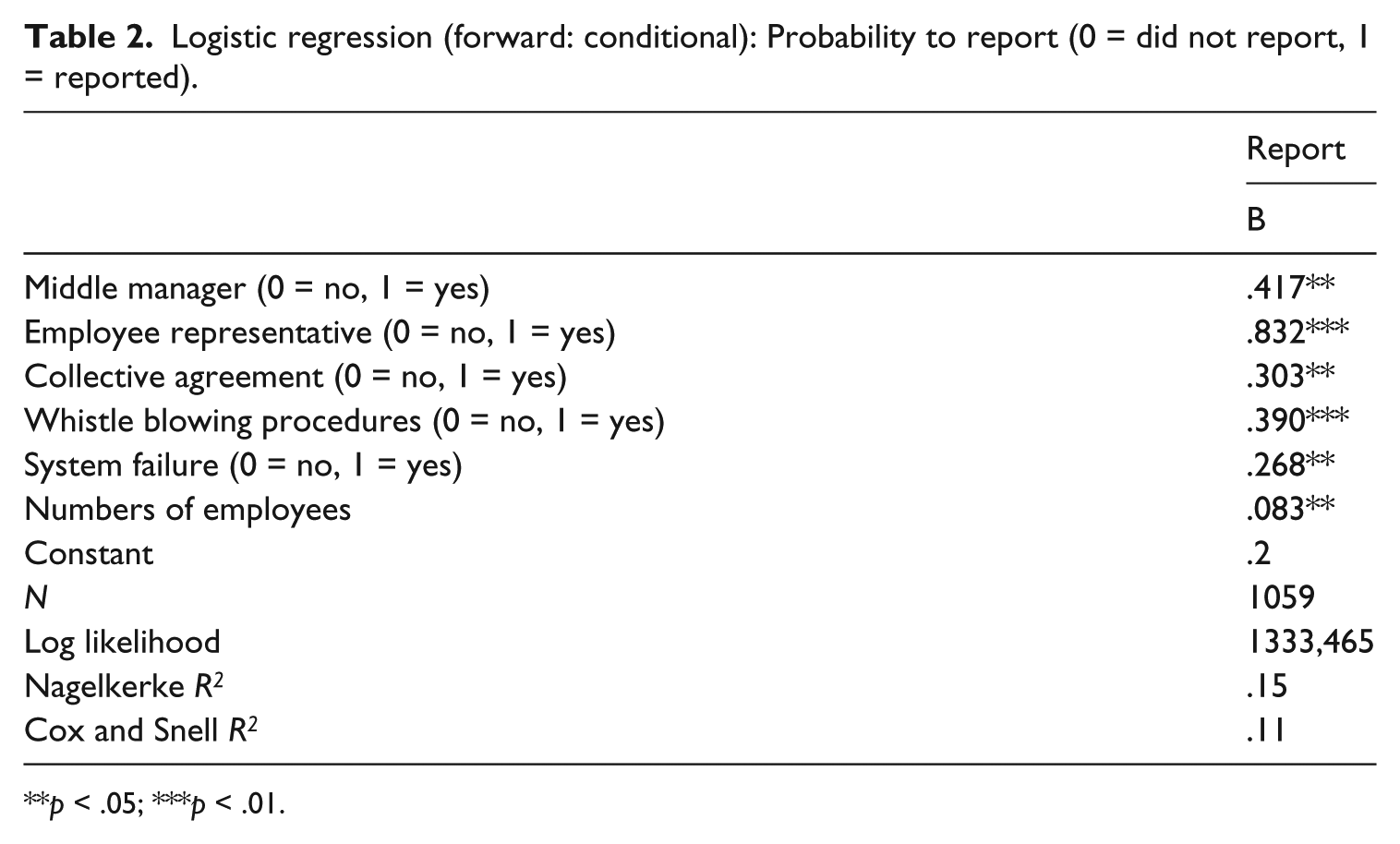
An employee is obliged to be loyal to the enterprise’s legitimate interests, which of course excludes attempts to cover up crimes and violation of laws and regulations (Ot. prp. nr. 84, 2005–2006). In our analysis we measure skills with the variable education, which we treat as an indicator of individual power resources. In Table 2 we investigate if individual power resources impact the probability to blow the whistle. In order to take into account that the dependent variable is a dichotomous variable (0/1), we use logistic regression. The interpretation of the effects is quite similar to linear regression. In the table, we have included the variables that correlate with the dependent variable.
Logistic regression (forward: conditional): Probability to report (0 = did not report, 1 = reported).
**p < .05; ***p < .01.
Education has no significant effect in the analysis. We do however find that those who are middle managers are less prone to report wrongdoing than other employees. The other variables measuring individual power resources have no significant effect. The findings presented in Table 2 further indicate that institutional arrangements matter. If a person holds an elected office as a trade union or safety representative, the probability to blow the whistle is greater compared to those who do not. We also see that the presence of whistle blowing procedures increases the chance for reporting misconduct. The same goes for those covered by a collective agreement. This may indicate that collective agreements to some extent are perceived as providing protection. We also see that if the most recent wrongdoing a person witnessed, discovered or experienced involved system failure, the chance for reporting is higher, compared to other types of wrongdoing. This category includes, for example, violations of health, safety and environmental regulations and the use of illegal chemicals. Last, but not least, we see that an increased amount of employees in the enterprise may contribute to blowing the whistle. Indicators of individual power resources such as seniority, hours at work, education and gender are not included in the analyses due to lack of significant impact. The same is valid for the sector variable.
The effectiveness of whistle blowing
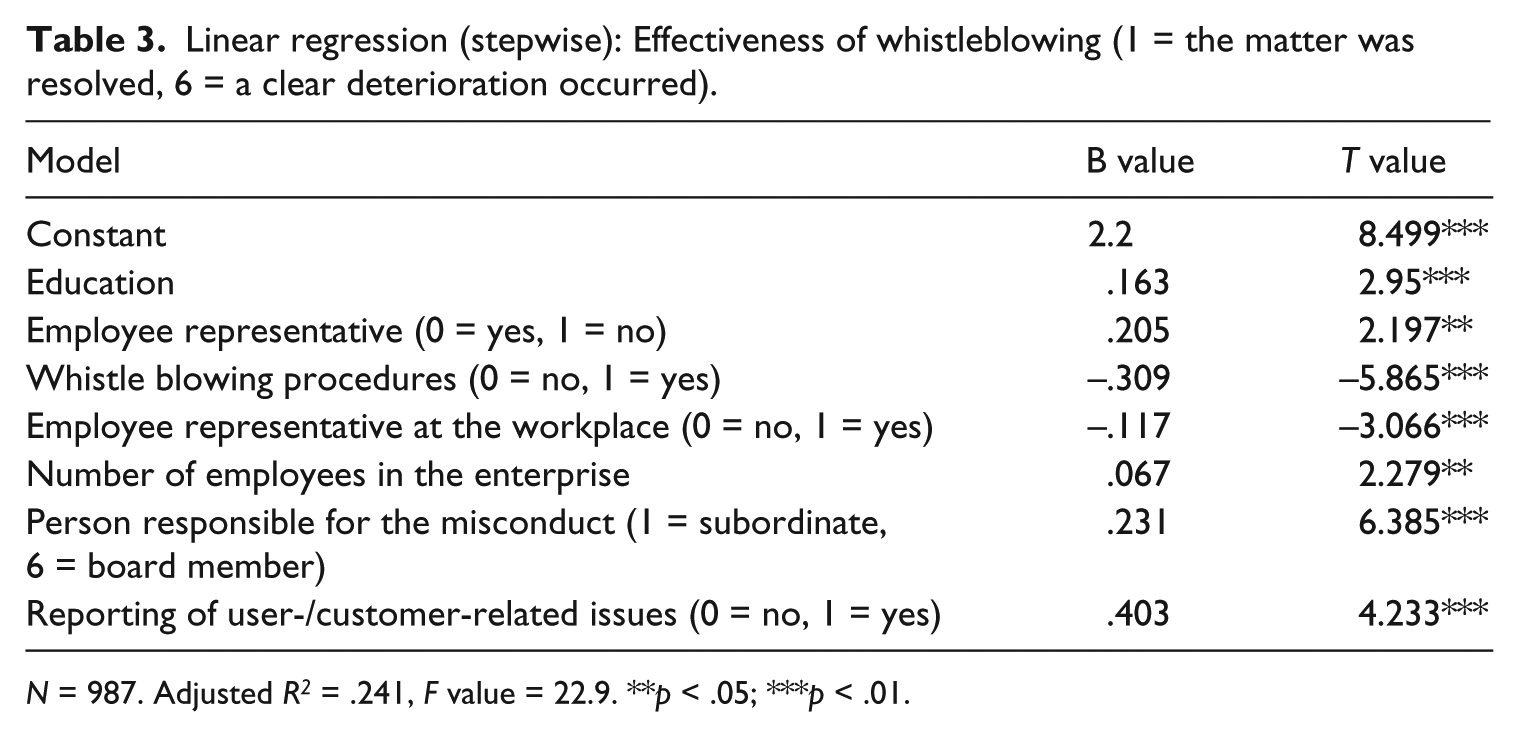
In our survey, half of the respondents (49%) state that the matter was resolved or that improvements occurred as a direct consequence of their whistle blowing activity; 31% answer that no significant changes occurred, while 3% (33 persons) report that a certain deterioration (2%) or a clear deterioration occurred (1%). An additional share of 16% reported the matter very recently, and it is too early to tell. To what extent will individual power resources and institutional arrangements at the workplace have an impact on the effectiveness of whistle blowing? Table 3 gives us an indication.
Linear regression (stepwise): Effectiveness of whistleblowing (1 = the matter was resolved, 6 = a clear deterioration occurred).
N = 987. Adjusted R2 = .241, F value = 22.9. **p < .05; ***p < .01.
The findings displayed in Table 3 indicate that the institutional arrangement at the workplace has an impact. The role as an employee representative seems to make whistle blowing more effective. However, the significance level here is at 5%. Further, employees who have access to whistle blowing procedures tend to respond that the reporting was effective, i.e. the issue or matter was changed for the better or was resolved. Resources in the form of employee representatives who are present at the workplace also seem to matter. Employees who have no trade union representatives or safety representatives available tend to achieve less change than other employees.
Our variables measure individual power resources, and only education has an impact, but in a surprising way. The higher the level of education of the whistle blower, the less effect he or she is likely to achieve, ceteris paribus. The other variables seniority, hours at work and gender – variables also grouped as individual power resources – have no significant effect and are excluded from the analysis.
Three of our control variables have significant impact upon effectiveness. We see that the rank of the person responsible matters: the higher the rank of the wrongdoer, the less effective a report of misconduct is likely to be. We also see that reporting of user- or customer-related issues significantly decreases the effectiveness, when compared to those who report issues pertaining to finance, system failure or the psycho-social working environment. Lastly, our model shows that number of employees has a similar significance level. The larger the enterprise is in terms of its number of employees, the lower the effectiveness of whistle blowing tends to be. The other control variable – sector – has no significant impact in the model: employees in the public sector are just as successful as their colleagues in the private sector when it comes to the effectiveness of whistle blowing.
Are whistle blowers sanctioned?
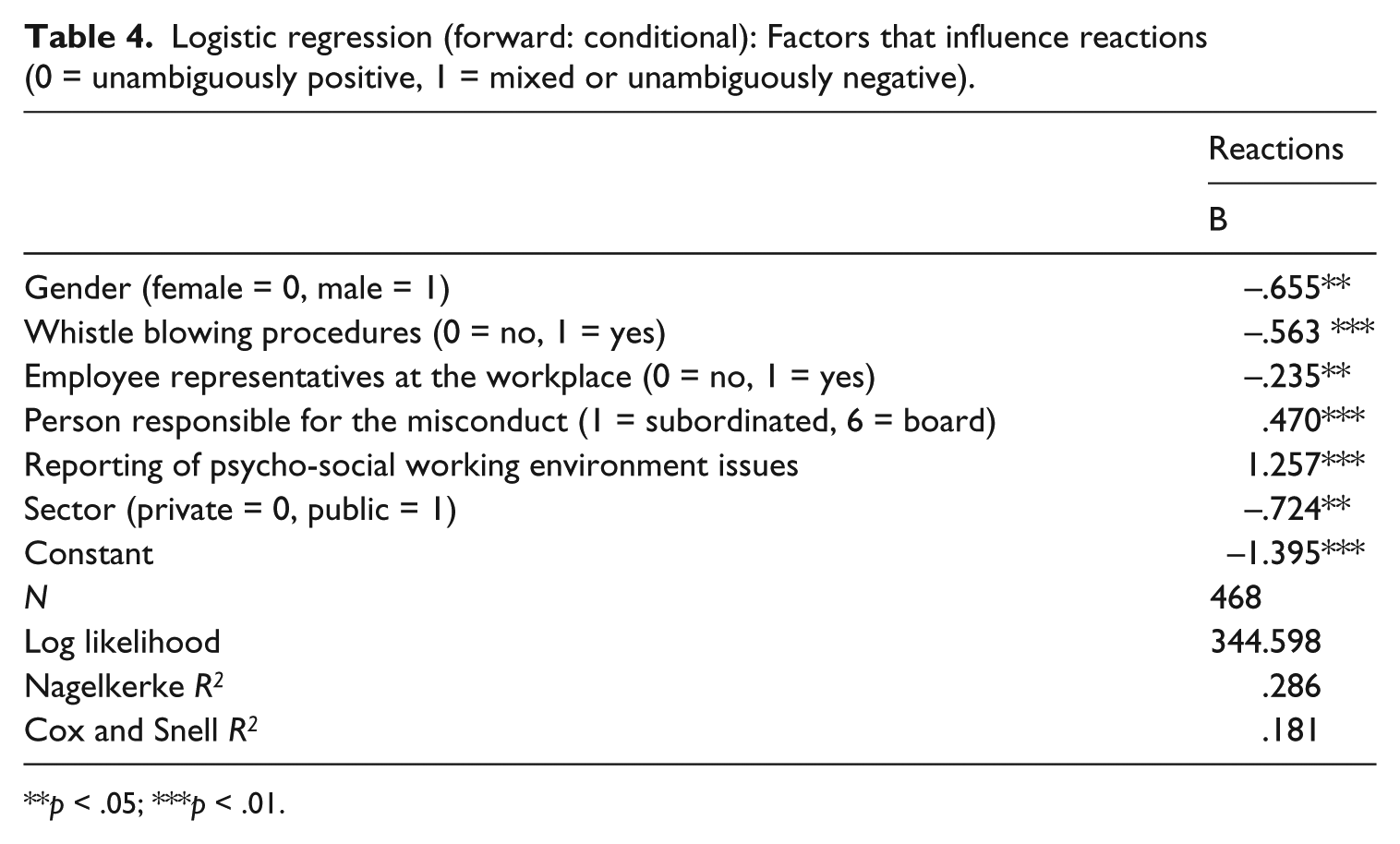
Our study shows that the most commonly experienced reactions include positive feedback from colleagues (47%), positive feedback from the management (36%) and no reaction at all (33%). From the questionnaires we can see that some respondents have ticked both positive and negative reactions. These include, for example, employees who respond that they have been reprimanded and rebuked by their supervisor, while at the same time receiving positive feedback from colleagues, and vice versa. We find that 13% encountered mixed and unambiguously negative reactions. What factors appear to have an effect on the reactions that are brought to bear on the whistle blowers? From Table 4 we can see that characteristics of the employees and features of the enterprise will have an impact.
Logistic regression (forward: conditional): Factors that influence reactions (0 = unambiguously positive, 1 = mixed or unambiguously negative).
**p < .05; ***p < .01.
Our findings suggest that women are more likely to be met with retaliation than men. We have no good explanation, but as mentioned earlier, the labour market in Norway is gendered. It could be that men who blow the whistle are more accepted among managers and co-workers than women. However, the other indicators grouped as individual power resources have no impact on reactions. On one hand, this comes as a surprise. On the other hand, it strengthens our hypothesis that institutional arrangements also matter when it comes to reactions. Whistle blowers who have access to appropriate procedures at their workplace are more likely to encounter positive reactions than others. We also see that the presence of employee representatives at the workplace tends to have a positive effect on the reactions, as those who have no access to such resources are at a greater risk of facing sanctions.
Once again we see that the hierarchical rank of the person responsible for the misconduct matters. If the person responsible is a board member or top manager, a whistle blower is more likely to face sanctions than in a situation where a subordinate person or a co-worker is responsible. Table 4 also indicates that it is more risky to report psycho-social working environment issues than other types of wrongdoing. Lastly, we see that employees working in the private sector have a higher likelihood of receiving retaliation than employees in the public sector.
Would the whistle blowers act in the same manner again? A total of 82% respond in the affirmative, 4% in the negative, while 13% are uncertain. If we take a closer look at only those who responded yes or no, a correlation analysis shows a clear correlation with the reactions that the respondents have faced. Those who encountered negative reactions are far less likely to act as whistle blowers again (Pearson’s correlation coefficient .36**). In other words, negative reactions induce employees who have witnessed, discovered or experienced wrongdoing that ought to have been corrected to remain silent.
Discussion
The findings show that institutional arrangements seem to matter when it comes to the whistle blowing activity, its effectiveness and reactions, and to a lesser degree do individual power resources have impact. The same goes for three of our control variables.
Individual power resources have no significant impact on the choice to become a whistle blower or not. In fact only the role as manager has an impact: middle managers seem to have a tendency to avoid reporting misconduct. One explanation could be that they have sufficient authority to resolve the matter themselves without reporting. It is also possible that managers submit information about the censurable issue through informal channels and resolve the case in this manner. Another explanation could be that managers are more reluctant to divulge such information, particularly if the culprit is a co-manager or a superior. As middle managers, they may be in a position to uncover wrongdoing that may harm the organization’s reputation. This may affect the ability to report, because the reactions could be unpleasant. As mentioned, managers more frequently than others explain their silence by pointing to exactly this fact: the consequences could be harsh. This indicates that even fear could be one of several reasons for silence.
When it comes to institutional arrangements the role as an employee representative increases the propensity to report wrongdoing. It seems like employee representatives act in accordance with the expectations embedded in the role. Trade union representatives are charged with protecting the interests of the employees. To the extent that any censurable issues that harm their members occur, they are obligated to act. Safety representatives are in the same situation: if the working environment is harmful, it is the safety representative’s duty to report it to someone with the power to act. In addition, the role as employee representative provides a higher degree of protection, even if previous research has shown that safety representatives are not immune to negative sanctions following a disclosure of censurable conditions (Skivenes and Trygstad, 2006). Further, those covered by a collective agreement are more likely to report misconduct, and the availability of whistle blowing procedures exerts a clear effect in the direction of more reporting of wrongdoing. This is an encouraging result in the sense that it shows how whistle blowing procedures serve a real function in the workplaces where they exist. Finally, we find that employees in big organizations are more likely to blow the whistle. A reason could be that big enterprises are more formally structured and therefore may encourage employees to report misconduct compared to small ones (Falkum et al., 2009). Another reason is that according to the WEA of 2005, enterprises that have 10 or more employees are obliged to have a safety representative at the workplace and if the number of employees is 50 or more, the enterprise has to have a working environment committee where safety representatives meet the management. Hence, the number of employees is here related to institutional arrangements.
Individual power resources do not show any particular impact on whistle blowing efficiency, with one exception: high levels of education decrease the effectiveness of whistle blowing. Other studies have found that whistle blowers often are high skilled employees (Glazer and Glazer, 1989; Rothschild and Miethe, 1999). We expected highly educated employees to have a better opportunity to exert influence on decision makers or others who have authority to deal with the matter. Our findings do not support such an assumption, and we have made similar findings in previous studies (Skivenes and Trygstad, 2010). One explanation could be that holding a more elevated strategic position increases the chance that the wrongdoing also represents a larger threat to the legitimacy of the organization (cf. Miethe, 1999). Not reacting to reports of such issues could thereby constitute a strategy used by those who feel threatened, as ignoring a whistle blower could serve to prevent elucidation and less attention being drawn to the matter, in a short term perspective.
Also when it comes to effectiveness, our analysis confirms that institutionalized arrangements make a difference. Employees who hold elected office in the enterprise are more capable of effecting change than others. There could be a number of reasons. As a rule, trade union representatives and safety representatives will have a stronger voice in the organization, as holding an elected office implies that they represent not only themselves, and because they also have access to a number of channels where they can voice their concerns more effectively than other employees. Also, and not least, a large part of their role embodies the function of watchdog, whose duty it is to draw attention to misconduct. Employees working in enterprises where employee representatives are present, as well as in enterprises that have established whistle blowing procedures, tend to achieve a higher degree of change in the censurable situation than those working in enterprises without such arrangements.
Our analysis also shows that those who reported wrongdoings related to user- or customer-related issues were less likely to observe that the situation had changed for the better. Our data indicate that whistle blowing activities are especially prevalent in health enterprises and the care/nursing services and social services sectors. In the latter two sectors we have indications that there is often a major discrepancy between the needs of the recipients of care and nursing, on the one hand, and the resources available to provide care, on the other. Disagreement will therefore occasionally occur over what is to be considered an adequate level of provision of care, and this could be one possible explanation of the lower effectiveness of whistle blowing (cf. Skivenes and Trygstad, 2006). The higher the position of the person responsible, the less effective whistle blowing is likely to be. And finally, we find that the size of the organization matters; the larger the enterprise is in terms of its number of employees, the less effective whistle blowing seems to be. We lack good explanations for this, although it could possibly be due to a risk of whistle blowing reports more easily being overlooked in large organizations and less frequently being addressed, for example because of unclear areas of responsibility and/or high performance pressure in the enterprise. A further explanation could be that the whistle blower will have more difficulty observing any effects from his or her actions in a large enterprise than in a smaller one, where matters are more transparent. It is also plausible that changes in big organizations will take a longer time, compared to small ones. Clearly, these findings need to be examined further.
Whistle blowers most frequently face reactions in the form of positive feedback from colleagues and managers. A clearly negative finding, although not a very surprising one, is that the position that the person responsible for the misconduct has in the organizational hierarchy seems to increase the likelihood of retaliation. If the person responsible is a top manager, the risk of negative sanctions increases, compared to conditions for which the person responsible is a colleague. The power held by the person responsible indicates that caution is called for by those who witness, discover or experience misconduct committed by a superior. The probability of receiving retaliation increases if the whistle blower is a woman. Again, we lack good explanations, but it may be related to a lower acceptance of women raising their voice in the organization. As regards indicators of institutional features that make a difference, the presence of whistle blowing procedures and employee representatives at the workplace appears to have an impact with regard to sanctions as well. Findings clearly indicate that whistle blowing procedures increase the chance of the reporting being met with positive reactions. This indicates that whistle blowing procedures in fact render such reporting less risky and increase the opportunities for success. The same goes for the presence of employee representatives, which decreases the risk of negative sanctions.
When it comes to type of wrongdoing, we find that the risk for retaliation increases if the reported wrongdoing is a psycho-social working environment issue. This is in line with findings in previous studies (Einarsen and Pedersen, 2007; Skivenes and Trygstad, 2010). It is also reasonable to assume that characteristics of the workplace can explain why reporting on psycho-social working environment issues invokes the toughest sanctions. In cases where bullying and sexual/ethnic harassment occur, the workplace is likely to be characterized by absent leadership. Finally, it is more risky to be a whistle blower in the private sector. One reason may be that freedom of speech has a stronger position in general in the public sector. From empirical studies, we also know that trade union representatives and safety representatives are well represented at different levels and in different units in a public enterprise, and that both employees and employee representatives will have access to more forums compared to in the private sector.
Conclusion
This study has presented findings from one of the largest surveys conducted among the Norwegian labour force, showing that whistle blowing activity, effectiveness and reactions are in line with previous results in Norwegian whistle blowing research. Comparatively, Norwegian employees are high on whistle blowing activity and effectiveness, and low on retaliation. The explanatory analysis shows that individual power resources, when isolated, only have limited significant impact, while the powers from institutional arrangements are of importance. The findings confirm our hypotheses and support the underlying ideas of institutional arrangements and the impact the Norwegian labour model, with its democratic work ethic, has on whistle blowing. On the basis of our findings and analysis we believe that institutional arrangements contribute to a form of organizational justice; these forms of arrangements give employees opportunities to use their voice in terms of blowing the whistle. The safety net embedded in the institutional arrangements seems to reduce the risk of sanctions. This study shows that there is good reason for making clear to managers at various levels that retaliating against a whistle blower is illegal, and to underline the responsibility managers have in handling wrongdoings. The presence of whistle blowing procedures and employee representatives at the workplace increases the effectiveness of whistle blowing, enhances the likelihood that the wrongdoing will be addressed, and increases the probability that reactions will be positive. What we do not know is if whistle blowing procedures are decisive, or if procedures are only established by enterprises where favourable conditions already exist. The answer is likely to be both. Our findings, however, indicate that whistle blowing procedures do have an effect. A higher number of whistle blowers come forward, they more often succeed, and the likelihood of positive feedback is higher. It is also reasonable to assume that the whistle blowing procedures would have been less prevalent if Section 3-6 – stating that whistle blowing procedures ought to be established – had not been included in the WEA of 2005. This demonstrates how institutional arrangements enacted at the central level may exert a direct influence at the workplace level. Although caution has been voiced on a possible over-emphasis on integrity and accountability regulations (Segal, 2012: 826), we regard whistle blowing procedures to be an important contribution that will strengthen the Norwegian labour market model’s focus on codetermination, democracy and openness.
Footnotes
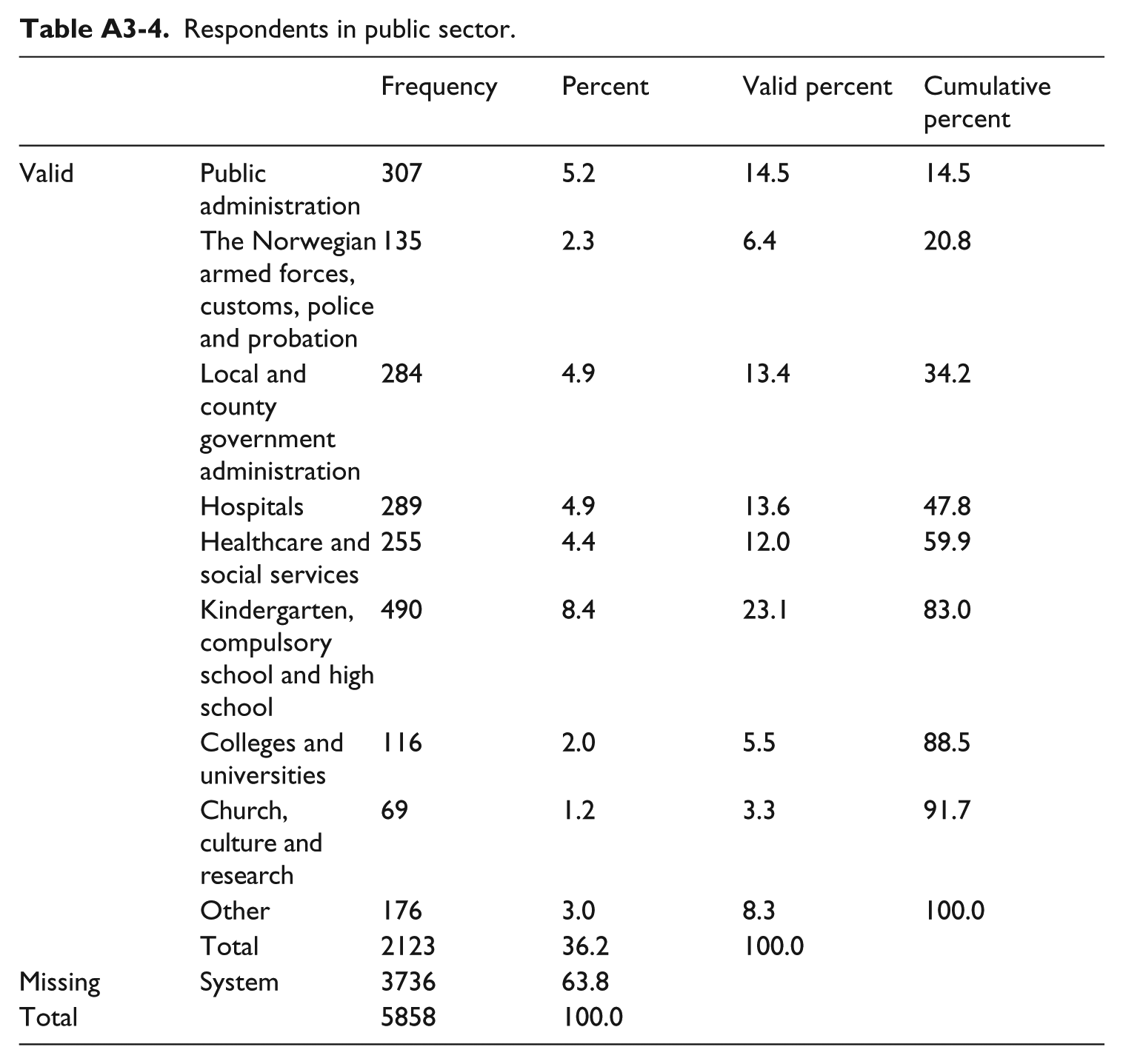
Appendix 3.
Respondents in public sector.
| Frequency | Percent | Valid percent | Cumulative percent | ||
|---|---|---|---|---|---|
| Valid | Public administration | 307 | 5.2 | 14.5 | 14.5 |
| The Norwegian armed forces, customs, police and probation | 135 | 2.3 | 6.4 | 20.8 | |
| Local and county government administration | 284 | 4.9 | 13.4 | 34.2 | |
| Hospitals | 289 | 4.9 | 13.6 | 47.8 | |
| Healthcare and social services | 255 | 4.4 | 12.0 | 59.9 | |
| Kindergarten, compulsory school and high school | 490 | 8.4 | 23.1 | 83.0 | |
| Colleges and universities | 116 | 2.0 | 5.5 | 88.5 | |
| Church, culture and research | 69 | 1.2 | 3.3 | 91.7 | |
| Other | 176 | 3.0 | 8.3 | 100.0 | |
| Total | 2123 | 36.2 | 100.0 | ||
| Missing | System | 3736 | 63.8 | ||
| Total | 5858 | 100.0 | |||
Appendix 1.
Bivariate frequencies analyses of the dependent variables.
| Did you report the observed wrongdoing? | |||||
|---|---|---|---|---|---|
| Frequency | Percent | Valid percent | Cumulative percent | ||
| Valid | No | 700 | 11.9 | 41.5 | 41.5 |
| Yes | 987 | 16.8 | 58.5 | 100.0 | |
| Total | 1686 | 28.8 | 100.0 | ||
| Missing | 99 | 185 | 3.2 | ||
| System | 3987 | 68.1 | |||
| Total | 4172 | 71.2 | |||
| Total | 5858 | 100.0 | |||
| Effectiveness | |||||
|---|---|---|---|---|---|
| Frequency | Percent | Valid percent | Cumulative percent | ||
| Valid | The situation was resolved | 92 | 1.6 | 11.1 | 11.1 |
| A clear improvement | 166 | 2.8 | 20.0 | 31.1 | |
| A certain improvement | 229 | 3.9 | 27.6 | 58.7 | |
| No significant changes | 309 | 5.3 | 37.3 | 96.1 | |
| A certain deterioration | 20 | .3 | 2.4 | 98.5 | |
| A clear deterioration | 13 | .2 | 1.5 | 100.0 | |
| Total | 828 | 14.1 | 100.0 | ||
| Missing | To little time has passed to allow for conclusion | 158 | 2.7 | ||
| System | 4871 | 83.2 | |||
| Total | 5030 | 85.9 | |||
| Total | 5858 | 100.0 | |||
| Reactions | |||||
| Frequency | Percent | Valid percent | Cumulative percent | ||
| Valid | Positive | 542 | 9.3 | 80.5 | 80.5 |
| Mixed and negative reactions | 131 | 2.2 | 19.5 | 100.0 | |
| Total | 673 | 11.5 | 100.0 | ||
| Missing | No reactions | 312 | 5.3 | ||
| System | 4873 | 83.2 | |||
| Total | 5185 | 88.5 | |||
| Total | 5858 | 100.0 | |||
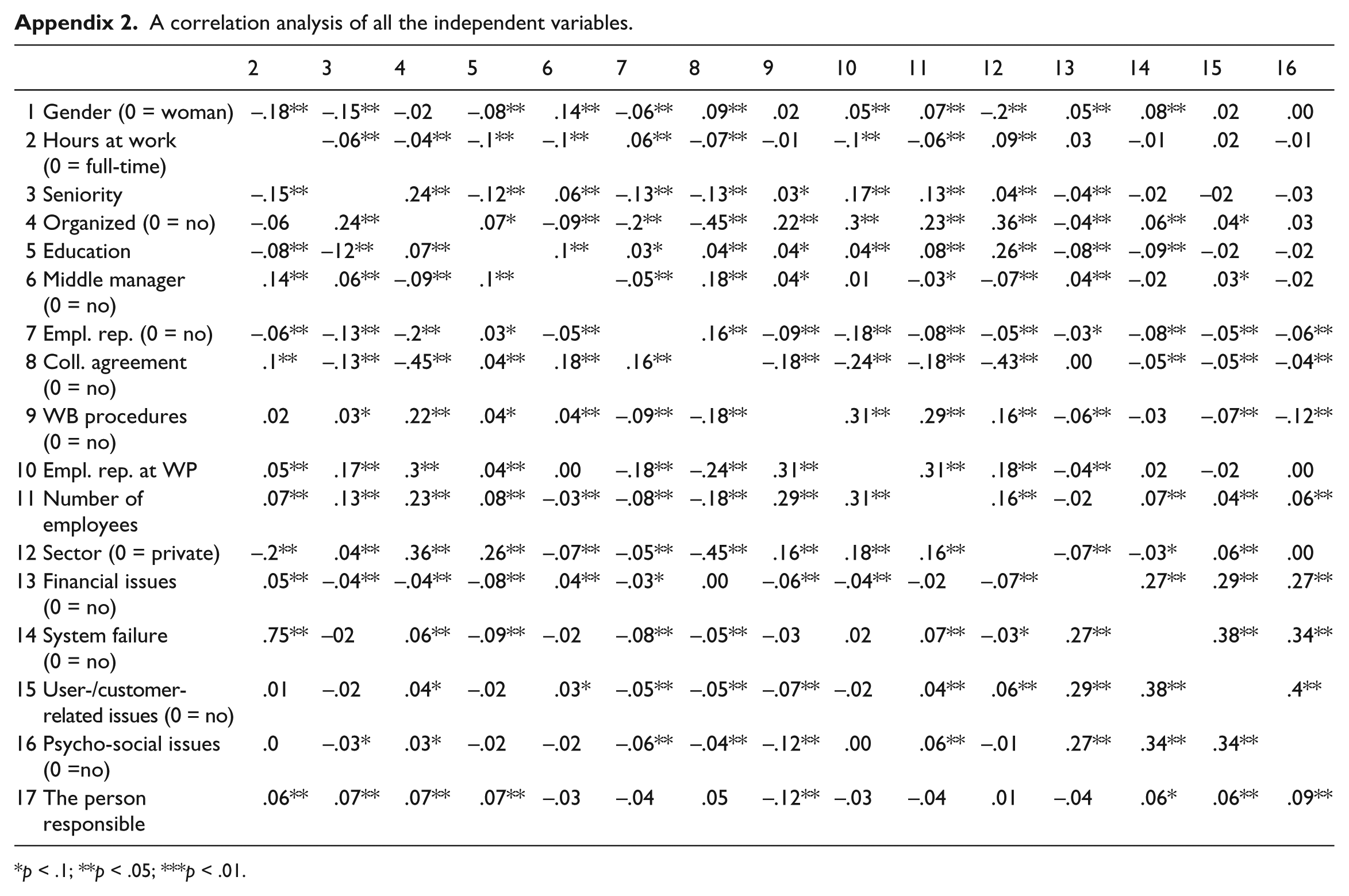
Appendix 2.
A correlation analysis of all the independent variables.
| 2 | 3 | 4 | 5 | 6 | 7 | 8 | 9 | 10 | 11 | 12 | 13 | 14 | 15 | 16 | |
|---|---|---|---|---|---|---|---|---|---|---|---|---|---|---|---|
| 1 Gender (0 = woman) | –.18** | –.15** | –.02 | –.08** | .14** | –.06** | .09** | .02 | .05** | .07** | –.2** | .05** | .08** | .02 | .00 |
| 2 Hours at work (0 = full-time) | –.06** | –.04** | –.1** | –.1** | .06** | –.07** | –.01 | –.1** | –.06** | .09** | .03 | –.01 | .02 | –.01 | |
| 3 Seniority | –.15** | .24** | –.12** | .06** | –.13** | –.13** | .03* | .17** | .13** | .04** | –.04** | –.02 | –02 | –.03 | |
| 4 Organized (0 = no) | –.06 | .24** | .07* | –.09** | –.2** | –.45** | .22** | .3** | .23** | .36** | –.04** | .06** | .04* | .03 | |
| 5 Education | –.08** | –12** | .07** | .1** | .03* | .04** | .04* | .04** | .08** | .26** | –.08** | –.09** | –.02 | –.02 | |
| 6 Middle manager (0 = no) | .14** | .06** | –.09** | .1** | –.05** | .18** | .04* | .01 | –.03* | –.07** | .04** | –.02 | .03* | –.02 | |
| 7 Empl. rep. (0 = no) | –.06** | –.13** | –.2** | .03* | –.05** | .16** | –.09** | –.18** | –.08** | –.05** | –.03* | –.08** | –.05** | –.06** | |
| 8 Coll. agreement (0 = no) | .1** | –.13** | –.45** | .04** | .18** | .16** | –.18** | –.24** | –.18** | –.43** | .00 | –.05** | –.05** | –.04** | |
| 9 WB procedures (0 = no) | .02 | .03* | .22** | .04* | .04** | –.09** | –.18** | .31** | .29** | .16** | –.06** | –.03 | –.07** | –.12** | |
| 10 Empl. rep. at WP | .05** | .17** | .3** | .04** | .00 | –.18** | –.24** | .31** | .31** | .18** | –.04** | .02 | –.02 | .00 | |
| 11 Number of employees | .07** | .13** | .23** | .08** | –.03** | –.08** | –.18** | .29** | .31** | .16** | –.02 | .07** | .04** | .06** | |
| 12 Sector (0 = private) | –.2** | .04** | .36** | .26** | –.07** | –.05** | –.45** | .16** | .18** | .16** | –.07** | –.03* | .06** | .00 | |
| 13 Financial issues (0 = no) | .05** | –.04** | –.04** | –.08** | .04** | –.03* | .00 | –.06** | –.04** | –.02 | –.07** | .27** | .29** | .27** | |
| 14 System failure (0 = no) | .75** | –02 | .06** | –.09** | –.02 | –.08** | –.05** | –.03 | .02 | .07** | –.03* | .27** | .38** | .34** | |
| 15 User-/customer- related issues (0 = no) | .01 | –.02 | .04* | –.02 | .03* | –.05** | –.05** | –.07** | –.02 | .04** | .06** | .29** | .38** | .4** | |
| 16 Psycho-social issues (0 =no) | .0 | –.03* | .03* | –.02 | –.02 | –.06** | –.04** | –.12** | .00 | .06** | –.01 | .27** | .34** | .34** | |
| 17 The person responsible | .06** | .07** | .07** | .07** | –.03 | –.04 | .05 | –.12** | –.03 | –.04 | .01 | –.04 | .06* | .06** | .09** |
p < .1; **p < .05; ***p < .01.
Funding
This research received no specific grant from any funding agency in the public, commercial, or not-for-profit sectors.