




Abstract
In this article, we explore the process of resilience for children with a cleft lip and/or palate (visible difference) starting secondary school in the United Kingdom. A qualitative longitudinal research design was used to consider resilience as a process with Bronfenbrenner's ecological theory as a lens. Data were collected using a range of qualitative methods, including family interviews, child interviews, and video blogs. Fourteen parents and eight child participants between 11 and 12 years old took part in the research. Key results identified a series of steps in the resilience process during the school transition, namely, (1) the family preparing for the new school microsystem, (2) the children entering and negotiating the new microsystem, (3) navigating in and between microsystems, and (4) actively engaging with the mesosystem. To conclude, viewing resilience as a process helps us understand the interactive role played by schools in preparation for supporting and monitoring the transition. Successful negotiation of the transition of secondary school required the child to be recognized as an active participant in this process.
Keywords
A cleft lip and/or palate (C/LP) sometimes referred to as a cleft is a condition occurring during the sixth to thirteenth week of pregnancy when the facial features begin fusing together (Yu et al., 2009). It is one of the most common congenital causes of having a visible difference of the face. Around 1200 babies are born with a cleft in the United Kingdom each year, with a prevalence of 9.25 per 10,000 births (Faulkner et al., 2021). The cleft lip occurs on the upper lip, varying in size and location; it can be unilateral, appearing on one side of the lip, or bilateral, occurring on both sides (Chapados, 2000). For children with a palatal cleft (center of the mouth), speech and facial appearance can be affected (Chapados, 2000). These children require several surgical interventions and recurring courses of orthodontic treatment during the first 20 years of their life (Sharif et al., 2013).
The transition to secondary school is a significant life event for children occurring at age 11 in the United Kingdom. Researchers have discussed the importance of negotiating the primary to secondary school transition, which impacts on the child's adjustment, wellbeing, levels of stress and depression, and indeed on their educational experience (Hughes et al., 2013; Jindal-Snape et al., 2020). This transition has been shown to be a stressful experience, resulting in a negative impact on wellbeing and educational attainment for some children (Mackenzie et al., 2012). Zeedyk et al. (2003) suggest that the secondary school transition can be difficult for several reasons, including fear of the unknown, worries about getting lost at school, and the physical size of the school compared to the previous educational environment. Importantly, many children adapt well to secondary school life, and some may even fare better than at primary school (Gillison et al., 2008) when the transition is seen as a new opportunity.
Less is known about primary to secondary school transition for children with a visible difference. Children with a CL/P often have a visible difference of the face, and the school transition occurs at a time when concerns may arise (such as bullying) about facial appearance in early adolescence (Feragen & Stock, 2016; Marshman et al., 2009). Children with a visible difference experience an added pressure when starting secondary school because looking different can be considered a risk factor (Stock & Ridley, 2017). One of the most recurrent difficulties during adolescence relates to their negative self-perception and struggles with social exclusion and loneliness (Tomova et al., 2021). Children with a visible difference may find that starting secondary school impacts their self-esteem and elicits unsolicited attention or bullying from the new peer group (Rumsey & Harcourt, 2007).
Relatively little is known about how children with a visible difference experience the school transition, or what it means to be resilient in secondary school. Recent research (Faulkner et al., 2021; Stock & Ridley, 2017) found several challenges experienced by children with a CL/P at school, including negative social interactions and bullying incidents, a lack of support from teachers and managing additional conditions, such as, hearing or sight concerns which are considered added risks to the child. However, neither study was a longitudinal study of secondary school transition, nor did either focus specifically on resilience. In the case of Faulkner et al. (2021), six pupils were interviewed within 12 months of starting secondary school, but this study did not follow the children over the transition period. There is a need for longitudinal research that follows children with a CL/P through secondary school transition if we are to understand the enactment of resilience from the children's perspective. The following sections will explain how resilience is viewed as a process as well as its relevance to secondary school transition.
Viewing resilience as a process during secondary school transition
Research on human resilience originated in psychiatry studies concerned with the effect of trauma and stress on the functioning of individuals and families. Early research viewed resilience as a personal quality or inherent invulnerability in a person (Anthony & Cohler, 1987; Block & Block, 1980). Studies focused on the characteristics of young children living in high-risk situations, identifying certain qualities, such as the need to be robust or good communicators (Richardson, 2002; Werner & Smith, 1992). As research developed, there was an impetus to understand how children cope successfully with difficulties at one point in life but react differently to other adversities (Rutter, 1987). Longitudinal studies of children and adolescents also found that for those exposed to multiple stressors, only a minority developed problematic emotional disturbances (Rutter, 1989; Werner, 1992). Evidence of children thriving despite negative socioeconomic disadvantage encouraged researchers to understand the varied responses to adversity, and to advance this understanding, resilience has been conceptualized as a process (Luthar et al., 2000; Rutter, 2000).
Viewing resilience as a process rather than a trait turns the focus away from the characteristics associated with being resilient and instead requires that we consider the mechanisms by which resilience might work (Windle, 2011). Luthar et al. (2000) defined resilience as “a dynamic process encompassing positive adaptation within the contexts of significant adversity” (p. 543). Rutter (1999) viewed resilience as a term used to describe resistance to psychosocial risk experiences, rather than a fixed attribute of an individual. Masten (2001) recognized the resilience process can be seen as ordinary magic, and it is worth paying attention to the positive adaptations taking place during the day-to-day happenings of the school day. Furthermore, it is helpful to take a multisystemic view of the child and the families and communities around them over the secondary school transition. As Ungar (2021) suggests, the more we can understand resilience as a process, the better we can influence systems to change in ways that benefit the people in those systems.
Studying the process of resilience as children transition to a new school setting provides an opportunity to consider how protective processes work and how the child engages with the social context. Viewing resilience as a process allows a more thorough understanding of resilience as a multidimensional phenomenon, which can operate across different systems (Vella & Pai, 2019), including the individual, family, school, and society that are interconnected and dynamic, rather than as something located in the individual. However, to date it is unclear what the process of resilience is for children starting secondary school, or how to conceptualize this process, given the lack of longitudinal data concerning secondary school transition.
In thinking about resilience as a process, secondary school transition is a very useful transition for researchers to study. Secondary school transitions can be seen as a turning point (Masten & Cicchetti, 2016) or a life change which have the potential to affect long-term progression. Critical junctures like school transitions afford children the opportunity to have new opportunities and choices, with the possibility of changing peer groups or placing themselves in healthier or riskier situations, resulting in some positive trajectories along their life path (Toland & Carrigan, 2011). Good relationships are fundamental and support within the family and in school can create an important context for the development of protective mechanisms (Luthar, 2006). Protective factors within the family include family cohesion and structure, while protective factors at school include positive peer relations (Jacelon, 1997; Werner, 1992), which are particularly salient in the secondary school transition when children encounter new peers across different classes and subject areas (Juvonen et al., 2012). These experiences will be shaped by the extent to which schools are able to foster and improve peer connectedness throughout the first year of secondary school (Kwarikunda et al., 2023). In addition, having a positive relationship with at least one adult, such as parent or teacher (Luthar et al., 2000), is also seen as a protective factor. School transition therefore affords opportunities for researchers to study resilience as a process for young people, particularly if longitudinal designs can be used to capture their lived experiences.
In order to undertake useful studies of resilience, Schoon (2006) suggests it is helpful to locate it within a wider theoretical model. Whilst some other theories such as the Social Ecology of Resistance Theory (Ungar, 2021; Ungar & Liebenberg, 2011) have been used as a theoretical lens to study resilience across multiple systems at the same time, operationalizing this theory usually requires sequential, longitudinal, mixed-method research methods involving an interdisciplinary team of researchers. For the current study Bronfenbrenner's (1979) ecological theory was chosen as the most appropriate theoretical lens since it emphasizes the interactions between the individual and the environment and is well capable of considering the complexity of these structures and interactions. This is important because in Bronfenbrenner's theory, a person's development occurs by regular interactions with others and is maintained over reciprocal relations between the individual and their environment (Bronfenbrenner, 1977, 1978, 1979).
According to Bronfenbrenner, the child's environment is seen as a set of embedded structures (i.e., subsettings), each inside the next. In school, these environments contribute to the learning environment of the student (Lau & Ng, 2014). Bronfenbrenner (1979) identified the systems as: (a) microsystem (a pattern of activities, roles, and interpersonal relations experienced by developing person in face-to-face settings, such as in the home or classroom); (b) mesosystem (the interrelations among key settings); (c) exosystem (a setting in which the child does not take part, but influences the child by events happening in this system, such as school governance); (d) macrosystem (the institutional systems of a culture influences the other ecological settings, such as national policies on schooling); and (e) chronosystem (changes over time in the environments where a person is living such as living through the pandemic). The attachment of the prefix bio to Bronfenbrenner's ecological theory paid attention to the characteristics of the developing person. His bioecological model evolved and defined the following elements: Process, Person, Context, and Time (PPCT, Bronfenbrenner & Morris, 2006).
In recent publications, Bronfenbrenner's theory has been used both to conceptualize childhood resilience (Antony, 2022), and in empirical studies of resilience in education settings such as Lin and Pendergast (2019) study of the development of resilience in preschoolers in Taiwan. It has also been employed in studies of primary to high school transition (Strnadová et al., 2023). Masten (2021) suggests that Bronfenbrenner's theory allows researchers to consider context in the form of all the systems around the developing child and it was therefore a good choice for the current study to research resilience as a process for children and their families during secondary school transition.
Current study
Relatively little is known about how children with a visible difference experience the secondary school transition, and the process of resilience. This research will be useful to several interest groups including organizations, clinicians, and educationalists. The current study employed a qualitative, longitudinal design to understand the process of resilience as it occurred for eight children with a CL/P and their parents, during the primary-to-secondary school transition. The longitudinal design was chosen in order to capture temporal changes and critical moments in the children's secondary school transition experiences, following them right through their first year of secondary school. The child participants were viewed as experts to understand how they perceived and interpreted events during the transition. Their meaning-making of such an important event made it a highly suitable subject matter for qualitative enquiry (Hass et al., 2014). Developing an understanding of a successful secondary education transition is important because of the salience for child's wellbeing, and because it is relevant to achievement in all school subjects and to understanding a child's adaptability to transitions (Jindal-Snape et al., 2019). The following research question is addressed: What is the process of resilience for children with a visible difference (cleft lip and/or palate) starting secondary school?
Method
A qualitative longitudinal design was conducted during the secondary school transition. The data were collected over two different year cohorts from August 2017 to January 2018, for the first cohort, and from August 2018 to January 2019 for the second. The data from both cohorts was collated for this research article and collected as part of the doctoral work of the first author.
A range of qualitative methods were employed, including semistructured family interviews with the children and their parents; online snapshot interviews with the child at different time points through the school term; an invitation to each child to make a digital diary in the form of a video blog (vlogging).
A qualitative methodology facilitated the collection of detailed and rich data and allowed the researcher to access the child's experiences and perspectives from the parents. The researcher was able to shadow the child participants at various time points in their first year, from starting secondary school to the end of the autumn school term.
Participants
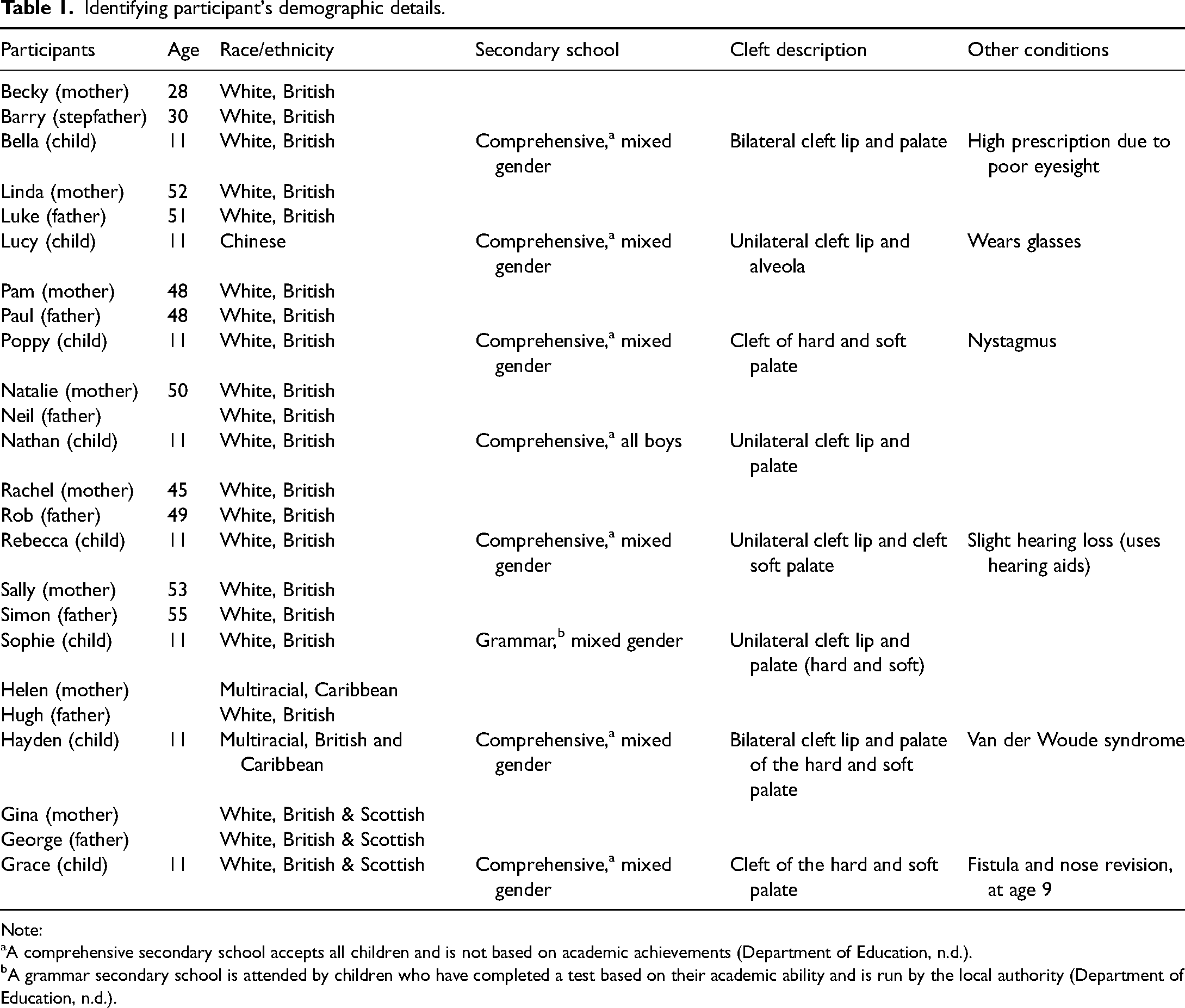
The child participants (2 boys and 6 girls) were aged 11 to 12 years, with an average age of 11 years and one month, and who lived in England and Scotland. Parent participants (n = 14) were included in the study at time points 1 and 4 (see Tables 1 and 2). Purposive sampling was used to recruit the child participants because the research study focused on children with a CL/P. Participants were recruited through CLAPA's (Cleft Lip and Palate Association) social sites and via the researcher's networks. CLAPA aims to support children with a CL/P, connecting families and creating a CLAPA community (CLAPA, 2019).
Identifying participant's demographic details.
Note:
A comprehensive secondary school accepts all children and is not based on academic achievements (Department of Education, n.d.).
A grammar secondary school is attended by children who have completed a test based on their academic ability and is run by the local authority (Department of Education, n.d.).
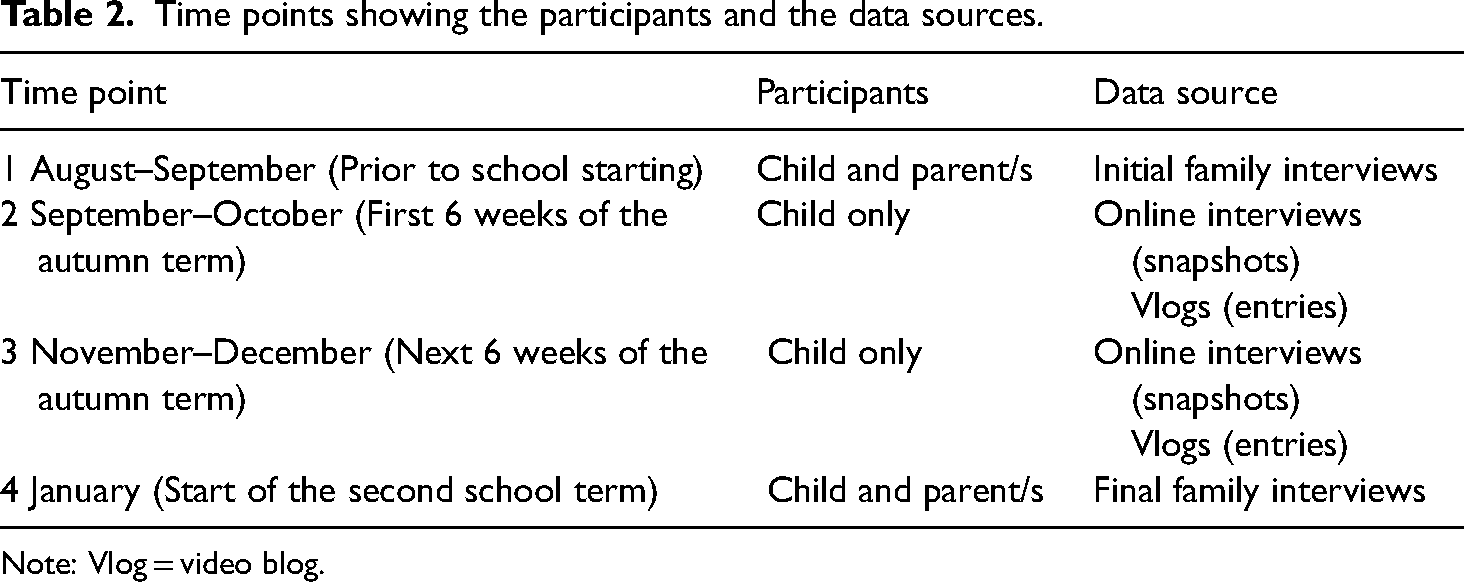
Time points showing the participants and the data sources.
Note: Vlog = video blog.
All participants were given a pseudonym (see Table 1) to ensure confidentiality. The child participants were from eight different schools, and they were all English speaking. Five child participants were white British, one was multiracial and Afro Caribbean, and one was white British and Scottish.
Table 1 depicts descriptions of the children's clefts and identifies all participants’ ages and race. Four children were born with a unilateral cleft lip, affecting both sides of the mouth. Other conditions experienced by the children included visual aid (glasses) and hearing—both associated conditions of a CL/P. Hayden was the only child participant who had Van der Woude syndrome, a condition that affects the development of the face (depressions [bumps, known as “pits”] near the center of the lower lip, which may appear moist due to the presence of salivary and mucous glands in the pits; MedlinePlus, 2020). There were differences in the participants’ school settings, with six attending a comprehensive mixed gender school, one (Nathan) attending a comprehensive all boys school, and one (Sophie) attending a grammar mixed gender school.
Data collection and procedure
Table 2 highlights the different types of data collected at four time points. The time points were designed to accommodate the school academic calendar because it supported the child participants “quieter” times and thus provided optimal opportunities to collect data. The first point occurred before school started, exploring the initial thoughts and perspectives of the children and their families. The school calendar was demarcated using specific time points, which allowed the researchers to study the events of the school transition, as indicated in Table 2 below.
Data collection techniques
Family interviews were conducted face-to-face and online (via Skype). Due to the geographic location of some participant families around the United Kingdom, four online interviews were conducted. Data from time points 2 and 3 included online snapshot interviews (via Facebook Messenger or WhatsApp) with the child participants. Online interviews were chosen as contemporaneous, and child-focused, and questions were age appropriate with the use of devices. The snapshot online interview with the child participants occurred in text form, as the researcher asked questions via the online apps and the child participant responded. The online interviews occurred synchronously. Furthermore, online interviewing was viewed as low cost, suitable and an innovative research tool (O’Connor & Madge, 2003). Examples of topics from the interview schedule included how the child participants regarded their new school, meeting new peers, what resilience means and questions about their CL/P.
Video blogging (vlogging) was used to capture events not recalled during specific time points, for example, between day-to-day school occurrences. Vlogging highlighted the agentic aspect of the research, as child participants had flexibility when to vlog. This form of data collection was complementary to the design and an iterative nature of the research (Walker & Boyer, 2018). Four child participants created eight vlog entries.
Coding, analysis, and data trustworthiness
The qualitative approach was idiographic, seeking to examine the individual child participants in detail to understand their experiences. Reflexive thematic analysis (Braun & Clarke, 2006; Braun & Clarke, 2019a) was used to analyze the data gathered from the four time points. Employing reflexive thematic analysis was based on the theoretical and methodological flexibility offered (Boyatzis, 1998; Braun & Clarke, 2006). The flexibility of this method was useful because of the complexity of the longitudinal research design and the use of Bronfenbrenner's PPCT model (Bronfenbrenner, 2005). Thematic analysis (TA) begins with rigorous reading and close examination of the dataset to identify and make note of patterns and potential themes (Braun & Clarke, 2006). Developed themes were refined and organized into relevant groups based on the research question and data-driven categories. During the analysis process of the research, regular meetings occurred for the research team. Initially, the doctoral researcher coded the transcripts (line-by-line) in accordance with Braun and Clarke's (2006) six phases. An inductive approach to developing codes was taken with an aim to best represent meaning in the data from the child participants. Codes were added to a table together with the participants’ quotations to generate the initial themes. The coding process was part of the reflexive analysis, as we were guided by Braun and Clarke (2019b) to recognize and appreciate the evolving nature of the developing themes, and the research team met regularly to discuss and reflect on the data.
To demonstrate commitment and rigor in the analysis, the researchers followed guidelines by Yardley (2008), as can be seen in the in-depth engagement with the data corpus and meticulous analysis of the data. At each stage of the analysis, the research team (doctoral student and two supervisors) checked the coding, assessed the table and reviewed the generated themes. In line with Braun and Clarke's (2019b) recommendations, the process was iterative and reflexive to ensure the data were organized and effectively analyzed. The first author kept reflexive accounts of the data collected (researcher log entries), to acknowledge and reflect on each participant's experience during the study. Reflection on these entries was intentionally built into the longitudinal design to ensure that data were analyzed attentively and with due consideration for trustworthiness. The transparency of this analysis (Yardley, 2008) is also evident in the reporting of the themes and verbatim extracts below. Reflexive TA underpinned by Bronfenbrenner's PPCT model, addressing the process, person, context, and time throughout the analysis, with particular attention given to the regular interactions that occurred between the developing children and their environment (termed proximal processes).
Adopting a critical realist outlook was employed, assuming that, while a reality exists independent of the observer; we cannot know that reality with certainty (Lyons & Coyle, 2007). Critical realism is concerned with the nature of causation, agency, structure, and relations, and the implicit or explicit ontologies we are operating with (Gorski, 2013). A critical constructivist approach informed the development of codes and themes, focusing the analysis on the meaningful events and experiences of child participants across and between time points. The use of multiple methodologies further supported a comprehensive framing and contextualization of the school transition process. The epistemology determined that a qualitative research design was appropriate to provide meaningful contextualization and clarity to the research question. It aimed to develop a detailed understanding of the experiences for these children, considering the processes and social structures, such as school. The study prioritized representing children's accounts of their school experiences while recognizing the reflexive influence of the researcher. Reflexive Thematic Analysis (RTA) was selected for its alignment with the study's theoretical assumptions and its capacity to respect participant subjectivity while acknowledging the researcher's interpretive role.
Ethical considerations
Voluntary participation was ensured by asking for written consent from the parents and verbal assent from child participants at each time point. All participants were given a pseudonym, and any identifying information was removed. The study was granted ethical clearance from the Kingston University ethics committee as part of the doctoral research of the first author.
Results
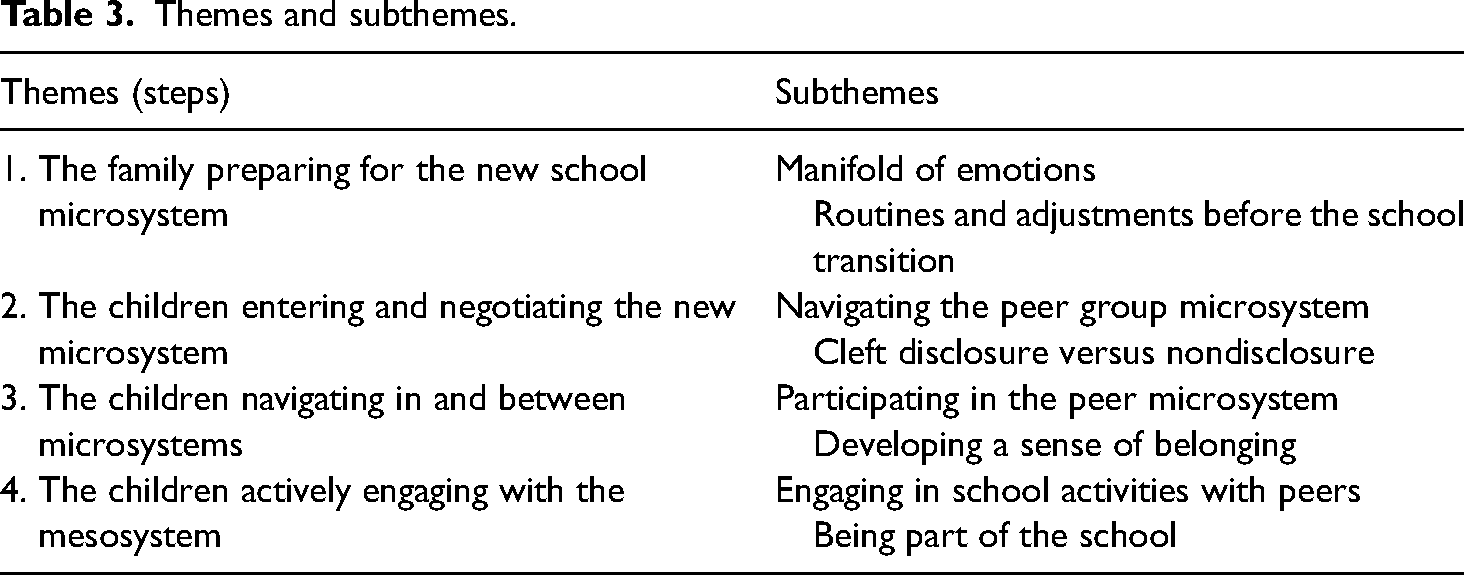
For the analysis, data were collated from the family interviews, the synchronous online interviews, and the vlog entries with the child participants. Four key themes were generated (Table 3). The themes developed provided a step-by-step guide to understanding the resilience process for these children and their parents.
Themes and subthemes.
Theme 1: The family preparing for the new school microsystem
A manifold of mixed feelings was experienced by the families in their home microsystem, in preparation for the transition to secondary school. The heightened anticipation and expectations expressed by the parents and children in relation to starting school were commonplace. Manifold of emotions and Routines and adjustments before the school transition were the subthemes.
Manifold of emotions
This subtheme explored the shift between feelings of excitement and nervousness for the children and their parents, stem from thoughts of independence and opportunity at the prospect of joining a new school. I’m a bit nervous because I don’t know anyone going, like I know people briefly who I recognise, but I don’t know anyone so it's a bit nervous because I’m not sure, about how easy it will be to make friends. (Sophie)
Nathan echoed this notion of not knowing anyone at his new school and how dissimilar it was from primary school. The sense of familiarity versus unfamiliarity between the school settings was expressed. It's much bigger and in primary school, like you usually like know everyone a bit earlier like you know who people are when you see them, you say hello, but in secondary school when you see them in the corridor you don’t say hello because you don’t know who they are. (Nathan)
From a parent's perspective, Rob exuded excitement for the family when talking about Rebecca starting secondary school. He acknowledged Rebecca's readiness for school, stating “I think great, I think she’ll cope with it really well and I think she's ready for it …” (Rob, father).
Routines and adjustments before the school transition
Parents viewed routine changes as providing the children with independence. These notions of independence link to the macrosystem (a setting in which the child does not take part, but which influences the child), related to cultural notions of “growing up,” displaying an independence away from parents. These views are normative expectations of children “moving up” to secondary school (Zeedyk et al., 2003).
Becky (parent) expressed giving Bella (daughter) the opportunity to walk to places on her own, as she believed it would support Bella before starting secondary school, stating “… so we spent quite a bit of time working on giving her independence walking places” (Becky, mother).
Linda (Lucy's mother) was comforted by her daughter's attendance at Guides club (an activity run organization that caters to girls, aged 10 to 14 years old in the United Kingdom) because it connected Lucy to her secondary school peers; she was “… pleased that she has gone to Guides and made friends in advance, that was good. So, we are glad she has that continuity.” In keeping with Lucey and Reay (2000), the adjustment to secondary school was a combination of concern and excitement. For example, Bella indicated uncertainty, which included an introduction to the unfamiliar setting and not knowing others; she expressed, “… it's a new school and I didn’t know many people, and it's a new experience and I have to learn where to go and everything.”
Theme 2: The children entering and negotiating the new microsystem
Child participants reflected on entering and negotiating new regular experiences during their daily interactions with peers (which Bronfenbrenner [2005] called proximal processes). The children encountered certain risks, including navigating the new peer group microsystem (meeting new peers) and other opportunities. Children were confronted with decisions concerning the disclosure and nondisclosure of their CL/P. Navigating the peer group microsystem and cleft disclosure versus nondisclosure are subthemes.
Navigating the peer group microsystem
At the start of the term, some children remained close to friends from primary school, while communicating with new students in parallel. In contrast, Sophie moved between groups, sensing it was important to get to know a variety of people; she stated “a group of friends, but I don’t just stick to them I like to have a wide range of people to be friends with.” She joined others and was not spending time exclusively in one group.
Cleft disclosure versus nondisclosure
This subtheme concerns the child participants’ reflections and deliberations on disclosure of their visible difference. Disclosure relates to the demand person characteristics of the PPCT model, and how living with a CL/P can impact on the reactions from others (Bronfenbrenner, 2005). Hayden was resistant to others knowing about his cleft, thinking about it as a secret that only he knew, stating “I really don’t tell anyone … It's my secret in school.” Sophie took a direct approach to this disclosure, telling her peers together, feeling a sense of acknowledgment. … I decided to tell my classmates about it last Friday so that I wouldn’t have a ton of people asking as more people started to realize but no one has said anything since … just because it feels like a weight off my shoulders.
Whereas Grace in secondary school was asked if her appearance was the result of an accident, not realizing that her classmate did not know what a cleft lip was: I was sitting in French and one of my friends who sits next to me asked me if I had fallen or something cause she’d noticed my scar there (points to lip), and I just told her about it and she didn’t realise what it was.
Theme 3: The children navigating in and between microsystems
Emphasis on the early experiences that occurred at school and among their peers was highlighted, during which a sense of belonging formed. Two subthemes developed: Participating in the peer microsystem and developing a sense of belonging.
Participating in the peer microsystem
As part of the child's immediate microsystems, the making and maintaining of friendships during the school transition was important. Having a friend in school was salient to the child participants and the connections between burgeoning friendships. Bella and Rebecca discussed how it would feel if they did not have a friend at school, and the potential risk of feeling a sense of neglect and loneliness, “… because if you are on your own, it's sad and like you’re on your own you don’t know what to do …” (Bella). They stressed the importance of informal times during the school day and spaces for socializing, noting that “… if you didn’t have that many friends you would struggle like socially and it would be like harder, you’d be more isolated …” (Rebecca).
Lucy talked about spending time with others during the break, which was a buffer because “… you just don’t want to be on your own because it's quite big.” Sophie indicated that without friends she would feel separate and that the experiences of school would be different, saying that “… if you don’t you will feel disconnected and not enjoy school life.”
Rebecca noted that friends during this time gave her the confidence to be herself. The proximal processes in Rebecca's peer microsystem could be viewed as protective mechanisms (Rutter, 1987), providing her with an increased sense of self-esteem, relevant to the resilience process. Rebecca: Yes, I feel without friends I wouldn’t have as much confidence as I do Interviewer: Can you tell me how your friends give you more confidence? Rebecca: They support me, and they let me be me.
The individual variations in the children's reasoning gave meaning and value to the peer microsystem, helping us understand the resilience process within this ecological model. Having friends at school and not being alone was key to successful transition outcomes for the children. The connection between the child and the peer microsystem acted as a secure base—dependable and supportive during the transition.
Developing a sense of belonging
The children's new school microsystem can be viewed as a valuable place where the entry to secondary school was seen as a “step up.” It forms part of macrosystemic views of “growing up” (Bronfenbrenner, 1979). A sense of belonging was conveyed by some of these children because of their connectedness, familiarity, and their understanding of their schools’ geographical landscape. Lucy compared herself in size next to other students, stating that she was “… feeling tiny against the big people.” This notion of size for Lucy in her school microsystem was akin to the spaces of subjectivity (viewing secondary school as huge in comparison to primary school) documented by Lucey and Reay (2000). Having a sense of a secure base is facilitated by a sense of belonging as well as routine and structure in the child's life (Gilligan, 2000). The provision of a secure base can be seen during this time point as the children engage regularly with the peer microsystem. Rebecca described this phase as feeling settled, “more normal,” which denotes a type of connectedness and belonging to her school at this time; she stated, “I’m settling in well. It's starting to feel more normal, not so new.” Sophie expressed that she, “… felt settled with other smart and clever students, who all seemed to excel at different things,” viewing school life as regular and connected.
Life at secondary school gave the children opportunities to regularly engage with the setting and their peers. Having a sense of belonging and a secure base was seen as part of the resilience process.
Theme 4: The children actively engaging with the mesosystem
The child participants were seen as actively engaging with the mesosystem. The mesosytem (Bronfenbrenner, 1979) links the interactions of the child's microsystems (home and school; Crawford, 2020). The subthemes developed were Engaging in school activities with peers and Being part of the school microsystem.
Engaging in school activities with peers
Participating in school clubs (such as cooking classes or a sports club) and activities was welcomed by the child participants. School clubs were seen as novel, enjoyable, and sociable, reinforcing peer interactions and familarization with the school. Rebecca recalled attending a club, which promoted friendship, and a science workshop. … I think one of them was making new friends and like, and also there was an activity, a cloning workshop, I was chosen for as something that I might like and you had to learn how the machine worked and how to use it and stuff. (Rebecca)
On the other hand, access to these school clubs for Lucy was an opportunity for her to get to know new people, separate from the regular peers she met in school. Lucy differentiated between who she spends time with and where. … you get to know different people if you go to the clubs, not just the normal people that you hang out with, and you get to know more people in your classes that you didn’t know. (Lucy)
By engaging with extracurricular activities, the children were learning skills inviting reciprocal interactions (Bronfenbrenner, 2005). These school activities facilitated peer interaction and friendship formation, acting as a support during the transition.
Being part of the school
Child participants reflected on becoming part of the school community. These reflections demonstrated the children's connection and belonging to their new school (Goodenow, 1993). For example, Bella's initial thoughts about secondary school were met with concern where people were excluded, but her experience was that the new school was a safe place; she stated that “… it's not that scary, I thought it would be people kind of ganging up on people, but it isn’t, there's just people, like there's different groups …” (Bella). Rebecca emphasized sharing with others that secondary school was not as bad as anticipated. She acknowledged the relevance of being involved in clubs and actively engaging in lessons. I’d probably say don’t be nervous, its actually not as bad as it seems, and once you make friends and you start doing clubs and you start getting in to the lessons. (Rebecca)
Being open and welcoming to others was part of Sophie's thoughts about starting secondary school. She recalled meeting new people, the time needed to develop a friendship, and how this changed and manifested into something meaningful. I would say go into it with an open mind, um try out doing different things and talk to lots of different people even if you think they may not be good friends of yours, but it could be that in a month or two they’re really your close, close friends, but they won’t be if you don’t talk to them. (Sophie)
Discussion
The study aimed to understand the process of resilience for children with a CL/P (visible difference) during the secondary school transition. Importantly, resilience as a process was seen as a series of steps in the themes, which unfold sequentially. Four steps were identified as part of the resilience process in the transition from primary to secondary school for all children, which can be seen in Figure 1.
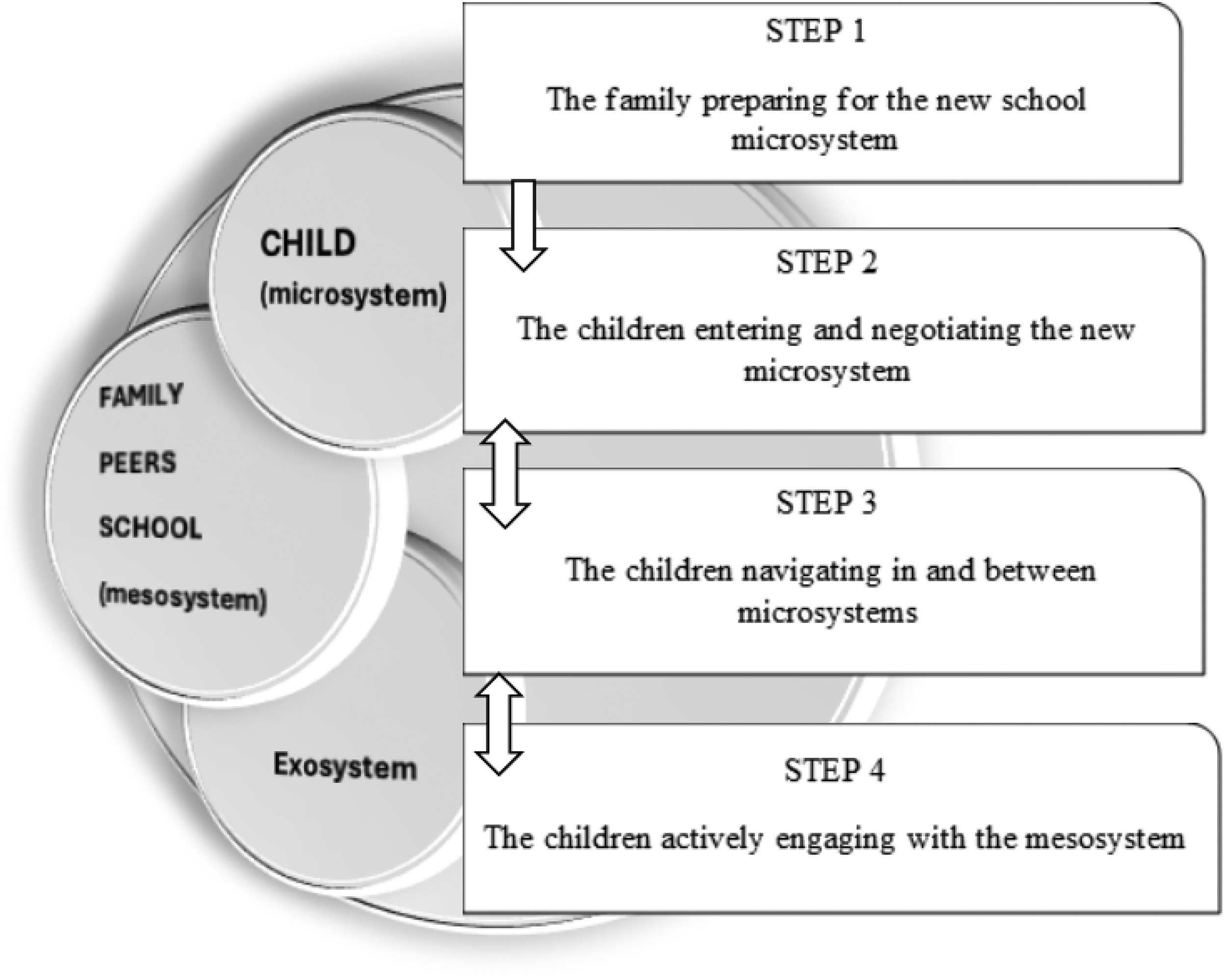
Four steps of the resilience process in the transition from primary to secondary school.
The first step that children take during the primary to secondary school transition is in entering the new school microsystem. The current study focused on the lived experiences of the child participants and the mixed feelings of excitement and nervousness in joining a new microsystem of secondary school. Adjusting to different routines for each child and the family involved activities such as school travel and varying start times. Bronfenbrenner (1986) identified such transitions as normative events, where new patterns of activity can directly affect the developing child and indirectly influence the entire family system. This marked an important first step in the resilience process (see Figure 1). In the three steps that follow, there was more fluidity, as the children negotiated the new microsystem, moving between the school and home, thus engaging with the new mesosystem (Bronfenbrenner & Morris, 2006).
Results suggested that the steps may overlap, or re-negotiation occurs at different time points, which means that the process is changeable. Viewing resilience as a series of steps revealed how this was a fluctuating process. These latter three steps were not conceived as unidirectional. Individuals may take them at different speeds and perhaps return to an earlier step. New microsystems may occur, for example, a child joining a school club, or meeting a new friend.
The study findings evidenced that resilience was interactive and that the process was adaptable because of its dynamic relational components. This challenges the idea of resilience as an individual quality (Block & Block, 1980; Richardson, 2002). More attention should be directed toward the types of questions we ask children about resilience. We need to reconsider how we talk and think about this concept because it is not helpful to consider resilience as a single quality. Thinking about resilience-in action, as part of a process, the following questions can be considered: (a) What does it mean to be resilient? (b) What does this mean for a child with a visible difference? (c) What does this mean for the child starting secondary school? (d) What resources are available to children starting secondary school, and how can they access them? (e) How can a culture of inclusion and belonging help children adjust to secondary school life?
The longitudinal design allowed an overview of the key aspects of resilience as a process, which may be of use to future researchers in studying school transitions; for example, we were able to observe the development of peer interactions and friendships and how these connections supported the child participants in the transition and enjoyment of school life.
We found that resilience in action can be observed when a child feels a sense of belonging to their new school and successfully completes the year. Longaretti (2020) described school belonging as, “… the quality of the social relationships within a student's experience of school” (p. 32). Education researchers agree that the need for belonging is important for young people in learning environments (Longaretti, 2020), referring to it as “connectedness” (Bond et al., 2007) and “membership” (Goodenow, 1993). A developing sense of belonging may contribute to resilience-in-action by allowing the child to feel a part of the new school community and, in particular, their peer group.
These positive adaptations were seen as part of the school transition over time, evidenced in the series of steps we have presented (Masten, 2021). However, it should be noted that the harnessing of resilience does not rest entirely with the child; rather, it is part of an ongoing process in which the child interacts and engages with the parents, school staff, and peers.
Applying these steps to the school transition process means we may be able to provide a framework for all children (including those with a CL/P) starting secondary school to recognize and use. Educationalists, teachers, and clinicians, as well as parents and support groups, may be interested in the study's results and the applied use of the resilience steps as a model for school transitions. Schools (both primary and secondary) should play a more interactive role in preparing children for this transition process. This is useful as a model for primary to secondary transition outcomes because, instead of focusing on the child being “ready” for the transition, this framework focuses on the school and the ecological systems, or environment surrounding the school and the child (Masten & Barnes, 2018).
Limitations
Conducting online snapshot interviews with the child participants resulted in delays in sending and receiving answers, and for the interviewer, there were no visible social cues. Therefore, more time between questions was given to the child participants. Notably, the final family interviews were used to clarify any uncertainty from the online interviews. Researchers should consider online interviews as a useful tool when working with adolescents but should also be mindful of the fragmented quality of text messages when child participants type in their responses.
It is difficult to know how generalizable the findings are because the sample was not representative of harder to reach families, those who chose not to participate, or those who had no ongoing involvement with CLAPA, all of whom may have very different experiences of the school transition. Furthermore, the heterogeneity of the sample was of interest because there were more females than males, and it would be helpful to recruit more boys in future research to see if themes or experiences differ. As is common with CL/P, some children had additional needs (e.g., hearing impairment). Further considerations about individual differences for children with a CL/P (i.e., vision impairment) were not addressed in the study. Parental backgrounds in the sample were also somewhat homogenous in terms of occupation, ethnicity, and location.
Implications from the research study
This research has implications for policy and practice concerning the secondary school transition and the resilience process for children with a visible difference who are transitioning to secondary school. It also has implications for parents whose children are starting secondary school and for schools (primary and secondary level).
For children with a visible difference, the school transition should be seen as a bespoke process for each family, and there is a need for children and families to be actively involved in the transition from primary school. It is important to educate all children about visible differences in other children. This extends to other visible differences (e.g., skin conditions) that children may be unaware of or may not fully understand without discussion and education. Such discussion and education can facilitate the disclosure process for children with a CL/P, lessening the need to explain the condition.
Children need to know how to access resources in both primary and secondary school to support their transition. For example, children need to understand resilience not only as “not giving up” but also as part of their learning process wherein they engage with peers and teachers to develop skills that support their wellbeing and persistence. Not giving up is part of the process; how children respond, react, and engage with the process is key to their subsequent success and adaptation.
For parents of a child with a visible difference starting secondary school, regular, and consistent communication with school staff is important. Parents need to be aware of the school's efforts to support their child's transition before and during the process. There often are transition or taster (i.e., orientation) sessions but very few follow-up events that aim to bridge the gap between home and school expectations. It is helpful for parents to have regular check-ins with their child and to understand the child's role in “joining up” communications between two systems—the family and the school. To engage with resilience as a process, there needs to be an alignment of communication between schools (primary and secondary) and the home. This alignment requires regular and consistent communication.
Schools should play a more collaborative role in facilitating the resilience process (e.g., coordinating peer groupings, developing, and applying student voice initiatives, training older peers to act as mentors to younger ones). This also includes offering informal opportunities to meet other peers and physical spaces where children can engage and interact with each other, perhaps before and after class and at break times. Applicable training of school staff to facilitate peer group development, such as through clubs and societies in school (both primary and secondary), should be provided. Furthermore, form tutor classes (child's personal tutor who monitors attendance) at the secondary level addressing subjects based on personal, emotional, and social wellbeing (e.g., Personal, Social, Health and Economic Education; PSHE) can be offered to initiate conversation among peers and teaching staff around differences, adversity and friendships. Regular open discussions about children's differences are needed in schools and at home. At the macro level, current inclusion policies for schools in the United Kingdom should include education about CL/P (Schuelka, 2018). Schools should ensure that there is a current policy used to explain a visible difference, included in the school's action plan to educate others about these differences and included as part of the school transition information for parents and children.
Conclusions
The longitudinal design of the current study afforded an overview of four steps in the transition from primary to secondary school, informed by Bronfenbrenner's (1979) Ecological Systems Theory. To the best of our knowledge, this is the first study to conceptualize how resilience is enacted over the course of the primary to secondary school transition, and it lends weight to the view of resilience as a process in which the child is actively participating. Each individual may navigate the steps of this process at different speeds and perhaps return to an earlier step. Entering the new school microsystem is the first step children take, but then in the three steps that follow, there is more fluidity as they negotiate the new microsystem and move between the school and home, thus shaping the new mesosystem. New microsystems may develop, such as a child joining a new school club, making a new friend, or joining a new peer group. This study may help educationalists to consider what it means to be resilient during the school transition and to position the child as an active participant during the process. Furthermore, it should be noted that the harnessing of resilience does not rest entirely with the child; it is part of an ongoing process in which each child interacts and engages with others, such as parents, school staff, and peers. Finally, the study has allowed a detailed understanding of primary to secondary school transition from the perspective of children with a cleft lip/palate and their families, based on their lived experiences and expertise, which are very much underrepresented in the wider literature.
Footnotes
Acknowledgments
During the development of this research project, the guidance and professional support of two other researchers were appreciated. Both acted as part of the supervisory team for the first author's doctoral work. Firstly, it was a privilege to work with Professor Adrian Coyle whose qualitative insight was invaluable. Thanks to Dr Chris Hewer, whose continued support for this research propelled our thinking from all sides. Lastly, the researchers would like to thank and acknowledge the Cleft Lip and Palate Association, and the remarkable children and their families who participated in the research.
Declaration of conflicting interests
The authors declared no potential conflicts of interest with respect to the research, authorship, and/or publication of this article..
Funding
The authors received no financial support for the research, authorship, and/or publication of this article.
