




Abstract
Alexithymia has an important effect on learning burnout; however, the underlying mechanism of this relation remains unclear. This study aims to examine why alexithymia is related to increased learning burnout. Here, we investigated associations between alexithymia and learning burnout, as well as the potential mediating role of self-compassion in a sample of 466 Chinese children and adolescents from primary and secondary schools. Mediation analysis showed that higher alexithymia was significantly associated with greater learning burnout, and this relationship was mediated by self-compassion. Findings suggest that promoting self-compassion may mitigate the adverse effects of alexithymia on learning burnout.
Introduction
Students’ learning pressure is constantly rising (Mahmud, 2021). Faced with increasing expectations from society, school, and family, the urgent demand for school admission and employment, and an often fast-paced lifestyle, students may become overwhelmed, leading to an increasingly serious degree of learning burnout (Zhao & Song, 2017). In recent years, the concept of “lifelong learning” has become gradually accepted by the public in China. For example, the Ministry of Education of China has launched the “double reduction” policy for primary and secondary school students to improve learning outcomes and reduce learning burnout (Zhou & Qi, 2022). Students who experience learning burnout in the stage of basic education may struggle to maintain long-term learning motivation and to pursue lifelong learning. Therefore, the study of learning burnout among primary and secondary school students has great practical significance, as it may help relieve learning pressure, provide theoretical support for learning psychological counseling, and provide ideas for school mental health education.
Research on learning burnout originates from the phenomenon of occupational burnout in the workplace. In the 1970s, an American clinical psychologist named Freudenbery published an article called “Staff Burnout,” which first drew people's attention and interest to the study of burnout. He found that burnout is an abnormal state and that prolonged burnout would inevitably lead to a decrease in work efficiency or to other negative consequences (Freudenberger, 1974). Learning burnout refers to the manifestation of burnout in the area of learning; specifically, it refers to a sustained passive psychological state in which students experience physical and mental exhaustion, academic alienation, and lack of academic achievement during the learning process due to course pressure, academic burden, or other psychological factors (Bell & Kozlowski, 2002; Schaufeli et al., 2002; Wu et al., 2007). Outcomes of learning burnout may include lowered cognitive performance and academic performance (May et al., 2015), which in turn further perpetuate burnout. Moreover, in some cases, learning burnout may lead to physical dysfunction (e.g. headache and general weakness), mental disorders (e.g. sleep disorders, loneliness, anxiety, and depression; Njim et al., 2019), and behavioral problems (aggression, truancy, school dropout, and suicidality; Bask and Salmela-Aro, 2013; IsHak et al., 2013; Li et al., 2020; Stockman, 2010; Wang et al., 2015). Studies have revealed that learning burnout has become a pressing issue among Chinese primary and secondary school students (Chen, 2020; Du & Jia, 2020). Therefore, we must examine the possible causes of learning burnout to develop future interventions aimed at diminishing it in this population.
One stable personality trait that may be a factor contributing to learning burnout is alexithymia (Salminen et al., 2006; Zhang et al., 2021), which has been defined by difficulties in identifying emotional feelings, difficulties in describing feelings and externally oriented thinking (Bagby et al., 2020). The prevalence of alexithymia is about 36% among Chinese adolescents (Ng & Chan, 2020). Previous research has found that higher levels of alexithymia are associated with lower need satisfaction and higher need frustration (Barberis et al., 2022), which suggests that alexithymia may lead to decreased satisfaction with students’ basic psychological needs (i.e. autonomy, competence, and relatedness; Deci & Ryan, 2000). Moreover, empirical studies have found that these basic psychological needs have a direct effect on learning-related behavioral outcomes such as academic engagement, academic performance, and learning burnout (Ariani, 2019; Markoubi & Sadoughi, 2018). Therefore, we contend that learning burnout and alexithymia may be associated, perhaps due to lower need satisfaction and higher need frustration among people with alexithymia.
Nevertheless, few studies have focused on the relationship between alexithymia and learning burnout among primary and secondary school students. A study on Chinese high school students demonstrated that alexithymia might play an important role in the development of learning burnout (Weng et al., 2015a). People with alexithymia tend to adopt more negative coping methods such as ruminating, catastrophizing, and blaming others rather than positive cognitive regulation strategies such as refocusing and positive reappraisal (Yi, 2007). This is highly likely to cause learning burnout. However, further research is needed. Therefore, based on the above theoretical analysis and empirical results, we hypothesized that alexithymia is a positive predictor of learning burnout among Chinese primary and secondary school students.
Alexithymia can lead not only to burnout but also to a lower level of self-compassion (Lyvers et al., 2020). Self-compassion, derived from Buddhist philosophy, is an effective emotion-focusing strategy and may be an important part of emotional intelligence (Neff, 2003a). It involves being understanding and kind to oneself instead of criticizing when one encounters difficulties, failures, or setbacks while recognizing that emotional pain and feelings of inadequacy and imperfection are part of the shared and inevitable human experience (Neff et al., 2007). Studies demonstrate that alexithymia is negatively associated with self-compassion (Lyvers et al., 2020; Ren et al., 2022). A study of junior school students suggested that alexithymia is an important correlate of low self-compassion (Ren et al., 2022). Thus, in this study, we also hypothesized that alexithymia was negatively associated with self-compassion among primary and secondary school students. Self-compassion may be an important protective factor against learning burnout. Self-compassion augments resilience to stress (Bluth & Neff, 2018) and may mitigate burnout. Several cross-sectional studies have found that self-compassion is inversely associated with burnout among nurses, war veterans, students, and healthcare professionals (e.g. Abdollahi et al., 2021; Atkinson et al., 2017; Hashem & Zeinoun, 2020; Ponkosonsirilert et al., 2020; Prudenzi et al., 2022). A longitudinal study examined the six-month stability of burnout, self-compassion, and social support among sports coaches and found that self-compassion negatively predicted burnout (Ackeret et al., 2022). It has been confirmed that self-compassion is promising in reducing stress (Bluth et al., 2015) and the potential escalation of stress into burnout (Sorkkila et al., 2019). Therefore, we believe that self-compassion affects the learning burnout of primary and secondary school students. Further research is needed to explore the relationships between the three variables, especially in Chinese students.
Furthermore, in educational settings, there may be gender differences in how students experience learning burnout. Previous studies have found that female students experience higher levels of learning burnout than male students (Salmela-Arom et al., 2009; Widlund et al., 2018). However, a study on interest and burnout profiles found no significant gender differences in many profiles (Asikainen et al., 2022). Purvanova and Muros (2010) also cautioned that considering females to be more prone to burnout than males is dangerous because it may lead to the experience of burnout among males being overlooked. Therefore, further research is needed to explore this topic in more detail, particularly in regard to gender differences in learning burnout (May et al., 2015). Additionally, some studies have shown that males have higher levels of alexithymia than females. Males tend to be more focused on external thinking and problem-solving, while females may be more focused on internal thinking and emotional orientation (Croyle & Waltz, 2002; Levant et al., 2009). These results may be attributable to differences in cultural norms and expectations about self-response patterns and self-concept according to gender (Rankin et al., 2004). The normative male alexithymia hypothesis suggests that due to some socialization processes during childhood, males may not be encouraged to talk about their emotions, which limits their emotional expression and makes it difficult for them to identify and describe their emotions with language (Levant et al., 2014). Furthermore, there is increasing recognition of gender differences in self-compassion, with males showing significantly higher levels of self-compassion than females (Bluth et al., 2016; Carnelius & Dennhag, 2022; Yarnell et al., 2015). However, further research is needed to explore the mechanism by which alexithymia affects learning burnout and whether there are gender differences in this relationship. Based on existing research on gender differences, we hypothesize that the mediating effect of self-compassion may differ between male and female students.
The present study investigated whether self-compassion mediated the correlation between alexithymia and learning burnout and whether the mediating effect of male students’ self-compassion is different from that of female students. Informed by prior research on alexithymia and related constructs, we tested three hypotheses: (1) alexithymia will be positively associated with learning burnout; (2) self-compassion will partially mediate the effect of alexithymia on learning burnout (see Figure 1); and (3) the mediating effect of self-compassion may be different for male students than it is for female students. We hope that this study will contribute to providing clues for future interventions on learning burnout in children and adolescents.
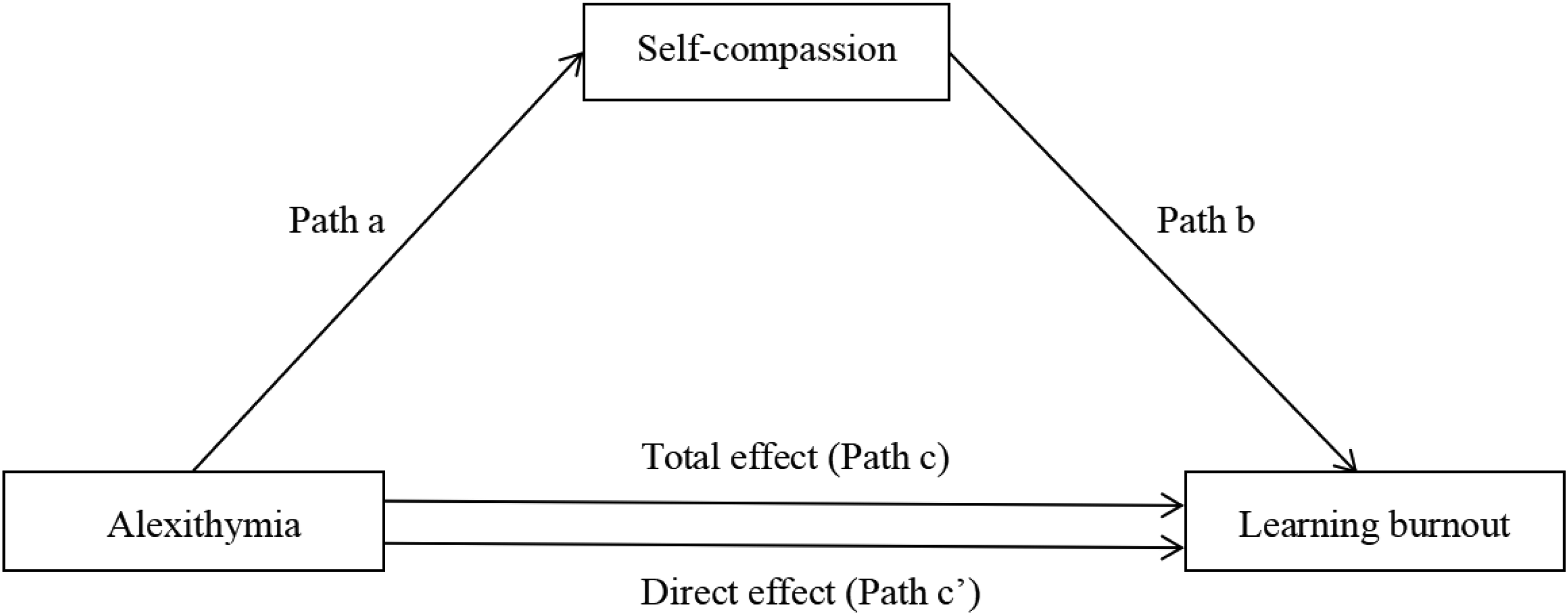
The hypothetical mediation model.
Method
Participants and procedure
A priori power analysis using G*power 3.1 showed that at least 395 participants were needed to detect small-sized effects (f2 = 0.02) in a multiple linear regression model with a significance level of 0.05 and a power of 0.80 (Faul et al., 2009). To provide greater generality, a total of 500 Chinese primary and secondary school students were recruited. Part of the data (n = 400) came from questionnaires distributed in psychology classes in four primary and secondary schools in the city of Fujian Province, China. The participants completed the survey voluntarily, anonymously, and without discussion. They were not offered compensation for their participation. The other part of the data came from an online survey platform (www.credamo.com) in which participants were paid. In the present study, all participants provided informed consent, and 34 respondents were excluded because of missing data. The final number of participants retained in the present study was 466 (52.4% males, 47.6% females; 37.1% primary school students, 62.9% secondary school students; Mage = 13.24, SD = 1.65, range: 10–16 years). This study met the requirements of the Research Ethics Committee of the authors’ university.
Materials
Alexithymia
To measure alexithymia, we used the Toronto Alexithymia Scale (TAS-20; Bagby et al., 1994; revised: Yi et al., 2003). This is a 20-item instrument that assesses three aspects of the alexithymia construct, namely (a) difficulties in identifying feelings (e.g. “I am often confused about what emotion I am feeling”), (b) difficulties in describing feelings (e.g. “I find it hard to describe how I feel about people”), and (c) externally oriented thinking (e.g. “I prefer to just let things happen rather than to understand why they turned out that way”). All items were rated on a 5-point scale ranging from 1 (strongly disagree) to 5 (strongly agree). Mean scores were calculated by averaging responses of all 20 items, with responses to negative-valenced items reverse-coded; higher scores reflected higher levels of alexithymia. The Chinese version of the TAS-20 demonstrates high internal consistency in Chinese populations (Cronbach's α = 0.82) (Yi et al., 2003). Cronbach's alpha in the present study was 0.80.
Learning burnout
To assess learning burnout, we adopted the Learning Burnout Scale (LBS; Hu & Dai, 2007). This is a 21-item instrument that assesses four aspects of learning burnout, namely emotional exhaustion (e.g. “I don't care if I can't finish my homework”), physical exhaustion (e.g. “Learning makes me feel physically sick”), learning inefficiency (e.g. “I think learning can make my potential come into full play”), and alienation between teachers and students (e.g. “The teacher has a certain prejudice against me and always looks down on me”). All items were rated on a 5-point scale ranging from 1 (never) to 5 (always), and an overall score was computed as the mean of all 21 items, with responses to negative-valenced items reverse-coded. Higher scores indicated greater learning burnout. It has been indicated that the TAS-20 is applicable to the Chinese population (Cronbach's α = 0.91; Gu et al., 2017). Cronbach's alpha in the present study was 0.90.
Self-compassion
To measure self-compassion, we used the Self-Compassion Scale (SCS; Neff, 2003b; revised: Gong et al., 2014). This is a 12-item instrument that assesses three aspects of self-compassion, namely self-kindness (e.g. “I try to be understanding and patient towards those aspects of my personality I don’t like”), common humanity (e.g. “When I am depressed, I think most people are happier than me”), and mindfulness (e.g. “When something upsets me I try to keep my emotions in balance”). All items were rated on a 5-point scale ranging from 1 (never) to 5 (always). Mean scores were calculated by averaging responses of all 12 items, with responses to negative-valenced items reverse-coded; higher scores reflected greater self-compassion. The SCS has been demonstrated to be a reliable measure in Chinese populations (Cronbach's α = 0.87) (Tian & He, 2021). Cronbach's alpha in the present study was 0.70.
Analysis
We used SPSS 26 for descriptive statistics and basic analyses. Model 4 in Hayes’ SPSS PROCESS macro (Hayes, 2013) was used to test the hypothesized mediation model with 5000 bootstrap samples as well as bias-corrected 95% confidence intervals (CIs); it estimates the indirect effects of a predictor (alexithymia) on an outcome (learning burnout) through a mediator (self-compassion). Effects were considered to be significant if the respective 95% CI did not include 0 (Mallickrodt et al., 2006). The unstandardized path coefficients are reported in the main text and in all tables and figures.
Results
Descriptive statistics and correlations of the study variables were shown in Table 1. Results showed strong associations between scores of alexithymia and scores of self-compassion and learning burnout, respectively, as well as a moderate association between scores of learning burnout and scores of self-compassion. When male and female students were considered, a moderate to strong correlation was also found between the total scores of variables (see Table 2).
Pearson's r correlations between variables (full sample).
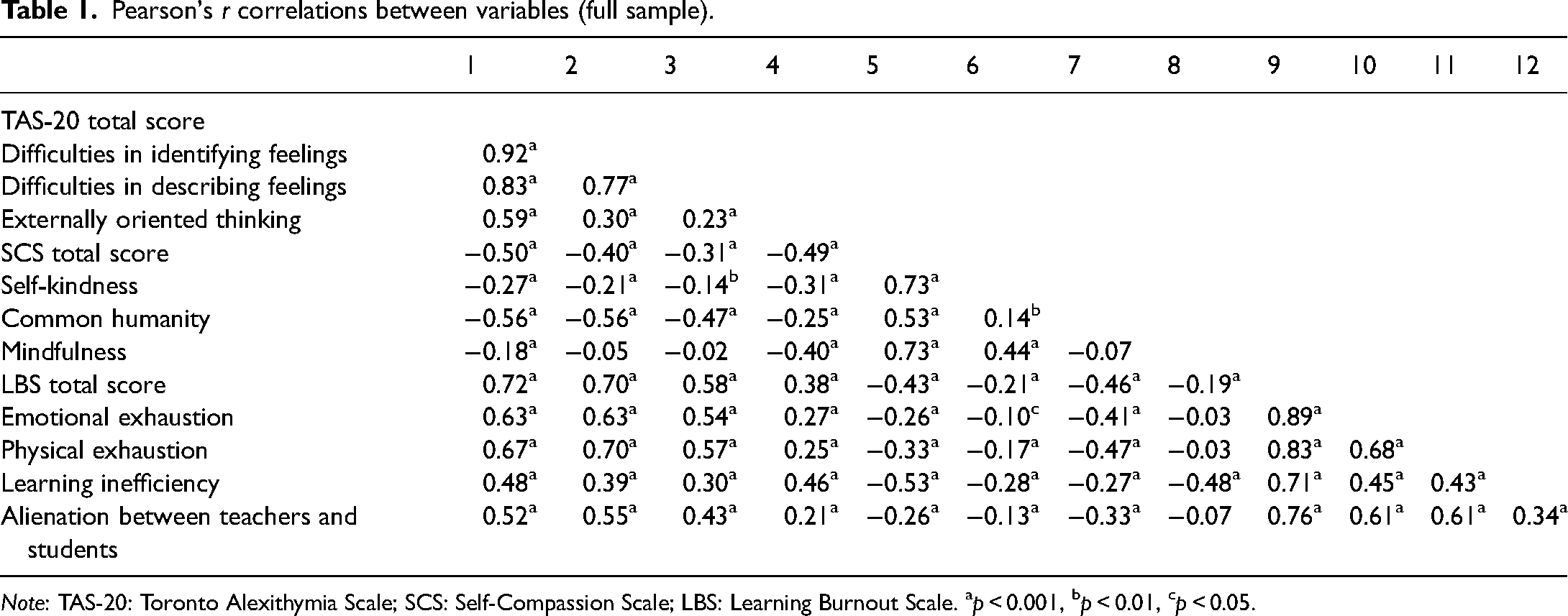
Note: TAS-20: Toronto Alexithymia Scale; SCS: Self-Compassion Scale; LBS: Learning Burnout Scale. ap < 0.001, bp < 0.01, cp < 0.05.
Pearson's r correlations between variables (male students and female students).
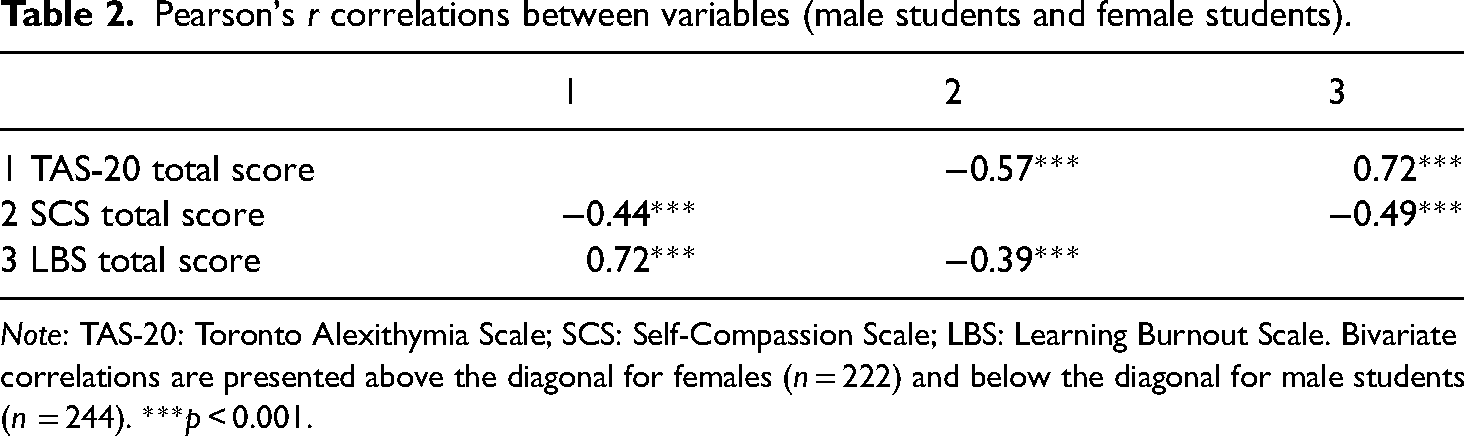
Note: TAS-20: Toronto Alexithymia Scale; SCS: Self-Compassion Scale; LBS: Learning Burnout Scale. Bivariate correlations are presented above the diagonal for females (n = 222) and below the diagonal for male students (n = 244). ***p < 0.001.
Next, we tested whether self-compassion mediated the relationship between alexithymia and learning burnout. Figure 2 depicts a mediation pathway diagram reflecting the results for the full sample. The structural pathways were consistent with the hypothesized directions, and all pathways in the model were significant. Alexithymia showed significant, direct paths to self-compassion (B = −0.61, SE = 0.05, p < 0.001) and learning burnout (B = 0.71, SE = 0.04, p < 0.001). Self-compassion also had a significant direct path to learning burnout (B = −0.18, SE = 0.03, p < 0.001), and the total effect was 0.82 (
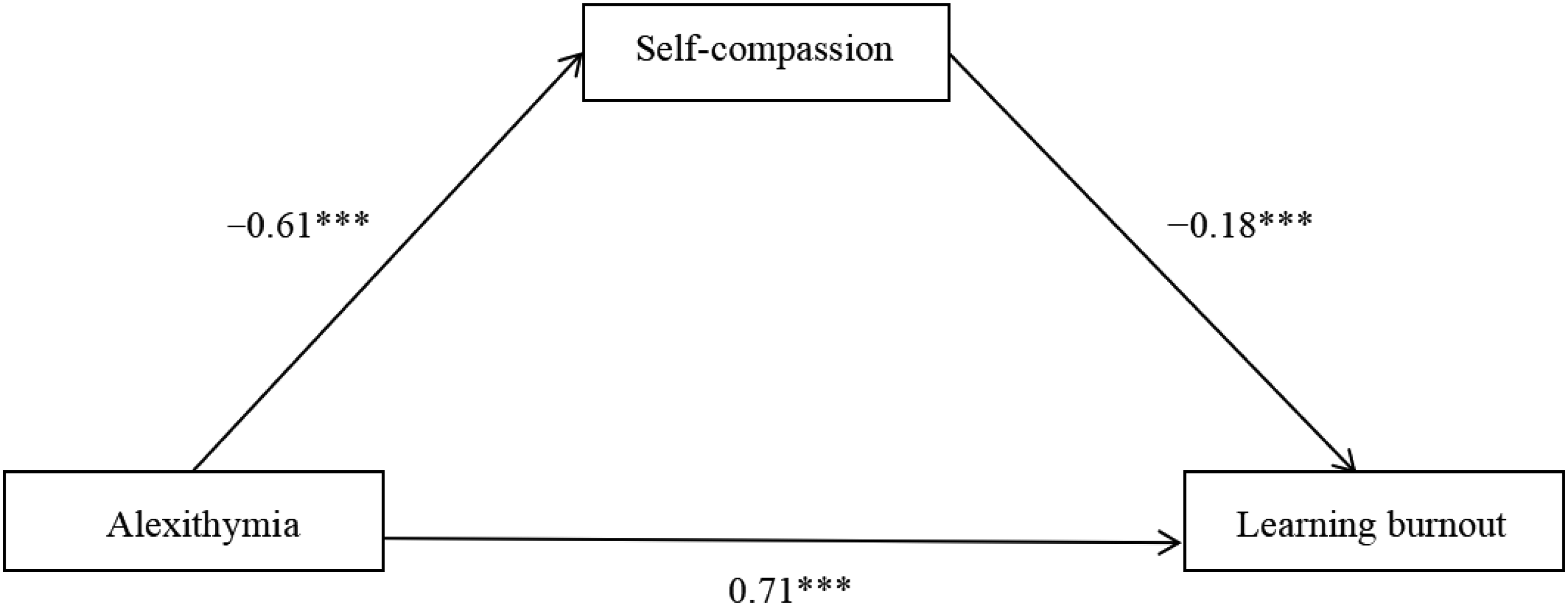
Statistical form of the mediation model with unstandardized path coefficients.
We then examined whether the relations in the model were comparable across males and females. There were no significant gender differences in alexithymia, self-compassion, and learning burnout, ps > 0.05. As shown in Figure 3, for males, the direct effect was 0.77 (after controlling for mediation), with a total effect of 0.86 (
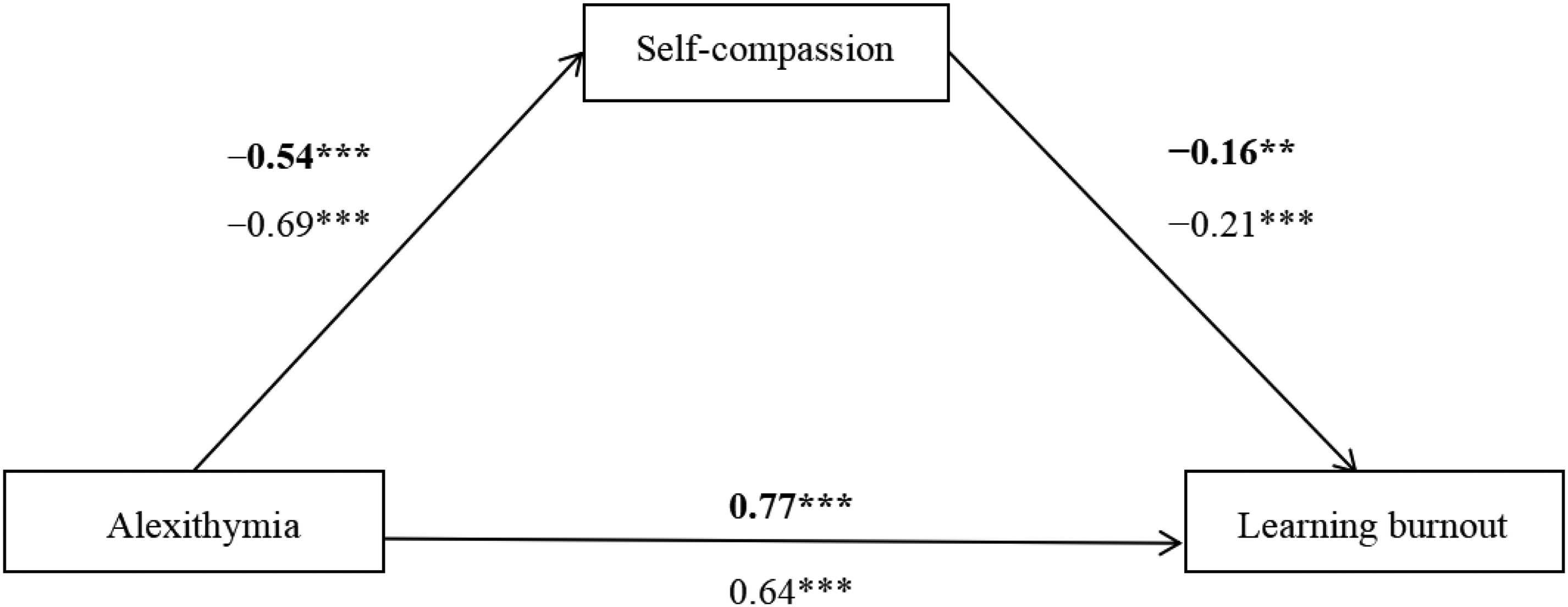
Regression coefficients for the mediation model in female students/male students.
Finally, we examined whether self-compassion could moderate the relationship between alexithymia and learning burnout. The results showed that self-compassion did not moderate the relationship (
Discussion
The current study confirmed our hypothesis that alexithymia has a significant positive association with learning burnout among primary and secondary school students and that this relationship is partially mediated by self-compassion. This means that alexithymia not only directly affects learning burnout but also indirectly affects learning burnout through self-compassion. However, the mediating effect was similar in males and females, which is inconsistent with our third hypothesis. These findings are discussed in turn below.
Consistent with previous empirical studies (Weng et al., 2015a, 2015b), this study revealed that alexithymia is positively correlated with learning burnout. Alexithymia is a personality trait characterized by impaired emotional cognition, processing, and regulation (Klauer & Musch, 2003). People with alexithymia tend to have negative behavioral coping styles, such as silence, suppression, overthinking, blaming others, and catastrophizing (Yi, 2007). In educational contexts, students may experience negative emotions that have not been dealt with over time, accompanied by a decline in learning interest and the emergence of mental disorders (Weng et al., 2015b; Zhang et al., 2020), which can lead to learning burnout (Pokhrel et al., 2020). Second, alexithymia is associated with impairments in emotional intelligence, which is an ability to control one's feelings and expression and protect people from burnout (Moon, 1999; Tesio et al., 2021). Students with alexithymia have difficulties in coping with pressure from daily life and study, which can contribute to learning burnout. Third, in collectivist cultures, such as those in East Asia, it is relatively more encouraged to suppress emotions than to express them (Soto et al., 2011); that is, people may be less likely to express their feelings openly or seek emotional support from others. It is possible that this cultural trait may contribute to a higher prevalence of alexithymia among Chinese students compared to other countries; however, research on this topic is limited, and further investigation is needed to understand the relationship between culture and alexithymia. Similarly, learning burnout may also be influenced by cultural factors. Chinese culture may place more emphasis on academic achievement and foster a more competitive educational system compared to Western culture (Fu, 2016), which could contribute to higher rates of learning burnout. However, it is important to note that learning burnout is a global issue that affects students in many different countries and cultures.
The results indicated that self-compassion partially mediated the relationship between alexithymia and learning burnout. In other words, alexithymia was related to learning burnout directly as well as indirectly through self-compassion. According to the emotion exchange theory, individuals with a higher level of alexithymia may find it difficult to have intimate and effective emotional communication with others (Floyd, 2006); this may be due to difficulties with emotional processing (Gong, 2008), including distinguishing and expressing their emotional states, sensing body feelings, and perceiving the emotions of others. They may also believe their own experiences to be disconnected from the experiences of others, which can lead to negative self-views. Due to these tendencies, individuals with alexithymia may lack the internal resources necessary to develop and foster self-compassion, which could account for the negative correlation observed between alexithymia and self-compassion in the current study. Additionally, people with greater self-compassion may be less prone to burnout, because they tend to be more resilient to stress (Coaston, 2017). While, in moderation, stress can improve academic performance and motivation, without proper management, it can also have detrimental effects. People with a high level of self-compassion accept and take care of themselves, which helps in times of hardship and makes them more resilient to psychological distress (Gold, 2020; Satici et al., 2020). In contrast, people low in self-compassion may be more self-critical and thus may experience increased burnout (Amemiya & Sakairi, 2020). In collectivist cultures in particular, people may be relatively more self-critical than those in an individualist culture (Kitayama et al., 1997); thus, Chinese students may perceive self-compassion as a form of self-indulgence or weakness rather than a healthy way to cope with stress. This can make it challenging for students to practice self-compassion.
Considering cultural differences is important as it helps to develop more effective interventions and support systems that are sensitive to the unique needs and experiences of individuals from different backgrounds. The results of the study found that the common humanity and mindfulness components of self-compassion have a mediating role in the relationship between alexithymia and learning burnout, suggesting that future interventions for could focus more on designing and implementing programs related to these elements. The potential role of self-compassion in the relationship between alexithymia and learning burnout, broadly speaking, would be an interesting topic for future work and is worthy of further exploration.
This study also found that there were no significant gender differences in the three research variables, which is inconsistent with previous research (Carnelius & Dennhag, 2022; Widlund et al., 2018). One possible reason is that this study focused on elementary school students, and previous studies have rarely examined the relationship between alexithymia and learning burnout in elementary school students. Moreover, our study indicated that the relationships in the mediation model were similar between male and female students, which not only fills a gap in previous research (especially in regard to children) but has implications for school education and future research. As mentioned earlier, assuming that burnout is primarily an issue for females may cause school staff to overlook burnout experiences among males. This could lead to a lack of support for males who are struggling with burnout and hinder efforts to address the issue effectively.
To our knowledge, ours is one of the few studies to examine the influence of alexithymia on learning burnout for children and adolescents. Although previous studies have covered a wide range of subjects, including high school students, young adults, and practitioners, most have only explored the direct association between the two variables (Ackeret et al., 2022; Gu et al., 2017; Lyvers et al., 2020). In contrast, this research constructed a mediation model to explore the internal mechanism by which alexithymia is associated with learning burnout, yielding practical implications for the prevention and intervention. First, as previously mentioned, individuals with high levels of alexithymia may have inherent emotional processing difficulties as well as maladaptive emotional and behavioral coping strategies, which can be a risk factor for learning burnout. Thus, it is important to increase awareness of the impact of alexithymia on learning burnout in children and adolescents. Second, this study highlights that cultivating and fostering self-compassion may be a critical protective factor for alleviating academic burnout. Interventions such as compassionate-focused therapy, cognitively based compassion training, mindful self-compassion, and so on, may be effective ways to reduce burnout and improve self-compassion (Dev et al., 2018; Kirby, 2017).
This study is subject to several limitations. First, this study was conducted with a Chinese sample. In the future, cross-cultural studies are needed to compare the results across different backgrounds and deepen the theoretical framework. Second, the current study used a cross-sectional design, which did not elucidate the causal directions of these variables. Future research should explore a causal relationship between these relationships using longitudinal studies. In addition, experimental studies should be considered in which self-compassion cultivation is engaged to verify the actual role of self-compassion in diminishing academic burnout associated with alexithymia, both in cross-sectional and longitudinal designs.
Conclusion
This study focused on the association between alexithymia, learning burnout, and self-compassion among Chinese primary and secondary school students. The findings have indicated that alexithymia is positively associated with learning burnout, and the path between alexithymia and learning burnout is mediated by self-compassion. These results make an important contribution to the literature on alexithymia. Notably, this could be the first study to date to explore the role of self-compassion as a mediator in relation to alexithymia and learning burnout. Strategies for alleviating alexithymia and cultivating self-compassion in primary and secondary school students may provide helpful tips for future interventions designed to diminish learning burnout.
Footnotes
Author’s contribution
Declaration of conflicting interests
The author(s) declared no potential conflicts of interest with respect to the research, authorship, and/or publication of this article.
Funding
The author(s) disclosed receipt of the following financial support for the research, authorship, and/or publication of this article: This work was supported by the National Social Science Fund of China Grant 19XSH016.
Ethical approval
This study was approved by the Ethics Committee of the School of Psychology and Education Research at Minnan Normal University (No. 2023-03-02) and in accordance with the 1964 Helsinki Declaration and its later amendments or comparable ethical standards.
Open practices statements
The data sets analyzed during the current study are available from the corresponding author upon reasonable request.
Research involving human participants
All procedures performed in studies involving human participants were in accordance with the ethical standards of the institutional research committee and with the 1964 Helsinki Declaration and its later amendments or comparable ethical standards.
Informed consent
Informed consent was obtained from all individual participants included in the study.
