




Abstract
The present study investigated (1) the mediating role of attention in the associations between children’s sleep problems and classroom learning behaviors in elementary school, and (2) the moderating role of gender in these associations. Results from structural equation modeling showed that children’s sleep problems had a significant and negative association with their attention level (β = –.08), and their attention level had a significant and positive association with their classroom learning behaviors (β = .20). The indirect effect of sleep problems on classroom learning behaviors, however, was not significant (β = .02). Gender of a child had significant moderating effects on the associations between sleep problems and attention level and between attention level and classroom learning behaviors. Related intervention programs can be implemented to reduce children’s sleep problems and to improve their academic performance.
An increasing number of children in China are facing the problem of lacking a sufficient amount of sleep (Jiang et al., 2015). According to a report published by the Chinese Sleep Research Society (2019), 32.2% of the elementary school students investigated had less than eight hours of sleep per day, and meanwhile they were suffering from sleep problems such as sleep anxiety. Bearing high academic pressure and high expectations from parents, children in China seem to be particularly vulnerable to experiencing various sleep problems (Jiang et al., 2015). Previous research has found that children’s sleep problems might affect their cognitive ability such as attention, as well as their academic performance (Dewald et al., 2010). Few empirical studies, however, have explored how sleep problems may affect Chinese children’s learning behaviors in classrooms. Therefore, more research is needed to investigate Chinese children’s sleep problems and how they may affect their learning in classrooms.
According to the theoretical framework proposed by Mullins et al. (2014) about sleepiness and its consequences, individuals’ sleep problems may affect their cognitive and affective functions such as information processing, and thereafter affect their behavioral performance such as learning behaviors. More specifically, sleep problems may lead to a decrease in activation of the brain regions for cognitive abilities, and may subsequently harm more distal outcomes such as task and adaptive performance in classroom settings (Mullins et al., 2014). Attention is one of the prominent cognitive abilities involved in children’s learning processes, and has been found to be closely related with children’s learning behaviors and academic achievement (Hanley et al., 2017). Therefore, the first aim of the present study is to investigate the association between children’s sleep problem and their classroom learning behaviors, and the mediating role of children’s attention level in this process.
Moreover, Mullins et al. (2014) further argued that individual characteristics such as gender may affect the associations between sleep problems, cognitive ability, and behavioral performance. Due to biological differences, males and females tend to display different patterns of regional brain activity after experiencing sleep problems, and this process may further affect their cognitive and behavioral functions differently (Dai et al., 2012). Thus, the second aim of the present study is to investigate the role of child gender in the associations among their sleep problems, attention, and classroom learning behaviors.
Sleep problems and classroom learning behaviors
Previous studies focusing on children’s sleep problems and classroom learning behaviors are limited. Classroom learning behaviors refer to students’ engagement and involvement in learning-related activities in classroom settings (Fredricks et al., 2004), and were closely associated with their school performance and academic achievement (Dotterer & Lowe, 2011; Fredricks et al., 2004). Therefore, we reviewed previous research about the associations between children’s sleep problems and school performance and academic achievement. Previous studies have found that children’s sleep quality was positively associated with their school performance (for a meta-analytic overview, see Dewald et al., 2010), such as students’ self-image and motivation (Meijer et al., 2000). Research focusing on children’s academic achievement, also supported that children’s sleep problems had generally been found to have negative effects on their academic achievement (for a review, see Shochat et al., 2014). For example, Jiang (2011) reported that children with inadequate sleeping time and poor sleep quality had lower levels of academic achievement in language and mathematics and had poorer school performance than children who did not have sleep problems.
However, previous studies have mainly focused on the influence of children’s sleep problems on their general school performance, whereas fewer studies looked into the influence on their specific classroom learning behaviors and the potential mechanisms linking these associations. Thus, more research is needed to explore the impact of children’s sleep problems on their learning behaviors, so that students experiencing sleep problems may be further identified and assisted.
Children’s sleep problems and attention
In line with the theoretical assumptions, previous research has found that children’s sleep problems may lead to lower levels of attention. Most of the existing literature, however, explored the influence of sleep deprivation on cognitive functions in an experimental setting. For example, the meta-analysis of Lundahl et al. (2015), and the meta-analysis of Lim and Dinges (2010) found that sleep deprivation in experimental settings could result in a decrease in children’s attention level. Only a small body of literature explored the impact of children’s sleep problems in a natural setting. These studies, however, generally included clinical samples (Mayes et al., 2009), or included single informant-report for both measures such as self-report (Hysing et al., 2016). For example, Mayes et al. (2009) asked parents of children with Attention-Deficit Hyperactivity Disorders (ADHD) to report their sleep problems and ADHD symptoms, and found that children with ADHD had more sleep problems than typically-developing children. Hysing et al. (2016) also found that adolescents’ self-reported ADHD symptoms were linked to a wide range of self-reported sleep problems. To summarize, little previous research focused on typically-developing children’s sleep problems in a natural setting and how it would affect their attention level, while at the same time including multiple informants for different measures. Therefore, more research is needed in this field.
Attention and classroom learning behaviors
Likewise, there is little research looking into the association between children’s attention and their classroom learning behaviors. Previous studies, however, have shown that children’s attention level had an important influence on their academic achievement. For example, in a review study, Polderman et al. (2010) found that attention problems had a negative association with students’ academic achievement, such as reading, spelling, and mathematics performances (Barriga et al., 2002). This finding was also confirmed in a longitudinal study that children’s attention level at first grade had long-lasting negative effects on their academic achievement at fifth grade and even at high school (Rabiner et al., 2016). A large proportion of previous studies, however, included a clinical sample such as children with ADHD (Polderman et al., 2010). For example, Rogers et al. (2011) investigated adolescents referred for ADHD assessment and found that high levels of inattention were associated with poor mathematic achievement. Therefore, more research about typically-developing children may be beneficial. As these studies focused more on academic achievement instead of how children’s inattention would affect their behavioral performance in classrooms, more research is needed to narrow this gap in the literature.
Gender differences in the associations among sleep problems, attention, and classroom learning behaviors
In line with the theoretical assumptions (Mullins et al., 2014), previous studies have found some evidence showing that child gender may influence the associations between their sleep problem, attention, and learning behaviors. In a meta-analysis, Lundahl et al. (2015) found that the negative association between sleep deprivation and attention level was stronger for boys than for girls. van Zundert et al. (2015), however, investigated adolescents’ sleep problems in natural settings and found that the influence of sleep problems on daytime performance was stronger for girls than for boys. In terms of the association between attention and school performance, DuPaul et al. (2006) found the negative association between attention problems and students’ school performance was stronger for girls than for boys. These findings provided preliminary evidence that child gender might affect how their sleep problems were related to attention and learning behaviors. However, given the limited studies exploring the role of gender in this process, more research is necessary to gain a better understanding.
The present study
Based on the theoretical framework (Mullins et al., 2014) and previous research (e.g., Dewald et al., 2010; Lundahl et al., 2015), children’s sleep problems are likely to affect their learning behaviors through impacting their attention level. Previous empirical studies, however, rarely discussed these associations, especially in natural settings. Therefore, the present study aimed to investigate the association between sleep problems, attention, and classroom learning behaviors among elementary school students in China. We hypothesized that elementary school students with more sleep problems would have a lower attention level, who in turn, have worse classroom learning behaviors (Dewald et al., 2010; Lundahl et al., 2015). Moreover, the present study explored the role of child gender in these associations. As previous studies rarely explored the influence of gender in this process and found inconsistent findings (Lundahl et al., 2015; van Zundert et al., 2015), we kept this research question exploratory.
Method
Sample and procedures
The data collection procedure was reviewed and approved by Zhejiang University. Students from grade four to six in an elementary school in Hangzhou, China were invited to participate in the present study. The mean age of students from the selected grades was about 12 years. In each grade level, two classes were randomly selected. Parents of the selected students were informed of the aims of the present study and could reject their children’s participation. Parents completed a questionnaire about their children’s sleep problems. In the same week, students finished an attention test in class, and the head teacher of the students completd a questionnaire for each student in the class about their classroom learning behaviors. The number of teacher-report questionnaires in each class ranged from 24 to 33.
In total, 183 parents completed the questionnaire about their child’s sleep problems (91 boys and 92 girls). In addition, 189 students (90 boys and 99 girls) completed the attention test. Teachers reported students’ classroom learning behaviors for 156 students (75 boys and 81 girls). The three different measures were matched, and students with missing information on one of the measures were subsequently excluded from further analysis. The final sample included 144 students. In this sample, there were 70 boys and 74 girls from fourth (N = 24; 9 boys), fifth (N = 54; 26 boys), and sixth (N = 66; 35 boys) grade, and the gender distribution was equal across different grade levels,
To examine whether there was selection bias in the missing data, an independent sample t-test was performed to examine mean differences in the measured variables across the sample with missing values and the final complete sample. Results showed that the mean score of the final sample with complete data did not differ significantly from the sample with missing values in terms of sleep problems (t (181) = 0.48, p =.631), attention (t (187)= 1.42, p =.158), and classroom learning behaviors (t (154) =0.739, p = .461). Thus, no serious selection bias was detected in the data.
Measurements
Sleep problems
To measured children’s sleep problems in natural settings, 33 items from the Chinese Version of Child Sleep Habit Questionnaire (CSHQ) were used. The questionnaire was originally developed by Owens et al. (2000) for school-age children, and was later translated by Li et al. (2007) into Chinese. The questionnaire covered eight subdimensions of children’s sleep habits, that is, bedtime resistance, sleep onset delay, sleep duration, sleep anxiety, night waking, parasomnias, sleep-disordered breathing, and daytime sleepiness. Parents reported their child’s frequency of displaying a specific sleeping habit in a typical week, such as Your child fell asleep in 20 minutes after going to bed. Each item was rated on a three-point scale, 1. Usually (5–7 times per week), 2. Sometimes (2–4 times per week), and 3. rarely (0–1 time per week). A higher score on this scale indicated a higher level of sleep problem. The validity and reliability of the questionnaire have been established in previous research (e.g., Li et al., 2007). In the present study, the questionnaire also showed satisfactory reliability (Cronbach’s alpha = .78) and sufficient construct validity (factor loadings > .50).
Attention
Children’s level of attention was measured by an attention text where children were asked to cross out a specific number among all different numbers. The present study used a two-page paper-pencil test, containing 851 numbers in total. Before the test began, children were instructed to read the guidance and finish a pilot test, to make sure that they fully understand the test. Participants were asked to cross out ‘Three’ in the tests as much as possible within three minutes. After the children finished the tests, the first author calculated the total number of correct cross, the amount of missed number, the wrong cross, and the checked number. Participants’ attention level was assessed with the following equation (Yang, 1989):

Classroom learning behaviors
Teachers reported students’ classroom learning behaviors by filing in the Classroom Learning Behavior Scale. The scale was developed based on interviews with elementary school teachers, in reference to previous questionnaires (c.f., Liu, 2012; Zhu, 2008). The scale contains nine items about students’ preparation for the class, their engagement in the class, and their learning attitude, for example, The student did sufficient preparation for classes. The head teacher of each class assessed students’ performance on each of the statements on a three-point scale, that is, 1. Fine, 2. Satisfactory, and 3. Excellent. A higher score on this scale reflects better classroom learning behaviors. The scale showed high reliability in the present study (Cronbach’s alpha = .88), and satisfactory construct validity (factor loadings between .43 and .82).
Analytical strategies
Structural equation modeling (SEM) was performed in Mplus version 7 (Muthén & Muthén,1998–2012) to analyze the data. First, the present study examined the association between children’s sleep problems and classroom learning behaviors, using attention as a mediator. Child gender and grade level were included in this model as covariates. Second, we examined the moderating effects of gender in these associations with multiple group comparisons. We compared the model where the associations were constrained to be equal across gender groups with the model when the associations were freely estimated across groups.
Maximum Likelihood with Robust Standard Error and Chi-Square was used in model estimation. As students were nested within classes, we also controlled for the nestedness by using ‘Type = Complex’ option in Mplus. Chi-square test was used to test the model fit. Additionally, Root Mean Square Error of Approximation (RMSEA), Comparative Fit Index (CFI), and Standardized Root Mean Square Residual (SRMR) were included to indicate overall goodness-of-fit. Satorra Bentler Chi-square difference test was used to compare nested models (Satorra & Bentler, 2010). Non-significant chi-square value, CFI > .90, RMSEA < .08, SRMR < .08 were considered as indications of a satisfactory model fit (Bentler, 1992; Hu & Bentler, 1999). Standardized regression coefficients were reported.
Results
Descriptive statistics
Descriptive statistics of study variables are shown in Table 1. The correlation coefficients showed that children’s sleep problems had a significantly negative association with their attention (r = –.08, p < .05), and their attention had a significantly positive association with their classroom learning behaviors (r = .25, p < .05). Regarding gender, girls had a higher attention level (r = .18, p < .05), and better classroom learning behaviors (r = .27, p < .01). To give a nuanced view of the study associations, we also provided correlations between subdimensions of sleep problems, test scores of attention, and classroom learning behaviors in Table 4 in Appendix 1.
Means, standard deviations, and correlations among study variables.
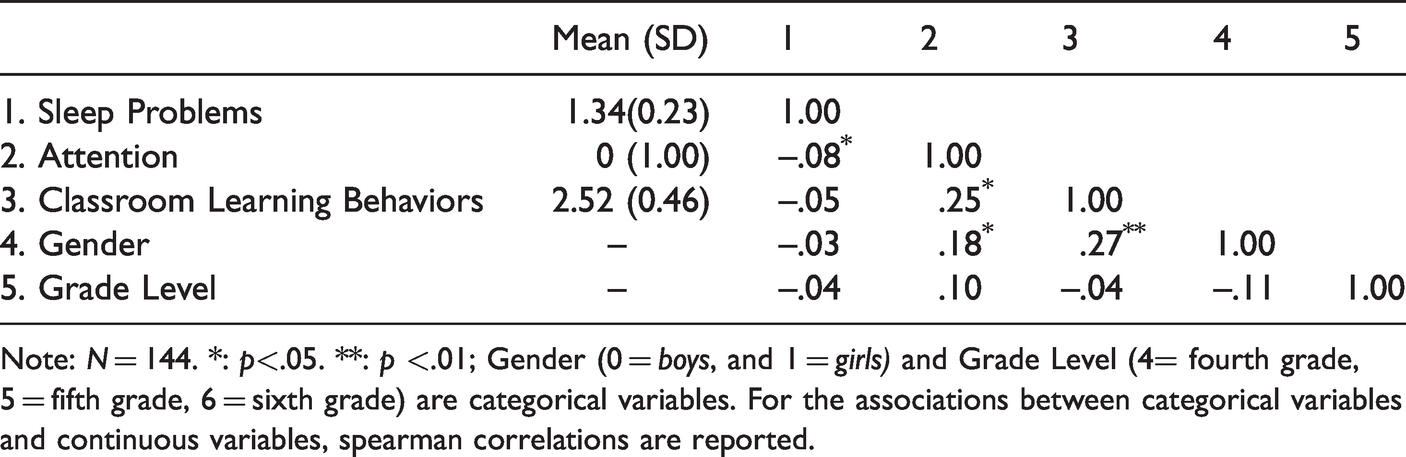
Note: N = 144. *: p<.05. **: p <.01; Gender (0 = boys, and 1 = girls) and Grade Level (4= fourth grade, 5 = fifth grade, 6 = sixth grade) are categorical variables. For the associations between categorical variables and continuous variables, spearman correlations are reported.
Examining the mediating effect of attention
Regression coefficients of the path model are presented in Table 2 and a visual presentation is provided in Figure 1. The model examining the associations between sleep problems, attention, and classroom learning behaviors had a satisfactory model fit:
Standardized regression coefficients of structural equation model predicting children’s classroom learning behaviors.
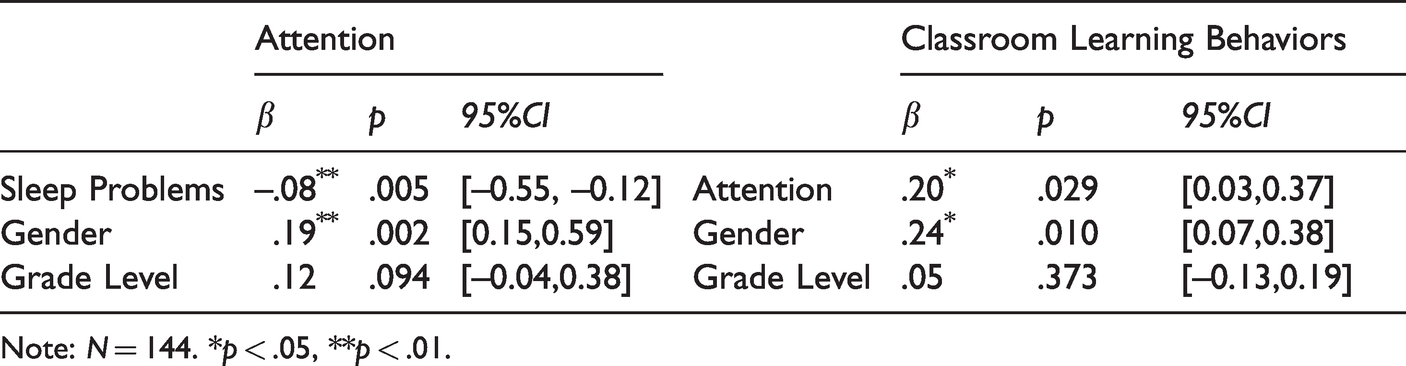
Note: N = 144. *p < .05, **p < .01.
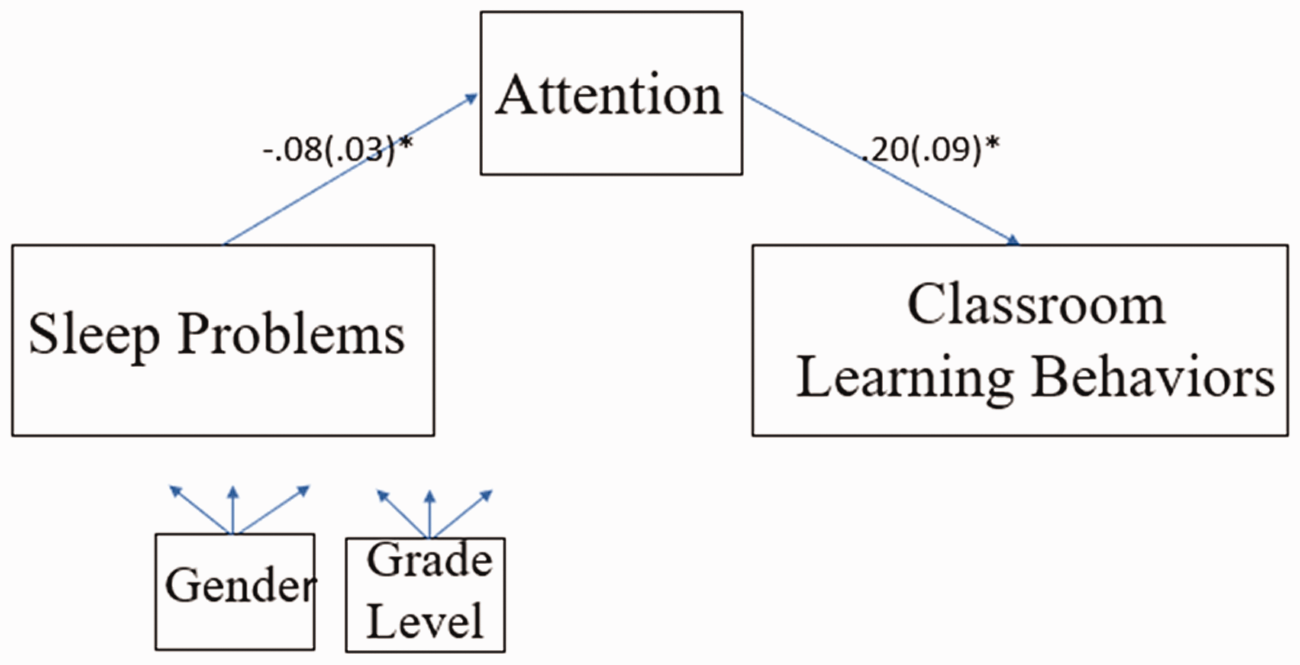
A visual presentation of the association between sleep problem, attention, and classroom learning behavior.
The moderating effects of child gender
The present study further explored the moderating effect of child gender in the studied associations. Regression coefficients of the multiple group model are presented in Table 3 and a visual presentation is available in Figure 2. The multiple group model where all the associations were freely estimated across gender groups was taken as the baseline model. This model had a satisfactory model fit:
Standardized regression coefficients of multiple group model about associations among sleep problems, attention, and classroom learning behaviors.
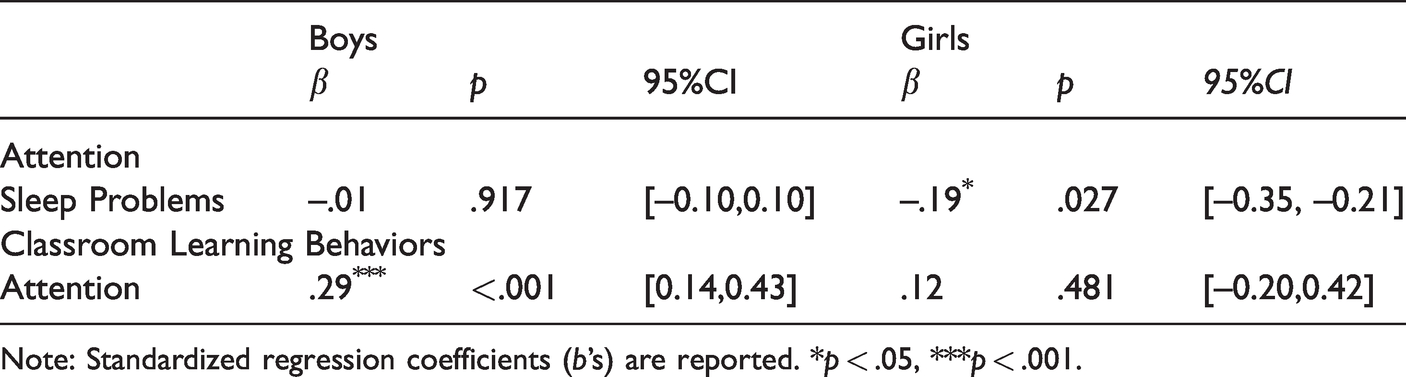
Note: Standardized regression coefficients (b’s) are reported. *p < .05, ***p < .001.
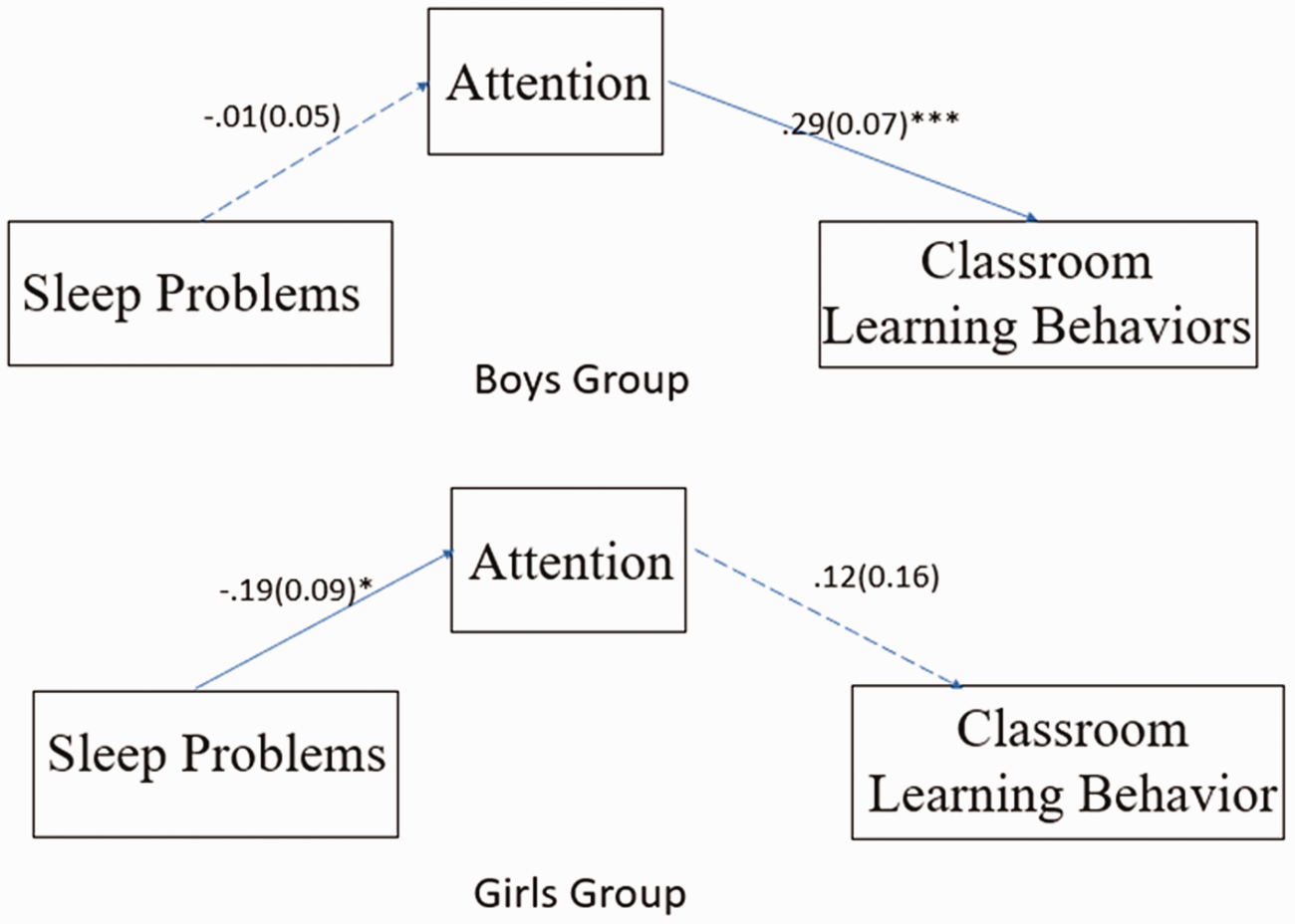
Multigroup comparisons of the associations among students’ sleep problems, attention and classroom learning behaviors.
Discussion
The present study investigated the associations between children’s sleep problems and classroom learning behaviors, and examined the mediating effect of attention and the moderating effect of gender in this process. Results showed that children’s sleep problems had a negative association with their attention level, and their attention had a positive association with their classroom learning behaviors. The indirect effect of students’ sleep problems on classroom learning behaviors, however, was not significant. Child gender had moderating effects on these associations: The negative association between sleep problems and attention was stronger for girls whereas the positive association between attention and classroom learning behaviors was stronger for boys.
Different from the theoretical assumption (Mullins et al., 2014) and previous research (e.g., Dewald et al., 2010; Lundahl et al., 2015), although children’s attention had significant associations with both their sleep problems and classroom learning behaviors, the mediating effect of attention was not significant. Given that we only found a weak association between sleep problems and attention, one of the possible reasons for the non-significant indirect effect might be that the attention test was assessed in a relatively short time (i.e., three minutes). The influence of children’s sleep problems on attention level might become more salient when students need to concentrate for a longer period of time (Meijer et al., 2000). Therefore, future research may adopt more comprehensive measures of students’ attention (e.g., Conners’ Continuous Performance Test; Edwards et al., 2007) and further examine the influence of sleep problems on students’ attention level over a longer period of time. As the present study is preliminary and we included a relatively small sample, future research may include a larger sample and further explore whether children’s sleep problems have influences on their school functioning. Nevertheless, our findings still showed that children’s sleep problems may harm their neurocognitive functioning, and suggested a careful reconsideration of the popular practice of sacrificing children’s sleep time for studying in Chinese society (Li et al., 2013). As a result, some attempts may be taken to help children with sleep problems, such as implementing school-based sleep intervention (Li et al., 2013).
In addition, some interesting gender differences were found in the present study. Girls had a higher attention level and better classroom learning behaviors, which were in line with previous studies that found school-age girls had better performance at attention and learning behaviors (Naglieri & Rojahn, 2001). A plausible explanation is that girls tend to experience puberty earlier than boys, and therefore girls in upper elementary schools may be more mature than their boy counterparts (Naglieri & Rojahn, 2001). More importantly, we found child gender had moderating effects on the associations between children’s sleep problems and attention, and between attention and classroom learning behaviors. First, in line with the findings of van Zundert et al. (2015), sleep problems were found to harm girls’ attention level to a larger extent than that of boys. According to Dewald et al. (2010), as girls are likely to enter puberty earlier, they may need higher sleep-quality in this specific developmental stage, and therefore suffer more from sleep problems (Calhoun et al., 2014; van Zundert et al., 2015). As little research has explored this topic, however, more research is needed to investigate the possible mechanisms.
On the contrary, in terms of the association between attention and classroom learning behaviors, the positive association was stronger for boys than for girls. This finding was different from the finding from DuPaul et al. (2006). The different results, however, might be due to the different samples included in our study (i.e., typically-developing children) and their study (i.e., students with ADHD). A possible reason for finding boys’ learning behaviors to be more severally affected by a decrease in attention level was that there might be gender differences in cognitive skills related to both children’s attention and learning behaviors. For example, the meta-analysis of Else-quest et al. (2006) pointed out that boys had a lower level of inhibitory control than girls, whereas inhibitory control was closely related to children’s attention level and behaviors. A plausible explanation is that, when children experienced a decrease in attention, girls tend to stay a high-level and stable performance in class due to their better inhibitory control, whereas for boys it is more difficult to perform well. Without further studies, however, we cannot draw a more stringent conclusion. Future research is therefore encouraged to explore the gender difference in how children’s cognitive functions are related to their learning behaviors.
Based on our findings, some implications were provided. First, given the importance of children’s sleep quality, researchers, school practitioners, and parents are suggested to pay more attention to children’s sleep problems. For example, research institute and schools may develop and provide effective interventions for children with sleep problems (e.g., workshops about good sleep habits and mindfulness training; Vriend et al., 2011). This may be especially important for Chinese teachers and parents, as they seemed to lack sufficient awareness and understanding about sleep problems (Jarrin et al., 2013). Second, as gender differences were found in the associations between children’s sleep problems, attention, and classroom learning behaviors, educational practitioners may need to adapt their strategies for boys and girls differently (Mallampalli & Carter, 2014). For example, in terms of interventions aiming at improving children’s sleep quality (e.g., Li et al., 2013), it may be beneficial to adopt approaches to encourage the participation of girls. Similarly, programs aiming at improving children’s attention level may try to be more attractive for boys. Future research is also encouraged to develop interventions and programs that are more specific and individualized.
The present study is one of the few studies exploring the associations among elementary school students’ sleep problems, attention, and classroom learning behaviors. Moreover, we employed a multi-informant methods and may provide added-value in this field of research. Several limitations of the present study, however, should still be accounted. First, the smaller sample size used in the present study may affect the generalization of our findings to a larger population. Therefore, future research is encouraged to include a larger and more diverse sample to investigate whether our findings apply to other students as well. Second, the present study included cross-sectional data, and was therefore not able to draw a conclusion about the causal relationship between the study variables. To further explore the direction of the studied relationships, future research is suggested to include longitudinal data and use more advanced statistical models (e.g., cross-legged model).
Third, although we already controlled for the effects of child gender and grade level, there might be other potential factors affecting the studied associations. Two potential confounding variables are students’ depression level and their externalizing behaviors. Depression may increase students’ sleep problems and harm their attention level (Mayes et al., 2009; Wade et al., 2002). Externalizing behaviors were frequently found to be associated with both attention level and school adjustment (Demirtaş-Zorbaz & Ergene, 2019; Mayes et al., 2020). As previous studies usually found girls to have higher levels of depression and lower levels of externalizing behaviors than boys (Mayes et al., 2020; Wade et al., 2002), children’s depression and externalizing behaviors may confound the gender differences we found in the associations among sleep problems, attention and classroom learning behaviors. In addition, students’ clinical status such as diagnosis of ADHD and learning disorders may also be considered, as these disorders may affect the studied variables as well (Mayes et al., 2009). Thus, future research may further include other important covariates such as students’ depressive symptoms and externalizing behaviors, and discuss their influences in the studied associations.
Fourth, the present study invited parents to report about children’s sleep quality whereas some parents may have little understanding of how well their children sleep. Combining subjective reports of children’s sleep problems and objective measures such as activity recorder, however, may provide more comprehensive information about children’s sleep problems (Holley et al., 2010). Future research may therefore assess children’s sleep problems with different types of measures, such as sleep dairy and using a sleep activity recorder. Fifth, the present study assessed students’ general sleep problems by aggregating different dimensions of sleep problems, and assessed students’ overall attention level with a paper-pencil test. Because of the power limitation, we did not further examine different dimensions of sleep problems and attention. It would be interesting to investigate how sub-dimensions of attention such as sustained attention (i.e., the ability to focus on a stimulus for a long period of time) and hyperactivity (i.e., constantly moving around, being restless and unusually active) are associated with students’ sub-dimensions of sleep problems (Mayes et al., 2009; Rogers et al., 2011). Future research may therefore include more sophisticated measures of students’ attention, such as Conners’s Continuous Performance Test, and investigate how sub-dimensions of sleep problems are related to sub-dimensions of attention.
In conclusion, despite the limitations, this study suggested that children’s sleep problems may affect their attention, while their attention level would influence their classroom learning behaviors. These influences are likely to be different for boys and girls. Therefore, more attention is needed for children’s sleep problems, and the mechanism of how their sleep problems may affect their well-being.
Footnotes
Declaration of conflicting interests
The author(s) declared no potential conflicts of interest with respect to the research, authorship, and/or publication of this article.
Funding
The author(s) disclosed receipt of the following financial support for the research, authorship and/or publication of this article: This article was supported by the CSC & UvA scholarship.
