



Abstract
Research suggests that mental contrasting with implementation intentions (MCII) enhances commitment and goal attainment. However, most studies have used limited comparison conditions. The present study compared MCII against two other potentially effective approaches: autonomous planning (AP), and solution-focused planning (SFP). It was thought that condition would have an indirect effect on goal progress by affecting commitment. However, goal attainment expectancy was hypothesised to be a moderator such that MCII has positive effects when expectancy is high but negative effects when expectancy is low. Ninety-eight female students were randomly assigned to one of three conditions: 1) MCII, 2) AP, or 3) SFP. All students initially set themselves a goal for the coming week regarding personal projects. Mean commitment and goal progress were marginally higher in the MCII condition than in the AP and SFP conditions but the differences were not statistically significant and (as predicted) much smaller than in previous research. Expectancy did not appear to have a moderating effect. The apparent benefits of MCII were larger relative to AP than to SFP. Results suggest that MCII may sometimes be no more effective than other approaches to goal-setting and planning, particularly if they are evidence-based and carefully-designed. Implications for schools are addressed.
Keywords
Goal-setting and planning
According to goal-setting theory (GST), setting specific goals enhances performance (Locke & Latham, 1990, 2013). However, the effectiveness of goal-setting depends on commitment, i.e. the extent to which people feel bound to their goals (Locke & Latham, 2019). Goal-commitment is positively associated with goal attainment in education and beyond (Klein et al., 2013; Langens, 2003). Commitment depends on (i) goal attainment expectancy - the degree to which a student believes a goal can be attained - and (ii) goal desirability - the degree to which the student considers the goal attractive or worthwhile (Klein et al., 2013). Work by Oettingen and colleagues suggests that goal commitment also depends on an individual’s mode of thought (Oettingen et al., 2001). For example, a student who merely indulges in positive fantasies (imagining the benefits of goal-attainment) is likely to be less committed to action than a student who contrasts the benefits of goal attainment with potential obstacles in the way (Oettingen et al., 2009).
Locke and Latham (1990) originally formulated goal-setting theory with respect to behavioural or task goals (e.g. ‘To have written 3,000 words by Monday’), or outcome goals (e.g. ‘To achieve an A on my assignment’). However, in the last two decades, learning goals (e.g. ‘To discover three ways to improve my essays’) have also been studied (Seijts et al., 2013). Regardless of the type of goal, GST has always emphasised the importance of planning. Goals are much more likely to enhance performance when they are accompanied by good plans (Latham & Arshoff, 2015). Together, goal-setting and planning (GS&P) are considered vital components of self-regulated learning (Zimmerman, 1989). Engagement in GS&P is related to achievement track placement in school (Zimmerman & Pons, 1986). Students scoring high marks on tests report more GS&P than students scoring low marks (Kitsantas, 2002). Other studies indicate that GS&P predict academic achievement (Alotaibi et al., 2017; Roick & Ringeisen, 2018). Moreover, interventions including GS&P have led to improved academic performance (Morisano et al., 2010; Schippers et al., 2015, 2020). However, the aforementioned GS&P interventions are lengthy and elaborate, lasting several hours. This makes them difficult to implement in natural school settings. Briefer GS&P interventions are therefore required.
Mental contrasting with implementation intentions (MCII)
One brief GS&P intervention is known as mental contrasting with implementation intentions (MCII). MCII can be performed by students in just eight minutes (Kizilcec & Cohen, 2017). MCII includes two components: mental contrasting (MC) and implementation intentions (IIs). Mental contrasting involves imagining the benefits of goal attainment, and then reflecting on the main obstacle in one’s way (Oettingen, 2000). Studies have shown that if goal desirability and goal attainment expectancy are high, then MC enhances commitment (Oettingen et al., 2010, 2013).
Implementation intentions (IIs) are ‘if/when-then’ plans that specify a critical cue and a goal-directed response (Gollwitzer, 1999). For example, a student might form the following IIs: ‘When it is 10am today, then I will write the conclusion to my essay’ and ‘If I feel like giving up, then I will take a deep breath and keep going.’ A meta-analysis of 94 studies found that IIs had a medium-to-large positive effect on goal attainment (Gollwitzer & Sheeran, 2006).
In MCII, individuals engage in MC and then formulate an II to overcome their obstacle. When expectancy and desirability are high, MCII should enhance commitment, which should in turn lead to greater goal progress. This mediational hypothesis (MCII → enhanced commitment → greater goal progress) has been supported empirically (Wittleder et al., 2019). MCII can be effective even as a brief single-session intervention (Kizilcec & Cohen, 2017). Nevertheless, MCII does not work on all occasions. One crucial moderator is expectancy (Cross & Sheffield, 2019; Gollwitzer et al., 2011; Oettingen et al., 2009). If students do not believe that they can overcome their obstacles, then they are likely to become less committed rather than more so.
Some studies suggest that MCII can be effective in schools. Duckworth et al. (2011) examined whether MCII could help high school students achieve the goal of completing practice questions (for an exam). Sixty-six students with a mean age of 16.7 were randomly assigned to an MCII or placebo writing activity. Students in the MCII condition completed over 60% more questions than those in the control group. The researchers did not report standard deviations, making it difficult to calculate Cohen’s d. However, they report a standardised beta coefficient (for condition) of 0.27, which in the context of academic performance may be considered a large effect (Keith, 2019).
Duckworth et al. (2013) conducted a study involving seventy-seven middle school students with a mean age of 11.05. Participants were randomly assigned to an MCII or ‘positive thinking’ condition. All students were initially asked to set a goal and to identify and imagine the ‘best thing’ about achieving it. Thereafter students in the former condition went through the remaining steps of MCII whilst students in the latter elaborated further on positive outcomes. Compared to the latter condition, MCII had a positive effect on grades, attendance and school behaviour. In terms of Cohen’s d, effect size estimates were of medium size.
Other studies have also reported positive effects. For example, MCII has helped middle school students (both at risk and not at risk for ADHD) improve their management of school activities (Gawrilow et al., 2013). College students have also benefited in terms of improving time management (Oettingen et al., 2015), increasing study time (Clark et al., 2020), overcoming bedtime procrastination (Valshtein et al., 2020) and managing unhealthy habits (Adriaanse et al., 2010).
Limitations in MCII research
Despite some positive results, there are significant limitations in the research. First, most studies of MCII in education have involved college students or postgraduates (Adriaanse et al., 2010; Clark et al., 2020; Kizilcec & Cohen, 2017; Oettingen et al., 2015; Saddawi-Konefka et al., 2017; Valshtein et al., 2020). Many more studies are needed in schools. Perhaps most importantly, however, studies of MCII have involved limited comparison conditions.
First, several studies have failed to control for goal-focus (or time-spent-on-the-goal). In Gawrilow et al.’s (2013) study with middle school students, all students participated in a ‘learning style’ intervention. After this, students in one condition engaged in MCII whilst students in the comparison condition did nothing. The comparison condition was therefore a passive control group, making it impossible to rule out placebo effects. Duckworth et al. (2011) did better by requiring their comparison group to be active. However, once again, goal-focus differed across conditions. The intervention group spent a full thirty minutes on MCII for their goal while students in the comparison group wrote an irrelevant essay. It is not clear, therefore, whether MCII students succeeded because of the intervention or merely because they spent more time on the goal. Moreover, if MCII participants focus on the goal while controls do something irrelevant (or nothing at all), the former may develop greater expectations for progress than the latter. As Boot et al. (2013, p. 445) point out, ‘only when the active control group has the same expectation of improvement as the experimental group can we attribute differential improvements to the potency of the treatment.’ Studies should therefore ensure not only that both conditions are active but also that both engage students in goal-focused tasks that are likely to generate similar expectations of progress.
Another important limitation in some previous conditions is the absence of action-oriented planning. In Duckworth et al.’s (2013) study, students in the comparison group indulged in ‘positive thinking.’ Unlike their MCII counterparts (who formulated a goal-relevant II), they were not prompted to formulate an action-step. Adriaanse et al. (2010; Experiment 1) conducted a randomised study involving female students with a mean age of 20.76. The aim was to see whether MCII could help students improve their eating habits. Students in one condition engaged in MCII (which culminates in the formulation of an action-step). Students in the comparison condition, however, merely listed healthy snacks. Listing items is not the same as deciding on action. A stronger test of MCII would compare it against a condition that also leads to an action-step (preferably in the form of an II).
Yet another limitation in previous comparison conditions is the absence of theoretical or empirical support. For example, Duckworth et al. (2013) asked students in the comparison to engage in ‘positive thinking.’ However, the process of indulging in positive thinking is known to be ineffective (Gollwitzer et al., 2011; Oettingen et al., 2010). Thus, the comparison condition not only lacked support but was indeed contradicted by theory and available evidence. Oettingen et al. (2015; Experiments 1 & 2) examined whether MCII could help undergraduates improve their time management with regard to academic goals. In one comparison condition, students focused on their goals (like their MCII counterparts). However, they engaged in a version of MCII in which the steps of MC and format of the II were reversed. It has been known for twenty years that reversing the order of MC or tampering with the format of the II undermines the effectiveness of the intervention (Oettingen et al., 2000, 2001). A stronger test of MCII would compare it with an approach that is both theoretically and empirically supported.
Finally, it may be wondered how ecologically valid or practically useful previous comparisons have been. School students with goals are not likely to engage in reversed-forms of MCII (Oettingen et al., 2015) or write irrelevant essays (Duckworth et al., 2011), or indulge in ‘positive thinking’ (Duckworth et al., 2013). A more ecologically valid test of MCII would compare it against students’ own planning. Moreover, schools are unlikely to ask students to engage in irrelevant tasks or positive fantasies or indeed nothing at all (Gawrilow et al., 2013) if their aim is to promote goal progress. There are in fact many GS&P approaches that schools may choose from (Dawson & Guare, 2012; Meltzer, 2014; White & DiBenedetto, 2015). A more practically useful test would compare MCII against another such intervention. For the reasons explained above, that other intervention should be equally active, equally goal-focused and should also include action-planning. Moreover, it should have empirical or theoretical support. Finally, it should be the sort of approach that schools (are likely to) adopt. One condition meeting all of these requirements is solution-focused planning.
Solution-focused planning (SFP)
Whereas MCII encourages individuals to identify obstacles (and is therefore problem-focused), solution-focused (SF) approaches avoid ‘obstacles’ altogether (Dierolf et al., 2009). Instead, individuals identify achievements, uncover resources and commit themselves to small goal-focused action-steps (Warner, 2013). SF approaches are much more than ‘positive thinking’ (O’Connell et al., 2012).
In order to help individuals identify their achievements, SF approaches encourage ‘success scaling’ (e.g. ‘On a scale from 0-10, how much progress have you made towards your goal?’). Reseach shows that establishing how far one has progressed enhances perceived self-efficacy (Bandura, 1997; Schunk, 1983). SF approaches also encourage individuals to identify their resources (e.g. ‘What do you have that could help you achieve your goal?’). Studies have shown that the perception of resources enhances expectancy and commitment (Schnelle et al., 2010).
Finally, in order to promote action, SF approaches encourage people to break down goals into small steps (e.g. ‘What could you do today to make some progress towards your goal?’). ‘Small victories’ early on accelerate goal progress (Brown & Lahey, 2014). In addition, students who have small, attainable proximal goals develop a stronger sense of self-efficacy and achieve a higher level of performance than students with only larger distal goals (Latham & Seijts, 1999).
From now on, ‘solution-focused planning’ (SFP) refers to a process involving all three of the aforementioned SF steps: (i) success scaling, (ii) identifying resources, and (iii) the formulation of a small-but-significant action step. These three features are staples of solution-focused practice (e.g. Jackson & McKergow, 2007). The power of SFP can be appreciated from both a theoretical and empirical perspective. As explained, goal-setting theory emphasises the importance of commitment, which depends partly on expectancy. Unlike MCII, solution-focused approaches are designed to enhance expectancy. Research suggests that (compared to asking about obstacles) asking students about resources raises expectancy which in turn raises goal commitment (Abdulla & Woods, 2020). Given the positive association between commitment and performance, SFP may therefore enhance goal pursuit
The benefits of SFP can also be understood from a social-cognitive perspective in terms of perceived self-efficacy (Franklin et al., 2012). Perceived self-efficacy refers to task-specific self-belief. The primary source of perceived self-efficacy is an individual’s own mastery experience (Bandura, 1997). The first step of SFP is success scaling, which encourages students to reflect on mastery experience. This should result in a greater sense of self-efficacy, which in both goal-setting and social-cognitive theory is thought to facilitate goal pursuit (Bandura, 2013).
Solution-focused approaches are used fairly widely in schools (Ajmal & Ratner, 2019; Simmonds, 2019, Stobie et al., 2005). They also have empirical support. Several studies have demonstrated that SF questions are superior to problem-focused alternatives in terms of their effects on perceived self-efficacy and subjective ‘goal approach’ (Braunstein & Grant, 2016; Grant & Gerrard, 2019; Neipp et al., 2016). SF interventions have been effective in helping students improve their behaviour (Franklin et al., 2008), enhance academic skills (Daki & Savage, 2010) and attain personal goals (Green et al., 2006). SFP would therefore appear to be an excellent intervention to compare with MCII.
Nevertheless, MCII and SFP both suffer from one limitation: they require students to follow a particular approach, thus (potentially) infringing on their autonomy. Self-determination theory emphasises the importance of autonomy for positive student outcomes (Niemiec & Ryan, 2009; Reeve, 2002). It is therefore important to compare MCII and SFP against autonomous forms of student planning. Doing so also allows an ecologically valid comparison. That is, an experimental intervention (MCII/SFP) is compared against a ‘natural’ student approach to goal-setting and planning.
Autonomous planning (AP)
As noted, MCII and SFP involve structured approaches to planning. That is, students are required to follow a precise set of steps and to formulate plans in a particular manner (viz., as IIs). An alternative approach is to give students autonomy in planning. In autonomous planning, as conceived here, students are not instructed to write their plans in a particular manner. Nonetheless, they are encouraged to plan in a manner that is goal-directed, action-oriented and detailed. In some previous studies of MCII, students in comparison conditions have been asked to engage in ‘planning’ that is irrelevant to their goals (Oettingen et al., 2015) or simply to list goal-relevant items (Adriaanse et al., 2010 – experiment 1) or to formulate a single II (Adriaanse et al., 2010 – experiment 2). A stronger test of MCII would compare it against a condition in which students formulate action-oriented plans that are both relevant to their goals and more detailed than a single II. Autonomy can be enhanced by allowing students to formulate their plans using whatever sentence-structure or method they like.
In theoretical terms, autonomous planning (AP) would appear to have the support of self-determination theory (SDT) (Ryan & Deci, 2017). Autonomy is considered a basic psychological need. It is thought to be ‘particularly important to adolescents within the school context’ (Núñez & León, 2015, p. 276). Many studies have indeed shown that students who are afforded greater autonomy are more engaged than students whose autonomy is reduced (Benita et al., 2014; Black & Deci, 2000; How et al., 2013). SDT suggests that autonomy can be enhanced by (i) giving students a rationale for what they are asked to do, (ii) acknowledging students’ (negative) feelings, (iii) emphasising choice rather than control (Niemiec & Ryan, 2009). MCII and SFP can benefit from the first two of these methods. However, AP clearly has the advantage with regard to the third. That is, AP makes it much easier to emphasise choice since students may choose how to write their plans.
In some contexts, allowing students to adopt whatever strategy they choose leads to better performance than telling them that a certain strategy ‘should’ be used (e.g. Boggiano et al., 1993). Experimental studies have also shown that emphasising autonomy and choice may lead students to spend more time on a task (Vansteenkiste et al., 2004). In the context of formulating plans this may be important. More detailed goal attainment plans have been associated with higher levels of achievement (Schippers et al., 2020). If autonomy leads students to spend more time on their plans, then AP should result in more detailed plans than MCII and SFP (which in this study involve a single II). That extra detail may prove beneficial.
There is therefore some reason to think that AP might fare well against MCII, compared to conditions such as ‘positive thinking’ or item-listing or a single II.
Pitting MCII against autonomous planning has one other major benefit: it allows MCII to be compared with what students naturally do when asked to engage in (goal-setting and) planning. This gives a study more ecological validity and practical relevance than previous MCII research. Schools will be more interested in how MCII fares against student’s own planning than in how it compares to irrelevant activities (Duckworth et al., 2011) or ‘positive thinking’ (Duckworth et al., 2013).
The present study
The present study compared MCII against solution-focused planning (SFP) and autonomous planning (AP). Unlike previously used comparison conditions, SFP and AP control for goal-focus, both include planning and are likely to be of great interest to schools. Advantages of SFP and AP over previously used conditions are displayed in Table 1.
Solution-focused planning (SFP) and Autonomous Planning (AP) as compared with previously used comparison conditions.
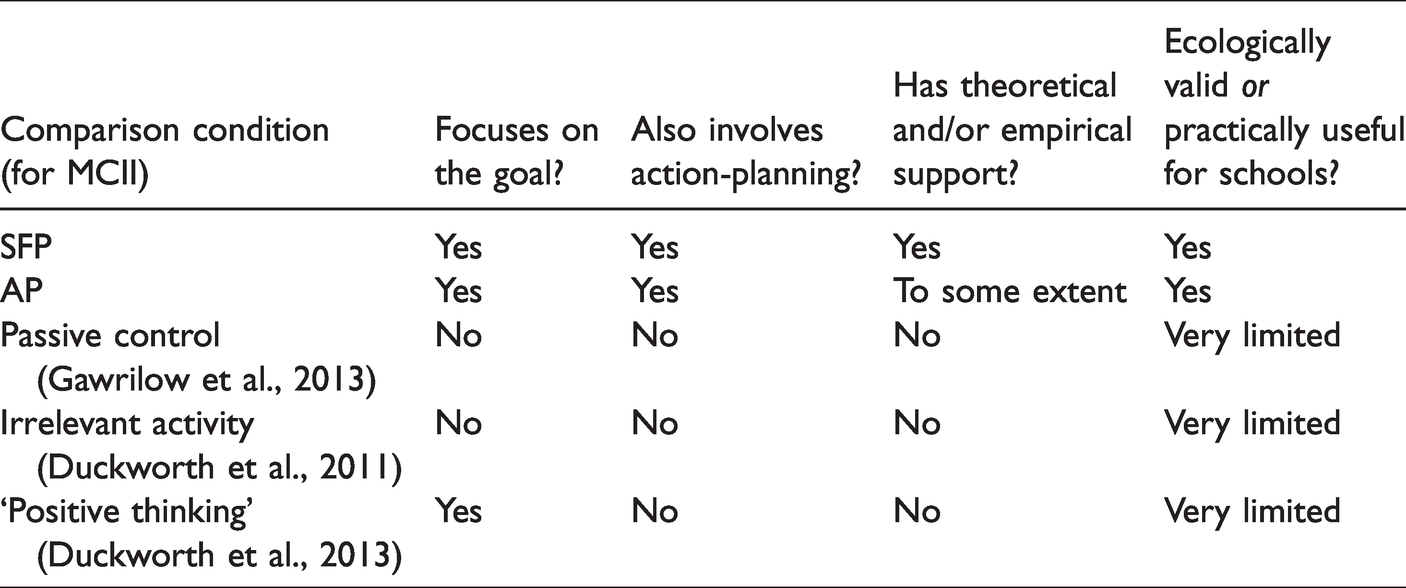
Research suggests that MCII leads to goal progress by enhancing individuals’ commitment (Wittleder et al., 2019). In the present study, therefore, goal commitment was hypothesised to mediate the positive effect of MCII on goal progress. However, for MCII to enhance commitment, individuals must have (reasonably) high expectancy (Cross & Sheffield, 2019). At low levels of expectancy, MC has been known to have a negative effect (Oettingen et al., 2009). In such cases, SFP might lead to greater commitment (and progress) because it is designed to enhance expectancy. Thus expectancy was hypothesised to moderate the effect of condition on progress. The following specific hypotheses were advanced:
when expectancy is high, MCII enhances commitment (relative to SFP and AP), but
when expectancy is low, MCII lowers commitment (relative to SFP and AP).
When expectancy is high, MCII has a positive indirect effect on goal progress (relative to SFP and AP) through enhanced commitment.
When expectancy is low, MCII has a negative indirect effect on goal progress (relative to SFP and AP) through reduced commitment.
The hypotheses above imply a moderated mediation model, which is depicted in Figure 1.
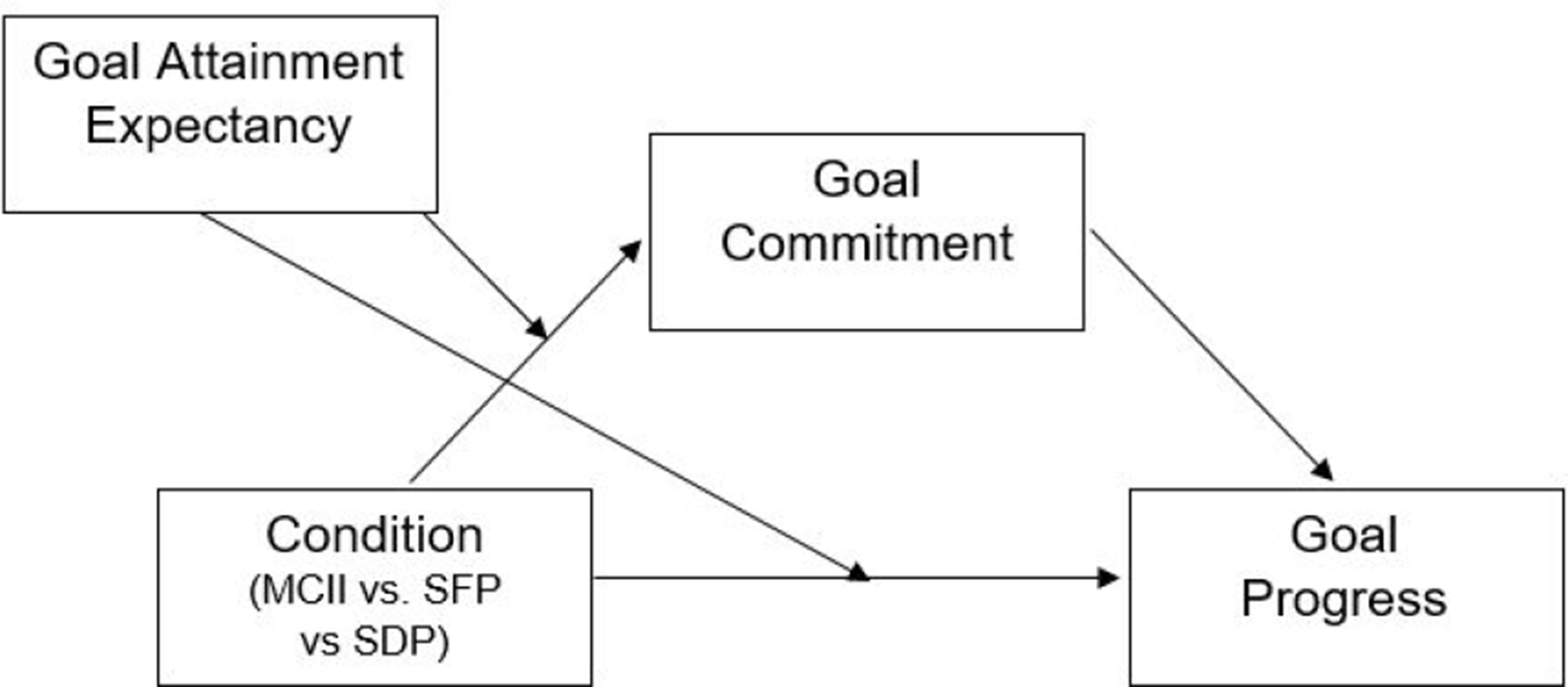
A moderated mediation model depicting the hypothesised direct and indirect effects of condition on goal progress as a function of expectancy.
Figure 1 posits that the effect of condition on commitment is moderated by goal attainment expectancy (H2). It also seemed reasonable to suppose that the direct effect of condition on progress might depend on expectancy. For example, if expectancy is extremely high (and goals are simple to attain), then perhaps there is less of a difference between conditions. The following hypothesis was therefore also investigated:
Method
Participants
One hundred female students aged 16–17 were recruited for the study. Two participants failed to complete the second survey, leaving a total of 98 participants (Mean age = 17.2; SD = 0.5). Participants attended a private secondary school in London, England. In the previous year all students had taken GCSEs – public examinations taken in England, Wales and Northern Island. At the time of the study, participants were in the first year of their A-level courses. The study was approved by the Ethics Committee at Robert Gordon University.
Procedure
Participants were randomly assigned to one of three conditions: MCII, SFP, and AP. In order to ensure fidelity, interventions were delivered through structured Google Forms rather than by school teachers. Participants in each condition were sent emails with links to the relevant form. They were then given 15 minutes to complete the intervention during a non-teaching slot between lessons.
All participants were initially prompted to set a goal for the coming week regarding their extended personal projects (EPPs). EPPs were independent projects on topics chosen by students. Topics related to students’ interests and were not specific to a particular subject or curriculum. Examples of EPPs were: ‘To what extent does working as a war correspondent have a negative effect on mental health?’ ‘To what extent should subliminal advertising be allowed?’
The initial prompt was designed to invite a behavioural/task goal: ‘What do you want to have done on your EPP by this time next week?’ Students were asked to set a goal that was ‘valuable’ to them. By allowing students to set their own goals and encouraging them to choose goals that were ‘valuable,’ we hoped to ensure goal desirability - one of the key determinants of commitment (Klein & Wright, 1994).
Following goal-setting, students were asked to indicate their goal attainment expectancy. After this point, forms differed according to condition.
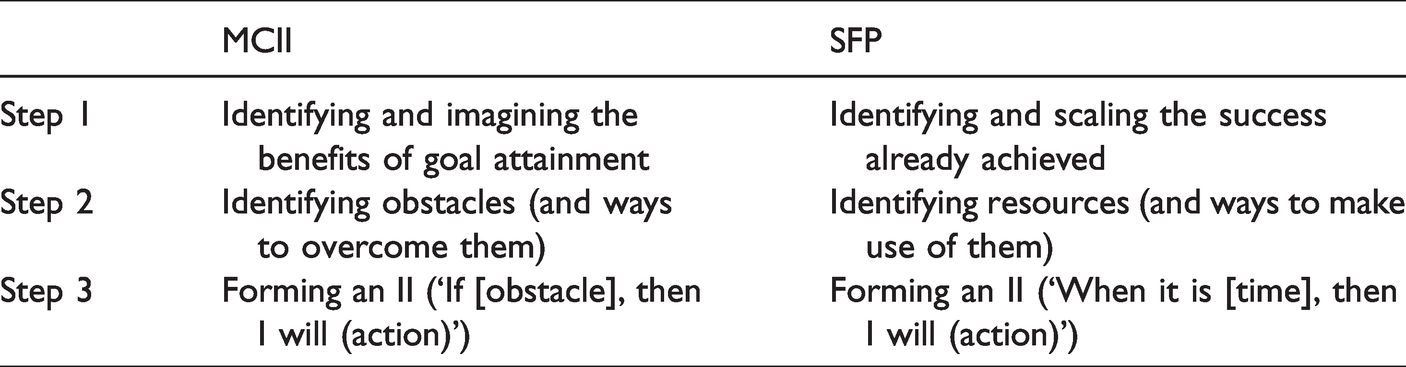
MCII
The first prompt was: ‘Take a moment to imagine success. Fast forward and imagine you’ve achieved your goal. Picture it as vividly as possible. Give your imagination free reign.’ Then they were asked to write down ‘the best thing about achieving [their] goal.’ After this, they were asked to consider ‘what could stop [them] from achieving [their] goal’ and to write down their ‘one main obstacle.’ Then they were asked to ‘imagine [their] obstacle as vividly as possible’. The next prompt was: ‘Now think about what you could to overcome that obstacle.’ After this, they were asked to write down what they would do ‘to overcome [their] obstacle’ and then to formulate a plan using the ‘If…then I will…’ format.
Solution-focused planning (SFP)
The first prompt was: ‘Take a moment to think about what you have already done to achieve your goal. Imagine a scale from 0 to 10. ‘0’ means you’ve done absolutely nothing to achieve your goal, and ‘10’ means you’ve already achieved your goal. Where are you now on the scale?’ Then they were asked to write down a number from 0 to 10. After this, they were asked to consider ‘what could help [them] achieve [their] goal’ and to write down one or two resources. The next prompt was: ‘Now think about one small thing you can do today to make progress towards your goal.’ After this, they were asked to write down ‘a small but useful step’ and then to formulate a plan using the ‘When it is … then I will’ format.
The SFC and MCII conditions were carefully balanced. Both conditions involved three main steps, an equal focus on the goal, and a final action-oriented plan in the form of an II (see Table 2).
The balancing of the MCII and SFP conditions.
Autonomous planning (AP) condition
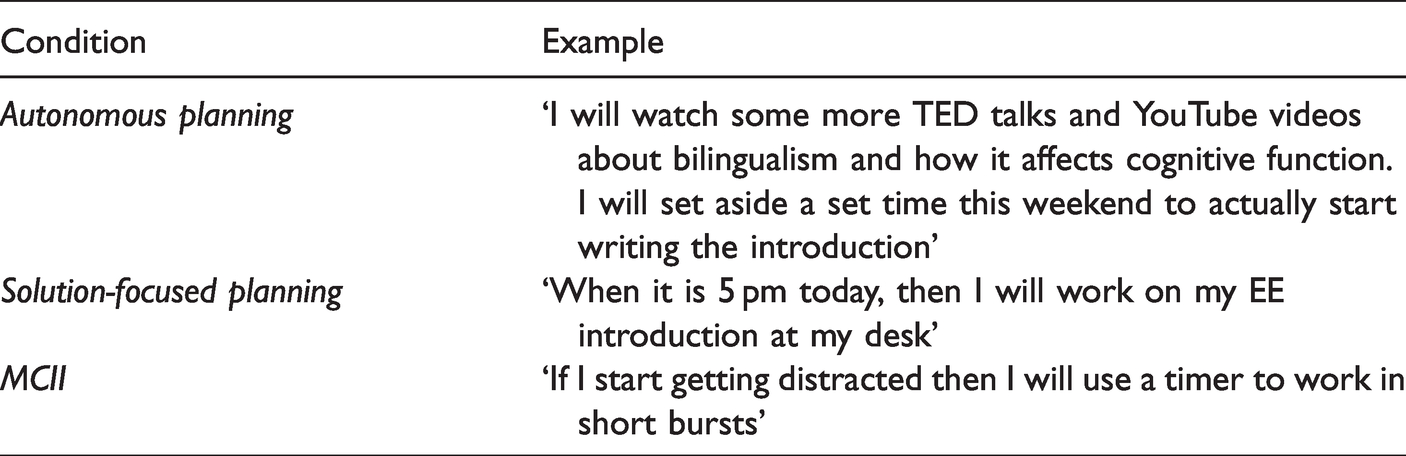
Students in the AP condition were presented with the following prompt: ‘Now take a few minutes to plan how you will achieve your goal. Consider what you will do. Write down your action steps below.’
After completing the condition-specific portion of the form, all students were presented with the commitment items. Exactly one week after the intervention, all students were sent a second email with a link to another Google Form. Following the procedure of other GS&P studies (e.g. Powers et al., 2005), students were initially reminded of the goal that they had set in the first session (i.e. the week before). They were then asked to report how much progress they had made towards that goal.
Measures
Goal attainment expectancy
This was initially assessed by means of a 3-item measure deriving from previous research (Abdulla & Woods, 2020). However, one of the items (‘How likely is it that you will achieve your goal?’) had low correlations with the other two and was therefore dropped. The remaining items were: ‘On a scale from 0-10, how easy will it be to achieve your goal?’ and ‘On a scale from 0–10, how ‘attainable’ is your goal?’ (α = 0.80). Higher scores indicated higher expectancy.
Commitment
Goal commitment was assessed with the 4-item commitment measure developed by Klein et al. (2013). A 7-point response scale was used (1 = ‘Not at all;’ 7 = ‘Completely’). The first item was: ‘On a scale from 1 to 7, how committed are you to your goal?’ Higher scores indicated higher commitment (α = 0.89)
Goal progress
This was measured with 6 items adapted from previous research (Wanberg et al., 2010). Students were asked to indicate their agreement with each statement on a 5-point scale (1 = ‘strongly disagree’; 5 = ‘strongly agree’). The first item was: ‘I made good progress on my goal this week.’ Negatively-worded items were reverse-scored. Higher scores indicated greater goal progress (α = 0.91).
Analytical strategy
A moderated mediation model was estimated using Hayes’ PROCESS macro (Model 8) (Hayes, 2018). The independent variable was condition (MCII vs. SFP vs. AP); the mediator was commitment; the dependent variable was goal progress; and the moderator was expectancy. Condition was coded by means of two dummy variables. Two product terms were then created by multiplying each dummy variable by expectancy.
In order to test for moderation (by expectancy) of the effect of condition on commitment, two models were compared: an augmented model containing expectancy, the two dummy variables and the two product terms, and a compact model containing the aforementioned variables minus the product terms. In order to test for moderation (by expectancy) of the indirect effect of condition on progress two indices of moderated mediation were calculated. The first concerned whether expectancy moderates the indirect effect of MCII relative to AP, and the second whether expectancy moderates the indirect effect of MCII relative to SFP. In order to examine potential moderation of the direct effect of condition on progress an omnibus test was conducted. Two models were compared: an augmented model containing commitment, expectancy, the two dummy variables and two product terms, and a compact model containing the aforementioned variables minus the product terms.
Results
As expected, almost all students (96%) set themselves behavioural/task goals specifying what they wanted to do by the following week. Four students (4%) set themselves a learning goal. Examples are given in Table 3.
Examples of students’ goals.

Plans were inspected in order to determine whether students had adhered to instructions. All students in the MCII and SFP conditions produced their plans in the required II format (‘If/When it is…then I will’). All students in the AP condition described their intended action-steps in free-form sentences. Participants therefore adhered to instructions. As expected, students in the AP condition generally produced longer, more detailed plans than students in the MCII and SF conditions. Examples of plans are presented in Table 4.
Examples of plans in each condition.
Group means and standard deviations for all measured variables are displayed in Table 5.
Group means and standard deviations for goal attainment expectancy, goal commitment and goal progress.
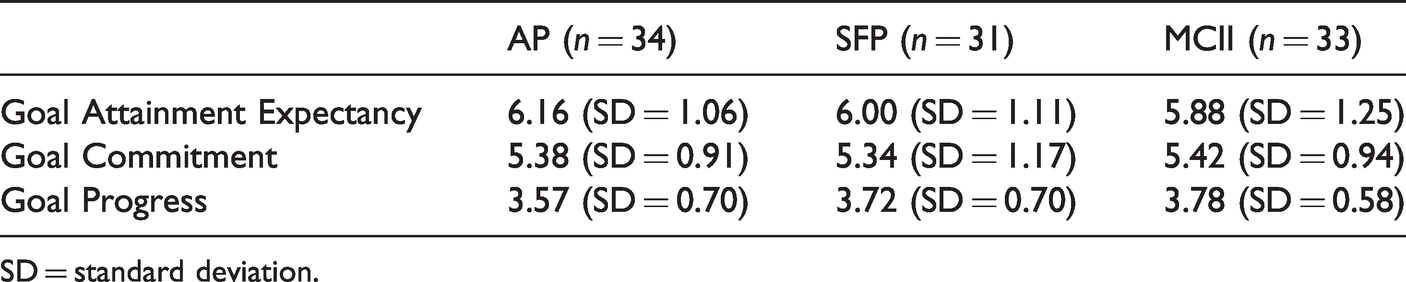
SD = standard deviation.
Goal attainment expectancy
Goal attainment expectancy was measured before the manipulation. Thus the groups were expected to be equivalent on this variable. A one-way between-subjects ANOVA confirmed that group differences in expectancy were not statistically significant: F(2,95) = 0.52, p = .60, η2 = .01. ‘Low’ expectancy was defined as a score lower than the midpoint on the 0-10 scale (i.e. <5). ‘Moderate’ expectancy was defined as a score between 5 and 7, and ‘high’ expectancy was defined as a score above 7. These cut-offs were based on the scale itself and not on previous research. They served only to provide a convenient means of categorisation. In the entire sample, 15.3% of participants had ‘low’, 71.3% had ‘moderate’, and 13.4% had ‘high’ expectancy.
The association between expectancy and commitment
Commitment was regressed on expectancy and the dummy variables coding condition. The coefficient for expectancy was statistically significant: b = 0.23 [0.06, 0.41], t = 2.63, p = .01. The standardised beta coefficient was .26, suggesting an appreciable association. There was therefore strong support for H1 (viz. that expectancy is positively associated with commitment).
Moderation (by expectancy) of the effect of condition on commitment
The change in R2 between the compact and augmented model was extremely small (0.002) and far from statistically significant: F(2,92) = 0.09, p = .91. In addition, neither of the two product terms was statistically significant (ps > .80). There was therefore no good evidence to support H2 (viz. that the effect of condition on commitment depends on expectancy).
The association between commitment and goal progress
In the model of goal progress, commitment emerged as a statistically significant predictor: b = 0.33 [0.19, 0.47], t = 4.65, p < .0001. The standardised beta value was .45, suggesting a considerable association. There was therefore strong support for H3 (viz. that commitment is positively related to progress).
Moderation of the indirect effect of condition on progress
A 95% bootstrap confidence interval for the first index of moderated mediation based on 5,000 bootstrap samples included zero [-.0.97, 0.16]. A bootstrap confidence interval for the second index of moderated mediation also included zero [-0.21, 0.15]. There was therefore little evidence to support H4 (viz. that the indirect effect of condition on progress depends on expectancy).
Moderation of the direct effect of condition on progress
The change in R2 in the omnibus test was small (0.02) and not statistically significant: F(2,91) = 0.09, p = .32. In addition, the product terms were not statistically significant (ps > .16). There was therefore no good evidence to support H5 (viz. that the direct effect of condition depends on expectancy).
Estimation of a simple mediation model
Since there was no good evidence for the moderated mediation model, a simple mediation model was estimated. Expectancy was retained as a covariate given its association with commitment. Goal progress was the dependent variable, condition the independent variable, and commitment the mediator. The omnibus test indicated that the direct effect of condition on progress was not statistically significant: F(2,93) = 0.65, p = 0.52, R2 = 0.01. Coefficients for the dummy variables were also not statistically significant (ps > .30). For the MCII vs AP contrast, a 95% bootstrap confidence interval for the indirect effect based on 5,000 samples included zero [-0.18, 0.10]. Similarly, for the MCII vs SFP contrast, a 95% bootstrap confidence interval for the indirect effect included zero [-0.24, 0.11]. There was therefore no good evidence of an effect on condition on progress through commitment.
Group differences in commitment and progress
Finally, in order to illuminate the sizes of the group differences in commitment and goal progress two one-way ANCOVAs were conducted. In each case, expectancy (mean-centred) was the covariate and condition was the independent variable. The effect of condition on commitment, controlling for expectancy, was not statistically significant: F(2,94) = 0.12, p =.89. The effect of condition on goal progress, controlling for expectancy, was also not statistically significant: F(2,94) = 0.68, p =.51. Adjusted group means are displayed in Table 6. As may be observed, the differences between these means and the (unadjusted) means in Table 5 are minimal for commitment. For goal progress adjusted and unadjusted means were identical to two decimal places.
Adjusted group means for goal commitment and goal progress (controlling for goal attainment expectancy).

If unadjusted means are used and Cohen’s (1988) thresholds are applied, the greater progress of the MCII condition amounted to an exceptionally small effect relative to the SFP condition (d = 0.09) and a small effect relative to the AP condition (d = 0.33). Relative to the AP condition, the greater progress of the SFP condition amounted to a small effect (d = 0.22). The higher commitment of the MCII condition amounted to an exceptionally small effect relative to the SFP condition and AP condition (ds < 0.08). Commitment was all-but-identical in the AP and SFP conditions.
Discussion
The primary aim of the present study was to compare mental contrasting with implementation intentions (MCII) against two other potentially effective approaches: solution-focused planning (SFP) and autonomous planning (AP). As predicted, expectancy was positively associated with commitment (H1) and commitment was positively associated with progress (H3). These findings are in line with many previous studies (see Klein et al., 2013) and lend further support to the tenets of goal-setting theory (Locke & Latham, 2013). Most participants (84.7%) had moderate-to-high expectancy. On the whole, therefore, students were wise enough to set themselves (subjectively) attainable goals - a fact that contributed positively to commitment.
There was no evidence to suggest that the effect of condition on commitment is moderated by expectancy (H2). Previous studies have found that MCII enhances commitment only when expectancy is high (Oettingen et al., 2001, 2009). When expectancy is low, individuals engaging in MC are predicted to disengage from goals. It may therefore be wondered why there was no evidence of moderation in the present study. Expectancy scores suggest one explanation. Although 15.3% of participants had expectancy scores below the midpoint, no participant had a score less than 4. Expectancy may therefore not have been low enough for MC to have a negative effect. A study of MCII involving middle school students (Oettingen et al., 2000) supports this supposition: clear evidence of moderation was obtained only when expectancy was extremely low.
Crucially, there also appeared to be little difference between conditions in commitment or progress. Mean commitment and progress were higher in the MCII condition than in the AP and SFP condition but the advantage was small relative to the former and negligible relative to the latter. Previous studies of MCII with students have reported medium-to-large positive effects (Clark et al., 2020; Duckworth et al., 2011, 2013). One notable exception is described by Kizilcec and Cohen (2017). These researchers conducted two large randomised controlled experiments to examine whether MCII could help older students complete online courses. They found that students in ‘individualist’ cultures (e.g. United States) benefited considerably from MCII whereas students in ‘collectivist’ (e.g. China) or ‘balanced’ (e.g. Russia) cultures were no more likely to complete courses after MCII than after the control activity. However, the researchers’ cultural explanation cannot explain the results of the present study since participants went to school in the UK - an ‘individualist’ culture as defined by Kizilcec and Cohen (2017).
However, another published failure of MCII may shed light on the present investigation. Sailer et al. (2015) examined whether MCII could help schizophrenic patients achieve their goal of attending jogging sessions. Results indicated that MCII was effective in an autonomy-oriented environment but not in a highly-structured setting (a hospital ward in which individuals were consistently reminded of their commitments). Although students in the present study were not in a hospital ward, they attended a highly-structured private school in which they were frequently reminded of assignments. It is possible that in such an environment MCII (or indeed SFP/AP) has little additional effect. That is, students may receive so many external prompts that further intervention is unnecessary.
Nevertheless, it is important to compare AP and SFP with comparison conditions in previous studies. As outlined in Table 2, SFP and MCII were carefully balanced. Both conditions involved three goal-focused steps; both conditions encouraged targeted action-planning; and both entailed the formulation of an II. Comparison groups in other studies have not been so evenly balanced. Adriaanse et al. (2010; Experiment 2) also conducted a study of MCII involving female students only. The mean age of their participants (19.36) was close to that of participants in the present study. However, MCII was compared against a condition containing nothing but a single II. In a study involving younger middle-school students, Gawrilow et al. (2013) compared a ‘learning style’ + MCII intervention with a ‘learning style only’ intervention, again creating an unbalanced comparison. Positive results for MCII are perhaps not surprising when comparison groups are truncated in these ways. However, when goal-focused activity and number of steps are held constant (as is the case with SFP and MCII), then benefits of MCII may be reduced.
Another difference between SFP and previous conditions is that SFP has theoretical and empirical support. In a study involving middle school students, Duckworth et al. (2013) found that MCII helped students improve punctuality, behaviour and performance. Students in the comparison condition were asked to focus on the positive outcomes of attaining their goals. Several other studies have compared MCII to a ‘positive thinking’ condition (e.g. Valshtein et al., 2020). And yet it has been known for at least a decade that indulging in positive thinking does little to enhance commitment or progress (Gollwitzer et al., 2011; Oettingen et al., 2010). On the other hand, both theory and research suggest that solution-focused approaches do enhance commitment. For example, in a recent study also involving female high school students, Abdulla and Woods (2020) found that solution-focused questions about resources had a positive effect on commitment by raising expectancy. In short, from a theoretical and empirical standpoint, SFP is more likely to be a match for MCII than conditions such as ‘positive thinking.’
It remains to consider why MCII was not (statistically significantly) more effective than autonomous planning (AP). A comparison with the study by Saddawi-Konefka et al. (2017) is instructive. Medical students in that study were randomly assigned to either an MCII or comparison condition. Participants were asked to set behavioural/task goals (e.g. ‘read 1 article each week about Sepsis’), just like students in the present study. MCII led to more time spent on studying than the comparison condition, generating a medium-to-large effect. However, in the experiment reported here, the difference between MCII and AP amounted only to a small (and non-statistically significant) ‘effect.’ Once again, differences in comparison conditions may be relevant. In Saddawi-Konefka et al.’s (2017) study participants in the comparison group engaged only in goal-setting. In the present study, on the other hand, students in the AP group engaged not only in goal-setting but also in relatively detailed action-planning. In fact, they wrote more words (on average) than students in the MCII condition. A positive association has been found between the level of detail in goal-setting and planning (i.e. number of words) and students’ academic achievement (Schippers et al., 2020). It is perhaps unsurprising, therefore, if MCII is less effective relative to AP than to a goal-setting-only condition.
Finally, the similar results for all three conditions (MCII, SFP and AP) might be explained by what they have in common: prolonged goal-focus and an action-planning orientation. SFP and AP are similar to MCII in that they require students to focus on their goals (for a similar amount of time) and to formulate goal-relevant action-steps. In Duckworth et al.’s (2011) study with high school students, participants in the comparison group were asked to write about a topic that was irrelevant to their goals. In Duckworth et al.’s (2013) study with middle school students, participants in the comparison group focused on their goals but were not prompted to engage in any action-planning.
The present study of course has limitations. Goal progress was assessed using a self-report measure, as was the case in other studies of IIs/MCII (Adriaanse et al., 2010; Koestner et al., 2006; Wittleder et al., 2019). Future studies may wish to include additional measures of progress such as teacher reports. Gender too may be important. The present study involved a convenience sample, which happened to be all-female. Previous research on MC, IIs and MCII has not found a moderating effect of gender (Gollwitzer & Brandstätter, 1997; Oettingen et al., 2009; Powers et al., 2005). Nevertheless, some research suggests that fostering a sense of autonomy through choice may be more motivating for girls than boys (Roemmich et al., 2012). It would be wise, therefore, to examine the relative effects of the present interventions in male as well as female students. A larger sample size would also be desirable.
In conclusion, the present study makes an important contribution to the literature on GS&P (goal-setting and planning) and MCII. It also has practical implications for schools. Previous research has apparently shown that MCII leads to positive student outcomes (e.g. Duckworth et al., 2011, 2013; Gawrilow et al., 2013). The present study suggests that the benefits may have been overestimated because of limited comparison conditions. It seems that equally brief GS&P approaches - SFP and AP - may be as effective as MCII. Moreover, they are in some ways easier to implement. For example, unlike MCII, SFP does not require vivid visualisation and AP is largely student-led. Schools looking for a scalable GS&P intervention may therefore prefer these to MCII. However, more research is needed on SFP and AP before recommendations can be made. Future studies should compare MCII with SFP/AP and with a previously-used condition (e.g. ‘positive thinking’). Such a study would further illuminate the effects of these interventions and enable schools to implement what is most effective.
Footnotes
Author’s note
Data are available from the first author on request.
Ethical approval
The study was approved by the Ethics Committee at Robert Gordon University.
Declaration of conflicting interests
The author(s) declared no potential conflicts of interest with respect to the research, authorship, and/or publication of this article.
Funding
The author(s) received no financial support for the research, authorship, and/or publication of this article.
