




Abstract
This systematic literature review examines the relationship between restricted and reduced sleep and school performance, learning and cognitive functioning in typically developing adolescents. Correlational and experimental data were evaluated from 17 studies which included participants ranging from 11 to 19 years in studies from seven countries around the world. The review found that there is evidence that restricted and reduced sleep is negatively associated with school performance and cognitive outcomes, although the findings were mixed. Implications for psychologists working with schools are discussed. More research and evaluation is needed to establish how these factors relate to each other conclusively.
Introduction
Research demonstrates that sleep is implicated in human learning and cognitive functioning, including, for example, memory (Hobson & Pace-Schott, 2002; Kreutzmann et al., 2015; Landmann et al., 2014; Stickgold et al., 2001; Walker, 2008), executive function (Wilckens et al., 2014) and decision making (Harrison & Horne, 2000; Krause et al., 2017).
Adolescents have different sleep characteristics and needs as compared to children and adults. These include differences in their circadian regulation and sleep phase, resulting in differences in the times of day and night that they feel sleepy and wakeful (Colrain & Baker, 2011; Hagenauer et al., 2009; Kelley et al., 2015; Short & Chee 2019; Skeldon et al., 2016). Developmental changes in the brain during adolescence may be associated with differing sleep needs (Tarokh et al., 2016).
There are multiple factors that negatively impact sleep that are relevant for adolescents. For example, use of technology (Cain & Gradisar, 2010; Exelmans & Van den Bulck, 2015; Hale & Guan, 2015), social communication (Woods & Scott, 2016), and use of stimulants and drugs such as caffeine, alcohol and nicotine (Dimitriou et al., 2015). Adolescents arguably have limited control over their sleep timings (American Academy of Pediatrics, 2014). The consequences of reduced and restricted sleep on their learning and cognitive abilities have potentially vital implications to understand.
Some research suggests that adolescents are not getting adequate sleep to meet their sleep needs (Gradisar et al., 2011; Matricciani et al., 2013) and other research highlights how important sleep is and how much more we have to understand (Galván, 2020). Recommendations suggest that adolescents require 9–11 hours sleep for those under 13 years and 8–10 hours for those over 13 years (Paruthi et al., 2016; Short & Chee, 2019; Tremblay et al., 2016). If sleep is significantly implicated in learning outcomes and many adolescents might not be getting sufficient sleep, then it is important to understand this relationship fully in order to inform educational approaches.
Researchers and professionals increasingly recommend that psychologists working with schools incorporate consideration of sleep factors into their practice (Buckhalt et al., 2009; Gruber, 2013; Gruber et al., 2016; Meltzer, 2017; Rydzkowski et al., 2016). Research has been utilised to explore sleep needs and consequences in special populations such as Autistic Spectrum Disorders (ASD; Cohen et al., 2014; Hodge et al., 2012) and Attention Deficit Hyperactivity Disorders (ADHD; Cohen-Zion & Ancoli-Israel, 2004; Cortese et al., 2013; Sadeh et al., 2006). Given the characteristics described above, it reasonable to assume that this is also a topic of relevance for typically developing populations of adolescents.
With regard to typically developing adolescents’ sleep-related cognitive and learning outcomes, some existing reviews have explored different areas of this. Curcio et al. (2006) carried out a non-systematic review of the literature regarding the association between sleep loss, learning and academic performance for children and adolescents. They identified that the existing research literature indicated that quantity and quality of sleep are important for academic achievement and learning. They highlighted the need for consistent research methods, using well-established measures across studies and experimental manipulations of sleep in order to explore causal pathways.
Astill and colleagues (Astill et al., 2012) reviewed the relationship between sleep, cognitive performance and behavioural problems for children (aged 5 – 12 years). They found a positive relationship between sleep duration and cognitive performance. Kopasz and colleagues (Kopasz et al., 2010) reviewed the relationship between sleep and memory for children and adolescents, with findings indicating that sleep supports working memory and memory consolidation. Cassoff et al. (2014) carried out a review of the effects of sleep restriction on outcomes in children and adolescents with a focus on attention. They found seemingly inconsistent results, with some studies suggesting that sleep restriction results in impaired functioning, and other studies not finding this effect. They highlight differences in study design, such as sleep manipulation and measures used, as partially explaining the inconsistencies found along with the issue of a lack of statistical power and the resources required to effectively execute a sleep restriction protocol.
This review builds on these findings by examining specifically the evidence regarding the relationship between reduced and restricted sleep and adolescents’ learning and cognitive abilities. This will be the first review of these wider learning outcomes. The research question is:
What is the impact of reduced sleep on cognitive and learning skills for typically developing adolescents?
Systematic literature search
A systematic search of the literature was conducted during August 2017 of all studies up to that date. Studies were included if they a) reported primary empirical data, b) included participants between 11 and 19 years of age, c) measured sleep as a predictor or independent variable, and d) measured one or more outcome or dependent variable relevant to school functioning (memory, school performance, executive functioning, information processing, learning). The PsycINFO, MEDLINE, Education Resource Information Centre (ERIC) and EMBASE databases were searched. Search terms were sleep AND adolescent* AND restrict* OR depriv* OR loss OR decrease* AND learn* OR memory OR attention OR academic OR performance OR achievement. When possible, database tools were used to remove duplicates and to limit results to peer reviewed journals and English language studies only This resulted in 553 articles in total. The articles were screened by title and abstract according to the inclusion and exclusion criteria and 508 were excluded. The full texts of the remaining 45 studies were examined in accordance with the inclusion and exclusion criteria with 17 studies being retained for the review. Table 1 lists the 17 studies in this review with information about each study.
The 17 studies included in the review.
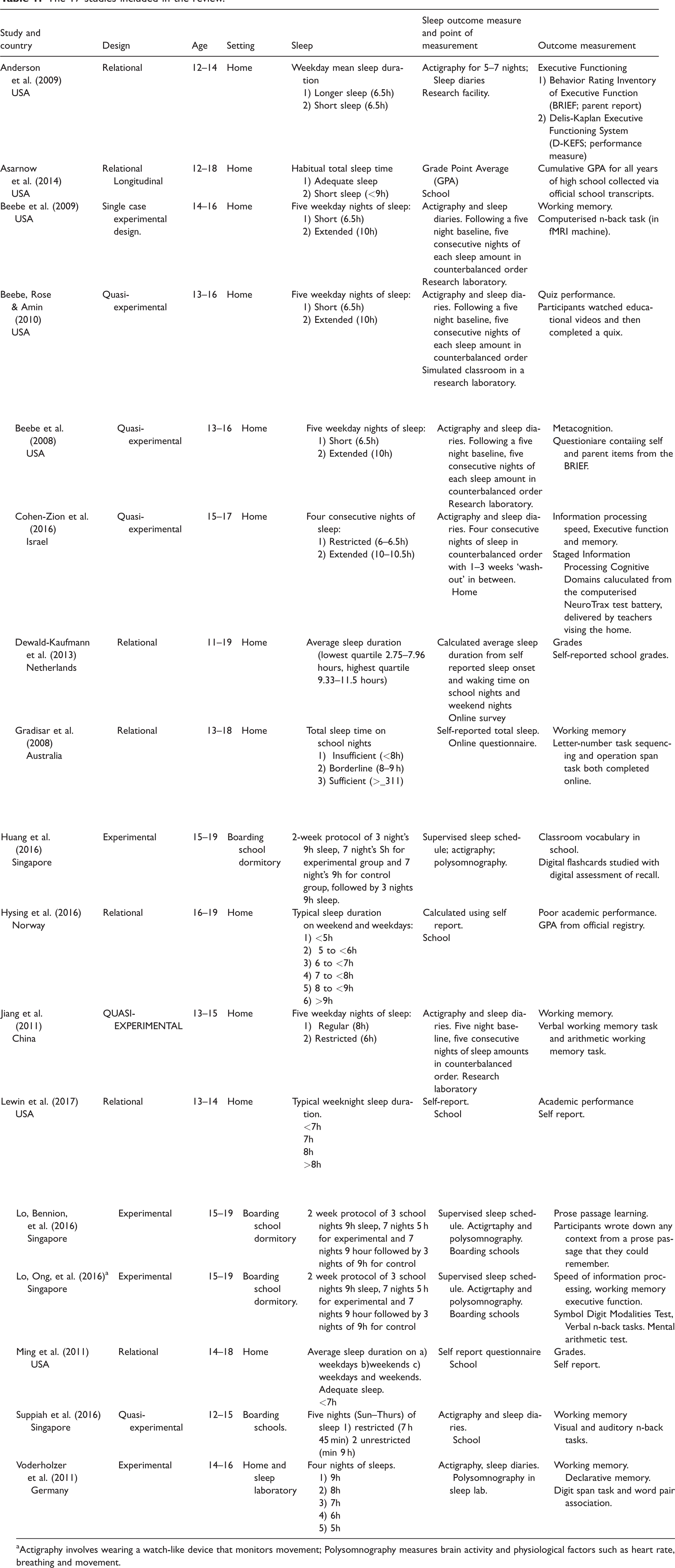
aActigraphy involves wearing a watch-like device that monitors movement; Polysomnography measures brain activity and physiological factors such as heart rate, breathing and movement.
Critical review
The evidence in the 17 studies was critically evaluated and compared with regard to multiple factors using a weight of evidence approach (Gough, 2007). The research has been undertaken in seven different countries, with the majority being undertaken in the USA (7) and Singapore (4). See Table 1 for details of the countries of origin.
The studies were given ratings that were calculated using sets of criteria that were weighted with regard to their relevance this review. Three sets of ratings were generated: weight of evidence A (WoE A), weight of evidence B (WoE B) and weight of evidence C (WoE C). These ratings were combined to create the superordinate evaluation rating of weight of evidence D (WoE D).
WoE A rated the methodological quality of the studies. This was evaluated using published coding protocols for research. Protocols developed by Gersten et al. (2005) were used if the study had experimental or quasi-experimental designs. The Thompson et al. (2005) coding protocol was used if the study consisted of correlational evidence. One study was evaluated using the Horner et al. (2005) coding protocol because it had a small group design. Although space precludes full details of these critical evaluations being presented here they are summarised and commented on below. Supplemental material provided shows the criteria used to evaluate the studies from the protocols used.
WoE B evaluated the appropriateness of the form of the evidence in each study for answering the research question in this review by considering the research design. To evaluate and quantify how well-suited the type of evidence was for this, a typology of evidence criteria (Petticrew & Roberts, 2003) was applied to each study.
WoE C examined how relevant the focus of each study was for answering the specific research question of this review.
For this review, all weight of evidence ratings of 1–1.6 are considered “low”, 1.7–2.3 “medium” and ratings of 2.4 – 3 are considered “high”. The three weight of evidence ratings were combined with equal weighting to create WoE D. Table 2 details these ratings.
Weight of evidence ratings for the studies evaluated in this review, ordered by WoE D.
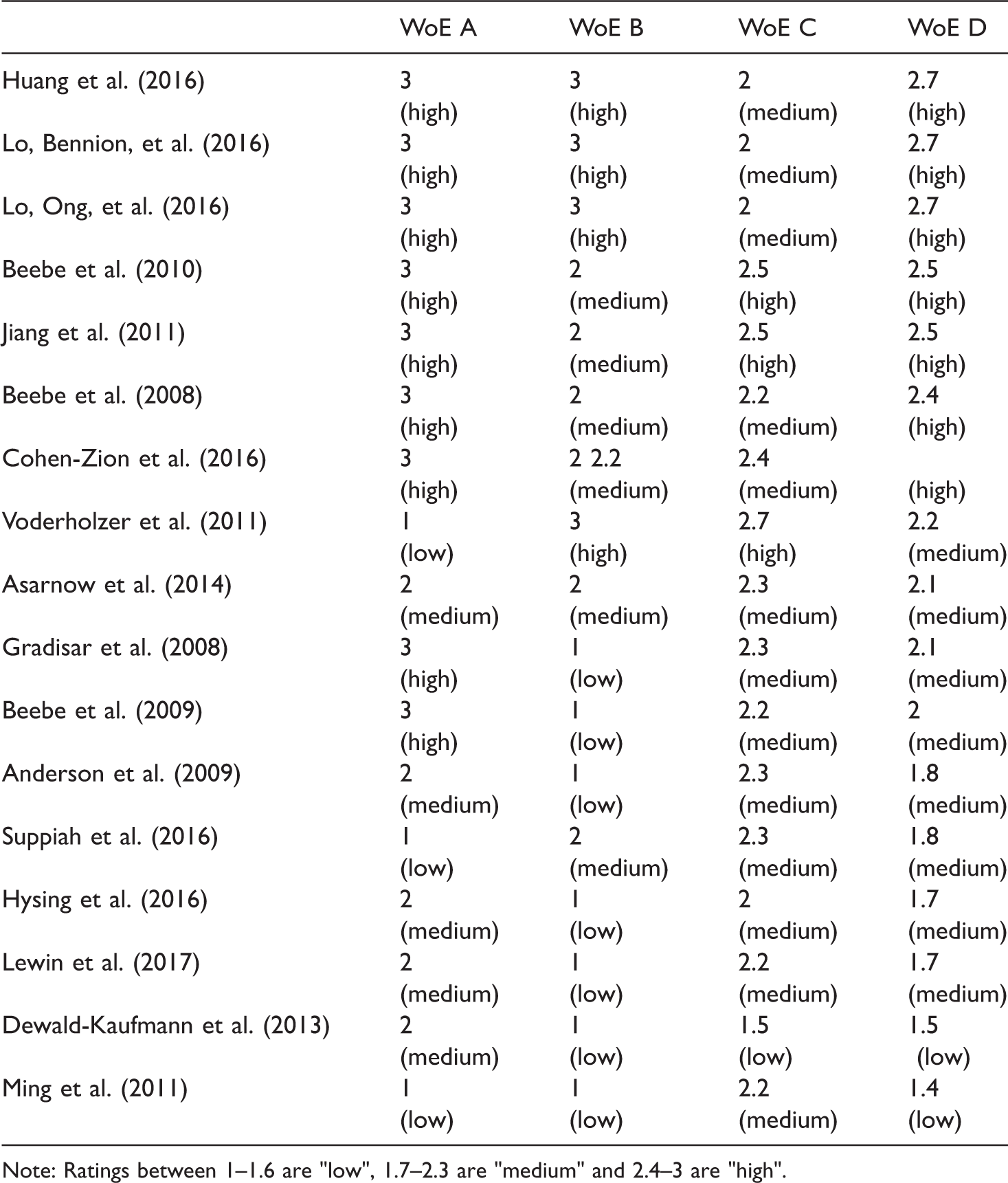
Note: Ratings between 1–1.6 are "low", 1.7–2.3 are "medium" and 2.4–3 are "high".
Effect sizes were extracted and calculated for the studies according to guidance from Ferguson (2009). These are presented in Table 3.
Effect sizes of restricted/reduced sleep for the outcome variables being examined.
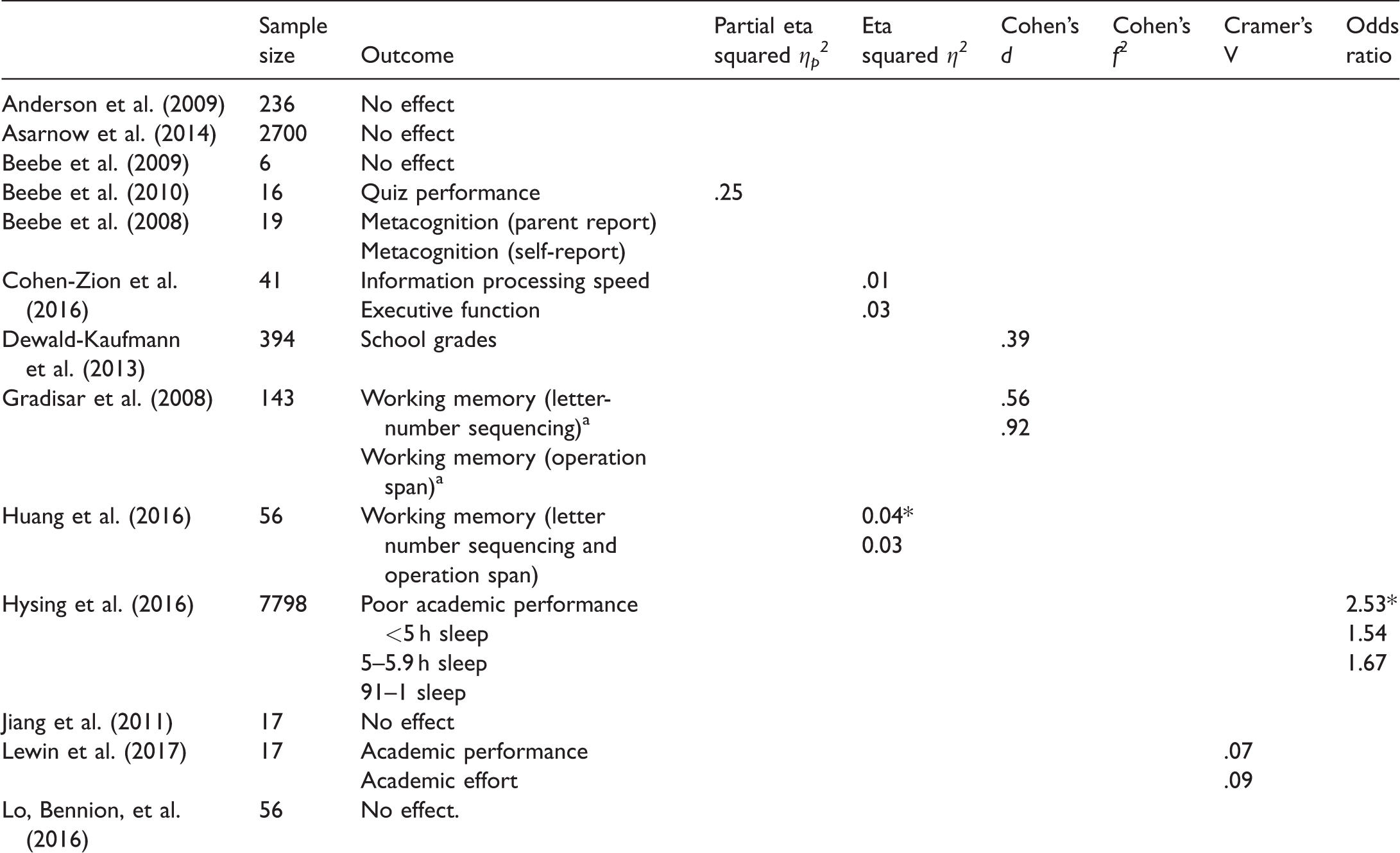
aInsufficient sleepers (<8 h) performed worse than borderline sleepers (8-9 h), but not differently from sufficient sleepers (≥9 h).
Table 4 gives an overview of the studies, their findings, effect sizes and WoE D ratings. The studies are then discussed and evaluated in more detail below.
Study findings, effect sizes and weight of evidence ratings.
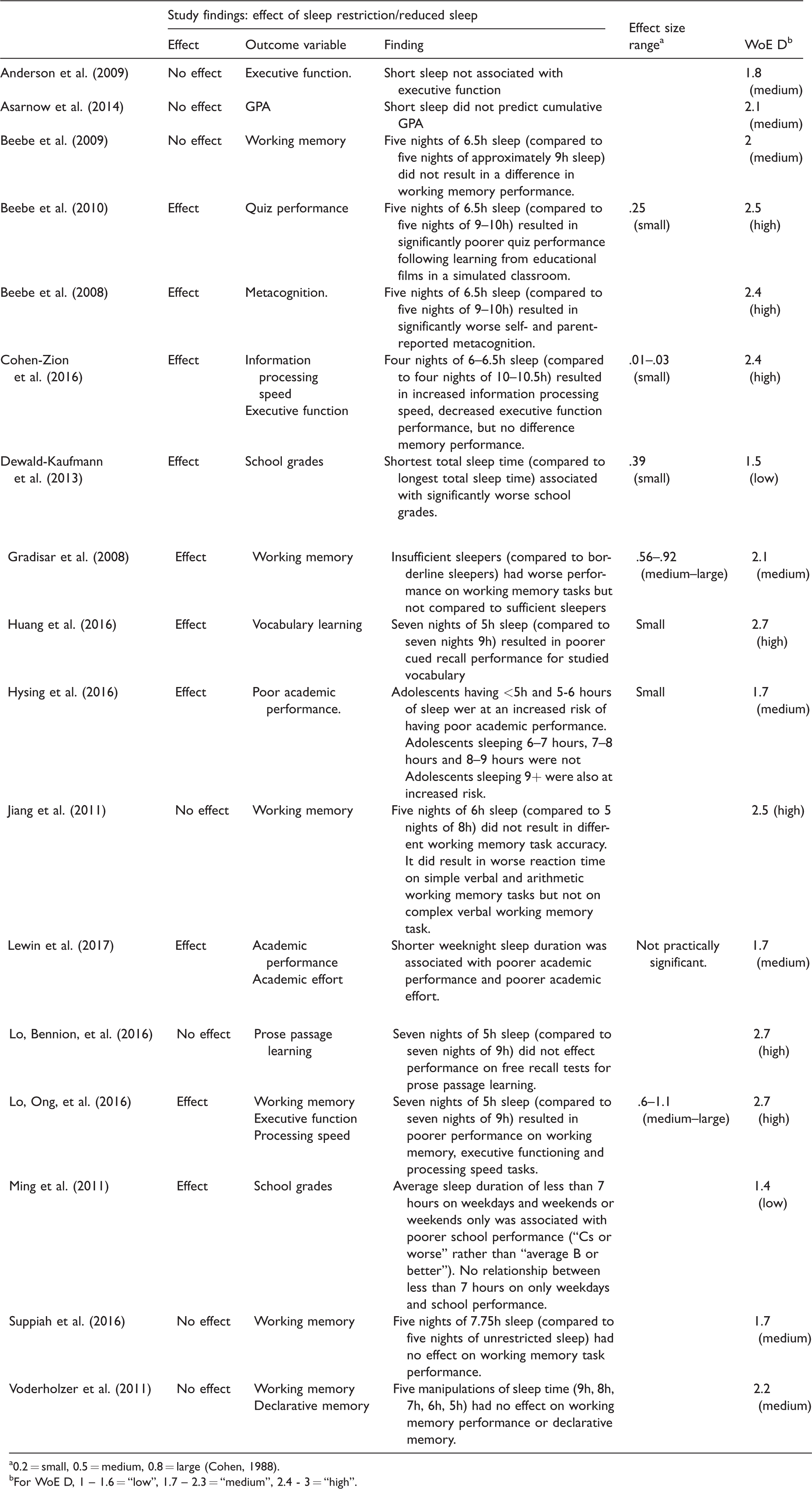
a0.2 = small, 0.5 = medium, 0.8 = large (Cohen, 1988).
bFor WoE D, 1 – 1.6 = “low”, 1.7 – 2.3 = “medium”, 2.4 - 3 = “high”.
Both correlational and experimental designs were utilised in the studies included in this review. Four studies (Huang et al., 2016; Lo, Bennion, et al., 2016; Lo, Ong, et al., 2016; Voderholzer et al., 2011) used an experimental design with random allocation of sleep condition to different groups of participants, which supports the establishment of a causal relationship controlling for confounding variables. Five studies (Beebe et al., 2008, 2010; Cohen-Zion et al., 2016; Jiang et al., 2011; Suppiah et al., 2016) had a quasi-experimental design. One study was based on a single case design (Beebe et al., 2009), although the study did not meet good standards for this type of design (Barlow et al., 2009; Horner et al., 2005). However, the main focus of this study was examining fMRI data, which typically precludes large sample sizes, going some way to explain the particular design utilised.
Sleep restriction
Ten of the studies (Beebe et al., 2008, 2009, 2010; Cohen-Zion et al., 2016; Huang et al., 2016; Jiang et al., 2011; Lo, Bennion, et al., 2016; Lo, Ong, et al., 2016; Suppiah et al., 2016; Voderholzer et al., 2011) used a sleep restriction protocol where the adolescents had the amount of sleep they were allowed dictated to them for four to seven nights at a time. With the exception of the study by Voderholzer et al. (2011), these ten studies compared four to seven nights of restricted sleep with the same number of nights of unrestricted or extended sleep, typically ranging from 8–10.5 hours.
All of the above studies also used actigraphy (wearing a watch-like device that measures movement and heart rate) to measure sleep duration and the effectiveness of the sleep restriction protocols. In addition, four studies (Huang et al., 2016; Lo, Bennion, et al., 2016; Lo, Ong, et al., 2016; Voderholzer et al., 2011) used polysomnography (taking multiple physiological and brain activity measurements) which enabled deeper insight into the type of sleep that adolescents in the studies were having.
The majority of these ten studies demonstrate that it is possible to experimentally manipulate sleep in adolescents in this way. However, one study did not demonstrate that they had effectively reduced sleep. Suppiah et al. (2016) aimed to have participants sleep for 7 hours 45 minutes for the five nights of the sleep restriction and sleep for a minimum of 9 hours for five nights in the unrestricted condition, yet the actual total sleep time of the two conditions did not meet this. Instead, the average total sleep time of the restricted sleep condition was 5 hours 42 minutes (with an average time in bed of 6.8 hours) and the average total sleep time of the unrestricted condition was 6 hours 8 minutes (average time in bed 8 hours). This could partially explain their lack of finding an effect of sleep restriction.
Seven of the 17 studies (Anderson et al., 2009; Asarnow et al., 2014; Dewald-Kaufmann et al., 2013; Gradisar et al., 2008; Hysing et al., 2016; Lewin et al., 2017; Ming et al., 2011) looked at the association between imposed sleep restriction, rather than simply reduced sleep. For most, this was through questionnaire items only (Asarnow et al., 2014; Dewald-Kaufmann et al., 2013; Gradisar et al., 2008; Hysing et al., 2016; Lewin et al., 2017; Ming et al., 2011), although one study (Anderson et al., 2009) used an objective measurement of sleep, actigraphy, in combination with sleep diaries to measure sleep over approximately a week rather than asking about typical habitual sleep.
Potential ethical issues could be raised regarding the issue of deliberately reducing the amount of sleep that the participants had or also regarding the issue of recording which participants typically had reduced sleep duration. All of the studies included information indicating that they had ethical approval from an appropriate review board and that they had acquired relevant informed consent and assent for participants. However, additional information regarding specific considerations for protecting the wellbeing of the participants who had experienced sleep restriction would have been relevant for inclusion in the articles. The manipulation of sleep restriction by researchers was carried out for limited periods of time, the participants had involvement with researchers immediately following sleep restriction and the participants had opportunities to return to typical sleep patterns following it. These factors suggest that there was adequate safeguarding features in place to monitor the wellbeing of participants and allow recovery, however more explicit information to clarify this would be beneficial. For the participants who typically have habitual sleep restriction in the other studies, it can be argued that this would be the case whether or not the researchers were involved and it can also be highlighted that research indicates that many adolescents do not get sufficient sleep. Information about whether signposting for these participants was provided would again be beneficial for evaluating the ethical concerns of the studies on this topic.
Outcome variables
None of the 17 studies looked at both school performance outcomes and cognitive skill outcomes within the same study, however, there were a mixture of both school performance outcomes and cognitive skill outcomes within each of the two sets of three studies that used the same participants and research protocol.
School performance and learning
Eight of the studies (Asarnow et al., 2014; Beebe et al., 2010; Dewald-Kaufmann et al., 2013; Huang et al., 2016; Hysing et al., 2016; Lewin et al., 2017; Lo, Bennion, et al., 2016; Ming et al., 2011) examined outcome variables closely related to school performance. Five of these studies (Asarnow et al., 2014; Dewald-Kaufmann et al., 2013; Hysing et al., 2016; Lewin et al., 2017; Ming et al., 2011) looked at school grades as an outcome variable of interest for this review, with one of these five also considering homework completion (Lewin et al., 2017). One study (Beebe et al., 2010) had quiz performance following an educational film in a simulated classroom and two studies used activities similar to what an adolescent might be expected to do in school: learning vocabulary (Huang et al., 2016) and learning a passage of prose (Lo, Bennion, et al., 2016).
The specific ways in which the outcome variables were measured impacts the studies' ecological validity and relevance to the review question. For example, the methodology used by Huang and colleagues (Huang et al., 2016) incorporated multiple study sessions for vocabulary learning, rather than a single learning session, which can be argued to be more similar to typical educational experiences of adolescents. Three of the studies that used school grades only used self-reported grades (Dewald-Kaufmann et al., 2013; Lewin et al., 2017; Ming et al., 2011), which may be vulnerable to inaccuracy or not as similar to school performance measures that families, educators and EPs may be interested in. Alternatively, there are more objective and direct alternatives that can be used, such as the cumulative grade point average gathered through official school data that was used by Asarnow et al. (2014) and Hysing et al. (2016).
Cognitive skills
The cognitive skill outcome measures of the other nine studies were typically objective, direct measurements. Of the cognitive skill outcomes examined in this review, five studies (Beebe et al., 2009; Gradisar et al., 2008; Jiang et al., 2011; Suppiah et al., 2016; Voderholzer et al., 2011) measured working memory as the only cognitive skill outcome while four studies (Anderson et al., 2009; Beebe et al., 2008; Cohen-Zion et al., 2016; Lo, Ong, et al., 2016) measured cognitive skill outcomes including executive functioning, information processing and metacognition (from an executive functioning perspective). In addition, two studies (Cohen-Zion et al., 2016; Voderholzer et al., 2011) looked at memory performance as an outcome.
One possible advantage of the studies that examined cognitive variables is that measures of cognitive skill are typically standardised, although not always for populations from the country the measures were undertaken in. The exception to this is the study that looked at metacognition (Beebe et al., 2008), which used self-and parent-reported behaviours as the measure. However, as highlighted by Anderson et al. (2009), there can be discrepancies between objective, laboratory-based measurements of cognitive functioning (such as executive function) and real-world executive functioning ability, whereby in a laboratory setting performance is better, meaning that simply because it is an objective, direct measurement does not necessarily in and of itself increase the external validity and generalisability of the finding.
There was some overlap between the cognitive measures used in different studies, for example two studies used at least part of the BRIEF (Anderson et al., 2009; Beebe et al., 2008) and multiple studies used variations of sequencing, span and n-back tasks (Beebe et al., 2009; Gradisar et al., 2008; Jiang et al., 2011; Lo, Ong, et al., 2016; Suppiah et al., 2016; Voderholzer et al., 2011). However, it could have been more helpful for comparison if these studies had used identical cognitive skill measures.
Sample
Across the 17 studies, the sample age range was between 11 and 19 years. This covers nearly the entire adolescent age range as defined by the WHO (World Health Organization, 2017). Twelve of the studies had participants that were within the 11 - 18 years age range of UK secondary education, with five studies (Dewald-Kaufmann et al., 2013; Huang et al., 2016; Hysing et al., 2016; Lewin et al., 2017; Lo, Ong, et al., 2016) including 19 year old participants.
All of the participants were typically developing adolescents, and most of them were representative of typical mainstream school populations. Four of the 17 studies stand out as having samples that are slightly less representative of the typical mainstream education adolescent population: three Singapore studies (Huang et al., 2016; Lo, Bennion, et al., 2016; Lo, Ong, et al., 2016) included only top high school students in their study and the fourth Singapore study, Suppiah et al. (2016), focused on students of a high-performance youth development shooting academy. The findings of these studies are considered relevant to this review because the participants were typically developing adolescents who could have been in mainstream education if they were not in their more specialist settings and they were not in special or clinical populations.
The data that is used in the study by Asarnow et al. (2014) is from 1995–2002, which threatens the generalisability of the findings, particularly given that one important factor for adolescent sleep, electronic social media use, has changed dramatically since that time (Cain & Gradisar, 2010; Eggermont & Van den Bulck, 2006; Exelmans & Van den Buick, 2015; Hale & Guan, 2015; Harbard et al., 2016; Johansson et al., 2016).
Study findings
Effect size statistics were extracted for 9 of the 10 studies that reported finding an effect. For one study that found an effect (Beebe et al., 2008), there was not enough information in the paper to extract or calculate an effect size statistic (Ferguson, 2009). Magnitude of effects found, were judged as being small, moderate or strong, according to guidance suggested by Ferguson (2009). A small effect is that which would be considered to meet Ferguson's threshold recommendation for being the minimum effect size that represents practical significance for social science data (Ferguson, 2009).
Statistical power was calculated for each study according to guidelines set out by Cohen (1998, 1992). Five of the studies in this review (Beebe et al., 2008, 2009, 2010; Jiang et al., 2011; Suppiah et al., 2016) were underpowered to find an effect that exists because the sample size was too small. Three of these studies (Beebe et al., 2009; Jiang et al., 2011; Suppiah et al., 2016) found no effect, so we can conclude that there was not enough power to find an effect that may have been there rather than being able to clearly establish that there is no effect to be found (Altman & Bland, 1995). It is also surprising that the two other underpowered studies (Beebe et al., 2008, 2010) found an effect, given that they were underpowered.
Of the studies that had enough power to find an effect, five (Dewald-Kaufmann et al., 2013; Hysing et al., 2016; Lewin et al., 2017; Lo, Ong, et al., 2016; Ming et al., 2011) found an effect of a magnitude that they had enough statistical power to find. Three studies (Cohen-Zion et al., 2016; Gradisar et al., 2008; Huang et al., 2016) found an effect of a smaller magnitude than they were considered to be statistically powered to find, adding to the unclear findings. Finally, there were four studies (Anderson, et al., 2009; Asarnow at al., 2014; Lo, Bennion, et al., 2016; Voderholzer et al., 2011) that were statistically powered to find an effect but did not find one, although only one of these (Asarnow et al., 2014) was powered to find a small effect, meaning that this one study gives a clear indication that it is likely that there was not an effect present.
There were mixed findings across the studies for the impact of reduced sleep on school performance and cognitive skills. Seven of the studies (Anderson et al., 2009; Asarnow et al., 2014; Beebe et al., 2009; Jiang et al., 2011; Lewin et al., 2017; Suppiah et al., 2016; Voderholzer et al., 2011) did not find an effect, while the other ten (Beebe et al., 2008, 2010; Cohen-Zion et al., 2016; Dewald-Kaufmann et al., 2013; Gradisar et al., 2008; Huang et al., 2016; Hysing et al., 2016; Lo, Bennion, et al., 2016; Lo, Ong, et al., 2016; Ming et al., 2011) did find effects. There was no particular divide between experimental and correlational studies or between school performance and cognitive skills studies for whether they found an effect or not.
School outcomes
On the one hand, two studies (Dewald-Kaufmann et al., 2013; Ming et al., 2011) found a small effect of reduced sleep on school grades, but on the other hand a third study (Asarnow et al., 2014) found no effect of reduced sleep on school grades despite having sufficient statistical power to find a small effect. The former two studies had the lowest WoE D rating for this review, while the latter study had a medium WoE D rating. However this finding is supported by two other studies (Hysing et al., 2016; Lewin et al., 2017), both with a medium WoE D rating, that found a small effect for reduced sleep on academic performance. Related to school performance, Lo and colleagues (Lo, Bennion, et al., 2016) did not find an effect of reduced sleep on prose passage learning, despite having the statistical power to find a large effect. This does mean that if the effect is small, as for school grades and academic performance, then their study design may simply have not identified an effect that does exist.
Cognitive outcomes
Two studies (Gradisar et al., 2008; Lo, Ong, et al., 2016) demonstrated a medium to large effect of reduced sleep on cognitive skills while two further studies (Anderson et al., 2009; Voderholzer et al., 2011) found no effect despite being statistically powered to find an effect of equivalent magnitude. The cognitive skills included in the two studies that found an effect were working memory, executive function and processing speed, while the cognitive skills in the studies that did not find an effect also included working memory and executive function, along with declarative memory.
Other factors
The findings of some of the studies in this review indicate the importance of moderating, mediating and confounding variables in this area of study. Hysing et al. (2016) found a negative association between reduced sleep and poor academic performance, but also between adolescents who were getting the most sleep (nine hours or more) and academic performance. They identify that this may highlight other relevant factors at play, such as somatic health problems in the group that are sleeping more than nine hours and have poorer academic performance.
In addition to the effects of sleep restriction, Lo, Ong, et al. (2016) found that having recovery sleep did not fully reverse the effects of sleep restriction.
Studying sleep
The findings of the studies in this review raise questions about what aspects of sleep need to be studied and focused upon in these areas of research. In this review, and in the studies within it, the primary focus was on sleep duration. There are, however, other aspects of sleep that are worthy of consideration.
For example, Lo, Bennion, et al. (2016) discuss the relevance of different aspects of sleep architecture, suggesting that possibly rather than studying just sleep duration, researchers need to consider different types of sleep. Voderholzer et al. (2011), who did not find an effect, found that the participants in different conditions all had the same total amount of slow wave sleep despite having differing sleep durations.
The human body's response to reduced sleep may also be important to consider. It has been highlighted that in some circumstances having one's sleep restricted may bring about changes that cause the body to have more efficient sleep, thereby compensating for the impact of the reduced sleep (de Bruin et al., 2017). This links to the issue of differences between individuals in how much sleep they require and differences in how well they can adapt to reduced sleep durations, something that is highlighted by two of the studies in this review (Anderson et al., 2009; Voderholzer et al., 2011). This could be particularly influential in experimental settings where participants are focusing on a single task for a short time (as compared to typical daily life where there are more numerous demands).
For these reasons, some researchers have suggested that daytime sleepiness is a better indicator of not having enough sleep than measuring sleep duration (Blunden & Galland, 2014).
Conclusions and recommendations
This review has been the first to explore the impact of reduced and restricted sleep on school related outcomes in terms of learning and cognition. The findings suggest there is some evidence for sleep restriction and sleep reduction having a negative impact on school performance and related cognitive variables but that the evidence is mixed with many studies not clearly demonstrating an effect. The very diverse range of research reviewed here indicates that more focussed research programmes might be beneficial that build and consolidate findings from particular research designs. Further thought also has to be given to the transferability of measures and findings from one country to another, which again adds diversity complexity to learning from the findings. It is clear that further research is needed should a definitive conclusion be sought and also that it would be worthwhile to look in more detail at other sleep-related variables in addition to sleep duration such as circadian rhythms and delayed phase in order to better understand the effects of sleep. This review has identified the likely negative impact of reduced and restricted sleep on school related learning outcomes in adolescence. The recommendations for future research should allow psychologists and educators to reach a better understanding of the impact of sleep on cognition and learning.
The key recommendation for psychologists working with schools is that sleep duration is a factor to take into consideration in professional practice when working with adolescents and their families and educators, but that evidence is still evolving, that findings are mixed and come from a diverse range of research designs with varying quality levels. Adolescents with school performance problems may be experiencing reduced sleep or inadequate sleep duration, and this is something that should be investigated when considering the factors related to their difficulties. It is also important for psychologists and school staff to engage in professional development to understand sleep and promote healthy sleep habits.
Supplemental Material
sj-pdf-1-spi-10.1177_0143034320961130 - Supplemental material for The impact of reduced sleep on school related outcomes for typically developing children aged 11–19: A systematic review
Supplemental material, sj-pdf-1-spi-10.1177_0143034320961130 for The impact of reduced sleep on school related outcomes for typically developing children aged 11–19: A systematic review by Ben Hayes and Josie Bainton in School Psychology International
Footnotes
Declaration of conflicting interests
The author(s) declared no potential conflicts of interest with respect to the research, authorship, and/or publication of this article.
Funding
The author(s) received no financial support for the research, authorship, and/or publication of this article.
Author biographies

Supplemental material
Supplemental material for this article is available online.
References
Supplementary Material
Please find the following supplemental material available below.
For Open Access articles published under a Creative Commons License, all supplemental material carries the same license as the article it is associated with.
For non-Open Access articles published, all supplemental material carries a non-exclusive license, and permission requests for re-use of supplemental material or any part of supplemental material shall be sent directly to the copyright owner as specified in the copyright notice associated with the article.
