




Abstract
This paper provides an overview of morphological and syntactic means of relating events in narratives in Mano, a Mande language of West Africa. For this study, we collected a corpus containing retellings in Mano of an animated movie, “Kirikou et la sorcière,” as well as other narratives, mostly folktales, told by children and adults. Overall, a linear mixed-effect model revealed a statistically significant effect of text type and age, with increased predicted values of entropy in free narratives as well as in older speakers. We explored the following aspects: narrative chains, connectivity, and hierarchical organization. We compared texts based on the narrator’s age and the narrative type (narrative retelling vs. free narratives). Both factors played a role for various aspects of narrative organization. There were very few developmental or genre differences in the use of main tense forms used in the narrative chain. By contrast, connecting devices and means of hierarchical organization were used more and were more varied in older children and adults. Hierarchical organization was also more developed in free narratives than in Kirikou retellings but means of expressing connectivity were more diverse in Kirikou retellings than in free narratives.
Introduction
Development of narrative ability has traditionally been one of the foci of child language research. Children from various cultural backgrounds have been compared. Often stories collected were in major languages: for example, Invernizzi and Abouzeid (1995) examined stories by children in Papua New Guinea, while Pesco and Crago (1996) studied stories by Algonquin children, but in both studies, the narratives were collected in English. Children’s narratives in underdescribed languages have been studied with dedicated narrative elicitation tools, such as the Multilingual Assessment Instrument for Narratives (Gagarina et al., 2012) or the “Frog, where are you?” storyboard (Berman & Slobin, 1994b; Strömqvist & Verhoeven, 2004, inter alia). We are only aware of a few publications covering African languages. Past research has focused on Bantu languages spoken in South Africa, or Afrikaans (Defty et al., 2025; Jiyane, 2017; Sebina et al., 2019; Smith & Klop, 2025), or lastly, Bantu languages elsewhere (Ogouamba, 1998). While there is an established documentary tradition based on spontaneous narrative corpora by adult speakers of Indigenous languages all over the world (Aplonova et al., 2023, inter alia), younger storytellers are most often overlooked. Instead, research on the spontaneous speech of children has mainly focused on child–caregiver interactions (Defina et al., 2021; Lester et al., 2022; Sagna et al., 2022). As a result, the narrative ability of children speaking lesser-spoken languages, including African Indigenous languages, is severely under-researched, which is in line with the overall trend in child language acquisition research limited, to a large extent, to national languages with a substantial speaker population (Kidd & Garcia, 2022).
Contributing to corpus-based research on lesser-studied languages spoken by children, this paper presents a previously unpublished corpus of child narrative retellings and a smaller corpus of children’s folktale narratives in Mano, or Manon [iso 639-3:mev], a South Mande language spoken in Northern Liberia and in the Southeastern Guinean region called Forest Guinea (Guinée Forestière), which is the locality that we study here. 1 The children’s narrative retellings and free narratives are matched with those told by adult speakers of Mano. We used an innovative prompt for narrative retellings: a famous animated film based on a recognizable West-African setting, Kirikou et la sorcière (Kirikou and the sorcerer).
Overall, our corpus allowed us to compare the texts – and this paper presents results of this comparison – according to the following macro criteria:
(A) Age groups (children of different ages, adults);
(B) Type of narrative: narrative retelling versus other types of narratives, especially folktales
Our primary interest in this study is the analysis of form-function pairings used in narratives (Berman, 1995; Berman & Slobin, 1994b). We compare the relative richness of grammatical means deployed by children, including the variety of verbal morphology, especially narrative forms, as well as syntactic complexity. Following Berman and Slobin (1994b), we study the developmental, but also genre-related patterns in (a) tense and aspect morphology deployed in the narrative chain, (b) the expression of connectivity, (c) various morphological and syntactic means for hierarchical narrative packaging. For the sake of brevity, many aspects of narrative development, such as lexical complexity, are not discussed in this paper. We employ a fine-grained approach attempting to link specific constructions to specific functions (e.g. temporal clauses as expressing contingent backgrounding, or tail-head constructions expressing connectivity), as opposed to analyzing more global measures, such as broad measures of syntactic complexity (Lindgren, 2022).
The paper is organized as follows. Section “Method” introduces the method, including the “Text Collection,” the “Annotation Procedure,” and the “Data Analysis.” Section “Results” presents the results, beginning with a “Statistical Modeling,” then proceeding to a more detailed discussion of the devices used in the “Narrative Chain,” for “Connectivity” and for “Non-Linear Packaging.” We discuss the findings in Section “Discussion” and conclude in Section “Conclusion.”
Method
Text Collection
The central component of the corpus (15 narratives in Mano by 6 girls and 9 boys) is narrative retellings by children based on a videoclip: a famous West African cartoon Kirikou et la sorcière (Kirikou and the Sorcerer). The participating children and adults watched the videoclip and were asked to retell it. Five narratives, which were collected first, were based on a full version of the cartoon (70 min). The subsequent collection was based on a shorter, 15-min version of the same movie. The prompt was shortened to adapt to the scarcity of electricity in the area, while keeping the main elements of the storyline. 2 Overall, 30 narratives were collected and transcribed, but only 10 were selected for annotation based on the quality of the recording and with the aim to balance the age representativity. A further five retellings were told by adults (one woman and four men), based on the short version of the cartoon. We also studied spontaneous narratives by children, namely, seven folktales told by three children (all girls), which we had collected previously for documentation purposes. In addition, we selected six narratives (four folktales and two narratives of other genres) by four adult men, which were annotated in previous studies of Mano. 3
In the corpus, the names of participating individuals are given in an anonymized, abbreviated form. The type of text is also indicated: Kirikou_long and Kirikou_short for long and short Kirikou videoclips, respectively. In case of Kirikou retellings, the speaker’s identifier comes last (e.g. Kirikou_short_MS) and in case of other narratives, the identifier comes first (e.g. CM_Fouet). Note that some individuals participated several times by telling several stories. CM told two folktales in Mano when she was 9-year old, one when she was 10-year old, and also retold a longer version of Kirikou when she was 12-year old. JZ told three folktales, EL and CS told two each. Similarly, one story was told several times: CM told a story about animals when she was 9-year old and a year later, when she was 10-year old (animaux1 and animaux2).
All the adult free narratives were not collected in the most natural environment where the folktales are often told (in the evenings, typically around a bonfire, in a group of people), but in a semi-formal setting: most often during the day, in a dialogue with the interviewer. Most of the children’s folktales by contrast were collected at home with several children present and taking turns in storytelling, thus approaching a naturalistic setting.
The interviewer was, in case of all texts in the free narrative subcorpus, Khachaturyan Maria, a foreign researcher, but in most texts in the Kirikou subcorpus, it was Pé Mamy, a community member and, with the shorter version of Kirikou, Pé Mamy’s son, a close acquaintance of the children, acted as the interviewer. 4
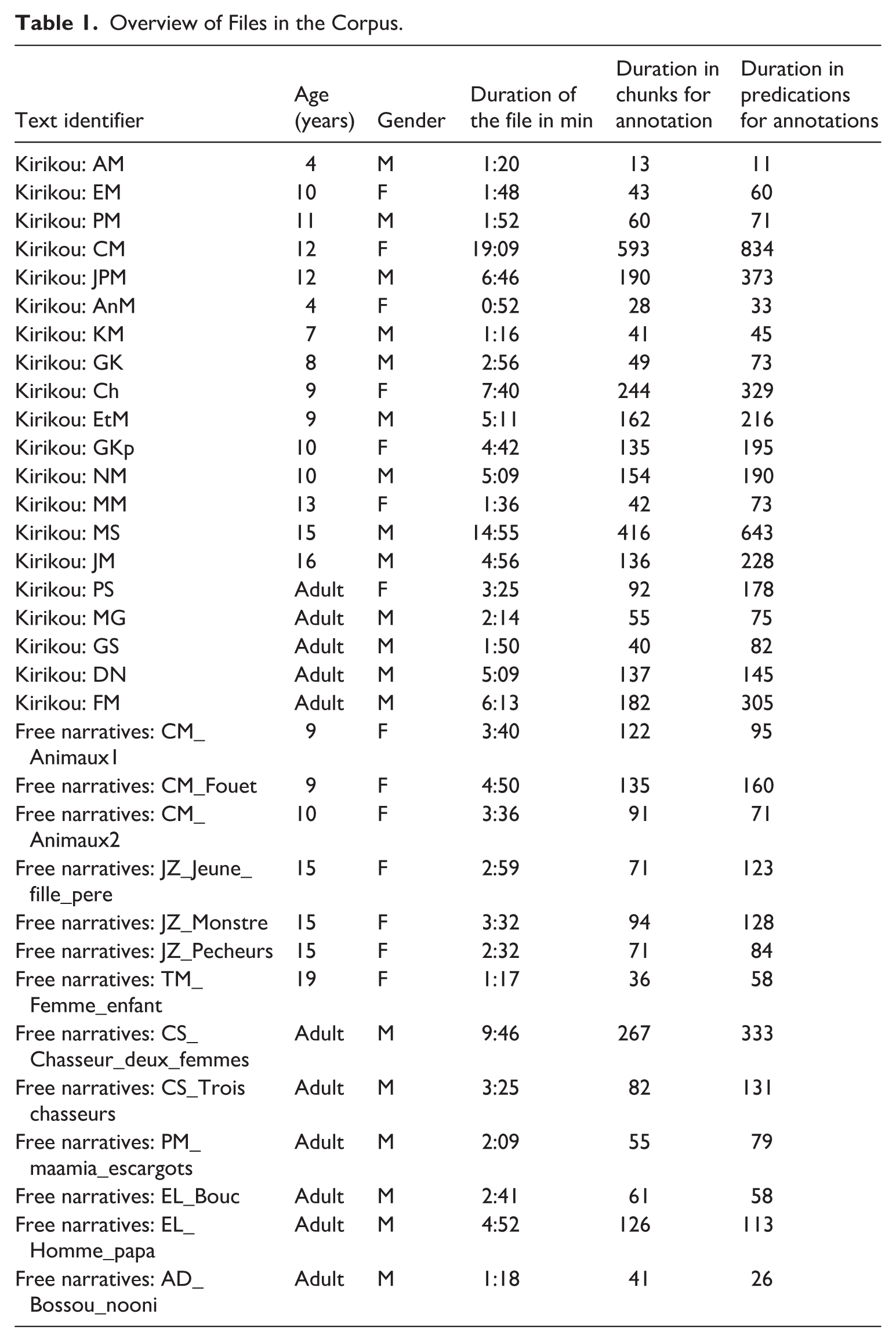
The total duration of the corpus is 2 hr 25 min, while the mean duration of retellings is 4 min. Some files include talking not immediately relevant to the discussion, and while it has still been kept as part of the recordings, it has been excluded from the annotation. The range of children’s ages is from 4- to 16-year old, and the mean age in each group was roughly 10-year old. The average age of the children who provided free narratives, however, was approximately 13 years (we do not provide the exact mean because the age of children was given in years). The shortest retellings were told by the youngest speakers (4- to 7-year-olds), while the longest retellings were told by the oldest speakers (13- to 16-year-olds), with the middle range producing retellings of around 5 min long. However, there appears to be no correlation between age and narrative length, measured by the number of predications (see Section 2 of the Supplement). The duration of the videoclip did not seem to influence the duration of the retelling: the longest retelling of Kirikou was 15 min long, as long as the short version of the videoclip itself. The adults were aged 26 years and over. The list of recordings in the corpus consulted is given in Table 1. On the definition of chunks, see Section “Annotation Procedure.”
Overview of Files in the Corpus.
Informed oral consent, which included consent for recording and publication, was always sought with the adults and, in case of children, their guardians; it was also audio-recorded for guardians of all participating children. A sample of consent interview, transcribed and translated into English and French, is included in the Supplemental Materials. 5
Annotation Procedure
A detailed account of the transcription and the annotation procedure can be found in Section 3 of the Supplement. We summarize the main points of morphosyntactic annotation. First, the narratives were transcribed and translated into French. Chunk boundaries were introduced with a fixed threshold: whenever the speaker paused for 150 ms or more, we introduced a chunk boundary. For motivation, see the Supplement, Section 3.1. Further annotation consisted of identifying finite predications (marked by square brackets), and non-predicative elements, such as extraposed noun phrases or interjections (marked by triangular brackets). Complex structures, such as several clauses which can be analyzed as part of the same construction (e.g. a modal verb and its sentential argument) or a clause with an extraposed argument (e.g. a hanging topic construction), were additionally framed in figure brackets. Predications were further annotated for the type of tense, aspect, modality, and polarity (TAMP) construction and, whenever applicable, non-finite extensions. Dependent clauses introduced by a clause-linking marker, and not (only) by a specific TAMP construction, were also marked. Finally, reported speech received dedicated annotation as well. The data annotated for morphosyntax can be found in an Excel spreadsheet (data_tense.xlsx) as part of the Supplemental Materials. The file data.xlsx gives an overview of the corpus, as well as raw numbers of tokens of the constructions under investigation. The Supplement provides additional counts, as well as the code for reproduction of the plots and calculations. The datasets and other Supplemental Materials can be found at https://osf.io/456cu/.
Data analysis
In order to model the variability of all features used in Mano’s spontaneous narratives, we employ mixed effects linear regression as implemented in the R (R Core Team, 2024) package lme4 (Bates et al., 2015). We decided to use the Shannon (1948) entropy measure applied to 43 categories, excluding reported speech. Shannon entropy provides an indication of how evenly distributed counts are across different categories within a narrative, evaluating the average uncertainty in predicting the probability of observing a specific category. Higher entropy values indicate a greater number of categories within the narrative, while lower values suggest a more skewed distribution. In addition, if we compare narratives with a different number of categories, higher entropy values are associated with narratives with a larger number of categories.
The input data consisted of 33 entropy values from individuals, with the model specification including duration (in number of predications), as well as an interaction between text type (free narratives vs. Kirikou retellings) and the logarithm of age. The model specification is presented below:
entropy ~ log(age) + text_type + duration + (1|speaker)
We employed the logarithm of age to reflect our expectation that variability increases with age and subsequently stabilizes. The inclusion of text type as a separate variable allowed us to analyze differences in variability between free narratives and Kirikou retellings. We acknowledge a potential systemic bias in the data since free narratives by young children are underrepresented in our dataset. Further considerations about the model choice are given in the Supplement.
Results
Statistical Modeling
The linear mixed-effect model described in Section “Data Analysis” revealed a statistically significant effects of text type, age, and text duration in predicting entropy. Model predictions show a gradual increase in entropy with age (Figure 1a) and duration (Figure 1b). The observed flattening of entropy values with age in Figure 1a supports our hypothesis that variability stabilizes with age. The potential absence of the full flattening in older speakers (we expected regression lines to be parallel to x axis) might be attributed to higher variance in entropy values observed in narratives of this group. Further refinement of this relationship could be achieved with more narratives and Kirikou retellings from older individuals. Regarding genre differences, according to the model, free narratives exhibit higher entropy values compared to Kirikou retellings, suggesting lower grammatical variability in the latter.
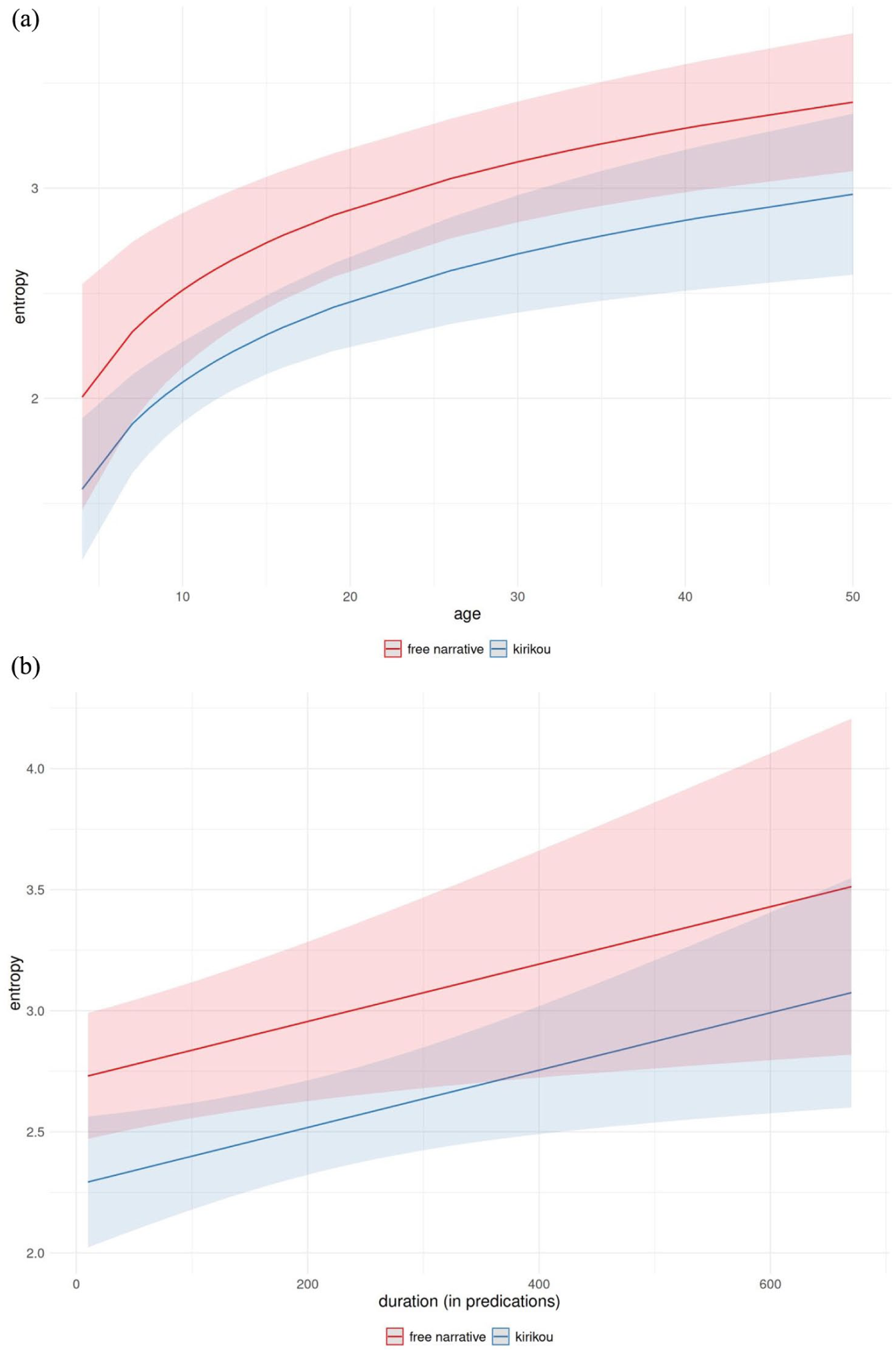
(a) Model predictions of entropy values over age in free narratives and Kirikou retellings (b) Model predictions of entropy values over number of predications in free narratives and Kirikou retellings.
Narrative Chain
In this section, we analyze the forms used in a narrative chain, including perfective and imperfective constructions.
The most frequent TAMP constructions in the Mano narrative chain of all genres are the Past construction (
(1)
“He went and fell into that water.” [Kirikou_short_JM.015] (JM, 16)
(2)
“He got up and went.” [Kirikou_short_JM.019] (JM, 16)
(3)
“He was surprised (lit.: his mouth filled), he said: . . .” [Kirikou_short_MS.056-57] (MS, 15)
Overall, in our corpus, PST and JNT were used 2714 and 1067 times, respectively, or 48.42% and 19.04%, or 67.46% total, out of 5605 finite predications. Note that some constructions are put into thematic groups to simplify representation, see Section 6 of the Supplement for details on the groups. By focusing on the narrative chain alone, which we achieve through excluding reported speech, we arrive at even higher proportions: 2544 and 1028 tokens of
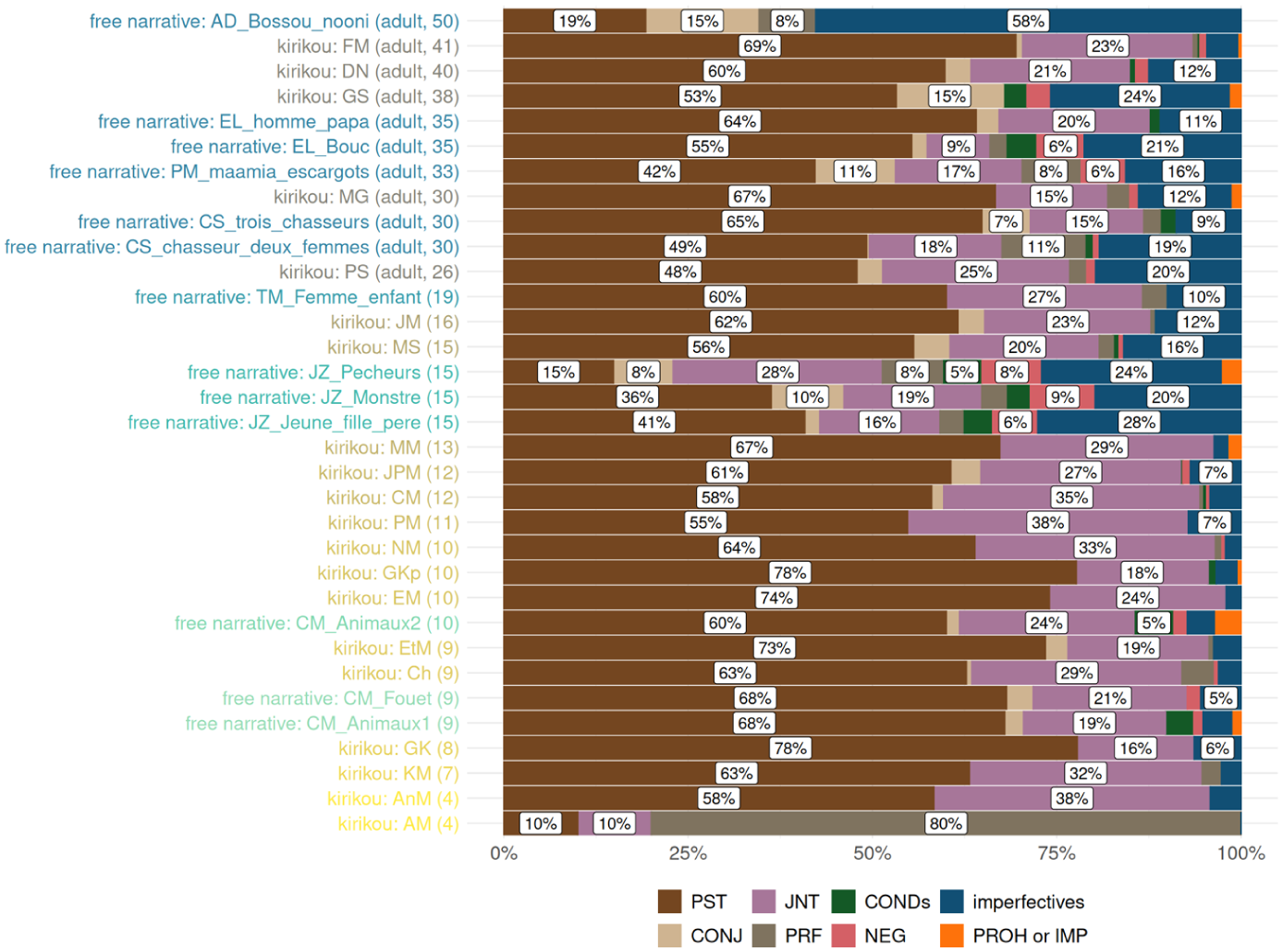
TAMP constructions in Mano narratives, excluding reported speech.
While most texts employ a combination of
More interestingly, the text told by the 4-year-old is a Kirikou retelling which, unlike all other retellings, is mostly told in the PRF (4), to be contrasted with (1) where the PST auxiliary is used with the same verb dà “fall”:
(4)
“Kirikou fell into the water.” [Kirikou_long_AM.009] (AM, 4)
While AM was perfectly capable of retelling at least part of the story (in fact, he focused only on one episode, Kirikou redeeming the village’s water source and almost drowning in the process), such usage indicates the immaturity of narrative competence and reliance on conversational TAMP usage instead of narrative constructions. Indeed, PRF is used in everyday speech to denote events of current relevance, as illustrated in (5). It is one of the first constructions to be acquired based on the parents’ reports: indeed, (5) was given by AM’s father when asked what his then 2-year-old child had already learned to say.
(5)
“My father has arrived!”
Unfortunately, we do not have a separate quantifiable conversational corpus, only observations. Instead, we rely on reported speech constructions as an approximation of actual conversational usage. Indeed, Figure 3 in the Supplement further gives the breakdown of constructions within the reported speech alone. There, it becomes clear that
With all other children and adults, there appears to be no difference in the usage of
(6)
“She came. Her father had prepared the fish.” [JZ_Jeune_fille_pere.051-052] (JZ, 15)
Overall, older children and adults show more diversity in TAMP marking in the narrative chain and employ other constructions in addition to JNT and PST. In addition, in Mano free narratives told by adults and children alike, there is a greater diversity of TAMP marking than in Kirikou retellings. Figure 3 illustrates that trend by presenting the text-specific rates of different auxiliaries, excluding PST, JNT, and reported speech.
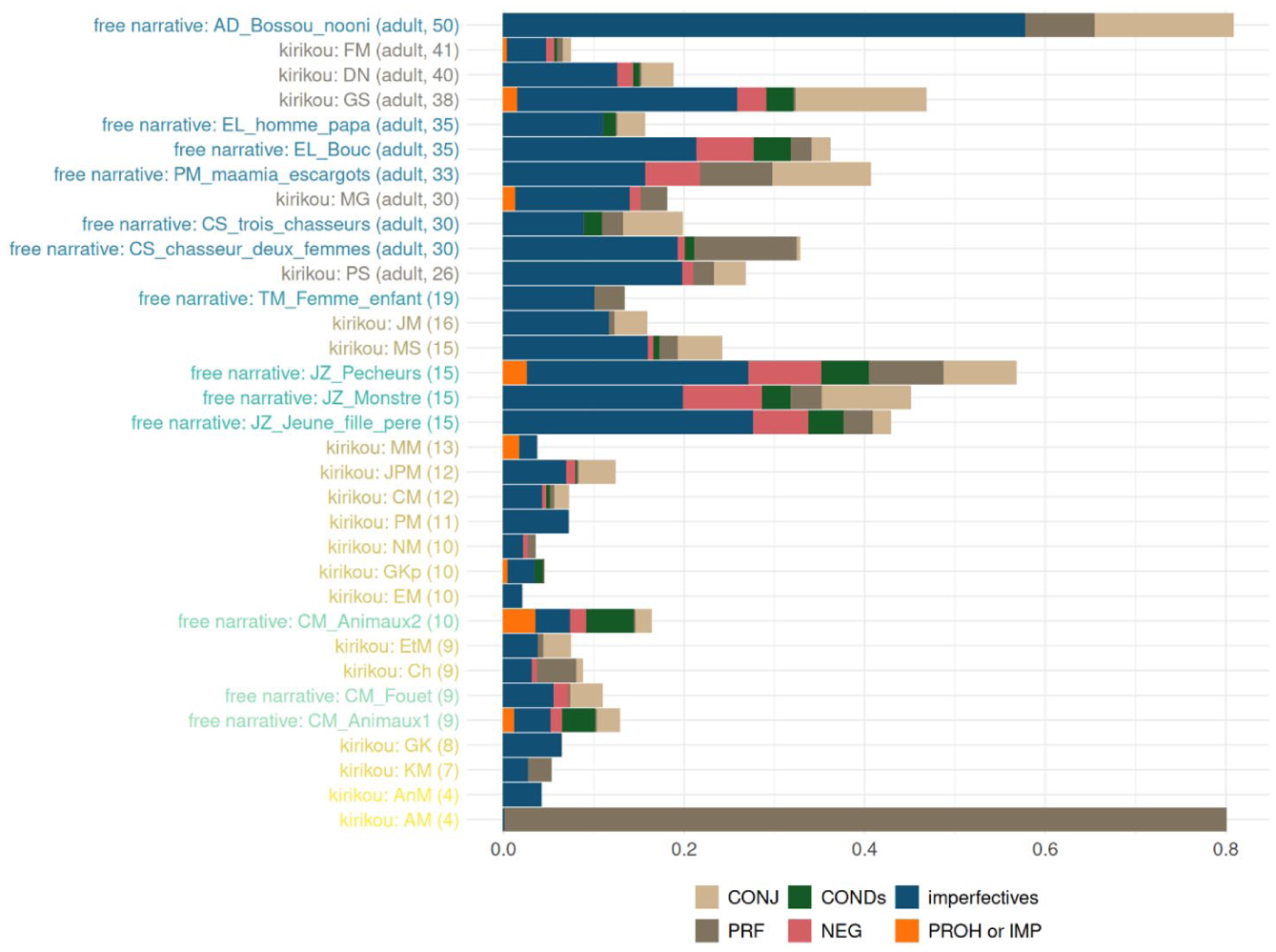
TAMP constructions in Mano narratives, excluding PST, JNT, and reported speech.
The events in a narrative can be represented as accomplishments or as continuous activities. In Mano, the distinction is conveyed with aspectual means, whereby a
(7)
“That tree
Figure 4 represents the text-specific ratio of durative constructions to all predications in Mano, excluding reported speech.
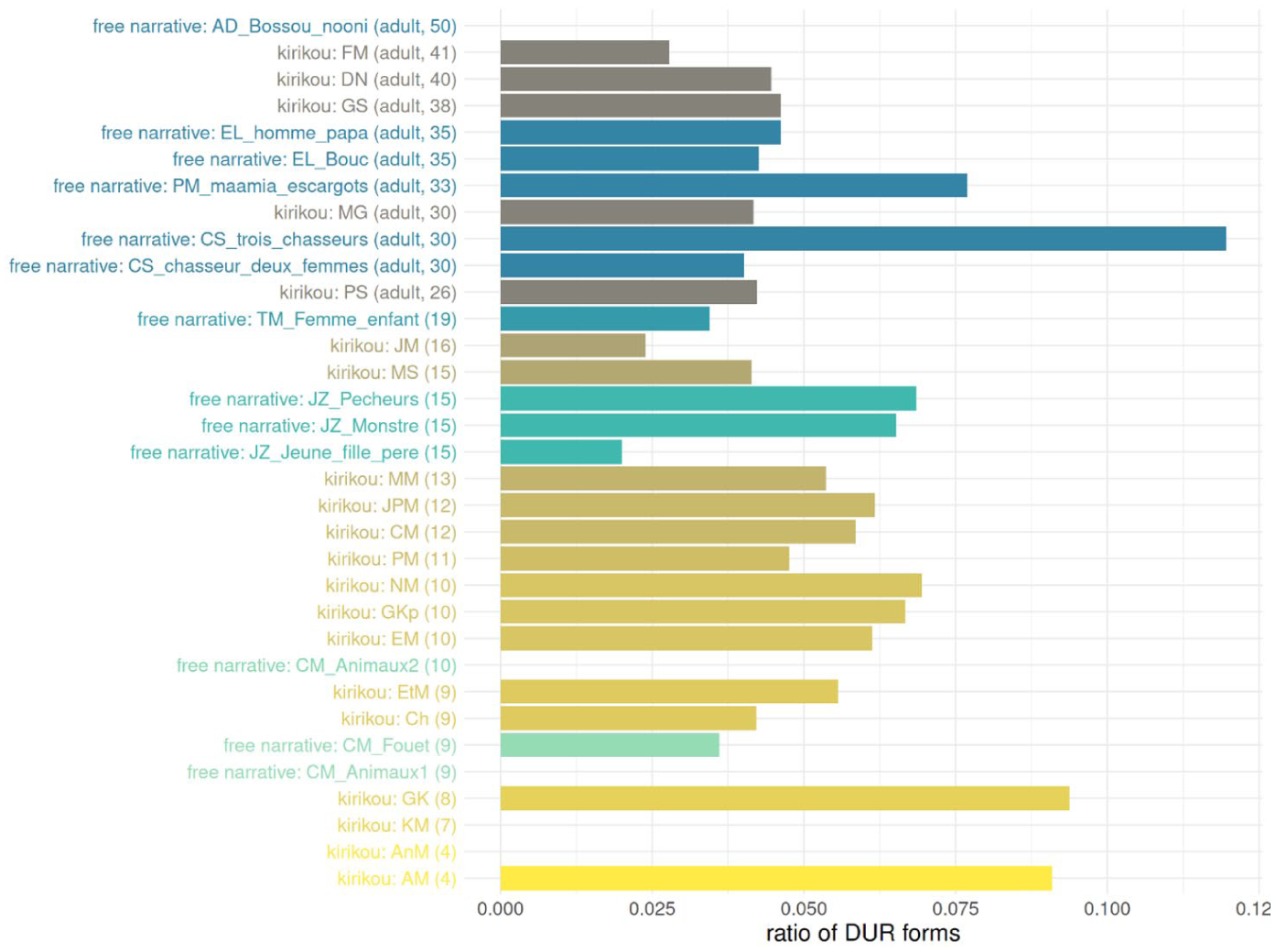
Ratio of durative constructions in Mano predication, excluding reported speech.
Durative constructions were used by most speakers, even the youngest ones. There does not seem to be any apparent relationship to age nor to text type. Interestingly, two folktales by the same adult speaker, CS, appear at opposite ends of the spectrum. Note that the Durative construction was the only time when AM used the
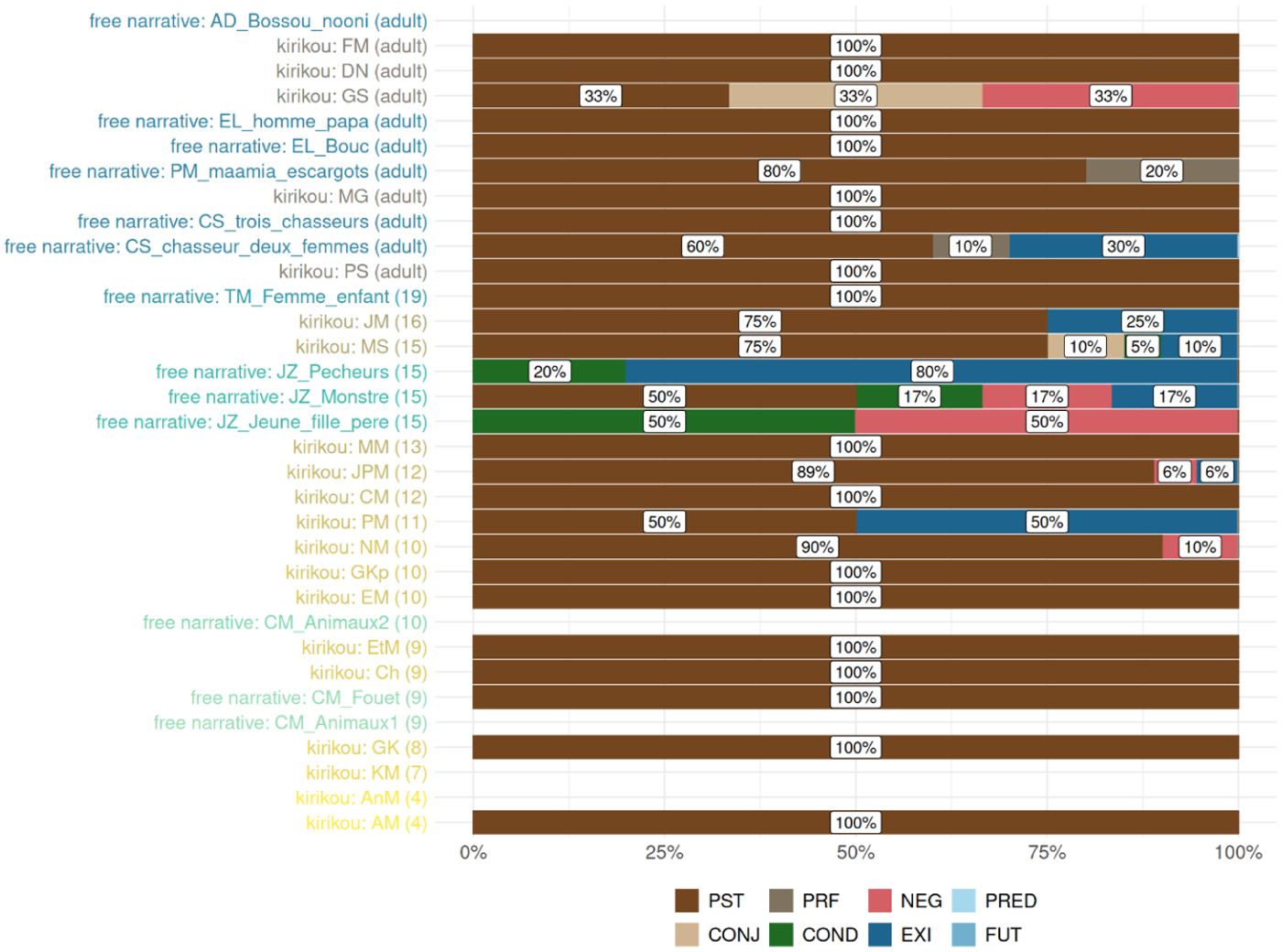
Auxiliary forms used in DUR constructions in Mano narratives excluding reported speech.
To sum up, we observed no age-related differences in the use of the main narrative forms, JNT and PST, one speaker being exceptional in that regard. No difference was observed in the frequency of use of durative constructions. There was no genre difference observed between spontaneous narratives and narrative retellings, again, with one exception. Older speakers did show a greater variety of auxiliaries in the narrative chain, an observation to which we return below. But first, we turn to the expression of connectivity.
Connectivity
The simplest way of connecting events in the narrative is the use of clause-linking markers: (yē) lɛ́, tɛ́ (which is a variant of lɛ́) (8), bɛ̀ī (zénīí~zéŋ́) (9), as well as a French borrowing donc.
(8)
“Then he explained to his mother.” [Kirikou_long_CM.558] (CM, 12)
(9)
“Furthermore, Kirikou ran.” [Kirikou_short_MS.174] (MS, 15)
Contrastive linking is done with markers ɓīī and a French borrowing mais, both meaning “but,” but we have only 14 observations in the entire corpus.
Another connector in the narrative is a construction meaning “it stayed/was there” or, more rarely, “it stayed/was with it,” where a third person auxiliary is used with the verb tó “stay” or kɛ̄ “be” in the PST (10) or, even more rarely, conjunctive JNT form. The combination of the verb tó “stay” with a third person auxiliary in the past or conjunctive form has lexicalized into a marker ētó~étó used for NP and clausal coordination.
(10)
“It stayed like this there, his uncle’s true door opened like this.” [Kirikou_short_MS.020] (MS, 15)
Another way of connecting events is repeating an event’s description before proceeding to another event (11). Repetitions can have multiple purposes: in particular, emphasizing duration. When such a repetition is embedded in a temporal clause with a linker, it serves as a connecting device like tail-head linking construction.
(11)
“They came now. When they came [they stopped.]” [Kirikou_short_MS.388] (MS, 15)
The most syntactically complex connector, however, is the dedicated tail-head construction. It is formed as a hanging topic construction, where the following predication contains a light verb ɓō “implement,” and the extraposed nominalized verb repeats the verb of the preceding predication (12). On the hanging topic construction, see also Section “Subordinate Clauses with Temporal Interpretation,” example (27). Tail-head constructions with complex verbs are formed differently: example (14) illustrates a construction with a complex verb lɛ̀ tā “to plow a field,” where lɛ̀ is extraposed and tā occurs in the subsequent clause.
(12)
“He put her in the roots of a tree. Having put her in the roots of a tree (lit.: putting her that he implemented in the roots of a tree. . .) [the dead leaves that were scattered there, this is where the woman was lying.]” [PM_maamia_escargots.016-017] (PM, adult)
Figure 6a below illustrates the overall frequency of usage of connecting devices (number of devices divided by length of a specific text in predications). Figure 6b zooms into devices excluding clause-linking markers. Figure 7 illustrates the share of each device type, in individual narratives. All counts exclude reported speech.
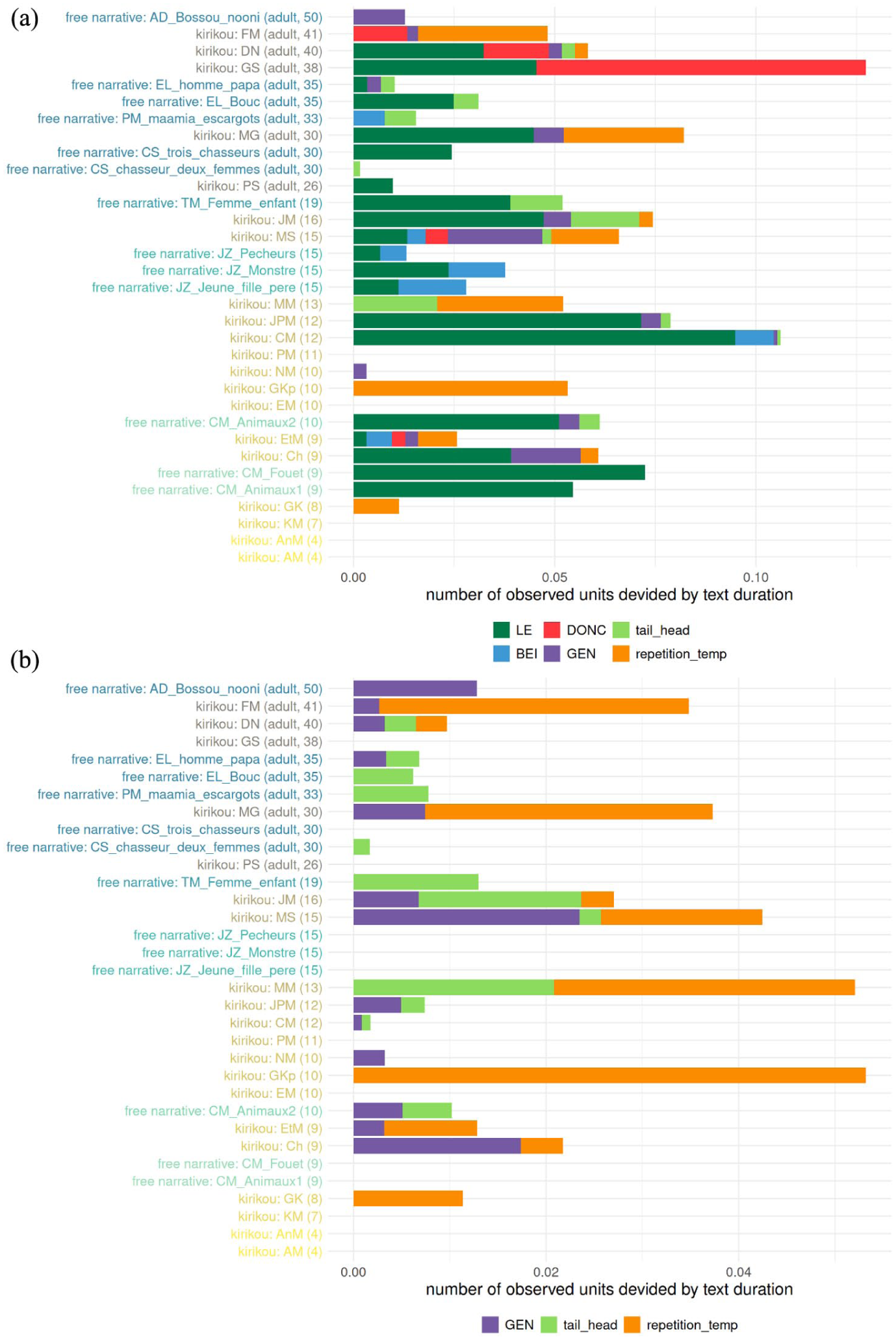
(a) Frequency of connecting devices, excluding reported speech (b) Frequency of connecting devices, excluding clause-linking markers and reported speech.
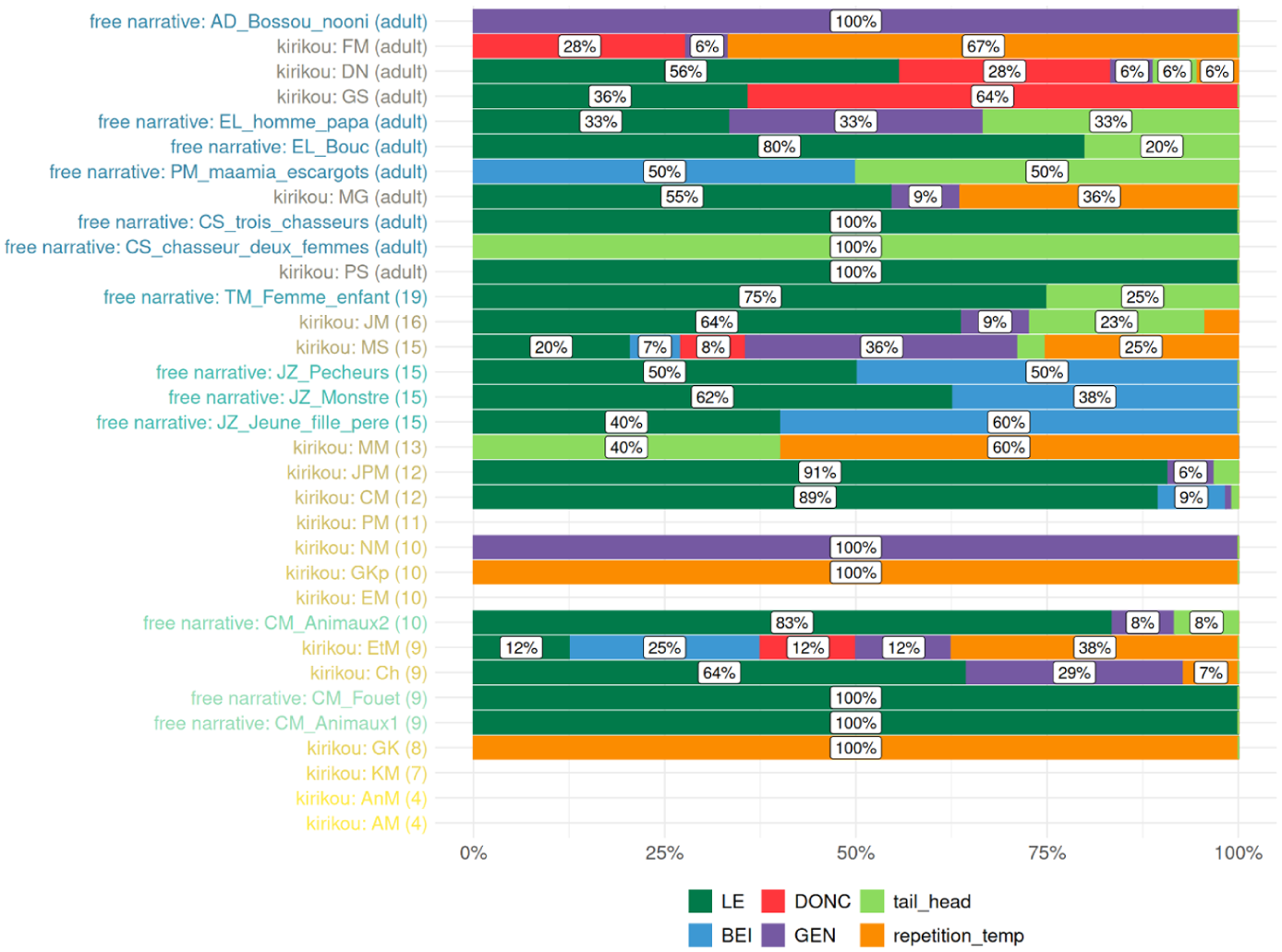
Share of connecting device types, excluding reported speech.
As is clear from Figure 6a and especially from its difference from Figure 6b, clause-linking markers, and especially lɛ́ and its variants, are the most frequent types of connectors. They are used by most speakers, and some speakers use only clause-linking markers at the exclusion of other devices. There seems to be individual preferences in the choice of a clause-linking marker, although some speakers combine several markers (e.g. EtM combines all three). Other types of linkers, which are morphosyntactically more complex, are used more rarely. Repetition within a temporal clause is the second most frequent device, while proper tail-head and the constructions with the generic third person subject (i.e. it stayed there) are the rarest. All connectors appear at the age between 8 and 10 years, repetition being the earliest and the proper tail-head and the constructions with the generic subject the latest.
Note, finally, that all types of connecting devices were used in both genres, except the French borrowing donc, which was used only by some of the oldest speakers and only in Kirikou retellings; the repetition construction was also used only in Kirikou retellings. 6 To sum up, older speakers tend to use more connecting devices. Overall, connecting devices are used only by speakers aged 8 and older, with the tail-head construction, the most morphosyntactically complex connector, used only by children aged 10 and older.
The next pair of examples (13–14) provides anecdotal evidence to illustrate the difference in the usage of connecting devices by younger versus older children. It comes from two tellings of the same folktale about animals told by the same speaker 1 year apart, when she was 9- and 10-year-old. In the first retelling, only the linker yēlɛ́ is used (13), while in the second one, which also contains a substantial elaboration, the linker is accompanied by a tail-head construction (14).
(13)
“And then they went to the Pig’s field. [The Pig finished preparing the meal.]” [CM_Animaux1.005-006] (CM, 9)
(14)
“And then they got up and went to the Pig’s field, they went to plow the field, then plowing the field did they go (lit.: the field that they went to plow. . .) [The Pig finished preparing the meal.]” [CM_Animaux2.005-011] (CM, 10)
Non-Linear Packaging
Stative and Habitual Descriptions
As observed by Berman and Slobin (1994b), “[a] skillful narrative does not simply consist of a linear chain of successive events located in time and space. Rather, events must be packaged into hierarchical constructions” (p. 13). In the subsequent discussion, we present two major types of packaging. The first type encompasses stative and habitual descriptions, which support the main plotline and alternate with verb forms denoting a sequence of events in the narrative. The second type is contingent backgrounding, whereby an event in the plotline is presented as contingent on the completion of a prior event, framed through a subordinate construction. The hierarchical organization is thus achieved through aspectual means, as well as through complex syntax.
In Mano, stative descriptions are expressed by non-verbal predications, which are typically formed with Existential auxiliaries (see EXI in 15–16) or, in the negative domain, with negative predicator (PRED). These constructions can be used even when the states described took place in the narrative time (15–16) and as part of the narrative chain, as in (16), which starts with the narrative linker yē lɛ́ (see Section “Connectivity”). With the verbs of mental activity, such as knowing, the Imperfective (IPFV) is used.
(15)
“Her father was (lit.: is) a hunter.” [J_Jeune_fille_pere.005] (JZ, 15)
(16)
“And so Kirikou was (lit.: is) in his mother’s womb.” [Kirikou_short_Ch.12] (Ch, 9)
Stative descriptions also include resultative states, which are expressed with non-finite Gerund forms. In addition to the non-finite form, the Resultative construction also contains a verbal predication (typically with the verbs “to be” or “to remain”) or a non-verbal predication. These forms precede predicators, as in (17), and follow auxiliaries, as in (19, 22). In the latter case they are accompanied by a postposition ká with which they merge (yàá sit.
(17)
“There is a thing installed up high on the roof of her house.” [Kirikou_short_MS.124] (MS, 15)
The PST form can also be used in non-verbal (18) and resultative (19) constructions.
(18)
“Kirikou was now big.” [Kirikou_long_CM.530] (CM, 12)
(19)
“His mother was sitting (lit.: was sitted) under a tree.” [kirikou_short_FM.002-003] (FM, adult)
Habitual actions in Mano are rendered by the Imperfective (20).
(20)
“[Her father was a hunter. When he would go out,] he would kill animals [and bring them to his daughter, she would cook them.]” [JZ_Jeune_fille_pere.007] (JZ, 15)
Keeping in mind that IPFV can have not only habitual, but also durative meanings (see Section “Narrative Chain” above, as well as example (10) in the Supplement) and be used outside the main narrative chain, and that non-verbal constructions in PST did not receive special annotation and were not included in the counts below, Figure 8 represents the ratios of non-verbal, resultative and imperfective constructions in Mano narratives.
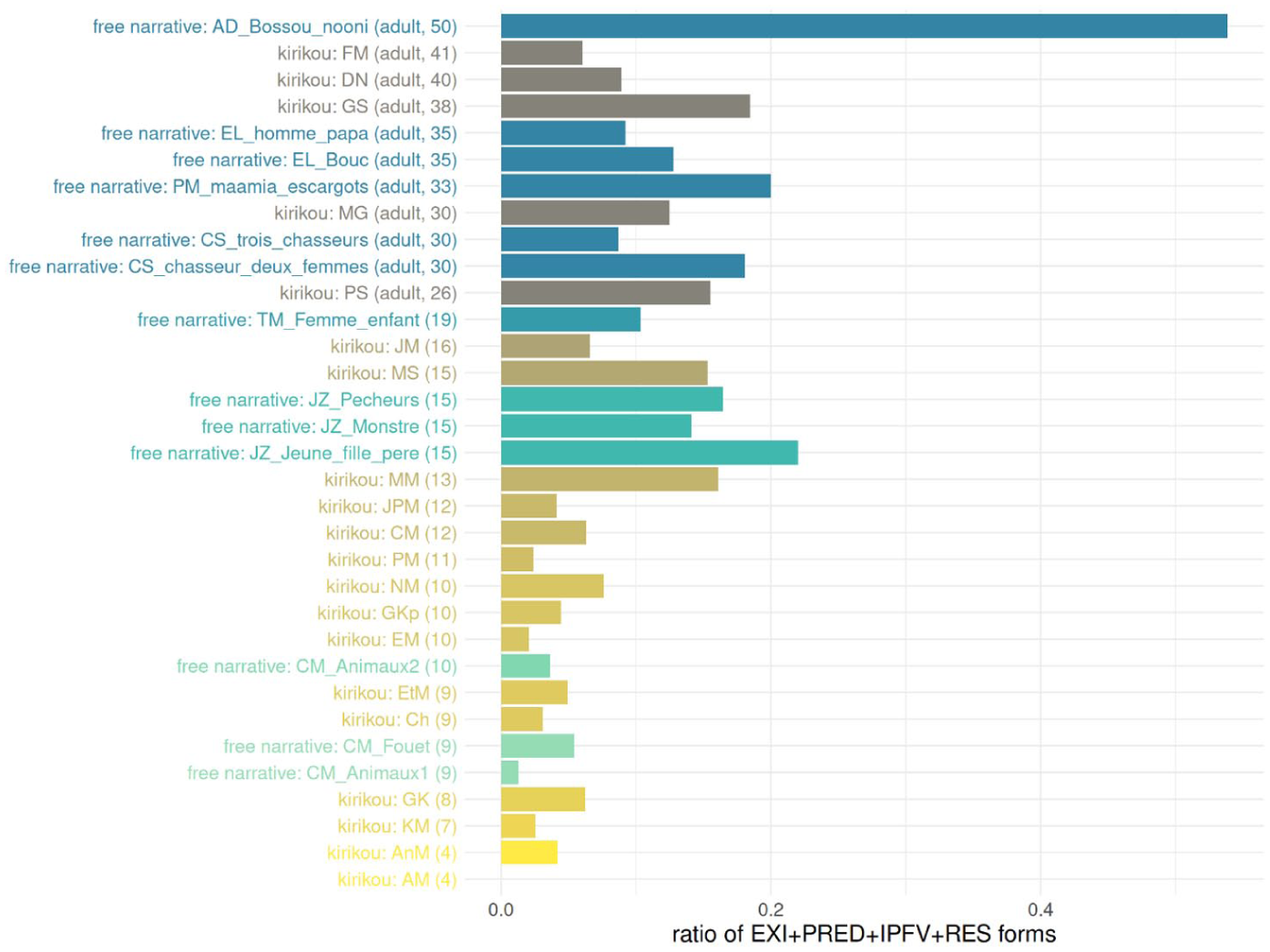
Non-verbal, resultative and imperfective constructions in Mano narratives, excluding reported speech
Overall, stative and habitual constructions are used quite rarely, in less than 0,2% of predications in most cases. One free narrative is exceptional in that regard and employs a greater share of imperfective constructions (see also Figure 2 and explanation in Section “Narrative Chain”). Crucially, stative and habitual descriptions are more common in folktales and other narratives than in Kirikou retellings, and younger narrators also used them less. The next pair of examples illustrates this tendency. Example (21) presents the sub-episode of Kirikou washing as a simple clause in the PST, taken from a retelling by a 9-year-old EtM. Example (22) is a retelling of the same episode where the 12-year-old CM first provides some background in the form of stative descriptions first in the form of a Resultative construction with an EXI auxiliary.
(21)
“He went and he washed.” [Kirikou_short_EtM.015] (EtM, 9)
(22)
“Water is not put next to him. He came, he threw himself in the water, he washed.” [Kirikou_long_CM.013-016] (CM, 12)
Subordinate Clauses with Temporal Interpretation
Clause-linking markers, typically situated at the beginning of the clause, are used to connect clauses both hierarchically, as in subordination, and horizontally. In Mano, the most frequent subordinating markers in the narrative are yé (temporal marker, ex. 23) and ékɛ̄á ~ ékɛ̄ɛ́ (conditional marker). Mano also employs the French borrowing comme “as.” These constructions are another means to express contingent hierarchical organization: one event happening in temporal connection with another.
(23)
“When his disguise took off (lit.: when his surface took off) [there was a large animal there].” [Kirikou_short_JM.091] (JM, 16)
Dependent clauses situated before the main clause are marked with a clause-final demonstrative (y)ā or wɛ̄ which can sometimes be dropped. Subordination can also be expressed solely by the clause-final demonstrative (24). Such clauses are also typically interpreted temporally.
(24)
“(When) he was about to leave (lit.: when he wanted that he goes) [a real bird came upon him].” [Kirikou_short_JM.078] (JM, 16)
Some subordinate clauses in Mano have special TAMP morphology. One such type of clauses is conditional clauses (COND), which are formed with an auxiliary of the Conjunctive series and a verb in a Conditional form (a tonal lowering plus suffix -á). COND constructions have a conditional or, in a narrative, a temporal interpretation (25–26).
(25)
“But when she goes, she doesn’t kill them.” [Kirikou_short_DN.012] (DN, adult)
(26)
“When the monkey came, it did its greeting and left.” [EL_Bouc.012-013] (EL, adult)
Hanging topic clauses (27), which are also usually translated as temporal dependent clauses, consist of two components. The first one is a left extraposed constituent, which is followed by lɛ́ ~ tɛ́ ~ floating high tone marker. The extraposed element is followed by the second component, which is a clause containing a resumptive pronominal or a full NP coreferential with the extraposed constituent; adjunct positions and comparative structures are exceptional, since the resumptive element is not obligatory after them. For more on hanging topic constructions, see Khachaturyan (2023b). Further patterns of hanging topic constructions can be found in Section 8 of the Supplement.
(27)
“Kirikou video that was shown, [what I saw I will tell.]” [Kirikou_short_GKp.001] (GKp, 10)
The following figures represent the usage of all the aforementioned constructions (temporal clauses formed with clause-linking markers, where we single out temporal linker yé “when” as the most frequent marker, COND constructions, hanging topic constructions) in Mano texts. Figure 9a represents the overall share of contingent backgrounding devices, Figure 9b singles out COND and hanging topic constructions for greater visibility of the age-related differences, and Figure 10 shows the relative proportion of different devices in individual narratives.
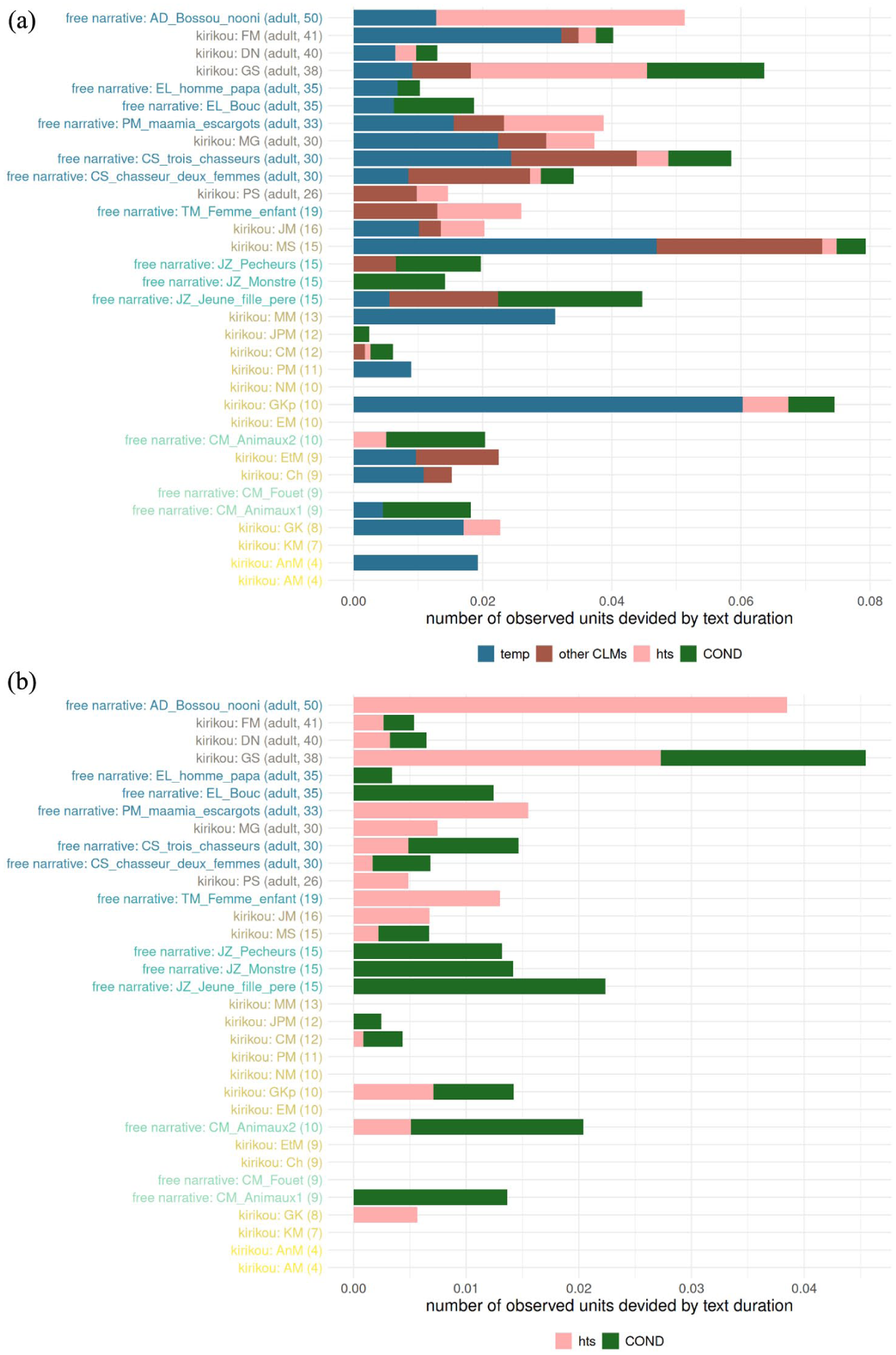
(a) Frequency of contingent backgrounding devices in Mano narratives excluding reported speech (b) Frequency of contingent backgrounding devices excluding temporal clauses with clause-linking markers and reported speech.
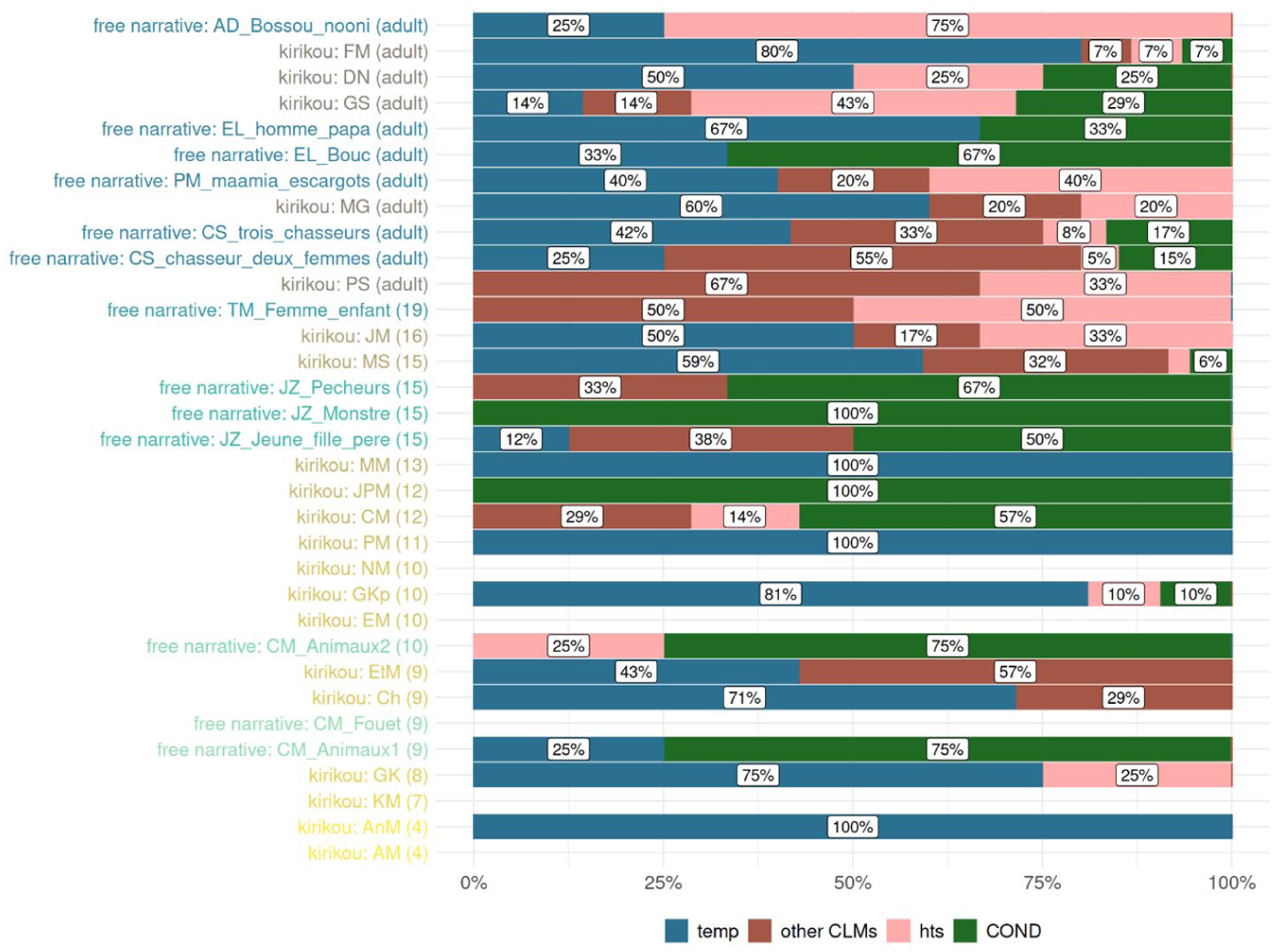
Share of different types of connecting devices in Mano narratives excluding reported speech.
The graphs show that syntactic and morphological means for event backgrounding in Mano are overall used by folktale narrators more than by Kirikou retellers and that older children tend to use them more than younger children. The temporal linker yé (annotated as “temp”) is more frequent than all other temporal clauses formed with clause-linking markers combined and its youngest user was 4 years old. By contrast, more syntactically and morphologically complex constructions (namely, hanging topics and COND constructions) were not used by 10 out of 15 children aged 13 years and younger. There seem to be individual stylistic preferences: JZ (15-year-old) and EL (adult) do not use hanging topics at all, CM (10- and 12-year-old at the moment of recording) and CS (adult) use them sometimes, but mostly use COND constructions, while AD uses hanging topics more frequently than anyone else and does not use COND at all.
The following pair of examples (28–29) contrasts the usage of a temporal clause with the clause-linking marker yé by a 10-year-old GKp and a hanging topic construction used by a 16-year-old JM.
(28)
“When Kirikou came. . .” [Kirikou_short_GKp.104] (GKp, 10)
(29)
“When Kirikou entered that place [lit.: entering that Kirikou went doing to that place]. . .” [Kirikou_short_JM.095] (JM, 16)
Discussion
In research on narrative retellings in Western settings, the ecological validity of the narrative retelling task is taken for granted, or little argued for (Manolitsi & Botting, 2011; Ralli et al., 2021). The reason is that participating children have been usually schooled, and that narratives told (as well as read) and retold (as well as written) are a central part of their curriculum (Berman & Slobin, 1994a, p. 23). Although stories are part of everyday life everywhere in the world, the specific configuration where videoclip or a set of pictures is given in a more or less formal setting, and the task is to retell the videoclip immediately after it was given (or during its administration, as in the case of storyboards), may be of little familiarity to children outside the urbanized Western settings. In addition, participants may not perform the same task when engaged in narrative retelling: some may rely on a dryer narrative and some, be engaged in a more colloquial storytelling, which is exactly what we observed in our study. 7 For these reasons, we found it particularly important to address not only the age, but also the role of the narrative genre in discussing to what extent the narrative strategies may differ (Berman, 1995). As it turns out, both age and genre were at play, but differently for the various parameters investigated. Keeping in mind that we do not have reliable information on speakers aged 8 years and younger because free narratives were told by children whose age was 9 years and above, Table 2 summarizes different parameters investigated, and the age and the genre differences observed.
Summary of Age-Related and Genre Differences in Narrative (Re)tellings.
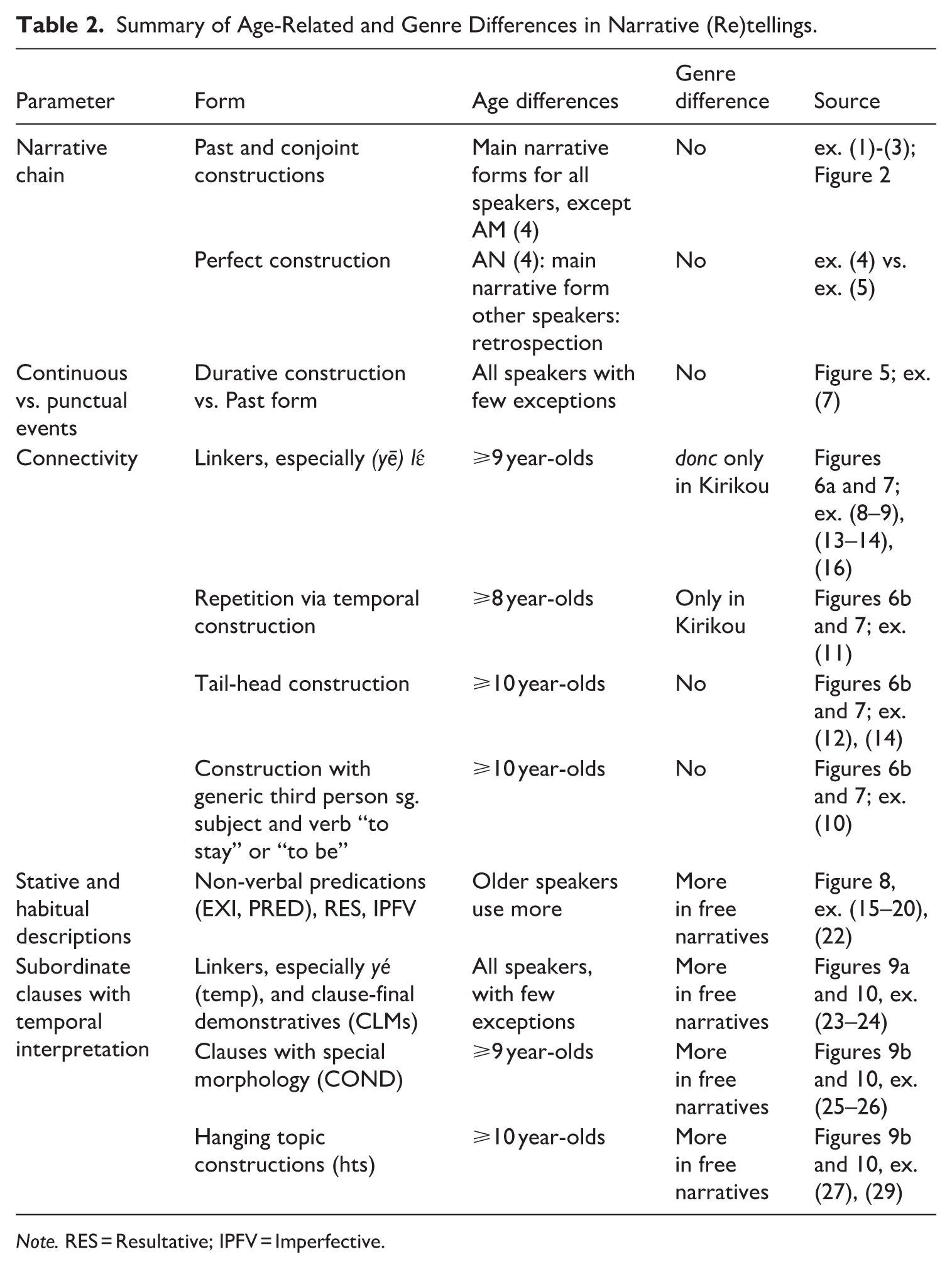
Note. RES = Resultative; IPFV = Imperfective.
Regarding the tense forms in the narrative chain, it has been reported for English that younger learners used present tense as the narrative form more, and that past tense forms as the main narrative tense emerged only later (Kang & Uchikoshi, 2022). By contrast, in Spanish, the past forms consolidate as the main narrative form by age three (Sebastián & Slobin, 1994; Uccelli, 2009). In Hebrew, yet another situation is observed: present and past tense can be used as main narrative forms even by adults (Berman & Neeman, 1994). In Mano, PST and JNT are the main narrative forms in all but one speaker in our sample. Indeed, AM, a 4-year-old boy, used PRF instead in his Kirikou retelling, in contrast to his peer, AnM, who used the usual narrative forms. The difference could be explained by AM’s comparative lack of exposure to storytelling as a practice (AM is raised in town in a multilingual family, while AnM is raised in a “traditional” environment, a Mano village and family) and as a result, by his reliance on conversational usage. PRF is overall rare in the narrative chains, and older speakers usually use it to mark temporal precedence. Other forms, such as EXI or IPFV, do not appear in the narrative to mark the sequence of events, but only for stative and habitual descriptions and, more rarely, to express events in duration. Although they may be interpreted in the present tense, their usage likely does not mark temporal shifts since Mande languages are primarily aspect-, rather than tense-based (Vydrin et al., 2017).
Similarly to tense, aspectual distinctions and specifically the use of the Durative construction are mastered even by the youngest speakers in our sample, including the aforementioned 4-year-old AM. There are no age-related differences either, and the differences in the rate of usage of the durative forms appear as rather idiosyncratic.
In the expression of connectivity, by contrast, there is a clear tendency: the youngest speakers (both 4-year-old and the 7-year-old) do not use any connecting devices. Clause-linking markers, similar to English and then, are the most common connecting devices. Interestingly, however, unlike English where such linkers are also the first to appear (Berman & Slobin, 1994a), the youngest speaker to use the linkers in our sample was a 9-year-old, which is 1 year later than a syntactically more complex device, namely, repetition within a temporal adverbial clause, which was used by an 8-year-old. The most complex device, namely, a tail-head construction, which is a common narrative linking device across languages (see, Guillaume, 2011; Obert, 2021, inter alia), was used by those aged 10 years and older, the same a finite clause with a generic subject (lit. it stayed there), which, in turn, is not necessarily very complex, being a more or less fixed expression.
The hierarchical organization of events via aspectual constructions (Stative and Habitual constructions vs. narrative chain) is also sensitive to age. Although stative and habitual descriptions are used by all speakers, excluding the 4-year-old AM, older speakers tend to use them more. We assume that aspectual distinctions, and in particular stative and habitual descriptions, are used in Mano to mark narrative background, as opposed to the foregrounded narrative chain (in line with Hopper, 1979, although proving such claim would require dedicated annotation into foreground and background, which we have not implemented). Our data suggest that younger speakers use stative and habitual descriptions less, and this finding supports other observations in the literature that lower-level learners do not organize their narratives into foreground and background and mostly employ foreground (Bardovi-Harlig, 2000; Kang & Uchikoshi, 2022). Note, however, that not all aspectual features are distributed the same way: as mentioned above, the usage of the Durative construction does not show any sensitivity to age.
Complex syntax used for contingent temporal backgrounding also shows an age-related variation. Subordinate clauses with temporal interpretation, especially those with the linker yé, are used by most speakers. More morphologically and syntactically complex means of expressing subordination, namely, the COND construction, which employs special morphology, and the hanging topic construction were used only by speakers aged 9 or older, and only a third of speakers aged 13 or younger used them. These observations confirm the expectation that syntactic complexity is acquired gradually (Frizelle et al., 2018; Lindgren, 2022).
Concerning genre differences, hierarchical packaging in the form of both aspectual distinctions (excluding the Durative construction) and complex syntax was used in free narratives more than in narrative retellings. This is probably because hierarchical packaging requires planning in advance and good knowledge of the plot, while retelling a movie is a demanding online task that results in the narrative being a sequence of episodes. By contrast, in the expression of connectivity, no difference was observed, or some markers were used more in narrative retellings than in free narratives. The tail-head construction was used both in spontaneous narratives and in narrative retellings. This finding contrasts with that of Klamer and Moro (2020), who report that in two languages of eastern Indonesia, tail-head linkage was not used in retellings of Frog stories, unlike in free narratives. The difference between our finding and Klamer and Moro’s could be related to the nature of the prompt: more connecting devices could be used in a retrospective retelling of an entire movie versus an online picture-based retelling. Furthermore, Kirikou retellings used some connecting devices (the French borrowing donc as a clause-linker and the repetition construction) which were not used in free narratives, suggesting a genre difference with more diverse, although not syntactically more complex, repertoire of forms in narratives with a prompt than with free narratives.
We conclude the discussion by emphasizing the main limitation of this study: namely, a small and unbalanced sample size. Further work could be done by annotating an existing collection of Kirikou retellings. Given that the narrative corpora of children and adults are not directly comparable (different stories are told), it seems particularly promising to collect the same traditional folk stories from children of different ages and from adults, with and/or without a prior prompt and to better control for the narrative elicitation context (formal or informal). A systematic longitudinal approach could also be beneficial to strengthen the developmental observations. More data from younger retellers, around 4-year-old, would be crucial to confirm whether children first rely on the conversational usage of the PRF form referring to past events before switching to the narrative-appropriate PST and JNT forms.
Conclusion
This paper provides an overview of morphological and syntactic means of relating events in narratives in Mano, a Mande language of West Africa. For this study, we collected a corpus containing retellings in Mano of an animated movie, “Kirikou et la sorcière,” as well as other narratives, mostly folktales, told by children and adults. We explored the following aspects: narrative chains, connectivity, and hierarchical organization. We compared texts based on the narrator’s age and the narrative type (narrative retelling vs. free narratives). Both factors listed played a role for various aspects of narrative organization. There were very few developmental or genre differences in the use of main tense forms used in the narrative chain, as well as the Durative construction. By contrast, we showed that connecting devices, Stative, Resultative, and Habitual constructions, as well as means of temporal subordination, were used more and were more varied in older children and adults. The latter two aspects of narrative organization were also more developed in free narratives than in Kirikou retellings, but the means of expressing connectivity were more diverse in Kirikou retellings than in free narratives. Overall, the linear mixed-effect model revealed a statistically significant effect of interaction of text type with age, as well as of narrative duration, with increased predicted values of entropy in free narratives, as well as in older speakers. We confirm the validity of the method of narrative elicitation – retelling of a culturally appropriate animated movie, since our corpus of retellings allowed to capture the main means of narrative organization present in free narratives.
Thus, keeping in mind the differences in method (retelling of a video clip versus storyboard-based retelling), which may not make the data directly comparable, the paper contributes to the empirical and theoretical work on narrative and broader linguistic development by confirming the most general trends, such as younger children’s preference for foregrounded events or a later acquisition of complex structures. It also contributes to the discussion of cross-linguistic variation in the acquisition of narrative tense.
Footnotes
Acknowledgements
As usual, we are grateful to the Mano-speaking community, and in particular to Pé Mamy’s family for support over many years. This time, our thanks extend to children, and we hope that participating was fun for them.
List of Glosses
Ethical Considerations
Consent to Participate
Informed oral consent, which included consent for recording and publication, was always sought with the adults and, in case of children, their guardians; it was also audio-recorded for guardians of all participating children. Despite the consent for publication, we openly publish only anonymized transcripts.
Author Contributions
Funding
The authors disclosed receipt of the following financial support for the research, authorship, and/or publication of this article: Research was supported by the Kone Foundation, grants number 201907156 and 202305389, and HSSH Catalyst funding from the University of Helsinki. In addition, George Moroz has received funding from the Basic Research Program at the HSE University.
Declaration of Conflicting Interests
The authors declared no potential conflicts of interest with respect to the research, authorship, and/or publication of this article.
Data Availability Statement
The corpus which this study is based on is being prepared for archiving with FIN-CLARIN, the Language Bank of Finland (https://urn.fi/urn:nbn:fi:lb-2025111121). Anonymized dataset with annotations is submitted as part of Supplemental Materials and is available at  .
.
Supplemental Material
Supplemental material for this article is available online.