




Abstract
Children and adults use prosocial lies in their everyday conversational exchanges. However, their use of this language form varies across contexts. Extending work demonstrating the importance of conversational partner knowledge for communicative decisions, we examine whether children (ages 8–11 years old; N = 81) and adults’ (N = 218) endorsement of prosocial lies (and truths) differ based on whether a recipient is/is not knowledgeable of the context. Additionally, we examine whether such endorsements varied based on whether the lie (or truth) was about their opinion or the objective reality. Participants were asked to imagine themselves within a scenario with another person who was unaware/aware of a negative event. They then rated how likely they would be to use truth/lie statements which varied in content (i.e., reference to opinion or reality). While children endorsed statements similarly for ignorant/knowledgeable recipients, adults were more likely to endorse telling a prosocial lie when the recipient was ignorant of the negative event. Both groups indicated higher likelihood of telling a prosocial lie about an opinion versus reality. Addressing individual factors, self-reported empathy was not associated with children’s responses but was associated with adults’ communicative choices. Together this work provides information as to how children (and adults) use varying language forms to navigate social situations.
Prosocial lies are false statements often told for the benefit of others (Backbier et al., 1997; DePaulo & Kashy, 1998), for example, saying that someone’s new haircut looks ‘great’ when in fact you do not think so. This contrasts with antisocial lies, which are false statements told for personal benefit, such as avoiding getting in trouble (e.g., denying that you had taken the last cookie, when you had). Perhaps because of prosocial lies’ general socially acceptability (relative to antisocial lies, Heyman et al., 2009, Xu et al., 2010), both children (Lavoie et al., 2017) and adults (DePaulo et al., 1996) demonstrate frequent use. However, inappropriate use of prosocial lies can have negative social consequences (Talwar & Crossman, 2011). Thus, it is important to understand how context affects how and when to use prosocial lies. In this study, we examined children’s sensitivity to recipient knowledge and statement content (i.e., reflecting an opinion or reality) when deciding whether to use a prosocial lie or tell the truth. As prosocial lies can be used to protect recipients’ feelings, we additionally examined whether sensitivity to others’ emotional states, namely empathy, related to prosocial lie endorsement. Additionally, as researchers have argued that there may be a developmental shift in the conception of prosocial lies between childhood and adulthood (Lee & Ross, 1997) with a call to examine such differences (Xu et al., 2010), we also examined these questions in a sample of young adults.
Prosocial lying
Children as young as 3 years old start to tell lies; however, rates and motivations vary through development (Lewis et al., 1989; Talwar & Lee, 2002a, 2002b; Talwar et al., 2007). By 7 years old, children start to tell prosocial lies to benefit others, including to protect others’ well-being (Popliger et al., 2011; Talwar & Crossman, 2011), such as alleviating a sad mood (Warneken & Orlin, 2015). As they get older (7–11 years), children view prosocial lies as more socially acceptable and generate more prosocial lies (Talwar & Crossman, 2011; Talwar et al., 2007; Xu et al., 2010). However, variability in children’s use of prosocial lies results from contextual and individual factors.
Contextual factors
Past work has demonstrated that children’s use of prosocial lies varies based on the recipient, such as familiarity/affiliation (Sierksma et al., 2019; Williams et al., 2013). Seeking to further understand how recipient characteristics may influence children’s feelings about the appropriateness of using a prosocial lie, we examine a recipient’s knowledge as a possible factor. Certainly, within the preschool-age, children modify their utterances based on the knowledge state of their communicative partner (O’Neill, 1996) and provide clarifying information when required by the listener’s knowledge (Nilsen & Graham, 2009). We extend this work to examine how recipient knowledge is used for other communicative decisions, such as whether to lie. In terms of antisocial lies, children are less likely to lie if the recipient is knowledgeable of the transgression (Fu et al., 2012). However, due to the social functions of prosocial lies, the same pattern cannot be assumed. When interpreting prosocial statements, children show sensitivity to recipient knowledge: 5- to 8-year-olds interpreted speakers as using a prosocial lie when a recipient was ignorant of a situation (Sullivan et al., 1995; Winner & Leekam, 1991). Moreover, while both adults and children perceived recipients generally would feel better after a prosocial lie, ignorant recipients are rated as having more positive affect (Ong et al., 2022). However, it is not known whether children use recipient knowledge in decisions about whether to use a prosocial lie. Children may feel that prosocial lies are only appropriate to use when a recipient is unaware of the situation and, thus, can effectively be misled to believe something different from reality. Alternatively, it may be that even when a recipient is aware of the situation, a prosocial lie conveys prosocial intention, and thus, children may still choose to use this language form. In the present work, we focus on this novel question, namely, how a recipient’s knowledge influences a child’s inclination to use a prosocial lie, and if so, whether certain types of lies are viewed as more appropriate.
Lie content
Opinion lies are untrue statements about a speaker’s judgment of a situation (e.g., ‘These shoes are better’.), whereas reality lies are untrue statements about a situation (e.g., ‘The chips are in that box’.; Cheung et al., 2015). Typically, past research has examined antisocial lies using content that references reality (e.g., Talwar et al., 2007) and prosocial lies with content referring to opinions (e.g., Xu et al., 2010), which limits analysis as to whether the statement content affects interpretation/use of each lie type. Given that prosocial lies are typically viewed as more socially acceptable than antisocial lies, content may play a bigger role relative to antisocial lies (since all antisocial lies are self-serving). Evaluating this premise, Cheung et al. (2015) asked children (7–11 years) and adults to read vignettes and identify the statements (as truths/lies) and evaluate them. Children were less likely to identify opinion lies as lies (compared to reality lies) and evaluated opinion lies as less negative, likely because the untrue statement refers to a personal, subjective judgment (Cheung et al., 2015). Extending this work, we examine whether similar patterns emerge when children are asked about using lies, and whether such effects interact with the recipient’s knowledge of the situation. That is, it may be the case that children’s endorsement of certain types of prosocial lies depends on the knowledge state of the recipient, for instance, showing a greater sensitivity to the distinction between reality and opinion lies when a recipient is knowledgeable of the situation. If this were the case, it would suggest that children are both sensitive to and able to integrate both cues when considering whether they might use prosocial lies.
Individual characteristics
Children’s characteristics are associated with their use of prosocial lies: for example, children with better executive functioning and theory of mind (ToM) are more likely to tell prosocial lies (Lee & Imuta, 2021; Sai et al., 2018; Talwar & Lee, 2008; Williams et al., 2016). Given that a key social function of prosocial lies is to enhance the emotions of a recipient, empathy (i.e., recognition/experience of others’ emotions; Findlay et al., 2006) may also relate to the likelihood of telling prosocial lies – and, as examined here, do so within particular contexts.
Empathy has cognitive and affective components (Davis, 1994), wherein cognitive empathy involves the understanding of why others experience emotions and affective empathy is vicariously experiencing another’s emotions. Batson (1991) theorized that when seeing someone in distress, one’s own vicarious experience of emotion motivates prosocial behavior to alleviate negative emotions. Indeed, empathy is important in children’s social development, showing associations with prosocial behavior (e.g., Eisenberg & Fabes, 1990).
Further, empathy is linked to specific facets of prosocial behavior, including prosocial lies; school-age children with greater empathy evaluate prosocial lies more positively (Lim et al., 2020) and are more likely to tell a prosocial lie within an experimental context (Nagar et al., 2020). Similar results have been demonstrated within an adult population: adults with higher self-reported empathy are more likely to use prosocial lies when communicating with a social partner who is experiencing sadness (Xu et al., 2019). However, Demedardi et al. (2021) did not find associations between children’s empathy and prosocial lying. Thus, associations between empathy and prosocial lie endorsement may depend on factors such as the social context and/or type of lie. We examine this premise in the current study, importantly, examining the possible influence of other socio-cognitive characteristics, such as ToM. That is, while there is interaction (Dvash & Shamay-Tsoory, 2014) and intertwinement (Singer, 2006) between these abilities, ToM and empathy are seen as separable, wherein ToM refers to understanding others’ cognitive states, such as thinking/beliefs, whereas cognitive empathy refers to understanding others’ emotions (Lim et al., 2020), and affective empathy to experiencing others’ emotions. Thus, by including a measure of ToM, we are able to assess whether it is understanding/experiencing of emotions per se, rather than general mentalizing, that may relate to prosocial lie endorsement.
Current study
We explore the novel question as to how recipients’ knowledge (ignorant vs. knowledgeable of the situation) and statement content (referring to opinion versus reality) affect children’s endorsement of telling a truth/lie. Moreover, we explored children’s self-reported empathy in terms of whether this trait predicts truth/lie endorsement rates as well as assessing the degree to which variation in internal characteristics interacts with contextual cues to predict children’s endorsement of different communicative approaches within negative situations. Together, these research goals have relevance for understanding how contextual cues and individual characteristics relate to how children navigate communicative decisions, particularly decisions that place rules of conversation against each other as is the case with prosocial lies (namely, that speakers should be truthful [Grice, 1975] and polite/amicable [Sweetser, 1987]).
Children were 8 to 11 years-old, as children this age understand the social functions of prosocial lies and distinguish between opinion and reality lies (e.g., Broomfield et al., 2002; Cheung et al., 2015; Warneken & Orlins, 2015). Although our focus was on the children’s pattern of responses, we also examined these research questions adults for comparison, and investigate whether the impact of contextual cues differs across developmental stages.
Participants were asked to imagine themselves in a series of vignettes in which a negative event occurs of which the recipient is unaware/aware, and rate how likely they would be to make various statements differing in type (truth, lie, unrelated statement) and content (opinion, reality). We chose this approach as we were interested in capturing children and adults’ thoughts on when prosocial lies may be more or less appropriate based on the context (vs. producing one statement). Thus, even though we are not capturing actual lie-telling or truthful behavior, we are able to see if endorsement rates fluctuate based on context.
We predicted that children and adults endorse more frequent lying when the recipient was ignorant of the negative event, versus knowledgeable, as the lie would be more believable. As lies referring to opinion are evaluated more positively than lies referring to reality (Cheung et al., 2015), we predicted that participants would more readily endorse saying a prosocial lie of their opinion, rather than objective reality – and that this difference will be greatest in the recipient knowledgeable condition (when there is a greater chance that the recipient could detect the lie). It was anticipated that, in general, participants with higher empathy would indicate greater use of prosocial lies (and less truth), particularly within the ignorant recipient condition.
Method
Participants
Children
Participants between 8 and 11 years old (N = 81; 39 boys, M = 9.43 years; SD = 1.16) were recruited from a lab database and Children Helping Science, an international platform that enables children and their caregivers to participate in online research studies. The majority of participants (88%) were from Ontario, Canada, with remaining participants living in other North American states/provinces (10%), and countries in Asia (2%). Most participants reported English as their first language (93%). The most frequently reported ethnicities were in the following categories: Caucasian (n = 56), Middle Eastern (n = 8), Asian (n = 9), Latin (n = 5), Black (n = 1), with some multi-ethnicities reported (missing values n = 7).
Adults
Participants (N = 218; 37 men, M = 20.45 years; SD = 4.17) were recruited from the University of Waterloo online undergraduate recruitment system. The majority of participants reported English as their first language (68%). Participants reported their ethnic backgrounds as Asian (n = 109), Caucasian (n = 79), Middle Eastern (n = 9), Black (n = 6), Latin (n = 4), and Other (n = 11).
Procedure
Children
Following parental/caregiver consent, children completed the empathy questionnaire via Qualtrics and subsequently completed a 45-min Zoom meeting wherein a researcher administered tasks by sharing their screen. Tasks were presented in a fixed order, a standard practice when assessing individual differences as it ensures that participants are exposed to identical stimulus contexts (Carlson & Moses, 2001).
Adults
Participants completed the tasks independently via Qualtrics. Modifications were made to ensure the quality of the data, such as including prompts to complete unanswered questions.
Measures
Prosocial lying task
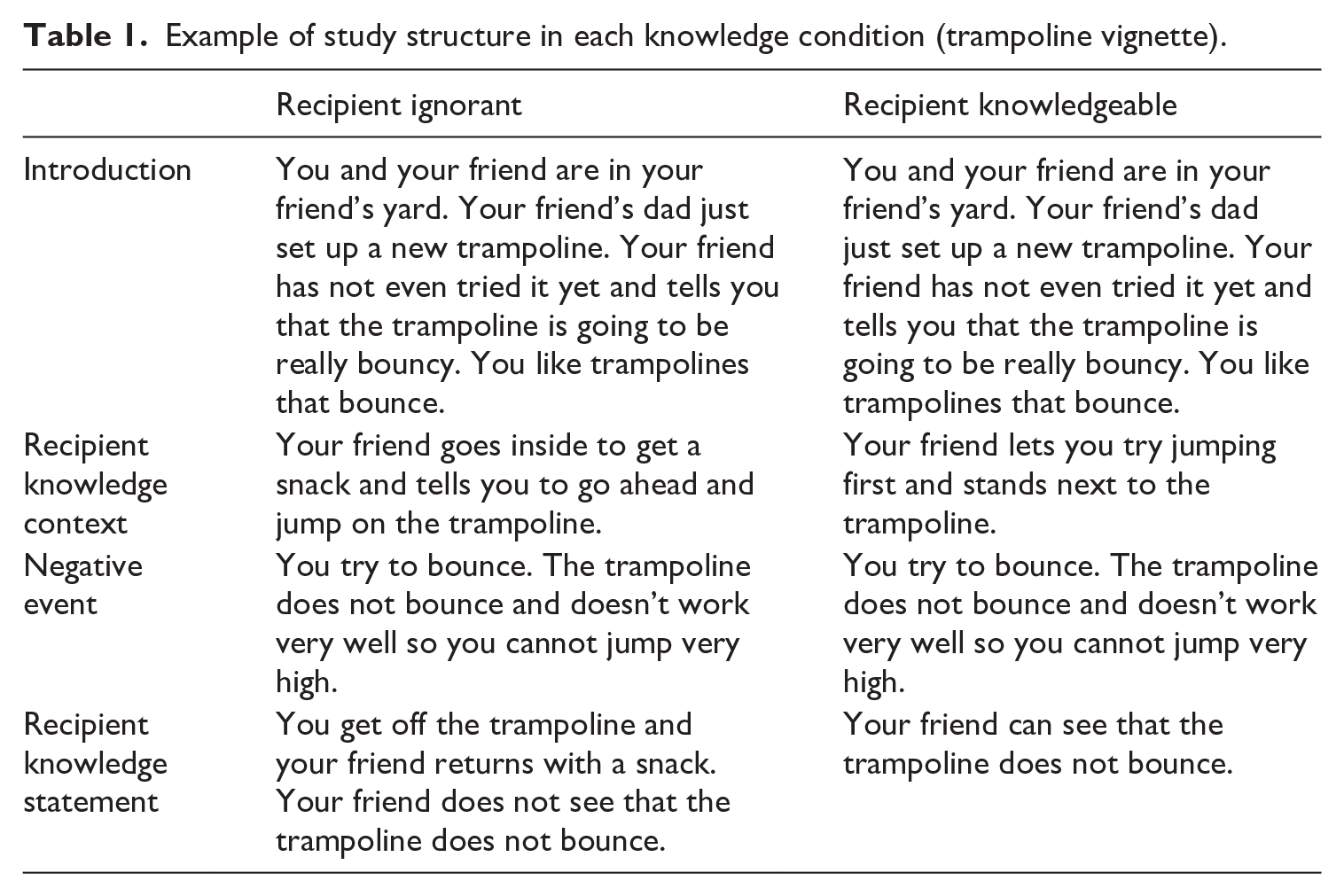
Children and adults completed the same prosocial lying task. To evaluate participants’ endorsement of truthful statements and prosocial lies, participants heard/viewed vignettes of six scenarios involving themselves and another character (gender-matched to the participant) interacting with an object that failed its function (i.e., a kite that doesn’t fly, a glow-in-the-dark toy that doesn’t glow, a trampoline that doesn’t bounce, a pool toy that doesn’t float, a movie that is not funny, a basketball that doesn’t bounce). Statements (truth/lie) were about the listener’s possession so that recipient knowledge (of the event) could be more easily manipulated. The task employed a 2(recipient knowledge: ignorant, knowledgeable) × 2(statement type: truth, prosocial lie) × 2(statement content: opinion, reality) within subject design. The stories followed the same structure (Table 1), which included an introduction and information about the recipient’s knowledge as unaware (ignorant) or aware (knowledgeable) of the negative event (see Figure 1).
Example of study structure in each knowledge condition (trampoline vignette).
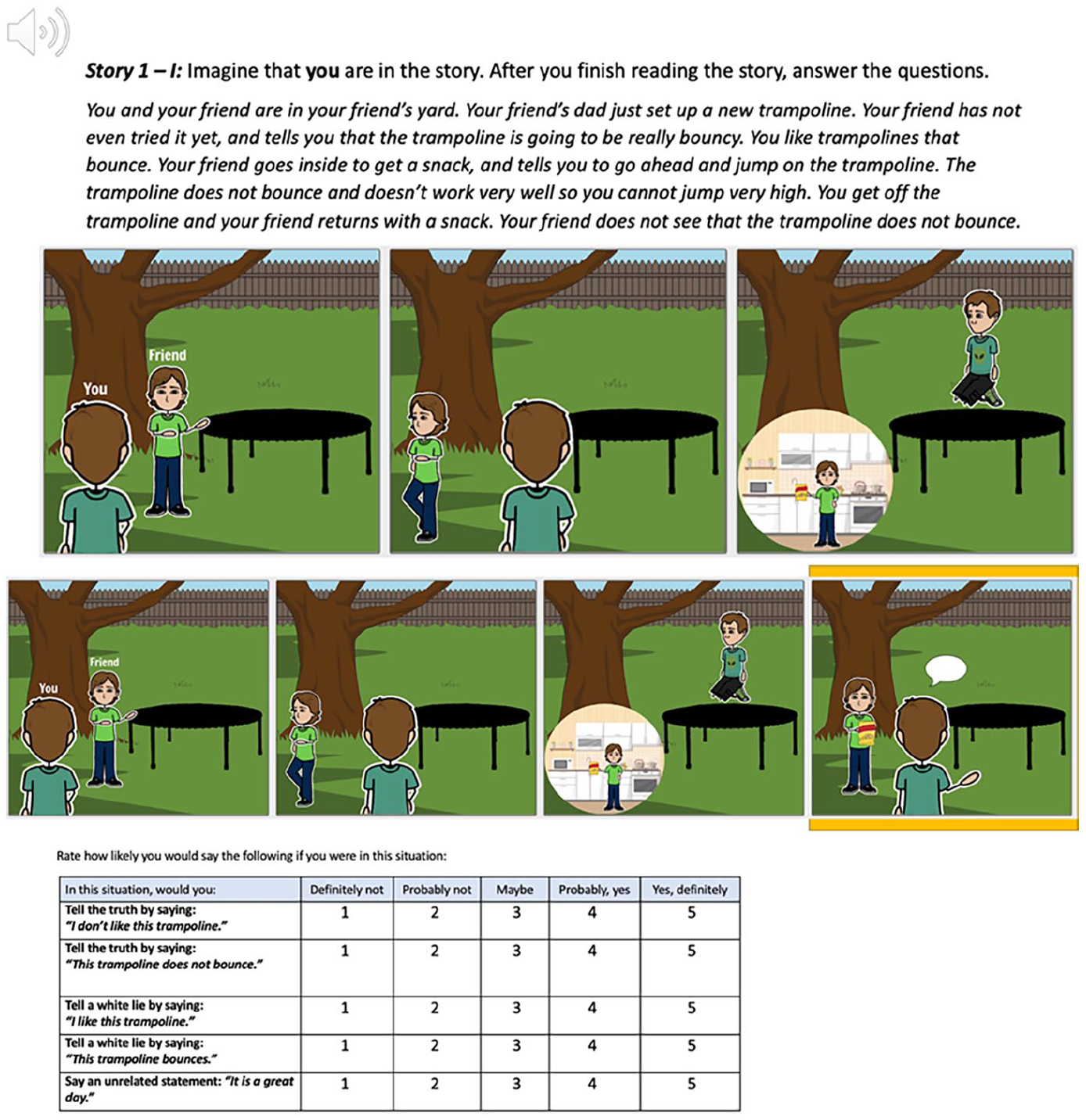
Trampoline story (recipient ignorant condition) with pictures. (Comics were created using https://www.storyboardthat.com and https://pixabay.com).
Following the knowledge manipulation, participants were asked how likely they would be to use each of five possible responses to the scenario: opinion truth, reality truth, opinion prosocial lie, reality prosocial lie, and unrelated statement. 1 Reality truths were negative statements about the negative event itself (e.g., ‘This trampoline does not bounce’); opinion truths were negative statements about the speaker’s opinion regarding the object (e.g., ‘I don’t like this trampoline’); reality lies were positive statements about the negative event (e.g., ‘This trampoline bounces’); opinion lies were positive statements about the speaker’s opinion regarding the object (e.g., ‘I like this trampoline’). As stories included information about the situation and the opinion participants were to adopt (e.g., You like trampolines that bounce.), both types of lies were in opposition to aspects of the story, whereas truths aligned. An unrelated statement, a positive comment unrelated to the object (e.g., ‘It is a great day’), was provided so there was a response that was neither a truth nor lie about the object.
Participants indicated the likelihood they would produce each response on a 5-point Likert scale: 1 (Definitely not) to 5 (Yes, definitely). Thus, importantly, we were able to assess the degree to which participants felt each response was reasonable, rather than forcing them to choose one response over another.
Empathy
Children’s empathy was assessed using the Cognitive (3 items) and Affective Empathy (6 items) subscales from the self-reported Empathy Questionnaire for Children and Adolescents (Overgaauw et al., 2017). With the current sample, the Cognitive and Affective Empathy subscales yielded reasonable reliability values of .77 and .67, respectively (Taber, 2018). Adults’ empathy was assessed using the Cognitive (9 items) and Affective Empathy (11 items) subscales from The Basic Empathy Scale (Carré, et al., 2013), a self-report questionnaire using a 5-point Likert scale: 1 (Strongly disagree) to 5 (Strongly agree). Within the current sample, reliability was strong with alpha levels of .80 and .84, for Cognitive and Affective Empathy, respectively.
Receptive vocabulary
As we were assessing an element of communication, a vocabulary measure was included as a possible control variable. Children’s language skills were assessed using the Receptive Vocabulary test (/19) from the Wechsler Individual Achievement Test-III (WIAT-III, Wechsler, 2009). Adults’ language skills were assessed using the vocabulary subscale (/40) of the Shipley Institute of Living Scale (Shipley, 1940).
Theory of mind
Given the relationship between empathy and ToM (e.g., Völlm et al., 2006), a ToM measure was included. Children’s ToM was assessed using second-order false belief stories from Coull et al. (2006), presented in two videos depicting puppets. To respond correctly, participants had to recognize that one character has an incorrect belief about another character’s mental state (/4). Adults’ ToM was assessed using a shortened version of the Embedded False Belief test (Rutherford, 2004) in which participants listened to/read four stories that involved embedded false beliefs (i.e., one character has a false belief about another character’s beliefs) and then chose the statements that described the character’s mental state (/5).
Results
Preliminary analyses
Children
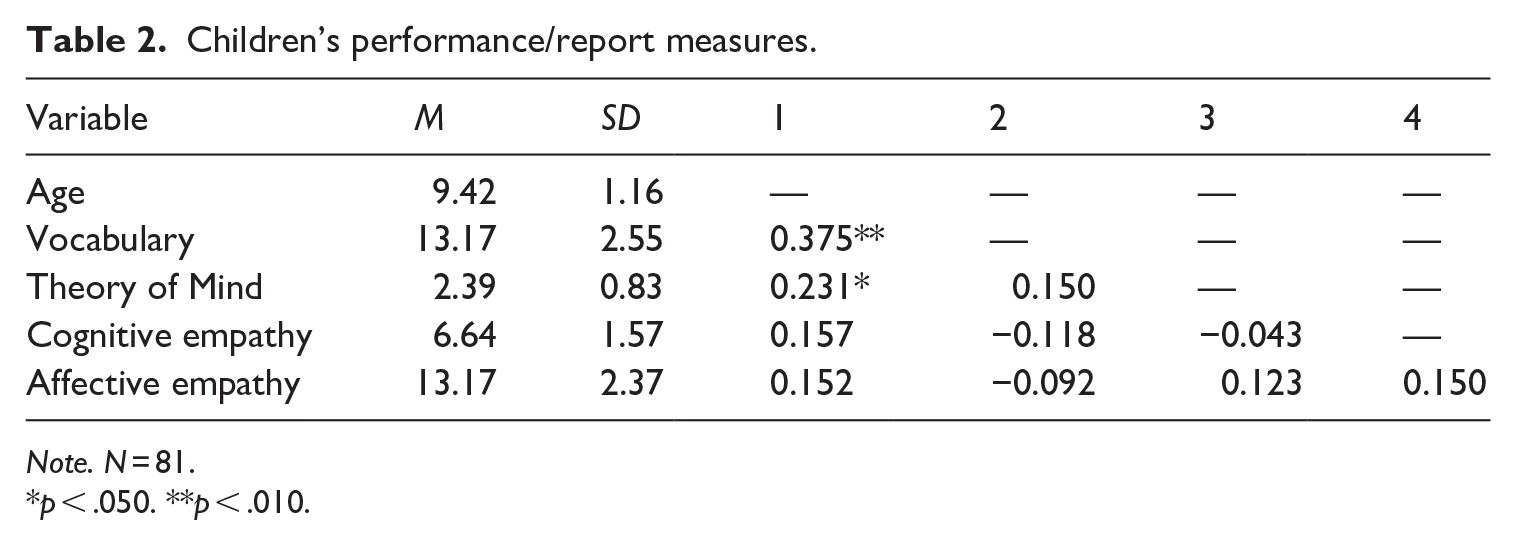
No variables violated normality assumptions based on Kline’s criterion (|skew| ⩽ 3; |kurtosis| ⩽ 10) and no measures showed outlier values of ±3 SD. There were no missing values. Consistent with work showing no, or even negative correlations between cognitive and affective empathy, (for example, Demedardi et al., 2021; Nagar et al., 2020), children’s affective and cognitive empathy were not related (Table 2; unlike the pattern for adults). Children’s age was unrelated to their ToM or empathy (consistent with past work showing variability in relations between empathy and ToM with age; Gallant et al., 2020).
Children’s performance/report measures.
Note. N = 81.
p < .050. **p < .010.
Adults
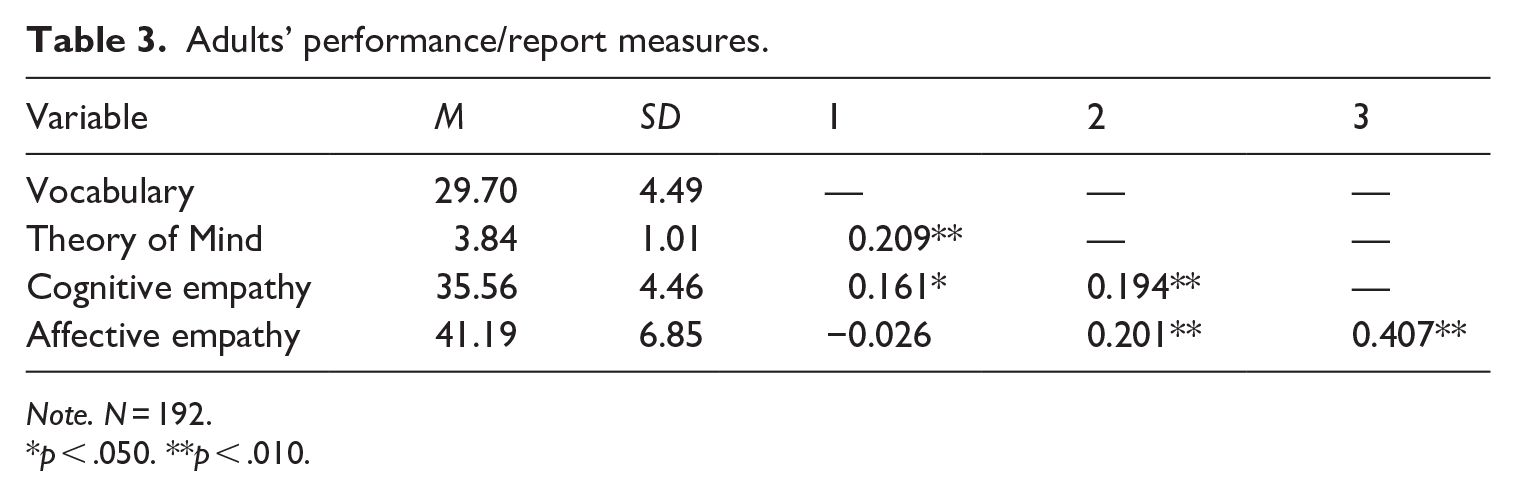
There were no variables that violated normality assumptions based on Kline’s criterion (|skew| ⩽ 3; |kurtosis| ⩽ 10; 1998). Outliers of ±3 SD were Winsorized: ToM measure (n = 2), vocabulary measure (n = 1), cognitive empathy (n = 1), and affective empathy (n = 2). Missing values (items) found in the cognitive (n = 7) and affective empathy subscales (n = 2) were imputed using single imputation (Eekhout et al., 2014). See Table 3.
Adults’ performance/report measures.
Note. N = 192.
p < .050. **p < .010.
Analytical strategy
Given the hierarchical nature of the data whereby statement endorsement ratings (level 1) were nested within participants (level 2), a multilevel modeling (MLM) approach was used to account for correlated participant error in the dependent variable. 2 Experimental variables were dummy coded: statement type (0 = truth, 1 = prosocial lies), knowledge condition (0 = ignorant, 1 = knowledgeable), and statement content (0 = opinion, 1 = reality). Prior to analyses, measures were centered at the grand mean. A backward stepwise approach was used to fit two sets of models for the statement endorsement rating. Analyses were considered adequately powered for MLM, with more than 50 units available at the participant level (Maas & Hox, 2005; Paccagnella, 2011).
Model set 1 – prosocial lying task
First, we fit a set of models (for children and adults) to examine the effect of the conditions (statement type, knowledge, statement content) as well as all interactions on the statement endorsement ratings. If the three-way interaction term for the model was not significant (i.e., p > .05), it was removed from the model and only two-way interactions were interpreted. If the two-way interaction terms were not statistically significant, only main effects were retained in the final model and interpreted. Significant three-way interactions were probed by splitting the dataset into two sets on one of the conditions. To explore two-way interactions, we conducted post hoc pairwise comparisons. Conditions that showed no significant main effects, nor were involved in significant interactions, were removed from the model.
Model set 2 – role of empathy
Second, MLM models were created to examine the association between empathy and the conditions on the statement endorsement ratings. These models contained the condition main effects, empathy, and all interactions. Covariates [i.e., gender, English first language, ToM, vocabulary, and age (child sample only)] were individually analyzed for main effects within each condition and were included in the model if significant. Significant three-way interactions with empathy were probed by examining the data separately by condition. Significant two-way interactions with empathy were explored by conducting simple slopes analyses, collapsing across conditions when relevant. When all interactions terms were not statistically significant, they were removed, and only main effects were reported. Only findings that involve individual differences are reported from this model.
Children’s endorsement of statements
We fit the conditions and their interactions in a model which revealed a nonsignificant three-way interaction (p = .761). When this, and the knowledge condition, was trimmed, the model showed a significant two-way interaction of statement type and statement content (Table 4). Post hoc pairwise comparisons indicated that for both statement content options, across knowledge, children indicated a greater likelihood of telling the truth (opinion: M = 3.17, SE = 0.08; reality: M = 3.86, SE = 0.08) than lying (opinion: M = 2.09, SE = 0.08, t(564) = 9.25, p < .001; reality: M = 1.66, SE = 0.08, t(564) = 18.75, p < .001). In addition, across knowledge, when telling a lie, children endorsed a greater likelihood in using an opinion (vs. reality), t(564) = 3.66, SE = 0.12, p < .001, and when telling the truth, children endorsed a greater likelihood of using a reality statement (vs. opinion), t(564) = 5.84, SE = 0.12, p < .001.
Children’s statement endorsement ratings – prosocial lying task.
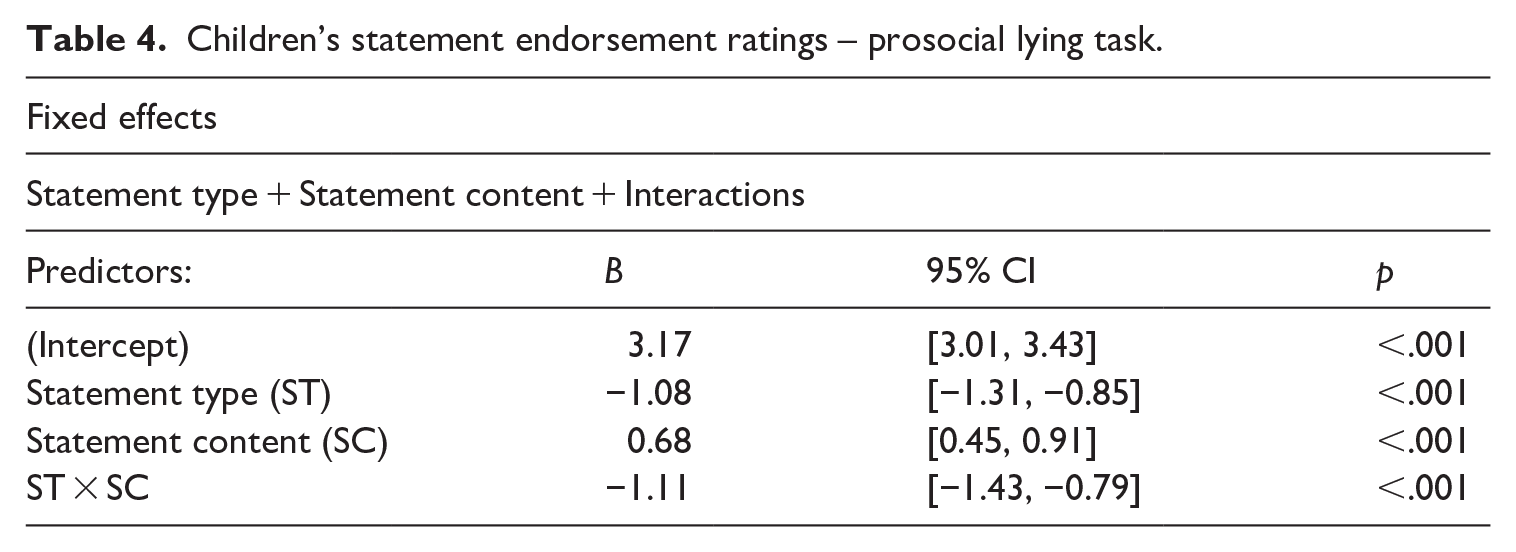
Thus, in the context of a negative event, children indicate that they would be more likely to tell the truth than use a prosocial lie. However, if they were going to lie, they would be more likely to use an opinion lie (whereas, for the truth, they would be more likely to use a reality statement). We did not find evidence that children were using recipient knowledge as a cue to guide communicative choices.
Role of empathy
Prior to fitting the second model with the conditions, cognitive/affective empathy, and their interactions, we analyzed the covariates individually with the conditions and found a significant two-way interaction of statement type and age (B = −0.28, 95% CI [−0.42, −0.14], p < .001), showing that as age increases, children endorse a greater likelihood of telling the truth (b = 0.14, p = .01) and less likely to endorse telling a lie (b = −0.15, p < .01). As well, there was a two-way interaction of statement type and language (B = 2.08, [1.31, 2.84], p < .001), showing that children whose first language was English reported a higher likelihood that they would tell a truth (M = 3.58, SE = 0.06) versus a lie (M = 1.84, SE = 0.06), t(551) = 19.85, p < .001, unlike children whose first language was not English (truth: M = 2.50, SE = 0.27; lie: M = 2.83, SE = 0.27), t(551) = 0.88, p = .38; children whose first language was English reported they were more tell the truth (t(270) = 3.91, p < .001) and less likely to endorse telling a lie (t(270) = −3.62, p < .001), when compared to children whose first language was not English. Further, there was a two-way interaction of statement type and ToM (B = −0.66, [−0.85, −0.46], p < .001), wherein children with higher ToM reported a greater likelihood of telling the truth (b = 0.35, p < .01), and less likelihood in telling a lie (b = −0.31, p < .01). As such, age, English first language, and ToM were controlled for in the subsequent models involving empathy.
Cognitive empathy
The model included the covariates, conditions, cognitive empathy, and their interactions. The four-way (p = .755), three-way (ps > .651), and two-way (ps > .262) interaction terms were nonsignificant and trimmed from the model. The main effects model also revealed a nonsignificant main effect of cognitive empathy (p = .415).
Affective empathy
The model included the covariates, conditions, affective empathy, and their interactions. The four-way (p = .956), three-way (ps > .591), and two-way (ps > .632) interaction terms were nonsignificant and trimmed from the model. The main effects model also showed a nonsignificant main effect of affective empathy (p = .189).
Unrelated statements
Recall that participants were asked how likely they would be to make a statement that was neither a truth nor lie about the event. Results showed that recipient knowledge did not impact children’s endorsement of an unrelated statement about a negative event (p = .439). See Table 5. In both knowledge conditions, and regardless of content, unrelated statements were endorsed less than truths (ps < .001), but more than lies (ps < .001). Empathy was not related to children’s endorsement of unrelated statements (ps > .273).
Children’s endorsement of different statement types on the prosocial lying task.
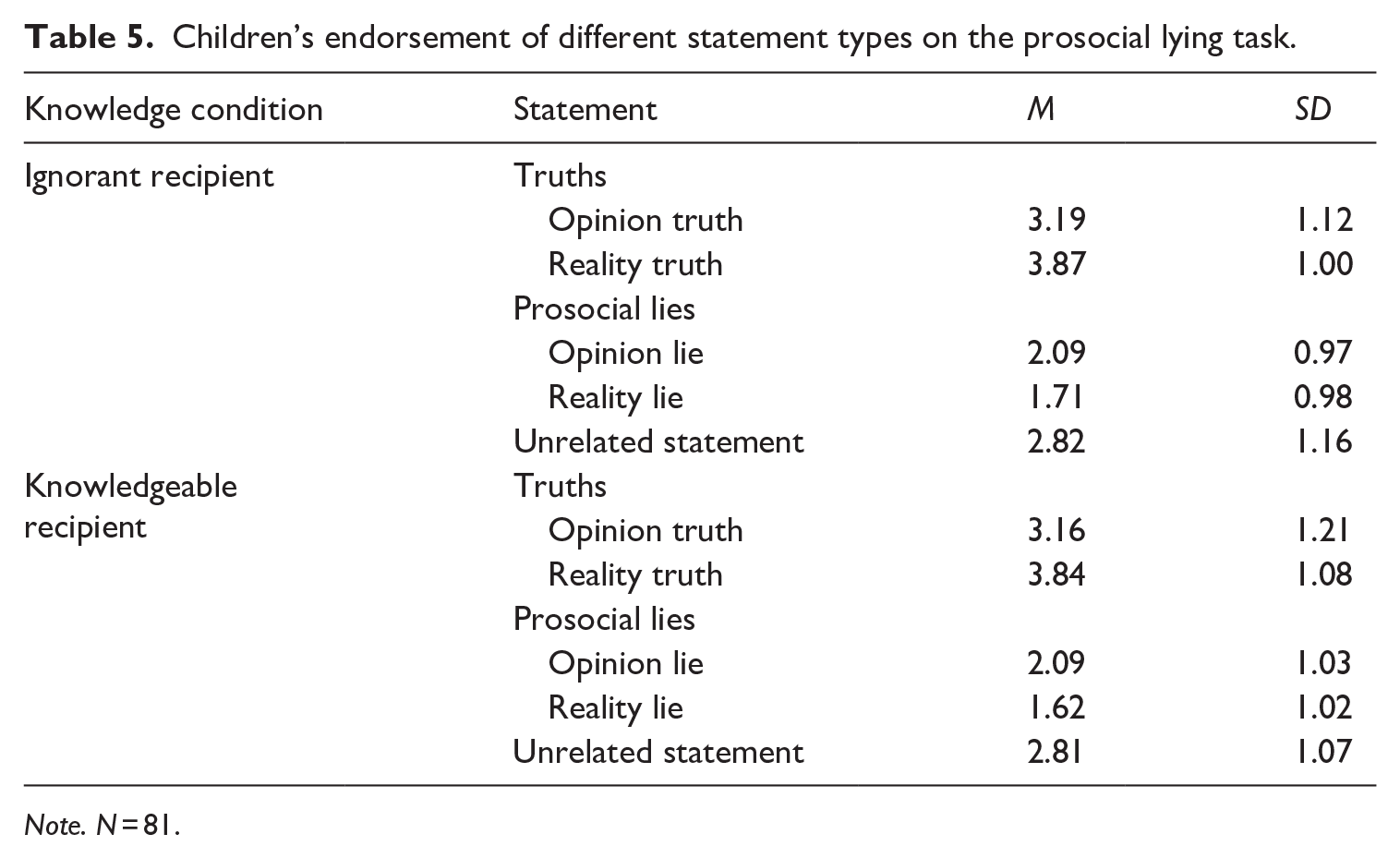
Note. N = 81.
Adults’ endorsement of statements
We fit the conditions and their interactions in a model which revealed a nonsignificant three-way interaction (p = .799). When this interaction term was trimmed, the model revealed two significant two-way interactions: (1) statement type by knowledge context; (2) statement type by statement content (Table 6).
Adults’ statement endorsement ratings – prosocial lying task.
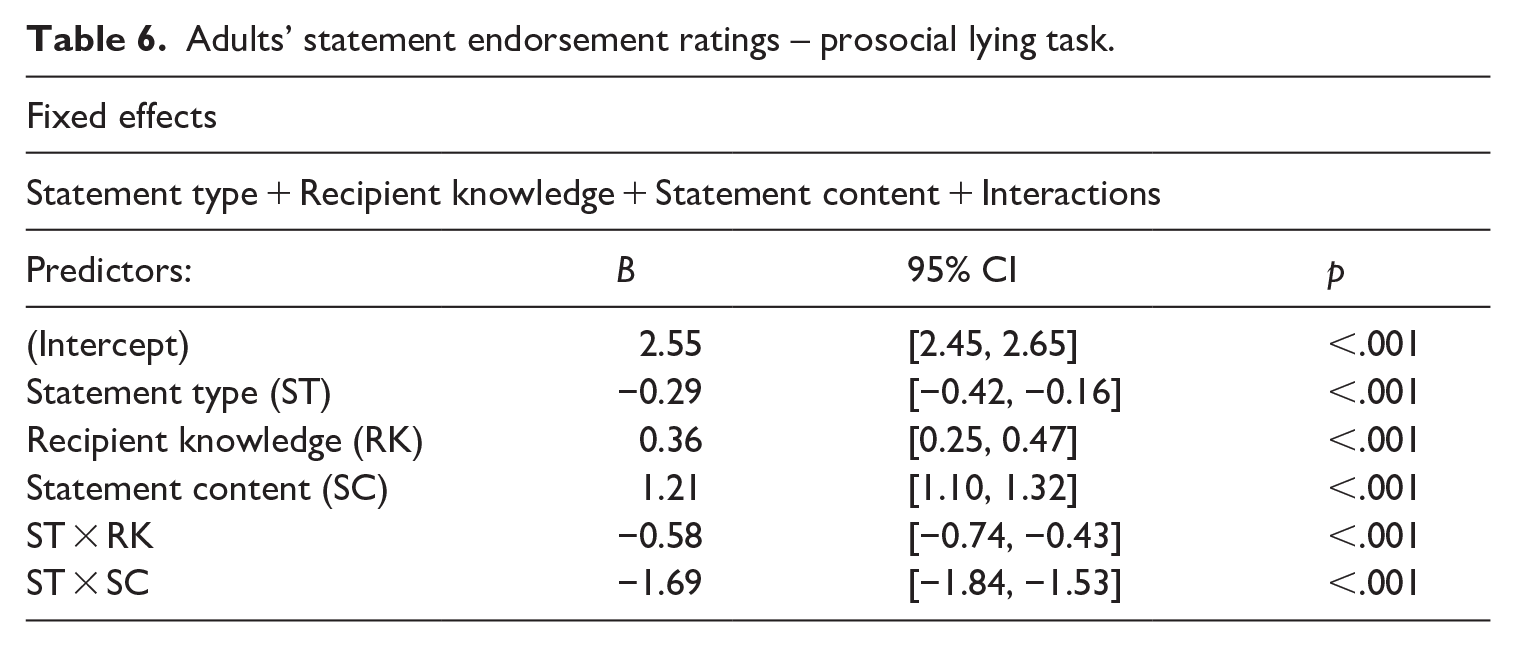
Interaction (1) was probed by examining post hoc pairwise comparisons, showing that, similar to children, in both knowledge conditions, adults were more likely to indicate they would make a truthful statement (ignorant: M = 3.16, SE = 0.04; knowledgeable: M = 3.51, SE = 0.04) than tell a lie (ignorant: M = 2.02, SE = 0.04, t(1521) = 20.41, p < .001; knowledgeable: M = 1.80, SE = 0.04, t(1521) = 30.88, p < .001). However, differing from children, when the recipient was knowledgeable (vs. ignorant) of the negative event, adults reported a greater likelihood of telling the truth (t(1521) = 6.42, p < .001), but were more likely to endorse telling a lie when the recipient was ignorant (vs. knowledgeable) of the event (t(1521) = 4.04, p < .001).
Interaction (2) was also probed using post hoc pairwise comparisons (across knowledge conditions), showing that for both statement content conditions, participants reported a higher likelihood in making a truthful statement (opinion: M = 2.73, SE = 0.04; reality: M = 3.94, SE = 0.04) than a lie (opinion: M = 2.15, SE = 0.04, t(1521) = 10.47, p < .001; reality: M = 1.67, SE = 0.04, t(1521) = 40.81, p < .001). When considering the truth, participants indicated they were more likely to refer to reality than an opinion (t(1521) = 21.73, p < .001); in contrast, for prosocial lies, participants indicated they would be more likely to tell an opinion lie than a reality lie (t(1521) = 8.61, p < .001).
Thus, after a negative event, adults indicated that they would be more likely to tell the truth than a lie, but they reported being more likely to use a prosocial lie when the recipient was unaware (vs. aware) of the negative event – and they indicated they would be more likely to tell the truth when the recipient was knowledgeable (vs. unaware) of the negative event. In addition, adults indicated that they would more likely tell the truth about reality, but lie about their opinion.
Role of empathy
We fit the second model with the conditions, cognitive/affective empathy, and their interactions. To determine which covariates to include in this second model, we first analyzed the covariates individually and found a significant two-way interaction of statement type and gender (B = 0.31, 95% CI [0.07, 0.55], p = .011), such that while both genders indicated they were more likely make a truthful statement (men: M = 3.59, SE = 0.08; women: M = 3.28, SE = 0.04) than a prosocial lie (men: M = 1.90, SE = 0.08, t(1524) = 14.99, p < .001; women: M = 1.91, SD = 0.04, t(1524) = 27.00, p < .001), men indicated a higher likelihood of telling truths than women (t(612) = 3.22, p = .001), with no gender difference in the endorsement of lies (t(612) = 0.09, p = .93). As well, there was a significant two-way interaction of statement type and ToM (B = −0.20, 95% CI [−0.29, −0.11], p < .001), such that higher ToM was negatively associated with likelihood of using prosocial lies (b = −0.19, p < .01), and this association was not seen for truthful statements (b = 0.01, p = .68). Adults were overall more likely to endorse truthful statements than prosocial lies, across all levels of ToM (-1SD: t = 18.78, p < .01; +1SD: t = 24.92, p < .01). However, as noted, as ToM increases, adults are less likely to endorse using prosocial lies.
Cognitive empathy
The model included the covariates, conditions, cognitive empathy, and their interactions. It showed that the four-way (p = .882) and three-way (ps = .291) interaction terms were nonsignificant. When these terms were trimmed, the model showed a significant two-way interaction of cognitive empathy and statement type (B = 0.10, 95% CI [0.02, 0.17], p = .014). The interaction was probed by simple slopes analyses, which revealed a marginal negative association between cognitive empathy and truths (b = −.06, p = .07), but not for prosocial lies (Figure 2). Adults were more likely to endorse truthful statements than prosocial lies at all levels of cognitive empathy (-1SD: t = 27.67, p < .001; +1SD: t = 24.18, p < .001). And, as noted above as cognitive empathy increases, adults are marginally less likely to endorse using truths.
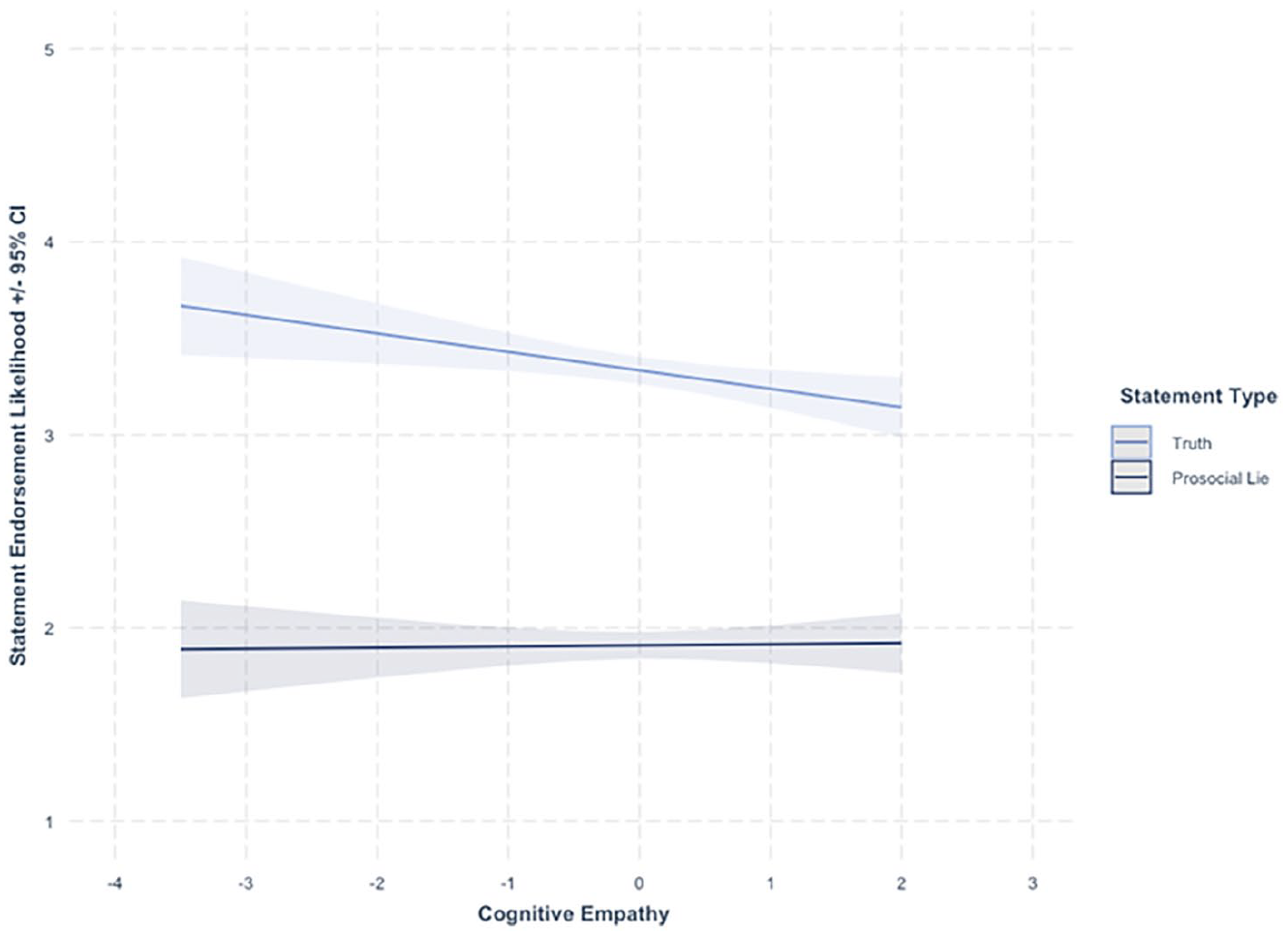
Adults’ endorsement ratings as a function of cognitive empathy and statement type.
Affective empathy
The model included the covariates, conditions, affective empathy, and their interactions. The four-way (p = .783) interaction term was not statistically significant; when trimmed, there was a significant three-way interaction of affective empathy, statement type, and statement content (B = −0.21, 95% CI [−0.37, −0.05], p = .009). To better understand this interaction, truths and lies were analyzed separately.
For truthful statements, there was a significant two-way interaction of affective empathy and statement content (B = 0.18, 95% CI [0.09, 0.27], p < .001). As shown in Figure 3a, higher affective empathy was associated with lower likelihood of telling an opinion-related truth (b = −0.16, p < .01); this pattern was not seen for reality-related truths (p = .75)
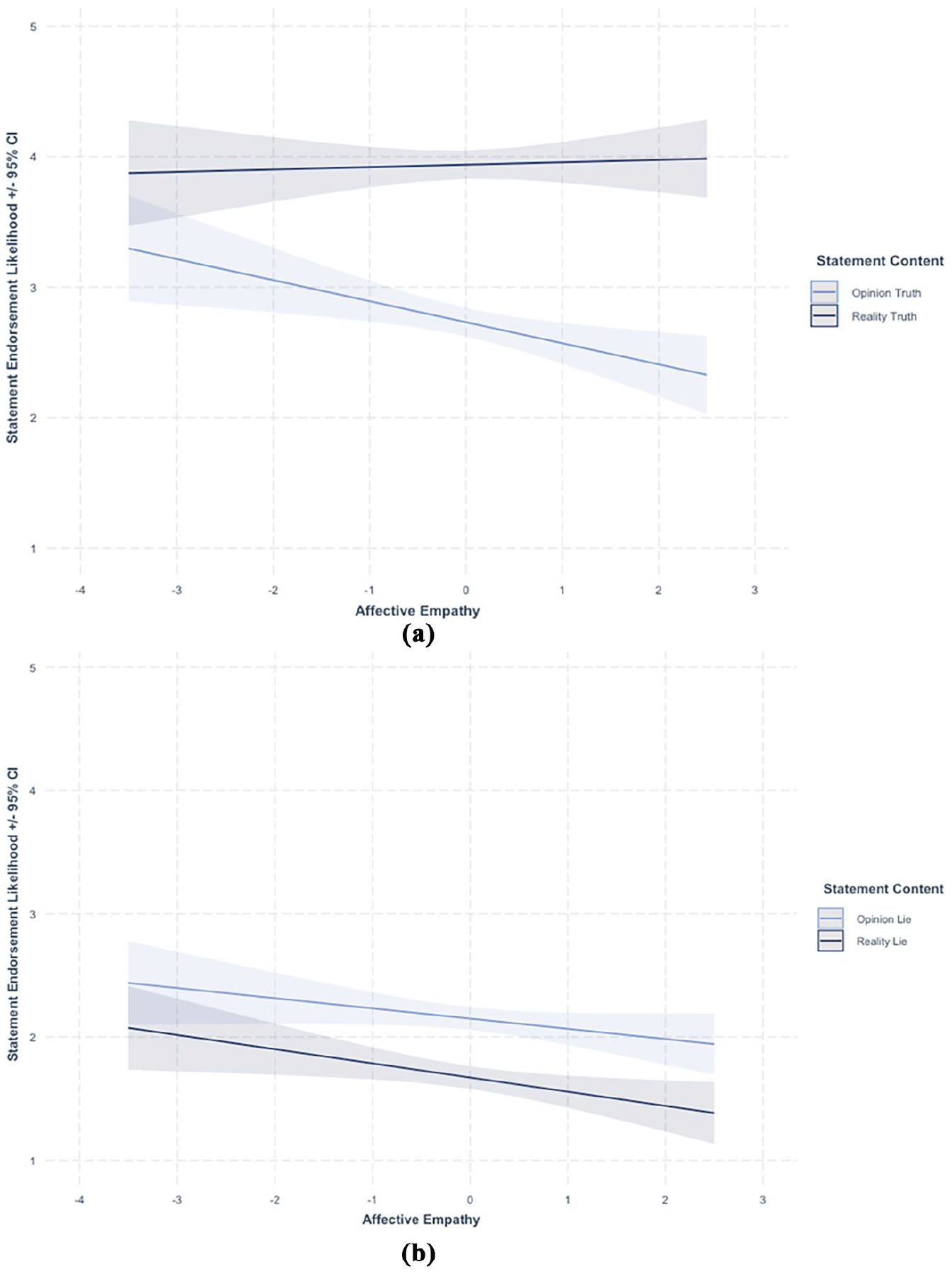
Adult endorsement ratings as a function of affective empathy and statement content.
For prosocial lies, the two-way interaction term of affective empathy and statement content was found to be nonsignificant (p = .339). When removed, the model showed a significant main effect of affective empathy (B = −0.10, 95% CI [−0.19, −0.01], p = .027), indicating that participants with greater affective empathy were less likely to endorse telling a prosocial lie (Figure 3b).
Together, results suggest that adults’ empathy relates to their communicative choices in a context involving a negative event: with greater cognitive empathy they are less likely to tell the truth; with greater affective empathy, they are less likely to make truthful statements about their opinion, and less likely to use prosocial lies generally.
Unrelated statements
Adults were more likely to endorse saying an unrelated statement when a recipient was ignorant of the negative event (t(217) = 3.87, p < .001) versus knowledgeable (Table 7). Unrelated statements were reported as less likely to be used than truths (reality: ps < .001), and more likely to be used than lies (ps < .001). Neither cognitive nor affective empathy was related to the endorsement of unrelated statements (ps > .100).
Adults’ endorsement of different statement types on the prosocial lying task.
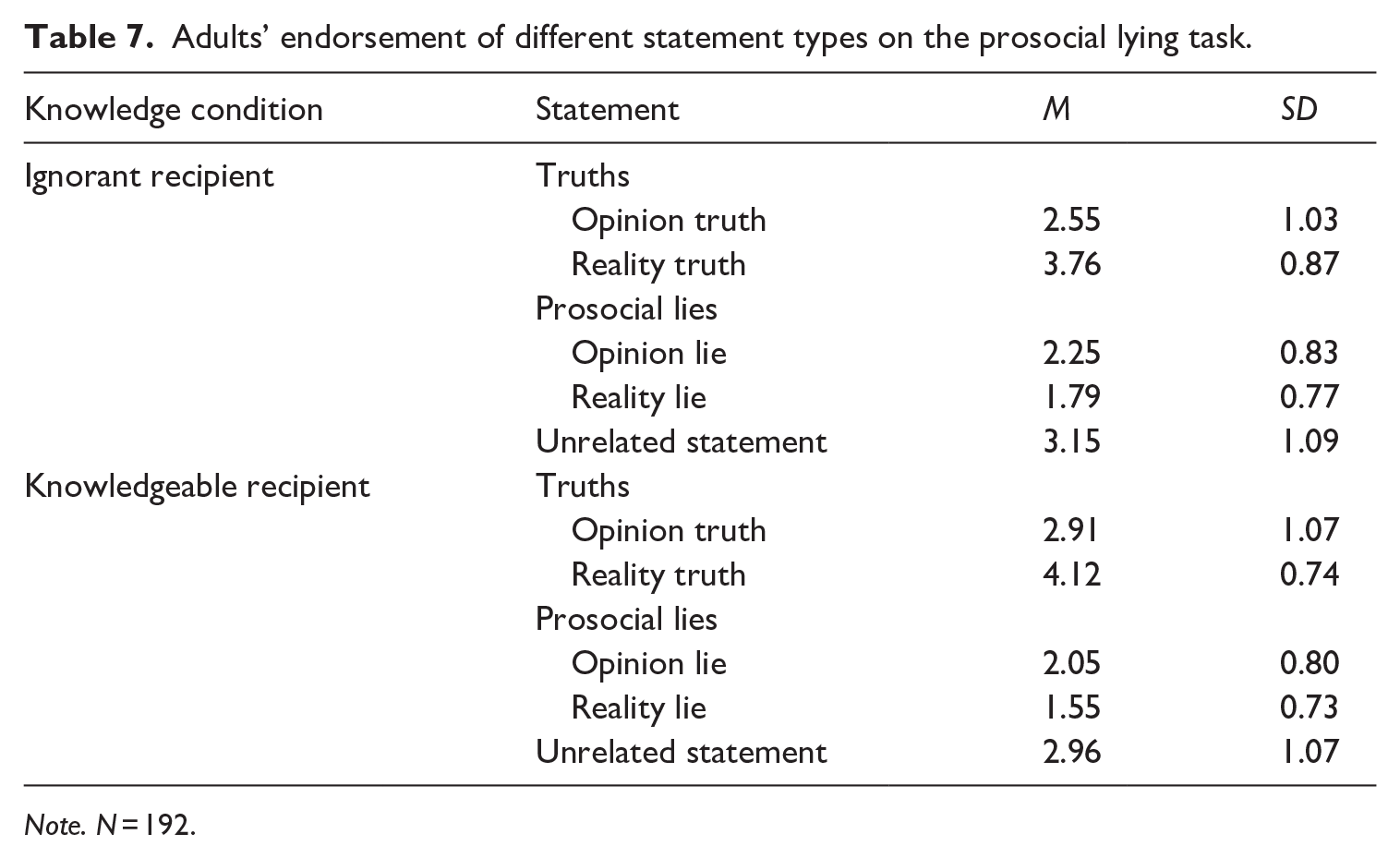
Note. N = 192.
Discussion
To understand how children navigate between honesty and lies, it is important to consider the individual and contextual factors influencing their communicative decisions. We asked children (and adults) to imagine themselves within social interactions in which a negative event occurred with the other person’s knowledge of the event, as well as the specific content of their options for truth or lies, differing. In addition, we asked children about their levels of empathy to explore how this characteristic relates to their sensitivity to contextual cues when deciding to tell a prosocial lie, given empathy’s role in prosocial behavior (e.g., Eisenberg & Fabes, 1990; Nagar et al., 2020). While the overall rates of endorsement should not be considered reflective of how often children/young adults lie or tell the truth generally (given that such rates are highly dependent on our methodology), comparisons across conditions provide information about how contextual factors and individual characteristics relate endorsement of prosocial lies.
On the prosocial lying task, unlike the adults, who showed greater endorsement of a prosocial lie when a recipient was unaware of the situation and telling a truthful statement when a recipient was knowledgeable, children did not use recipient knowledge to guide their decisions. That is, children’s rating of using a prosocial lie was comparable whether the recipient was aware or unaware of the true state of affairs. Although it is plausible that children did not attend to the recipient’s knowledge within the scenarios, past work has shown that they are sensitive to knowledge context in other studies that utilize social vignettes (e.g., Nilsen et al., 2011; Sullivan et al., 1995; Winner & Leekam, 1991). Thus, it seems that recipient’s knowledge is not a strong cue guiding their endorsements of prosocial lies. Children’s overall endorsement of lies was low (showing less endorsement than truth-telling, consistent with previous work, e.g., Broomfield et al., 2002). Thus, results should be interpreted in the context of lower lie endorsement generally, that is, both when it could deceive (i.e., ignorant recipient), and when recipient is aware of the situation. It is possible that the motivations to lie versus tell the truth may differ across knowledge conditions – for example, to make someone think something different from reality versus to convey a caring gesture. Thus, future work should include open-ended questions for children to provide rationales for their choices.
In addition to contributing to the prosocial literature, findings add to the literature on children’s attention to others’ knowledge states within communicative contexts. Specifically, preschool-age children show sensitivity to what speakers know (Bohn & Köymen, 2018; Graham et al., 2017, San Juan et al., 2015), drawing on this information at early stages in sentence processing (Nadig & Sedivy, 2002). Moreover, children use information about recipients’ knowledge to determine when a statement may be ambiguous for the recipient (Nilsen & Graham, 2012) as well as whether the recipient would interpret a statement in a literal or counterfactual way (Nilsen et al., 2011). Preschool-age children provide more information to listeners who have less knowledge (e.g., Nilsen & Graham, 2009; Nilsen & Mangal, 2011; O’Neill, 1996). Given this impressive sensitivity in other communicative contexts, it is interesting to consider why in this situation, listener knowledge did not play a role. One possibility is that children make use of conversational partner knowledge when it is directly relevant to the communicative goals. For instance, in referential communication contexts, understanding what a listener knows is crucial to meeting the goal of unambiguously identifying a referent. However, when considering prosocial lies, with the goal to make a recipient feel better (Warneken & Orlins, 2015), children may not perceive that success hinges on listener ignorance.
Turning to statement content, children were more likely to endorse truths about reality (vs. opinion), but for lies, they were more likely to endorse offering an opinion versus a statement of reality. Cheung et al. (2015) find that children/adults rated reality truths more positively than opinion truths, and opinion lies more positively than reality lies (the ‘content effect’). These researchers suggest that lies about reality carry the most moral weight since they acknowledge an objective world, whereas lies about one’s opinion carry less moral weight as they only acknowledge the speaker’s personal thought. Thus, in our work children may have indicated they would use an opinion lie more than a reality lie because they felt it was more acceptable. In addition, children’s greater endorsement of using lies about their opinion versus reality may reflect a sensitivity to how discoverable the lie is (i.e., it is more difficult to identify/catch an opinion lie [e.g., I like this trampoline] than a reality lie [e.g., This trampoline bounces]). In sum, past findings demonstrate that children perceive prosocial lies to differ in their levels of acceptability based on content (Cheung et al., 2015), and current findings demonstrate that such content effects impact their communicative decisions. The same pattern of results was found for adults, suggesting that the lie content effect, demonstrated here for varying endorsement of prosocial lies, is present from school-age onwards through development.
Unrelated statements
Adults’, but not children’s, endorsement of unrelated statements varied by recipient knowledge. Carson (2016) suggests that people use evasive language to avoid consequences that may be associated with either truths or lies. That is, an unrelated statement may be used to protect the recipient, the speaker, and/or their relationship (Afifi & Guerrero, 2000; Carson, 2016). Here, we show that adults use this strategy more with ignorant recipients, potentially because this communicative strategy would seem obviously evasive if the recipient was knowledgeable.
Individual characteristics associated with communicative choices
Contrary to our hypothesis that greater empathy would relate to more endorsement of lies, particularly for an ignorant recipient, children’s empathy was not related to their ratings. While consistent with Demedardi et al. (2021), an association may not have emerged as our paradigm did not ‘activate’ empathy in the same way past work has. For instance, Nagar et al. (2020) used a first-person task and provided information about the lie recipient, such as distress. Given that children tell prosocial lies to improve others’ feelings (Warneken & Orlins, 2015), having children interact with a distressed confederate may activate their own distress, and thus facilitates a response to alleviate the confederate’s negative emotions.
Within the adult sample, empathy was associated with their endorsement of statements: higher cognitive empathy was associated with lower endorsement of truths; higher affective empathy was associated with less endorsement of opinion truths. This reduced endorsement of truths suggests that adults with greater empathy are adhering to the adage, ‘if you can’t say something nice, don’t say nothing at all’. (Hand, 1942). However, we also found that greater affective empathy was associated with less endorsement of prosocial lies. Thus, the nature of our task wherein lies in both knowledge conditions would be known or possibility discovered, may have contributed to the findings.
The pattern of covariate findings is consistent with this latter notion. Children whose first language was English, were older, and had higher ToM scores, were more likely to endorse the truth and less likely to endorse using a prosocial lie. These patterns that diverge from past work (e.g., Lee & Imuta, 2021; Sai et al., 2021; Talwar & Crossman, 2011), but likely emerged because our scenarios involved events that were either known to the recipient (knowledgeable condition) or could be easily discoverable as they related to performance of an object (ignorant condition). Thus, prosocial lying may not be deemed as appropriate as is the case in other lie paradigms, with older children (and adults) with greater ToM showing more sensitivity to this context.
Limitations
Despite novel findings, several limitations should be noted. In terms of methodology, participants may have had difficulty imagining themselves within the scenarios and the specific choices may not have fit with their own communicative style. Thus, it would be useful to further examine the role of recipient knowledge using a behavioral task (e.g., Nagar et al., 2020). In addition, in the current study, the lies were about objects external to the recipient, because we needed to manipulate the recipient’s knowledge. This differs from previous work on prosocial lies, which has tended to focus more on lies that are more personal (e.g., about recipient attributes, a gift they chose; Broomfield et al., 2002; Talwar & Lee, 2002b; Warneken & Orlins, 2015). As such, these prosocial lies may hold different meanings.
Conclusion
Children showed a similar (low) rate of endorsing prosocial lies regardless of whether a recipient was aware or not of the negative situation, unlike adults who used recipient knowledge to guide endorsement of lies. When choosing to tell a prosocial lie, children were more likely to endorse a lie about their subjective opinion than the reality of a negative event, likely because such lies are viewed as more morally acceptable. Both children and adults with greater ToM were less likely to endorse prosocial lies, potentially because of greater sensitivity to recipients’ ability to discover the lies. Adults’, but not children’s empathy was related to their endorsement of communicative decisions, with greater cognitive and affective empathy generally relating to lower endorsement of truths (particularly opinion truths), as well as fewer prosocial lies. Together this work highlights the interplay between contextual and individual factors for communicative decision-making.
Footnotes
Acknowledgements
We would like to thank Kate Van Kessel and Navya Roby for assistance with data collection, Janel Silva-Grande for assistance with data organization, Judy Bueckert for comic creation, and Konstantyn Sharpinski for statistical consultation.
Author contributions
Data availability statement
Data will be provided on reasonable request of corresponding author.
Funding
The author(s) disclosed receipt of the following financial support for the research, authorship, and/or publication of this article: This research was supported by a Social Sciences and Humanities Research Council (SSHRC) Insight Grant awarded to E.N.
Ethics approval statement
This research was approved by the University of Waterloo Research Ethics Board, where the study was conducted. Informed consent was provided by all participating parents/caregivers.
