




Abstract
Children’s oral language skills at the earliest stages of education are known to determine their success at school later on. Improving oral language skills is achievable through targeted intervention, and drama can be an effective intervention medium, but its potential has not been extensively evaluated to date. The present study piloted an eight-week drama-based intervention designed to improve young children’s skills in English. Forty-one children in Years 1–3 (between 6 and 8 years old) took part. Of these, 21 (12 of whom had English as an Additional Language) completed the intervention (12 followed a movement-based approach and 9 followed a text-based approach), while 20 acted as a control group. Quantitative data (i.e., oral language assessments administered before and after the intervention) and qualitative data (i.e., interviews held before and after the intervention and observations held during the drama workshops) were collected. No significant differences in oral language measures were found between the two intervention groups or between the intervention group and the control group at the end of the intervention. However, the qualitative measures suggested that the workshops were enjoyable and helped children develop their confidence, self-expression and leadership skills. As these communication skills can facilitate the development of oral language, we suggest that future research should explore the effects of drama on their development.
Introduction
Oral language refers to the linguistic skills needed in the context of understanding and producing spoken discourse. It is a multifaceted construct that comprises a constellation of skills, including grammar knowledge, receptive vocabulary, productive vocabulary, expressive language (e.g., the informational content in a narrative) and listening comprehension (Haley et al., 2017).
Children’s oral language skills at the earliest stages of education are known to determine their success at learning to read later on (Murphy et al., 2019). This idea is underpinned by theoretical frameworks such as the Simple View of Reading (Gough & Tunmer, 1986), which suggests that reading comprehension is achieved through the combination of decoding skills and oral language. Given the role that reading comprehension plays in school attainment, children who enter school with poor oral language skills are at risk of underachievement.
This issue is pressing in the case of many children with English as an Additional Language (EAL). Results from national tests reveal an achievement gap between EAL learners and their monolingual English peers at the early stages of schooling in the UK (Strand et al., 2015). It is also known that oral language skills tend to have a greater impact on EAL pupils’ academic performance and social integration relative to English monolingual peers (Whiteside et al., 2017), and recent evaluations suggest that EAL children’s oral language skills suffered more than their monolingual peers’ as a result of COVID-19 and the disruptions/changes it brought about (Tracey et al., 2022). These observations suggest that there is a need to provide support for those EAL learners with weaker language and communication skills to develop their early oral language skills.
Oral Language in Children with EAL
The term ‘EAL’ does not denote a homogenous group. Children with EAL differ with regards to their cumulative exposure to English (Murphy, 2014). As such, EAL learners also have different levels of proficiency in English. ‘EAL’ also aggregates numerous ethnic backgrounds, which often vary in terms of attainment (Demie, 2018).
Despite the diverse nature of the group, many children with EAL consistently lag behind their English monolingual peers in terms of oral language and general communication skills (Paradis & Jia, 2017). While the difference between EAL and English monolingual pupils is first noted at preschool, it persists even after the beginning of formal schooling (Murphy et al., 2019). Many EAL learners often struggle with two key aspects of oral language in particular: verbal comprehension (e.g., McKendry & Murphy, 2011) and vocabulary knowledge (e.g., Mahon & Crutchley, 2006). These areas are not challenging just for some EAL learners: bilingual learners in general tend to have smaller vocabularies in their second language (L2) relative to their monolingual counterparts (e.g., Byers-Heinlein et al., 2024; Cote & Bornstein, 2014).
Improving oral language in EAL and non-EAL learners alike is achievable through targeted intervention programmes (e.g., Dixon et al., 2020; Fricke et al., 2017; West et al., 2024). However, the multifaceted nature of oral language makes it difficult to target in a holistic fashion during an intervention: most interventions aim to support specific aspects, such as learners’ comprehension of vocabulary, articulation of ideas, or spoken expression. The present study is no exception: while we appreciate the limitations of our approach, we operationalise oral language as vocabulary knowledge.
The Potential of Drama
Theatre can be a suitable medium for developing oral language and communication, as it makes use of a wide range of relevant (linguistic, as well as social and cognitive) skills and has the potential to develop these skills further (Winston, 2022). Moreover, drama activities can be integrated into school curricula with ease (e.g., in the form of after-school clubs or during standard lessons). It is not surprising, therefore, that some teachers already use drama activities in their classrooms, and there are numerous available resources (for an overview, see Belliveau & Kim, 2013).
However, the number of studies exploring the potential of drama for improving young children’s L2 oral language and communication skills appears to be scarce. The few studies conducted on the topic report positive results. For example, engaging in drama-based activities has been shown to develop children’s vocabulary, although the lexical gains are not always statistically significant (e.g., Stanat et al., 2012). Some studies also found psychological improvements, such as an increase in language learning motivation, a decrease in language learning anxiety and better attitudes towards language learning (e.g., McDonnell & O’Boyle, 2021). Wager et al (2009) also identified some social benefits of participating in drama activities, including the development of intercultural understanding and the development of a community among pupils. Since higher motivation, lower anxiety and better attitudes can facilitate and sustain language learning (Taylor & Marsden, 2014), these psychological and social dimensions are worth exploring further.
It should be noted that many of the studies on the topic are qualitative and while making important contributions in their own right, the strength of their observed effects cannot be quantified. Quantification is useful for evaluating how effective a particular pedagogical approach is at supporting learning. Nevertheless, quantitative studies can also be problematic: Lee et al’s (2015) meta-analysis, which examined the impact of drama on children’s educational outcomes, reported that most of the quasi-experimental investigations on the topic involved methodological limitations (such as the lack of a control group) and reporting omissions (including in relation to key intervention variables) that prevented conducting an accurate investigation regarding the effectiveness of drama as a pedagogical approach.
Another issue with the available literature is that most studies conducted on the topic target foreign language learners. As foreign language learning takes place in a different context and involves different methods than the learning of English by EAL learners (who live in English-speaking countries), the effects of drama might differ in this group. To date, no studies appear to have studied the use of drama for improving oral language and communication skills in this population. We argue that, given its versatile and engaging nature, drama can be a particularly useful intervention tool for developing young EAL learners’ vocabulary.
The Present Study
Spurred by the dearth of research on the topic, we aimed to design, pilot and evaluate the potential of a drama-based intervention for developing the oral language and communication skills of primary school children with and without EAL. The design of the intervention was co-produced with language teachers and drama facilitators, as we wanted the end product to meet their needs. To this end, we organised a workshop during which we outlined the common practices and existing evidence and asked stakeholders (one researcher, one facilitator and four teachers) to share their thoughts on practical matters, including how to deliver the intervention and what kinds of words to teach (e.g., specific or general vocabulary). Taking their views into consideration, the intervention we then designed consisted of specified activities that were not curriculum-based and did not involve pre-specified vocabulary but could be adapted to suit the needs of diverse classrooms/learners.
Due to the initial high numbers of children signing up and the fact that drama facilitators advised that workshops with more than 20 participants per group would be difficult to accommodate, we divided the intervention group into two: a text-based group (Group A) and a movement-based group (Group B). Having two intervention groups allowed us to compare two different programmes of activities and their impact, relative to a control group that did not take part in the intervention. Having two groups also allowed us to create more activities as part of the project. Thus, we aimed to answer the following questions:
(1) Can an eight-week drama-based intervention lead to improvements in children’s oral language and communication skills?
(a) Are text-based drama activities more effective than movement-based drama activities in developing children’s oral language? (b) Do children with EAL benefit from the intervention?
(2) What are children’s perceptions about the intervention?
Methods
Participants
We did not calculate the sample size a priori, as this was a pilot study exploring the effectiveness of an intervention approach that has not yet been investigated. However, we were interested in having a sufficient sample of students participating. To this end, upon receiving ethical approval for the project, we asked the school to advertise the drama club to all students who met the inclusion criteria (i.e., EAL and non-EAL pupils in Years 1, 2 and 3).
The promotion created substantial interest – with over 40 children who met the inclusion criteria signing up following an opt-in consent protocol. Despite the initial interest, most children who signed up did not show up and some even dropped out after the first workshop – highlighting that an intervention delivered as an after-school club might be subject to high attrition. This left a total of 21 children (N = 15 girls) in the intervention group: 9 were randomly placed in Group A and 12 in Group B. Most (N = 12) students who took part in the intervention spoke an additional language: Albanian (N = 2), Arabic (N = 1), Greek (N = 2), Lithuanian (N = 1), Malayam (N = 1), Polish (N = 1), Romanian (N = 2) and Urdu (N = 2). Each group had both EAL and non-EAL learners; this decision was made because children with different language backgrounds co-exist in most classrooms and having pupils with diverse characteristics in each group would allow us to gauge whether the activities worked in the target context.
To ascertain the effectiveness of the intervention and address the limitations of prior research, we also recruited a control group, consisting of children who did not take part in drama club. Thus, 20 children (N = 14 girls) in Years 1-3 who were involved with different clubs that the school ran at similar times (i.e., dancing or swimming) were selected following the administration of an opt-out consent protocol. The distribution of participants is presented in Table 1. 1
Age and EAL status of the participants.

There were no significant differences between the two intervention groups or between the intervention and the control group in terms of receptive vocabulary, productive vocabulary, or verbal fluency before the workshops started, suggesting similar levels of language proficiency at baseline. The participants’ scores are presented in Tables 2 and 3. It should be noted that for the receptive and, to some extent, the productive vocabulary measures, most children’s performance was already at the ceiling. The ceiling effects at baseline pose a potential problem for statistical analysis (see below) but indicate that the participants’ English proficiency was high.
Mean scores of the intervention and control group on the oral language measures at baseline and results of independent-sample t-tests comparing the groups’ scores.

Mean scores of the two intervention groups on the oral language measures at baseline and results of independent-sample t-tests comparing the groups’ scores.

Drama Workshops
As the intervention group was split in two, two different programmes of activities were designed in collaboration with a drama facilitator. To maximise intervention fidelity, the first author led Group B and the second author led Group A. Group A focused on the dramatisation of a fictional text, which was broken down into six parts, through a variety of language-based drama activities (e.g., story recapping and creative play). Group B followed a programme of movement-based drama activities based on abstract themes (e.g., natural elements or power dynamics) and did not involve the use of a text or language production. While the two groups adopted different approaches, some of the activities (e.g., warm-up and introduction) overlapped (see Appendix 1 for a scheme of work and Appendix 2 for a description of the activities). We ensured that both groups engaged in similar amounts of comprehension and production over the duration of the intervention.
Evaluation measures
As we were interested to find out whether drama is an effective tool for developing children’s oral language and communication skills, as well as what worked (and what could be improved) with regards to the intervention, we adopted a mixed-methods approach – combining quantitative measures (in the form of oral language assessments focusing, in particular, on vocabulary) and qualitative measures (in the form of observations and interviews). The quantitative measures were administered one week before the intervention (T1) and one week after the intervention (T2); the qualitative measures were administered either during the intervention (observation) or before and after the intervention (interviews).
Oral language assessments
Three general measures of oral language were assessed before and after the intervention: receptive vocabulary, productive vocabulary and verbal fluency. Receptive vocabulary was measured using the Pic-Lex (Alexiou, 2021). The Pic-Lex is a validated multiple-choice test with 100 items that can be completed using a tablet or laptop in about 10 minutes. Similar to other receptive vocabulary tests, the Pic-Lex requires children to select the picture that corresponds to the word they hear. Children were awarded one point for a correct answer and no points for incorrect answers.
Productive vocabulary was measured using a novel, child-appropriate adaptation of the Lex30 (Meara & Fitzpatrick, 2000) and the ‘Lex15’ (Liggins & Faitaki, 2024). This test comprised 15 items in total. Upon hearing each item, children had 30 seconds to produce up to four words that were ‘related’ to the item. Following the test guidelines, we awarded one point for each word outside the 1000 most frequent words. If a child produced four low-frequency words per item, they would have a total score of 60 (15 × 4).
We also assessed children’s phonological verbal fluency. We asked children to produce as many words as they could starting with a particular letter in 30 seconds. Following Lehtinen et al. (2023), three phonemic trials were included to provide a reliable measure of overall fluency while accommodating children’s smaller vocabularies and shorter attention spans. We chose the letters ‘P’, ‘S’ and ‘T’. 2 We awarded one point for every word produced in each trial, excluding imaginary words, repeated words and words beginning with different letters. The total score for the task was, therefore, the sum of the scores for the three trials. Note that, based on previous studies using phonological verbal fluency tasks (e.g., Riva et al., 2000), (monolingual) children aged between 6 and 8 seem to produce between 3 and 10 words per letter within 1 min (60 s), with the number of words produced increasing as a function of the children’s age.
Interviews
Two sets of semi-structured interviews were carried out to ascertain children’s perceptions of the intervention. This interview format was chosen to allow for a degree of structure but, also, to offer the researchers latitude to adjust the course of the conversation as needed by attending to the participants’ answers (or non-answers).
The questions of the initial interviews were designed to tap into how the students felt when they were talking to friends and in front of the whole class. The second set of interviews only involved the children who had attended at least four sessions of drama club (most of the participants had attended all eight sessions) (see Appendix 3 for a list of the interview questions). During this round, children were asked whether the drama club had helped them be more confident when talking with friends/in class, made speaking in English any easier, and facilitated the learning of new words. Moreover, we asked children to comment on what they liked the most/least about drama club as a whole, as well as about individual activities. Throughout the interview, we asked the children to justify their answers by sharing their individual experiences of the activities.
All interviews were conducted one-to-one after the pre- and post-tests by the same two researchers who were running the workshops. To limit bias in the second set of interviews (conducted after the intervention), the researcher-facilitator who had worked with Group A interviewed the children of Group B and vice versa. 3 All the interviews were held in English as the participants were proficient in English (see previous sections). 4 During the interviews, it was evident that all participants could both understand the interview prompts and articulate their answers without difficulties.
Observations
One independent observer sat with each intervention group in every workshop without participating in the action. 5 To facilitate the observation process while paying attention to each student, we asked observers to focus on five categories: non-verbal expression, interaction, verbal fluency, anxiety, leadership (i.e., demonstrating initiative in small group activities and being prominent in whole-group discussions) (see Appendix 4 for the observation template and the descriptors for each observation category). The categories were chosen based on previous literature that has found positive effects of drama on communication skills and affective factors (e.g., McDonnell & O’Boyle, 2021). Each category was ranked using a five-point Likert scale. On the scale, 1 stood for limited verbal expression, low interaction, low verbal fluency, high anxiety and limited leadership. If a student’s behaviour changed during the session, the observers were asked to indicate the change. Then, the average between the starting and ending points was calculated and used for this particular aspect.
In two random sessions, the workshop leaders also completed the observation template to establish interrater reliability. Cohen’s kappa was calculated for each group (same scores were marked as agreement between raters; different scores were marked as disagreement). It was found that the agreement between the raters was good for both Group A (κ = 0.83) and Group B (κ = 0.81), suggesting that the observations were reliable. The differences between the raters’ scores regarding a particular behavioural aspect in a single student tended to be small and were reconciled by using the mean score.
Findings
Quantitative Findings
The quantitative analyses aimed to address the first question of the present pilot study: whether the drama-based intervention was effective in developing children’s oral language skills (which would be evidenced by the children in the intervention group outperforming the children in the control group). We also conducted separate analyses for the two intervention groups (text-based vs. movement-based) and the two language groups (EAL vs. monolingual) to further explore the effects of the approach.
Intervention versus Control Comparisons
Table 4 presents the mean scores of the intervention and control groups on the three oral language measures that were administered at T2. A set of independent-sample t-tests revealed that the two groups’ scores were not significantly different from one another, suggesting no effects of participating in the workshops on receptive vocabulary, productive vocabulary, or verbal fluency. Moreover, as evidenced by a series of dependent-sample t-tests, there were no significant differences between the pre-test and post-test for either group in either measure (Table 5).
Mean scores of the intervention and control group on the oral language measures at T2 and results of independent-sample t-tests comparing the groups’ scores.

Results of dependent-sample t-tests comparing the performance of the intervention and control groups between T1 and T2 on the three oral language measures.

Group A versus Group B comparisons
Table 6 presents the mean scores of Group A and Group B on the three oral language measures at T2. The two groups’ scores were not significantly different, suggesting that the two intervention approaches had similar effects on children’s oral language. Moreover, the two groups’ scores on the three measures did not significantly change as a result of participating in the intervention (Table 7). 6
Mean scores of the two intervention groups on the oral language measures at T2 and results of independent-sample t-tests comparing the groups’ scores.

Results of dependent-sample t-tests comparing the performance of the two intervention groups between T1 and T2 on the three oral language measures.

EAL Children
We also wanted to explore whether children with EAL developed their oral language skills during the intervention. As visualised in Table 8, however, their scores on the three measures had not significantly changed as a result of participating in the drama club sessions.
Mean scores for EAL children on the oral language measures at T1 and T2 and results of dependent-sample t-test comparing the group’s scores at baseline and after the intervention.

Qualitative Findings
While the quantitative data shed light on the effectiveness of the drama intervention, the qualitative data was valuable for offering a better understanding of the impact that drama-based pedagogies have on oral language development and the ways in which they can be successfully implemented to benefit young learners – thus answering the second question of the pilot study. The data we collected was in the form of observation records and interviews, but the students’ responses during the interviews became the analytical focus. ‘Persistent patterns’ were drawn out in each form of data (Yin, 2014). With iterative readings of interview data, different categories of experiences came to light. We adopted a case study methodology (Stake, 1995), which allowed us to generate detailed, personal and contextualised data that could elucidate important developmental patterns or perspectives (Duff, 2012). The focal case was the intervention, but we also treated the two groups as sub-units and their individual participants where appropriate, as embedded case studies.
Case studies
Group A
From the beginning, Group A was enthusiastic about participating in the drama club. The odd occasion that the will to participate was low usually stemmed from an event that had occurred prior to the class or, on a few occasions, from a student being given a role that they did not choose during the book reading. On these occasions, the range of activities helped to rekindle students’ enthusiasm (see Appendix 5a for a vignette).
The group interacted well with the facilitator-researcher, who made sure to build a rapport with them via individualised comments, general praise for participation and repeating points back to show keen listening. The group quickly built up a strong sense of familiarity, which allowed students to speak in front of the group with ease. Shyness was rarely an issue and students were keen to showcase their presentations, feedback on their discussions and share their ideas. The activities were lively and short, which helped keep students’ attention.
The only session which consisted of a longer activity was the penultimate session which was dedicated to practicing for a semi-improvised performance in front of the other intervention group. While a longer activity could have proven difficult for the age group, the motivation to prepare a performance aided their concentration. The whole script was rehearsed as a group, with students waiting patiently as their classmates worked out their lines and helping each other when it was their turn to speak. 3.2.1.2. Group B. Members of Group B were also enthusiastic about participating in the drama club, and their willingness to engage in the activities was, for the most part, sustained throughout the intervention. The children had different linguistic abilities and confidence levels – with some being keen to share their ideas and doing so with ease, and others being unwilling and/or unable to communicate their thoughts. Members of this group also varied in terms of their attention spans: most were able to focus without an issue, but a few lost concentration quickly during the activities.
To navigate the children’s linguistic and behavioural profiles, short non-verbal activities were chosen. To ensure that children had an opportunity to hone their language and communication skills, the activities involved children working in pairs/groups before presenting their improvisations and sharing their thoughts about the activities in a circle. The most successful activities were chosen to form part of the showcase that was presented to the other group on the last week of the project. The activities were tied together through student-led devising.
Everyone interacted well with the facilitator-researcher and with each other. While most children did not know one another well, five children (who were some of the oldest, most fluent and confident children of the intervention group), often assumed a dominant role in most activities and discussions. This had interesting effects on the group dynamics – with some initially shy pupils being encouraged to take a more leading role (see Appendix 5b).
Interviews
After arranging ‘preliminary jottings’ of ideas for analytic consideration, we coded interview transcriptions using the ‘codes’ function in In NVivo. Similar experiences and responses were grouped together under themes, and categories were generated through a bottom-up reading.
Enjoyment
According to the data from the interviews, the participants enjoyed being a part of the project. Most students said they liked the workshops and would take part in the drama club again. When asked what they liked about drama club, most students gave concrete examples about how they were ‘fun’. ‘Fun’ was a frequently occurring word (as Figure 1 suggests) that came up 60 times during the interviews. Six students referred to a game called ‘Zip-Zap-Boing’, in which participants have to pass on or reflect back an imaginary ball of energy. Five responses were directly related to the final showcase. Other responses referred to the ‘Counting Game’, during which participants have to count to 10 one number at a time without more than one person saying the number each time. Some students also liked acting out a story; P10 said: ‘It’s fun acting, and maybe one time I’ll be an actor!’.
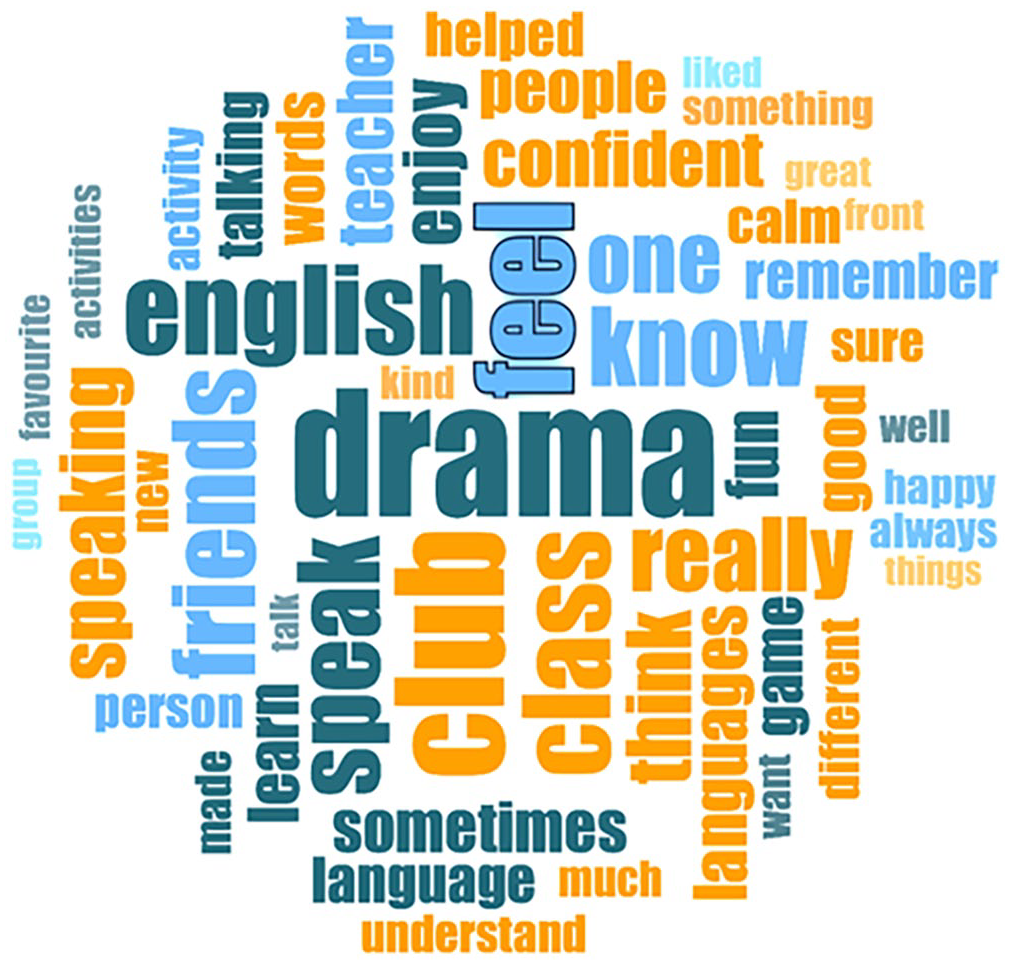
Word cloud featuring the most common words in the interviews.
When asked whether there was anything they disliked about the drama club, most students said they liked everything. For example, P21 said that the only thing she did not like was that ‘it had to end’. However, one student felt that the text Group A worked on was childish, and another said that she did not like the ‘Counting Game’ because of the disruption that some students in Group B caused when we played it. The disruption referred to two children who intentionally said each number at the same time, for the group to start counting from the beginning. However, most other children in the group found this interaction ‘funny’.
It is interesting to note that the majority of the group welcomed the freer nature of the activities, which differed drastically from the ones used at school. Indeed, a theme that appeared often and for different activities in the interviews was freedom of expression. Typical school activities do not afford as many opportunities for self-expression; thus, being able to do ‘silly things’ (P6) or ‘have powers’ (P43) could help students feel comfortable and develop their confidence.
Confidence
Students discussed whether drama club had helped them feel more confident when talking to friends. Most responded positively, with comments such as: ‘everyone in drama club is supportive’ (P10), ‘I actually have anxiety, so it kind of got me to speak up in front of people I don't know’ (P14), and ‘it helps me a lot to talk to other people that are new’ (P46).
Various references to the activities showed that at times participants were happy to have been challenged to get outside of their comfort zones. This was particularly evident in relation to the final showcase which was a new experience for most students (e.g., P5 said that he liked participating in the showcase ‘because in [his] old classes, [he] didn’t do that’).
Ten participants also mentioned that drama club had helped them feel more confident when talking in class. For instance, P21 was worried about speaking in class before the project, stating: ‘I feel like they are going to laugh at me’. After the project, she noticed a small improvement: ‘[. . .] some words are still hard for me to say. The words I didn't know helped me’. One student was able to describe substantial improvement in their classroom speaking abilities as a result of the project: ‘[. . .] recently we had to talk in front of the class about something. Before, I used to stammer a bit when I was talking like that, but the last time I did that I didn't’ (P40). The workshops appeared to be helpful even for students who were not worried about speaking before the project. For example, P46 explained that the workshops helped her become more sure of herself and not get ‘muddled up’ when she tries to communicate.
Language development
When asked whether drama club had made speaking English any easier, responses were a mix of agreement and students being surprised to be asked. Positive responses included comments like: ‘Yes. Because we learned words we probably didn't know how to pronounce. Then we could actually pronounce them’ (P41).
In response to whether any new words had been learned during the drama club, half of the children responded positively but found it hard to pinpoint particular items. Some children from Group A identified some words, such as ‘keen’ and ‘fragile’, which had been acquired through a game of adjective charades, or ‘stethoscope’, which had been learnt via acting out a character.
In terms of non-verbal language development, one response highlighted the ways in which the drama activities provoked thought on how to communicate non-verbally. The ‘Chair Game’ in which students, who had been assigned different levels of ‘power’, were competing to sit on a chair, required communicating via non-conventional means. P17 said: ‘[. . .] we weren't allowed to speak that much so that I had to try and show the people what I'm trying to say’.
The interviews highlighted that non-verbal activities can generate language on reflection. For instance, in response to whether they liked the ‘Elements’ activity (during which students had to transform, move and speak, like fire, water, earth and wind), students stated that: ‘[. . .] it was quiet and peaceful’ (P13) and ‘[. . .] it helps me calm and settle down’ (P46). Given the sophisticated words used and insightful ideas expressed in children’s responses, it could be argued that movement-based, abstract and emotive activities can give rise to appropriate and topic-specific language.
Language was also developed as a result of peer work. When asked what she liked most about the performance, P10 said: ‘helping a classmate’. The fellow participant she helped (P5) was younger and had less developed English language skills, so the two of them had been coupled up to perform one character. Peer support was welcomed by P5, and it also encouraged her to talk louder and enunciate better – perhaps being more effective than repeating after a teacher in the more traditional way would have been. This finding suggests that drama activities can encourage socialisation and help-seeking.
Observations
Based on the observation records, we were able to aggregate each intervention group’s scores per week and observe descriptive (rather than statistical) changes regarding the five aspects of behaviour we paid attention to: expression, interaction, verbal fluency, anxiety and leadership. We also produced mean scores of the five aspects for each group to note behavioural changes over time. As indicated in Figure 2, there was an increase in children’s overall workshop performance scores for both intervention groups. Looking at the individual graphs, three aspects can be seen to show some signs of development: expression, anxiety and leadership. For Group B (which followed a movement-based programme of activities), there also seemed to be an improvement in terms of verbal fluency. Interaction levels and habits did not drastically increase for either group (though they did not decrease either). These descriptive findings corroborate those obtained from the interviews with the participants – suggesting positive effects of drama on various communication skills.
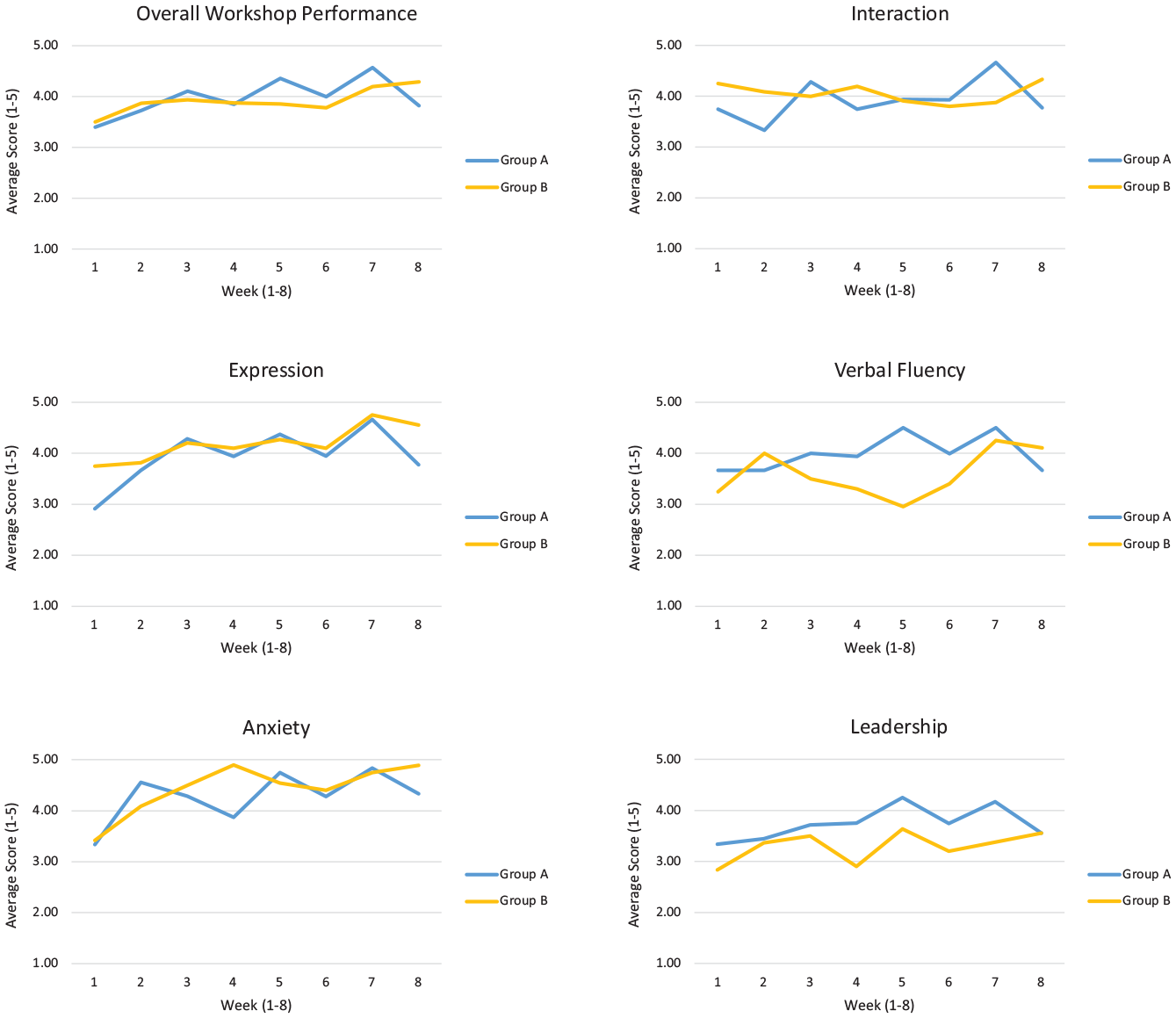
Observation scores for Group A (text-based) and Group B (movement-based) on overall workshop behaviour, as well as on individual factors (interaction, expression, fluency, anxiety, leadership).
Discussion
Oral language
In a nutshell, no significant differences in any of the three language measures were found between the intervention and the control group after the former participated in an after-school drama club for eight weeks. As such, we do not have evidence to support that drama has the potential to improve children’s oral language skills. It is important to highlight that this does not mean that drama does not have this potential: as discussed in the Introduction, drama is considered to be a useful pedagogical tool (Winston, 2022) and other studies have reported gains in children’s vocabulary as a result of drama-based teaching. The discrepancy between our findings and previous research could be that our study was underpowered to detect any significant effects. Moreover, the ceiling effects observed at baseline in the receptive vocabulary measure suggest that the participants’ English was at a high level before our workshops started – potentially leaving little room for improvement on this particular measure. It might be the case that drama-based activities are more beneficial for children with limited proficiency and with limited opportunities to experience/use the target language as they offer an interactional context that is conducive to developing children’s linguistic knowledge.
Nevertheless, not all studies focusing on foreign language learning through drama have found positive effects on oral language. Stanat et al. (2012), who have conducted the only randomised control trial on the effects of drama on primary school children’s vocabulary acquisition to date, found that an intensive summer theatre programme did not, in and of itself, allow participants to pick up vocabulary in their L2 German. Only when the theatre programme was coupled with explicit language tuition were lexical gains made and retained after the intervention had come to an end. It is crucial to emphasise that Stanat et al. (2012) did not report the negative effects of the drama-based intervention on children’s oral language: in other words, engaging in drama activities does not hurt young children’s vocabulary. This observation is echoed in our quantitative findings.
It is also worth noting that some of our participants did claim to have picked up new words or expressions during the workshops, although they were often not able to remember them. While we cannot exclude the possibility that these children’s answers were motivated by an attempt to please the interviewers (who were also the workshop leaders), it might also be the case that some incidental vocabulary learning took place. Both of the drama programmes we implemented involved repeated exposures to various words and expressions, which is known to facilitate incidental vocabulary learning: the text that Group A worked on involved the repetition of specific tropes, while the activities that Group B engaged in were revisited and expanded each week. As our vocabulary language measures did not specifically test the words that children were exposed to during the intervention, we were not able to detect any learning of words or expressions that were specific to the intervention programmes we delivered.
Communication skills
Promising findings emerged in relation to soft skills and psychological factors, as assessed through the observations and interviews. A notable development was that children’s anxiety was reduced. Indeed, the observation records suggested that, regardless of which intervention group they were part of, children became more relaxed during group work. During the interviews, children also spoke about the workshops having helped them feel more comfortable socialising inside and outside the classroom. Our findings are in line with Turgut.
Children's verbal and non-verbal expressiveness also appeared to increase as a result of attending the workshops. Our observation notes suggested that children became more eager to share their thoughts with the rest of the group during individual activities and whole-group discussions. Similar findings were reported by McDonnell and O’Boyle (2021). During the interviews, it was also discussed that the scope for self-expression that the activities allowed helped children develop their confidence. Since being confident and seeking out opportunities for social interaction is important for language learning, engaging in confidence-boosting drama activities might benefit students’ linguistic development (Wager et al., 2009).
A related finding from our study was that the children’s willingness to lead (e.g., in activities or discussions) appeared to increase. New dynamics emerged as the weeks passed – with some less proficient and/or less outspoken students taking the lead in peer work or showcase preparation. Taking initiative is important for socialisation as well as for learning, so drama activities that cultivate a sense of control and foster leadership abilities might have a role to play in the (language) classroom (McDonnell & O’Boyle, 2021; Wager et al., 2009).
It is important to highlight the connections between these skills and the development of oral language, particularly among EAL learners who are often adjusting not only to a new language but to a new cultural environment as well. Research has highlighted that improved confidence, alongside imagination and creativity, can aid oracy development (McAtamney, 2021). Confidence and empowerment have been shown to be key elements in developing self-expression (Bundy et al, 2015), and decreased levels of anxiety and an improved sense of agency have been seen to lead to improved oral fluency and quicker responses in turn-taking. These skills are also important socially, as they could facilitate peer socialisation, which could in turn improve school integration as well as academic performance. The fact that our qualitative findings highlight the learners’ growth over the course of the intervention as a function of these soft skills suggests that this is an avenue that merits further exploration.
Areas for consideration
Research suggests that, for an intervention to result in durable linguistic gains, the activities it involves should be related to the wider curriculum (Lee et al., 2015). In this study, we did not purposely relate the activities to the students’ lessons because we did not want to target specific words. This decision was motivated by the fact that the stakeholders we consulted recommended that we do not target specific words as these would not necessarily work across classrooms/learners. Focusing on general vocabulary also gave us the chance to design a wider range of activities. Despite our choice to avoid specific words being a conscious one, we acknowledge that if we had developed a targeted intervention and bespoke pre- and post-tests, we might have obtained significant (or at least clearer) quantitative results. We would welcome a replication of the study that follows a targeted approach.
Moreover, operationalising oral language as vocabulary knowledge and measuring it through (isolated) word tests might have prevented us from identifying other facets of oral language knowledge that participants could have been developing over the intervention. These include listening comprehension or the articulation of ideas. Based on the children’s interview responses and our observation records, we have some reason to suspect that these skills were developing. For instance, when asked if she learned any new words during the drama club, a participant replied that she learned the word ‘because’. We speculate that what she could have attempted to convey was that she had learned how to articulate her reasoning. We hope that future drama-based interventions adopt a broader conceptualisation of ‘oral language’ and use more measures to capture the complex learning that is taking place as children are engaged in drama activities.
Another change that would be worth exploring concerns the involvement of classroom teachers. Involving teachers in an intervention is known to contribute to its success (Lee et al., 2015). Of course, not all teachers are familiar with the medium of drama, and some might feel uncomfortable to use it in their classrooms in the absence of training (Winston, 2022). Thus, it is recommended that teachers become familiar with the activities and receive training on how to incorporate them into their lessons prior to the intervention.
Nevertheless, a caveat that should be considered is that the use of drama activities might not be fully compatible with the curriculum in its current form. This was evidenced by children seeing drama as an add-on to a normal school day rather than as something that could be integrated into school (e.g., one child said that he would not welcome drama activities in class, as he would then not be doing any work). However, some children suggested that it would be good for drama to be included ‘because then you could get physical while learning’ (P41). These issues should be explored further before an extended replication of this work goes ahead.
Conclusion
Our study aimed to design, pilot and evaluate an eight-week drama-based intervention using quantitative and qualitative measures. Given the small scope of this largely exploratory study, it is no surprise that our findings cannot provide conclusive evidence in favour of the effectiveness of drama for developing oral language. However, this pilot clearly demonstrated that a drama-based intervention can be willingly completed by stakeholders. We found that all children (EAL and non-EAL alike) were keen to take part in the workshops: they enjoyed themselves, while also noticing an improvement in their spoken language skills. This finding might seem small, but is very important: it is known that an intervention cannot be impactful if teachers and students do not want to engage with it, so the success of an intervention should be established in advance (Bowyer-Crane et al., 2019).
The pilot also showed that drama can lead to improvements with regards to communication skills (e.g., expressiveness) and affective factors (e.g., anxiety), which could be important for developing oral language. The question of whether drama can also be an effective tool for developing oral language in its own right remains. Based on the positive initial results of this substantive pilot, we are confident in calling for further, larger-scale and more robust studies that can provide a definitive answer to this question. In turn, answering this question could provide a research basis for the incorporation of drama-based activities in the curriculum, thus supporting practitioners’ favourable beliefs and current practices.
Supplemental Material
sj-docx-1-fla-10.1177_01427237251326982 – Supplemental material for Piloting a drama-based oral language intervention
Supplemental material, sj-docx-1-fla-10.1177_01427237251326982 for Piloting a drama-based oral language intervention by Faidra Faitaki, Sophie Liggins and Victoria A. Murphy in First Language
Footnotes
Acknowledgements
We are grateful to Madeleine Masters, Yu-Hsuan (Shani) Yang and Joyce Li for their valuable help during data collection. We would not have been able to design our stimulating drama workshops without the help of Emily Louizou (Collide Theatre) and the support of the stakeholders during the initial steering workshop. We would also like to extend our thanks to the staff and students who embraced the project and enthusiastically engaged in the drama club sessions.
Author contributions
Declaration of conflicting interests
The author(s) declared no potential conflicts of interest with respect to the research, authorship and/or publication of this article.
Funding
The author(s) disclosed receipt of the following financial support for the research, authorship and/or publication of this article: This work was supported by the John Fell Oxford University Press Research Fund [Grant Reference: 0012163].

Supplemental material
Supplemental material for this article is available online.
Notes
References
Supplementary Material
Please find the following supplemental material available below.
For Open Access articles published under a Creative Commons License, all supplemental material carries the same license as the article it is associated with.
For non-Open Access articles published, all supplemental material carries a non-exclusive license, and permission requests for re-use of supplemental material or any part of supplemental material shall be sent directly to the copyright owner as specified in the copyright notice associated with the article.
