




Abstract
Despite earlier claims that language abilities are intact in individuals with Williams syndrome (WS), many studies have shown that language development is often delayed and atypical, that is, it develops in line with different cognitive abilities compared to typically developing populations. It is unclear, however, whether general cognitive development predicts language comprehension in WS. The current study is the first to examine the development of grammatical comprehension in a large group (N = 58) of individuals with WS aged 5 to 21 years old. Grammatical comprehension is key to a person’s ability to understand what is being said and engage in successful social interaction. Using cross-sectional developmental trajectories, performance on the Test for the Reception of Grammar was shown to increase with chronological age and performance was predicted by vocabulary scores, but not non-verbal ability. In addition, there was no meaningful difference between items that contained spatial language and similar grammatical constructions that did not contain spatial language and performance on both types of expressions was similarly predicted by vocabulary scores. Overall, these results show that grammatical development in WS is delayed but not atypical in its relationship to vocabulary.
Introduction
Williams syndrome (WS) is a non-hereditary genetic syndrome caused by a microdeletion of around 26 genes on the long arm of Chromosome 7 (Osborne, 2012), with a prevalence estimated at 1 in 7,500 live births (Strømme et al., 2002). Historically, language abilities in WS have been characterised as ‘spared’ or ‘preserved’ (e.g. Bellugi et al., 1990, 2000) in the context of a developmentally delayed or impaired overall level of cognitive functioning (see, e.g. Karmiloff-Smith et al., 2003, for an overview) and in contrast to robust evidence for particular difficulties in visuo-spatial processing (Farran & Jarrold, 2003; Mervis et al., 2000). However, reviews of the literature (e.g. Brock, 2007; Kozel et al., 2021) indicate a more complex picture, with almost all areas of language developing atypically and performance levels in line or below those predicted by general mental age. Atypical language is evident even in early development, with toddlers with WS being delayed in early pre-linguistic skills such as referential pointing (Laing et al., 2002).
Language abilities do generally appear to be less impaired than visuo-spatial abilities in individuals with WS (Donnai & Karmiloff-Smith, 2000; Farran & Jarrold, 2003; Farran et al., 2024). However, although particular claims have been made about relative strengths in vocabulary knowledge in WS (Rossen et al., 1996), the use of more sensitive tests that use a developmental approach has cast doubt on such claims, with the level of lexicosemantic knowledge being consistently below that predicted by receptive vocabulary (Purser et al., 2011). Furthermore, the understanding of non-literal language including figurative expressions has also been shown to be an area of marked difficulty in WS (Lacroix et al., 2010; Van Herwegen et al., 2013), with studies suggesting many individuals with WS might meet the criteria for pragmatic language impairment (Hoffman et al., 2013; Laws & Bishop, 2004).
Grammar abilities include syntax, the rules of a language at a sentence level and how words combine, as well as morphology, the grammatical rules that apply to affixes, such as tense and number. Claims that grammar, especially production, is a relative strength for people with WS were made towards the end of the last century, not least by Bellugi (1988) and Bellugi et al. (1994, 2000), who argued that this linguistic proficiency, against a background of more general cognitive delay, constituted strong evidence for the independence of language and non-verbal cognition. Other proponents of the innate modularity view of language echoed these arguments (e.g. Clahsen & Almazan, 1998; Pinker, 1991). The evidence for these claims largely consisted of comparisons between the grammar proficiency of groups of individuals with WS and those of people with Down syndrome (Bellugi et al., 1994, 2000). However, people with Down syndrome have marked difficulties with grammar, such that apparent WS superiority in this area (see also Mervis et al., 2003; Vicari at al., 2004) likely reflected this fact rather than any particularly strong grammatical ability of the participants with WS. In support of this view, when compared with typically developing (TD) control participants or with participants who have neurodevelopmental conditions other than Down syndrome, grammar in WS is consistently found to be no better than that of the controls (see Mervis & Becerra, 2007, for a review).
Grammatical abilities in WS
Early grammatical abilities have been reported to develop in line with vocabulary knowledge and general mental age abilities in WS. For example, using the Words and Sentences Scale of the MacArthur-Bates Communicative Development Inventory (Fenson et al., 1993), it has been shown that young children with WS produced sentences that are comparable in complexity to TD children matched for overall mental age (Vicari et al., 2002) and that the complexity of the sentences produced related to the number of different words children used, which is similar to what is seen among TD children (Singer-Harris et al., 1997). However, grammar itself can be fractionated into component sub-areas and most basic grammatical structures tend to be in place by the age of 3 to 4 years in TD children (Levy & Eilam, 2013; Pinker, 1994). Many studies of WS involve individuals with mental ages higher than this and WS is associated with particular difficulties in more complex aspects of grammar.
Indeed, Grant et al. (2002) showed that a WS group with a mean age of 17 years was at the 5-year-old level on a task of imitating sentences that contained embedded relative clauses. Individuals with WS often simplified the sentence structure by omission of a verb or verb phrase, or an entire clause, despite the group having a mean receptive vocabulary mental age of almost 9 years. These results are consistent with earlier studies finding particular difficulty with embedded clauses in WS (Karmiloff-Smith et al., 1997; Volterra et al., 1996). Other studies have shown that various aspects of grammatical abilities are comparable to much younger TD children, including passives of actional/agentive verbs (Perovic & Wexler, 2007, 2010, 2018), wh-questions (Joffe & Varlokosta, 2007) and relative clauses (Zukowski, 2001), although Clahsen and Almazan (1998) have reported that children with WS correctly use complex syntactic structures and grammatical morphemes in a spontaneous production task, were able to accurately comprehend full passives, and were able to interpret correctly anaphoric and reflexive pronouns.
Potential predictors of grammatical development
Successful grammatical development relies on multiple cognitive domains, including vocabulary and overall reasoning abilities, with grammatical abilities in WS often at the expected level for their overall cognition (Mervis & Velleman, 2011; Stojanovik et al., 2018). However, it is generally found that individuals with WS have uneven cognitive profiles, with receptive vocabulary abilities developing at a faster rate than visuo-spatial abilities (Jarrold et al., 1998). It is currently not clear how these different developmental trajectories for receptive vocabulary and visuo-spatial abilities relate to grammatical development in WS and where the development of grammatical abilities falls within the cognitive profile of WS strengths (e.g. receptive vocabulary) and weaknesses (e.g. visuo-spatial abilities).
In addition to overall cognitive abilities, working memory and short-term memory abilities have been shown to be important for grammatical development in WS. Robinson et al. (2003) examined the receptive grammatical abilities scores of 39 children with WS (aged 4.5–16.7 years old) using the Test for the Reception of Grammar (TROG). In the TROG, participants hear a spoken sentence and have to select which of four pictures best matches the sentence. Robinson et al. examined the relationship between TROG scores and short-term memory, working memory, receptive vocabulary scores and scores from a non-word repetition task as well as chronological age (CA). They found that memory abilities significantly predicted TROG scores in children with WS but not in TD children and that receptive vocabulary scores mediated this relationship between memory abilities and receptive grammar abilities. However, phonological short-term memory contributed independently to grammatical ability even after receptive vocabulary was taken into account. Indeed, Thomas et al. (2001) have suggested that the acute auditory sensitivity and proficiency in phonological short-term memory, relative to other areas of ability, shown in early childhood by people with WS, may lead to a bias towards processing phonological over semantic features of spoken language. If so, then this contribution of phonological short-term memory to grammatical ability may reflect an atypical reliance on phonological information (accessed from memory) to derive grammatical meaning (Thomas & Karmiloff-Smith, 2003).
Further research has examined the interactions between memory, cognitive development and grammar acquisition in WS. Brock et al. (2005) demonstrated that individuals with WS frequently rely on strong verbal memory skills to compensate for structural grammar difficulties, suggesting a unique, memorisation-based approach to language processing. Similarly, Stojanovik et al. (2018) found that participants with WS may depend more heavily on familiarity (i.e. item-based processing) than grammaticality (rule-based processing) to learn grammatical structures. The individuals with WS seemed unable to learn an artificial language in the absence of prosodic cues which suggests that they are ‘stuck’ in the lowest part of the speech segmentation hierarchy (prosodic cues being the lowest ones used by young children, and lexical cues being the highest cues in the hierarchy preferred by TD older children and adults). Furthermore, Sederias et al. (2024) reported that individuals with WS may have a bias towards statistical properties of word combinations rather than grammatical rules; this means that they may rely more on holistically stored familiar phrases in language production, thus masking potential grammatical difficulties. Taken together, the above studies suggest that individuals with WS might benefit from interventions addressing underlying cognitive processes, such as working memory, alongside targeted grammar and vocabulary strategies to support more adaptive language use.
Seeing that individuals with WS tend to have poorer visuo-spatial cognition compared to language abilities (Jarrold et al., 1998), which is also reflected in grammatical structures, Phillips et al. (2004) examined whether spatial items included in TROG could explain some of the delay observed in grammatical comprehension abilities. Using a sample of 32 individuals with WS aged 8 to 38 years old, they showed that participants with WS showed relative difficulty on blocks that contained spatial language compared to those that did not. The score on spatial blocks did not relate to participants’ CA or receptive vocabulary scores, but there was a significant relation with non-verbal reasoning abilities. This shows that language and spatial cognitive abilities are not entirely separate and that spatial items present a particular difficulty for individuals with WS. This was further confirmed in a study by Farran et al. (2016), in which 24 individuals with WS aged 12 to 30 years old were found to be impaired on spatial category representations and scored at the level of 4- to 5-year-old TD children, while their receptive vocabulary scores were higher than 7-year-old TD children.
Stability over time
Although there is now some research into the grammatical abilities of individuals with WS, there has been a scant investigation into the development of grammatical comprehension: what trajectory does it follow relative to CA or mental age (overall or non-verbal mental age)? Thomas et al. (2001) showed that past-tense generation in individuals with WS was comparable to younger TD children and that deficits in irregular past-tense elicitation (which were also found by Clahsen and Almazan (1998, 2001) disappeared when verbal mental age was taken into account.
Vicari et al. (2004) compared the linguistic profile of two WS groups, one aged 8 years or less and one aged 12 years or more (up to 26.8 years old), each matched on CA to a group of participants with Down syndrome. The older group of individuals with WS performed better than the older group of individuals with Down syndrome on both receptive vocabulary and a phrase repetition production task that required accurate imitation of morphology and syntax. Such differences were not evident between the two younger groups and no meaningful group difference was evident in grammar comprehension for either age range. This pattern of results suggests that linguistic profiles change with age, presumably because of different trajectories for different linguistic abilities across different conditions. However, as there was no direct examination of how linguistic profiles change with age (either chronological or mental age), it is not clear what characterises any of these trajectories, including that for grammar comprehension.
Only one study (Perovic & Wexler, 2007) thus far has examined the development of complex grammatical structures by comparing young children with WS (aged 6–12) to older children with WS (aged 12–16). This study showed that the understanding of raised embedded grammatical structures is exceptionally delayed in both groups of individuals with WS. Yet again, this study used small sample sizes (n = 26), and thus, there is limited evidence of whether individuals with WS continue to improve on complex grammatical structures such as passive and embedded sentences over development.
Recent research on grammatical ability in individuals with WS continues to reveal complex developmental patterns in both receptive and expressive grammar. Farran et al. (2024) explored cross-sectional and longitudinal language development in WS, finding that while verbal skills in WS generally exceed non-verbal cognitive abilities, the progression in both vocabulary and grammar remains slower than in TD children. Complementing these findings, Kozel et al. (2021) reviewed evidence showing that while vocabulary often appears as a relative strength, grammatical comprehension and production lag significantly behind, especially in more complex structures. Stojanovik et al. (2018) explored artificial grammar learning in WS, showing that while individuals with WS can learn grammatical patterns, they often perform below controls due to possible deficits in working memory and lower non-verbal intelligence. These results underscore the importance of understanding verbal ability as a predictor of cognitive functioning over time in WS while highlighting variability in developmental trajectories.
The current study
The current evidence on grammatical development in WS is rather scant and unclear about whether the developmental trajectories of grammatical abilities are in line with their CA, delayed (in line with mental age abilities similar to TD children), or both delayed and atypical 1 (Thomas et al., 2009). Although current conclusions about development being typical, delayed or atypical in WS depend on the complexity of the grammatical construct as well as the type of control group used, most studies have failed to examine the development of grammatical abilities and those that have done so have included small sample sizes with participants of various ages or have not examined the development of grammatical abilities across a wide age range.
Grammatical comprehension in WS was measured using the TROG-2 (Bishop, 2003), a widely used measure of receptive grammar. As previous studies have found conflicting evidence as to which abilities predict TROG-2 scores and as these might relate to the age of the individual, a developmental approach is required to examine how grammatical abilities develop in individuals with WS. The current study fills this gap by analysing cross-sectional trajectories with the aim to examine: (a) How does performance on the TROG-2 in WS develop relative to CA, (b) Can variability in TROG-2 scores be explained by scores for receptive vocabulary and non-verbal ability? (c) As spatial items have been shown to be a specific weakness in WS, what does the development of TROG-2 performance look like for spatial items versus non-spatial items?
It was predicted that TROG-2 raw scores would increase with CA. It also was predicted that TROG-2 performance would increase in line with vocabulary comprehension and general cognitive abilities as has been shown in studies examining very early grammatical abilities in WS (Singer-Harris et al., 1997; Vicari et al., 2004), reflecting distinct contributions of vocabulary and cognitive abilities to grammatical development, rather than some domain-general factor. Finally, for the spatial versus non-spatial items, it was predicted that the rate of development of the comprehension of spatial items would be shallower compared to non-spatial items.
Methods
Participants
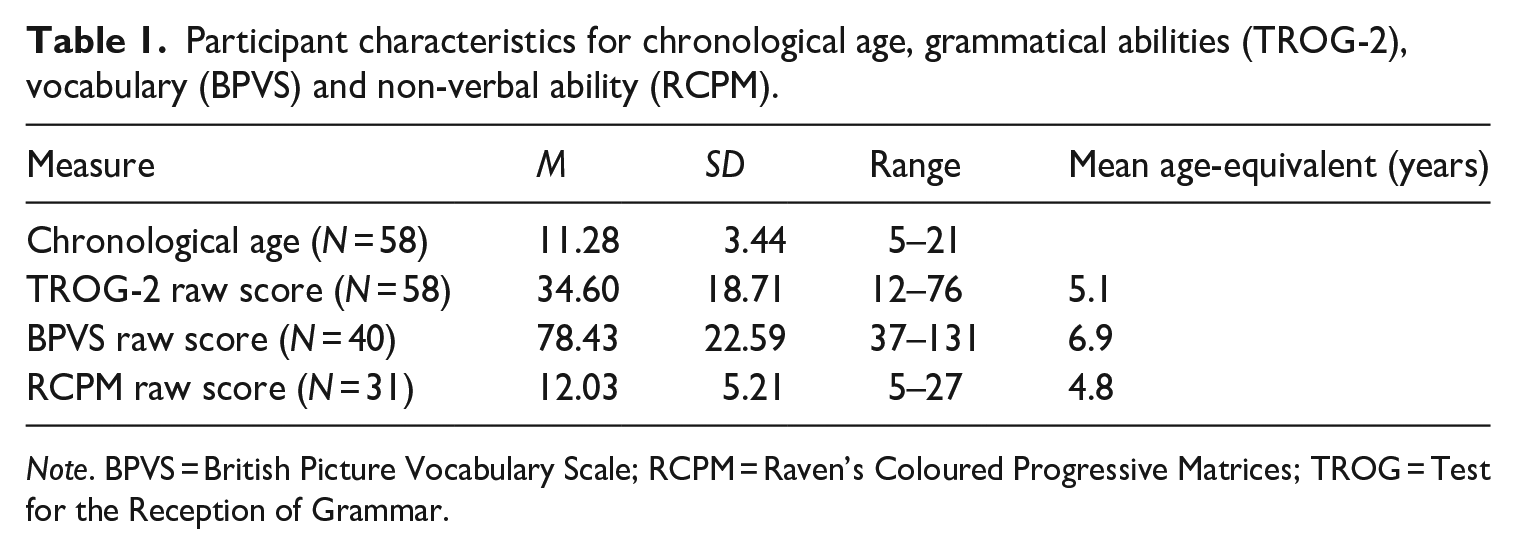
Participant characteristics are shown in Table 1. Data from 58 participants with WS were included from 5 different research labs across the South of the United Kingdom (https://blogs.ucl.ac.uk/wisdom), for whom TROG-2 data were available. Data are available on request at https://blogs.ucl.ac.uk/wisdom. Combining data from different labs allowed a greater sample size across a wide range to be included. However, not all labs collected data for vocabulary (N = 40) and non-verbal abilities (N = 31: see below). This meant that all three standardised test measures were available for only 13 participants, constraining the analytical approaches that could be taken. This was the result of pooling legacy data across labs before it was possible to put data harmonisation protocols in place.
Participant characteristics for chronological age, grammatical abilities (TROG-2), vocabulary (BPVS) and non-verbal ability (RCPM).
Note. BPVS = British Picture Vocabulary Scale; RCPM = Raven’s Coloured Progressive Matrices; TROG = Test for the Reception of Grammar.
Materials
Test for the Reception of Grammar – 2
All participants completed the TROG-2 (Bishop, 2003) in which participants are presented with blocks of trials. On any trial, the participant is shown four pictures and asked to select the picture that goes with the spoken sentence. Non-matching pictures (foils) may differ grammatically, lexically or in both ways from the target sentence. TROG-2 includes 20 constructs, which are assessed 4 times each using different stimuli across 20 blocks. The constructs presented increase in complexity as the participant progresses through the blocks. All participants start with the first block and the task finishes once the participants fail five consecutive blocks of items. A block is failed when the participant incorrectly answers one of the four items in a block.
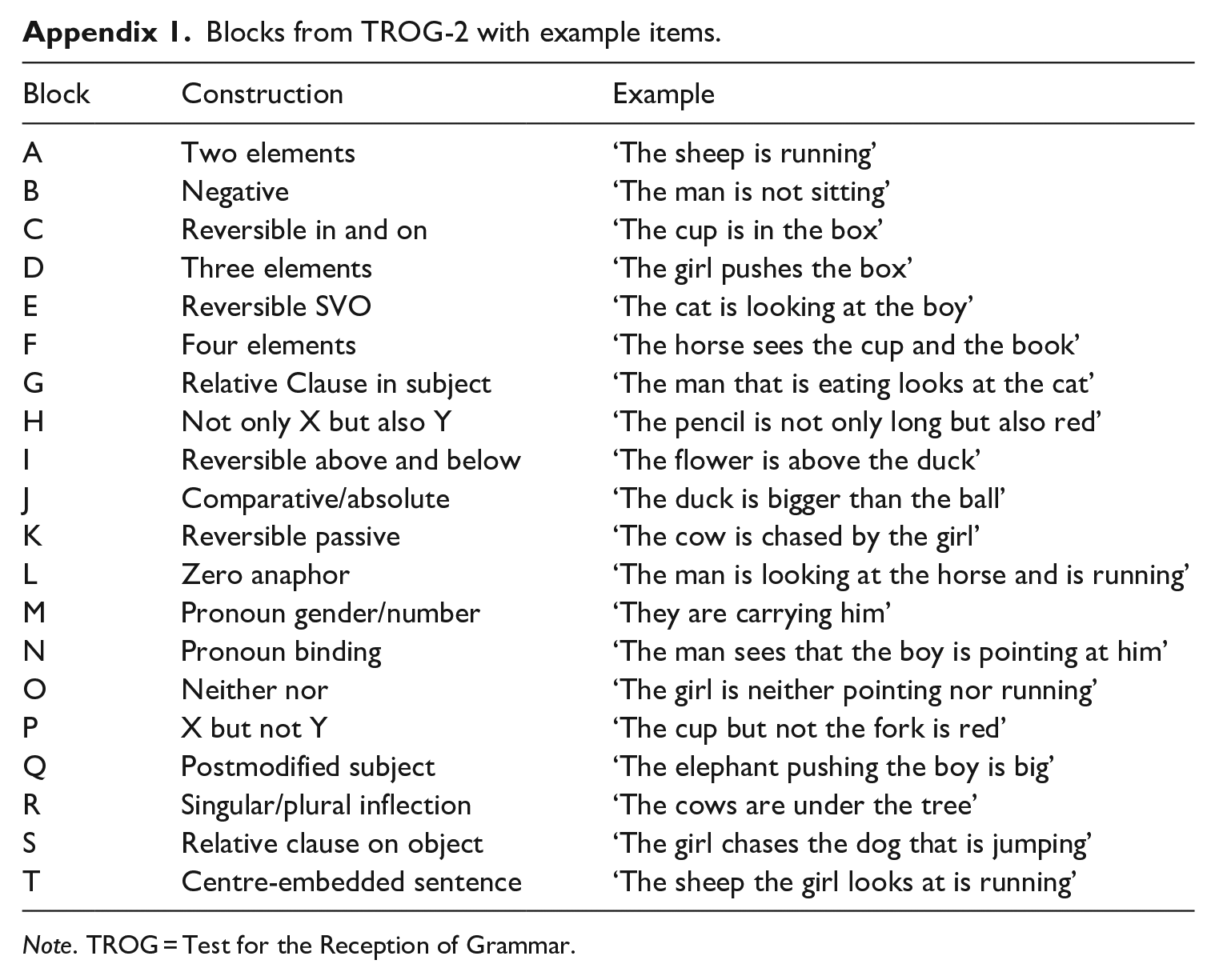
Across the different blocks, there are three that assess mainly spatial concepts, such as ‘in’ and ‘on’ (Block C), ‘above’ and ‘below’ (Block I), and comparative statements related to size (bigger/taller; Block J). The total number of items was recorded as each participant’s raw score. An overview of the blocks can be found in Appendix 1.
British Picture Vocabulary scale
Receptive vocabulary scores were obtained using the British Picture Vocabulary Scale (BPVS; either 2nd edition, Dunn et al., 1997, or 3rd edition, Dunn et al., 2009). 2 For each trial, the participant hears a word and chooses which picture, from a set of four pictures, depicts the meaning of the word. Trials are arranged in sets of 12, and the basal set is the lowest set in which the participant makes no more than one error, and the ceiling set is the set in which the participant makes 8 or more errors. Raw score was calculated by taking the ceiling item minus the number of errors.
Raven’s Coloured Progressive Matrices
Raven’s Coloured Progressive Matrices (RCPM; Raven, 1993) is a measure of non-verbal abilities. Across 36 trials, the participant is shown a pattern, or pattern sequence, with an element missing. They must choose, from a matrix of six pattern pieces, which one is the missing element to complete the pattern or pattern sequence. Raw score was the number of accurate answers out of 36.
Use of raw scores
Raw scores were mainly used in the current study because these are the purest measure of performance and avoid the common issue of floor and ceiling effects that can be associated with standard scores. For example, for the TROG-2, the lowest standard score is 55, but at age 6 and older, there is no differentiation between a participant who scores 0 correct blocks or 1 correct block as both will receive a standard score of 55. Participants between a CA of 10; 00 (years; months) and 13; 11 who correctly answer between 0 and 7 blocks all receive a standard score of 55. As such, standard scores are not sensitive enough to assess development. However, raw scores are not directly comparable across tasks due to differences in scoring ranges. In addition, raw scores do not always progress linearly. For example, vocabulary development in younger children is much steeper than in older children. Thus, progression in raw scores in WS can be considered for single tasks only, and this must be within the context of the nature of the growth curve of the typical population (i.e. that it might not be linear). These considerations have been taken into account in the current analyses.
Analysis
Developmental trajectories (Thomas et al., 2009) were used to explore the development of receptive grammatical abilities. First, we explored how scores on the TROG-2 relate to CA. Second, we examined the mechanistic development of the TROG-2 by observing how variance in performance on the TROG-2 relates to variance in the cognitive maturation of mechanisms that are thought to contribute to task performance, in this case, receptive vocabulary (BPVS) and non-verbal abilities (RCPM). To examine the developmental trajectory of TROG-2 relative to CA in the context of corresponding trajectories for the BPVS and RCPM, the three raw test scores were converted to z-scores by standardising across the participant sample, regardless of age. These scores are linear transforms of the raw scores, but they remove any overall difference in means or variance across tasks, as the mean is always zero. For a complementary perspective, we also considered age-equivalent scores, which allow us to consider how age-appropriate scores are while preserving any task-specific differences in mean and variance.
Linear interpolation was used to generate a wider range of age-equivalents for RCPM, given that the manual has very coarse steps. No participants performed on the floor on any measures analysed in the current study when using raw scores or z-scores.
Results
Analyses were conducted with R Studio (R Core Team, 2024).
Development of TROG-2 performance in relation to other standardised measures of ability
Figure 1a shows the z-scores of raw scores plotted against CA. Curve-fitting revealed that quadratic and cubic functions were better fits to all of the measures than linear ones. Although these models were still better fits, the variances explained by these models were almost identical to the linear models, which were therefore chosen for parsimony. The linear model was significant for the TROG-2, F(1, 56) = 13.37, p < .001, R2 = .193; and the BPVS, F(1, 38) = 12.12, p = .001, R2 = .242; but not the RCPM, F(1, 29) = 0.24, p = .631, R2 = .008. This shows that z-scores for the TROG-2 and BPVS increased with increasing CA, but those for the RCPM did not. It is worth noting that these and all subsequent statistics involving z-scores are comparable to those obtained by using simple raw scores.
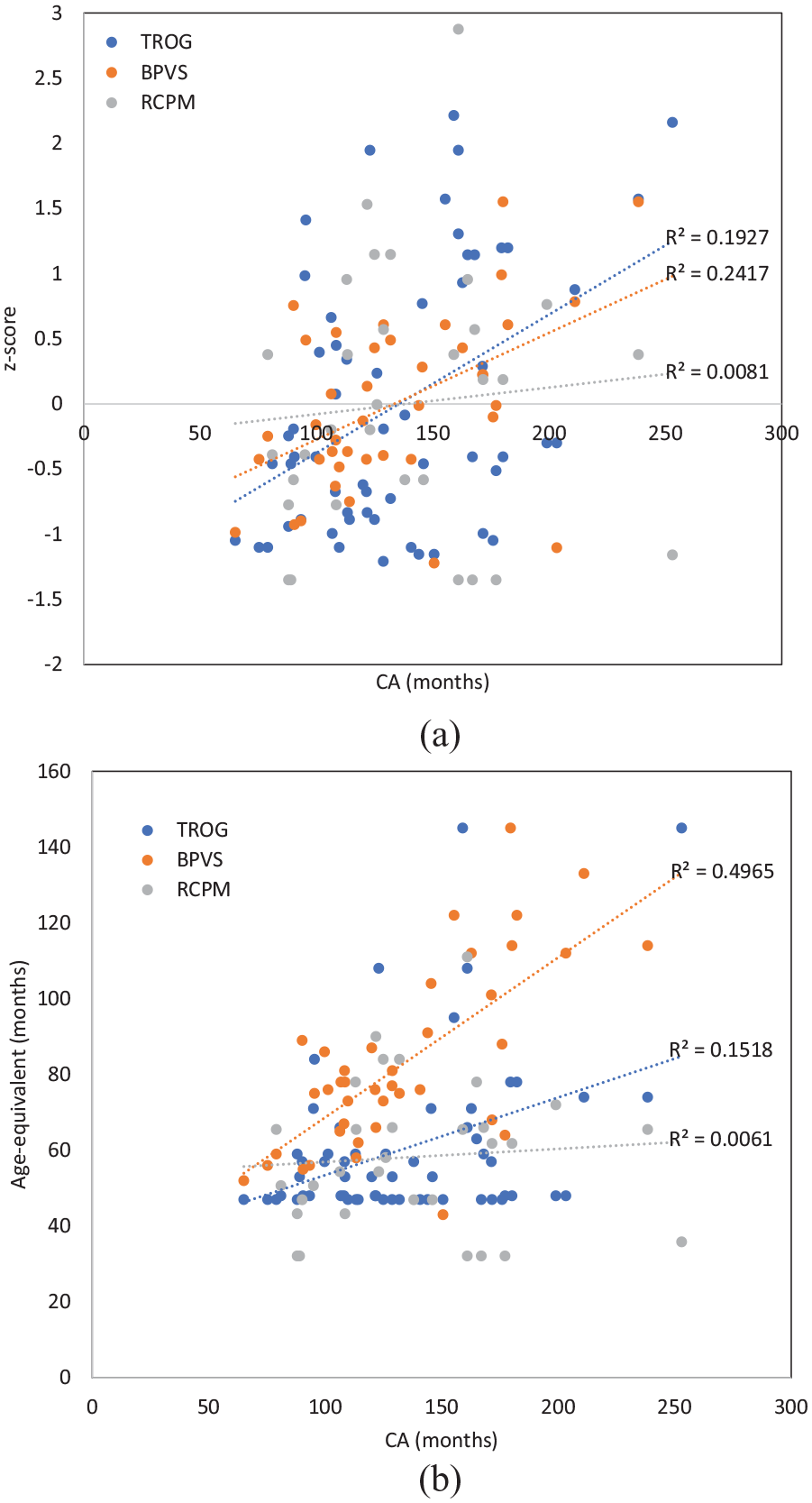
(a) Z-scores of raw scores for grammatical ability (TROG-2), receptive vocabulary (BPVS) and non-verbal reasoning (RCPM) against chronological age. (b) Age-equivalents for grammatical ability (TROG-2), receptive vocabulary (BPVS) and non-verbal reasoning (RCPM) against chronological age.
Although corresponding comparisons based on age-equivalents are to be treated with caution, because of the different samples used in producing those age-equivalent scores for each test and also because of floor effects, the current data were reanalysed using age-equivalents as the y-values (Figure 1b). The linear model was significant for the TROG-2, F(1, 56) = 10.02, p = .003, R2 = .152; BPVS, F(1, 38) = 37.48, p < .001, R2 = .497; but not RCPM, F(1, 29) = 0.177, p = .677, R2 = .006. The same pattern was found when excluding participants scoring on the floor. It is noteworthy that the variance model fit for BPVS is much higher when using age-equivalents rather than z-scores, necessarily because age-equivalents capture some non-linearity in the relationship of BPVS and age.
Variability of TROG-2 performance
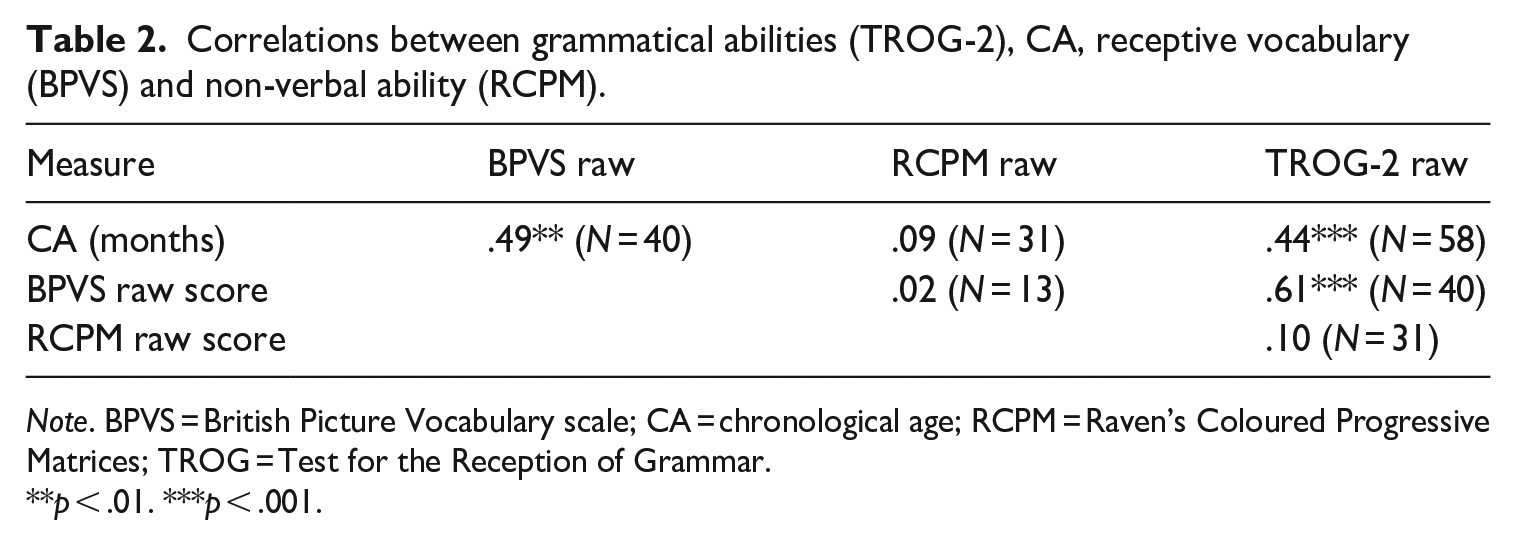
Correlations between CA and TROG-2, BPVS and RCPM raw scores are shown in Table 2 (raw scores were used in this ‘Results’ section except for plotting developmental trajectories). Only 7 of the 58 participants completed every block of the TROG-2, with the remainder stopping earlier after failing four blocks in a row.
Correlations between grammatical abilities (TROG-2), CA, receptive vocabulary (BPVS) and non-verbal ability (RCPM).
Note. BPVS = British Picture Vocabulary scale; CA = chronological age; RCPM = Raven’s Coloured Progressive Matrices; TROG = Test for the Reception of Grammar.
**p < .01. ***p < .001.
Partial correlations between TROG-2, BPVS and RCPM raw scores were conducted, controlling for CA: TROG-2 raw scores were significantly correlated with BPVS raw scores, r(37) = .51, p < .001, but not with RCPM raw scores, r(28) = .07, p = .727. These analyses indicate that the correlation of TROG-2 with BPVS shown in Table 2 was not solely due to the variance each measure shares with CA. Although to be expected, the same patterns of correlations and partial correlations were found when using age-equivalents rather than raw scores.
Spatial and non-spatial grammar
The development of spatial and non-spatial grammatical comprehension was compared by separately analysing z-scores for spatial (C, I, J) and non-spatial TROG-2 blocks (D, H, K). 3 The non-spatial blocks were chosen on the basis of being similar in difficulty to the spatial ones and being in proximity to one another, meaning that if one block was administered it was likely that the other block was also administered. Blocks C and D are both simple two-argument structures (‘The cup is in the box’ vs. ‘The girl pushes the box’), whereas I and K are both reversible, although the latter passive structure is syntactically more complex (‘The flower is above the duck’ vs. ‘The cow is chased by the girl’). Block J (comparative/absolute, ‘The duck is bigger than the ball’) and block H (Not only X but also Y, ‘The pencil is not only long but also red’) were less well matched in demands, but were paired on the basis of being close together in the testing sequence. In addition, these three non-spatial blocks afforded good matching of the sample’s average scores across the spatial (M = 6.34, SD = 3.19) and non-spatial (M = 6.53, SD = 3.35) items, t(57) = 0.576, p = .567, such that the analysis below was not confounded by overall difficulty (see Figure 2 for the proportion of participants passing each block).
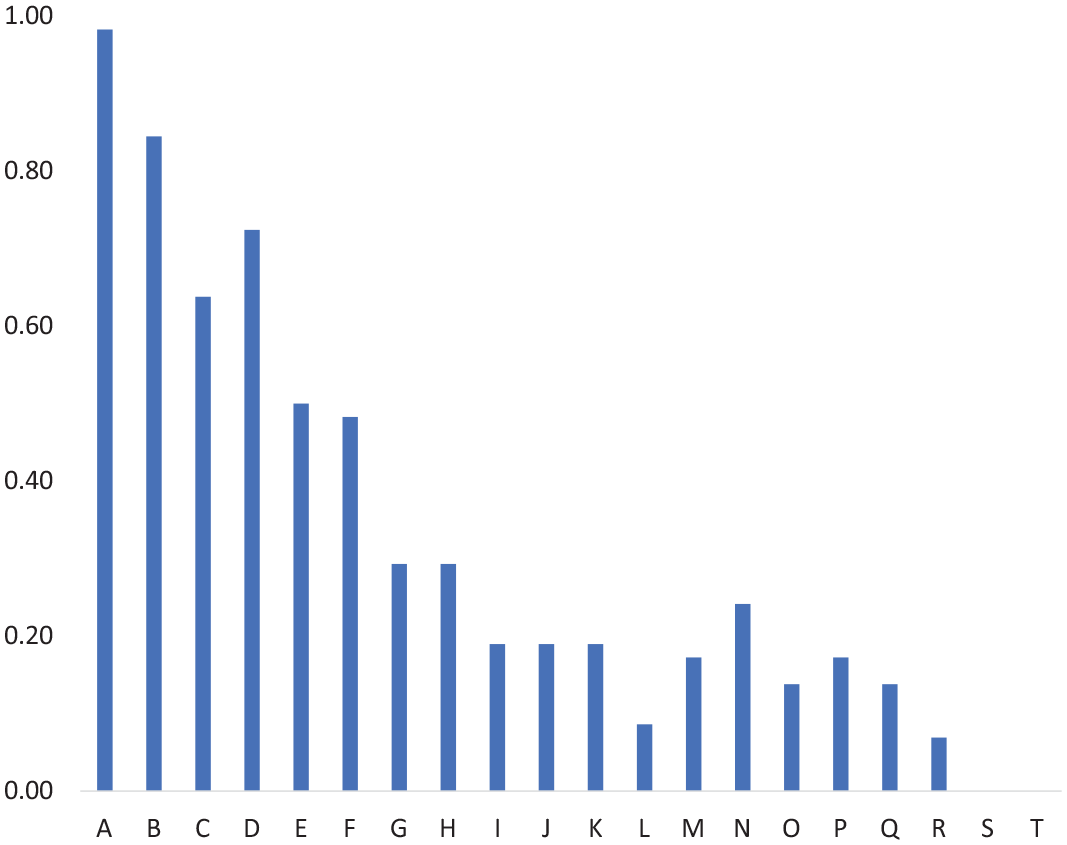
Proportion of participants passing each TROG block (N = 58).
Spatial scores were significantly associated with non-spatial ones, r(56) = .71, p < .001. CA was a significant positive predictor of the spatial trial score, r(56) = .37, p = .004, y = 0.009x − 1.22, and non-spatial trial scores, r(56) = .28, p = .031, y = 0.007x − 0.927, reflecting similar trendlines for these two relationships (see Figure 3). Spatial scores were significantly associated with BPVS scores, r(38) = .51, p < .001, but not with RCPM scores, r(29) = .11, p = .544; non-spatial scores were significantly associated with BPVS scores, r(38) = .44, p = .005, but not with RCPM scores, r(29) = .05, p = .790.
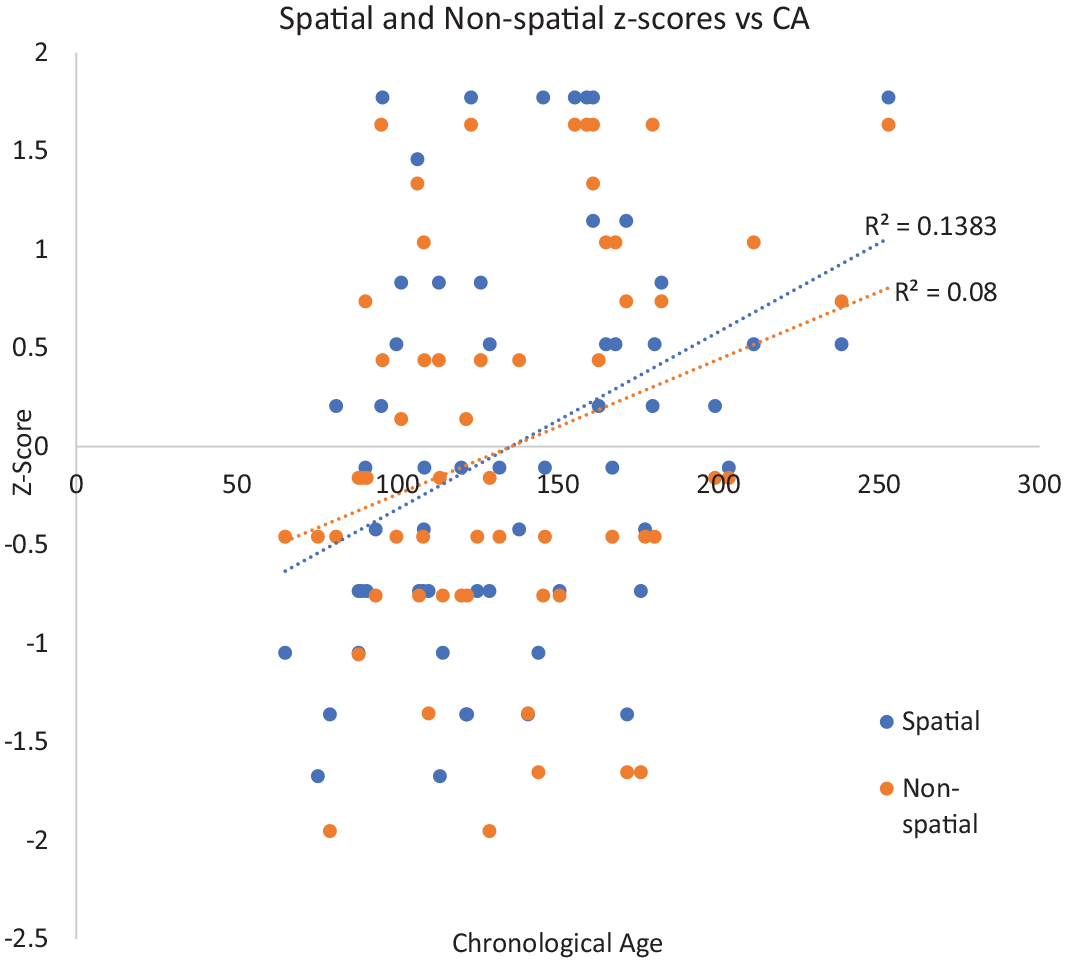
Z-scores of spatial and non-spatial trial performance against chronological age.
Exploring these associations of BPVS with both spatial and non-spatial scores, simultaneous multiple regressions were conducted, with TROG-2 scores as the outcome variable and CA and BPVS raw scores as predictor variables. The model was significant both for spatial blocks, F(2, 37) = 6.47, p = .004, R2 = .259, and non-spatial blocks, F(2, 37) = 4.41, p = .019, R2 = .193, with BPVS but not CA predicting significant unique variance in the outcome measure in each case. Statistics for the intercepts and individual predictors in each analysis are provided in Table 3.
Multiple regressions with spatial or non-spatial trial score as the outcome variable, predicted by CA (in months) and vocabulary (BPVS raw score).
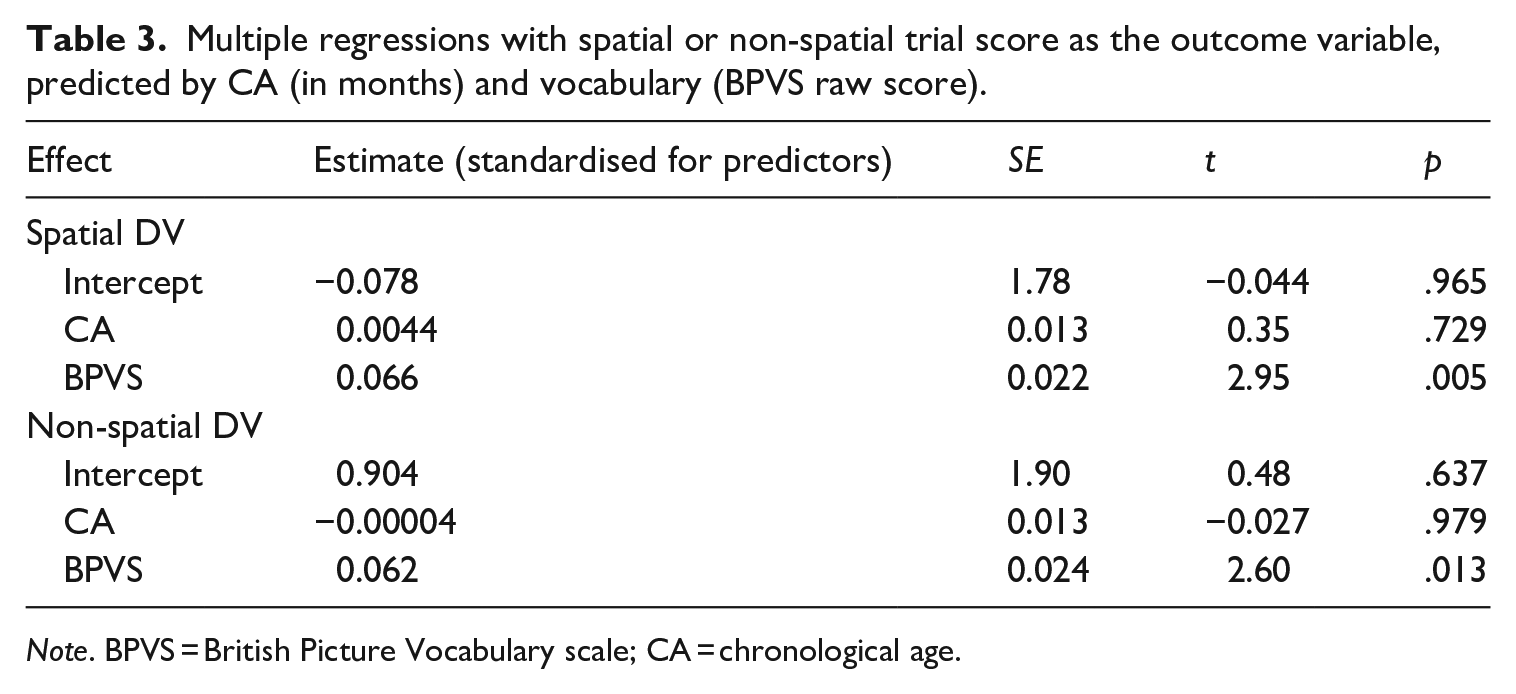
Note. BPVS = British Picture Vocabulary scale; CA = chronological age.
Discussion
The current study was the first to examine developmental cross-sectional trajectories of grammatical comprehension in individuals with WS using a large sample size to qualify the development (delayed vs. atypical) of grammatical abilities in WS, determine how the development of grammatical comprehension relates to vocabulary and non-verbal abilities, and provide an understanding of how this development might differ between different grammatical structures (spatial vs. non-spatial items).
Analyses suggested that grammatical comprehension abilities increase in line with CA even for older participants (above the age of 11 years old). Together, these analyses indicate that while grammatical development may be delayed in individuals with WS, older individuals tend to show stronger performance than younger individuals. These findings align with previous research by Vicari et al. (2004), who, using a cross-sectional sample, found that older children scored higher than younger children on the Grammatical Comprehension Test (Rustioni, 1994).
In terms of predictors of grammatical ability, performance on the TROG-2 was positively associated with vocabulary scores as measured by the BPVS but showed no relationship with non-verbal ability as measured by the RCPM. Furthermore, RCPM was neither associated with BPVS nor CA. These findings suggest that the observed vocabulary-grammar relationship reflects a language-specific association rather than being driven by broader cognitive abilities and are consistent with previous studies that have shown grammatical abilities to increase in line with the number of words known by the young person with WS (Vicari et al., 2002). In addition, in TD populations, grammatical abilities usually develop in line with vocabulary abilities (Bates & Goodman, 1999). However, additional examination of the predictors of comprehension of spatial and non-spatial items within the TROG-2 revealed further interesting insights. Vocabulary was a significant predictor for both non-spatial and spatial items, whereas RCPM was not predictive of either. These findings may seem to contradict those of Philips et al. (2004) who found a significant relationship between spatial items and non-verbal abilities, but not of those items with age or vocabulary ability. However, there are a number of differences between the current study and Philips et al. (2004).
First, Philips et al. (2004) used the first edition of the TROG, whereas the second edition was used in the current study. The items in the second edition do overlap but, for some blocks, are very different compared to edition 1. In addition, the current study followed the standard TROG-2 administration rules, meaning that the assessment ended when the participant failed five consecutive blocks in a row, whereas participants completed all items in Philips et al. (2004). A closer look at the participants shows that the sample of Philips et al. (2004) included adults over the age of 19 up to age 38, whereas the sample in the current study for the analysis of the spatial items only included participants between the ages of 5 and 21. Furthermore, in the study by Philips et al. (2004), participants were only administered later blocks, as pilot work had shown the earlier blocks were too easy. In contrast, the spatial/non-spatial comparisons in the current study were from earlier and perhaps easier items in the test, although the spatial terms themselves used in the relevant blocks in the current study and in Philips et al. (2004) are very similar.
Although the current study used a large sample size and showed that the age of the participants plays an important role in predicting grammatical comprehension, development was examined using cross-sectional data and thus the current findings should be replicated longitudinally (see Farran et al., 2024, for comparisons of cross-sectional and longitudinal data on standardised tests with participants with WS). In addition, while the current study suggests that grammatical abilities remain malleable over development, no data were available on the frequency and intensity of any speech and language therapy (SLT) that participants may have had access to. Although it can be assumed that older participants would have had more access to SLT over the course of development, which may have driven our results, data from Van Herwegen et al. (2018) suggest that very few individuals with WS have access to SLT compared to people with other genetic conditions. Nevertheless, future studies should look further into the relationship between SLT access and interventions and grammatical abilities in WS.
Another set of limitations is the use of single measures for the various constructs related here, namely TROG-2 for grammatical ability, BPVS for vocabulary and RCPM for visuo-spatial ability. Although such operationalisation is commonplace in developmental research, the practice means that the measures capture only some aspects of the targeted constructs, although the adult version of RCPM correlates well with other measures of general cognitive abilities (e.g. Carpenter et al., 1990). Furthermore, tests like the TROG-2 and BPVS rely on multiple-choice responses, which do not necessarily reflect natural language use and do not assess production, for example. Future studies that build on this one should, therefore, consider using additional tests to capture a broader range of cognitive and linguistic abilities in WS. Further future work could benefit from an analysis of error patterns in the TROG-2, as this could provide insight into specific aspects of items that present difficulties. Such an analysis would allow for a more detailed examination of the nature of grammatical challenges in WS, complementing overall performance measures. However, this was not possible in the present study due to the availability of only summary data.
The current study suggests for the first time that grammatical comprehension, including grammatical constructions that include spatial items, appears to increase with CA in WS. However, that apparent increase may be due to the fact that vocabulary knowledge is itself related to age, rather than from any effect of age per se because correlations between these language measures remained after partialling out variance associated with age. In addition, the current study has shown for the first time that the predictors of grammatical comprehension do not seem to depend on whether the grammar test items are spatial or non-spatial, for children and adolescents with WS. There was no meaningful difference in performance between spatial and non-spatial items and both related comparably to vocabulary scores. This suggests that comprehension of grammatical constructions in WS, including spatial or non-spatial structures, is delayed but not atypical. Seeing that there is a strong association between vocabulary and grammatical abilities in WS, as in TD children (where it has been causally established; Bates & Goodman, 1999), it can be argued that increasing vocabulary abilities might help to improve grammatical comprehension abilities in WS and thus, individuals with WS would benefit from regular SLT. Alternatively, should the causal relationship run in the other direction, then that would carry different implications for intervention. Such questions should be addressed in future work, ideally by experiments that can establish causality.
Footnotes
Appendix
Blocks from TROG-2 with example items.
| Block | Construction | Example |
|---|---|---|
| A | Two elements | ‘The sheep is running’ |
| B | Negative | ‘The man is not sitting’ |
| C | Reversible in and on | ‘The cup is in the box’ |
| D | Three elements | ‘The girl pushes the box’ |
| E | Reversible SVO | ‘The cat is looking at the boy’ |
| F | Four elements | ‘The horse sees the cup and the book’ |
| G | Relative Clause in subject | ‘The man that is eating looks at the cat’ |
| H | Not only X but also Y | ‘The pencil is not only long but also red’ |
| I | Reversible above and below | ‘The flower is above the duck’ |
| J | Comparative/absolute | ‘The duck is bigger than the ball’ |
| K | Reversible passive | ‘The cow is chased by the girl’ |
| L | Zero anaphor | ‘The man is looking at the horse and is running’ |
| M | Pronoun gender/number | ‘They are carrying him’ |
| N | Pronoun binding | ‘The man sees that the boy is pointing at him’ |
| O | Neither nor | ‘The girl is neither pointing nor running’ |
| P | X but not Y | ‘The cup but not the fork is red’ |
| Q | Postmodified subject | ‘The elephant pushing the boy is big’ |
| R | Singular/plural inflection | ‘The cows are under the tree’ |
| S | Relative clause on object | ‘The girl chases the dog that is jumping’ |
| T | Centre-embedded sentence | ‘The sheep the girl looks at is running’ |
Note. TROG = Test for the Reception of Grammar.
Author contributions
Consent to participate
Written participant consent was provided at each lab when data were collected.
Consent for publication
Not applicable.
Funding
The author(s) disclosed receipt of the following financial support for the research, authorship, and/or publication of this article: This research was supported by funding from the Williams Syndrome Foundation UK to Jo Van Herwegen and Michael Thomas. Legacy data were collected under multiple grants to the authors.
Ethics considerations
Data for this study were obtained from the WiSDom database ( ), a U.K.-based legacy database. The database was put together retrospectively using cognitive and behavioural data for individuals with Williams syndrome from the last 20+ years from seven U.K. labs (labs were led by each of the authors and Annette Karmiloff-Smith). Ethical approval for the WiSDom project was approved by UCL: Z6364106/2019/08/37.