




Abstract
Spoken narrative skills are crucial to the social and academic success of young people; however, research indicates that this may be an area of challenge for autistic adolescents. Most previous studies have used narrative elicitation tasks that incorporate visual support, and little is known about how autistic adolescents perform on less structured narrative tasks that more closely approximate everyday instances of communication. Autistic participants aged 11–15 years (N = 53) and a non-autistic group (N = 57) were asked to recount the events of two 3–4 minute video clips. Narratives were coded for both macrostructure (‘story grammar’) and coherence. Group differences were explored using multiple regression analyses, after controlling for age, non-verbal cognitive ability, and both receptive and expressive language skills. Autistic adolescents produced spoken narratives that were rated as less well-structured and less coherent than those of the non-autistic comparison group. However, controlling for narrative length in exploratory analyses virtually eliminated group differences, suggesting that further research into this relationship is warranted.
Introduction
Narrative skills in everyday life
Narrative discourse, or the ability to verbally relate a series of events to a listener, is central to human communication. Everyday instances of narrative take many forms: for example, recounting personal experiences; story retellings, such as describing the plot of a book or film to others; procedural or instructional narratives explaining how to do something; and sharing jokes or gossip. These narrative-based interactions allow us to establish connections with others and strengthen social ties (Petersen et al., 2008). Spoken narrative abilities are thus crucial for building and maintaining reciprocal relationships. As children attain maturity, their social landscape gradually shifts from play-based interactions to relationships founded on shared conversations, in which narrative aspects, such as discussing everyday experiences, become increasingly important (Siller et al., 2014).
Spoken narrative discourse is also an important medium for learning (Petersen et al., 2008), and there is ample research evidence to indicate that early spoken narrative skills predict later educational attainment (e.g. Griffin et al., 2004; O’Neill et al., 2004; Shaqiri et al., 2020). It has been suggested that narratives provide a ‘bridge’ from conversational language to the more literate, abstract forms of discourse used in teaching and learning (Worsfold et al., 2010). Once children reach secondary age, they are increasingly required to use narrative discourse in the classroom ‘to elaborate and explain clearly their understanding and ideas’ (Department for Education, 2013). Examples of this might include providing information about a topic through an expository narrative or justifying their views using persuasive discourse (Wallis & Westerveld, 2024). Difficulties with narrative can, therefore, have a significant impact on academic achievement.
The ‘building blocks’ of narrative
Spoken narrative production is a demanding task, in which numerous linguistic and cognitive skills are called upon simultaneously. At a fundamental level, narrative requires linguistic competence. This includes using accurate morphosyntax to mark grammatical forms such as verb tenses, pronouns, and possessives; providing adequate content in terms of vocabulary, including adjectives and adverbs; and using conjunctions and clauses to structure complex sentences (Worsfold et al., 2010). At the same time, the speaker must organise key story events coherently within a causal and temporal framework, relate these to a broader context and deliver an overall theme or ‘gist’ to the listener. This level of narrative organisation relies upon aspects of cognitive ability such as memory, and executive skills (Ketelaars et al., 2012; Mar, 2004).
Beyond the core structural elements of narration, pragmatic skills are essential. The term ‘pragmatics’ refers to ‘the appropriate use of language within social and situational contexts’ (Geurts & Embrechts, 2008, p. 1931). A proficient narrator accounts for the listener’s frame of reference and background knowledge of the events described; maintains their interest by providing narrative perspective through evaluative comments; provides relevant information about the psychological states of the actors (Capps et al., 2000); and employs various stylistic conventions (Losh & Capps, 2003). Non-verbal communication skills are also key to delivering a successful narrative. Boorse et al. (2019) suggest that the ability to read facial expressions and interpret non-verbal cues is essential for monitoring comprehension and knowing when to pause, provide more information or clarify a previous utterance.
Narrative analysis
Narrative skills are typically analysed at two levels: microstructure (the internal linguistic structure of the narrative) and macrostructure (the overall organisation of the content). Microstructural analysis includes metrics such as story length, mean length of utterance, syntactic complexity and lexical diversity, whereas macrostructural analysis is concerned with the inclusion of key story elements and how these are organised episodically (Justice et al., 2006). Although microstructure and macrostructure reflect distinct aspects of narrative ability, they are closely interrelated. For example, narrative ‘cohesion’ or ‘cohesiveness’, often measured by the frequency of causal and temporal connectives or the accuracy of referential expressions (Rollins, 2014), is commonly categorised under microstructure. However, markers of narrative cohesion are also considered relevant to macrostructural analysis, since they ‘transcend individual utterances and are necessary for producing coherent narratives’ (Heilmann et al., 2010, p156).
Similarly, relationships have been demonstrated between microstructural measures of productivity and aspects of macrostructure. For instance, Peterson and McCabe (1983) found that narrative length correlated with macrostructural complexity in children’s narratives while Reese et al. (2011) noted that increased length corresponded to increased coherence in the narratives of preschoolers. However, these relationships were only observed in some samples: McCabe et al. (2013) reported that length did not correlate with narrative complexity in young autistic adults; Reese et al. (2011) found that length and coherence were not correlated in school-aged children, suggesting that these skills may develop along different trajectories.
Although its role remains unclear, length is an important consideration when assessing macrostructural abilities. It has often been viewed as a confounding factor when comparing scores on narrative tasks, since shorter accounts tend to include less content and therefore fewer opportunities to garner ‘points’ on the chosen assessment framework. Yet, arguably, a key aspect of narrative skill itself is the individual’s ability to produce extended (and connected) discourse. It may, therefore, be more revealing to explore relationships between narrative length and aspects of macrostructure than to simply control length as a variable from the outset.
Autism and narrative: key considerations
Autism is a complex neurodevelopmental condition characterised by core differences in communication and reciprocal social interaction, in addition to restricted and repetitive, or stereotyped, patterns of behaviour (Diagnostic and Statistical Manual of Mental Disorders, 5th ed.; DSM-5, American Psychiatric Association, 2013). Autism frequently co-occurs with other conditions, such as language disorders, intellectual disability, attention-deficit hyperactivity disorder (ADHD) and mental health issues (Gillberg, 2010), and as a result, autistic people require differing levels of support in their daily lives.
A key area of challenge in autism is the use of language in context. Even in the absence of structural language impairment, autistic people typically show differences in their pragmatic communication, such as difficulties with neurotypical social and conversational cues (de Giambattista et al., 2019; Loveland et al., 1990). Since spoken narrative production draws heavily on pragmatic and socio-cognitive skills (Kunnari et al., 2016; Norbury et al., 2014), it is unsurprising that autistic children and adolescents often find this form of discourse challenging. For example, King and Palikara (2018) reported that despite scoring within the average range on standard language assessments, autistic adolescents produced narratives that were significantly shorter and less grammatically complex than those of non-autistic young people. Narrative may therefore be a particularly sensitive form of language assessment for autistic individuals, since it captures pragmatic abilities at a more advanced level than is needed for the generation of individual sentences (Volden et al., 2017). For instance, subtle pragmatic difficulties, such as the idiosyncratic use of language, have been reported on narrative tasks by autistic adolescents; and by those who were previously diagnosed with autism but no longer met diagnostic criteria (Suh et al., 2014).
In addition to linguistic and pragmatic differences, there are other cognitive features of autism with potential impacts on narrative abilities. For instance, memory differences are likely to play a role in difficulties experienced in recounting personal narratives, with studies indicating that autistic individuals recall fewer autobiographical memories than neurotypical comparison groups, and that these tend to be less specific and less detailed (Westby, 2022).
Difficulties with executive function have also been widely documented in autistic individuals, affecting skills such as cognitive flexibility and planning (Demetriou et al., 2018), which may correspond to challenges in organising a story in a coherent manner (van den Broek et al., 1997). Johnston (2008) suggests that because of the inherent complexity of storytelling, executive processing demands may lead children to neglect certain elements of a narrative while focusing on others. For example, while concentrating on advancing the plot, they may have insufficient working memory capacity to simultaneously keep track of referential expressions. If this is the case, it may be particularly challenging for children with underlying executive difficulties to achieve all aspects of narrative to a high standard.
Differences in social cognition, or interpreting the mental states of others, are another key feature of autism. ‘Mentalising’ difficulties can hinder successful storytelling, since explaining the emotional and psychological states of the characters is an important aspect of narrative (Mar, 2004). Autistic children and adolescents might also find it more challenging to provide sufficient contextual information when narrating, as this involves judging what their audience already knows and what they need to be told (Loveland et al., 1990).
Narrative skills in autistic young people
Research into the spoken narrative skills of autistic young people has resulted in a complex set of findings, with previous studies producing conflicting evidence about different aspects of narrative ability. There are several issues relating to methodology that may explain this variability in the literature. First, researchers have investigated these skills across a range of narrative genres and experimental tasks, including picture-based story generation, story retellings, personal or autobiographical verbal accounts, and conversational narratives (see Baixauli et al., 2016, for a meta-analysis). These elicitation methods place differing demands on narrators; for example, retellings or personal narratives involve a higher memory load and provide lower levels of support for story generation than tasks that incorporate visual cues. Losh and Gordon (2014) found that autistic children performed significantly less well on narrative tasks that did not include visual scaffolding. Previous research studies have also examined different dimensions of narrative, with some providing a broad overview of narrative ability across sentence-level (microstructure) and discourse-level (macrostructure) elements, whereas others have focused on specific aspects, such as internal state language or causality.
Equivocal findings may also be accounted for by the variable matching procedures used by different research groups. The heterogeneity of autism is problematic for group matching, since autistic individuals often show uneven cognitive profiles, including areas of marked strengths and challenges (Burack et al., 2004), and averaged group scores may obscure considerable individual variance in performance (Tager-Flusberg, 2004). Some researchers have matched autistic participants with younger children on either mental age or language ability; however, this raises the question of whether the comparative maturity of the autistic sample might mask some narrative difficulties (Banney et al., 2015). Most previous studies have focused on those with typical-range cognitive abilities (Volden et al., 2017) and attempted to match them to comparison groups on chronological age and intellectual ability (Baixauli et al., 2016). However, researchers have varied in the extent to which they consider structural language ability, an important prerequisite for narrative competence (Bishop & Donlan, 2005). This hinders meaningful comparison between studies. To overcome these limitations, in the present study, the groups were compared on measures of both receptive and expressive language, in addition to age and non-verbal cognitive ability, and we controlled for each of these variables in our statistical analyses.
Previous narrative findings relating to story length, syntactic complexity, lexical diversity and cohesion are contradictory. However, when comparison groups are carefully matched on cognitive and linguistic ability, it appears that autistic children and adolescents may perform at a similar level to non-autistic peers (e.g. Capps et al., 2000; Kauschke et al., 2016; Rumpf et al., 2012). A further limitation of existing research in this area is the small sample sizes of many studies. Baixauli et al. (2016) reported that less than 30% of the studies identified by their systematic review had sample sizes of greater than 20 participants. This suggests that in many cases, the findings of previous investigations should be interpreted with caution.
There is somewhat more consistent evidence to suggest that autistic children and adolescents experience challenges with the more ‘holistic’ aspects of narrative generation; that is, with generating informative and clearly structured spoken narrative accounts that make sense to the listener. Numerous studies have indicated challenges with macrostructure (‘global’ story structure) and narrative coherence in accounts by autistic narrators (e.g. Baixauli et al., 2016; Conlon et al., 2019; Volden et al., 2017, although see Henry et al., 2020; and Norbury & Bishop, 2003, for contrasting findings). In the present study, we aimed to investigate these two core elements of narrative in free recall accounts produced by autistic and non-autistic adolescents.
Approaches to analysing narrative macrostructure and coherence
Macrostructural analysis considers the overall content and organisation of a narrative and has been widely used in previous work on narrative skills in autism. A recent scoping review of narrative assessment methodologies in the autism research literature (Harvey et al., 2023) found that ‘story grammar’ (Stein & Glenn, 1979) was the most frequently used approach to scoring spoken discourse (used in nearly half of the included studies). Story grammar frameworks break narratives down into key story elements, which are organised into ‘episodes’ describing a protagonist’s attempts to overcome a problem or achieve a goal, and the outcomes of their actions. Numerous episodes are often combined within one story to build a complex plot and may involve the same character or describe the experiences of different protagonists (Petersen et al., 2014). Another approach to analysing macrostructure in autistic people’s narratives was to score accounts for their inclusion of salient content (used in approximately one third of the included studies). In some studies, these two approaches were combined, with key story events being ‘mapped onto’ a story grammar framework. Finally, a small number of studies used alternative assessment methodologies to score macrostructure, including holistic rating scales; high-point analysis; and subjective story quality ratings (Harvey et al., 2023).
Although macrostructure is closely related to the perceived coherence of a verbal account, these concepts reflect distinct areas of narrative competence. For example, a story featuring significant referencing errors or too much off-topic information can be difficult for listeners to follow, even if the content is well structured. Harvey et al. (2023) found little previous work focusing directly on the coherence of spoken accounts by autistic narrators, and no existing measure that comprehensively assessed this aspect of narrative. However, some features of coherent storytelling were identified across different studies; for example, the inclusion of relevant contextual information (Kauschke et al., 2016; Rumpf et al., 2012); explicit causal relationships between events (Diehl et al., 2006; Ferretti et al., 2018; Sah & Torng, 2015); accurate chronology (Diehl et al., 2006; Sah & Torng, 2015); and the absence of incongruous or extraneous information (Ferretti et al., 2018; Kauschke et al., 2016; Marini et al., 2020). These findings were used to devise a novel assessment framework to comprehensively assess narrative coherence in the present study.
Narrative elicitation methods
The ability to produce a well-structured and coherent verbal account is a crucial aspect of daily communication for young people. Despite this, there is a lack of research into how autistic adolescents use their narrative skills to recount events in everyday situations. Evidence from work with young autistic adults suggests that this population may find it particularly challenging to generate narrative structure when providing an account of personally experienced events (McCabe et al., 2013). However, most previous studies have used fictional ‘storybook’ tasks featuring visual support to elicit narratives from participants. This approach reduces the memory and cognitive load on the narrator, since the pictures prompt the narrator to structure their story by mapping out the sequence of events. As a result, ‘storybook’ tasks may not accurately reflect the functional narrative skills of autistic young people in real-life contexts, where interactions tend to be less structured (Losh & Capps, 2003; Siller et al., 2014). The use of video stimuli for narrative elicitation offers one way of overcoming this issue, since the transience of the images viewed by the participant eliminates visual support for retelling. This method has been used in research into eyewitness skills in autism, but usually with the focus on the completeness and accuracy of event recall rather than storytelling skills per se (e.g. Henry et al., 2017; Maras et al., 2020).
To date, only a limited number of previous studies have used video-based tasks to examine narrative abilities in autistic samples. An early video-based study (Loveland et al., 1990) found that compared to a group of young people with Down syndrome, autistic adolescents produced narrative accounts that were less sensitive to the needs of the listener, including more pragmatic violations and fewer meaning-enhancing gestures. More recently, Henry et al. (2020) examined autistic children’s accounts of a series of events witnessed either in person or via a video recording. Although autistic children reported fewer event details overall, they performed at a similar level to non-autistic children in their ability to structure their witness statements around key narrative elements (e.g. ‘setting’). However, group differences have been demonstrated between autistic and non-autistic adults when describing video clips from popular television programmes (Barnes & Baron-Cohen, 2012; Dindar et al., 2023), with both research groups noting that autistic adults tended to produce narratives that were more focused on specific details or events, rather than providing an overall interpretation of the scene. Further research into narrative performance on video-based tasks may provide new insights into autistic young people’s everyday communication skills, since in comparison to static picture sequences, the dynamic audio-visual modality of videos or live staged events more closely resembles how events are experienced in real life.
The present study
Using a video-based free recall task, the present study compared the spoken narrative abilities of 110 autistic and non-autistic adolescents aged 11–15 years, in terms of both macrostructure (‘story grammar’) and narrative coherence. This study aimed to contribute to the literature by focusing on these more functional aspects of narrative production in ‘everyday’ instances of storytelling. It also aimed to overcome the methodological limitations of some previous work by including a larger sample size and by controlling for the impact of age, sex, non-verbal cognitive ability, and both receptive and expressive language skills on participants’ narrative abilities.
The main research questions were:
How do autistic adolescents’ spoken accounts compare to those of non-autistic peers in terms of narrative macrostructure (‘story grammar’)?
How do autistic adolescents’ spoken accounts compare to those of non-autistic peers in terms of narrative coherence?
An additional exploratory research question was added:
3. How does narrative length impact autistic and non-autistic adolescents’ scores on measures of narrative macrostructure (‘story grammar’) and coherence?
Based on previous literature described in Baixauli et al.’s (2016) meta-analysis, we predicted that the autistic group would perform less well than the non-autistic group on measures of both macrostructure (RQ1) and narrative coherence (RQ2). Although we anticipated that the narratives of the autistic group were likely to be shorter than those of the non-autistic group (Rumpf et al., 2012; Siller et al., 2014), we were hesitant to form a directional prediction for RQ3, as previous literature presents conflicting evidence regarding the relationship of narrative length to macrostructure and coherence (e.g. McCabe et al., 2013; Peterson & McCabe, 1983; Reese et al., 2011).
Method
Recruitment
Ethical approval for this study was obtained from the Department of Language and Communication Science Proportionate Review Committee at City St George’s, University of London (ETH1920-1434) on 14 July 2020. Recruitment targeted secondary-aged children in the 11- to 15-year age range, to reflect the development of adolescents’ narrative skills in the years leading up to GCSE qualifications (General Certificate of Secondary Education: national exams taken in the United Kingdom at age 16, across a broad range of subjects). Participants were recruited from across the United Kingdom through social media (e.g. Twitter, Facebook), UK-based autism research networks (Autistica and Cambridge Autism Research Network) and secondary schools. Information sheets about the study were designed for parents/carers, and an age-appropriate information sheet with accessible language was created for participants. Participants included in the autism group were required to have a formal diagnosis from a relevant professional, according to parental report. Diagnostic status was supported by parents completing the Social Responsiveness Scale about their child (SRS-2; Constantino & Gruber, 2012), a screening instrument which identifies the presence and level of autistic traits. The overall internal consistency for this measure is reported at .96–.98 for the age range targeted in the present study (11–15 years). For the School-Age assessment, sensitivity is .92 and specificity is .92 for total scores ⩾60, and sensitivity .96 and specificity .85 for total scores ⩾75. The authors also report retest reliability correlations of approximately .90 across a 5-year period. No participants in either group were excluded due to additional diagnoses (e.g. Dyslexia, ADHD). Participants were excluded, however, if they did not reside in the United Kingdom, had not spent a minimum of 5 years attending English-speaking educational settings or did not fall within the stipulated age range (11–15 years) at the time of assessment. Participants also were excluded if they scored two or more standard deviations below the mean on the ‘Matrix Reasoning’ subtest of the Wechsler Abbreviated Scale of Intelligence (WASI-II; Wechsler, 2011), that is, if their non-verbal skills fell within the intellectual disability range. Participants signed up to take part through a website featuring information about the study and research team. A small incentive of online vouchers was provided to encourage young people to volunteer.
Procedure
Once parents/carers had completed the consent form, they were contacted to schedule their child’s assessment and were sent a short guide explaining what to expect from the session. Data collection was carried out remotely over Zoom by the first author, with participants joining an online assessment session from their home. Parents were encouraged to remain present during the sessions but were instructed not to prompt their child. A small number of participants (N = 6) joined the assessment session from their school, supported by a member of staff. A PowerPoint visual timetable was used to introduce each activity. The assessment sessions typically lasted between 60 and 90 minutes, with breaks offered to participants as often as desired. Two of the participants opted to complete their assessments across two shorter sessions (30–45 minutes). All participants completed all the tasks reported in this article.
Participants were assessed on the British Picture Vocabulary Scale (BPVS-3; Dunn & Dunn, 2009), a measure of receptive vocabulary in which they were required to choose the picture that corresponded to a spoken word from a choice of four images. The standard published procedure was followed, except that stimuli were presented via screen-share using a document visualiser and participants were asked to say the number of their chosen response rather than point to the item. The BPVS-3 was standardised on a representative sample of 3278 students from schools in the United Kingdom. Confidence bands of 95%, based on the standard error of measurement, were built into the norms to ensure reliability.
Participants’ expressive language was then assessed using the Clinical Evaluation of Language Fundamentals (CELF-5) ‘Recalling Sentences’ subtest (Wiig et al., 2013), in which participants repeat spoken sentences of increasing length and complexity, with their responses scored according to the number of errors. Internal consistency reliability coefficients reported for this subtest ranged from .90 to .95 for a normative sample of children in the target age group (11–15 years), with a coefficient of .97 reported for a clinical sample of 69 autistic children. Test–retest stability for all ages was also excellent, at .90.
Next, participants completed a spoken narrative task (described below). Following this, participants were assessed on their cognitive abilities using the WASI-II: ‘Matrix Reasoning’ subtest: a measure of non-verbal ‘perceptual reasoning’ ability, in which participants are asked to choose a picture to complete a matrix or series (this task was also presented via screen-share). Internal consistency for this measure is reported at .86–.87 and test–retest stability at .76–.81 (Wechsler, 2011). Participants were also assessed on a battery of cognitive assessments relating to ‘theory of mind’ and ‘executive function’, which are reported in Harvey et al. (2025). To ensure an identical procedure, each session followed a pre-written script, and tasks were presented in the same order, with the main narrative task and linguistic and cognitive measures (BPVS-3, CELF-5 and WASI-II) prioritised over the additional cognitive measures.
Narrative task
For the narrative task, participants were instructed to describe events they had viewed on two short video clips. These were chosen to include social situations and experiences that would be relatively familiar to young people, but to reflect different instances of everyday narrative generation. Video A was an animated short film with no dialogue, depicting a misunderstanding between two strangers. An older lady becomes annoyed that a teenage boy is eating the cookies that she has just bought. However, the ‘plot twist’ (revealed through a flashback sequence) is that the lady’s cookies were in her bag the whole time, and she was in fact the one who was eating the teenager’s snack. This video was selected to approximate the real-life scenario of a young person describing an amusing online video to their friends. Video B was an extract from a live-action BBC short film about a secondary-aged student who arrives late to his lesson and is told off by his teacher. This clip included spoken dialogue and was chosen to mirror everyday situations in which an adolescent might have to tell a teacher or parent ‘what happened’ at school. The two videos were similar in length (3–4 minutes each) and had a similar episodic structure, with each featuring three ‘scenes’ in different locations. However, they included differing content and presentation, particularly in terms of ‘language load’, with Video A having no language. Once the participant had finished watching each clip, the researcher used the question prompt: ‘Tell me everything you can remember about what happened in the video’. No further verbal prompts were given. Narratives were elicited immediately following each stimulus video, to achieve the best possible level of recall from participants. Narrative retellings were video recorded and were manually transcribed by the first author following the session.
Story grammar measure
To create a ‘story grammar’ scoring framework, the video stimuli were analysed by the research team to create a list of all the main narrative events, defined as those that advanced the story, rather than minor or less relevant details. Since the videos were similar in length and episodic structure (see above), 26 main events were identified for each video, split into 3 episodes. Each event was then identified as corresponding to a ‘story grammar’ element: Setting, Initiating Event, Plan, Action/Attempt, Consequence, Internal Response and Resolution (the distribution of these story grammar elements was not identical for both videos, due to their differing content). Participants’ narrative transcripts were then scored against these frameworks, with each story event marked as either 0 or 1 depending on its presence or absence, to produce a total score out of 26. The exact phrasing used by the participant was not important, provided that it accurately conveyed the action described (e.g. ‘hits’, ‘bangs’ or ‘smashes’ would all be acceptable alternatives). The full ‘story grammar’ scoring frameworks for both videos are available in the supplementary materials.
Coherence measure
Harvey et al.’s (2023) scoping review of narrative assessment methods in the autism literature indicated six key dimensions of coherent storytelling identified across previous research studies (Context, Characterisation, Chronology, Causality, Cohesion and Congruence), although the authors found no existing measure that assessed these comprehensively. A novel scoring framework (the ‘6Cs’) was therefore devised to evaluate the coherence of participants’ narratives. This measure featured a 0–3 rating scale adapted from previous scoring frameworks in the narrative literature (see Bliss et al., 1998; Heilmann et al., 2010; McCabe et al., 2017; Norbury & Bishop, 2003; Reese et al., 2011; Sah & Torng, 2015), with descriptors included in a scoring rubric to guide the rater (see Figure 1). Scores were summed to create a total coherence score (out of 18).
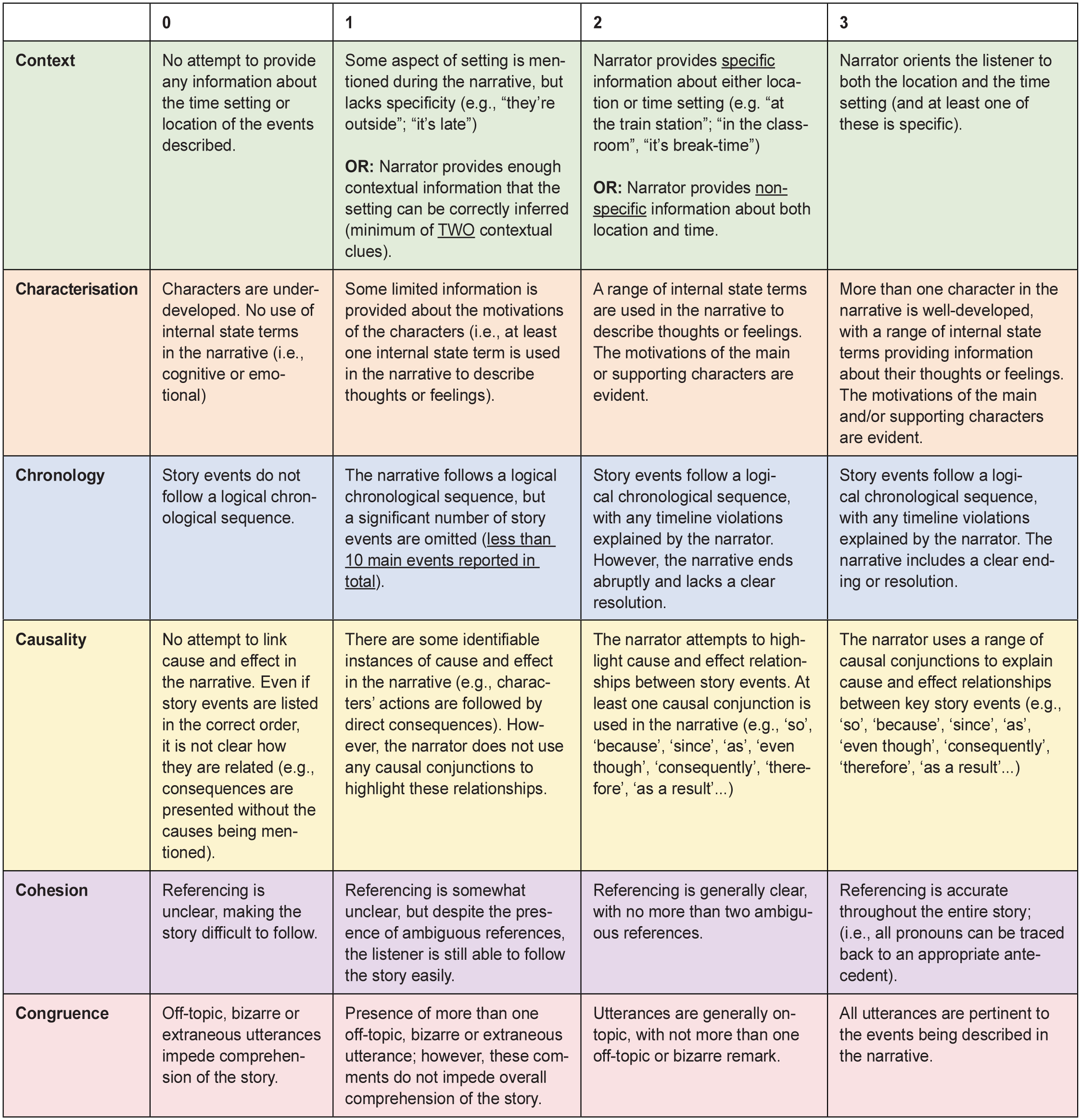
The ‘6Cs’ narrative coherence scoring framework.
Reliability
To evaluate the reliability of the narrative scoring carried out by the lead researcher, 20 narrative transcripts were randomly selected from each group (40 in total; that is, 36% of the sample) for double coding. These were scored for story grammar by a group of eight student speech and language therapists at City, University of London, who were blinded to participants’ age, sex, diagnostic status and any other individual characteristics. Intraclass correlation coefficients (ICCs; two-way random, single measures, absolute agreement) were used to assess inter-rater reliability. ICCs were calculated individually between the author and each of the eight students to determine the range in reliability across the different raters. The mean of these values was also calculated as an overall reliability measure. Inter-rater reliability was found to be ‘good’ to ‘excellent’ for story grammar total scores across both videos (Video A: M = 0.90, range = 0.75–0.96; Video B: M = 0.89, range = 0.70–0.96). The same 40 transcripts were scored for ‘coherence’ by an experienced Speech and Language Therapist, who was also blinded to all participant characteristics. An ‘expert’ rater was preferred for this scoring framework, as it involved more subjective judgements of narrative quality (vs simply identifying whether listed story events were included in the account). ICCs were calculated between the author and the expert rater, with inter-rater reliability found to be ‘moderate’ to ‘good’ for coherence scores across both videos (Video A: 0.74; Video B: 0.83).
Participants
The final sample comprised 110 participants, 53 with a diagnosis of autism (40 male; 13 female) and 57 without (35 male; 22 female). Four of the participants in each group took part in the pilot phase of the project. Their scores are included here, since the administration of measures relevant to the current research questions was identical to the main phase of the study. Using Green’s (1991) formula, 110 participants are needed to detect medium effect sizes (F2 = 0.15) in a regression with 6 predictors, achieving a power of 0.8. A post hoc power calculation using G*Power v.3.1.9.7 (Faul et al., 2009) confirmed that 0.98 power was achieved with alpha = 0.05.
To investigate potential group differences, participants were compared on key background variables using independent samples t-tests (Table 1). No statistically significant differences were found between the groups in terms of age, non-verbal cognitive ability (although note this finding was marginal), receptive vocabulary or expressive language skills. Although the groups were found to be broadly comparable across these measures, p-values did not reach the more stringent thresholds recommended for group matching by Mervis and Klein-Tasman (2004). These variables were therefore controlled in the subsequent data analyses. A chi-square test established that the groups did not differ significantly in terms of sex, χ2(1) = 2.51, p = .113.
Mean (SD) scores for control variables (age, non-verbal cognitive ability, receptive vocabulary and expressive language) and SRS-2 scores for autistic and non-autistic groups, with ranges (min–max), group differences and effect sizes (Cohen’s d).
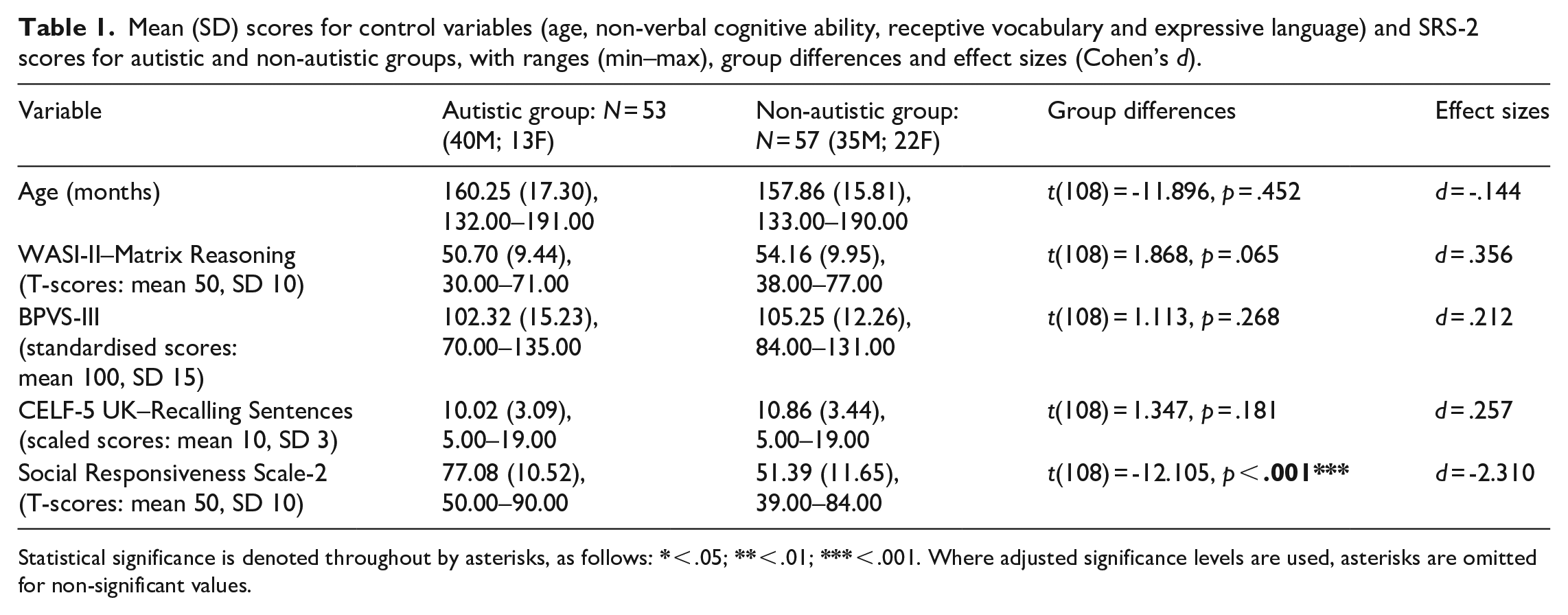
Statistical significance is denoted throughout by asterisks, as follows:
As expected, scores on the Social Responsiveness Scale (SRS-2) differed significantly between groups (p < .001), with the mean score of the non-autistic group falling within typical limits; and the mean score in the autistic group indicating ‘severe’ challenges with social communication. However, despite the overall group difference observed on SRS-2 scores, 13 non-autistic participants scored above the ‘typical’ cut-off for this measure. Although this might indicate that these individuals could meet some (or all) of the diagnostic criteria for autism, there are other possible explanations. For example, research has demonstrated that some non-autism-related learning or behavioural difficulties can result in elevated SRS-2 scores (Cholemkery et al., 2014; Hus et al., 2013; Wigham et al., 2012). Regardless, we were concerned that the presence of non-autistic participants with elevated scores on this measure might affect our results. For this reason, all analyses were repeated with these participants excluded (N = 97), for comparison. The results were very similar, increasing our confidence that the findings reported in this article were robust.
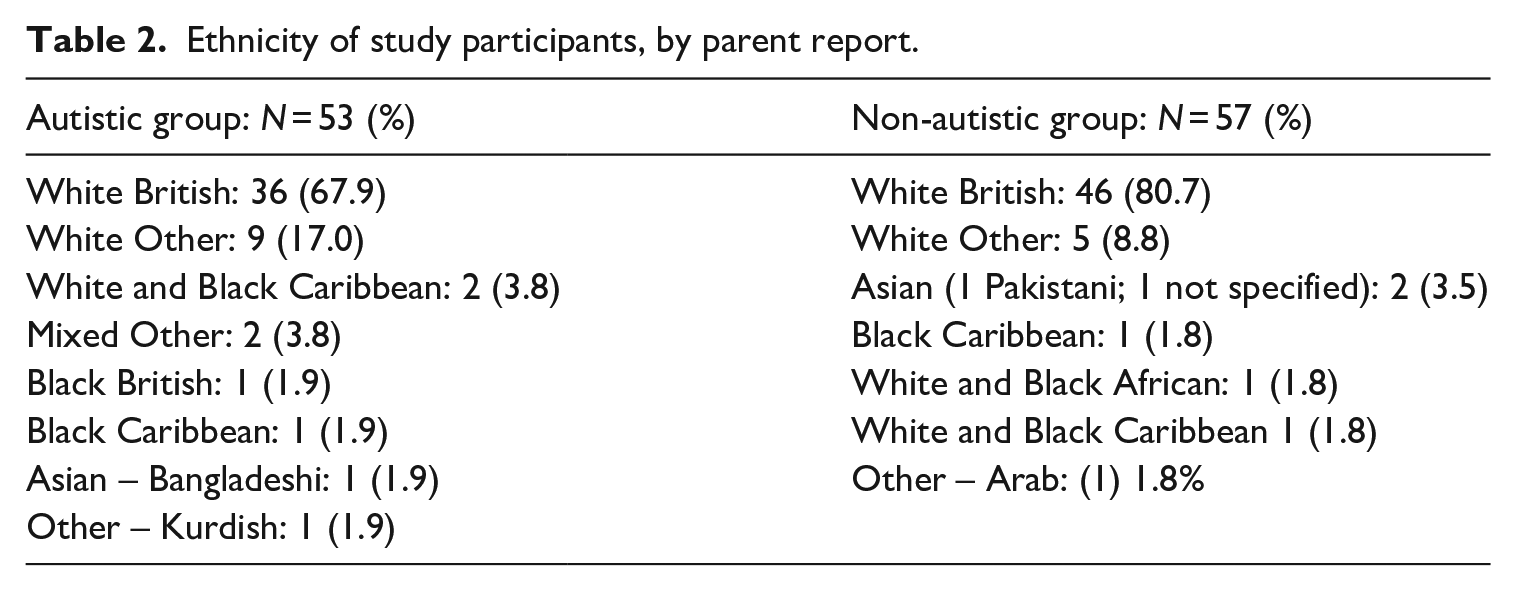
The ethnic background of participants was recorded, although groups were not matched on their ethnicity. Both groups had majority White participants; however, the autistic group was slightly more diverse overall than the non-autistic group (Table 2). Although our sample broadly reflected the ethnic make-up of the United Kingdom, minority ethnic groups were somewhat underrepresented when compared to ethnicity data for the wider population (Office for National Statistics, 2022).
Ethnicity of study participants, by parent report.
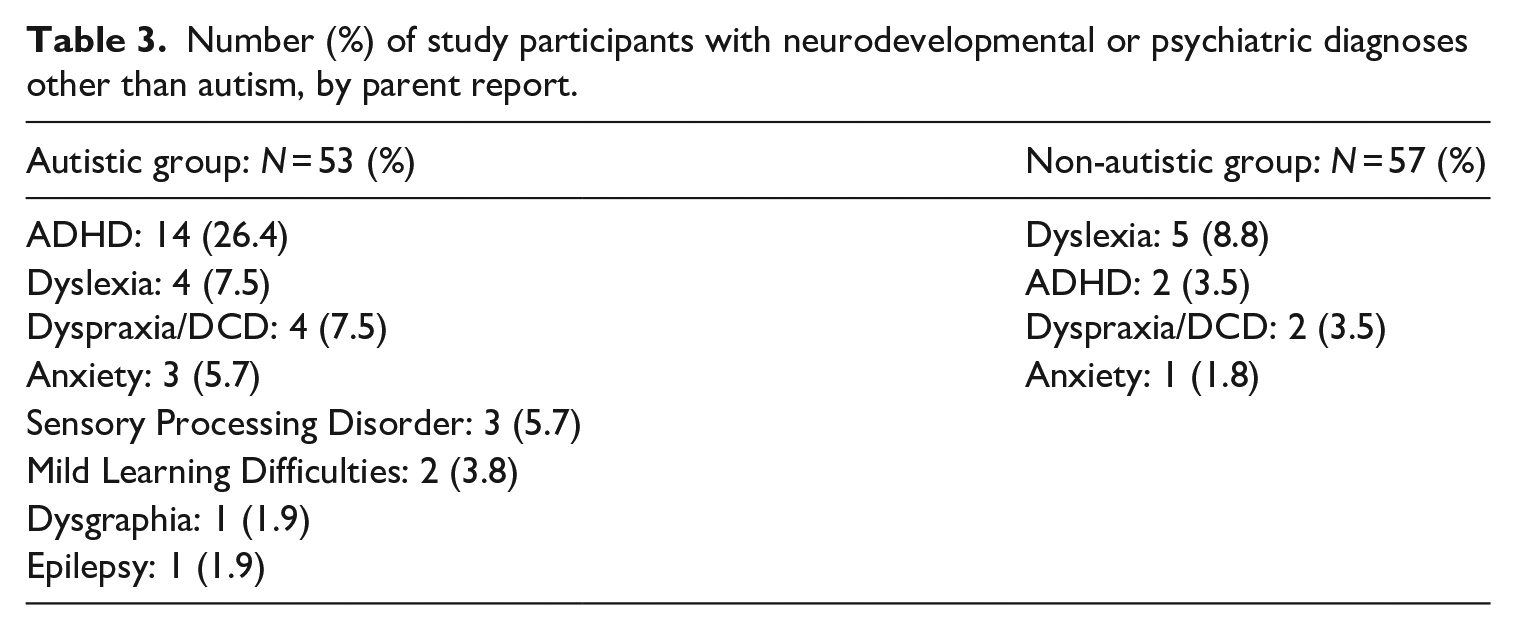
Some participants in both groups had additional neurodevelopmental or psychiatric diagnoses (e.g. ADHD, Dyslexia, Dyspraxia), although these were more common among the autistic participants (see Table 3).
Number (%) of study participants with neurodevelopmental or psychiatric diagnoses other than autism, by parent report.
Specific information on other demographic factors such as socio-economic status or parental level of education was not collected in this study.
Data analysis
Participants’ scores were analysed using IBM SPSS Statistics, version 28. In all analyses, narrative scores for Videos A and B were considered separately, due to important differences in the content and presentation of both videos. Previous research indicates that narrative performance is affected by varying task demands (Wallis & Westerveld, 2024) and that such effects may be more pronounced in autistic participants (Losh & Gordon, 2014). Video A was a non-verbal animated sequence, whereas Video B featured real actors and dialogue. Since these stimuli arguably placed a different set of demands on participants in terms of processing and comprehension, combining the scores from the two videos might have obscured potentially differing patterns of results.
Hierarchical linear regressions were carried out to investigate how diagnostic group contributed to unique variance in Story grammar total scores (RQ1) and Coherence total scores (RQ2) for each video. For each regression, the control variables of age (months), non-verbal cognitive scores (WASI-II: ‘Matrix Reasoning’), receptive vocabulary scores (BPVS-3) and expressive language scores (CELF-5: ‘Recalling Sentences’) were entered in the first block. In the second block, Group was entered as a dummy variable, to determine whether this added any unique variance after the control variables had been accounted for.
To investigate the relationship between narrative length and narrative quality (RQ3), post hoc analyses included narrative length as an exploratory third step in the regression models. To provide a measure of narrative length, the first author first reviewed the transcripts, deleting any unintelligible utterances and any non-word ‘filler’ utterances such as ‘um’ and ‘uh’. The word count feature of Microsoft Word was then used to calculate the total number of words produced in the account.
Community involvement statement
A small pilot study (N = 8) was carried out prior to data collection, to ascertain the feasibility of the research design and to trial the assessment materials and procedure. Pilot participants and their parents/carers were asked a detailed set of feedback questions following the assessment sessions. The aim of this study was to ensure that the tasks and methods of administration were appropriate and enjoyable for participants, and that the specific needs of autistic participants were identified and considered. Following this input, some adjustments were made to the data collection procedure before commencing the main phase of the study. For example, parents/carers of autistic participants were contacted ahead of their scheduled assessment to discuss whether any adjustments should be made for the session, such as planned movement breaks. The research team that carried out this study includes both a neurodivergent individual and a member of the autism community (parent of an autistic child).
Results
Scores for the main narrative measures are presented in Table 4.
Mean (SD) and range (min–max) for Story grammar total scores, Coherence total scores and narrative length for autistic and non-autistic groups, for Videos A and B.
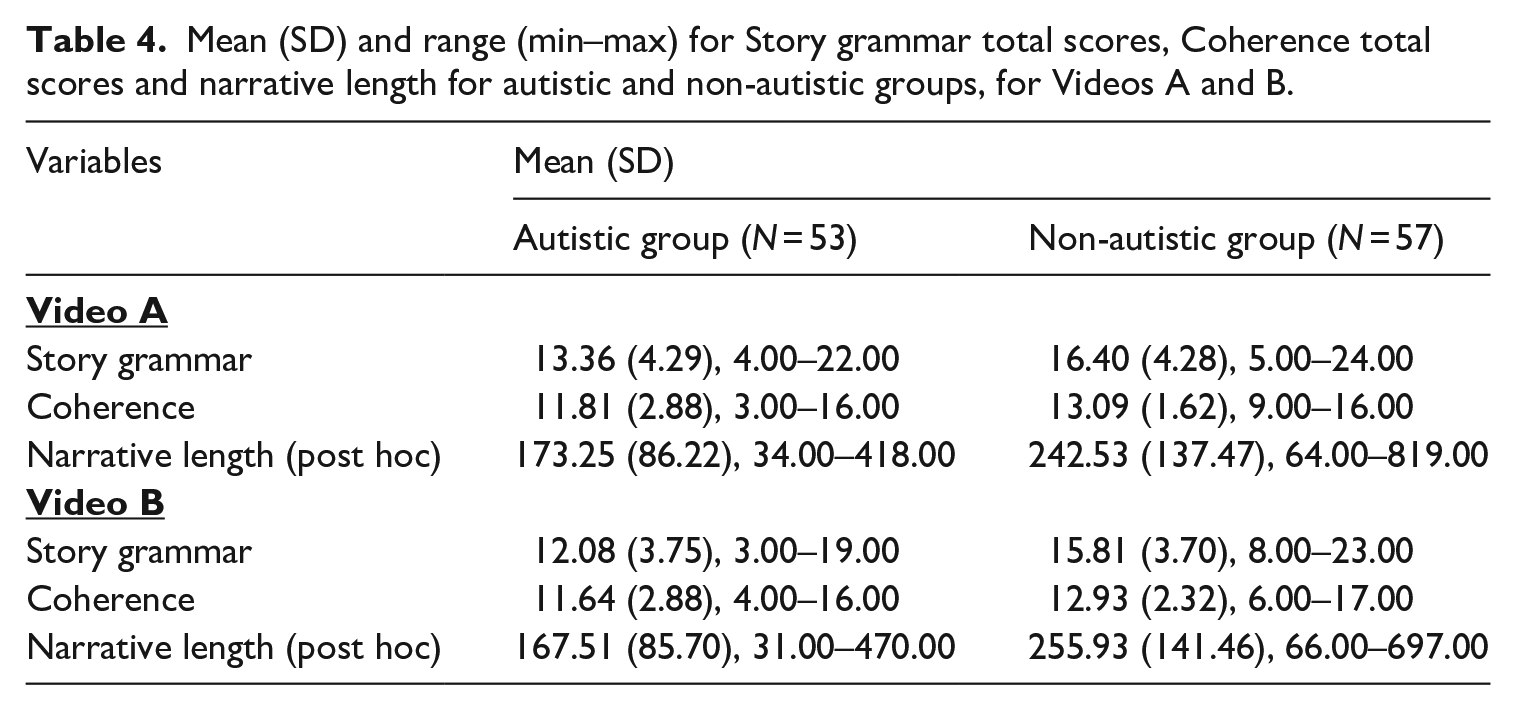
For each video, two-tailed Pearson correlation coefficients were used to investigate the relationships between Story grammar and Coherence scores. The two measures showed moderately large positive correlations across both videos (Video A: r = .60, p < .001; Video B: r = .66, p < .001). The correlations between Coherence (‘6Cs’) and Story grammar (an established measure of narrative ability) scores provided some indication of the validity of the ‘6Cs’ Coherence framework as an assessment tool. Moreover, the size of the correlations for both videos suggested that the two dependent variables (Story grammar and Coherence total scores) reflected similar, although not identical aspects of narrative ability. This dissociation between macrostructure and coherence was further evidenced by Pearson correlations carried out between each of the measures with narrative length. Story grammar total scores showed a large positive correlation with number of words for both Video A (r = .77, p < .001) and Video B (r = .76, p < .001). However, Coherence total scores were only moderately correlated with the length of participants’ narratives (Video A: r = .36, p < .001; Video B r = .47, p < .001). These findings supported our theoretical rationale for examining these aspects of narrative ability separately.
Story grammar: Video A (animated clip, no dialogue)
The first step of the model including all control variables was not statistically significant, R2 = .07, F(4, 105) = 2.06, p = .091, adj. R2 = .04, indicating that they did not predict overall narrative structure. However, when Group was added to the model in the second step, this was a significant predictor, R2 = .16, F(5, 104) = 4.08, p = .002, adj. R2 = .12, accounting for approximately 9% of additional variance in Story grammar scores, ∆R2 = .09, F(1, 104) = 11.36, p < .001, with the non-autistic group achieving higher scores than the autistic group.
When narrative length was added in an exploratory third step, this significantly predicted Story grammar total scores for Video A, R2 = .61, F(6, 103) = 27.07, p < .001, adj. R2 = .59, accounting for approximately 45% of additional variance, ∆R2 = .45, F(1, 103) = 118.84, p < .001, with the non-autistic group producing longer narratives than the autistic group. With the addition of narrative length to the model in Step 3, Group became non-significant as a predictor variable (p = .075). See Table 5.
Hierarchical multiple regression predicting total Story grammar scores (Video A) from age, non-verbal cognitive ability, receptive vocabulary, expressive language, diagnostic group and narrative length.
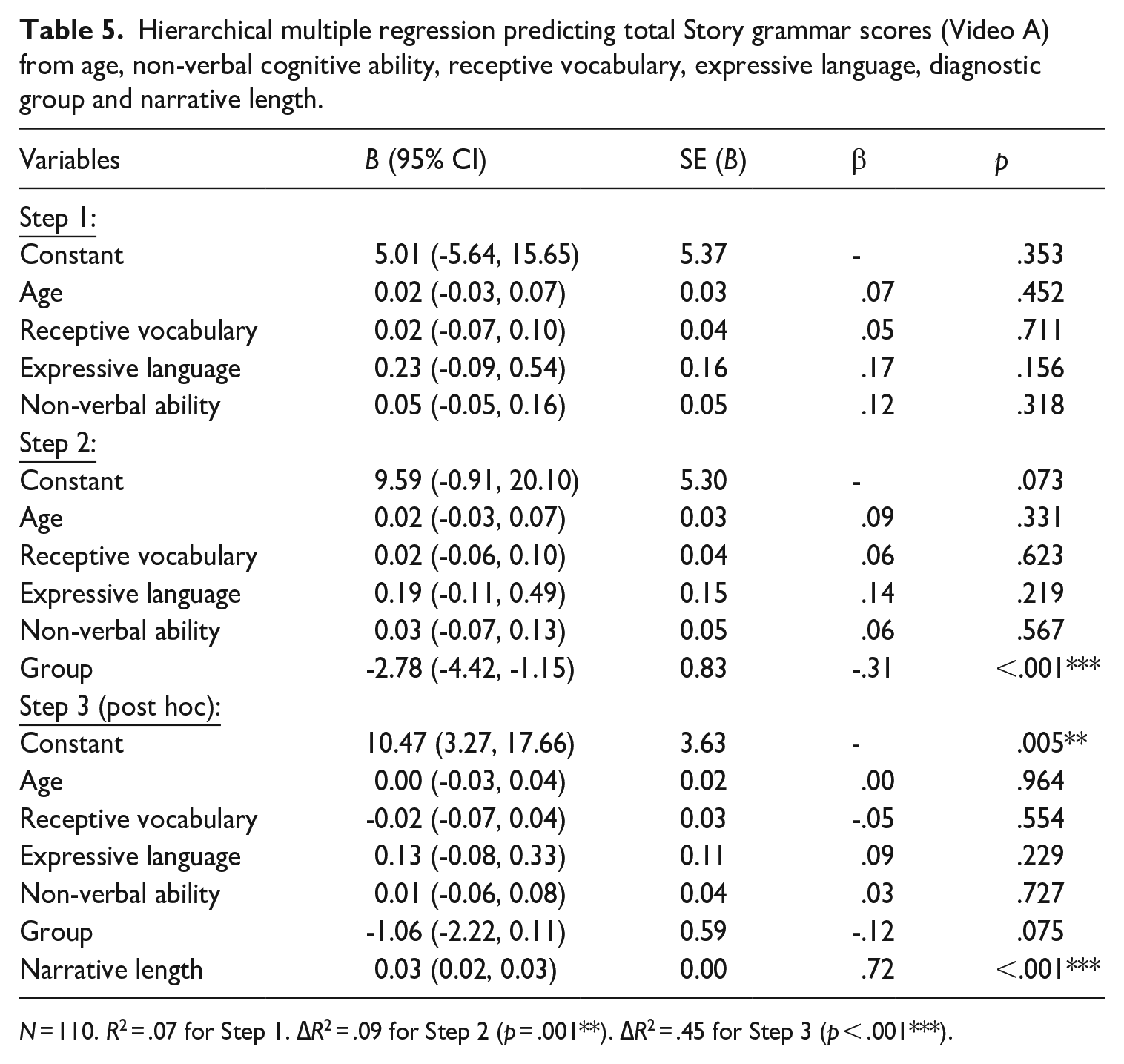
N = 110. R2 = .07 for Step 1. ∆R2 = .09 for Step 2 (p = .001**). ∆R2 = .45 for Step 3 (p < .001***).
Story grammar: Video B (real actors, with dialogue)
The first step of the model (control variables) was statistically significant overall, R2 = .12, F(4, 105) = 3.54, p = .010, adj. R2 = .09, accounting for 12% of the variance, although, on inspection of the beta values, none of the control variables reached significance individually. When Group was added to the model (Step 2), this was a significant predictor, R2 = .29, F(5, 104) = 8.30, p < .001, adj. R2 = .25, explaining almost 17% of additional variance, ∆R2 = .17, F(1, 104) = 24.24, p < .001, with the non-autistic group achieving higher scores than the autistic group.
When narrative length was added in an exploratory third step, this significantly predicted Story grammar total scores for Video B, R2 = .62, F(6, 103) = 27.73, p < .001, adj. R2 = .60, accounting for approximately 33% of additional variance, ∆R2 = .33, F(1, 103) = 89.53, p < .001, with the non-autistic group producing longer narratives than the autistic group. Even with the addition of narrative length to the model in Step 3, Group remained significant as a predictor of overall narrative structure (p = .002). See Table 6.
Hierarchical multiple regression predicting total Story grammar scores (Video B) from age, non-verbal cognitive ability, receptive vocabulary, expressive language, diagnostic group and narrative length.
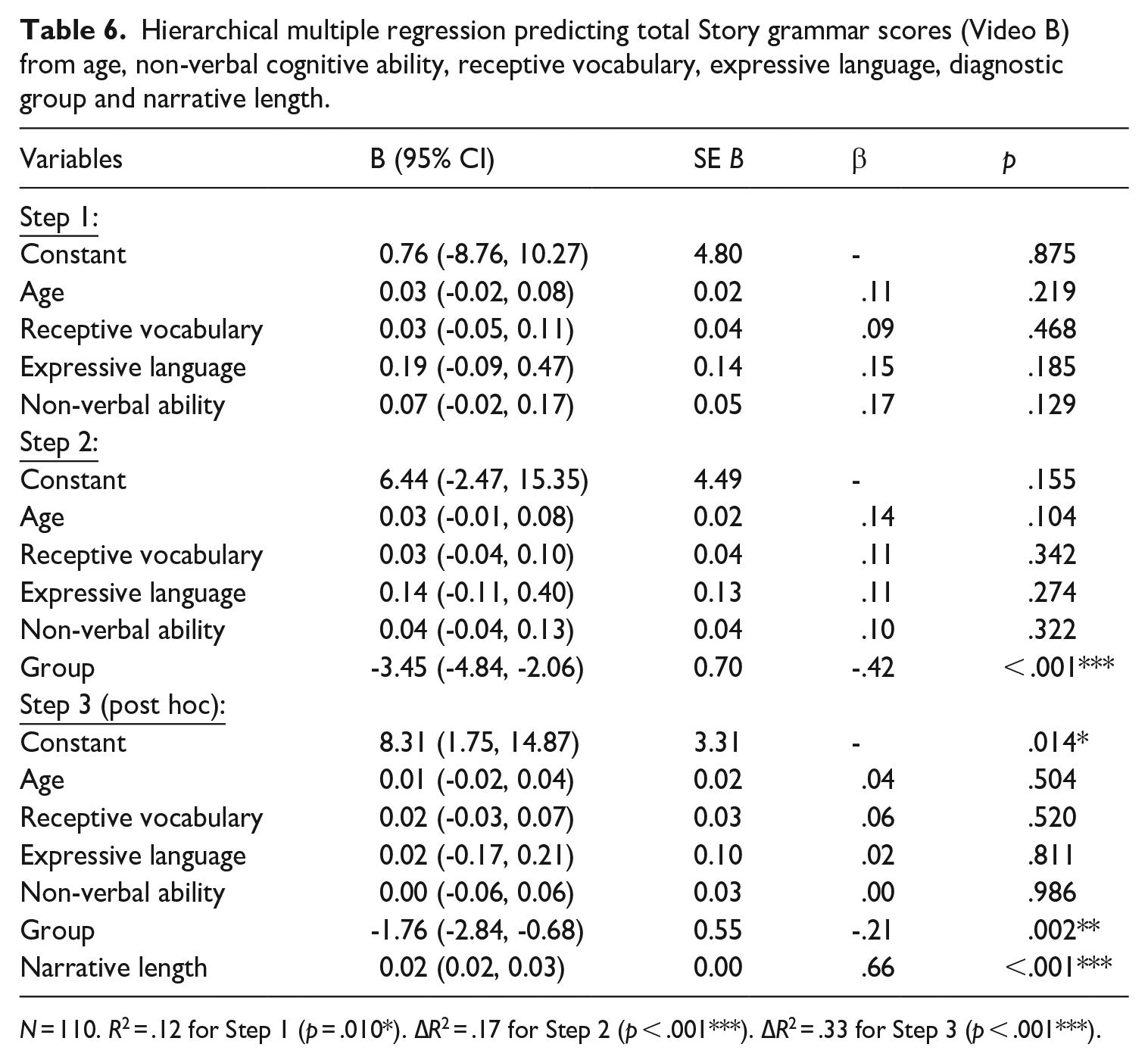
N = 110. R2 = .12 for Step 1 (p = .010*). ∆R2 = .17 for Step 2 (p < .001***). ∆R2 = .33 for Step 3 (p < .001***).
Coherence: Video A (animated clip, no dialogue)
The first step of the model was statistically significant overall, R2 = .09, F(4, 105) = 2.72, p = .034, adj. R2 = .06. However, on inspection of the beta values, none of the control variables reached significance individually. When Group was added to the model (Step 2), this was a significant predictor, R2 = .15, F(5, 104) = 3.79, p = .003, adj. R2 = .11, accounting for an additional 6% of variance in Coherence total scores, ∆R2 = .06, F(1, 104) = 7.43, p = .008, with the non-autistic group achieving higher scores than the autistic group.
When narrative length was added in an exploratory third step, this significantly predicted Coherence total scores for Video A, R2 = .21, F(6, 103) = 4.53, p < .001, adj. R2 = .16, accounting for approximately 5% of additional variance, ∆R2 = .05, F(1, 103) = 7.09, p = .009, with the non-autistic group producing longer narratives than the autistic group. Adding narrative length to the model rendered Group non-significant as a predictor of Coherence scores (p = .050). See Table 7.
Hierarchical multiple regression predicting total Coherence scores (Video A) from age, non-verbal cognitive ability, receptive vocabulary, expressive language, diagnostic group and narrative length.
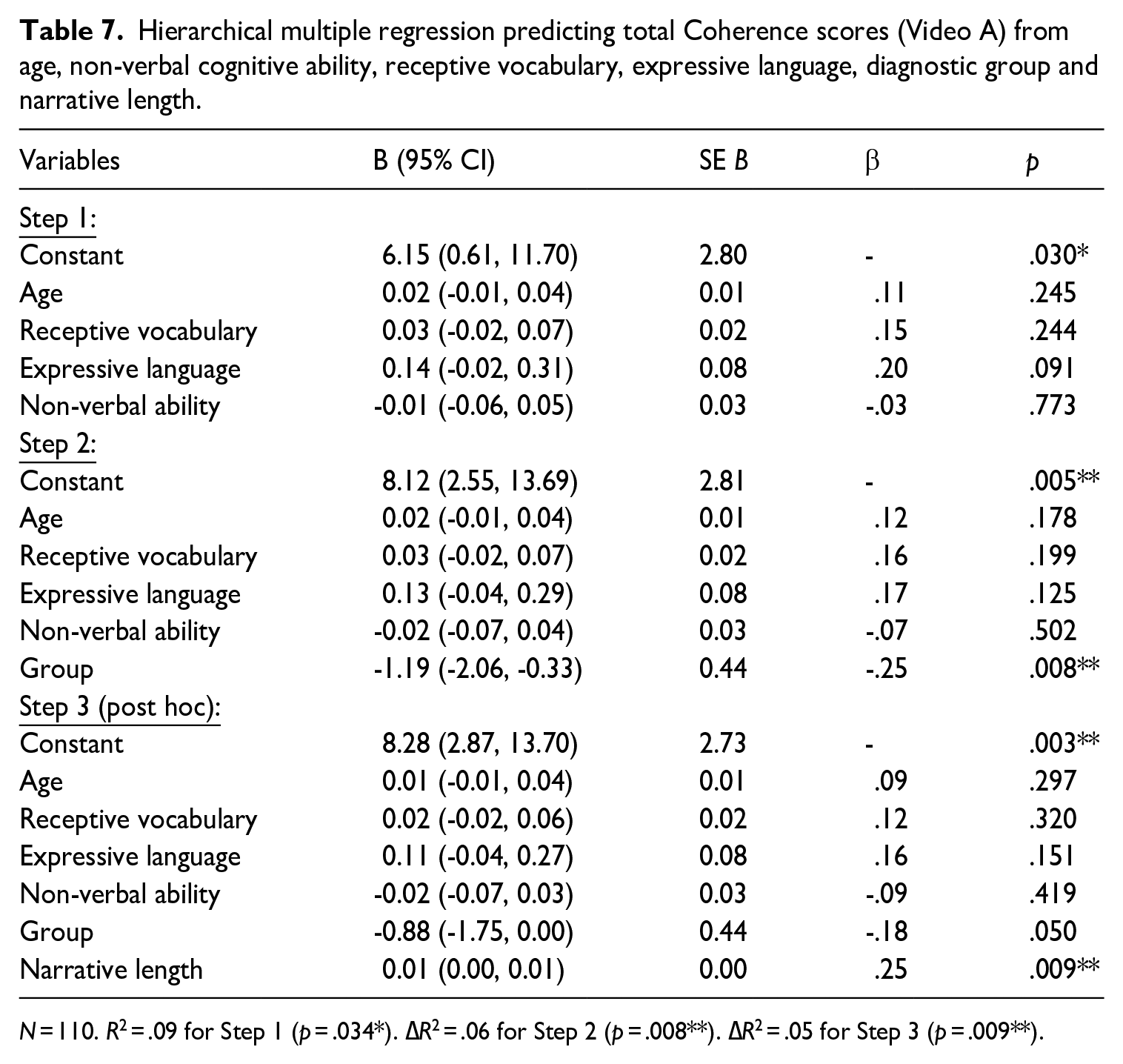
N = 110. R2 = .09 for Step 1 (p = .034*). ∆R2 = .06 for Step 2 (p = .008**). ∆R2 = .05 for Step 3 (p = .009**).
Coherence: Video B (real actors, with dialogue)
The first step of the model was statistically significant, R2 = .21, F(4, 105) = 6.77, p < .001, adj. R2 = .18, with age emerging as a significant predictor of Coherence scores for Video B (β = .22, p = .015). When Group was added to the model (Step 2), this was a significant predictor, R2 = .24, F(5, 104) = 6.70, p < .001, adj. R2 = .21, explaining an additional 4% of unique variance, ∆R2 = .04, F(1, 104) = 5.30, p = .023, with the non-autistic group achieving higher scores than the autistic group.
When narrative length was added in an exploratory third step, this significantly predicted Coherence total scores for Video B, R2 = .32, F(6, 103) = 8.14, p < .001, adj. R2 = .28, accounting for approximately 8% of additional variance in Coherence scores, ∆R2 = .08, F(1, 103) = 11.86, p < .001, with the non-autistic group producing longer narratives than the autistic group. As for Video A, with the addition of narrative length to the model, Group became non-significant as a predictor of Coherence scores for Video B (p = .248). However, Age remained a significant predictor of narrative coherence at Step 2 (β = .23, p = .010) and Step 3 (β = .18, p = .31). See Table 8.
Hierarchical multiple regression predicting total Coherence scores (Video B) from age, non-verbal cognitive ability, receptive vocabulary, expressive language, diagnostic group and narrative length.
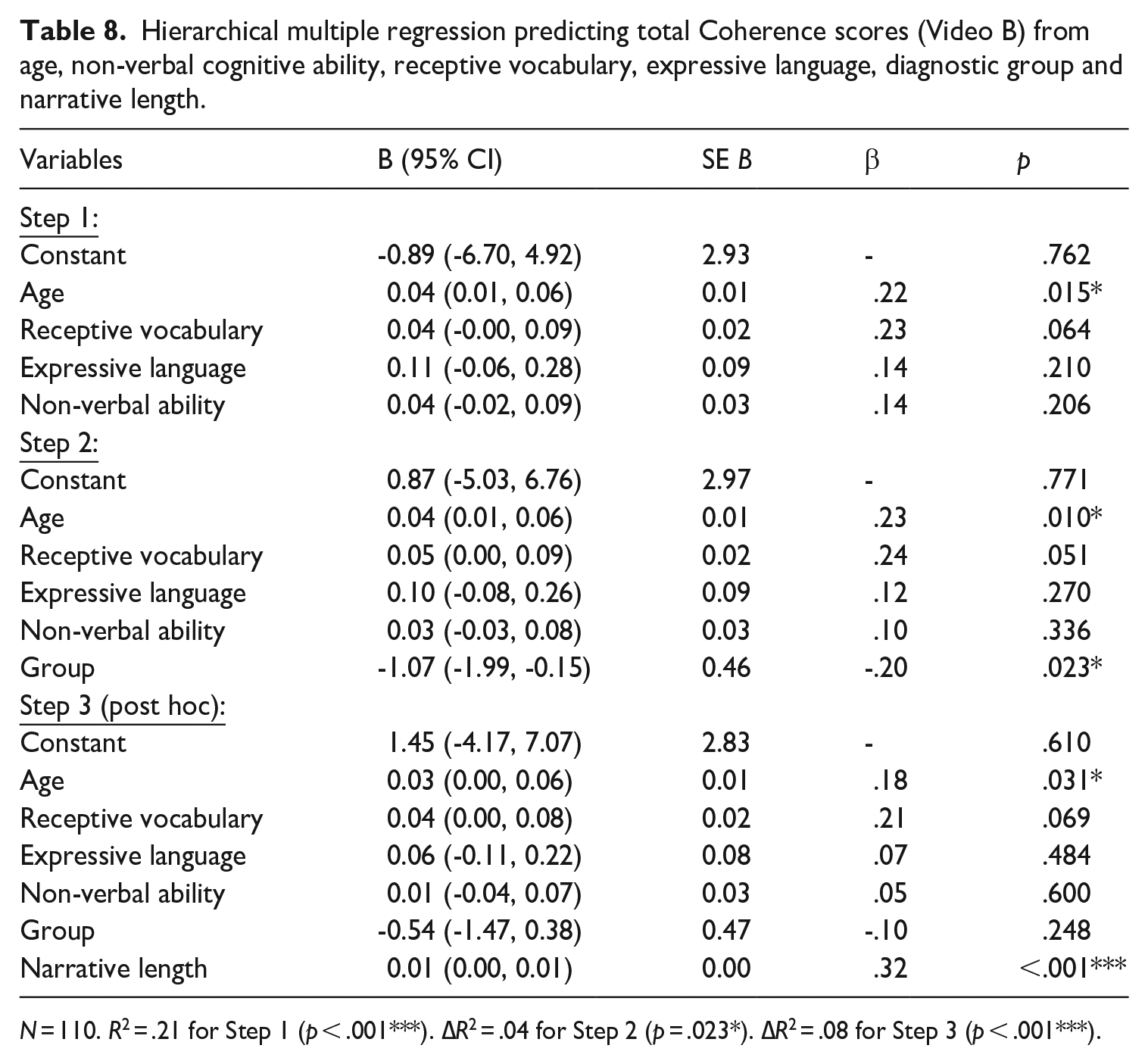
N = 110. R2 = .21 for Step 1 (p < .001***). ∆R2 = .04 for Step 2 (p = .023*). ∆R2 = .08 for Step 3 (p < .001***).
Discussion
The present study investigated narrative macrostructure (‘story grammar’) and coherence in free recall narrative accounts by autistic and non-autistic adolescents, using a task designed to reflect ‘everyday’ instances of narrative production. In response to conflicting findings in previous literature, possibly attributable to small samples and variability in group-matching procedures, this study included a larger sample size and controlled for the potentially confounding factors of age, non-verbal cognitive ability and receptive and expressive language skills in the analyses. We aimed to first establish whether there were significant differences between the groups’ performance on our key narrative measures (i.e. how their accounts as given were perceived by a rater), to provide insight into how any narrative difficulties might be experienced by listeners in the real world. We then ran post hoc analyses to explore the complex relationship between narrative length and narrative quality.
RQ1 and RQ2. How do autistic adolescents’ spoken accounts compare to those of non-autistic peers in terms of narrative macrostructure and narrative coherence?
In line with our prediction, as judged by a rater, non-autistic adolescents significantly outperformed a comparable group of autistic adolescents on measures of ‘story grammar’ when recounting the events of two video clips (see Step 2 of the relevant regression models). These findings support previous studies that have found macrostructural difficulties in autistic children and adolescents when using a ‘story grammar’ approach (e.g. Banney et al., 2015; Colozzo et al., 2015; Kuijper et al., 2017; Peristeri et al., 2017; Rumpf et al., 2012; Volden et al., 2017). Also as predicted, the spoken accounts produced by autistic participants in our sample were rated as less coherent overall than those of the non-autistic group, using a novel measure of narrative coherence (see Step 2 of the relevant regression models). The current results indicate that autistic narrators may find it more challenging to provide an account of events that is easy to follow and meaningful to their listener, supporting some previous findings in this area (e.g. Diehl et al., 2006; Hilvert et al., 2016; Maras et al., 2020). Unlike most prior research into narrative skills in autistic young people, the present study focused on ‘everyday’ narrative skills and used an unsupported recall task. A key implication of our findings is therefore that challenges with narrative macrostructure and coherence could have a negative impact on autistic adolescents’ daily social interactions with peers and adults (Losh & Capps, 2003; Petersen et al., 2008) as well as on their academic attainment (Worsfold et al., 2010).
RQ3. How does narrative length impact autistic and non-autistic adolescents’ scores on measures of narrative macrostructure and coherence?
We also investigated the relationship between narrative length and narrative performance in our sample, as an exploratory research question. Shorter narratives have been reported in some previous studies of narrative productivity in autistic children (e.g. Rumpf et al., 2012; Siller et al., 2014), and this finding was replicated in the present study. Narrative length, measured by number of words, was included as a post hoc third step in the regression models. When narrative length was included in the analyses, it significantly predicted a large proportion of unique variance in Story grammar scores and Coherence scores for both videos. Furthermore, for three of the four analyses on our narrative measures, it eliminated the observed group differences. Bliss et al. (1998) suggested that in addition to providing the listener with sufficient ‘facts’ about the story events, a coherent narrative must include enough detail and elaboration to engage the listener and help them to make sense of what they are hearing. Our findings indicate that shorter narratives include fewer story structure elements and are rated as less coherent than longer narratives, regardless of the narrator. Since autistic young people tend to produce shorter accounts compared to non-autistic peers, this may be a factor in the perceived quality of their spoken narratives.
Memory, narrative structure and pragmatic differences as potential explanatory factors
Although our findings indicate that length is implicated in successful narrative generation, the direction of this relationship remains unclear. Some researchers have suggested that reduced narrative length may be linked to memory differences documented in the autistic population. For example, Narzisi et al. (2013) found that autistic children with typical-range cognitive abilities had significant difficulties on a narrative recall task when compared to a neurotypical comparison group. Research on memory suggests that autistic people process and recall events differently to neurotypical individuals. There is evidence for a mixed profile including relative strengths in declarative and procedural memory, but areas of challenge relating to autobiographical and episodic memory (Williams et al., 2017). Both autistic children and adults have been found to recall autobiographical memories with less specificity, reduced elaboration and fewer details when compared to neurotypical controls (McDonnell et al., 2019). In addition, autistic individuals often display source monitoring difficulties in free recall tasks, that is, remembering ‘who’, ‘when’ or ‘where’ in relation to a specific event (Maras et al., 2020). It is possible that autistic participants in the present study may have produced shorter narratives due to these memory differences.
Alternatively, autistic participants may have had greater difficulty verbally structuring the events that they recalled from the video, resulting in accounts that were shorter. O’Shea et al. (2005) reported that autistic children aged 8–14 years recalled significantly fewer details on a story free recall task than non-autistic children matched on chronological and mental age, despite demonstrating equivalent fact recognition memory for the same stimulus stories. These authors suggested that the autistic group ‘were not able to use the structure of the story as a meaningful tool in which to freely recall the content information’ (p. 356). Similarly, underlying difficulties with coherence could have meant that autistic participants were less able to generate a coherent representation of story events for their listener, resulting in shorter narrative accounts overall.
A further possible explanation is that participants in the two groups may have interpreted the task instructions differently in pragmatic terms, affecting the amount of information they provided. It is important to note, however, that although for three of the four narrative measures, the inclusion of narrative length as a predictor eliminated group differences in performance, Group did remain a significant predictor for Story grammar scores in Video B. These results indicate that, at least in relation to macrostructure, productivity in terms of number of words was not the only factor differentiating autistic and non-autistic adolescents’ performance, and that performance may vary for narrative tasks with different demands, such as the presence or absence of language content.
Limitations
The present study had several limitations that should be acknowledged. This study was not sufficiently powered to investigate interactions between group and narrative length, which limited the conclusions that we were able to draw about possibly differing patterns of performance in relation to this factor. The autistic adolescents included in our sample had borderline to typical-range cognitive and linguistic skills and had relatively low support needs, with most attending mainstream school settings. This means that the findings may not be generalisable to the wider population of autistic young people, who may present with co-occurring language disorders, intellectual disability or other complex support needs. Despite efforts to recruit an equal number of male and female participants in each group, we did not achieve a balanced sample in terms of participant sex, with more male than female participants. The challenge of recruiting autistic females is well acknowledged in autism research (Shefcyk, 2015) and may be attributed to the underdiagnosis of autistic girls (Mandy & Lai, 2017). We also noted that minority ethnic groups were somewhat underrepresented in our sample when compared to ethnicity data for the whole UK population, again potentially limiting the generalisability of our findings.
Although the two groups were comparable on measures of age, non-verbal IQ, expressive, or receptive language (and we controlled these variables in regression analyses), individuals were not excluded from either group if they had co-occurring diagnoses. The aim was to obtain samples that were representative of the wider population rather than to attempt to isolate a ‘pure’ diagnostic profile (see Gillberg, 2010). In our final sample, however, many more participants in the autistic group had additional diagnoses than the non-autistic group, notably in relation to ADHD (14 autistic participants vs only 2 in the non-autistic group). This was unsurprising, given that the prevalence of co-occurring diagnoses in autistic people is estimated at more than 50%, with autism/ADHD being a particularly common dual diagnosis (Stevens et al., 2016). However, it does complicate the interpretation of observed group differences in our sample, as some of the variance in scores could be attributable to the impact of ADHD on narrative skills, particularly in the autistic group.
The study was advertised directly to families via the Internet, which may have led to a bias in recruitment. For example, the online format of the assessment session limited our sample to families that had access to a device with an Internet connection, and enough time and space for the child to take part in the assessment uninterrupted.
All data in this study were collected remotely, via online meetings between the participants and the researcher. Although there is a growing body of evidence to suggest that online video-based administration of formal language assessments shows good reliability and validity when compared to face-to-face administration (Ciccia et al., 2011; Waite et al., 2010); the impact on narrative performance is less clear. For example, Ferman and Kawar (2023) reported that Arabic-speaking children produced fewer utterances when asked to generate personal narratives during an online assessment (compared to face-to-face administration of the same task). However, this difference was not observed in a Hebrew-speaking comparison group, suggesting that individual participant characteristics may differentially influence narrative competence across elicitation contexts. In relation to the present study, the impact of diagnostic status on narrative performance in online versus face-to-face tasks remains unknown. It is possible that the online mode of administration may have affected the narrative output of the two groups in different ways, and the findings of this study should therefore be interpreted with some caution.
Although we consider that our video-based experimental task was more ecologically valid than that of many previous picture-based studies, it still fell short of fully replicating authentic instances of narrative generation, such as recounting personal narratives.
Describing a ‘real-life’ situation rather than an animation or filmed sequence might place a different set of cognitive demands on narrators, possibly resulting in important differences in narrative quality. Furthermore, the impact of the experimental situation may have affected narrative performance. Adolescents were required to narrate to an unfamiliar adult listener and might present differently in narrative contexts where they are addressing their friends, parents or familiar adults (McCabe et al., 2013). Participants may have also (correctly) assumed that the experimenter was familiar with the content of the video clip and therefore omitted some information from their narratives.
Implications and areas for future research
This study found that in an unsupported free recall narrative task, autistic adolescents showed comparative difficulty in structuring their spoken narratives by providing key story elements. They also produced accounts that were judged to be more difficult for a listener to follow. We suggest that verbally recounting events may prove challenging for autistic adolescents in the unstructured interactions of daily life; for example, conversing with peers or talking to teachers. Future research could extend the present findings by investigating how visual or verbal prompts might be used to support narrative production within such contexts.
Our findings also suggest that further research is required to directly investigate the relationship between narrative length and perceived narrative quality in autistic versus non-autistic samples, and how this may relate to memory differences previously documented in autistic people (e.g. Williams et al., 2017). This might provide additional insight into the most appropriate strategies for supporting autistic children and adolescents who find narrative discourse challenging. We also recommend that future research and clinical practice in this area should include unstructured storytelling tasks alongside the more traditional picture-based narrative assessments. This may better reflect the functional narrative skills of autistic young people in everyday life and help to inform new ways of supporting their communication in real-world situations.
Supplemental Material
sj-docx-1-fla-10.1177_01427237251315253 – Supplemental material for Everyday narrative skills in autistic adolescents
Supplemental material, sj-docx-1-fla-10.1177_01427237251315253 for Everyday narrative skills in autistic adolescents by Anna Harvey, Helen Spicer-Cain, Nicola Botting and Lucy Henry in First Language
Footnotes
Author contributions
Data availability statement
The authors do not have permission to share the raw data from this study.
Funding
The author(s) disclosed receipt of the following financial support for the research, authorship and/or publication of this article: The study reported in this article was carried out as part of the first author’s doctoral studentship, which was funded by City St George’s, University of London.
Ethical approval
Ethical approval for this study was obtained from the Department of Language and Communication Science Proportionate Review Committee at City St George’s, University of London (ETH1920-1434) on 14 July 2020.
Informed consent
Informed consent was obtained verbally from all participants and in written form from their parents before participating in the study.

Supplemental material
Supplemental material for this article is available online.
References
Supplementary Material
Please find the following supplemental material available below.
For Open Access articles published under a Creative Commons License, all supplemental material carries the same license as the article it is associated with.
For non-Open Access articles published, all supplemental material carries a non-exclusive license, and permission requests for re-use of supplemental material or any part of supplemental material shall be sent directly to the copyright owner as specified in the copyright notice associated with the article.
