




Abstract
This study investigated the complex relationship between false-belief (FB) understanding, structural language and pragmatic communication in typically developing children. A total of 78 Finnish children, aged from 4 to 6 years, including an equal number of boys and girls, participated in this study. In the first instance, the study explored the relationship between children’s structural language skills and their understanding in FB tasks. The children’s structural language was evaluated using the Token Test for Children, German’s Test of Word Finding and the structural language scales (Speech, Syntax, Semantics and Coherence) of the Children’s Communication Checklist (CCC-2). Subsequently, the study examined the relationship between FB understanding and pragmatic communication skills, as measured by the pragmatic communication scales of the CCC-2 (Inappropriate Initiation, Stereotyped Language, Use of Context and Non-verbal Communication). In addition, the study investigated the effect of sex on these skills. A significant effect was found between the ability to understand verbal instructions and FB reasoning. However, no significant effect was found for naming and word retrieval abilities, nor for linguistic abilities as assessed by the CCC-2’s structural linguistic scales. Furthermore, children who demonstrated higher skills in understanding the mental states of others also exhibited better pragmatic communication skills using the CCC-2’s pragmatic scales. Although girls outperformed boys in the FB task, sex did not significantly predict pragmatic communication skills. The result suggests interrelatedness of language comprehension and FB understanding, as well as between FB and pragmatic communication abilities in typically developing preschool children.
Introduction
Between the ages of 4 and 6 years, children exhibit rapid development in various capabilities and functions. These include the understanding of the minds of others (Wellman, 2014), as well as the development of pragmatic comprehension (Loukusa et al., 2007), and formal language functioning (Song et al., 2015). This period of simultaneous growth presents a unique opportunity to explore the interconnectedness of these developmental paths. The aim of this study is to understand how these abilities mutually support each other during development. Furthermore, it has been suggested that boys and girls may follow slightly different trajectories in their social communication development (Ash et al., 2017). This study explores the relationship between false-belief (FB) performance, structural language and pragmatic communicative abilities among typically developing Finnish preschool children. It also examines the role of children’s sex in this developmental process.
Theory of mind and FB tasks
Understanding that other people have minds of their own with different desires, intentions and beliefs as compared with one’s own state of mind helps with navigating the community of human minds. The ability to infer others’ mental states is referred to as the theory of mind (ToM; Premack & Woodruff, 1978). It has been suggested that ToM forms the basis for the interconnection of minds helping to explain and interpret the words and actions of others (Happé et al., 2017). In addition, ToM may draw upon similar underlying mental abilities, such as the ability to differentiate one’s own perspective from that of another, which are used in everyday social communication (Happé et al., 2017; Schaafsma et al., 2015). There are several ways to measure ToM, including tasks involving faux pas or irony (Baron-Cohen et al., 1999; Happé, 1994). All ToM tasks assess the capability to recognise the perspectives of others, but with varying degrees of demand for cognitive processing (Wellman & Liu, 2004). A frequently used method to assess children’s ToM ability is the application of FB tasks. These tasks require an understanding that beliefs are not necessarily shared, but a person may have FBs about the state of another person’s mind (Sodian et al., 2012; Wellman, 2014). In first-order FB tasks, a child is asked about the beliefs of the main protagonist in a scenario. The most common first-order FB tasks involve a change of location (e.g. Wimmer & Perner, 1983) or the introduction of unexpected content (e.g. Gopnik & Astington, 1988), both of which focus on exploring how a child understands that different people can have different beliefs about the same situation. Based on simple settings, these tasks measure the ability to construct a representation of another person’s mental state and to understand the consequences of FB. Preschool years are the most active period for the development of mental state attribution, and children typically start to pass language-based first-order FB tasks around 4 years of age, but there is marked variation in the rate of development (Wellman, 2014). Although the development of FB skills is universal, cultural background has been shown to have some impact on the rate of development (Selcuk et al., 2023).
Interaction between ToM and structural language skills
The role of language in the ToM learning process has been examined without conclusive evidence on the interaction between language development and adapting the perspectives of others (Kissine, 2021; Milligan et al., 2007). Studies of typically developing children suggest a link between language and FB skills (e.g. Farrar et al., 2017; Milligan et al., 2007), especially regarding FB tasks that require verbal answering (Grosse Wiesmann et al., 2017). A meta-analysis by Milligan et al. (2007) revealed a relationship between general language abilities and FB reasoning skills for preschool children when controlling for participant age. The meta-analysis suggested also that the relationship between language abilities and FB performance is potentially bidirectional. Nevertheless, Kissine (2021) has proposed that the connection between language learning and understanding the minds of others may not be equally strong for all individuals.
In addition, previous studies that have explored the interaction between FB understanding and distinct structural language domains have had mixed results (e.g. Lohmann & Tomasello, 2003; Slade & Ruffman, 2005). A crossover effect between receptive language skills and ToM capabilities has been suggested in some studies. For example, Venkadasalam et al. (2022) demonstrated that shared reading with a mother promotes not only receptive language skills but also ToM capabilities. Furthermore, Rosso and Riolfo (2020) found that receptive vocabulary correlated with ToM task performance in school-aged children. However, there are mixed findings concerning the role of semantic and syntactic abilities. Milligan et al. (2007) found that semantic ability accounted for 23% of the variance in FB tasks, but Slade and Ruffman (2005) did not find any connection between semantic and FB abilities. Some studies suggest that syntactic abilities are linked to the development of FB reasoning skills (de Villiers & Pyers, 2002; Grosse Wiesmann et al., 2017; Lohmann & Tomasello, 2003), while others have not found such a link (e.g. Lind & Bowler, 2009; Slade & Ruffman, 2005). It has also been proposed that advanced linguistic skills can help to construct meaningful mental representations by connecting states of mind to context, place and time (Sodian et al., 2012). There is also research to suggest that children learn how to discuss and reason concerning the perspectives of others when they have acquired the appropriate mental language skills (e.g. Peters et al., 2009). Nevertheless, the causal mechanisms between FB abilities and language are unclear (Farrar et al., 2017; Lind & Bowler, 2009).
Interaction between ToM and pragmatic communication skills
Pragmatic communication refers to the use of language appropriate to a particular situation and audience, and it relies on using contextual cues in complex ways (Loukusa et al., 2017). Pragmatic competence requires more than linguistic competence, including understanding the intentions of others (Bara, 2010; Sperber & Wilson, 2002). Many studies have suggested that the ability to understand other peoples’ beliefs is an integral part of pragmatic communication (Matthews et al., 2018; Westra & Carruthers, 2017). Comprehension of the pragmatic meaning of communicated messages entails that a child forms a mental representation of another person’s mind, based on linguistic and non-linguistic input (Sperber & Wilson, 2002; Sullivan et al., 2022).
Pragmatic communication skills and ToM abilities can be viewed as partially overlapping (Cummings, 2015; Sperber & Wilson, 2002). Studies that have focused on ToM skills and pragmatic communication have often searched for a link between certain aspects of pragmatic communication (e.g. metaphor comprehension) and ToM understanding. For example, Bosco and Gabbatore (2017) found that the FB performance of 3- to 8-year-old children was connected to their capability to understand and produce sincere and deceitful communication acts. However, Szücs and Babarczy (2017) did not find such a link between irony and FB performance in 5- to 8-year-old children. In addition, Lecce et al. (2019) found that the connection between children’s ToM skills and understanding of mental metaphors diminished with age. Regardless of findings showing interconnection between ToM and some pragmatic skills, real-life pragmatic challenges may not manifest in ToM tasks (Mognon et al., 2021). It has also been suggested that pragmatic skills are partly independent of ToM skills (Bosco et al., 2018; Kissine, 2021). Although several studies have sought to establish a link between pragmatic competence and ToM skills, the question remains whether ToM skills are linked to everyday pragmatic functioning, and in particular, whether there is a connection between FB understanding and pragmatic functioning of children.
FB and communication skills in boys and girls
Earlier studies have found some differences in FB understanding between boys and girls. Walker (2005) found that 3- to 5-year-old girls outperformed boys in FB tasks, while Calero et al. (2013) reported a similar finding in children between 6 and 8 years of age. Charman et al. (2002) found that 3- to 5-year-old girls had only marginally higher FB reasoning skills than boys. It has also been suggested that in FB skills, the effect of sex is developmentally less critical than the effect of age (Charman et al., 2002; Girli & Tekin, 2010).
While research shows better performance for girls in some areas of pragmatic communication (Ash et al., 2017; Gabbatore et al., 2023), not all studies confirm sex differences in pragmatic communication skills (Collins et al., 2014; Yliherva et al., 2009). For example, Loukusa et al. (2007) found no sex-related differences in 4- to 8-year-old children when asked to use contextual information in pragmatic understanding. Pragmatic communication differences between boys and girls are potentially related to distinct pragmatic abilities (Ash et al., 2017; Gabbatore et al., 2023). For example, boys initiate fewer requests for help than girls (Thompson, 1999). Nevertheless, the role of sex in the interaction between FB understanding and communication skills has received little attention in typically developing children.
Aims of this study
Since previous research has shown variable results concerning the developmental link between effective everyday communication skills and understanding the mental states of others, and also the role of sex in the interaction, we will further explore the connection between FB reasoning, and structural and pragmatic communication skills in 4- to 6-year-old boys and girls. The specific goals are as follows:
To examine possible sex differences in FB performance.
To explore the relationship between structural language skills and FB understanding. The structural language skills to be investigated include (a) the ability to follow verbal instructions, (b) naming and word retrieval and (c) parent-evaluated structural language abilities.
To explore the relationship between FB understanding, sex and pragmatic communication skills as evaluated by parents.
Method
Participants
This study included 78 typically developing Finnish children (mean[SD] 5 years 5 months [10 months], range 4 years 1 month – 6 years 10 months), with equal numbers of girls (n = 39) and boys (n = 39). The ages of the girls and boys were matched, for the girls the age range being 4 years 1 month – 6 years 9 months (mean[SD] 5 years 5 months [10 months]) and for the boys 4 years 1 month – 6 years 10 months (mean[SD] 5 years 5 months [10 months]). The children were recruited from local kindergartens and preschools. Using a questionnaire, the parents of the children were asked about their child’s early language development. Children were excluded from the study if they had a history of delayed language development or had previously received speech therapy, except for therapy for a single speech sound error. None of the participants had a diagnosis for a language disorder or neurological condition. Since children in Finland typically start school at the age of 7, none of the participants were attending school. All participants were native Finnish speakers with normal hearing, as reported by their parents. Participation in the study was voluntary and with parental written consent. The ethical approval for the study was given by the regional medical research ethics committee of the Northern Ostrobothnia Welfare Region.
Behavioural measures
The participants completed the Pragma test, a tool used to assess pragmatic language skills (Loukusa, 2019). The FB task of this study is comprised of two items of the Pragma test (Table 1). The FB items assessed the participants’ ability to answer a ‘Change-of-location’ and an ‘Unexpected-content’ type of first-order FB tasks. The items consisted of a short verbal description of the scenario presented with paper dolls and plastic objects. After describing the scenario, the researcher asked a question concerning the beliefs of one of the characters. In line with the instructions of the Pragma test, the question was repeated once only if the participant requested a clarification. The FB task score is a sum score of the Change-of-location and Unexpected-content questions ranging from 0 to 2. The score depends on the number of items answered correctly, the maximum score being 2. The assessments using the Pragma test took place in a quiet environment at a kindergarten, at the participant’s home, or on the premises of the University of Oulu. The test situation included only the participant and the test administrator (a speech therapist or a final-year speech therapy student).
False-belief (FB) items of the Pragma test.
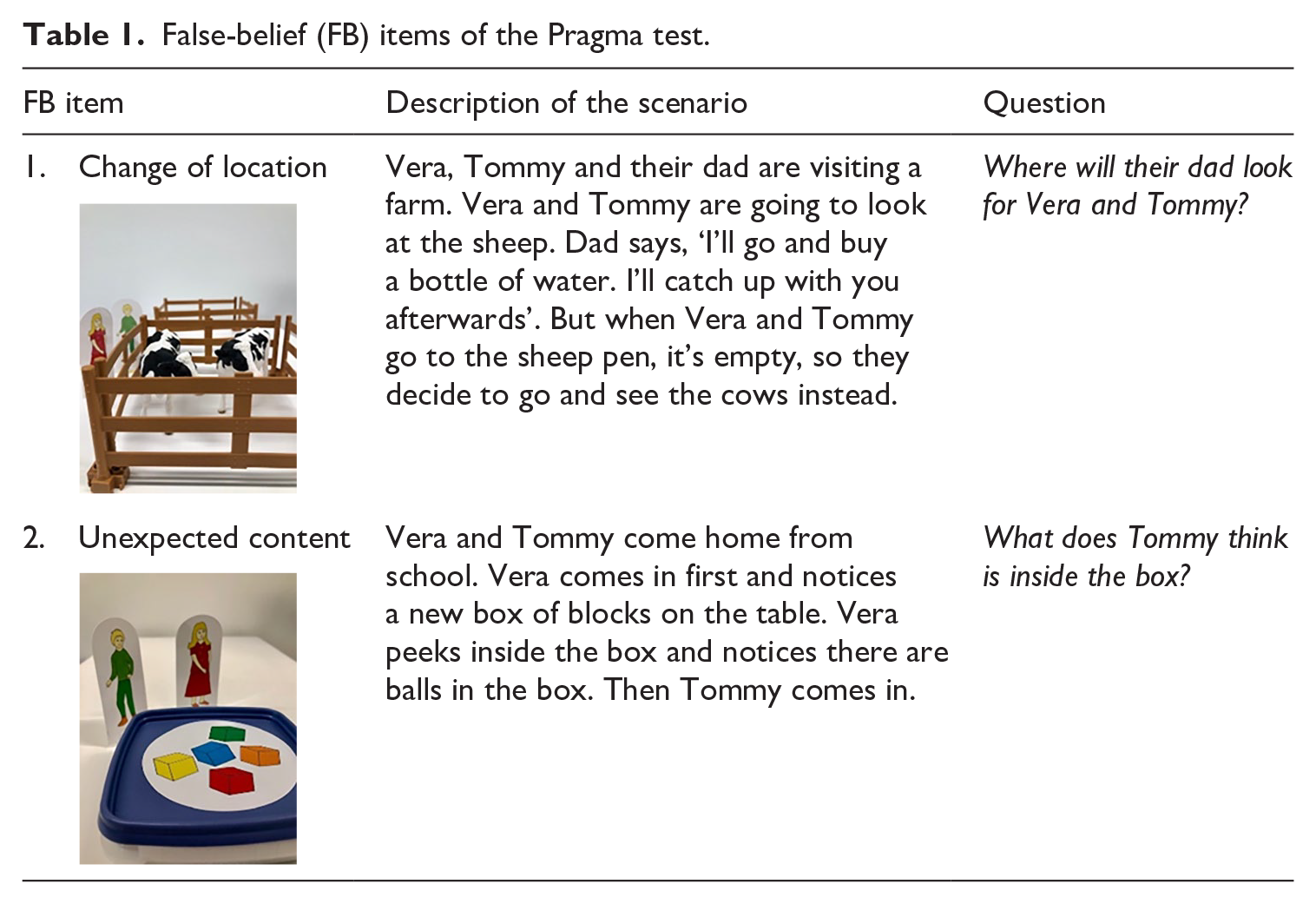
The language skills of the participants were assessed using two linguistic tests: the Token Test for Children (TTFC-2; McGhee et al., 2007) and German’s Test of Word Finding (second edition), Finnish version (TWF-2; German, 2000). The TTFC-2 test provides critical information about receptive language abilities in children as it measures the ability to follow multi-step verbal instructions with varied lengths and increasing complexity. During the test consisting of 46 verbally transmitted instructions, a child is required to manipulate the provided tokens of different shapes and colours according to the given instructions. This probes the child’s understanding of various spoken language components, such as syntactic structures and knowledge of relational concepts and the ability to memorise and recall instructions from short-term memory. The test begins with a child following instructions to touch an object described by its size, colour and shape. As the test progresses, the child must touch two different objects, identified first by their colour and shape and later by size as well. The final stage involves manipulating objects with various properties, guided by instructions that incorporate relational concepts. The syntax of the tasks simplifies as follows: (1) initial phase: verb (V) + adjective (ADJ) + ADJ + noun(N), (2) later phases: V + ADJ + ADJ + N + ‘and’ + ADJ + ADJ + N and (3) final phase: instructions include relational concepts, such as ‘behind’ and ‘with’, for object manipulation.
TWF-2 is a single-word expressive language test which was used to assess the naming and word retrieval abilities of the participants. The test focuses on four areas of expressive language: (1) picture naming with nouns when the target word is one to four syllables long, (2) sentence completion by providing appropriate words, (3) picture naming with verbs and (4) object naming by the categories to which the objects belong.
In statistical analyses, raw scores of both TTFC-2 and TWF-2 tests were used to allow comparison with FB task performance. The TTFC-2 test has not been standardised for a Finnish-speaking population. The raw score range is 0–46 points for TTFC-2 and 0–64 points for TWF-2.
The parental view of the language and communication skills of the participants was assessed using the Finnish version (Bishop, 2015) of the CCC-2 (Bishop, 2003), which can be used to identify the everyday language and pragmatic functioning of children. There are 10 scales in the CCC-2 questionnaire and each scale has 7 items with 4 alternatives for each (0 = less than once a week, 1 = at least once a week, 2 = once or twice a day, 3 = multiple times a day or always). Out of seven items, five focus on weaknesses and two on strengths. When counting the raw sum score for each scale, the scores of the strength items are reversed. The higher the raw score, the weaker the performance. The first eight scales of CCC-2 are used to assess general communication abilities (Bishop, 2003). The Speech, Syntax, Semantics and Coherence scales measure linguistic and discourse skills. The raw sum scores of the Speech, Syntax, Semantics and Coherence scales were added together to form the Structural Index (SI, see also De la Torre Carril et al., 2021), which presents the structural language abilities of a child. The Speech scale focuses on speech production skills such as articulation and fluency, whereas the Syntax scale focuses on the structure of language on the sentence level by assessing the ability to use syntax structures and produce complex sentences. Questions in the Semantics scale are related to the use of words and phrases in order to express ideas and the understanding of word meanings. The Coherence scale assesses the ability to produce meaningful and connected discourse by using language to express logical relationships. Pragmatic aspects of communication were assessed by using the Inappropriate initiation, Stereotyped language, Use of context and Non-verbal communication scales (Bishop, 2003). The Inappropriate initiation scale is concerned with unsuitable speech acts when the initiation of the conversation does not fit the timing or context of the current situation. The Stereotyped language scale assesses whether a child uses patterned or repetitive language in communication. The Use of context refers to the ability to interpret others or to use language in a way that is sensitive to the communication context, including social rules. The Non-verbal communication scale focuses on the usage and understanding of nonverbal conversational cues conveyed by gestures, facial expressions and speech prosody. To present the pragmatic communication abilities, raw sum scores of the Inappropriate initiation, Stereotyped language, Use of context and Non-verbal communication scales were added together to form the Pragmatic index (PI, see also De la Torre Carril et al., 2021). The last two scales of CCC-2, namely Social relations and Interests, were excluded from this study since these scales are sensitive to potential autistic features in a child. Therefore, they are outside the scope of this study.
Statistical analysis
The relationship between sex and FB task performance was examined using Pearson’s Chi-square test. In addition, we explored the relationship between structural language skills and FB task performance utilising an ordinal logistic regression model designed to predict the outcome of the FB task based on the TTFC-2, TWF and SI scores while adjusting for sex and age. The model fitness was assessed using Chi-square statistics, which showed a significant relationship between dependent and independent variables in the final model (χ2[5]= 35.36, p < .001). The goodness-of-fit Pearson test indicated that the model was fit (χ2[149]= 134.4, p = .80). McFadden’s Pseudo R-square measure proved that the model accounted for 22.4% of the variance.
The study examined the effect of FB task performance and sex on pragmatic communications skills (PI) by using the multiple linear regression model while accounting for the effect of age. The normal distribution of residuals and linearity and homoscedasticity of the model were ensured by visual inspection of the data. Variance inflation factor (VIF) statistics was at an acceptable level (VIF < 3) indicating low multicollinearity among the predictor variables (FB performance, sex and age) in the model.
The statistical analysis was performed using IBM’s SPSS Statistics tool (version 28).
Results
Descriptive statistics of the participants
Out of the 78 children, 42 (54%) completed the FB task with a maximum score of answering both questions correctly, 18 (23%) answered one FB question correctly and 18 (23%) answered both questions incorrectly. The mean score for all participants in the task was 1.3 (SD 0.8). The performance in the FB task depended significantly on sex (χ2[2]= 9.21, p = .01). Overall, girls (mean[SD]= 1.5[0.8]) performed better than boys (mean[SD]= 1.1[0.8]). Most of the girls (69%) answered both FB questions correctly, compared with 39% of the boys (Figure 1[a]). In addition, 36% of the boys answered one FB question correctly (girls 10%). When examining the FB questions in detail (Figure 1[b]), a significant association was observed between Change-of-location and Unexpected-content questions in girls’ responses (χ2[1]= 20.84, p < .001), indicating similar answers to both question types. In contrast, boys’ answers did not show such an association (χ2[1]= 3.143, p = .105), which can be attributed to a lower number of correct answers on the Change-of-location question compared with the Unexpected-content question.
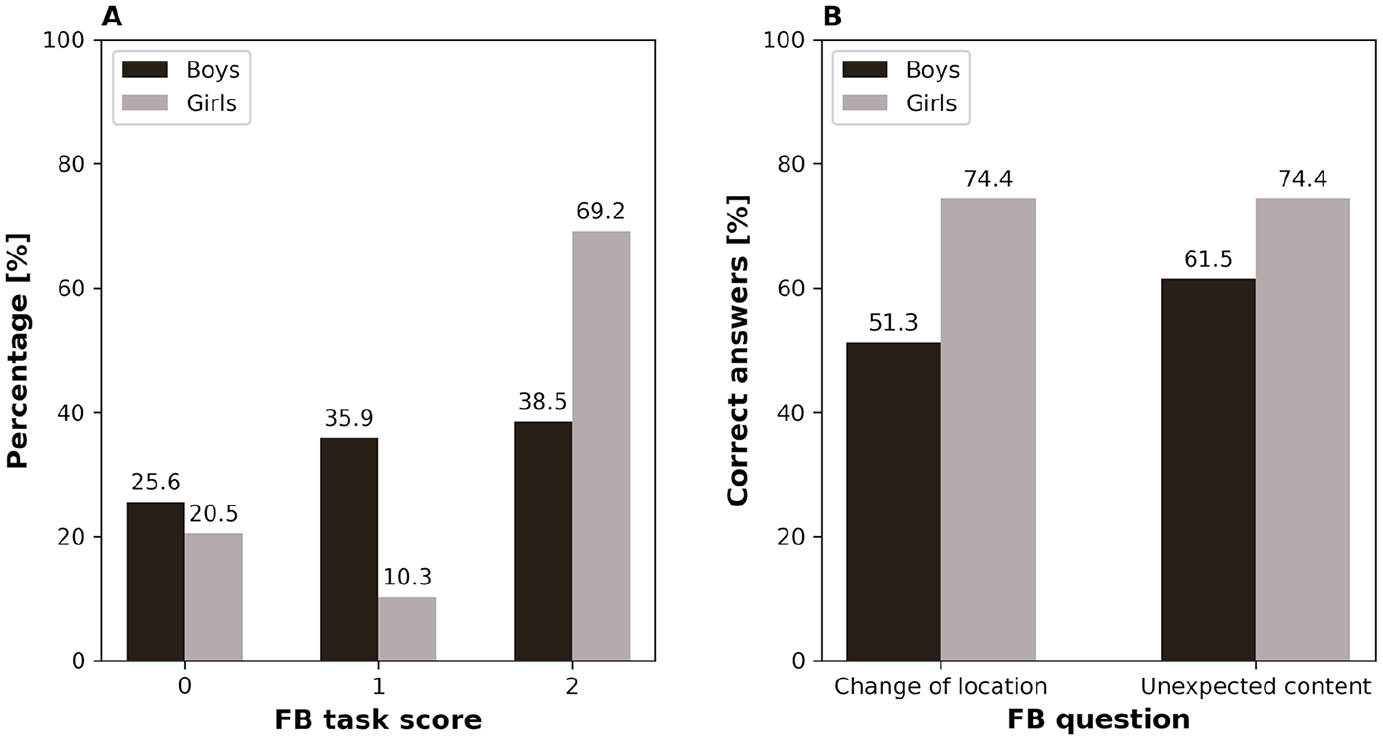
(a) False-Belief (FB) Task Performance and (b) Correct Answers on the FB Task Type by Sex.
Relationship between structural language skills and FB performance
Violin plots (Figure 2) were created to depict the distribution of TTFC-2 (mean[SD] 30.6[7.7], range 4–44), TWF-2 (mean[SD] 29.5[5.3], range 16–38) and the SI scores (mean[SD] 7.4[6.3], range 0–34) with respect to the FB scores. The mean values of the predictive linguistic variables TTFC-2, TWF-2 and SI for each FB value (0, 1, 2) are given in Figure 2(a)–(c), respectively. An ordinal logistic regression was performed to create a model of the relationship between the predictor variables TTFC-2, TWF-2 and SI, and the FB score while adjusting for sex and age. The regression model showed (Table 2) that for each unit increase in TTFC-2, the chance of improving the FB task outcome increased by a factor of 1.13, which was statistically significant at the level of .05 (p = .017). Therefore, TTFC-2 performance significantly predicted performance in the FB task (Figure 2[a]). The effects of other linguistic variables TWF-2 and SI remained insignificant in relation to the FB task scores. In addition, the logistic regression model verified the previous result (Figure 1) showing that sex is a significant (p = .048) predictor of FB task performance (Table 2). Age remained an insignificant predictor.

Distribution of (a) Token Test for Children (TTFC-2), (b) German’s Test of Word Finding (TWF-2) and (c) Structural Index (SI) Scores With Respect to False-Belief (FB) Task Scores.
Ordinal logistic regression model used to predict false-belief (FB) task performance.

CI, confidence interval; SE, standard error; TTFC-2, Token Test for Children; TWF-2, Test of Word Finding; SI, structural index.
p < .05.
PI of CCC-2 by FB task performance
A multiple linear regression was conducted to predict pragmatic communication ability (PI; mean[SD] 8.6[6.6], range 0–29) based on FB skills and sex while accounting for the effect of age. The regression model was significant, F(3,74) = 4.83, p = .004, with R2 = .16 which equals a medium effect. The results (Table 3) indicate that FB task performance predicted PI scores significantly (β = –.34, p = .009). Children with higher FB task scores had better pragmatic skills, indicated by lower PI scores, compared with children with lower FB task scores (Figure 3). The results (Table 3) also show that sex did not significantly predict PI scores.
Multiple linear regression model used to predict pragmatic index (PI).

B, unstandardised coefficient; β, standardised coefficient; CI, confidence interval; FB, false-belief task performance; SE, standard error; VIF, variance inflation factor.
p < .01.

Pragmatic Index (PI) by the False-Belief (FB) Task Score.
Discussion
FB assessments can be used to examine a child’s capacity to understand the minds of others, which is a skill that forms a basis for effective communication in social interaction. In typical development, potentially multiple variables contribute to FB reasoning skills; therefore, we wanted to explore what appears to be a multifaceted developmental link between language skills and FB understanding in 4- to 6-year-old children. In addition, we examined the role of FB understanding in pragmatic communication. In our study, we found a link between receptive linguistic skills as measured by TTFC-2 and FB understanding. We also found a link between FB and pragmatic communication skills as assessed by the pragmatic scales of the CCC-2.
Since TTFC-2 focuses on the ability to follow multi-step verbal instructions, the result provides support for the suggestion that receptive language abilities, such as comprehending morpho-syntactic structures and understanding relational concepts, are linked to FB skills (Kim, 2016; Maridaki-Kassotaki & Antonopoulou, 2011), and in particular, being a precursor for explicit FB understanding (de Villiers & Pyers, 2002). Although, the instructions of the TTFC-2 test do not necessitate an understanding of mental concepts, comprehending the relational aspects of language can support reasoning about mental states of others from linguistic cues (de Villiers & de Villiers, 2014). The development of receptive language provides opportunities for engaging in discussions and for inferring the mental states of others. Our FB task was based on verbal scenarios and therefore required a certain level of receptive language skills. However, it is unlikely that the children could have mastered the FB task based on structural language inferencing strategies only, without adopting the perspectives of others (Kissine, 2021; Lohmann & Tomasello, 2003). Similar performance in both FB and TTFC-2 tasks could indicate that the children relied on similar underlying cognitive processing mechanisms in both tasks (Happé et al., 2017; Wellman, 2014). Furthermore, both tasks required the ability to memorise and retrieve information from memory. Working memory may have been an influencing factor in both FB reasoning and the recalling of verbal instructions in the TTFC-2 task (Kim, 2016). However, previous research has not been able to confirm the role of working memory in the interplay between language and FB understanding (Slade & Ruffman, 2005). The test scenarios in our study were presented using toy objects, with the aim to reduce verbal memory load.
It was also shown that there was no significant association between TWF-2 test scores and performance on the FB task. This suggests that the participants’ expressive language abilities, as demonstrated by their naming and word retrieval skills, did not influence their capacity to infer mental states in the presented FB scenarios. The TWF-2 test involved picture naming of different word categories, sentence completion and description naming. In other words, it targeted word production and lexical knowledge. Our results indicate that lexical knowledge may be independent of ToM skills (Kissine, 2021). The result is also congruent with the meta-analysis by Milligan et al. (2007) which did not show a strong link between lexical knowledge and FB understanding. Nevertheless, some studies have shown that the size of mental state vocabulary and FB reasoning skills correlate (Nielsen & Dissanayake, 2000; Peters et al., 2009). However, the TWF-2 test used in this study did not focus on mental state words. The performance in the TWF-2 test can be related not only to the size of the vocabulary but also to lexical retrieval ability. It has been suggested that word retrieval ability is connected to general cognitive processing capabilities indicating a common basis with mental state reasoning (Messer & Dockrell, 2006). Based on our results, this potentially shared underlying mechanism between word retrieval and FB reasoning remains unsupported.
As a further contribution to the discussion about the role of structural language in FB reasoning, everyday expressive language skills were assessed using the sum score SI comprised by the language scales of the CCC-2, including Speech, Syntax, Semantics and Coherence (Bishop, 2003; De la Torre Carril et al., 2021). In our study, we did not find a significant relationship between the SI scores and FB reasoning skills, which is in line with our finding concerning the other expressive language measures (TWF-2). The lack of evidence concerning the link between expressive language and FB abilities might indicate that the potential association between structural language and ToM skills does not apply similarly to all areas of language but is mainly connected to the understanding of spoken language as shown by the TTFC-2 test (Kim & Phillips, 2014; Maridaki-Kassotaki & Antonopoulou, 2011). Furthermore, this study involved both direct (TTFC-2, TWF-2) and indirect (CCC-2) methods to assess children’s structural language skills. While direct assessments measure children’s ability to perform in a structured situation, parent-rated assessments, such as CCC-2, rely on observations in typical communicative situations, which can give a good picture of a child’s everyday functioning, although indirect assessments are less sensitive to measuring distinct language abilities. However, convergence between these two approaches has been shown (Ebert, 2017), and earlier studies have indicated that parent-rated CCC-2 assessment significantly correlates with direct assessments of children’s language and communication abilities (see, e.g. Andrés-Roqueta et al., 2021).
We also explored the parents’ assessment of their children’s pragmatic communication skills using the composite score (PI) of the CCC-2’s pragmatic scales and showed that the children’s FB performance was connected to their pragmatic skills. This result is in line with the view that ToM ability supports pragmatic communication (e.g. Lecce et al., 2019; Sperber & Wilson, 2002). The FB items used in this study (i.e. change of location and unexpected content) required interpreting the characters’ cognitive mental states, recognising their intentions and also using contextual information. These are all skills that are linked to pragmatic understanding (Cummings, 2015). Because the direction of the interaction remained inconclusive, the results may also indicate that acquired pragmatic skills support FB reasoning (Westra & Carruthers, 2017). For example, Bara (2010) has suggested that abilities such as using contextual information and understanding nonverbal communication are potentially linked to understanding the mental states of others. However, not all studies have supported an association between FB skills and pragmatic communication, especially for understanding of irony (Bosco & Gabbatore, 2017; Szücs & Babarczy, 2017) and expressive pragmatic skills (Pronina et al., 2022). One potential reason why Pronina et al. (2022) did not find a connection between FB and pragmatic skills may be related to the younger age (3–4 years) of the participants in that study compared with the age of the participants in our study. Furthermore, it may be that different aspects of pragmatic skills relate differently to FB understanding (Andrés-Roqueta & Katsos, 2017; Beaudoin et al., 2020). These observations suggest that the interaction between ToM and general pragmatic competence may entail multiple influencing factors, one of them being language (Kissine, 2021). Since the relationship between ToM and pragmatic communication is complex (Matthews et al., 2018), it has been suggested that real-life pragmatic communication difficulties are not always evident in ToM tasks (Mognon et al., 2021). The results of our study suggest that children who show good pragmatic skills in everyday communication situations also perform well in FB tasks. Our finding supports the idea that these abilities may develop in parallel when a child is exposed to varied and diverse social contexts (Happé et al., 2017; Lecce et al., 2019; Tomasello, 2018). The interconnectedness of the skills may be related to the development of the cognitive resources that allow a child to exploit a growing number of various aspects of interpretation in everyday communicative situations (Cummings, 2015; Loukusa et al., 2017).
We examined the effect of sex in FB task performance and found that girls had better FB skills than boys, which is in line with previous studies (Calero et al., 2013; Walker, 2005). While more of the girls than the boys performed to the optimum level in the FB task, a considerable number of the boys passed only one of the two FB questions. This may be related to slower emerging FB skills in boys and reflect developmental progression in understanding the mental states of others (Wellman & Liu, 2004). Charman et al. (2002) have suggested that better performance by girls in FB tasks will dissipate with age, which was not possible to evaluate in our study. Girls might be more involved in play focusing on mental states (e.g. playing with and taking care of soft toys and dolls) than boys, who may be more involved in physical activities during play. Furthermore, it has been shown that parents talk differently to boys and girls involving more mental state language in discussions with girls, which may give them an advantage in understanding the minds of others (Fivush et al., 2000). Although girls performed better than boys in the FB task, our results showed that pragmatic communication skills were not affected by the participants’ sex. This potentially indicates that FB and pragmatic communication skills are similarly linked regardless of sex (Collins et al., 2014).
Further considerations
All studies lead to further considerations and research. The sample of this study was limited to 78 children due to careful matching for age between boys and girls. Further studies would benefit from a larger sample size. Furthermore, ToM is considered as a range of abilities which help individuals in their understanding of the mental states of others. These abilities can be assessed using different types of tasks, of which first-order FB tasks are the most frequently used tasks in the age group in question (4–6 years; Beaudoin et al., 2020). In this study, we assessed FB understanding using ‘change-of-location’ and ‘unexpected-content’ which are common tasks to explore first-order ToM abilities (e.g. Girli & Tekin, 2010). It is possible that a larger and more variable set of ToM tasks could have provided a deeper understanding of the children’s skills. In addition, we could have used follow-up questions in order to explore the children’s understanding of the short passages read to them in the FB tasks. This was not done as we followed the test protocol of the Pragma test. However, the participating children were typically developing without any neurological or language-based diagnoses, and therefore it can be assumed that they understood the simple language used in the tasks. Structured tasks were used to ensure the same conditions of task focus for every participant.
Conclusion
This study explored the relationship between FB understanding, structural language abilities and pragmatic communication skills in typically developing children aged 4–6. We found that children’s ability to comprehend verbal instructions, a key receptive language skill, was related to children’s understanding of FB tasks. However, we observed no relationship between naming and word retrieval abilities, as well as expressive linguistic abilities and performance on the FB tasks. The results did reveal a link between FB understanding and everyday pragmatic communication skills in typically developing children. However, while girls outperformed boys on FB understanding, sex did not predict pragmatic communication abilities. By deepening our understanding of the specific communication abilities needed to comprehend others’ mental states, and how ToM skills support pragmatic communication, we can find new strategies to support children’s development and their functioning in social situations.
Footnotes
Acknowledgements
The authors thank the participants of this study, their parents and the staff at various kindergartens for making this research possible. The authors also thank the logopedics students of the University of Oulu, particularly Ilona Haataja, Meeri Nurmimäki, Anniina Ruohomäki, Katja Saarinen and Kaisa Tervahauta for data collection assistance and Adjunct Professor Ilaria Gabbatore and Dr Katja Dindar for their support for this work. The authors also thank Dr Hannu Vähänikkilä for statistical guidance.
Author contributions
Funding
The author(s) disclosed receipt of the following financial support for the research, authorship and/or publication of this article: This study was financially supported by the Academy of Finland (grant no. 333672).
