




Abstract
Toddlers with smaller vocabulary than expected for their age are considered late talkers (LT). This study explored the effects of characteristics of words on vocabulary acquisition of 12- to 24-month-old LT children compared with an age matched (AM) and a vocabulary matched (VM) group of typically developing peers. Using the Hebrew-MacArthur-Bates-Communicative Development Inventory questionnaire, words were rated by adults for babiness, concreteness and iconicity and scored for phonological complexity. The effects of the characteristics of the words on their acquisition were examined. Results showed that the vocabulary of the toddlers from all three groups consisted of words that are more relevant to a child’s world and experience (babiness), more concrete, more phonologically simple, and more iconic. When LT children were compared to AM children, the characteristics of their vocabulary were different in terms of structure (e.g., iconicity) and meaning (e.g., concreteness), but similar in phonological complexity and babiness. When they were compared to VM peers, the vocabulary characteristics of LT children were similar, though they used words that were less related to babies’ world. The parallel patterns found for LT and VM children versus AM children suggest that LT children’s vocabularies differ from those of their age-matched peers due to their smaller size and not due to structural differences. The implications for theory and clinic are discussed.
Introduction
Most children say their first words around the age of 12 months. During the second year of life, the vocabulary of typically developing (TD) children grows rapidly, and hundreds of words are added to their lexicon (e.g., Fenson et al., 1994; Frank et al., 2017). Some children add words to their lexicons at a faster rate than others (Frank et al., 2017). Therefore, the size of the lexicons of same-age TD children varies greatly (Bates et al., 1994; Hoff & Naigles, 2002). However, a subgroup of children with substantially smaller lexicons than their age matched (AM) peers is reported in the literature, known as ‘late talkers’ (LT) (Fisher, 2017; Rescorla, 2011; Rescorla & Dale, 2013).
Despite individual differences in the size of TD children’s lexicons, there are similarities in the characteristics of the words they acquire. For example, with regards to meanings, children talk about the objects around them, in their home environment and outside. They name animals, toys, and vehicles. Furthermore, children say social words such as ‘bye-bye’ and ‘thank you’ (e.g., Frank et al., 2021). In addition, the form of a word (e.g., phonological complexity) is also associated with its acquisition, such that words that are less phonologically complex are acquired earlier in both comprehension and production (e.g., Gendler-Shalev et al., 2021; Wehberg et al., 2007). The current study first investigated the characteristics of the target words in the early vocabulary of TD toddlers (Study 1). We further investigated whether the characteristics of words in the vocabulary of LT children differ from those of AM and vocabulary-matched (VM) controls (Study 2).
Lexical development and vocabulary composition
In TD children, the vocabulary grows from one word to hundreds of words during the second year of life (Frank et al., 2021). The process of word learning is complex and includes three main parts: segmentation of the word from the input, fast mapping of the word’s form to its referent, and a long process of mapping between form and meaning (Hoff & Naigles, 2002). What are the characteristics of the early lexicon? This question has been at the heart of much research (e.g., Braginsky et al., 2019). Previous studies have examined the effects of a number of factors on early word acquisition, including grammatical status (e.g., Bates et al., 1994), the form of the words, that is, the words’ phonological complexity (e.g., Gendler-Shalev et al., 2021), the meaning of the words (e.g., Braginsky et al., 2019) and their phonological representation (iconicity, e.g., Massaro & Perlman, 2017). The next paragraphs present a short summary of these findings.
When examining the characteristics of words in the early lexicon from a grammatical point of view, many studies reported a ‘noun bias’ in children’s early lexicons, that is, a greater proportion of nouns than words from other classes, such as verbs, adjectives, and function words (e.g. Bates et al., 1994; Caselli et al., 1995; Kim et al., 2000; but see the analysis of data from Tseltal-speaking toddlers by Casillas et al., 2024, which suggests that a noun bias is not universal). It has been reported that once a child’s lexicon reaches around 200 words, the proportion of verbs and adjectives in their vocabulary tends to increase (Bates et al., 1994), along with combining words into sentences (Bates et al., 1991).
The form of words has been found to be associated with their acquisition. Babies produce prelinguistic sounds followed by first words around their first birthday. These first words sometimes sound like babble. Stoel-Gammon (2011) suggested that babies make a connection between the babbling sounds they produce and their meanings using the feedback they receive. For example, a baby randomly produces ‘ma’ when babbling, and adults respond to it by referring to ‘mama’. When this occurs a few times, babies make a connection between the sound ‘ma’ and the word ‘mama’ and intentionally use it to refer to their mothers. It has been shown that babies unconsciously select words that sound like the babbling they already produce (Stoel-Gammon, 2011). As children add words to their early vocabulary, phonologically simpler words are produced before more phonologically complex words are (Braginsky et al., 2019; Gendler-Shalev et al., 2021; Hansen, 2017; Vihman, 2017).
In addition, words that have a high correspondence between their form and their meaning, that is, words with high iconicity, are shown earlier in the vocabulary of toddlers. An iconic word is one whose form represents its meaning in some way. It can be the sound of the form (e.g., onomatopoeic words like ‘buzz’ in English, representing the sound of the concept) or the repetition of the form (e.g., ideophonic words like ‘kibikibi’, ‘energetic’ in Japanese, which includes repeated forms representing repeated events) (Dingemanse et al., 2015). Massaro and Perlman (2017) showed that words learned earlier tended to be more iconic, suggesting that iconicity may facilitate word learning. Similarly, Motamedi et al. (2021) found that children used onomatopoeic words more often at 18 months than at younger or older ages (as determined by the proportion of tokens they produced).
The meanings of words in the early lexicon were also examined. Tardif et al. (2008) found that there are similarities in the meanings of the first ten words, across languages. These words include descriptions of people by using kinship terms, individual names, manipulable objects toddlers encounter in their home environment, and animals. As the lexicon grows from ten to 50 words, children add words from different semantic categories to their vocabulary (Dromi & Fishelzon, 1986). In the growing lexicon, it has been found that words with meanings that are relevant to a baby’s world (high babiness score) are acquired earlier than words that are less relevant for babies. This effect was found to be consistent throughout the second and third years of life across many languages (Braginsky et al., 2019). In addition, words that refer to concrete ideas are acquired before words that refer to abstract ideas (Swingley & Humphrey, 2018).
In the current study, we explore the characteristics of words in the early lexicon of TD and LT toddlers. We focus on the form (i.e., phonological complexity and iconicity) and the meaning (i.e., babiness and concreteness) of words beyond their grammatical category. These characteristics have been well-documented for TD toddlers in different languages (Braginsky et al., 2019; Frank et al., 2021); however, less is known about these characteristics in the lexicon of LT toddlers. The following section summarizes research findings on the language and communication characteristics of LT children.
Late talkers
Despite large variability in the rate of lexical growth during the second year of life, children who have substantially smaller vocabularies than expected are considered LT. For example, studies defined LT as children with vocabulary size at the 10th percentile or lower (Bishop & McDonald, 2009; Henrichs et al., 2013), 20th percentile or lower (Fernald & Marchman, 2012), or 30th percentile or lower (S. S. Jones, 2003) based on parent-report measures. In addition to small vocabulary size, some LT children are reported to have a large gap between the sizes of their comprehension and productive vocabularies, with comprehension exceeding production (Rescorla, 2011), while others seem to have delayed comprehension (Cheung et al., 2022). LT children also use fewer communicative gestures (Thal & Tobias, 1994), and they have limited symbolic play (Hall et al., 2013). Furthermore, LT children are reported to develop phonological abilities slower than TD children do (Carson et al., 2003), they start using multiple word phrases later (Dale et al., 2003), and are reported to show difficulties in their grammatical abilities when they are older (Moyle et al., 2007; Rescorla, 2011).
Some of the toddlers identified as LT children are diagnosed with developmental disorders as they grow older (Dale et al., 2003), although approximately half catch-up to their peers’ lexical abilities at pre-school age (Fisher, 2017) and are referred to as ‘late bloomers’. However, as a group, even ‘late-bloomers’ are reported to have lower academic abilities than TD children who had typical lexicon size at toddlerhood (Bleses et al., 2016; Rescorla, 2011). Thus, whether the slower rate of language acquisition of LT children has typical characteristics (S. D. Jones & Brandt, 2019) or atypical characteristics (e.g., Beckage et al., 2011; MacRoy-Higgins et al., 2016) is still an open question.
Vocabulary characteristics of LT children
Exploring the characteristics of words in the lexicon of LT children may reveal information about the processes that guide word acquisition in atypical versus typical early vocabularies. It is important to explore both age-related effects obtained, when comparing LT to AM children (e.g., S. D. Jones & Brandt, 2019) and language experience effects obtained, when comparing LT to VM children (e.g., Jiménez et al., 2021). The former (LT and VM groups) explore the effects of productive language experience, and the latter explore the effect of age.
For example, S. D. Jones and Brandt (2019) analyzed the characteristics of words in the vocabulary of 442 toddlers who were 18 months of age and found that the characteristics of the words were associated with vocabulary size. Toddlers with larger expressive lexicons were more likely to produce long words (measured in phonemes) than toddlers with smaller vocabularies. In addition, they found that toddlers with larger expressive lexicons were more likely to produce words with low babiness ratings than toddlers with smaller lexicons. In contrast, toddlers with larger expressive lexicons were more likely to produce words with high concreteness ratings than those with smaller expressive lexicons, suggesting that at this age TD toddlers use more concrete words. Note that S. D. Jones and Brandt (2019) reported substantial differences between same age toddlers with large versus small vocabulary sizes. The authors reported that the development of children in the lower percentiles was comparable to that of younger children in the normal range reported by Braginsky et al. (2019), suggesting that they have delayed but not atypical lexical acquisitions (S. D. Jones & Brandt, 2019). A study that compared LT children with children with autistic spectrum disorder (ASD) explored delayed versus atypical lexical development (Jiménez et al., 2021). In this study, 118 children with ASD, 12 to 84 months old were compared to a sample of 4626 TD children (i.e., children who were not diagnosed with a developmental disorder) 8 to 30 months old, who were VM to the ASD group. The TD sample included a subgroup of children with a substantially smaller lexicon size (LT). Children with ASD and LT children had a weaker noun bias compared with the remaining TD children. The differences between the groups (ASD and LT vs TD) were explained by age differences. Since ASD children and LT children were older, they were more exposed to verbs than TD children. In addition, children with ASD produced fewer verbs that were classified as social (e.g., ‘kiss’, ‘hug’, ‘help’, and ‘tickle’) than TD and LT children did, a difference that might be associated with the ASD difficulties (Jiménez et al., 2021). The authors suggested that there may be differences in the processes that guide word learning in children with developmental disorders compared to children with TD.
MacRoy-Higgins and colleagues (2016) compared the vocabulary acquisition of LT to TD children (AM and VM), exploring semantic categories and the proportion of nouns, verbs, and closed class words. They reported that the semantic categories in the vocabularies of LT toddlers were similar to those of VM peers but not to the AM peers. They found that nouns represented the largest word class in all groups. However, LT toddlers had a smaller percentage of nouns in their vocabularies compared to AM and VM peers. LT also had more words classified as animal sounds and sound effects, and more words classified as games and routines than AM and VM groups did. The authors suggested that the vocabulary of LT toddlers may be atypical, rather than delayed. Another study supported atypical rather than delayed vocabulary among LT children by examining the semantic networks of children’s early vocabulary (Beckage et al., 2011). The authors found that words in the early lexicons of TD toddlers were more semantically related than words in the lexicons of LT toddlers with the same lexicon size. They suggested that atypical processes guide word learning of LT children, that is, words are not learned based on semantic associations and connections to the words that are already known.
To summarize, the findings of vocabulary acquisition of LT children are contradictory; some studies suggest late but typical acquisition (S. D. Jones & Brandt, 2019), whereas others show atypical patterns (Beckage et al., 2011; Jiménez et al., 2021). When examining the characteristics of words in the vocabulary of LT children, the vocabulary of both AM and VM children should be included as reference, as was done in the current study. Both LT and AM groups share the same age, and thus, the comparison between these two groups reveals effects linked to age and general developmental experience. The LT and VM groups share the same language experience, and the comparison between these two groups reveals effects linked to the specific productive language experience.
The current study
The aim of the current study was to explore the characteristics of words in the early lexicons of LT children and to assess the effects of these characteristics on word acquisition by LT compared with TD (AM and VM) toddlers. With this aim in mind, we conducted a preliminary study (study 1) to obtain babiness, concreteness and iconicity ratings and phonological complexity scores. The measures of babiness (study 1a) and concreteness (study 1b) represent characteristics of the meanings of the words, and the measures of phonological complexity (study 1c) and iconicity (study 1d) represent characteristics of the form of the words. We calculated the correlations between the four measures of characteristics of the words to understand their interrelationships.
In study 2, we examined the effects of the four characteristics on the acquisition in an LT group and two groups of TD toddlers (AM and VM).
Study 1: babiness, concreteness, phonological complexity, and iconicity, of the Hebrew MB-CDI words
Method
Participants
Study 1a: babiness ratings. One hundred sixteen Hebrew-speaking adults (100 females and 16 males, mean age 30 years, including 10 Hebrew-Arabic bilinguals, proficient in Hebrew) completed the babiness rating questionnaire of the Hebrew MB-CDI wordlist. Fifty-five of the participants were parents.
Study 1b: concreteness ratings. One hundred nineteen Hebrew-speaking adults (100 females and 19 males, mean age 30 years, including 11 Hebrew-Arabic bilinguals, proficient in Hebrew) completed the concreteness rating questionnaire of the Hebrew MB-CDI wordlist.
Study 1c: phonological complexity. The measures for this variable were taken from Gendler-Shalev, et al. (2021) (see Procedure section for a detailed description of the phonological complexity calculation).
Study 1d: iconicity ratings. One hundred seven Hebrew-speaking adults (88 females and 19 males, mean age 30 years, including 21 Hebrew-Arabic bilinguals, proficient in Hebrew) completed the iconicity rating questionnaire of the Hebrew MB-CDI wordlist.
Procedure
Study 1a: babiness ratings. Participants rated the babiness of the 596 Hebrew words from the Hebrew MB-CDI wordlist. Note that this list includes the target words from both versions of the MB-CDI wordlist (MB-CDI words and gestures, and MB-CDI words and sentences) (for MB-CDI words and gestures Gendler-Shalev & Dromi, 2022; for MB-CDI words and sentences Maital et al., 2000). The words were rated on a scale of 1–7 (1 – not babyish, to 7 – very babyish) (Perry et al., 2015) via an online questionnaire. Instructions were given in the beginning of the questionnaire (in Hebrew): ‘There are words for objects, actions, and descriptions that are relevant to babies’ and toddlers’ worlds. For example, the word “pacifier” is relevant to toddlers’ world, but the word “bank” is related to a place that is usually not relevant to toddlers. Words can be rated on a scale between “babyish” and “not babyish”. Following is a list of approximately 600 words. Please rate them according to their relevance to toddlers, i.e., a word that is very related to babies will be rated 7. A word that is not relevant at all to their world, i.e., a word that describes something that is not babyish, would be rated 1’.
Study 1b: concreteness ratings. Participants rated the concreteness of the 596 Hebrew words from the Hebrew MB-CDI wordlist (including words from the MB-CDI words and gestures, and the MB-CDI words and sentences) (Gendler-Shalev & Dromi, 2022; Maital et al., 2000). The words were rated on a scale of 1 to 7 (1 – abstract, to 7 – concrete) via an online questionnaire. Instructions were given in the beginning of the questionnaire (in Hebrew): ‘Concrete words represent things or actions that exist and can be experienced through one of the five senses (smell, taste, touch, hearing, and sight), by an action that can be performed (e.g., “jump”) or by pointing to an object or picture (e.g., “couch”). Abstract words refer to meanings that cannot be experienced through our senses, but we know their meaning by using other words (e.g., “justice”). Words can be rated on a scale between concrete and abstract. Following is a list of approximately 600 words. Please rate them according to their concreteness level. A word with concrete meaning will be rated 7 and a word with an abstract meaning will be rated 1’.
Study 1c: phonological complexity. Phonological complexity scores were calculated based on the ‘Whole Word’ (Ingram & Ingram, 2001), which was adopted to Hebrew by Gendler-Shalev, et al. (2021). The phonological complexity score for each word in the MB-CDI questionnaire was calculated as the total number of consonants and vowels, with consonants receiving 2 points each, and vowels 1 point each. For example, the word ‘sveder’ (meaning a ‘sweater’ in English) includes 4 consonants = 8 + 2 vowels = 10; the word ‘mita’ (meaning a ‘bed’ in Hebrew) includes 2 consonants = 4 + 2 vowels = 6.
Study 1d: iconicity ratings. Participants rated the iconicity of the 596 Hebrew words from the Hebrew MB-CDI wordlist (including words from the MB-CDI words and gestures, and the MB-CDI words and sentences) (Gendler-Shalev & Dromi, 2022; Maital et al., 2000). The words were rated on a scale of 1–7 (1 – not iconic at all, to 7 – very iconic) via an online questionnaire. Instructions were given in the beginning of the questionnaire (in Hebrew): ‘There are words in Hebrew that sound like the meaning they represent. For example, the word “zvuv” (fly) sounds like the buzzing sound the fly makes, and when we describe something small, we use the word “pitsi” (tiny). These words have a high iconic level since someone that does not speak Hebrew can guess their meaning based on their sound. A word is considered not iconic when the sound does not represent its meaning. Words can be rated as iconic or not iconic. Following is a list of approximately 600 words. Please rate them according to their iconicity level. An iconic word will be rated as 7. A word that is not iconic at all will be rated as 1’.
Results
Study 1a: babiness ratings
Mean babiness rankings for each word of the Hebrew MB-CDI wordlist varied from 1.5 to 6.7, with an average ranking of 3.82 (Figure 1).
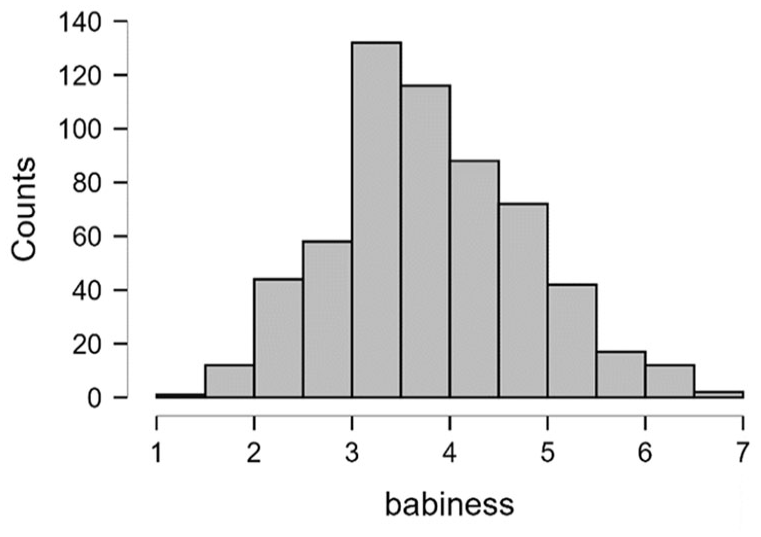
The Distribution of Words Per Babiness Level.
Study 1b: concreteness ratings
Mean concreteness rankings for each word of the Hebrew MB-CDI wordlist varied from 1 to 7, with an average ranking of 4.87 (Figure 2). Note that 43% of the words were rated with a high concreteness level of 6 or above.
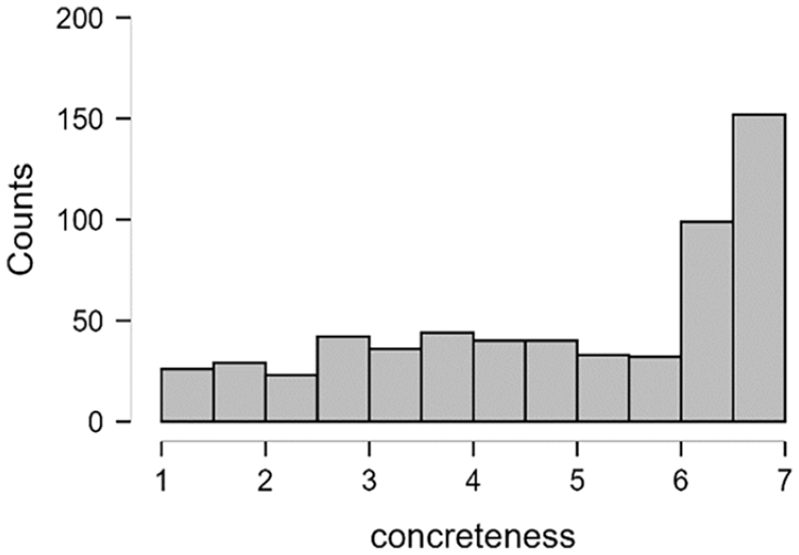
The Distribution of Words Per Concreteness Level.
Study 1c: phonological complexity of the words
The phonological complexity scores for each word of the Hebrew MB-CDI wordlist varied from 2 to 22, with an average score of 8.24 (Figure 3).
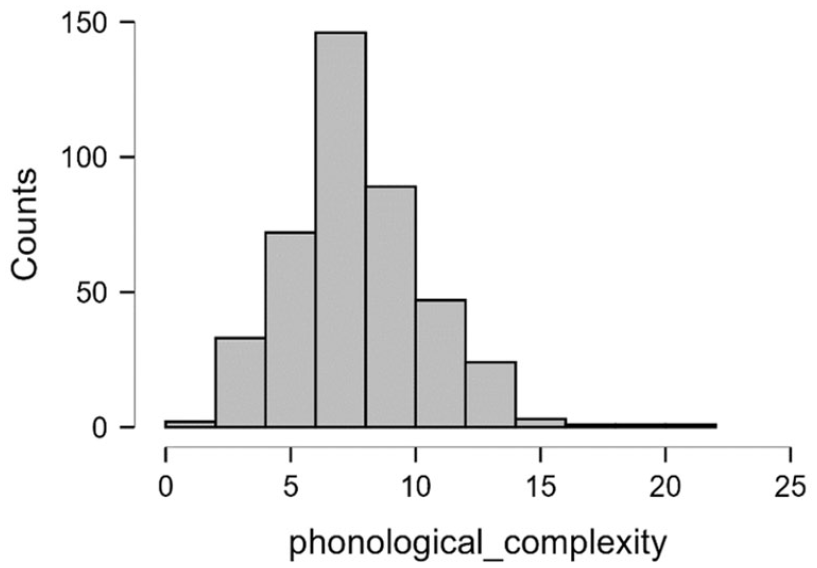
The Distribution of Words Per Phonological Complexity Score.
Study 1d: iconicity ratings
Mean iconicity ranking for the words in the Hebrew MB-CDI wordlist varied from 1.5 to 6.6, with an average ranking of 2.25 (Figure 4). Most words had a low iconicity level (83% of the words were rated 1.5–2.5). The words with high iconicity were mostly animal sounds (i.e., ‘meow’ and ‘moo’) but there were also words from other lexical categories (i.e., ‘bakbuk’, ‘bottle’, ‘raashan / kashkeshan’, and ‘rattle’).
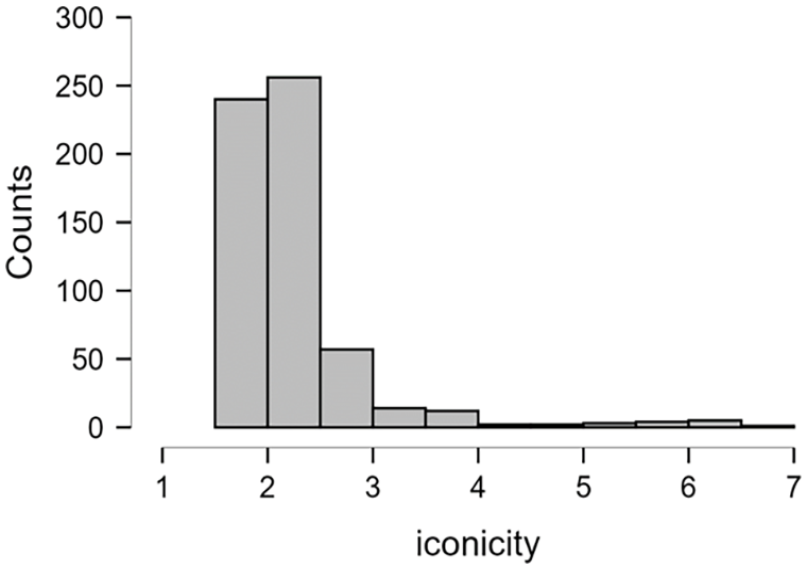
Distribution of Words According to Iconicity Level.
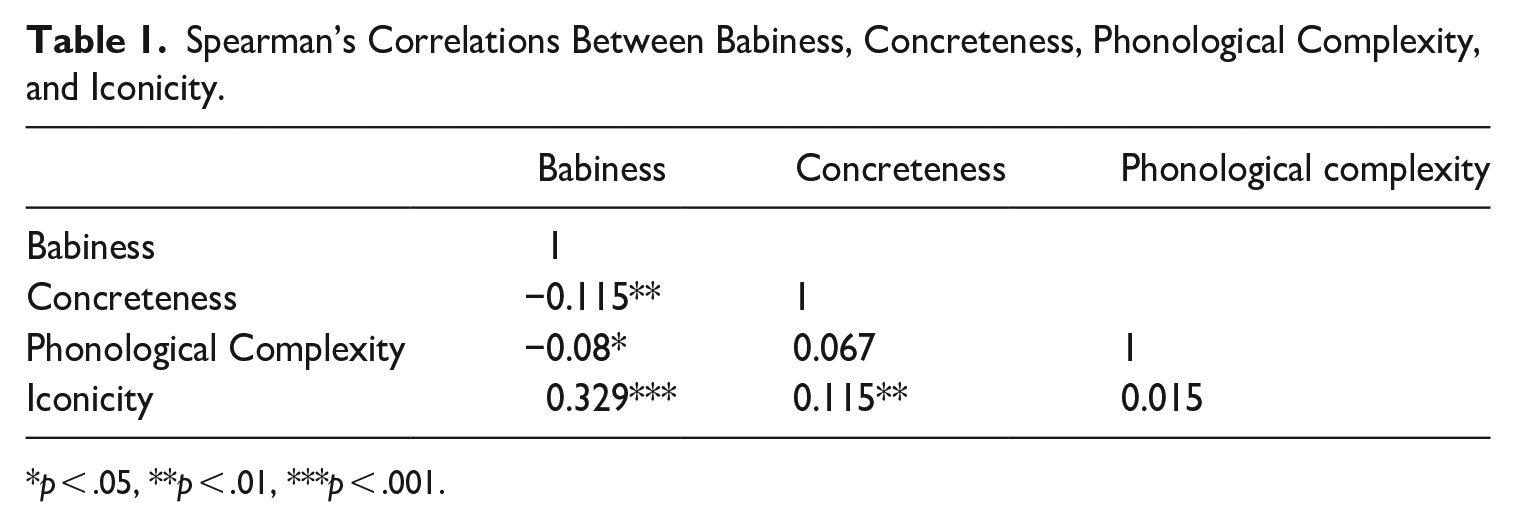
Spearman’s correlations between babiness, concreteness, phonological complexity, and iconicity were calculated (Table 1). Results showed a small negative correlation between babiness and concreteness, that is, words that were rated high on the scale of babiness, were rated low on the scale of concreteness. There was a small positive correlation between concreteness and iconicity, that is, words that were rated high on the scale of concreteness were also rated high on the scale of iconicity. Furthermore, a medium positive correlation between babiness and iconicity was shown, that is, words rated high in babiness were also rated high in iconicity. Finally, there was a weak negative correlation between babiness and phonological complexity, that is, words that were rated high on the scale of babiness were less complex phonologically. Note that the small-medium correlation coefficient values represent weak or small associations between variables.
Spearman’s Correlations Between Babiness, Concreteness, Phonological Complexity, and Iconicity.
p < .05, **p < .01, ***p < .001.
Summary and discussion
The MB-CDI wordlist consists of words that are common in the early vocabulary of children 12–24 months of age (Fenson et al., 1994; Gendler-Shalev & Dromi, 2022). In the current study, these words were rated by adults for the characteristics of babiness, concreteness, and iconicity and were scored for their phonological complexity.
The distribution of babiness was varied such that based on subjective ratings most of the words were in the middle range on the babiness scale, and there were also words with low and high babiness ratings. These results suggest that the words children acquire early are not restricted to their world (e.g. ‘coffee’ and ‘wallet’). Many of the words were rated as concrete (43%), which is in line with studies showing that the first words children acquire are concrete (e.g., Swingley & Humphrey, 2018). Finally, 83% of the Hebrew MB-CDI wordlist was rated as not iconic.
Correlations revealed positive correlations between iconicity and concreteness and between iconicity and babiness. Although these correlations were significant, the coefficient values were small-medium and might be due to the items in the animal sounds category, which were rated high on the iconicity, concreteness and babiness rankings. The negative correlation found between babiness and concreteness suggests that not all words that are relevant to a baby’s world are concrete (e.g., the word ‘od’ meaning ‘more’ was ranked 5.4 in the babiness rating, and 1.2 in the concreteness rating; the word ‘bye-bye’ was rated 5.3 in babiness, and 1 in concreteness ratings). Finally, negative correlations were found between babiness and phonological complexity scores, suggesting that words that are more complex phonologically are less relevant to the world of toddlers; however, the coefficient value was very small. To summarize, the small-medium coefficient values of the correlations between babiness, concreteness, iconicity, and phonological complexity suggest that each of these four variables can independently be associated with vocabulary acquisition. This question was evaluated in Study 2.
Study 2: the effect of the characteristics of words on their acquisition in LT toddlers compared with TD (AM and VM) toddlers
Study 2 explored the characteristics of words in the early lexicons of LT children compared with two groups of toddlers: AM and VM. This allows us to investigate effects that are driven by age representing general development (LT and AM children share the same age), and the effects that are driven by specific language experience (LT and VM children share the same vocabulary size).
Method
Participants
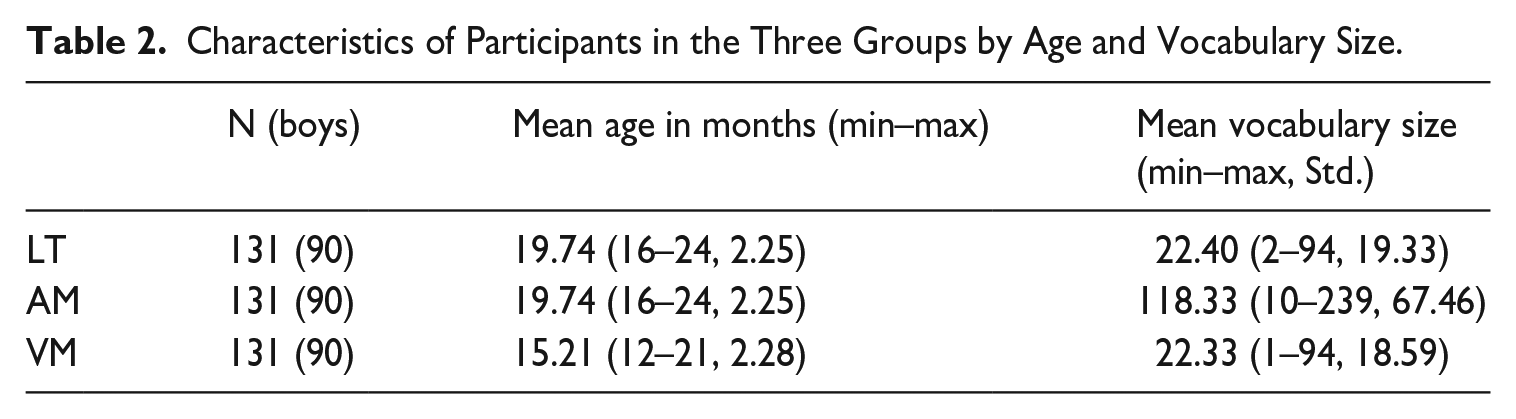
We sampled 396 participants ages 12–24 months from Gendler-Shalev and Dromi (2022). In the original database, 881 monolingual Hebrew-speaking toddlers ages 12–24 months participated. Their parents completed the Hebrew MacArthur-Bates Communicative Development Inventory – Words and Gestures (MB-CDI – WG) (Gendler-Shalev & Dromi, 2022). In the current study, three groups with 131 toddlers (90 boys) in each, were sampled from the original sample (Gendler-Shalev & Dromi, 2022) according to the following criteria (Table 2):
(a) LT group: participants with vocabulary sizes at the 15th centile or lower compared to their AM peers. This group included 131 toddlers, of which 90 were boys. Based on this number, two control groups were compiled.
(b) Two control groups of TD toddlers: AM group, and vocabulary matched (VM) group.
Characteristics of Participants in the Three Groups by Age and Vocabulary Size.
Selection of control groups was implemented using code written for this purpose in MATLAB. The process of matching children to each child in the LT group was as follows:
All children of the same gender as the LT child, who did not belong to the LT group, and had not yet been selected to the control group under consideration, were identified. The latter criterion was intended to ensure that no child was selected to the same control group twice. Sixteen children were selected for both the AM and the VM groups. Note that the children were matched to different children in the LT group, due to the different matching criteria of each control group.
Of the children identified in step 1 above, those best matching the LT child by either age (for the AM group) or vocabulary (for the VM group), were identified.
Of those children (i.e., children who were both the same gender and best match in terms of either age in month or vocabulary to the LT child), one was selected randomly, and added to the respective control group (AM or VM).
Note that it is important to match the groups for gender, as there is a significant difference in vocabulary size during this age range between girls and boys (see Eriksson et al., 2012; Gendler-Shalev & Dromi, 2022).
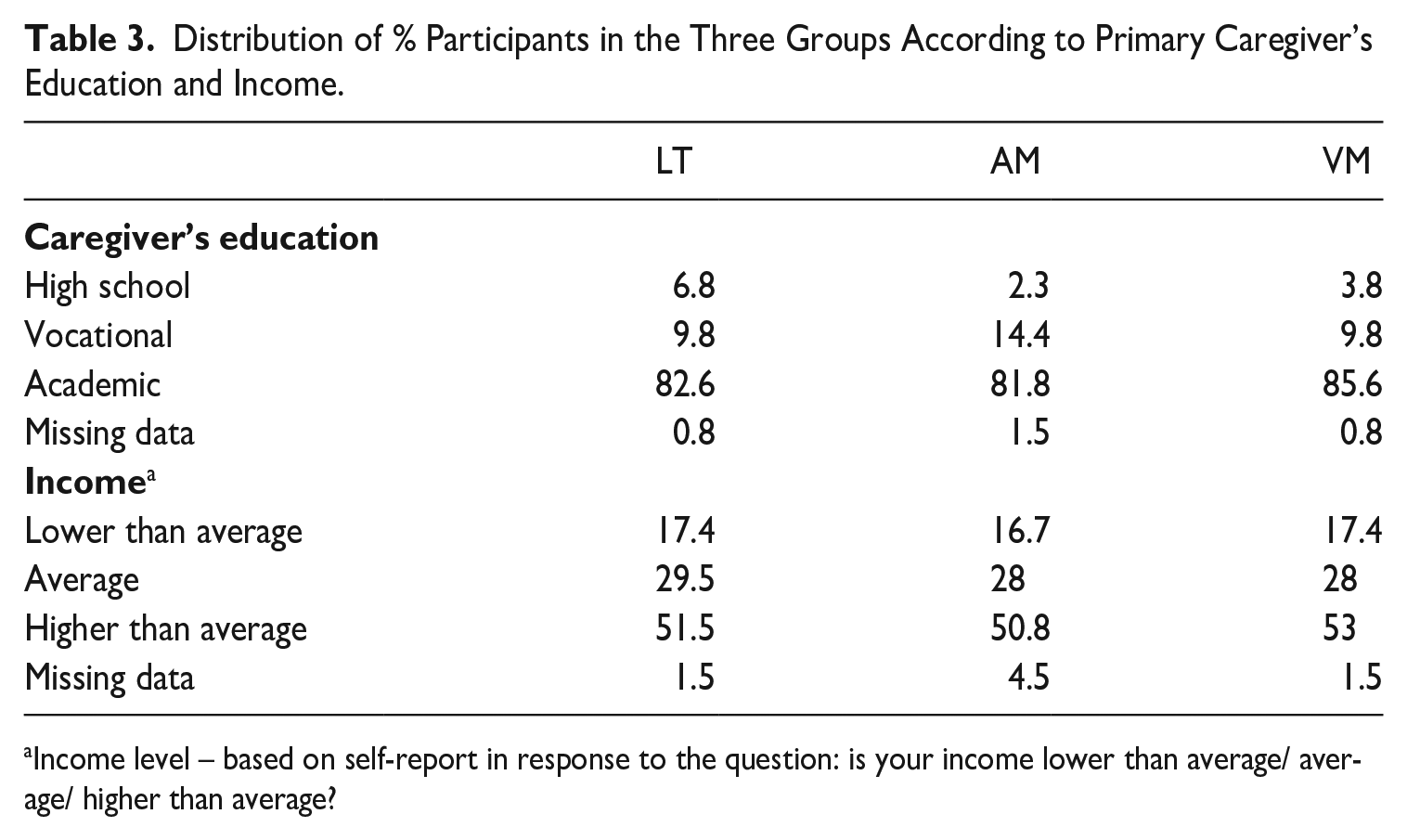
The three groups that were sampled had similar socio-economic status characteristics. In all groups, as in the original Gendler-Shalev and Dromi (2022) sample, families with academic education and high income were over-represented (see Table 3).
Distribution of % Participants in the Three Groups According to Primary Caregiver’s Education and Income.
Income level – based on self-report in response to the question: is your income lower than average/ average/ higher than average?
Materials and procedure
MB-CDI WG questionnaire
The Hebrew adaptation of the MB-CDI WG was used (Gendler-Shalev & Dromi, 2022). The questionnaire was found to be a reliable and valid tool for evaluating the early lexical development of Hebrew-speaking toddlers during the second year of life. It consists of 428 1 words in 18 semantic categories (for a detailed description, see Gendler-Shalev & Dromi, 2022). In the MB-CDI WG questionnaire, parents are asked to mark the words that the child ‘understands’ and the words that the child ‘says and understands’. For the purposes of the current study, only scores of ‘says and understands’ were used. In addition, background information is obtained via multiple-choice questions about the child’s development and the parents’ background.
In the current study, multiple-word phrases that appear in the Hebrew MB-CDI standard word list were excluded (i.e., ‘lalexet lishon’ – ‘go to sleep’) because they could not be rated for the four explored variables. Note that these word phrases represent meanings that toddlers acquire during the second year of life, but in terms of phonological complexity, these target phrases were beyond what toddlers produce at the stage of first words (see calculation of phonological complexity of the target words in study 1c above). In addition, words that indicated animal sounds (i.e., ‘meow’ and ‘moo’) were removed from the analysis due to their high ratings in iconicity. Finally, words that were not produced by any of the children in the LT or VM groups were removed from the analysis, to avoid potential biases in coefficient estimation due to floor effects. Note that all words were produced by children from the AM group. Thus, the analysis included 239 words out of the 428 words.
Analysis
Mixed-effects logistic regression models were used to examine the effects of group, Babiness, Concreteness, Phonological Complexity, and Iconicity on production, as well as interactions between group and the words’ characteristics, on the child’s production of each word. These models yield estimates of coefficients which represent the log odds for the production of words with respect to each of the predictors. Two separate models were defined. In each model, LT children were compared with one of the control groups (AM and VM). The formula for the model was: word production ~ group (LT/AM, LT/VM) × phonological complexity + group × iconicity + group × concreteness + group × babiness + (1| word) + (1| child). Group was dummy coded, with 0 indicating membership in the control group (AM or VM), and 1 indicating membership in the LT group.
Results
A comparison of LT and AM groups
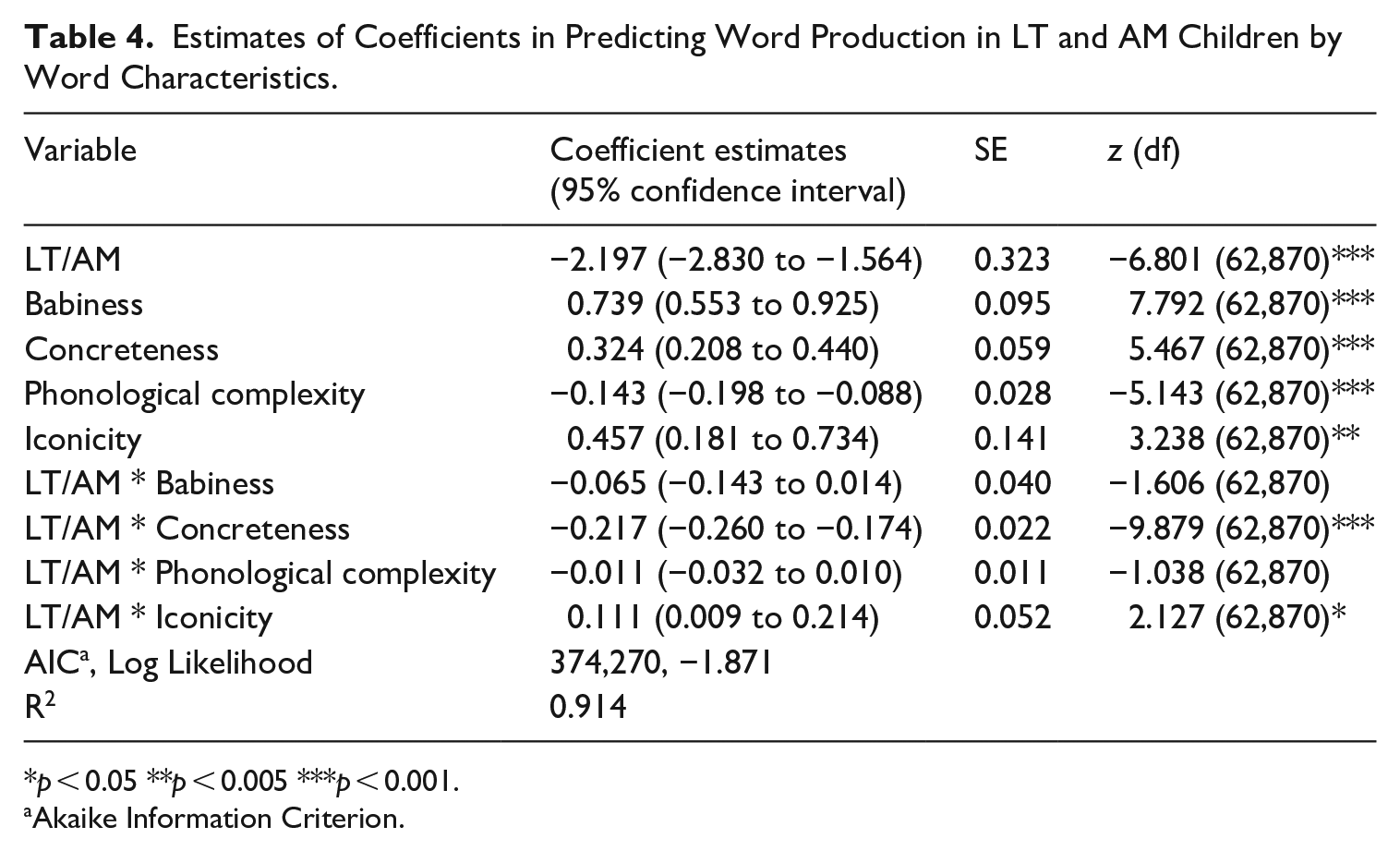
The effect of words’ characteristics on the production of LT and AM peers is shown in Table 4. A significant difference was found in word production between LT and AM peers. This represents the construction of the sample, as the two groups were chosen based on the size of their production vocabularies.
Estimates of Coefficients in Predicting Word Production in LT and AM Children by Word Characteristics.
p < 0.05 **p < 0.005 ***p < 0.001.
Akaike Information Criterion.
The variables of babiness, concreteness and iconicity showed a positive effect, indicating that toddlers produce more words from the questionnaire that are ranked as more related to babies’ worlds, are more concrete and more iconic. A negative effect of phonological complexity was also found, indicating that toddlers produce more words from the questionnaire that are ranked as less phonologically complex.
In addition, significant interactions of LT/AM and words’ concreteness and iconicity were found, indicating different effects of these characteristics on word production for LT and AM peers (the interactions are unfolded below). No interaction of LT/AM and words’ babiness and phonological complexity was found, indicating a similar effect (as reported above for the main effects) of these characteristics on word production for LT and AM peers. Note that the negative coefficient for the group×concreteness interaction indicates that beyond the differences between children in the AM group and children in the LT group accounted for by the main effect of group, children in the AM group benefit more than the children in the LT group from words’ concreteness (i.e., the more concrete the word, the greater their advantage, see Figure 5a). On the other hand, the positive coefficient for the group×iconicity interaction indicates that while children in the AM group produce more words overall, their advantage is somewhat smaller compared with the children from the LT group, for more iconic words compared to less iconic words. This is particularly true for the most iconic words (see Figure 5b).
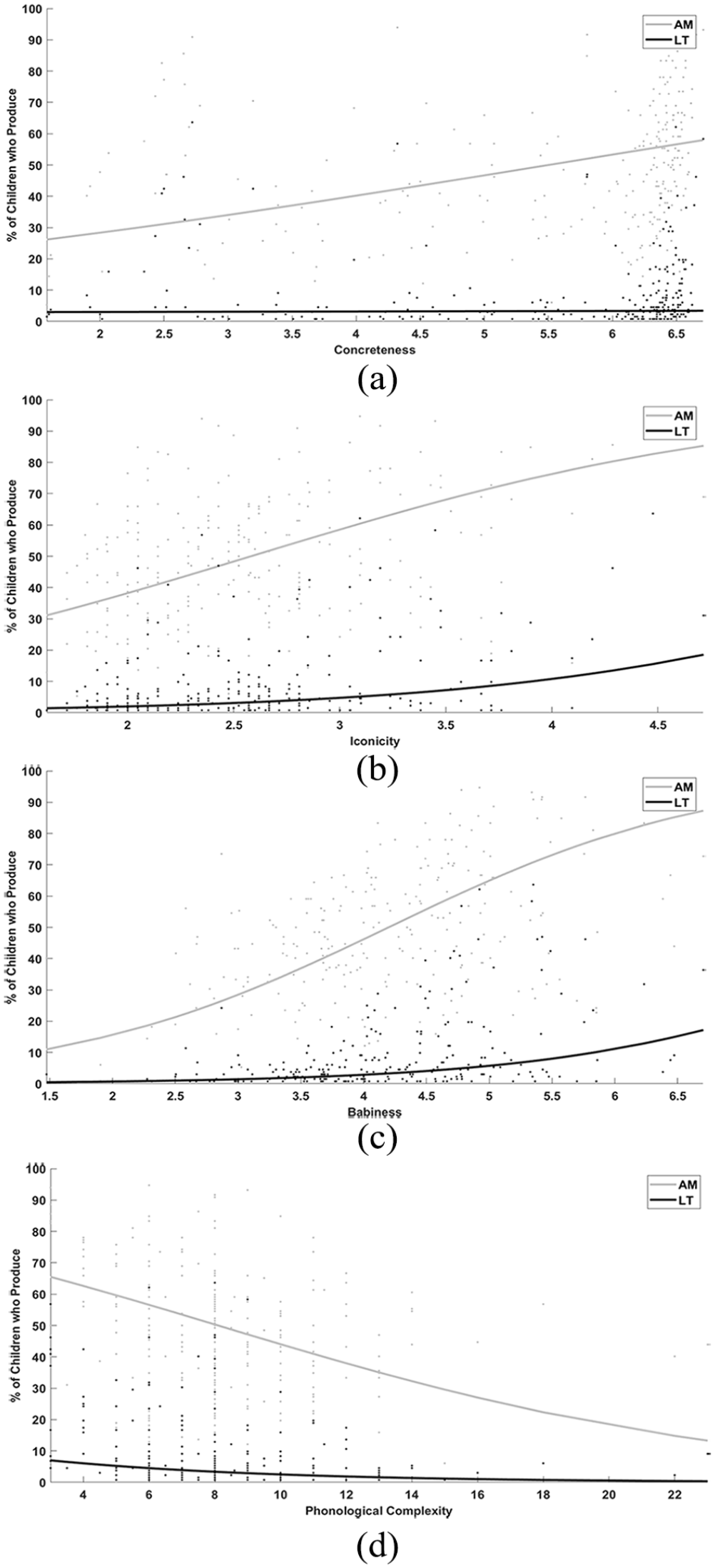
The Effect of (a) Concreteness, (b) Iconicity, (c) Babiness, and (d) Phonological Complexity on Word Production for LT and AM Children.
Figures 5(a) to (d) were plotted to unfold the interactions. For
For
Comparison of LT and VM groups
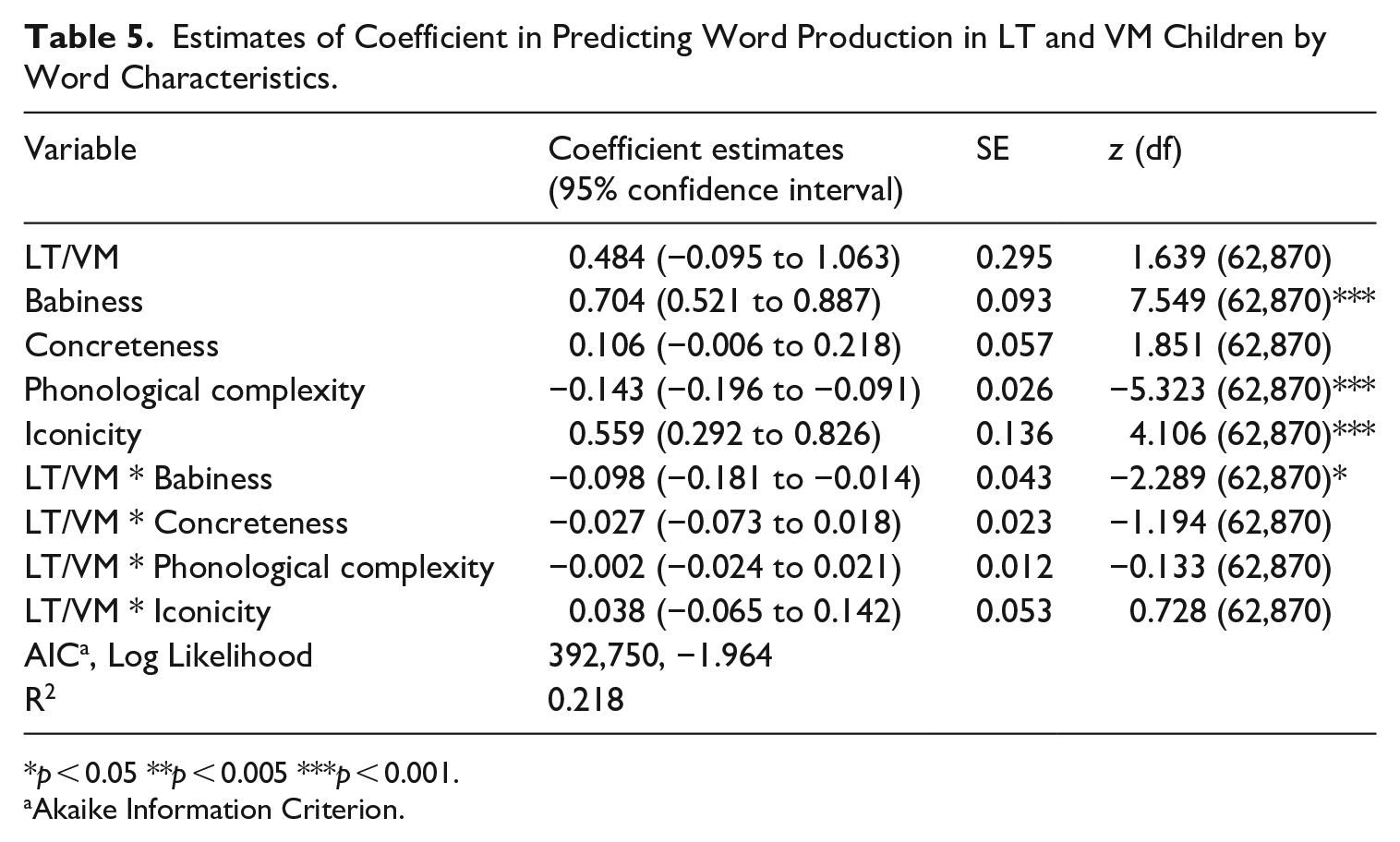
Next, using the same statistical model, the effect of words’ characteristics on word production of LT and VM peers was calculated (Table 5). No significant difference was found for word production between LT and VM peers. This represents the construction of the sample, as the two groups were matched based on the size of their production vocabularies. A positive main effect of babiness and iconicity on word production was found, indicating that toddlers produced more words from the questionnaire that were ranked as more related to babies’ worlds and more iconic. Further, a negative main effect of phonological complexity was found, indicating that toddlers produced more words from the questionnaire that were ranked as less phonologically complex. A marginal main effect was found for concreteness (p = 0.06). The small effect of concreteness might be influenced by the distribution of the concreteness of words after removing from the analysis words that were not produced by any of the children in the LT or the VM groups. Most of the words that remained in the analysis were ranked with the high concreteness scores (6 or 7 in a scale of 1–7) as can be seen in Figure 6 (compared with Figure 2 above).
Estimates of Coefficient in Predicting Word Production in LT and VM Children by Word Characteristics.
p < 0.05 **p < 0.005 ***p < 0.001.
Akaike Information Criterion.
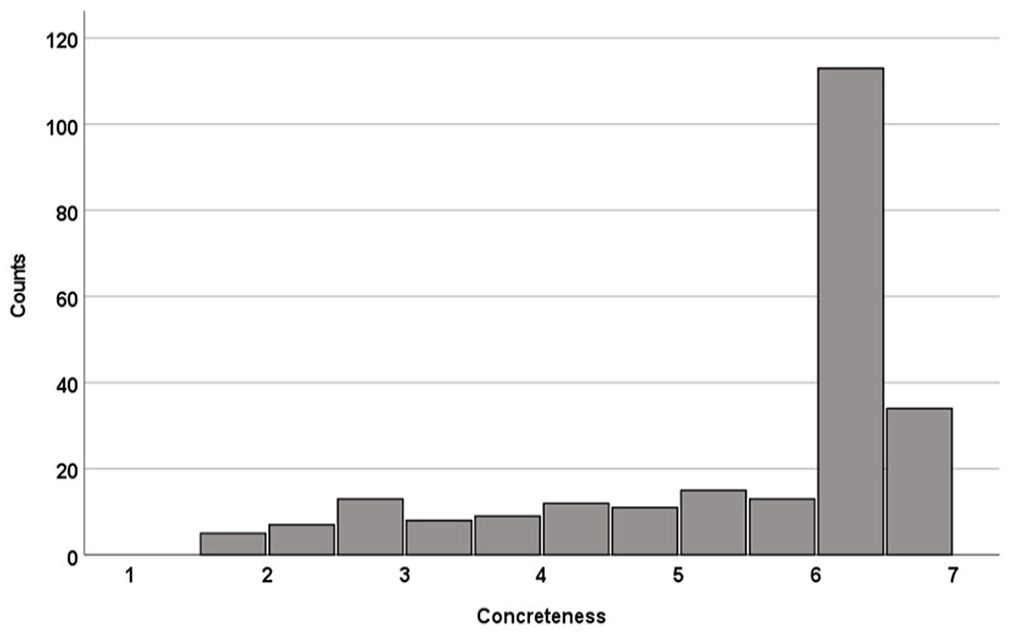
Distribution of Concreteness Scores of the Words After Removing From the Analysis Words That Were Not Produced by Any of the Children in the LT or VM Group.
No interactions of LT/VM and the words’ concreteness, phonological complexity, and iconicity were found, indicating similar effects of these characteristics on word production for LT and VM children. However, a significant interaction of LT/VM and babiness was found, indicating a different effect of babiness on word production for LT and VM peers. Figure 7 was plotted to unfold the interaction of LT/VM × Babiness. The plot indicates that the vocabulary of the VM group consists of words that were ranked with higher babiness scores compared with the LT group. Note that although the effect was found to be statistically significant (p = .04) it appeared to be small.
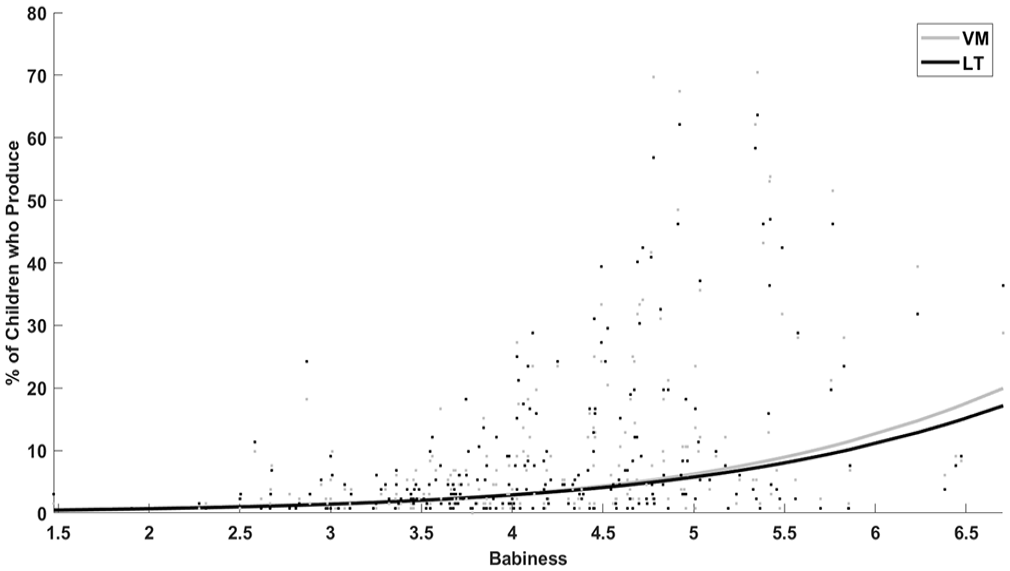
The Effect of Babiness on Word Production for LT and VM Children.
Since we were interested in exploring subtle differences in the vocabularies, we examined whether the lexicons of LT and VM children differed in specific words beyond their characteristics. We calculated the proportions of children in each group producing each of the words. The distributions of these proportions were then compared using the Kolmogorov–Smirnov test (Massey, 1951). The results indicated that the distributions were not significantly different (p = 0.57). In Figure 8, the distributions were obtained such that words were arranged in decreasing order, according to their production by the VM group, representing typical acquisition. For example, the most common word in the lexicons of LT and VM children was ‘bye’. Note that though no significant difference was shown, there were words in the lexicons of LT children that were not found in the lexicons of VM children (e.g., ‘kipod’ meaning ‘hedgehog’ and ‘dvash’ meaning ‘honey’).
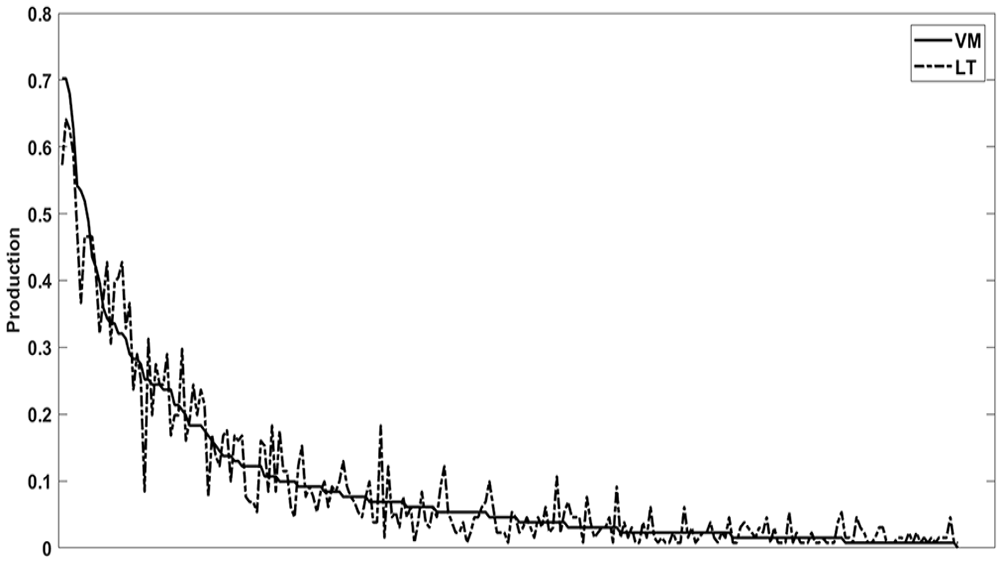
The Distribution of Words in LT and VM Children by Their Proportions.
Comparison of the two control groups: VM and AM
In order to test whether the interactions in the models arise from differences in vocabulary structure and not differences in variability across the groups, the effects of words’ characteristics in the two control groups were compared. For this comparison 16 participants that were in both control groups were removed from the analysis (13 boys, 3 girls) to ensure different participants in each group.
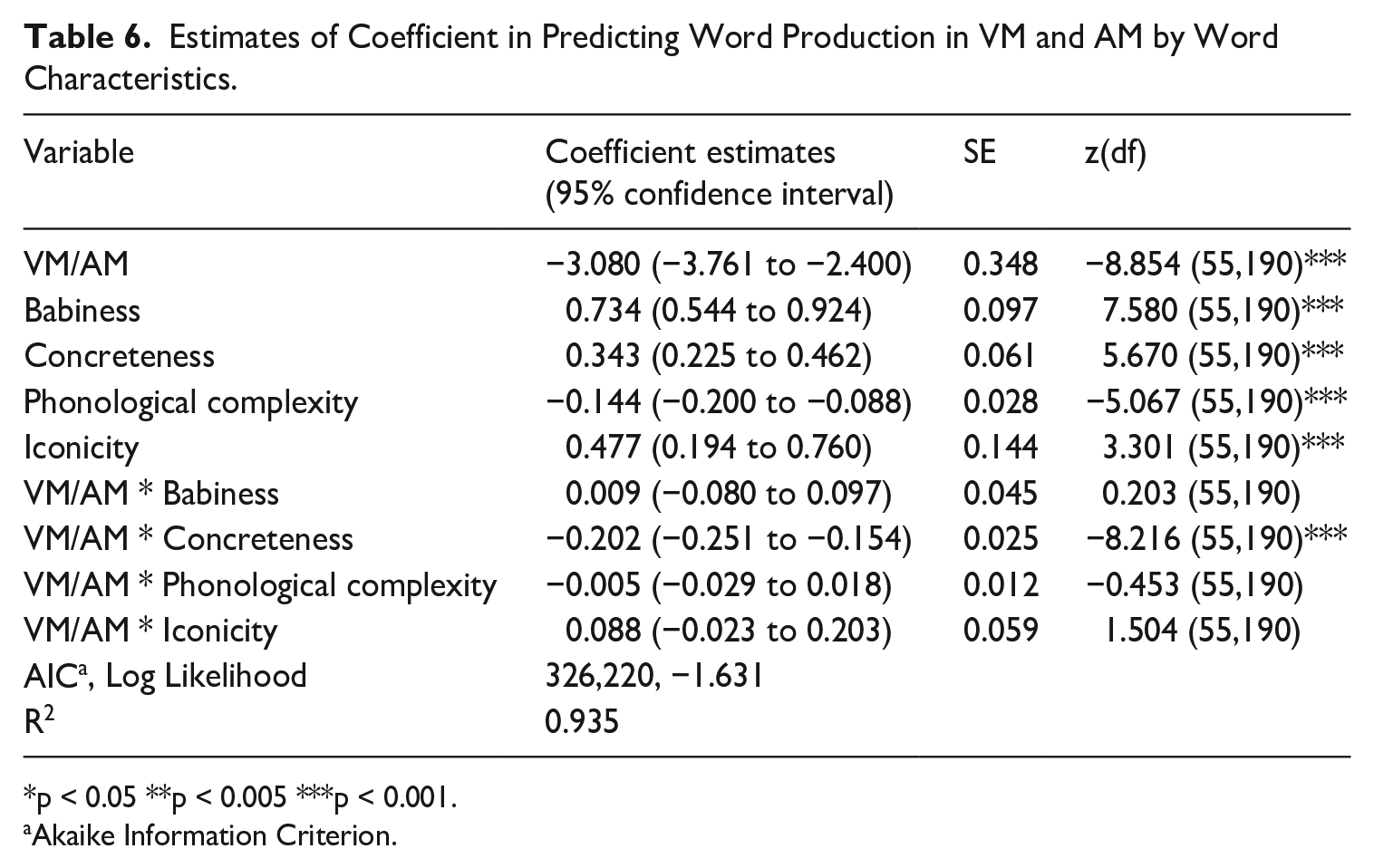
The effect of the words’ characteristics on their production by the VM and AM groups is shown in Table 6. A significant difference was found in word production between VM and AM groups. This represents the construction of the sample, as the two groups were chosen based on the size of their production vocabularies to the LT group (VM) and matching age to the LT group (AM).
Estimates of Coefficient in Predicting Word Production in VM and AM by Word Characteristics.
p < 0.05 **p < 0.005 ***p < 0.001.
Akaike Information Criterion.
The variables of babiness, concreteness and iconicity showed a positive effect, indicating that toddlers produce more words from the questionnaire that are ranked as more related to babies’ worlds, are more concrete and more iconic. A negative effect of phonological complexity was also found, indicating that toddlers produce more words from the questionnaire that are ranked as less phonologically complex.
In addition, a significant interaction of VM/AM and words’ concreteness was found, indicating different effects of concreteness on word production for VM and AM peers. No interaction of VM/AM and words’ babiness, phonological complexity and iconicity was found, indicating a similar effect (as reported above for the main effects) of these characteristics on word production for VM and AM. Note that the interaction of VM/AM children and words’ concreteness is similar to the interaction of LT/AM children (see Table 4), suggesting that the effect is related to vocabulary size and not because LT children are learning different words than VM children.
Discussion
The current study explored how the characteristics of words affect their acquisition by 12- to 24-month-old LT toddlers vs their age-matched (AM) and vocabulary-matched (VM) peers (who, though slightly younger, were in the same age range). We predicted that the characteristics of words would be associated with their acquisition for all groups. In addition, we predicted that the effect of the characteristics of words would differ for LT group compared with the two TD groups. We tested these predictions with LT children compared to AM children, and LT children compared to VM children.
For the AM group, more words with high ratings of babiness and concreteness were acquired than were words with lower ratings. These findings correspond with previous studies (e.g., Braginsky et al., 2019; Swingley & Humphrey, 2018). Further, the two characteristics related to the form of the words also showed an effect in the AM group. At 12–24 months, more phonologically simple words were acquired compared with phonologically complex words and more words with high iconic rating were acquired than words with lower iconicity. These findings agree with earlier studies (for phonology, Braginsky et al., 2019; Gendler-Shalev et al., 2021; for iconicity, Massaro & Perlman, 2017).
The effects of the words’ concreteness and iconicity were different between LT and AM peers, whereas the effect of the words’ babiness and phonological complexity was similar. Further, the LT and the VM groups showed similar patterns for concreteness, phonological complexity, and iconicity, meaning no significant effect was found between the two groups. However, a small but significant difference was found for the effect of babiness, indicating that the VM group has more words with high babiness rating in their vocabulary than the LT group. In the discussion below, we explain the pattern of acquisition for the LT, AM, and VM groups for each of the tested variables.
For the variable of
Both LT and VM groups showed more words that ranked high on the babiness scale (as seen for the LT in Figure 5[c]), and there was a small but significant difference between the two groups, showing that the VM group, which is younger, produced slightly more words that were ranked with high babiness scores (Figure 7). Despite the small age difference between the VM and LT groups (i.e., an average difference of 4 months), age affected the relevance of words. Note that this effect was not shown in the comparison of the AM and the VM groups, who also differed in age, but this might be affected by the small sample in this comparison (see ‘Results’ section).
For the variable of
For the variable of
Finally, for
Integrating the results of the four variables tested in the current study, we ask if the lexicon of toddlers who are LT represents atypical acquisition. The LT group used mostly words that are phonologically simple, and the effect of concreteness and iconicity was similar across the LT and VM groups. Thus, it can be argued that the lexicon of LT children is similar in nature to the lexicon of TD younger toddlers (in our study, the VM group). This assumption is also supported by the similarities of the words themselves (shown in Figure 8). However, the children in the VM group used more words that are related to babies’ world compared with the children in the LT group, most likely due to their younger age. This was the only difference found between the two groups because in concreteness, phonological complexity, and iconicity, the vocabulary composition of LT children was similar to that of younger TD children (the VM group). These results suggest that beyond the expected small lexicon of the LT group, which defined them as LT children, they learn vocabulary with simple phonology, high concreteness, and high iconicity, as do TD children, while using words that are relevant to their age (babiness). Note that the effect of babiness was not found when comparing the two control groups (AM and VM), which represent a similar age gap.
The clinical implications of the current study imply that vocabulary size as a sole assessment tool can be used to identify LT children but cannot distinguish between typical and atypical acquisition during the second year of toddlers’ life. Studies that explored LT children at older ages found continuous difficulties in their language acquisition (Dale et al., 2003; Moyle et al., 2007; Rescorla, 2011), indicating that as a group, they are at risk for language disorder (Bishop et al., 2017; Reilly et al., 2010; Roos & Weismer, 2008). However, the characteristics of their lexicon do not show a picture of language disorder, and sensitive screening tools for this aim await future research.
One of the study’s limitations is the small age gap between the LT and VM groups (means of 4 months, but note that the range was larger; see Table 2 above). The LT group included toddlers aged 12–24 months with vocabulary sizes at the 15th centile or lower compared to their AM peers, and the VM group was selected from the same age range and were younger than the LT children. In future studies a larger age gap is suggested between older LT and VM groups. Another limitation might be collinearity between the predictors, which may affect the ability to distinguish between effects of different predictors. However, the significant interactions reported in the current study do not appear to be due to collinearity. If they were, one might expect interactions between group and babiness to be associated with interactions between concreteness and/or iconicity, which is not the case here. Similarly, coefficients for interactions between group and iconicity and group and concreteness might be expected to have the same sign, which is also not the case. Note that the words examined here were taken from a widely used instrument of language assessment and were not selected specifically for the distributions of the properties examined here. Future studies could address this issue by selecting words (perhaps even a subset of the MB-CDI used here) for which the distributions of relevant properties are better suited for regression analyses.
To summarize, the current findings, together with previous studies, suggest that the early vocabulary of TD toddlers consists of words that are more relevant to a child’s world and experience (babiness), are more concrete, more phonologically simple, and more iconic. It is suggested that when LT children are compared to AM children, the characteristics of their vocabulary are different in terms of structure (e.g., iconicity) and meaning (e.g., concreteness), but similar in phonological complexity and babiness. When they are compared to VM peers, the vocabulary characteristics of LT children are similar, though they use words that are less related to babies’ world. The parallel patterns found for LT and VM children vs AM children suggest that LT children’s early vocabularies, though smaller than their age-matched peers, follow a similar developmental path.
Footnotes
Acknowledgements
We would like to acknowledge Michael Nevat for his role as consultant in the analysis and statistical modeling of this study.
Author contributions
Funding
The author(s) received no financial support for the research, authorship, and/or publication of this article.
