




Abstract
This article evaluates the acquisition of directionals in Q’anjob’al, a Western Mayan language of Guatemala. The data come from a longitudinal study of two Q’anjob’al monolingual children of Santa Eulalia, Huehuetenango, Guatemala: Xhuw (1;9–2;5) and Xhim (2;3–3;5). The results show how these children acquire the morphological distribution of motion verbs and directionals in Q’anjob’al. They produce directionals parallel to motion verbs. Xhuw produced more motion verbs than directionals, while Xhim produced more directionals than motion verbs. Despite the omission of tense/aspect and agreement in the verb complex, these children produce two types of suffixes that distinguish motion verbs from directionals. The children acquired three groups of directionals in the following order: DIR3 (teq ‘toward X’, toq ‘away from X’) > DIR2 (el ‘out’ aj ‘up’ ok ‘enter, in’ ek’ ‘pass’ ay ‘down’) > DIR1 (kan ‘stay’).
Introduction
Talmy’s (1985, 1991) work on the semantics of motion events has played an important role in cross-linguistic research on first language acquisition (e.g. Slobin, 2004). Following Choi and Bowerman (1991, p. 86), a motion event (1) is formed by four basic components (2).
1. John went into the room. [Figure] [Motion] [Path] [Ground] 2. Components of a motion event a. Motion: Presence of motion. b. Figure: The moving object. c. Ground: The reference-point object with respect to which the Figure moves. d. Path: The course followed by the Figure with respect to the Ground.
Constructions like those in (1) have received attention in cognitive linguistics and linguistic typology (Guillaume & Koch, 2021; Verkerk, 2015). They are also known as motion verbs and directionals in other typological research (e.g. Guillaume & Koch, 2021) as well as in the Mayan literature (Aissen et al., 2017; Brown, 2001; Craig, 1992; De León, 2001; Delgado Rojas et al., 1999; England, 1983; Haviland, 1993; Hober, 2022; Mateo Toledo, 2008, 2022; Raymundo González et al., 2000; Zavala, 1994). This article follows this terminology, that is, motion verbs and directionals.
Ross (2021) argues that motion verbs and directionals belong to different grammatical categories. Motion verbs add motion to typically non-motion verbs, while directionals specify the path for a lexical motion verb (Ross, 2021, p. 33). These two types of verbal constructions differ from language to language (Papafragou & Selimis, 2010; Talmy, 1985, 1991), as shown in (3) for a comparison between Spanish and English (Slobin & Bocaz, 1988).
3. a. El perro salió de la casa corriendo. ‘The dog exited from the house running’. b. The dog ran out of the house.
The data in (3) show that for movement through space, Spanish uses verbs that indicate directionality, such as entrar ‘enter’, salir ‘exit’, but for the manner of movement, it uses other types of verbs like salir ‘exit’, correr ‘run’ (3a). In contrast, for manner of movement, English uses manner verbs without directionality but these are accompanied by directional particles, such as out (3b) (Bowerman, 1994; Naigles & Terrazas, 1998; Slobin & Bocaz, 1988).
A further difference between motion verbs and directionals is found in other languages. While English uses verbs of manner with directional particles, as in (3b), Korean uses different lexical verbs to indicate spontaneous movement and caused movement, as in (4) (Choi & Bowerman, 1991, p. 93).
4. John-i yelswey-lul chayksang-ey tency-ess-ta.
1
John- ‘John threw keys to desktop’.
The differences in the expression of motion verbs and directionals across languages raise the question of how children acquire both resources to express motion events (Bowerman, 1994; Slobin, 2004). In English, for example, children add verb particles such as down, up, in, out, on, off, back, and away to motion verbs to express direction. Children first use the verb particles in single word utterances (5) and later combine them with motion verbs in early word combinations (6) (Bowerman, 1994, p. 40). Furthermore, they use the words up and down productively and extend them to other contexts around the second year of life (Choi & Bowerman, 1991).
5. a. Christy down as the child goes down a flight of stairs b. socky up as she picks a sock up of the couch 6. a. pant pull up as mother pulls up her pants b. put down asking mother to put a train on the floor c. push down asking mother to push a jack-in-the box down in its box
Cross-linguistically, children show variation in the production of motion verbs and directionals. In English, for example, children show an early acquisition of motion verbs and directionals, while in Korean children show a late acquisition of these constructions as in (7) (Bowerman, 1994, p. 43).
7. a. Ike pwuth-ye. this put.on-cause ‘Put this on’. b. Yeki-ta noh-a. here-
In Mayan languages, it has been shown that motion verbs indicate the trajectory of the movement of a figure or the lack of movement of that figure in a location in relation to the ground, while directionals are clitics, affixes, or words that provide the meaning of direction, trajectory, or aspect (Aissen et al., 2017; Delgado Rojas et al., 1999; Hober, 2022; Mateo Toledo, 2008, 2022; Raymundo González et al., 2000; Zavala, 1994). Mayan directionals are derived from motion verbs through grammaticalization (Craig, 1992; Haviland, 1993; Zavala, 1994). In some Mayan languages, for example, Tzeltal (Brown, 2001), Tzotzil (De León, 2001), and Mam (England, 1983), directionals also refer to the spatial coordinates north, south, east, and west, depending on the local topography of the land.
Directionals in Mayan languages are highly productive (Law, 2017). 2 Some languages, such as Q’anjob’al (Mateo Toledo, 2010, 2022) and Mam (England, 1983), use up to three directionals. Furthermore, directionals are more frequent in Mayan languages than in other language families, for example, Mixe-Zoquean languages (Zavala, 2002).
In contrast to Spanish or English, in Mayan languages, the morphological distribution of motion verbs and directionals differs as illustrated in (8) for Q’anjob’al. In this Mayan language, motion verbs take inflection of aspect (max-), person (-ach), and status suffix (e.g. -i if it appears in final position) (Mateo Toledo, 2008) as in (8a) (Delgado Rojas et al., 1999, p. 2). Directionals appear after the main verb and take the suffix -oq if the verb appears in final position (Mateo Toledo, 2008), as in (8b) (Delgado Rojas et al., 1999, p. 16). In addition, directionals form a chain of up to three directionals, as shown in (9) (Delgado Rojas et al., 1999; Mateo Toledo, 2008, 2022; Zavala, 1994).
8. a. Max-ach kan-i. ‘You stayed’. b. Max-ach hin-kol- ‘I helped you’. (before doing something else). 9. Max-∅ lajwi- mansan tu’. apple ‘Those apples finished getting down [in relation to X]’.
The morphological distribution of motion verbs and directionals and the chain of directionals add further complication for their acquisition in Q’anjob’al. That is, children have to learn not only to control the morphology, but also the position of directionals in relation to the main verb, and the combination of up to three directionals.
Mayan languages show internal variation in the position of directionals in relation to the main verb, as is illustrated by the Mayan languages below grouped into branches: Tzotzil and Tzeltal (Ch’ol-Tseltalan branch), Q’anjob’al (Q’anjob’alan branch), K’iche’ (K’ichean branch), and Mam (Mamean branch) (Kaufman, 1974). In Tzotzil (10a) (De León, 1994, p. 874), Tzeltal (10b) (Polian, 2017, p. 633), and Q’anjob’al (10c) (Mateo Toledo, 2008, p. 125), directionals appear after the main verb.
10. a. ak’-o give- ‘Put it toward here, on the top (head)’. b. Le’ ay-∅ ta s-pat there ‘There it is away down behind this hill’. c. Max-∅ saq-b’i-kan el-teq. ‘It was clean and taken out’.
In contrast, in K’iche’ and Mam, directionals either appear before or after the main verb (Pye & Pfeiler, 2019). In K’iche’, directionals are frequent after a main verb or a non-verbal predicate (11a) (Can Pixabaj, 2017, p. 479). However, two directionals appear in preverbal position, which are considered as either movement verbs (Can Pixabaj, 2017) or directionals (Pye & Pfeiler, 2019) and take the independent suffix -oq (11b) (Can Pixabaj, 2017, p. 478).
11. a. ch-∅-a-ya’-a ‘Leave it at the door’. b. x-in- ‘I went to eat’.
In Mam, directionals occur in both preverbal (12a) and postverbal (12b) positions (England, 2017, pp. 510–511).
12. a. xhin ku’=x t-iiqa-n ch’in wee’ t-witz tx’otx’. 3 ‘Is it possible that you could carry me down onto the land’. b. chi=mok’-ee=ka=x=a kyja’w. ‘Crouch down like this! (you pl)’
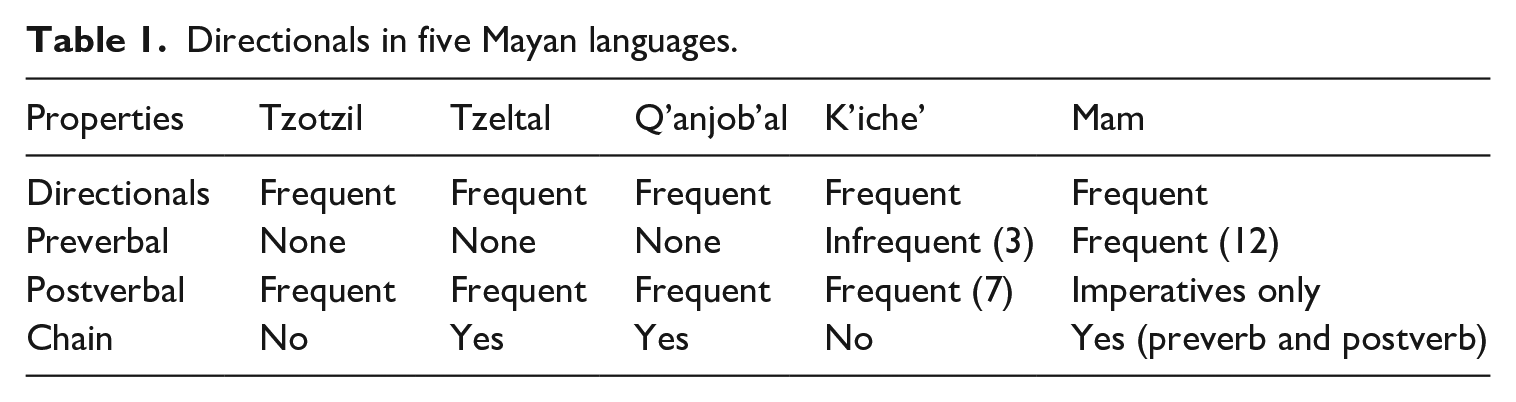
K’iche’ allows only one directional before or after the main verb (11), but Mam allows chains of up to three directionals before or after the main verb (12). Q’anjob’al also allows a chain of up to three directionals (10c). Tzeltal also allows a chain of directionals (10b). The distribution of directionals in relation to the main verb in Tzotzil, Tzeltal, Q’anjob’al, K’iche’, and Mam is shown in Table 1.
Directionals in five Mayan languages.
Due to the internal variation of directionals in Mayan languages, their acquisition varies depending on the language that children are acquiring. For example, in Tzeltal (Brown, 2001) and Tzotzil (De León, 1994, 2001), in which directionals only occur after the main verb, children acquire directionals later than motion verbs. In Tzotzil, for example, children acquire directionals around the age of 2;0 (De León, 2001). In contrast, in K’iche’ and Mam (Pye & Pfeiler, 2019), children acquire directionals following the pattern of the adult grammar of both languages. That is, K’iche’-speaking children acquire directionals in postverbal position earlier (around the age of 2;0) than directionals in preverbal position (around the age of 2;9). In contrast, Mam-speaking children acquired preverbal directionals and postverbal directionals around the age of 2;0. Children acquiring Mam produced chains of up to two directionals, as illustrated in (13) (Pye & Pfeiler, 2019, p. 10).
13. kaxh nexh taka? Jos (2;6.16) = qax chin- what ‘What happens if I fall out’.
The variation found in the acquisition of directionals in Mayan languages illustrates that children are sensitive to the language that they are exposed to when acquiring motion verbs, as Bowerman (1994) suggests for the acquisition of motion verbs in English and Korean. This study investigates the acquisition of motion verbs and directionals in the Mayan language Q’anjob’al. In doing so, it evaluates how children acquire the morphological distribution of motion verbs and directionals. Following Bowerman’s (1994) observation, one would expect Q’anjob’al children to acquire the morphological distribution of motion verbs and directionals, following the adult grammar of Q’anjob’al. Furthermore, these children would produce directionals after the main verb and up to three directionals. The morphological distribution of motion verbs and directionals and the position of the directional in relation to the main verb are provided in (8) and (9) and are repeated below in (14) and (15).
14. a. Max-ach kan-i. ‘You stayed’. b. Max-ach hin-kol- ‘I helped you’. (before doing something else). 15. Max-∅ lajwi- mansan tu’. apple ‘Those apples finished getting down [in relation to X]’.
The data come from a longitudinal study of two Q’anjob’al monolingual children living in Santa Eulalia, Huehuetenango, Guatemala: Xhuw (1;9–2;5) and Xhim (2;3–3;5). The results show that these children acquire the morphological distribution of motion verbs and directionals, as shown in their production of directionals with different main verbs (cf. [40] and [41]) and use of up to three directionals (33). Although both children produce directionals parallel to motion verbs, they show variation. Xhuw produced more motion verbs than directionals, while Xhim produced more directionals than motion verbs. This difference may have to do with age: Xhim is older than Xhuw. Based on this morphological distribution and following De León (2001) for the acquisition of Tzotzil, I argue that in Q’anjob’al, children produce motion verbs to indicate the trajectory of the movement of a figure or the lack of movement of that figure in a location in relation to a ground. In contrast, directionals provide the meaning of direction, trajectory, or aspect (Aissen et al., 2017; Delgado Rojas et al., 1999; Mateo Toledo 2008, 2022; Raymundo González et al., 2000; Zavala, 1994).
Despite their omission of tense/aspect and agreement marking in the verb complex in Q’anjob’al around the age of 2;0 (Mateo Pedro, 2015), these children produce two types of suffixes to distinguish motion verbs from directionals. The acquisition of directionals in Q’anjob’al can be attributed to different factors, such as the presence of the favored Verb 1 and Verb 2 (V1 V2) construction in Q’anjob’al (Mateo Toledo, 2008, 2022), and prosody, following Pye and Pfeiler (2019) for the acquisition of directionals in Mam and K’iche’. Children do not acquire all directionals at the same time, but they acquire the three groups of directionals in the order shown in (16).
16. Order of acquisition of directionals in Q’anjob’al First: Directionals of group 3: teq ‘toward X’, toq ‘away from X’ Second: Directionals of group 2: el ‘out’, aj ‘up’, ok ‘enter’, ek’ ‘pas’, ay ‘down’ Third: Directionals of group 1: kan ‘stay’
The remaining sections of the article are organized as follows. Section 2 provides a brief language background of Q’anjob’al. Section 3 provides a morphological distribution of motion verbs and directionals. Section 4 briefly discusses the auxiliaries, which are also derived from motion verbs. Section 5 reviews the acquisition of directionals in other Mayan languages, for example, Tzotzil, Tzeltal, K’iche’, and Mam. Section 6 discusses the acquisition of directionals in Q’anjob’al, focusing on suffixes that children produced to distinguish the distributional morphology of motion verbs and directionals, and productivity of the use of main verbs and directionals. Section 7 briefly discusses the input and its effect on the acquisition of directionals in Q’anjob’al. Section 8 concludes the article by highlighting the contribution of the study to our understanding of the acquisition of motion verbs and directionals in Mayan languages and to cross-linguistic research in general.
Language background
Q’anjob’al belongs to the Q’anjob’alan branch of the Western Mayan languages (Kaufman, 1974) and is spoken in San Juan Ixcoy, San Pedro Soloma, Santa Cruz Barillas, and Santa Eulalia, Huehuetenango, Guatemala. It has approximately 208,008 speakers (Instituto Nacional de Estadística Guatemala, 2019). Thousands of Q’anjob’al speakers migrated to Mexico, the United States, and Canada during the civil war in Guatemala (Peñalosa, 1992) 3 that lasted from 1960 to 1996.
Q’anjob’al is a head-marking, agglutinative language with a rigid Verb Subject Object (VSO) word order (Mateo Toledo, 2008, 2022). It shows an ergative alignment on the verb. Ergative morphemes cross-reference transitive subjects, s- for third person singular before a consonant (17), while absolutive morphemes (-ach for second person singular) cross-reference transitive objects (18a) and intransitive subjects (18b).
17. Max-ach s-kol-o’. ‘She helped you’. 18. a. Max-ach w-il-a’. ‘I saw you’. b. Max-ach way-i. ‘You slept’.
Morphology of motion verbs and directionals in Q’anjob’al
In this section, I describe the morphological distribution of motion verbs and directionals in Q’anjob’al based on Mateo Toledo (2008, 2022). Motion verbs indicate the trajectory of the movement of a figure or the permanence of that figure in a location (Talmy, 1985; Zavala, 1994). They inflect like other intransitive verbs (Mateo Toledo, 2008, 2022), as in (19) (Delgado Rojas et al., 1999, p. 2). The status suffix -i receives stress if it appears in final position. Status suffixes are unique linguistic properties of Mayan languages and are added to the end of the Mayan verb complex, where they mark aspect, transitivity, stem class (non-derived vs derived), and position of the verb in a clause (Kaufman, 1990; Robertson, 1992).
19. a. Max-ach kan-i. ‘You stayed’. b. Max-ach kan ewi. ‘You stayed yesterday’.
Directionals do not indicate movement or displacement; they indicate only the trajectory or location of a figure (Zavala, 1994). They appear after the main verb and obligatorily take the suffix -oq (Mateo Toledo, 2008, 2022) if the verb appears in final position, as illustrated in (20) (Delgado Rojas et al., 1999, p. 16).
20. a. Max-ach hin-kol- ‘I helped you’. (before doing something else) b. Max-ach hin-kol- ‘I helped you yesterday’. (before doing something else)
Directionals are derived from motion verbs through grammaticalization (Zavala, 1994) creating a directional construction (Mateo Toledo, 2008, 2022). For Q’anjob’al, Mateo Toledo (2008, 2022) argues that a directional construction is composed of V1 + V2 + argument(s). V1 represents the main verb that takes aspect, agreement, and status suffixes; V2 represents the directionals, as illustrated in (21). In this case, the intransitive verb b’ey ‘to walk’ is followed by two directionals aj ‘up’ and teq ‘toward the speaker’.
21. Max-∅ b’ey- ‘The child walked from down there to here’.
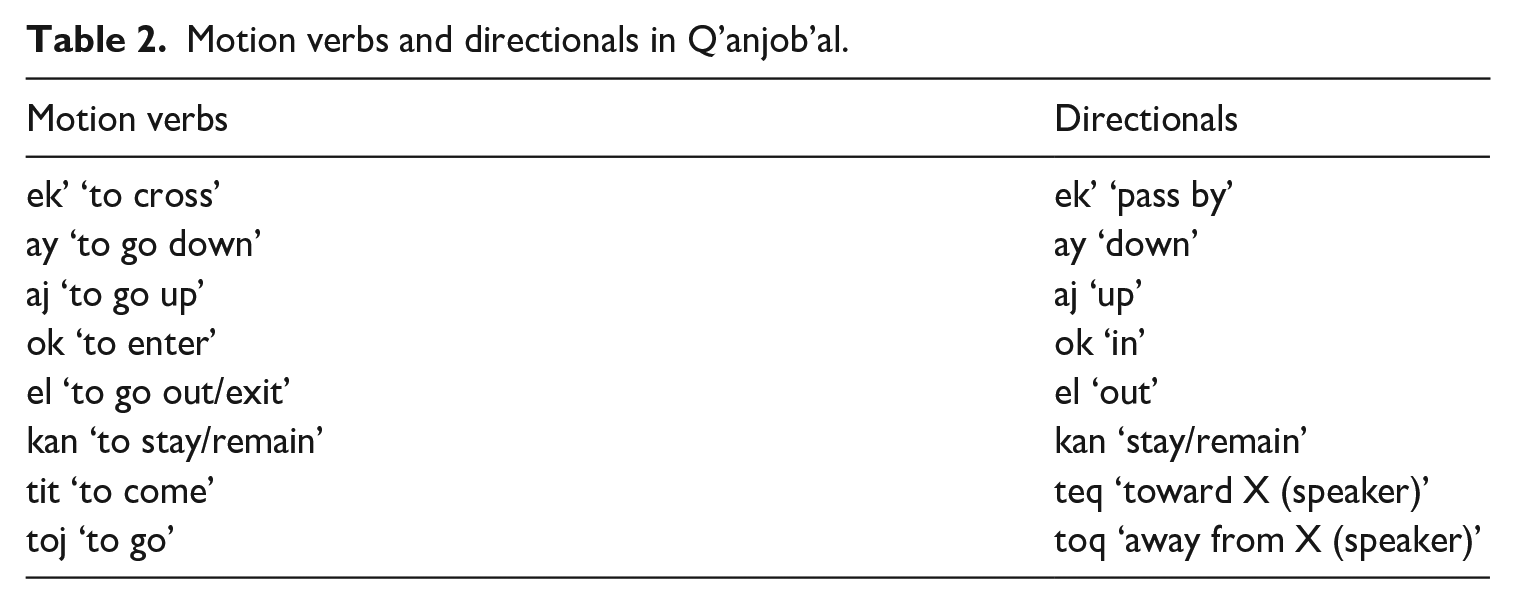
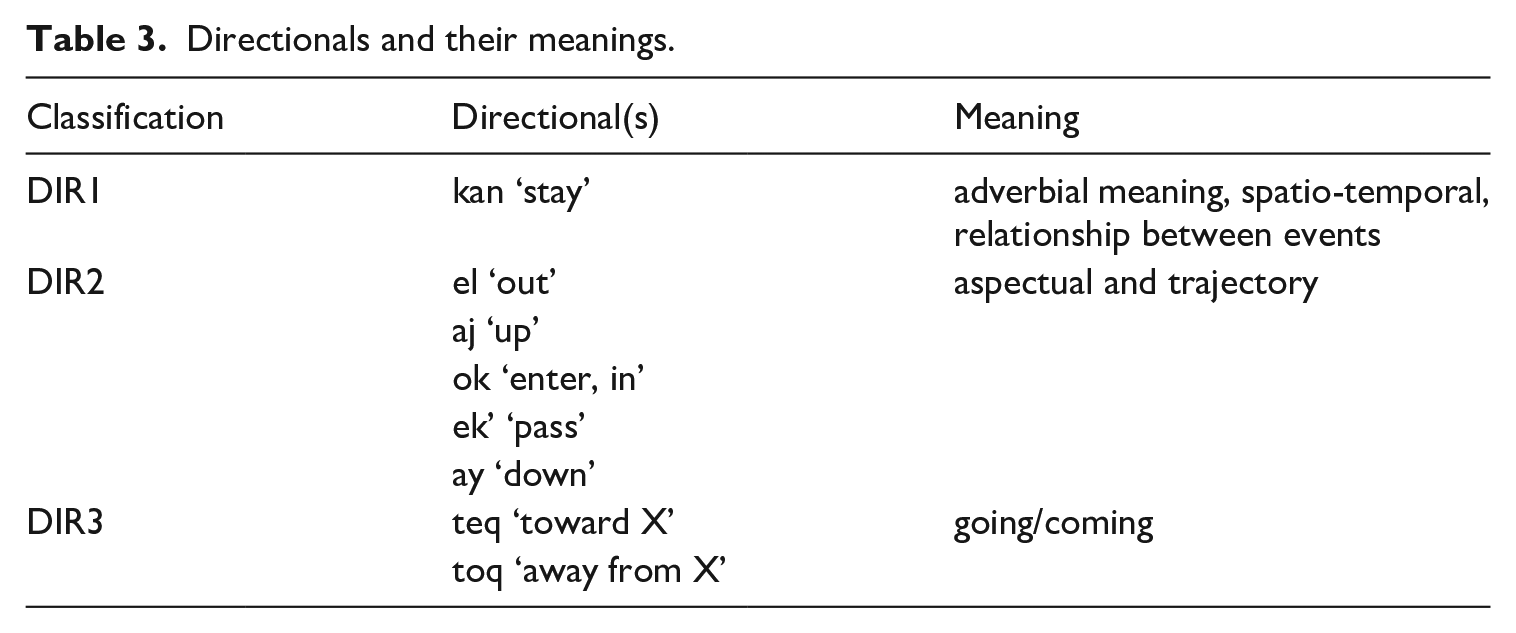
The paradigm of motion verbs and directionals in Q’anjob’al is shown in Table 2 (Mateo Toledo, 2008, p. 112). Based on their meanings, directionals can be grouped into three categories, as shown in Table 3.
Motion verbs and directionals in Q’anjob’al.
Directionals and their meanings.
Some phonological and syntactic features of directionals in Q’anjob’al are discussed below. For example, the directional aj ‘up’ in (22) undergoes phonological change (Mateo Toledo, 2008) due to vowel deletion and causes ambiguity as shown in (22). Vowel deletion is shown in (23a) and (23b). In (23a), the main verb i ‘to take’ gets deleted and only the directional aj ‘up’ remains, while in (23b) the vowel of the same directional (aj ‘up’) gets deleted and the consonant of the main verb also gets deleted.
22. X-∅-y-aj-toq. ‘She took it upstairs’. / ‘She sent it upstairs’. 23. a. X-∅-y-i- ‘She took it upstairs’. b. X-∅-y-aq’- ‘She sent it upstairs’.
The directionals that undergo phonological changes are listed in (24). The remaining directionals, including kan ‘stay’, teq ‘toward speaker’, and toq ‘away from speaker’, do not undergo phonological changes.
24. Directionals with phonological changes ek’ ‘pass’ el ‘out’ ok ‘in’ aj ‘up’ ay ‘down’
Mateo Toledo (2008, 2022) argues that the main verb and the directionals form a unit and that, unlike lexical verbs, directionals do not attract stress. Therefore, they are considered clitics, but not lexical verbs or suffixes as argued in other Mayan languages. Directionals can be part of the main verb or form their own phonological word. The directionals kan ‘stay’, teq ‘toward speaker’, and toq ‘away from speaker’ are always linked to the main verb (25) (Mateo Toledo, 2008, p. 124).
25. Max-in q’anjab’- ‘I spoke to you [in relation to something else]’.
When there are two directionals, they form their own phonological word (26a), but when there are three directionals, the first directional is attached to the main verb and the other two create their own phonological word (26b).
26. a. /max q’an.len el.teq xal ix jun.tu/ (Mateo Toledo, 2008: 125) Max-∅ ∅-q’anle-n el-teq xal ix jun-tu
‘So, the lady asked for that one (and it came out)’. b. /max saq.b’i.kan el.teq/ (Mateo Toledo, 2008: 125) Max-∅ saq-b’i-kan el-teq. ‘It was clean and taken out’.
According to Mateo Toledo (2008), directionals do not form a complex syntactic clause; instead, they form only a simple clause, as illustrated in (27).
27. Max-∅ lajwi- mansan tu’. apple ‘Those apples finished getting down [in relation to X]’.
Directionals can form a chain of up to three directionals (Delgado Rojas et al., 1999; Mateo Toledo, 2008, 2022; Zavala, 1994). In this chain, each slot is occupied by a specific directional, a restriction that applies to the directionals of group 2 (ek’ ‘pass’, ay ‘down’, aj ‘up’, el ‘out’, ok ‘in’) and group 3 (teq ‘toward speaker’, toq ‘away from speaker’), but not to group 1 (kan ‘stay’) (Mateo Toledo, 2008).
Auxiliaries
An auxiliary precedes the main verb (Mateo Toledo, 2008; Zavala, 1994). In Akateko, a language from the Q’anjob’al branch, all motion verbs can function as auxiliaries, except for b’et ‘went’ and meltzu’ ‘return’ (Zavala, 1994). In contrast to the possible chain of directionals, Q’anjob’al allows only a single auxiliary, as in (28). 4
28. a. Max-ach ‘I passed by to see you’. b. Ch’-∅-ek’ y-aq’-on kan heb’ b’ay one-one cross ju-jun kurus ‘[They pray with candles . . .], they pass and leave them at each cross’.
Acquisition of directionals in Mayan languages
Acquisition studies in Mayan languages report that children acquire verbs at an early age, beginning with the acquisition of the verb root and the status suffix (Pye et al., 2007). The studies on the acquisition of directionals in Mayan languages are in Tzeltal (Brown, 2001), Tzotzil (De León, 2001), and K’iche’ and Mam (Pye & Pfeiler, 2019).
Pye and Pfeiler (2019) found that children acquire directionals following the pattern of the adult grammar of K’iche’ and Mam. K’iche’-speaking children acquire directionals in postverbal position earlier than directionals in preverbal position. Although there were contexts of directionals in preverbal position in the spoken input, children did not produce them until the age of 3;0. In contrast, Mam-speaking children produce preverbal directionals more frequently than K’iche’-speaking children but also produce postverbal ones more frequently like the K’iche’-speaking children. The Mam children produced chains of up to two directionals. The authors argue that for the acquisition of directionals in K’iche’ and Mam, stress plays a more important role than input frequency.
In contrast, in Tzotzil and Tzeltal, children acquire directionals later than motion verbs. This is because these children produce bare verb roots at the one-word stage, so directionals come later (Brown, 2001; De León, 2001).
Acquisition of directionals in Q’anjob’al
In this section, I discuss how children acquire directionals in Q’anjob’al by asking the following questions: (1) Do children acquire motion verbs and directionals about the same time or they acquire first motion verbs and then directionals, as in Tzotzil and Tzeltal? (2) Do children acquire the morphological distinction of motion verbs and directionals? (3) Do children acquire the distribution and chain of directionals as in the adult grammar of Q’anjob’al? (4) Do children produce directionals based on the stress pattern of the language?
Method
For this study, spontaneous and longitudinal data from two Q’anjob’al monolingual children were explored: Xhuw (1;9–2;5) and Xhim (2;3–3;5). Each child was visited every 15 days for approximately a year; each session lasted for 1 hour. The data can be found at www.almaya.org (Mateo Pedro, 2015; Pye et al., 2017).
The ethnographic contexts in which the data were collected are provided below (Mateo Pedro, 2015). Although the two children grew up monolingually in Q’anjob’al, they had exposure to children’s television programs in Spanish.
Xhuw is a girl and was the only child in her family when the recordings took place. Her parents are fluent in Spanish. She spent most of her time with her female cousin and her father. In the recordings, she interacted with her father and cousin, and limited number of interactions with her mother. Xhim is a boy who lives with his grandparents, aunts, and uncles. Xhim sometimes spent time at his grandparents’ local business at the communal market of Santa Eulalia. During the recordings, he rarely interacted with his uncles or grandfather. Xhim’s grandparents are monolingual in Q’anjob’al and with some basic Spanish. Xhim’s aunts and uncles go to school, but during the recordings, they did not use Spanish at home with him.
The recordings and transcriptions were made by native speakers of Q’anjob’al, who were trained in data collection, digitization, and transcription. Pye’s (2019) Qancord program was used to extract motion verbs and directionals.
Motion verbs
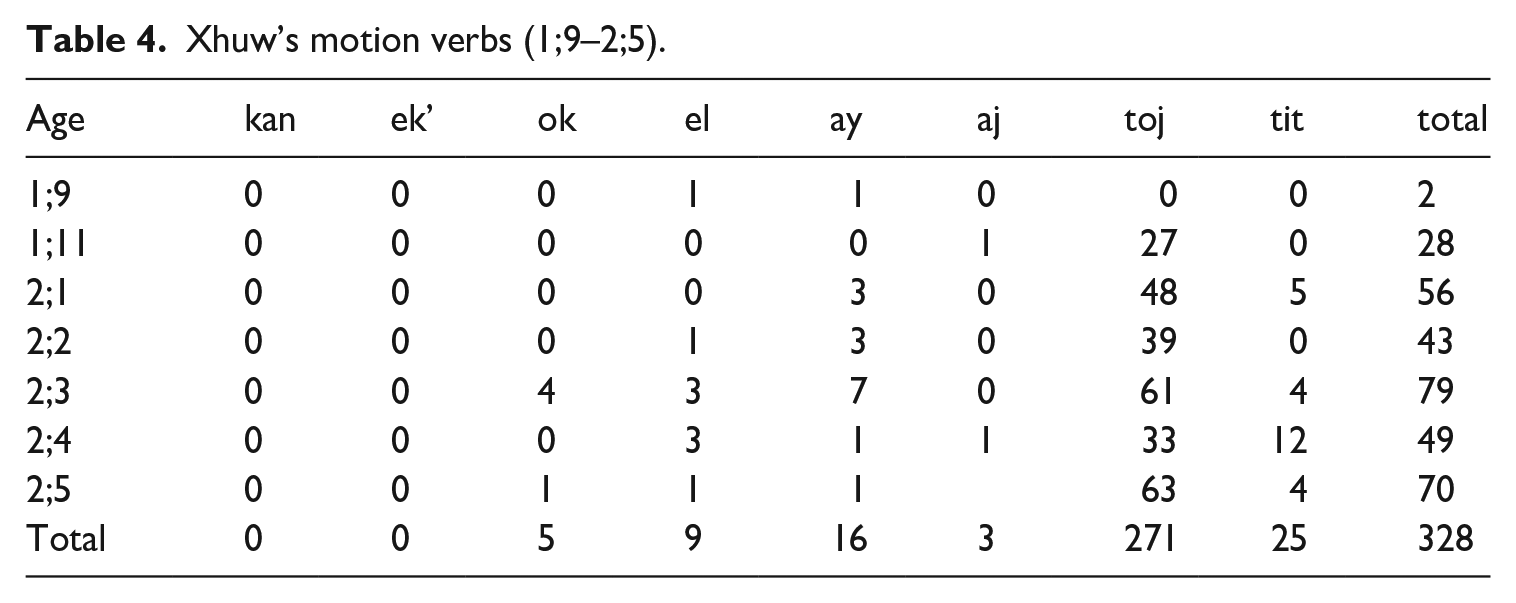
The two children’s monthly production of motion verbs in one sample hour is provided in Tables 4 and 5. Xhuw’s motion verbs are provided in Table 4, which shows that she produced fewer motion verbs than Xhim. The motion verbs that she produced the most are toj ‘to go’, tit ‘to come back’, ay ‘to go down’, and el ‘to cross’. Some of Xhuw’s motion verb utterances are provided in (29). At the age of 2;0, these children produce motion verbs with directionals as shown by Xhuw’s data in (29c). The child data are presented with the following format: the first line shows the child’s production; the second line shows an equivalent version of Q’anjob’al adult grammar; the third line provides the morphological gloss; and the fourth line provides a translation from Q’anjob’al to English (Mateo Pedro, 2015). The child’s production in line 1 is divided into syllables by periods (.), stress is marked by acute accent (ˊ), main verbs appear in small capitals, and directionals appear in bold.
29. a. = max-∅ ‘Grandmother left’. b. = chi-∅ ‘Juana comes’. c. = ch-∅-’ ‘It gets out’.
Xhuw’s motion verbs (1;9–2;5).
Xhim’s motion verbs (2;3–3;5).
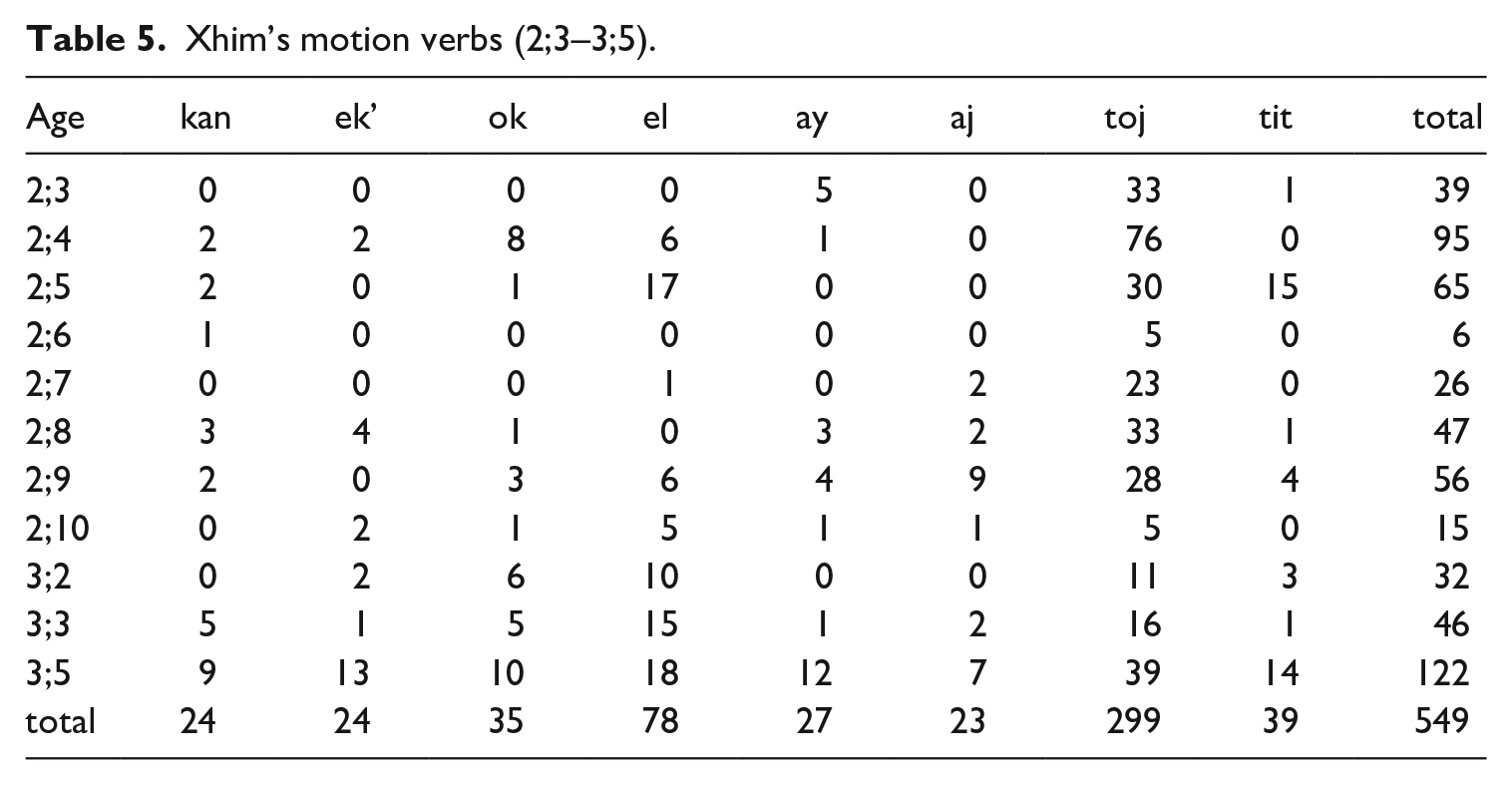
Xhim’s motion verbs are provided in Table 5. He produced more motion verbs than Xhuw. The data were collected when he was 2;3; 6 months older than Xhuw. The motion verbs that he produced the most are toj ‘to go’, el ‘to exit, tit ‘to come’, ok ‘to enter’, ek’ ‘to cross’, aj ‘to go up’, and kan ‘to stay’. Some of Xhim’s motion verbs are shown in (30).
30. a. = max-∅ ‘Dominga, he left’. b. = ok-an-teq enter- ‘Come in’. c. ch = ch-∅- ‘(The truck) falls in the hill’.
Directionals
At the age of 2;0, Xhuw produced directionals of group 2, such as ok ‘in’, el ‘out’, ay ‘down’, and uj ‘up’, and directionals of group 3, for example, toq ‘away from speaker’ and teq ‘toward speaker’, as shown in Table 6. The directionals aj ‘up’ and el ‘out’ show phonological change, as illustrated in (31).
31. a. = give- ‘Put it on my back’. b. y = chi-∅ y- ‘She takes it off’.
Xhuw’s directionals (1;9–2;5).
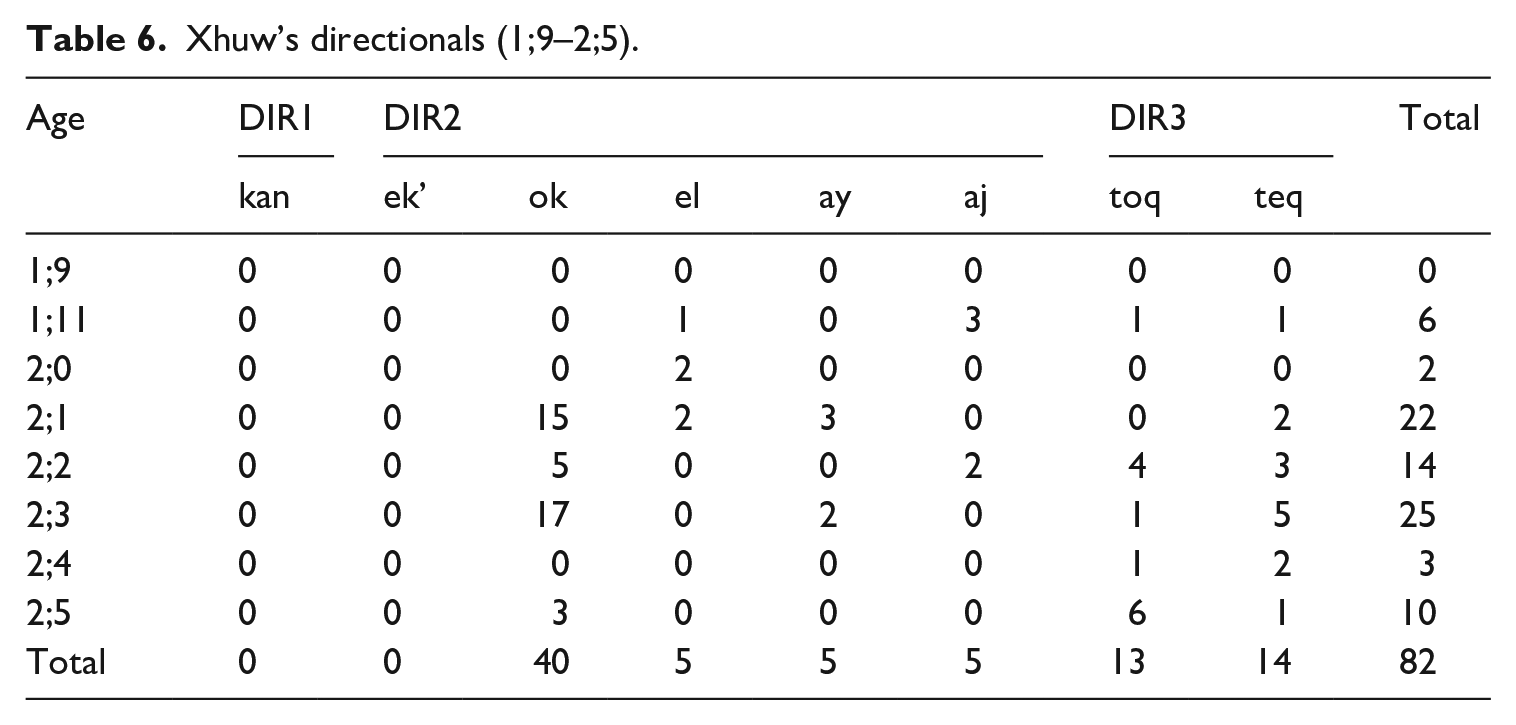
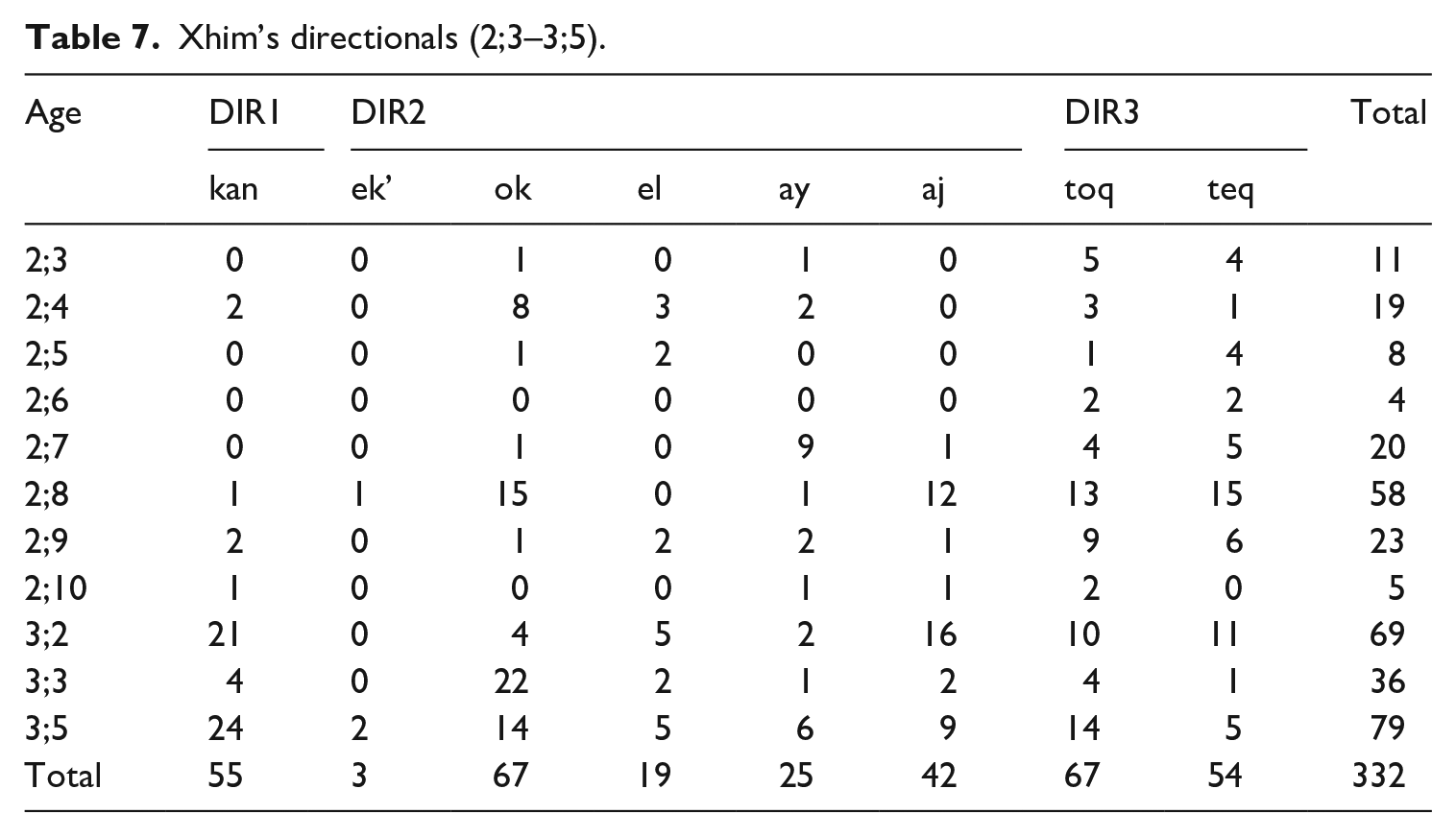
Table 7 shows that Xhim produced directionals of the three groups: directional kan ‘stay’ (group 1); ok ‘in’, aj ‘up’, ay ‘down’, el ‘out’ (group 2), and toq ‘away from speaker’ and teq ‘toward speaker’ (group 3). He produced more directionals than Xhuw, even though throughout his data he produced the directional ek’ ‘pass’ of group 2 only three times. Some of Xhim’s directionals are provided in (32).
32. a. w = chi-∅ w- ‘I put it on’. b. ch = ch-∅- ‘She enters’. c. = chi-∅ ‘She goes to the mountain’. d. mal = mayal-∅ ‘That one stayed already’.
Xhim’s directionals (2;3–3;5).
The frequency of the motion verbs toj ‘to go’ and tit ‘to come back’ in the children’s data may be due to their early acquisition of directionals teq ‘toward speaker’ and toq ‘away from speaker’. These two directionals are attached to different types of verbs. Both children produced these two directionals at about the same frequency and around the age of 2;0.
De León (2001) reports that in Tzotzil, children produce the deictic directional tal ‘coming’ around the age of 2;0, although apparently not very productively given that it occurs with only a very small number of verb types. In K’iche’, children acquire the directional ul ‘arrive here’ around the age of 3;0, and it occurs in preverbal position. In Q’anjob’al, ul ‘arrive here’ is considered as an auxiliary but not as a directional (Mateo Toledo, 2008). Q’anjob’al-speaking children acquire ul ‘arrive here’ as an auxiliary around the age of 2;0, as shown in (39).
Chain of directional
By the age of 2;7, Xhim produced chains of directionals, as illustrated in (33). During this early period, these children acquire the grammatical restrictions of directionals in Q’anjob’al. 7
33. a. hin. = chi-∅ hin- ‘I pull down the curtain’. b. w = w- ‘I put this one upwards’.
Children’s errors in the production of directionals
Xhuw and Xhim produced directionals with few errors; their main errors were the omission of the main verb and/or directionals due to stress, as shown in (34) and (35). In (34), Xhuw omitted the directional (aj ‘up’) but produced the suffix -oq. Xhim either omitted the main verb (ek’ ‘cross’) but produced the directional (ok ‘in’) plus the suffix -oq (35a) or produced two directionals (ay ‘down’, teq ‘toward speaker’) and the initial consonant of the main verb (toq’ ‘to pull’) (35b).
= chi-∅ hin-sik’- inc-3abs 1erg-pick-dir.up-suf ‘I pick it up’. 35. a. ok.ój. Xhim (2;4) = ch-∅-’ek’ inc-3abs-enter dir.in-suf ‘She enters’. b. kot.ay.téX. Xhim (2;7) = chi-∅ ko-toq’ inc-3abs 1ERG-pull dir.down-dir.toward X ‘We pull it down’.
The data above show that stress plays an important role in the production of directionals, as reported in the acquisition of directionals in K’iche’ and Mam (Pye & Pfeiler, 2019). In Q’anjob’al, children do not produce a directional or a main verb if these appear in an unstressed syllable. Children produce directionals when they have prosodic prominence. These children also produced directionals with phonological contractions ek’ ‘pass’, ay ‘down’, aj ‘up’, ok ‘in’, and el ‘out’, as how they occur in the Q’anjob’al adult grammar. Some examples of phonological contractions are shown by Xhuw’s data in (36). Xhuw also produced uncontracted directionals, as illustrated in (37).
36. a. = give- ‘Put it on my back’. b. y = chi-∅ y- ‘She takes it off’. c. = give- ‘Turn on our television’. 37. a. = take- ‘Bring your ball (from there to here)’. b. = i-toq s-nene’ take- ‘Take her toy (from here to there)’.
Children’s motion verbs and directionals
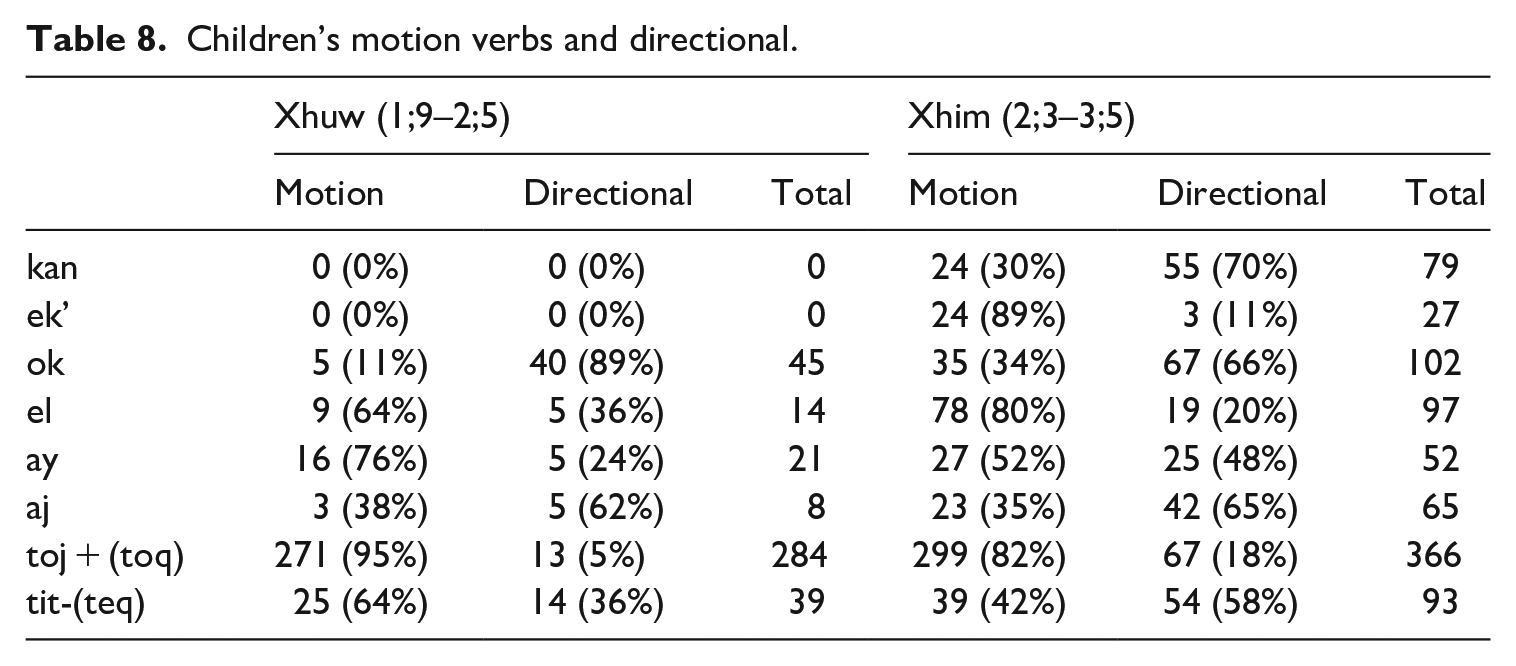
A comparison of the children’s motion verbs and directionals is shown in Table 8. Both children produce directionals parallel to motion verbs, although they show variation. Xhuw produced more motion verbs than directionals, while Xhim produced more directionals than motion verbs.
Children’s motion verbs and directional.
These children distinguish the morphological distribution of motion verbs and directionals in Q’anjob’al. Xhuw, for example, produced the verb el ‘to exit’ as a motion verb and as a directional (el ‘out’), as illustrated in (38). Although there was an omission of aspect and agreement, Xhuw produced the suffix -i (38a), when the verb occurred as a motion verb. When the same verb occurred as a directional, Xhuw produced the suffix -oq (38b).
38. a. = chi-∅ ‘She gets out, she says’. b. y = chi-∅ y- inc-3 ‘She takes it off’.
Auxiliaries
In Q’anjob’al, children also produce auxiliaries, in addition to motion verbs and directionals, as summarized in Table 9 and illustrated in (39).
Children’s motion verbs, directionals, and auxiliaries.
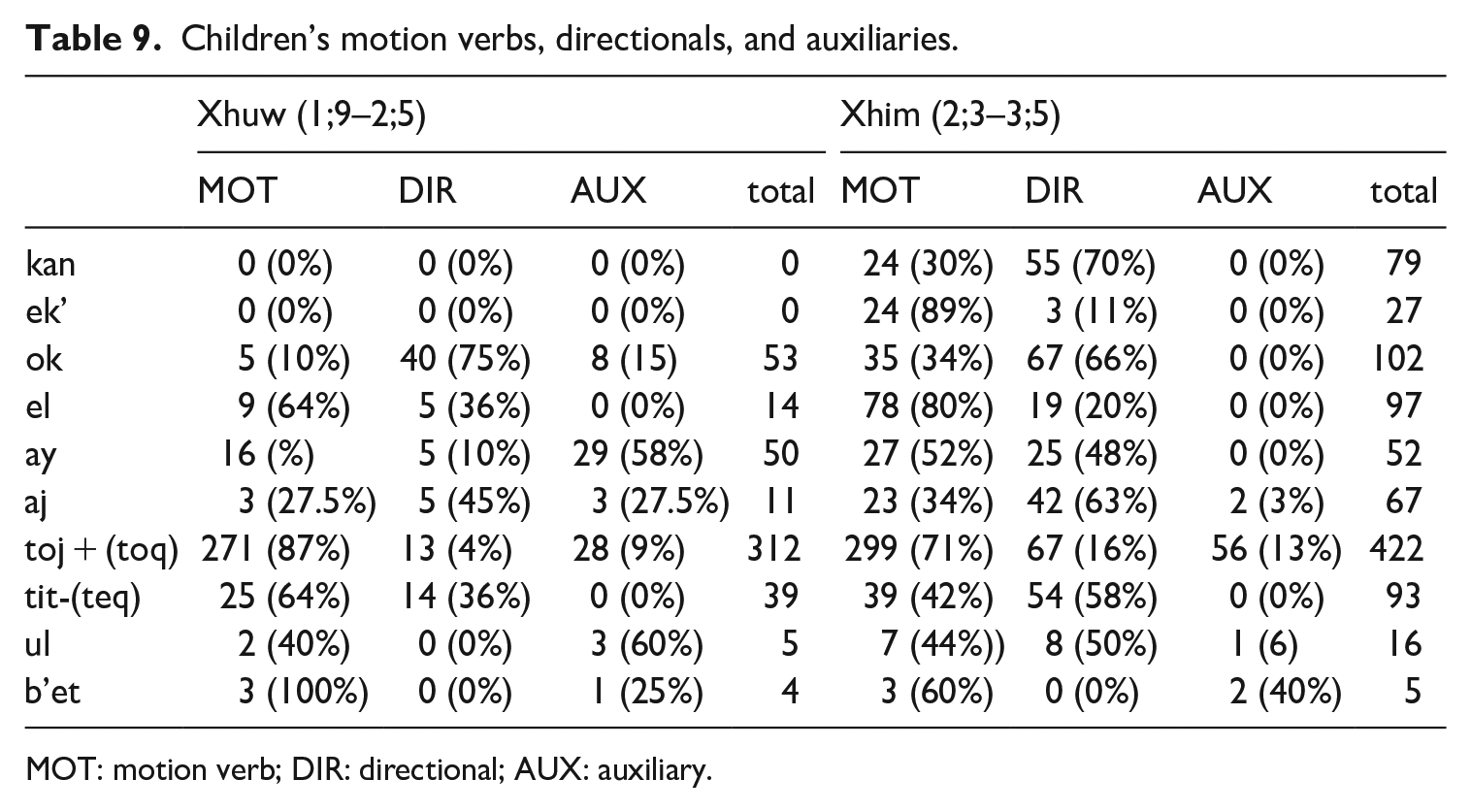
MOT: motion verb; DIR: directional; AUX: auxiliary.
39. a. = hoq-∅ ‘You will get punished’. b. = ‘Come see it’.
Suffixes
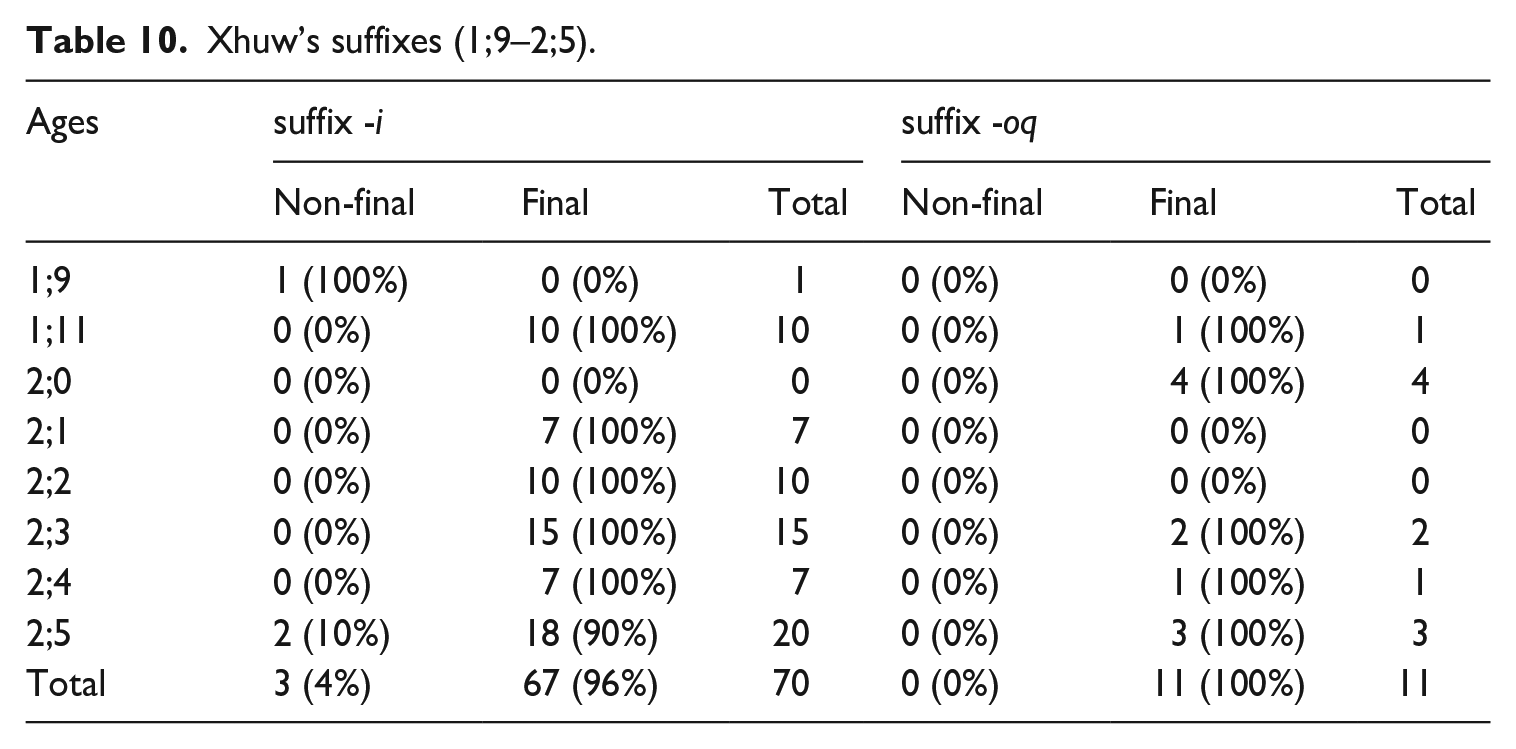
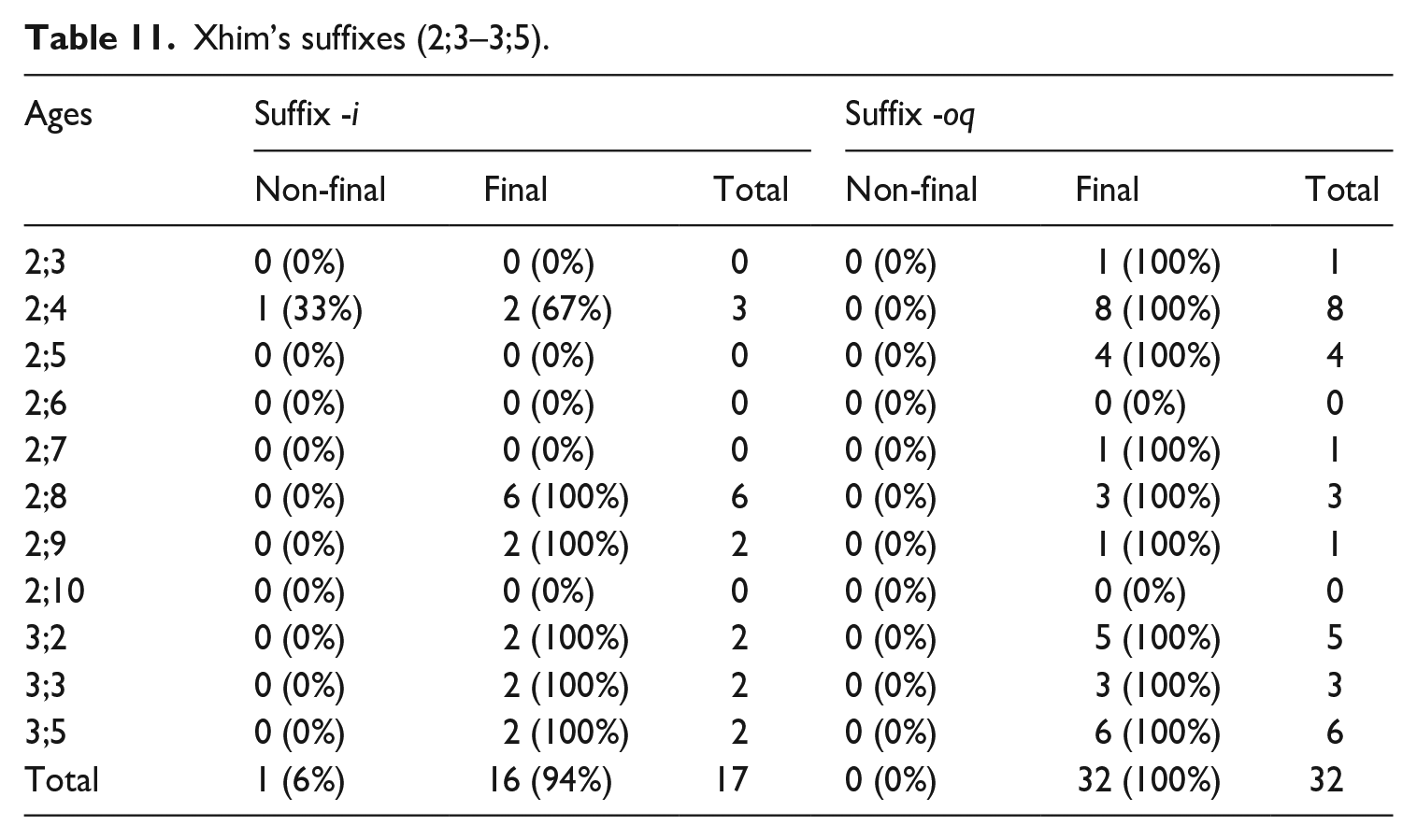
Another way to tell that children acquire the morphological distribution of motion verbs and directionals in Q’anjob’al is their production of the suffixes -i and -oq. The suffix -i appears with motion verbs, while -oq appears with directionals. Xhuw’s productions of -i and -oq are provided in Table 10, while Xhim’s are provided in Table 11. Both children produce both suffixes with different verbs at different ages, but not with the same verb. They also show differences in their production of each suffix, but most importantly in their production of -oq with directionals. As the tables below show, Xhim produced this suffix more than Xhuw.
Xhuw’s suffixes (1;9–2;5).
Xhim’s suffixes (2;3–3;5).
Productivity of directional
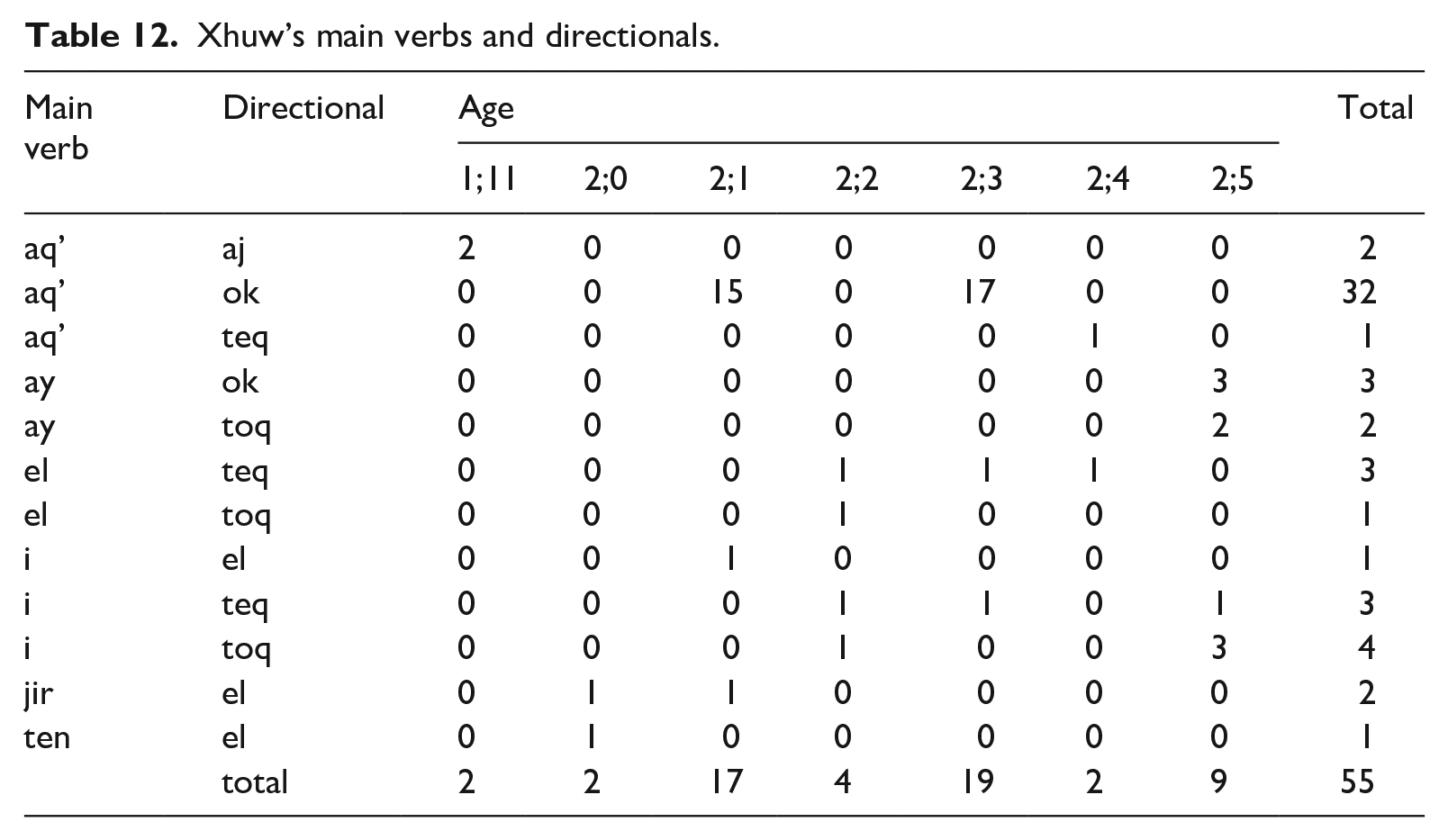
The data show that these children are productive in the combination of main verbs and directionals, as illustrated in Tables 12 and 13. Although there were only a few combinations, each combination occurred with different main verbs and with different directionals, and not with only one form. This suggests that these Q’anjob’al children do not produce main verbs and directionals merely as frozen forms. In directional constructions, these children also omit the main verb and produce the directional. In the adult grammar of Q’anjob’al, sometimes some parts of the main verb get deleted but not the whole verb.
Xhuw’s main verbs and directionals.
Xhim’s main verbs and directionals.
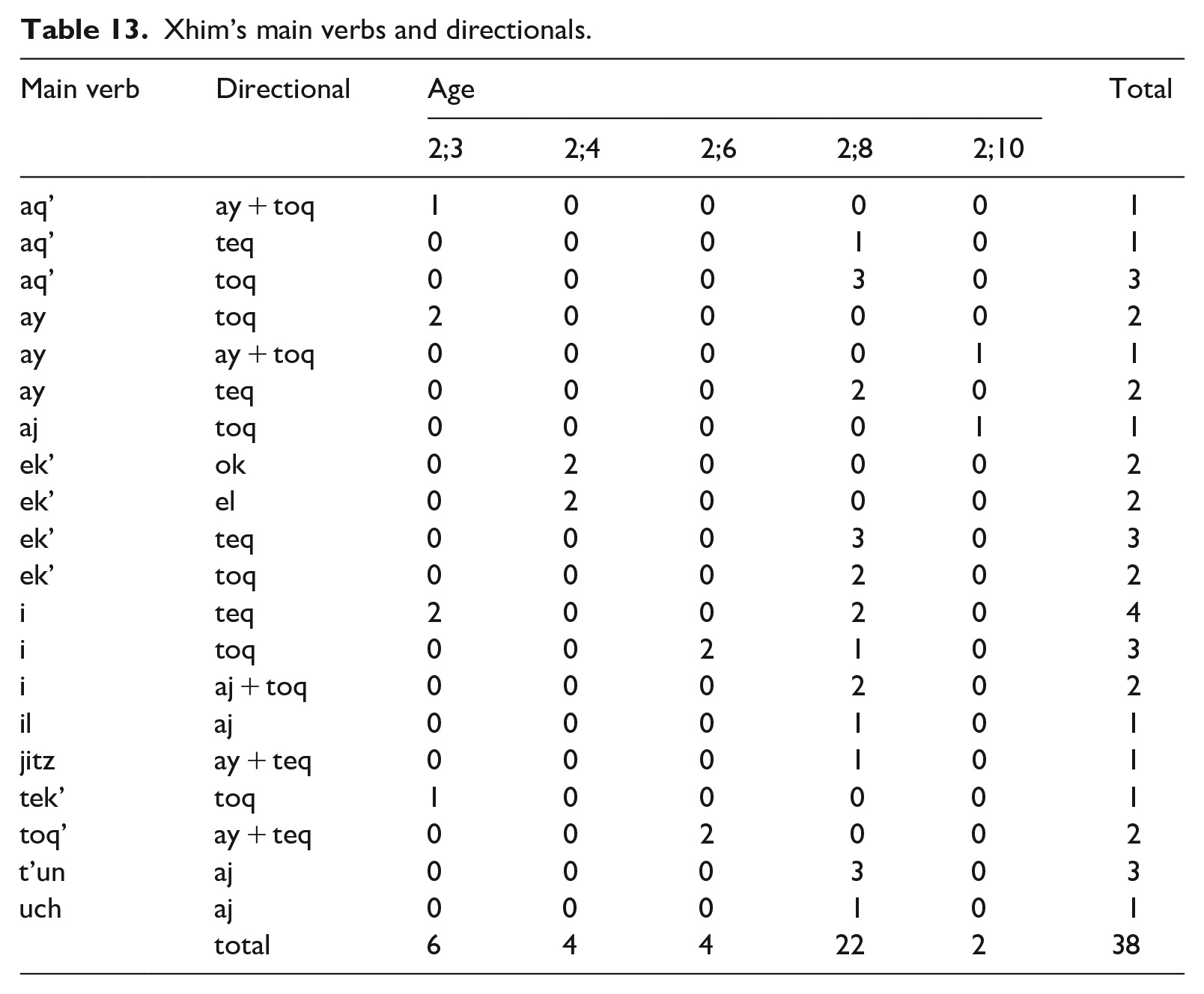
Both children produced different main verbs combined with different directionals or directionals combined with different main verbs. On the one hand, the main verb aq’ ‘to give’ appears at different ages with the following directionals aj ‘up’, ok ‘in’, and teq ‘toward speaker’. On the other hand, the directional ok ‘in’, is combined with the main verbs aq’ ‘to give’ and ay ‘to go down’. Xhuw’s combination of main verbs and directionals is given in (40) and Xhim’s in (41).
40. main verb directional a. aq’ ‘give’ aj ‘up’ Xhuw (1;11) b. aq’ ‘give’ ok ‘in’ Xhuw (2;1, 2;3) c. aq’ ‘to give’ teq ‘toward X’ Xhuw (2;4) d. ay ‘go down’ ok ‘in’ Xhuw (2;5) e. ay ‘go down’ toq ‘away from X’ Xhuw (2;5) f. el ‘exit’ teq ‘toward X’ Xhuw (2;2, 2;3, 2;4) g. el ‘exit’ toq ‘away from X’ Xhuw (2;2) h. i ‘take’ el ‘out’ Xhuw (2;1) i. i ‘take’ teq ‘toward X’ Xhuw (2;2, 2;3, 2;5) j. i ‘take’ toq ‘away from X’ Xhuw (2;2, 2;5) k. jir ‘throw’ el ‘out’ Xhuw (2;0, 2;1) l. ten ‘push’ el ‘out’ Xhuw (2;0) 41. main verb directional a. aq’ ‘give’ ay ‘down’, toq ‘away from X’ Xhim (2;3) b. aq’ ‘give’ teq ‘toward X’ Xhim (2;8) c. aq’ ‘give’ toq ‘away from X’ Xhim (2;8) d. ay ‘go down’ toq ‘away from X’ Xhim (2;3) e. ay ‘go down’ ay ‘down’, toq ‘away from X’ Xhim (2;10) f. ay ‘go down’ teq ‘toward X’ Xhim (2;8) g. ay ‘go down’ toq ‘away from X’ Xhim (2;8) h. aj ‘go up’ toq ‘away from X’ Xhim (2;10) i. ek’ ‘cross’ ok ‘in’ Xhim (2;4) j. ek’ ‘cross’ el ‘out’ Xhim (2;4) k. ek’ ‘cross’ teq ‘toward X’ Xhim (2;8) l. ek’ ‘cross’ toq ‘away from X’ Xhim (2;8) m. i ‘take’ teq ‘toward X’ Xhim (2;3, 2;8) n. i ‘take’ toq ‘away from X’ Xhim (2;6, 2;8) o. i ‘take’ aj ‘up’, toq ‘away from X’ Xhim (2;8) p. il ‘see’ aj ‘up’ Xhim (2;8) q. jitz
8
ay ‘down’, teq ‘toward X’ Xhim (2;8) r. tek’ ‘kick’ toq ‘away from X’ Xhim (2;3) s. toq’ ‘pull’ ay ‘down’, teq ‘toward X’ Xhim (2;6) t. t’un ‘hang’ aj ‘up’ Xhim (2;8) u. uch ‘destroy’ aj ‘up’ Xhim (2;8)
Input
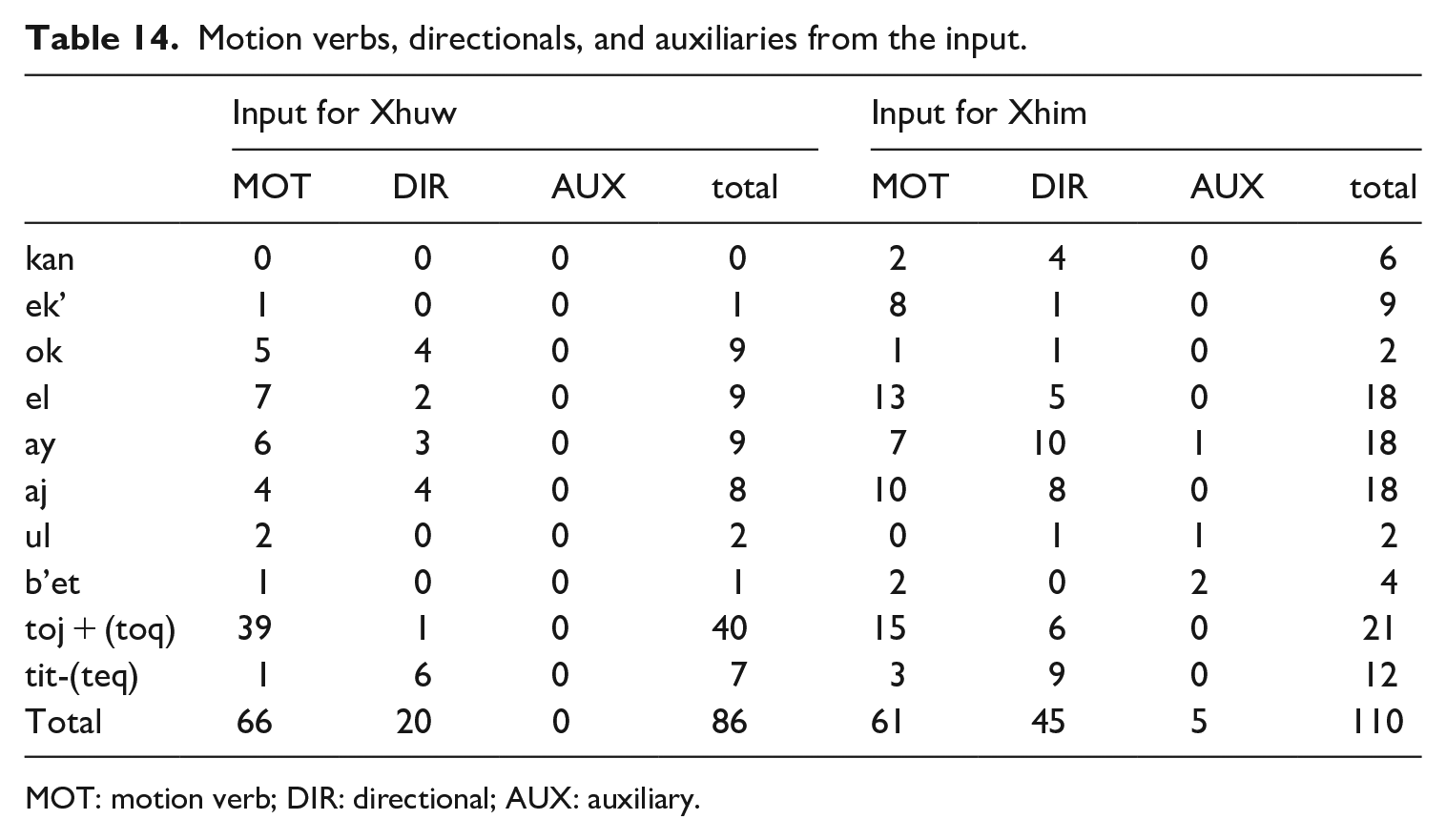
This section provides a brief discussion of the input that Xhuw and Xhim were exposed to while acquiring Q’anjob’al. The data come from one session from Xhuw’s father and Xhim’s grandmother. Motion verbs, directionals, and auxiliaries from the input are provided in Table 14.
Motion verbs, directionals, and auxiliaries from the input.
MOT: motion verb; DIR: directional; AUX: auxiliary.
Table 14 shows that there is variation in the use of motion verbs, directionals, and auxiliaries in the input. Although both children had more and similar access to motion verbs, Xhuw had less access to directionals and auxiliaries in contrast to Xhim. Some examples of these constructions are provided in (42) for Xhuw’s father and in (43) for Xhim’s grandmother. As the data show, both children are also exposed to the chain of directionals, for example, (42b) and (43b).
42. a. Mal-∅ toj-i. Motion verb already-3 ‘She went already’. b. K’am ch-∅-∅-e aj-teq mija. Directional ‘Do not take it out, daughter’. 43. a. May-∅ toj naq. Motion verb already-3 ‘He went already’. b. Ay kan aj-toq y-ul pip xhi naq. Directional ‘It is in the car, he said’. c. Q-ach ul w-i kachi b’ay. Auxiliary ‘I will come to get you, tell her’.
Although the frequency of the directionals in the input varies, it may have an effect on the early acquisition of directionals in Q’anjob’al and the order of acquisition of these directionals shown in (16) and repeated in (44). The directionals teq ‘toward X’ and toq ‘away from X’ of group 3 are more frequent in the input. Furthermore, in the input, almost every main verb takes a directional or directionals, as De León (1994) reports for Tzotzil. In English, the early acquisition of words down, up, in, and out, which play an important role in the acquisition of motion verbs, may be because of their prominence in the input (e.g. Choi & Bowerman, 1991).
44. Order of acquisition of directionals in Q’anjob’al First: Directionals of group 3: teq ‘toward X’, toq ‘away from X’ Second: Directionals of group 2: el ‘out’, aj ‘up’, ok ‘enter’, ek’ ‘pas’, ay ‘down’ Third: Directionals of group 1: kan ‘stay’
Conclusion
In Q’anjob’al, children acquire directionals along with motion verbs and auxiliaries, which is different from Tzotzil and Tzeltal. In Tzeltal (Brown, 2001) and Tzotzil (De León, 2001), children produce directionals later than motion verbs. Although the children omit markers of inflection of tense/aspect and agreement in the main verb in Q’anjob’al (Mateo Pedro, 2015), these children produce two different suffixes (-i and -oq) to distinguish the morphological distribution of motion verbs and directionals. Around the age of 2;0, the children produced the directionals teq ‘toward speaker’ and toq ‘away from speaker’. The early acquisition and high frequency of use of these two directionals may be the result of the high frequency of use of the motion verbs toj ‘to go’ and tit ‘to return’. This means that it may be guided by the acquisition of spatial deixis, following what has been reported in Tzotzil (De León, 2001) and Tzeltal (P. Brown, 2001).
In Q’anjob’al, children produce directionals after the main verb and produce chains of up to three directionals as reported for the acquisition of chains of directionals in Mam (Pye & Pfeiler, 2019). Some directionals undergo phonological changes, as in the adult grammar. The two children did not acquire all directionals at the same time. For example, the directional kan ‘stay’ appeared around the age of 2;8 in Xhim’s data. It seems that the order of production of directionals in the Q’anjob’al child data is as follows: group 3 > group 2 (some) > group 1.
Different factors may play a role in the acquisition of directionals in Q’anjob’al. First, as in other Mayan languages, directionals are very frequent and they can be a chain of up to three directionals in the adult grammar (Mateo Toledo, 2008, 2022). This is also true for the input, although the use of directionals varies. This is an area that needs more attention in future research. Second, directionals are favored by the V1 V2 construction, which according to Mateo Toledo (2008, 2022) is a favored construction in Q’anjob’al. The children produced different combinations of main verbs with up to three directionals, and they also produced auxiliaries. Third, there is a morphological distinction between motion verbs and directionals in the adult grammar and input. Motion verbs take aspect, person, and the optional status suffix -i, while directionals take the suffix -oq only. Fourth, stress plays an important role in the acquisition of directionals. Children omitted the main verb but produced the stressed syllable containing the directional. These factors may be responsible for the children’s acquisition of directionals in Q’anjob’al. In Q’anjob’al, both children produced a main verb with different directionals or a directional with different main verbs, which means they did not produce directionals as frozen forms, as illustrated in (40) and (41).
While studies exist on motion verbs and directionals in adult Q’anjob’al (e.g. Mateo Toledo, 2008, 2022), this is the first study that explores how children acquire directionals in contrast to motion verbs in the language. Both Q’anjob’al children are exposed to motion verbs, directionals, and auxiliaries, which favors their productivity in the acquisition of these types of constructions. The findings will contribute to the current literature on the acquisition of motion verbs and directionals in Mayan languages.
Furthermore, this study supports the findings of studies of motion verbs in other languages and shows that children acquire a contrast between motion verbs and directionals following the constraints of the adult grammar that children are exposed. This is reported for the acquisition of directionals in other Mayan languages, such as K’iche’ and Mam (Pye & Pfeiler, 2019), and in languages from other families, for example, English and Korean (Choi & Bowerman, 1991). Stress plays an important role in the production of the main verb and a directional, as shown in section ‘Children’s errors in the production of directional’, like findings on the acquisition of directionals in K’iche’ and Mam (Pye & Pfeiler, 2019).
Footnotes
Acknowledgements
I would like to thank the parents of the children of the project ‘Documentation of the Acquisition of Maya Languages’ (www.almaya. org). My special thanks to the Q’anjob’al team for their support in the recordings and transcriptions of the Q’anjob’al child data: Francisco Pedro Mateo, Basilio Luin Bernabé, Flora García, Diego Adalberto Martínez Esteban, Pedro Martínez Esteban, Efraín Ramón de León, and Basilio Sebastian Basilio. Thanks to Clifton Pye for his helpful comments and suggestions on preliminary versions of this paper. My special thanks for the comments and questions from the audiences of the Form and Analysis in Mayan Linguistics (FAMLi VI), the Third Toronto-Ottawa-Montréal Workshop on Indigenous Languages of Latin America (TOMILLA 3), the Canadian Linguistic Association (CLA) Annual Meeting 2022, and the Department of Linguistics at the University of Kentucky. I am also thankful to Chloë Marshall, editor of First Language, and Lourdes de León, my co-editor of this issue, for their encouragement in the revisions and to the three anonymous reviewers for their feedback on previous versions of this paper.
Author Contributions
Funding
The author(s) disclosed receipt of the following financial support for the research, authorship, and/or publication of this article: Thanks to the funding for data collection from the National Science Foundation (BCS 0515120 and BCS 0613120), UNAM-PAPIIT (IN-401207), CIESAS-Sureste, the KU Center for Latin American Studies, the Schiefelbusch Child Language Scholarship, and the Tinker Fellowship.
