




Abstract
While monolingual English speakers acquire most pronouns by age 5, acquisition amid prevalent, normative code-mixing, such as in Trinidad, is underexplored. This study examines how Trinidadian 3- to 5-year-olds express third-person subject, object, reflexive and possessive pronouns and factors influencing pronoun choices. Seventy-five preschoolers produced pronouns via a word elicitation task conducted in Trinidadian English Creole and Trinidad and Tobago English. Responses were coded for children’s age, gender, district and socioeconomic status; task language; grammatical gender/number; and response form. Conditional inference trees facilitated statistical analysis. When choices were available, children exhibited variable production, with Creole forms often dominant. Grammatical gender influenced whether English or Creole pronouns were selected. Task language influenced possessive pronoun choices, indicating developing sociolinguistic competence. The non-significance of other variables suggests widespread mixing of English and Creole pronouns. Findings underscore the importance of describing understudied populations, especially where variation is inherent, to ensure accurate language assessment.
Introduction
This article’s preoccupation is third-person pronoun production. Previous work on English pronoun acquisition has determined that children start producing pronouns early in their lives. According to Samad and Arshad (2017), subject pronouns are said to be acquired first, by 2;10. Object and possessive pronouns follow, acquired by 3;10. Finally, reflexive pronouns are acquired beyond 3;10, although a specific age is not provided by these authors. Huxley’s (1970) study found that by age 4, children were producing ‘myself’, ‘yourself’, ‘herself’, ‘himself’ and ‘themselves’. While Girouard et al. (1997) arrive at similar ages for correct production of ‘she’, ‘he’, ‘her’ and ‘him’, other studies have alternative findings. For instance, Wells (1985) found that of his 125 subjects from Bristol, subject pronouns were in use by over 90% of them at 4;9. Most object pronouns were being produced by over 90% of the sample by 5;0, although ‘her’ notably had not reached the 90% threshold; it was used by 83% of the subjects. Possessive and reflexive pronouns fared worse in that study: only ‘mine’ and ‘yours’ were used by over 50% of the sample by 5;0, and no reflexive pronouns were produced by over 50% of subjects by 5;0. Overall, it seems one can expect English-speaking children to consistently use pronouns by age 6. In fact, Varlokosta et al. (2016, p. 12) conclude that ‘pronominal production can be taken as a cross-linguistic robust marker of language development’. In their study, 19 English-speaking children aged 63–71 months produced the third-person object pronouns ‘him’, ‘her’ and ‘it’ on average 81.6% of the time and did not omit any in obligatory contexts.
This article departs from the aforementioned studies by examining pronoun acquisition in a Creole context. This topic is underexplored, as is acquisition of Creoles in general (see Kidd & Garcia, 2022, which shows that for each Creole language that has been researched, there have been only one or two articles published in major journals over the last 45 years). Prior work largely has been concerned with pronoun acquisition in either monolingual English-speaking children or bilingual speakers of typologically distinct languages, for example, Qi’s (2010) investigation of Mandarin-English bilinguals. Work on Creole pronouns mainly has been focused on Principle B violations and null subject/object phenomena (e.g. Adone, 1994, 2012; De Lisser, 2015; De Lisser et al., 2016). However, Kennedy (2017), in her discussion of acquisition of possession in Jamaican Creole and Jamaican English, notes that children aged 2;9 to 4;2 only used ‘mine’, and to a lesser extent, ‘yours’ and ‘yorn’ from Jamaican English. ‘Fi’ and ‘uon’ from Jamaican Creole were preferred markers for possession. De Lisser (2015), who focuses on Jamaican Creole-speaking children, finds that they initially produce twice as many first-person singular personal pronouns than third-person singular personal pronouns. However, third-person singular pronouns quickly begin to dominate the output. In terms of order of pronoun types, singular pronouns emerge before plurals. Reflexive pronouns were sparse in the data but produced accurately when they appeared.
In this article, I shift focus to pronoun acquisition in a different Creole context. The island of Trinidad is host to a national English variety as well as an English Creole. These languages are closely related; consequently, the boundaries between the two are sometimes difficult for speakers to identify. Added to this is the practice of normative code-mixing of the languages in all but the most formal contexts: speakers use different percentages of features associated with each code depending on the situation. This is distinct from code-switching from one language to another in different settings. Thus, children must acquire pronouns from both systems – which overlap in certain domains – as well as rules about how to use pronouns associated with each system appropriately. This article is therefore concerned with acquisition of variation in a multilingual context.
In sum, this exploratory study seeks to (1) describe what acquisition of pronouns in Trinidad is like and (2) determine which independent variables influence choices between pronouns from each language. In the discussion, the reader will find that answers to both of these questions have implications for language assessment in this linguistic community, where language assessments are largely facilitated by exonormative tests.
The article is organized as follows: first, I describe the Trinidadian context and the pronoun systems of the two languages. Following this, I discuss studies on acquisition of variation and acquisition in bidialectal or multilingual settings. The methodology of the present study is then detailed. Findings are presented and the article closes with a discussion.
Trinidadian sociolinguistic context
The main languages on the island of Trinidad are Trinidad and Tobago English 1 (TTE), and Trinidadian English Creole (TrinEC). These languages share most of their lexicon, overlap in certain grammatical domains and influence each other linguistically; unsurprisingly, Ferreira (1997) notes that it is difficult for many to distinguish between the two. TTE is the national variety of English. Like other Caribbean varieties such as Jamaican English, TTE has more recently been suggested to be an English as a Second Dialect variety rather than an English as a Second Language variety (Deuber, 2014). Some distinguishing features are a modal system influenced by TrinEC and angloversal tendencies (e.g. ‘would’ is often used in a future sense in formal situations), and the use of second-person plural ‘you all’, influenced by the equivalent TrinEC pronoun ‘allyuh’, especially in informal registers (see Deuber, 2014, for further details). TrinEC is often described as a mesolectal creole, that is, an intermediate variety that is closer to the standard (Winer, 1993). Some notable features of TrinEC are ø plurals, ø copulas, ø progressive aspect and ø past tense markers, and tense, mood and aspect markers such as future ‘go’, habitual ‘does’ and completive ‘done’ (for in-depth descriptions, see James & Youssef, 2004; Solomon, 1993; Winer, 1993).
Based on estimates of Sealey and Aquing (1983) and Mühleisen (2001), TrinEC is the mother tongue of most of the population. Some children have a balanced exposure to both codes and some have more exposure to TTE (Youssef, 1996). Attitudes towards the languages can vary. TTE enjoys a measure of prestige; some view it with pride, some with indifference (Ferreira, 1997), while others may view its use as ‘pretentious’, ‘insincere’ or ‘showing off’ (Mühleisen, 2001). As for TrinEC, Ferreira (1997, p. 8) comments that attitudes ‘range from affectionate pride to outright rejection’. Mühleisen (2001, p. 66) finds that attitudes have improved, but TrinEC is still seen as appropriate for ‘private’ or ‘informal’ settings.
Added to the existence of two related languages and the varying attitudes towards them is the practice of normative and extensive code-mixing of TTE and TrinEC. Winford (1972) notes that the speech of different groups is ‘not differentiated . . . by discrete sets of features but rather by differences in the combinations of features, and in the frequency with which they occur in everyone’s speech’ (pp. 424–425, emphasis added). For instance, Winford (1980) observes that while respondents of all socioeconomic backgrounds completely suppressed habitual ‘does’ – a stigmatized TrinEC feature – in careful interviews, ø copulas – a less stigmatized feature – were not reduced as extensively. Youssef (1990) describes the situation as such: ‘distinct language systems may have alternants between them linked in an individual’s competence.
Trinidadian pronouns present an interesting case for exploring varilingual competence. The TTE and TrinEC phonemic inventories considerably overlap while the TTE and TrinEC verb paradigms are largely distinct from each other. However, the pronoun systems of both languages seem to lie somewhere in between: there is an almost balanced distribution of areas that overlap and areas that are distinct. One must wonder what code-mixing is like in such an instance.
Trinidadian pronoun systems
Given the lack of comprehensive research on how children use pronouns in Trinidad, the first aim of this study is to describe their pronoun repertoire. In this section, I review what has been documented about the TTE and TrinEC pronoun systems. Information presented on TrinEC pronouns in this section comes from James and Youssef (2004), Richards (1970), Solomon (1993) and Winer (1993). Information on the TTE system comes from Quirk et al. (1985), since there is no difference between TTE pronouns and the English pronouns described therein. This overlap probably accounts for why researchers have not been inclined to describe TTE pronouns. This section only examines third-person pronouns as these are the present study’s focus. It should be noted that pronoun usage in Trinidad is understudied – while some researchers have documented the TrinEC pronouns observed in use, there has been no comprehensive research on how adults or children use TrinEC or TTE pronouns, which was one motivation for the present study.
Table 1 shows third-person subject and object pronouns in both codes. The third-person singular subjects ‘she’ and ‘he’ are shared by TTE and TrinEC. Of note is the TrinEC third-person plural subject ‘them’. Richards (1970) claims ‘they’ is preferred as a subject in affirmative sentences while ‘them’ is an additional option in negated sentences, for example,
Subject and object pronouns in TTE and TrinEC.
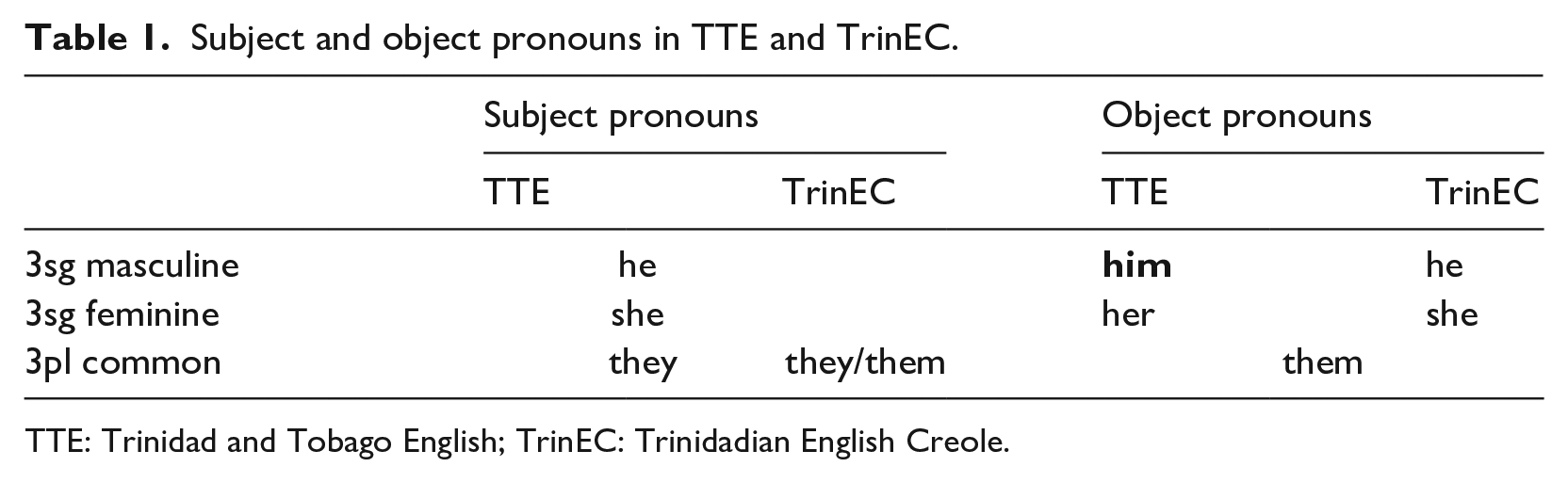
TTE: Trinidad and Tobago English; TrinEC: Trinidadian English Creole.
For reflexive pronouns (Table 2), while TTE distinguishes between singular and plural with <-self> and <-selves>, respectively, TrinEC uses <-self> consistently, for example,
Reflexive pronouns in TTE and TrinEC.
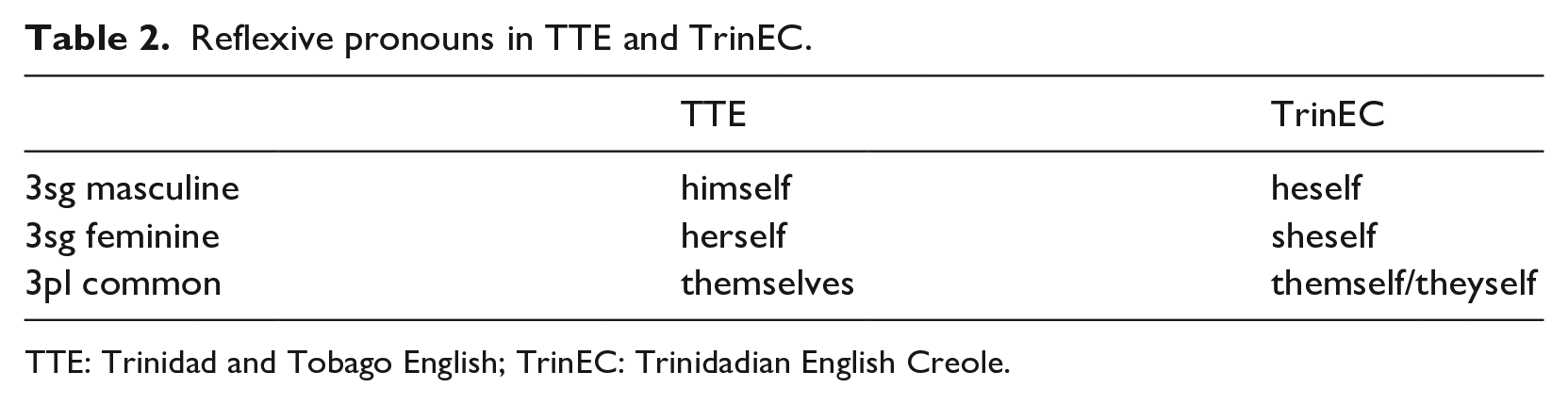
TTE: Trinidad and Tobago English; TrinEC: Trinidadian English Creole.
For possessive pronouns (Table 3), the suffix <-own> is productive in TrinEC, for example,
Possessive pronouns in TTE and TrinEC.
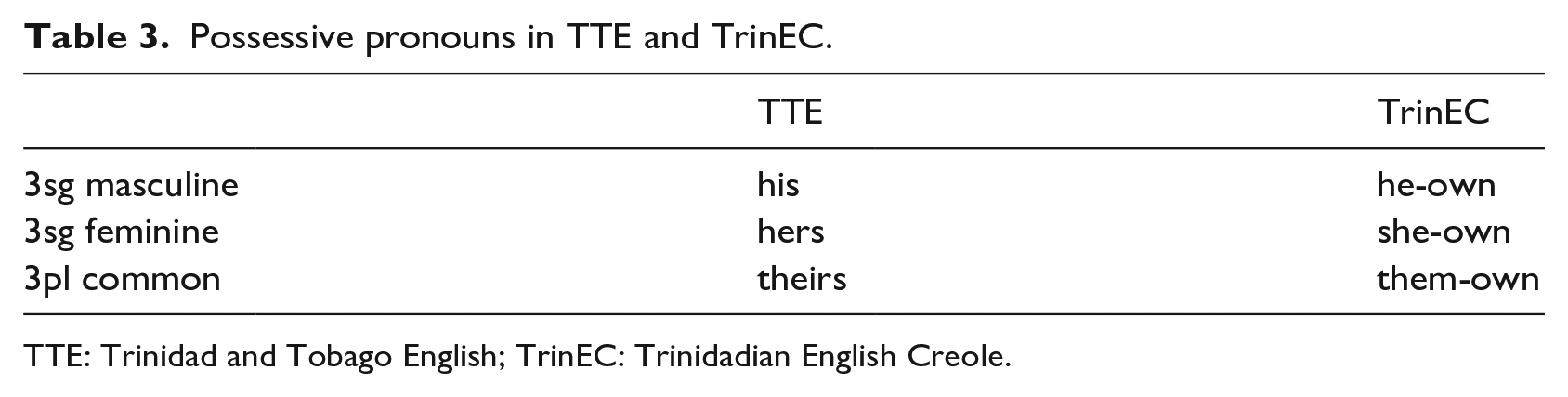
TTE: Trinidad and Tobago English; TrinEC: Trinidadian English Creole.
Based on this description, Trinidadian children’s pronoun choices clearly involve both variation and overlap. As mentioned earlier, there is often mixing in the input children receive, although it may be TrinEC-dominant for many. Thus, children have the task of acquiring two systems as well as using the pronouns associated with each system appropriately.
Acquisition of variation
The second aim of this study is to explore which factors influence choices between TTE and TrinEC pronouns. In the face of limited research on Trinidad, I turn to other studies on acquisition of variation to determine which independent variables should be considered. Table 4 provides an overview of the studies surveyed. Traditionally, research on acquisition of variation focused on phonological variables but expansion into morphosyntax and into other linguistic communities has allowed more insight into which linguistic and social constraints are important and how they influence acquisition depending on the linguistic variable under study.
Overview of studies on acquisition of variation.
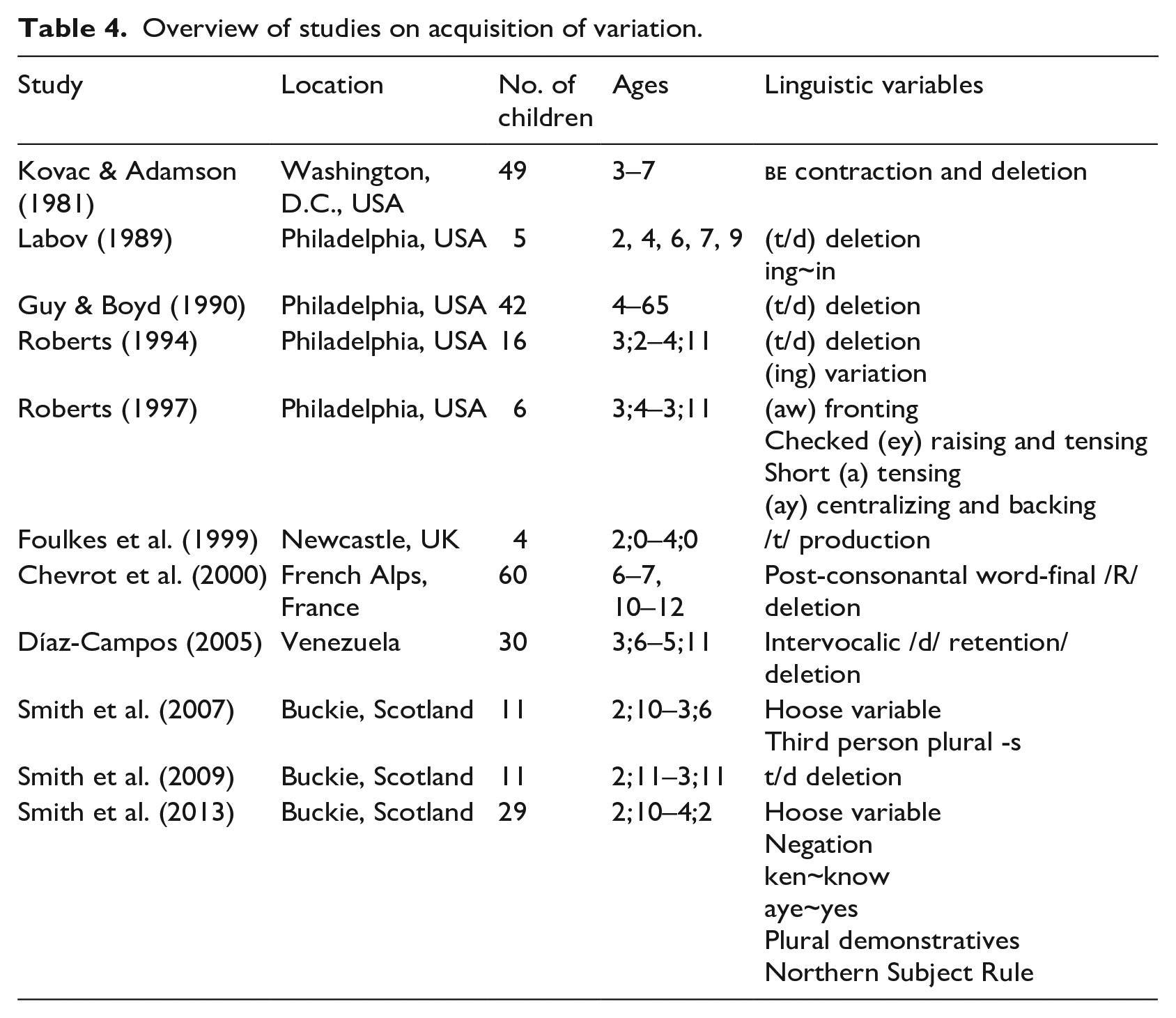
The following independent variables have been found to be relevant:
Age. In Smith et al. (2007) for the hoose variable, and Smith et al. (2013) for four linguistic variables, caregivers used lower rates of local forms with younger children, resulting in reduced rates of the local form in these children’s speech. In Smith et al. (2009), caregivers’ t/d deletion rates increased as children got older while children’s t/d deletion decreased as they aged. Díaz-Campos (2005) found that children aged 4;6–5;11 increased intervocalic /d/ retention in careful speech compared to those aged 3;6–4;5. In Guy and Boyd (1990), rates of t/d deletion of semi-weak verbs varied according to age. Chevrot et al. (2000) found that 6- to 7-year-olds deleted /R/ more frequently than 10- to 12-year-olds before consonants in dialogue compared to exercises. In contrast to these studies, Roberts (1994) found that age was not significant for (ing) variation or t/d deletion. In Smith et al. (2013), rates of use of local forms for morphosyntactic variables were not age dependent, similar to Smith et al. (2007) for third-person plural -s, where children used both forms from the outset.
Linguistic constraints. In Smith et al. (2007, 2009, 2013), all children mirrored caregivers’ categorical and variable linguistic patterns, whether they depended on lexical items, verb type, sentence type or subject type. Children in Foulkes et al. (1999) followed acoustic patterns for /t/ production similar to adults in their community. In Chevrot et al. (2000), deletion of post-consonantal word-final /R/ was more frequent before consonants than before vowels/pauses; phonological context had a greater effect compared to situation and age and was determined to emerge before style. In Kovac and Adamson (1981), the linguistic variable mattered: grammatical and phonological constraints on
Socioeconomic status. Children of lower socioeconomic status (SES) in Díaz-Campos (2005) had a lower percentage of retention of intervocalic /d/ than those of higher SES. Parents’ SES was significant in Chevrot et al. (2000): workers’ children had higher rates of /R/ deletion than managers’ children in certain contexts. In Kovac and Adamson (1981), social class influenced rates of
Style. Labov (1989) found that children between 4 and 9 first acquired social and stylistic constraints on variation before grammatical and articulatory constraints for t/d deletion and ing~in variation. In Roberts (1994), children adapted (ing) variation to context. In Smith et al. (2007), once children started using both variables for hoose, there was evidence of stylistic and lexical constraints being acquired at the same time. In Smith et al. (2013), generally, older children – who experienced style-shifting from the input – demonstrated similar style-shifting. Style-shifting was largely not used with younger children; unsurprisingly then, younger children did not style-shift. However, caregivers used style-shifting with the hoose variable for younger children and these children still did not demonstrate this sensitivity, thereby lending credence to the hypothesis that social constraints are not acquired first. No style-shifting was found for t/d deletion in Smith et al. (2009) and Roberts (1994) or third-person plural -s in Smith et al. (2007).
Child’s gender. In Smith et al. (2009), Guy and Boyd (1990) and Roberts (1994), gender was not significant for t/d deletion. Similarly, gender was not significant for /t/ production in Foulkes et al. (1999). Roberts (1994) found that gender was not significant for (ing) variation. However, for t/d deletion, girls showed higher rates than boys.
Caregiver input (Henry, 2016; Roberts, 1997; Smith et al., 2007, 2013), interlocutor (Quay, 2008; Roberts, 1994), racialized group (Kovac & Adamson, 1981) and peer group interaction (Nardy et al., 2013) have also been significant, but they are not discussed here in detail since caregiver input cannot be tested due to limited research on this context and the latter two cannot be tested due to the prompt used to elicit data. Overall, the five independent variables discussed above are possible influential factors, but they do not always turn out to be significant.
Apart from considering possible independent variables, it is also important to consider the linguistic context of the acquisition. In their work on acquisition in Buckie, Scotland, Smith and colleagues demonstrate that the age at which and the extent to which acquisition of a linguistic variable occurs depends on the linguistic variable and the community of interest. Smith et al. (2007), for instance, find that in this community, caregivers recognized the social perception of the phonological, but not the morphosyntactic, variables they examined. As a result, caregivers used more local morphosyntactic forms in their child-directed speech. The authors, echoing Chevrot et al. (2000), recommend that researchers consider a variable’s sociolinguistic value in the specific community when studying the acquisition of (socio)linguistic competence. This is particularly relevant to the Trinidadian context. Winford (1972) concludes that the Trinidadian community shares views on the linguistic and sociolinguistic value of variables, with some variables being stigmatized.
Youssef’s (1990, 1991, 1996) longitudinal study on three Trinidadian children’s acquisition of the verb phrase is the most extensive research on language acquisition and child code-mixing in Trinidad. Through this study, Youssef found that from as early as 2;4, children do not just acquire multiple languages, but also the ability to code-mix proficiently. Kareem, a child with balanced exposure to TTE and TrinEC, is discussed at length. Recorded from 2;4 to 4;9, Kareem exhibited different levels of mixing in the verb phrase according to the setting (e.g. home vs formal nursery) and the language use of his interlocutor and his relationship with them (e.g. mother vs babysitter vs researcher). Verbal markers were also selected based on semantic intent, discourse orientation, and phonological and syntactic factors, and these factors sometimes competed with one another. Another child, Janet, was influenced by similar factors but her language use was different due to her exposure to more TTE than TrinEC. By 4;0, she used over 90% of TTE verb forms in her mother’s presence but mixed both codes with peers. Both linguistic and extralinguistic factors influenced variable verb phrase production. Overall, Youssef has found that code-mixing emerges early and is influenced by addressee, emotional involvement, setting, topic, purpose and one’s competence in both codes.
Jackson’s (2019) work on the phonological acquisition of 147 Trinidadian children aged 3;0–5;2 found that children had high rates of production of consonants shared by TTE and TrinEC but had low levels of production of consonants and consonant clusters belonging only to TTE. To be more likely to select a TTE variant over a TrinEC one, children were influenced by linguistic variables such as word class, word position and following phone. Extralinguistic variables such as children’s gender and district were significant for 3 of the 10 variable pairs studied, meaning that although rates of TTE variants were low overall, children were more likely to produce them based on these variables. These results indicate that phonological acquisition in this community differs from verb phrase acquisition. It is unclear how pronouns will present in the subset of these children who participated in the current study.
Present study
Research questions
This study addresses two questions:
How do Trinidadian preschoolers express third-person subject, object, possessive and reflexive pronouns?
• Since there is no data on local children’s pronoun repertoires, this descriptive question is a necessary first step.
When faced with a choice between TTE and TrinEC pronouns, what factors influence these children’s choices?
• Given the lack of research on acquisition in varilingual contexts and that different independent variables have been found to influence linguistic variables, this exploratory question is interested in uncovering what motivates choices between the different types of TrinEC and TTE pronouns.
Methods
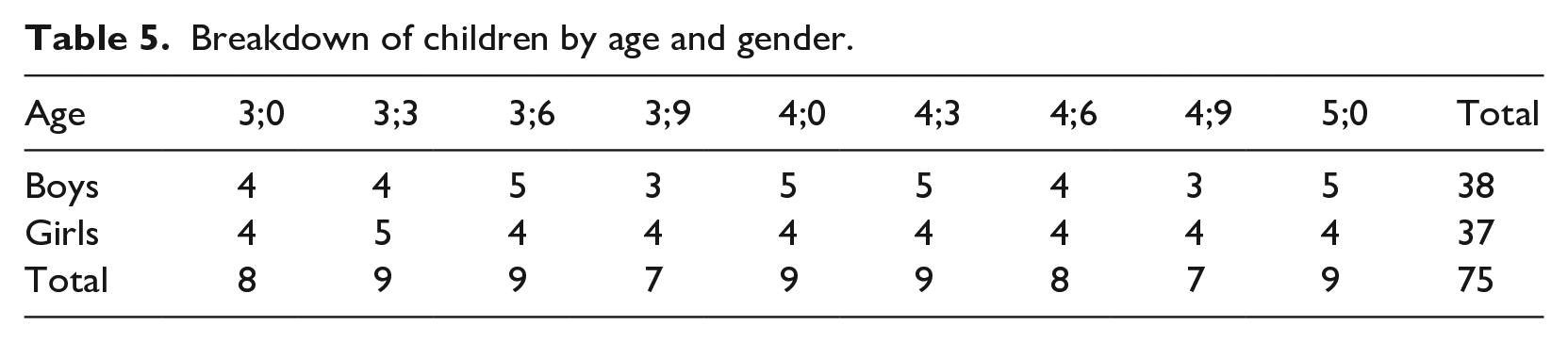
Participants were part of a larger, 147-child study aimed at describing language norms of Trinidadian preschoolers. The subset used for this study consisted of 75 preschoolers aged 3;0–5;2 (mean = 50.3 months, SD = 7.1 months) drawn from government(-assisted) early childhood care and education centres from the island’s seven educational districts. The number of children recruited per district was proportional to the percentage of the population living in that district, to mirror the population. Table 5 details the number of boys and girls for each 3-month age band.
Breakdown of children by age and gender.
I designed a word elicitation task using a modified subsection of the Clinical Evaluation of Language Fundamentals – Preschool, Second Edition (CELF-2) (Semel et al., 2004). The CELF-2 is a language assessment commonly used by speech-language pathologists (SLPs) in Trinidad. However, for the purposes of this study, it was used as a template for data elicitation. Ali et al. (2022) argue that adapting foreign tests for these purposes has its merits. In the larger study, there was also an interest in whether the CELF-2 was appropriate for assessing varilingual children. Pictures and prompts are frequently used in elicited production experiments in language acquisition (see Eisenbeiss, 2010) and have become more popular in sociolinguistic research (see Alfaraz, 2010; Boyd et al., 2015; Jaber et al., 2012). This task examined several morphosyntactic elements, but the present study focuses on the subsection on third-person subject, object, possessive and reflexive pronouns. The task consisted of pictures accompanied by prompts to elicit the targeted pronoun types, for example, ‘He is hugging
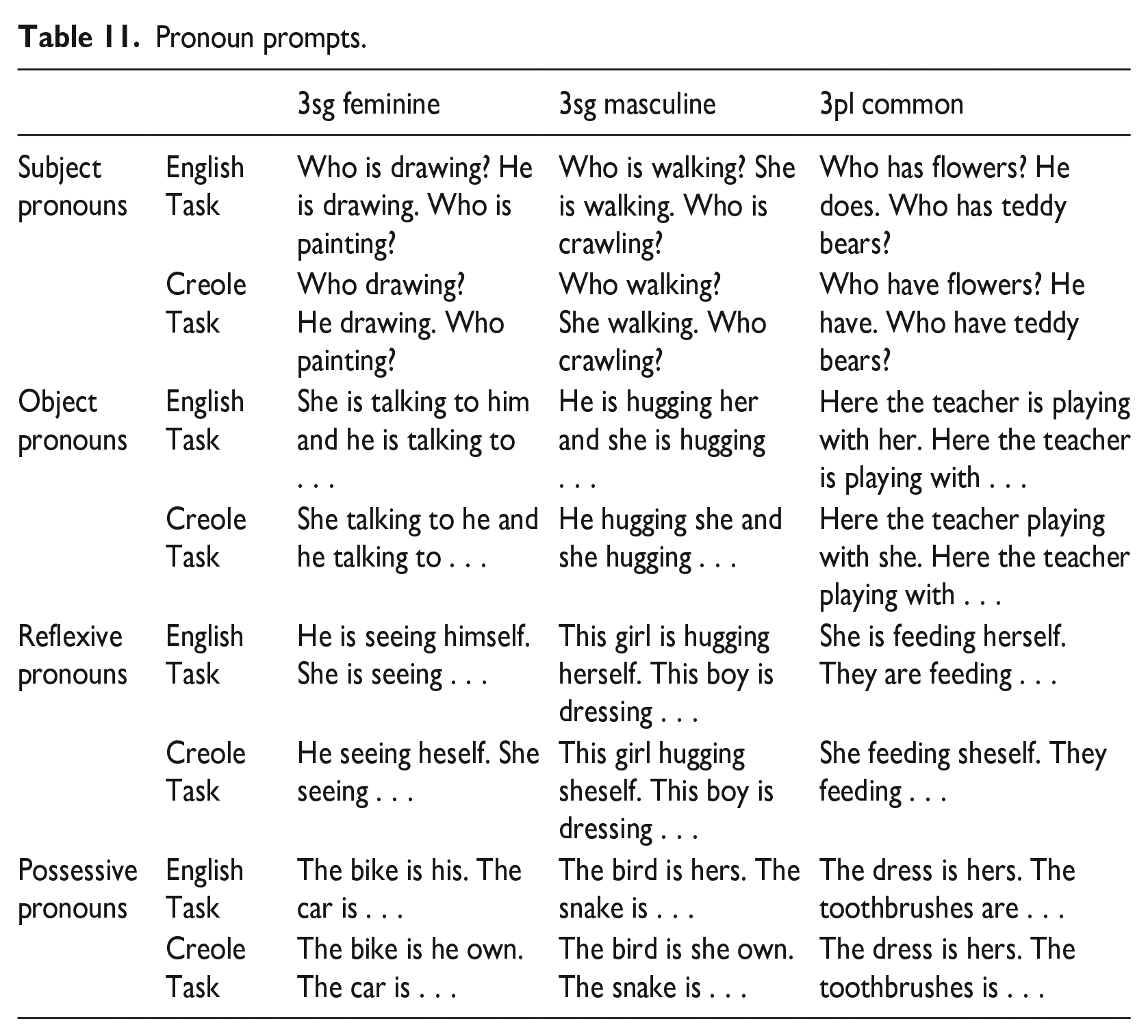
In a quiet area in the school, I showed each child pictures on a laptop and prompted them to provide the targeted pronoun types relevant to each picture. In the first instance, I delivered the prompts in TTE; this is referred to as the English task. A few days later, I repeated the task using the same pictures, but this time using TrinEC prompts; this is referred to as the Creole task. All prompts in both languages are listed in table 11 in the Appendix. Sessions were video and audio recorded and transcribed in Computerized Language ANalysis (MacWhinney, 2000).
Each pronoun type had three targets: third-person singular feminine and masculine, and third-person plural common. Pictures for the feminine and masculine targets used stereotypical gender portrayals of girls and boys, respectively. The following responses were excluded: unintelligible answers (n = 2), noun phrases (e.g. ‘She is seeing
Because this is an exploratory study, it was important to examine multiple independent variables in order to see what was significant for pronoun selection. Thus, data were coded for age, gender, district and SES of the child; task language used; and grammatical gender of the pronoun produced. Grammatical gender was used rather than number to avoid overlooking possible differences between use of masculine and feminine pronouns. However, wherever number is more relevant than gender, it will be so discussed. Pronouns were also coded for response form using one of four labels:
Described Shared (DS) – A form belonging to both TTE and TrinEC, as described in the literature, for example, singular subject ‘he’.
Described English (DE) – A form belonging to TTE only, as described in the literature, for example, singular object ‘him’.
Described Creole (DC) – A form belonging to TrinEC only, as described in the literature, or observed in use by Trinidadian adults by me, for example, singular reflexive ‘hisself’.
Non-described (ND) – A form not described for TTE/TrinEC or not observed in use, for example, singular possessive ‘him’s’.
These terms, while novel, are more appropriate here than a less neutral term such as ‘prescribed’, which implies a prescriber, and there is none for Creole. However, relying on native speaker intuition is unideal and, while I did consult other Trinidadian residents about whether forms should be classified as DC or ND via an informal online poll, more systematic research is needed to classify these terms to avoid the logical fallacy ‘What is not English is Creole’.
The data were studied for patterns and compiled for distributional analysis. Analysis was also conducted using conditional inference trees (CITs) in R, via the package ‘PARTY’ (Hothorn et al., 2006). CITs are particularly useful for exploratory studies like this one, where it is not clear how independent variables may affect the dependent variable and where there may be complex interactions between variables. Jongmans et al. (2010, p. 289) and Levshina (2020, p. 612) explain the recursive partitioning method for CITs: (1) The algorithm determines whether there is any dependence between the independent variables and the dependent variable at a significance of .05. If there is no dependency with any independent variable, the algorithm will stop. If there is, the algorithm selects the independent variable with the strongest association with the dependent variable (as determined by the smallest p-value). (2) The algorithm creates an optimal binary split in this independent variable. (3) These two steps are recursively repeated until there are no further possible splits. The resulting trees are useful for explaining the relationships between variables and the response while avoiding overfitting.
Findings
Question 1: pronoun expression
Because most Trinidadians’ first language is TrinEC, it was expected that children would easily produce DC or DS pronouns but would be restricted in their production of DE pronouns due to a tendency to choose TrinEC forms.
Subject pronouns
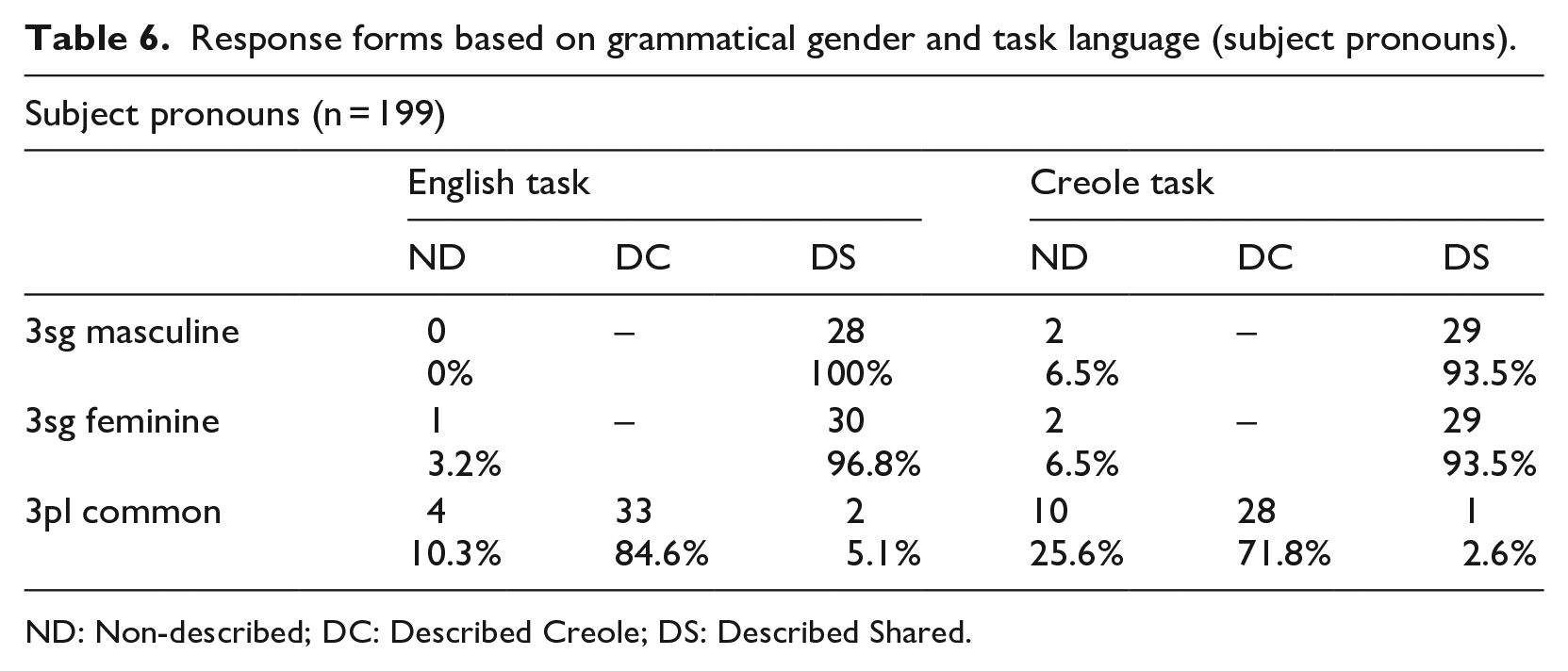
Table 6 summarizes response form frequency based on grammatical gender and task language for subject pronouns. Hyphens are placed in a cell when the response form was not an option for a particular gender. For each of the singular pronouns, there was one choice (‘she’ and ‘he’) since the two systems overlap. For the plural, however, there was a choice between DC ‘them’ and DS ‘they’. Children chose the DC pronoun most often.
Response forms based on grammatical gender and task language (subject pronouns).
ND: Non-described; DC: Described Creole; DS: Described Shared.
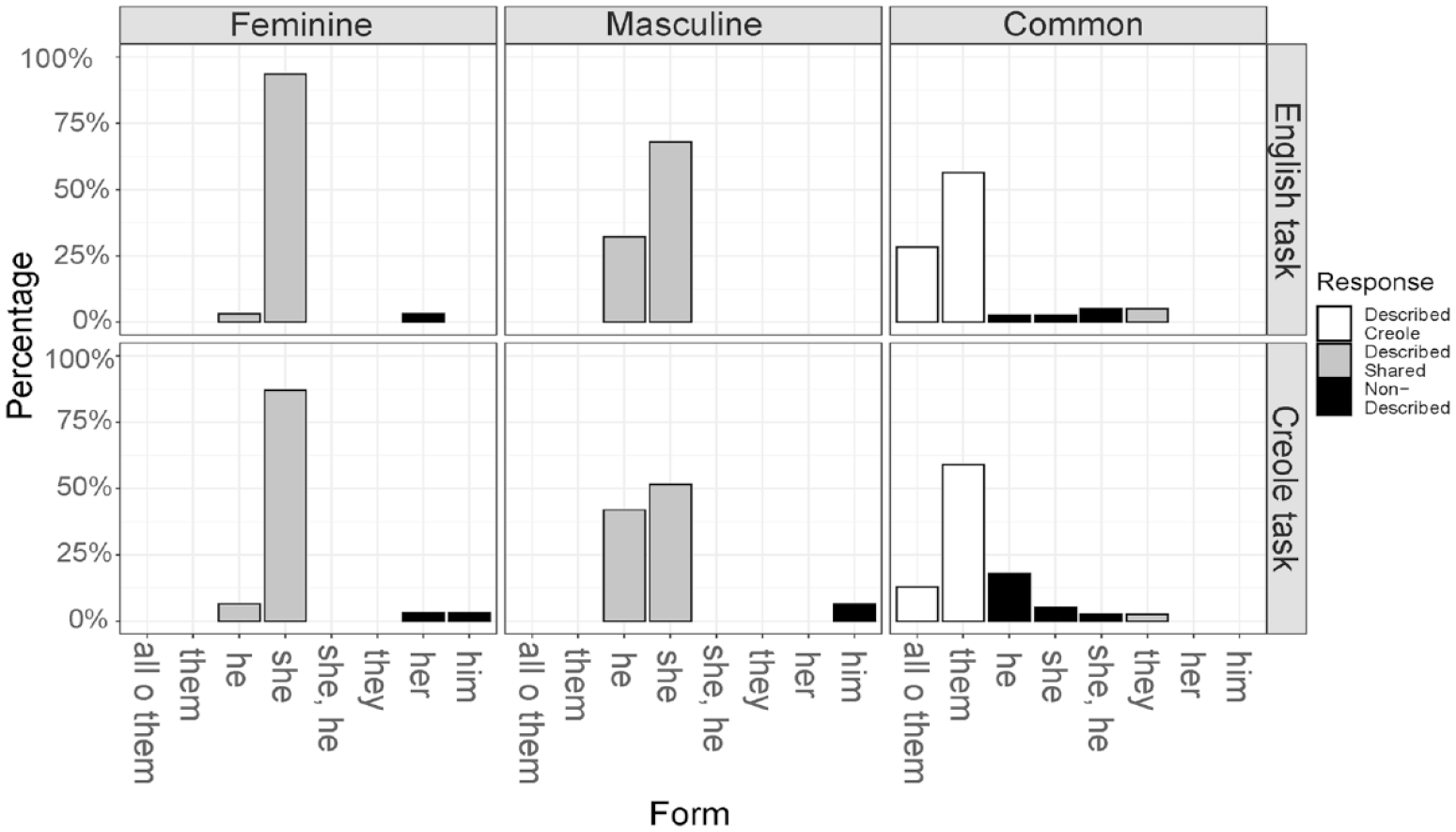
Figure 1 shows the range of words used to express subject pronouns, arranged by grammatical gender and task language and shaded by response form. For third-person singular feminine, the overwhelming choice was DS ‘she’ (n = 56). Some participants reversed gender, using DS ‘he’ (n = 3). ND forms included ‘her’ (n = 2) and ‘him’ (n = 1). For third-person singular masculine, the clear choice was still DS ‘she’ (n = 35), likely due to ambiguity in the task picture, which was a toddler boy with long hair. Many participants also used DS ‘he’ (n = 22). The only ND form was ‘him’ (n = 2). For third-person plural common, the most frequent choice was DC ‘them’ (n = 46), followed by DC ‘all o them’ (n = 16). DE ‘they’ was used minimally (n = 3). ND forms included ‘he’ (n = 8), ‘she’ (n = 3) and ‘she, he’ (n = 3).
Bar Charts Showing Percentage Levels of Production of Described Creole, Described Shared and Non-Described Feminine, Masculine and Common Subject Pronouns in the English and Creole Tasks.
Object pronouns
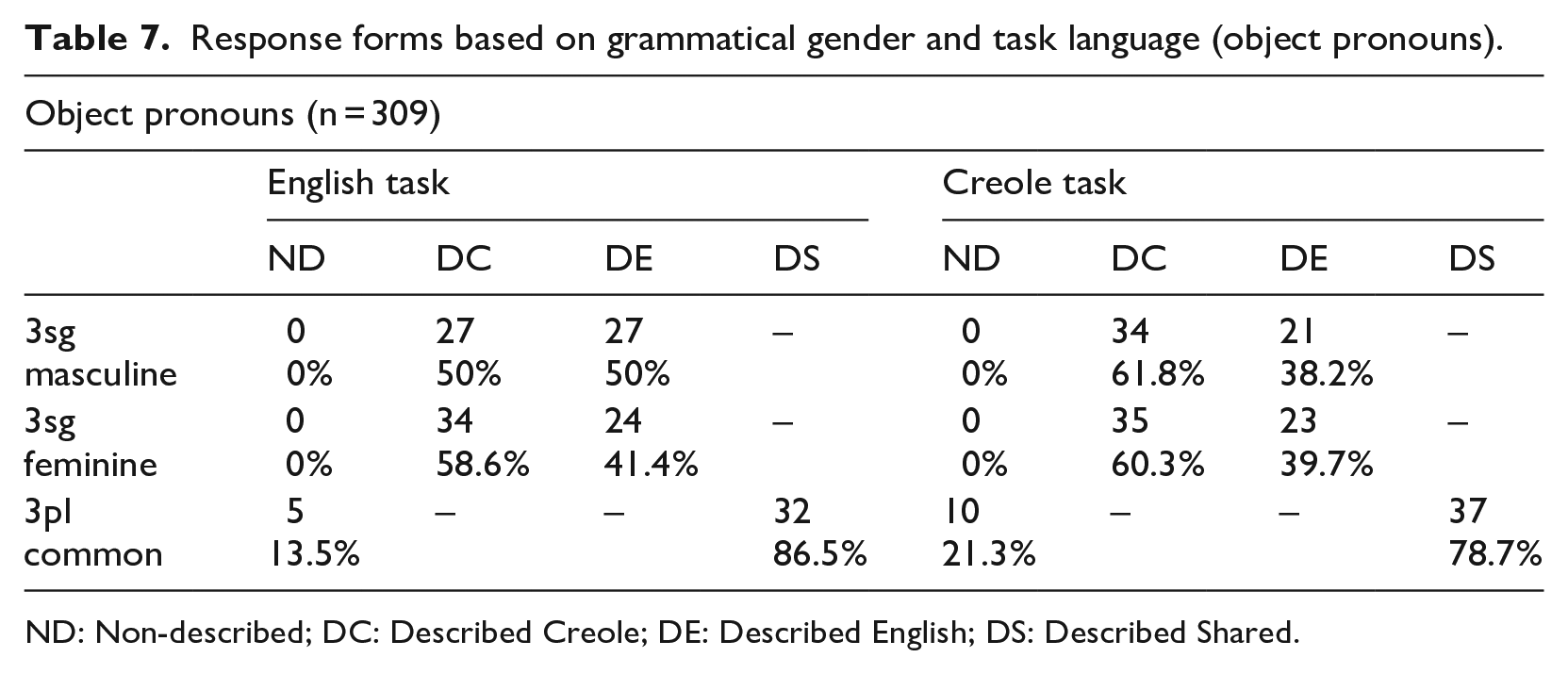
Table 7 summarizes response form frequency based on grammatical gender and task language for object pronouns. Results here are opposite to subject pronouns. Plural pronouns only have one choice (DS ‘them’). Conversely, children have a choice between DE and DC for singular pronouns. While the DC pronoun is still chosen more frequently overall for both feminine and masculine, the difference is less stark than for subject pronouns. In fact, for singular masculine, participants equally choose ‘he’ and ‘him’ in the English task.
Response forms based on grammatical gender and task language (object pronouns).
ND: Non-described; DC: Described Creole; DE: Described English; DS: Described Shared.
Figure 2 shows how children expressed object pronouns, arranged by grammatical gender and task language and shaded by response form. For singular feminine, the top choice was DC ‘she’ (n = 66). Second was DE ‘her’ (n = 46). Few participants reversed the gender and used DC ‘he’ (n = 3) and DE ‘him’ (n = 1). There were no ND forms. For singular masculine, the first choice was DC ‘he’ (n = 56). Next was DE ‘him’ (n = 43). Some participants reversed the gender, using DC ‘she’ (n = 5) and DE ‘her’ (n = 5). There were no ND forms. For plural common, the most popular choice was DS ‘them’ (n = 62), followed by ‘all o them’ (n = 7). ND forms included ‘he’ (n = 3), ‘she’ (n = 7), ‘him’ (n = 1) and ‘her’ (n = 4).
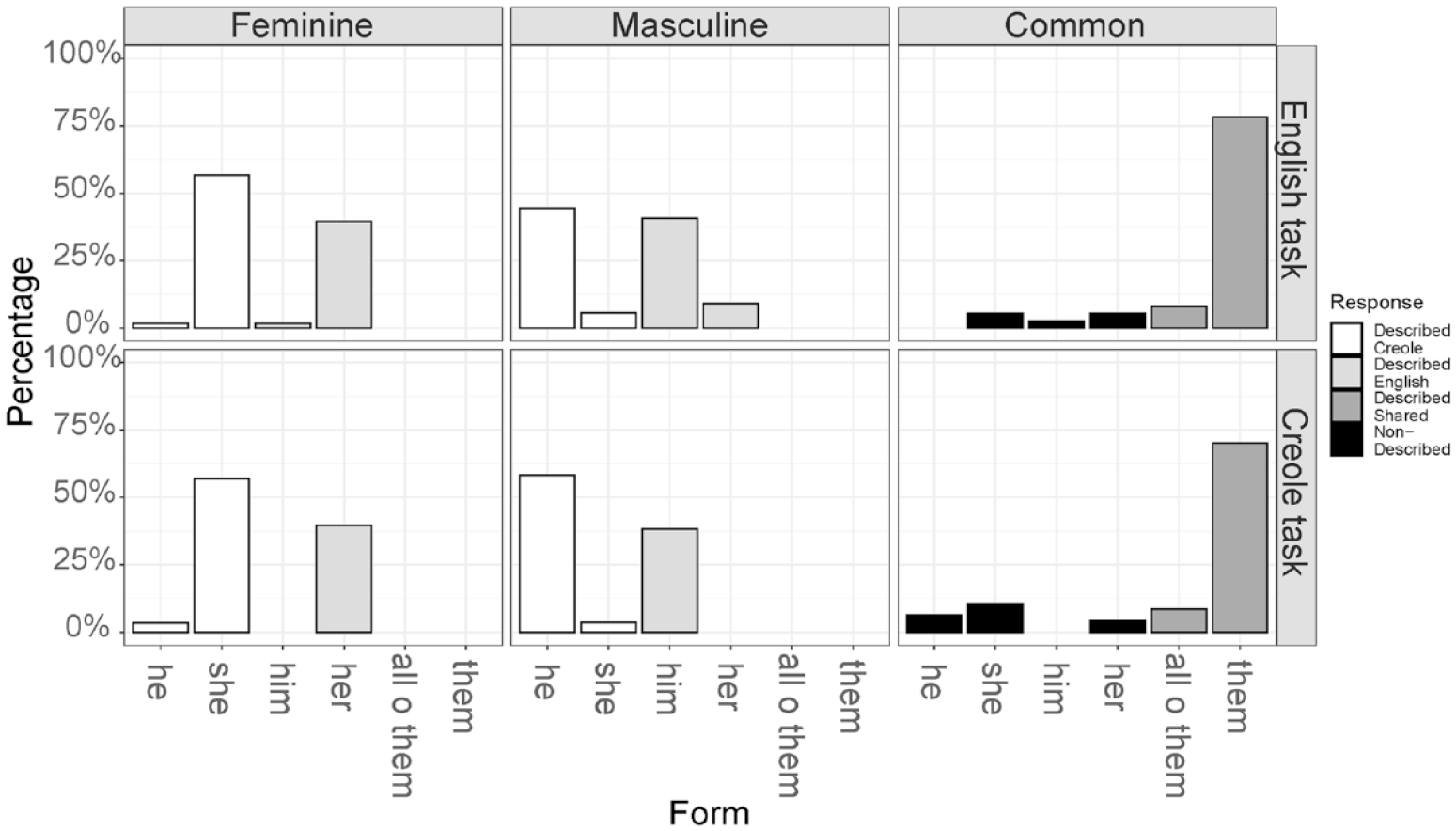
Bar Charts Showing Percentage Levels of Production of Described Creole, Described English, Described Shared and Non-Described Feminine, Masculine and Common Object Pronouns in the English and Creole Tasks.
Reflexive pronouns
Table 8 summarizes response form frequency based on grammatical gender and task language for reflexive pronouns. All grammatical genders had choices between DC and DE as there are no DS forms. Children selected DC forms most frequently in both tasks. For singular feminine, DC pronouns (‘sheself’, ‘she own self’, ‘heself’, ‘hisself’, ‘he own self’) accounted for 67.3% of choices. For singular masculine, DC pronouns (‘heself’, ‘hisself’, ‘he own self’) were 92.2%. For plural common, DC pronouns (‘theyself’, ‘theirself’, ‘they own self’, ‘them own self’, and ‘theyselves’) were used 92.5% of the time.
Response forms based on grammatical gender and task language (reflexive pronouns).
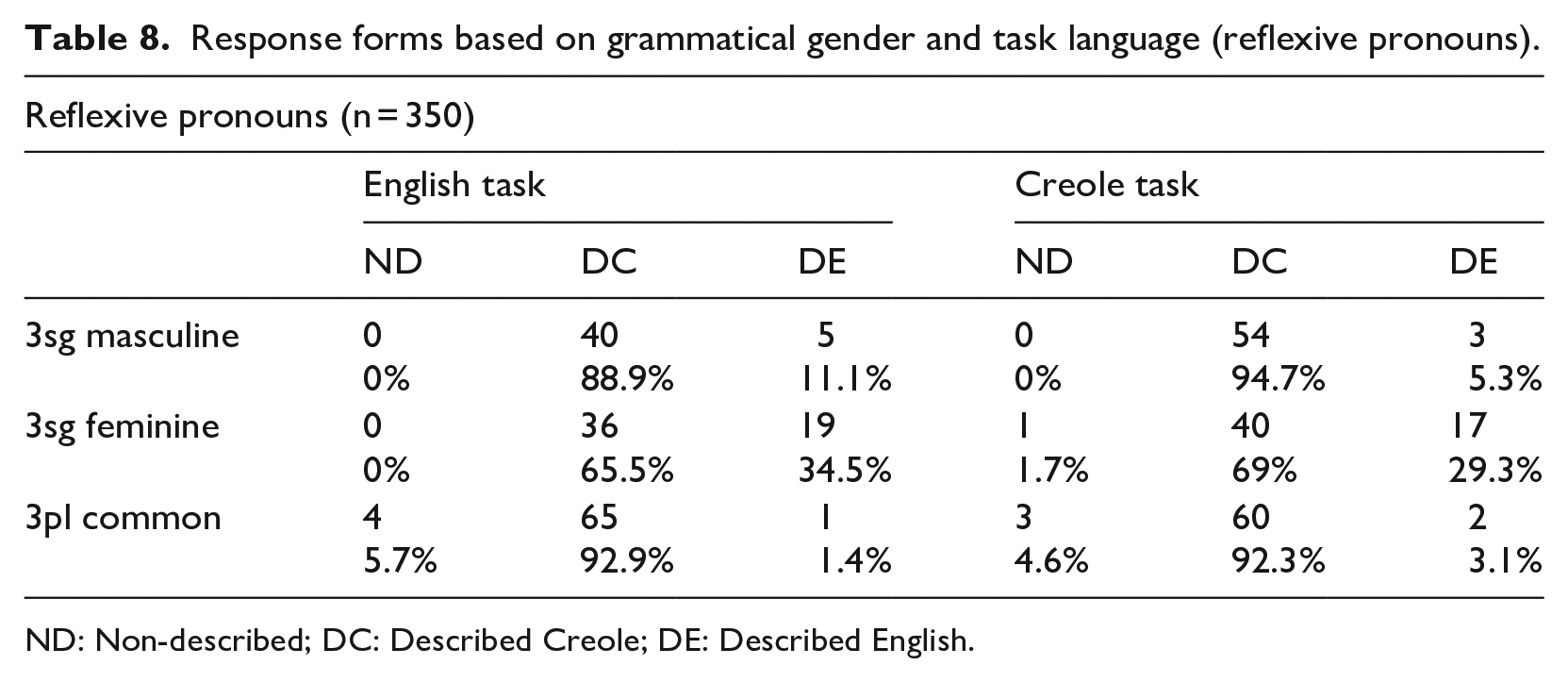
ND: Non-described; DC: Described Creole; DE: Described English.
Figure 3 shows the words expressing reflexive pronouns, arranged by grammatical gender and task language and shaded by response form. For singular feminine, the most frequent choice was DC ‘sheself’ (n = 65). This was followed by DE ‘herself’ (n = 34). DC ‘she own self’ was used minimally (n = 3). Gender reversals occurred with DC ‘heself’ (n = 6), ‘hisself’ (n = 1) and ‘he own self’ (n = 1), and DE ‘himself’ (n = 2). There was also ND ‘sheselves’ (n = 1). For singular masculine, the clear choice was DC ‘heself’ (n = 62), followed by DC ‘hisself’ (n = 25) and ‘he own self’ (n = 7). DE ‘himself’ was also used (n = 7). A gender reversal occurred in the English task with DE ‘herself’ (n = 1). There were no ND forms. For plural common, the first choice was DC ‘themself’ (n = 58), followed by DC ‘theyself’ (n = 37). Other DC pronouns used were ‘theirself’ (n = 14), ‘they own self’ (n = 9), ‘them own self’ (n = 4) and ‘theyselves’ (n = 3). DE ‘themselves’ was infrequent (n = 3). ND forms included ‘theirselves’ (n = 2), ‘hisself’ (n = 2), ‘heself’ (n = 2) and ‘herself’ (n = 1). Note that several DC forms (‘she own self’, ‘he own self’, ‘hisself’, ‘they own self’, ‘them own self’, ‘theyselves’, ‘theirself’) were not included in the literature on TrinEC pronouns, but were attested by over 40% of the residents consulted and were produced by these children.
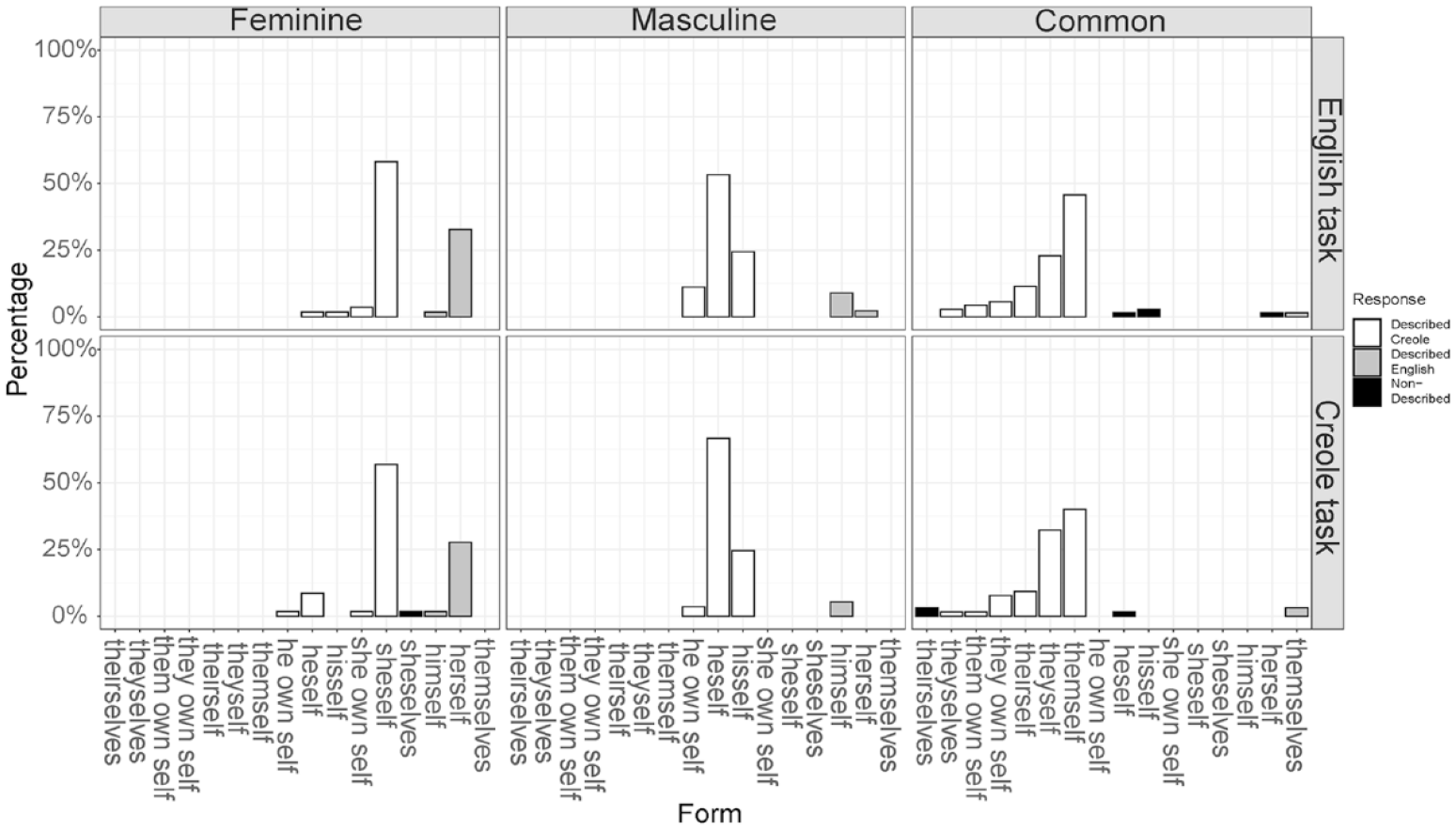
Bar Charts Showing Percentage Levels of Production of Described Creole, Described English and Non-Described Feminine, Masculine and Common Reflexive Pronouns in the English and Creole Tasks.
Possessive pronouns
As with reflexive pronouns, children must choose between a DE form and multiple DC options. Table 9 summarizes response form frequency based on grammatical gender and task language for possessive pronouns. For the third-person singular feminine, DC answers (‘she own’, ‘her own’, ‘she own’, ‘her one’, ‘he own’) accounted for 78.4% of responses. DE ‘hers’, amounting to 19.6% of responses, was restricted to the English task. For the third-person singular masculine, DC responses (‘he own’, ‘his own’, ‘he one’, ‘her own’, ‘she own’) were given 64.4% of the time. DE ‘his’, amounting to 20.7%, was restricted to the English task. For the third-person plural common, DC responses (‘them own’, ‘them one’, ‘all o them own’, ‘they own’, ‘their own’) were provided 79.7% of the time. DE ‘theirs’ was not produced.
Response forms based on grammatical gender and task language (possessive pronouns).
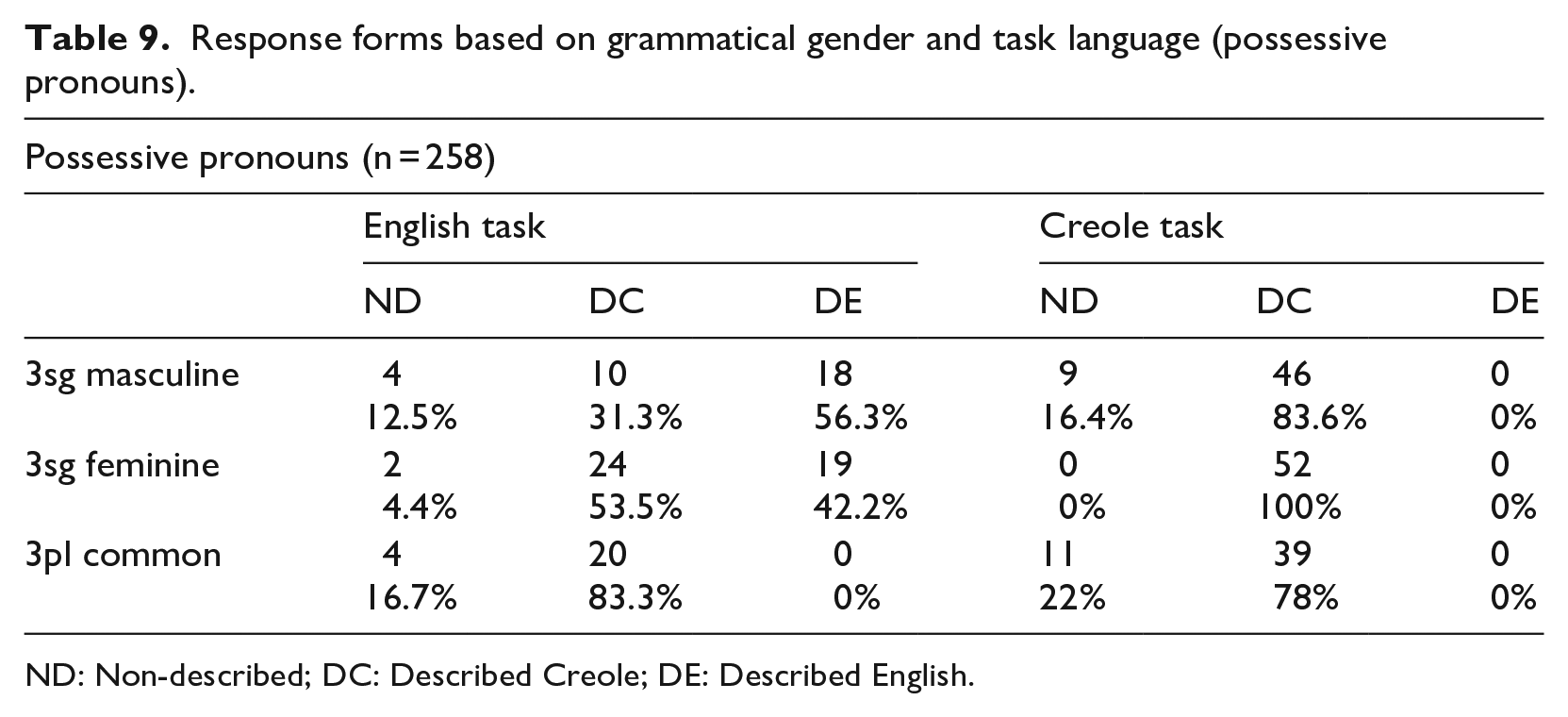
ND: Non-described; DC: Described Creole; DE: Described English.
Figure 4 shows the words used to express possessive pronouns, arranged by grammatical gender and task language and shaded by response form. For singular feminine, the clear choice was DC ‘she own’ (n = 53). DE ‘hers’ had a relatively high frequency (n = 16) but was only used in the English task. Other responses were DC ‘her own’ (n = 15), ‘she one’ (n = 5) and ‘her one’ (n = 2). Gender reversals resulted in DE ‘his’ (n = 3) and ‘he own’ (n = 1), the former occurring in the English task and the latter in the Creole task. ND ‘she’s’ was also noted (n = 2). For singular masculine, the most frequent choice was DC ‘he own’ (n = 36), followed by DE ‘his’ (n = 9). Other responses were DC ‘his own’, (n = 8) and ‘he one’ (n = 5). Gender reversals resulted in DE ‘hers’ (n = 9), DE ‘her own’ (n = 2) and DE ‘she own’ (n = 1). ND forms were ‘him own’ (n = 8), ‘him’s’ (n = 4), ‘them own’ (n = 4) and ‘him one’ (n = 1). For plural common, the most common choice was DC ‘them own’ (n = 44), followed by DC ‘them one’ (n = 7), ‘all o them own’ (n = 4), ‘they own’ (n = 2) and ‘their own’ (n = 2). ND forms were ‘thems’ (n = 1), ‘hers’ (n = 4), ‘she own’ (n = 7), ‘his own’ (n = 1), ‘her one’ (n = 1) and ‘he own’ (n = 1). DE ‘theirs’ was never produced. Again, note that several DC forms (‘her own’, ‘her one’, ‘she one’, ‘his own’, ‘he one’, ‘they own’, ‘them one’, ‘all o them own’, ‘their own’) were not included in the literature on TrinEC pronouns, but were attested by over 40% of the residents consulted and were produced by these children.
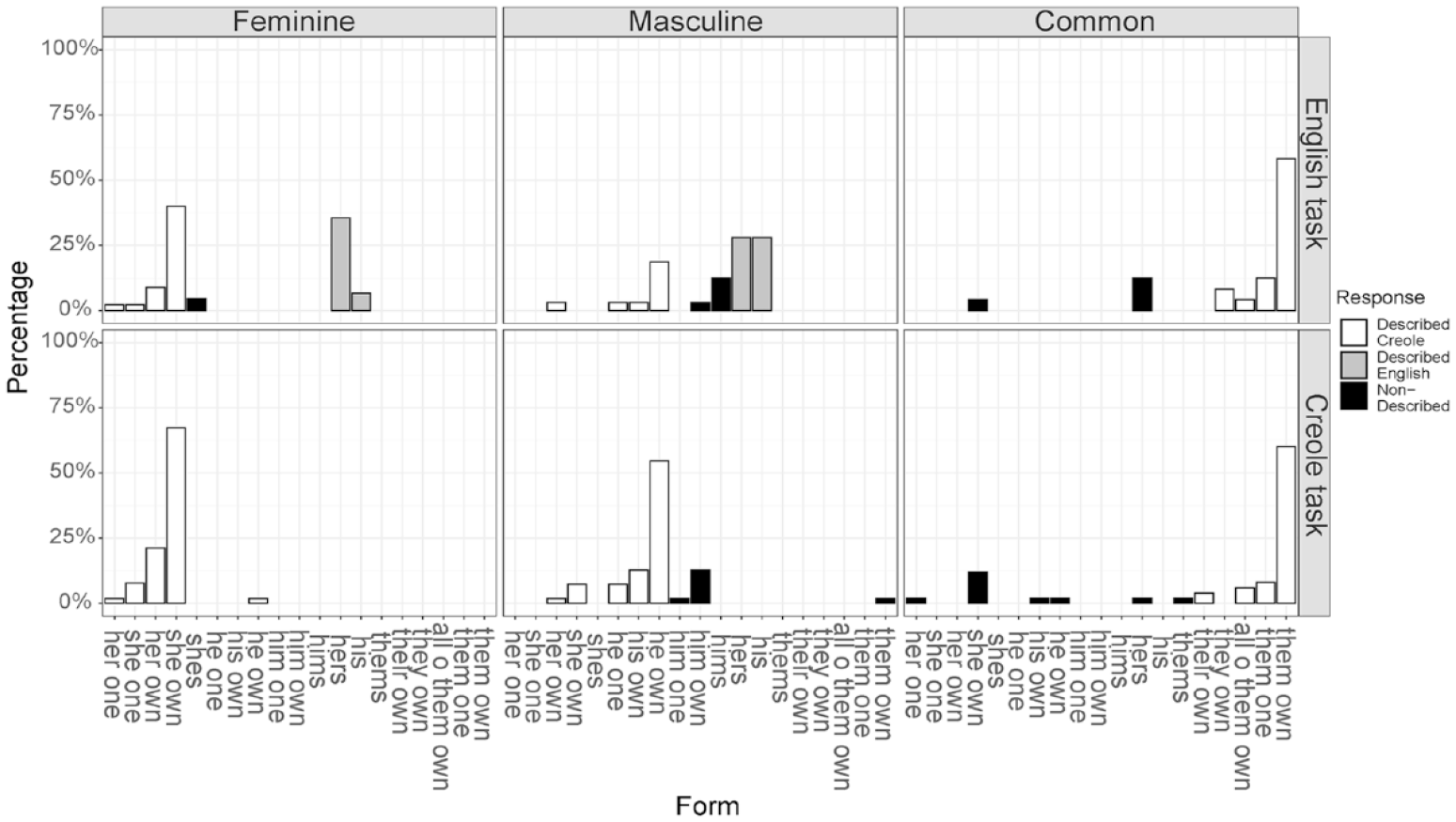
Bar Charts Showing Percentage Levels of Production of Described Creole, Described English and Non-Described Feminine, Masculine and Common Possessive Pronouns in the English and Creole Tasks.
Question 2: variables influencing pronoun selection
This section discusses, for each pronoun type, which independent variables significantly affected selection between TrinEC and TTE forms. Recall that for this exploratory question, data were coded for age, gender, district and SES of the child; task language used; and grammatical gender of the pronoun produced. It was expected that older children would use more TTE forms based on increased exposure to the language at preschool; girls would use more TTE forms than boys; children of higher SES would use more TTE pronouns; and that children would increase TrinEC forms in the Creole task. No predictions were made about district and grammatical gender.
Subject pronouns
Selection between TrinEC and TTE forms was only available for third-person plural common because both languages use the same forms for third-person singular feminine and masculine (see above). As a result, grammatical gender was not included as an independent variable in this model. A CIT was used to identify which factors possibly influenced choices between subject pronoun plural forms. However, none of the independent variables – that is, age, gender, district or SES of the child, or task language – significantly influenced selection.
The data were re-analysed with the aim of detecting variables influencing production of pronoun errors. This was done by distinguishing responses that are expected locally from those that may be production errors. To this end, all Non-described responses were viewed as possible errors. All Described responses were viewed as satisfactory responses in the linguistic context. Thus, DC and DS responses were grouped together under the label ‘Described’ for this analysis. The same independent variables were used; none of them were significant.
Object pronouns
Selection between TrinEC and TTE forms was only available for third-person singular masculine and feminine because both languages use the same forms for third-person plural common (see above). Again, grammatical gender was excluded as an independent variable. In the CIT used to examine the independent variables possibly influencing choices between object pronoun singular forms, none of the variables – that is, age, gender, district or SES of the child, or task language – significantly influenced selection. When the data were re-analysed as ‘Non-described’ and ‘Described’ (DC and DE), again, none of these independent variables were significant.
Reflexive pronouns
For reflexive pronouns, selection between TrinEC and TTE was available for all three grammatical genders. The resulting CIT, seen in Figure 5, has a classification accuracy of 0.88 (with the baseline value of 0.51). 2 The top split (Node 1) is made in the independent variable grammatical gender. This is the independent variable that is most important for choosing between reflexive pronoun forms (p < .001). Grammatical gender is split into two subsets. First is third-person singular feminine on the left, which constitutes a terminal node (Node 2). Within this node, the proportion of DC forms is higher than DE forms, while ND forms are minimal. The right branch of the top node represents third-person singular masculine and third-person plural common and also ends in a terminal node (Node 3). In this bar chart, the proportion of DC forms is much higher than for third-person singular feminine while the proportion of DE forms is much lower than for third-person singular feminine. DC forms thus dominate the responses for masculine and common pronouns, while DE forms are used more frequently for feminine pronouns, although DC forms also dominate that group. ND forms were slightly higher for the masculine-common grouping due to children identifying one individual in the picture in the plural tasks as the target; no ND forms occurred for masculine reflexives. None of the other independent variables – that is, age, gender, district or SES of the child, or task language – were significant. When the data were re-analysed as ‘Non-described’ and ‘Described’ (DC and DE), again, none of these independent variables were significant.
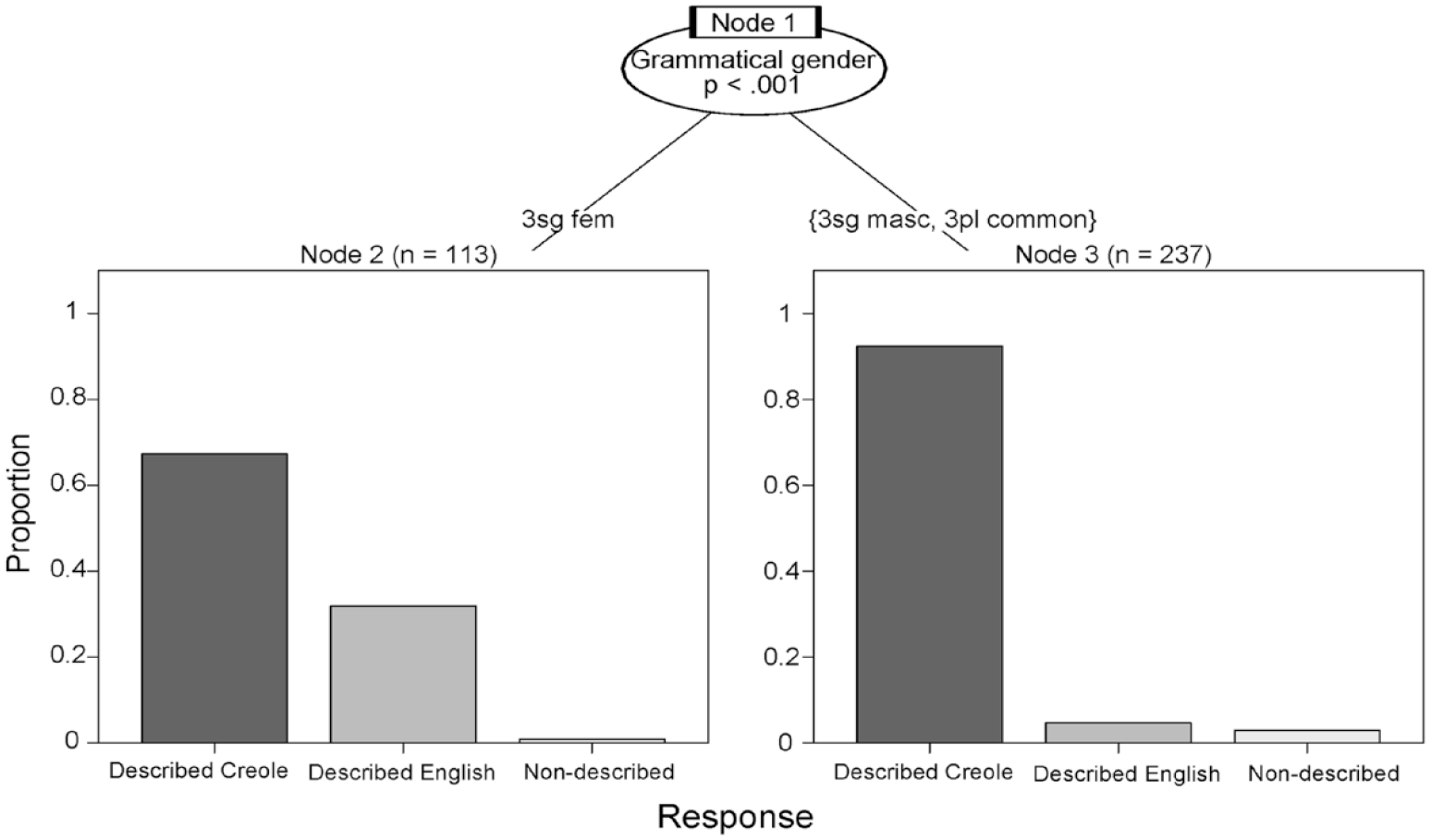
Visualization of Conditional Inference Tree Model Testing the Influence of Independent Variables of Age, Gender, District and SES of the Child, Grammatical Gender and Task Language on the Realization of Reflexive Pronoun Response Forms.
Possessive pronouns
For possessive pronouns, selection between TrinEC and TTE was also available for all three grammatical genders. The resulting CIT (Figure 6) has a classification accuracy of 0.75. The top split is made in the independent variable task language (Node 1). This is the most important independent variable that influences choices between possessive pronoun forms (p < .001). Task language is split into two subsets. Let us examine the left-hand branch first. This branch represents the English task. A further binary partition is made within the English task based on grammatical gender (Node 2, p < .001). The first split, on the left-hand side, represents third-person plural common pronouns in the English task and ends in a terminal node (Node 3). Here, DC forms account for over 80% of responses, while ND forms account for the remainder – these were due to participants identifying one individual in the picture as the target. There are no DE responses. The right-hand branch from Node 2 represents third-person singular feminine and masculine pronouns in the English task (Node 4). This bar chart shows a more balanced production of DC and DE pronouns. In fact, DE forms surpass DC forms. The proportion of ND forms is lower in this branch.
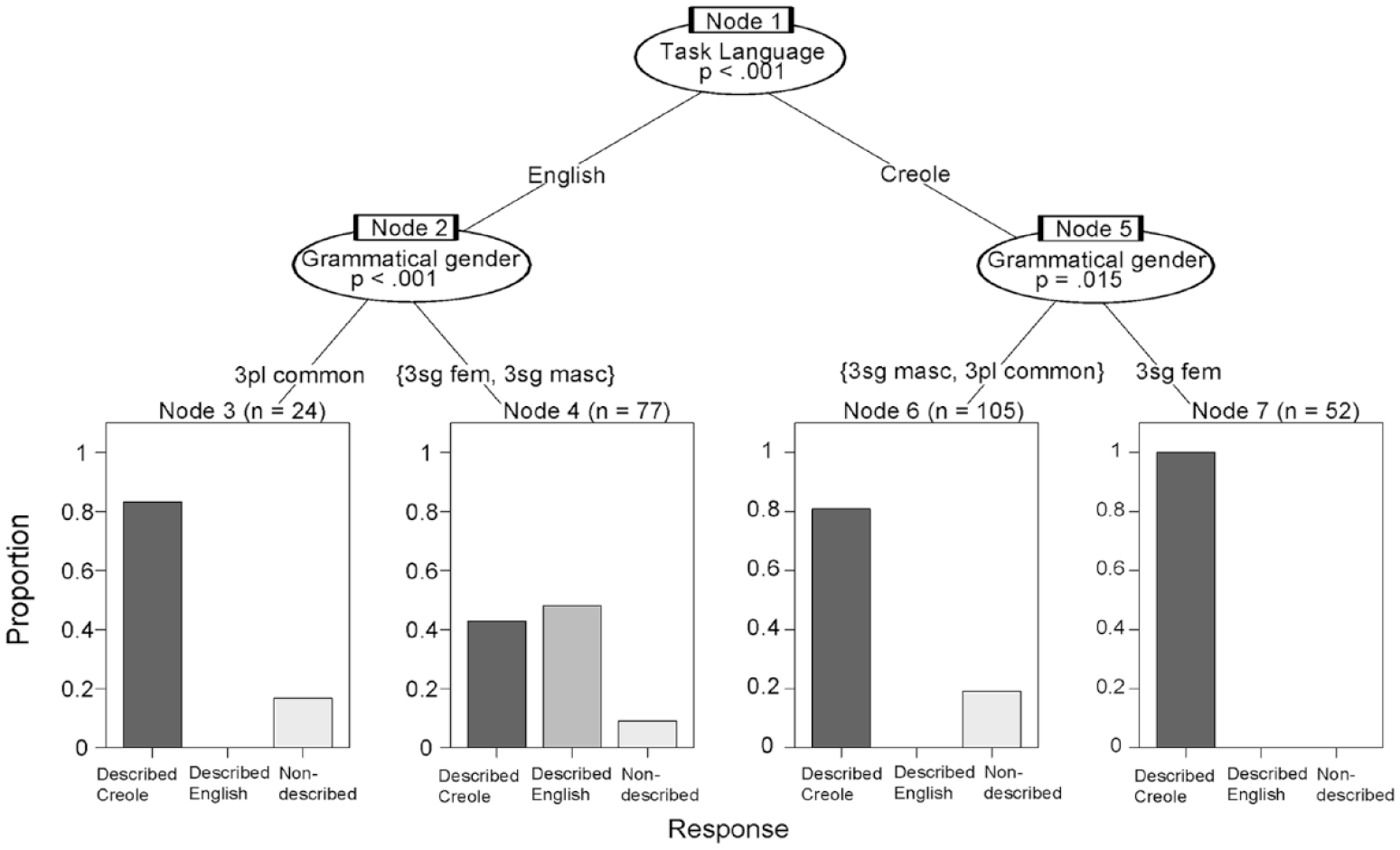
Visualization of Conditional Inference Tree Model Testing the Influence of Independent Variables of Age, Gender, District and SES of the Child, Grammatical Gender and Task Language on the Realization of Possessive Pronoun Response Forms.
Let us return to the topmost split and move to the right-hand branch, which represents the Creole task. This branch is also split into two further partitions based on grammatical gender (Node 5, p = .015). On the left side is third-person singular masculine and third-person plural common, which ends in a terminal node (Node 6). In this bar chart, DC forms account for almost 80% of responses, while ND forms account for the remainder, this time due to a mix of individuals being singled out for plural and some uncommon forms being used for the masculine (‘him own’, ‘him one’ and ‘him’s’). On the right branch is third-person singular feminine, which ends in a terminal node (Node 7). There are only DC responses in this bar chart. Overall, DE forms are restricted to the English task. DC responses increase overall in the Creole task. DE responses do not just decrease in the Creole task, but disappear altogether, despite this task occurring second. None of the other variables – that is, age, gender, district or SES of the child – were significant.
Finally, the data were re-analysed into ‘Described’ (DC and DE) versus Non-described to detect the independent variables influencing pronoun errors. In the CIT in Figure 7, grammatical gender is the most important independent variable related to whether errors are produced or not (p = .003). This variable is split into two branches. Third-person singular feminine on the left ends in a terminal node (Node 2). In this bar plot, Non-described forms are minimal while Described forms hold the majority. On the right branch, third-person singular masculine and third-person plural common end in Node 3. The proportion of Non-described forms here is higher than in Node 2, indicating that more errors are made with masculine and common pronouns. This CIT had a classification accuracy of 0.84.
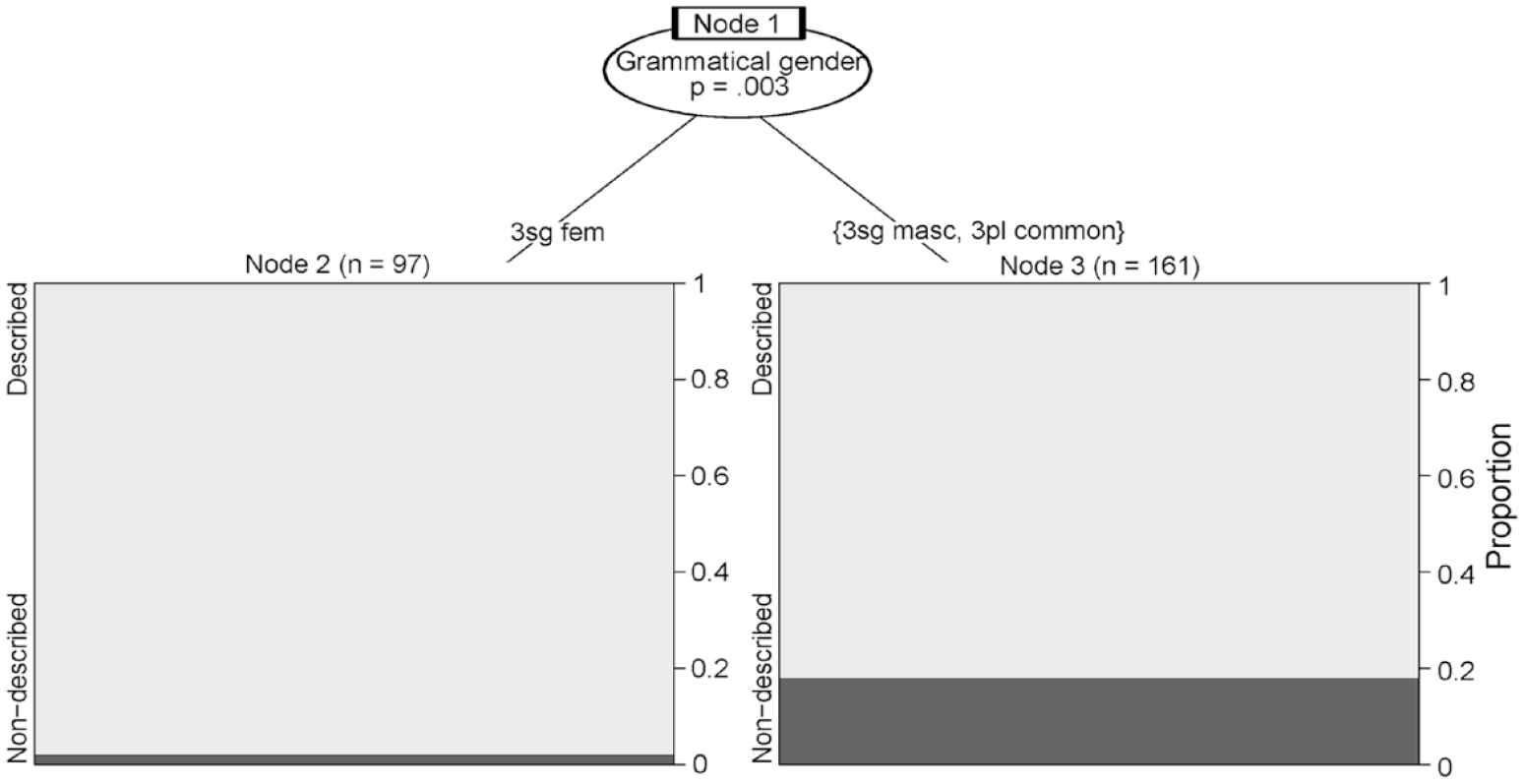
Visualization of Conditional Inference Tree Model Testing the Influence of Independent Variables of Age, Gender, District and SES of the Child, Grammatical Gender and Task Language on the Realization of Non-Described and Described Possessive Pronoun Forms.
Discussion
This study examined expression of third-person pronouns in a community that practices normative code-mixing of two languages. Seventy-five Trinidadian preschoolers participated in an elicitation task that was conducted in both languages. The aim was to describe their repertoires and explore which factors influenced their choices between TTE and TrinEC pronouns where choices were available.
Children were predicted to produce DC pronouns and DS pronouns, but be restricted in production of DE pronouns since the first language of most Trinidadians is TrinEC. The first key finding is that children are largely TrinEC-dominant but their TTE production is not minimal. For subject and object pronouns, when children could choose between a DC and a DS/DE pronoun, they chose the DC options more often, resulting in the top choices of ‘(all o) them’ (n = 60) as the plural subject and ‘she’ (n = 56) and ‘he’ (n = 22) as singular objects. However, this did not mean DE usage was minimal. While DS selection was minimal for plural subject pronouns, for singular object pronouns, there was almost 40% selection of the DE forms ‘her’ and ‘him’. Similarly, children did not entirely choose TrinEC over TTE for reflexive and possessive pronouns. For singular feminine reflexive pronouns (in Figure 5), almost 35% of responses were DE, and for singular possessive pronouns (Figure 6), in the English task, children actually provided more DE responses than DC forms overall. Thus, although TrinEC forms often hold the majority, children are not limited in their production of TTE forms.
Due to the lack of research on factors influencing choices between TTE and TrinEC pronouns, I tested several independent variables. The second key finding is that task language and grammatical gender were the only independent variables that significantly affected language choice. For possessive pronouns, the language of task prompts significantly influenced pronoun choices. DE pronouns only appeared in the English task, even though the Creole task was administered second. A shift from TTE to TrinEC often indicates a decrease in formality. This sensitivity to interlocutor language/formality demonstrates these children’s developing varilingual competence: hearing DE ‘hers’ and ‘his’ in the English task prompted them to produce these forms; hearing DC ‘she own’ and ‘he own’ in the Creole task encouraged them to increase DC responses, and avoid DE. It is also noteworthy that there were more analysable responses in the Creole task than in the English task (157 vs 101). It is possible that becoming more familiar with the task or hearing DC prompts encouraged more relevant responses.
This effect of task language had been expected for all pronoun types but was only significant for possessive pronouns. Examination of Tables 6 to 8 shows that the DS plural common subject reduced by 2.5% from the English to the Creole task. The DE singular masculine object reduced by 11.8% while the DE singular feminine object reduced by 1.7%. For reflexive pronouns, the DE singular masculine reduced by 5.8%, the singular feminine reduced by 5.2% and the plural common actually increased by 1.7%. Ultimately, none of these differences were as significant as the 56.3% reduction for the DE singular masculine possessive or the 42.2% reduction for the DE singular feminine. A potential explanation for the significant result for possessive pronouns may be that the salient <-own> suffix distinguishes the TrinEC forms from the TTE forms. Reflexive pronouns, on the other hand, use <-self> in both TTE and TrinEC while subject and object pronouns may be harder to distinguish due to their overlap. There is prior evidence that Trinidadians avoid using TrinEC pronouns in formal registers (Deuber, 2014). The current findings therefore indicate that these children’s style-shifting competence is still developing.
Grammatical gender, and by implication number, was the other independent variable that significantly influenced pronoun choices. For reflexive pronouns (Figure 5), common and masculine pronouns patterned together, as DC forms far exceeded DE forms for these two, while the singular feminine was more balanced in DC~DE responses (around 65~35). Perhaps this is because there are only three options for the singular feminine while there are four singular masculine options and seven plural common options. More work needs to be done to explore why ‘herself’ is more salient than ‘himself’ or ‘themselves’. For possessive pronouns, as per Figure 6, in the English task, singular pronouns received both DE and DC responses while plural pronouns only had DC answers. Children clearly avoided using DE ‘theirs’. One possibility for this is this pronoun may be minimally produced in the input to these children, thereby making the DC forms more salient, especially since there are five competing DC plural pronouns. Further research is necessary to determine how ‘theirs’ is used in child-directed speech. In the Creole possessive pronoun task, feminine pronouns outnumbered masculine and common pronouns in proportion of DC forms. This was due to some ND singular responses being provided in the plural task as well as some uncommon masculine forms. I have previously discussed that ND forms in the plural were largely due to participants identifying one individual in the picture as the target. It is unclear whether the ND forms for the singular masculine, ‘him own’ and ‘him one’, are overextensions or evidence of language change in progress. Further work can determine this.
At this point, I should discuss the independent variables that were not significant: age, gender, district and SES of the children. These were all surprising, since age, gender and district were significant for selection of phonetic variants in Jackson (2019) and since SES has been previously correlated with TrinEC/TTE production (Winford, 1972). In addition, production of <-one> for possessive pronouns only came from participants in three of the seven educational districts. The non-significance of these variables indicates that mixed input to preschoolers for pronouns occurs regardless of their age, gender, district or SES. I suggest that this may be due to the local sociolinguistic value (Chevrot et al., 2000; Smith et al., 2007) of pronouns. It is possible that Trinidadians stigmatize the verb phrase more than most pronouns, resulting in more careful speech in caregivers’ verb phrases and an earlier ability in children to adjust their TTE~TrinEC verb phrase use according to interlocutor, as per Youssef (1990). TrinEC possessive pronouns may be similarly stigmatized due to their distinctness, resulting in more separate contexts for using TrinEC or TTE forms (hence the significance of task language). TrinEC subject, object and reflexive pronouns, on the other hand, may be permitted in increasingly formal contexts where TrinEC possessive pronouns and TrinEC verbs may not be. This could be investigated by comparing the use of TrinEC and TTE verbs and pronouns by adults.
For plural subject pronouns and singular object pronouns, no independent variables significantly influenced choices between DC and DE/DS forms or the errors made. This may be because children minimally produced the DS plural common subject ‘they’ overall (3.8%). A possible explanation for minimal ‘they’ is that since the only option for the plural object is DS ‘them’, children may recognize ‘them’ and become inclined to select this form as a subject pronoun when faced with the choice between ‘them’ and ‘they’. It is not immediately clear why no variables significantly influenced singular object pronoun choices.
Another notable point is that the preschoolers in this study produced pronouns beyond the scope of what has been described in the extant literature. For reflexive and possessive pronouns, the DC forms that held the majority were the ones described in the literature on the adult TrinEC pronoun system: ‘sheself’, ‘heself’ and ‘themself/theyself’ for reflexive pronouns and ‘she own’, ‘he own’ and ‘them own’ for possessive pronouns. However, there were multiple other DC forms: ‘she own self’, ‘hisself’, ‘he own self’, ‘theirself’, ‘they own self’, ‘them own self’ and ‘theyselves’ for reflexives, and ‘her own’, ‘she own’, ‘her one’, ‘his own’, ‘he one’, ‘them one’, ‘all o them own’, ‘they own’ and ‘their own’ for possessives. Most of these pronouns were not errors, as they were recognized by over 40% of the Trinidadian residents I consulted. It is possible that the original documentation of the pronoun systems was incomplete. On the other hand, this may be evidence of language change in progress and a testament to the dynamic nature of the cross-linguistic influence between TTE and TrinEC. Many of these ‘innovations’ are combinations of elements from both languages, for example, TTE ‘her’ and TrinEC <-one> to make possessive ‘her one’. There is also evidence of potential reinforcement from one language to the other. For instance, the DS object ‘them’ may have reinforced production of DC ‘them’ as a subject. Finally, one can see possible analogies being drawn across both languages. In terms of the singular reflexives, children chose ‘sheself’, ‘heself’, ‘herself’ and ‘hisself’ as top options. These four pronouns pattern very similarly: the first two can be analysed as a TrinEC possessive determiner attached to ‘self’ and the second pair can be analysed as a TTE possessive determiner attached to ‘self’. It then makes sense why ‘himself’ – produced only nine times – would be a less attractive option for these children since it does not contain the possessive determiner ‘his’. As for the plural, there seems to be resistance to the plural <-s> on ‘themselves’ since <-self> is the general way that TrinEC forms the reflexive, regardless of grammatical number, since the plural is null-marked. Overall, an extensive study needs to be conducted to update the description of these pronoun systems.
Implications
The final part of this discussion relates to implications for fair and accurate language assessment in bidialectal/multilingual contexts. Many British/American language assessment instruments which local SLPs use are normed on monolingual English speakers; thus, these tests only expect English answers. Similarly, all exams within the Trinidadian education system are in TTE and answers in English are required. Figure 8 shows group performance on TTE pronouns only (i.e. DS or DE forms). The horizontal line represents the 80% benchmark for pronoun mastery used by Nicholls et al. (2011). Only the third-person singular feminine subject ‘she’ passes this benchmark. Third-person plural common ‘(all o) them’ nears 75%. All other pronouns, whether DS or DE, are below 50%. Most reflexives and possessives are under 25%. Thus, children would be seen as mastering only one of these 12 English pronouns. However, Figure 9 shows group performance on TTE and TrinEC pronouns combined (i.e. DE, DS and DC forms). All pronoun types except for the third-person plural common possessive – which is at 79.7% – surpass the 80% benchmark, indicating widespread mastery. Recall that several studies expected all four pronoun types to be acquired by age 5. TTE-only assessments as in Figure 8 underestimate Trinidadian children’s language development, while a whole-language assessment as per Figure 9 reflects their full competence. These children are clearly proficient at expressing feminine, masculine and common subject, object, reflexive and possessive pronouns; they simply use two locally valid languages to do so.
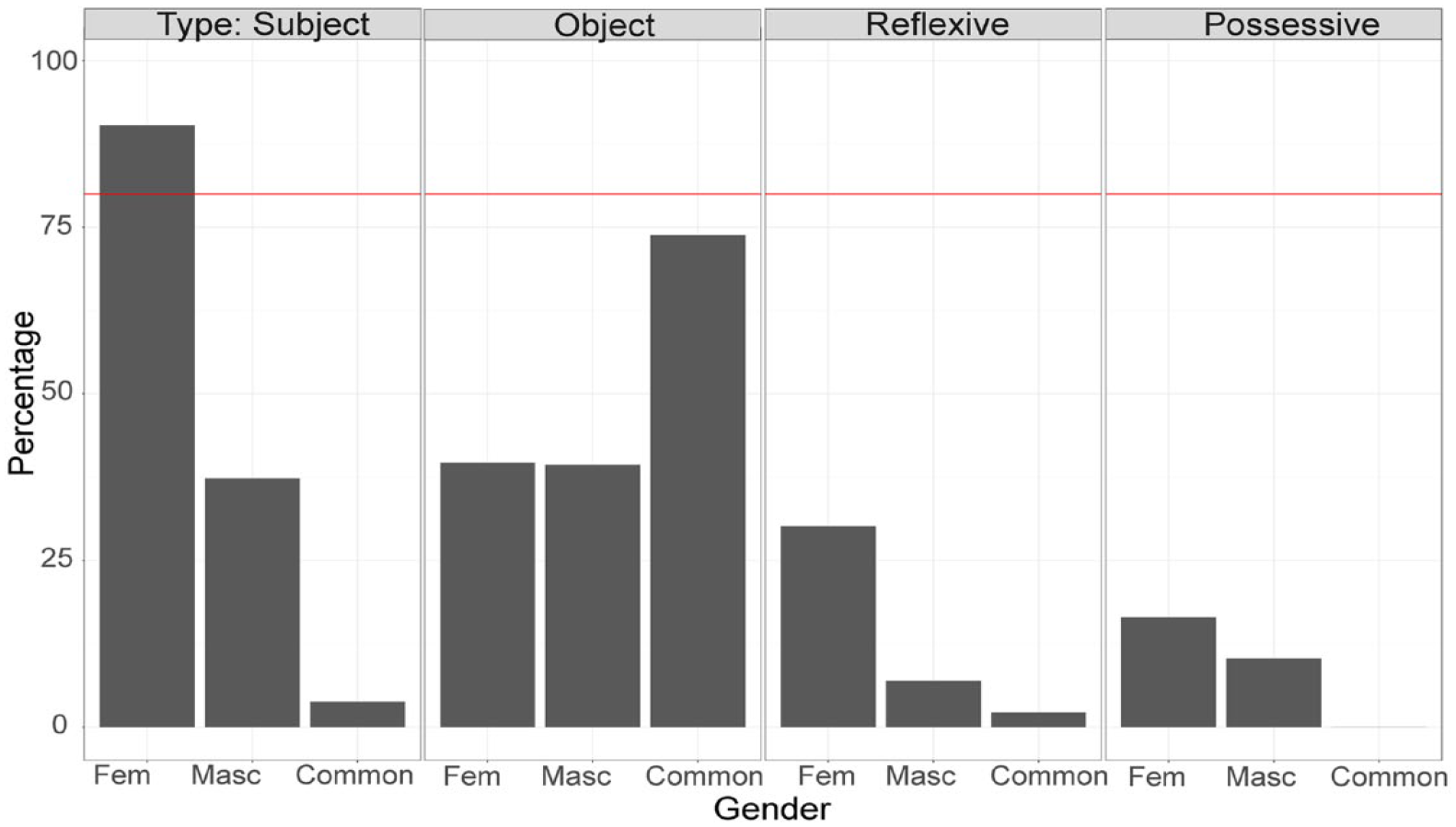
Bar Chart Showing Percentage Levels of Group Production of TTE Subject, Object, Reflexive and Possessive Pronouns.
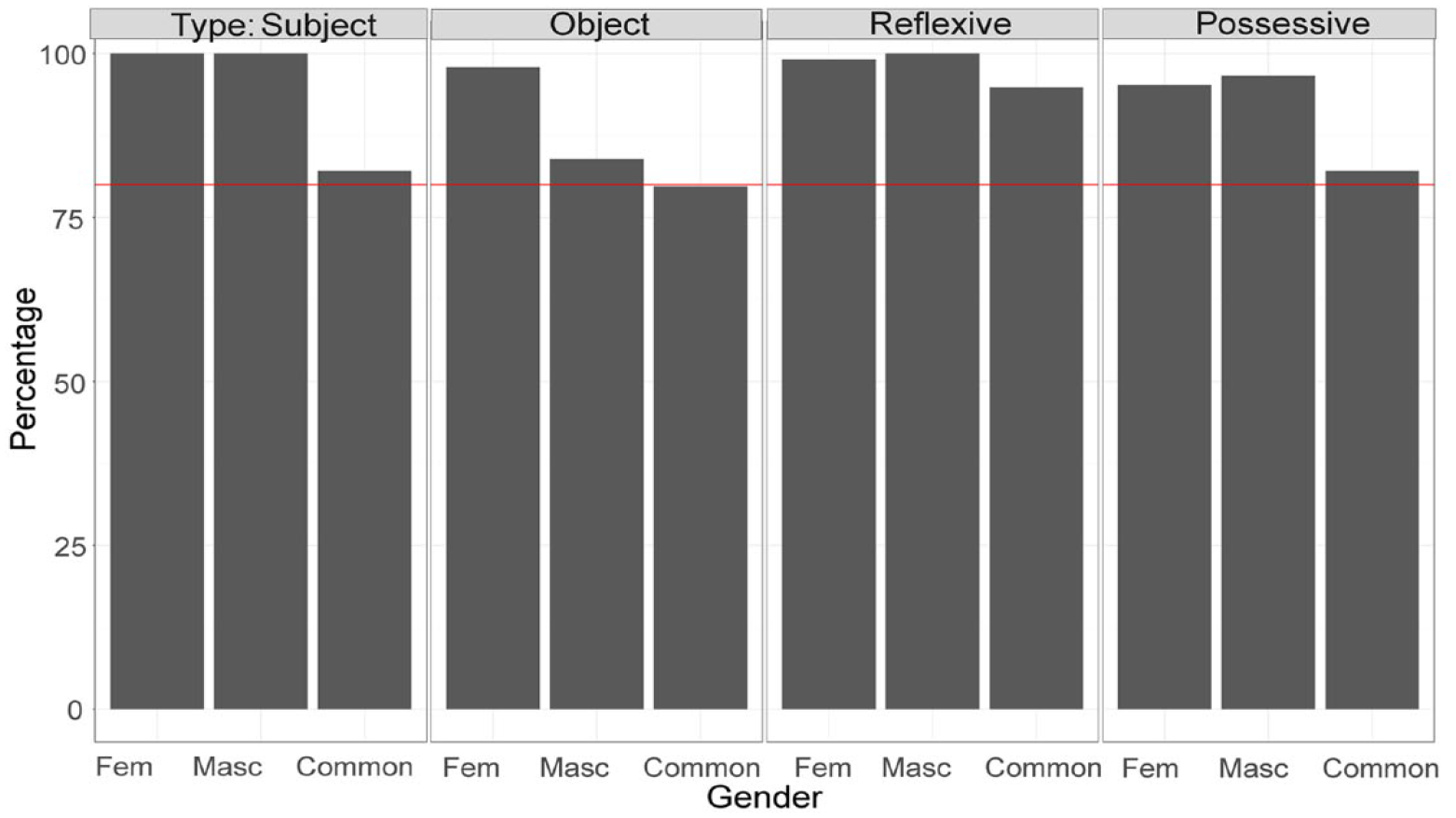
Bar Chart Showing Percentage Levels of Group Production of TTE and TrinEC Subject, Object, Reflexive and Possessive Pronouns.
Children from varilingual environments cannot be held to the same expectations as monolingual English-speaking children because language mixing is normative in their context. This can be a considerable challenge for SLPs when locally appropriate language assessments and information on normative development of local languages are lacking (Brebner, 2010). However, researchers such as Martin (2000, p. 126) stress the importance of evaluating ‘the full language repertoire of the child’. As Kohnert (2010) advises, since dual-language learners have different proficiencies in each language and use language differently across tasks, settings, interlocutors and purposes, they should not be evaluated in one language nor should their language performance be compared with monolinguals. Instead, SLPs should assess all languages spoken based on community norms (Gupta & Yeo, 1994). Without local norms, Kohnert (2010) notes that identification of the need for therapy may be delayed or overlooked, or intervention may be insufficient.
In Trinidad, local language tests have not yet been developed (Dos Ramos et al., 2016) and documentation on typical language development is limited. Consequently, many SLPs use British or American tests. These exonormative instruments may misidentify typically developing children as having developmental delays. Dos Ramos et al. (2016) note inconsistencies in local SLPs’ approaches to evaluating possible TrinEC speakers and scoring TrinEC forms when using foreign assessments. If SLPs depend on their intuitions about the local situation, they risk misdiagnosis.
Washington (2015) notes that language sample analysis allows more unbiased language production evaluations, but this approach only works if clinicians know the community’s dialectal features. I suggest that to avoid misdiagnosis, SLPs should use a language sample to observe the range of words children use to express these pronoun types. This can be compared to the present findings. This way, children’s overall language development, rather than just their TTE ability, can be examined.
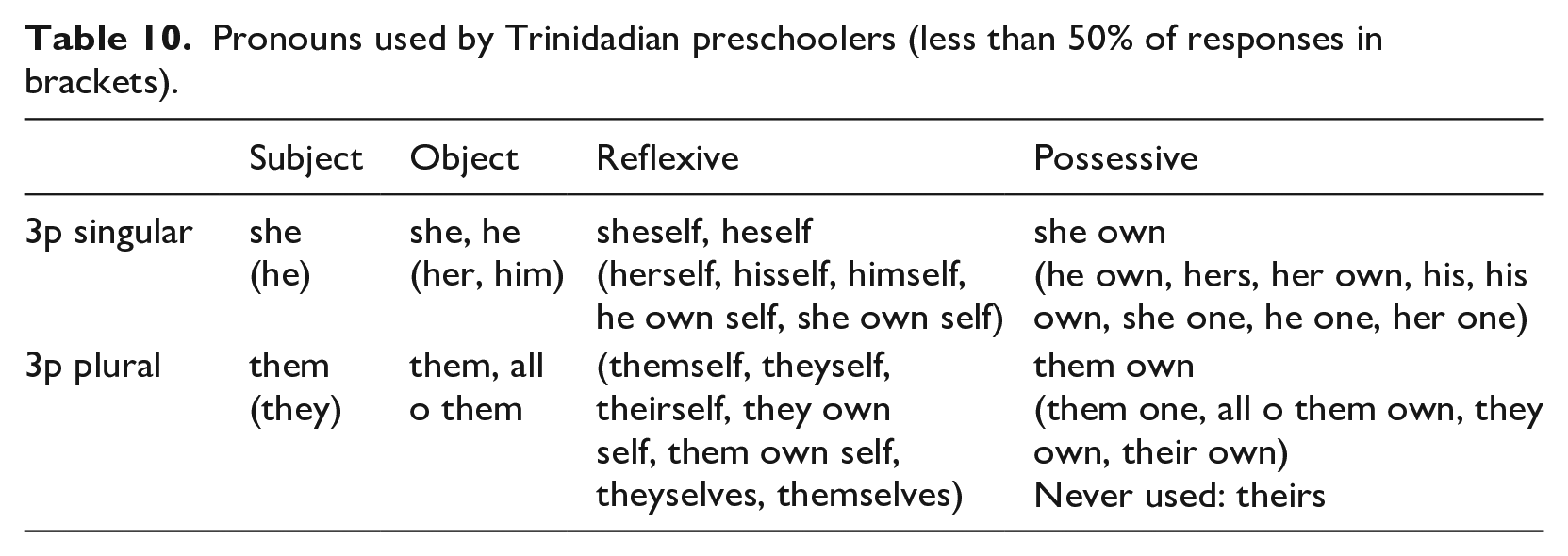
Early childhood and primary school educators may also find these results useful for curriculum planning. Table 10 summarizes Trinidadian preschoolers’ Described pronouns, with pronouns accounting for less than 50% of responses in brackets in decreasing order of frequency. Since 3- to 5-year-olds are already using a wide range of pronouns, it makes sense for teachers to use this range to help to differentiate the TrinEC and TTE systems. One strategy would be starting with the pronouns accounting for more than 50% of responses and using those to move to teaching lesser known ones.
Pronouns used by Trinidadian preschoolers (less than 50% of responses in brackets).
Conclusion
Overall, these Trinidadian children’s variable pronoun production indicates they are, to a great extent, familiar with both codes and that TrinEC is their more comfortable and possibly more proficient language. This study demonstrates the importance of describing understudied populations and the dangers not only of making assumptions about them but of evaluating them based on foreign norms. The levels of English pronoun production here differ from monolingual English children, but difference does not result in deficit as Trinidadian children express all the pronoun concepts using two languages and make few errors.
Based on the present findings, it seems that preschoolers exposed to related languages that are normatively mixed may access both codes to express pronouns, may be motivated to select certain pronouns in one language due to reinforcement from the other and may be developing an ability to adjust which pronouns they use based on their interlocutor’s language.
Other questions remain to be addressed by future work. This study’s word elicitation task found no significant social variables. However, natural language samples may reveal whether Youssef’s (1990) extralinguistic variables are significant for pronouns. It would also be useful to collect elicited and natural pronoun data from Trinidadian 10-year-olds. These children would have experienced almost 4 years of formal teaching geared towards preparing for an examination heavily focused on TTE. It is unclear whether such instruction may lead to subtractive bidialectalism or whether children may learn to use TTE variants at school and code-mix elsewhere. Addressing these questions would provide further insight into how the child, faced with prevalent but normative variation, becomes a proficient language user, and allow those in positions of power to make informed and fair decisions about how to evaluate language development.
Footnotes
Appendix
Pronoun prompts.
| 3sg feminine | 3sg masculine | 3pl common | ||
|---|---|---|---|---|
| Subject pronouns | English Task | Who is drawing? He is drawing. Who is painting? | Who is walking? She is walking. Who is crawling? | Who has flowers? He does. Who has teddy bears? |
| Creole Task | Who drawing? He drawing. Who painting? | Who walking? She walking. Who crawling? | Who have flowers? He have. Who have teddy bears? | |
| Object pronouns | English Task | She is talking to him and he is talking to . . . | He is hugging her and she is hugging . . . | Here the teacher is playing with her. Here the teacher is playing with . . . |
| Creole Task | She talking to he and he talking to . . . | He hugging she and she hugging . . . | Here the teacher playing with she. Here the teacher playing with . . . | |
| Reflexive pronouns | English Task | He is seeing himself. She is seeing . . . | This girl is hugging herself. This boy is dressing . . . | She is feeding herself. They are feeding . . . |
| Creole Task | He seeing heself. She seeing . . . | This girl hugging sheself. This boy is dressing . . . | She feeding sheself. They feeding . . . | |
| Possessive pronouns | English Task | The bike is his. The car is . . . | The bird is hers. The snake is . . . | The dress is hers. The toothbrushes are . . . |
| Creole Task | The bike is he own. The car is . . . | The bird is she own. The snake is . . . | The dress is hers. The toothbrushes is . . . |
Acknowledgements
I would like to thank the editor, the reviewers and Derek Denis for their valuable suggestions on improving this paper.
