




Abstract
In a changing society where the roles of fathers and mothers in caregiving are becoming more equal, the role of the father in early language development has also changed. We aimed to study associations between paternal factors and early vocabulary development in boys and girls. In a longitudinal cohort study, we examined the growth of expressive vocabulary in 354 boys and 331 girls between 13 and 24 months of age using the MacArthur-Bates Communicative Development Inventory. The results show that boys who had fathers not working full time, who had mothers with higher occupational status, and who had a larger vocabulary size at 13 months of age had larger gains in vocabulary. Girls with fathers working as professionals (high occupational status) had larger vocabulary growth compared to girls with fathers of lower occupational status. The results demonstrate that vocabulary growth in boys and girls relates differently to environmental factors. The results highlight the importance of further studies on fathers’ role in children’s early vocabulary development and the need to analyse the influence of environmental factors on early language development as a function of the child’s sex.
Introduction
Studies on the influences of demographic factors in early language development have traditionally focused on the contribution of the mother and her education and occupational status (e.g. Gilkerson et al., 2017; Letts et al., 2013; Vernon-Feagans et al., 2020). Less attention has been paid to the father’s influence, although this is changing (e.g. Cabrera et al., 2017; Lankinen et al., 2018; Malin et al., 2014; Rowe et al., 2004). Nevertheless, only a few studies have examined the time the father is available or engages with the child (Korpilahti et al., 2016; Waller, 2009). The present study investigates whether the amount of time the father is available is associated with children’s language development. We focus in particular on the growth of children’s expressive vocabulary over the second year. This age is a period of considerable variation across children and rapid increases in vocabulary size, making it a good one for examining the effects of environmental factors. Another benefit of focusing on vocabulary growth at this age is that after 24 months of age, a dramatic increase in the number and type of words makes accurate measurement with vocabulary questionnaires difficult (Frank et al., 2021).
The influence of the context on the child’s development
According to the social interactional framework, language develops in interplay with people in the immediate family environment (Bruner, 1981) and also in interaction with a broader ecological context (Bronfenbrenner & Ceci, 1994; Shelton, 2018). The macro context in which the child grows up, that is, the political and cultural systems guiding political decisions, educational and health care solutions as well as parenting trends, also influences the micro context, the child’s immediate communication environment (Rowe & Weisleder, 2020). The child’s experiences are thus formed by many factors in both the macro and the micro contexts working together, along with the active role the child itself plays in relation to their environment (Rowe & Weisleder, 2020). The child’s early language development is influenced by experienced communicative interactions in the language environment where the child grows up (e.g. Gilkerson et al., 2017; Gilkerson & Richards, 2009; Madigan et al., 2019). Studies show that both the quantity and the quality of parental speech and communication in the early years affect the child’s language abilities even several years later (Gilkerson & Richards, 2009). Accordingly, when analysing early language development, we need to consider not only the close family but also factors affecting family life, like the parents’ education and working status. Thus far, these environmental factors have primarily been studied with respect to the mother and mother–child interactions (e.g. Gilkerson et al., 2017; Hammer et al., 2017; Hoff, 2003; Hoff-Ginsberg, 1998).
The father’s role in early language development
Changing structures in today’s society, along with a raft of new legislation and regulations, have emphasized the father’s role and facilitated his involvement in childcare (Adler & Lenz, 2016). This has led to more attention being paid to the father’s role in early language development. Research exploring parental communication has shown that fathers contribute differently to communication with their children than mothers. Compared to mothers, fathers use more questions, more diverse language, and request more explanations (Lovas, 2011; Rowe et al., 2004). It has been suggested that less adjustment in the father’s speech challenges the child linguistically, a phenomenon usually referred to as a linguistic bridge (Rowe et al., 2004). Consistent with the impact of maternal speech, the content of paternal speech with children under 2 years of age has been associated with children’s expressive language at age 2;6 and 3 years (Lovas, 2011; Majorano et al., 2013; Rowe et al., 2004). Similar results have been found in younger children. For example, some studies have focused on the relationship between paternal playfulness and language use and language development in 2-year-olds (e.g. Cabrera et al., 2017; Leech et al., 2013; Malin et al., 2014; Salo et al., 2016). The findings indicate that fathers’ use of language during play, reading, and communicating with their children can be associated with their children’s vocabulary size, use of words, and sentence length at 2 years of age. Studies also show that the effects of fathers’ language use during play with their 2-year-olds can be seen in their children’s expressive vocabulary even 1 year later (Pancsofar & Vernon-Feagans, 2006). Fathers who are engaged with their children during the first months are also more likely to be involved in their children’s life 2 years later (Huerta et al., 2014).
What factors are associated with the kind of paternal behaviour that promotes their children’s language development? Parental socioeconomic (SES) background has been argued to influence the quantity and quality of parental speech (Hart & Risley, 1995; Rowe, 2008). Most of this work has focused on mothers. Studies have shown that children of well-educated mothers hear more words than do children of mothers with less education (Gilkerson et al., 2017; Hart & Risley, 1995). Compared to mothers with mid-SES background, mothers with advanced education and a higher occupational status use longer sentences and a more varied and richer vocabulary (Hoff, 2003). Studies also show that well-educated mothers and parents are more responsive toward the child, have better knowledge of early child development, and may adjust their communication more to the child’s level (Marjanovic-Umek & Fekonja-Peklaj, 2017; Rowe, 2008; Topping et al., 2011). Although there have been fewer studies with fathers, we can assume that the effects of education and professional status on paternal communication are similar. There have been studies suggesting that fathers with higher education are more supportive and more attentive to children’s needs, which relates positively to their vocabulary development (Armstrong et al., 2017; Cabrera et al., 2007; Korpilahti et al., 2016; Lankinen et al., 2018). Paternal occupational status has also been found to be associated with early language development (Korpilahti et al., 2016; Lankinen et al., 2018). Lankinen et al. found that among paternal variables (like education, age, father-child activities, family income), occupational status was the strongest predictor of expressive vocabulary size at 2 years of age. It is important to note, however, that communication characteristics with positive effects on children’s early language development are not exclusive to high SES families. Such characteristics have been found in studies with fathers from low SES backgrounds as well (e.g. Cabrera et al., 2017; Malin et al., 2014; Rowe et al., 2004). Indeed, there is considerable variation in the properties of speech to children within SES groups (Gilkerson et al., 2017; Rowe et al., 2004; Sperry et al., 2019).
There are possibly additional paternal factors, like time spent at home and with the child, which contribute to the early communicative environment. Only a few studies have examined the presence of the father – working hours (full time or less), use of paternal or parental leave, and hours spent with the child – in relation to early language development. There are studies showing that fathers who work less than full time are more involved in caretaking (NICHD Early Child Care Research Network, 2000; Waller, 2009). There are also indications that fathers who take paternal or parental leave are more involved in childcare compared to fathers not making use of such leave (Huerta et al., 2014; Tamm, 2019). Huerta et al. suggested that fathers who take at least 2 weeks of paternal leave are more engaged in attending to their children, including beyond the duration of the paternal leave, than fathers not having this extensive leave. Based on this, it seems that fathers who make use of paternal or paternity leave are also more present in their child’s life. This presence seems to establish a pattern that also extends to the time after the leave, which could explain the earlier mentioned results of Pancsofar and Vernon-Feagans (2006), with effects of paternal language use during play even 1 year later. Without looking into the content of the father–child relationship, the father’s presence at home during the first years, in addition to the mother’s, seems to be significant for early language development (Korpilahti et al., 2016). In their study on risk factors for language delay, Korpilahti et al. found that children with fathers who were more at home (unemployed, working part-time or working from home) when the child was young had a larger vocabulary size at 3 years of age.
Together with Norway, Finland was the first country to introduce paid paternity leave in the late 1970s (Huttunen & Eerola, 2016). Today, in contrast to Germany, Italy, Slovenia, the United Kingdom, and the United States, Finland offers 9 weeks of dedicated paternity leave with a substantial allowance during the child’s first 2 years (Adler & Lenz, 2016). The father may also stay at home with the mother (at the same time) for up to 18 days, both parents with a paid allowance. Finland further offers paid parental leave of up to 158 days, which can be split between the parents as they choose until the child turns 3 years (KELA [The Social Insurance Institution of Finland], 2021). Compared to some other countries (e.g. Italy, the United Kingdom, and the United States), Finnish fathers therefore have better possibilities to involve themselves in the care of young children. From an international perspective, fathers who take paternity or paternal leave are usually highly educated and working full time (Huerta et al., 2014). However, countries like Finland, in which paternal leave is well-established and paid, offer the possibility of examining how paternal leave affects children’s early language across a broader sample.
Language development in boys versus girls
In the perspective of factors shaping the language milieu of the child, we also need to focus on gender and how it relates to early language development. Differences in language development related to the sex of the child have mostly been reported to favour girls (Andersson et al., 2011; Marjanovic-Umek & Fekonja-Peklaj, 2017; Schults & Tulviste, 2016). Andersson et al. (2011) found that girls at the end of the second year had a larger and more uniform expressive vocabulary size, whereas boys’ vocabulary was on average smaller and varied more. The authors did not find significant differences between the sexes at a younger age, but Schults and Tulviste (2016) found differences in favour of girls already between 1;2 and 1;4 years of age. The difference in vocabulary size between girls and boys seems to widen with age (Eriksson et al., 2012), which raises the question of whether environmental factors affect vocabulary growth differently in boys and girls. Only a few studies have looked at how environmental factors affect early development as a function of the child’s sex. Some recently published studies demonstrated different effects of parental SES level on early language development in boys and girls (Barbu et al., 2015; Lankinen et al., 2018). Barbu et al. studied the acquisition of liaison in children aged 2;6 to 6;4. They found that, overall, lower SES (based on a combined measure for maternal and paternal occupational status) affected language development negatively in both boys and girls. Furthermore, there was a difference between the performance of boys and girls, where boys from low SES families performed more poorly compared to girls from low-SES families. However, these sex differences were not found in children from high-SES families. Barbu et al. (2015) concluded that to get a correct picture of the effects of SES on language development, the child’s sex must be considered. Similarly, in a study by Lankinen et al. (2018), vocabulary development in boys and girls was not affected equally by paternal factors. Paternal occupational status was associated with expressive vocabulary at 24 months in boys and girls, but more strongly in boys, and paternal level of education was only associated with larger vocabulary size in boys at 24 months.
In conclusion, more studies are still needed on how paternal factors influence early language development. Since earlier studies seem to indicate that early language development in boys and girls relates differently to different demographic factors, this suggests that the child’s sex should be considered when analysing the influence of paternal factors on children’s language.
The present study
The aim of the study was to examine how paternal factors during the first year (working full time, taking paternal/paternity leave, hours spent with the child, advanced educational and occupational level) are associated with children’s expressive vocabulary growth between 13 and 24 months of age. Vocabulary growth in this study is measured as the number of added words between the ages of 13 and 24 months. This time period is favourable to analyse expressive vocabulary for several reasons: it is relatively close to the leave period; there is a lot of vocabulary development during this age, which means lots of variability across children to explore; and it is more feasible to measure vocabulary in this age than later. After 24 months of age, vocabulary is difficult to measure accurately with parental questionnaires because of the considerable increase in number of words (Frank et al., 2021). Given the results of Pancsofar and Vernon-Feagans (2006), we predicted that the effects of paternal factors during the first year might be observable even 1 year later.
We hypothesized that children with fathers working less than full time (H1), fathers who had taken paternity/parental leave (H2), and fathers who spent more hours with their child during the first year (H3) would have more vocabulary growth. We also hypothesized that a father’s advanced educational (H4) and occupational (H5) level (professional) would be associated with more vocabulary growth. In analysing the effect of the paternal factors, vocabulary size at 13 months, maternal education, and maternal occupational level were controlled for.
We were also interested in exploring whether paternal factors related differently to vocabulary growth in boys and girls. Based on previous studies, we hypothesized that the vocabulary growth of boys would be more closely related to paternal factors than that of girls.
Method
The current study is a longitudinal substudy of a prospective observational cohort study, Steps to the healthy development and well-being of children (the STEPS Study), in the Hospital District of Southwest Finland (Lagström et al., 2013). The STEPS study was approved by the Finnish Ministry of Social Affairs and Health and the Ethics Committee of the Hospital District of Southwest Finland in 2007.
Selection of participants
From an eligible cohort of 9811 mothers, recruited during pregnancy at maternity clinics or at a delivery ward between January 2008 and April 2010, 1797 Swedish- and Finnish-speaking families chose to participate in the study. Written informed consent to the study was given by the parents. Fathers were recruited through the mothers. The inclusion criteria for participants in the present substudy was monolingual Finnish-speaking families with existing language data for the child at both 13 and 24 months of age. Swedish-speaking families were not included due to slight differences in the content between Finnish and Swedish CDI questionnaires (Eriksson et al., 2002; Lyytinen, 1999), which would have made it difficult to combine the results. Other exclusion criteria were preterm delivery (under 259 days) or missing gestational data or impairments (e.g. cleft palate, epilepsy) possibly affecting language development. After the exclusion process, the study sample consisted of 685 children (51.7% boys) (Figure 1).
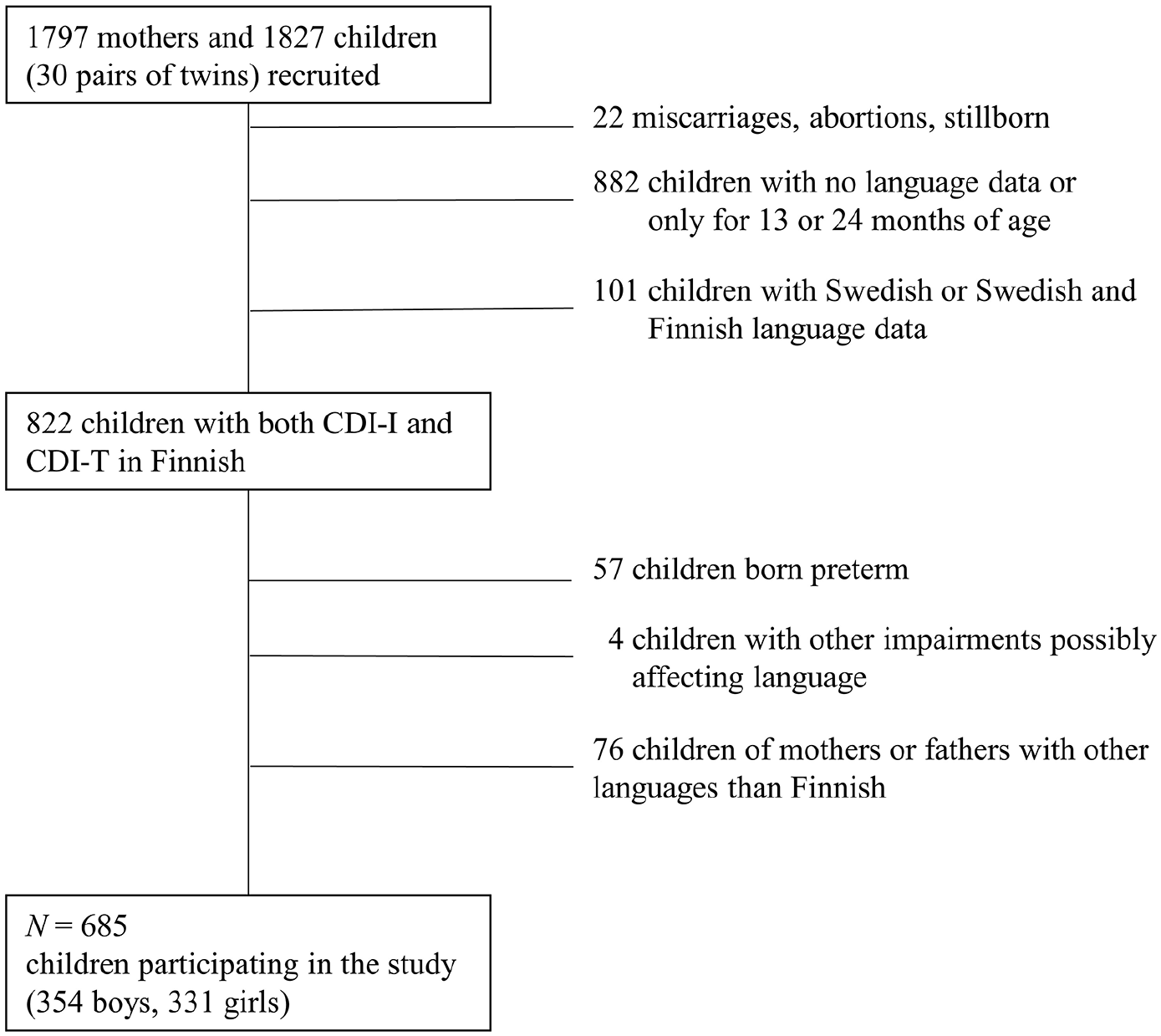
Flowchart of Recruitment Procedure.
In the present study, 45.5% of the fathers were highly educated compared to 64.1% of the mothers, and 56.0% of the fathers were professional (high occupational status) compared to 61.9% of the mothers. Most of the fathers (85.0%) worked full time (fathers of boys 85.4% and of girls 84.5%), and 79.3% of the fathers had used paternity and/or parental leave (fathers of boys 78.6% and of girls 80.1%) during the child’s first year. The fathers spent approximately 4.5 hours/day with the boys and 4.3 hours/day with the girls at age 13 months. The mean family monthly income was 3400 euros, and the average net income nationally over the same period was 3120 (2008) and 3173 (2009) euros (‘Statistics Finland’s PX-Web databases’, n.d.). Few parents reported a personal history of late onset of speech as a child: mothers 1.0% and fathers 2.0%. Of the children, 53.7% were firstborn and 21.0% were in day care outside the home at 13 months of age, compared to 52.9% at 24 months of age. For a descriptive overview of the study population according to child’s sex, see Table 1.
Descriptive overview of the study sample (N = 685).
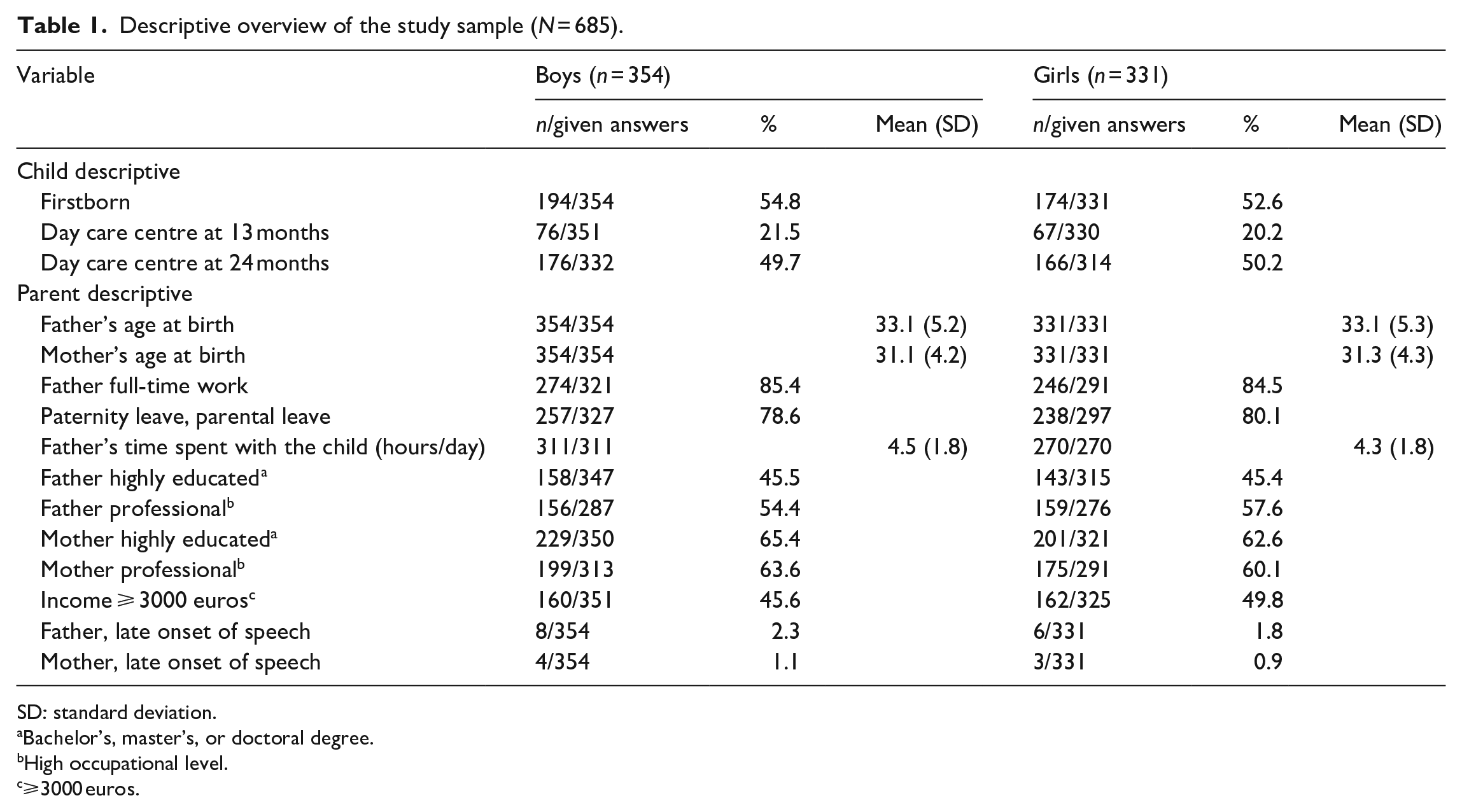
SD: standard deviation.
Bachelor’s, master’s, or doctoral degree.
High occupational level.
⩾3000 euros.
Chi-square analyses and independent two-tailed t-tests were used to assess the characteristics of included (N = 685) and non-included study families (N = 1120) and to compare the background factors of included boys and girls. There were no significant differences between included and non-included families except for the mother’s age and educational level. The mothers included in the study were about 7 months older than those who were not included, and they were significantly more educated (64% vs 57% highly educated, p = 0.002). There were no significant differences in background factors between included boys and girls.
Data collection
Outcome
The outcome of this study was expressive vocabulary growth between 13 and 24 months of age, that is, changes in the number of words produced. As the children had acquired the different number of words at 13 months of age, we needed to control for that to ensure we analysed the growth of vocabulary. This was done by adding vocabulary size at 13 months of age as a variable in the analysis.
To measure vocabulary, we used the Finnish version of the MacArthur-Bates Communicative Development Inventory (CDI) for infants (CDI-I) and for toddlers (CDI-T) (Lyytinen, 1999; Test information cf. Fenson et al., 2007). The parents were asked to complete the CDI-I inventory for the child at 13 and the CDI-T at 24 months of age. The questionnaires were either completed on paper and posted in stamped envelopes or completed on the study’s website. If no answer was received within 2 weeks, a new questionnaire was sent. The vocabulary checklists of the Finnish CDI-I and CDI-T forms consist of 380 and 597 items, respectively, divided into 19 and 20 semantic categories, respectively. Each child received a vocabulary size score for 13 and 24 months, based on the number of words the parents marked off on the checklist. To analyse vocabulary growth, we took the difference in the vocabulary size at 24 and 13 months of age.
Predictors and control variables
The parents completed questionnaires about their background factors – including education, occupation, family income and health-related questions – before or at the birth of the child and at the age of 13 and 24 months (Table 2). The first questionnaire was completed by the mother, after which both parents received their own questionnaires. The parents also completed questionnaires about the child’s health at 13 and 24 months of age. The questions were in multiple-choice or open format.
Language and demographic data. Who completed the questionnaires and when they were answered.
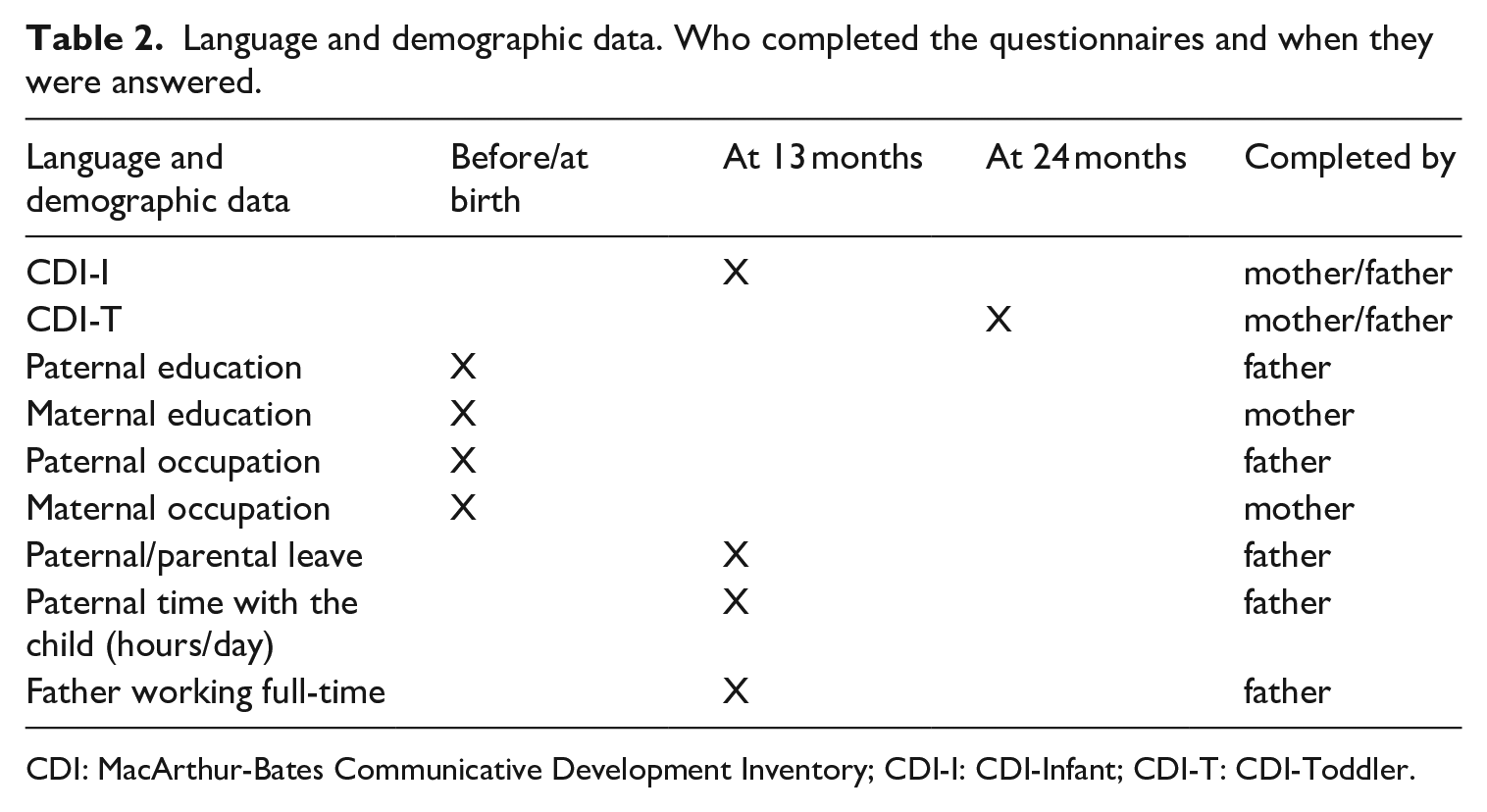
CDI: MacArthur-Bates Communicative Development Inventory; CDI-I: CDI-Infant; CDI-T: CDI-Toddler.
The main predictors in this study were the father’s full-time work status (yes/no), the father’s use of paternity/parental leave (yes/no), the father’s time spent with the child during the first year (in hours), the father’s educational status (high vs low), and the father’s occupational status (professional vs non-professional). For the time spent variable, fathers were asked approximately how much time, in hours and minutes, during the first year, they spent per day on weekdays and on weekends, taking care of, socializing with and playing with the child when the child was awake. Hours spent with the child were counted as average hours and minutes per day, by multiplying the time given for weekdays (weight factor 5/7) and weekends (weight factor 2/7). High educational level included bachelor’s, master’s and doctoral degrees; educational levels below these were categorized as low. Occupation was classified into two categories, professional and nonprofessional. Professional (high occupational status) included managerial and specialist levels. Office worker, service worker, construction worker, farmer and other occupations were classified as nonprofessional (low level of occupation). In analysing the effect of paternal factors on vocabulary growth, we controlled for vocabulary size at 13 months as well as maternal education and occupation.
Analysis
IBM SPSS Statistics Versions 24.0 and 26.0, SAS for Windows Release 9.4., and Mplus Version 8.7 with Robust Maximum Likelihood estimator were used in the analysis. p-values <0.05 were considered statistically significant. The p-value of 0.05 was adjusted by Bonferroni correction in the independent t tests by dividing the alpha level of 0.05 by the number of comparisons.
Collinearity analysis was performed between the independent variables to exclude multicollinearity; this analysis revealed no multicollinearity (tolerance > 0.2 and variance inflation factor [VIF] < 10). Therefore, all of the independent variables were used in the analyses.
Results
Vocabulary size and growth
We found great variability in early expressive vocabulary size, from no words to 297 words at 13 months (Mean = 10, SD = 18) and from four to 595 words at 24 months of age (Mean = 301, SD = 165). Girls outpaced boys in vocabulary size at both ages. See Table 3 for vocabulary size and growth in relation to child’s sex. Vocabulary growth between 13 and 24 months of age varied extensively in boys and girls (−19 to 582 and 4 to 594 words, respectively). For one participant the parents had marked fewer words at 24 months than at 13 months of age, resulting in negative growth (−19 words).
Expressive vocabulary size at 13 and 24 months of age and vocabulary growth between 13 and 24 months of age in boys (n = 354) and girls (n = 331).
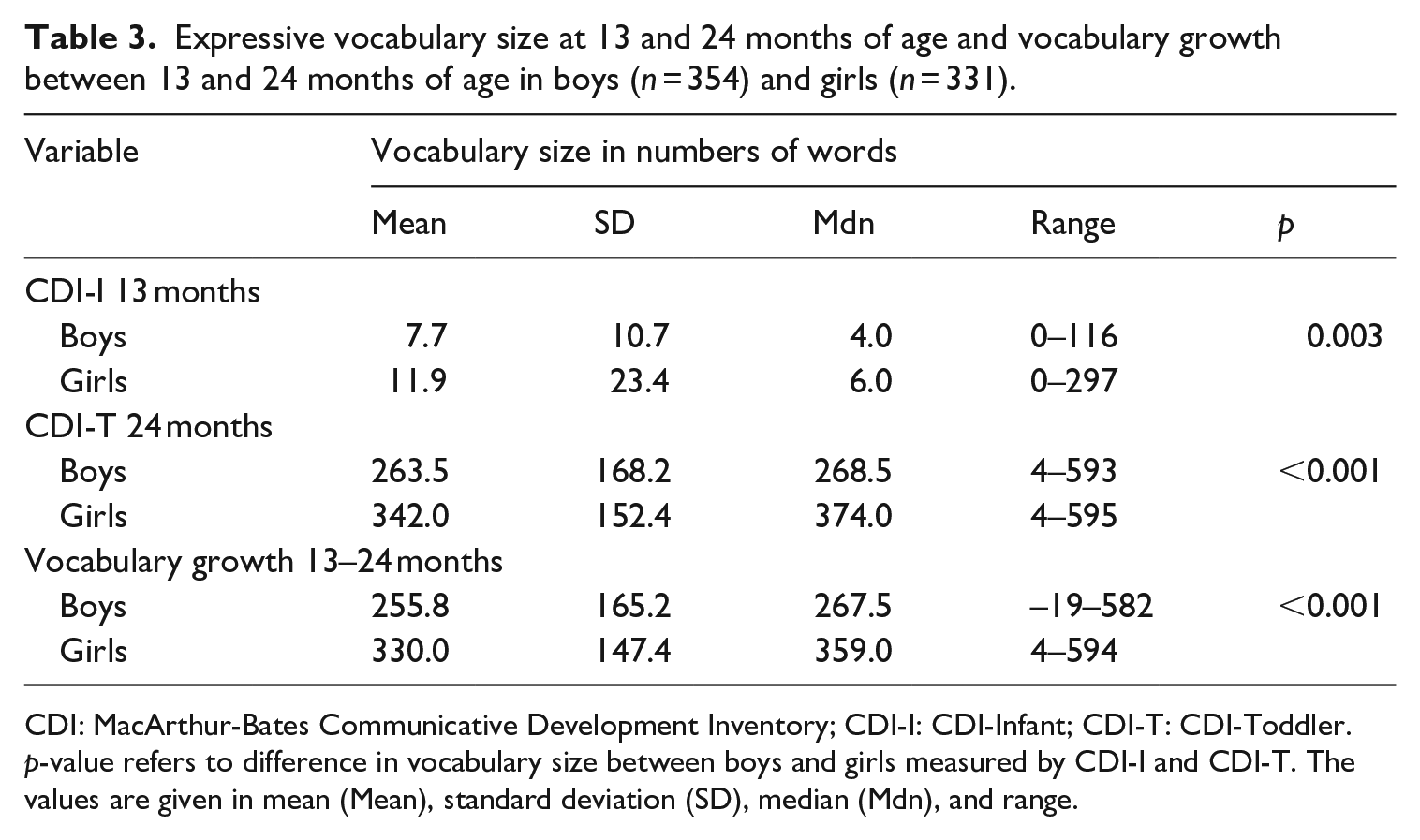
CDI: MacArthur-Bates Communicative Development Inventory; CDI-I: CDI-Infant; CDI-T: CDI-Toddler.
p-value refers to difference in vocabulary size between boys and girls measured by CDI-I and CDI-T. The values are given in mean (Mean), standard deviation (SD), median (Mdn), and range.
We analysed the correlations between vocabulary size at 13 and 24 months of age and growth between 13 and 24 months using Pearson’s correlations. Vocabulary size at 13 months of age correlated with vocabulary size at 24 months of age in boys and girls (r = 0.315, p < 0.001 and r = 0.287, p < 0.001, respectively) and with vocabulary growth between ages 13 and 24 months (r = 0.256, p < 0.001 and r = 0.138, p = 0.012, respectively).
Analysing boys and girls separately
One of the aims of the study was to explore whether paternal factors related differently to vocabulary growth in boys and girls. To ensure that the analysis could be done separately for boys and girls, we conducted a two-way analysis of variance examining vocabulary growth as a function of the parental variables and gender. An interaction was found between ‘maternal occupational status*gender’, F(1,600) = 4.70, p = 0.031. An effect of the mother’s occupational status was found in boys, professional: M = 282 SD = 168, non-professional: M = 217, SD = 156, t(311) = −3.43, p < 0.001, but not in girls, professional: M = 326, SD = 144, non-professional: M = 318, SD = 156, t(289) = −0.50, p = 0.616. Given this interaction, we proceeded with analysing vocabulary growth in relation to paternal and maternal factors separately for boys and girls.
Comparison of paternal factors and early vocabulary growth
To explore how paternal factors related to each other and to the maternal factors, we used Spearman’s correlations. Fathers working full-time spent less time with their children (rs = −0.209, p < 0.001). Fathers who took paternity/parental leave had a somewhat higher level of education (rs = 0.088, p = 0.032) and occupation (rs = 0.106, p = 0.016). The father’s use of paternity/parental leave also showed a weak positive correlation with maternal education (rs = 0.092, p = 0.023) and occupation (rs = 0.085, p = 0.046). No correlations were found between taking paternity/parental leave and time spent with the child (hours/day) or working full time or not. Paternal level of education and occupation correlated positively (rs = 0.614, p < 0.001). Paternal education correlated somewhat positively with maternal education (rs = 0.339, p < 0.001) and paternal occupation with maternal occupation (rs = 0.336, p < 0.001).
Independent two-tailed t tests were used to compare vocabulary growth in boys and girls in relation to paternal and maternal variables. Boys and girls with highly educated fathers had more vocabulary growth than boys and girls with less educated fathers, t(345) = 3.06, p = 0.002 and t(313) = 1.97, p = 0.049, respectively, and boys and girls with fathers working as professionals had more vocabulary growth than boys and girls with fathers with lower occupational status, t(285) = 3.16, p = 0.002 and t(274) = 2.95, p = 0.004, respectively. However, after Bonferroni correction, the association between vocabulary growth and paternal education was no longer significant in girls. There was no significant difference in the children’s vocabulary growth in relation to the fathers being on paternity or parental leave after the child’s birth. Paternal hours spent with the child per day were not related to vocabulary growth in boys or girls (Table 4).
Associations between vocabulary growth in boys and girls between ages 13 and 24 months and paternal and maternal variables.
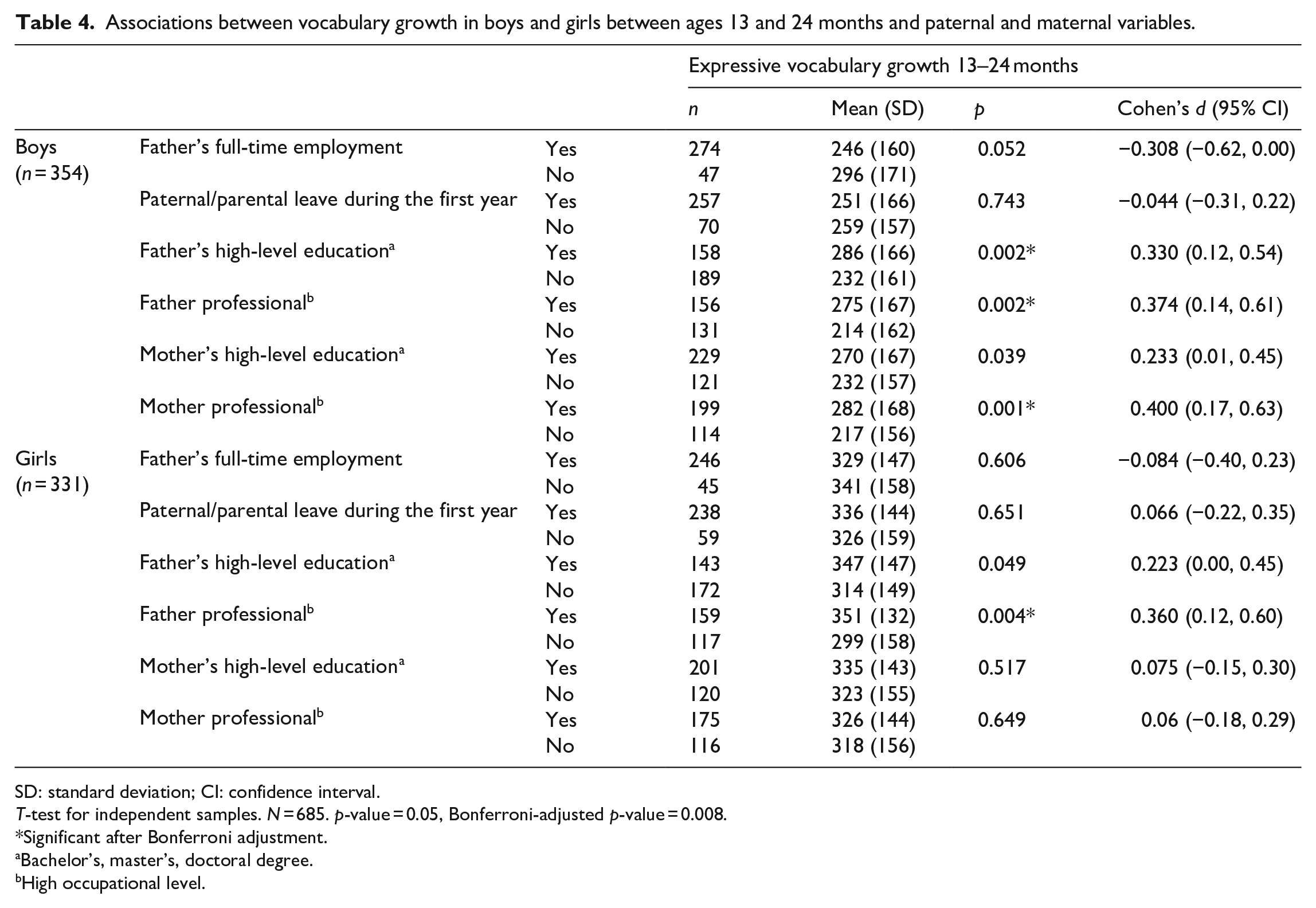
SD: standard deviation; CI: confidence interval.
T-test for independent samples. N = 685. p-value = 0.05, Bonferroni-adjusted p-value = 0.008. *Significant after Bonferroni adjustment.
Bachelor’s, master’s, doctoral degree.
High occupational level.
SEM analysis of paternal factors and vocabulary growth in boys and girls
To explore how paternal factors (working full time, use of paternity/parental leave, hours spent with the child, high level of education and occupation) relate to early vocabulary growth between 13 and 24 months of age (hypotheses H1–H5) in boys and girls, structural equation modelling (SEM) was used. See Figure 2 for the hypothesized model. In addition to paternal factors, maternal control factors and vocabulary size at 13 months of age were added to the models. The analysis was performed separately for boys and girls. Paternal factors, as well as maternal factors, were allowed to correlate. The model fit was evaluated by chi-square test statistics and the following fit indices: root mean square error of approximation (RMSEA), standardized root mean square residual (SRMR), Tucker–Lewis index (TLI), and comparative fit index (CFI). The cut-off values that were applied were: RMSEA and SRMR values under 0.08 and TLI and CFI values acceptable over 0.90 (e.g. Hu & Bentler, 1999) but preferable over 0.95 (e.g. Kline, 2011; Metsämuuronen, 2009). The model fit indicators CFI and TLI tell how good the model is and RMSEA and SRMR are measures of the misfit of the model, meaning that the better the model is the smaller are the RMSEA and SRMR values. In a good model fit the value of the chi-square test should be p > 0.05, that is, insignificant.
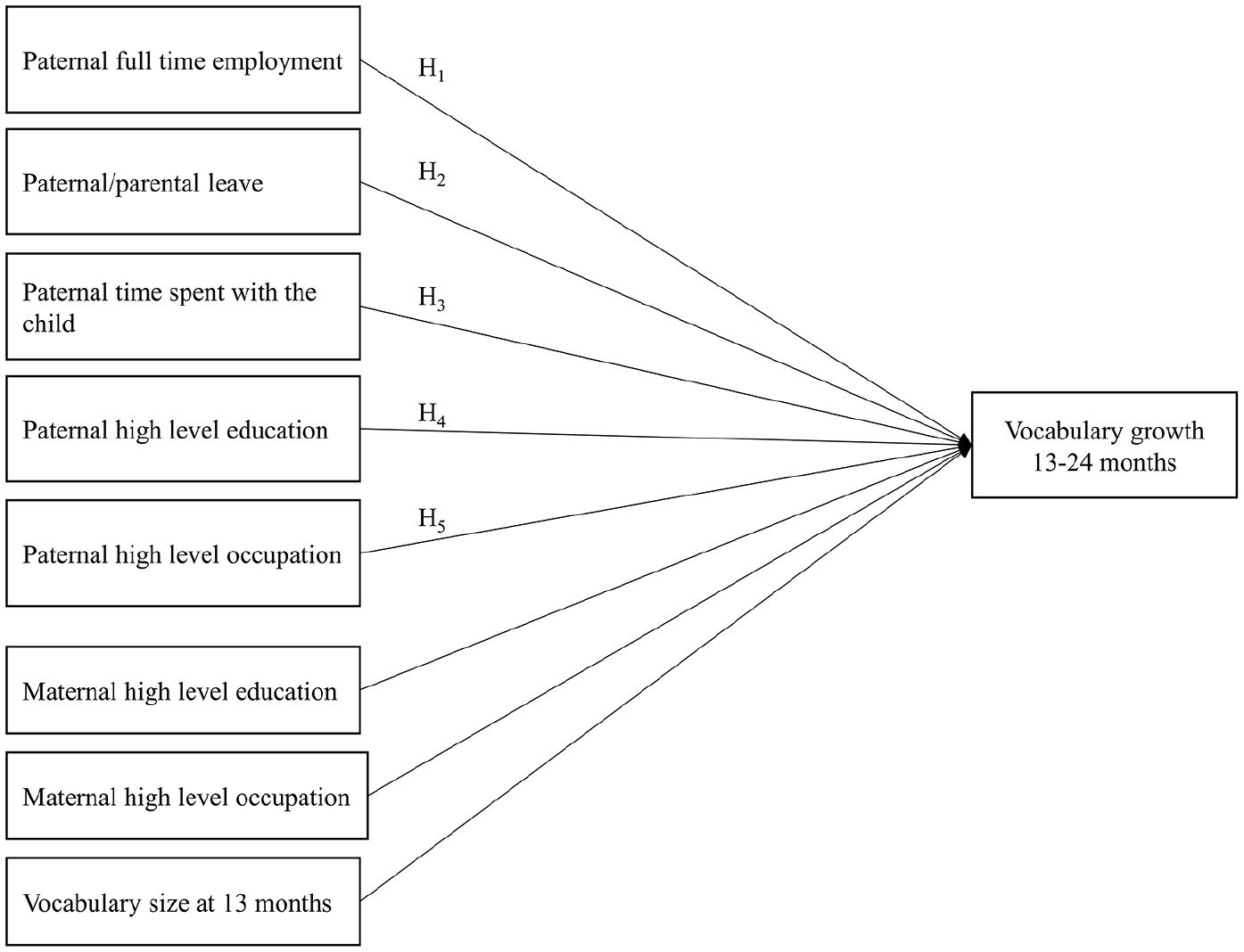
Conceptual Model of the Hypothesized Associations Between Paternal and Control Factors and Vocabulary Growth Between 13 and 24 Months.
Both models, for the boys and girls, were well-fitting, meaning the theoretically driven models fit the data. The fit indices for the models of boys and girls were: Σ2 (7) = 5.82, p = 0.5607; RMSEA = 0.000; CFI = 1.000; TLI = 1.000; SRMR = 0.018, and Σ2 (7) = 7.56, p = 0.3732; RMSEA = 0.016; CFI = 0.898; TLI = 0.883; SRMR = 0.024, respectively. Vocabulary growth in boys was less if the father worked full time but greater if the mother had a high level of occupation. Boys with more words at 13 months of age also had more vocabulary growth. Vocabulary growth in girls was associated with paternal occupational status, with more growth for girls with fathers of high occupational status. The standardized loadings were weak, from 0.12 to 0.26. See Figure 3 for the findings of the fully estimated models.
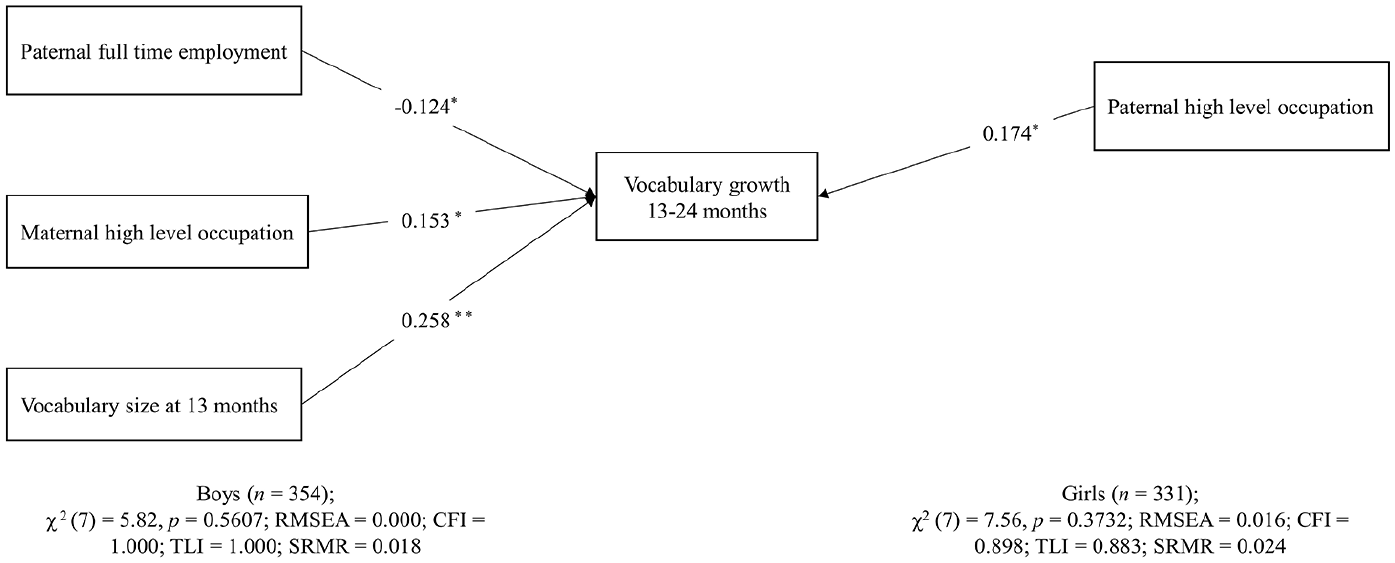
Structural Equation Models Including Significant Factors in Predicting Vocabulary Growth in Boys and Girls Between 13 and 24 Months of Age. The Significant Factors of the Boys Are to the Left and That of the Girls to the Right.
Discussion
The main aim of the study was to investigate how paternal factors relate to the child’s early vocabulary development. We identified significant differences in vocabulary growth in relation to fathers’ work status (full time or not) and level of education and occupation, but also the maternal level of occupation and the child’s vocabulary size at 13 months of age. We found that these factors related differently to vocabulary growth in boys versus girls.
The presence of the father and growth in early vocabulary
Our hypotheses that children with fathers not working full time, fathers taking advantage of paternal/parental leave, and fathers spending more hours per day with their child during the first 13 months would have more vocabulary growth were partially confirmed. Boys with fathers working less than full time had larger expressive vocabulary growth between 13 and 24 months of age. This confirms a previous study by Korpilahti et al. (2016) in which positive effects of the father being at home more related to vocabulary size even at 3 years of age, but it also shows that positive associations can be seen already during the second year. It could be that fathers working less and staying more at home during the child’s first year establish a pattern of involvement with their children, which continues during the second year, as suggested by Huerta et al. (2014). However, fathers’ use of paternal/parental leave was not related to greater vocabulary growth. Could it be that paternity leave, often taken just after the birth of the child, is too short and at a time when a lot is changing in the family structure to have long-lasting effects? In contrast, not working full time is a more stable condition, engaging the father differently in caretaking. Studies show that the involvement of fathers in co-parenting the child is related to well-being in the couple’s relationship and collaboration between the mother and the father (Frascarolo-Moutinot et al., 2020). However, as this study did not include these measurements, this should be focused on in the future.
Fathers in the study who were working full time spent less time with their children, in line with the results of the NICHD Early Child Care Research Network (2000) study that fathers tend to be more involved in caregiving if they work fewer hours. However, it seems that it is not the time as such that is the decisive factor for vocabulary growth during the second year. In the present study, the use of paternal/parental leave and more hours spent with the child during the first year did not relate to greater vocabulary growth during the second year. It has been suggested that during early infancy mothers talk more (by roughly two thirds) to their children than do fathers, and that they speak more to girls than to boys (Bergelson et al., 2018; Johnson et al., 2014; Shapiro et al., 2021). It is possible that even if the father is at home with the child, he engages less in verbal activities with the child than does the mother. In a study by Yeung et al. (2001), a child under 2 years of age was engaged in playing with the father on a weekday for 44 minutes, but only for 2 minutes in reading activities. If fathers were engaged more verbally with their children, we could expect it also to have affected vocabulary size in families where the father was more at home, as the father’s involvement with the child contributes to early language (Lankinen et al., 2018). It is likely that at this early age (under 13 months), fathers used fewer words when playing with their children than later on (Pancsofar & Vernon-Feagans, 2006). This would be consistent with Shapiro et al. (2021), who found that fathers’ child-directed speech increased with the child’s age more rapidly than the mothers’, even if it was still less overall than maternal child-directed speech. There is a possibility that it is easier for fathers to be verbally engaged with their children when the child has passed the preverbal communication stage and starts to answer with words.
Paternal high level of education and occupation and vocabulary growth
Second, we hypothesized that children with fathers with higher educational attainment and children with fathers working as professionals (high occupational status) would have larger vocabulary growth between 13 and 24 months of age. This was partly confirmed. Direct comparisons of vocabulary growth demonstrated advantages for boys and girls with fathers who had higher education and occupational status (relative to those with less education and lower occupational status). There was also greater vocabulary growth for boys with mothers of higher occupational status and girls with fathers with higher occupational status.
However, in the results of SEM analyses, although paternal occupation predicted vocabulary growth for girls, paternal education and occupation did not predict vocabulary growth in boys between 13 and 24 months of age. The absence of associations between paternal education and occupation and boys’ early language development differs from earlier studies where these factors supported larger vocabulary in children (Armstrong et al., 2017; Cabrera et al., 2007; Lankinen et al., 2018). One possible explanation for the difference is that previous studies focused on children 2 years of age and older. It may be that these paternal factors have more influence when children’s vocabulary size is larger. This could also explain why the paternal level of occupation predicted vocabulary growth in girls (who had larger vocabulary size on average) but not in boys in the current study.
Maternal factors and vocabulary growth
The SEM analysis showed that maternal occupational status was related to vocabulary growth between 13 and 24 months of age but only in boys. Boys with mothers working as professionals had larger vocabulary growth compared to boys with mothers of lower occupational status. The impact of parental occupational status on language use was established most famously by Hart and Risley (1995). Mothers from a high SES background have been demonstrated to use richer language with their children, with more words and child-directed speech (Hoff, 2003; Hoff-Ginsberg, 1998; Rowe, 2008; Weisleder & Fernald, 2013).
In the present study, the mother’s level of education did not relate to vocabulary growth. This runs counter to earlier studies (Gilkerson et al., 2017; Letts et al., 2013; Rowe, 2012), where higher maternal education was associated with a larger vocabulary size. One reason for the differences could be the younger age of the children in our study compared to these studies, in which the children were over 2 years of age. Another explanation could be that most Finnish women have good basic and secondary education. Most (80%) of the mothers in the study had at least 12 years of education, even if they did not have an academic degree. The corresponding value for the fathers was less (54%). The low variability in maternal education could explain the absence of associations between education and vocabulary growth in this sample. Mothers are also actively instructed at maternity and child health care clinics in Finland on how to support early language development. Although several studies have demonstrated the significance of maternal education (e.g. Bergelson et al., 2018; Gilkerson et al., 2017; Letts et al., 2013; Rowe, 2012), these were done in countries with a different educational and social system than in Finland. Overall, more studies are needed to investigate how different paternal and maternal factors, as well as factors like harmony between the parents and parental well-being contribute to children’s early language development.
Sex differences in vocabulary growth
Our findings suggest that a discrepancy between expressive vocabulary size and growth between boys and girls, in favour of girls, can already be found at 13 to 24 months of age. This is in line with earlier studies suggesting that girls outperform boys in language development between the ages of 1 and 3 years (Andersson et al., 2011; Schults & Tulviste, 2016). Vocabulary size varied greatly between the participants in the present study as has earlier been established (Bates et al., 1994). In the present study, girls’ vocabulary size varied more than boys’ at 13 months of age but similarly at 24 months. At this age, a few boys already had a large vocabulary, explaining the increased variability at this age. The finding that vocabulary size in boys at 13 months of age predicted vocabulary growth between 13 and 24 months of age is significant. It suggests that already at 13 months of age we can find, at least in boys, trajectories for later language development as has also been suggested by Fenson et al. (2007), Hart and Risley (1995), and Lee (2011).
According to the results, vocabulary growth in boys was not more associated with paternal factors compared to that of girls. However, the study showed differences between boys and girls in which factors predicted larger vocabulary growth. Boys with fathers working full time had a smaller increase in vocabulary than boys with fathers who worked less. This was not the case for girls. Why the vocabulary growth of girls was not associated negatively with the father working full time is interesting. As it is suggested that mothers talk more to girls than boys (Lovas, 2011), one explanation could be that this is enough for vocabulary growth in girls at this stage. Even if fathers talk less than mothers do, to both boys and girls (Gilkerson & Richards, 2009), it could be that boys are more dependent on the presence of the father than girls are for early language development. High maternal occupational status also predicted positive vocabulary growth only in boys, whereas high paternal occupational status predicted larger vocabulary growth in girls but not in boys. As mentioned above, there is evidence that children of highly educated fathers and fathers working as professionals have more advanced language development (Armstrong et al., 2017; Cabrera et al., 2007; Korpilahti et al., 2016; Lankinen et al., 2018). It is possible that girls in the second year, with their more developed vocabulary than boys on average, are better able to take advantage of the fathers’ use of advanced language. According to the results, we presume that the father’s role as a linguistic bridge between the ages of 13 and 24 months, challenging the child linguistically, is not yet as strong for boys as for girls (Lovas, 2011; Rowe et al., 2004).
The significance of the child’s sex in early vocabulary growth in favour of girls has been widely reported (Andersson et al., 2011; Marjanovic-Umek & Fekonja-Peklaj, 2017; Schults & Tulviste, 2016). The reasons for these differences have not been explored as much; studies have focused primarily on differences in heritability (Galsworthy et al., 2000) and how people in the environment communicate with boys versus girls (Gilkerson & Richards, 2009). The results of the present study indicate that environmental factors relate differently to early vocabulary growth depending on the child’s sex, consistent with some earlier studies (Barbu et al., 2015; Lankinen et al., 2018). Our study suggests that researchers should consider the effects of different factors on early vocabulary development separately in boys and girls. Otherwise, sex differences in language development resulting from environmental/biological factors may be masked. Combined norms for boys and girls may also lead to risks of not detecting language problems in girls in clinical evaluations (Urm & Tulviste, 2016). Our study suggests that vocabulary growth in boys during the second year is more sensitive to environmental factors than vocabulary growth in girls. These results should encourage more research into the relationship between biological and environmental factors and different aspects of boys’ versus girls’ language development.
Strengths and limitations of the study
The present study focused on associations between multiple paternal factors and early vocabulary development in boys and girls. We also showed how early vocabulary growth relates differently to environmental factors due to the child’s sex.
Fathers who are on paternity/parental leave have more opportunity for caregiving but this leave does not guarantee per se that they spend more time with their child and does not determine how the time was spent. In the present study, we did not have the possibility to analyse the quality of paternal time with the child. Differences in quality may be why paternal leave and hours spent with the child did not relate to children’s vocabulary growth. It is also possible that the effect of these factors during the first year is seen only later in the child’s language development. Another limitation of the study is that paternal involvement during the second year was not measured. This could be done in future studies to get more information on paternal factors in early language acquisition. There is also a possibility that more paternal involvement in the family, because of working less, gives the mother more time to be engaged with the children supporting their language development.
However, we did not analyse maternal time spent with the child as Finnish mothers are mostly at home during at least the child’s first 10 months. When interpreting the results, it must also be considered that among the participating families, parents were highly educated, fathers (45.5%) and mothers (64.1%). In addition, more than half of the parents had a high occupational status. There is also a possibility that the influence of paternal and maternal factors is more interrelated than the present analyse can show.
Conclusion
The current study adds information about associations between paternal factors and the development of early expressive vocabulary between the ages of 13 and 24 months. It reveals the effect of the father’s full-time work status on early vocabulary growth in boys. The study also shows an effect of paternal occupational status on vocabulary growth in girls. Furthermore, the study emphasizes that vocabulary growth in boys and girls reacts differently to environmental factors and that boys’ vocabulary growth seems to be sensitive to more factors in the second year of life compared to that of girls. The current study underlines the importance of studying vocabulary growth and factors influencing it separately in boys and girls. Studies recording the father’s use of time together with the child would give more qualitative information about father–child interaction that could be informative in understanding these effects.
Footnotes
Acknowledgements
The authors are grateful to all the families who took part in this study, the midwives for their help in recruiting them, the entire STEPS study team, and senior researcher Eero Laakkonen, from the Department of Teacher Education at University of Turku, for advice on SEM analysis.
Author contribution(s)
Funding
The author(s) disclosed receipt of the following financial support for the research, authorship, and/or publication of this article: This research was supported in part by Kommunalrådet C G Sundells stiftelse.
