




Abstract
Research on lesser studied languages is vital for the advancement of theories of language acquisition. We discuss two areas where data from Eegimaa have the potential to produce innovative research: (1) language typology, with an overview of the complex demonstratives found in this language, and (2) learning environment and input speech. Here, we show that Eegimaa children learn to speak in a polyadic environment, where they receive input from multiple caregivers, siblings and other members of their community.
Keywords
Introduction
Kidd and García (2022) chart the imbalance in child language research in languages, as well as speaker populations and authorship by region. Although the results look promising in the trend towards reducing the imbalance, the world is bound to lose languages at faster rates than the academic community manages to include in acquisition studies. Because of the extremely skewed nature of language acquisition data, it is important to remember how limited our evidence base is for describing the mechanisms underlying acquisition and the possible trajectories of acquiring diverse linguistic structures and rare linguistic phenomena.
In our commentary, we consider two ways in which research on children’s acquisition of Eegimaa (Atlantic, Niger-Congo) can contribute to our understanding of acquisition. Eegimaa is an endangered language spoken by about 13,000 speakers across 10 villages in Southern Senegal (Sagna, 2022). Data from Eegimaa-acquiring children shed light on both how language typology can affect language acquisition and how the variables included in acquisition studies must be interrogated across cultures, continents and more specific contexts.
In our recent project, we collected 113 hours of naturalistic interactions with Eegimaa-speaking children between the ages of 1;10 and 4;0. Transcription is still ongoing, partly because of the large-collected corpus, but also because of various hindering factors, including issues of equipment and power, lack of skilled transcribers, and difficulties associated with managing a project of this scale across large distances. Our initial analyses, however, indicate that this corpus will contribute to discussions of (1) typological differences affecting language acquisition, with related languages leading to diverse acquisition paths and (2) the importance of including diverse language learning environments. The Eegimaa children are exposed to input speech from multiple caregivers of various ages, and they are raised in predominantly monolingual contexts, in which most speakers have access to multilingual repertoires. We discuss each of these below.
Typological details that may affect language acquisition
Typologically, Eegimaa is related to Bantu languages, which have been studied more than most African languages (see, for example, Demuth, 2003), yet typological differences mean children learning Eegimaa face a different set of challenges. To illustrate one particular challenge, we discuss the demonstrative system here. Demonstratives are among the first words that children learn, often used with gestures such as pointing, and they rely on some degree of joint attention between speaker and addressee (Diessel, 2006).
The demonstrative system of Eegimaa is unusually elaborate: the morphologically distinct demonstrative forms are illustrated in Table 1. They take obligatory agreement, with single or double agreement marking (in boldface), indicating the gender and number of the antecedent noun. In addition, demonstratives combine with the proximal (-e), medial (-u) or distal (-ua/-a) suffixes. The table exemplifies Eegimaa demonstratives using three genders (
Morphological forms of Eegimaa demonstratives.
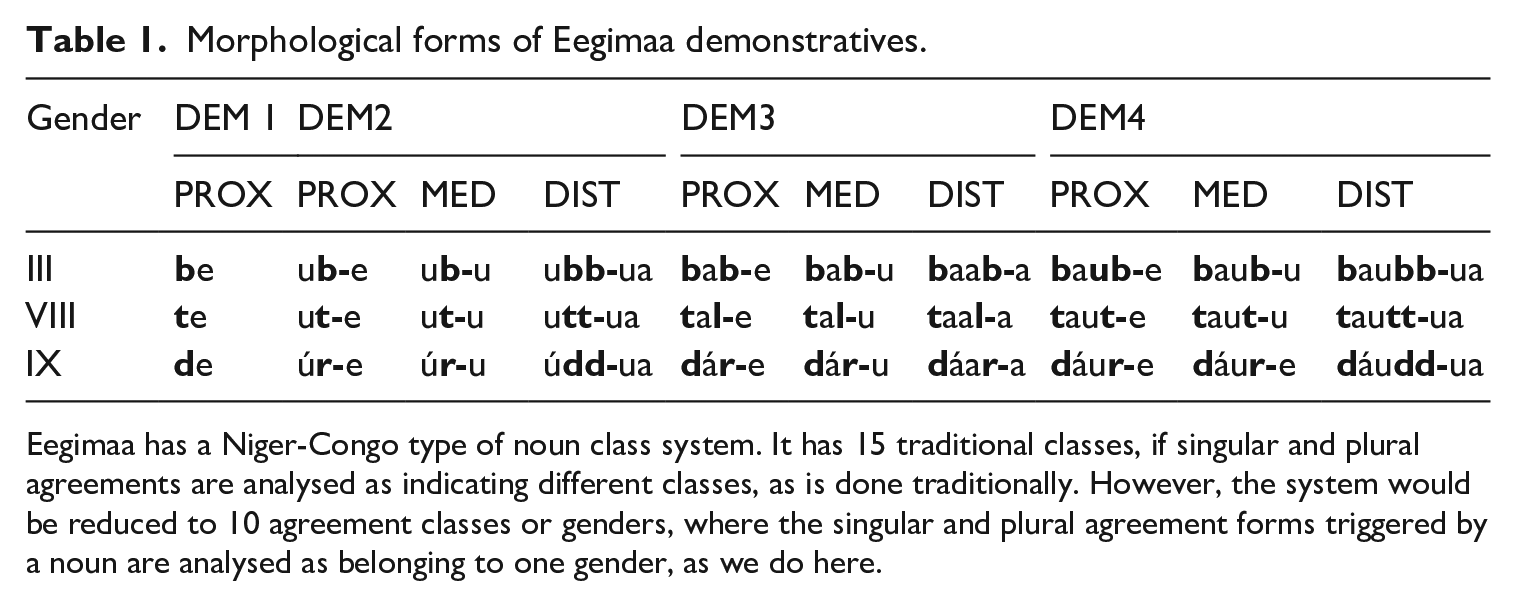
Eegimaa has a Niger-Congo type of noun class system. It has 15 traditional classes, if singular and plural agreements are analysed as indicating different classes, as is done traditionally. However, the system would be reduced to 10 agreement classes or genders, where the singular and plural agreement forms triggered by a noun are analysed as belonging to one gender, as we do here.
Eegimaa agreement is generally alliterative, as in example 1, which shows matching gender and number feature values of the noun and the demonstrative.
t-place( ‘This place (precise location)’
Agreement mismatches also occur, as exemplified in example 2, where the feature values (gender
2. w-aare w-woman( ‘These women’
For a child acquiring Eegimaa, the pragmatic challenge of learning the deictic system of demonstratives includes the complex pragmatic and morphosyntactic choice of demonstrative forms, and the added layer of complexity of syntactic versus semantic cues guiding agreement. If a child points to a location using
This sort of investigation requires (1) a thorough grammatical description enabling us to map the similarities and differences between languages and (2) sufficient data to map children’s productive use and understanding of the linguistic features in question. Research on the acquisition of the Eegimaa demonstrative system will contribute to our general understanding of the acquisition of morphological complexity.
A monolingual setting with multilingual caregivers
Kidd and Garcia advocate for the investigation of lesser studied languages as essential for shedding light on children’s language acquisition; this extends to their language learning environment, input and socialisation context (Lieven & Stoll, 2013; Rabain-Jamin, 2001; Weber et al., 2017). The sociolinguistic settings in which children learn to speak are underexplored, and they may have as yet unidentified effects on language learning. In the case of Eegimaa, children are initially raised monolingually, in villages where Eegimaa remains the default language of communication between adults. This setting is markedly different from the multilingual Senegalese cities or cosmopolitan villages where children need to learn several languages to communicate with their peers and adults.
Our fieldwork since 2018 shows that in Eegimaa-speaking villages, children in their early years are spoken to almost exclusively in Eegimaa. However, since the independence of Senegal from France in 1960, turn-around migration to cities and among the villages has considerably increased the level of individual multilingualism.
Beyond their early years, in the school nursery (around age 3), children start to hear French in ambient speech. Some of the children begin to use isolated words in Wolof (Atlantic, Niger-Congo). This may be learned in part from other children who come from the cities – either during school holidays or who arrive in the villages to live with their relatives on a permanent basis. Some older children learn Wolof by going to the city themselves for holidays. Overall, although our research shows that child-directed speech is entirely in Eegimaa, children get some early exposure to a variety of other languages. Our data provide an opportunity to investigate children’s exposure to and use of languages other than Eegimaa.
In addition to the multilingualism of their caregivers, Eegimaa children learn to speak in a polyadic environment characterised by daily interactions with multiple peers and caregivers including mothers, older siblings and other members of the community. Consequently, children are exposed to varied input. Research on the influence of this diverse input on children’s language learning is still in progress. It is, however, widely reported in the literature that children learning to speak in non-Western/non-industrialised contexts have different learning experiences (see, for example, Loukatou et al., 2021). Research on a polyadic environment like that of Eegimaa children has the potential to address questions on the facilitative nature of child-directed speech, its correlation with children’s production of grammatical categories such as the demonstratives discussed above and the development of multilingual repertoires. Without investigating the diversity of childhood experience and acquisition patterns, we cannot identify which aspects of language and development are universal, which are individual, and which vary with language and culture.
Footnotes
Author contribution(s)
Funding
The author(s) disclosed receipt of the following financial support for the research, authorship, and/or publication of this article: The author(s) greatly acknowledge the financial support from the Economic and Social Research Council (ESRC, UK), and the Arts and Humanities Research Council (AHRC, UK), Grant ES/P000304/1.
