



Abstract
Communication is best understood as occurring along three dimensions: interactional, conceptual, and linguistic. However, few studies have examined early parent–child communication along all three dimensions simultaneously. This study examines these three dimensions of communication in Norwegian parent–child interactions during play. Thirty-nine 2-year-old children participated in dyadic interactions with their fathers (N = 30) and mothers (N = 38). Of these 39 children, 29 engaged in separate interactions with both parents. Father–child and mother–child responsive communication, levels of abstract talk, and language complexity and diversity were examined and compared. Overall, the features of communication were very similar between father–child and mother–child interactions, and there were some noteworthy associations between the features of father–child and mother–child communication within families and dyads. We discuss these findings in reference to the three dimensions and in relation to the specific activity and cultural setting of the study.
Keywords
Parent–child communication is perhaps best understood along three dimensions: interactional, conceptual, and linguistic (Rowe & Snow, 2020). However, little research has examined father–child and mother–child communication along these three dimensions simultaneously. In this study, we build on prior work that has examined communication during father–child and mother–child play interactions (Tamis-LeMonda et al., 2012) and investigate communication features that have been found to facilitate child language learning in toddlers along the three dimensions. For the interactional dimension, we examine parent and child responsive communication; for the conceptual dimension, we investigate their levels of abstract talk; and for the linguistic dimension, we study their language diversity and complexity.
We focus on Norwegian parent–child interactions and aim to contribute knowledge about early communication in a country with high levels of support for parental involvement through public subsidized childcare and parental leave policies that have quotas for both maternity and paternity leave periods (Nordahl et al., 2014). Such conditions may affect human development through proximal processes that actualize ‘genetic potentials for effective psychological functioning’ (Bronfenbrenner & Ceci, 1994, p. 568). Some previous comparisons of father–child and mother–child interactions have attributed differences between them to the different roles that parents play in a family (e.g. Gleason, 1975). The Bridge Hypothesis (Tomasello et al., 1990), for example, states that fathers are more challenging communicative partners for their children because, in their breadwinning roles, they spend less time with their children and tend to request clarification from and question the child more than the mother, who, as the primary caregiver, might be more familiar with the child’s language abilities. The father’s interactions with the child might thus serve as a ‘bridge’ to the outside world.
However, fathers and children in Norway have been found to spend more time together than is typical in other countries (Hook & Wolfe, 2012), presenting a unique opportunity to explore parent–child communication in this cultural context. Nevertheless, before we review previous work on parent–child communication across the three dimensions and studies of parent–child interactions in Norway, we will first look at some communication features associated with toy play.
Features of communication during toy play
In this study, we examine parent–child communication during toy play, which has been found to generate pretend talk (Katz, 2001) and may elicit certain types of communication less associated with other activities (Hoff, 2010; Hoff-Ginsberg, 1991; Salo et al., 2016; Tamis-LeMonda et al., 2019; Yont et al., 2003). For example, toy play conversations have been found to elicit more parental talk about past events than book reading, which has been found to promote more talk related to a joint focus of attention (e.g. Yont et al., 2003). However, activities do not determine communication, as demonstrated by studies that report conflicting results regarding some aspects of language used during book reading and toy play (e.g. Hoff-Ginsberg, 1991; Salo et al., 2016), and the types of talk in a conversation will vary depending on other factors, such as the role of the different communication partners in different cultures (Rowe & Weisleder, 2020). Across activities, different features of communication are perhaps best understood when considered along all three dimensions: interactional, conceptual, and linguistic (Rowe & Snow, 2020). With toy play activity as a background, we review previous research on parent–child communication along these dimensions, paying particular attention to previous work that includes fathers.
Responsive communication
Parents’ responsive communication – responses that are related to the activity with which the child is occupied – is presumed to play a vital role in facilitating children’s early language development in several ways. First, responsive communication can facilitate language learning by making it easier for children to process the language to which they are exposed (Akhtar & Tomasello, 2000). Second, the reciprocal nature of responsive communication in which the child’s acts and the parent’s responses follow each other (Tamis-LeMonda et al., 2001) can contribute to facilitating children’s participation in back-and-forth conversations (Hirsh-Pasek et al., 2015). Finally, such parental talk may facilitate language learning by providing information about new words in a syntactic frame that builds on the child’s utterances (Taumoepeau, 2016).
An extensive body of research has examined responsive communication between mothers and children (e.g. Bornstein et al., 2008, 2015; Tamis-LeMonda et al., 1996), and more responsive children have been found to have more responsive mothers (Kuchirko et al., 2018). Less is known about responsive communication between fathers and their children, but some studies have reported that fathers’ supportive parenting predicts children’s language and cognitive development (Shannon et al., 2002; Tamis-LeMonda et al., 2004) and that when aspects of fathers’ and mothers’ responsive communication during play are compared, there are more similarities than differences at the group level (Tamis-LeMonda et al., 2012). However, compared to mothers, fathers have been found to issue more conversational challenges to their toddlers through wh-questions and explicit requests for clarification (e.g. Rowe et al., 2004); this can lead to more communicative breakdowns (Tomasello et al., 1990), raising the question of whether fathers and mothers are equally responsive overall. In this study, we build on the existing literature by examining the extent to which children and their fathers and mothers are responsive to one another by connecting their talk to the ongoing activity in which the communication partners are engaged.
Levels of abstract talk
Another communication feature associated with language development in the toddler years is parents’ and children’s use of decontextualized talk, which consists of talk that is removed from the physical context of an interaction (Demir et al., 2015; Uccelli et al., 2019). In contrast to contextualized talk, which is related to entities in the physical setting of an interaction, a parent’s decontextualized talk may introduce children to more complex linguistic input – that is, in the absence of a physical context, the language must serve as its own context, which will often require longer utterances to communicate meaning. The grammatical complexity of decontextualized talk may therefore be one possible explanation for its positive impact on child language development (Demir et al., 2015). Early in a child’s development, decontextualized conversations often involve a combination of contextualized and decontextualized aspects (e.g. Ganea & Saylor, 2013). This combination is particularly salient in early pretend talk (Pellegrini, 1985), which is a type of decontextualized talk (e.g. Rowe, 2012) presumed to be especially beneficial in facilitating children’s early language learning (Weisberg et al., 2013).
Compared to the other communication dimensions, few studies have compared levels of abstract talk in early father–child and mother–child interactions. One exception is Tamis-LeMonda et al. (2012), which reported that the contextualized (e.g. labels and descriptions) and decontextualized talk of fathers and mothers did not differ at a group level but relationships between the talk of fathers and mothers of the same child were less clear. Nonetheless, findings from studies on parent–child communication during play may provide information about the levels of abstraction in both father–child and mother–child communication. For example, Cabrera et al. (2017) found no differences in the degree to which fathers and mothers showed imagination, creativity, or curiosity during play with toddlers in low-income families. In that study, parents were measured on a global scale ranging from 1, indicating no playfulness, to 7, indicating high levels of creative play. Both fathers and mothers received an average score of approximately 4, which implied that half of the interaction was spent in concrete play and the other half in imaginary play in which the toy was used according to its intended function (e.g. using a cup to pretend drinking; Cabrera et al., 2017).
Relatedly, Haight et al. (1997) examined mothers’ and fathers’ beliefs about and spontaneous participation in their toddlers’ pretend play in European-American middle-class families. They found that both fathers and mothers characterized pretend play as an enjoyable activity that facilitates children’s cognitive development and creativity and that they engaged in relatively equal amounts of pretend play. Together, these findings suggest that fathers and mothers are similar in the extent to which they engage in imagination or pretense with their child. Here, we expand on the limited literature on levels of abstract talk in both father–child and mother–child communication by examining their contextualized, pretend, and decontextualized talk.
Language diversity and complexity
On the linguistic dimension, using more diverse and complex speech with toddlers contributes to their subsequent language outcomes (Anderson et al., 2021; Hoff, 2003; Rowe, 2012). For example, Rowe (2012) found that parents’ use of different word types in the toddler years played an especially important role in contributing to children’s vocabulary growth, and Hoff (2003) found that children who heard longer utterances built productive vocabulary faster than children who heard shorter utterances.
With respect to father–mother communication, features of input at the linguistic level are perhaps the most widely researched, with some studies reporting differences between fathers and mothers and others not. For example, Pancsofar and Vernon-Feagans (2006) examined the talk of 92 middle-class fathers, mothers, and 2-year-old children during triadic free play interactions and found no differences between fathers’ and mothers’ mean length of utterance (MLU). However, they did find that mothers used a greater variety of word types than fathers. Similarly, Tamis-LeMonda et al. (2012) found no differences between fathers and mothers with respect to either MLU or word types in a sample of 50 low-income families, and associations between fathers and mothers of the same child and between parent and child within dyads were moderate to strong. However, the children in that study used a greater variety of words with fathers than with mothers. These findings are in line with a study by Rowe et al. (2004), which examined the talk of 33 low-income fathers and mothers in separate interactions with their 2-year-old children during play with toys. They found no differences between fathers and mothers in their use of word types or MLU, and the children in their study used longer utterances and a significantly greater variety of word types in communication with their fathers than with their mothers.
The role of culture in parent–child communication
The above literature review is based on families from English-speaking countries. However, as features of communication may vary across cultures (Fernald & Morikawa, 1993; Grøver Aukrust & Snow, 1998; Wei et al., 2020), it is important to identify cultural and contextual factors that may influence patterns of parent–child communication (Rowe & Weisleder, 2020). This study examines features of communication in families from Norway, which is a country characterized by a strong welfare state (Bendixsen et al., 2018); for example, all new parents in Norway are offered a 1-year parental leave quota, with a part of the quota reserved only for fathers. Moreover, childcare is subsidized by public policy, with the vast majority of toddlers and most preschoolers attending full-time childcare outside the home (Statistics Norway, 2021), which enables the employment of both mothers and fathers. Intertwined with the welfare state is the concept of egalitarianism and social equality, which is a value strongly embedded in Norwegian society (Bendixsen et al., 2018).
Several studies have argued that these broader societal factors, when related to early childcare, may impact children’s language development; for example, findings from the Wordbank Project, in which the effect of maternal education on child vocabulary was examined across different languages and cultures, revealed that the relationship between maternal education and child vocabulary was less evident in Norway than in other countries, such as the United States (Frank et al., 2021). One possible reason for this may be that the Norwegian welfare system frees up time for both parents to spend with their children, which may enable children to experience more varied social interactions in the first years of life (Frank et al., 2021; Rowe & Weisleder, 2020).
Another study examined levels of father involvement in the United States, Germany, Norway, and the United Kingdom and found that father–child time was greater in Germany and Norway and that Norwegian fathers were more involved in physical childcare, such as feeding and dressing their child, than fathers in the other countries. The authors suggested that these findings may relate to policy in Norway facilitating father involvement (Hook & Wolfe, 2012). Further, Grøver Aukrust and Snow (1998) compared narratives and explanations during mealtime conversations in families from the United States and Norway and found that the Norwegian mealtime conversations were more structured, with minor deviations from familiar social scripts, whereas the US mealtime conversations comprised more explanatory talk. Relatedly, Grøver Aukrust (2001) found that parents from Norway emphasized how children would pick up utterances from others, while parents from the United States reported this less often; the Norwegian parents also reported that their children participated in household activities much more often. Together, these findings suggest that Norwegian parent–child interactions are more structured around familiar scripts and implicit social rules than parent–child interaction in the United States. These characteristics may reflect broader cultural values embedded in the two cultures, with Norwegian culture emphasizing egalitarianism more than US culture (Grøver Aukrust, 2001; Grøver Aukrust & Snow, 1998).
Although broader societal factors of the Norwegian political system and culture represent, in many ways, an interesting contrast to other Western societies, such as the United States, little is known about father–child and mother–child communication in Norway. One study that examined gender differences in parent–child structured interaction at 12 months found no relationship between the quantities of verbal communication that each parent had with their child (Nordahl et al., 2014). Another study that used LENA recordings to follow Norwegian children and their fathers and mothers for a day at home reported that mothers provided children with a higher number of words than fathers (Kristensen et al., 2020). Together, these findings illustrate that parental gender differences can be found even in Norway. In this study, we build on previous findings by examining features of early communication in families within a ‘father-friendly’ context (Nordahl, 2014).
The current study
An extensive body of research has documented features of communication in early childhood interactions along the interactional, conceptual, and linguistic dimensions, but there is a lack of research that investigates all three dimensions in father–child and mother–child communication. Furthermore, previous studies have documented noteworthy differences in parent–child communication between cultures (Fernald & Morikawa, 1993; Grøver Aukrust & Snow, 1998; Wei et al., 2020), and parental gender differences are presumed to vary according to broader societal factors embedded in different cultures (Hook & Wolfe, 2012), yet we know little about parent–child communication in countries such as Norway, with high-level family services and public policies that support fathers’ involvement in childcare. In this study, we examine the features of communication in Norwegian father–child and mother–child interactions across the three dimensions that have been found to facilitate child language learning in the toddler years. We examine parent and child responsive communication (interactional dimension), their levels of abstract talk (conceptual dimension), and their language complexity and diversity (linguistic dimension). The following research questions were addressed:
RQ1. Do features of father and child communication differ from features of mother and child communication at the group level?
RQ2. Are features of father and child communication related to features of mother and child communication within families?
RQ3. Are features of father–child communication and mother–child communication related within dyads?
Because the literature on father–child and mother–child communication in the Norwegian context is sparse, we found little support for formulating specific hypotheses. However, based on previous research, we predicted that father–child and mother–child communication would be largely similar at the group level and within dyads (Pancsofar & Vernon-Feagans, 2006 ; Rowe et al., 2004; Tamis-LeMonda et al., 2012) along the three dimensions. Within families, we expected to find small to moderate relationships between fathers’ and mothers’ talk for the three dimensions (Tamis-LeMonda et al., 2012), and because previous research on parent–child communication has reported different patterns of results when features of communication are measured at the individual level (e.g. father and mother within families, father–child within dyads) versus the group level (e.g. fathers versus mothers; Tamis-LeMonda et al., 2012), we measured features both at the individual and at the group level, with the aim of providing as complete a picture as possible of the features of communication in father–child and mother–child interactions.
Method
Participants
Thirty-nine 2-year-old children (20 boys, 19 girls) participated in the study. They were all part of a larger ongoing prospective longitudinal study of children’s early development that included 1159 families recruited between 2006 and 2008 during their 5-month mandatory visits to child health clinics in five municipalities in Norway. Child health clinics in Norway are public, free of charge, and almost universally attended (Nærde et al., 2014).
This study was approved by the Regional Committees for Medical and Health Research Ethics and the Norwegian Social Science Data Services, and participation was based on the informed consent of the parents, who could withdraw from participation and ask for their data to be deleted at any time. To be included, the child had to be of the appropriate age and at least one parent had to be able to participate without a translator (Nærde et al., 2014). To obtain a representative subsample of the larger sample, 45 randomly selected children were invited to participate with both parents (father and mother) in structured interactions when the child was aged 1, 2, and 3 years. We initially examined the data at the age of 2 years, as that is an age at which children should produce enough language themselves for relationships between parent and child measures to be detectable. In total, 42 two-year-old children participated, but 3 children were excluded from analysis: 1 because the parents and child spoke a foreign language during the interactions, 1 because the child felt sick during the observation, and 1 due to technical problems with the video recording. This study therefore comprises 29 children in separate interactions with each parent, 9 children with their mother only, and 1 child with their father only.
Demographic data were collected using a parent questionnaire when the child was 6 months old: none of the children had any known serious illnesses, congenital diseases, disabilities, or injures associated with atypical or delayed development. The fathers’ average age was 33.57 years (SD = 3.83, range = 28–41) and the mothers’ was 31.34 years (SD = 4.59, range = 22–42) at the 6-month observation. The children’s ages at the 2-year observation averaged 24.06 months (SD = 0.54, range = 23.13–25.69). Sixty-two percent of the mothers and 53% of the fathers had some university college or university education (i.e. more than 12 years of education) – the mothers averaged 14.08 years (SD = 2.51, range = 9–17) of education and the fathers averaged 13.47 years (SD = 2.33, range = 10–17). The educational levels therefore ranged from not completing high school (less than 12 years) to a graduate degree (more than 15 years). Fathers’ and mothers’ years of education were correlated within the families in which both parents attended separate interactions with their child (r = .472, p = .011). Data on one mother’s educational level was missing. In Norway, 40% of women and 31% of men have some higher education, suggesting that our sample was more educated than the general population (Statistics Norway, 2021).
Procedure
The parents were filmed separately while playing alone with their child with a standard set of age-appropriate toys. Each parent was asked to sit on a mat with the child and to play with the toys in whatever way they wished for a period of 4 minutes. Before the observation took place, the person administering the tasks informed the participants that they would be filmed while engaging in play and conversation with their child and that the goal was to investigate children’s social development. The administrator then provided the toys, turned on the camera, and left the room.
The mean time for the session was 4.14 minutes with fathers (SD = 0.20) and 4.08 minutes with mothers (SD = 0.16), which was assumed to be enough time to capture the quality of parent–child communicative interaction and variation in children’s early language experiences in a structured play situation (Tamis-LeMonda et al., 2017). For the 29 pairs of dyads in which both parents attended, there was no strategy for which dyad was observed first, so the order reflects the availability of the parents (mother first, N = 21; father first, N = 8). The average time between the two observation points was 9 days (SD = 16).
Transcription
The units of transcription were utterances and nonverbal acts. Parent and child verbal communications were transcribed by the first author in line with the Codes for the Human Analysis of Transcripts (CHAT) of the Child Language Data Exchange System (CHILDES; MacWhinney, 2000), and nonverbal communication was transcribed in line with Mundy and Gomes (1998). Utterances were defined as conversational units (c-units), that is, a clause together with its dependent clauses, including subordinate clauses (e.g. If you are freezing, then you should wear a hat) and coordinate clauses (e.g. I see a doll, and I see a truck). However, if an interlocutor responded to the speaker before the c-unit was completed, the clause was divided (e.g. Parent: Maybe we should put on the hat? Child: Yes. Parent: So that she does not freeze?) A clause was also divided if it was followed by a pause or change in intonational pattern indicating the end of an utterance. Nonverbal acts included invitations to social interaction (e.g. a child rolling a car to the parent), pointing, showing, and requesting (e.g. a child extending a toy toward the parent’s hand; Mundy & Gomes, 1998). In addition, we included information about local gestures and actions that were necessary to understand what the interlocutors were focusing on. For example, if a child said ‘this’ with reference to a specific toy, we included nonverbal information (e.g. points at doll, looks at doll) to provide information about what the child was referring to. Each transcript was verified by a trained research assistant to ensure accuracy.
Measures
Responsive communication
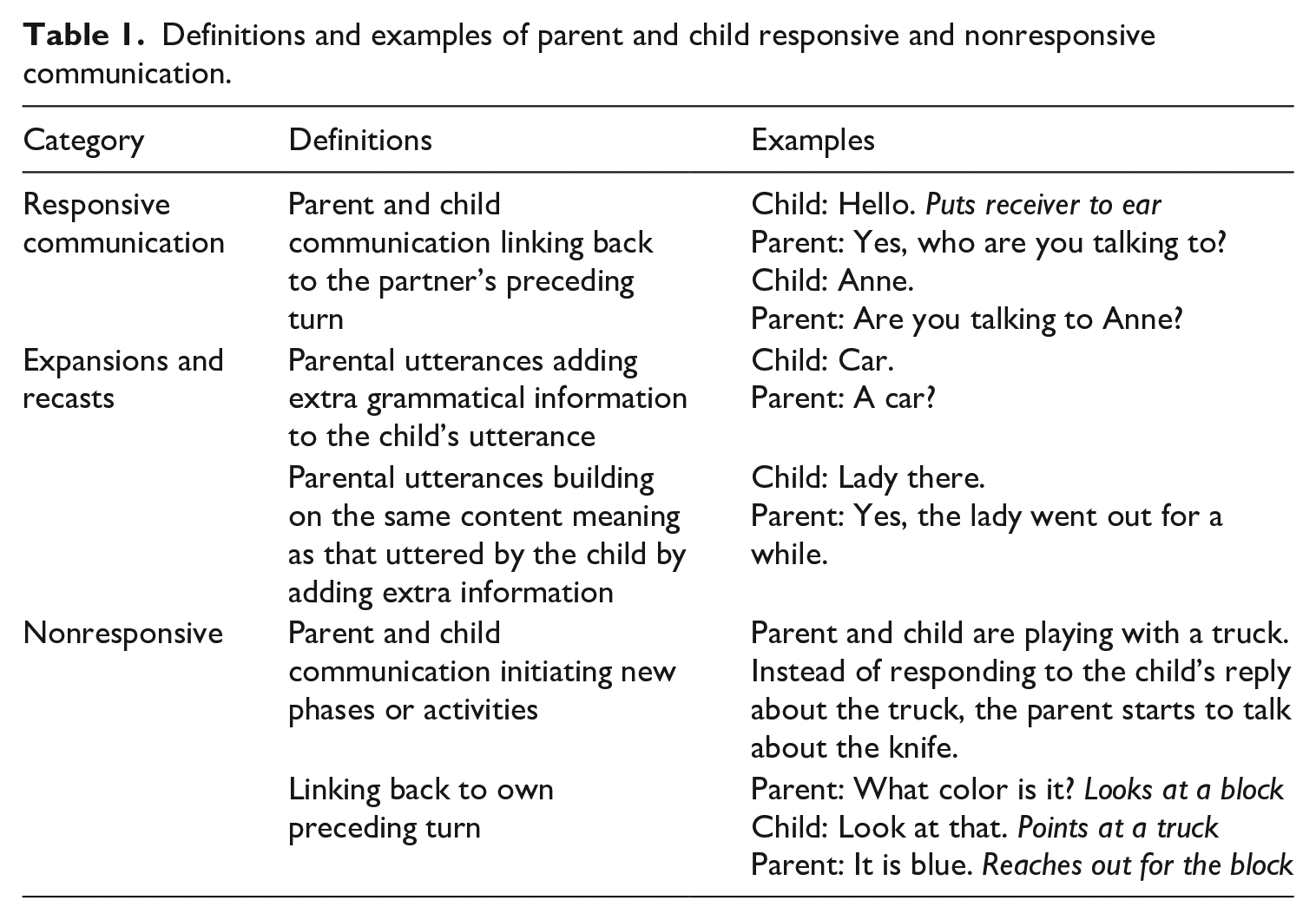
To examine parent and child responsive communication, we first assessed how they used verbal and nonverbal cues to maintain the topic of the previous turn. Their communication was considered responsive if they ‘followed’ the partner’s focus of attention; this included all communication that was connected to the activity in which the partner was already engaged. Communication that referred to something else was considered nonresponsive. Contributions that did not make sense were excluded, and we did not consider the temporal dimensions of the responses (i.e. response times). Definitions and examples of communication considered responsive and nonresponsive are presented in Table 1.
Definitions and examples of parent and child responsive and nonresponsive communication.
A trained research assistant coded 68% of the observations, and the first author coded 32%. In addition, 20% of the transcripts were independently coded by both coders to ensure inter-rater reliability. Coder agreement ranged from 79% to 97% (Cohen’s kappa = .75–.97), and all discrepancies were discussed to reach agreement.
During further coding of a parent’s verbal responses to a child’s utterance, we identified all the responsive talk to those utterances and coded the parent utterances that built upon the utterance by adding extra information as an expansion or a recast. The new information might be semantic, syntactic, and/or phonological and could include changes to the form of the child’s utterance (e.g. from a statement to a question; Girolametto et al., 2002; Levickis et al., 2014; Nelson et al., 1996; Taumoepeau, 2016; see Table 1).
A trained research assistant and the first author both independently coded 22% of the transcriptions. Coder agreement varied between 89% and 96% (Cohen’s kappa = .87–.97). The research assistant then coded the remainder of the transcripts.
Levels of abstract talk
To examine the levels of parent and child abstract talk, all utterances were coded into one of the six mutually exclusive categories developed to identify different levels of abstract language use (Table 2). The categorization of levels was inspired by previous studies focusing on different abstraction levels in child and parent language (Blank et al., 1978; Danis et al., 2000; Pellegrini, 1985; Rowe, 2012).
Definitions and examples of categories at different conceptual levels.
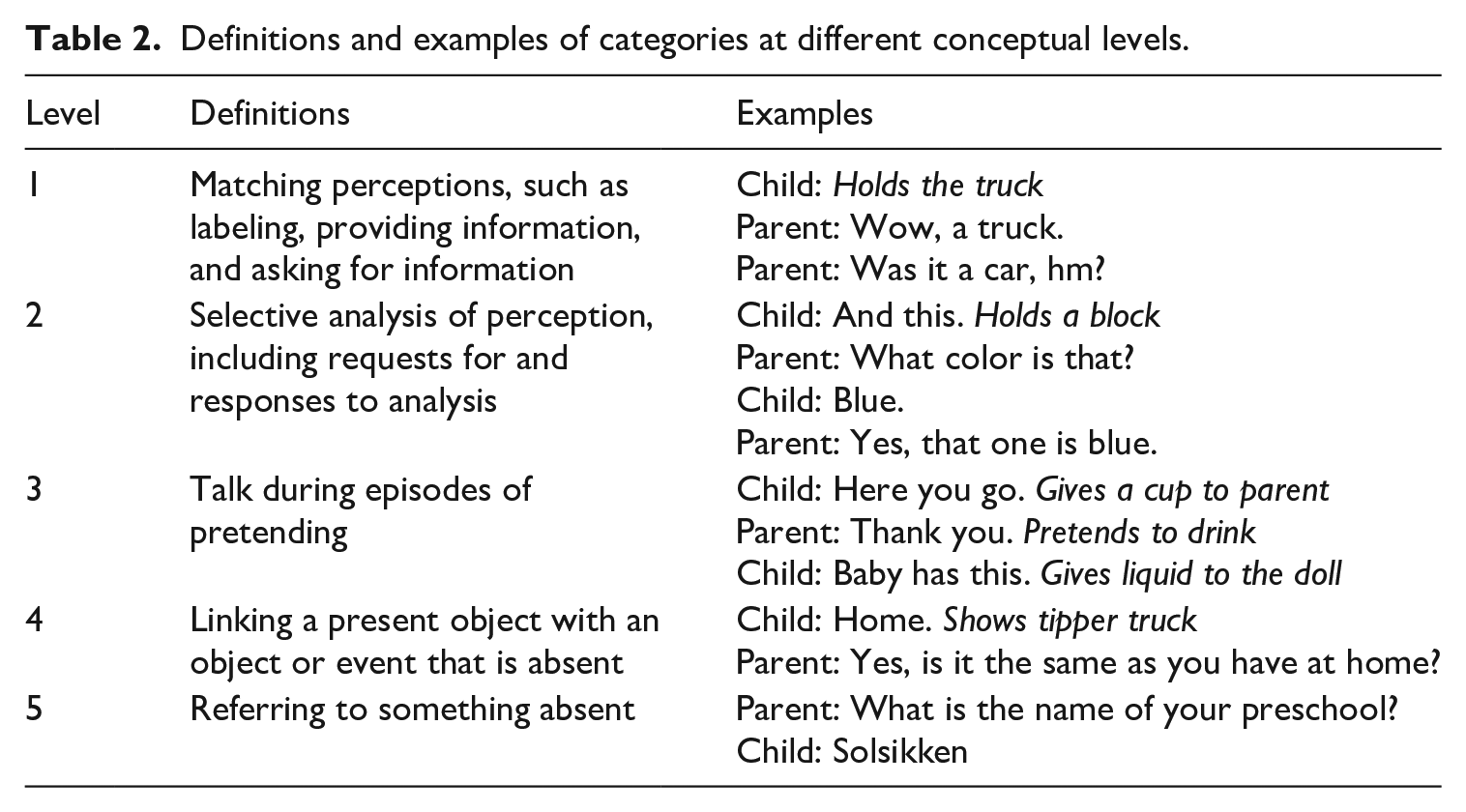
The abstraction levels were further allocated to three broader categories of abstraction: Level 1 (matching perception) and Level 2 (selective analysis of perception), which referred to contextualized talk; Level 3, which included pretend talk – that is, ‘talk during pretend episodes of interaction, including making an object represent another, attributing actions, thoughts, or feelings to inanimate objects, assuming a role or persona, enacting scripts or routines’ (Rowe, 2012, p. 1767); and Levels 4 and 5, which referred to utterances with reference to absent entities (excluding pretend talk), such as talk about nonpresent persons and past and future events. The following utterances were not included at any level: simple confirmation replies (yes, no, alright), back-channeling cues (mhm, okay), clarification requests (hm?), and unintelligible speech.
The first author coded 90% of the transcripts, and a research assistant coded the remaining 10%. In addition, 20% of the transcripts were independently coded by both coders, and the inter-rater reliability ranged between 80% and 94% (Cohen’s kappa = .78–.93).
Language diversity and complexity
To examine the diversity and complexity of parent and child communication, we used the mean length of utterances measured in words (MLU-w) and the word types (i.e. how many different word roots they produced), which we derived from an automated analysis of the transcripts using the CLAN program. Interactional fillers, such as ehm, were excluded when counting words per utterance and word types. Phrasal combinations, including lines from songs (baa_baa_black_sheep), nursery rhymes, counting, and frequently used phases, such as ha_det_bra [goodbye] and tusen_takk [thank_you_very_much], were marked with underscores between the words so that they counted as one word per utterance. All other words in an utterance were considered separate. When counting word types, we included dictionary words, proper names, and onomatopoeias. Morphological variants of a given word (e.g. kloss [block] and klosser [blocks]) were considered one type, but alternative forms of words (e.g. sykle [to cycle] and sykkel [bicycle]) were considered to be separate. Contractions and assimilations, such as hakke [haven’t], were considered as if they were their full forms (i.e. har ikke [have not]). To ensure that the numbers of word types were correct, frequency lists of words in each transcript were examined.
Results
To address our first research question concerning the features of father–child and mother–child communication at the group level, we present descriptive statistics of the parent and child communication and paired-sample t tests comparing the communication features in the father–child and mother–child dyads. To address our second and third research questions concerning features of communication within families and dyads, we present bivariate correlations. Not all variables were evenly distributed, and we therefore conducted both parametric and nonparametric analyses. However, as the results were the same for both analyses, the parametric analytical results are presented here.
Features of communication in father–child and mother–child interactions
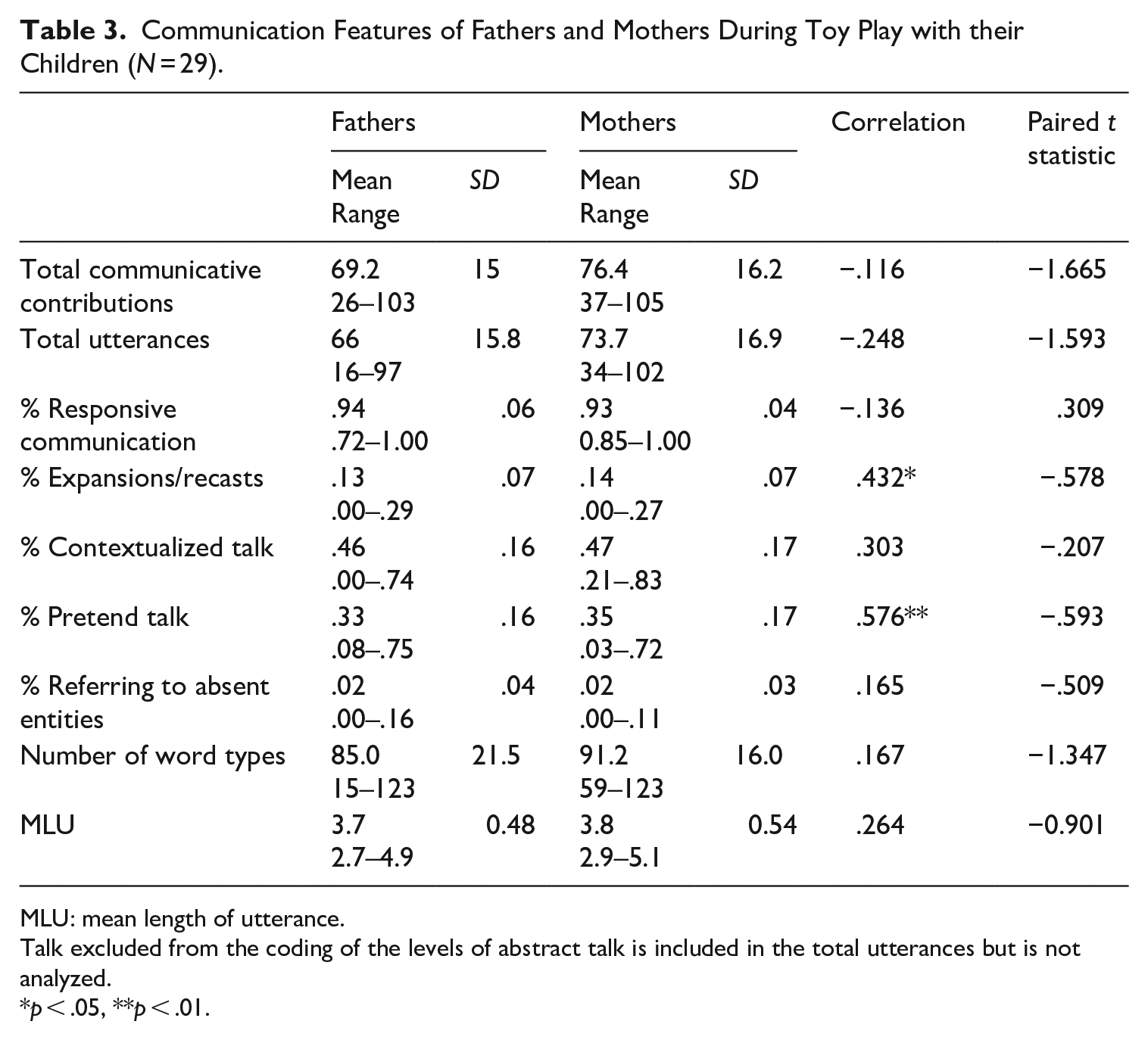
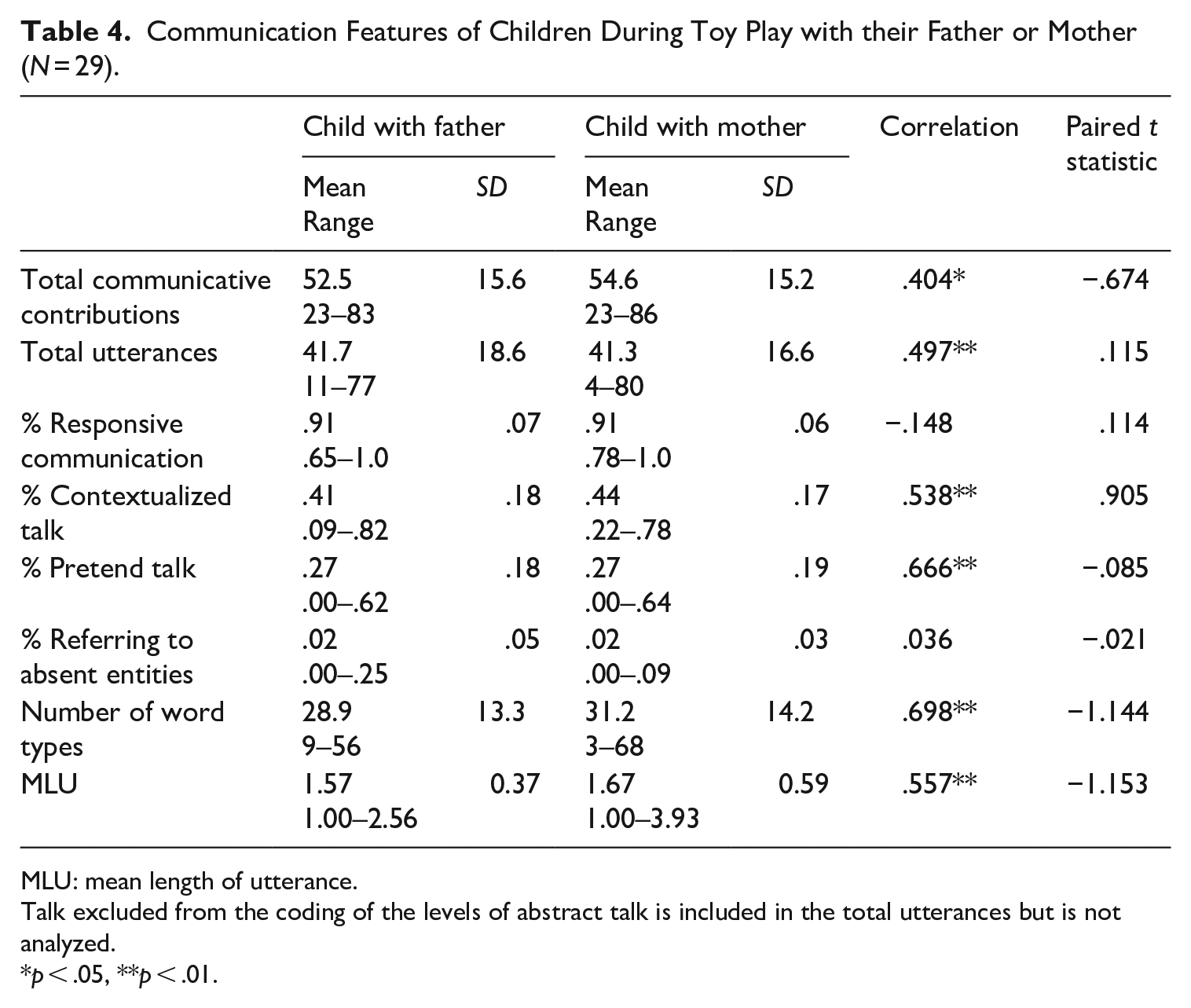
Table 3 presents the descriptive and inferential statistics for parent communication features and Table 4 presents the same for child communication features for the 29 families in which both parents participated in separate interactions with their child. As there was great variation in how much talk the participants produced during the interactions, we converted frequency scores to proportions to compare the features of communication between individuals. In converting the frequency scores of parents’ and children’s responsive communication into proportions, we used their total communicative contributions (i.e. both verbal and nonverbal) as the denominator, but in deriving the proportions of abstract talk, we used their total utterances as the denominator.
Communication Features of Fathers and Mothers During Toy Play with their Children (N = 29).
MLU: mean length of utterance.
Talk excluded from the coding of the levels of abstract talk is included in the total utterances but is not analyzed.
p < .05, **p < .01.
Communication Features of Children During Toy Play with their Father or Mother (N = 29).
MLU: mean length of utterance.
Talk excluded from the coding of the levels of abstract talk is included in the total utterances but is not analyzed.
p < .05, **p < .01.
For the interactional dimension, both father–child and mother–child interactions had high proportions of responsive contributions, indicating that the interlocutors behaved highly responsively by building on each other’s verbal and nonverbal interactional contributions. However, the children’s proportion of responsive communication was somewhat lower and more variable than that of the parents. On average, around 13% of fathers’ and mothers’ responsive communication consisted of expansions or recasts, but the variation was large; while one of the fathers and two of the mothers did not expand at all, others expanded on their child’s utterances in almost 30% of instances. This illustrates qualitative differences in parents’ response behaviors to children’s verbalizations.
For the conceptual dimension, an examination of the levels of abstract talk of the parents and children revealed that almost 50% of the parents’ utterances and around 45% of the children’s utterances were contextualized. This indicates that their talk was predominately related to the concrete ‘here-and-now’ setting, such as labeling objects and organizing toys. Nevertheless, the variance between parents was great, ranging from one father who did not produce such talk at all to one mother who produced such talk in 83% of her utterances. Moreover, pretend talk constituted more than 30% of parents’ utterances and, on average, 27% of children’s utterances. However, there were also great variations between children – two children (one communicating with their mother and one with their father) did not produce such talk at all, while for two other children, such talk accounted for 60% of their totals. In contrast, talk referring to absent entities constituted only about 2% of both children’s and parents’ utterances and was only present at all in the talk of 12 mothers, 17 fathers, 8 children with fathers, and 8 children with mothers.
In terms of the linguistic dimension, parent and child language diversity and complexity varied greatly. Most notably, the range of fathers’ word types ranged from 15 different words for one father to 123 different word types for another. Finally, results from paired t tests showed that there were no group-level differences between the communication features of mother–child interactions and those of father–child interactions, either when comparing fathers against mothers or when comparing children with fathers against children with mothers.
Relationships between father–child and mother–child communication
Next, we examined correlations between the parent and child features of communication within families. Pearson’s correlation coefficient was used to determine the relationships between matched pairs of mothers and fathers and between children with fathers and children with mothers. As Table 3 shows, there were two significant relationships between the features of communication of fathers and those of mothers within families: their proportions of expansions/recasts were moderately correlated, and their proportions of pretend talk were strongly correlated. The features of children’s communication with their fathers and with their mothers were strongly correlated for all variables except responsive communication and talk referring to absent entities (Table 4).
Relationships between parent and child features of communication
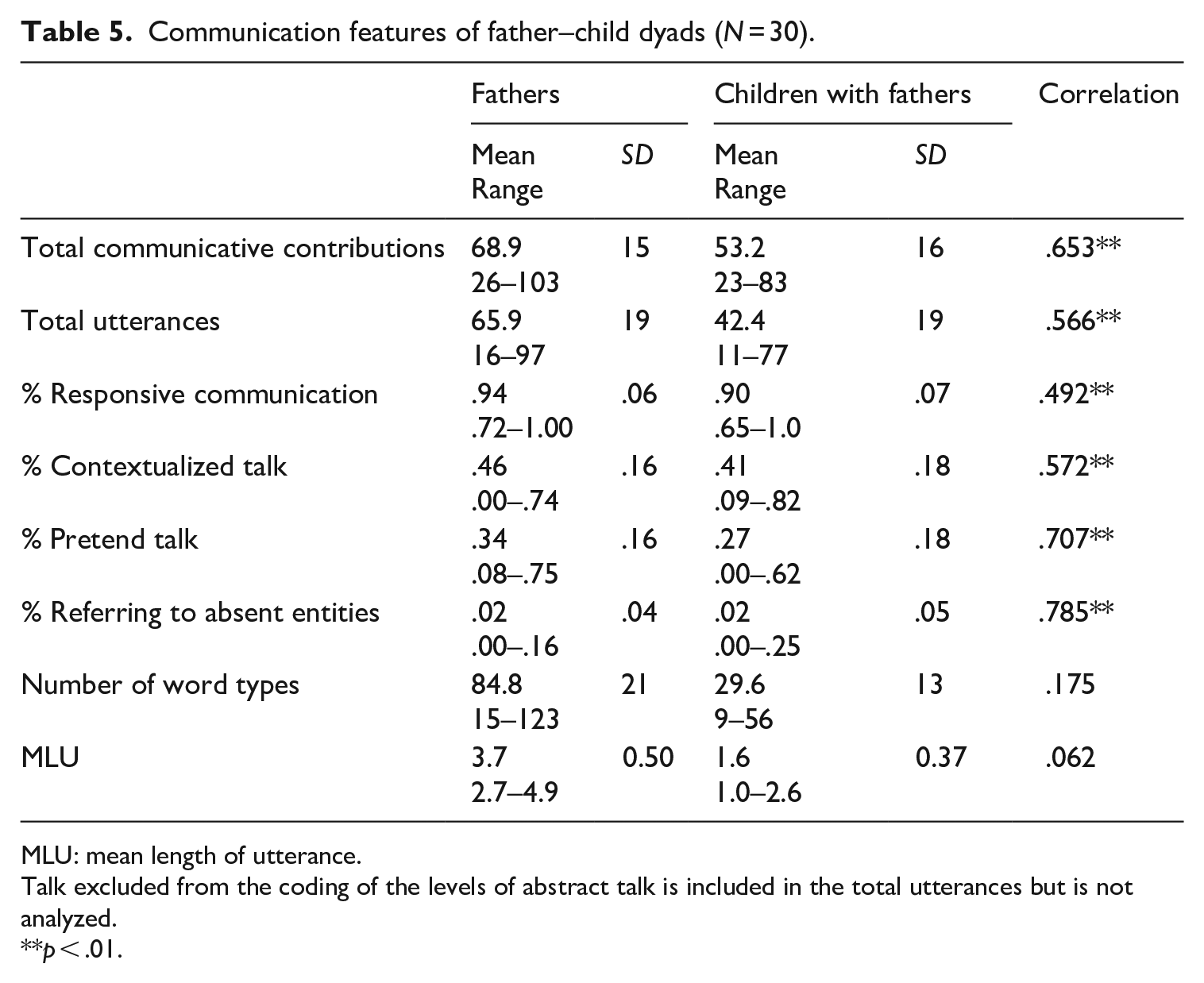
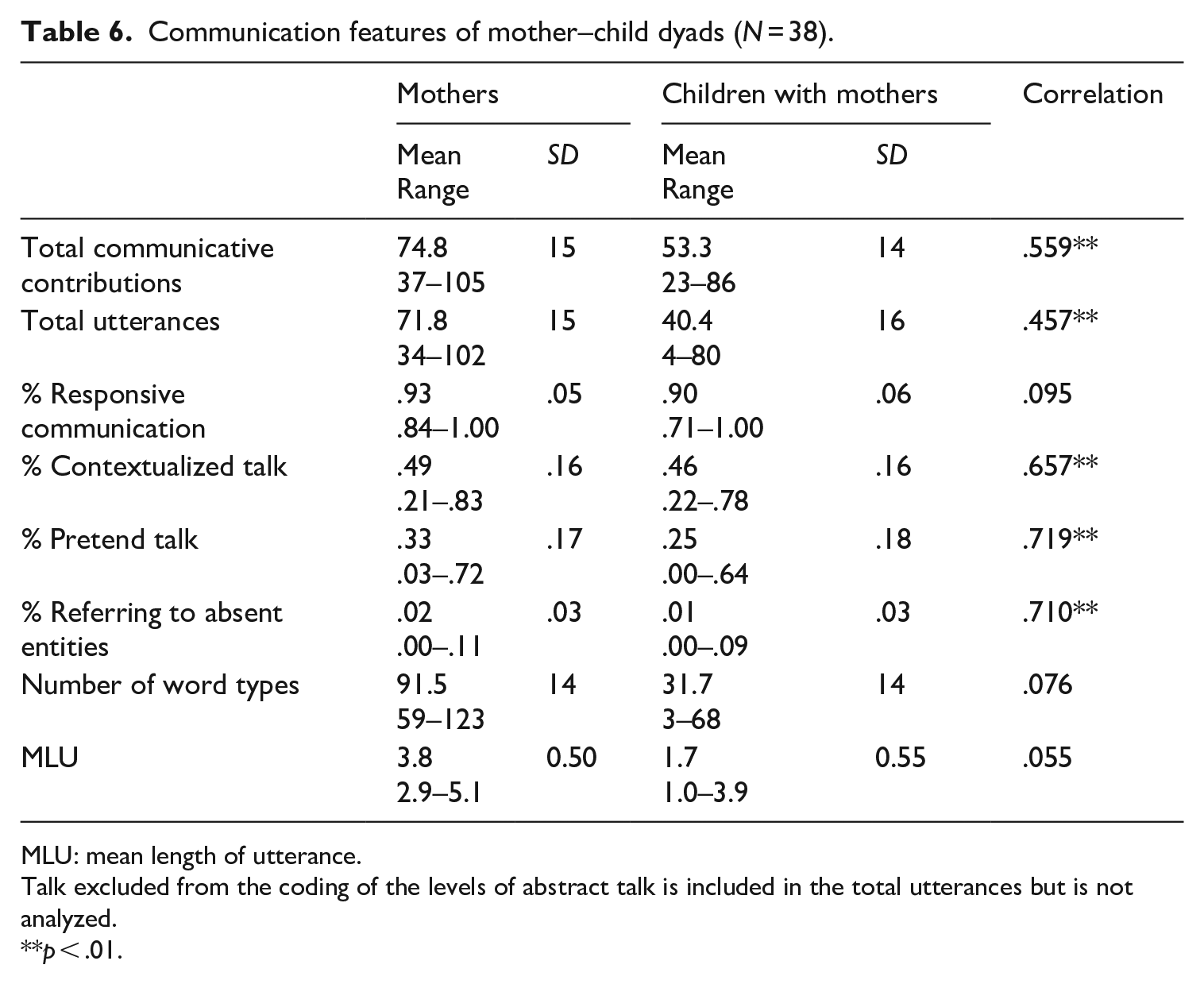
Finally, we examined the relationship between the communication features of the parents and children at the dyad level. Table 5 presents the correlations between the communication features of fathers and those of children, and Table 6 presents the same for the mothers and children. Pearson’s correlation coefficients determined that the proportion of the father’s responsive communication is correlated with the proportion of the child’s responsive communication, but no such relationship was seen between mothers and children.
Communication features of father–child dyads (N = 30).
MLU: mean length of utterance.
Talk excluded from the coding of the levels of abstract talk is included in the total utterances but is not analyzed.
p < .01.
Communication features of mother–child dyads (N = 38).
MLU: mean length of utterance.
Talk excluded from the coding of the levels of abstract talk is included in the total utterances but is not analyzed.
p < .01.
The proportion of contextualized and pretend talk by parents was correlated with the proportion of children’s talk within both mother–child and father–child dyads, and the same was found for talk related to absent entities. However, because several dyads produced no talk that referred to absent entities at all, these results must be interpreted with caution, as the number of data points for the correlational analysis was reduced. Finally, there were no associations between parental and child language at the linguistic level in either the father–child or mother–child dyads.
In summary, the examination of communication features in father–child and mother–child dyads revealed that more responsive fathers have more responsive children and that there were no significant relationships between the responsive communication of mothers and that of their children. Furthermore, greater proportions of some types of parental talk were associated with greater proportions of the same types of talk in children, but there were no associations between the linguistic features of parents and children.
Discussion
This study describes and compares features of communication in Norwegian father–child and mother–child play interactions along three dimensions (interactional, conceptual, and linguistic) that have been found to facilitate child language learning in the toddler years. We found that mother–child and father–child communication was highly similar at the group level, but there were some noteworthy relationships between the features of communication within families and dyads.
Regarding the interactional dimension, we described and compared the extent to which the interlocutors’ verbal and nonverbal contributions connected to each other’s ongoing focus and found high proportions of responsive communication in interactions between fathers and children and between mothers and children, with fathers and mothers equally expanding and reformulating their children’s utterances. Responsive communication in early interactions may impact children’s language learning because words that are introduced within the child’s attentional focus are easier to learn (Akhtar & Tomasello, 2000), and our results suggest that children experience equal proportions of responsive communication with their fathers and mothers. However, the proportions of fathers’ and mothers’ responsive communication were not related within families; thus, although there were no father–mother differences overall, our findings suggest that fathers and mothers of the same child vary in the extent to which they respond to their child’s ongoing focus.
Patterns of father–child and mother–child responsive communication also differed within dyads; more specifically, we found that the child’s responsive communication was related to that of the father, but not of the mother. The finding that responsive communication was related in father–child dyads may indicate more back-and-forth communication between fathers and children than between mothers and children, which supports the importance of ensuring that there is also a focus on fathers and children in studies of early communication. The lack of a relationship in mother–child responsive communication was somewhat surprising, given that previous work has found such relationships (Kuchirko et al., 2018). Nevertheless, we cannot conclude that the mothers and children in our sample were unresponsive to each other; indeed, this lack of a correlation between mothers and children may indicate that the mothers were responsive despite the child not being equally responsive toward her, while fathers may have been more responsive toward children who were also responsive in their communication. The results might also reflect the way in which we measured responsive communication; that is, we coded all parent and child utterances as either responsive or nonresponsive, and although not significant, the mothers tended to produce more talk than the fathers. The total utterances that children produced in communication with their fathers and mothers, however, did not differ, which may have resulted in a greater ‘distance’ between the contributions of the children and those of their mothers than between those of the children and those of their fathers and thus a ‘poorer’ match between mother and child responsive communication. Therefore, in reporting the findings of this study, it is important to consider how responsive communication was measured.
For the conceptual dimension, both parents and children, in general, produced mostly contextualized talk, followed by pretense and talk referring to absent entities. However, some dyads produced mostly pretend talk, while others produced most contextualized talk. The children’s level of abstract talk (contextualized talk and pretend talk) was associated with both fathers’ and mothers’ abstract talk, and fathers’ and mothers’ proportions of pretend talk were strongly correlated within families. These findings indicate that children are experiencing similar levels of abstract talk in communication with both their fathers and their mothers, and these results align with previous research that has found high similarities in the ways in which mothers and fathers engage with their child during play interactions (Cabrera et al., 2017; Haight et al., 1997; Tamis-LeMonda et al., 2012).
It may be that the parents’ educational levels mediated these associations; the fathers’ and mothers’ educational levels were correlated within families, and, as found in previous research, parents’ education levels correlate with the proportion of pretend utterances that they produce in communication with their children (Rowe, 2012). Relatedly, these findings may reflect different preferences in the communication styles of parents and children across dyads and families; that is, while some dyads tended to use the toys as springboards for enacting scripts and routines (e.g. talking with grandma on the phone, acting out a tea party), others tended to describe the toys and play with them in a more physical way (e.g. building with blocks, passing a car back and forth).
For the linguistic dimension, there were no differences between fathers’ and mothers’ input features at the group level, which is consistent with previous research that found fathers’ and mothers’ language complexity and diversity at the group level to be similar (Rowe et al., 2004; Tamis-LeMonda et al., 2012). Moreover, we found no differences in the children’s MLU or word types when communicating with fathers versus mothers at the group level. Some previous work has found that children use a greater variety of words (Rowe et al., 2004; Tamis-LeMonda et al., 2012) and longer utterances (Rowe et al., 2004) in communication with their fathers than their mothers, and the lack of such relationships here may indicate that fathers and mothers serve as equally challenging communication partners with their child.
In contrast to previous research that found parents’ MLU and word types to be positively associated with those of their children in parent–child talk (Tamis-LeMonda et al., 2012), we found no relationships on the linguistic dimension. The linguistic input features of fathers and mothers within families were not related either, suggesting that individual children may experience different linguistic environments depending on which parent they interact with and that the role of the father and mother may differ between families. Nevertheless, our sample size was small, and there may have been insufficient power to detect significant relationships. Contextual variations may also have played a role; for example, the toys in the study by Tamis-LeMonda et al. (2012) were different from ours in that they included a book, and because different contexts, such as reading a book versus playing with toys, may prompt different language use (e.g. Salo et al., 2016), it may be that characteristics of the situational context contributed to the different results. Indeed, the characteristics of the toy play activity should be taken into account when considering all this study’s results. For example, high proportions of responsive communication between parent and child may be particularly evident in a toy play activity; that is, toy play may require less management from an adult partner than for example book reading, which requires literacy competence, such as interpreting text. Playing with toys may thus be seen as ‘children’s territory’, which may have facilitated the children’s involvement in the interaction, which in turn may have resulted in high proportions of responsive communication between parent and child.
Moreover, the toy play activity clearly contributed to our findings at the conceptual level; that is, the toys were likely inviting the interlocutors to explore, label, and describe and thus produce contextualized talk. The same goes for the high proportions of parents’ and children’s pretend talk in that the toys invited the participants to engage in episodes of pretending. Although these controlled conditions may have contributed to equalizing the parent–child interactions, we found that some features of communication varied between families and dyads and thus between communication partners.
Finally, this study represents a sample of fathers and mothers from the socio-political system in Norway, which is characterized by egalitarian values and high-level family services that differ in many ways from other Western societies, such as the United States. Such broad societal factors embedded in Norwegian culture may have impacted our results in different ways. For example, previous research has reported that Norwegian fathers typically spend more time together with their child than in other comparable countries, which may impact communication between parent and child. At the same time, fathers from the United States have been found to spend more time engaging in interactive care, such as reading, talking, and playing, than Norwegian fathers (Hook & Wolfe, 2012). Thus, although our findings in many ways concur with those on parent–child communication in other countries – and in the United States specifically – we cannot preclude the possibility that parents’ total time together with their child or the time parents and children typically spend in toy play impacted our results in ways that differ from other countries.
Previous work has also found that families from the United States engage in more explanatory conversations during mealtimes than Norwegian families, whose conversations revolve more around familiar scripts (Grøver Aukrust & Snow, 1998). Such cross-cultural differences might also be evident during toy play, but to answer this question, cross-cultural studies of parent–child interactions during toy play are needed.
Limitations and future directions
In interpreting the results, several limitations should be noted. First, the semi-structural context of our study (i.e. laboratory setting with pre-determined toys) restricted the possible ways for parents and children to interact with each other. We might have seen other patterns of results if the participants had been observed engaging in other activities and contexts; for example, mealtime conversations may have introduced a larger spectrum of speech acts and thus a more ecologically valid picture of typical parent–child communications (Grøver Aukrust & Snow, 1998; Hook & Wolfe, 2012; Wei et al., 2020). Nevertheless, toy play is a much-studied activity in early childhood research and heavily represented by samples from English-speaking countries, and knowledge about parent–child communication in this specific activity across different cultures is theoretically important for providing information about how parent–child communication in different activities may vary between cultures. Building on the comprehensive framework offered by Rowe and Snow (2020), this study offers a possible way, in future research, to analyze parent–child communication during toy play across different communication partners in different cultures.
Second, the duration of the observations was short. Although we were able to capture a relatively large variation in features of language use across dyads, we cannot preclude the possibility that longer observations may have yielded different results. Third, this study focused on concurrent parent–child language measures. Future research should examine whether and how parents’ and children’s features of communication on the interactional, conceptual, and linguistic dimensions combine to contribute to children’s subsequent language development. Other work has found that parents use longer utterances with their children when talking about something absent than something present (Demir et al., 2015). A suggestion for future research is to investigate how parents’ input features in one dimension, such as the interactional (e.g. expansions), are associated with features in other dimensions (e.g. utterance length during talk that references absent entities). By examining different features of communication simultaneously, we may get a more comprehensive understanding of the unique and combined features of communication that contribute to children’s language development.
Conclusion
In this study, we have examined features of communication in Norwegian father–child and mother–child play interactions along the interactional, conceptual, and linguistic dimensions at the group level, within families, and within dyads. This comprehensive examination of parent–child play interactions suggests that Norwegian children experience somewhat different communication features when interacting with their fathers and mothers during toy play but that this varies between individuals and within families, rather than between fathers and mothers per se.
Footnotes
Acknowledgements
We are grateful to the Behavior Outlook Norwegian Developmental Study and its participants for the data. Thanks also to Kristin Berg Nordahl at The Norwegian Center for Child Behavioral Development for valuable insight into the data, to Sarah Sandvær Eva and Pia Sundnes for assisting in transcribing and coding the data, and to Vibeke Grøver for comments on earlier versions of the article.
Funding
The author(s) disclosed receipt of the following financial support for the research, authorship, and/or publication of this article: This study is affiliated with the ChInfoSeek study, which is funded by the Norwegian Research Council (project no 254974). The Behavior Outlook Norwegian Developmental Study is situated at the Norwegian Center for Child Behavioral Development, which is supported by the Norwegian Ministry of Children and Families. We are indebted to the families participating in this ongoing study who contributed their time and effort to make this research possible.
