




Abstract
Mind-mindedness (MM), the parent’s propensity to treat their young child as an individual with a mind of their own, has repeatedly been found to be positively associated with subsequent child development outcomes. In the current Swedish study, the first aim was to investigate the main features of MM in this cultural context and the second aim was to investigate its association with early child language development. Sixty-three parent-child dyads participated. MM was assessed by videotaped laboratory-based parent-child dyad free-play sessions. Language development was assessed using the parent questionnaire Swedish Early Communicative Development Inventory (SECDI), a Swedish adaptation of the internationally used MacArthur-Bates Communicative Development Inventories (MB-CDI). The ratio between Appropriate MM and Non-attuned MM was 4:1 and there was no statistically significant correlation between these two variables. There were no statistically significant correlations between Total MM or Appropriate MM and language ability ratings at either 9 or 25 months. This may be due to methodological issues concerning elicitation of MM in a Swedish context. We emphasize the importance of further theoretical and empirical studies of cross-cultural validation of MM.
Keywords
Introduction
A child’s language environment is a crucial contributor to their subsequent communicative and language development (e.g. Hoff, 2014). One aspect of child language environment is parental mind-mindedness (MM), referring to the caregiver’s propensity to treat their child as an individual in their own right with their own mind. MM has been a subject of research for over 20 years (Meins, 1997) and has previously been found to positively predict child outcomes, especially mentalizing abilities (McMahon & Bernier, 2017). MM as a predictor for subsequent language development has, however, been the focus of limited investigations to date and the findings are inconsistent (McMahon & Bernier, 2017). The aim of the current longitudinal study conducted in Sweden was therefore to investigate parental MM at 9 months and its association with parental reports of child language development at 9 and 25 months.
Language development in 0–25 months old children
Nine-month-old infants are ordinarily preverbal and communicate by babbling and using gestures instead of talking (Bishop, 1997; Gross, 2018). Around this age and onwards, the gestural communication becomes more intentional and infants also start to point at unreachable objects and raise arms to express a desire to be picked up (Goldin-Meadow & Alibali, 2013; Gross, 2018). Use of gestures enables the young child to express early communicative and representational skills that are not dependent on production of verbal language (Fenson et al., 2007) and early use of gestures predicts subsequent language skills (Bates et al., 1979; Brooks & Meltzoff, 2008). Furthermore, parents often respond verbally to the child’s gestures, and a substantial proportion of these responses include internal-state labels referring to the child’s mind (Olson & Masur, 2011). Typically, 9-month-old Swedish infants comprehend several words, with a vocabulary comprehension between 2 and 45 words for the 10th and 90th percentiles (Eriksson & Berglund, 2002). Infants produce their first spoken word around their first birthday (Saxton, 2017). Children take many steps in their language development from 9 months to 25 months and at the latter age, Swedish toddlers’ vocabulary production has been shown to vary between 58 and 568 words for the 10th and 90th percentiles (Berglund & Eriksson, 2000a). Twenty-five-month-olds can usually put together words and create simple sentences (Gross, 2018). During the second year of life, some toddlers show a developmental pattern that can be described as a vocabulary spurt but even more show a more steady and gradual vocabulary development (Ganger & Brent, 2004). The interindividual variations in communicative and language development are huge and therefore it is important to bear in mind that a wide range is considered as ‘typical’ at both 9- and 25-months.
Language environment
The language surrounding children differs both quantitatively and qualitatively and the value of language environment in early language development has been demonstrated in several decades of research (e.g. Nelson et al., 2001; Hart & Risley, 1995). On one hand, researchers have highlighted the importance of quantity, such that children exposed to more words from adults have a faster language development (e.g. Hart & Risley, 1995; Hurtado et al., 2008). On the other hand, researchers have emphasized quality rather than quantity for subsequent child language development, for example, contextual appropriateness of parental comments during parent-child interaction (Bernier et al., 2017), diversity of parental lexical input (Pan et al., 2005) and ‘parentese’ parental speech (Ramírez-Esparza et al., 2014).
Parental mind-mindedness
Over 20 years ago, Meins (1997) created the concept mind-mindedness (MM). MM refers to the caregiver’s propensity to treat their young child as an individual with a mind of their own and the related tendency to orally attribute mental states to the child (Meins, 1997). MM can be divided into Appropriate MM and Non-attuned MM, depending on the interactional context in which the MM-related statement is uttered (Meins & Fernyhough, 2015). Specifically, Appropriate MM is when the parent interprets the infant’s internal states correctly and Non-attuned MM when the parent misinterprets the infant’s responses. The ratio between Appropriate MM and Non-attuned MM has been shown to be about 5:1 (Meins et al., 2003). Maternal Appropriate MM and Non-attuned MM have been found to be unrelated (Meins et al., 2002), which indicates that these two types of MM are determined by different factors (Meins et al., 2011). One potential factor that has been investigated is obstetric history. Meins et al. (2011) found that planned conception was positively associated with Appropriate MM for mothers who, in retrospect, perceived the pregnancy as straight-forward, while more non-attuned MM was associated with mothers who reported mixed, negative, or neutral feelings about the birth.
The theoretical basis for MM is rooted in both Ainsworth’s and Vygotsky’s work, which argues that development takes place within social interaction (McMahon & Bernier, 2017; Meins & Fernyhough, 2015). More specifically, Ainsworth’s work about maternal sensitivity (i.e. the parent’s capacity to take the child’s perspective and accurately perceive and interpret the child’s signals) laid the groundwork for MM. Inspired by Vygotsky’s writings, Meins (1997) theorized that parents who focus on the child’s mental states have a capacity to identify the child’s cognitive ability and scaffold for maximizing learning opportunities.
In their detailed coding manual, Meins and Fernyhough (2015) described two approaches for measuring parental MM. The first approach is observational, where the researcher videotapes and codes the caregiver’s utterances during infant-caregiver free-play. The second approach is representational, where the caregiver is asked to describe their child and the researcher codes this description. Usually, the observational approach is carried out during the first year of life and thereafter the representational approach, although it is not necessary to follow these guidelines if the researcher wishes otherwise (Meins & Fernyhough, 2015). In a recent review, McMahon and Bernier (2017) summarized 20 years of MM research and found approximately equal numbers of studies that used the two measurement approaches (38 observational, 33 representational, and five studies using both approaches). The observational approach ranged from 5 to 20 minutes of infant-caregiver free-play and was either conducted in a laboratory setting or at home. The representational approach was most often conducted orally face-to-face, but in one study, the caregiver was interviewed through telephone and in three studies, the caregiver answered in written form as part of an online survey. The observational approach is used in this study based on the fact that the participating infants were 9 months old.
Most research about MM has been conducted with participants with middle-to-high socioeconomic status (SES) and most studies have solely focused on maternal MM (McMahon & Bernier, 2017). There is no evidence to date, however, that the tendency to utter Appropriate MM is associated with SES (Meins et al., 1998), the parents’ educational level (Meins et al., 2002), or the number of children (Meins et al., 2011). A few studies have compared maternal MM and paternal MM but have not found gender differences (e.g. Lundy & Fyfe, 2015; Wang et al., 2017). Furthermore, there is no evidence that Appropriate or Non-attuned MM is related to the child’s sex (e.g. McMahon & Meins, 2012; Meins, Centifanti, et al., 2013; Meins et al., 2011). Instead, the mother’s use of MM can be understood as a relational construct and might possibly come from her own experiences of her relationship with her child (Meins et al., 2011).
To date, most research on MM during the child’s first 2 years has been carried out in the Western world, and especially in English-speaking contexts and in French-speaking Canada (Dai et al., 2019; McMahon & Bernier, 2017). A small-scale study investigated paternal MM in the United Kingdom and in Denmark and found no differences in MM between countries (Tharner et al., 2016). Little is known about the cross-cultural validity of MM as a construct. To our knowledge, only three studies have been conducted to date in non-Western countries (Dai et al., 2019; Hughes et al., 2017; Wang et al., 2017), and only Dai et al. (2019) have investigated MM below 2 years of age. Dai et al. (2019) investigated MM among Chinese and Australian mothers of 18-month-olds during free-play. After controlling for maternal verbosity and educational level, the researchers found that Chinese mothers uttered more Non-attuned MM than Australian mothers and that Australian mothers uttered both more Total MM comments (i.e. Appropriate and Non-attuned summed) and more Appropriate MM than Chinese mothers. The Australian mothers also uttered more MM referring to the toddler’s desires and preferences than the Chinese mothers. These findings were interpreted in terms of differences between individualistic and collectivistic cultures, where self-expression and autonomy are more emphasized in individualistic cultures and harmony, group identity, and suppression of self are more important in collectivistic cultures. What parents talk about with their child is likely a mirroring of valued developmental outcomes and childrearing goals (Dai et al., 2019).
Parental mind-mindedness and child outcomes
Parental MM (i.e. mostly maternal MM) has repeatedly been linked to child outcomes both concurrently and predictively. In particular, a higher prevalence of Appropriate MM during the child’s first years of life has been associated with a more advanced Theory of Mind in children (Lundy, 2013; McMahon & Bernier, 2017) and secure infant-mother attachment (Meins et al., 2001; Miller et al., 2019). Furthermore, infrequent use of Appropriate MM has been associated with subsequent child externalizing behavior problems and frequent use of Non-attuned MM has been associated with lower subsequent social competence (Colonnesi et al., 2019).
Parental mind-mindedness and child language development
The connection between MM and language development is not yet clearly understood. In their recent review, McMahon and Bernier (2017) stressed that there is limited evidence of a link between parental MM and child language development and that the little evidence that exists needs to be replicated. They also suggest that more studies are needed that examine self-regulation and language development as recent findings have linked MM to child cognitive school readiness through child language and executive functioning as complete mediators (Bernier et al., 2017).
McMahon and Bernier (2017) found only four studies in which the researcher had examined child language development, and in two of these (Lundy & Fyfe, 2015; Meins, Fernyhough, et al., 2013), this variable was analyzed as a possible mediator instead of as a developmental outcome. In the first of these four works, the authors found that overall Appropriate MM at 12 months (N = 84, observational measures in a home environment) predicted more advanced expressive language according to parental reports at 2 years (Laranjo & Bernier, 2013). This correlation between overall Appropriate MM and expressive language was driven by the MM subcategory ‘Cognition’, whereas the two MM subcategories ‘Desires’ and ‘Emotions’ did not independently correlate with language abilities. In the second study, the researchers found a concurrent and positive association between maternal MM (N = 36, both representational and observational in the lab) and 4-year-olds’ use of mental state language during a problem-solving task (Lundy & Fyfe, 2015). In the third study, the authors found no statistically significant associations between maternal MM at 8 months (N = 206, observational in the lab) and parental report child internal-state language at 2 years, but they found that Appropriate MM was positively associated with lab-assessed child receptive language at 4 years (Meins, Fernyhough, et al., 2013). In the fourth study, the researchers found large concurrent correlations (rs > .63) between MM (N = 34, representational) and parental reported communicative abilities in 2-year-old children (Zammit & Atkinson, 2017). However, these large correlations were not statistically significant, possibly due to the low statistical power of the relatively small sample size. The researchers investigated mothers attending babysign classes (n = 15) and mothers attending classes without babysign (n = 19) and they found that the former generated more MM than the latter but that child language abilities did not differ significantly between the groups of mothers. A more recent study that was not included in the review was conducted in Italy by Longobardi et al. (2018). At 16 months, they investigated both maternal MM (N = 25, observational at home) and five communicative functions (tutorial, didactic, conversational, control, and asynchronous) and their relation to expressive language both concurrently at 16 months and longitudinally at 20 months. They found that Appropriate MM predicted internal-state language at 20 months and that the effects of MM seem to be more robust than communicative functions, but they did not find a concurrent correlation between Appropriate MM and expressive language at 16 months.
Theoretically, Appropriate MM (but not Non-attuned MM) should be a significant factor for subsequent child language development because the parent focuses on the child’s mental state and accurately verbalizes it. Laranjo and Bernier (2013) suggested that the importance of Appropriate MM goes beyond children’s own mental state talk and extended it to overall expressive language abilities. They argue that exposure to MM occurs within a broader context and therefore a mind-minded parent is more likely, in general, to verbalize the words that their child is attempting to pronounce or communicate. Thus, a mind-minded parent might verbalize a lot of words relating to the object that the child is focused on at the time (e.g. ‘you like cars, this is a cement truck’; Laranjo and Bernier, 2013). Previous research has demonstrated that when parents label objects their child is focused on (i.e. joint attention), the child learns the words better (Yu & Smith, 2012; Yurovsky et al., 2013). Parents also modify their speech according to current child language level (Leung et al., 2019), but by focusing on MM we might add information about parents’ psychological orientations toward their child (Meins et al., 2011). Thus, it might be that Appropriate MM influences the child’s language development since a mind-minded parent, by being sensitive to their child’s linguistic and cognitive ability, supports both expressive and pragmatic abilities.
Studies investigating the relationship between MM and child language development are therefore needed since to date only a few studies with inconsistent findings have been conducted (McMahon & Bernier, 2017). In this study, we investigate parental MM and its association to child language development in Swedish families both concurrently at 9 months and longitudinally at 25 months. These two ages signify two different but important phases in early language development. At 9 months, the child is still preverbal but is on the verge of using important non-verbal communicative abilities (e.g. pointing and joint attention), while at 25 months, the child is on his or her way to become a verbal toddler. To our best knowledge, there are no previous published studies on MM conducted in a Swedish context and, therefore, this study further increases the understanding of parental MM and its coding procedure in different cultural contexts.
Aims 1
The first aim in this study was to investigate the main features of parental MM in a sample of 9-month-old infants, situated in a Swedish cultural context. Based on previous research we made two hypotheses relating to the first aim. First, we hypothesized a ratio between Appropriate MM and Non-attuned MM of 5:1 (e.g. Meins et al., 2003). Second, we hypothesized that these two measures would be unrelated (e.g. Meins et al., 2002). The second aim was to investigate the concurrent and longitudinal associations between MM and child language development. We hypothesized that proportionally higher use of Appropriate MM at 9 months would predict more advanced language abilities at 25 months old (namely the four subscales in SECDI-w&s, Vocabulary Checklist, Pragmatic Scale, Grammar Scale, MaxLu), but that this pattern would not be present concurrently at 9 months (namely the three subscales in SECDI-w&g, Word Comprehension, Word Production, and Use of Gestures; e.g. Laranjo & Bernier, 2013; Zammit & Atkinson, 2017).
Method
Procedure
All participants were part of a larger longitudinal study and the initial recruitment was through the Swedish Population Register (SPAR). During the data collection period in 2017, all families in a selected region of Sweden with an infant aged 9 months received an invitation through letter to participate in the study. The first testing session (T1) took place when the infant was 9 months old and the second testing session (T2) took place at 25 months of age.
Written informed consent was obtained from the parents at T1. A small reward (a bookstore gift card and a toy) was given to each participant. The Regional Ethical Board (2016/490-31) approved the research protocol.
Participants
The final sample in this study consisted of 63 parent-infant dyads assessed at T1. In addition to these, seven dyads were excluded because the parent did not speak Swedish with their infant during the dyadic free-play situation (n = 5), the camera angle did not allow data analysis (n = 1) or the parent declined to participate in the free-play situation (n = 1).
T1
Infant mean age on the day for the T1 free-play session was 9.59 months (SD = 0.25, Min = 9.14, Max = 10.16, >10 months = 3) and there was an even distribution between the sexes (31 girls and 32 boys). All except one infant were full-term (M = 40.49 weeks, SD = 1.29) and all parents reported normal Apgar scores at 5 minutes after birth. Mean birth length was 50.79 cm (SD = 2.13) and mean birth weight was 3526.78 g (SD = 470.41). All parents reported that their infant was developing typically and had no known medical issues. None of the infants had begun daycare and at the time of testing, statutory parental leave was being taken by the mother in 50 families, by the father in 10 families and shared fifty-fifty by mother and father in three families. Forty infants had no sibling, 17 had one older sibling, and six infants had two or three older siblings. All families reported Swedish as their main language at home. Of the 63 parents taking part in parent-infant dyads included in the final sample, 48 were mothers and 15 were fathers. Of these, 49 parents (41 mothers) had a university degree. Furthermore, 53 infants had at least one parent who had a university degree, in total, 51 mothers and 41 fathers. Thus, the infants typically lived in highly educated families. SECDI data were collected within 2 weeks of the free-play session and 54 families completed the questionnaire.
T2
Of the 63 parent-infant dyads that took part at T1, 51 also completed an online survey including SECDI at T2, which occurred when the infants were 25 months, that is, 15 months (Min = 15, Max = 16) later. There was an even distribution between the sexes (26 girls and 25 boys). 42 infants had at least one parent who had a university degree; in total, 41 mothers and 33 fathers had a university degree. 44 families completed SECDI at both T1 and T2.
Measures
Parental mind-mindedness at T1
MM was calculated from a videotaped free-play session with the parent and infant that took place on a floor mat in a child-adapted lab. The parent was instructed to play with their child as usual, just as they would have done at home. A transparent box filled with age-appropriate toys was left with the parent-infant dyad. The experimenter made sure that the camera angle captured the dyad and then waited outside the lab with a timer during the play session, closing the door behind them. The play session ended when the experimenter reopened the door after 7 minutes (M = 7.40 minutes, SD = 0.64, range = 6.47–9.98). The free-play session took place on the second day of lab visit and was the third task for the day.
The videotaped free-play sessions were transcribed using the MM manual adapted to a Swedish-speaking context by Holmer (2010), which is in line with the original MM manual by Meins and Fernyhough (2015). Holmer (2010) translated the original MM manual and made a few minor linguistic adaptations and clarifications. Following Meins and Fernyhough (2015), an utterance was defined as a word or a sentence. A new utterance started when the parent either initiated a new sentence, changed subject, had a verbal pause for at least 1 second, or initiated a new line in a song. According to the manual, a mind-related comment was either (a) an explicit comment about what the infant may be thinking, experiencing, or feeling or (b) the parent was talking on behalf of the infant. The first type (i.e. the a-part) of mind-related commentary was further divided into subcategories; desires/preferences, cognitions, emotions, epistemic states, physical states, funny/amusing, clever, cheeky, and intentions. Furthermore, the mind-related comments were categorized as either Appropriate or Non-attuned. Appropriate MM was coded (1) when the coder agreed with the parent’s description of the infant’s mind, (2) the parent linked the current activity with similar past or future events, or (3) the parent produced utterances to proceed after a lull in the mind-related interaction. Non-attuned MM was coded (1) when the coder disagreed with the parent’s description of the infant’s mind, (2) the linked activity was unrelated to the infant’s current activity, (3) suggested a new activity to the infant when the infant already was actively engaged in another activity, (4) the parent seemed to impose their own internal states on the infant, or (5) the parent did not make it clear whose mind was the referent of the comment. In line with the manual, this dichotomization was applied to all MM except for physical states, funny/amusing, and clever. Physical states were only considered mind-related if the utterance was non-attuned. Funny/amusing and clever were only considered mind-related if the utterance was appropriate. For details about the coding of MM, see Meins and Fernyhough (2015).
Two trained coders (SN and PM) independently transcribed and coded the videotaped free-play sessions. A random selection of the transcripts (n = 10, 15.9%) were independently coded by both coders and overall inter-rater reliability of the identification of all mind-related utterances (regardless of whether they were appropriate or non-attuned) was κ = .78. However, when we excluded the b-part, ‘the parent is talking on behalf of the infant’, the overall inter-rater reliability was κ = .89. The inter-rater reliability for the b-part alone was κ = .012. That is, one of the two parts that are considered as mind-related substantially reduced the overall reliability. Therefore, we decided to exclude the b-part from all further statistical analyzes in this study. Control analyses including the b-part did not change the pattern of results. Any disagreements noted in the a-part of the mind-related comments after inter-coding were resolved by discussion.
In this study, each participant’s data were aggregated to give an Appropriate MM, a Non-attuned MM, and a total MM (i.e. Appropriate MM and Non-attuned summed). In line with the MM manual (Meins & Fernyhough, 2015), to control for parental verbosity, we calculated proportional scores. Thus, each of the three MM measures was divided by the parental overall utterances and reported as a percentage. These proportional scores were used as measures of parental propensity for MM and henceforth it is this proportional MM we are referring to.
Among the 63 parent-infant dyads, 49 parents reported that the play situation felt like usual, six reported that it did not feel as usual and data from eight parents were lost due to technical error. The correlation analyses yielded the same conclusions when we only included the dyads where the parent reported that the free-play situation felt like usual.
Language development at T1 and T2
Early language development was assessed by The Swedish Early Communicative Development Inventories (SECDI), which is a Swedish adaptation of the internationally used instrument MacArthur-Bates Communicative Development Inventories (MB-CDI; Eriksson & Berglund, 1999; Fenson et al., 1994). SECDI is a reliable instrument based on parental reports (Berglund & Eriksson, 2000b). In this study, the parents filled in the SECDI online as part of a larger online questionnaire. The Swedish norms were used for T1 (Eriksson & Berglund, 1999) and T2 (Berglund & Eriksson, 2000a).
Version at T1. At T1, the SECDI-words and gestures (SECDI-w&g) was used. SECDI-w&g is designed primarily to describe communicative skills in infants aged 9–16 months. In this study, the three main sections were used: Word Comprehension, Word Production, and Use of Gestures. The maximum scores for both Word Comprehension and Word Production were 382 and were calculated by adding up the number of items that the parent had marked from a checklist that consisted of 382 items. The maximum score for Use of Gestures was 73 and was calculated by adding the 51 items that had a binary response (yes–no, scored as 1–0) and the 11 items that had a three-point rating scale (not yet–sometimes–often, scored as 0–1–2). Word Comprehension and Word Production were scored in line with the Swedish scoring manual (Eriksson & Berglund, 2002) and the section Use of Gestures was scored in line with previous work (see Nyberg et al., 2020). SECDI T1 descriptive statistics and correlations with SECDI scores based on a largely overlapping sample are reported in Nyberg et al. (2020).
Version at T2. At T2, the SECDI-words and sentences (SECDI-w&s) was used. SECDI-w&s is designed primarily to describe communicative skills in toddlers aged 16–28 months. In this study, the four subscales with Swedish norms were used: Vocabulary Checklist, the Pragmatic Scale, the Grammar Scale, and the Maximum Length of Utterances (MaxLu). The scoring was performed according to the Swedish scoring manual (Eriksson & Berglund, 2002). The maximum score for the subscale Vocabulary Checklist was 711 and was computed by adding up the number of items marked as ‘says’ by parent from a checklist consisted of 711 items. The maximum score for the Pragmatic Scale was 10 and was computed by adding up the three-point rating of five items (not yet–sometimes–often, scored as 0–1–2). The maximum score for the Grammar Scale was 12 and was computed by adding up the three-point rating of six items (not yet–sometimes–often, scored as 0–1–2). In the subscale MaxLu, the parent was asked to list the three longest sentences they have heard the toddler say recently and this results in a mean number of morphemes per utterance used by the toddler.
Data analysis
All analyses were run in the Statistical Package for Social Sciences 26.0 (SPSS). First, we generated descriptive statistics for MM and SECDI, the latter at 9 and 25 months. For each variable, we included all participants with complete data and participants with incomplete data were excluded. We computed t-test (Welch’s and Student’s) for gender group differences. Then, parametric correlations were computed. Due to skewness, we also ran non-parametric correlations, which yielded similar patterns and interpretations as parametric correlations. Therefore, parametric correlations are reported. One-tailed analyses were run for correlations where we had a priori hypotheses either that there would be a statistically significant association (MM at 9 months and SECDI at 25 months) or that there would not be (MM at 9 months and SECDI at 9 months) and two-tailed analyses in other cases. We controlled for potential confounders that may be of relevance when investigating MM and language development (e.g. Eriksson & Berglund, 1999; Hoff, 2014; McMahon & Bernier, 2017). Alpha level was .05 and we did not adjust for multiple comparisons.
Results
Descriptive data
Parental mind-mindedness
The average proportion of Total MM was 5.48% (SD = 3.74, Min = 0.00, Max = 13.66), meaning that on average just over 5% of parental utterances were classified as MM per play situation. In the dichotomization of Total MM, the average proportion of Appropriate MM was 4.39% (SD = 3.29, Min = 0.00, Max = 12.42). This means a proportional ratio of Appropriate MM to Non-attuned MM of 4:1. There were no statistically significant differences between maternal MM and paternal MM using Welch’s t-test regarding either Total MM, t(18.46) = .034, p = .973, or Appropriate MM, t(20.48) = .299, p = .768. Furthermore, MM generated was not statistically significantly different using Student’s t-test depending on the sex of the infant; Total MM, t(61) = 1.259, p = .213, and Appropriate MM, t(61) = .137, p = .891.
Language development
According to SECDI-w&g at T1 (n = 54), the average Word Comprehension was 20.98 (SD = 21.45, Min = 0, Max = 119), the average Word Production was 0.69 (SD = 1.16, Min = 0, Max = 5), and the average Use of Gestures was 10.85 (SD = 5.75, Min = 1, Max = 26).
According to SECDI-w&s at T2, the average for Vocabulary Checklist was 326.43 (SD = 153.07, Min = 51, Max = 586, n = 51), the average for the Pragmatic Scale was 7.98 (SD = 1.95, Min = 2, Max = 10, n = 50), the average for the Grammar Scale was 5.72 (SD = 3.26, Min = 0, Max = 12, n = 50), and the average for the MaxLu was 4.04 (SD = 1.49, Min = 1.33, Max = 8.67, n = 49). The results of the language abilities at T1 and T2 were within the expected norms of Swedish children (Berglund & Eriksson, 2000a; Eriksson & Berglund, 1999).
Correlational data
Parental mind-mindedness and language development at T1
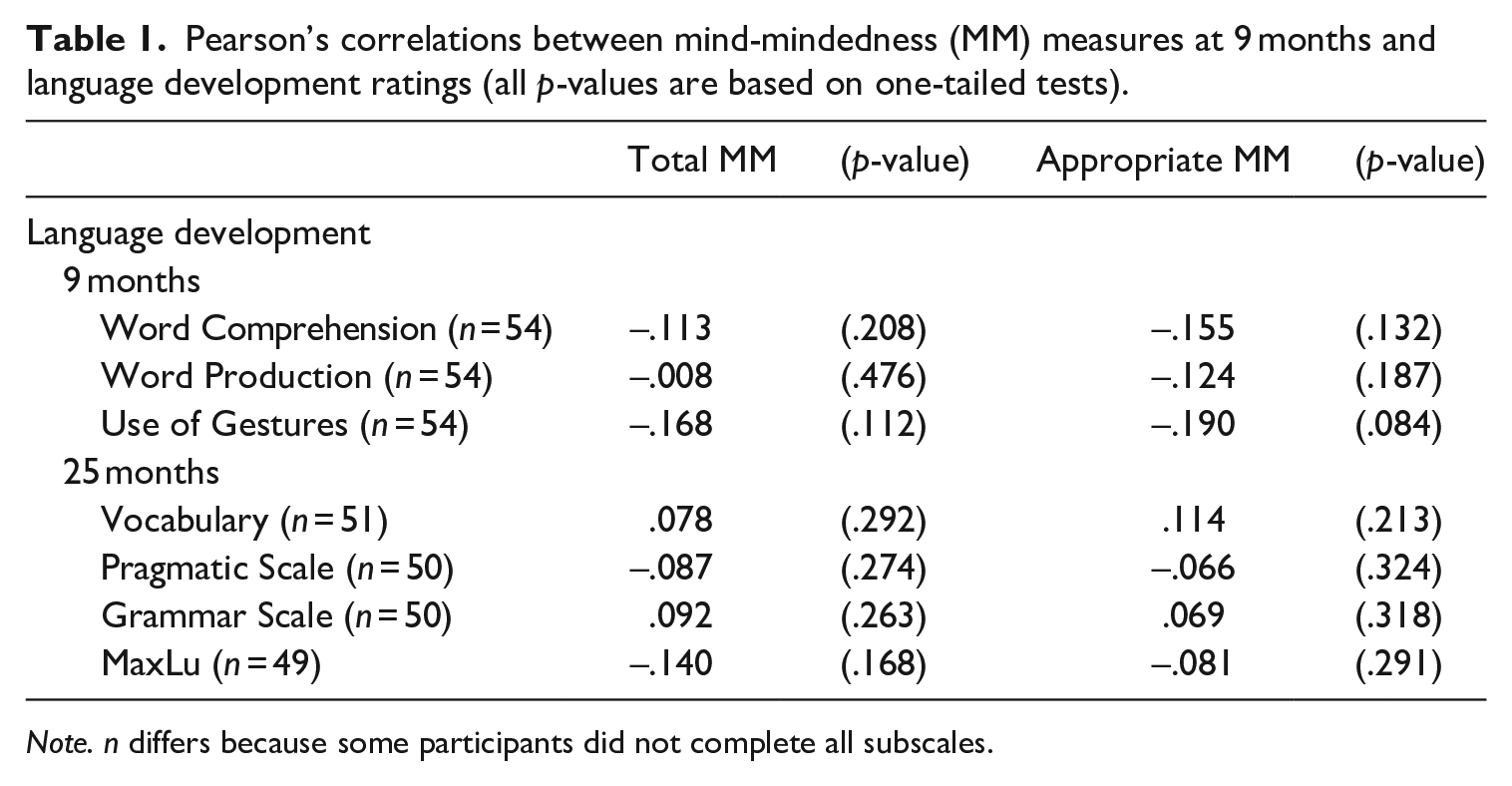
MM variables and language development at 9 months did not significantly correlate (see Table 1; all ps > .05, one-tailed).
Pearson’s correlations between mind-mindedness (MM) measures at 9 months and language development ratings (all p-values are based on one-tailed tests).
Note. n differs because some participants did not complete all subscales.
Parental mind-mindedness and language development at T2
MM measures were not correlated with language development at 25 months (all ps > .100, one-tailed). Language measures at 9 months were not significantly correlated with language measures at 25 months (r range = .116–.265, all ps > .100, except Word Production at 9 months and Pragmatic scale at 25 months, r = .265, p = .085, two-tailed).
Potential confounders
Two-tailed Pearson correlations were computed between the variables of interest in this study and seven potential confounders: educational level for the parent that took part in the free-play session, educational level for both parents combined (0, 1, or 2 parents university degree), household income, child age at T1, child age at T2, and two-tailed point biserial-correlations were computed with child sex (0 = boy, 1 = girl) and siblings (0 = no, 1 = yes). MM measures did not statistically significantly correlate with any of the seven potential confounders (all ps ⩾ .05). Regarding SECDI measures at T1, the subscale Word Production and household income was statistically significantly correlated (r = –.281, p = .041) and the subscale Use of Gestures and educational level for the parent that took part in the free-play session (r = –.332, p = .014). Regarding SECDI measures at T2, there were statistically significant correlations between the subscale Vocabulary Checklist and sibling (rpb = –.281, p = .045), between the Pragmatic Scale and sex (rpb = .383, p = .006), between the Grammar Scale and sibling (rpb = –.335, p = .017), and between the subscale MaxLu and sibling (rpb = –.307, p = .032). We also computed partial correlations between MM and SECDI measures and controlled separately for each identified significant confounder and all findings and interpretations remained the same.
Discussion
In this study, the first aim was to investigate the main features of MM in a Swedish sample and the second aim was to investigate its concurrent (at 9 months) and longitudinal (at 25 months) association with early language development. We formulated two hypotheses relating to the first aim. First, a ratio between Appropriate MM and Non-attuned MM of 5:1 and second that these two measures would be unrelated. Regarding the second aim, we hypothesized that proportionally higher use of Appropriate MM at 9 months would positively predict language abilities at 25 months but not concurrently at 9 months.
Parental mind-mindedness
In support of our first hypothesis, the ratio between Appropriate MM and Non-attuned MM was 4:1, which was of the same order of magnitude as hypothesized (5:1) based on previous research (e.g. Meins et al., 2003). In support of our second hypothesis, there was no statistically significant correlation between Appropriate MM and Non-attuned MM. Thus, we show for the first time that MM in Swedish parent-infant dyads is similar to what have previously been found in Anglophone and Francophone studies. This unrelatedness is in line with the suggestion by Meins et al. (2011) that these two types of MM are generated by different factors. One factor that Meins et al. (2011) previously has suggested is obstetric history, which was a study only including mothers. In this study including both mothers and fathers, we did not investigate possible underlying factors of MM. Therefore, it would be interesting to further investigate both whether paternal MM could also be related to obstetric history and other possible underlying factors (e.g. parental attachment style or parental characteristics).
Parental mind-mindedness and language development
Regarding the second aim, the hypothesis was that a greater proportion of Appropriate MM uttered by parents when their infant was 9 months would positively predict the infant’s language development at 25 months, but not concurrently at 9 months. However, only the second part of this hypothesis was supported because MM measures were not statistically significantly correlated with language development at either 9 or 25 months. Thus, MM did not predict language development either concurrently or longitudinally in a meaningful and measurable way in the current sample.
The lack of significant correlations between Appropriate MM and language development ratings are in line with some previous work. For example, Meins, Fernyhough, et al. (2013) found no significant correlation between parental MM when the infant was 8 months and child language measures at 2 years, although they did find a significant positive correlation when the children had reached 4 years. However, two other comparable studies both found a significant and positive correlation between parental MM measures and child language measures (Laranjo & Bernier, 2013; Longobardi et al., 2018). Laranjo and Bernier (2013) measured MM at 12 months and language abilities at 2 years. Longobardi et al. (2018) measured MM at 16 months and although they did not find a concurrent correlation with language abilities, they did find a predictive correlation at 20 months. Both studies implemented a free-play procedure in the home environment, and in the study by Longobardi et al. (2018), the parent-child dyad even played with their own toys. In the current study and in the study by Meins, Fernyhough, et al. (2013), the participants were younger than 1 year, and laboratory-based free-play sessions were used, which is the procedure described as the most common in the MM coding manual (Meins & Fernyhough, 2015). On this basis, one possible explanation for the lack of correlation between parental MM and child language development in this study might be the data collection procedure, specifically child age at MM data collection and the free-play procedure.
Another possible explanation for the lack of correlation between parental MM and child language development might be cultural differences. This study was conducted in Sweden, where the social security legislation allows parents to spend at least the first year at home with their infant. At 2 years of age, 89% of Swedish toddlers have begun preschool (Statistics Sweden, 2019). When we measured MM at 9 months, none of the children participating in the study had begun preschool. The follow-up, however, took place when the participants had reached the age of 2 years and most of them had begun preschool. Attendance at preschool during the parents’ working hours might possibly reduce the influence that parental speech has on their toddler’s language development. Further research should investigate this factor by controlling for time spent in childcare or preschool.
Theoretically, we assumed that Appropriate MM, regardless of subcategory, would be associated with overall language development. Since a parent who has a higher proclivity to treat their child as an own individual and is attuned and attentive to their child’s mind and behavior also might have more occasions to scaffold and maximize their child’s learning opportunities. Notably, Laranjo and Bernier (2013) found a positive association between Appropriate MM at 12 months and expressive abilities at 2 years, but this association was driven by the MM subcategory Cognition. We focused on Appropriate MM as a whole and we cannot rule out the possibility that a specific subcategory could have been significantly associated with overall language abilities in our study. Finally, since we focused on overall language abilities, we did not specifically measure child mental state language and therefore do not know if there would have been a relation between Appropriate MM and child mental state language. Thus, our results showing a lack of correlation between parental MM and child language development are inconclusive.
Noteworthy, language abilities at 9 respectively 25 months were not statistically significantly correlated in the current sample. These results are in line with previous findings suggesting that the range of normal variation is wide and that the stability in language development is limited during the first years of life (e.g. Duff, Nation, et al., 2015; Duff, Reen, et al., 2015). However, the original manual of the MB-CDI instrument (Fenson et al., 2007) states that there is evidence for the predictive power of parent-reported instruments across the first 3 years of life, but the predictive validity substantially rises during the second year of life.
Limitations
The results from this study are subject to several limitations, and the most central is how MM is assessed in cross-cultural contexts. Both the procedure of the free-play situation (such as laboratory or home based, length of the session, and selected toys) and the coding of MM in different linguistic contexts need to be discussed.
In this study, the free-play sessions were laboratory-based and lasted an average of 7.40 minutes (SD = 0.64). Meins and Fernyhough (2015) describe in their MM coding manual that they use 20 minutes laboratory-based free-play sessions but that it may also be suitable to use shorter or home-based sessions. One aspect to consider is whether the average of 7.40 minutes in this study provides an equally reliable reflection of parental verbosity and MM as a 20-minute session. At least, the overall verbosity in this study seems to be comparable with previous studies. We found an average of 13.63 overall utterances per minute (SD = 4.69, Min = 4.01, Max = 24.32) and Meins, Fernyhough, et al. (2013) used 20-minute free-play sessions and had an average of 10.96 overall utterances per minute. Longobardi et al. (2018) used 15-minute free-play sessions but only transcribed the first 10 minutes, and they had an average of 16.67 utterances per minute. Also, in this study, an average of 5.48% of all utterances was classified as MM, which is comparable to 6.93% (Meins, Fernyhough, et al., 2013) but much lower than the 12.05% reported by Longobardi et al. (2018).
To our knowledge, this study is the first to investigate MM in Sweden. Translation and minor adaptations of the original MM coding manual (Meins & Fernyhough, 2015) have previously been made to make it suitable in a Swedish context (Holmer, 2010). However, after conducting this study, we found some features of the Swedish language that might indicate a need for adaptations similar to those suggested for Mandarin (Dai et al., 2019). These authors noticed that the Chinese parents in their study frequently used utterances that translated from Mandarin something like ‘Let’s kick the ball, is that okay?, that could be understood as ‘Do you want us to kick the ball?’. Utterances like these were not classified as MM because they did not contain an explicit term referring to the mind. In the current study, we noticed a similar pattern: parents frequently uttered sentences that could be understood as ‘Do you want . . .?’ but without an explicit mental state term. For example, when the child reaches for a toy horse and the parent utters ‘Ska du ha hästen?’ an exact translation from Swedish would be ‘Shall you have the horse?’, but it is understood as ‘Do you want the horse?’ Thus, in the specific context, both ‘Ska du ha hästen?’ and ‘Vill du ha hästen?’ can be understood as ‘Do you want the horse?’ but only the second sentence contains an explicit term referring to the mind (‘vill’ is ‘want’) and is therefore considered mind-related. In our Swedish context, we identified the use of explicit MM terms, but we find it possible that we did not capture MM in the same extensive way as originally intended in the English manual. Like Dai et al. (2019), we recognize that questions are raised about the coding of MM in different languages and the need for cross-cultural validation of the MM construct. For example, it needs to be considered to what degree language and cultural adaptions of the coding manual can be made without compromising the concept of MM and confusing it with the more inclusive term of maternal sensitivity.
We excluded the b-part of MM, ‘talking on behalf of the infant’, from all analyses because of poor inter-rater reliability. This exclusion could have affected the results. Specifically, it may have reduced the ratio between Appropriate and Non-attuned MM. However, we have no reason to believe that it influenced the association between MM and language abilities. In the Swedish adaptation of the coding manual (Holmer, 2010), the b-part has already been further clarified by the statement that only utterances that are ‘extremely obvious’ examples of ‘talking on behalf of the infant’ should be coded as such. Also, during the coding training phase, this b-part was the most problematic and we consider it hard to find a meaningful and reliable way to further operationalize it. This raises the question why ‘talking on behalf of the infant’ is so difficult to distinguish in a Swedish context. Are there differences in cultural or language features which, for example, lead to Swedish parents not talking on behalf of their infant? Could it be the case that the b-part of MM is not relevant across all cultures and that the a-part and the b-part represent two different MM phenomena?
Finally, the families were highly educated. Even though a letter of invitation was sent to all families with an infant aged 9 months in a selected region, more than three quarters of the parents that took part in the free-play session had a university degree. This is a higher level of educational degree compared to the region and is not representative of the Swedish population (Statistics Sweden, 2018). The main features of MM and its relation to language development in lower SES samples needs to be investigated. However, we expected a positive association between MM and language development regardless of parental SES.
Conclusion
In this study, we investigated parental MM in a Swedish sample and its concurrent relation to child language abilities at 9 months and longitudinally at 25 months. We found a pattern of parental MM similar to that found in Anglophone and Francophone cultures. Unexpectedly, there was no evidence of a systematic association between Appropriate MM and language abilities at either 9 or 25 months. This may be due to methodological issues concerning elicitation of MM. We emphasize the importance of further theoretical and empirical studies of cross-cultural validation of MM. Several questions remain as how to best adapt the MM coding manual to other languages and cultures.
