




Abstract
Listening comprehension is important for daily communication and at school, yet relatively little is known about the variables contributing to listening comprehension, especially in the upper elementary years. The aim of this study was to explore whether vocabulary, verbal memory, but also self-efficacy and self-reported concentration contribute to listening comprehension. The authors assessed oral text comprehension, as well as the concurrent contributors vocabulary, verbal short- and long-term memory, self-efficacy and concentration in a sample of 442 upper elementary school children (9- to 12-year-olds). Structural equation models were used to test for direct and indirect associations. The best-fitting model was an indirect model in which verbal short-term memory and self-efficacy were positively associated with children’s vocabulary. Vocabulary, in turn, was positively associated with children’s listening comprehension. Using bias-corrected bootstrap procedures, however, vocabulary appeared to mediate the association between academic self-efficacy and listening comprehension. The indirect association between verbal short-term memory and listening comprehension through vocabulary just missed significance. The findings relate to models of listening comprehension that state a dominant role for vocabulary, also in the upper elementary years. They imply that the models could extend to evaluating broader student-related resources, such as academic self-efficacy. Furthermore, the findings on general cognitive resources fit the pattern of mixed findings in previous research. Together, the results motivate further research into contributors to listening comprehension throughout the elementary years.
Keywords
Listening comprehension refers to the ‘ability to listen and comprehend spoken language of multiple utterances and oral texts’ (Kim & Pilcher, 2016). For children, understanding spoken language is essential in daily functioning and for understanding instructions in the classroom. In daily life, for instance, listening comprehension is required in understanding conversations or in watching television. In school, children often have to distil instructions and information from orally-delivered teaching, making listening comprehension important for learning and acquiring knowledge (e.g. Hogan et al., 2011). It also adds to learning through its role in reading comprehension, as listening comprehension is a crucial component of reading comprehension (Gough & Tunmer, 1986), and its contribution to reading comprehension increases over time (Adlof et al., 2006; Catts et al., 2005; Kendeou et al., 2009).
Although listening comprehension plays such an important role both in- and outside school, the acquisition, development and promotion of this ability have received relatively little attention. In light of this limited attention, listening comprehension has been dubbed the ‘Cinderella skill of language acquisition’ (Vandergrift, 1997) and we consider this to still be the case today. Furthermore, the studies that have looked into listening comprehension tend to focus on listening comprehension in foreign language learning (e.g. Bang & Hiver, 2016; Elkhafaifi, 2005; Vandergrift & Goh, 2012) or on young children at preschool, kindergarten or lower elementary grades (e.g. Florit et al., 2009; Kendeou et al., 2005; Language and Reading Research Consortium [LARRC] et al., 2018, 2019; Tunmer & Chapman, 2012; Wolf et al., 2019), whereas there has been less attention for children in higher grades (but see Lervåg et al., 2018; Ouellette & Beers, 2010; Wolfgramm et al., 2016). At the higher years of elementary school, listening comprehension remains important. This is due to its increasing contribution to reading comprehension, as well as the increasing demands of understanding the immediate environment and school-related tasks (LARRC et al., 2018). Furthermore, there are changes in the ways that knowledge and skills such as vocabulary and verbal memory contribute to listening comprehension outcomes across the elementary grades (e.g. LARRC et al., 2018, 2019). It is thus also important to evaluate listening comprehension and the potential contributors to this ability in higher grades.
The present study aims to build on the relatively limited body of research on listening comprehension of children in upper elementary grades. We explore the unique contributions of vocabulary and verbal (short-term and working) memory, factors whose relation to listening comprehension has been assessed (e.g. Currie & Cain, 2015; Lervåg et al., 2018; Wolf et al., 2019), in tandem with academic self-efficacy and self-reported concentration – two variables that have received much less attention in relation to listening comprehension.
Listening comprehension is always a dynamic and active process. It is required in different settings and can have different functions. It can concern two-way listening (listening and speaking) or one-way listening (Lynch & Mendelsohn, 2002). The purpose can be interactional (person-oriented), focused on maintaining social relationships, or transactional (message-oriented), focused on conveying information and ideas (Brown & Yule, 1983; Morley, 1990). Instruction at school and understanding of spoken texts (such as the news or stories) are examples of transactional, one-way listening. In these situations, the focus is on listening to learn. Because this type of listening does not allow for requesting clarification and repetition and might have higher information density, it is relatively challenging for children.
Listening comprehension, and certainly oral text comprehension, demands the construction of a mental representation of the meaning of the text or narrative, a so-called situation model (Kintsch, 1988). This mental representation is not a verbatim record of the text but is a representation of the meaning of the text (Zwaan & Radvansky, 1998). It is constructed while perceiving and processing verbal information and is continuously updated in real time with every new sentence and is integrated with prior knowledge. There are different interpretations of the order of the steps that need to be taken (e.g. A. Anderson & Lynch, 1988; J. R. Anderson, 2015; Brown & Yule, 1983; Oakhill & Cain, 2017), but they converge on the fact that information needs to be perceived and processed, with meaning retrieval and connection to existing knowledge to construct the meaning of the text.
Constructing a situation model is thus a complex activity. Different divisions in the components required have been proposed (e.g. Lynch & Mendelsohn, 2002; Morley, 1990; Rost, 2002). Parallel to reading comprehension, in which a situation model also needs to be constructed while reading texts (e.g. Castles et al., 2018; Perfetti & Stafura, 2014), we divide the steps that need to be taken into knowledge (linguistic knowledge, general knowledge), processes (such as meaning retrieval, sentence parsing, inferring and comprehension monitoring) and general cognitive resources (such as executive functions, including verbal memory and self-monitoring [Pimperton & Nation, 2014]).
Vocabulary knowledge is essential for oral text comprehension, as word meanings are the building blocks of passage and text meaning. These meanings need to be retrieved during listening comprehension and thus affect the ability to make inferences and monitor understanding of the text. Both vocabulary size and quality are likely to affect comprehension (Oakhill & Cain, 2017). The Lexical Quality Hypothesis (Perfetti, 2007) can be used to specify this assumed relationship: the availability of more words, especially those that have rich, precise and well-connected semantic representations, allows swift activation of the meaning of the specific words, as well as the related words and concepts’ more detailed representations. This could facilitate comprehension (see LARRC et al., 2019; Oakhill & Cain, 2017 for a similar line of reasoning). Through meaning retrieval, listeners can integrate pieces of information with each other and with their background knowledge (Kintsch & Rawson, 2005) in a way that is coherent and cohesive (van den Broek et al., 1995).
The assumption that vocabulary and listening comprehension are closely related is widely agreed upon and has led researchers to sometimes use vocabulary as a proxy for linguistic comprehension (Muijselaar & De Jong, 2015). Empirical studies have indeed shown significant correlations between vocabulary and listening comprehension across all school ages (e.g. Hagtvet, 2003; Kim, 2016; Kim & Phillips, 2014; Lepola et al., 2012; Lervåg et al., 2018; Protopapas et al., 2013; Wolf et al., 2019; Wolfgramm et al., 2016). These findings indicate that vocabulary is a contributor to listening comprehension outcomes, also in higher grades (Lervåg et al., 2018).
In terms of general cognitive resources, memory, and especially verbal memory (Pimperton & Nation, 2012), plays a role in the process of constructing meaning. Speech is fleeting, so it needs to be processed quickly and the essence needs to be captured immediately. As speech is continuous, an ongoing interpretation of what is heard needs to be made and the obtained information needs to be stored. These tasks require verbal memory (Daneman & Merikle, 1996; Ericsson & Kintsch, 1995). Verbal memory can be divided into verbal short-term memory (VSTM) and verbal working memory (VWM). It has been proposed that these measures should not be considered as a unitary measure of verbal memory (Daneman & Carpenter, 1980), but that there is a difference between storage and processing (e.g. Alloway et al., 2006; Florit et al., 2009; Verhagen & Leseman, 2016).
Measures of VSTM assess retention of verbal information. This is needed to start meaning retrieval. Measures of VWM assess simultaneous storage and processing (Baddeley & Hitch, 1974), which is needed to maintain information, integrate it with world knowledge, construct and revise the mental model, as well as perform comprehension monitoring. Possessing greater verbal memory capacity allows for retaining more information, making more inferences and connections, as well as (re)activating relevant information and suppressing irrelevant information (e.g. Castles et al., 2018; Daneman & Merikle, 1996).
The findings on the effect of VSTM on listening comprehension are not consistent. Some studies do not indicate a strong influence of VSTM: no effects of VSTM were found on passage comprehension by Wolf et al. (2019) in second and third graders, by Chrysochoou and Bablekou (2011) in 5- to 9-year-olds, or by Potocki et al. (2013) in 5-year-olds, for instance. In contrast, Currie and Cain (2015) found that VSTM made significant contributions to local and global inference making, skills closely related to and arguably part of listening comprehension, in 6-year-olds, and to global inference making in 10-year-olds, but not in 8-year-olds. Furthermore, Florit et al. (2009) found that VSTM predicted unique and independent variance to passage comprehension in 4- to 6-year-olds. There are thus mixed findings for the role of VSTM in listening comprehension. The focus has been limited to this contribution in younger children.
With respect to VWM, mixed findings have been reported. Some studies found a direct contribution to listening comprehension. For instance, Florit et al. (2009) reported such a contribution of VWM to passage comprehension in 4- to 6-year-olds. LARRC et al. (2018) evaluated the role of memory from preschool to grade 3; they found an increasing contribution of VWM to listening comprehension across time. Furthermore, Lervåg et al. (2018) found that VWM constituted one factor together with vocabulary, grammar and inference skills, which explained 95% of the variance in listening comprehension. VWM loaded on one factor with these other skills.
In contrast, other studies did not find that VWM contributes to listening comprehension (Alonzo et al., 2016; Andringa et al., 2012), whereas others reported limited contributions after controlling for other variables (Florit et al., 2011; Potocki et al., 2013; Tighe et al., 2015). Currie and Cain (2015) found that effects of VWM on inference making were fully mediated by vocabulary, indicating an indirect effect on listening comprehension. There thus seems to be a contribution of verbal memory to listening comprehension, but not much is known about this contribution in the upper elementary years. Furthermore, it is not clear whether this association is direct or indirect and whether it includes both short-term and working memory.
Research into listening comprehension has focused on the roles of language- and memory-related components. The studies have shown that word knowledge and the verbal memory components VSTM and VWM (can) interact and influence processing of the oral text, as listening comprehension measures demand meaning retrieval, sentence parsing, inferring and comprehension monitoring. Next to the verbal memory components VSTM and VWM, students’ metacognitive skills might also be one important general cognitive resource affecting listening comprehension outcomes. Metacognitive skills refer to ‘the ability of learners to control their thoughts and to regulate their own learning’ (Vandergrift & Goh, 2012, p. 5). Research in foreign language learning has shown that metacognitive skills play a role in listening comprehension (Goh, 2008). Listeners’ metacognitive skills can influence listening comprehension through the standards of coherence they set. In other words, the criteria listeners have for understanding the information they are presented with, such as goals, interests and purposes, might affect their construction of the mental representation of the text (Morley, 1990; see van den Broek et al., 2011 for reading comprehension).
In light of this assumed association between metacognitive skills and listening comprehension, it seems likely that task focus, or concentration, may be associated with children’s listening comprehension. The transient nature of speech demands the intention to listen as well as active and focused listening during the entire period of speech delivery. Despite the fact that maintaining concentration is likely to be associated with listening comprehension, this assumption has received little attention. To date, only one study, from Wolfgramm et al. (2016), has investigated the contributions of concentration and self-concept (and vocabulary) to sixth graders’ listening comprehension. Results from this empirical study indicated that students’ concentration contributed moderately and significantly to their listening comprehension. These findings suggest that even after accounting for the strong contribution of vocabulary, concentration may play a positive, moderate role in students’ listening comprehension.
Academic self-efficacy, learners’ beliefs about their capability to carry out activities that are needed to effectively accomplish academic tasks (Bandura, 1997; Hsieh & Schallert, 2008), can also be anticipated to be associated with listening comprehension. Following a social-cognitive perspective (Bandura, 1997; Zimmerman, 2000), these self-motivational beliefs may provide students with a sense of agency to motivate and regulate their learning and can therefore be considered to play a central part in self-regulated learners’ belief systems. Indeed, a sizeable literature has indicated that students with a positive sense of academic self-efficacy are likely to put in the effort and persistence to fulfil academic tasks, to display higher levels of engagement, and to achieve better in various academic domains (e.g. Eccles & Wigfield, 2002; Peetsma et al., 2005; Zimmerman & Bandura, 1994). Accordingly, academic self-efficacy beliefs might be associated with children’s standard of coherence and influence listening comprehension directly. Alternatively, this association could be indirect, as self-efficacy could affect word learning and/or the process of meaning retrieval and also, through this path, listening comprehension. These interpretations relate to the literature that has found both direct and indirect effects of self-efficacy on learning (e.g. Graham & Macaro, 2008; Kormos et al., 2011; Magogwe & Oliver, 2007).
Although it seems plausible that academic self-efficacy plays a role in listening comprehension (Graham, 2011), this relationship has not received much attention. Some studies have looked into self-efficacy in relation to foreign language learning and the findings are mixed: a positive correlation between self-efficacy and listening comprehension has been attested (Bang & Hiver, 2016), but not in another study (Mills et al., 2006). Furthermore, as predictors of first and foreign language listening comprehension can differ (e.g. Andringa et al., 2012), findings do not automatically relate to a first language learning population. In a study by Wolfgramm et al. (2016) the contribution of first language learners’ academic self-concept to listening comprehension was investigated. Self-concept can be considered a global reflection of personal efficacy (Bandura, 1997). There was no contribution of self-concept to listening comprehension.
Given the relative paucity of findings on the role of academic self-efficacy to listening comprehension, it might be relevant to evaluate its role in first language text reading comprehension, in which a situation model also has to be created. Findings related to reading comprehension show a mixed picture. Whereas Carroll and Fox (2017) found that self-efficacy did not predict reading comprehension of 8- to 11-year-olds, a meta-analysis by Guthrie et al. (2007) of a classroom-based reading programme that incorporated improvement of self-efficacy showed increases in both self-efficacy as well as reading comprehension. These findings warrant further research into the relationship between academic self-efficacy and comprehension (here, listening comprehension). At the same time, foreign language research has shown that self-efficacy influences vocabulary learning (Heidari et al., 2012; Mizumoto, 2013). The question whether self-efficacy is directly or indirectly associated with children’s listening comprehension has yet to be explored.
Present study
In this study, we aimed to explore whether vocabulary, VSTM, VWM, self-reported concentration and academic self-efficacy uniquely contribute to upper elementary children’s listening comprehension. Conceptually, these skills all have a direct association with listening comprehension. However, on the basis of the literature so far, only vocabulary is assumed to have both a strong and direct association with listening comprehension at older ages. Previous findings on VSTM and VWM are mixed, but seem to suggest that associations might be indirect and run through vocabulary. With regard to concentration and academic self-efficacy, expectations are less clear-cut. They might contribute to listening comprehension directly or through vocabulary.
In sum, we investigate whether there are direct relationships of these different components with listening comprehension or whether they are (partly) indirect. Furthermore, we evaluate these relationships in the upper elementary school grades. Three control variables were included: age, gender and home language. Age might play a role as the relationship of verbal memory with listening comprehension could increase or decrease. Although gender generally has not been reported to play a role in listening comprehension (e.g. Florit et al., 2011; LARRC et al., 2018) and has not been found to substantially affect the outcomes of models of listening comprehension (Wolfgramm et al., 2016), we did include it in the model, as a study on foreign language learning found a differential relationship for boys and girls on listening comprehension and self-efficacy (Mills et al., 2006). Home language is assumed to be associated with the language outcomes, as second language learners show both lower language comprehension and vocabulary outcomes (Melby-Lervåg & Lervåg, 2014).
Method
Participants and procedure
Participants were 442 children who attended third (n = 111), fourth (n = 29), fifth (n = 102) and sixth (n = 200) grade of regular elementary school, respectively. The students’ ages ranged from 9 to 12 years (M = 10.43, SD = 0.74) and the gender distribution was 39.6% boys (and 60.4% girls). Most students spoke Dutch at home (90.7%), with the remaining 9.3% of children speaking other languages, including Turkish, German and French. The distribution across grades did not differ for the students speaking Dutch or another language at home, χ2 (3) = 2.47, p = .650. Based on their mother’s country of birth, 85.5% of participating children (n = 378) could be considered native Dutch-speakers.
Data for this study were collected by trained undergraduate students who were following a second-year course on children’s cognitive development and learning problems in the College of Child Development and Education, University of Amsterdam. These students (N = 442) each selected one child that attended grades 3, 4, 5 or 6, was a speaker of Dutch, and did not show signs or evidence of cognitive or behavioural difficulties or disorders. Under the students’ supervision, these children completed a series of tests regarding their working memory, vocabulary, self-regulation and listening comprehension. Before taking the tests, all students were given a standardized protocol for assessing the children’s skills. This protocol included extensive information about the methods of administration of the tasks, coding schemes, and standardized instructions per task that were read aloud by the students to the child each selected. Moreover, students could practise with, and ask questions about this protocol in a 90-minute small group teaching session, which was led by qualified lecturers in the pedagogical and educational sciences. Students had to administer the battery to an adult before testing the child. After the test session, test experiences and results were discussed in another 90-minute session. All tests were administered individually in the child’s school or home, during the first two weeks of September 2016 (data of n = 213 children) and September 2017 (data of n = 229 children). The complete test took approximately 90 minutes. Tests were scored by students and checked for accuracy by lecturers. This investigation was approved by the institutional Ethics Review Board (project no. 2016-CDE-7203) and informed consent was obtained from children’s parents prior to participation.
Instruments
Vocabulary
Children completed the word definition subtest of the Clinical Evaluation of Language Fundamentals (CELF-4-NL; Kort et al., 2008). Children heard a word embedded in a sentence and were then asked to describe the target word in their own words. They were first presented with three practice questions. An example is ‘The word is “to clean”, as in: Grandma said: “You need to clean your room.” What is “to clean”?’ The answer was awarded with 2, 1, or 0 points. The task contained 25 items, rendering a maximum of 50 points. It was abandoned after 7 consecutive 0 scores. Reported reliability for the different ages varies between .85 and .89 (Kort et al., 2008) and is thus good. The reported construct validity and reliability of the entire CELF-4-NL has been reported to be good (Evers et al., 2009–2012).
Verbal memory
Digit spans forwards and backwards from the Wechsler Intelligence Scale for Children (WISC-III-NL; Kort et al., 2005) were used to assess VSTM and VWM, respectively. Digit span forwards requires the children to repeat a string of digits spoken aloud by the test administrator. The task commences with a digit string of two digits (e.g. 2 – 8), increasing in difficulty up to nine digits. For each span, two strings were presented. The final score was the number of correctly repeated digits strings with a maximum score of 16. The task was stopped when both strings of a pair were incorrectly repeated. There was one two-digit practice item. The design of the backwards task is similar, with the difference that children now had to reverse the order of the string of digits, e.g. ‘2 – 8’ had to be repeated as ‘8 – 2’. The maximum score was 14. Both the forward and backward digit span tasks are classified as reliable and these tasks have been found to be construct valid (Evers et al., 2009–2012; Kort et al., 2005).
Concentration and academic self-efficacy
Students’ self-perceptions of their concentration and their beliefs in their academic efficacy were measured using eight items from the School Questionnaire (SVL; Smits & Vorst, 1982). The Concentration subscale (4 items) measures the extent to which students believe they can intentionally maintain attention over a longer period of time. An example item of this scale is ‘When I’m in class, I can easily stay focused on my work’. In addition, the Academic Self-Efficacy subscale (4 items) captures the extent to which students feel able to organize and execute school tasks. An example item includes ‘When I’ve tried hard, I feel certain that I will get a good grade for my school work’. All items were rated by children on a 5-point Likert scale, ranging from 1 (no, that is not true), to 5 (yes, that is true). Evidence for the construct validity, norms and reliability of the SVL has been provided by Egberink and Vermeulen (2013). In the present study, Cronbach’s alpha was .80 for Concentration and .65 for Academic Self-Efficacy, respectively.
Listening comprehension
The text comprehension task of the CELF (CELF-4-NL; Kort et al., 2008) was used to measure listening comprehension. The CELF-4-NL is a short narrative comprehension task, which consists of three recorded narrative passages with no picture cues. Each narrative passage is followed by five open-ended questions which demand factual knowledge (e.g. ‘which prize did the children receive?’) as well as the need to draw inferences about the story (e.g. ‘what do you think would have happened if the children had not read the 5000 books?’). Prior to the three short oral narratives, the child had the opportunity to practise with an example narrative. To ensure that the level of difficulty of the narratives and questions was age-appropriate, we used the two versions of the task that are available in the CELF-4-NL: one for 9- to 10-year-olds, and one for 11- to 12-year-olds. The maximum score of the task for both versions is 15. The construct validity of the CELF-4-NL, as indicated by significant positive correlations with nationally normed scores on technical reading, spelling, listening comprehension and vocabulary, has been previously classified as sufficient (Evers et al., 2002–2012). Reported reliability in prior research varies between .71 and .79 for the ages 9–12 (Kort et al., 2008). Given that these reliabilities exceed the minimum threshold of .70 (Tabachnick & Fidell, 2007), the internal consistency of this measure can be considered sufficient.
Data analysis
To check the quality of the administration and scoring of the outcomes, students had to submit recordings of the test sessions and, in the case the qualified lecturers or the course coordinator had doubts about the assessment, these recordings were listened to and scored again. If a student failed to deliver a recording, the data were not retained in the dataset. Finally, data were checked of 40 random students. There were no differences in scoring and data entry by the student and the lecturer/coordinator.
To investigate the unique contributions of vocabulary, verbal memory, concentration and academic self-efficacy to students’ listening comprehension, we conducted structural equation modelling using Mplus 7.11 (Muthén & Muthén, 1998–2012). To yield estimates of the model’s coefficients, we used maximum likelihood estimation. Missing data (< 3%) were handled using full information maximum likelihood, after finding that Little’s MCAR test was not statistically significant, χ2 (499) = 529.77, p = .165 (Tabachnick & Fidell, 2007).
Modelling procedure
Data were analysed in three steps. First, we fitted a measurement model to the data, to evaluate whether the latent factors in our model corresponded to the hypothesized structure and supported the construct validity of the measures. To achieve model identification, the first unstandardized factor loading of each construct was fixed to 1, and all latent variable variances and covariances were allowed to be estimated freely. The error variances of the single indicators (i.e. vocabulary, VSTM, VWM and listening comprehension) were specified on the basis of previously reported reliabilities, as less than perfect measurement of each variable was assumed. Second, we added structural relationships among the latent variables in the model. Three models were tested. The first was a direct effects model, in which vocabulary, verbal memory, self-efficacy and concentration were added as direct predictors of listening comprehension. The second was an indirect effects model, based on the idea that VSTM, VWM and the self-regularity processes contribute to listening comprehension through vocabulary. Students’ gender, age and home language were included as covariates. Based on the need to consider potential alternatives to the proposed model (Kline, 2011), we also tested a third theoretically plausible model in which VSTM and VWM both served as mediators between vocabulary and listening comprehension. After estimating the best-fitting structural model, we calculated point estimates and 95% confidence intervals (CI) for all potential mediation effects in our model, using the bias-corrected (BC) bootstrap procedure (Preacher & Hayes, 2008). If the 95% CI around the point estimate of the indirect effect does not cover zero, the estimate is considered statistically significant.
Model goodness-of-fit
The overall goodness-of-fit of the models was evaluated by the χ2 test. Generally, non-significant χ2 tests are indicative of a good model fit (Kline, 2011). Yet, given that trivial discrepancies between the expected and the observed model may already lead to the model’s especially in large samples, we also reported the normed χ2 value as a measure of fit, with values ⩽ 3.00 indicating an acceptable fit (Kline, 2011).
Next to overall fit, the model’s approximate fit was determined using the root mean square of approximation (RMSEA), with values below .05 reflecting close fit, and below .08 signifying reasonable fit (Browne & Cudeck, 1993), and the comparative fit index (CFI), with values ⩾ .90 indicating satisfactory fit, and values ⩾ .95 indicating close fit (Bentler, 1992). To evaluate component fit, we used the model’s modification indices, residual correlations and their associated summary statistic SRMR (standardized root mean square residual). Values ⩽ .08 indicate good model fit (Kline, 2011). Last, to compare the fit of the direct and indirect effects models, we used the Akaike information criterion (AIC; Akaike, 1974), which penalizes for model complexity and therefore provides a more rigorous test of the better-fitting model than a simple comparison of fit statistics. Models with lower AIC are considered to be the best fitting.
Results
Descriptive statistics
Table 1 displays the means, standard deviations and zero-order correlations of the study’s main variables. Partial correlations, with the effects of students’ age removed, are displayed above the diagonal. As expected, children’s Vocabulary, and VSTM and VWM were positively associated with their Listening Comprehension skills. Academic Self-Efficacy was weakly but positively correlated with Listening Comprehension, but Concentration was not. Additionally, weak to moderate positive associations of VSTM with Vocabulary were noted. Children’s Academic Self-Efficacy and ability to Concentrate were significantly and positively correlated with their Vocabulary. Last, the correlations among children’s background characteristics, Vocabulary, Verbal Memory and Metacognitive components revealed that children who spoke Dutch at home were likely to have better vocabulary skills. As indicated by the partial correlations, the direction and magnitude of the associations among the variables did not change when students’ age was controlled for.
Means, standard deviations, partial correlations and zero-order correlations.
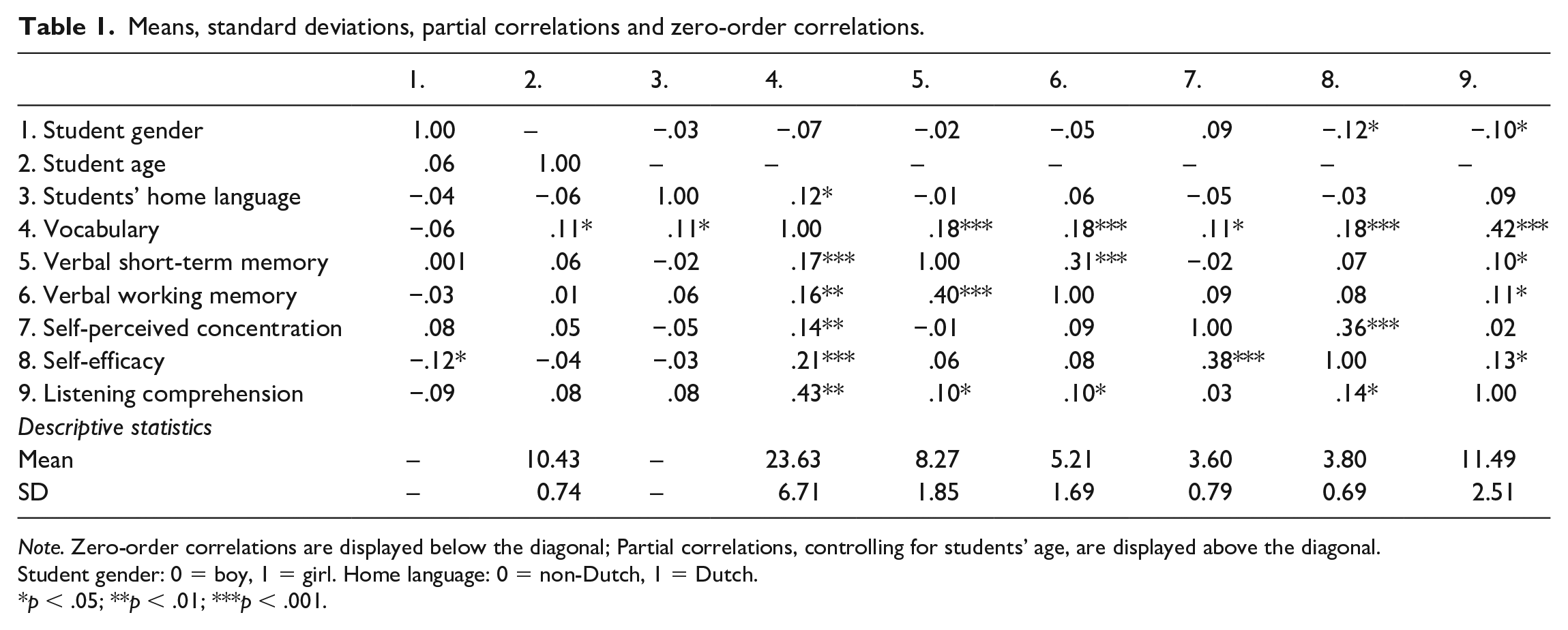
Note. Zero-order correlations are displayed below the diagonal; Partial correlations, controlling for students’ age, are displayed above the diagonal.
Student gender: 0 = boy, 1 = girl. Home language: 0 = non-Dutch, 1 = Dutch.
p < .05; **p < .01; ***p < .001.
Measurement model
We first tested a measurement model, in which Vocabulary, VSTM, VWM, Academic Self-Efficacy, Concentration and Listening Comprehension were specified as latent factors. As the single indicator factors were not measured without error, we fixed the residual variances of these factors on the basis of previously reported reliabilities using the formula (1 - reliability)*sample variance. Additionally, all factors were allowed to correlate. The specified model yielded an acceptable fit to the data, χ2 (43) = 82.27, p < .001, normed χ2 = 1.91, RMSEA = .045 (90% CI [.030–.060]), CFI = .961, SRMR = .035, AIC = 17285.19. The model’s parameters and modification indices suggested that no further estimates would improve the model’s fit. All latent factors demonstrated sufficient item homogeneity and construct validity, with factor loadings ranging from .47 to .94. In addition, weak to moderate correlations among the latent factors were found, ranging from –.04 to .56. The measurement model is depicted in Figure 1.
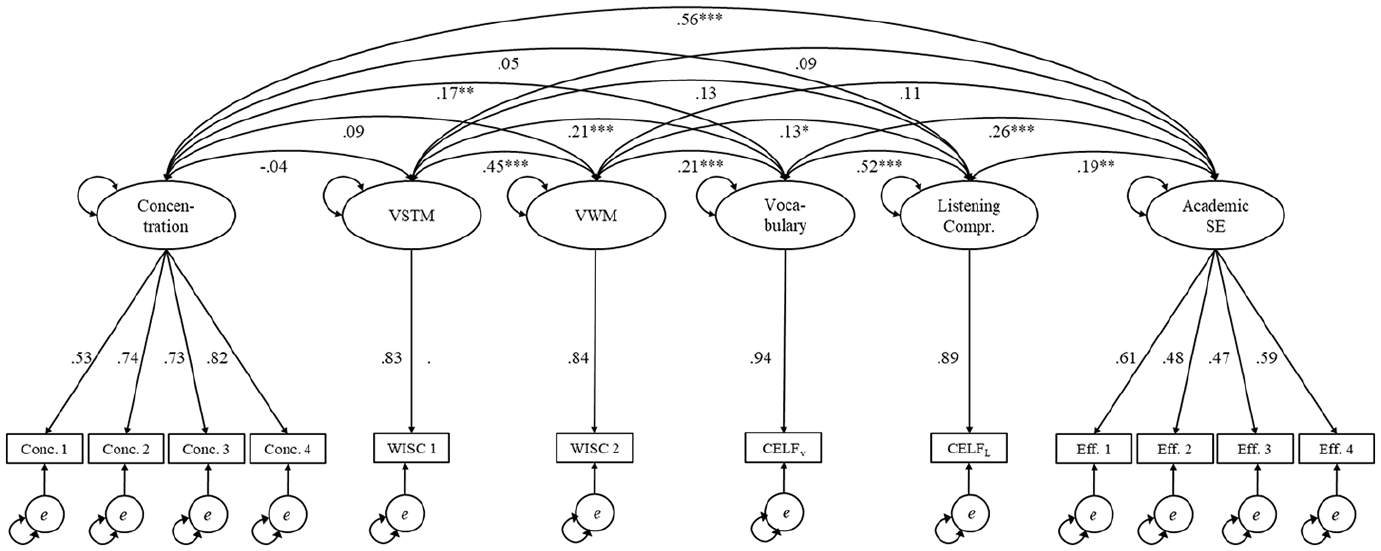
Measurement model of children’s listening comprehension.
Structural equation model
After an acceptable fit of the measurement model was established, we first specified a direct structural model, in which children’s VSTM and VWM, Vocabulary, self-reported Concentration and Academic Self-Efficacy served as direct predictors of their Listening Comprehension. In this model, we controlled for students’ Gender, Age and Home Language. This model reached an acceptable fit to the data, χ2 (61) = 120.69, p < .001, normed χ2 = 1.89, RMSEA = .047 (90% CI [.035–.059]), CFI = .943, SRMR = .036, AIC = 19055.01. In this model, only Vocabulary appeared to be significantly and positively associated with Listening Comprehension (β = .49, p < .001), after accounting for all other variables in the model. Also, none of the covariates appeared to be associated with children’s Listening Comprehension.
Based on the assumptions that verbal memory and metacognitive skills contribute to Listening Comprehension through Vocabulary, we next tested an indirect effects model. Both the approximate fit indices and the model’s parameter estimates suggested a slightly better fit to the data than the direct effects model, χ2 (68) = 125.16, p < .001, normed χ2 = 1.84, RMSEA = .044 (90% CI [.033–.055]), CFI = .945, SRMR = .037, AIC = 19045.48. Furthermore, adding direct paths from VSTM, VWM, Concentration and Self-Efficacy to Listening Comprehension did not result in a statistically significant improvement of fit, χ2 (61) = 122.70, p < .001, normed χ2 = 2.01, RMSEA = .046 (90% CI [.033–.058]), CFI = .943, SRMR = .037, AIC = 19051.02. Hence, the full mediation model of Listening Comprehension appeared to be a slightly better reflection of the data than the direct effects model or partial mediation model.
The third model was also an indirect model, in which VSTM and VWM both served as mediators between Vocabulary and Listening Comprehension. This model did not reach a satisfactory fit to the data, χ2 (78) = 249.02, p < .001, normed χ2 = 3.19, RMSEA = .070 (90% CI [.061–.080]), CFI = .835, SRMR = .059, AIC = 19149.34. Adding a direct path from Vocabulary to Listening Comprehension resulted in a statistically significant improvement of fit, χ2 (77) = 171.78, p < .001, normed χ2 = 2.23, RMSEA = .053 (90% CI [.042–.063]), CFI = .909, SRMR = .046, AIC = 19074.10. However, the second full mediation model of Listening Comprehension still appeared to be a slightly better reflection of the data than the direct effects model and alternative model. Hence, these findings support the idea that the second full mediation model is the best-fitting model.
Results (see Figure 2) indicated that Self-Efficacy (β = .22, p < .01), VSTM (β = .14, p < .05), Age (β = .12, p < .05), and Home Language (β = .14, p < .01) were significantly and positively associated with children’s Vocabulary. Children’s Vocabulary was positively associated with their Listening Comprehension (β = .52, p < .001). 1
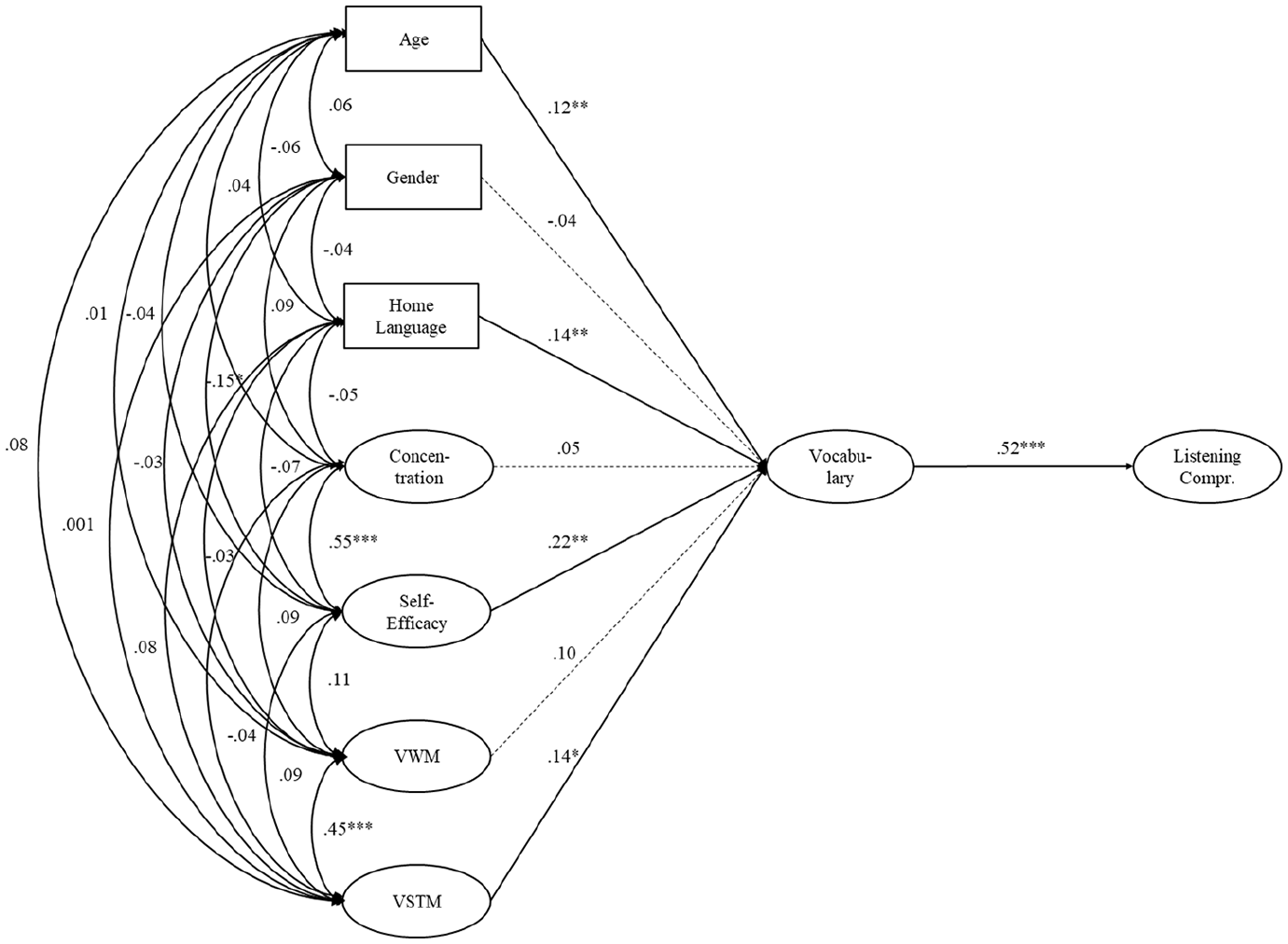
Final model of children’s listening comprehension.
To formally test the statistical significance of the mediation effects in the alternative model, we employed the bias-corrected bootstrap procedure (Preacher & Hayes, 2008). Based on 5000 bootstrap samples, we found that Vocabulary mediated the association of Self-Efficacy (β = .12, p < .01, 95% bias-corrected bootstrap CI [.010–.223]), Age (β = .07, p < .05, 95% bias-corrected bootstrap CI [.011–.119]), and Home Language (β = .07, p < .01, 95% bias-corrected bootstrap CI [.018–.127]). The indirect association between VSTM and Listening Comprehension through Vocabulary just missed significance (β = .08, p = .053, 95% bias-corrected bootstrap CI [–.001–.150]). Together, the variables accounted for 15.4% of the variance in Vocabulary, and 27.3% in Listening Comprehension.
Discussion
In the present study, we explored the unique associations of vocabulary, verbal short-term (VSTM) and working memory (VWM), as well as academic self-efficacy and concentration with 9- to 12-year olds’ oral text comprehension. Structural equation models were used to test for direct and indirect associations. The final, best-fitting, model was an indirect model in which self-efficacy and VSTM, but not VWM and concentration, were positively associated with children’s vocabulary. Vocabulary was a direct concurrent contributor to listening comprehension. Furthermore, bias-corrected bootstrap procedures also established that vocabulary appeared to mediate the association of academic self-efficacy with listening comprehension. This non-significant pathway may indicate that VSTM has much more in common with other cognitive components, including VWM, than with the variance of listening comprehension. Thus, by controlling for irrelevant variance that is shared with predictors such as VWM (r = .45), but not with vocabulary and/or listening comprehension, the effects of these two variables may cancel each other out (Maassen & Bakker, 2001; Pedhazur, 1982).
Consistent with our expectations, vocabulary was the strongest contributor to listening comprehension, and it was even the only direct contributor. This finding underscores the importance of vocabulary knowledge in constructing a situation model (Kintsch & Rawson, 2005; van den Broek et al., 1995) and relates to previous findings that confirm this conceptual relationship with empirical data (Hagtvet, 2003; Kim, 2016; Kim & Phillips, 2014; Lepola et al., 2012; Lervåg et al., 2018; Protopapas et al., 2013; Wolf et al., 2019; Wolfgramm et al., 2016). This contribution seems to remain strong, as our multigroup analysis showed that the contribution of vocabulary was even stronger for the 11- to 12-year-olds than for the 9- to 10-year-olds.
Furthermore, vocabulary mediated the association between children’s home language with listening comprehension. There was a significant vocabulary advantage for children who spoke Dutch at home compared to those with a different home language. These results relate to previous findings on second language vocabulary: second language learners have been reported to possess smaller vocabularies in their second language (e.g. Babayiğit & Shapiro, 2020; Verhoeven, 2000) with fewer associative links between these words (e.g. Vermeer, 2001; see also the meta-analysis by Melby-Lervåg & Lervåg, 2014). They also match findings that vocabulary outcomes of both first and second language learners influence comprehension outcomes (Babayiğit & Shapiro, 2020; Verhoeven & van Leeuwe, 2012). Although the findings on the role of vocabulary in listening comprehension sit well with models and empirical findings of comprehension, there are limits to the conclusions that can be drawn. For instance, although vocabulary clearly contributes to listening comprehension in our study, we cannot determine whether this is due to the size of the children’s vocabulary (vocabulary breadth) and/or the quality of the representations of these words (vocabulary depth). Both have been proposed to contribute to listening comprehension (LARRC et al., 2019; Oakhill & Cain, 2017; Swart et al., 2017), but findings so far are mixed. Arguably, the word definition task used here is a measure of both breadth and depth (e.g. Ouellette, 2006), but the discussion of the constructs that are targeted in different vocabulary tasks is ongoing (e.g. LARRC et al., 2019). Furthermore, as the words included in this vocabulary task were not matched to words used in the listening comprehension task, it is difficult to evaluate whether the quality of the children’s representations of the specific words of the listening comprehension task contributed to the outcomes. The present findings can thus not specify the contribution of vocabulary to listening comprehension further. They do, however, confirm the importance of word knowledge for listening comprehension, including in higher grades.
Correlations indicated that the two components of verbal memory, VSTM and VWM, were both positively correlated to listening comprehension and vocabulary. However, the structural models showed that neither contributed to listening comprehension directly or indirectly. These findings relate to the previous mixed findings on the relationship between verbal memory and listening comprehension. With respect to VSTM the absence of an (in)direct contribution to listening comprehension relates to those that also did not find this relationship (Chrysochoou & Bablekou, 2011; Potocki et al., 2013; Wolf et al., 2019), in contrast to those that did (Currie & Cain, 2015; Florit et al., 2009). It is not clear what the causes of these different findings are. Both studies that did and did not find the relationship included different age groups and used story/text comprehension as a measure of listening comprehension. Furthermore, it does not seem that assessment format of listening comprehension impacted on the outcomes, as for instance, the assessment by both Florit et al. (2009) and Wolf et al. (2019) included multiple choice questions. Such questions could potentially require more VSTM than open-ended questions. Nevertheless, Florit et al. (2009) did find a contribution of VSTM, but Wolf et al. (2019) did not. We cannot rule out that the type of VSTM task used impacted on the findings, as different measures were used, with some using digit span forwards (Florit et al., 2009; Wolf et al., 2019; present study) and others non-word repetition (Potocki et al., 2013) or several measures of VSTM (Chrysochoou & Bablekou, 2011; Currie & Cain, 2015). Again, however, despite the use of similar measures, and fixing the residual variances of our single indicators on the basis of previously reported reliabilities, the attested relationships between VSTM, vocabulary and listening comprehension are not the same.
Regarding VWM, the absence of a direct contribution and a just-missed significant contribution to vocabulary does not agree with previous studies that did find a direct (Florit et al., 2009; Kim, 2016; LARRC et al., 2018; Tighe et al., 2015) or an indirect contribution (Currie & Cain, 2015; Florit et al., 2011; Potocki et al., 2013) to listening comprehension. It also seems to run counter to the finding of Lervåg et al. (2018) that VWM was one component of the factor with vocabulary, grammar and inferencing skill. Instead, it relates to studies that did not find an (in)direct contribution (Alonzo et al., 2016; Andringa et al., 2012; Wolf et al., 2019). Similar to the VSTM and listening comprehension findings, the differences in a (direct) contribution of VWM to listening comprehension do not seem to be due to the measure of listening comprehension used (all are short passages followed by questions) or VWM (which include digit span backwards, word list recall and judgement tasks). It does seem to be the case, however, that the majority of studies that do find a contribution of VWM to listening comprehension are based on studies with younger children (cf. Lervåg et al., 2018) whereas the absence of a contribution is based on participants at higher primary school grades and higher education. Similarly, LARRC et al. (2018) report an increasing contribution of VWM to listening comprehension based on children up to grade 3, whereas Currie and Cain (2015) report a decreasing contribution based on data of children in years 1, 3, and 5. It might thus be the case that VWM does not have a substantial influence at older ages, when listening comprehension is measured through short oral text passage comprehension.
Nevertheless, the absence of a contribution of VSTM and VWM to listening comprehension seems at odds with the assumption that spoken information at school increases in amount and complexity as grades increase, demanding more memory resources (see LARRC et al., 2018, for this line of reasoning). Future work should ascertain whether the short oral passages used as a measure of listening comprehension relate to real-life listening comprehension complexity and demands, and whether different relationships with VSTM and VWM are found (see also Wolfgramm et al., 2016). Furthermore, as there seems to be a shift in the involvement of VWM in listening comprehension, from increasing to decreasing contribution, a longitudinal study spanning the entire kindergarten to primary school years is needed to chart this pattern in the same group of children. Such a study would also allow for the evaluation of the potentially dynamic nature between VSTM, VWM, vocabulary and listening comprehension. On the basis of the present findings, we can conclude that vocabulary is an important contributor for short passage text comprehension in the upper elementary years, whereas the effects of VSTM and VWM are not strong.
In our study, we also assessed whether there was an association of self-reported concentration and academic self-efficacy with listening comprehension. The finding that there was no direct or indirect association between self-reported concentration and listening comprehension was in contrast with our expectations as well as with the finding by Wolfgramm et al. (2016). These investigators found that students’ concentration skills contributed directly and substantially to their listening comprehension. One evident difference between the two studies is that we measured self-perceived concentration through a questionnaire, whereas Wolfgramm et al. (2016) assessed concentration through testing focused attention and a test battery for assessment of concentration, encompassing copying fables in writing, listening to a story and listing the animals that were mentioned in the story, and performing a timed math task. It may be that self-reported concentration is somewhat different to the child’s observed concentration.
Moreover, concentration tapped in the questionnaire may not be as specific as in the experimental test battery: whereas our measure reflected students’ more general capability to stay focused at school, the tests in Wolfgramm et al. (2016) tapped into specific cognitive skills, such as attention, updating and processing speed. Possibly, specific skills that students use when they try to understand spoken words may be more important to their listening comprehension than more general concentration skills. The contribution of attention to listening comprehension, for instance, has been investigated. However, findings do not show a consistent pattern (e.g. Cain & Bignell, 2014; Kim, 2016; Kim & Phillips, 2014; LARRC et al., 2018; Wolf et al., 2019). One possible implication is that general self-reported concentration is not specifically involved in listening comprehension. Future research using both observations and experimental test batteries may confirm this option. However, we cannot rule out that using longer oral text passages would have drawn on general concentration. Similarly, listening comprehension in real-life settings might demand general concentration.
In contrast to concentration, there was a correlation between students’ academic self-efficacy beliefs and their listening comprehension. In large part, this is in line with the study by Bang and Hiver (2016), who found a positive relation between self-efficacy and listening comprehension for foreign language learners. However, in our study, this association was indirect, as students’ with positive academic self-efficacy beliefs were more likely to have a better vocabulary, which in turn resulted in better listening comprehension skills. Moreover, whereas previous studies focused on foreign language learning (Bang & Hiver, 2016; Mills et al., 2006), our sample included mainly first language learners from the upper elementary grades.
The present study provides some indication that positive academic self-efficacy beliefs may also be relevant for the listening comprehension skills of elementary students. However, we entertained the option that academic self-efficacy would affect listening comprehension directly, because of its influence on the standard of coherence required for constructing a situation model. Such a relationship has been proposed for reading comprehension (van den Broek et al., 2011) and for foreign language listening comprehension (Morley, 1990). Instead, the association of self-efficacy with listening comprehension ran through vocabulary in the present study. The vocabulary task required children to define words, as well as the ability to explain them. This task could thus be taken to demand academic language (Schleppegrell, 2012). Subsequently, children’s conviction about their ability to effectively complete academic tasks is already involved in this vocabulary task. This finding of a relationship between academic self-efficacy and vocabulary matches those found for students learning a foreign language (Heidari et al., 2012; Mizumoto, 2013).
Notably, we examined students’ academic self-efficacy perceptions at a general level, instead of a (listening) comprehension-specific level. The contribution of such more general academic self-efficacy judgements, focused on learning in the classroom setting, to individually assess listening comprehension might be due to the fact that performance in the classroom is also partly dependent on the ability to listen to instructions and process information. Our assumption therefore is that this general measure of academic self-efficacy is already strongly related to language in general and listening comprehension specifically. It would be interesting to assess whether self-efficacy specifically related to listening comprehension would show more pronounced effects (see Bandura, 1997 and Zee et al., 2018, for this line of reasoning). However, a previous study on foreign language listening comprehension did not find an overall association between specific listening comprehension self-efficacy and listening comprehension (Mills et al., 2006). The study by Mills and colleagues was focused on foreign language learners and did not include a measure of vocabulary, which could have mediated the effect of self-efficacy on listening comprehension. It is therefore difficult to compare the findings on general academic self-efficacy and listening comprehension in our sample to the findings on specific listening comprehension self-efficacy and listening comprehension in the study by Mills et al. (2006). The findings do indicate that further research into the evaluation of the contribution of general cognitive resources to listening comprehension is needed to understand how listening comprehension is shaped. Similar to the findings on verbal memory and concentration, it is an open question whether this relationship between academic self-efficacy, vocabulary and listening comprehension would be different in longer and/or real-life listening comprehension settings.
Limitations and practical implications
The present study is qualified by some important limitations, some of which have been referred to above. The first is that it is not a longitudinal study; the contributions of the abilities under investigation can thus not be causally linked to listening comprehension. The contribution of the different components, as well as the order of associations should ideally be determined over a longer time span with multiple time points. Such an approach, which has been adopted for some variables related to listening comprehension (e.g. LARRC et al., 2019; Lervåg et al., 2018), is also needed to comprehend the pattern of mixed results reported in the literature on the relationship between verbal memory and concentration (as well as attention) and listening comprehension. Given that concurrent listening comprehension is best predicted by prior listening comprehension (Alonzo et al., 2016; Lepola et al., 2012), a longitudinal design should include this measure as well as the separate components. Furthermore, the reciprocity between the different variables over time could then be assessed, as better listening comprehension ability could, for instance, impact positively on vocabulary as well as on self-efficacy.
Another limitation is the inclusion of some, rather than all proposed abilities underlying listening comprehension. In terms of language, for instance, only vocabulary was included, not measures of grammar. Given that grammar, the ability to understand sentence structure, and morphological inflections and derivations, has been found to influence listening comprehension (Kim, 2016), it might have added to our model, as found by Lervåg et al. (2018). Nevertheless, the strength of the effect of vocabulary indicates that word knowledge is a pivotal language component of listening comprehension. We also did not include comprehension monitoring, inferencing, focused/sustained attention and processing speed. Inclusion of such abilities would probably have increased the explained variance in our study (see Kim, 2016). Nonetheless, the listening comprehension measure tapped some of these abilities, as the test questions concerned literal as well as inferential questions. Furthermore, our main aim was to evaluate the associations of vocabulary and verbal memory, as well as variables that have not received much attention yet, i.e. concentration and self-efficacy. The findings, in turn, provided important information on the shape of the path towards explaining contributions to listening comprehension.
Third, there was a 1 to 1 ratio between experimenters and children in this study. We cannot rule out that this setting might have affected the results of the study. However, the students were studying for a degree in the field of pedagogical or educational sciences, which means that they were generally interested in this part of the course. Furthermore, the student evaluations of the course show that students liked this part of the course best, as it related theory to practice and allowed them to acquire a lot of knowledge and experience. They thus took this test session very seriously. Furthermore, we used a detailed, thorough and standardized protocol and provided ample practice and feedback to minimize the influence of the tester–child ratio.
Fourth, we assessed listening comprehension through a measure of oral text/passage comprehension. We did this to measure the listening comprehension task in a transactional setting, which is possibly relatively challenging and might thus make more demands on verbal memory, concentration and academic self-efficacy. Despite this deliberate choice (see e.g. Keenan et al., 2008 for an adamant plea to do so), our assessment was limited to only one measure of listening comprehension. It is not clear whether performance on listening comprehension and the relations with predictors would have been the same had another measure been used. In the field of reading comprehension, differences between tasks and associations have been reported when different measures are used (Keenan et al., 2008) and different tests lead to different outcomes for first and second language learners (Melby-Lervåg & Lervåg, 2014). It is important to assess this issue for listening comprehension as well.
Despite these limitations, the present findings do render some practical implications. First, our findings reiterate the important role that vocabulary plays in listening comprehension, also in higher elementary grades. They therefore indirectly promote the need for continued attention to vocabulary learning. Second, as findings on different potential contributors of listening comprehension are mixed, it seems that in understanding children’s paths to listening comprehension many different factors need to be taken into account. These consist of already identified factors but also speak to ones that have not yet received attention. The novel finding that academic self-efficacy contributes indirectly to listening comprehension through vocabulary paves the way for further research into this relationship. This is important to understand to what extent students’ beliefs about their abilities to succeed in linguistic tasks relate to their actual language learning outcomes. Furthermore, the findings can be taken to imply that research into the interplay between self-efficacy, anxiety and other metacognitive skills and listening comprehension warrants more attention. Although this matter has received attention in foreign language learning (e.g. Bang & Hiver, 2016; Mills et al., 2006), this is not the case for first language learning. Relatedly, including the broader context in which children develop listening comprehension might be relevant too, as this context could shape listening comprehension itself as well as the different contributors.
In sum, the present findings show that vocabulary is an important direct concurrent contributor to listening comprehension in 9- to 12-year-olds and that self-efficacy contributes indirectly. More research is evidently needed to advance our understanding of the factors that shape listening comprehension. A first step forward might be to include tasks tapping knowledge, processes and general cognitive resources related to task performance, as well as contextual factors, in a longitudinal framework.
Footnotes
Author contributions
Funding
The authors received no financial support for the research, authorship, and/or publication of this article.
