This paper first establishes the lattice model for nonlocal stochastic genetic regulatory networks with reaction diffusions by employing a mix of the finite difference and Mittag–Leffler time Euler difference techniques. Second, the existence of a unique bounded almost automorphic sequence in distribution and global mean-square exponential convergence to the achieved difference model are investigated. An illustrative example is used to show the feasible of the works of the current paper.
The vast number of DNAs, RNAs, proteins, and small molecules in an organism together with the mechanisms regulating gene expression forms gene regulatory networks. It is a network of intracellular genes and their interactions. In the past few years, gene regulatory networks have attracted more and more attention of scholars due to their easy-to-understand properties. Gene regulatory networks are built on the foundation of life sciences and control theory. They are extremely practical and powerful approaches in characterizing highly dynamic and sophisticated interactions of transcription. Therefore, gene regulatory networks are not only the basis for studying various phenomena in living organisms, but also offer a wide range of prospects for applications in systematic biology. In the previous decades, a number of literatures have been reported for gene regulatory networks, please refer Pasquini and Angeli (2021), Augier and Yabo (2022), Kim et al. (2022), Hillerton et al. (2022), Stamova and Stamov (2021), Padmaja and Balasubramaniam (2022), Stamov and Stamova (2021) and Qiao et al. (2020). On the contrary, fractional calculus (Kilbas et al., 2006; Zhang and Xiong, 2020) is more than 300 years. It allows us to characterize a more accurate representation of the problem than the traditional “integer order” approach. Fractional-order gene regulatory networks have played an exceedingly significant position in the evolution of systematic biology, as they provide an efficacious way to describe memory and genetic properties, refer Stamova and Stamov (2021), Padmaja and Balasubramaniam (2022), Stamov and Stamova (2021) and Qiao et al. (2020). Padmaja and Balasubramaniam (2022) considered the /passivity performance of fractional-order gene regulatory networks in the form of
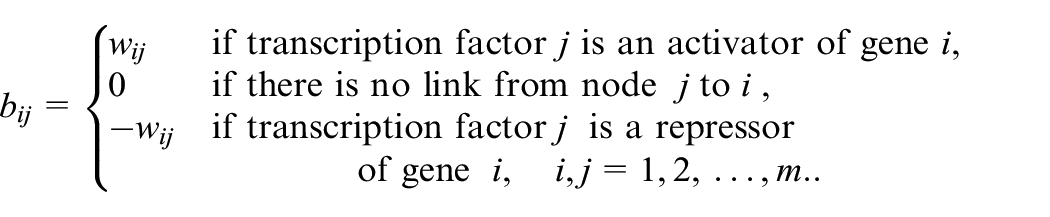
where denotes Caputo fractional-order derivative from initial point , , and represent the concentrations of the mRNA and protein, respectively; and are the decay rates of mRNA and protein, respectively; is the translation rate; , is the Hill coefficient and is a positive constant; , is bounded and is the set of all the j which is a repressor of gene i, and
In biological systems, the concentration of the constituents is not uniform, resulting in diffusion of cytoplasm from higher to lower concentrations, which is known as diffusion. The gene regulatory networks with reaction diffusions were formulated and have shown significant prospects for spatio-temporal pattern storage and matching, refer Liang et al. (2020) and Li et al. (2017). Recently, stochastic models have been broadly investigated as they are commonly found in people’s daily lives. Stochastic perturbations not only separate the models from deterministic cases, but also can bring about substantial modifications in dynamic actions of gene regulatory networks, refer Coulier et al. (2021) and Xu et al. (2020b). In general, the behaviors of stochastic systems are highly reliant on time and spatial. Consequently, reaction diffusion is necessary to be taken into account, and this induces the investigations of stochastic reaction diffusion systems, refer the researching topics on the exponentially stable in the mean-square sense (Wei et al., 2019) and chaos synchronization (Tai et al., 2019), etc.
Discrete-time neural networks are better fitted for real-time implementations. There are two advantages to working in a discrete-time framework. First, appropriate technology can be used to implement digital controllers rather than analog ones. Second, the synthesized controller is directly implemented in a digital processor. Therefore, control methodologies developed for discrete-time nonlinear systems can be implemented in real systems more effectively (Garrappa and Popolizio, 2011; Shao et al., 2022; Yang et al., 2022; Zhang and Xu, 2019; Zhang et al., 2020; Znidi et al., 2022). A number of processes have a certain regularity; however, they are not completely periodic. So, the study of almost periodic or automorphic sequence has been a significant and interesting topic in the field of difference equations owing to the intensive evolution of the theories of difference equations and the applications in the areas of science and engineering, please refer Li and Shen (2021), Lizama and Mesquita (2013), Aouiti et al. (2021), Xu et al. (2020a) and Feng and Zong (2018) for some relevant works in this field.
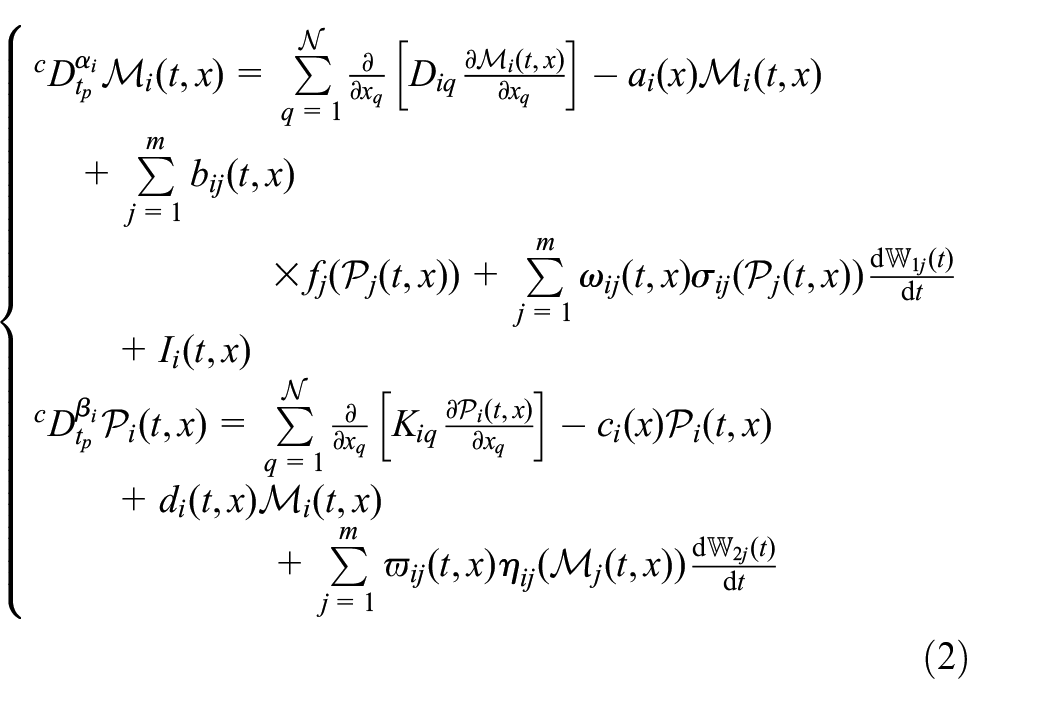
For all the authors know, up to now, there are few papers focusing on the study of almost periodicity or automorphy to genetic regulatory networks in literatures (Aouiti and Dridi, 2021; Ayachi, 2021, 2022; Duan et al., 2020; Stamova and Stamov, 2021). Furthermore, almost no paper discusses almost automorphic oscillations of fractional-order stochastic gene regulatory networks with reaction diffusions, and we can observe that almost all of the existing findings are about the time variable. Motivated by the above analysis, by introducing the space variable, this paper discusses the nonlocal stochastic genetic regulatory networks with reaction diffusions in the formula of
where , , , , , ; ; and denote Caputo fractional-order derivatives from initial point , ; and stand for the transmission diffusion matrixes; and denote the Brownian motion on a complete probability space, .
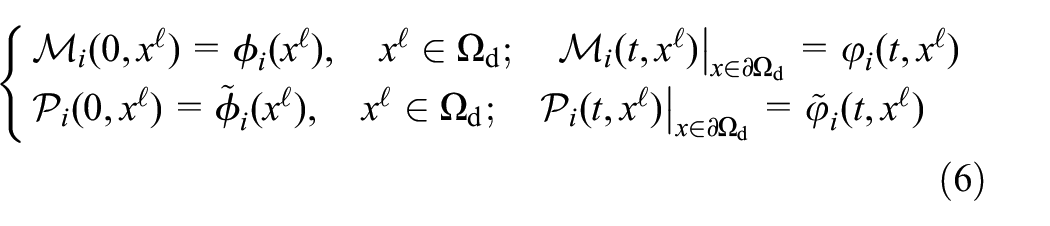
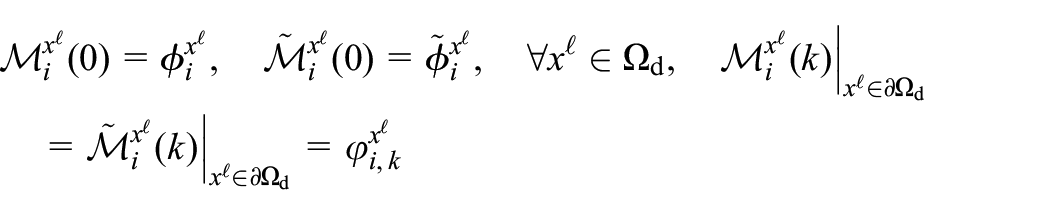
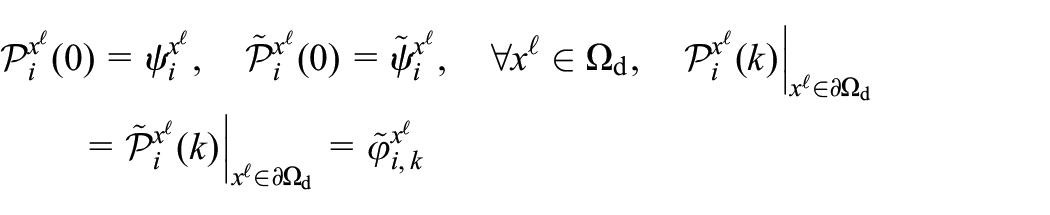
The corresponding initial boundary conditions of model (2) are depicted as
where
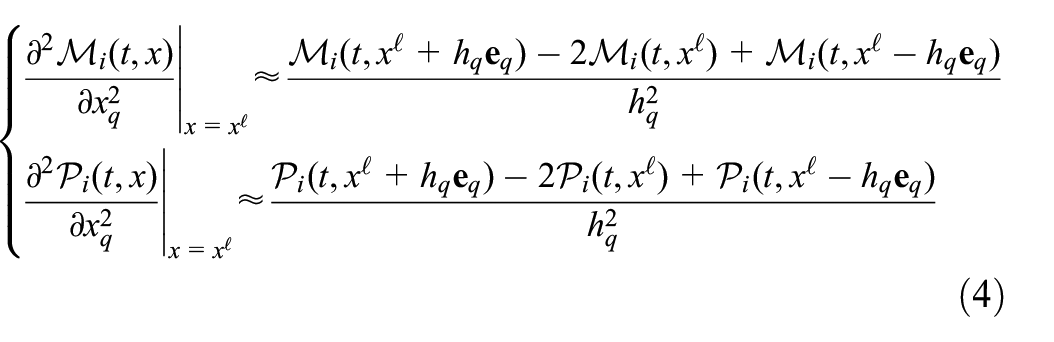
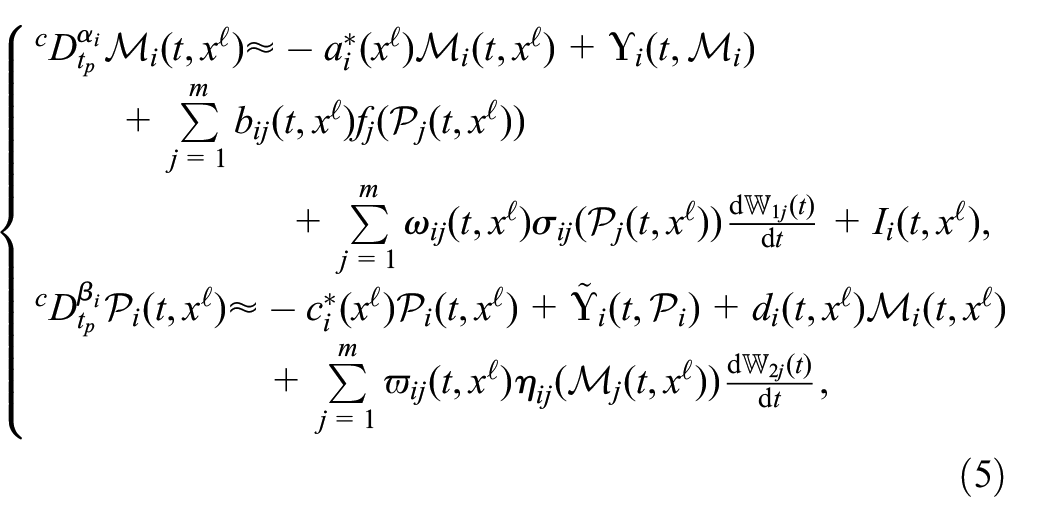
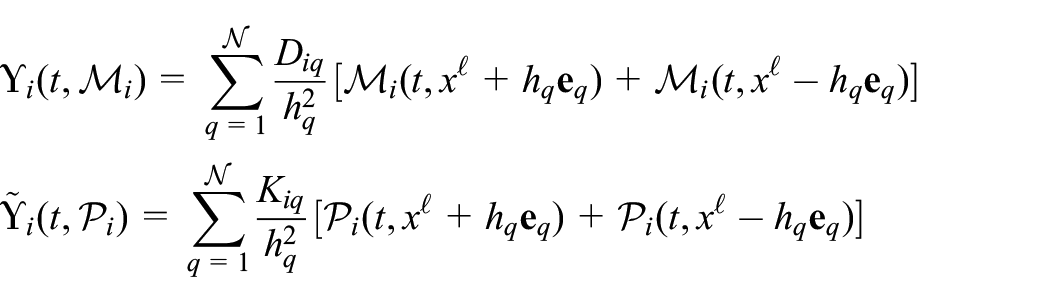
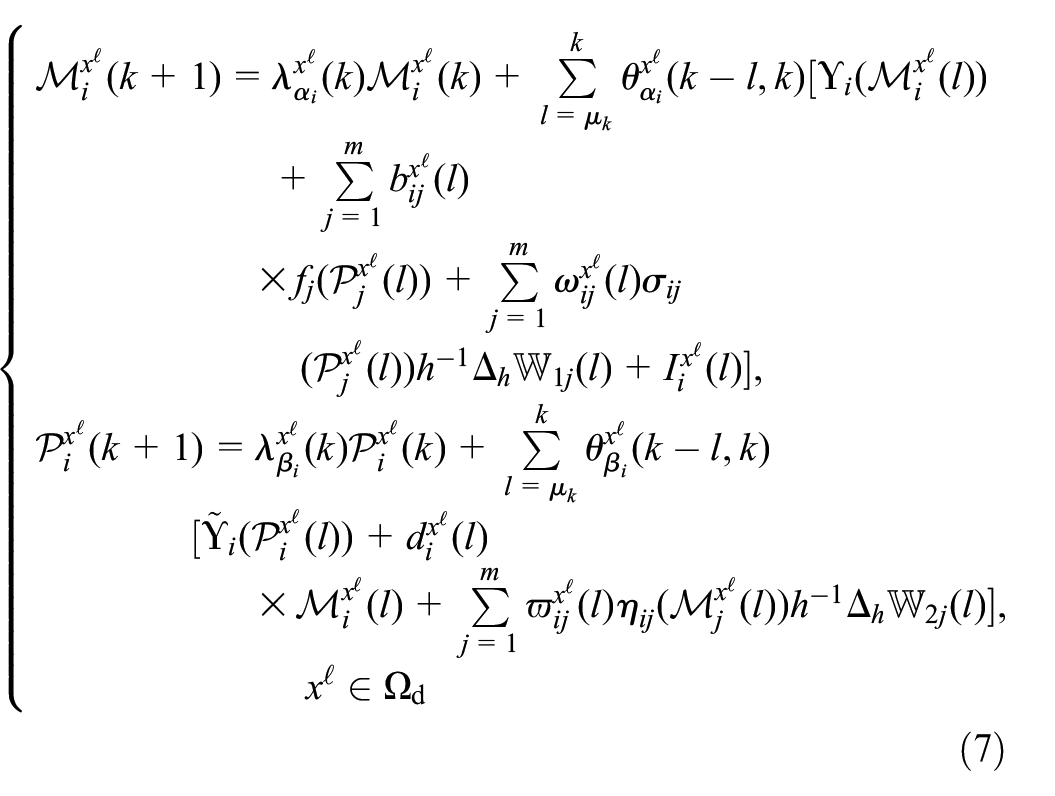
By employing a mix of the finite difference methods and Mittag–Leffler Euler time difference techniques, the objective of the current paper is to achieve the discrete-time and discrete-space schemes corresponding to model (2). In addition, on this basis, the existence and uniqueness of bounded almost automorphic sequence solution in distribution for equation (7) are achieved. Then, the global exponential stability in the mean-square sense is investigated. Compared with the previous literatures, the distinct characteristics of this article are narrated as follows:
Based on the finite difference and Mittag–Leffler Euler difference techniques, a novel stochastic lattice model for model (2) is introduced.
The existence of a unique bounded almost automorphic sequence solution in distribution is discussed.
Global exponential convergence in the mean-square sense is considered.
The organization of the rest is as follows. In “Stochastic lattice networks” section, a stochastic lattice model corresponding model (2) is achieved by using the finite difference methods and Mittag–Leffler Euler difference techniques. The existence of a unique bounded almost automorphic sequence solution in distribution and global exponential convergence in the mean-square sense are discussed in “Almost automorphic motions” and “Global mean-square -exponential convergence” sections. In “Illustrative example” section, an illustrative example and some numerical simulations are employed to visually expound the current research findings. The conclusions and future works of this paper are presented in “Conclusion and perspectives” section.
Symbols: denotes the space of m-dimensional real vectors; is the field of integral numbers; ; ; for any ; , . Let be some sets, .
Stochastic lattice networks
Let us introduce the relative conception of fractional calculus as below. The -order Caputo fractional derivative of is defined by
where . The Riemann–Liouville fractional integral of is given by
where .
The Mittag–Leffler functions play a vital role in this paper, we now present the definitions of one-parameter and two-parameter Mittag–Leffler functions and some properties which will be used in the sequel.
By Lemma 1 and a direct calculation, it easily gets the lemma below.
Lemma 3.If, and, one has
for all
Almost automorphic motions
This section introduces some usual notations and concepts concerning the almost automorphic sequence, as well as several crucial inequalities.
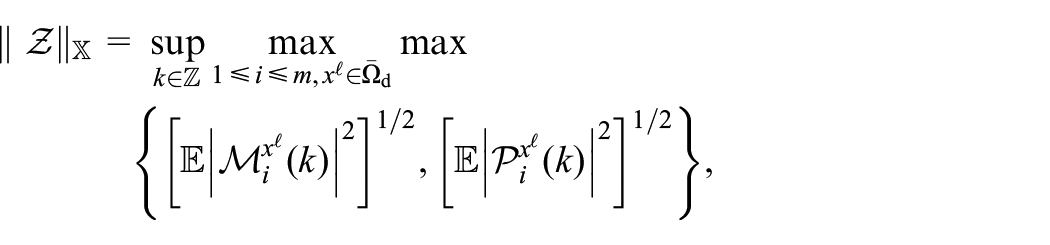
Let be the expectation under a complete probability space and be a two-sided standard -dimensional Brownian motion defined on . Set for . Furthermore, denotes the family of all square integrable -valued random variables and stands for the set of all functions from to endowed with the norm
where Obviously, becomes a Banach space. In the whole paper, are -adapted and are -adapted,
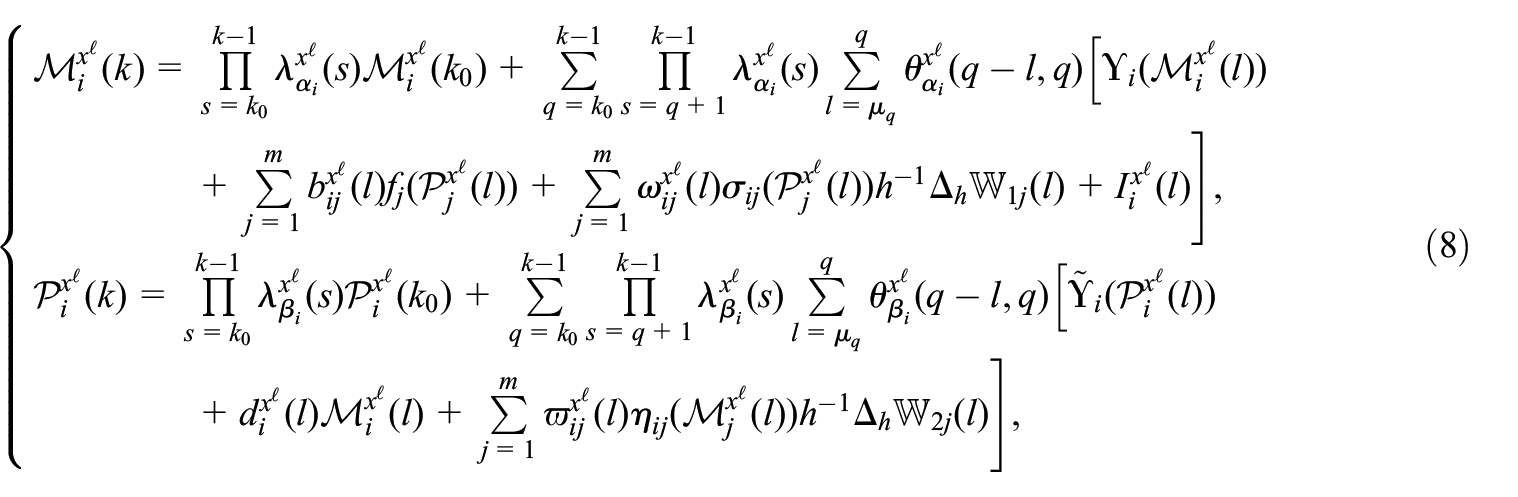
Definition 1.A discrete-time stochastic processis called the solution of equation (7) if it is-adapted and meets equation (8).
Definition 2.(Diagana, 2013) is called Bohr almost automorphic sequence if for each sequence , it has a sequence and some function meeting
uniformly for on any compact subset from .
The random sequence converges to f in distribution if the corresponding laws of weakly converge to the law of f. The definition of weak convergence can be found in literature (Cheban and Liu, 2020).
Definition 3.A mappingis called Bohr almost automorphic sequence in distribution in case for each sequence, if there exists a subsequence and some function such thatconverges to some functionin distribution andconverges toin distribution uniformly on any compact subset from.
Next, we collect some important inequalities and more details please refer to literatures (Kuang, 2012; Zhang and Xu, 2019).
Lemma 4. (Kuang, 2012) (Minkowski inequality) If , then
Lemma 5. (Kuang, 2012) (Hölder inequality) Let and . Then
Lemma 6. (Zhang and Xu, 2019) Letandbe a two-sided standard one-dimensional Brownian motion. Then
where,
Here, we need the following assumptions.
(H1) is a periodic sequence, that is there exists such that , .
(H2) , , , , and are Bohr almost automorphic sequences with respect to variable , , .
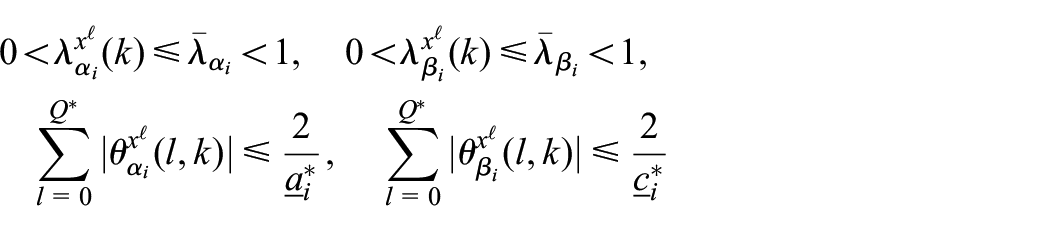
(H3) It exists positive numbers , , and such that
for any ,
Define which is a sequence. Let ,
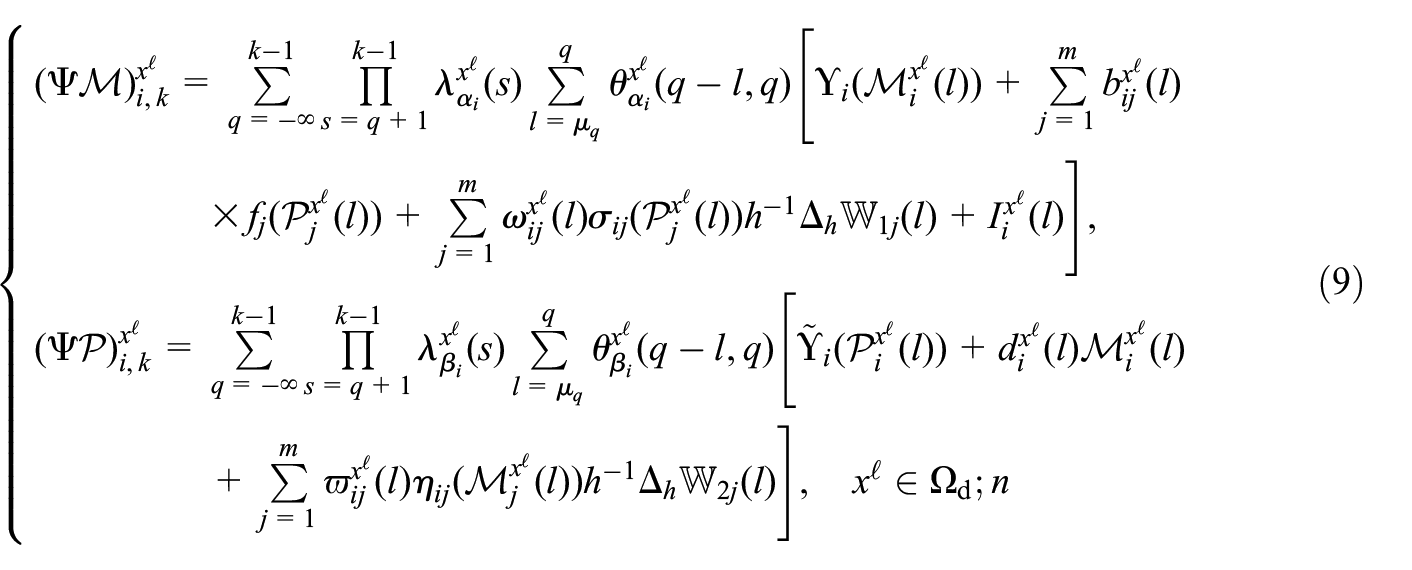
Let In accordance with equation (8), define a mapping as
where
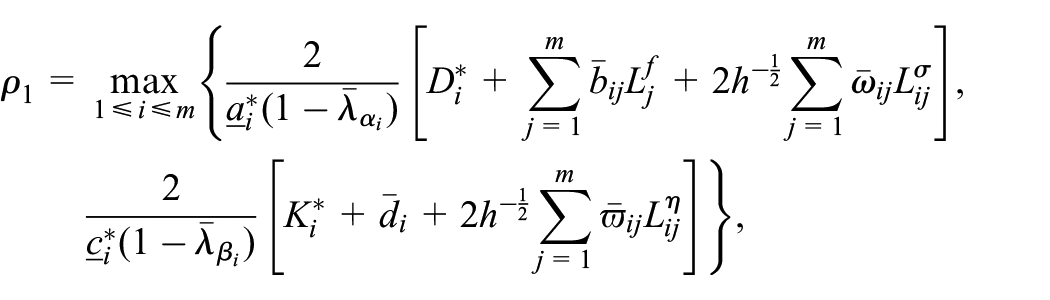
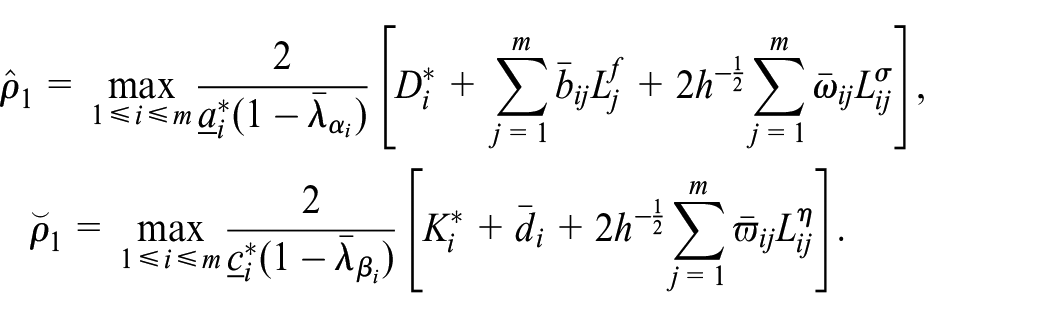
Proposition 1. is well defined and maps to if and below hold.
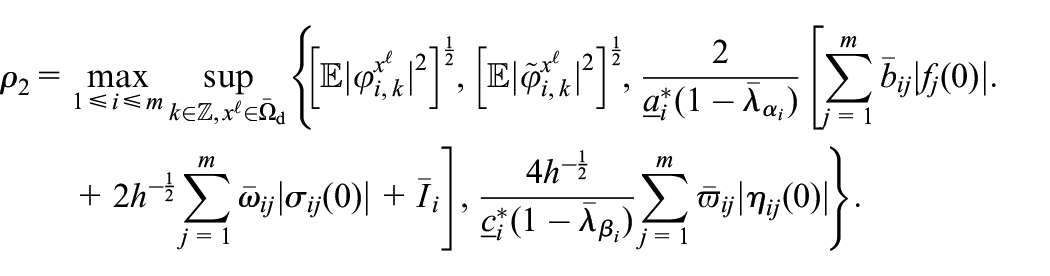
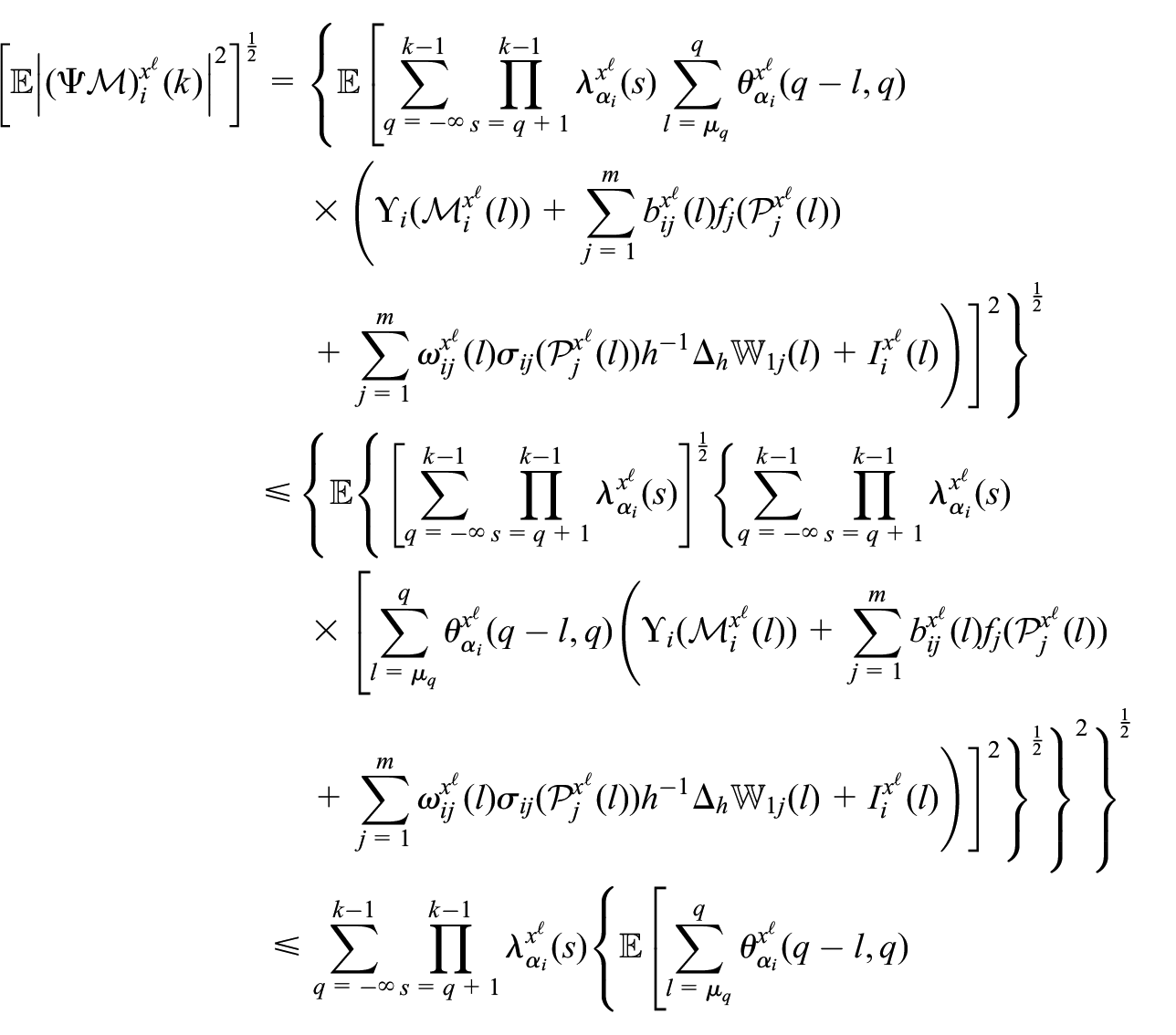
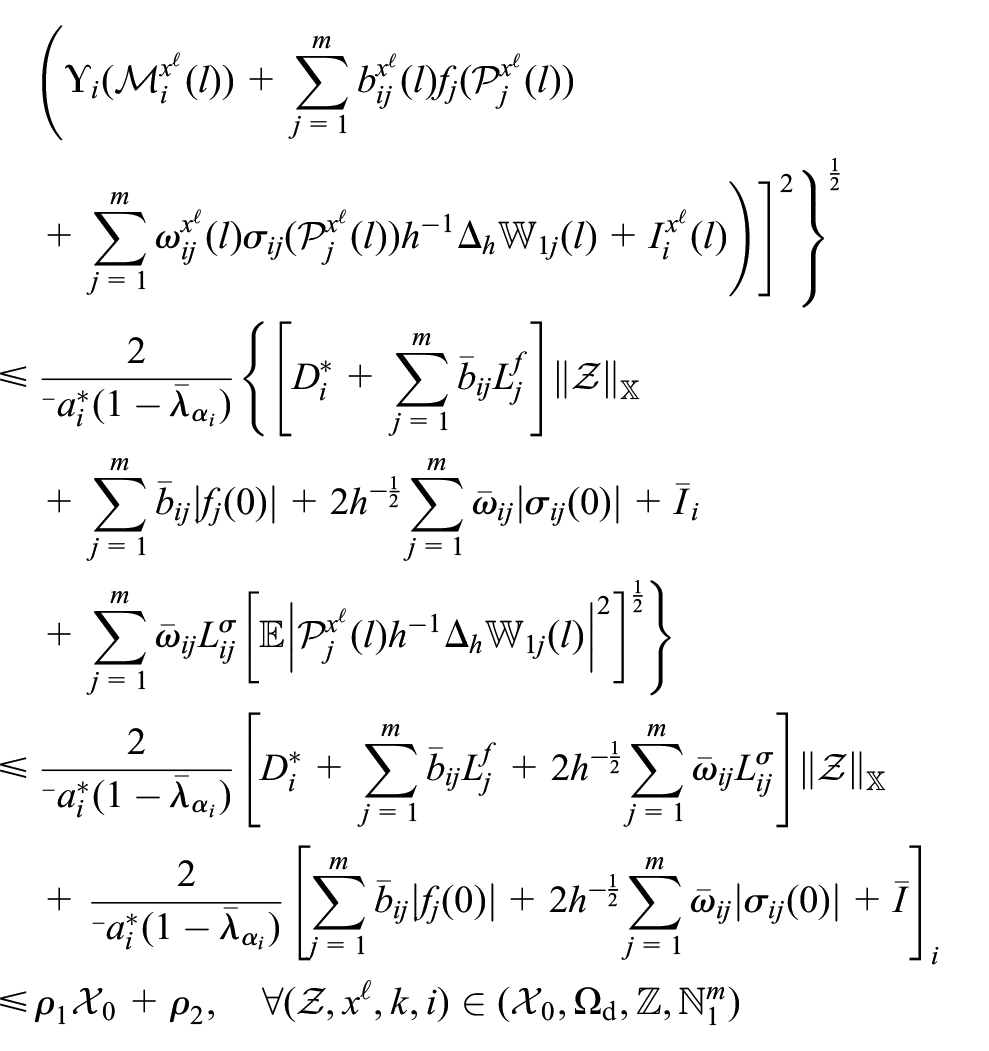
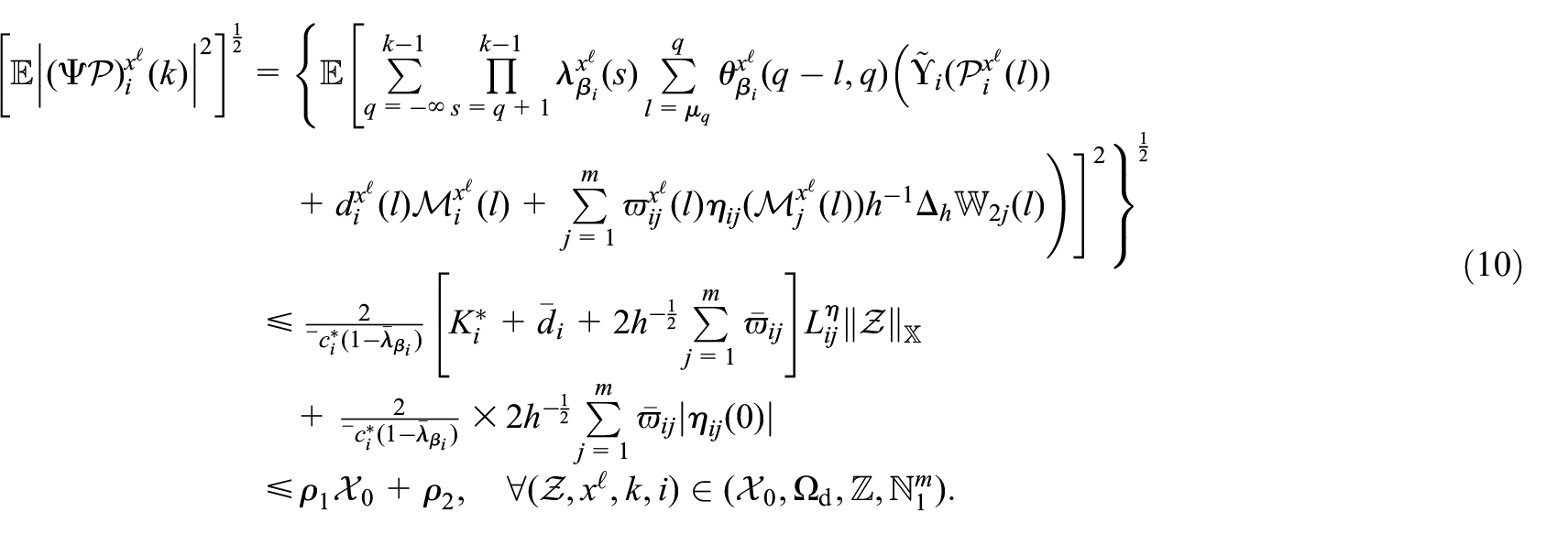
Proof. Suppose that . Based on equation (9), Lemmas 4, 5, and 6, it gets
and by a similar derivation as the above, it acquires
Summarizing the above analyses, it leads to Therefore, is well defined and maps to itself. The proof is achieved.
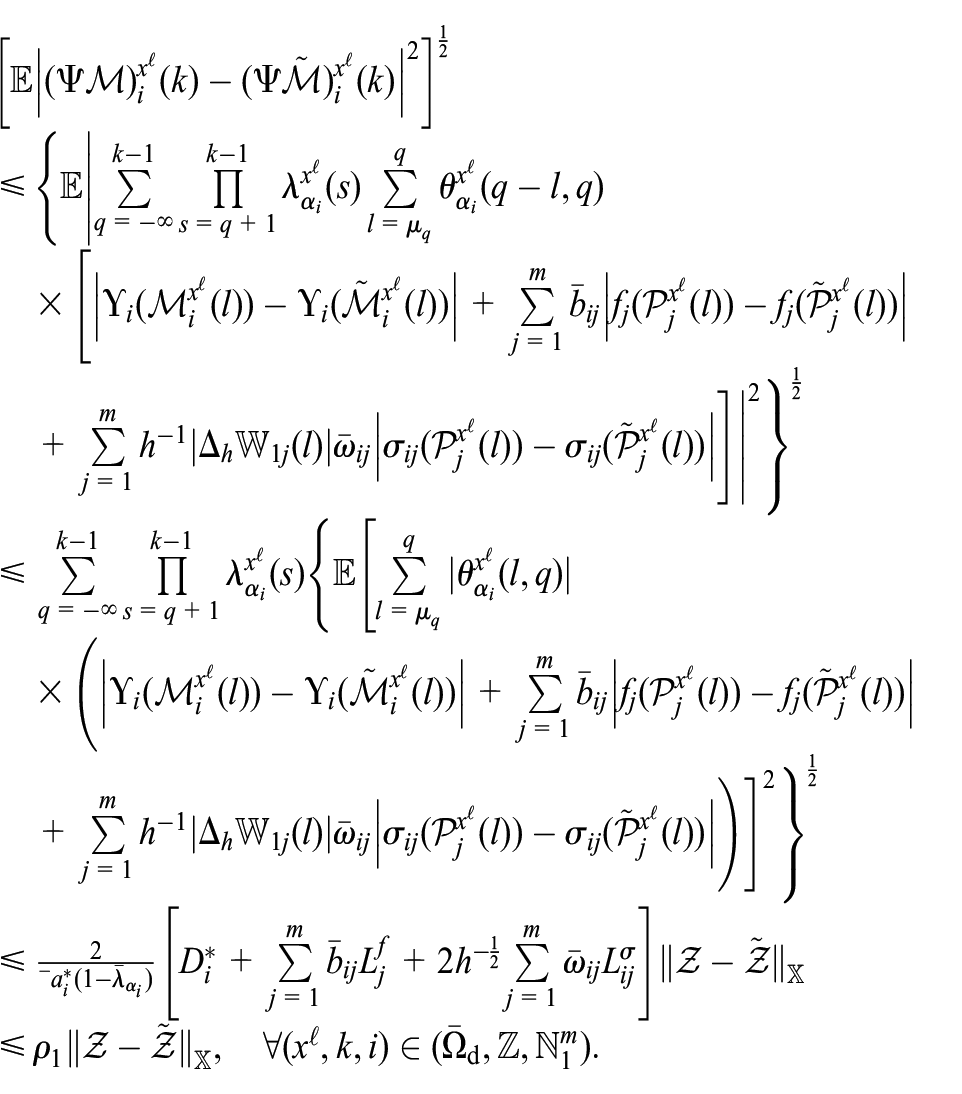
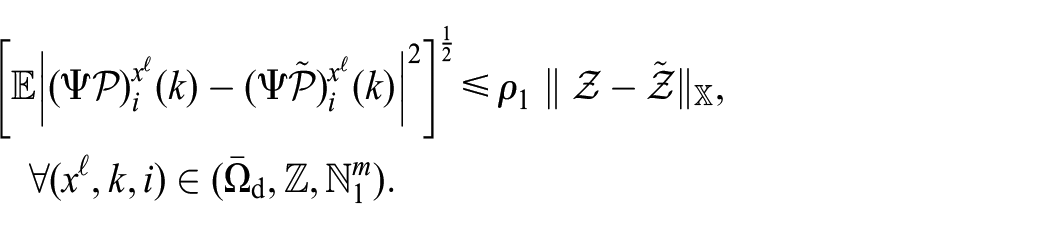
Proposition 2.Equation (7) possesses a unique bounded solution in if - hold.
So . From , is a contractive mapping and has a unique fixed point solving equation (7). This finishes the proof.
Let
Theorem 1.A unique Bohr almost automorphic sequence in distribution solvesequation (7)if-hold.
Proof.Equation (7) possesses a unique solution in on the basis of Proposition 2. From -, for any , it has a subsequence and some functions , , , , and such that uniformly for and
uniformly in k on any compact subset from , , , .
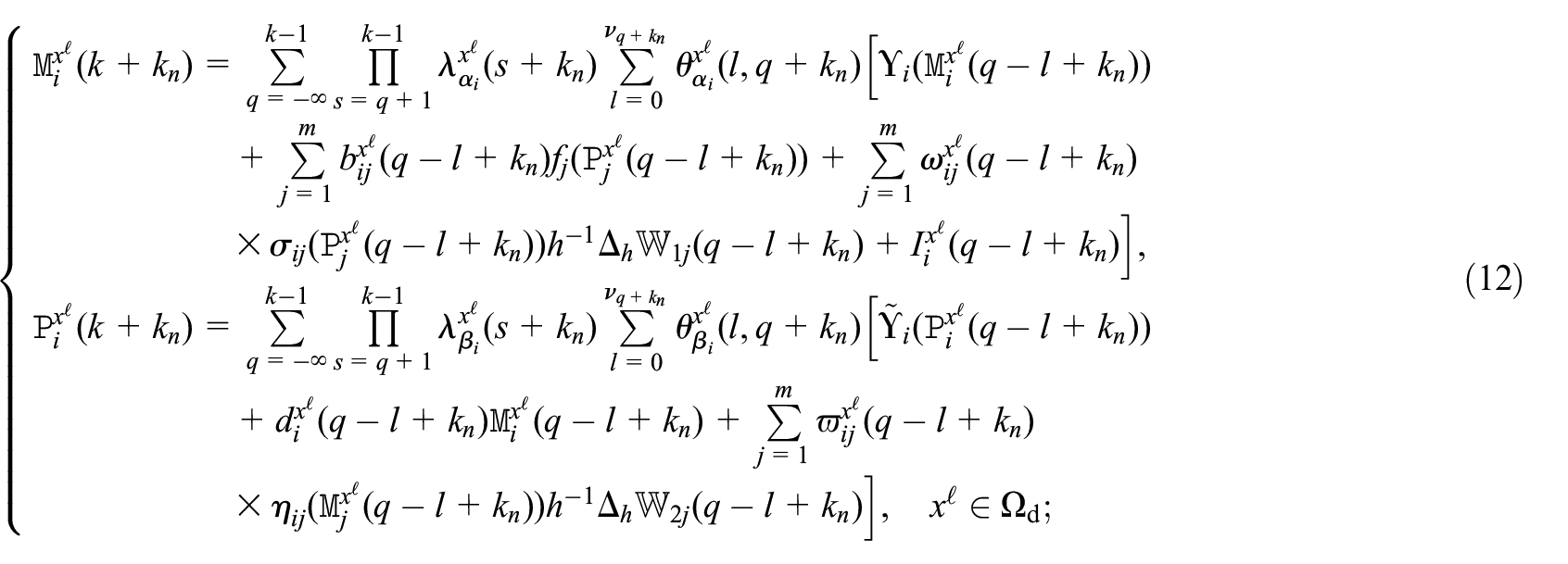
Let be the solution of
According to Proposition 2, the unique solution of equation (7) satisfies
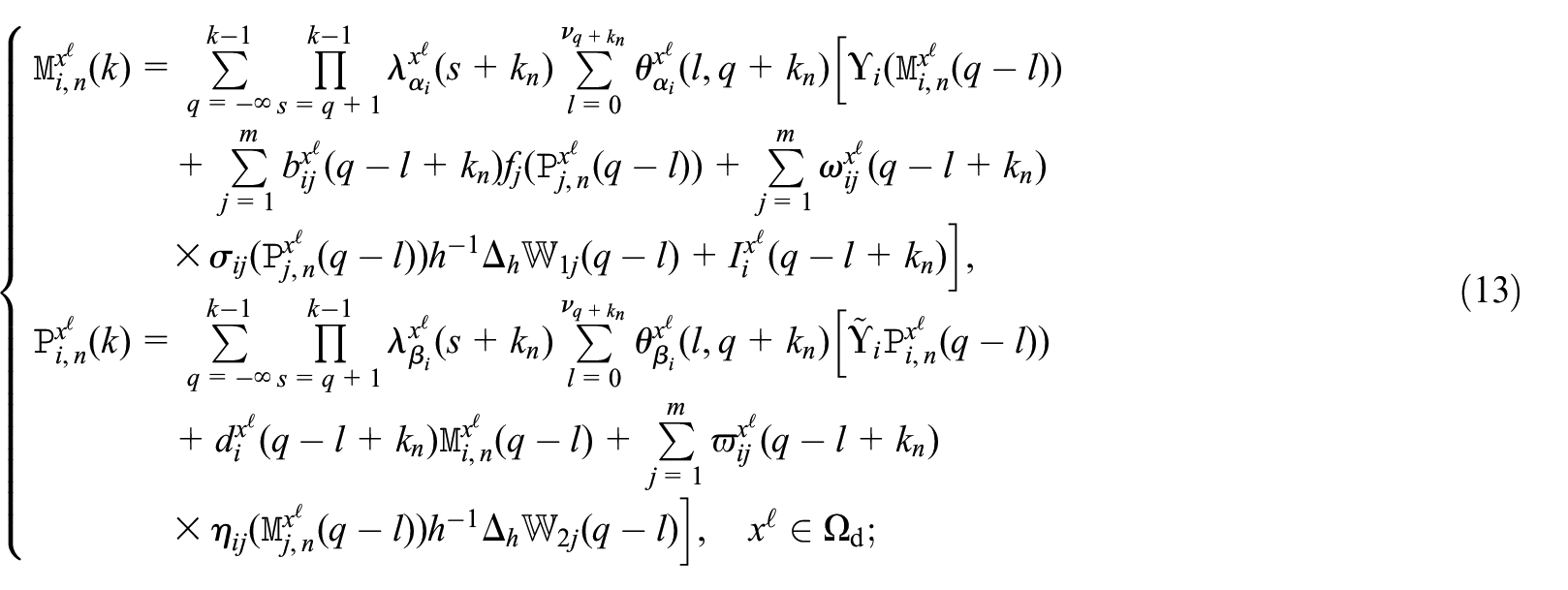
It should be remarked that has the same law as , , . Let us discuss the stochastic process below
Clearly, has the same distribution as , . Similar to , and are unique and bounded in , .
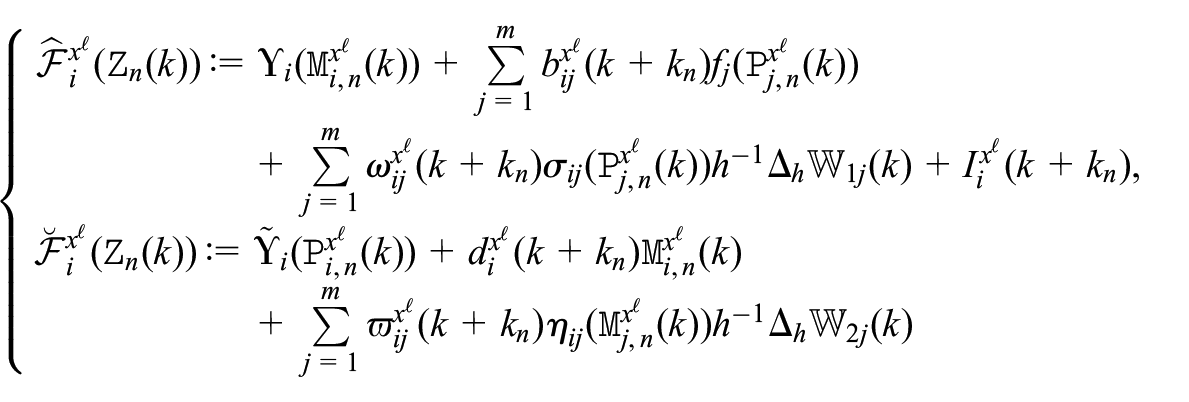
For simplify, let , ,
and
. Because , it must exist a positive constant such that , .
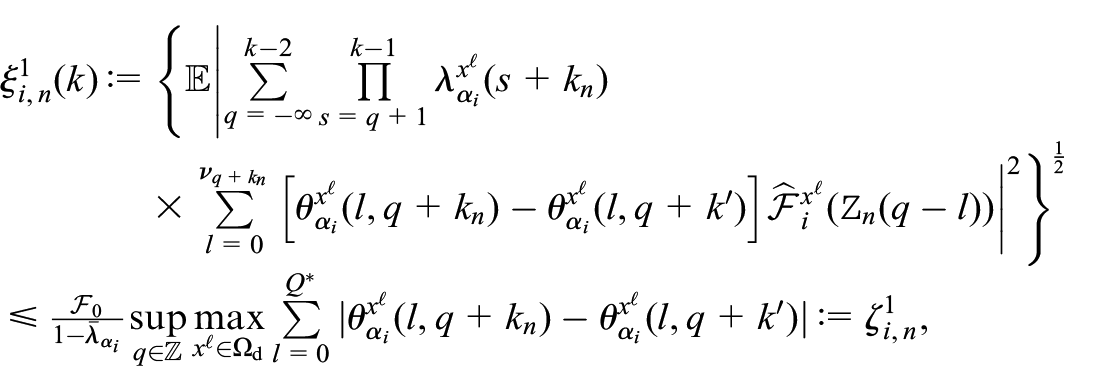
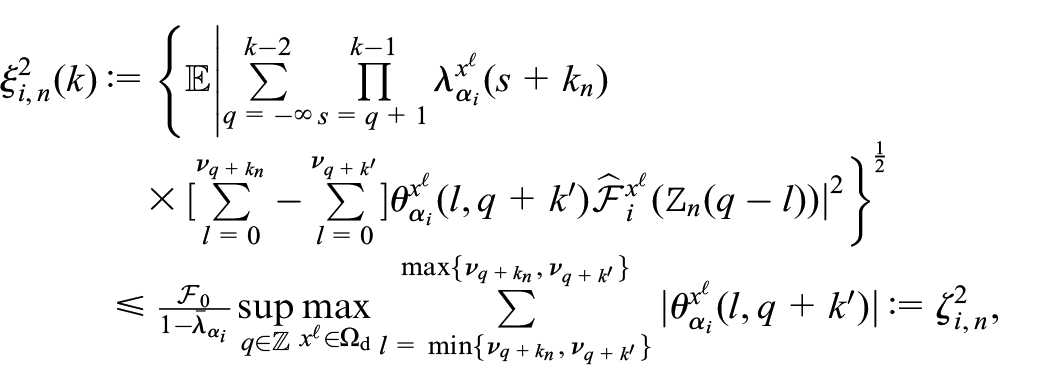
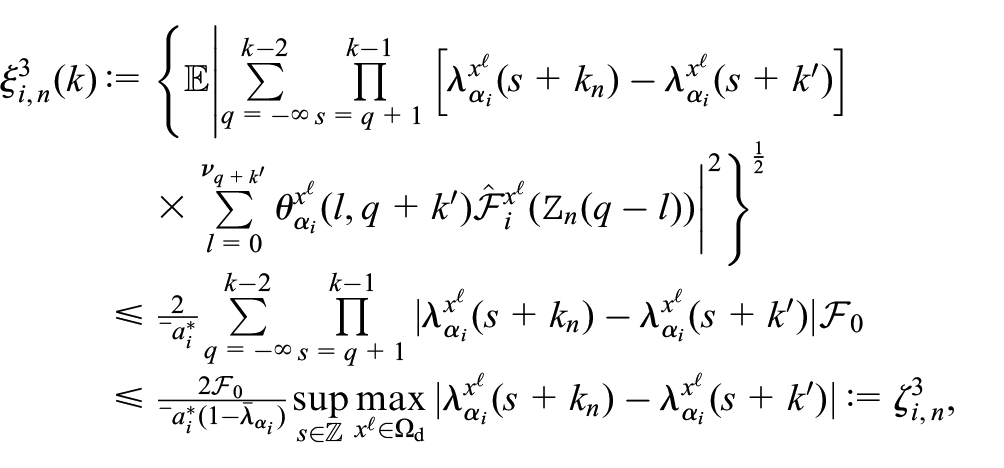
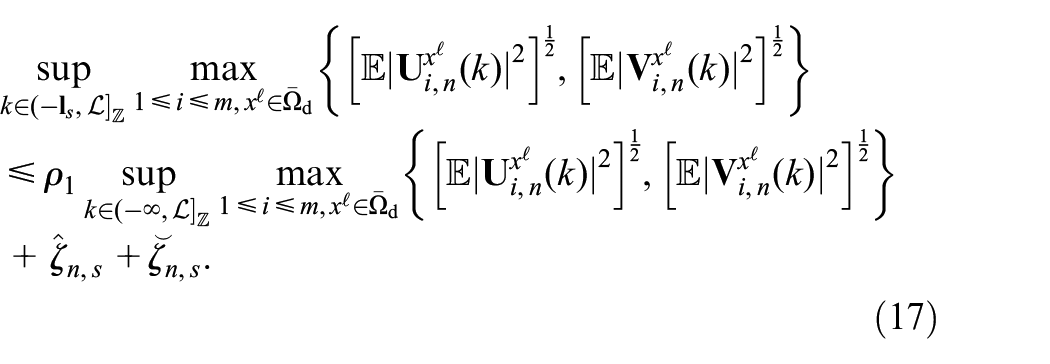
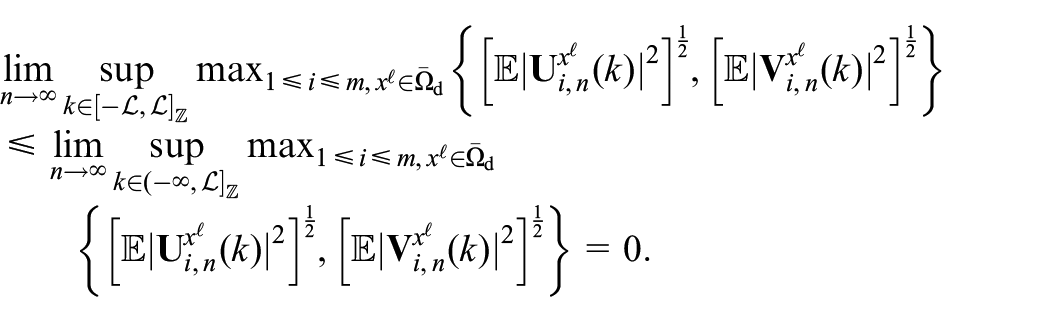
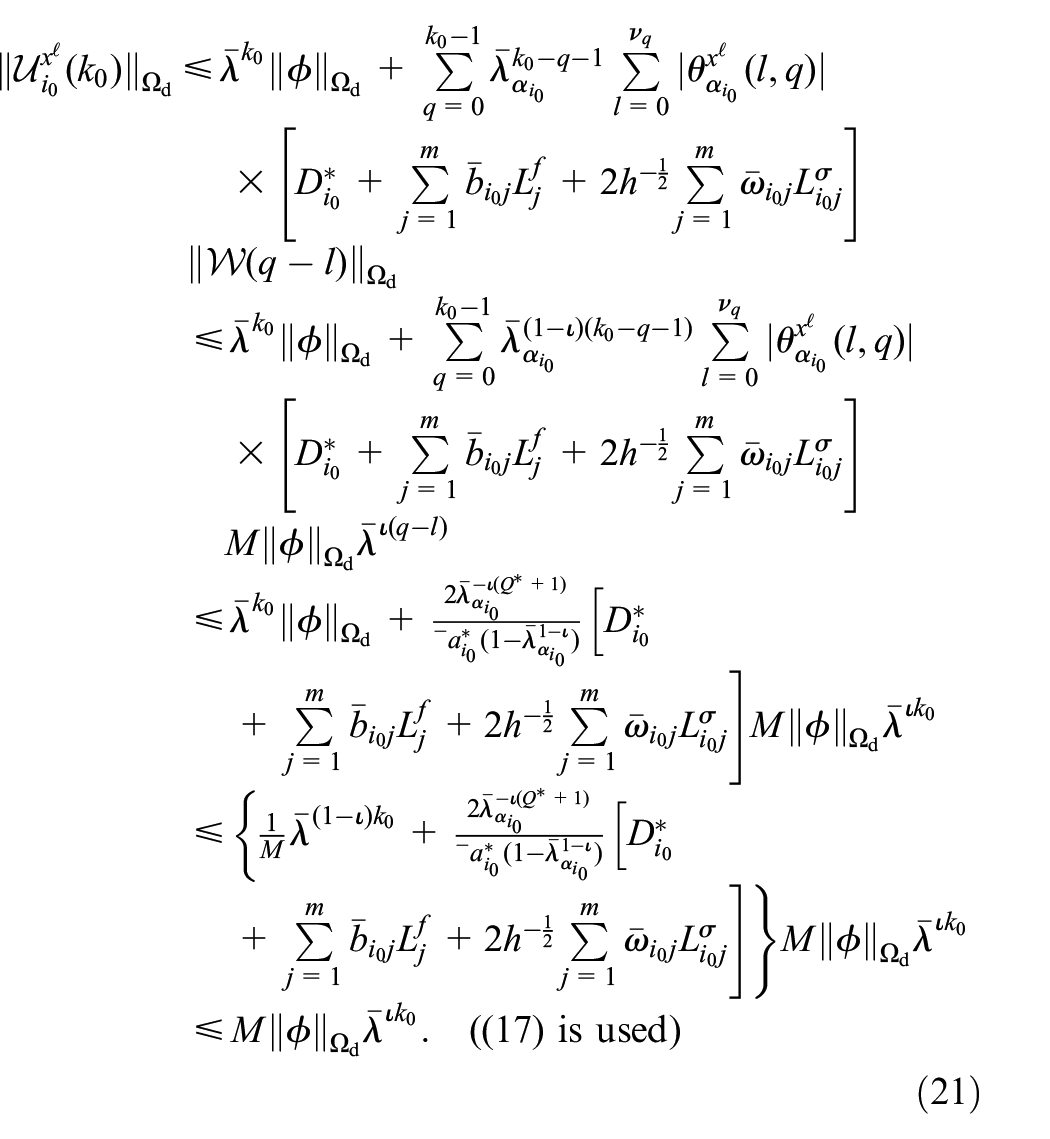
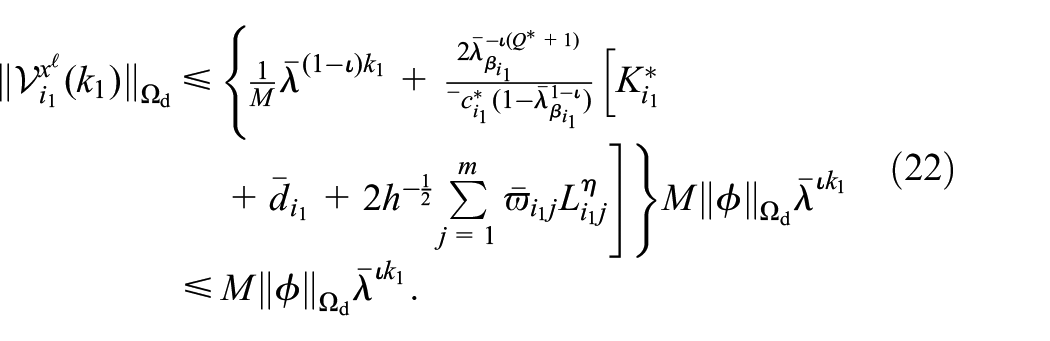
for . In equation (17), letting and in turn, it gains
Because has the same distribution as , converges to in distribution uniformly on any compact subset , . Similarly, it easily obtains converges to in distribution uniformly on any compact subset , . The proof is achieved.
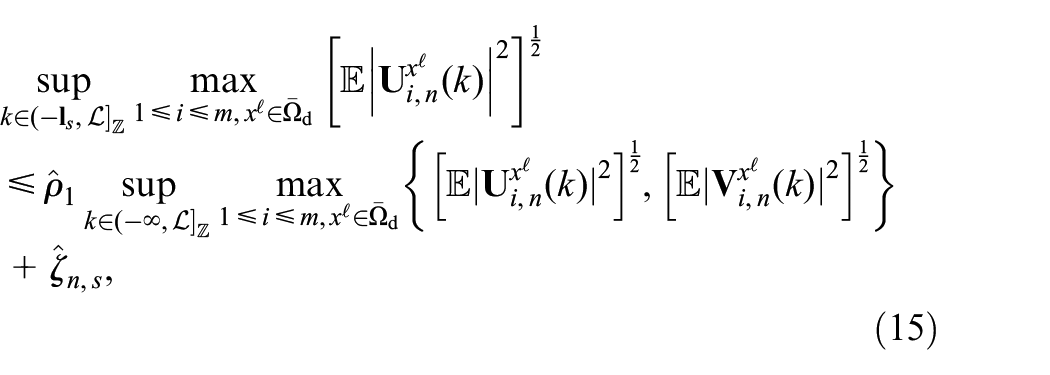
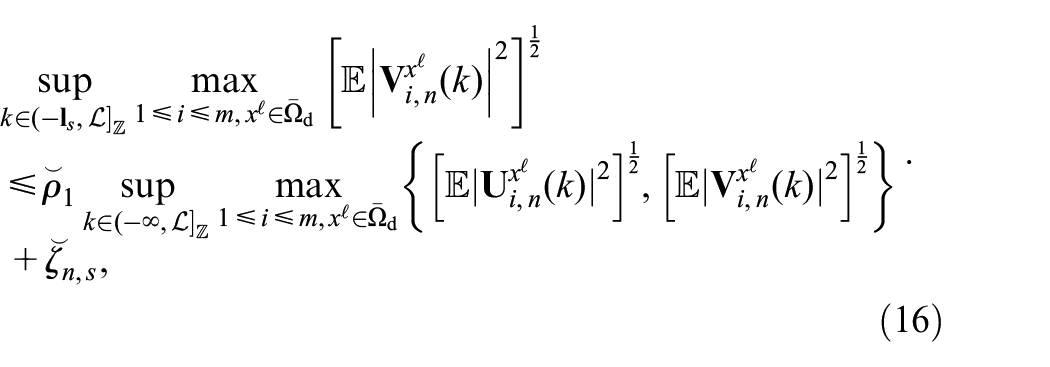
This induces a confliction with . Similarly, by , it acquires
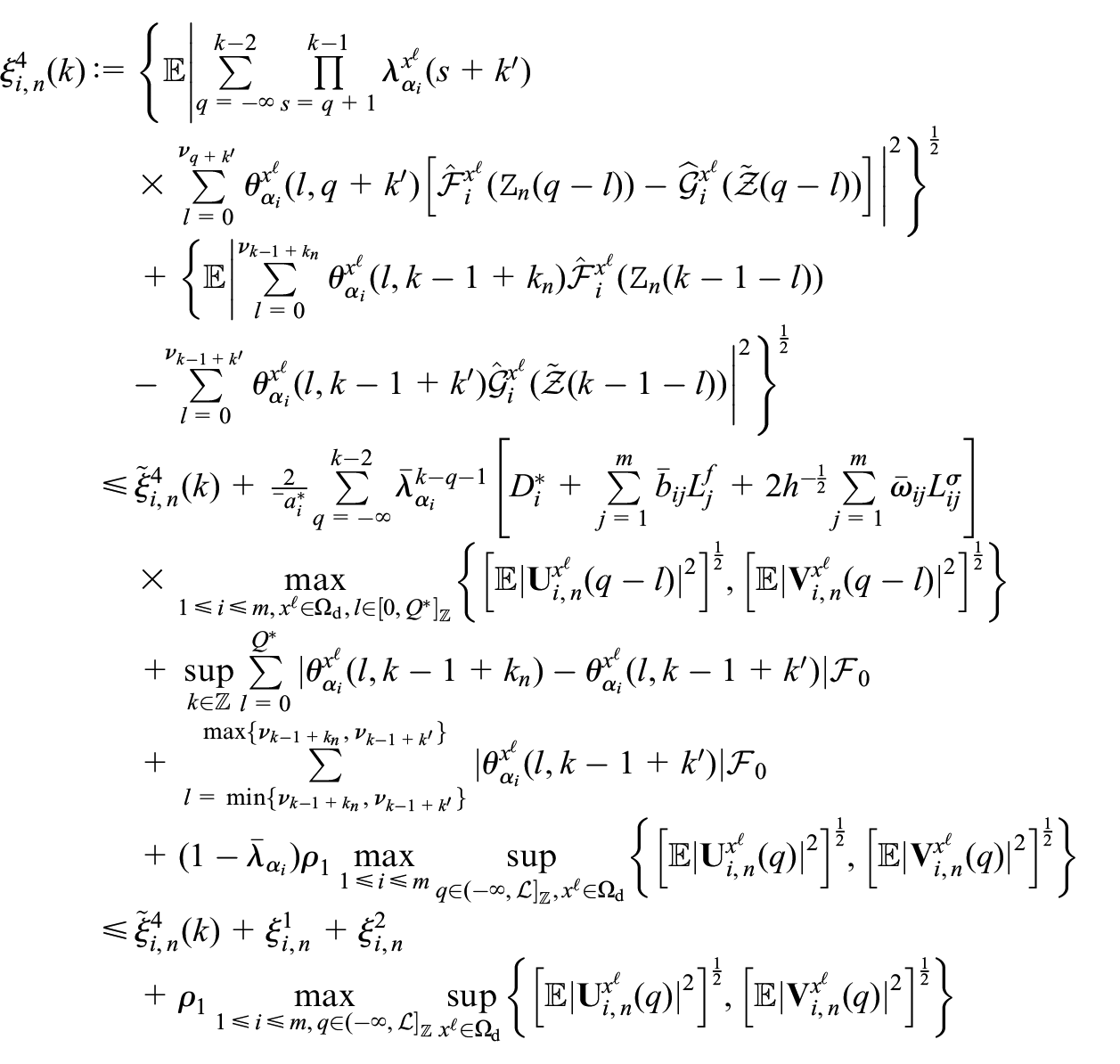
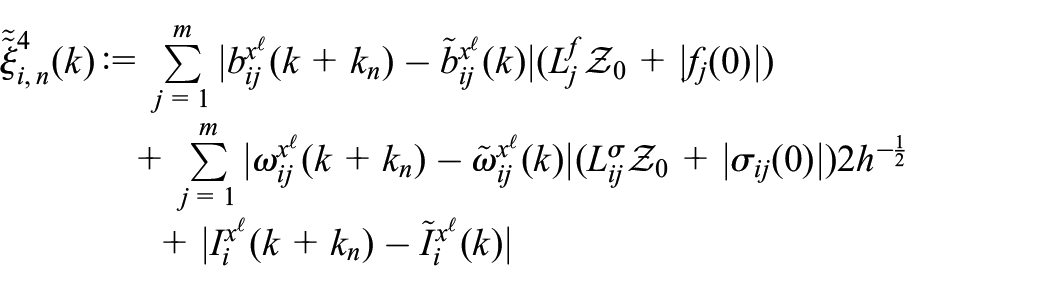
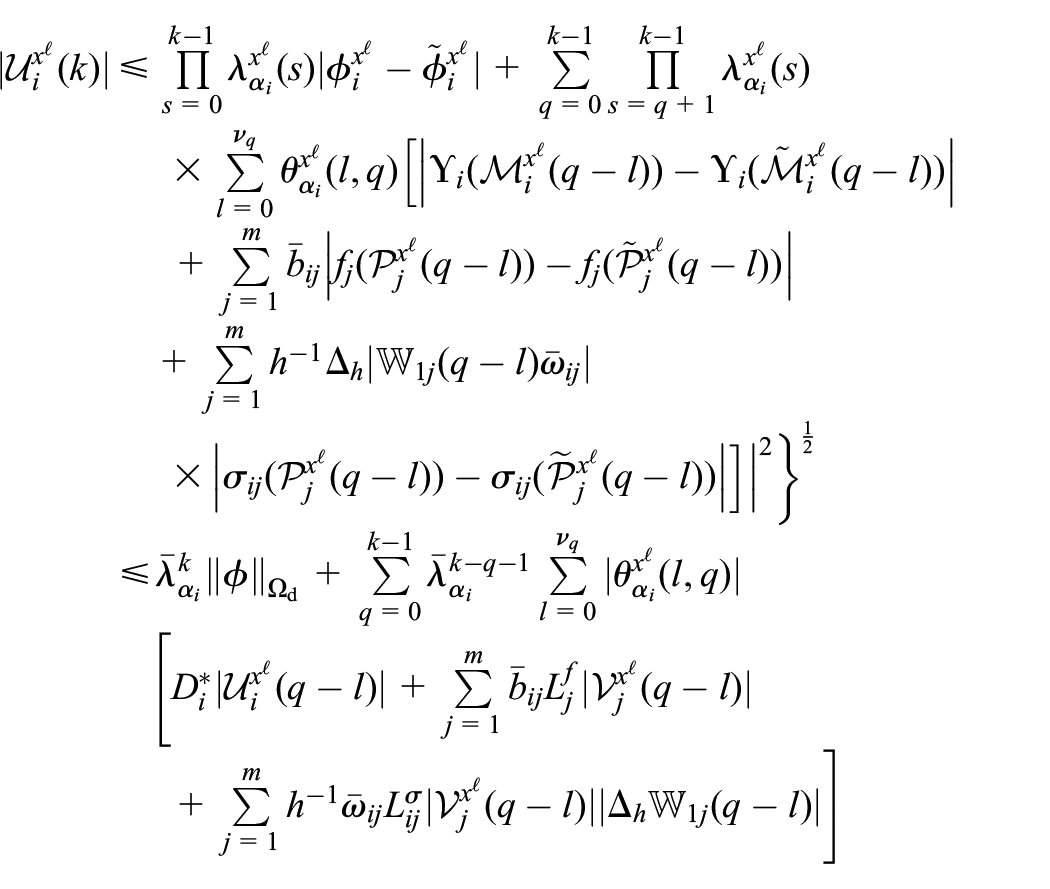
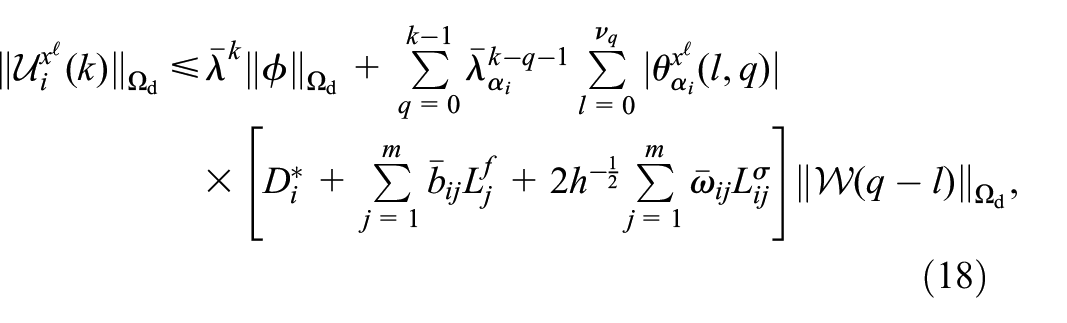
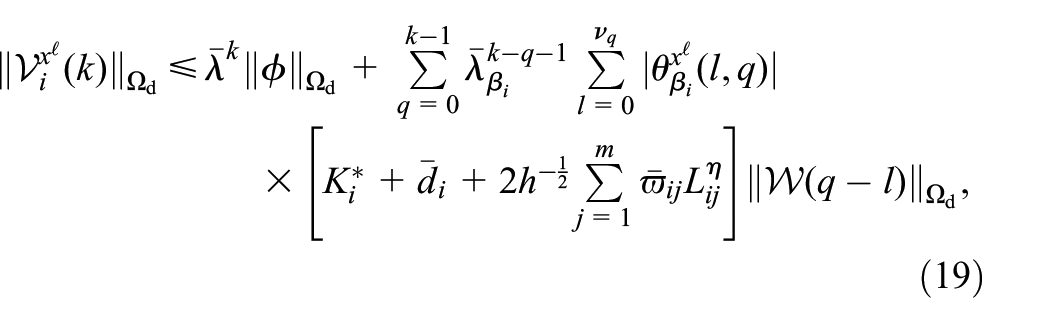
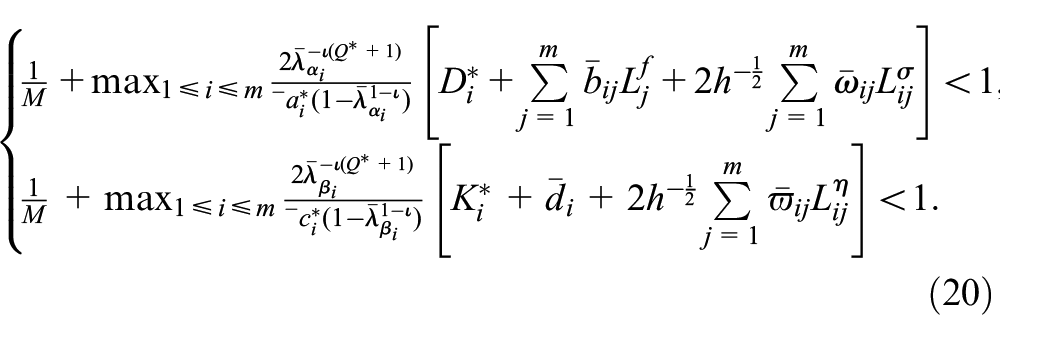
This is also a confliction with . Then for all That is, equation (7) is globally mean-square -exponentially convergent. The proof is finished.
Remark 2. By employing time exponential Euler differences, literatures (Zhang and Xu, 2019; Zhang et al., 2020) discussed exponential convergence of discrete-time stochastic models without diffusions. Apparently, the achieved difference models in literatures (Zhang and Xu, 2019; Zhang et al., 2020) can be viewed as a special case of model (4) to some extent. Thus, the work of this article supplements and extends the corresponding results in papers (Zhang and Xu, 2019; Zhang et al., 2020).
Illustrative example
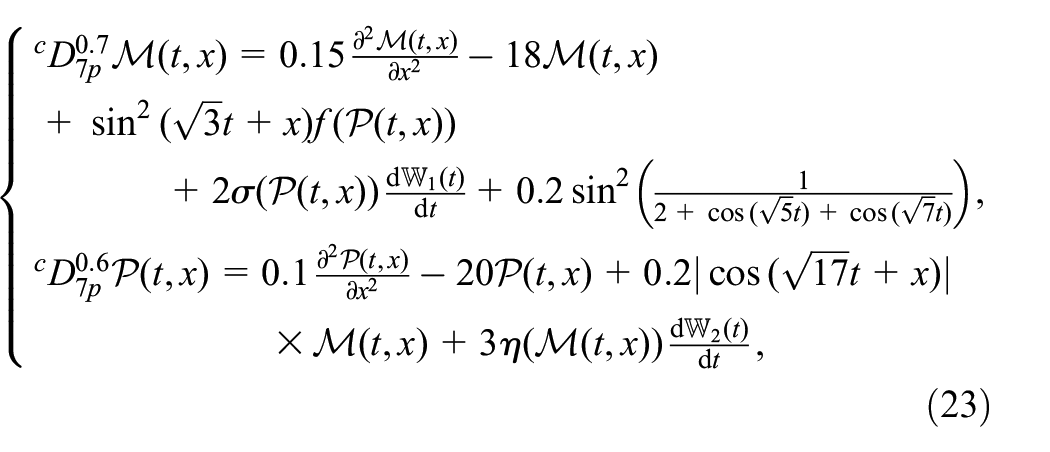
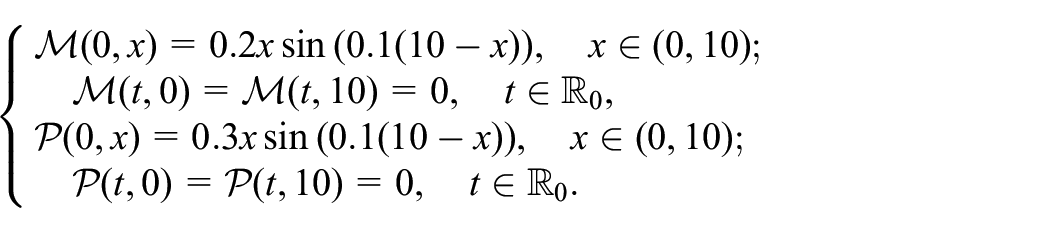
Considering the following nonlocal stochastic genetic regulatory networks with reaction diffusions in the form of
where , ; , , for . The initial boundary conditions are depicted as
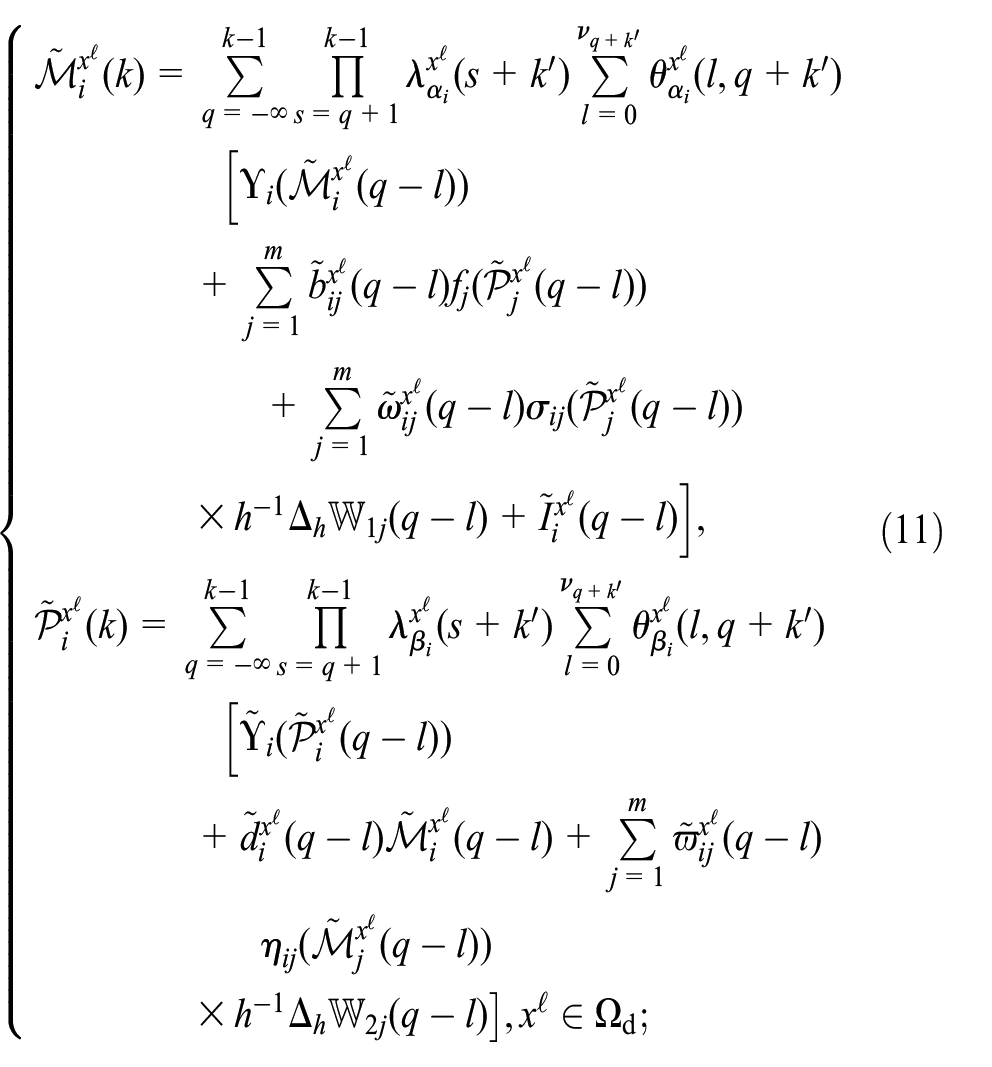
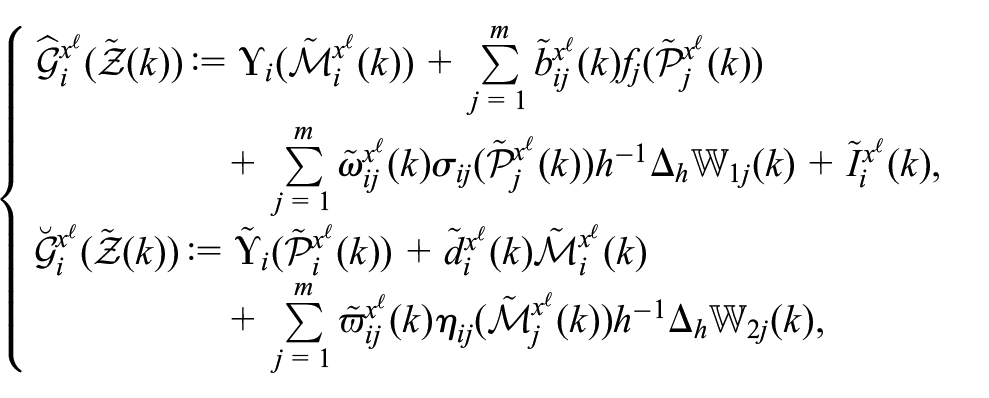
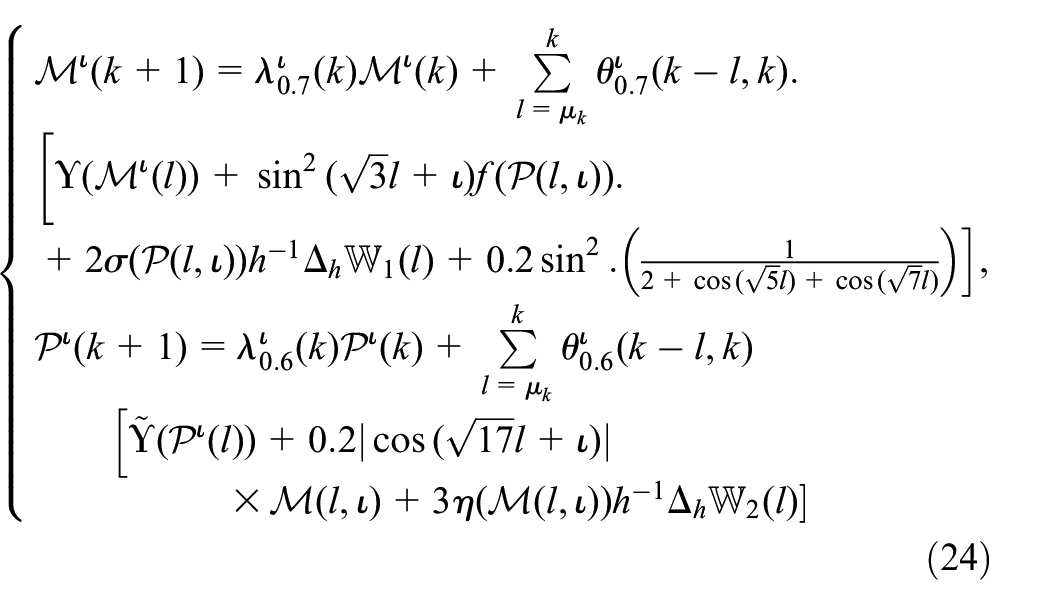
Taking and . It obtains the lattice equations corresponding to equation (9) in the shape of
with initial condition
for , and boundary condition
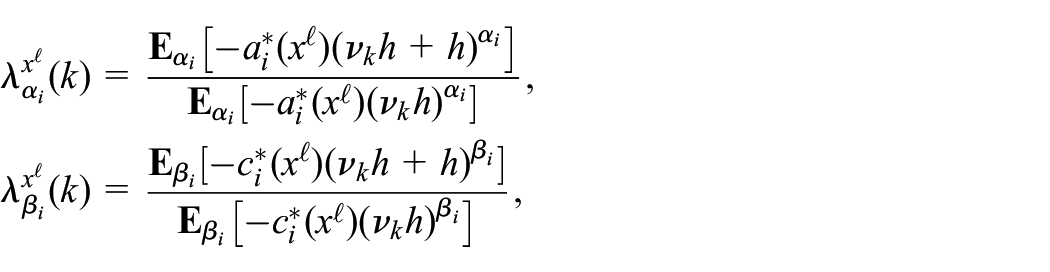
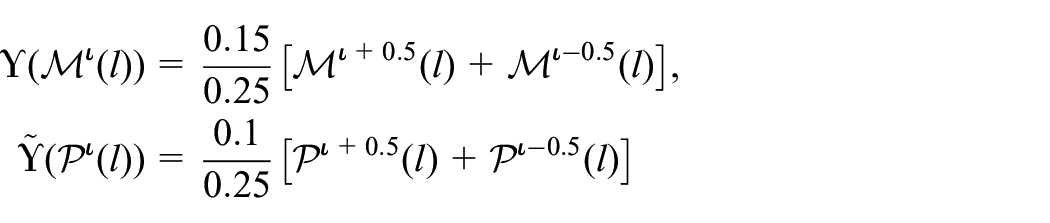
, , , , and are defined as those in (4) with and , respectively;
for all and , .
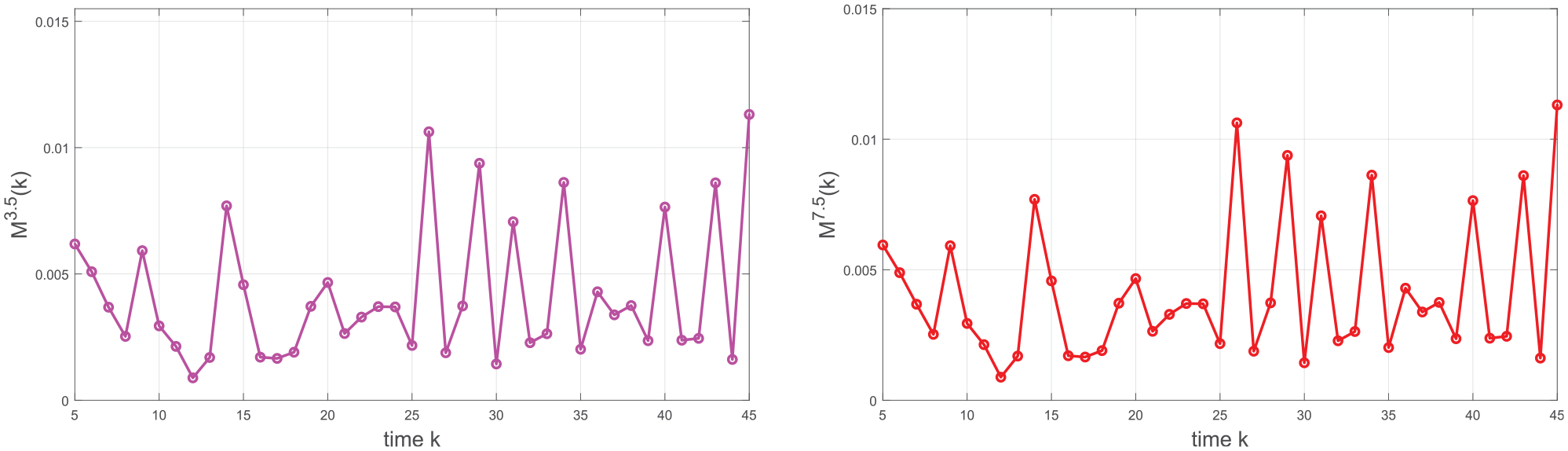
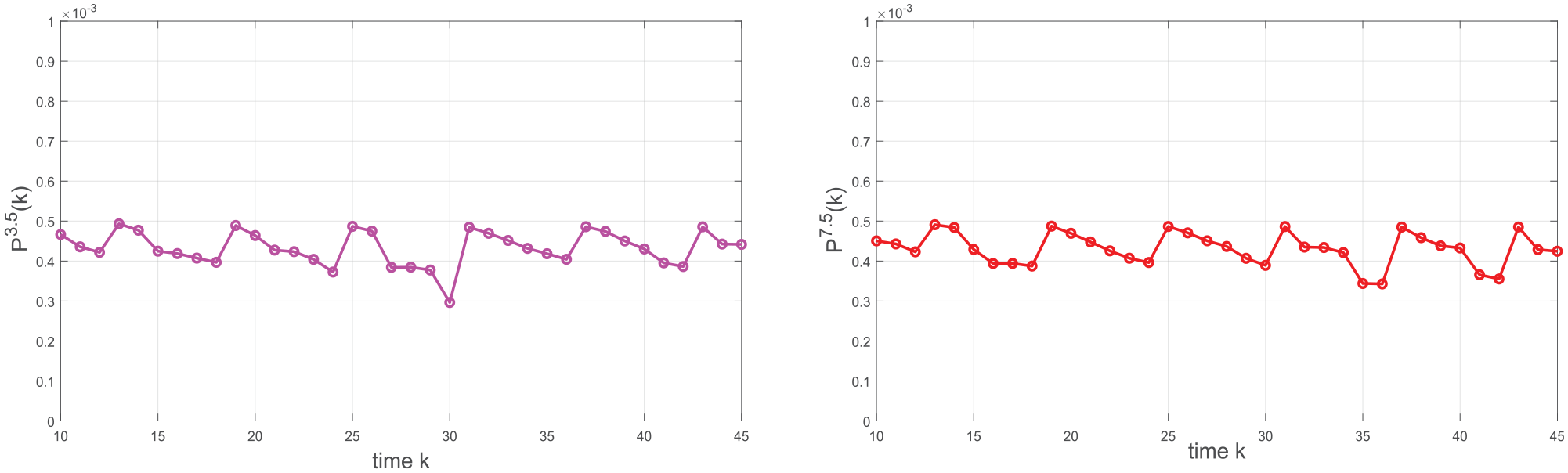
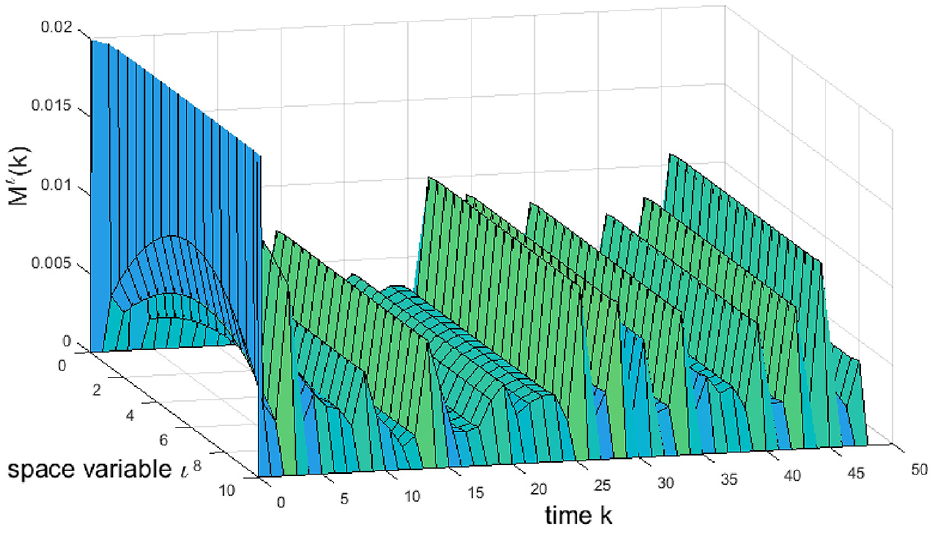
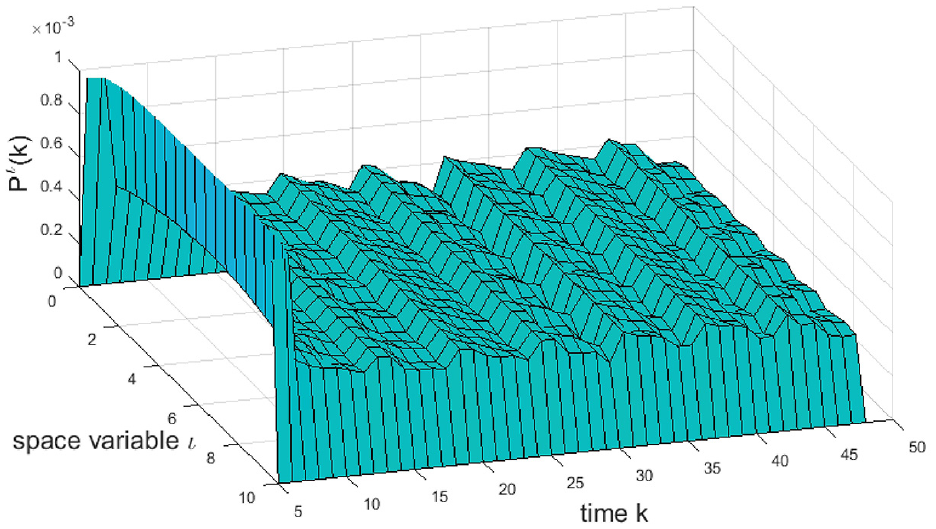
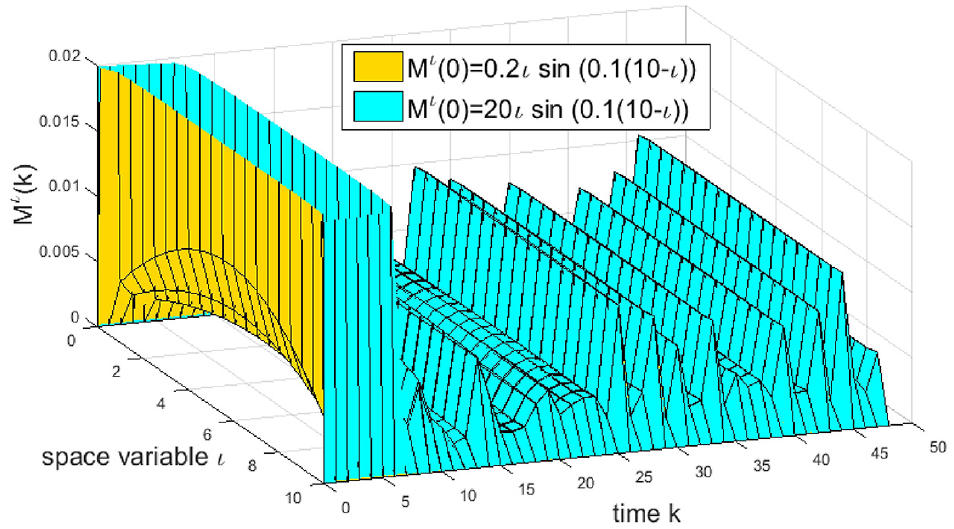
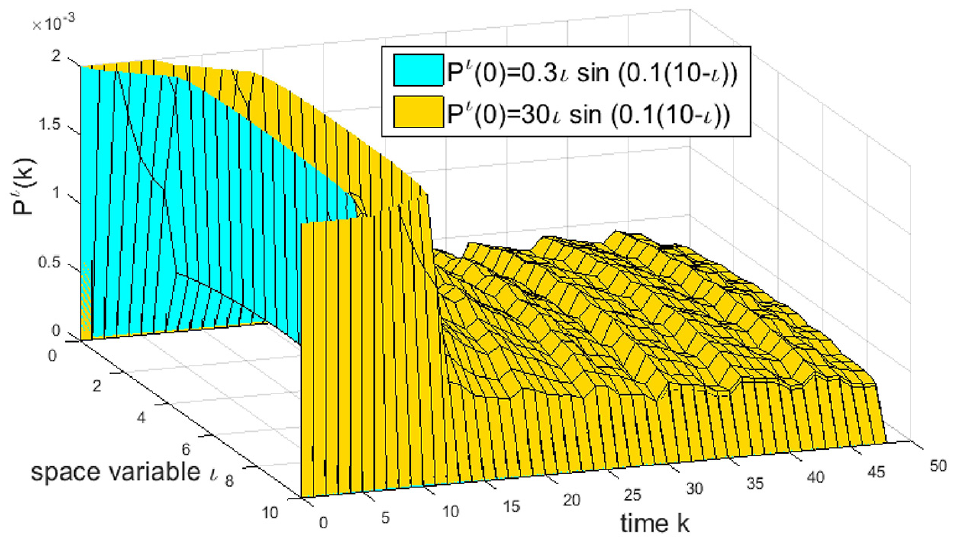
By a calculation, it gets Therefore, conditions - hold and equation (24) admits a unique almost automorphic sequence solution, which is globally mean-square -exponentially convergent (see Figures 1–6).
Figures 1–6 show the trajectories of the solutions to equation (24) in two- and three-dimensional spaces. Figures 1 and 2 depict the almost automorphic oscillations of states and of equation (24) with space variable . Figures 3 to 6 picture three-dimensional overall views of states and of equation (24) with space variable and time variable .
Remark 3. Exponential Euler difference methods were proposed and had been applied into the study of applied numerical time-varying models, please refer Mohamad and Gopalsamy (2000), Zhang and Li (2022a), Huang et al. (2014) and Zhang and Li (2022b). For the fractional-order multivariable models, few reports are published up to now, and the work of this paper will fill this gap.
Conclusion and perspectives
By employing the finite difference and Mittag–Leffler time Euler difference techniques, a novel lattice model for nonlocal stochastic genetic regulatory networks with reaction diffusions is set up. Furthermore, the existence of a unique global bounded almost automorphic sequence solution in distribution and global exponential convergence in the mean-square sense have been investigated for the achieved stochastic lattice model.
According to the works in this literature, it will be many problems worthy of further discussion.
This paper only discusses , and other cases are supposed to be studied.
Reimann–Liouville derivatives should be studied in the further.
Other dynamics ought to be discussed, for example, bifurcation, chaos, and control.
Footnotes
Declaration of conflicting interests
The author(s) declared no potential conflicts of interest with respect to the research, authorship, and/or publication of this article.
Funding
The author(s) disclosed receipt of the following financial support for the research, authorship, and/or publication of this article: This work was supported by Scientific Research Fund Project of Education Department of Yunnan Province (grant no. 2022J1097).
ORCID iD
Bing Hao
References
1.
AouitiCDridiF (2021) Study of genetic regulatory networks with Stepanov-like pseudo-weighted almost automorphic coefficients. Neural Computing & Applications33: 10175–10187.
2.
AouitiCDridiFHuiQ, et al. (2021) -Pseudo almost automorphic solutions of neutral type Clifford-valued high-order Hopfield neural networks with D operator. Neural Processing Letters53: 799–828.
3.
AugierNYaboAG (2022) Time-optimal control of piecewise affine bistable gene-regulatory networks. International Journal of Robust and Nonlinear Control. Epub ahead of print 25 January. DOI: 10.1002/rnc.6012.
4.
AyachiM (2021) Existence and exponential stability of weighted pseudo-almost periodic solutions for genetic regulatory networks with time-varying delays. International Journal of Biomathematics14(2): 2150006.
5.
AyachiM (2022) Dynamics of fuzzy genetic regulatory networks with leakage and mixed delays in doubly-measure pseudo-almost periodic environment. Chaos Solitons & Fractals154: 111659.
6.
ChebanDLiuZX (2020) Periodic, quasi-periodic, almost periodic, almost automorphic, Birkhoff recurrent and Poisson stable solutions for stochastic differential equations. Journal of Differential Equations269(4): 3652–3685.
7.
CoulierAHellanderSHellanderA (2021) A multiscale compartment-based model of stochastic gene regulatory networks using hitting-time analysis. Journal of Chemical Physics154(18): 184105.
8.
DiaganaT (2013) Almost Automorphic Type and Almost Periodic Type Functions in Abstract Spaces. New York: Springer.
9.
DuanLDiFWangZ (2020) Existence and global exponential stability of almost periodic solutions of genetic regulatory networks with time-varying delays. Journal of Experimental and Theoretical Artificial Intelligence32: 453–463.
10.
FengXWZongGF (2018) Pseudo almost automorphic solution to stochastic differential equation driven by Lévy process. Frontiers of Mathematics in China13: 779–796.
11.
GarrappaRPopolizioM (2011) Generalized exponential time differencing methods for fractional order problems. Computers and Mathematics with Applications62(3): 876–890.
12.
HillertonTSecilmiDNelanderS, et al. (2022) Fast and accurate gene regulatory network inference by normalized least squares regression. Bioinformatics38(8): 2263–2268.
13.
HuangZKMohamadSGaoF (2014) Multi-almost periodicity in semi-discretizations of a general class of neural networks. Mathematics and Computers in Simulation2014(101): 43–60.
14.
KilbasAASrivastavaHMTrujilloJJ (2006) Theory and Applications of Fractional Differential Equations. Boston, MA: Elsevier.
15.
KimEIvanovIDoughertyER (2022) Network classification based on reducibility with respect to the stability of canalizing power of genes in a gene regulatory network-a Boolean network modeling perspective. IEEE-ACM Transactions on Computational Biology and Bioinformatics19(1): 558–568.
LiCXLiuHHZhangTH, et al. (2017) Hopf bifurcation analysis of a gene regulatory network mediated by small noncoding RNA with time delays and diffusion. International Journal of Bifurcation and Chaos27(13): 1750194.
18.
LiYKShenSP (2021) Compact almost automorphic function on time scales and its application. Qualitative Theory of Dynamical Systems20: 86.
19.
LiangXZhuoXLWangRL (2020) Global attractor of reaction-diffusion gene regulatory networks with S-type delay. Neural Processing Letters51: 1557–1577.
20.
LizamaCMesquitaJG (2013) Almost automorphic solutions of dynamic equations on time scales. Journal of Functional Analysis265(10): 2267–2311.
21.
MohamadSGopalsamyK (2000) Dynamics of a class of discrete-time neural networks and their continuoustime counterparts. Mathematics and Computers in Simulation2000(53): 1–39.
22.
PadmajaNBalasubramaniamP (2022) Mixed H-infinity/passivity based stability analysis of fractional-order gene regulatory networks with variable delays. Mathematics and Computers in Simulation192: 167–181.
23.
PasquiniMAngeliD (2021) On convergence for hybrid models of gene regulatory networks under polytopic uncertainties: A Lyapunov approach. Journal of Mathematical Biology83(6–7): 64.
24.
QiaoYHYanHYDuanLJ, et al. (2020) Finite-time synchronization of fractional-order gene regulatory networks with time delay. Neural Networks126: 1–10.
25.
ShaoMYWangYRGaoZY, et al. (2022) Discrete-time rate-dependent hysteresis modeling and parameter identification of piezoelectric actuators. Transactions of the Institute of Measurement and Control44(10): 1968–1978.
26.
StamovTStamovaI (2021) Design of impulsive controllers and impulsive control strategy for the Mittag-Leffler stability behavior of fractional gene regulatory networks. Neurocomputing424: 54–62.
27.
StamovaIStamovG (2021) Lyapunov approach for almost periodicity in impulsive gene regulatory networks of fractional order with time-varying delays. Fractal and Fractional5(4): 268.
28.
TaiWPTengQYZhouYM, et al. (2019) Chaos synchronization of stochastic reaction-diffusion time-delay neural networks via non-fragile output-feedback control. Applied Mathematics and Computation354: 115–127.
29.
WeiTDLinPWangYF, et al. (2019) Stability of stochastic impulsive reaction-diffusion neural networks with S -type distributed delays and its application to image encryption. Neural Networks116: 35–45.
30.
XuCJLiaoMXLiPL, et al. (2020a) Almost automorphic solutions to cellular neural networks with neutral type delays and leakage delays on time scales. International Journal of Computational Intelligence Systems13(1): 1–11.
31.
XuGXBaoHBCaoJD (2020b) Mean-square exponential input-to-state stability of stochastic gene regulatory networks with multiple time delays. Neural Processing Letters51: 271–286.
32.
YangXRuanXGengY (2022) Iterative learning fault-tolerant control for discrete-time nonlinear systems subject to stochastic actuator faults. Transactions of the Institute of Measurement and Control44(10): 2012–2023.
ZhangTWLiYK (2022b) Global exponential stability of discrete-time almost automorphic Caputo–Fabrizio BAM fuzzy neural networks via exponential Euler technique. Knowledge-Based Systems246: 108675.
35.
ZhangTWXiongLL (2020) Periodic motion for impulsive fractional functional differential equations with piecewise Caputo derivative. Applied Mathematics Letters101: 106072.
36.
ZhangTWXuLJ (2019) Mean almost periodicity and moment exponential stability of discrete-time stochastic shunting inhibitory cellular neural networks with time delays. Kybernetika55(4): 690–713.
37.
ZhangTWHanSFZhouJW (2020) Dynamic behaviours for semi-discrete stochastic Cohen-Grossberg neural networks with time delays. Journal of the Franklin Institute357(17): 13006–13040.
38.
ZhangTWZhouJWLiaoYZ (2021) Exponentially stable periodic oscillation and Mittag-Leffler stabilization for fractional-order impulsive control neural networks with piecewise Caputo derivatives. IEEE Transactions on Cybernetics52(9): 9670–9683.
39.
ZnidiADehriKNouriAS (2022) Discrete indirect adaptive sliding mode control for uncertain Hammerstein nonlinear systems. Transactions of the Institute of Measurement and Control44(10): 1907–1921.