




Abstract
This article questions the conventional interpretation of 1 Corinthians 15.51–52, especially as evidence that Paul assumed an imminent parousia. There are two main problems with the conventional view. First, the majority view of 1 Cor. 15.51 relies on a counter-intuitive reading of the syntax. Second, on 15.52, the usual interpretation must assume that the reference to ‘change’ there has a different scope from the similar statement earlier in 15.51. The constructive argument takes vv. 51 and 52 in turn. First, the proposed reading of v. 51 adopts a more natural understanding of πάντες οὐ and reconsiders the meaning of ‘shall sleep’ (κοιμηθησόμεθα). This yields the following sense: ‘None of us shall continue to sleep, but we will all be changed in an instant, in the blinking of an eye, at the last trumpet.’ This alternative view is strengthened by evidence that Paul envisages this last trumpet as waking the dead: Paul refers to a state of sleep coming to an end in v. 51, not the falling asleep of some believers. Second, in v. 52, Paul is not distinguishing between the living and dead but rather is concluding his answer to the questions about resurrection posed in 15.35.
51a ἰδοὺ μυστήριον ὑμῖν λέγω·
51b πάντες οὐ κοιμηθησόμεθα, πάντες δὲ ἀλλαγησόμεθα,
52a ἐν ἀτόμῳ, ἐν ῥιπῇ ὀϕθαλμοῦ, ἐν τῇ ἐσχάτῃ σάλπιγγι·
52b σαλπίσει γὰρ
52c καὶ οἱ νεκροὶ ἐγερθήσονται ἄφθαρτοι καὶ ἡμεῖς ἀλλαγησόμεθα.
Introduction
The mystery in 1 Corinthians 15.51–52 has long been a standard prooftext for the idea that Paul envisaged the parousia happening in his lifetime.
1
On this view of the passage, Paul assumes his survival and that of a portion of his generation until ‘the last trumpet’, when all believers—living or dead—would experience immediate transformation. The NIV, for example, reflects the conventional view of the two verses: 51 ἰδοὺ μυστήριον ὑμῖν λέγω· πάντες οὐ κοιμηθησόμεθα, πάντες δὲ ἀλλαγησόμεθα, 52 ἐν ἀτόμῳ, ἐν ῥιπῇ ὀϕθαλμοῦ, ἐν τῇ ἐσχάτῃ σάλπιγγι· σαλπίσει γὰρ καὶ οἱ νεκροὶ ἐγερθήσονται ἄϕθαρτοι καὶ ἡμεῖς ἀλλαγησόμεθα. 51 Listen, I tell you a mystery: we will not all sleep, but we will all be changed—52 in a flash, in the twinkling of an eye, at the last trumpet. For the trumpet will sound, the dead will be raised imperishable, and we will be changed.
Hence the standard view is that (v. 51) some, though ‘not all’ of Paul’s contemporaries will die, and (v. 52) those who have died will be resurrected on the last day, whereas Paul and his readers who survive will be transformed while alive. Scholars are able without argument to cite 1 Cor. 15.51–52 for Paul’s position that the end is nigh; 2 standard handbooks express this view of the passage. 3 As well as being as much a consensus position in scholarship as one could find, the general sense ‘we will not all (i.e., only some of us will) sleep’ also features in virtually all English Bible translations. 4 1 Cor. 15.51–52 has often been likened to 1 Thess. 4.15–17, and the two passages are frequently brought together and presented as the two key pieces of evidence for Paul’s expectation of the parousia in his lifetime. 5 I have discussed 1 Thess. 4.13–18 elsewhere. 6 In the case of the 1 Corinthians example, various scholars have noted some potential difficulties with elements of the conventional view.
First, for the standard interpretation to hold, commentators must suppose that Paul has constructed v. 51 with ‘the unusual word order πάντες οὐ’. 7 This is not impossible, but may be a difficulty which should invite a reconsideration of Paul’s meaning here.
Secondly, Perriman has noted that elsewhere in the argument in 1 Cor. 15.35–58 more broadly, Paul draws no distinction between the dead and the living. He notes that if vv. 51–52 do make this distinction, then they might be something of an anomaly in the wider passage. 8
Thirdly, and relatedly, scholars may too readily assume that the two statements about transformation in vv. 51 and 52 respectively have different scopes. On the standard view, the former (πάντες δὲ ἀλλαγησόμεθα) refers to all being changed, while the latter (οἱ νεκροὶ ἐγερθήσονται ἄϕθαρτοι καὶ ἡμεῖς ἀλλαγησόμεθα) is usually understood as distinguishing between οἱ νεκροί (the dead) on the one hand and ἡμεῖς (i.e., the living) on the other. Hence Paul envisaged himself among the living, who at the parousia will be transformed, not resurrected. Various scholars, such as Klein, have questioned this construal of the passage. 9
Fourthly, Paul in the same letter can even talk in terms of expecting his own and his audience’s resurrections from the dead (not their transformation with the living at the parousia). As Garland, for example, remarks, ‘Those who interpret this verse [sc. 15.51] to mean that he assumed that he would survive until the parousia must reckon with what he says in 1 Cor. 6.14, “God both raised the Lord and will raise us through his power.”’ 10
Finally, other passages in 1 Corinthians suggest further that Paul may not be so confident of survival to the parousia. To cite an old representative of this view, Goodwin notes in his discussion of 1 Cor. 15.51–52: ‘in this very 15th chapter of his first epistle, the apostle had just referred, and that with the greatest solemnity, to the fact of his living in constant expectation of suddenly dying, of his being face to face with death, “delivered to death”, day by day’. 11
None of these are fatal problems for the standard scholarly interpretation and conventional translations of the present passage, but they should at least lead to a greater degree of exegetical caution than is usually in evidence, and perhaps invite consideration of other possible readings.
The aim of the present article is to give fuller articulation to the five points above and to develop new arguments with the goal of re-evaluating two key elements of the passage which are usually taken to suggest Paul’s expectation of the survival of some of his audience until the parousia. As noted in the title, this is a suggestion rather than a cast-iron certainty.
The first of these key elements is πάντες οὐ κοιμηθησόμεθα in v. 51. The aim here is to provide a rereading of this statement, and to argue that here Paul explains that at the sounding of the eschatological trumpet (ἐν τῇ ἐσχάτῃ σάλπιγγι), no one shall continue to sleep (πάντες οὐ κοιμηθησόμεθα). Although this proposal may seem initially to be a rather eccentric interpretation, it does at least take account of the difficulties with the conventional view, and also has several advantages in its favour.
The second component to be re-examined is ἡμεῖς ἀλλαγησόμεθα in v. 52. This statement is usually taken to refer to ‘us, the living’, and thereby to imply that—in contrast to οἱ νεκροί just mentioned—Paul expects himself and some of his contemporaries to survive to the parousia and at that moment therefore be transformed rather than resurrected. This second section below will question whether this is necessarily the case.
Finally, we will consider some incidental supporting arguments, which take account of the aforementioned comments by Garland, Goodwin, and others.
Πάντες οὐ κοιμηθησόμεθα in 1 Cor. 15.51–52a
A Preliminary Note on the Text
Before venturing into the exegesis proper, we should consider the text of 1 Cor. 15.51b (πάντες οὐ κοιμηθησόμεθα, πάντες δὲ ἀλλαγησόμεθα). This verse’s textual history is, as Goodwin put it a century ago, ‘in extraordinary confusion’. 12 The Text und Textwert volume for 1 Corinthians numbers the different forms of the text at thirteen, with some additional subdivisions. 13 Fee identifies the English senses of the five main forms as follows, and I have appended the corresponding Greek texts: 14
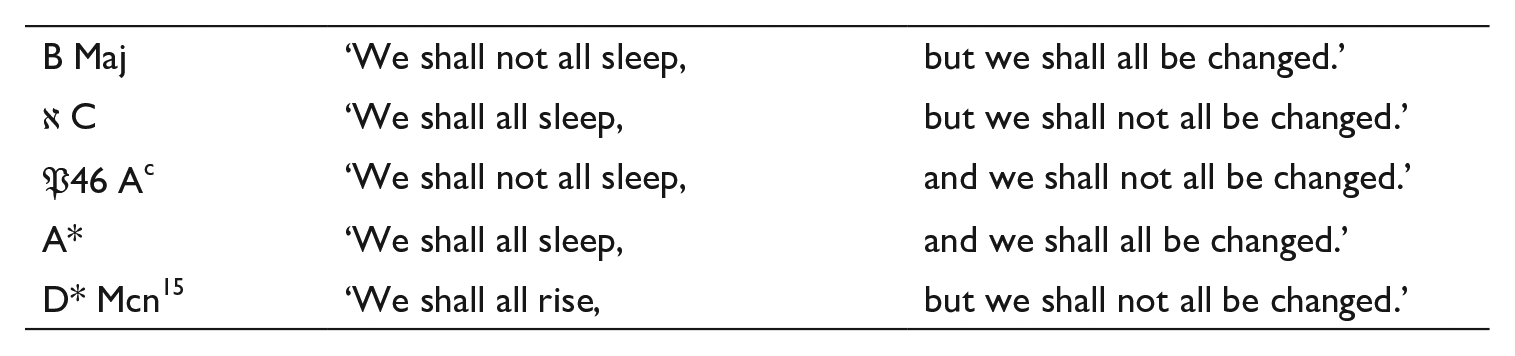
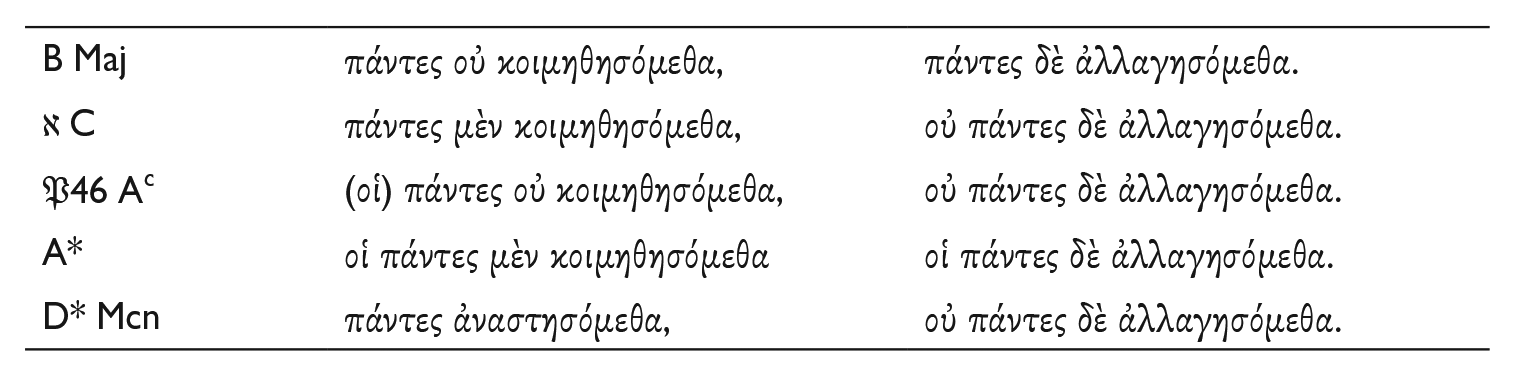
Already in 1887, however, Ellicott commented on the first variant above: ‘The best critical opinions, however, seem now clearly settling down in favour of the text’. 15 Jeremias, in his SNTS Presidential address in 1955, remarked: ‘The diversity of readings in v. 51 need not detain us, for—as far as I can see—scholars rightly agree that the reading preferred by Nestle: πάντες οὐ κοιμηθησόμεθα, πάντες δὲ ἀλλαγησόμεθα is the original one’. 16 Metzger similarly concluded that this text is ‘the reading which best explains the origin of the others’. 17 A few decades on, this is still the general view. 18 It is still the reading favoured by NA 28 , as well as by the SBL and Tyndale House Greek New Testaments. As a result, the ‘all’ in both cases are the righteous; the B Maj reading, which is the scholarly consensus and which is adopted in this article, does not imply a general resurrection of the righteous and the unrighteous.
A common explanation of these variants is that the reading in ‘The lapse of time had compelled second-century readers to transpose another awkward negative … The passing of two generations prohibited a literal interpretation of ἡμεῖς οἱ ζῶντες οἱ περιλειπόμενοι … ἁρπαγησόμεθα (1 Thess. 4:17) and πάντες οὐ κοιμηθησόμεθα (1 Cor. 15:51); all Christians alive in 50 were now “asleep”. As soon as the last one died this puzzle must have become intolerable and somehow the negative at 1 Cor. 15:51 had to be juggled to prevent an embarrassing collision with uncomfortable facts …’
20
On this view, the earliest interpretation of the original text of 1 Cor. 15.51 was that Paul envisaged an imminent end, and that consequently the text needed to be emended in the second century. One might question this interpretation: after all, 1 Thess. 4.15 and 17 remain largely unaffected by scribes. It was apparently not the case that the Thessalonian verses ‘must have become intolerable’ and ‘had to be juggled’. 21 As we shall see in the conclusion, there is an alternative reason, at least as plausible, why the textual history of 1 Cor. 15.51b turned out to be so diverse.
Πάντες οὐ … vs ‘Not all …’
Granting the standard text, commentators and translators have almost universally rendered the clause πάντες οὐ κοιμηθησόμεθα as ‘We shall not all sleep’ or some close equivalent. The purpose of this sub-section is note how odd this actually is. 22
To begin with, it is generally known that οὐ (and οὐκ/ οὐχ) can negate either a whole clause, or an individual element of a clause (a word or phrase). 23 In the latter case, οὐ is ‘generally put before the word it negates’, as Liddell-Scott’s definition notes in the paragraph of the entry, ‘B: Position’. The ‘generally’ is necessary because LSJ also remarks that in poetry there is considerable freedom; additionally, οὐ can appear, for emphasis, at the end of a sentence, and in a μέν … δέ … contrast it can also appear after either the μέν or the δέ. 24 In sum, then, where a particular phrase or word is being negatived, the οὐ normally comes before that word or phrase: the standard grammars agree on the point that οὐ and μή are prepositive, i.e., attach themselves to the word(s) following. 25 Where a whole clause is being negatived, probably the most common locations are either at the beginning of the clause or before the verb.
This pattern is reproduced, unsurprisingly, in Paul. We can take as a snapshot the examples in Paul’s undisputed letters where οὐ/οὐκ/οὐχ appear with a form of πᾶς in the same clause. Two contrasting examples, which each appear more than once, can illustrate this. In Paul’s justification discourse in both Romans and Galatians, he states ἐξ ἔργων νόμου οὐ δικαιωθήσεται πᾶσα σάρξ (Rom. 3.20; Gal. 2.16). This illustrates how the negation of an entire clause is achieved by placing the οὐ before the verb. 26 Conversely, on four occasions in 1 Corinthians, Paul apparently qualifies a Corinthian slogan that ‘all things are permissible (for me)’: πάντα (μοι) ἔξεστιν (1 Cor. 6.12a,b; 10.23a,b). His addenda to the quoted slogan are ἀλλ᾽ οὐ πάντα συμϕέρει (6.12a; 10.23a) and ἀλλ᾽ οὐ πάντα οἰκοδομεῖ (1 Cor. 10.23b). 27 These examples from 1 Corinthians illustrate how οὐ can negate a particular word when it precedes that word. These cases from Romans/Galatians on the one hand, and 1 Corinthians on the other, therefore show how Paul’s usage fits general Greek usage (as summarised, for example, in Liddell-Scott).
This pattern is carried through in the other instances in Paul’s letters. In Rom. 9.6b (οὐ γὰρ πάντες οἱ ἐξ Ἰσραὴλ οὗτοι Ἰσραήλ), the οὐ either modifies the whole clause by virtue of its being in first position, or it modifies πάντες which, via the γάρ, it precedes. 28 Rom. 10.16a (ἀλλ᾽ οὐ πάντες ὑπήκουσαν τῷ εὐαγγελίῳ) is straightforward: the οὐ negatives the subsequent πάντες (‘not all …’). By contrast, in Rom. 10.11, οὐ before the main verb negates the whole idea of the sentence: πᾶς ὁ πιστεύων ἐπ᾽ αὐτῷ οὐ καταισχυνθήσεται. In the final instance in Romans, a specific phrase in the clause is negated: τὰ δὲ μέλη πάντα οὐ τὴν αὐτὴν ἔχει πρᾶξιν (‘all the members have not the same function’, Rom. 12.4).
In 1 Corinthians, we have noted 6.12 and 10.23; in 8.7 (ἀλλ᾽ οὐκ ἐν πᾶσιν ἡ γνῶσις) the οὐκ could negate either the whole clause or specifically the phrase ἐν πᾶσιν. 29 The regular pattern is seen again shortly before our eschatological mystery, in 1 Cor. 15.39: οὐ πᾶσα σὰρξ ἡ αὐτὴ σάρξ (‘not all flesh is the same’). Also in keeping with the ‘rule’ is Gal. 3.10: πᾶς ὃς οὐκ ἐμμένει πᾶσιν τοῖς γεγραμμένοις … (‘anyone who does not abide by everything written …’). 30 In Phil. 2, Paul brings out the contrast of ‘one’s own interests’ versus (οὐ) those of the Lord: οἱ πάντες γὰρ τὰ ἑαυτῶν ζητοῦσιν, οὐ τὰ Ἰησοῦ Χριστοῦ. (Phil. 2.21). In 2 Thess. 3.2 (οὐ γὰρ πάντων ἡ πίστις), the οὐ negatives πάντων (‘not all have faith’). There are as far as I know no exceptions to this pattern of Paul’s usage. 31 Some have tried to explain Paul’s word order in 1 Cor. 15.51 on the grounds that he is fronting the two instances of πάντες to bolster the parallel between the two clauses; 32 this is of course possible, though in the nature of the case speculative.
I have laboured this point to try to show just how unusual 1 Cor. 15.51 (πάντες οὐ κοιμηθησόμεθα) is if the general interpretation, ‘(some but) not all will sleep’, is correct. 33 On the standard view, one would have expected Paul to place the negative before the ‘all’ (οὐ πάντες κοιμηθησόμεθα). Despite the strength of the majority—indeed, near consensus—position, however, by far the most natural rendering would be different: positioned where it is in 1 Cor. 15.51, the οὐ negates the verb and thus the whole clause. By analogy with, e.g., ἐξ ἔργων νόμου οὐ δικαιωθήσεται πᾶσα σάρξ (‘by works of the Law will no one be justified’), πάντες οὐ κοιμηθησόμεθα ought to mean: ‘None of us will sleep.’ 34 I recall the words of C. K. Barrett in another context, that of 2 Cor. 5.4: ‘It must be observed too that Paul does not say, ‘Not because we wish’ (οὐκ ἐϕ’ ᾧ θέλομεν), but because we do not wish (ἐϕ’ ᾧ οὐ θέλομεν), and though his word order is occasionally eccentric we must (until the contrary is proved) assume that he means what he says.’ 35
Kοιμηθησόμεθα in 1 Cor. 15.51 as Punctual or Durative?
The reason that this translation ‘None of us will sleep’, despite its linguistic attractions, has not caught on is that it seems absurd. 36 A statement that ‘none shall fall asleep’, i.e., that no more Corinthians would die before the parousia, could be very quickly falsified: Paul notes in 1 Corinthians itself that Christians elsewhere and, presumably fairly recently, believers in Corinth have already died (1 Cor. 15.6; 11.30). 37 Barrett and Schnelle even consider that, by the time he wrote 1 Corinthians, Paul took death before the parousia to be the rule, rather than the exception. 38
The key point to be argued in this subsection is as follows: both the absurd, purely hypothetical interpretation just noted above (that none of ‘us’ would ever die) and the standard interpretation (that some though not all would die) assume κοιμηθησόμεθα to be ‘punctual’ rather than ‘durative’. 39 That is, they presuppose that κοιμάομαι here means ‘to fall asleep’ (punctual, i.e., referring to an event), rather than ‘to be asleep’ or ‘continue to sleep’ (durative, i.e., referring to a state).
But this need not be the case. Κοιμάομαι can be either punctual or durative: to translate the metaphor, it can refer either to dying or to being in a state of death. 40 The following examples will illustrate how one important, though not decisive, indicator of whether κοιμάομαι in particular instances is durative or punctual is grammatical tense. When κοιμάομαι is in the aorist or perfect, the sense is ‘fall asleep’; when it is in the present, it seems to mean to ‘be asleep’. 41
In the cases of aorists and perfects, Paul can refer in 1 Cor. 15.6 to some of the five hundred noted above who ‘have fallen asleep’ (ἐκοιμήθησαν, punctual). In 1 Cor. 15.20 (νυνὶ δὲ Χριστὸς ἐγήγερται ἐκ νεκρῶν ἀπαρχὴ τῶν κεκοιμημένων), the sense is again punctual, because the verb is in the perfect tense. Similarly with the dead Jerusalem saints in Mt. 27.52 (πολλὰ σώματα τῶν κεκοιμημένων ἁγίων ἠγέρθησαν). This also applies in cases of literal sleep: the usage in the perfect tense yields punctual senses in the two cases of Lazarus allegedly literally falling asleep in Jn 11.11–12 (Λάζαρος ὁ ϕίλος ἡμῶν κεκοίμηται, and κύριε, εἰ κεκοίμηται σωθήσεται). The same is true of all the aorist instances of κοιμάομαι in the New Testament. 42
Conversely, with the instances in the present, κοιμάομαι is durative, as for example in the discussion περὶ τῶν κοιμωμένων (1 Thess. 4.13) and the lament in 1 Cor. 11.30 for the dead Corinthians who κοιμῶνται (durative). 43 The same applies in the quotidian instances which refer to literal sleep: the examples in the present are durative in Mt. 28.13 (οἱ μαθηταὶ αὐτοῦ νυκτὸς ἐλθόντες ἔκλεψαν αὐτὸν ἡμῶν κοιμωμένων), Lk. 22.45 (ἐλθὼν πρὸς τοὺς μαθητὰς εὗρεν κοιμωμένους αὐτοὺς) and Acts 12.6 (ἦν ὁ Πέτρος κοιμώμενος).
These examples are only of limited help, however, because the future tense can be either durative or punctual. Κοιμηθησόμεθα in 1 Cor. 15.51 could in principle therefore equally refer either to the event of falling asleep or to the state of being asleep. This instance is the only case of the future of κοιμάομαι in the New Testament, but the LXX illustrates how both senses are live possibilities. Some of the instances are ambiguous, but clear cases can be found on both sides: e.g. ‘any meat which you may sacrifice in the evening on the first day shall not lie out until morning’ (οὐ κοιμηθήσεται … εἰς τὸ πρωί) in Deut. 16.4 is clearly durative, and ‘I will lie down and sleep’ (κοιμηθήσομαι καὶ ὑπνώσω) in LXX Ps. 4.9 seems likely to be punctual. 44 Further afield from biblical literature, examples can also be found on both sides. 45 Unfortunately, there are no hard criteria by which one can distinguish between durative and punctual instances, except by the context.
The implication of this evidence for 1 Cor. 15.51 is that the assumption that κοιμηθησόμεθα is necessarily punctual is unwarranted, because it could in principle equally be durative. 46 Either is possible. There may also, however, be a further point in favour of the durative interpretation, ‘none of us will (continue to) sleep’/‘none of us will remain asleep’/‘none of us will sleep on’, since trumpets were known to disturb slumber and awaken those in a state of sleep, especially in eschatological contexts. Or, to put it in more literal terms, in eschatological settings, the heavenly trumpet can wake the dead. To this we will now turn.
‘The Trumpet of Alarm’: The Eschatological Trumpet
We can recall that the great change occurs in 1 Cor. 15.51–52 ‘in an instant, in an Augenblick, at the final trumpet’. The next point here, therefore, is to suggest that Paul, writing πάντες οὐ κοιμηθησόμεθα, πάντες δὲ ἀλλαγησόμεθα, ἐν ἀτόμῳ, ἐν ῥιπῇ ὀφθαλμοῦ, ἐν τῇ ἐσχάτῃ σάλπιγγι, was declaring that the last trumpet would be the occasion for the waking of the dead. Therefore, none shall continue in a state of death but all shall be woken up and changed. Scholars have offered different views of the purpose of the trumpet here, such as a signal of the arrival of the king, especially for battle. 47 The argument here, however, will be that the reference to the eschatological trumpet can be part of the imagery of the waking of those asleep.
At a common-sense level, we can imagine that trumpets would be effective instruments for waking people up. According to Athenaeus’s Deipnosophistae, the orator Demades referred to ‘the cockerel, the trumpeter for the whole of Athens’ (τὸν δὲ σαλπιγκτὴν κοινὸν Ἀθηναίων ἀλέκτορα). 48 An imitator of Lucian can similarly talk of how ‘the cockerel “trumpets” the morning’ (ἀλέκτωρ ἡμέραν ἐσάλπισεν). 49 Plutarch reports a maxim ‘from the one who said: “not trumpets but cockerels awake those who sleep in times of peace”’ (τοῦ εἰπόντος, ὅτι τοὺς ἐν εἰρήνῃ καθεύδοντας οὐ σάλπιγγες, ἀλλ’ ἀλεκτρυόνες ἀϕυπνίζουσι). 50 The implication is that, in wartime, trumpets do, which is made clear elsewhere in Plutarch, as well as in Josephus. 51
More relevant to 1 Cor. 15, however, is not the usage in everyday contexts, but the singular or final eschatological σάλπιγξ in early Judaism and Christianity. 52 Related to the theme of resurrection are perhaps the several places where the trumpet initiates an ingathering. 53
The particular occasion for the trumpet is often the general resurrection or the resurrection of the righteous. There is some evidence in Jewish literature for the eschatological trumpet rousing the dead and bringing them resurrection; it is mostly late, but does go as far back as the Septuagint. 54 The idea of the trumpet waking the dead is more widely evident early on in Christian literature, and especially in Paul himself:
(i) The theme comes first in 1 Thess. 4.16, where the descent of Christ is accompanied by three audible, indeed loud alarms, after which the dead rise: ‘For the Lord himself will come down from heaven, with a loud command, with the voice of the archangel and with the trumpet call of God (ἐν σάλπιγγι θεοῦ), and the dead in Christ will rise first (καὶ οἱ νεκροὶ ἐν χριστῷ ἀναστήσονται πρῶτον)’. In this case, as commentators generally agree, at least part of the scene consists of the dead being wakened by the noise. 55
(ii) Even closer to 1 Cor. 15.51–52a, the cause-and-effect of the trumpet and resurrection is decisively reinforced in the remainder of v. 52: ‘For the trumpet will sound, and the dead will be raised’ (σαλπίσει γὰρ καὶ οἱ νεκροὶ ἐγερθήσονται ἄϕθαρτοι). As Schrage comments: ‘The pick-up in the impersonal σαλπίσει γάρ in V 52d, which apparently does not require any express supplementation by ἡ σάλπιγξ, does not speak for a merely incidental meaning of the reference. Rather, the awakening of the dead that it triggers carries full weight’. 56
Outside of Paul, this theme of the trumpet raising the dead is in evidence more widely in early Christianity:
(iii) Did. 16.6–7 (early second century) probably gives evidence of a tradition independent of 1 Cor. 15: ‘And then the signs of truth will appear: first, a sign of stretching out in heaven, then a sign of the sounding of a trumpet, and thirdly, the resurrection of the dead (but not of all, as it is written “The Lord will come, and all his saints with him”.)’ The juxtaposition of the trumpet and resurrection may well suggest the waking of the dead.
(iv) One fragment perhaps belonging to the Apocalypse of Peter (c. 130), contains the prophecy: ‘And at the third blast of the trumpet, the dead will rise in an instant and will be placed before his face, and he will put the sheep at his right hand and the goats at his left …’. 57 Here the collocation of the trumpet and resurrection is no mere proximity of the two themes; rather the third trumpet-blast is the occasion of resurrection.
(v) For Clement of Alexandria, writing circa 197, the trumpet is the cause of resurrection. He interprets Ps. 150.3 in light of the tradition of this eschatological trumpet: ‘The Spirit, distinguishing from such revelry the divine service, sings, “Praise him with the sound of trumpet”, for with the sound of trumpet he shall raise the dead (καὶ γὰρ ἐν ἤχῳ σάλπιγγος ἀναστήσει τοὺς νεκρούς)’. (Paed. 2.4.41.)
(vi) Tertullian (writing c. 208) asks incredulously about the Christian: ‘Will a person be troubled in death by the trumpeter’s trumpet, when he expects to be awakened by the angel’s trump? (qui excitari a tuba angeli expectat)’ (De Corona 11.3). In these two passages in Clement and Tertullian, it is even more explicit that the trumpet is literally the instrument by which the dead are awakened.
The same point is expressed in two fairly early Christian funerary inscriptions:
(vii) First, a late second- or third-century epitaph from Claudiopolis (IK 31.177) expresses the resurrection hope: ‘Neither gold nor silver are lying here, but bones waiting for the sound of the trumpet (περιμένοντα ϕωνὴν σάλπινγος)’. 58
(viii) The second epigraphic example comes from around the third century, when the motif appears on a tomb built by the deaconess Paula for her brother Helladius. The tombstone proclaims itself as ‘guardian of his body until the trumpet sounds terribly, and wakes mortals (ἄ[χρ]ι σάλπιγξ ᾐχηέσσα ἐκπάγλως ἐγίρουσα βρότους) for the judgment of God’. 59
The last two examples are of uncertain date, but attest to the persistence of this theme: 60
(ix) Similarly, in the Greek Apocalypse of Ezra (late antique), God states that his beloved Son will come, and later thereafter, ‘a trumpet will sound, and the tombs shall be opened, and the dead shall be raised incorruptible’ (4.36). 61
(x) In the Questions of Ezra (date unknown), the angel speaks of the souls which are ‘in the hand of Satan until the coming of Christ, when the trumpet of Gabriel sounds’; then the souls ‘come and are united each with its body which had been returned to dust and which the sound of the trumpet had built and aroused and renewed. And it raises it up before Christ our God’. (B10–14).
In summary, then, both in Paul beyond 1 Cor. 15.51, and in early Christian literature elsewhere, the idea of the eschatological trumpet waking the dead is present.
In light of all this, the wording of 1 Cor. 15.51–52 suggests that it is very natural to see being asleep in death as interrupted by the alarm call of the final trumpet sounding. 62 This is probably not just a waking of the dead, but also a gathering of them together with the living. It makes good sense, therefore, to read 1 Cor. 15.51–52a as saying: ‘None of us will (continue to) sleep but we will all be changed, in an instant, in the blinking of an eye, at the last trumpet’. 63
Interim Conclusion
Thus far we have noted that the standard reading is correct (“A Preliminary Note on the Text”), and observed that the usual reading of 1 Cor. 15.51 is actually rather unusual (“πάντες οὐ… vs ‘Not all…’”). The more natural sense of 15.51b–52a is captured in the following translation: ‘None of us will (continue to) sleep but
64
we will all be changed in an instant, in the blinking of an eye, at the last trumpet’.
65
In addition to taking account of Paul’s word order (πάντες οὐ), this interpretation takes seriously (see above “Κοιμηθησόμεθα in 1 Cor. 15.51 as Punctual or Durative?”) the possibility of a durative sense of sleeping (κοιμηθησόμεθα). It also takes into account what is not just possible, but clear: as discussed under ‘The Trumpet of Alarm’ above, that Paul makes the no-longer-sleeping contemporaneous with the blast of a trumpet in 1 Cor. 15.51–52a, just as he does in 1 Thess. 4.16 and 1 Cor. 15.52b. The implications of this are (a) that Paul does not distinguish between the living and the dead in 1 Cor. 15.51, and (b) that he does not necessarily include himself and his contemporaries among the living who will witness the parousia during their lifetimes.
The next stage of the argument proceeds to 1 Cor. 15.52bc, to explore whether the second sentence implies a distinction between the living and the dead, and an expectation on Paul’s part of surviving until the parousia.
‘We’ the Living or ‘We’ All ἀλλαγησόμεθα (15.52)—Inclusive or Exclusive?
In contrast to what has been a near consensus on 1 Cor. 15.51b, there has been more disagreement in recent years over the referent of ἡμεῖς in v. 52. In the standard interpretation of 1 Cor. 15.51–52, scholars consider Paul in v. 52b to be contrasting the dead and the living, and to place himself in the latter category: σαλπίσει γὰρ καὶ οἱ νεκροὶ ἐγερθήσονται ἄϕθαρτοι καὶ ἡμεῖς ἀλλαγησόμεθα.
A contrastive distinction between the two groups (οἱ νεκροί vs ἡμεῖς) and their respective destinies (ἐγερθήσονται vs ἀλλαγησόμεθα) is generally assumed. 1 Cor. 15.52 would therefore imply that Paul—as a part of the ἡμεῖς—expected that he and the rest of the ‘we’ would survive until the parousia. One may at least question, however, whether Paul is interested in making such a distinction between the dead and the living. We will first (in “Paul’s lack of distinction”) approach this question with Paul’s larger argument in view, before looking (in “Does Paul distinguish between the dead and the living”) in particular at vv. 51–52.
Paul’s Lack of Distinction between the Dead and the Living in 1 Cor. 15.35–58
The universality of death is a general assumption in 1 Cor. 15 as a whole. ‘For as in Adam all die, so in Christ all will be made alive’. (15.22). The resurrection in 1 Cor. 15 is a topic not just relevant to those already dead: the future resurrection is Paul’s motivation to endure hardship in ministry (15.30–32), and the motivation for the Corinthians to stand firm (15.58).
Moving to the particular argument of which 1 Cor. 15.51–52 is a part, we can focus on 1 Cor. 15.35–58. As is sometimes noted, the ‘mystery’ in 15.51–52 and the subsequent exposition brings to a conclusion the answer to the questions posed in v. 35: 66 ‘But someone will ask, “How are the dead raised? With what kind of body will they come?”’ The overall theme of 1 Cor. 15.35–58 is therefore not to do with the living but concerns the dead. 67 This does not of course mean that any reference to the living is excluded a priori. But the way in which Paul’s response to this question proceeds does not in fact give any space to the living. Indeed, his immediate response is that resurrection life requires death (‘What you sow does not come to life unless it dies’) in v. 36. He then explains (in v. 37) how seeds differ from the fruit, (in v. 38) how different kinds of fruits grow from different seeds, (in v. 39) how different animal species also have different sorts of flesh, and (in vv. 40–41) how cosmological bodies also differ in nature from one another. 68 The upshot of this is not to distinguish between the fate of the dead and the living, but—on the assumption that the living die—to stress that the resurrection body is raised imperishable, glorious, powerful, and spiritually directed (vv. 42–44). 69 ‘So will it be with the resurrection of the dead!’ (v. 42a).
Paul then quotes the lemma: ‘The first man, Adam, became a living soul’ (Gen. 2.7) and appends a gloss—‘and the last Adam a life-giving spirit’ (15.45). An exegesis of the lemma and gloss then follows: that Adam came first shows the sequence—psychic then pneumatic (v. 46). After sequence the interest moves to the respective natures of the psychic man and the pneumatic man—viz. earthly and heavenly (v. 47). This is applied to the constituencies they represent—they in turn are earthly and heavenly (v. 48). Or at least, the latter will be heavenly in the future: ‘just as we have borne the image of the earthly man, so shall we bear the image of the heavenly man’ (v. 49). The inheritance of a heavenly image is necessary for the saints because no one can simply enter the kingdom of God as they are: ‘flesh and blood cannot inherit the kingdom of God, nor does the perishable inherit the imperishable’ (15.50). This declaration does not introduce the problem ‘but what about the living?’ because the dead are as much ‘perishable’ as the living: after all, they need to be raised imperishable (v. 52). 70
This fact—that no one can remain as they are, but must bear the image of the heavenly one—is the backdrop to Paul’s announcement of the mystery. 1 Cor. 15.51–58 need not be regarded as a new unit addressing a fresh issue. Against the backdrop of v. 50, with its insistence that no one enters the kingdom with perishable bodies, v. 51 makes good sense with its notes of rupture and transformation. ‘None of us will continue to sleep, but we will all be changed!’ (v. 51). We have not been prepared for any sort of distinction between the fate of the dead and the fate of the living in the larger argument. As Perriman comments on the standard view: ‘This leaves us with vv. 51–52, which, if they do distinguish between the dead and the living at the parousia, are beginning to look rather incongruous in the context of the passage as a whole’. 71 The argument in 1 Cor. 15.35–58 is conducted with a focus on resurrection because that is the topic of the question in 1 Cor. 15.35. The argument is in fact more unified than is sometimes appreciated: the emphasis on perishable vs imperishable cuts across what some regard as a divide when the μυστήριον comes into the picture in 1 Cor. 15.51a. 72 Rather than introducing a new theme, the mystery concludes Paul’s answer to the questions in 1 Cor. 15.35: how and in what form will the dead rise? Answer: a sovereign act of God will instantly transform us all so that we will be immortal and incorruptible. In sum, the overall thrust of 1 Cor. 15.35–58 does not exclude a possible distinction between the living and the dead in vv. 51–52, but it renders it less likely.
Does Paul Distinguish between the Dead and the Living in 1 Cor. 15.52?
We can begin with what is clear. In v. 51b, Paul talks of all Christians in general in the first reference to the great ‘change’: πάντες δὲ ἀλλαγησόμεθα. What unites Christians there is their destiny of transformation. The next question concerns the identity of the ἡμεῖς at the end of 15.52, viz. whether the ‘we’ is inclusive of the dead or distinguished from the dead: 73
15.52bc: σαλπίσει γὰρ καὶ οἱ νεκροὶ ἐγερθήσονται ἄϕθαρτοι καὶ ἡμεῖς ἀλλαγησόμεθα.
As noted, the most common reading is to see in 15.52bc a contrast between two groups: group 1 (the dead) who will undergo resurrection, and group 2 (we the living) who will undergo transformation when we meet Jesus at his return. 74 This might be termed an exclusive reading of the ἡμεῖς. In favour of a contrast is the apparent distinction between ‘them and us’ in 15.52 (-ονται / ἡμεῖς -ομεθα). On this view, Paul envisaged himself among the living, who at the parousia will be transformed, not resurrected from the dead.
A minority reading, on the other hand, takes the ἡμεῖς as inclusive of the dead: when the trumpet sounds we will all—dead or alive—experience transformation. Klein, for example, has questioned the exclusive reading of the ἡμεῖς and advocated for a non-contrastive construal of 15.52bc. 75 He makes the following points, after which I add some supplementary comments.
First, there is no indication of a non-identity of the ‘we’ in vv. 51b and 52c. ‘Nothing in the text hints that the 1.pls in vv. 51–52 would be used in quite different senses, first (in v. 51) of the present Christian generation in its totality, then (in v. 52) of a smaller circle’. 76 There is a prima facie case for assuming that the subject of ἀλλαγησόμεθα in v. 51 is the same as the subject of ἀλλαγησόμεθα in v. 52. The conventional view requires ‘a shift to a restrictive sense’ from v. 51 to the ἡμεῖς in 52. 77 But there is no clear evidence of such a shift. The idea that ‘the dead’ (οἱ νεκροί) and ‘we’ (ἡμεῖς) in v. 52 are mutually exclusive categories is just an assumption. 78 We have just had, for example, a general Christian ‘we’ in 15.49 (as well as the case in 15.51).
Secondly, moving from the who of ἀλλαγησόμεθα to the what, a further weakness of the standard view according to Klein is as follows: What according to v. 52 only happens to some of the Christians could not be presented as the fate of the whole in v. 51: the … limitation of the transformation motif to the survivors already in the version of v. 51 is in view of the clearly defined πάντες quite untenable … How should the transformation of all Christians differ from that of the surviving part?
79
In v. 51 ἀλλαγησόμεθα is the umbrella term under which the different fates of the dead and survivors can be subsumed. The difference between the two groups is resolved in the certainty of transformation. 80
Thirdly, the clear distinction between the dead and those who survive in 1 Thess 4 gives way to a much vaguer relationship in 1 Cor. 15. 81 The distinction in 1 Thessalonians (which arises from a particular pastoral situation) should not be imported into 1 Cor. 15.
Fourthly, οἱ νεκροὶ ἐγερθήσονται in v. 52 can be taken as specifying in advance what the transformation of the dead will involve. 82 Transformation and resurrection are not distinct categories: Resurrection to an incorruptible state (οἱ νεκροὶ ἐγερθήσονται ἄϕθαρτοι) is a species of transformation.
In addition to Klein’s points, we can note some additional fresh observations.
The same case which Klein makes about transformation can be applied to ἀϕθαρσία. In v. 52, Paul’s statement about the dead is not a narrowly particular one, because ἀϕθαρσία is in v. 53 applied across the board, to all: δεῖ γὰρ τὸ ϕθαρτὸν τοῦτο ἐνδύσασθαι ἀϕθαρσίαν καὶ τὸ θνητὸν τοῦτο ἐνδύσασθαι ἀθανασίαν. All flesh and blood needs to be clothed with an imperishable nature.
Additionally, to extend Klein’s argument again, this specification of what will happen to the dead is in keeping with Paul’s broader argument (as discussed above: see “Paul’s lack of distinction between the dead and the living”). 83 Paul in v. 52 is in the process of concluding his answer to the question posed in 15.35: ‘How are the dead raised? With what kind of body will they come?’ How? By divine action: σαλπίσει γὰρ καὶ οἱ νεκροὶ ἐγερθήσονται. With what kind of body? οἱ νεκροὶ ἐγερθήσονται ἄφθαρτοι.
Finally, vv. 52–53 can be seen to be fleshing out the points of v. 51:
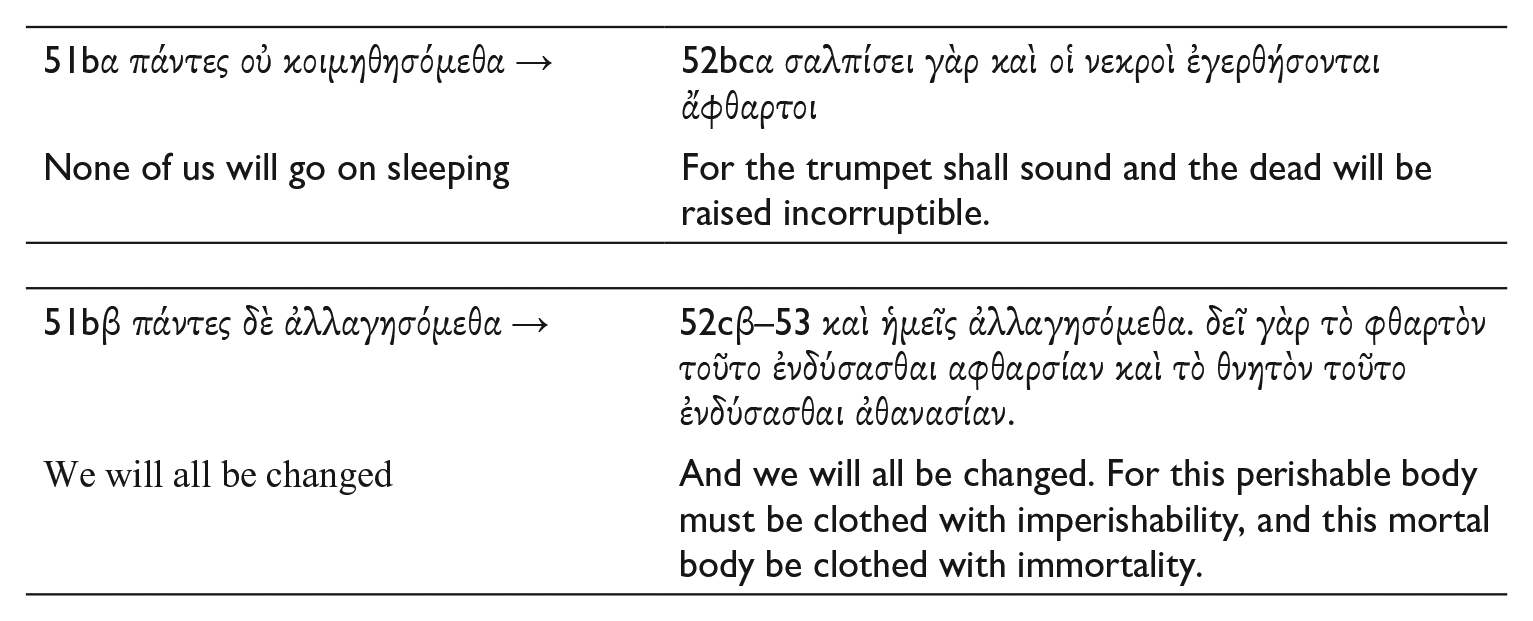
In the first line (51bα || 52bcα), the trumpet-blast explains why no-one will continue to sleep: they will be raised incorruptible. In the second line (51bβ || 52cβ–53), ‘we shall be changed’ because of the necessity of acquiring an incorruptible nature: After all, ‘flesh and blood cannot inherit the kingdom of God, nor does what is corruptible inherit the incorruptible’ (15.50).
These arguments contribute to the case that the dead are a subset of the ‘we’ in 52c. Overall, then, the general view that Paul introduces a clear distinction between the living and the dead in 1 Cor. 15.52 is by no means as certain as is usually thought.
Interim Conclusion
In sum, then, scholars too readily assume that the two statements about transformation in vv. 51 and 52 respectively have different senses. Even if in the end it is hard to be certain, there are strong arguments for (a) the identity of the subjects of ἀλλαγησόμεθα in both vv. 51 and 52; (b) the difficulty of narrowing the transformative destiny of all in v. 51 to only a subset in v. 52, and (c) the fit with Paul’s larger argument. As a result, 1 Cor. 15.52 does not offer hard evidence for Paul’s expectation to survive until the parousia.
Circumstantial Evidence from Elsewhere in 1 Corinthians
In addition to the specifics of 1 Cor. 15.51–52, we can also consider some of the circumstantial evidence of other passages in the letter. These give further support to the idea that Paul did not necessarily assume an imminent parousia in his own lifetime.
Potential Counterevidence to Paul’s Expectation of Survival to the Parousia (1 Cor. 6.14)
In 1 Cor. 6.14, Paul states that, just as God raised Christ from the dead, so ‘he will raise us up by his power’ (ὁ δὲ θεὸς καὶ τὸν κύριον ἤγειρεν καὶ ἡμᾶς ἐξεγερεῖ διὰ τῆς δυνάμεως αὐτοῦ). 84 Here a direct analogy is drawn between Jesus on the one hand, and Paul together with the Corinthians on the other: God both raised Christ, and will raise them. Some elements of the broader paragraph (1 Cor. 6.12–17) are complicated by the problem of the Corinthian slogans, but it is clear that Paul is expressing his own view in v. 13b: ‘The body, however, is not meant for sexual immorality but for the Lord’. Paul then reinforces 6.13b in two ways: first, by drawing attention to the resurrection of Christ (‘and the Lord for the body’ in 13b; ‘by his power God raised the Lord from the dead’ in v. 14a); and second by drawing attention to the enduring bodily state of his Corinthian audience not just in the present but also in the future when God will raise them (‘and he will raise us also’ in v. 14b). The close identification Paul is making between the destinies of Christ and Christian believers leads him to portray himself and the Corinthians as destined to die.
My point here is not to argue on the basis of 1 Cor. 6.14 that Paul expected himself and the Corinthians to die (and therefore definitely not to survive to the parousia). Paul certainly did not assume a Fernerwartung, convinced that the parousia would certainly take place after his death. 85 The point of the “Potential Counterevidence” here is rather that Paul—for a particular rhetorical purpose in 1 Cor. 6.12–17—can envisage himself dying. That Paul can write this way does therefore reinforce the likelihood that 1 Cor. 15 is not expressing any sort of clear expectation that he would live to see the parousia. 86
Paul’s Reckoning with the Possibility of Dangers/Death in 1 Cor 15–16
This point that Paul can envisage himself dying according to 1 Corinthians is reinforced by his references to life-threatening events—not least in ch. 15 itself. Paul states in 1 Cor. 15.6 his awareness of the deaths of others. Various dangers to him personally are apparent in the chapter. He faces danger every hour (15.30: κινδυνεύομεν πᾶσαν ὥραν), is threatened with death every day (15.31: καθ’ ἡμέραν ἀποθνῄσκω), has fought wild-beasts in Ephesus where he still currently is (15.32: ἐθηριομάχησα). At the beginning of ch. 16, he continues to envisage many opponents in Ephesus (16.9: ἀντικείμενοι πολλοί). 87 If, as we have seen Barrett and Schnelle note, Paul viewed death before the parousia as the norm by the time he wrote 1 Corinthians, he himself was very much on the front line of the battle. There is none of the breezy confidence that Paul has in Phil. 1. Rather, the lapidary conclusion at the end of 1 Cor. 16.9 has an almost chilling note: θύρα γάρ μοι ἀνέῳγεν μεγάλη καὶ ἐνεργής—καὶ ἀντικείμενοι πολλοί. 88
Conclusion: Summary and Implications
The first subsection of this article (“A Preliminary Note on the Text”) noted the general agreement about the reading in Codex Vaticanus being the earliest recoverable form. What is more controversial is the hypothesis of Metzger and North, as well as of various commentators, that the impulse for the variant in א and C (which in turn led to the text of
The main point of the first half of this article (“πάντες οὐ κοιμηθησόμεθα in 1 Cor. 15.51-52a”) is to suggest a rereading of 1 Cor. 15.51–52a by arguing that πάντες οὐ probably does not mean ‘not all’ since the negative goes with the verb, and that the verb κοιμηθησόμεθα can be understood in a durative sense (‘being asleep’). As a result, 1 Cor. 15.51b can be translated: ‘None of us shall (continue to) sleep, but we will all be changed’. This fits rather well with Paul’s emphasis in vv. 51–52 on the blaring of the last trumpet, especially given his explicit reference in v. 52b to the tradition of the final trumpet waking the dead.
In the second main section (“‘We’ the living or ‘We’ all ἀλλαγησόμεθα (15.52)”), the main aim was to query the usually assumed reading of v. 52bc as distinguishing between the living and the dead, making those changed in v. 52 a subset of those changed in v. 51, and envisaging Paul’s survival until the parousia. As Klein notes, the arguments for these points are not nearly as strong as is commonly assumed, especially considering Paul’s larger argument.
Finally, we examined the circumstantial evidence. We noted the rhetorical point that, even if Paul did present himself in 1 Cor. 15.51–52 as surviving to the parousia, he can also present himself in a different rhetorical context (in 6.14) as destined to die and be raised from the dead. There is also the evidence of Paul’s hazardous lifestyle in which—on the face of it—he is constantly aware of the danger of death, not least in 1 Cor. 15 itself.
Although these conclusions are potentially radical, this article is, as promised in the title, a modest suggestion. It may be, like the time traveller in H. G. Wells, ‘too clever to be believed’. 91 On the other hand, it does seek to point out some of the various shortcomings of the conventional interpretation, and at least propose an alternative for consideration. Paul does have some imminent expectations in 1 Corinthians: 92
He is going to stay in Ephesus for some length of time (16.8).
While Paul is absent from the Corinthians, he envisages Timothy visiting them (16.10).
Paul also expects them to send Timothy back to him in Ephesus (16.11b).
Others will also visit Paul, along with Timothy (16.11c).
Apollos will also visit the Corinthians when he has the chance (16.12).
Paul is then going to Macedonia (16.5).
Then he plans to visit them in Corinth (16.3, 5).
Then he was willing to go to Jerusalem with the Corinthian envoys (16.4).
Whether in 1 Cor. 15 he also expected an imminent parousia, which he and a portion of his contemporaries would live to witness, is perhaps less clear than has previously been thought. 93
Footnotes
1.
For Naherwartung in 1 Cor. 15.51–52, see (in addition to the bibliography in nn. 2, 3 and 5 below), e.g., Usami 1976: 491; Mearns 1984: 19; Plevnik 1997: 158; Oegema 1999: 203; Perkins 2012: 192. Paul’s use of the term ‘mystery’ is taken by scholars either in a general, eschatological sense (Perkins 2012: 190), or specifically as referring to the hidden-but-now-revealed truth of the specifics of transformation: for the latter, see, e.g., Adewuya 2009: 117, and  : 250, 261.
2.
See, e.g., recently, Barclay 2016: 260, and : 41.
3.
E.g., Horrell 2015: 96–98 and : 520.
5.
NA27 and NA28 both have marginalia to each of the passages referring to the other, for example. On 1 Cor. 15 and 1 Thess. 4 as similar witnesses to Naherwartung, see, e.g., Dodd 1934: 94; Hunzinger 1968: 70; Conzelmann 1975: 290; Schnelle 1989: 47–48; Erlemann 1995: 195; Lindemann 2000: 366; Schrage 2001: 375–76; Fredriksen 2017: 131. : 155) agrees, but with qualifications.
12.
See Goodwin 1888: 121. For a survey and discussion of the variants, see esp. Oppenheim 1931: 92–135; Brandhuber 1937: 303–33, 418–438; : 317–21.
15.
The Marcion reading could be queried, as Schmid does not regard the attestation as sufficiently clear. See Schmid 1995: 327; also Lieu 2015: 266–67, and , ad 15.50–52. My thanks also to Hugh Houghton for sending me the ITSEE collation of 46 manuscripts of 1 Corinthians.
19.
There are only a few exceptions: Saake (1972: 277–279) preferred א C (though connecting the οὐ with the first half); : 661–669) opts for the text of
20.
For accounts which take scribes to be making parousia-motivated changes, see, e.g., Metzger 1994: 569; Jeremias 1956: 152; Plevnik 1997: 160, and North 2008: 34–36. Further, in the commentaries, see Héring 1949: 158 n. 2; Barrett 1968: 381; Lindemann 2000: 366; Schrage 2001: 370; : 604.
22.
Metzger notes the omission of οἱ περιλειπόμενοι in 1 Thess. 4.17 (though not in 4.15) in a few manuscripts. I am grateful to Dr Dirk Jongkind for his advice on this matter.
23.
Many note the unusual word order, e.g., Olshausen 1851: 262: ‘This negation would appear more suitably placed before πάντες than before κοιμηθησόμεθα, for in the latter case the words would really imply “none will die”’; Robertson and Plummer 1911: 376; Héring 1949: 150 n. 1; Fee 1987: 800; Lindemann 2000: 366; : 370.
25.
26.
See, e.g., Blass 1911: 257: ‘The position of the negative is as a matter of course before the thing to be negatived’. Because of this, Blass concludes that the standard reading (i.e., that of Vaticanus and the Majority Text) ‘gives a quite unsatisfactory sense’, and so he thinks a different text must be adopted. Similarly Blass and Debrunner (1961: 224, §433); Muraoka 2016: 713: ‘when a particular clause constituent alone other than a verb is negatived, the negator is positioned immediately before it’. Turner (1963: 286) notes: ‘As a rule the negative precedes what is negatived, excepted that it may also (as in class. Greek) precede the preposition or ὡς if such occurs before a ptc. or adj.’. He goes on to note that, ‘The rule is several times broken with πᾶς’, but all but one of these ‘breakages’ are in the opposite direction to that which would be required for the conventional view of 1 Cor. 15.51, and in fact conform to the pattern in the Pauline examples above. The exception to this which he notes is: ‘1 Co 1551 πάντες οὐ κοιμηθησόμεθα (must = οὐ πάντες)’! (Italics original.) : 181) comment on the displacement of the οὐ, and offer 1 Cor. 1.15 as a parallel, but 1 Cor. 1.15 is a perfectly ordinary use of the negative: ἵνα μή τις εἴπῃ ὅτι εἰς τὸ ἐμὸν ὄνομα ἐβαπτίσθητε (‘so that no one might say that you were baptised in my name’).
27.
Of course, in certain cases it may be specifically the verb that is being negated (e.g., Mk 4.12).
28.
The qualification in 1 Cor. 6.12b (ἀλλ᾽ οὐκ ἐγὼ ἐξουσιασθήσομαι ὑπό τινος) is not relevant to the discussion here, but still follows the pattern of the fronted οὐ(κ) negating the whole sentence.
30.
The examples with μή (in the sense of num …?) in 1 Cor. 12.29 might also be negations of the clause as a whole or of the subsequent term:, e.g., ‘Are all really apostles?’ or ‘Are all apostles?’
31.
The first πᾶς does not belong to the same clause as the οὐκ and the πᾶσιν.
32.
Some have sought to adduce parallels. As Schrage comments (2001: 370 n. 1849): ‘Öfter wird auf Num 23,13 verwiesen (so Godet 2:239; Schlatter 443) für die Verbindung des οὐ mit dem verbum, auch wenn es einen anderen Satzteil negiert, auf 2Kor 7,3 (so Barrett 380).’ However, Num. 23.13 (μέρος τι αὐτοῦ ὄψῃ, πάντας δὲ οὐ μὴ ἴδῃς) is not a good parallel, because οὐ μή can only negate a verb. Further, with respect to 2 Cor. 7.3 (πρὸς κατάκρισιν οὐ λέγω), as discussed above placing οὐ before the verb can negate the whole idea of the sentence rather than necessarily the verb (see, e.g., Rom. 3.20; 10.11 above). More appropriately, : 224, §433) identify Xenophon, An. 2.5.35 (πάντες μὲν οὐκ ἦλθον, ᾿Αριαῖος δὲ…) and Hermas, Sim. 8.6.2 (πάντες οὐ μετενόησαν) as analogies to the conventional understanding of 1 Cor. 15.51.
33.
See, e.g., Fee 1987: 800; Plevnik 1997: 157; : 181.
34.
35.
37.
So Quesnel 2018: 410; cf. Lang 1986: 239; Fee 1987: 800. Goodwin and Merklein sought to make sense of it. For Merklein (1992: 422), Paul acknowledges that the discussion about the dead in vv. 35–49 does not apply to the living, and so v. 51 (and the subsequent explanation) shows how all are changed together. Somewhat similarly, Goodwin (1888: 123), commented that vv. 35–49 raise the question of whether Paul’s audience would have to die to be transformed, to which Paul replies: ‘none of us (exclusive - living) will have to sleep (or die)’. For some other nineteenth-century approaches, see : 580–582.
38.
39.
Barrett 1953: 143; Schnelle 1989: 39–41, 47, noting the references to death(s) in 1 Cor 7.39; 11.30; 15.6, 18, 29, 51. Similarly, Gillman 1982: 319–20; Lüdemann 1980: 199. Cf. Plevnik (1997: 165), for whom death is not the rule, but not the exception either. See also the astute discussion in : 388–89.
42.
43.
In Paul: 1 Cor. 7.39; 15.18, 20; 1 Thess. 4.14–15; also Acts 7.60; 13.36; 2 Pet. 3.4. For the avoidance of doubt, I am not assuming any particular view of the aspect or temporality of the aorist here.
44.
It is possible that in 1 Thess. 4.13 Paul is talking generically about the class of people ‘who fall asleep’, but this makes less good sense.
45.
Additionally, in the LXX there are durative examples in Exod. 34.25 (‘sacrifices of a feast of pascha οὐ κοιμηθήσεται until morning’) and Lev. 19.13 (‘the wages of a day labourer οὐ μὴ κοιμηθήσεται with you until morning’). Isa. 21.13, by contrast, is a punctual instance: ‘In the evening, you will lie down (κοιμηθήσῃ) in the thicket, in the way of Dedan’.
46.
Durative: ‘Serpents and asps will sleep (κοιμήσονται) with babies and will not harm them’ (Or. Sib. 3.794–5); ‘The angels who cause fires to gleam and pour forth rivers will sleep (κοιμήσονται) under his [sc. David’s] feet’ (Or. Sib. 7.33–35); ‘I will myself drink the one first, and the other I will give to the maiden. She will sleep the whole night through (κοιμηθήσεται δὲ πάντως δι᾿ ὅλης τῆς νυκτός) after she has taken it’. (Achilles Tatius, Leuc. 4.16.4); ‘For the time we continued in this manner; and when evening came she did her best to make me pass the night (κοιμησόμενον) there’. (Leuc. 5.14.1).
Punctual: ‘The wise man must never have a bilious attack, never fall asleep (οὔτε κοιμηθήσεται), and above all must never die’. (Philo, Plant. 177); ‘It was evening, and after dinner we lay down to go to sleep (ἐκείμεθα κοιμησόμενοι)’ (Leuc. 5.15.3).
47.
48.
Gardner 2018: 725; : 831.
49.
Athenaeus, Deipn. 3.55 (99d).
50.
Ps.-Lucian, Ocypus 114.
51.
Plutarch, Nicias 9.6 (529).
52.
Plutarch, Numa 20.4–5; Josephus, War 3.86.
53.
See the trumpet signalling eschatological redemption in Joel 2.1 and Zeph. 1.16. Further, in the early Jewish interpretation of the sacrifice of Isaac, the horns of the ram caught in the thicket (Gen. 22.13) were seen as a harbinger of salvation, connected with the Lord blowing the horn (Zech. 9.14–16) and thereby announcing salvation. Just as Isaac was rescued, so all Israel in the end ‘will be redeemed by the ram’s horn’: see y. Taan. 2.4; Gen. R. 56.9 on Gen. 22.13; cf. Lev. R. 29.10; b. RH 11b; b. RH 16a. Elsewhere the blast announces judgment: see, e.g., Apoc. Zeph. 9–12; T. Abr. 12.8; Sib. Or. 4.171–177; Rev. 8–11. See further : 206–7.
54.
See Isa. 27.12–13; Jer. 4.5 (cf. 51.27); Apoc. Mos. 22; Matt. 24.31; Shemoneh Esreh 10.
55.
Isa. 27.13 LXX; Tg. Ps.-Jon. Exod. 20.15/18; Signs of the Messiah (Lueken 1898: 50); Alphabet of Rabbi Akiba (Imber 1897: 715, and text in Jellinek 1855: 12–64); Eccl. R. 1.7.8; History of Daniel (Qiṣṣa-ye Dāniyāl) (Zotenberg 1869: 420–21); Tg. Zech. 14.4 Codex Reuchlinianus; Midrash Leqah Tob on Num. 24.17. See further : 61–73. The evidence of shofarot in inscriptions, especially on epitaphs, may also be relevant here: see, e.g., Goodenough 1954: 167–94.
57.
61.
See also CIIP IV/2: 3819, a sixth-century Greek mosaic inscription on a burial chamber, quoting (in loose fashion) 1 Cor. 15.52–54: δεῖ τὸ ϕθαρτὸν τοῦτο ἐνδύσασθαι ἀϕθαρσίαν καὶ τὸ θνητὸν τοῦτο ἐνδύσασθαι ἀθανασίαν. σαλπίσει γὰρ καὶ οἱ νεκροὶ ἀναστήσονται (: 1299–300). See further the Jewish evidence cited above in n. 55.
62.
Gk Apoc. Ez. 4.36: καὶ μετὰ ταῦτα σάλπιγξ, καὶ τὰ μνημεῖα ἀνοιχθήσονται καὶ οἱ νεκροὶ ἀναστήσονται ἄϕθαρτοι.
63.
64.
In Paul’s sequence ἐν ἀτόμῳ, ἐν ῥιπῇ ὀϕθαλμοῦ, ἐν τῇ ἐσχάτῃ σάλπιγγι, the final entry—the last trumpet—is introduced as something definite: τῇ ἐσχάτῃ σάλπιγγι. That is to say, it is already a known quantity.
65.
Possibly one should not see a contrast: the δέ might be simply continuous. I recall two examples where a clause is followed by a δέ clause in a continuous sense. In Rom. 3.21–22: νυνὶ δὲ χωρὶς νόμου δικαιοσύνη θεοῦ πεϕανέρωται, μαρτυρουμένη ὑπὸ τοῦ νόμου καὶ τῶν προϕητῶν, δικαιοσύνη δὲ θεοῦ διὰ πίστεως [Ἰησοῦ] Χριστοῦ, εἰς πάντας τοὺς πιστεύοντας, οὐ γάρ ἐστιν διαστολή. The first δέ (νυνὶ δέ) is obviously contrastive, but the second (δικαιοσύνη δὲ θεοῦ) is strongly continuous. Second, in the Valentinian Summer Harvest hymn, the poet begins πάντα κρεμάμενα πνεύματι βλέπω, πάντα δ’ ὀχούμενα πνεύματι νοῶ (Valentinus fr. 8 [], ad Ps.-Hippolytus, Ref. 6.37.7). Here again the sense is strongly continuous.
67.
Gladd 2008: 250: ‘vv. 50–53 constitute the climax of Paul’s argument thus far and the answer to the question in v. 35’. Cf. Usami 1976: 490: ‘V. 51 shows that in this paragraph the answer to the question of v. 35 is given a very personal emphasis’. Perhaps a majority of scholars see vv. 35–57/58 as an argumentative unit: see : 155–56; Thrall 1965: 110–12; Conzelmann 1975: 280; Sider 1977: 428–39 (vv. 35–54); Gillman 1982: 309; Fee 1987: 775; Horsley 1998: 208; Thiselton 2000: 1257; Keener 2005: 129; Fitzmyer 2008: 586; Adewuya 2009: 112; Zeller 2010: 504; Schreiner 2018: 319; Starling 2025: 366. Some understand v. 35 as asking two questions which are answered differently in vv. 36–58 (e.g. Jeremias 1956: 157).
68.
69.
: 105–6, comments as follows on 15.39–41: ‘Paul is laying the groundwork ultimately to show that the resurrection of the dead can be comprehended within this context of cosmic, locative polarity. In this section, he merely frames the notion of cosmic, locative polarity in a way that allows for the resurrection to be discussed in this context’. See further Asher 2000: 103–6, on this whole theme.
70.
On the assumption, not necessary to the argument here, that πνευματικός means not composed of spirit but governed by the spirit, just as ψυχικός does not mean composed of soul but governed by the soul, see, e.g., Klein, 1973: 255.
73.
For Lindemann (2000: 356), v. 50 begins a new section; : 586) comments that one of the questions in v. 35 is dealt with in vv. 36–49, and the other in vv. 50–57.
75.
So, e.g., Conzelmann 1975: 111; Lang 1986: 239; Fee 1987: 802; Horsley 1998: 213; Schrage 2001: 375; Merklein 2005: 3.417 n. 43; Gladd 2008: 252; Zeller 2010: 522; : 231.
76.
Followed by, e.g., Romeo 1934: 274, 313–16; Schnabel 2006: 984. For other advocates, see the survey in Gillman 1982: 312–20. Klein also mentions : 193.
77.
Klein 1973: 252: ‘Nichts im Text aber weist darauf hin, daß die 1. Pers. Plur. im Zusammenhang der Vv. 51 f. in völlig verschiedener Bedeutung verwendet, nämlich zunächst (V. 51) auf die gegenwärtige Christengeneration in ihrer Gesamtheit, dann (V. 52) auf einen kleineren Kreis bezogen wäre’. Cf. also : 515: ‘One difficulty with this interpretation [i.e., the normal one] is the need to understand the second ἀλλαγησόμεθα in a restricted sense’.
78.
Klein 1973: 252: ‘eine restriktive Sinnverschiebung’; similarly : 515.
84.
85.
There is general agreement that this text (with ἐξεγερεῖ, rather than ἐξήγειρεν or ἐξεγείρει) is the correct one. Barrett (1968: 148) notes on the text of 1 Cor. 6.14 that ‘only the future provides the argument Paul needs’. Similarly Godet 1889–1890: 2.307: ‘The readings raises and raised are evidently erroneous.’ Additionally, Schnelle’s proposal of 1 Cor. 6.14 as a gloss has not been accepted. On this, see Lindemann (2000: 147) and Collins (1999: 246) vs. Schnelle 1983: 217–19. : 81–94) argues against Schnelle’s first two points, on Paul’s rhetoric; Schnelle’s third argument is that 1 Cor. 6.14 contradicts 1 Cor. 15.51–52 as conventionally understood.
87.
Points along these lines are made by Jones 1947: 47; Morris 1958: 232; Bruce 1980: 155; Garland 2003: 742–43, and 981–82; contra Conzelmann, who dismisses appeal to 1 Cor. 6.14 as ‘idle’ (1975: 290).
88.
Various commentators note Acts 19 as illustrative of the situation in Ephesus: see, e.g., Robertson and Plummer 1911: 390; : 241.
89.
It calls to mind what are promised to followers of Jesus in Mk 10.29–30: Ἀμὴν λέγω ὑμῖν, οὐδείς ἐστιν ὃς ἀϕῆκεν οἰκίαν ἢ ἀδελϕοὺς ἢ ἀδελϕὰς ἢ μητέρα ἢ πατέρα ἢ τέκνα ἢ ἀγροὺς ἕνεκεν ἐμοῦ καὶ ἕνεκεν τοῦ εὐαγγελίου, ἐὰν μὴ λάβῃ ἑκατονταπλασίονα νῦν ἐν τῷ καιρῷ τούτῳ οἰκίας καὶ ἀδελϕοὺς καὶ ἀδελϕὰς καὶ μητέρας καὶ τέκνα καὶ ἀγροὺς—μετὰ διωγμῶν.
90.
91.
Robertson 1928: 159 (offering differing understandings of the resurrection as another possibility), followed by : 154.
94.
I am very grateful to Benjamin Gladd, Thomas Schreiner, David Starling, Jeffrey Weima, and Peter Williams for their comments on earlier versions of this article.