




Abstract
This study proposes a new reading of Jesus’ confrontations with the elemental and the demonic on the sea of Galilee – the stilling of the storm (Mk 4.35–41), the Gerasene demoniac (5.1–20) and Jesus walking on water (6.45–52) – in light of literary and material records associating hydromachy (battles against sea and river gods) with the conquest of land. Taken together these episodes reveal a Galilean Messiah who by subduing demonic waters is able to go on and conquer territory long held to be part of Israel, thereby fulfilling well-documented hopes for the restoration of the land and becoming the Jewish (as opposed to Roman) ‘lord of land and sea’.
Keywords
Our study begins not in the sea of Galilee but the English channel in the fifth century ce. The Venerable Bede tells us that at this time Britain had succumbed to the Pelagian heresy. Hoping to reclaim the country for the Catholic faith, the Church of Rome dispatched two Gaulican bishops, Germanus and Lupus, on a mission to save Britain. Having set sail from Gaul, the bishops and their crew initially encountered fair winds and following seas until ‘suddenly, as they were sailing, the might of evil spirits [came] to withstand them’. The demons raised a mighty tempest to repel the advance of the bishops with ferocious winds and waves which threatened to swamp the boat. As the mariners despaired for their lives, however, Germanus had fallen asleep. Lupus and the mariners hastened to wake the sleeping bishop so that he might save them from the demonic forces before they perished. Upon waking, Germanus called on the name of Christ and sprinkled holy water over the waves. At once, the evil spirits were ‘chased away’ and a ‘clear calm’ ensued. With the wind now at their backs the bishops sped peacefully to their destination. Upon arriving, they expelled the Pelagian demons from the British people and reconquered the country for the Catholic faith (Bede, Eccl. Hist. 17).
This confrontation on the high seas is – like many of the tales recorded by Bede – modelled on a well-known episode in the Gospels: the stilling of the storm in Mk 4.35–41 (par. Mt 8.23–27; Lk. 8.22–25). 1 The episode is one of three confrontations with the elemental and demonic on the sea of Galilee in the Gospel of Mark, the other two being Jesus’ altercation with the Gerasene demoniac in Mk 5.1–20 wherein a legion of demons is sent into a herd of swine which is drowned in the sea and the stilling of a second storm in Mk 6.45–52 during which Jesus walks on water. These episodes have often been understood as epiphanies or theophanies revealing Jesus’ divine identity to the reader in subtle echoes of and allusions to the Jewish scriptures. To take one example, Richard Hays (2016: 66–69) finds in the first stilling of the storm alone echoes of Ps. 107, Job 38, Ps. 89, Ps. 65, Ps. 106, Isa. 51 and Ps. 44, which together present Jesus as ‘Israel’s God’ who is leading a ‘new exodus’, a theme that for Hays evokes a larger complex of passages from the Jewish scriptures. Reading Hays and some other scholars, myself included, one can get the mistaken impression that the only cultural and religious data relevant for understanding the Gospels comes from the exegesis of the Jewish scriptures.
In this study I take a different tack to Jesus’ maritime encounters in Mk 4–6. 2 I argue that Jesus’ contests with the elemental and demonic in and around the sea of Galilee are best understood against the backdrop of ancient beliefs about sea and river gods. Popular legends told of gods and humans battling to determine control of a particular body of water – a contest which usually determined who controlled the land that lay beyond. In the following I aim to show how these beliefs – common to Greek, Roman and Semitic cultures – might help us reappraise Jesus’ three confrontations on the sea of Galilee. Just as Bede’s Catholic bishops by calming the demonic sea are able to reclaim Pelagian Britain, so Mark’s Messiah by conquering the waters is able to go on and conquer hostile territory and thereby become lord of both land and sea.
Catch a Wave: Hydromachy in Antiquity
Legends of gods battling seas and rivers gradually emerge in Assyrian and West semitic epic from the Middle Bronze Age onwards. An earlier legend of the god Haddu’s victory over the sea developed into the Baal cycle, in which the upstart storm god defeats the prince of the sea, Yamm, the river god Nahar and the serpent Litan (KTU 1.2 IV 23–24; 1.3 III 38–42). 3 A contemporary Assyrian tradition found in the Enuma Elish speaks of the storm god Marduk slaying Tiamat, the cosmic sea, out of whose body the world is created (I 108–110; IV 101–104). 4 While the Baal cycle is not a creation epic, the theme of Chaoskampf has – rightly or wrongly – been associated with both traditions. 5 The gods are shown creating cosmic order by defeating the forces of chaos, personified by the waters. This Chaoskampf theme has been identified in early Hebrew literature, which depicts YHWH triumphing over the forces of the sea, Yam, slaying Rahab and subduing the serpent Leviathan (e.g. Job 9.8; 26.12–13; Pss. 74.13–14; 89.9–10; Isa. 51.9). 6 The myth corresponds to the Greek tradition of the young storm god Zeus defeating the water serpent Typhon to become king of the gods (Hesiod, Theogony 836–868). Common to each is the idea of a younger storm god – Baal, Marduk, YHWH, Zeus – usurping rule of the divine assembly by defeating the water gods and their monsters. This establishes a rule that will hold for humans as well as gods: to rule the world, one must first rule the waves.
Hydromachy becomes less cosmic and more localised, however, in the nascent Greek and Latin traditions of the first millennium bce. Instead of gods waging war against a primaeval sea, we find battles between gods and humans over who controls a specific river or sea strait, usually as the prelude to the conquest of the land. Two early legends of demigods battling river gods profoundly influenced subsequent traditions. The first is Hercules’ battle with the river god Achelous for the maiden Deianira (e.g. Sophocles, Trachiniae 9–17; Ovid, Metamorphoses 9.1–103; Hyginus, Fabulae 31). Achelous attempts to overpower Hercules by transforming into a serpent and then a bull – representing the snaking river and the rushing flood, respectively – but Hercules is able to defeat the river god by breaking off one of the bull’s horns. Afterwards the Naiads fashion this horn into a cornucopia which symbolises the abundance brought by Hercules taming the waters of the Achelous delta in Western Greece. By the common era, Hercules’ conquest of Achelous had become the model for rulers who brought fertility and abundance to their kingdoms by conquering rivers and seas. 7 This fresco uncovered in the Sacellum of the Augustales in Herculaneum depicts a Flavian hero – perhaps Titus – as Hercules defeating Achelous and in so doing presents the emperor as a semi-divine figure who by mastering the waters brings abundance to the empire (Figure 1). 8
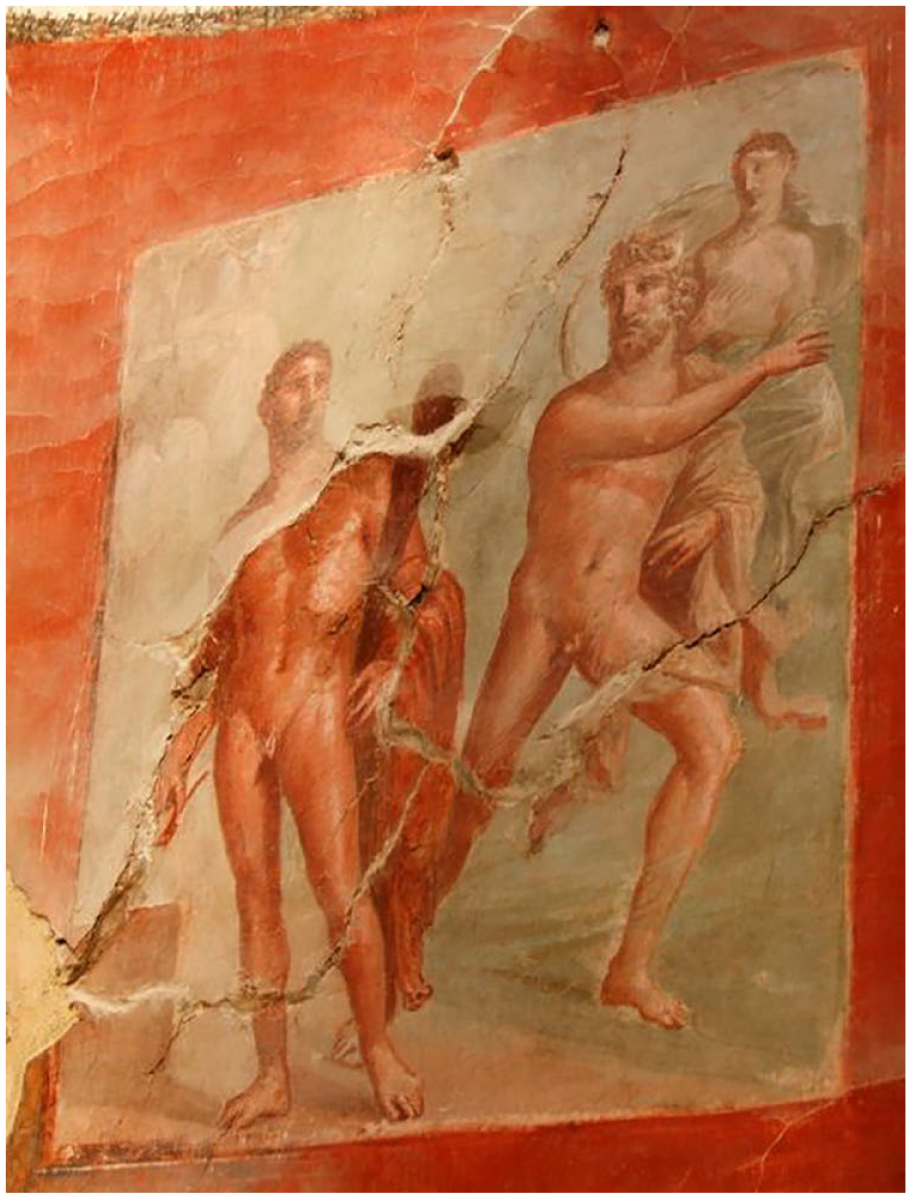
Fresco on the north wall of the Sacellum of the Augustales in Herculaneum depicting a Flavian hero as Hercules defeating Achelous, c.a. 79 ce. Used with permission.
The other foundational legend is found in the Iliad, which narrates Achilles’ battle with the river god Scamander. The episode begins with Achilles polluting the river with the corpses of noble Trojans. When Achilles boasts that the river is unable to protect Troy, ‘Scamander rushed on him with surging flood, and roused all his streams tumultuously’ (Il. 21.234–235) 9 . Achilles clings for life to a tree hanging over the river bank but the force of the flood overpowers him. Just as Achilles is about to drown Hera dispatches Hephaestus, who sends fire upon the river so that the water boils and the flood abates. The fire continues to rage until Scamander swears an oath not to protect Troy from the flames when the time comes (21.373–76). Achilles’ divinely assisted victory over the Scamander marks a turning point in the narrative as it allows the Greeks to go on and conquer the land, with the burned river foreshadowing the city’s fiery fate.
By the Flavian era, Achilles’ confrontation with Scamander had become the standard literary model for stories of rivers resisting an invading force. 10 The model lies behind Hippomedon’s contest with the river god Ismenus in Statius’ Thebaid (9.315–521), in which the warrior chokes the river with noble blood, causing Ismenus to rush upon Hippomedon who clings to life by clasping an overhanging tree until Hera comes to his aid and subdues the river god. More elements of the legend appear in Silius Italicus’ Punica (4.638–703), in which the elder Scipio challenges the river god Trebia, who had treacherously sided with Hannibal during his conquest of the land. Scipio chokes the river with noble blood, boasting before the river god, prompting Trebia to rush upon the general, who despairs of his life until Venus sends Vulcan to burn up the river. Trebia begs Venus to relent and the river is restored to its height. But unlike Achilles, Scipio does not go on to conquer the land. It is not until book 17 that the elements side with the Romans, as the younger Scipio sets sail from Sicily for the final conquest of Carthage, with the support of the sea god and sea birds in tow (17.48–58).
More than just a literary model, Achilles’ contest with Scamander reflects an established military tactic for conquering foreign territories: one first had to defeat or win the support of the waters and their gods before conquering the land. 11 While rulers like Xerxes, Antiochus, and Caligula were mocked for attempting to tame the seas, lordship over the waters was nonetheless a mainstay of imperial propaganda. 12 As nations were identified with their rivers, lakes, and sea straits, the conquest of these bodies of water and their gods was synecdochic for the conquest of the land as a whole. 13 Imperial coins minted from the Flavian era onwards depict emperors vanquishing the river gods of conquered nations, usually by showing the emperor standing on the river – like this sestertius of Domitian standing over the Germanic river god Rhenus (Figure 2).
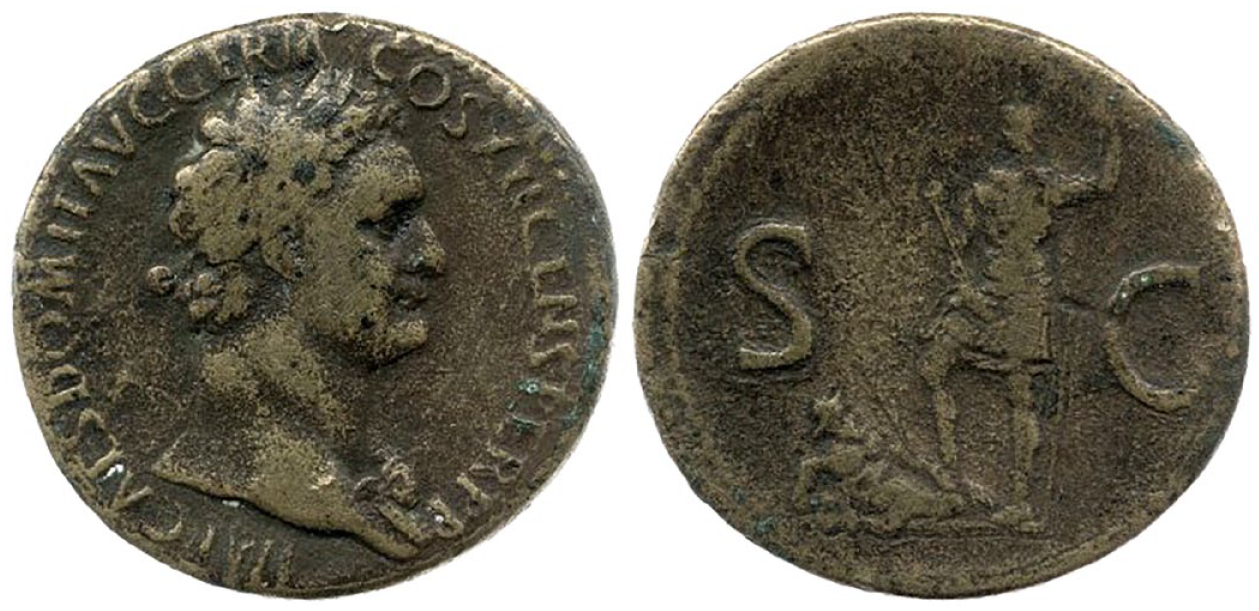
Sestertius of Domitian with reverse of emperor standing over the river god Rhenus while holding a parazonium and a spear. Rome, 86 ce. RIC II.1 no. 468, p. 297. Photograph © The Trustees of the British Museum. Used with permission.
Triumphal processions paraded the conquered river gods, portrayed by statues or actors reclining on fercula – an act which symbolised the cornucopic abundance of conquered nations coming to Rome (Tacitus, Annals 2.41; Silius Italicus, Punica 17.625–650; Florus, Rom. Hist. 2.13). Interestingly, for our purposes, the Arch of Titus depicts a mysterious river god carried on a ferculum trailing the spoils of Jerusalem (Figure 3). The identity of the river god is unknown but the figure could symbolise the Jordan, the tutelary river of Judaea, or lake Gennesaret – the sea of Galilee – on which Vespasian and Titus had won a pivotal naval battle (but more on that later). 14
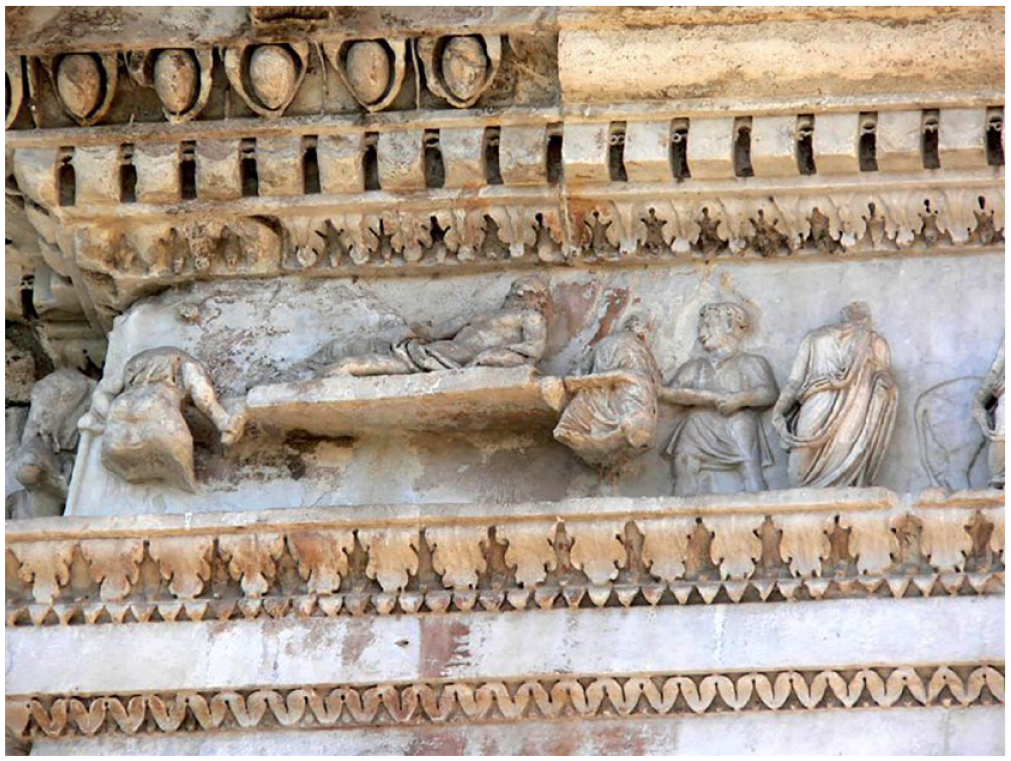
Reclining Judaean river god carried on a ferculum trailing the spoils of Jerusalem, Triumphal frieze, Arch of Titus, c.a. 81 ce. Used with permission.
When taken together, these legends and images show how water and conquest were confluent in ancient military campaigns and subsequent propaganda. An invading force could expect resistance from seas, rivers, and lakes if the country’s gods were against them. Only by subduing or winning over the country’s waters and their gods could the invader go on to conquer the whole land. But in overcoming the elements, the conqueror was not the land’s destroyer but its liberator. Like the cornucopia of Hercules, generals and emperors were thought to restore life and abundance to the land by taming its waters. So when Titus approached Jerusalem, Josephus tells us that dry streams began flowing freely – Judaea’s waters had literally taken Rome’s side, a miracle that portended the region’s conquest (War 5.410–11). It is little wonder then that the Romans claimed a river god of the Judaeans among their spoils. The claim of lordship over sea extended to all bodies of water – and when it came to conquest, water naturally came before land, both as a natural border and life-source. What all of this has to do with Jesus’ aquatic activities in the Gospel of Mark we will now explore.
Messiah Rule the Waves: Hydromachy in the Gospel of Mark
The saga begins with Jesus and his disciples on the western shore of the Galilean sea, from where Jesus gives the instruction διέλθωμεν εἰς τὸ πέραν, ‘Let us go across to the other side’ (4.35). It is now a common refrain in Markan studies that our author considers Galilee, on the western side of the sea, to be Jewish territory, whereas the eastern side of the sea, what one might call the region of the Decapolis, is gentile territory. 15 This is, of course an oversimplification – we know from Josephus and the archaeological record that the larger cities in Galilee, like Sepphoris and Tiberias, were not without gentiles, while there were sizable Jewish populations in the Decapolis. Nevertheless the rabbis pit the peoples of the opposing shores against each other: commenting on Lam. 1:17, ‘The Lord has commanded for Jacob that her adversaries surround her’, the rabbis note that Tiberias stands opposite its enemy, Susita/Hippos (Lam. Rab. 1:52; Lev. Rab. 23:5). But the hydromachic elements of Jesus’ maiden sea voyage and its aftermath suggest that our author saw the eastern shore of the sea as something more than ‘gentile territory’.
Just as the Scamander rose up against Achilles and the English channel resisted Bede’s bishops, the sea wages a counterattack against Jesus’ incursion: ‘a great windstorm arose, and the waves beat into the boat, so that the boat was already being swamped’ (4.37). However, in what may be a subtle allusion to Jon. 1.4–6, Jesus is sound asleep on a cushion in the stern of the boat. 16 The disciples wake Jesus, who proceeds to rebuke (ἐπιτιμάω) the wind and muzzle (φιμόω) the waves. 17 To tame the sea, Jesus uses the same formula as when he first encountered an unclean spirit in Mk 1.25: he rebukes (ἐπιτιμάω) and then muzzles (φιμόω) the demon. Mark is identifying the elemental forces of the sea with unclean spirits, over which Jesus establishes his authority as he advances into hostile territory. Our author may have known that the eastern shore housed shrines to pagan water and storm gods including the water-trampling Tyche-Atargatis (see Figure 4), 18 or that the so-called country of the Gerasenes was (in)famous for its Maiuma water festivals (Lipiński 2013: 919–38). 19
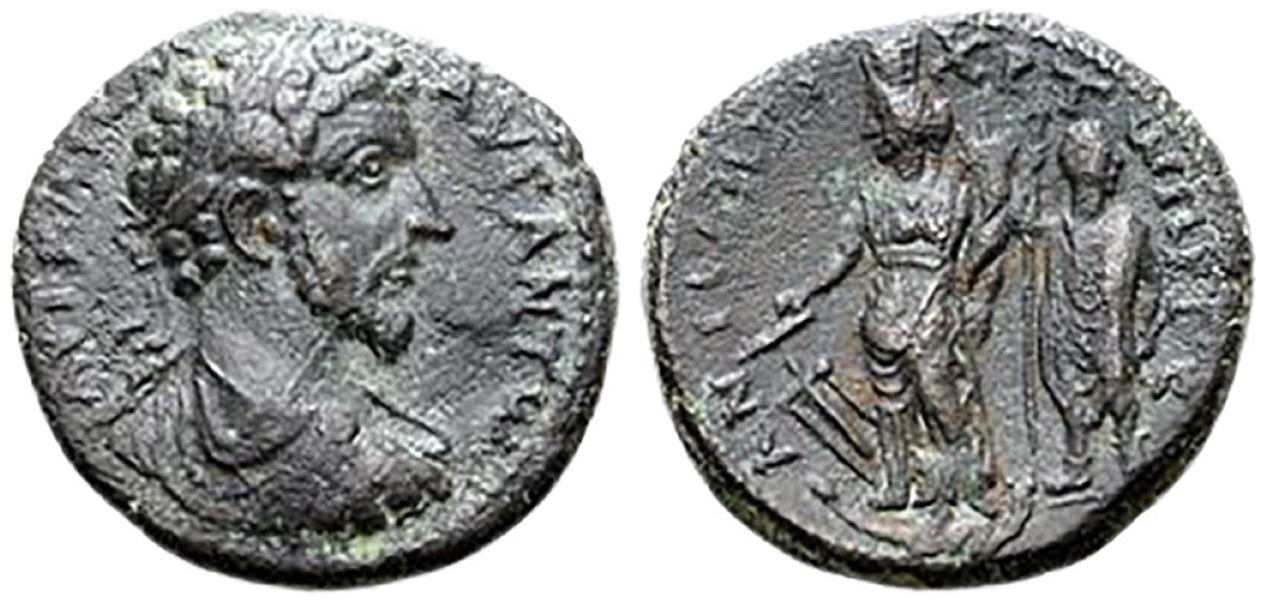
Laureate coin of Marcus Aurelius with reverse depicting Tyche-Atargatis standing on a river god, holding a rudder and cornucopia, with an unknown male figure (e.g. emperor or city founder), Gerasa, c.a. 161–80 ce. Spijkerman 9. Photograph © Roma Numismatics Ltd. Link [Last accessed 26 July 2023]. Used with permission.
Later rabbis would claim that lake Gennesaret was ruled over by the ‘prince of the sea’ – an appellation given to Baal’s nemesis Yamm. 20 More generally our author may have attributed shipwrecks to the work of demons, as did the author of the Testament of Solomon. 21 In any case, Jesus’ contest with the demonic wind and waves as he crosses over into hostile territory follows the programme of ancient conquests: before the Messiah conquers the land, he must first subdue its waters and their gods.
The objective of Jesus’ campaign is revealed in the next scene. When Jesus and his disciples disembark on the eastern shore in the ‘country of the Gerasenes’ (5.1), they encounter a caricature of impurities associated with gentile lands: a man possessed by a Roman legion of unclean spirits living in a graveyard by a herd of swine. This cluster of impurities tells us something about the nature of Jesus’ campaign. In chapter eighteen of the tractate Oholot – which discusses corpses and burials – Mishnah and Tosefta have the sages debate the halakhic status of lands occupied by gentiles (m. Ohol. 18.7–10; t. Ohol. 18.1–18). 22 This was a particular concern for Jews who had been exiled from Judaea to neighbouring Syria in the aftermath of the wars against Rome. The question was how a Jew could maintain ritual purity in a land where the very soil was impure from unclean burials. The sages attempt to settle the question, debating whether the ruins of a gentile graveyard, a legion encampment, or pigs render an area unclean – reaching at times paradoxical and surprising conclusions. 23 At the same time, they prescribe various methods to determine the purity of the land and declare some Syrian cities – like the Decapolis settlements on the eastern shore of lake Gennesaret (t. Ohol. 18.4) 24 – to be free from the halakhah governing gentile lands. Mark’s narrative appears to be animated by a similar concern about the uncleanliness of land occupied by gentiles but offers a more drastic solution. Instead of settling a halakhic dispute, Mark’s Jewish Messiah physically and symbolically purges the neighbouring land of its impurities – not just the unclean spirits, but legions and pigs also. Let us return to the story.
Having seen the Galilean landing party from a distance, the demoniac runs up to Jesus and asks why he is there and begs not to be tormented. Jesus, like Solomon the exorcist (e.g. T. Sol. 2.1), ascertains the demon’s name – Legion – and negotiates the demon’s exit from the man. The demon begs not to leave the land, so Jesus permits Legion to enter a herd of pigs – in what is almost certainly a tongue-in-cheek reference to the swine-bearing legio X Fretensis (see Figure 5), which had conquered Galilee and garrisoned in the Decapolis before besieging Jerusalem during the great revolt, after which it remained in the region. 25
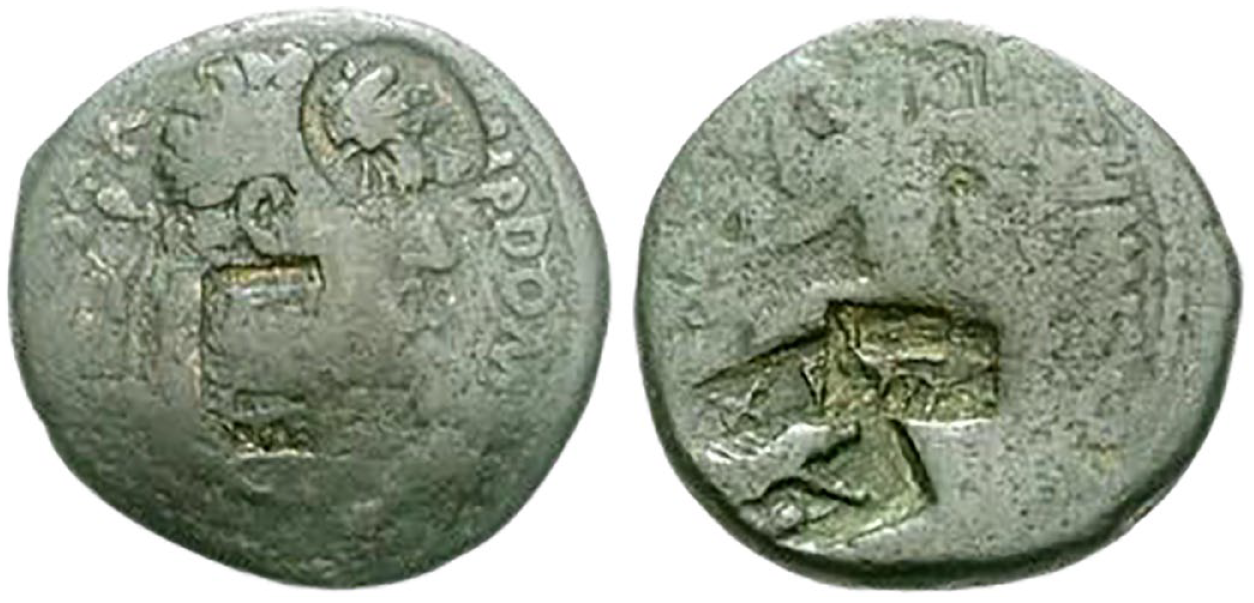
Laureate coin of Domitian with reverse depicting Tyche-Atargatis standing on river god (under incuse), countermarked by legio X Fretensis, with incuse of boar, dolphin, and galley, Sebaste, c.a. 81–82 ce. RPC II no. 2226. Photograph © Classical Numismatic Group LLC. Link [Last accessed: 26 June 2023]. Used with permission.
Then comes a verse that has baffled interpreters: ‘And the unclean spirits came out and entered the swine, and the herd, numbering about two thousand, stampeded down the steep bank into the sea and were drowned (ἐπνίγοντο) in the sea’ (5.13). The unforgettable image of two thousand pigs rushing to their deaths in the sea led to the once popular belief that pigs cannot swim. The opposite is in fact true. The ancient praised pigs’ ability to swim. Aelius Aristides writes that pigs ‘know how to swim, indeed much more competently than human beings’ (Oration 2. A Reply to Plato 378). Interestingly, for our purposes, pigs were famed for swimming away from danger. The Elder Pliny and Aelian relate a popular legend in which a herd of stolen pigs capsized the boat of their captors and swam back to their master on the shore while the pirates drowned (Pliny, Nat. Hist. 8.208; Aelian, Anim. 8.19). The Edinburgh great Robert Louis Stevenson observed the same in the nineteenth century: ‘It was told us in childhood that pigs cannot swim; I have known one to leap overboard, swim five hundred yards to shore, and return to the house of his original owner’ (Stevenson, 2004: 33).
What explains the fate of Mark’s pigs is not their inability to swim or some madness brought on by demonic possession, but Jesus’ stilling of the storm only a few verses before. We have already been told that the ‘wind and the sea obey [Jesus]’ (Mk 4.41). The implication here is that when the pigs are ‘drowned’ (ἐπνίγοντο), the verb is passive and not middle – the pigs do not drown themselves, but are drowned by the sea which obeys Jesus. 26 This would have been the natural reading for Mark’s Jewish readers, who would have heard in it echoes of the greatest battle in Israel’s history, when Pharaoh’s army was drowned by the sea at YHWH’s command, a scene depicted in this mosaic in the synagogue at Huqoq (ca. 400 ce), a village just a few miles north of lake Gennesaret, which shows Pharaoh’s army being swallowed by sea monsters (Figure 6).
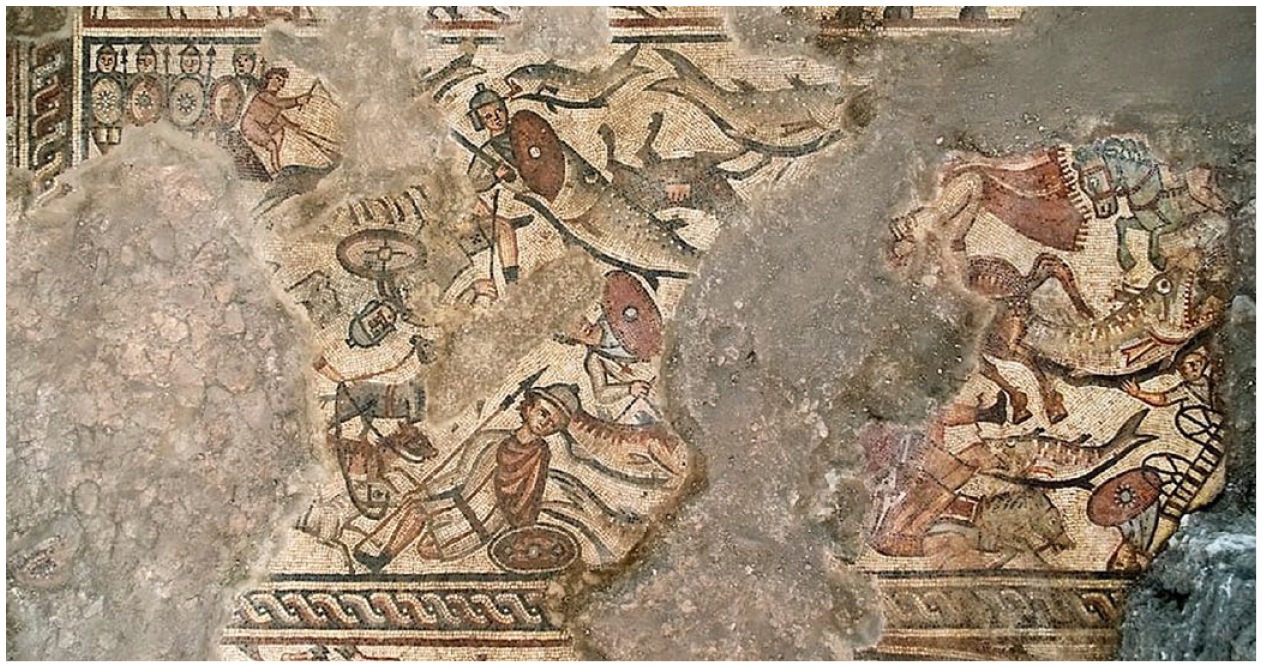
Red Sea mosaic depicting Pharaoh’s army being drowned and eaten by sea monsters, Huqoq Synagogue, Galilee, c.a. 400 ce. Photograph by Jim Haberman; courtesy of the Huqoq Excavation Project. Used with permission. Magness et al (2018: 61–131).
The same idea can be found in a Palestinian legend about the late first-century R. Joshua, who challenges a Min – a Christian heretic – to a miracle-working contest on the sea of Galilee (y. Sanh. 7.13). The Min faithfully recreates Moses’ miracle, parting the waves of the sea. R. Joshua is unimpressed, however, and challenges the Min to recreate the miracle properly by walking into the sea. But just as he walks into the waves, R. Joshua commands the ‘prince of the sea’ to swallow the Min. 27 In the end it is the Jew, not the heretic, who rules the waves.
Mark would agree. For our author, it is the Jewish Messiah who rules the waves. The sea does Jesus’ bidding when it drowns the demonic pigs. And with this, Jesus’ conquest of the land is complete, having driven the unclean legion of spirits and unclean herd of animals from the country. In the end we find the former demoniac clothed and in his right mind – and no longer dwelling in an unclean graveyard – whom Jesus commissions to spread the news throughout the Decapolis, as any Roman victor might have done. 28 Mark stresses that Jesus’ conquest affects the whole region, which may explain the author’s strange decision to identify the eastern shore of lake Gennesaret as the ‘country of the Gerasenes’ (Mk 5.1), despite Gerasa’s location approximately thirty-six miles inland. The description is like a Scot claiming to cross the Firth of Forth from Queensferry to the county of Perthshire, despite Perth’s location approximately thirty-six miles from the Queensferry Crossing. While interpreters since Matthew’s Gospel have proposed more proximate locations (i.e. Gergesa, Gadara, Kursi), there are good reasons to think Mark’s wording is deliberate. Not only does Gerasa offer the attractive Semitic wordplay on garash, ‘to cast out’, and ger for ‘stranger’ – as Bede long ago observed 29 – but the strategic city appears to function as a synecdoche for the central region of the Decapolis (for reasons which will become clear in the next section). By purifying the land, Jesus prepares the way for his second foray over ‘to the other side’ (6.45). This time Jesus does not cross on a boat, but walks across the obedient sea – in language at once reminiscent of the book of Job, wherein God tramples on Rahab the sea monster (Job 9.8–13), and Flavian propaganda which depicted the emperor standing over the vanquished waters of conquered territories. 30
Victoria Navalis: The Jewish Lord of Land and Sea
My aim thus far has been to show that Jesus’ sea voyages in Mk 4–6 follow the ancient programme of water conquest – that is, the conquest of rivers, lakes, sea straits and their gods – as the prelude to land conquest. But why Mark felt compelled to tell a story of conquest in the first place has yet to be answered. Markan scholars have generally agreed on two things about these passages. One is that Jesus’ incursion into ‘gentile’ territory is Mark’s way of laying the groundwork for a mission to the nations. 31 The other is that the purpose of Mark’s sea contests is to reveal Jesus’ divinity, wherein fleeting echoes of the Psalms and Isaiah and Jesus’ creator-like mastery over the elements point to Mark’s high Christology. 32 One wonders whether these scholars might prefer to be discussing a Pauline or Johannine document. In this final section, my aim is to show that Mark’s story of conquest appears to be responding to imperial propaganda and Jewish hopes for the region. While it has been more commonplace to see Jesus’ confrontation with the Gerasene demoniac as reacting to the Roman occupation during and after the great revolt, 33 our first proposal is that all three of Mark’s sea contests should be read narrowly in relation to the account of Vespasian’s conquest of Galilee, occupation of the Decapolis, and subsequent Flavian propaganda. There is one famous incident, in particular, from Vespasian’s northern campaign that appears to have been front of mind for our author: the naval battle of Tarichaeae.
Vespasian and Titus arrived in Galilee in the late spring of 67 ce armed with three legions, including the swine-bearing legio X Fretensis. The Galilean cities of Gabara, Jotapata, Japha, and Joppa fell in quick succession to Vespasian’s forces, with Tiberias surrendering peacefully shortly thereafter. Josephus, the young general sent to Galilee by the provisional Judaean government, was now Vespasian’s prisoner, ingratiating himself to his new master by prophesying his captor’s rise to the principate: ‘You, Caesar, are lord … of all land and sea and the whole human race’ (War 3.402) 34 . Meanwhile, the revolutionary party, led by Jesus of Saphias, had regrouped at Tarichaeae, a town with ‘strong defenses and the lake beside it, called Gennesaret (i.e. the sea of Galilee) by the locals’ (3.463). Battle lines were drawn between the rebels and the Romans on land and on sea. Knowing that the success of the campaign was hanging in the balance, Titus addressed the Roman troops: ‘I think this is the very moment when we shall all be put to the test’, reassuring them that the ‘battle outside the walls is just the beginning of our further success’ (3.482–84). The tide turned in Rome’s favour when, sensing a weakness inside the rebel camp, Titus ‘leapt onto his horse and led the way round to the lake, then rode through the water and entered the town’ (3.497), forcing the Tarichaeans to take refuge in boats on the sea. Titus ‘sent the good news’ (εὐαγγελίζεται) to Vespasian, who then launched a flotilla of Roman soldiers to meet the rebels in the lake. Surrounded on all sides, the small rebel fleet was no match for the Roman vessels and it was not long until ‘they and their boats were sent to the bottom’ (3.525), while those who had not drowned were shot with arrows in the water or struck down on the shore. Josephus reports that ‘One could see the whole lake stained with blood and full of dead bodies – not a single man survived’ (3.529). Vespasian’s victory at sea, the final act in book three of the War, marks a turning point in Josephus’ narrative. Not only was it ‘just the beginning of [their] further success’, as Titus had predicted, but the episode neatly fulfils Josephus’ prophecy on the eve of battle: by trouncing the rebels of Tarichaeae on dry land and water, Vespasian is for the first time revealed as the rightful ‘lord of land and sea’.
Following Vespasian’s victory on the sea of Galilee, what was left of the revolutionary party in Galilee surrendered to Vespasian (4.1), with the exception of Gischala, Mount Tabor, and Gamala on the eastern shore of the sea in Gaulanitis. By the end of the year these too had fallen or surrendered to the Romans. Vespasian’s forces then marched south through the Decapolis and Peraea (68 ce), with the tenth legion occupying Scythopolis (4.87), Peraean Gadara surrendering to the fifth legion (4.413–18) and Gerasa falling to Lucius Annius (4.486–89). 35 By the time Vespasian was finally declared emperor in the autumn of 69 ce by his troops in Caesarea (4.601–4) and then by Rome (4.655), most of Judaea, Hebron, and Idumaea had been conquered (4.550–55). While the new emperor and his successors soon became inseparable from their conquest of Jerusalem and Judaea – IUDAEA CAPTA/DEVICTA coins would continue to be minted until the demise of the Flavian dynasty in 96 ce – Vespasian’s maritime victory at Tarichaeae was the only vestige of the northern campaign to become a permanent fixture of Flavian mythology. Flavian coins minted from 71 ce onwards feature a reverse bearing the legend VICTORIA NAVALIS and winged Victory standing on the prow of a ship (Figure 7).
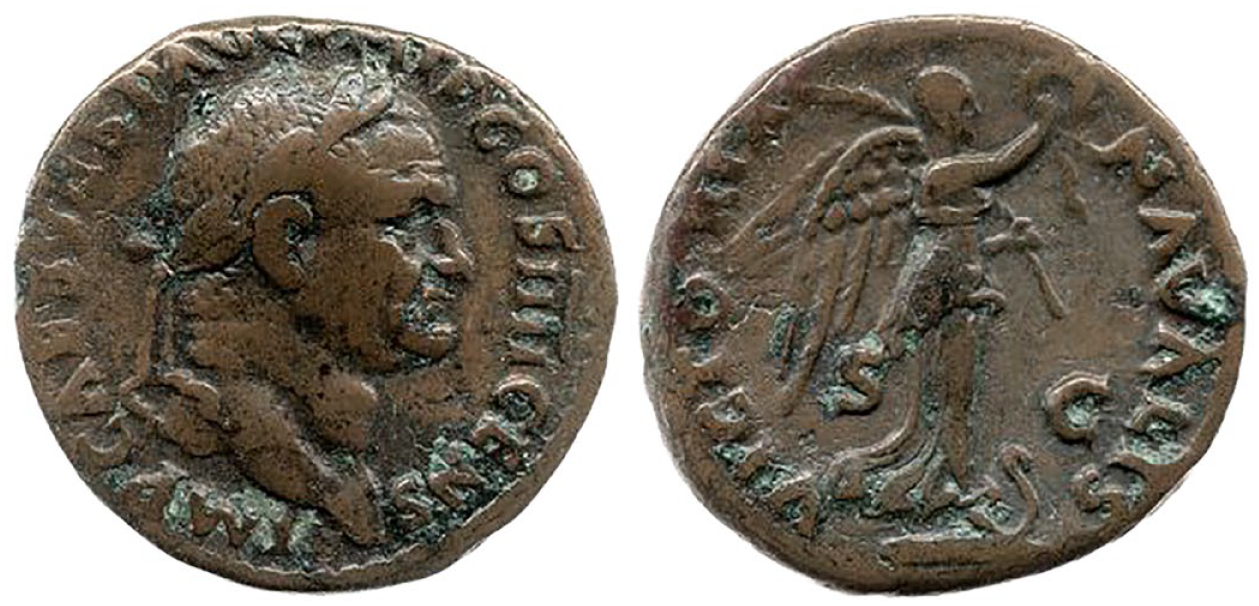
As of Vespasian with reverse depicting Victory standing on the prow of a ship, holding wreath and palm. Legend reads: VICTORIA NAVALIS. Rome, 73 ce. RIC II.1 no. 605, p. 102. Photograph © The Trustees of the British Museum. Used with permission.
A procession of war-galleys was paraded at the Flavian triumph in Rome (War 7.148), where, if we are to believe the Arch of Titus, a captive river god of the Judaeans was carried on a ferculum (see Figure 3) – symbolising the conquered waters of Judaea (i.e. the Jordan river) or, in recognition of the battle of Tarichaeae, Galilee (i.e. lake Gennesaret). In any event, Vespasian’s victory on the sea of Galilee appears to have functioned in Flavian mythology – much as it does in Josephus’ War – as proof of the new emperor’s claim to lordship over land and sea. 36
In a world awash with Flavian propaganda, Mark’s story of a Galilean Messiah becoming ruler of the same sea and the land that lay beyond by drowning a Roman legion of demonic pigs would have appealed to Jewish anxieties and hopes in the post-bellum. Here it is not Vespasian or his sons but Jesus the Galilean who is revealed as the true ‘lord of land sea’. Many exegetes would happily go this far, even without acknowledging the association of Vespasian’s lordship with the sea of Galilee. 37 But these same exegetes pass over the fact that the claim of lordship over land and sea was necessarily a declaration of conquest. Vespasian’s victory over the waters of Galilee and Judaea (and their gods) is what enabled him to go on and conquer the entire region. The aim of Vespasian’s conquest was simple: to crush all strongholds of the Judaean revolutionaries and bring the region back under Roman control. Why then was conquering the ‘country of the Gerasenes’ necessary to the Messianic campaign of Mark’s Jesus? The region with its cryptic name and location and obvious ethnic markers – unclean spirits, legions, graveyards and pigs – is often thought to be a stand-in for gentile lands. 38 But its geographical location would have had a greater significance for an ancient Jewish audience. For this – and our second proposal – we must return again to the Venerable Bede.
Bede writes in his commentary on Mark: ‘Gerasa is a small city in Arabia across the Jordan, adjoining Mount Gilead, which was held by the tribe of Manasseh, not far from the lake of Tiberias’ (Gerasa est urbns insignis Arabiae trans Iordanen iuncta monti Galaad quam tenuit tribus Manasse non longe a stagno Tiberiadis). 39 Bede was aware that Gerasa fell within the traditional borders of Gilead, which corresponded to the hill country of the central Decapolis, one of the two territories east of the Jordan allotted to the half-tribe of Manasseh but never fully conquered – the other was Bashan, which corresponded with Gaulanitis (Josh. 17.1–13), not by chance the aborted destination of Jesus’ second sea crossing (Mk 6.45). Jerome confirms this association of Gerasa with the land of Gilead, commenting on Obadiah’s prophecy that Benjamin would inherit the region: ‘Now Benjamin, whose borders extend northward immediately from Jerusalem, will possess all of Arabia, which was formerly called Gilead, and is now called Gerasa’ (Benjamin autem cujus statim ab Jerusalem, contra septentrionem termini dilatantur, cunctam possidebit Arabiam, quae prius vocabatur Galaad, et nunc Gerasa nuncupatur). 40 Later Jewish writers identify Gilead with Gerasa: commenting on 2 Sam. 24.6, Midrash Shmuel comments ‘And they came to Gilead [which is] Gerash’ (ויבאו הגלעדה גרש), 41 while Ishtori Haparchi, the medieval geographer who resided in nearby Beit She’an (Scythopolis), identifies Gerasa (גרש) with ‘the town of Gilead’ (גלעד קורין) 42 – presumably Ramoth-Gilead, one of the six Levitical cities of refuge (Deut. 4.41–43; Josh. 20.7–9), the unsuccessful recapture of which briefly united the two kingdoms but spelled doom for three Israelite and Judahite kings (1 Kgs 22.1–38; 2 Kgs 8.28–9:28). This seems to confirm the rabbinic description of Ramoth-Gilead as standing directly opposite Shechem (Nablus) across the Jordan (t. Makk. 2.2; y. Makk. 2.6; b. Makk. 9b), a location which would be accurate if referring to Gerasa. The identification of Gerasa with the refuge city of Ramoth-Gilead is strengthened by Gerasa’s reputation as a city of asylum. 43 In any case, the reconquest of Gilead was an early policy of the Hasmonaeans (1 Macc. 5.9–54; 2 Macc. 12.10–31; Josephus, Ant. 12.335–49), with Judas ransacking many of its walled cities and destroying a temple of the water deity Atargatis, the region’s tutelary goddess (see Figures 4 and 5). Alexander Jannaeus briefly managed to subdue Galaaditis (Gilead), forcing them to pay tribute (Ant. 13.374, 382). In his second attempt to reconquer the territory, Alexander subdued Gerasa as well as the Decapolis cities of Pella and/or Dion (War 1.104; Ant. 13.393) 44 – though he was apparently unable to hold it as Josephus does not list Gerasa among the Syrian cities ruled by Judaea at the time (Ant. 13.395–97). While Josephus claims the Judaean campaign against the Decapolis in 66 ce was to avenge the massacre of Jews in Caesarea (War 2.457–80), the revolutionaries appear to have been driven by the same desire to reconquer the region for Judaea, as the Hasmonaeans had done a century earlier.
By conquering the ‘country of the Gerasenes’, Mark’s Jesus appears to be fulfilling long-held Jewish hopes for the region by reclaiming the land for Israel. But unlike the Manassites and Hasmonaeans, who had failed to purge Gilead of its foreign elements, Jesus makes good on his conquest by cleansing the country of its impurities, thereby liberating its inhabitants – symbolised by the restored demoniac, who unlike the woman from Syrophoenicia (Mk 7.26) is not explicitly marked as a gentile but is presented as a native of the country, perhaps a Gileadite who had been polluted by non-Jewish elements in the region. With this, Mark’s Jesus follows the ancient Israelite practice of purifying reconquered lands, idealised in the cleansing of Gog in Ezek. 39.11–29 and put into practice by Judas Maccabaeus after his reconquest of Judaea: ‘Then Judas with the ready assistance of his brothers and others drove the enemy out of the country, and made an end of those of his countrymen who had violated their fathers’ laws, and purified the land of all pollution (καἱ ἐκαθάρισεν ἀπὸ παντὸς μιάσματος τὴν γῆν)’ (Josephus, Ant. 12.286).45, 46
But Jesus’ purification of the land has implications that go beyond conquest: it would have addressed the liminal halakhic status of the Syrian cities bordering Judaea and Galilee, which sometimes fell under the law of the land of Israel and at other times under the law of gentile lands (e.g. m. Shev. 6.1–2; m. Hal. 4.7–11; m. Orl. 3.9; m. Avod. Zar. 1.8; m. Ohol. 18.7–10). By dealing with the sources of the land’s impurity – unclean spirits, legions, graveyards and pigs – Mark’s Jesus can be seen resolving the halakhic difficulty for Jews who had been living in the region under impure conditions as well as those who were forced to flee there during or after the great revolt. 47 An important factor may have been the desire for purification after violence, a concern that lies behind a Galilean legend recorded in the Yerushalmi in which R. Simeon bar Yochai emerges from a cave after thirteen years, having hidden there during Bar Kokhba’s revolt, whereupon he goes to cleanse the lake city of Tiberias. He effects a miracle so that improperly buried corpses rise to the surface, allowing the city to be purified (y. Shek. 9.1). For Jews who had escaped the bloodshed of Hadrian’s war but now had to navigate living in an unclean city, Simeon’s miraculous purification of Tiberias resolved the halakhic difficulty. 48 For Mark’s early Jewish readers, Jesus’ purification of the ‘country of the Gerasenes’ would have had a similar effect: the early Christ movement, and with it the Messianic kingdom, could take root in the Transjordan, in biblical Gilead, because the Jewish Messiah had already gone ahead and prepared the way for them.
Conventional accounts of Jesus’ encounters while crossing the sea of Galilee, and of the Gospels more generally, have not seriously considered how these tales might have spoken to well-documented concerns about the borders of the land and its purity, especially in the aftermath of Rome’s conquest of Judaea-Galilee and its environs. 49 New Testament scholars’ refusal to reckon with the role of political and eschatological hopes for the restoration of the land is no doubt downstream from the stubborn myth that the early Christ movement was free of nationalistic elements. 50 To the contrary: the subtext of these Markan episodes is not a ‘mission to the gentiles’ but the conquest – or reconquest – of territory. The ‘country of the Gerasenes’ is not some cipher for gentile lands but territory long held to be part of an idealised Greater Israel. We have seen that water conquest symbolises the subjugation of hostile territory and Mark’s Messiah follows this ancient programme with the subjection of the lake (4.35–41), the purging of the land (5.1–20) and the trampling of the waters (6.45–52). In the final analysis, the sequence of Mark’s conquest has the ring of imperial propaganda. Here is one who has gone ahead and subdued the demonic forces of the sea and reclaimed the land by casting out unclean spirits, legions and pigs. This one – and not Vespasian, Titus or any other ruler – is the true conqueror, the Jewish ‘lord of land and sea’.
Footnotes
Acknowledgements
I am grateful to those who offered thoughtful and encouraging responses to earlier versions of this article, including Matthew Larsen, Gitte Buch-Hansen, Heike Omerzu, Matt Novenson, Margaret Williams, Shelley Wachsmann, Amelia Brown, and Sandra Blakey. My thanks also goes to the Society of Ancient Mediterranean Religions for hosting ‘Sailing with the Gods: Religion and Maritime Mobility in the Ancient World’ in Malta, June 2022. I would also like to thank the Scottish Borders Council, Northumberland National Park and Northumberland County Council for maintaining St Cuthbert’s Way. It was reading Bede’s Ecclesiastical History of the English People while walking this route that the idea of this article came to me. Above all I would like to thank my magnificent MTh students Ellouise Southam, Joseph Hayes, Emma Scalfano and Lena McNerney for reading and critiquing this piece – I could not have asked for a better editorial team!
1.
Bede may have had the Markan episode in mind as he authored the first attributable commentary on the Gospel: In Marci euangelium expositio (CCSL 120. 437–648).
2.
This is not to deny that scriptural language (e.g., Ps. 107.23–30; Jon. 1:4–6; Job 9.8–13) informed parts of Mark’s sea saga: scriptural language is Mark’s native tongue and supplies the primary colours for our author’s compositional palette. The problem is that the identification of a single fleeting scriptural resonance often becomes the exegetical tail wagging the dog. I aim to show that, in the case of Mark’s sea voyages, another model proves more illuminating.
4.
Text in Smith (1994) and  .
.
5.
7.
On the association of Hercules with imperial symbolism see : 289–94). Hercules’ defeat of Achelous lies behind Pliny’s Panegyric to Trajan wherein the emperor is praised for bringing fertility to the Nile delta when the river – and its gods – would not (Pan. 29.1–32.4). By the first century ce, Hercules’ cornucopia had become a potent imperial symbol displayed on triumphal arches and coins – or both in the case of this sestertius of Nero (Lugdunum, 65 ce. RIC I no. 393, p. 175, British Museum), the reverse of which depicts Pax or Abundantia holding the cornucopia on a triumphal arch, representing the cornucopic abundance granted to the empire by Nero’s conquests.
9.
Homer. Iliad. (Translated by A.T. Murray. Revised by William F. Wyatt. Loeb Classical Library 170. Cambridge, MA: Harvard University Press). 1924.
14.
Beard (2009: 159) favours the former, while Mason favours the latter (: 29–30).
15.
Most have followed Kelber (1974: 48–62) in labelling the regions traversed by Mark’s Jesus in chs. 5–8 as ‘gentile territories’. The Jewish/gentile spatial binary is reinforced by : 40–44).
17.
Jesus’ silencing of the wind and waves resembles some magical formulae, including this Egyptian spell found in PGM VII.318–34: ‘Let the earth be still, let the air be still, let the sea be still; let the winds also be still, and do not be a hindrance to this my divination – no sound, no loud cry, no hissing’.
18.
Storm gods worshipped on the eastern shore of the lake included Zeus Arotesios and Dushara, see Ovadiah (1981: 101–4). A temple of Tyche, who was in Syria identified with the water goddess Atargatis, has been uncovered at Hippos-Sussita overlooking the lake. Numerous coins from the Decapolis, especially Gerasa, depict Tyche/Atargatis holding a cornucopia and standing over a water deity or on the prow of a ship, symbolising the importance of water supply in the typically dry region, see : 53–66).
19.
Maiuma, a water god closely related to the Palestinian deities Marna and Dagon, was associated with the city of Gerasa according to Lev. Rab. 5:3. Chrysostom disapprovingly reports that Maiuma festivals featured naked women diving into a pool (Hom. Matt. 7.6 [PG 62.79]). A Greek inscription from the cult theatre at Birketin confirms that the festival was still being celebrated at Gerasa in 535 : 471–72).
20.
y. Sanh. 7.13.
21.
T. Sol. 16.1–7.
23.
For example, the presence of pigs guarantees that a site does not need to be checked for improperly buried corpses, because, had there been any, the pigs would already have uncovered them. This is a rare instance when pigs do not impart impurity but prevent it. Mishnah rules that ‘legion camps’ do not count among ‘gentile residences’ (m. Ohol. 8.10), while Tosefta offers two different rulings: ‘Fortifications and legion-camps – Rabbi declares unclean. And sages declare clean’ (t. Ohol. 18.12). The former ruling finds support elsewhere in Tosefta and Bavli, ‘A legion which is passing from place to place – that which shelters it is unclean. You have no legion in which there are no scalps [i.e. taken from enemy soldiers as trophies]’ (t. Chull. 8.16; par. b. Chull. 123a).
24.
‘Sisit (i.e. Hippos-Sussita) and the villages around it’ (t. Ohol. 18.4).
25.
Other symbols of legio X Fretensis included Neptune, a dolphin and a war-galley, probably in recognition of their role in the naval battle of Naulochus (36 bce). During the great revolt, Josephus tells us that the tenth legion fought at Jotapata (War 3.233–34), Japha (3.289), Gamala (4.13), before garrisoning at Scythopolis in the Decapolis (4.87). The legion went on to play a leading role in the siege of Jerusalem, afterwards garrisoning there (7.17) and besieging Machaerus (7.164). The legion’s headquarters appear to have remained in Jerusalem until the early third century. Zeichmann (2018: 99) dismisses any association between the tenth legion and the Gerasene demoniac since ‘legio X Fretensis never garrisoned Gerasa or its environs … Gerasa was [not] somehow ideologically or militarily continuous with Jerusalem, the city where legio X Fretensis was stationed’. This may be so, but the tenth legion’s association with Galilee and the Decapolis, more generally, cannot be disputed. Indeed, as Zeichmann notes, the legion’s ongoing presence in the Decapolis is attested with an inscription from Scythopolis in 130 ce, see CIL 3.13589; CIL 3.14155.14. A Roman presence in Gerasa, presumably a vexillation from legio X Fretensis, is also attested in the post-war period, see : 28–48). Klinghardt is surely right to conclude: ‘Dass die ertrinkenden Schweine die schwimmenden Legionseber der X Fretensis karikieren’ (45).
26.
The passive reading is strengthened by the instrumental dative ἐν τῇ θαλάσσῃ.
27.
A title given to Yamm in the Ugaritic Baal cycle (KTU 1.2 IV 23–4; 1.3 III 38–42). The ‘prince/angel of the sea’ (שָׂרָהּ דְיַמָּא) is a recurring character in classical rabbinic literature. Slaughtering alongside the sea is prohibited lest it be considered a sacrifice to the ‘angel of the sea’ (b. Chull. 41b). The ‘prince/angel of the sea’ is identified as Rahab (Midr. Tanh. [Buber], Chukat Siman 1.1; Midr. Tanh. [Yelemmedenu], Chayei Sara 3.8; Gen. Rab. 18.22). This ‘prince of the sea’ was present at the crossing of the Red Sea: the prince receives Pharaoh’s drowned army only to have God command him to ‘spew them up onto dry land’, much to the prince’s disappointment (b. Pes. 118b; b. Arak. 15a).
28.
See for example, Appian, Bell. civ. 4.474. Compare with the good news of Vespasian’s proclamation as emperor spreading in Josephus, War 4.618.
29.
Bede: ‘Hence it is right that Gerasa, or Gergesa (as some read it), is interpreted as throwing out the colonist, or the stranger approaching’ (Vnde bene Gerasa siue Gergesi ut quidam legunt colonum eiciens siue aduena propinquans interpretatur) (In Marci euangelium expositio 2.98–99 [CCSL 120.491]). Translation own.
30.
31.
See for example Sahlin (1964: 159–72); Craghan (1968: 522–36); Wefald (1995: 3–26); Iverson (2007: 20–39); a notable exception is : 152–73).
32.
See for example Guelich (1989: 351); Hurtado (2005: 285–86); Hays (2016: 66–69); and for an intended pagan audience see : 166–79).
34.
Josephus. The Jewish War. (Translated by Martin Hammond. Introduction and Notes by Martin Goodman. Oxford World’s Classics. Oxford: Oxford University Press). 2017.
35.
Whether the Decapolitan Gerasa is meant or an unknown Judaean Gerasa is not clear. Schürer (1979: 2.150) is certain the town cannot be Gerasa/Jerash on the assumption that the Greek city would have been unsupportive of the revolutionary cause, as was the case with other Decapolis cities; see Josephus, Life 341–4. To the contrary, the Gerasenes appear to have been supportive of Jews who wished to leave and join the revolt (War 2.480). Nevertheless, sending a substantial detachment to the Decapolitan Gerasa would make little sense during the Roman campaign in northern Judaea (4.442–74), unless the aim was to circumscribe recently conquered Peraea (4.439, 450), perhaps as a defensive measure against a looming Eastern (i.e. Parthian) threat (see Gross 2023: 479–513). Shortly thereafter Simon bar Gioras is introduced as a ‘native of Gerasa’ (4.503). For the view that this Gerasa should be identified with the more proximate Judaean village of Gezer, see Fischer, Isaac & Roll (1996: 162–63).
36.
Attempts to see the Victoria Navalis legend as instead commemorating the defeat of rebel pirates on the Black Sea in 69 ce fail to convince for one simple reason: the battle on the Black Sea was won by the fleets of Misenum and Ravenna with Vespasian in absentia while it was the Emperor himself who won the naval victory on the sea of Galilee. Cf. : 185). In all likelihood the Flavians commemorated the battle of Tarichaeae with naumachiae staged in the Colosseum (Cassius Dio, Hist. 66.25.2–4; Suetonius, Dom. 6.1), the Naumachia Augusti (Suetonius, Titus 7.3) or the newly constructed Flavian naumachia (Cassius Dio, Hist. 66.8.2; Suetonius, Dom. 4.2).
37.
E.g., Incigneri (2003); Samuel (2007); Kimondo (2018); Froelich (2021). For example : 179–81) instead finds a parallel to Mark 4.35–41 in the pirates of Joppa who drowned in a storm while survivors fell to a detachment from the fifth legion (Josephus, War 3.414–427). Since Vespasian was also not present at this incident (War 3.417), one wonders how a reader could have perceived the juxtaposition between the Emperor and Jesus. Nevertheless the unusual sequence of a storm, a naval battle, the subjugation of the Decapolis and the proclamation of a king in Caesarea who then marches on Jerusalem raises the question of how much Mark’s narrative was loosely modelled on the Flavian conquest.
38.
A view as old as Bede: ‘It signifies, however, the nations of the gentiles’ (Significat autem nationem gentium) (In Marci euangelium expositio 2.95–96 [CCSL 120.491]). Translation own.
39.
In Marci euangelium exposito 2.93–95 (CCSL 120.491). Translation own.
40.
Jerome, Commentariorum in Abdiam Liber 19 (PL 25:1114).
41.
Midr. Sam. (Buber) 32:1. Likewise, Yefet Ben ‘Eli, Ms. SP 10S B221, fol. 141v.
43.
A Greek dedication (Kraeling 1938: 376–77) from 69/70 ce mentions Theon, a ‘refugee’ (ἱκέτης) of the ‘Zeus of Refuge’ (Διὸς Φυξίου), while a Latin inscription (Kraeling 1938: 390) from Hadrian’s reign speaks of the city as ‘Gerasa the sacred and asylum and autonomous’ (Gerasa hiẹra et asylo[s] et autonomos). Theissen suggests plausibly that Mark may have been aware of this element of Gerasa’s reputation (: 111).
44.
Pella in War 1.104 and Dion in Ant. 13.393.
45.
Likewise 4 Macc 1.11; 17.20–1. See also Simon’s cleansing of Gazara and Jerusalem in 1 Macc 13.43–52.
46.
Josephus. Jewish Antiquities, Volume V: Books 12-13. (Translated by Ralph Marcus. Loeb Classical Library 365. Cambridge, MA: Harvard University Press) 1943.
47.
As with all wars, the great revolt caused a refugee crisis throughout the region, with Jews seeking asylum among non-Jews and gentiles seeking asylum in Jewish territory – with one famous incident occurring under Josephus’ command of Galilee (Life 112–13). Josephus reports that during the Zealot takeover of the temple in 68 ce many Jerusalemites ‘fled to the foreigners’ (ἔϕευγον πρὸς τοὺς ἀλλοϕύλους) – presumably the Roman army – especially after the murders of Ananus and Jesus ben Gamla (War 4.377–80, 397), apparently fearing a prophecy that the city would fall when the sanctuary was defiled (4.388). Since at the time the Roman army was in the Decapolis (4.88) and then Peraea (4.413–39), a destination in the Transjordan is most likely. Jesus’ warning that ‘those in Judaea must flee to the mountains’ after some unnamed sacrilege (Mk 13.14) probably refers to the same flight and likewise suggests a destination in the mountainous (and predominantly non-Jewish) Transjordan. Josephus speaks later of the barbaric treatment of Jewish refugees at the hands of Syrians (5.550–52). : 461–62) finds a further parallel with the flight to the Decapolis city of Pella in early Christian tradition (Eusebius, Eccl. Hist. 3.5.3; Epiphanius, Pan. 29.7.7–8; 30.2.7; Weights and Measures 15). Perhaps also Gerasa with its reputation as a city of refuge (see n. 41) was the intended destination for the flight.
48.
Nevertheless, the city continued to be associated with gentile impurity with a later Galilean legend placing Diocletian as a swineherd in the countryside of Tiberias (y. Ter. 8.10; Gen. Rab. 63.8).
49.
As Davies (1974: 61, also 4) observed some fifty years ago, New Testament scholars have ‘failed to inquire after the place of the land in the thought and lives of early Christians’. Davies nonetheless concludes that ‘Jesus, as far as we can gather, paid little attention to the relationship between Yahweh, and Israel and the land’, adding that ‘The Church came both to reject and to transmute [the centrality of the land] in various ways’ and in so doing ‘remained true to the intent of her Lord’ (365). While most have followed Davies on this point, a few studies have affirmed the importance of the land for the early Christ movement at least to some degree (Wenell 2007; Willitts 2015; ), but none to my knowledge has related Markan geography to the well-documented socio-political desire for the restoration of Greater Israel.
50.
A view that predates Baur 1878–1879: 1.3, and postdates : 389–90.