



Abstract
Scholars have long suggested that Luke employs idealized, philosophical language to describe the life of the Christ-believing community in Acts 2.44–47 and 4.32–35 for the purpose of garnering social capital for the movement. In defense of this case, many scholars point to the similar cultural appeal evident in descriptions of the communal life of the Essenes in the works of Josephus and Philo. Against this consensus, I argue that the communal summaries of Acts 2 and 4, unlike the comparable accounts in Josephus and Philo, do not share enough distinctive language or themes with any of the various philosophical traditions to merit the claim that Luke alludes to them. Undue attention to these unlikely parallels distracts from the way Luke’s allusion to LXX Deuteronomy, which stands on firmer ground, rhetorically portrays the early Christian community as fulfilling the ideals set down in the Law of Moses—a credible legitimizing technique within an intra-Jewish apologetic context.
Introduction
In Acts 2 and 4, Luke
1
describes the nascent Christ-believing community in Jerusalem with two summaries of their daily life: Awe came upon everyone, because many wonders and signs were being done by the apostles. All who believed were together and had all things in common; they would sell their possessions and goods and distribute the proceeds to all, as any had need. Day by day, as they spent much time together in the temple, they broke bread at home and ate their food with glad and generous hearts, praising God and having the goodwill of all the people. And day by day the Lord added to their number those who were being saved. (Acts 2.43–47)
2
Now the whole group of those who believed were of one heart and soul, and no one claimed private ownership of any possessions, but everything they owned was held in common. With great power the apostles gave their testimony to the resurrection of the Lord Jesus, and great grace was upon them all. There was not a needy person among them, for as many as owned lands or houses sold them and brought the proceeds of what was sold. They laid it at the apostles’ feet, and it was distributed to each as any had need. (Acts 4.32–35)
Since at least the mid-eighteenth century, scholars have agreed that Luke employs specific language in these descriptions to cast the Christian movement in idealized philosophical terms for the sake of garnering social capital within the Hellenistic world. 3 Indeed, while there is some debate over the philosophic traditions to which Luke appeals—perhaps the friendship traditions, 4 utopian ideals, 5 the Golden Age myth, 6 or philosophical descriptions of distant religious or ethnic groups 7 —scholars are virtually unanimous in accepting that Luke makes some kind of appeal to the culturally prized ideals of the day. 8
In this paper, I problematize this consensus, contending that the thematic and lexical parallels that scholars draw between Acts and various philosophical traditions are not distinctive enough to merit the claim that Luke intentionally appeals to these traditions. Comparison with Philo and Josephus, often referenced to support the claim that Luke uses similar apologetic strategies, instead demonstrates the relative paucity of evidence supporting an appeal to philosophical discourse in the case of Acts 2 and 4. Luke’s use of Deuteronomy in these passages further illustrates the comparative lack of evidence for asserting a similar genealogical relationship between Greek philosophical traditions and Luke’s communal summaries.
Luke’s ‘Hellenizing’ Language?
The lexical and thematic connections interpreters have drawn between Luke’s communal summaries and various philosophical traditions are vast, but I have distilled the most striking parallels (and the ones that interpreters most often reference) into Table 1. 9 A brief perusal of my list and the Greek text of Acts 2 and 4 reveals several lexical parallels. Luke asserts that the believers held all things in common (εἶχον ἅπαντα κοινά in 2.44 // ἅπαντα κοινά in 4.32) and adds further detail in the chapter four summary, noting that the believers were of one heart and soul (ἦν καρδία καὶ ψυχὴ μία [4.32]) and that no one called anything his own (οὐδὲ … ἔλεγεν ἴδιον [4.32]). Many of these terms appear scattered throughout various authors describing shared goods.
Friendship proverb
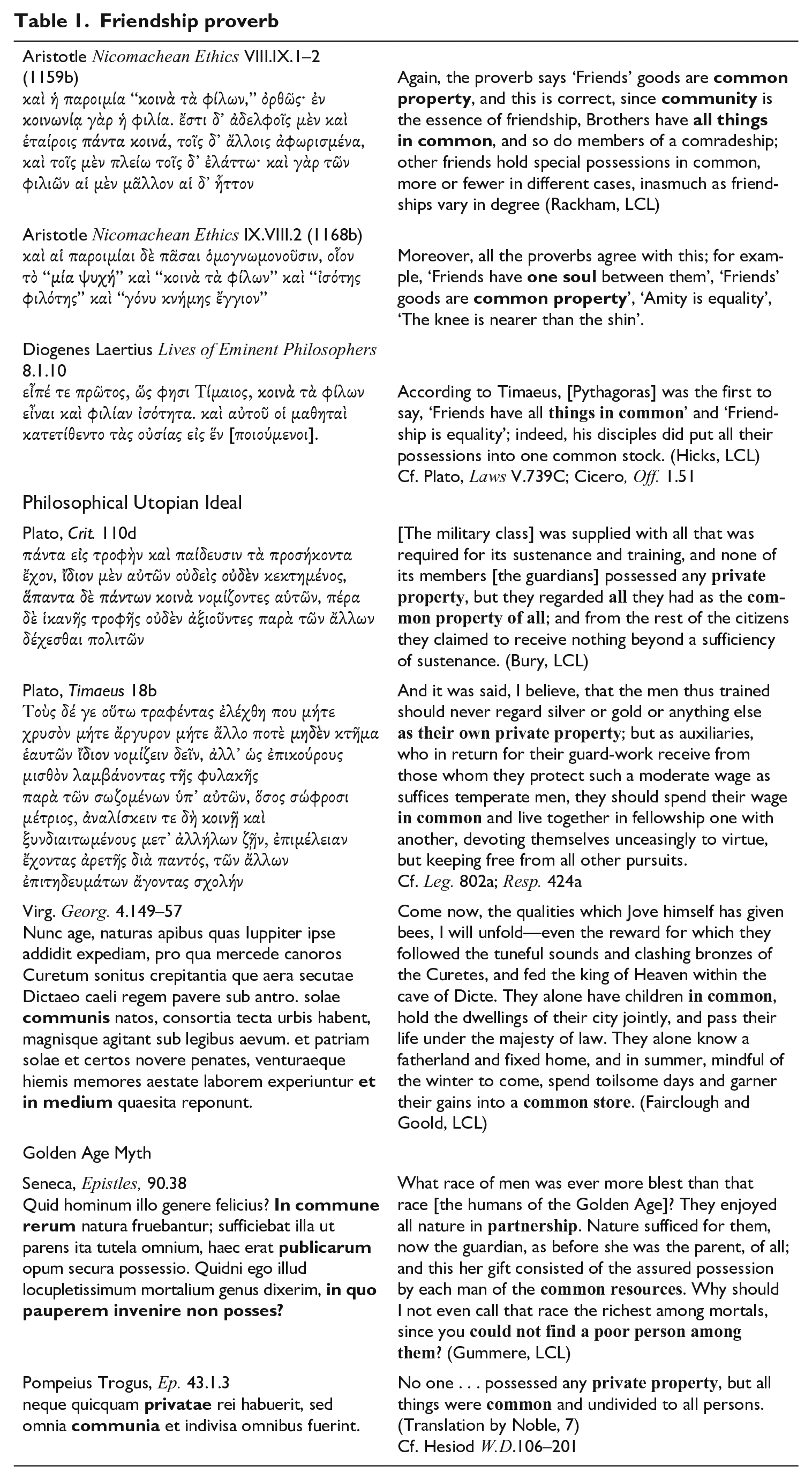
Perhaps the most striking parallel, and the one that has garnered the most significant amount of scholarly support, might be made with Aristotle’s friendship motif. Aristotle cites as proverbial the saying, κοινὰ τὰ φίλων, which Diogenes Laertius and Iamblichus attribute to Pythagoras. 10 Interestingly, in Nicomachean Ethics 1168b, Aristotle brings together two friendship proverbs, κοινὰ τὰ φίλων and οἷον τὸ μία ψυχή, after saying only a few chapters earlier that brothers hold πάντα κοινά (1159b). Taking these references together, one notices a cluster of shared terms between Luke’s description of his community and the friendship tradition upon which Aristotle draws. For Luke Timothy Johnson (1977: 199), this evidence is enough to assert that the author of Acts ‘explicitly identified the community as a community of friends’. While others might assert the point with more caution, a whole host of interpreters in the last quarter of a millennium agree that Luke must be appealing to the Greco-Roman philosophical tradition, and most agree that the friendship tradition is most probable.
There is a problem with this conclusion, however. Neither the theme/motif of a community sharing goods nor the language Luke employs in describing that community are distinctive enough to warrant the claim that Luke intentionally appeals to the friendship motif. Mitchell (1992: 256) explains: Formal comparisons between Luke and ancient authors on friendship, however, must remain general because the maxims he quotes, ἅπαντα κοινὰ (2:44; 4:32) and ψυχὴ μία (4:32) appear in a variety of different writers. . . . Whereas the attestation of these maxims over a broad period of time shows the vitality of the friendship tradition, their extensive use leads one to wonder exactly what Luke was thinking when he quoted them.
Despite seeing the problem, Mitchell still speaks of Luke ‘quoting’ these traditions, even though Luke includes no reference formula or indication that he cites a common maxim, and the language Luke employs is general, not specific. Noting the same problem, Joshua Noble (2020: 2–11) demonstrates that it is not just the friendship tradition but Utopian state ideals, Golden Age myths, and accounts of virtuous people-groups that share similar language and the concept of common goods with Acts 2 and 4. Indeed, interpreters have had difficulty agreeing on what tradition(s) Luke specifically appeals to because both the idea of shared goods and the language of commonality are, well, common.
The widespread usage of similar themes and language among various authors writing from different traditions calls into question whether Luke intentionally alludes to one or more of these traditions. One of the most important criteria for detecting allusions is the presence of shared distinctive language or ideas. Christopher A. Beetham (2005) calls this criterion ‘word agreement or rare concept similarity’; Richard Hays’s (1989) concept of ‘volume’ includes the idea of marked language; and Dennis R. MacDonald (2000) employs our preferred term, ‘distinctiveness’. To support the claim that Luke alludes to one or more traditions, it is not enough to point out mere resemblance. The interpreter must show that two texts display enough shared distinctive language or themes that the relationship between them cannot be incidental. 11
Demonstrating this more marked relationship between texts has proved difficult for interpreters. For example, Luke’s connection to the friendship motif (again, the tradition with the closest lexical parallels to Acts 2 and 4 and the favorite among interpreters) lacks the distinctive word that would attach it to that tradition—φίλων. Likewise, Luke never mentions a golden, primitive age or any other philosophical utopias anywhere in his two volumes. 12 These connections hang on the same set of parallels: a shared theme (holding goods in common) and similar language (πάντα κοινά; ψυχὴ μία; οὐδὲ … ἔλεγεν ἴδιον), neither of which are distinctive enough to uphold the conclusion that Luke intentionally appeals to one of these traditions. That Luke used the common parlance of his day to describe a community of shared goods is, on its own, altogether unsurprising. Due to the prevalence of these themes throughout so many different traditions, one might (cautiously) posit that Luke uses conventionally noble language in his description of the community. However, Luke does not employ enough distinctive language in the summaries to conclude that he intends a strong appeal to utopian ideals.
Interpreters drawing these parallels, however, attempt to make more than general statements about Luke’s language. Beyond the mere resemblance between Luke’s description of the early Christian community and any/all these traditions, they assert that Luke intentionally appeals to one of these traditions and that apprehending this relationship is ‘interpretively significant’ for understanding Luke’s purposes. 13 Thus, Luke might employ the friendship motif ‘for encouraging the rich of his community to benefit the poor, by transferring to them some of the normal benefits well-off friends took for granted’. 14 Or maybe Luke, like Philo and Josephus, attempts to portray his group as fulfilling the highest Greek utopian ideals. 15 Perhaps the summaries serve an apologetic function, demonstrating that the Christians adhere to culturally celebrated values. 16 Each of these conclusions requires the inference that beyond merely resembling other descriptions of communal living, Luke intentionally appeals or alludes to one or more of the various philosophical traditions, 17 but the communal summaries do not contain the kind of distinctive language that could justify such a conclusion.
Josephus and Philo
Scholars often bolster the claim that Luke appeals to philosophical traditions in Acts 2 and 4 by comparing Luke’s community descriptions with the accounts of the Essenes in Philo and Josephus (Mealand 1977: 99; Dupont 1979: 89; Sterling 1994: 696; Keener 2012: 1013). Both authors describe the Essene community as realizing some of the highest aspirations of Greco-Roman philosophical ideals—the motivation often attributed to Luke in Acts 2 and 4. Comparison with Philo and Josephus, however, further illustrates the problem with making such a connection when it comes to Acts. Both Josephus and Philo display what Luke lacks: multiple distinctive thematic and lexical parallels; explicit references to philosophical traditions; and a connection of this theme with a wider, unambiguous apologetic aim. 18
While we do not have the space here for a full analysis of all the texts pertaining to the Essenes in Philo and Josephus, 19 a brief glance over some of the material sufficiently illustrates the point. Josephus often mentions the Essenes alongside the Pharisees and Sadducees as representing three schools of thought among the Jewish people (War 2.119; Ant. 13.171–73; 18.11). In War 2.119, Josephus introduces the three groups as those among the Judeans who philosophize (Τρία γὰρ παρὰ Ἰουδαίοις εἴδη φιλοσοφεῖται [War. 2.119]), and in Antiquities he refers to them as three philosophies (φιλοσοφίαι [18.11]). Thus, in his descriptions of the Essenes, Josephus makes the connection to a philosophical way of life explicit.
The excerpt describing the Essenes in the second book of Jewish War is the longest and best illustrates the clarity of Josephus’s appeal to philosophical ideals. In his introduction of the Essenes, Josephus singles them out from the other schools as those who ‘cultivate seriousness’ (τρίτον δέ, ὃ δὴ καὶ δοκεῖ σεμνότητα ἀσκεῖν [2.119]). As Mason (2008) notes, σεμνότης is a peculiarly Roman virtue, anticipated by the Spartans. 20 But the parallels do not end there. Josephus goes on to describe the Essenes with a laundry list of virtuous traits: the Essenes shun pleasures and esteem temperance and control of passions (2.120); they protect themselves from the ‘wanton ways of women’ (τὰς δὲ τῶν γυναικῶν ἀσελγείας φυλαττόμενοι [2.121]); they despise wealth and keep a common stock (κοινωνικός [2.122]); they master their temper and anger (ὀργῆς ταμίαι δίκαιοι, θυμοῦ καθεκτικοί, πίστεως προστάται, εἰρήνης ὑπουργοί [2.135]); and they master the fear of terrors and death (2.151). 21 Many of these attributes and virtues were prized in the Greco-Roman world of his day, and this section (1.119–1.161) is densely packed with conceptual and verbal parallels to various philosophical traditions (perhaps most especially the stories about the Spartans). 22
The parallel between Josephus’s description of the Essenes and other philosophical traditions/ideals does not, however, hang merely on lexical or conceptual similarity. Several times throughout his work, Josephus explicitly compares the Essenes with other philosophical groups. We have already noted that he introduces the Essenes as practicing philosophy. He goes on, in the middle of his description in War, to comment on their view of the soul: For it is a fixed belief of [the Essenes] that the body is corruptible and its constituent matter impermanent, but that the soul is immortal and imperishable. Emanating from the finest ether, these souls become entangled, as it were, in the prison-house of the body, to which they are dragged down by a sort of natural spell; but when once they are released from the bonds of the flesh, then, as though liberated from a long servitude, they rejoice and are borne aloft. Sharing the belief of the sons of Greece, they maintain that for virtuous souls there is reserved an abode beyond the ocean. . . . The Greeks, I imagine, had the same conception when they set apart the isles of the blessed for their brave men, whom they call heroes and demigods, and the region of the impious for the souls of the wicked down in Hades. (2.154–55, 156; Thackeray, LCL)
Here, Josephus repeatedly links their belief in the soul with ‘The Greeks’, supporting the conclusion that he makes a sustained comparison throughout his description of the Essenes.
Josephus draws similar explicit comparisons elsewhere in his writings. In his shorter account of the Essenes in Antiquities 18.18–22, Josephus again lists several philosophical virtues practiced by the Essenes, and asserts, They deserve admiration in contrast to all others who claim their share of virtue because such qualities as theirs were never found before among any Greek or barbarian people, nay, not even briefly, but have been among them in constant practice and never interrupted since they adopted them from of old. (Antiq. 18.20)
Josephus holds up, the Essenes as exemplarily virtuous—surpassing not only the other philosophies among the Jews but also all Greeks and barbarians. One especially poignant example of these virtues, for Josephus, is their sharing of goods (τὰ χρήματά τε κοινά ἐστιν αὐτοῖς; 18.21). Earlier in Antiquities, Josephus even compares the Essenes with the Pythagoreans: ‘This is a group which follows a way of life taught to the Greeks by Pythagoras’ (15.371). As we noted previously, several ancient authors traced the utopian ideal of shared goods (and particularly the friendship proverbs) back to Pythagoras. That Josephus explicitly identifies the Essenes with the Pythagoreans—and makes several similar comparisons elsewhere—secures the notion that Josephus intentionally describes the Essenes in ideal philosophical terms and accounts for the significant lexical parallels that appear in these descriptions.
Furthermore, interpreters regularly agree that Josephus’s depiction of the Essenes fits within his wider apologetic purposes. This can be demonstrated by observing that while Josephus presents the Essenes as an especially pious school within Judaism, his description of them matches his more general depiction of Judean ideals elsewhere. As Mason (2000: 434) notes, In all of its aspects, this [Josephus’s depiction of the Essenes] could hardly be more typical of Josephus’s presentation of Judean ideals. Mastery of the passions was of course basic popular philosophy and, with a strong dose of misogyny admixed, reflected the conservative values of Rome that were so fondly attributed to Cato (Plutarch, Cat. Ma. 1–9).
In Josephus’s Antiquities, biblical heroes (Moses, Joseph, etc.) exemplify the virtues associated with the Essenes, and notorious women (Potiphar’s wife, Jezebel, Cleopatra, and Mariamne) exemplify the danger of womanly wiles. 23 Furthermore, in various places, Josephus himself claims to hold the same perspective as he assigns to the Essenes (compare War. 2.154–55 with 3.372–74). 24 Thus, the Essenes are a kind of ‘trump card’—they prove for Josephus that the best ideals of Greco-Roman society are realized among the Jewish people (again: Ant. 18.20). 25 This was especially important for Josephus as he attempts to counter the growth of anti-Jewish biases after the war (War. 1.1–5) by demonstrating the virtue of his people and blaming the war on specific insurrectionists. 26
Similar language, themes, and motivations characterize Philo’s discussion of the Essenes. Like Josephus, Philo employs several utopian topoi in his description of the Essenes, such as avoiding urban life (Prob. 76) and training in philosophical virtues: They are trained in piety, holiness, justice, domestic and civic conduct, knowledge of what is truly good, or evil, or indifferent, and how to choose what they should and avoid the opposite, taking for their defining standards these three, love of God, love of virtue, love of men. (Prob. 83–84; Colson, LCL)
Furthermore, the Essenes share common goods: First of all then no one’s house is his own [οὐδενὸς οἰκία τίς ἐστιν ἰδία] in the sense that it is not shared [κοινὴν] by all, for besides the fact that they dwell together in communities. . . . Again they all have a single treasury and common [κοινός] disbursements; their clothes are held in common and also their food through their institution of public meals. (Prob. 85–86)
As Joan E. Taylor (2007: 8) notes, Philo’s descriptions of the Essene community ‘does not contain many references to Essene particularities that are not immediately recognizable as examples of philosophical perfection within the Greek Tradition’. The themes and language clearly echo Greco-Roman ideals.
Like Josephus, Philo makes the connection to philosophical ideals explicit. Indeed, Philo brings up the Essenes in a series of wise peoples, including the sages of Greece (Prob. 73), men of excellence among the Persians (74), and the Indian Gymnosophists, who study physical and ethical philosophy (οἳ πρὸς τῇ φυσικῇ καὶ τὴν ἠθικὴν φιλοσοφίαν [74]). He then introduces the Essenes, claiming, ‘Palestinian Syria, too, has not failed to produce high moral excellence’ (75).
In the middle of his description, Philo evaluates them according to the tripartite division of Hellenistic philosophy (logic, ethics, natural philosophy): 27
As for philosophy they abandon the logical part to quibbling verbalists as unnecessary for the acquisition of virtue, and the physical to visionary praters as beyond the grasp of human nature, only retaining that part which treats philosophically of the existence of God and the creation of the universe. But the ethical part they study very industriously. (Prob. 80)
Moreover, Philo finishes his description of the Essenes by saying, ‘Such are the athletes of virtue [ἀθλητὰς ἀρετῆς] produced by a philosophy free from the pedantry of Greek wordiness’ (88). Alongside other utopian groups, the Essenes, according to Philo, are the paragon of virtue that surpasses lesser, pedantic forms of philosophy.
Philo also demonstrates similar apologetic purposes as Josephus. In another work, Apologia pro Iudaeis (preserved in Eusebius’s Praeparatio Evangelica 8.11.1–18), Philo again recounts the various virtues of the Essenes. Though the work is fragmentary, he appears to defend the Jews against those in Alexandria who present Judaism in a bad light (both the ‘Greeks’ and ‘Jews’ of Alexandria wrote to Gaius Caligula in 39 C.E. and Claudius in 4 C.E. to lobby against each other).
28
In a summary statement, Philo remarks, Such then is the life of the Essenes, a life so highly to be prized that not only commoners but also great kings look upon them with admiration and amazement, and the approbation and honours which they give add further veneration to their venerable name. (PE, 8.11.18)
Clearly Philo attempts to gain outside honor for the Essenes, employing them as the best representatives of philosophical virtue among the Jews. Of course, like Josephus, Philo also presents the Jewish people more generally in similar terms throughout his works. Bilde (1998: 62) summarizes: Both writers describe Judaism as a sort of ideal ‘philosophy’, able to compete with Greek philosophical schools and with Hellenistic-Roman religions. In this general context they present the Essenes as the Jewish elite. They describe the Essenes as representing the highest quality of Judaism and Jewish values and, therefore, as the best bid of the Jewish people in the international, Hellenistic-Roman, religio-philosophical debate on social ethics, legislation and the ideal and utopian society.
Our brief analysis confirms Bilde’s assertions. Philo and Josephus both describe the Essenes in the idealistic, utopian terms of Greco-Roman philosophy. They both explicitly compare the Essenes with other philosophical groups and often assert their superiority. Finally, their depictions fit clearly into the larger apologetic project undertaken by both authors.
By contrast, Luke’s description of the early Christian community lacks the features that would establish an allusion or appeal to Greco-Roman philosophical traditions. Josephus and Philo share traces of the same common language for describing a community of shared goods (which I have highlighted throughout this section). Their use of this language, however, only further illustrates how common the words are—anyone describing the phenomena of shared goods in Greek is likely to use words such as κοινός and κοινωνία. The connection to utopian ideals in Josephus and Philo does not hang on one or two shared words but (1) dense thematic and lexical allusions to various philosophical tropes, (2) explicit mention of philosophy and direct comparison with other traditions (‘the Essenes follow the practices of Pythagoras’), and (3) connection to a wider, unambiguous apologetic aim. The community summaries of Acts 2 and 4 lack these shared features. Thus, while scholars often point to passages about Essenes in Philo and Josephus to defend the conclusion that Luke makes a comparable appeal to Greek utopianism for similar apologetic purposes, this comparison points toward the opposite conclusion. If Philo and Josephus exemplify what an appeal to Hellenistic philosophic topoi looks like, one should be impressed by the comparative lack of evidence in Acts 2 and 4.
A More Compelling Referent
Interpreters exegeting Acts 2 and 4 also point out that Luke’s community summaries, particularly Acts 4.32–35, recall Deuteronomy. Scholars often regard the two possible allusions—to Deuteronomy and Greek philosophical texts—as ‘both and’: Hellenistic Jewish writers like Philo and Josephus described the Essenes in terms reminiscent of Greek Utopianism. The writer of Acts seems to have seen the nascent Christian community as fulfilling the hopes, the promises, and the ideals, not only of Deuteronomy, but also of that same Greek Utopianism.
29
It is conceptually possible that Luke intends this kind of polyvalent reference—there certainly is no necessary dichotomy between Deuteronomistic and philosophical Utopianism, and at times Luke demonstrates his ability to refer to both traditions (Acts 17.22–31 being the classic example). As we have seen, however, the evidence for an intentional allusion to philosophical utopianism (or Golden Age myth, friendship ideals, or some combination of these themes) in Acts is shakier than interpreters recognize. 30 By contrast, Luke’s allusion to Deuteronomy stands on significantly firmer ground.
The case for demonstrating an allusion to Deuteronomy hangs on several important indicators. First, while interpreters often single out ψυχὴ μία in Luke’s description as an appeal to the friendship proverb, it appears much more commonly to designate a person, or a unity of persons, without reference to the friendship motif (Noble 2020: 5). What is distinctive about Luke’s usage of the phrase, then, is not reference to friendship (which he does not mention) but placing ‘heart’ and ‘soul’ together in parallel: ἦν καρδία καὶ ψυχὴ μία (4.32). This phrase does not appear in any extant literature predating Luke’s writing. Furthermore, the heart-and-soul combination itself, unlike the other language in Luke’s summaries, is uncommon. The two are rarely set in parallel, as Luke employs them here, as denoting a united whole, except in the LXX and texts citing the LXX (Philo, On Flight and Finding, 142.4; Mt. 22.37; Mk 12.30; Lk. 10.27).
31
In LXX Deuteronomy, the heart-and-soul combination appears no less than nine times (Deut. 4.29; 6.5; 10.12; 11.18; 13.3; 26.16; 30.2, 6; 30.10) as an expression of what full devotion to the law entails: And now, Israel, what does the LORD your God ask from you, but to fear the LORD your God, to walk in all his ways, and to love him and to worship the LORD your God from your whole heart and from your whole soul (10.12) And you shall set these words in your heart and in your soul, and you shall bind them as a sign on your hand (11.18) If you hear the voice of the LORD your God to keep and do all his commands and his statutes and his judgements which are written in the book of this law, if you turn to the LORD your God from your whole heart and from your whole soul. (30.10)
Again and again, Deuteronomy employs the distinct heart-and-soul combination to express whole-person commitment to the law, and Luke’s communal summaries share this distinctive language. 32
What is more, Acts 4.32 is not the first time Luke employs the heart-and-soul parallel. In a discussion of the law in the Third Gospel, a scribe cites Deuteronomy 6:5: ‘You shall love the Lord your God with all your heart, and with all your soul, and with all your strength, and with all your mind; and your neighbour as yourself’ (10.27)—a summary of the law of which Jesus approves (10.28). That Luke first employs the heart-and-soul motif in an explicit citation of Deuteronomy increases the likelihood that the phrase is an allusion to Deuteronomy in Acts 4.32. Of course, Luke cites Deuteronomy several times throughout both his works (cf. Lk. 4.4/Deut. 8.3; Lk. 4.8/Deut. 6.13; Lk. 4.12/Deut. 6.16; Lk. 10.27/Deut. 6.5; Lk. 18.20/Deut. 5.17, 18; Acts 3.22/Deut. 18.15), further illustrating the probability that this shared language is not incidental. The last of these examples, where Peter proclaims that God has fulfilled the promise in Deut. 18.15 to raise up a prophet like Moses, even appears in close context between Luke’s two communal summaries. Taken together, all these factors encourage reading Luke’s communal summaries as an appeal to Deuteronomy.
Observing additional parallel language illustrates the purpose of Luke’s allusion to Deuteronomy. As Steve Walton (2008) notes, Luke’s comment, οὐδὲ γὰρ ἐνδεής τις ἦν ἐν αὐτοῖς, likely echoes Deut. 15.4: For there will be no one in need among you, because the LORD your God will bless you exceedingly in the land that the LORD your God gives you as a portion to inherit. ὅτι οὐκ ἔσται ἐν σοὶ ἐνδεής, ὅτι εὐλογῶν εὐλογήσει σε κύριος ὁ θεός σου ἐν τῇ γῇ, ᾗ κύριος ὁ θεός σου δίδωσίν σοι ἐν κλήρῳ κατακληρονομῆσαι αὐτήν.
The LORD promises that there will be no needy person among the people if they obey his commands (in this context, the regulations concerning remission of debts in the sabbatical years). But the promise that there will be no needy person has a counterpart in the following command that if there is a needy person among them (Ἐὰν δὲ γένηται ἐν σοὶ ἐνδεὴς), they must care for that one (15.7). Not only does this additional parallel language (οὐδὲ γὰρ ἐνδεής τις ἦν ἐν αὐτοῖς // ὅτι οὐκ ἔσται ἐν σοὶ ἐνδεής) further secure a connection between Luke’s communal summaries and Deuteronomy, but it also uncovers Luke’s goal in making such an appeal: ‘Luke presents the messianic community in Jerusalem as fulfilling the hopes and ideals embodied in the Torah for a community life in which no one was poor or in need’ (Walton 2008: 105). In a section of Acts thoroughly devoted to presenting the community as fulfilling and receiving scriptural promises (cf. Acts 2.17–21, 38, 39; 3.19, 20, 22, 25–26), Luke recounts the communal living of the Christ-believing community as fulfilling God’s commands and realizing his promises from Deuteronomy.
Finally, and perhaps most importantly, this reading of the community summary fits within the wider themes of wealth and law observance in Luke-Acts. Lk. 10.25–31, which we have already noted previously, is the first extended discussion of how one should read the law in the Third Gospel. Jesus agrees with a lawyer’s summary of the law as heart-and-soul devotion to God and love of neighbor (10.25–28). Jesus then employs the story of the Good Samaritan to illustrate adherence to the second part of this summary. Memorably, the Samaritan cares for the robbed man (10.33–35), including paying for his stay at an inn and promising further reimbursement to the innkeeper if required (10.35). This willingness to care for others—including the financial aspect of such care—continues throughout several more discussions of Torah-observance in Luke’s Gospel. In Luke 11.37–42, Jesus criticizes the law-observance of the Pharisees, exhorting them to give alms as an expression of the justice the Law requires. 33 Later, another confrontation with the Pharisees arises because, as the narrator tells us, the Pharisees are lovers of money and thus ridicule Jesus for suggesting that one ‘cannot serve God and wealth’ (16.14). While interpreters have found Jesus’s commentary on the law in 16.16–18 enigmatic, the subsequent parable unambiguously addresses the connection between use of wealth and the law. A rich man is condemned to burn in Hades for failing to care for the poor, dying Lazarus (16.19–31). Abraham rejects the rich man’s appeal to send someone to his brothers so that they might avoid a similar fate because the witness of Moses (i.e., the law) and the prophets should be enough to lead to repentance and prevent such a disaster (16.29–31). The rhetorical point of such a parable, directed to ‘lovers of money’, should not be missed: neglect of the poor marks an egregious failure to heed the law and will result in judgment. 34 Finally, Lk. 18.18–25 contains yet another discussion of the Torah, which raises the question of wealth. Queried by Jesus, a rich ruler claims to have obeyed all the commands of the Law (18.21). When asked to sell his property, distribute the proceeds to the poor, and follow Jesus, however, he fails to respond (16.23). His unwillingness to divest himself of wealth for the poor, despite keeping other commands, shows him to be unfit for the kingdom (in contrast to Peter in 18.28–30 and Zacchaeus in 19.1–10). While ascertaining a comprehensive picture of Luke’s understanding of the law has proved a difficult task (and reaches far beyond the purview of this paper), 35 virtually all interpreters agree that, according to Luke, true law observance requires care for the poor and needy. Again and again in the Third Gospel, Jesus expresses his vision of faithful Torah observance with reference to economic concerns.
This wider arc of Luke’s narrative supports the position of Walton and others who conclude that Luke appeals to Deuteronomy in his community summaries. When Luke describes the community of believers in Acts 2 and 4 as one of shared resources, narrating the willingness of wealthy members to sell property to care for the needs of others, the implied reader—one who has already read the Third Gospel (Acts 1:1) and thus is familiar with Jesus’s legal teaching 36 —should recognize the promise/command of Deuteronomy that there will be no needy person among God’s people if they obey the law (Deut. 15.4). By alluding to Deuteronomy, Luke describes the believers as fulfilling the specific vision of ideal Torah observance repeatedly emphasized and developed by Jesus in the Third Gospel.
Detecting Luke’s appeal to Deuteronomy, and consequently reading the community summaries in light of that allusion, hangs on several factors: (1) shared distinctive language between Acts and Deuteronomy, (2) explicit citations of Deuteronomy throughout Luke-Acts, especially in Acts 3.22 (near context) and Luke 10.27 (similar language), and (3) coherence with the prominent theme in Luke-Acts of wealth divestment, which Luke connects to law observance several times. By contrast, the evidence for an appeal to Hellenistic philosophical ideas lacks these important markers, ultimately hanging on Luke’s use of a few words, which are common to nearly all Greek texts discussing shared goods. At best, one might posit that Luke describes his community in generally idealized terms for his time and Greek milieu. Especially in light of the far more salient connection to Deuteronomy, however, which satisfyingly explains why Luke chooses to describe the early Christ-believing movement as a community of shared goods, the proposed allusion to philosophical ideals is, in all probability, a red herring.
Conclusion: Why Not Both?
As we have already said, interpreters often hold out Deuteronomy alongside various philosophical traditions as parallel sources for a polyvalent allusion in Acts 2 and 4. Keener’s comment is emblematic: Both here and in the Gospel, through explicit quotations and implicit allusions, Luke also grounds this lifestyle in the ideals of community for Israel and the example of its prophets (e.g., Deut. 15:7–8; 2 Kgs 4:38–44); he also employs Hellenistic language for the ideal community.
37
Once again, such polyvalence is certainly possible. Philo, for example, adeptly articulates his view of Mosaic Law, respecting its uniqueness, divine origin, and authority while writing in terms that could be appreciated in a Roman Stoic intellectual context by associating Mosaic Law with natural law and claiming the law produces the four cardinal virtues. 38 The problem with this conclusion in the case of the communal summaries in Acts 2 and 4, however, is that it gives the impression of parity between the two allusions, as if both stand upon similar evidence and hold equal weight for understanding Luke’s portrayal of the community. As we have demonstrated, however, the proposed reference to Deuteronomy rests on all the markers one needs to identify an allusion, whereas the connections scholars draw to philosophical literature lack the evidence required to make a similar genealogical claim.
Parrallelomania is a perennial danger for literary and historical scholars. By overdrawing connections and asserting allusions to various materials, interpreters risk misconstruing an author’s rhetorical purposes. I do not mean to insulate Luke from his Greco-Roman milieu: he writes in Greek, employs a form common in Greco-Roman literature, and demonstrates awareness of Greek philosophy. One might fruitfully juxtapose Luke’s account of shared goods with that of other groups (for example, the sharing of goods engaged in at Qumran or among the Pythagoreans). However, the scholarly consensus that Luke intentionally alludes to or appeals to philosophical ideals oversteps the evidence and cannot bear the weight of the conclusion that Luke is making a cultural appeal.
Unfortunately, the overestimated parallels in these two passages hold undue influence in debates concerning Luke’s wider purposes for writing. For example, a long-held tradition asserts that the writings of Luke and Acts have an apologetic function (or, at least, an inner-apologetic, legitimizing function),
39
whereby one of the primary purposes of Luke’s narratives is securing cultural capital for the Christian movement within the Greco-Roman world: the Christians practice an old tradition, are not a political threat to the Roman government, and realize culturally prized moral virtues. This consensus has recently been subjected to increasing criticism from various angles.
40
Within the debate, Acts 2 and 4 are often held up as a flagship example for demonstrating the presence of this apologetic discourse in Luke-Acts.
41
The communal summaries are considered such an impressive example of Luke’s use of this type of discourse that even those scholars contesting this hypothesis often admit the presence of apologetic reasoning when it comes to the community summaries. For example, in the conclusion of a work devoted to undermining the notion that Luke makes an apologetic appeal to the argument-from-antiquity, Andrew Cowan admits, Nevertheless, Luke does at times describe the early church in ways that appeal to Greco-Roman cultural values. For example, scholars have often noted that Luke’s depictions of the church in Jerusalem sound very much like either a fulfillment of the Greco-Roman ideal of friendship or descriptions of utopian societies in ancient philosophical literature. The fact that such passages depart from the dominant trends within the book makes them all the more interesting, and the questions of where, to what to degree, and why Luke shapes passages in accordance with Greco-Roman values are perhaps issues that deserve further attention. (2019: 171–72)
Kavin Rowe takes a similar conciliary stance: whereas Rowe complicates the notion that Acts presents Christians as innocent of political charges against them (undermining a key tenet of the apologetic reading of Luke-Acts), still he asserts, ‘Luke must have esteemed Greek philosophical ideals of friendship and community to have depicted their embodiment in the κοινωνία of early Christian gatherings’ (2009: 136). If our analysis of these community summaries is correct, however, then Cowan, Rowe, and others do not need to cede this ground—even the community summaries do not evince an appeal to Greco-Roman philosophical ideals. At best, the communal summaries offer peripheral evidence that Luke used common parlance when describing the sharing of goods in his community, which is hardly surprising and proves nothing about Luke’s specific rhetorical intentions. Thus, Acts 2 and 4 should not be used, as they often are, as load-bearing walls to support the hypothesis that Luke attempts to legitimate the Christian community by appealing to culturally prized values from the Greek philosophical tradition. Interpreters will have to look elsewhere for firm evidence of this kind of legitimizing rhetoric.
In Acts 2 and 4, Luke does not portray the believers fulfilling the utopian aspirations of Greek philosophy but the Deuteronomistic ideals for the people of God. This description of the Christ-believing community may still have legitimizing value but within a more specific context than the wider Greco-Roman world—that is, among Jewish people who respect the Law of Moses. In her evaluation of the apologetic tone of Acts, Loveday Alexander (2005) points out that within the narrative the followers of Jesus most often defend themselves against accusations of speaking against the Temple and Law of Moses. She concludes, Acts is a dramatized narrative of an intra-communal debate, a plea for a fair hearing at the bar of the wider Jewish community in the Diaspora. . . . It may be that one of the most significant pointers to the apologetic scenario of the book as a whole is the neutral, uncommitted, stance of the community leaders in Rome in the final scene: ‘We have received no letters from Judea about you, and none of the brethren coming here has reported or spoken any evil about you. But we desire to hear from you what your views are; for with regard to this sect we know that everywhere it is spoken against’. (205)
Our findings support the conclusion of Alexander and others 42 who situate Luke’s writings within the intrafamily struggle of various Jewish groups over who represents faithful Israel. If the communal summaries furnish Luke’s audience with a kind of apologetic argument, it is that their community exemplifies the economic ideals God demands of his people in the Torah. 43 This rhetoric would hold clout among Jewish people (and Gentile converts/sympathizers) across the Mediterranean who, like the people receiving Paul in Rome, revere the Law and desire to understand the messianic movement.
Debates concerning Luke’s purposes for writing Luke-Acts will continue, and it is far beyond the scope of this paper to assess fully whether, and to what extent, Luke attempts to legitimate his movement by appealing to prized moral or political values within the Roman empire. Nevertheless, a key plank modern scholars have used to build this reconstruction of Luke’s rhetorical purposes is the philosophical reading of Luke’s community summaries. Whether or not the removal of this plank destabilizes the building will be the subject of further discussion, but our analysis at least sheds light on the prominence of other apologetic concerns that shape the text of Acts—namely, establishing the Christian community as those who truly fulfill the commands of Mosaic Law.
