



Abstract
Transpositions of large sections of text in New Testament manuscripts occurred only when omissions and chronological problems were ‘corrected’. It is argued here that the words commanding that women be silent in 1 Cor. 14.34–35, which appear elsewhere in Western manuscripts, were interpolated, and the interpolator probably created a textual variant at 14.37 and transposed Prisca and Aquila at 16.19 so that a woman would not host a church. Textual variants at 16.19 in the Western manuscripts are explicable if Prisca originally preceded Aquila here, as she does elsewhere. Second Timothy 4.19 is an early witness to Prisca’s precedence in 1 Corinthians.
Introduction
There is growing evidence that women in Paul’s churches were apostles, teachers, church leaders, and delegates. 1 The principal passage in Paul’s undisputed letters that is in tension with this is 1 Cor. 14.34–35, which calls for women to be silent in the assemblies. However, these are not the only verses where First Corinthians is an outlier on the roles of women. First Corinthians 16.19 is the only place in the New Testament where Prisca is listed after her husband, Aquila, in our earliest surviving manuscripts. This article explores the textual evidence concerning both 1 Cor. 14.34–35 and 16.19 to determine whether First Corinthians suffered early sexist corruption.
Background on 1 Cor. 14.34–35 and Its Transposition
First Corinthians 14.34–35, which tells women to be silent in the churches, has been considered an interpolation by many since the nineteenth century. 2 This is because (a) it interrupts an otherwise smooth transition from 14.33 to 14.36, (b) it contains un-Pauline vocabulary, and (c) it conflicts with Paul’s views expressed elsewhere, including in 1 Cor. 11.3–16 where it is assumed that women speak in the assembly. 3 Furthermore, Gordon D. Fee stressed a text-critical argument, which starts with the observation that 14.34–35 appears after 14.40 in D06, F, G, and the Latin counterparts of these bilingual manuscripts, and also in Ambrosiaster and Sedulius-Scotus, the Old Latin manuscripts VL61 and VL89, and the Greek minuscules 88 before correction (88*), and 915. 4 These manuscripts, with the exceptions of 88 and 915, have a text type of Paul’s letters, known as ‘western’. D is also known as GA06 (henceforth D06). With its Latin counterpart, VL75, it constitutes Codex Claromontanus, which is sixth century. F and G are the Greek texts of Augiensis and Boernerianus, respectively, and are ninth century. The Latin text of Augiensis is Vulgate so is not cited in this article. The Latin of Boernerianus is generally just a translation of the Greek and is also not cited here. The relationship between the Greek texts of the three Western bilinguals is shown in Figure 1. The (lost) common ancestor of D06, F, and G is believed to belong to the fourth century (see Kloha 2006b: 610, 637).
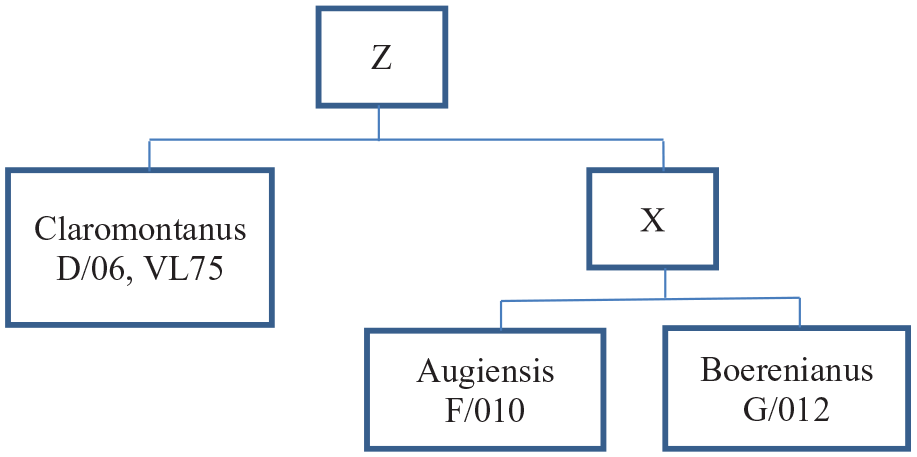
Western Bilinguals of ‘Paul’.
While D06, F, and G are known as ‘Western’, they do not have the same character as Bezae, D05, which is known for its glosses, especially in Acts. D06, F, and G are much more restrained. 5
For Fee (1987: 699), there were three options: (1) Paul wrote verse 34 and 35 after verse 33, (2) Paul wrote them after verse 40, and (3) they were ‘a very early marginal gloss that was subsequently placed in the text at two different places’. He argued for the third option on the grounds that we have no example of the type of transposition required by the other two: If in fact these sentences originated with Paul in this letter, then one is faced with the only displacement of this magnitude in the roughly twelve-century copying tradition of the entire NT: there is simply nothing else even remotely like it anywhere else in that history of transmission. (Fee 2014: 780)
He challenged his detractors to ‘respond in kind, ceasing the often defensive and dismissive posturing on their part’ (Fee 2014: 780). Indeed, most of the textual debate has dodged Fee’s argument and focused instead on claims made by Philip B. Payne about sigla in the margins of Codex Vaticanus and other peripheral issues. 6 Curt Niccum (1997) attempted to minimize the importance of the manuscripts that have verses 34–35 after verse 40 by arguing that they likely derived from a single location (northern Italy). However, he fails to link minuscule 88 with any part of Italy and has to concede that it is Byzantine. Indeed, the wording of 1 Cor. 14.34–35 in 88 is clearly from a different text stream than the bilingual manuscripts.
Scribal Practice Causing Interpolations to Spread and Transpose
Michael W. Holmes (2011: 69–70), in discussing cross-fertilization between text streams, judges that ‘every surviving manuscript and every textual tradition (Alexandrian, Western, Byzantine, etc.) exhibits the presence and effects of mixture’. He suggests that copying from more than one exemplar was ‘a primary means by which mixture occurred’. P66 is an example of an early manuscript whose scribe made extensive use of a second exemplar (Royse 2008: 461–77).
Accidental omissions by eye skips were common among scribes. However, this tendency toward omission did not shorten texts over time because it was counteracted by the tendency to incorporate text that was absent from one manuscript but present in another. This tendency, which was necessary to repair accidental and deliberate omissions, had the downside of spreading interpolations. Jennifer Knust and Tommy Wasserman write, ‘scribes and scholars were trained never to delete, even when they doubted the authenticity of a given passage’, (Knust & Wasserman 2019: 10, also 180). This tendency for accretion is found also in copies of Homer (Lamberton 1997: 34, cited by Knust & Wasserman 2019: 129 n. 103) and in Origen’s version of the Septuagint (Knust & Wasserman 2019: 129).
So, while every surviving manuscript includes 1 Cor. 14.34–35, we cannot conclude, from this alone, that Paul wrote it since an interpolation could spread from manuscript to manuscript until it had infected all that remained in circulation. Indeed, at one time many manuscripts of Paul’s letter to the Romans lacked Rom. 15–16, yet these chapters are included in every surviving manuscript (Gamble 1977).
Omissions (and missing interpolations) from a particular manuscript could be repaired by copying the missing text to the margin of the manuscript. Ulrich Schmid (2011: 49–64) has pointed out that marginal notes were likely made by people other than trained scribes. The marginal text might have lacked clear insertion sigla (signes de renvoi), either because the writer was untrained or because the writer was not sure that it should be inserted. Gallen and Jerome discuss the problem of copyists mistakenly incorporating marginal notes into the body of the text. 7 It is, therefore, easy to imagine how a later copyist could incorporate the marginal text into a logical but new location. Also, a copyist might copy too much of his manuscript before noticing the text in the margin (or in a second exemplar) and might then decide to add the text at a later location. In the case of 1 Cor. 14.34–35, one can imagine a copyist not wanting to interrupt the flow of his familiar text and, therefore, choosing to incorporate the new material at the end of the chapter. Moreover, text introduced from outside would be more likely to be altered or relocated than text already familiar to the community. 8 Thus, an interpolation could be transposed when it multiplied. 9
Fee suggested that 1 Cor. 14.34–35 began as a marginal note in a manuscript that was copied more than once, with the note being incorporated into the body of the text after verse 33 in one copy and after verse 40 in another copy. However, it has been shown previously that the interpolation theory need not suppose that the two positions of 14.34–35 derived directly from a single manuscript.
The Data on Transpositions
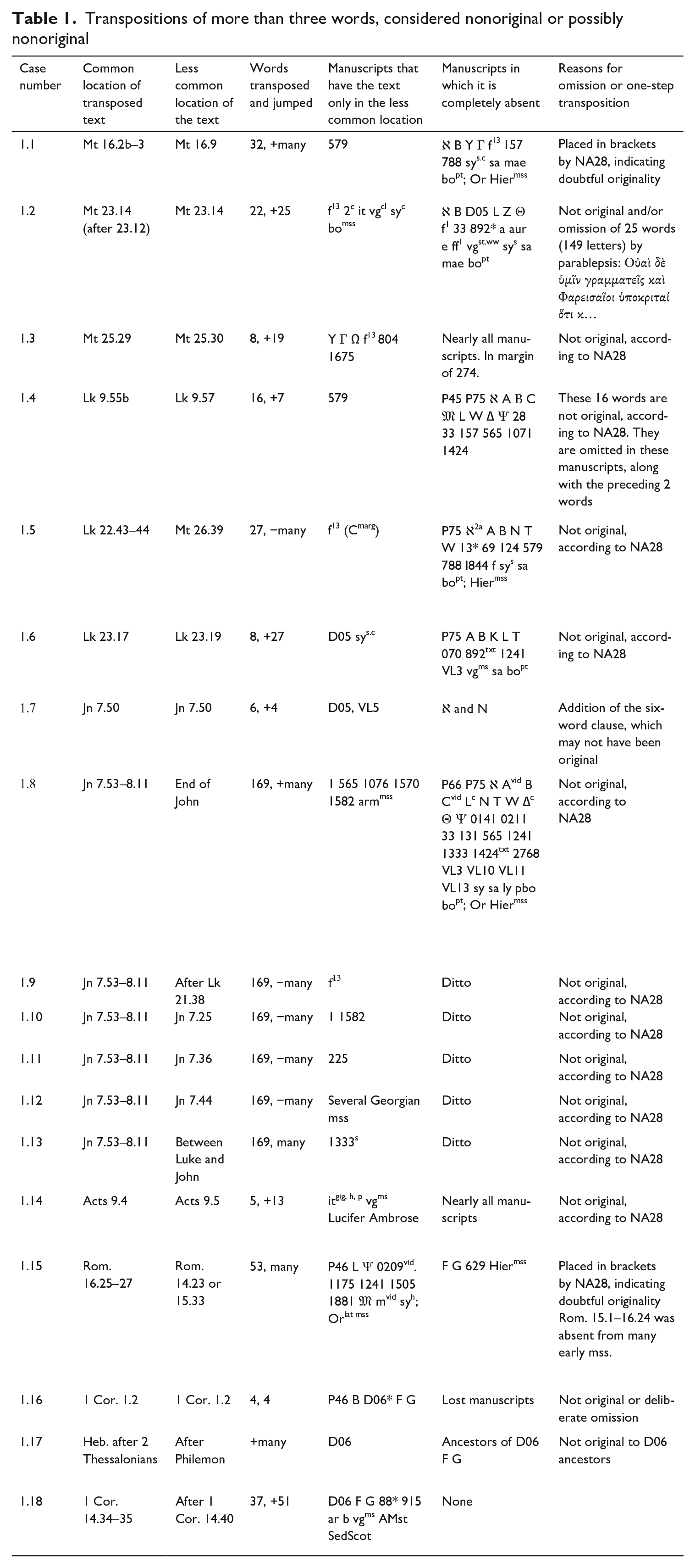
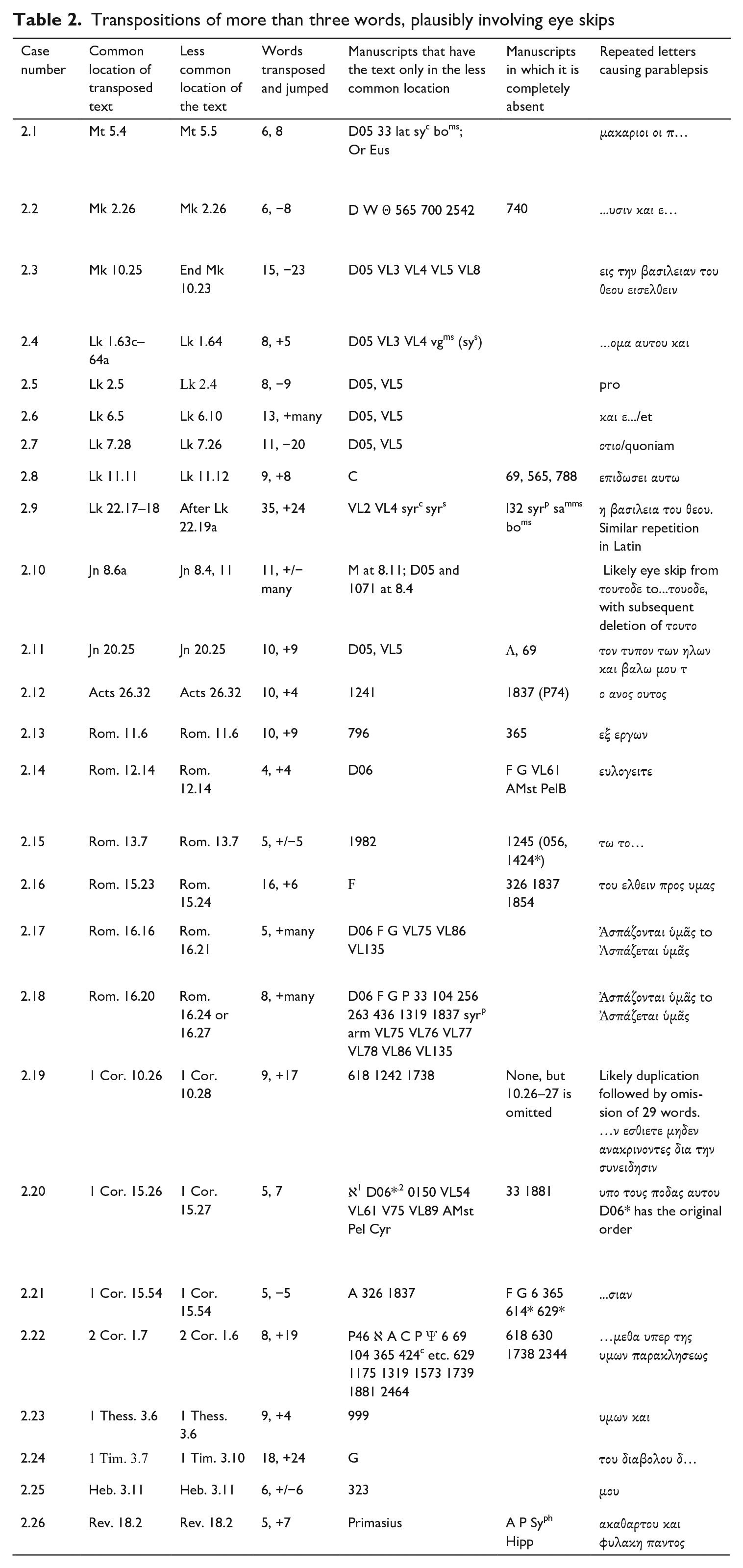
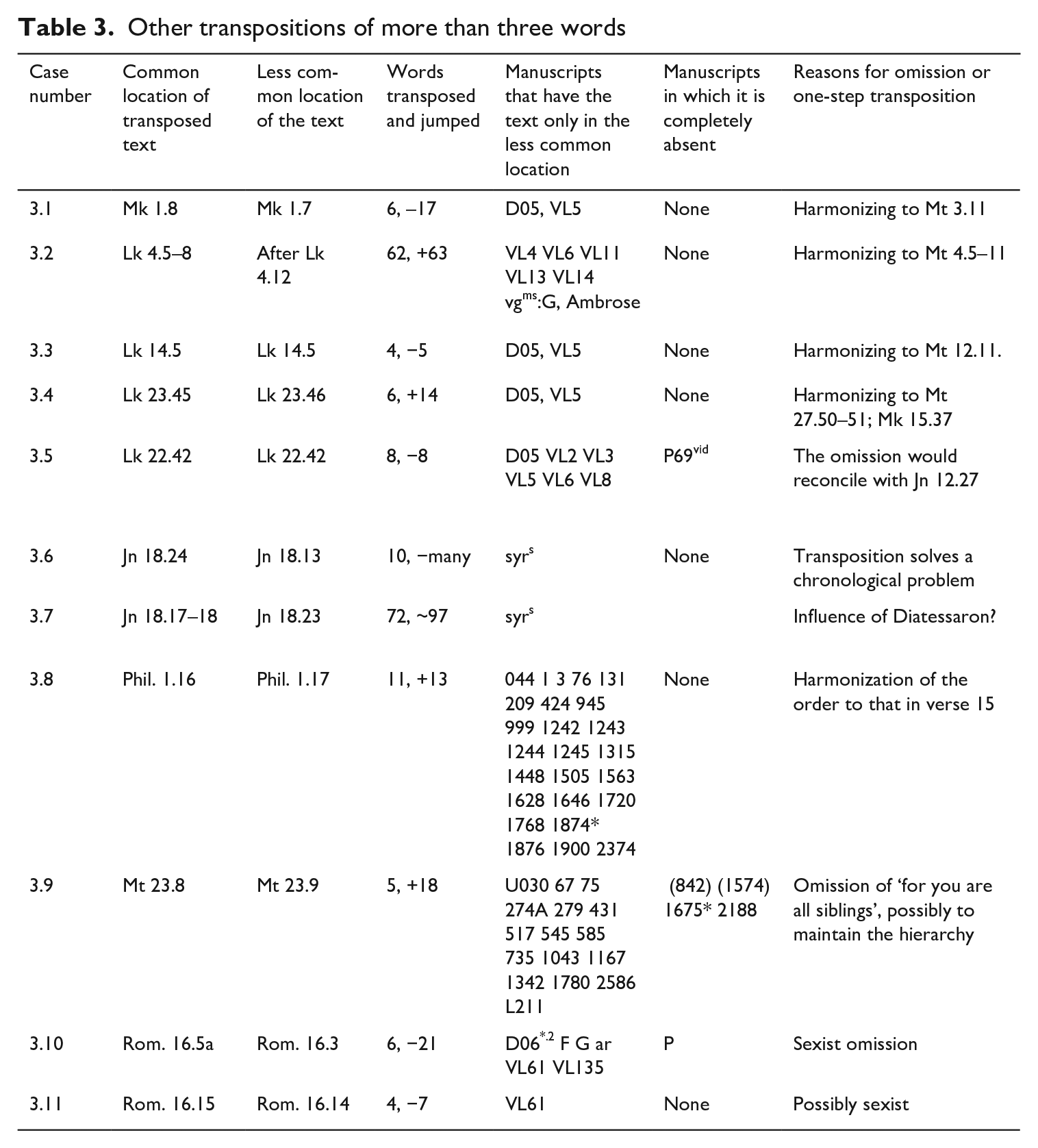
Fifty-five cases of transpositions of more than three words in New Testament manuscripts were found by searching NA28, Reuben Swanson’s volumes, Metzger’s textual commentary, Philip W. Comfort’s textual commentary, and checking the contributions of Matthew Rose and J. M. Ross. 10 Table 1 gives the cases that appear to be interpolations. Table 2 gives the cases that likely resulted from omissions caused by eye skips. Table 3 contains the remaining cases.
Transpositions of more than three words, considered nonoriginal or possibly nonoriginal
Transpositions of more than three words, plausibly involving eye skips
Other transpositions of more than three words
Transpositions of Interpolations
Of the 56 cases of New Testament transpositions of more than three words, the 18 cases shown in Table 1 are transpositions of texts that are considered to be probable or possible interpolations. It can be seen that sections of text that were missing in some manuscripts but present in others were often transposed. Just three of these cases require comment.
Case 1.7 is the transposition of the clarifying note saying that Nicodemus was the same member of the Jewish ruling council who had previously gone to Jesus (Jn 3.1). It adds no new information and could have originated as a reader’s marginal note. This text is absent from Codex Sinaiticus (ℵ) (fourth century) and N (sixth century) and, whether original or not, could have been absent from an ancestor of Bezae (D05), the manuscript in which it is relocated.
Case 1.16 relates to 1 Cor. 1.2, in which the NA28 text is τῇ οὔσῃ ἐν Κορίνθῳ ἡγιασμένοις ἐν Χριστῷ Ἰησοῦ (‘that is in Corinth, to those who are sanctified in Christ Jesus’). P46, B, D06, F, and G place the first four words after the others. Günther Zuntz (1953: 91–92) wrote, ‘Variants of this kind arise through the insertion of additional or the reintroduction of omitted words. At some very early stage, or even originally, one of the two clauses must have been absent from the text’. Zuntz argued that the second clause was absent, while Kloha (2006a: 28–30) argues that the first phrase, τῇ οὔσῃ ἐν Κορίνθῳ, was absent. Either way, the transposition occurred when missing text was inserted.
Case 1.17 is an example of a whole book of the New Testament being added in a novel location. David Eugene Young (2019: 148–89) has shown that codex Claromontanus, D06, took most of its text from a primary exemplar, which lacked Hebrews, and that D06 copied Hebrews at the end of the manuscript, from a second exemplar, which probably had Hebrews after 2 Thessalonians. D06 conceivably relocated Hebrews to where it minimized disruption to the familiar sequence of the primary exemplar.
These 17 cases in Table 1, in combination, show that transpositions often indicate interpolation. Several of these transposed texts are of a similar size to 1 Cor. 14.34–35, which is placed at the bottom of the table for comparison.
Transpositions of Accidental Omissions
Twenty-six of the remaining 37 cases of New Testament transpositions of more than three words can plausibly be explained by the misplaced correction of an omission that originated when a copyist’s eye skipped from a sequence of letters to the same sequence repeated later (parablepsis). These 26 cases are shown in Table 2. It can be seen that there are often surviving manuscripts that witness the eye skip.
It is unlikely that 1 Cor. 14.34–35 belongs to this category. We would need to suppose that a copyist’s eye jumped from the εκκλησιαις near the end of verse 33 to the εκκλησια(ις) near the end of verse 35 and that the λαλιν/λαλειν was corrected to των αγιων.
Figure 2 shows that the proposed eye skip at 1 Cor. 14.34–35 would be the longest of all those in Table 2. It would be a skip of 195 letters, which is 4.5 times longer than the median (43 letters).
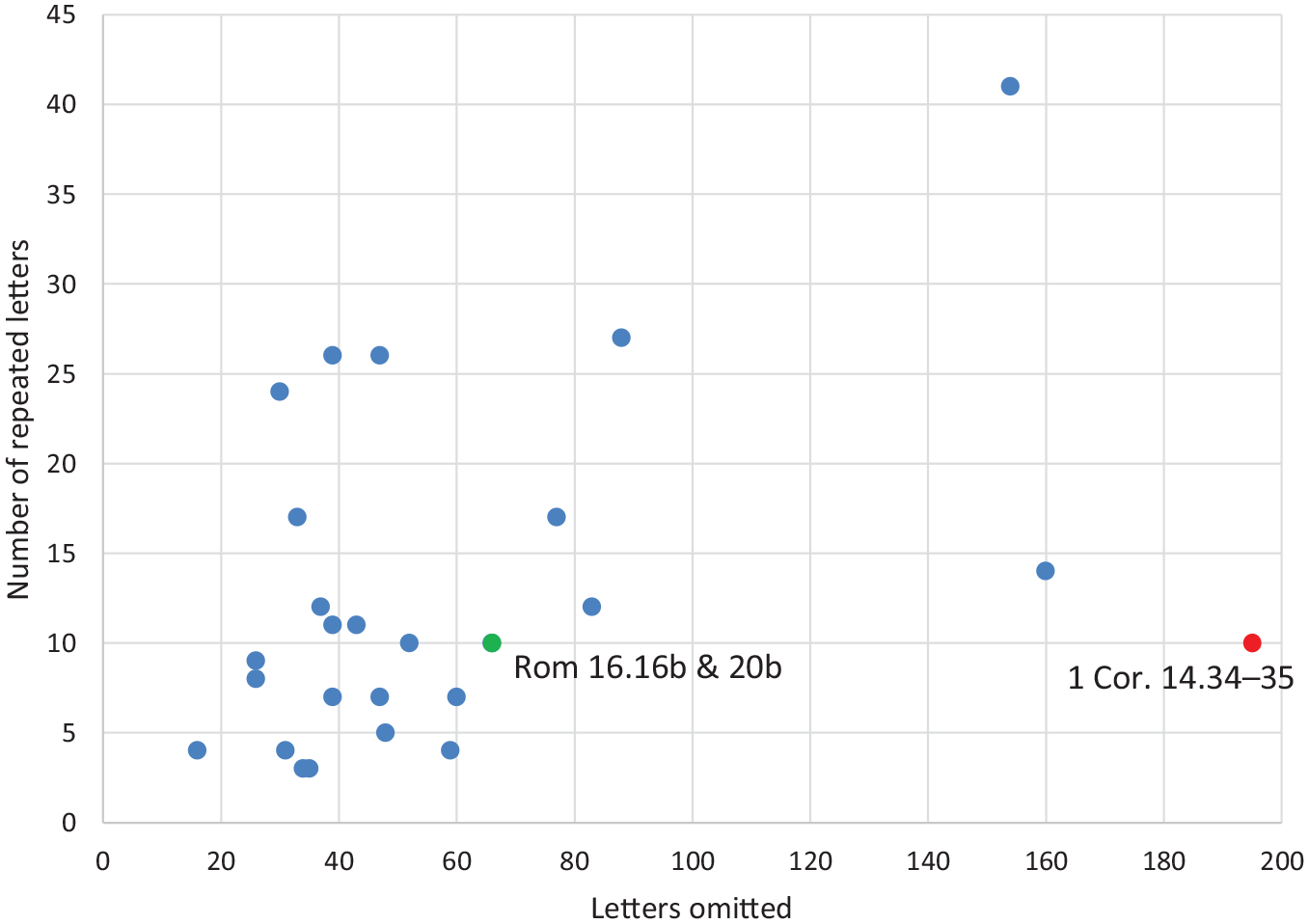
Possible Eye Skips Resulting in Transpositions in Table 2.
Moreover, it would be an eye skip to just a single word, compared to the average of 2.6 words. These facts make this the most unlikely of all the proposed cases of parablepsis listed. Kloha (2006b: 539) likewise concludes that the accidental omission of 1 Cor. 14.34–35 is ‘a very remote possibility’. Niccum (1997), too, following Antoinette Wire (1990), concedes that scribal error is an unlikely explanation.
Other Transpositions
The remaining 11 cases of the 55 cases of New Testament transpositions of more than three words are shown in Table 3. These ‘miscellaneous’ transpositions largely reconcile or harmonize texts between gospel accounts. Indeed, three of these cases merely harmonize the order in Codex Bezae (D05/VL5) with the gospel parallels in Matthew (Cases 3.1, 3.3, and 3.4).
Case 3.5 is a transposition within Lk 22.42. The entire verse is absent from P69, which is a third-century fragment of about 50 words and contains ‘three characteristic D variants’(Hernández Jr 2012: 123). The verse, especially the first part, may have been deleted to reconcile with Jn 12.27, which implies that Jesus did not seek to avoid suffering. The transposition in D05 likely occurred when the missing text was reinserted.
Case 3.6 solves a chronological problem. Jesus is with the high priest at Jn 18.19 before being sent to the high priest at Jn 18.24. Someone, not realizing that there were two high priests, resolved this apparent contradiction by moving 18.24 to 18.13. 11
Case 3.7 may be related to the disruption caused by Jn 18.24 (Case 3.6), and, according to Metzger (1994: 215), probably followed the Diatessaron.
Case 3.8 evidences many manuscripts that reverse the order of Phil. 1 verses 16 and 17. This was likely to make the sequence agree with verse 15 (Comfort 2008: 605).
Case 3.9 is perhaps explained by an omission/deletion intended to support hierarchy among men. Likewise, it will be argued below, that cases 3.10 and 3.11 probably resulted from sexist omissions designed to maintain gender hierarchy.
It is notable that the transposition of 1 Cor. 14.34–35 does not harmonize the text to a parallel passage or solve a chronological problem.
Cases 3.4 and 3.10 likely resulted from deliberate omissions. The deliberate omission of 1 Cor. 14.34–35 is unlikely. When manuscripts change the authority of women, they almost invariably diminish it. 12 It is just possible that these verses were deleted in previous manuscripts because they were seen to contradict 1 Cor. 11.3–16, which assumes that women will not be silent in the assembly but will instead pray and prophesy. However, this contradiction is not easily noticed, and readers who were aware of the contradiction would more likely have changed the wording (of either passage) to resolve the contradiction rather than delete the entire text.
Interim Conclusion on 1 Cor. 14.34–35
We have seen that transpositions of more than three words in New Testament manuscripts rarely, if ever, occur unless the transposition solved a perceived chronological problem or the text in question had suffered omission or was an interpolation. As already noted, the transposition of 1 Cor. 14.34–35 solves no chronological problem, and omission is unlikely, so the verses were likely interpolated.
Much of the textual evidence for the interpolation theory comes from the Western manuscripts of the Pauline texts, so we will now explore the causes of transpositions in these documents in more detail.
The Causes of Transpositions in Western Manuscripts of Paul
David Garland, Kloha, and David Trobisch, apparently independently, find three cases of clause-length transpositions in the Western text of Paul’s letters, all from Rom. 16 (cases 2.17, 2.18, and 3.10, from Rom. 16.16, 20, and 5a respectively). 13 They cite these transpositions as evidence that the common ancestor of these manuscripts had a tendency to transpose without the transposed text ever having been missing from a manuscript. They then conclude that 1 Cor. 14.34–35 could have been transposed without having been absent. To determine whether they are correct, we will now explore several transpositions in the Western manuscripts, including those in Rom. 16.
Rom. 12.14 (Case 2.14)
NA28 εὐλογεῖτε τοὺς διώκοντας ὑμᾶς, εὐλογεῖτε καὶ μὴ καταρᾶσθε F, G ευλογειται και μη καταρασθαι D06 ευλογε[ι]τ[ε] και μη καταρασθαι ευλογειτε τους διωκοντας υμας
Romans 12.14 consists of two phrases, each of four words. The first phrase is lacking in F and G manuscripts, presumably because a copyist’s eye skipped from the first to the second instance of the word ευλογειτε. D06 has repaired this omission using another manuscript but has inserted the missing phrase at the wrong place. Often it is impossible to determine whether a leap was corrected in scribendo or much later. Here, however, the omission was almost certainly already in the common ancestor of D06, F, and G.
Col. 4.16
It is noteworthy that the same scenario (albeit with fewer than three words) occurs at Col. 4.16. D06 omits και, F and G have ινα και, and all other manuscripts have και ινα. Again, the transposition in the common ancestor of F and G occurred when the omission, evinced by D06, was corrected. Other similar examples are suspected. 14
Rom. 16.16b, 21 (Case 2.17), and Rom. 16.20b, 24 (Case 2.18)
Rom. 16.16b reads Ἀσπάζονται ὑμᾶς αἱ ἐκκλησίαι πᾶσαι τοῦ Χριστοῦ. ‘All the churches of Christ greet you’.
This is followed by Rom. 16.17–20a, which is suspected to be an interpolation (see Jewett 2007: 986–8).
Then we have Rom. 16.20b: ‘The grace of our Lord Jesus Christ be with you’.
The text continues with the greetings: Rom. 16.21–23, which begins: Ἀσπάζεται ὑμᾶς Τιμόθεος …
Now, 16.16b is absent from its usual location in D06, F, G, their Latin counterparts, and in VL86, VL135, and Speculum. Instead, και αι εκκλησιαι πασαι του Χριστου or et ecclesiae uniuersae Christi (with minor variations) (‘and all the churches of Christ’) are added to the end of verse 21 in the same manuscripts and in VL61and PELB.
Furthermore, 16.20b is missing from its usual location in the same manuscripts that omit 16:16b from its usual location and also in a Vulgate manuscript. These manuscripts add verse 24: ‘The grace of our Lord Jesus Christ be with all of you’. Verse 24 is essentially 16.20b transposed. Verse 24 is also added in L Ψ 33 104 365 629 630 1175 1241 1505 1881
How, though, did the transpositions of 16.16b and 16.20b occur in the first place? Both transpositions are explained by a single eye skip. A copyist jumped from Ἀσπάζονται ὑμᾶς at the start of 16.16b to Ἀσπάζεται ὑμᾶς at the start of 16.21, thus omitting 16.16b–16.20b. If 16:17–20a was present in the manuscript being copied it would have been an eye skip of 650 letters, which is implausibly long. However, if these verses were absent from the manuscript being copied, the copyist’s eye would have skipped over only 66 letters, which is typical of the cases graphed in Figure 2. After starting to write 16.21, the copyist realized the mistake and added the two missing sentences at the earliest opportunity, placing 16.16b after 16.21 and placing 16.20b at the end of the letter, after 16.23. Thus, a simple case of parablepsis, followed by in scribendo correction, neatly explains both transpositions, but only if 16.17–20b was absent from the exemplar. It is highly unlikely that 16.17–20b would have been accidentally or deliberately omitted, so the interpolation theory is confirmed. This interpolation provides a close parallel to the interpolation of 1 Cor. 14:34–35. Both texts seek to suppress the speech of fellow believers. Textual evidence for both interpolations is found in the Western manuscripts.
1 Cor. 6.8
A transposition in 1 Cor. 6.8 is important because it occurs in much the same manuscripts that relocate 1 Cor. 14.34–35 and is in the same epistle. Indeed, it is the only other such transposition of more than one word in this letter. Paul dictated: ἀλλ(ὰ) ὑμεῖς ἀδικεῖτε καὶ ἀποστερεῖτε καὶ τοῦτο ἀδελφούς. However, ἀποστερεῖτε καὶ precedes ἀδικεῖτε καὶ in D. The equivalent transposition is found in Latin in VL61, VL75, VL89, AMst, PELB, and Sedulius Scottus. This section of First Corinthians is not extant in F and G. It is likely that ἀποστερεῖτε καὶ was omitted by eye skip because of the repetition of the letters ειτεκαι. The same omission is found in minuscule 88. Probably, the missing words were added to the margin of a Western ancestor manuscript as an alternate reading without indicating where they belonged in the text. This transposition cannot have been by a leap corrected in the running text in scribendo, because the omitted words were inserted earlier rather than later. Thus, the ancestor of the manuscripts that place 1 Cor. 14.34–35 after verse 40 likely created transpositions by correcting omissions using another manuscript and inserting the missing text in the wrong place.
Rom. 16.15 (Case 3.11)
The Vulgate at Rom. 16.15 reads Salutate Filologum et Iuliam Nereum et Sororem eius et Olympiadem et. . . . For whatever reason, Nereum is changed to Neream in VL61, VL75 (VL135), and Pelagius. One possible reason for this alteration was to represent Nereum, a man, as Neream, a woman, to avoid having Iulia, a woman, being listed before a man. However, in this case, the sister is defined by her relationship to a woman, in violation of the cultural convention that a woman is defined by her male-named relatives. Such sexist cultural conventions are precisely those that Paul repeatedly challenges in this chapter of Romans. VL61, perhaps to solve this problem, transposes eius et Olympiadem et to the end of verse 14.
The Transposition of Prisca’s House-Church in Western Manuscripts (Case 3.10)
The Invention of a Male Priscas. At Rom. 16.3 and 2 Tim. 4.19, Prisca is given in the accusative case, Πρισκαν, which makes her gender ambiguous to Greek speakers who were unfamiliar with this Latin name. Fellows has shown that the sexist assumption that Πρισκαν was a man was widespread among Greek speakers. Early cases of masculine versions of Prisca’s name are found in P46 (Πρεισκας at 1 Cor. 16.19) and ℵ (Πρισκον at 1 Cor. 1.14). Furthermore, male companions of Paul, called Πρισκας/Πρισκος, are given by pseudo-Epiphanius and a work attributed to Pamphilius. 15 In addition to these data given by Fellows, we find that at 2 Tim. 4.19 there are six minuscules that have the masculine Πρισκον, which is the standard transcription of the accusative of the male Latin name Priscus. 16 It is difficult to ascribe this to scribal slips, for a survey of Swanson showed no cases of interchange between -αν and -ον in the 109 cases of relevant accusative names. Also, no instances of Ακυλον were detected after an extensive search.
Latin speakers would have known that Πρισκαν could only have been a woman’s name. How, then, did they deal with Rom. 16.3–5, where we read that there was a church in the house of Prisca and Aquila? Firstly, Ambrosiaster, writing in Latin between 366 and 384 CE, placed Aquila ahead of Prisca in his text of Rom. 16.3. 17 Manuscript Budapestiensis, VL89, while it is Vulgate in this part of Romans, adds the word et after aquilam. This addition has the effect that the church greeted in 16.5 no longer belongs to Prisca and Aquila, but instead belongs to coworkers who are distinguished from the couple.
The Transposition of Rom
16.5a. Rom. 16.3 names Prisca before her husband, Aquila, and 16.5a refers to the church in their house. D06, F, G, their Latin counterparts, and VL61 and VL135 omit the phrase καὶ τὴν κατ᾽οἶκον αὐτῶν ἐκκλησίαν/et domesticam eorum ecclesiam from Rom. 16.5a and include it instead at the end of 16.3. The ninth-century uncial, P, omits the phrase entirely. 18 Many manuscripts of Ambrosiaster also omit Prisca’s church, as well as verse 4.
Kloha (2006b: 547 n. 277) suggested that the transposition of this phrase occurred without it being previously omitted and that the transposition then led to the omission that we find in P. He writes, ‘P omits και την κατ οικιαν αυτων ακκλησιαν from 16.5 but does not add it at 16.3; parablepsis is not an obvious reason for the omission, and may indicate that the alteration influenced Greek manuscripts outside the narrow bilingual tradition’. This is highly unlikely. I found no other evidence that P was influenced by the text of the DFG ancestor, and I searched all of Romans in Swanson’s collation. Also, if the text of DFG were to interact with the standard text, it would be more likely to result in the duplication of the phrase than its complete omission (and VL86 does indeed include the phrase at both locations). Furthermore, P* makes only one other omission in Rom. 15–16, and it too is in Rom. 16.5. Here most manuscripts describe Epaenetus as ἀπαρχὴ τῆς Ἀχαίας (first fruits of Achaia), but P* omits ἀπαρχὴ τῆς, presumably because Stephanas was the ἀπαρχὴ τῆς Ἀχαίας (1 Cor. 16.15). This confirms that we are looking at deliberate omissions in P at Rom. 16.5. P, therefore, shows that 16.5a could be omitted.
The transposition of Prisca’s church in the Western manuscripts, therefore, is explained by its earlier deletion. This case is important, not only because it provides another example of early corruption on the basis of sexism, but also because it provides further evidence that an ancestor manuscript had missing text added to its margins and later incorporated this text at logical (but sometimes wrong) places. Thus, while Garland, Kloha, and Trobisch appeal to the Western text of Rom. 16.3–5 to support their view that 1 Cor. 14.34–35 was transposed in a single step and was in the original, the opposite conclusion should be drawn.
Junia
Further evidence for a sexist tendency in the Western manuscripts can be found in Rom. 16.7. Paul wrote that Andronicus and Junia were prominent among the apostles and were in Christ before him. However, Western manuscripts, in both Greek and Latin, change the wording so that it is the apostles who were in Christ before Paul. This allows the interpretation that Andronicus and Junia were well known to the apostles who were in Christ before Paul. Non-Latin speakers could have taken Ιουνιαν here to be a man, but the Latin and bilingual tradition would have known her to be a woman. Thus, Junia and Prisca are diminished by some who know them to have been women, and they are spared by others.
An Addition to Gal. 4.17 in Western Manuscripts
Kloha finds five clause-length textual variants, which, like the relocation of 1 Cor. 14.34–35, are common to the principal Western manuscripts. He declares that these five corruptions are witnesses to ‘the very types of displacements that Fee argues never occur’ (Kloha 2006b: 555). We have already dealt with Rom. 16.5, 16.16b, and 16.20. First Corinthians 16.19 will be discussed later. Here, we consider Gal. 4.17 to which D, F, G, VL61, VL89, Ambrosiaster, Sedulius Scotus, PelagiusB, and Mar have added the phrase ζηλοῦτε δὲ τὰ κρίττω χαρίσματα/aemulamini autem meliora dona (with small variations). These words come from 1 Cor. 12.31a (with minor differences). The manuscripts do not lack these words at 1 Cor. 12.31, so this is not a transposition. While the word ζηλόω (‘zealous’) is common to Gal. 4.17 and 1 Cor. 12.31, it is hard to imagine why a copyist would make this duplication. It appears likely that a user of the archetype manuscript added the words from 1 Cor. 12.31 to the margin at Gal. 4.17 perhaps to facilitate a homily on zeal, and a copyist later incorporated this marginal note into the continuous text. This case therefore does nothing to support Kloha’s conclusion but instead suggests that a copyist had a tendency to incorporate marginal notes, even when they did not have insertion sigla. It, therefore, supports the view that 1 Cor. 14.34–35 was copied into the Western ancestor from the margin.
1 Cor. 15.26–27 (Case 2.21) and the Value of the Western Text
Kloha helpfully argues that the Western text predates P46 (which is commonly dated to ca 200 CE) since P46 contains three conflated readings that used the Western text. 19 He concludes that D06, F, and G ‘preserve very early readings’ and sometimes ‘preserve archetypal readings against the rest of Greek tradition’ (Kloha 2006b: 692–93).
A case that is not discussed by Kloha is the sequence at 1 Cor. 15.26–27. The Western manuscripts (D06 VL54 VL61 VL75 VL89 AMst PelAB), along with 0150 and Cyril of Alexandria, have verse 26 after 27a.
D/06 and Old Latin: 25, 27a, 26, 27b Sinaiticus: 25, 26, 27b Most Greek manuscripts: 25, 26, 27a, 27b
We can be confident that the Western order goes back to Paul since it can explain the other readings. Verse 25 and 27a end with the same phrase (τοὺς πόδας αὐτοῦ), so the omission of 27a in Sinaiticus can be explained by parablepsis if the Western reading is the original. The transposition in the other Greek manuscripts likely resulted from the reinsertion of 27a in the wrong place. The conventional order of these phrases cannot explain the omission in Sinaiticus or the transposition in the Western manuscripts.
This case shows that the Western text of First Corinthians, while it may have suffered contamination, has an ancestral line that is independent of the genealogy of almost all the surviving non-western manuscripts. The Western evidence in First Corinthians must be taken seriously. The value of the Western manuscripts of Paul must be assessed with wider text critical arguments rather than merely with a discussion of their former geographical extent (against Niccum 1997).
In conclusion, while I was convinced by Garland, Kloha, and Trobisch for a while, the evidence supports the opposite conclusion. Large transpositions in Western manuscripts, as in manuscripts of other text types, occur when text that was not in a manuscript is inserted in the wrong place.
Textual Variants at 1 Cor. 14.37, 38
It is important to ask whether there is evidence of other sexist corruptions in 1 Corinthians that the hypothesized interpolator of 1 Cor. 14.34–35 may have made. A variant, discussed by Kloha (2006b: 556–7), is found in 1 Cor. 14.37, where Paul says, ‘what I am writing to you is of the Lord’. The entire non-Western manuscript tradition includes the word εντολη/mandata (command) at the end of this verse. This word strengthens Paul’s words, so that they are now a command of the Lord. The word is absent from D06, F, G, VL75, VL89, Ambrosiaster, and some manuscripts of Pelagius, Hilary, and Origen.
20
This list of manuscripts is similar to those that place 1 Cor. 14.34–35 after verse 40. The SBL edition omits the word, and Kloha gives five pieces of evidence that it has indeed been interpolated. Firstly, the word is absent from some manuscripts and relocated in others. Secondly, κυρίου ἐντολή is a non-Pauline term. Thirdly, it creates a non-Pauline word order. Fourthly, ‘no motive for its omission can be given’. Fifthly, ‘without the noun the text is clear’. Kloha then seems to contradict this last statement when he suggests that the word’s ‘insertion clarifies the text by supplying the implied noun’. Furthermore, Kloha (2006b: 636) states that it is the DFG ancestor that had a tendency to create a ‘clear readable text’. A different motive for the addition must be found. After the silencing of women in 14.34–35, we read, 36 Or did the word of God originate with you? 37 Anyone who claims to be a prophet, or to have spiritual powers, must acknowledge that what I am writing to you is (a command) of the Lord. 38 Anyone who does not recognise this is not to be recognised. (NRSV)
The interpolation at verse 37 makes the silencing of women in the previous verses a command of the Lord. Probably the motive was to strengthen the statement and make it apply to 14.34–35, which certainly are a command. This is confirmed by the fact that verse 38 also has a strengthening variant. Here, the indicative αγνοειται is replaced by the imperative αγνοειτω in most non-Western manuscripts. For αγνοειται, NA28 cites ℵ* A*vid D* F G 048 0243 6 33 1739 VL89 co, and Kloha (2006c: 120) adds 424c 1831 VL75 Ambrose, Ambrosiaster, and Origen. For αγνοειτω NA28 cites P46 ℵ2 Ac B D1 K L Ψ 81 104 365 630 1175 1241 1505 1881 2464
The relative impact of these three changes on the surviving manuscripts makes sense. The interpolation of 14.34–35, being a large section of text, was not easily overlooked, so this explains how it could have spread to all surviving manuscripts so that the textual evidence for its nonoriginality survives only in transpositions. By contrast, the addition at 14.37 is only of a single word, so its absence is preserved in several manuscripts. Also, the variant at 14.38 consists only of a verb ending so its survival is more extensive. The data is shown as follows, with transpositions shown in square brackets. The principal transposition of εντολη is found in Sinaiticus (ℵ). 21
14.34–35 omit? [D06 F G VL75 VL89 AMst 88, 915, VL61, Sed.Scot., vgms] 14.37 omit εντολη D06 F G VL75 VL89 AMst Or Hil [ℵ 81vid] PELvar 14.38 αγνοειται D06 F G VL75 VL89 AMst Or Hil ℵ* A*vid 33 f1739 (0243 6 424c2 1739) 048 co Ambrose
The Sequence of Prisca and Aquila at 1 Cor. 16.19 22
The NA28 text of 1 Cor. 16.19 reads: ἀσπάζεται ὑμᾶς ἐν κυρίῳ πολλὰ Ἀκύλας καὶ Πρίσκα σὺν τῇ κατ᾽οἶκον αὐτῶν ἐκκλησίᾳ.
and the NRSV translates: Aquila and Prisca, together with the church in their house, greet you warmly in the Lord.
Here it will be argued that Paul named Prisca before Aquila, and that the names were reversed early, probably by the same person who interpolated 1 Cor. 14.34–35 and/or modified 14.37–38. To do this, we will examine the internal evidence for the name order at 1 Cor. 16:19, the word order in the Pastoral Epistles, corruptions paralleling this transposition, and variants confirming that Prisca was named first.
Internal Evidence for the Name Order at 1 Cor. 16.19
This subsection will address the question: Is Paul more likely to have written ‘Aquila and Prisca’ or ‘Prisca and Aquila’?
The Order Elsewhere
Luke lists Priscilla (the diminutive form of Prisca) and Aquila twice (Acts 18.18, 26), and on both occasions, he places Priscilla first. 23 Paul likewise names Prisca ahead of Aquila at Rom. 16.3. However, all but one manuscript of 1 Cor. 16.19 lists Aquila before Prisca/Priscilla, and this is surprising because Rom. 16.3 and 1 Cor. 16.19 were written by the same author in the span of about a year, and the contexts of the two texts are very similar. I do not know of any explanation that has been offered for this name order inconsistency. We must consider the possibility that Paul named Prisca before Aquila, and an early corrupter of 1 Corinthians transposed the names, with the transposition eventually spreading to all but one surviving manuscript.
The Wording of the Greeting
In 1 Cor. 16.19, the couple greets with a third-person plural verb (ασπαζονται) in most of the best and earliest manuscripts. 24 Elsewhere, when multiple individuals join in sending greetings, Paul uses the singular verb. The presence of the singular verb at 1 Cor. 16.19b in some manuscripts may be designed to conform to Paul’s usual practice or to put more emphasis on Aquila at the expense of Prisca. Paul, however, probably used the plural. The couple sends greetings together with (συν) the church in their house. Why does Paul use the word συν instead of the usual και? The plural verb and the συν suggest that the congregation and its hosts spoke together. Paul’s wording here is more explicable if he named Prisca first. In a speech of Cato reported by Livy, women talking to other people’s husbands was seen as a scandal. 25 Paul may have emphasized that Prisca sent her greetings in the presence of her husband and the church to prevent a misunderstanding.
The greetings from the couple are sent εν κυριω (‘in the Lord’). Nowhere else does Paul send greetings from anyone εν κυριω (‘in the Lord’). Tertius greets the church of Rome ‘in the Lord’, but these are his words, not Paul’s, and he adds them to show that he is a believer. Why then do Prisca and Aquila, who were already known to be believers, send greetings ‘in the Lord’, and why do the words εν κυριω appear in a prominent position before πολλα? It is significant that Paul uses the phrase εν κυριω in four of the six times that he refers to individual women or groups where a woman is mentioned first. 26 In one of the other two cases (Rom. 16.3), Paul uses εν Χριστω Ιησου, which is a close equivalent. In contrast, Paul mentions male church members and groups of church members led by males 63 times and applies the phrase εν κυριω to only five of these occasions. 27 It is, therefore, likely that Paul named Prisca before Aquila at 1 Cor. 16.19.
The case of Phoebe (Rom. 16.1–2) would then provide a close parallel. Paul commends her with no mention of her husband, and she was to work within the congregations of Rome to organize a collection for Judea (see Fellows 2023a). With Paul’s endorsement, she, like Prisca, was likely rejecting the expectation that respectable women should be subservient to their husbands and should not get involved in public discourse. We can speculate why Paul so often writes of females that their interactions with the congregations should be understood as ‘of the Lord’. Perhaps he is countering the patriarchal assumption that women’s roles are not ‘of the Lord’ unless they are subservient to male authority. Paul’s thought may be similar to that in 1 Cor. 16.10–11, where he counters prejudice against Timothy with the words, ‘see that he has nothing to fear among you, for he is doing the work of the Lord just as I am; therefore let no one despise him’.
Might the words εν κυριω have also worked if Aquila was the first-named greeter? Textual variants suggest not, for there is much disruption to this phrase in the manuscripts. The words εν κυριω are absent in 911 1115 1127 1243 1524 1881 1917 2002, and they are placed after πολλα in 056 0121 0142 0243 33 61 142 206 326 429 629 630 664 1149 1241 1678 1739 1837 1857 1872 2200 2865. Some of these manuscripts, such as 33 and 1739/1881, are important witnesses to early readings. This suggests that early readers found the words εν κυριω to be unnecessary and/or poorly placed when they appeared before πολλα Ακυλας και Πρισκα.
The Witness of the Pastoral Epistles
The author of the Pastoral Epistles knew 1 Cor. 16 and placed Prisca before Aquila (2 Tim. 4.19). At 1 Tim. 1.3, ‘Paul’ recalls going to Macedonia and leaving Timothy in Ephesus to counter opponents. This seems to be a false inference from 1 Cor. 16.8–11 (see 2 Cor. 1.1 where Timothy has left Ephesus). Timothy is presented as a timid youth who is not to be despised (1 Tim. 4.12; 2 Tim. 1.7), and this seems to be an interpretation of 1 Cor. 16.10 (where Paul tells the Corinthians to ensure that Timothy has nothing to fear) that does not account for 1 Cor. 4.17–21 (where we learn that Timothy had reason to fear). 28 First Corinthians 16.19 places Prisca and Aquila in Ephesus, where they reside in 2 Tim. 4.19. It is unlikely that Rom. 16.3 is the author’s source for these names since that text has the couple in Rome. The author may have read Acts, but he does not seem to have taken the names from there since Prisca goes by the diminutive form, Priscilla, in Acts. Second Timothy 4.19 is, therefore, probably our earliest witness to the text of 1 Cor. 16.19, and it places Prisca before Aquila. The author of the Pastoral Epistles affords women low status (1 Tim. 2.11–15; 4.7; 5.11–14; 2 Tim. 3.6; Tit. 2.3–5) and places the female Claudia last, behind three male greeters (2 Tim. 4.21). If 1 Cor. 16.19 had Aquila ahead of Prisca, the author of the Pastorals would likely have followed that precedent, even if he was aware of the reverse order from other sources.
Corruptions that Would Parallel the Transposition of Prisca and Aquila
This subsection shows that the demotion of Prisca at 1 Cor. 16.19 is to be expected. This transposition of the two names could have occurred multiple times and/or spread by mixture.
Motivations for Major Alterations
It is worthwhile to consider what issues may have induced major textual changes. Kloha (2006b: 543–5) finds three lengthy insertions in the Corpus Paulinum in manuscripts not associated with the bilingual or Latin tradition. These cases relate to Col. 3.18, 1 Tim. 3.2, and Gal. 4.22–26.
Eph. 5.21 reads, ‘Be subject to one another out of reverence for Christ’. This precedes Eph. 5.22: ‘Wives be subject to your husbands as you are to the Lord’. A tenth-century manuscript, 075, adds Eph. 5.21 in front of Col. 3.18, which is a close equivalent to Eph. 5.22. While this addition is not sexist, it connects to issues of gender and authority.
1 Tim. 3.2 lists the necessary attributes of a bishop, and 075 adds αγρυπνον διορατικον ζεοντα τω πνευματι (‘watchful, clear-sighted, overflowing with the spirit’). This addition, too, relates to issues of leadership and authority.
Kloha presents a series of revisions at Gal. 4.22–26, which are preserved in the patristic evidence. He concludes that ‘the editing reflects an enhancement of the latent anti-Judaic sentiment of the passage, a sentiment which is known to exist in Christian circles of the late-first and early-second centuries (and later)’.
These three major additions concern the roles of women, Jews, and qualifications for church leaders. They can be seen as efforts to strengthen a text, but it must be noted that they may have been subject to prevalent cultural biases or prejudices. Since Prisca was a female Jew who hosted a church, we should not be surprised to find textual variants that change her role.
Kloha (2006b: 541) notes the tension between 1 Cor. 14.34–35 and 1 Cor. 11.3–16 and uses it to argue for the authenticity of these passages, writing ‘It is unlikely that a gloss would be added which contradicts Paul’s teaching’. However, sexist corruption did create tensions. Feminine pronouns at Jn 11.1 and Mk 6.22 were changed to male, even though these changes resulted in contradictions with the immediate context. 29
Demotion of Women by Early Textual Variants
In a recent article, Fellows (2022: esp. 253–63) gives the 15 occasions in the New Testament where women are listed ahead of men who are not their sons. He shows that in almost every case, there exists an early manuscript that avoids giving prominence to the female. Table 4 shows that this is normally achieved by reversing the order of the males and females. 30 An early example is the reversal of the names Julia and Nereus that took place in a predecessor of P46, which is our oldest copy of Paul’s letters and is dated to ca 200 CE.
NT texts with females preceding males
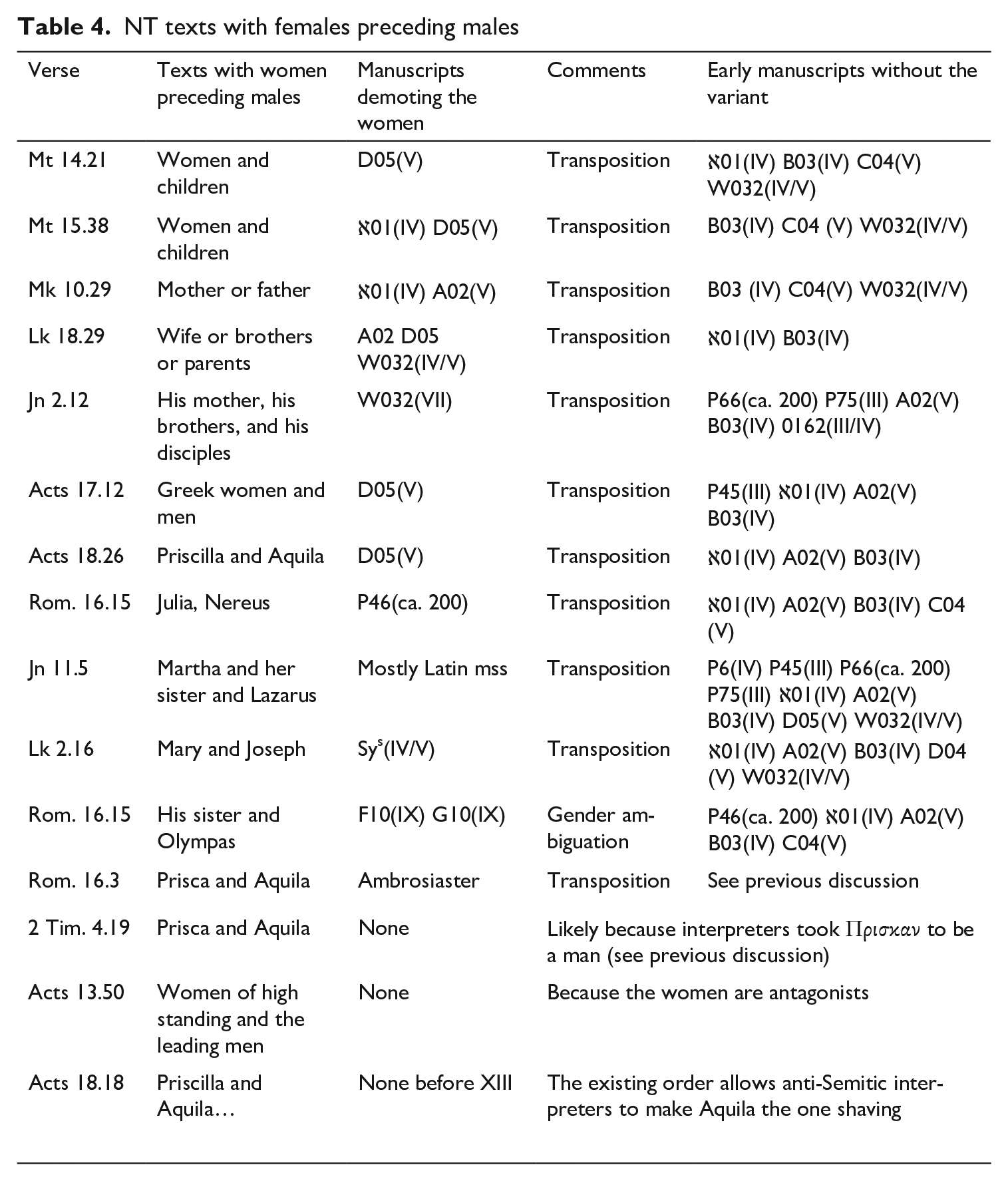
There are some 62 occasions in the NT where males are listed before females. Apart from the fifteenth-century minuscule 69 (at Mt 19.5), Fellows finds only two of these occasions where the order of the males and females is reversed, and I found no others in Swanson’s volumes. One of these two is Acts 2.18, where Sinaiticus has transposed the males and females. Fellows (2022: 253) points out that this probably occurred by a corrected leap. The other case is the reversal of brothers and sisters in Bezae at Mk 10.30. This is also probably a corrected leap. A close relative, W, omits brothers, likely because of the repetition of a string of nine letters: οἰκίας καὶ ἀδελφοὺς καὶ ἀδελφὰς.
Three conclusions should be noted. Firstly, early Christians were sensitive to name order. This is not surprising in a patriarchal honor/shame society but has been largely overlooked by NT scholars. 31 Secondly, transpositions that placed women after men were common and early. Thirdly, transpositions that promoted females were rare and likely caused by accidental mechanical copying errors.
Acts 18:26
Thirteen Greek manuscripts list Priscilla before Aquila in Acts 18:26. These (with their centuries) are ℵ(4th) B(4th) A(5th) E(6th) P74 (7th) 33(9th) 619(10th) 1735(10th) 1162(11th) 629 (14th) L1188(14th) 1884(16th). 32 John Chrysostom’s comments illustrate the importance of name order and show that his manuscripts named Priscilla first at Acts 18.26, as well as Rom. 16.3.
This too is worthy of inquiry, why, as he addressed them, Paul has placed Priscilla before her husband. For he did not say, ‘Greet Aquila and Priscilla’, but ‘Priscilla and Aquila’. He does not do this without a reason, but he seems to me to acknowledge a greater godliness for her than for her husband. What I said is not guess-work, because it is possible to learn this from the Book of Acts. She took Apollos, an eloquent man and powerful in the Scriptures, but knowing only the baptism of John; and she instructed him in the way of the Lord and made him a teacher brought to completion.
33
It is therefore highly likely that Luke named Priscilla first. She has, however, been a victim of transposition, for 231 Greek manuscripts surveyed name Aquila first. The earliest are D05 from the fifth century and H L P 049 0120 1886 from the ninth.
Prisca precedes Aquila also at Acts 18.18, but readers could claim that the name order here was not determined by prominence but by the grammatical expedient of making Aquila the subject of the following clause. Indeed, our earliest Latin manuscript of Acts, VL55, of the fifth century, makes it explicit that Aquila was the one who shaved his head: Priscilla et Aquila, qui votum cum fecisset [Cenchris], capud tondit.
Nympha
At Col. 4.15 we read that Nympha hosts a church. It is likely that readers were uncomfortable with the idea that a woman should lead a church, for many manuscripts seem to have changed the feminine pronoun into a masculine or plural pronoun, thus changing or ambiguating Nympha’s gender. 34 The feminine pronoun is probably original, not only because it is supported by important manuscripts but also because the Apostolic Constitutions gives the role of bishop of Laodicea to Archippus rather than to a Nymphas. This raises the possibility that manuscripts were corrupted also at 1 Cor. 16.19 and Rom. 16.3–5 to prevent a woman from hosting a church.
Damaris
Luke names two believers in Athens: Dionysius and Damaris (Acts 17:34). David A. Evans (2020) infers (correctly, I think) that Luke mentions them because they became the leaders of the church(es) in Athens and were probably church hosts. 35 Codex Bezae, D05, however, omits the female, Damaris. This fits the pattern of sexist textual variants that we see elsewhere, especially in D05. Presumably a user of an ancestor of D05 was uncomfortable with the implication that Damaris was prominent in the church.
Variants Confirming that Prisca Was Named First
It was shown in section “Textual Variants at 1 Cor. 14.37, 38” that the following manuscripts escaped the sexist corruption of 1 Cor. 14.38: D06, F, G, VL75, VL89, ℵ*, A*vid, 33, f1739, 048, co, Ambrose. Unfortunately, 048 is not extant at 1 Cor. 16, and the Coptic requires specialist expertise and so cannot readily be assessed. However, we can explore whether the other manuscripts listed show some form of textual disruption around Prisca that might have resulted from her being named before Aquila, or whether the variants are equally explicable if Aquila always preceded his wife in 1 Cor. 16.19.
Family 1739 and Minuscule 945
Minuscule 945, which reads Πρισκιλλα και Ακυλας, is the only manuscript to name Prisca before Aquila at 1 Cor. 16.19. It is an 11th-century manuscript, which in Paul ‘is mostly Byzantine, though it has a few readings reminiscent of family 1739’ (Robert B. Waltz [online a]). It is possible that the name order in this manuscript is a late variant, produced under the influence of Acts 18.18, Rom. 16.3, or 2 Tim. 4.19.
Manuscript 945 omits πολλα at 1 Cor. 16.19, and this seems significant since the word is omitted only in 608, and in 1243, which also omits εν κω. The omission of πολλα in 945 may have occurred by parablepsis if an ancestor had Πρισκιλλα πολλα και Ακυλας. Alternatively, someone may have felt that it was inappropriate for a woman to send greetings heartily.
Minuscule 1881 is an important member of Family 1739 and a witness to ancient readings. 36 It omits αὐτός at 16.19 so that its text no longer explicitly states that the church met in the house of Prisca or Aquila. If Prisca was originally named first, this omission might have been made to avoid giving church leadership to a woman. This manuscript preserves omissions, including of αὐτός elsewhere in the letter.
While most manuscripts read ἐν κυρίῳ πολλὰ, 22 of the manuscripts surveyed read πολλὰ ἐν κυρίῳ. These include five of the eight Family 1739 members that are extant here and minuscule 33. 37
Alexandrinus (A)
Scribe 1 of Alexandrinus copied Matthew (extant from 25.6), Mark, the Pauline epistles (from 1 Cor. 10.8), and Hebrews (Smith 2014). There are only two long omissions in the texts written by this scribe: 1 Thess. 1.8a and all of 1 Cor. 16.19. The omission of 1 Cor. 16.19 might have been caused by a long leap because of the repetition of ασπαζονται υμας. However, the omission and/or its preservation is more likely if Prisca preceded Aquila. The same manuscript omits Persis (Rom. 16.12) and Martha (Jn 11.1), both women.
Minuscule 33
In place of Ακυλας at 1 Cor. 16.19, minuscule 796 (at the end of a line), 33, and F have Ακυλα, which non-Latin speakers could consider a female name. The loss of the sigma from Aquila’s name would be more likely if he was named after Prisca, for his name would then have been immediately followed by another sigma: ακυλασσυν. The two sigmas could easily sound as one when the copyist repeated the words to himself or when they were dictated to him. Also, a copyist not accustomed to finding a man’s name listed after a woman’s name could consciously or subconsciously drop the sigma from the name. The Lexicon of Greek Personal Names cites one attestation of Ακυλα as a woman’s name. One wonders why the variant Ακυλα was not corrected. Some may have taken it to be a Latinate form of Ακυλας, for the same manuscript, with F and G, has the Latinate Απολλω in place of Απολλως at 1 Cor. 3.22. It is possible that the variant Ακυλα arose merely as a Latinate spelling, but this seems less likely because the other male Latin NT name ending in -a, αγριππας, is never changed to αγριππα. 38
Sinaiticus (ℵ*)
This manuscript actually has a male version of Prisca. At 1 Cor. 1.14 it has Πρισκον where other manuscripts have Κρισπον. It also has Ακυλα in place of Ακυλας at Acts 18.26, perhaps because a copyist’s subconscious assumption that a male would not be named after a female.
Western Manuscripts
We have seen that the Western ancestor was not descended directly from the manuscript(s) in which the sexist interpolation of 14.34–35 and the sexist variants at 14.37–38 were added. Here, we assess whether the Western tradition also had Prisca before Aquila at one time. We will examine the addition to 1 Cor 16:19 in the Western manuscripts and discuss two textual variants that provide parallels.
Giving the Leadership of Prisca’s Church to Paul
At the end of 1 Cor. 16.19, the bilinguals D06, F, and G have the added words ‘with whom I am staying’ (in both Greek and Latin). The same phrase appears in other Latin manuscripts. 39 It is not a quotation, and it cannot be an innocent note from the margin that was accidentally incorporated into the text, since it has a first-person verb. It, therefore, demands an explanation.
The added phrase allows interpreters to believe that the church met in the house of Aquila and Prisca, only because Paul was staying there. It gives the leadership of the church to Paul. This is just the kind of corruption that we would expect if Prisca/Priscilla preceded Aquila in the ‘Western’ ancestor.
The addition at 16.19 is the longest addition in the ‘Western’ text of First Corinthians. It will now be shown that the second- and third-longest additions also likely arose from concerns over who should hold authority.
Clement of Rome and the Origin of the Western Text of 1 Corinthians
At 1 Cor. 16.15–16 we read, Now, brothers and sisters, you know that members of the household of Stephanas (τὴν οἰκίαν Στεφανᾶ) were the first converts in Achaia (ἀπαρχὴ τῆς Ἀχαΐας), and they have devoted themselves to the service of the saints; I urge you to put yourselves at the service of such people, . . .
However, several manuscripts, including the Western manuscripts (both Greek and Latin), add the names of Fortunatus (and sometimes Achaicus) to that of Stephanas. 40 Zuntz (1953: 164) judges that this variant was probably already present in the second century. Fortunatus and Achaicus, both men, are named in verse 17, but their addition to verse 15 enhances their authority by making it explicit that they, with Stephanas, are the first fruits of Achaia, and that the Corinthians should be submissive to them.
It is often supposed that the church of Corinth comprised multiple house churches under the leadership of such men as Gaius, Titius Justus, Crispus, and Stephanas. However, Fellows (2016) has shown that Sosthenes (who had left Corinth by the time of 1 Cor. 1.1) was Crispus renamed, and that ‘Stephanas’ was the leadership name given to Gaius Titius Justus. Stephanas and his household were, therefore, likely the hosts and leaders of the entire Christian community of Corinth.
Clement of Rome wrote to the Christians in Corinth and his letter is usually dated to near the end of the first century. We learn in this letter that Corinthian church members had rejected their leaders, at least some of whom were advanced in years (1 Clem. 1, 3, 21). Clement likely has members of the household of Stephanas in mind, for he writes that the apostles ‘preaching everywhere in country and town, . . . appointed their firstfruits (ἀπαρχή), when they had proved them by the Spirit, to be bishops and deacons unto them that should believe’. (1 Clem. 42.4).
41
There is a hint that Stephanas had died: And our Apostles knew through our Lord Jesus Christ that there would be strife over the name of the bishop’s office. For this cause therefore, having received complete foreknowledge, they appointed the aforesaid persons, and afterwards they provided a continuance, that if these should fall asleep, other approved men should succeed to their ministration. Those therefore who were appointed by them, or afterward by other men of repute with the consent of the whole Church, and have ministered unblameably to the flock of Christ in lowliness of mind, peacefully and with all modesty, and for long time have borne a good report with all these men we consider to be unjustly thrust out from their ministration. (1 Clem. 44.1–2)
In closing the letter, Clement writes, ‘Now send ye back speedily unto us our messengers Claudius Ephebus and Valerius Bito, together with Fortunatus also, in peace and with joy’ (Τους δε απεσταλμενους αφ ημων Κλαυδιον Εφηβον και Ουαλεριον Βιτωνα συν και Φορτουνατω εν ειρηνη μετα χαρας εν ταχει αναπεμψατε προς ημας) (1 Clem. 65.1). The word συν implies that Fortunatus is in a different category from Ephebus and Bito. Fortunatus is likely the Fortunatus of 1 Cor. 16.15–17, 42 especially if Clement is not describing him as one of the messengers, and if it is he, in particular, who is to come ‘in peace and with joy’. If the Corinthian congregation recommits to loyalty to the household of Stephanas, Fortunatus will be able to travel to Rome ‘in peace and with joy’, accompanying Clement’s messengers, Ephebus and Bito.
It is noteworthy that Paul wrote four letters to Corinth, but only two survive. Clement knew First Corinthians only, for he writes, ‘Take up the epistle of the blessed Paul the Apostle’ (1 Clem. 47.1) and makes no allusions to Second Corinthians or any other letter to Corinth. These facts, and the addition of Fortunatus to the Western manuscripts of 1 Cor. 16.15, can now be explained. The household of Stephanas likely cherished First Corinthians since they are honored there. Fortunatus, and perhaps other members of the household of Stephanas, were still alive, and old, when church members rebelled against their leadership. They then wrote to the Church of Rome, asking for their support, sending a copy of First Corinthians. They added text to the margin of this copy, at 16.15, to clarify that the household of Stephanas, to whom Paul had demanded allegiance, included Fortunatus. This copy of 1 Corinthians, being the copy of the bishop of Rome, gave rise to the Western text stream. This scenario is perhaps confirmed by the addition of the words δηλω υμιν οτι (‘I clarify to you that’) to 16.12 in the Western manuscripts (D06, F, G, the Old Latin) and ℵ*. 43 This addition is explicable if the marginal note, which was intended to clarify 16.15, began with the words δηλω υμιν οτι and was later misunderstood as corrections for the copyists to insert. The nearest place to 16.15 where δηλω υμιν ότι would make sense is 16.12. The addition to 16.12 is less widespread than that at 16.15, presumably because it was made by copyists only after the reason for the marginal note was no longer remembered. Clement anticipates that Fortunatus may visit Rome. Perhaps Fortunatus, when appealing to the church of Rome for support, had written (diplomatically or with real intent) that he longed to visit them.
In conclusion, the additions in the Western manuscripts at 1 Cor. 16.12, 15 demonstrate the tendency to incorporate marginal text, sometimes incorrectly. They also show that those with authority over the manuscripts created textual variants that concerned the questions of who should have authority in the church.
A Variant Denying Church Leadership to a Bigamist
We will now see that a further addition to 1 Cor. 16.19 also concerns authority in the church and therefore parallels the addition in the Western textual tradition discussed previously. The minuscules 460, 181, 1836, and 1875, which are not prone to additions, have the added words απολλω και before ακυλας και πρισκιλλα. This gives precedence to Apollos over Aquila and Prisca, as the likely leader of the church. The INTF gives 460 as 13th century and the other three as 10th century. Minuscule 460 has parallel columns in Greek, Latin, and Arabic and has the addition in all three languages.
These manuscripts reveal no particular interest in Apollos elsewhere. Rather, their interest is in Aquila, for, while 1836 is lacking 2 Tim. 4.19, the other three manuscripts have an interesting addition there. Metzger explains: After Ἀκύλαν two minuscules . . . insert Λέκτραν τὴν γυναῖκα αὐτοῦ καὶ Σιμαίαν (Σημαίαν 460) καὶ Ζήνωνα τοῦ υἱοὺς αὐτοῦ. Since, according to the apocryphal Acts of Paul and Thecla, these are the names of the wife and the children of Onesiphorus, the gloss was evidently written first in the margin and later introduced into the text at the wrong place (giving Aquila two wives!).
44
After a thorough search of the INTF website and Swanson, I found no manuscripts, other than 181, 460, and 1875. The added words give the translation: ‘Greet Prisca and Aquila, Lectra his wife, and Simias and Zeno his children, and the household of Onesiphorus’. It is clear, then, that the extra words were added to the margin as commentary on Onesiphorus and were later incorporated into the text. This is confirmed by the fact that 181 has a marginal note referring to Thecla at 2 Tim. 3.11. 45 It is possible that this text was incorporated by someone who took Prisca to be a male (see section “The Invention of a Male Priscas”). We can observe, in passing, that this addition to 2 Tim. 4.19 provides a further example of the incorporation of a marginal note in the wrong place.
One possible explanation for the insertion of Apollos before Aquila and Prisca at 1 Cor. 16.19 in the common ancestor of 181, 460, 1836, and 1875 now presents itself. The additional words at 2 Tim. 4.19, before or after they were incorporated from the margin, implied that Aquila had two wives and this would disqualify him from church leadership (2 Tim. 3.11). This explains why the leadership of the church in 1 Cor. 16.19 was taken from him and given to Apollos by the addition there. This variant, therefore, arguably demonstrates sensitivity over who could host a church.
The Transposition of πολλα
D06 has πολλα after Ακυλας, and this is supported by VL89, VL64, PELB, and Vulgate manuscripts A, B, G, H, K, M, P, and Θ. πολλα is omitted by some copies of Ambrosiaster, but the usual word order is found in F and G. Thus, we have further evidence of disruption around Aquila and Prisca. Perhaps πολλα was omitted from the Western ancestor and has been reinserted in the wrong place. Judging from 945, discussed previously, this omission would provide further evidence that Prisca preceded Aquila in the Western ancestor. In any case, the resulting text of D06, etc., gives prominence to Aquila at the expense of Prisca because it has only Aquila sending the greetings heartily.
Priscilla
Many manuscripts give the diminutive form, Priscilla, at 1 Cor. 16.19, and this might have been a put-down, as Kurek-Chomycz pointed out. 46
Conclusions on 1 Cor. 16.19
The transmitters of the New Testament had a tendency to name the man before the woman and we should expect this tendency to be strong at 16.19 where the question of female church leadership arises. This is confirmed by the strong cumulative case that the manuscript traditions that avoid the sexist corruptions at 1 Cor. 14.34–35, 37, 38 (to varying degrees) also had Prisca before Aquila at 16.19. Therefore, while Aquila is named first in every manuscript but one, we cannot conclude from this that Paul named him first. It is possible to hypothesize that Ακυλας και Πρισκα was changed to Πρισκιλλα και Ακυλας under the influence of Acts (compare the variants at Gal. 2.9), but this does not avoid the conclusion that Priscilla’s precedence was later suppressed.
Conclusions
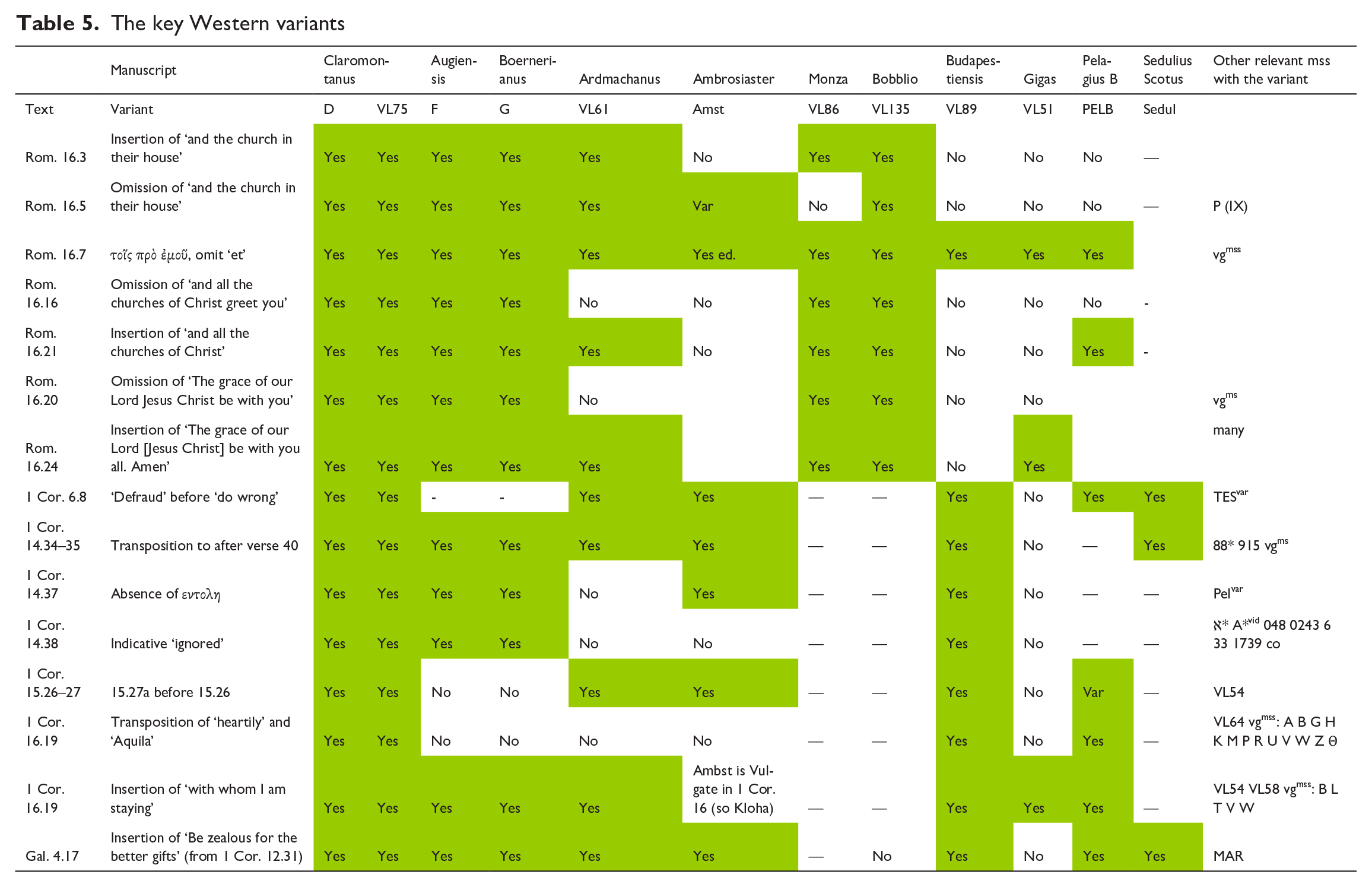
There are few large-scale disruptions to the text of Paul’s letters (or indeed to other parts of the New Testament), but they often concern issues of authority and especially the authority of women in the church. Table 5 summarizes the main variants discussed in this article and shows their coherence. Note that VL86 and VL135 are not present in First Corinthians and that VL89 is considered Vulgate in Rom. 15–16.
The key Western variants
We have seen that words that were absent from a manuscript or text stream could be added from a manuscript that included them. Sometimes the words were added in the wrong place. This mechanism and accidental omissions corrected in scribendo explain almost all of the transpositions of more than three words. The transposition of 1 Cor. 14.34–35 in manuscripts such as D06, F, and G strongly suggests that it was absent from early manuscripts. This is explicable if the verses were interpolated early. Variants at 14.37, 38 suggest that there was indeed early sexist corruption of the letter.
The assumption that church hosts should be men (with just one wife) has induced several textual variants:
Alteration of the pronoun so that Nympha is not female (Col. 4.15).
The change of gender of Prisca at 2 Tim. 4.19 and elsewhere.
The deletion of Prisca’s church at Rom. 16.5.
The addition of Apollos to 1 Cor. 16.19, giving him the leadership of the church.
The addition of ‘with whom I am staying’ to 1 Cor. 16.19, giving the leadership to Paul.
The early transposition of Prisca and Aquila, making Aquila the head of the church.
We can conclude that Paul named Prisca before Aquila at 1 Cor. 16.19 because
He and Luke do so elsewhere.
2 Tim. 4.19, which is likely dependent on 1 Cor. 16.19, names Prisca first.
Variants at 1 Cor. 16.19 are best explained if ancestor manuscripts placed Prisca first.
The precedence of Prisca explains why the greetings are sent ‘in the Lord’.
We have seen that textual variants that reduce the role of women in the church were common and include a long addition in 1 Cor. 16.19. It is, therefore, hard to argue that the interpolation of 1 Cor. 14.34–35 would have no parallel. The hypotheses concerning the transposition of Prisca and Aquila, the addition at 1 Cor. 14.37 and the interpolation of 1 Cor. 14.34–35, are mutually supporting and need to be assessed together.
Footnotes
Acknowledgements
I thank Bridget J. Jeffries, Hugh A. G. Houghton, and Katherine Kandalaft for their feedback on earlier versions of this article.
1.
On Junia, see Bernadette Brooten (1977: 141–44). Also, Eldon J. Epp (2005) and Yii-Jan Lin (2020: 191–209). There is strong evidence that Euodia and Syntyche were church leaders. See particularly Richard G. Fellows and Alistair C. Stewart (2018: 222–34) and  : 4–7). This view goes back at least to John Chrysostom, Homilies on Philippians 13: ‘It seems to me that these women were the head (κεϕάλαιον) of the church which was at Philippi’.
2.
3.
For a recent review of much of the literature, see Jorunn Økland (2021: 69–98). provides a recent defense of the theory that Paul is quoting the Corinthians at 14.34–35 and refuting them at 14.36. He argues that the verses were moved to the end of the chapter in some manuscripts so that they could no longer be seen as a quotation. This interesting possibility is weakened by the fact that we lack evidence that the ancients considered these verses to be quotations.
5.
This point has been missed by Philip W. Comfort (2008: 527), who writes about the addition to 1 Cor. 16.19 in D06 F G, ‘As was so often commented upon in the book of Acts, the Western text is known for its propensity to supply historical details-few of which can be verified, as in this case’. Günther Zuntz (1953: 163) correctly writes, ‘Additions of the substantial kind which is so typical of the Western text, especially, of Acts are, as is well known, very rare in the Epistles’. Similarly, Kurt Aland & Barbara Aland (1989: 110) write, ‘The attempt to find here or in other diglot manuscripts any similarities to the textual expansions or abbreviations found in 05 must be considered unsuccessful’.
6.
Philip B. Payne (1995: 240–62; 1998: 152–58); Payne and Paul Canart (2000); Payne (2004: 105–12; 2009; 2017). Payne was rebutted by Curt Niccum (1997); J. Edward Miller (2003); Jennifer Shack (2014); Richard G. Fellows (2019); .
7.
9.
10.
Metzger (1994); Reuben Swanson (1995–2005); Comfort (2008); Barbara Aland et al. (2012). Here, we define a transposed text as one that is present in two (or more) manuscripts but in different locations, with each manuscript omitting the text where the other includes it. Matthew M. Rose, (2021), brought cases 1.2, 1.5, 1.6, 1.8, 1.9, 1.11, 1.13, 1.15, 2.3, 2.6, 2.10, and 3.6 to my attention but does not claim that they all support his conclusion that the passage is authentic. J. M. Ross (1992) cites cases 1.2, 1.5, 1.6, 1.8, 1.9, 1.11, 1.13, 1.15. He seems to agree that varying positions of a text are indications that it was absent in some ancestor manuscripts. Oddly, he assumes that a copyist with an exemplar that lacked a text and another exemplar that included the text would copy the text in a new location if he knew it to be genuine. But how would the copyist know? Ross seems to cast copyists as text critics. For further criticism of Ross’s paper, see .
12.
Richard Fellows (2022) finds that in cases where females are listed before males (who are not their sons), there are early manuscripts that transpose them in nearly every case (see ). Following the same search method, Fellows finds only two early manuscripts that demote males relative to females out of the 65 cases in the New Testament where males are listed first.
13.
David E. Garland (2003: 676); Kloha (2006b: 547–56); : 45–46).
14.
There are 23 transpositions that are in D06 and F and/or G, but not in other Greek manuscripts surveyed or in the Vulgate. Most of these are of one word. Those at Gal. 2.1, Eph. 3.2, and Eph. 5.22 show evidence of corrected absences. See also Rom. 5.8.
15.
For Pseudo-Epiphanius’s list of apostles, see Theodorus Schermann (1907: 125). Pamphilius’s Exposition of the Chapters of the Acts of the Apostles replaces the Crispus of Acts 18.12 by a Priscus. See : 268).
16.
605 (10th C) 627 (10th C) 104 (11th C) 459 (11th C) 2817 (11th C) and 110 (12th C)
20.
Combining citations from Kloha (2006c: 1202) and : 278).
21.
It also appears before the verb in 69, 365, 1175, 1270 1319, and 1573, but these cases may not be genealogically relevant because the verb and noun are plural, following the Byzantine text.
22.
I thank Stephen Carlson for his helpful feedback on an earlier version of this section of the article.
23.
Acts 18.2 says that Paul found Aquila, who had come from Italy with Priscilla, but this is not a names list. The text does not give more honor to Aquila than to Priscilla but merely shows that Paul met Aquila before being introduced to his wife (lest the reader gets the impression that Paul sought the company of married women).
24.
NA28 cites for the plural, ασπαζονται, B F G L 075. 0121. 0243. 33. 81. 365. 630. 1175. 1241. 1505. 1739. 1881
26.
Rom. 16.2, 12 (twice); Phil. 4.2. The exceptions are Rom. 16.3, 6. This analysis is limited to the undisputed letters.
27.
Rom. 16.8, 13; 1 Cor. 4.17; Phil. 2.29; Phlm. 20.
30.
The transposition of Mary and Joseph at Lk 2.16 was brought to my attention by Peter Williams.
32.
34.
NA28 cites αυτου D F G K L Ψ 365 630 1241s. 1505
35.
36.
1881 is a 14th century manuscript but is an important close relative of manuscript 1739. While 1739 is a 10th-century manuscript, it was probably copied from a fourth-century manuscript. Bruce M. Metzger and Bart D. Ehrman (2005: 91). Zuntz finds that, in 1 Corinthians and Hebrews, manuscript 1739 ‘represents a manuscript comparable, in age and quality, to P46’ and yields ‘unhoped-for glimpses of the textual situation about A.D. 200’. : 69, 84). Waltz (online b) writes, ‘In Paul it [1881] is the best complete manuscript of the family other than 1739 itself. It appears to retain at least a few family readings lost in 1739 itself’. 1881, which omits εν κυριω, may preserve the reading of the common ancestor, with 1739 correcting the omission and relocating ἐν κυρίῳ in the process. 1881 also omits αὐτός, but this might not be an attack on Prisca’s church, since this manuscript omits words, including αὐτός elsewhere in the letter.
37.
0243, 0121, 630, 1739, 2200. The others are 6, 424, and 1881, which omits ἐν κυρίῳ.
39.
In bilingual minuscules 620 (12th C) and 629 (14th C), and in VL51, VL54, VL58, VL61, VL89, PELB, and vgcl.
40.
NA28 cites και Φορτουνατου ?ℵ2 D 104. 629. 1175. 1241. 2464 b vgst bo ¦ και Φορτουνατου και Αχαικου C*vid F G 365. 1505 ar vgcl syh**; Pel ¦ txt ??
42.
So, correctly, Clare K. Rothschild (2017: 50–51). also proposed this identification.
43.
Additions in the Western text of 1 Corinthians occur but are not common. There is a two-word addition at 10.26, but this fills an obvious gap.
44.
Metzger (1994: 581). agrees with Metzger’s conclusion.
45.
Comfort (208: 675) writes that similar glosses are found in the margins of K and Syrh.