



Abstract
Written in late second-century Rome, Tatian’s Diatessaron is one of the earliest and most influential Gospel harmonies in history. The original text of the Diatessaron was lost, and its surviving translations suffered from alterations. However, the attention of scholarship has recently shifted toward revisiting the Arabic Diatessaron with the aim of gathering fresh evidence from its text. This study examines Mark 16 in the Arabic Diatessaron, considering an innovative approach to its text with a new body of evidence. I will study ibn at-Ṭayyib’s style of translating and understanding the Diatessaron based on his catena commentary on the four (separate) Gospels, using three newly identified witnesses that, for the first time, grant us access to the entire catena in its original recension. I will then analyze the text of Mark 16 in the Arabic Diatessaron in comparison with other editions and Gospel witnesses. I will show that the Arabic Diatessaron provides a set of readings that can be attributed to Tatian’s original work. Finally, I will provide an apparatus of the Arabic text, based (for the first time) on the entire corpus of witnesses, and a translation.
Introduction
The Diatessaron of Tatian
According to his own testimony, Tatian was an Assyrian scholar (Tatian, Oratio 42). He lived in second-century Rome, where he became a student of Justin Martyr (Irenaeus, Haer. 1.28; Eusebius, H.E. 4.29; Epiphanius, Pan. 46.1.1–5). Tatian flourished in the second half of the second century, but after Justin’s death, he left Rome and returned to his original homeland (Irenaeus, Haer. 1.28.1). Epiphanius dates his return to 173 AD (Pan. 46.1.4). 1 Measuring Justin’s influence on Tatian is a matter of debate (see Hunt 2003: 52–73). One aspect is Justin’s use of the Gospels. Justin used a source he identified as the Memoirs of the Apostles (ἀπομνημονεύματα τῶν ἀποστόλων) (1 Apol. 66–67), which included a harmonization of texts from the Gospels. 2 Therefore, it is safe to say that Tatian was at least exposed to this type of harmonization of the Gospels during Justin’s mentorship.
Near the end of the second century, Tatian produced an account of Jesus’s life which was a harmony of the four Gospels, and it became known as the Diatessaron. The Greek term Διατεσσάρων, which means ‘via-four’, is not the name of this work, but a technical term to describe its nature, and therefore, it was used for other similar works. For instance, Eusebius of Caesarea informs us that the segmentation of the text of the four Gospels into the sections that fed his canon tables was based on a harmony identified as a ‘διὰ τεσσάρων εὐαγγέλιον’, composed by Ammonius of Alexandria of the third century (Ep. ad Carpianum). Tatian’s Diatessaron was a synthesis of the Gospel texts at a time when the canon was still in a state of fluidity, particularly in Rome, where Marcion introduced his canon of ‘the Gospel’ and Apostolikon. Tatian’s mentor, Justin Martyr, engaged in debates with Marcion, 3 which is a context that we cannot dissociate from Tatian and his Diatessaron.
In this respect, the Diatessaron should be considered as an important source for the study of historical debates and controversies surrounding the Gospels during the second century. Further, its text of the Gospels should be considered as a valuable source for text-critical scholarship since it was done at a very early period, which makes it older than most of manuscript witnesses we have.
To the disappointment of New Testament scholars, the original text was lost, and today, the Diatessaron survives only in translations. Tatian’s disputed orthodoxy (Irenaeus, Haer. 1.28.1) overshadowed it, which led some ecclesiastical figures such as Theodoret, the bishop of Cyrus, to confiscate the two hundred copies he found in his parish (Theodoret, Haer. 1.20) or others to take the liberty to have it standardized as it appears in the Fuldensis edition.
The Diatessaron survives in two main lines: the East and the West. The Western line is best represented by the sixth-century Latin codex Fuldensis. 4 This copy was commissioned by Victor of Capua and was done with great care. Victor supplied the Diatessaron text with a siglum for each Gospel, preceding each verse in the harmony (Mt, Mr, Lc, Io). He also prefaced the Gospels with an introduction and the Eusebian canon tables. He supplied the Diatessaron passages with the Eusebian canon numbers and their corresponding parallel Ammonian sections across the Gospels (marginal mini tables), in the same fashion (and color code) advised by Jerome in his famous letter (Novum opus), 5 which became a standard practice in Vulgate manuscripts. The style and layout are not the only aspect of the codex in which Victor followed the Vulgate. The text of this codex is also ‘a very pure Vulgate’ (Petersen 1994: 86; see Zola 2014: 15). This renders any attempt to retrieve Tatian’s original wording from the Fuldensis futile. A second, and much later, branch in the West includes a group of vernacular harmonies related to the Diatessaron in varying degrees (Petersen 1994: 445–556; see also Barker 2021: 9–21). These harmonies are best represented by the thirteenth-century Dutch edition, preserved in Liège (University Library 437). 6 The relationship between this branch and Codex Fuldensis has been subject to heated debates. Was there a Western archetype from which both Codex Fuldensis and the line of these later vernacular harmonies stem? And if so, was it a vulgate just like Codex Fuldensis or was it an old Latin text (presumably closer to Tatian’s Vorlage)—that is, was Victor innocent of vulgatising his exemplar? This debate over the existence and nature of this hypothetical archetype divided scholars and necessitated the imagining of hypothetical scenarios to explain its possible influence on fragmented readings found in these vernacular harmonies. 7 The inconsistencies of these observations, and the great influence of Codex Fuldensis, as it appears in the large number of copies and commentaries that used it, made the case for an old Latin archetype ‘unnecessarily complicated, and anachronistically founded’, as Schmid asserts in an influential study that almost laid the ‘old perspective’ to rest (Schmid 2003a: 185). This conclusion was further supported in Zola’s doctoral thesis on Codex Fuldensis (Zola 2014: 13–26). However, James Barker’s most recent study revived the theory of the old Latin archetype and went as far as prioritizing the line of vernacular harmonies (the Stuttgart-Liège-Zürich harmonies) as a witness to that archetype. Barker’s study focused on comparing the sequence of events and the attestation of particular features in alignment with the Arabic Diatessaron, such as the omission of Lk 1.1–4 and starting with Jn. 1.1. Despite Barker’s comprehensive study of the evidence in support of what he called his ‘sharpest intervention in Diatessaron studies’, both Zola and Schmid’s rejection of the old Latin archetype remains unshaken, as their most recent responses to Barker’s work show (Schmid 2022; Zola 2023). 8 It is beyond the scope of this study to evaluate the complex theory of what came before Codex Fuldensis in the Latin west. As far as we are concerned, Codex Fuldensis remains, by far, the most important witness to the Diatessaron in the West, while later harmonies, particularly the Dutch Liège, preserve rich characteristics in common with the Arabic witness that deserve our attention in this study as highlighted by Barker.
In the east, we know that the Diatessaron was received in Syriac as the earliest known four-Gospel form introduced to the Syriac speakers, called the Gospel of the Mixed (ܐܘܢܓܠܝܘܢ ܕܡܚܠܛܐ) vis-à-vis the Gospel of the Separated (ܐܘܢܓܠܝܘܢ ܕܡܦܪܫܐ). 9 This is in line with the reception of the Diatessaron as a Gospel, rather than a work based on the Gospels, as recent research has shown (see Crawford 2013: 362–85). 10 Therefore, the fourth-century Syriac scholar, Ephrem, used it as the biblical exemplar for his commentary on the Gospels. 11
This has created the trajectory of the transmission of the Diatessaron through Syriac-speaking Christians to an Arabic translation: the ‘Gospel of the Diatessaron (الإنجيل الرباعي– ܐܘܢܓܠܝܘܢ ܕܕܝܬܣܪܘܢ)’ of ‘Tatian the Greek (ططيانوس اليوناني—ܛܝܛܢܘܣ ܝܘܢܝܐ )’ (see Harris 1895: 21; Scher 1912: 159 lines 9–16). 12 According to manuscript evidence, the translator was called Abul-Faraj ʿAbdullāh ibn at-Ṭayyib. He acquired his Syriac exemplar from a copy owned by ʿĪsā ibn ʿAlī al-Mutaṭabbib, the student of the most established Syriac translator of his age, Ḥunayn ibn Isḥāq. 13 Today, ibn at-Ṭayyib’s translation survives in seven complete codices and a fragmentary manuscript. They can be roughly divided into two recensions: the twelfth-century manuscript A (vat.ar.14) and the Beirut fragments (MS C) belong to one recension, while B E O Q S T belong to another recension. 14 Unfortunately, the translations made of European languages in the late nineteenth and early twentieth centuries relied on the manuscripts known at that time, producing editions that show preference for the recension of manuscript A. However, this recension was standardized according to the Peshitta and added any missing verses or sections such as genealogies. The result was heavily standardized—and consequently misleading—apparatuses and translations (Ciasca 1888; Hill 1894; Hogg 1910; Marmardji 1935) that gave the false impression that the Arabic Diatessaron was effectively of little historical value (Metzger 1977: 31; Joosse 1997: 45–47). As the number of discovered witnesses increased, studies such as Tijze Baarda’s confronted this ‘unwarranted neglect and disregard’ (Baarda 1986: 25) and managed to shift this view in recent literature (Crawford and Zola 2019: 6). In 2021, Mina Monier and Joan Taylor showed how the Arabic text, as constructed from the entire corpus of surviving witnesses, gives the closest possible reading to the only surviving Greek fragment of the Diatessaron (Dura Parchment 24), which is a third-century fragment with 14 lines and is given Gregory-Aland number 0212 (Monier and Taylor 2021). In light of this progress, we should expect to gain helpful insights from the presentation of Mark 16 in the Arabic Diatessaron. Therefore, in his most recent study on the Diatessaron, James Barker stated that a new critical edition of the Arabic Diatessaron is ‘the foremost desideratum in Diatessaron studies’ (Barker 2021: 7).
However, breaking the deadlock of research on this theme requires fresh data that can better inform our understanding of the Arabic Diatessaron and its context. In this article, I will enquire whether Ibn at-Ṭayyib’s translation can offer a window into Tatian’s original work. I will focus on the last chapter of the Gospel of Mark as a case study by analyzing it in his translation. By contextualizing this analysis, I will examine ibn at-Ṭayyib’s own translation style and perception of the Diatessaron in a commentary he left, using newly identified manuscripts of its earliest recension. Then, I will address the entire corpus of the Diatessaron’s surviving manuscripts and compare it with what we learned from the commentary, as well as other editions of the Diatessaron in the West. Finally, I will offer an apparatus with a translation of Mark 16 in the Arabic Diatessaron.
I chose the ending of the Gospel of Mark because it presents one of the most challenging text-critical issues for this Gospel. 15 On the level of patristic evidence, the question of the origins of the Long Ending (16.9–20) prompted scholars to pursue its earliest attestation to establish its terminus ante quem. Scholars are, understandably, divided over Justin Martyr’s knowledge of it, since he only left us with a sentence that includes three words in common with Mk 16.20. 16 The earliest explicit reference to the Long Ending appears in Irenaeus’s Against Heresies, who quoted Mk 16.19, which he found ‘towards the conclusion of his Gospel’ (Haer. 3.10.5). The latter citation seemed to have been of great value for legitimizing the ending, as we see it in at least four manuscripts as a marginal note next to Mk 16.19, stipulating that ‘Irenaeus who was near the (age of) the apostles, reported this content’. 17 Between Justin’s ambiguous three words, and Irenaeus’s explicit citation, the possibility of a full use of the Long Ending is worth investigating—that is, the Diatessaron of Tatian.
The Translator and His Commentary
Abul-Faraj ʿAbdullāh ibn at-Ṭayyib (أبو الفرج عبد الله بن الطيب) was a prominent physician, philosopher, and theologian who lived in Abbasid Baghdad and died between 1043 and 1044 AD. His life was documented by prominent writers of his time, such as Ibn Abi Uṣaibiʿa and Ibn al-ṬIbrī (Al-ʿIbrī 1992: 190; Uṣaibiʿa 1995: 323–24). From them, we know that Ibn at-Ṭayyib was a celebrated physician and prolific writer. The large oeuvre of ibn at-Ṭayyib earned him universal recognition, and he had students who would also contribute significantly to science, such as ʿAlī ibn ʿĪsā al-Kaḥḥāl (علي بن عيسى الكحال), whose Memorandum of the Oculists was a foundational work for Western ophthalmology (Mittwoch 2007). Ibn Buṭlān, who was another prominent physician and a student of at-Ṭayyib, tells us that his teacher dedicated the last twenty years of his life to the study of metaphysics until ‘he became mentally ill, before he breathed his last’ (Al-ʿIbrī 1992: 190). Ibn at-Ṭayyib left many translations and authored books in the fields of medicine, philosophy, and theology (see a bibliographical summary in Butts 2011). He also left exegetical works, including The Paradise of Christianity (فردوس النصرانية), 18 a commentary on the Psalms, and another on the Gospels (see Graf 1947: 160–69).
His commentary on the Gospels was copied under the name Tafsīr al-Mašriqī (تفسير المشرقي), which means the Easterner’s Interpretation. This commentary appears to have been circulated widely, as manuscript evidence shows. Today, the most recent checklist of its surviving witnesses counts 29 manuscripts in Arabic (original), Garshuni, and Ge͑ez (see Khalil 1972: 241–59; Schulz 2016: 306). The commentary is in the catena format; the whole of the four Gospels text is extant in biblical lemmata, commented on by patristic scholia and translated and compiled by ibn at-Ṭayyib. Therefore, it was also used as an authoritative source of biblical text for Arab scholars. As early as the thirteenth century, al-As͑ad ibn al-͑Assāl (Khalil 1994: 441–551) used it as one of the exemplars that he consulted in producing his apparatus of the four Gospels. 19
The wide circulation of this commentary across denominational borders came at the cost of maintaining the original text. Ibn at-Ṭayyib belonged to the Nestorian church, and he extensively used the writings of ecclesiastical writers such as the fifth-century Syriac exegete Theodore of Mopsuestia and the ninth-century commentator Ishodad of Merv. Copts, who produced most of its surviving copies, redacted the commentary to fit their Christological beliefs that reject Nestorianism. This has created two recensions of this commentary: the first (original) recension of eastern churches and the second recension used among Copts. The scale of difference, which affected the biblical text, was shown in a study done by Julian Faultless on the Johannine prologue in this catena (Faultless 2003). Unfortunately, witnesses to the first recension are few and are mostly in areas that may not be easily accessible due to political turbulence (Iraq and Syria). Faultless had to use three manuscripts: two of them belong to the second recension, and only one witness belongs to the first recension that he was able to access, which is Arabe 85 (Faultless 2003: 187), preserved in the National Library of France. 20 Faultless was fortunate because Arabe 85 included John’s prologue, but not Mark’s Gospel, which could have been helpful for this study. 21 A look into recently digitized material shows that three new manuscripts of the first recension should be added, including two that cover the whole commentary of the four Gospels: CCM 81 and 83, and 82 for Matthew. 22 These previously unlisted manuscripts enable us to have a full-scale examination of the first recension of the entire four-Gospel commentary. Therefore, they will help us gain more insights regarding ibn at-Ṭayyib’s style, and the text of the Gospels he transmitted, including Mark 16.
Style and Content
The patristic scholia of this catena start with the heading: ‘the exegete said (قال المفسِّر)’, while the biblical lemma starts with ‘the Evangelist said (قال الإنجيلي)’, along with the name of that Evangelist. A reader of this work would clearly see the considerable difference in the quality of Arabic writing between the prologue and the literal translation, which compromised the writing quality significantly. In 1908, Yousef Manquriyūs (the then dean of the Coptic Patriarchal Seminary) received a manuscript of this commentary and found it of great value. So, he published it in two volumes. In the introduction of the first volume, Manquriyūs tells us that despite the high value of the commentary that reflects the great intellectual flair of its author, ‘I found its language poor (ركيك). So, I had to clothe it with a more eloquent and clearer language, and to make its words smoother and more palatable (عذباً مستساغاً)’, and he continues, ‘I would not even exaggerate if I said that authoring an entire commentary would not have made me face the same suffering I had to endure in editing, correcting and replacing what is wrong with what is right, and swapping foreign (muʿjam— معجم) with classic (faṣīh—فصيح) words’ (Manquriyūs 1908: 3–4). From this statement, we understand that the kind of errata Manquriyūs had to edit included grammatical mistakes, poor style (rakīk), and ambivalent words. The contrast Manquriyūs made between muʿjam and faṣīh shows that the ambivalent words in the manuscript were foreign, which in our case is Syriac, and they had to be replaced with classic Arabic (faṣīh). The Syriac tone appears in nouns particularly, especially with names, such as Jesus as Išuʿ, which is the exact Syriac form ܝܫܘܥ. Ibn at-Ṭayyib also uses Syriac words such as mart, which means saint (ܡܪܛ). In some cases, he puts a Syriac word in an Arabic form, such as the word ‘teacher’ (ܡܠܦܢܐ), in the Arabic broken plural (jamʿ at-taksīr), which becomes malāfinah (ملافنة), an artificial rendition that is not Arabic. On the other hand, he uses a classical Arabic synonym al-a’immah (الأئمة) in the authored introduction. Such words would be difficult to comprehend, especially for non-Syriac Christians, such as Copts. Manquriyūs’s remarks regarding an old text that he aimed to make more contemporary should not simply be seen as compliant with the twentieth century. Ibn at-Ṭayyib’s translations of other works were criticized by his contemporary readers in the same way: they were praised for the high quality of their content and their Arabic being not ‘faṣīh’ (غير فصيح). 23
Manquriyūs’s trouble with ibn at-Ṭayyib’s translation style in this commentary is also not unique in modern scholarship. In 1936, Marmardji published his edition of the Arabic Diatessaron, based on three manuscripts, which became the standard reference to this text for subsequent scholarship. Marmardji prefaced his edition with a large analysis of the text’s style and the nature of its translation. Marmardji stated that the ‘literalist’ translator exhibited a poor use of classic Arabic, as a ‘consequence inévitable d’une traduction servilement littérale’ (Marmardji 1935: xviii). Obviously, Marmardji expressed his discontent at ibn at-Ṭayyib’s ‘slavishly literal’ translation, but he commended the faithfulness of this path and promised to follow that in his French edition, without reaching the level of ‘la defectuosité du contre-sens, comme le fait notre traducteur’ (Marmardji 1935: xviii). By contre-sens, Marmardji was referring to the Syriacism that affects the comprehensibility of the text. Marmardji amended the Arabic text to a more standard and embellished classic Arabic and corrected the grammar in Arabic and consequently in his French translation. He provided two tables of samples, showing problems in the translation, in comparison with what could be the Syriac text behind them (Marmardji 1935: xviii–xix). In these cases, we can see how ibn at-Ṭayyib committed himself to make a word-for-word translation. For example, ibn at-Ṭayyib translates ܝܘܡܐ ܕܒܬܪܗ in Lk. 7.11 to the day that follows it, which is a word-for-word translation, while Marmardji ‘corrects’ it to become tomorrow. In Mk 3.21, ibn at-Ṭayyib translated ܡܢ ܗܘܢܗ ܢܦܩ as he went out of his mind (خرج عن عقله), which is a word-for-word translation of the Syriac, while Marmardji corrected it to gone mad (جُنَّ). This literal translation drove the suspicion of Marmardji regarding the identity of the translator. But as later research on other published works of ibn at-Ṭayyib’s translations show, the style of translation Marmardji complained about was not unique to the Arabic Diatessaron.
In 1956, W. Hoenerbach and O. Spies studied ibn at-Ṭayyib’s text of his Canons of Christianity (فقه النصرانية), which is a collection of canon-law documents that regulate ecclesiastical life, which ibn at-Ṭayyib translated from Syriac. In their study of his vocabulary and grammar, they reached similar observations. Beside the predominant Syriacism, they noticed how his translation reveals significant breaches of Arabic grammar, which perplexed them because they saw other examples of ibn at-Ṭayyib’s authored works where he exhibited excellent command of classic Arabic (Hoenerbach and Spies 1956, vi; see also Marmardji 1935: lxxxviii–ix). The same material has also led Paul Kahle to the same conclusion regarding ibn at-Ṭayyib’s ‘excellent Arabic’ (Kahle 1959: 224).
In 1963, the Dutch scholar J. Sanders studied the style of ibn at-Ṭayyib in his commentary on the story of creation in Genesis in his Paradise of Christianity (فردوس النصرانية) commentary. Part of this work survives in a thirteenth-century manuscript held in the Vatican library (Vat.ar.37) (Sanders 1963). Sanders joined Hoenerbach and Spies in noting the heavy Syriac influence on his language. Further, he also observed how ibn at-Ṭayyib’s sentences were short and the comments were concise. In this case, Sanders noticed that ibn at-Ṭayyib committed himself to follow the Syriac Vorlage literally, which placed him in difficult circumstances, such as using the Arabic auxiliary verb (كان) in order to mediate the best meaning, even if the result was not exactly classical Arabic (Sanders 1963: 37). However, he also observed how ibn at-Ṭayyib exhibited a high quality of classical Arabic in some of his comments on the biblical text (Sanders 1963: 30–1). Without offering a solution to this phenomenon, Sanders concludes his observations with an interesting question: ‘If Ibn at-Ṭayyib’s style was so poor, his fame would not have reached the writers of the thirteenth century. After all, al-Qiftī and Ibn Abi Uṣaibiʿa 24 spoke very appreciatively of our author. Knowledge and use of classical language have always been a prime yardstick in judging one’s good reputation. Nevertheless, it appears that the vocabulary is not always purely Arabic’ (Sanders 1963: 31).
Sanders’s analysis is most important because it deals with a commentary on a biblical text as well. In the seven cases raised, Sanders shows that ibn at-Ṭayyib did not standardize the biblical text, in contrast with the then-standard Syriac edition, known as the Peshitta. Interestingly, he finds that ibn at-Ṭayyib placed a reading in the biblical lemma that can only be found in the Septuagint, against both Ishodad’s quotation and the Peshitta (Sanders 1963: 60). In another, ibn at-Ṭayyib kept a reading of Gen. 1.4 that differs from the Peshitta and Ishodad’s comment that follows. He did not reference this difference, which perplexed Sanders, who said that ‘a true exegete would have noticed this change, but it went unnoticed to ibn at-Ṭayyib’ (Sanders 1963: 54). In conclusion, Sanders stated that ibn at-Ṭayyib ‘always goes back to the original Syriac which he maintained unchanged in principle’ (Sanders 1963: 56). After analyzing the biblical citations in the context of the Paradise of Christianity commentary, Sanders recapitulates ibn at-Ṭayyib’s style by saying: ‘Where ibn at-Ṭayyib acts more independently, he still adheres to the same scripture. It was apparently not his intention to make a choice between different recensions of the Holy Scriptures, which he must have known from biblical translations, or from the liturgy’ (Sanders 1963: 62). This is important for us because it shows how he committed himself to a faithful translation of the biblical text without standardizing it according to a certain edition, as seen in the Peshitta.
It is worth noting that the literal translation was present in Abbasid Baghdad since the beginning of the translation changes there. There was tension between the two approaches to translation: the verbum e verbo approach and the sensus de sensu approach. The latter became more dominant as the former was criticized by prominent translators, like Ḥunayn ibn Isḥāq, for being excessively literal or text-oriented, which sometimes made the produced text ‘incomprehensible’ (Brock 2004: 8–10). 25 Because Christian writers heralded the translation process in the Abbasid era, it was natural to see that the treatment of sacred texts was literal, under the influence of earlier Christian schools of translation, as Sebastian Brock demonstrates (Brock 1979). This best explains ibn at-Ṭayyib’s unique attitude toward the biblical text.
From this survey of studies on ibn at-Ṭayyib’s surviving Christian translations, we can see that he was a literalist translator in the sense that he kept the wording as close as possible to the original text at the expense of Arabic grammar and syntax. He does not intervene to rephrase or embellish the translated text, despite his excellent command of classic Arabic. Unfortunately, Manquriyūs’s heavy redaction of the commentary, and the replacement of the biblical lemmata with editions Copts are familiar with, rendered his edition unhelpful for scholarship. Therefore, it is necessary to return to the manuscripts.
Another aspect of ibn at-Ṭayyib’s style is that he avoids repeating his comments on overlapping accounts across the Gospels. Therefore, the largest commentary is the one on Matthew, while Mark’s is the smallest. We note that the commentary on Mark 16 is reduced significantly, with a reference drawing the reader’s attention to the equivalent Matthean section. A third aspect is ibn at-Ṭayyib’s appreciation of the textual evidence behind the different readings. In his comment on Mk 1.2, he raises the question of ‘some people’ regarding the confusing attribution of Malachi’s prophecy to Isaiah. In response, he said: في النقل اليوناني، وفي دياطاسرون الذي كتبه ططيانوس تلميذ يوسطيانوس الفيلسوف الشاهد ليس بمكتوب اشعياء لكن كما كتب في النبي In Greek copies and the Diatessaron, which was written by Tatian, the student of Justin the philosopher and martyr, it is not written as ‘Isaiah,’ but ‘as written in the prophet’.
In fact, this remark is true to many New Testament witnesses (with the plural τοῖς προφήταις), 26 while the Arabic Diatessaron has the Lukan reference to the prophecy (Lk 7.27) instead. This statement informs us that ibn at-Ṭayyib used the Diatessaron as an authoritative source regarding the text, as the Greek witnesses also were. This point will be helpful in our understanding of how he approached the Diatessaron in his translation. It is worth noting that the use of Greek copies alongside the Diatessaron for fact-checking is not entirely new in this tradition. Ephrem the Syrian used ‘the Greek’ text next to the Diatessaron in some contested textual variants. 27 It remains as a matter of dispute among scholars whether Ephrem meant ‘the Greek’ as an edition of the four separate Gospels (which is likelier) or even a Greek edition of the Diatessaron, which Crawford has recently proposed as a possibility (Vööbus 1951: 38–40; see Crawford 2015: 31–43). As for ibn at-Ṭayyib, he clearly distinguished between Greek copies and the Diatessaron, but he treated both with authority in addressing text-critical issues.
The Text of Mark 16
In verse 16.2, the text reads: وفي سدفة يوم الأحد فأتين القبر مع طلوع الشمس And in the darkness of Sunday, they came to the tomb
In the Syriac texts that have this verse (Sy p s), the word used to express the period of ‘very early (λίαν πρωῒ)’ in the day is ܫܦܪ, which means the very earliest dawn, when the first glimmer of light appears (Smith 1902: 592; Brockelmann 1928: 797). The Arabic word used here is sedfah as (سدفة), which means deep darkness, although in some communities, it could imply the same meaning as the Syriac ܫܦܪ. 28 This takes us to the question of whether the sun had risen when the women came to the tomb. The most common reading from Greek manuscripts is that the sun had already risen (ἀνατείλαντος), and the Syriac Peshitta has its equivalent ܟܕ ܕܢܚ. Ibn at-Ṭayyib’s edition, however, has along with the rising of the sun (مع طلوع الشمس), which would be closer to the reading found in codex Bezae (and Latin manuscripts c n q): ἀνατέλλοντος (oriente sole). Therefore, the sun had yet to fully rise in ibn at-Ṭayyib’s edition. The combination of sedfah and ‘with the rising of the sun’ is found in both CCM 81 and 83. However, in Chaldean 81, we have ‘before (قبل)’ above the word ‘along with (مع)’, suggesting that the women arrived before sunrise. This reading appears in Arabe 86 as well, which suggests that the scribe of CCM 81 brought it from a similar recension. However, the reading ‘before the sunrise’ runs against ibn at-Ṭayyib’s own understanding as expressed in his commentary. In listing the women’s (five) visits to the tomb, he stated that the last visit was the one reported by Mark, which took place at the rising of the sun (عند طلوع الشوس). This confusion was likely due to the word sedfah, which makes it difficult to decipher if there was any light. This leads us to wonder whether ibn at-Ṭayyib had a different word in his exemplar, or if it was the same Syriac term in the other surviving Syriac manuscripts (ܫܦܪ). In fact, in Mk 16.9, this same Syriac word was used in the Peshitta for ‘early’ (πρωϊ). However, in this verse (16.9), ibn at-Ṭayyib used the standard word for ‘early morning’ in Arabic, which is saḥar (سحر). This difference in translation means that his choice of sedfah in verse 16.2 was either based on a different Syriac word, which is difficult to establish since we have no access to his Syriac text, or his choice was under the influence of an authoritative text such as the Diatessaron. We will leave the second possibility open in the next section when we deal with his Arabic Diatessaron translation. It is important to note that the verb أتين (they came) was prefixed with the resumptive particle ف, which renders the grammatical structure nonsensical. This was probably an attempt to accommodate the Syriac ܕ, although we cannot be certain since we have no access to the exemplar. However, ibn at-Ṭayyib repeated these grammatically problematic issues in other places, such as Mk 16.7 (فهناك) and 10 (فبشرت). In Mk 16.8, he says قد ملكهن (they were seized by), without prefacing قد with a preposition to connect it with the previous sentence, which could be a rough translation of ܟܕ.
Mk 16.11 also has an interesting reading: ولم يصدقوهن إذ سمعوا قولهن إنه حي وقد رأينه And they did not believe them when they heard them saying that he was alive and that they saw him
The verse tells us that those who had been with Jesus did not believe the women’s testimony of seeing him alive. The plural pronouns in italics are, in fact, third-person feminine plural. This wording implies that there was an apparition to the women collectively, yet Mark mentions a single apparition in verse 9 to Mary Magdalene only. As it stands, this verse does not fit within its Markan context. However, this reading is not unique to ibn at-Ṭayyib’s edition. In fact, a similar reading can be found in the Peshitta, albeit in a different order: ܘܗܢܘܢ ܟܕ ܫܡܥܘ ܕܐܡܪܢ ܕܚܝ ܘܐܬܚܙܝ ܠܗܝܢ ܠܐ ܗܝܡܢܘ ܐܢܝܢ And when they heard their saying that he was alive and that he had appeared to them, they did not believe them.
The participle ܕܐܡܪܢ (their saying) and the third person plural pronouns ܠܗܝܢ (to them) and ܐܢܝܢ (them) are all feminine. The Peshitta has ‘he appeared to them (ܘܐܬܚܙܝ ܠܗܝܢ)’, unlike ibn at-Ṭayyib’s ‘they saw him (رأينه)’. Otherwise, the content is like ibn at-Ṭayyib’s, yet with the main and subordinate clauses transposed. Of course, the Peshitta also does not provide a context in which this reading fits. This leads us to ask about the original written source that provided this reading to both the catena’s exemplar, and the Peshitta, a source that has a collective apparition that justifies the rendition of the pronouns to feminine plural. This question should also be left open until we see this verse in the Arabic Diatessaron.
It is also worth noting the variant of verse 16.17, which reads: ‘those who believe in me (يؤمنون بي)’. The added ‘in me (بي)’ appears in all the aforementioned witnesses of the commentary, yet it does not appear in any other witness across languages except in the Syriac Curetonian (SyC). This leads us to ask about the common source of this reading. Could it be the Diatessaron?
In conclusion, this commentary enables us to observe the following: first, ibn at-Ṭayyib’s personal profile and style of translation consistently show that he was committed to a literal translation, even if it came at the expense of the quality of his Arabic writing. Second, the text of Mark 16 indicates that ibn at-Ṭayyib had no clear tendency to standardize the readings of his exemplar according to the Peshitta, which supports the first point. Third, when ibn at-Ṭayyib approached a text-critical problem, he stated that the authoritative reference for the right reading would be Greek manuscripts and the Diatessaron, and he did not mention any other standard Syriac text. This means that ibn at-Ṭayyib gave the Diatessaron great authority, and would be unlikely to exert any editorial work on something that he already used as a reference to the correct reading. This probably explains why, when he decided to provide a copy of the Gospels for Arabic readers, he chose to translate the Diatessaron.
Mark 16 in the Arabic Diatessaron
The Women Visit the Tomb
The Arabic Diatessaron (henceforth, AD) agrees with the Fuldensis (Fs) and Liège (Lg) on starting the resurrection story from Mt. 28.1. The Fs and Lg move from John’s ‘while it was still dark’ (20.1a) to Mark’s ‘the sun had risen’ (16.2). On the other hand, the AD maintains the darkness of the scene for the women’s arrival. Instead of Mk. 16.2, AD has a harmonic reading of Lk. 24.1 and Jn 20.1a together: ‘at dawn | while it was still dark’. This harmonic reading is found in the Peshitta as Lk. 24.1. Logic dictates that this harmonic reading came from the Diatessaron to the Peshitta.
The Arabic Diatessaron’s depiction of the arrival of the women in the darkness is not an entirely isolated case. Ulrich Mell has already observed the connection between the depiction of the women visiting the tomb in the darkness in the baptistery painting of the Dura Europos (where the only surviving Greek fragment of the Diatessaron was found) and AD’s text (Mell 2010: 176–87). Further, as Joan Taylor observed, the painting conflates the Lukan darkness with the Markan scene where the women arrive, finding the stone in front of the tomb, which would lead the viewer to imagine them asking ‘Who will roll away the stone for us?’ (Mk 16.3) (Taylor 2021: 268–69).
AD and the Western harmonies converge, again, in the report of the women’s encounter with the angel and the rolled stone. The AD has the following harmony: Mk 16.3 | Mk 16.4b | Mt. 28.2 | Mk 16.4a
However, the AD has unique readings that can provide important remarks. Mk 16.3–4 in the Arabic Diatessaron reads: وقلن في نفوسھن من الذي یزیل لنا الحجر من باب القبر؟ فإنه كان عظیماً جداً وجئن فوجدن الحجر قد أزیل And they were saying to one another, ‘Who will roll away the stone for us from the entrance of the tomb?’ (4b) for it was very large. (4a)
Looking into the AD manuscripts, we can see that Mk 16.4a was given the siglum of Mark (ر) even though the wording does not seem to be similar to any other Syriac reading (see Figure 1).
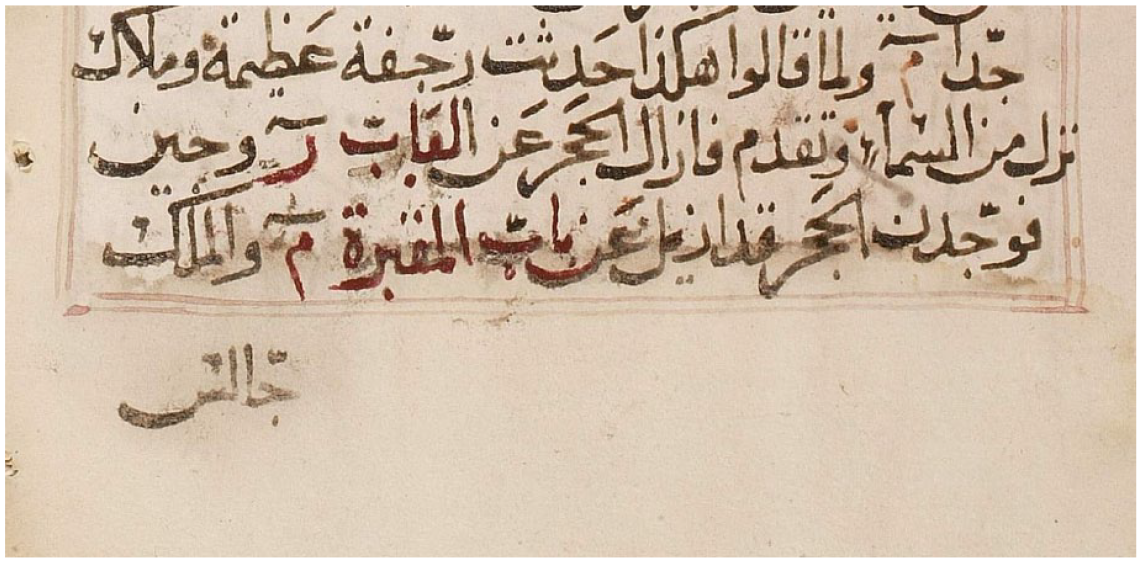
Manuscript S (Ar 218), fol. 129v. The siglum of Mark (ر) appears (in red ink) in the second line before ‘and they came’. Copyright statement: Image courtesy of the Fondation Georges et Mathilde Salem, Aleppo, Syria and the Hill Museum & Manuscript Library. Published with permission of the owners. All rights reserved.
Unfortunately, Ciasca, Marmardji, Hogg, and Hill decided to consider Mk 16.4a like Lk. 24.2a and put the Lukan siglum in their apparatuses, against the original manuscript siglum of Mark (Ciasca 1888: 991; Marmardji 1935: 504). However, the closest reading in Syriac is the Sinaitic Syriac, and while it shares the order, it does not have the same wording. The Syriac Sinaitic palimpsest has ‘came and saw (ܘܐܬܝ ܘܚܙܝ)’
29
instead of ‘came and found’. Where did ibn at-Ṭayyib get this Markan order (16.3|16.4b|4a) and the reading (‘came and found’) from? In fact, the same order and wording are found in codex Bezae and the old Latin witnesses c, ff
2
, and n. So, the Greek (of Bezae) and Latin read: καὶ ἔλεγον πρὸς ἑαυτοὺς· τίς ἡμῖν ἀποκυλίσει τὸν λίθον ἀπὸ τῆς θύρας τοῦ μνημείου; ἦν γὰρ μέγας σϕόδρα. Et dicebant ad inuicem · quis nobis reuoluit lapidem, ab osteo monumenti erat enim magnus ualde.
So, ibn at-Ṭayyib’s siglum is valid. If, at least, the order of 16.3–4a is agreed upon by the three main Diatessaron witnesses (Fs 174.3–4; Lg 234.8–9), and if the Arabic Diatessaron’s reading of 16.4b survives mainly in Latin manuscripts, and not even old Syriac, then we can logically conjecture that it goes back to Tatian’s second-century work. 31
The AD diverges again from the Western editions in detailing the encounter of the women with the angel/youth in Mark. In Fs and Lg, we have two consecutive blocks: Mt. 28.2–6 and Lk. 24.4–7. On the other hand, AD has a more sophisticated harmonization of the three synoptic accounts. This harmonization allowed the interjection of Markan verses that are otherwise unattested in the Western editions. So, we have Lk. 24.3b between Mk 16.5a and 16.5b. Then, we see the ‘Nazarene’ from Mk 16.6 placed in Mt. 28.5, Mk 16.7 interwoven with Mt. 28.7, and Mt. 28.8a coupled with Mk 16.8b. The final product is a harmonistic mosaic of the three Synoptic Gospels vis-à-vis the simple two consecutive blocks of Matthew and Mark in the Fs and Lg.
The Women Report Jesus’s Apparitions
The following section of apparitions shows that the Diatessaron, across the different editions, identified the apparition to Mary Magdalene in Mk 16.9 with the apparition in Jn. 20.15–17. However, the Fs and Lg add the identification of Mary as the one ‘from whom Jesus cast out seven demons’ in Mk 16.9b to Jn. 20.11 and omit Mk 16.9a. On the other hand, the AD does the opposite; it adds Mk 16.9a at the end of the Johannine apparition as a concluding statement and omits Mk 16.9b. Ciasca, Hill, and Marmardji erroneously add Mk 16.9b to their editions, using its attestation in MS A, which usually adds missing verses (Ciasca 1888: 26; Hill 1894: 215; Marmardji 1935: 510). However, it is unattested in the other six codices. Given the profile of MS A, we can confidently state that 9b was not in ibn at-Ṭayyib’s original text. Comparing the AD and the Western translations, it is difficult to argue for the originality of one reading against the other. However, the AD’s text reads in a way significantly different from the wording of Mk 16.9a: ‘And on the Sunday whereon Jesus rose, he appeared first to Mary Magdalene’. This loose quotation is unlikely to have been added by a later scribe who intended to add a missing verse. It lacks the keyword πρωϊ, which stipulates the time of the resurrection, and its structure is different from Mk 16.9a. Further, why would he omit Mk 16.9b? In fact, traces of this reading can possibly be found in the Lg but in a different position, preceding the apparition to the two traveling disciples, saying: ‘On that same day
It is worth noting that correspondence between the AD and Lg in excerpts that appear to be bridging different accounts can be found in several cases. For instance, an interesting case is this sentence from the AD: ‘and when they heard that they were gladdened’ (AD 54.14), which connects Jesus’s final commission to the disciples to remain in Jerusalem (Lk. 24.46–49) and his apparition in Jn 20.20. The Lg reads: ‘When the disciples heard and saw this, they were gladdened’ (Lg 240.6). The Lg edition only adds ‘and saw’ to conform it with the ἰδόντες of Jn 20.20. This is also found in an added editorial verse that precedes Mt. 28.8b, which appears in the AD (53.32) and Lg (235.29–30) but not in the Fuldensis. Therefore, it is likely that Tatian himself provided these extra sections and even edited verses to smooth the transition from one account to another. They probably disappeared in the Fs because of the strong tendency to vulgatise the text, and these bridging sentences must have been viewed as uncanonical, which led to their excision. 32 Nicholas Zola has already observed how the transition from one account to another in the Fs is rough, causing grammatically incorrect structure and confusion, including the case of Mk 16.9b. 33
After the report of the guards (Mt. 28.11–15), we learn that Mary Magdalene preached to the disciples about the apparitions (Jn 20.18). At the same time, we are told that the ‘first’ women who had been with Mary Magdalene earlier, during the angelic apparitions, were also going to report this to the disciples. This detaches Mary Magdalene from that group, who received news of Jesus’s apparition on their journey (Mt. 28.8b–10). As both Mary Magdalene and the women received (separate) visions of Jesus, they reported these visions to the disciples, who did not believe. This is detailed in harmony and ordered as follows: Lk. 24.9 | Mk 16.10 | Lk. 24.10 | Mk 16.11. Except for Lk. 24.10, the content is similar in Fs and Lg but in a different order.
We cannot be certain which order is more faithful to the original Diatessaron. However, in terms of wording, the text of the AD exhibits some interesting characteristics that should be highlighted. The AD reading is close to codex Bezae and old Latin manuscripts. We notice that ‘ἀπὸ τοῦ μνημείου’ of Lk. 24.9 is omitted in AD, even from manuscript A, which usually adds these missing details. This omission only corresponds to codex Bezae and old Latin manuscripts. The other case is how Mk 16.10a appears in Arabic. In the AD, we have an extra dative demonstrative pronoun: ‘to those (لأوليك) who (الذين) were with him’. This peculiar structure is only found in codex Bezae: ‘αὐτοῖς τοῖς μετ᾽ αὐτοῦ (his qui cum eo fuerant)’. The Fs lacks this pronoun (his), like the reading found in the Peshitta (ܠܗܢܘܢ ܕܥܡܗ). So, the AD readings in these verses are in line with the old Latin tradition, and particularly codex Bezae, in contrast with the Fs and the Peshitta.
Mk 16.11 preserves a good example of ibn at-Ṭayyib’s ‘slavishly literal’ style. 34 Ibn at-Ṭayyib translated ولا لذلك أيضاً صدقوا to ‘not to this as well they believed’. The syntax is nonsensical. Besides, he prefixed the accusative (this) with a proposition li (ل), which means to or for in classic Arabic. This preposition renders the grammar incorrect and gives a nonsensical meaning to the word because the accusative in Arabic does not receive proposition (حرف جر). Therefore, Marmardji edited it out and corrected the meaning in his French translation. But if we look at the Syriac text, as found in the Peshitta (since we do not have any other Old Syriac witness to this verse), we will see that this is a word-for-word translation in terms of syntax, ܠܐ ܗܝܡܢܘ ܐܢܝܢ, yet without an equivalent to ibn at-Ṭayyib’s ل proposition, in Arabic. The question is, then, where did it come from? In Syriac, the accusative can be supplied with ܠ to indicate a definite object (Nöldeke 1904: 227–32). 35 Therefore, ibn at-Ṭayyib most likely had it in his Syriac copy and decided to accommodate the Syriac Lāmaḏ (ܠ) by adding Lām (ل) in his Arabic text to leave nothing untranslated, even if this decision rendered the grammar nonsensical.
As Mary Magdalene and the women reported their visions of Jesus to the disciples, the AD and Fs use Mk 16.11 to record the reaction of the disciples. The AD reads: ‘and after they heard them saying that he was alive, and had appeared to them, they did not believe them’. The three ‘them’ here are feminine. This exactly matches the Peshitta reading. However, it would be hasty to consider the Peshitta as the source of this reading for the following reasons. First, as it stands, the verse fits perfectly in the context of the Diatessaron. Referencing the women in the third-person feminine plural as ‘them’ refers to the visions that the women had earlier (Mk 16.9 and Mt. 28.9–10). On the other hand, as we saw earlier, this reading is nonsensical in Mark as a separate Gospel, because only Mary Magdalene received a vision of Jesus. Second, it is also attested in the Fs (176.4) with reference to the women receiving the vision by adding eis to non crediderunt.
36
It is worth noting that only codex Bezae (the Greek side) has the pronoun, although it is in the singular form to fit the Markan context (that only refers to Mary Magdalene): ‘καὶ οὐκ ἐπίστευσαν
Jesus’s Apparitions and Ascension
As the Diatessaron moves to Jesus’s apparitions to the disciples, Mk 16.12a–13b in AD and Fs appears to bracket the Lukan story of the Emmaus disciples (Lk. 24.13–35). Afterward, we see in the AD that the apparition is commenced with a loose quotation of Mk 16.14a, which acts as another editorial bridge to smooth the transition from one account to the other: ‘And when they sat and he, then, appeared to them as well and admonished them, etc.’
Was this sentence (in italics) added by ibn at-Ṭayyib? Its grammar shows us that he probably translated it as he found it in his Syriac exemplar. This is a conditional sentence (جملة شرطية), with the subordinate clause starting with ‘when’. Then it moves to the next sentence (and admonished them), without giving a main clause. As it stands, the structure is nonsensical. It is unlikely that ibn at-Ṭayyib added this extra sentence in such a nonsensical form, while it is more plausible to imagine him as grappling with the translated text from Syriac, just as we saw in previous cases.
Mk 16.15 is a good case for testing the problematic methodological presuppositions in modern Diatessaron scholarship. This is the only verse in the Long Ending that was cited by Ephrem the Syrian in his commentary on the Diatessaron. Because of that, it was taken as an example on how it differs from the AD text, and therefore the AD was considered to be an unreliable witness to the Diatessaron, but rather to the Peshitta, as Zola recently argued (see Zola 2019: 208–23). Looking into the text of this verse, Zola stated that ‘the Arabic Diatessaron 55:5 appears to add οὖν after πορευθέντες in Mk 16.15 (cf. Mt. 28.19), while Ephrem (19.15) does not’ (Zola 2019: 208). Zola refers to Ephrem’s citation in 19.15 (Mk 16.15 | Mt. 28.19), which says: ‘Go into the whole world | and baptise in the name of the Father, the Son and the Holy Spirit’. However, Zola did not refer to the fact that it appears at least twice in the commentary. 37 In another citation of the same harmony (8.1b), Ephrem says: ‘Go into the whole world and preach my Gospel to the whole of creation | and baptise all the Gentiles’. The two citations are both harmonization of Mark with Matthew, but they are very different in wording. Which one should we choose to represent the Diatessaron? Apparently, the only explanation is that Ephrem was citing this harmonic reading from memory. This could explain why the citation in 19.15 is shorter than the Arabic Diatessaron and Fuldensis, and why the one in 8.1b has some odd paraphrasing, such as transposing the two words ‘whole’ and ‘world’ to become ܠܟܠܗ ܥܠܡܐ and abbreviating Matthew’s ‘disciple all nations and baptise them’ to ‘baptise all nations’. Therefore, while Ephrem’s citations attest to the existence of the harmonization of Mk 16.15 with Mt. 28.19, the wording cannot be considered as a reliable source to judge readings in other sources, such as the Arabic Diatessaron. This must be viewed in light of the difficulties pertaining to the use of Ephrem’s citations in this commentary in general (Petersen 1985: 27; McCarthy 1993: 35–6).
But does the AD have the equivalent of οὖν after πορευθέντες in Arabic? Zola’s conjecture relied on Marmadji’s translation of the text, which reads allez donc, just as Ciasca did in his Latin edition (ite ergo) (Ciasca 1888: 98; Marmardji 1935: 529). But, as we look at the Arabic manuscripts, it is striking that they have a different reading. The verbs امضوا (go) and أعمدوهم (baptize them) are both in the second-person imperative form like Ephrem and the Peshitta (ܙܠܘ – ܐܥܡܕܘ). However, in AD the imperative ‘go’ is followed by نﻵ (now), not ‘therefore’. Both Ciasca and Marmardji mistranslated it as ‘go therefore’ to conform it to the Peshitta of Mt. 28.19, which reads: ܙܠܘ ܗܟܝܠ (go therefore). This is what led (or rather misled) Zola to expect an equivalent to οὖν in the Arabic text. This incorrect translation of such a clear word reveals the European translators’ tendency to standardize odd readings in manuscripts.
This leads us to the question of the source of the AD’s translation ‘go now’. Since both Mk 16.15 and Mt. 28.19 start with the same imperative ‘go’, the ‘go now’ reading could be from Mt. 28.19, in harmony with Mk 16.15. In fact, if we consider that the Arabic’s ‘go now’ is Mt. 28.19, then we will find that this reading is in verbatim agreement with the Latin of Mt. 28.19 in, again, the Vetus Latina witnesses (ite nunc—πορεύεσθαι νῦν) only. But is there any support in other Diatessaron witnesses? A look into the recently digitized images of the Fuldensis show that the beginning of the verse is considered to be from Matthew. In Figure 2 (line 6), we can see that euntes is still part of the passage that has the siglum of Matthew (Ammonian section 355), while the Markan siglum appears in a lighter color (MR) before the word in mundum.
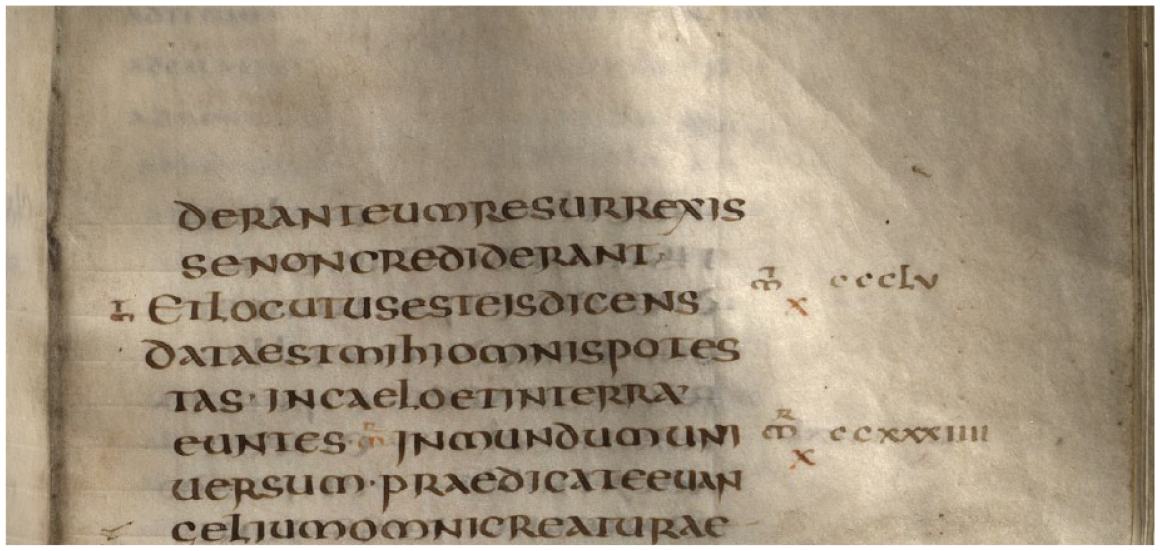
Codex Fuldensis fol. 179r. License: Used with Permission: Hochschul- und Landesbibliothek Fulda. CC-BY-NC-SA 4.0.
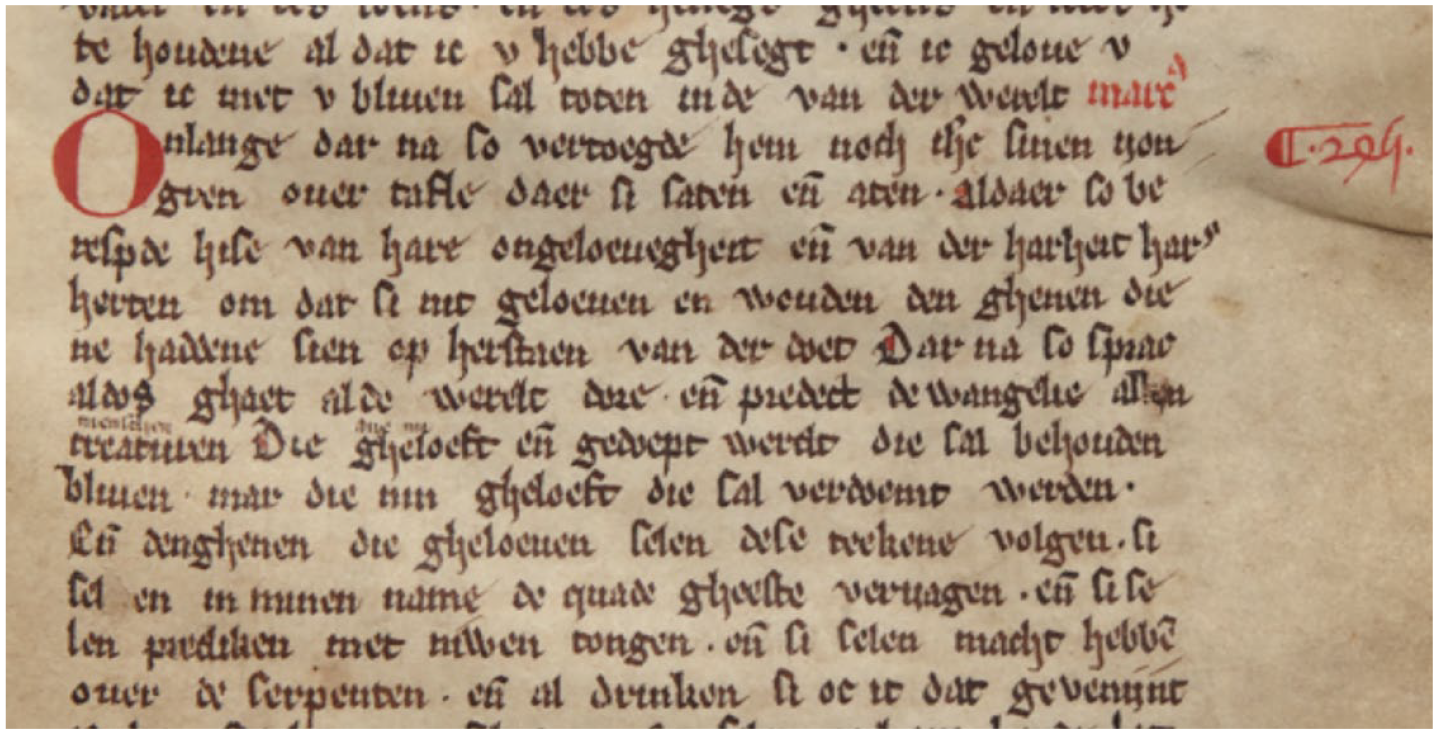
The Liège manuscript (University Library 437), f. 101r. correction added to the 7th line. Copyright: University of Liège – Public Domain.
While the Fs has the Vulgate reading, which is unhelpful, the sigla support that this verse starts with Mt. 28.19 makes the connection between the AD’s reading, Tatian’s edition, and Old Latin even more compelling.
Another case is found in Mk 16.16, where the AD has ‘who’ prefixed by the resultative particle ف in ‘
Verses 17–18 are fully quoted in these three witnesses (AD, Fs, and Lg). As in ibn at-Ṭayyib’s catena, 16.17 has ‘those who believe in me’. It is difficult to figure out the source of this added in me (بي). This addition does not imply any theological significance or a translation necessity. It is not attested in the other major Diatessaron texts either. However, it appears in the Curetonian Syriac manuscript (ܒܝ). It is likely that ibn at-Ṭayyib did not add this reading but found it in his Syriac exemplar, which also explains how it influenced his catena Gospel text. The existence of this reading in the Curetonian Syriac leads us to conclude that if this comes from Tatian’s original text, it must be the Syriac Diatessaron that was behind this reading in the Syriac Curetonian as well. This is not entirely hypothetical if it is placed in the context of recent studies that show how the Diatessaron influenced old Syriac witnesses, particularly the Curetonian manuscript. 38 As Francis Watson summarizes: ‘These texts (the Sinaitic and Curetonian manuscripts) have evidently been influenced by DE (Diatessaron), and it is sometimes plausible to speculate about DE readings preserved in them even where these cannot be corroborated from elsewhere’ (Watson 2016: 98). Perhaps it is also worth mentioning a curious case in the Liège’s reading. In Mk 16.16, we find that a later hand adds ‘in me (ane mi)’ on the top of ‘believes (gheloeft)’ (Lg 245.30). This reading is just as odd as ibn at-Ṭayyib’s ‘in me’. However, we note that the Liège’s copyist adds it to the ‘believes’ in Mk 16.16, not the ‘believes’ in Mk 16.17 as in ibn at-Ṭayyib. Could he have added it to the wrong ‘believes’ and instead meant to add it to the ‘believes’ of Mk 16.17? If we look at the manuscript itself, we note that the word gheloeft (believes) of verse 16 appears above the gheloeft of verse 17 in such a way that makes this mistake not entirely implausible, even if it should not be considered as conclusive evidence.
Verses 19 and 20 are attested in the Arabic and Fuldensis, in harmony with Lk. 24.49–53. It is also noteworthy that in Mk 16.19, ibn at-Ṭayyib used a wrong proposition مِن (min), meaning ‘from’ instead of the correct عن, which means ‘at’ or ‘on’ in his translation of ‘at the right hand’. This is also another excessively literal translation of the Syriac ܡܢ. The scribe of manuscript A corrected it to عن for this reason. The Fuldensis concludes the entire Diatessaron with Mk 16.20, which has a final amen. On the other hand, the Arabic Diatessaron concludes with the final verse of John (21.25) as the Diatessaron started with the first verse of the same Gospel.
Conclusion
This study detailed a new approach to the Arabic Diatessaron by analyzing the style of ibn at-Ṭayyib and the text in his commentary. By doing so, in the case of Mark’s ending, we gained the following key insights:
Ibn at-Ṭayyib was a literalist in his approach to translation as shown in his catena, which contained authored and translated materials in the same work.
Ibn at-Ṭayyib treated the Diatessaron as an authoritative source for the text. We showed a case in which he returned to the Diatessaron along with Greek witnesses to revise a reading.
The biblical text of ibn at-Ṭayyib’s commentary did not suffer standardization according to the Peshitta, even though this could have been considerably easier since the Gospels were separate and not harmonized like the Diatessaron. In fact, in some cases of Mark 16 in this commentary, he had readings only found in the Arabic Diatessaron. These points could explain why he produced a translation of the Diatessaron when he needed to provide an authoritative edition of the Gospels to his Arab-speaking community.
Moving to the Diatessaron translation, we concluded the following. First, when we compare the Arabic Diatessaron text of Mark 16 with the main Western Diatessaronic witnesses—namely, Fuldensis and Liège—we observe that they greatly vary in terms of which verses of Mk 16.1–8 are attested. However, the case is reversed in the Long Ending. This comes as a surprise, as we would have expected the opposite in the case of the much-debated Long Ending.
Second, compared to its Western parallels, the Arabic Diatessaron exhibits more harmonization between Mark and its parallel Gospel texts, sometimes by injecting one or two words within a verse. At the same time, the Fuldensis and Liège resort to reporting consecutive blocks of verses from each Gospel. Therefore, the Arabic Diatessaron provided us with a more complex harmonization of Mark 16, which is a feature that supports its credibility in transmitting Tatian’s conformity, as James Barker has recently shown (Barker 2021: 125).
Third, we observed that the readings common in the Peshitta better fit within the Diatessaron’s narrative context. In fact, the case of Mk 16.11 fits in the context in the Arabic (and Latin) Diatessaron perfectly, while in the Peshitta, it appears to be nonsensical. This suggests that the Arabic Diatessaron preserves readings that influenced the Peshitta, not the reverse.
Fourth, looking at the Arabic text itself, we can see that it exhibits an affinity with old Latin manuscripts. Mark 16 and its associated texts from the other Gospels not only agree with old Latin manuscripts, but they often do so against old Syriac witnesses, which is an extraordinary feature, given the historical, geographical, and cultural disparity between the milieux of ibn at-Ṭayyib and old Latin texts.
Given that (1), external evidence (from the catena commentary) on the profile, style, and approach of ibn at-Ṭayyib, and (2), the internal evidence in the Arabic Diatessaron itself, we can be confident that Tatian recorded the Long Ending in his version. Further, the nature of the text compels us to ask how ibn at-Ṭayyib, or the producer of his Syriac exemplar, could have possibly come up with the readings that appear in the old Latin world, and exclusively in some cases. This question makes the figure of Tatian, an Assyrian in second-century Rome, inescapable. This outcome should not devalue the Fuldensis’s role in future research. While the Fuldensis’s text is pure vulgate, which makes it effectively unhelpful in terms of comparing wording, the agreement in sequence and attestation of the verses with the Arabic Diatessaron should be taken as evidence of their presence in Tatian’s work.
This study has limited its scope to the text of Mark 16. However, the Arabic Diatessaron still needs to be studied and analyzed systematically. As far as this study is concerned, it affirms the role of the Arabic Diatessaron in attesting to the presence of the Long Ending in the Diatessaron. The nature of its text should be considered closest to Tatian’s text, in comparison to the rest of the Diatessaron witnesses. Consequently, it has also affirmed the findings of Monier and Taylor who compared the Arabic text with the Greek fragment (Dura Europos) and showed that the Arabic Diatessaron is closest to the Greek text, considering all witnesses of the Arabic text (Monier and Taylor 2021: 230).
In conclusion, as we look at the surviving translations of the Diatessaron, the Arabic Diatessaron remains the best and closest witness to Tatian’s original edition. Compared to the pure vulgate of the Fuldensis, and the Western harmonies that remain mostly indebted to the Fuldensis’s copy, the Arabic Diatessaron provides the most accurate order of events and wording. Therefore, the unfounded generalization that dismisses the Arabic Diatessaron as a heavily Peshittised text, and consequently less significant, should no longer be presumed, as it does not stand up to scrutiny. A good example of this is the complex case of Mk 16.15, as discussed previously, which shows how such a prejudiced judgment was based on a chain of wrong transcriptions and translations.
After providing an apparatus of the Arabic Diatessaron, future research on this topic should also be directed toward feeding future critical apparatuses. It is possible to add a reference to the Latin and Arabic editions of the Diatessaron (T), with a qualifier for each edition in the lists of witnesses. A similar case is found in the Gospel of Marcion, which survives in a very complicated condition, indirectly through the works of Marcion’s antagonists. 39 Acknowledging that recovering ‘the original wording of Marcion’s text still remains unsolved’, this did not deter the editors of the Nestle-Aland editions (since NA26) from adding Marcion’s readings with a qualifier that indicates the source from which the reading is attested (McionT/E/A) in the hope that this could ‘assist the reader in making an independent evaluation of the evidence in a textual tradition recognized for its difficulties’ (Aland et al. 2012: 33–34). Similarly, nearly two decades ago, Ulrich Schmid stated that using Tatian’s harmony in future apparatuses is ‘too promising a goal to be left unchallenged’ (Schmid 2003b: 150), which this study supports. Therefore, I have provided a critical text and translation of Mark 16 in the Arabic Diatessaron, based (for the first time) on the entire corpus of its surviving manuscripts (A B C E O Q S T), showing its most important variants for the assistance of future research.
Footnotes
Appendix 1: Mark 16 in the Arabic Diatessaron
The sigla in the Arabic text are ibn at-Ṭayyib’s original ones. Square-bracketed sentences are the non-Markan material entangled with Markan verses. Words in italic do not come from any of the four Gospels.
Appendix 2. Manuscripts of the Arabic Diatessaron
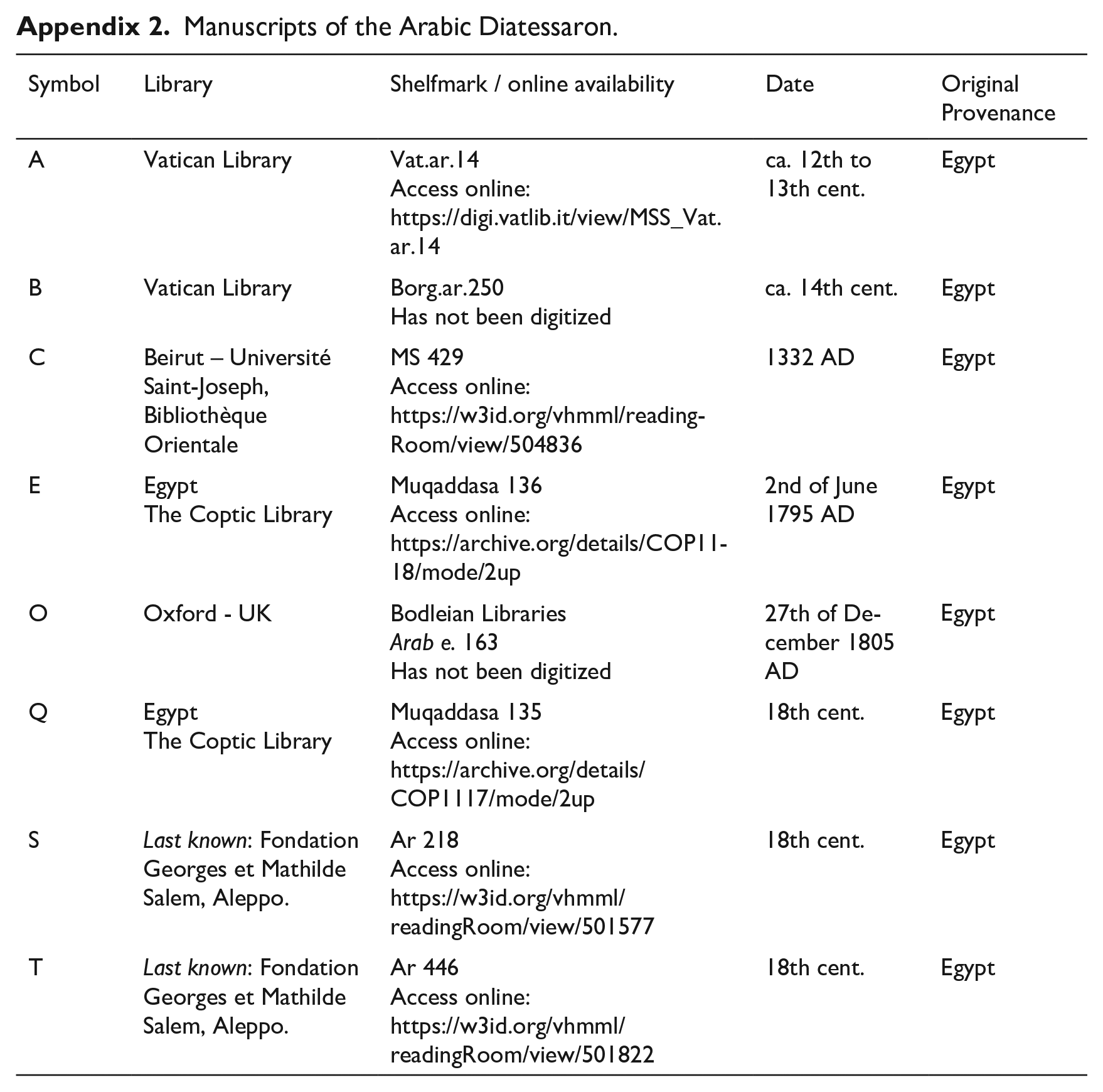
| Symbol | Library | Shelfmark / online availability | Date | Original Provenance |
|---|---|---|---|---|
| A | Vatican Library | Vat.ar.14 Access online: https://digi.vatlib.it/view/MSS_Vat.ar.14 |
ca. 12th to 13th cent. | Egypt |
| B | Vatican Library | Borg.ar.250 Has not been digitized |
ca. 14th cent. | Egypt |
| C | Beirut – Université Saint-Joseph, Bibliothèque Orientale | MS 429 Access online: https://w3id.org/vhmml/readingRoom/view/504836 |
1332 AD | Egypt |
| E | Egypt The Coptic Library |
Muqaddasa 136 Access online: https://archive.org/details/COP11-18/mode/2up |
2nd of June 1795 AD | Egypt |
| O | Oxford - UK | Bodleian Libraries Arab e. 163 Has not been digitized |
27th of December 1805 AD | Egypt |
| Q | Egypt The Coptic Library |
Muqaddasa 135 Access online: https://archive.org/details/COP1117/mode/2up |
18th cent. | Egypt |
| S | Last known: Fondation Georges et Mathilde Salem, Aleppo. | Ar 218 Access online: https://w3id.org/vhmml/readingRoom/view/501577 |
18th cent. | Egypt |
| T | Last known: Fondation Georges et Mathilde Salem, Aleppo. | Ar 446 Access online: https://w3id.org/vhmml/readingRoom/view/501822 |
18th cent. | Egypt |
Acknowledgements
I am grateful to Nicholas Zola, who provided valuable insights on the text of the Western editions during our regular meetings in Lausanne. I should also thank my colleague, Professor Liv Ingeborg Lied, for her advice on the Syriac text, and for the comments of the department members. I am also grateful for the constructive comments of the journal editors and the reviewers, which improved this manuscript significantly.
Funding
The author(s) disclosed receipt of the following financial support for the research, authorship, and/or publication of this article: The bulk of my analysis of Mark 16’s text was supported by the SNSF-funded project MARK16 (grant no. 179755), for which I am grateful. This analysis was later edited, revised, and expanded during my postdoctoral fellowship supported by the MF Norwegian School of Theology. I am grateful for the extra financial support provided by the MF to cover editorial and copyright permissions costs.
1.
4.
The only complete printed edition of it remains Ranke (1868). See also Zola (2014). Permanent link: http://hdl.handle.net/2104/9121. The whole codex has been digitized and made available online:  .
.
5.
8.
I am grateful to Professor Zola for sharing his preprint copy of his review with me.
10.
11.
Syriac text as published by Leloir (1990). A French translation is by him as well (Leloir 1966). An English translation was done by C. .
12.
See also Moses bar Kepha’s Commentaries in Harris (1895: 21). The 11th-century Nestorian Church History, written in Arabic, is the earliest Arabic historical record referring to Tatian as Greek. Arabic text is in : 295).
15.
On the most recent survey of textual and paratextual evidence, see respectively: Clivaz (2019) and .
16.
Several scholars accept that there are allusions to verses in the Long Ending in Justin Martyr (see Robinson 2006: 170; Stein 2008: 82). However, these views offer only indecisive evidence on such dubious allusions such as the three words common between Mk 16.20 and Justin’s Apol. 1.45.5 (ἐξελθόντες πανταχοῦ ἐκήκραξαν) (see Kelhoffer 2000: 170; : 124).
18.
19.
20.
A digitized edition is now available on the BNF’s Gallica: . Arabe 86 is now available online: https://gallica.bnf.fr/ark:/12148/btv1b11000378h.
22.
CCM81: https://w3id.org/vhmml/readingRoom/view/130078; CCM 82 (Matthew only): https://w3id.org/vhmml/readingRoom/view/130079; and CCM 83: .
23.
See for instance the report of Ẓahīr ad-Dīn al-Bayhaqī in his Tatimmat Ṣiwān al-Ḥikmah (section 6) online: https://shamela.ws/book/273/6#p15. See other cases in : 234–35).
24.
For ibn Abi Uṣaibiʿa, see: Uṣaibiʿa 1995. For al-Qifṭī’s testimony, see : 172).
26.
A K P W Γ f 13 28. 579. 1424. 2545.
28.
33.
See the cases of Mk 16.9, Jn 20.13, and Lk. 24.13, 45 in : 139, 144, 146), respectively. In the case of how Mk 16.9b appears in Fs, Zola states (2014: 139), ‘One wonders why this line was not used back before F 174.18 (Jn 20.2) to identify Mary Magdalene as the one running. Furthermore, in its Markan context Magdalenae is dative, which no longer makes sense in the new Johannine context’.
35.
Interestingly, the Definite Object with ܠ crept into some only-spoken colloquial Arabic dialects in regions like Lebanon and Iraq but not in classic or standard Arabic. For Iraqi, see Levin (1987: 35–7). See also : 512–17).
36.
38.
See, for instance, the case of Jn. 1.5 in Baarda (1993: 216–17). See the case of Mt. 4.16/Isa. 9.1 in Schedinger (1999: 272–73). On the Diatessaron and Old Syriac manuscripts, see : 132).
40.
T: نفوسهم in third-person plural masculine.
41.
S: (out of) عن
42.
A adds قد
43.
A adds التي أخرج منها سبعة جنةٍ
44.
B: الباقي and omits التلاميذ
45.
A adds و
46.
A: om. و
47.
A adds و. A also uses the correct third-person masculine plural منهم.
48.
A: جلسوا
49.
A: لهم
50.
AQ: وغير
51.
A corrector of O adds in the margin: their heart (قلبهم) instead of their hearts (قلوبهم)
52.
A: لا
53.
Q: فيشفون
54.
A: من بعد خطابهم
55.
A: ورفع يديه
56.
A: عن
57.
A: موضعٍ
58.
Mk 16.3–4b txt D Θ 565 c ff2 n.
59.
Mt. 28.2 ἀπὸ τῆς θύρας Α C K W D 579 1424 f h q syp.
60.
Mk 16.5 ‘the women entered’ instead of ‘they entered’ is probably for editorial reasons. | Lk. 24. τοῦ Ιησοῦ 579 1241 sy bo
61.
Mk 16.7 ‘to Cephas’ sys.
62.
MS A adds: from whom he had cast out seven daemons.
63.
Lk. 24.9om. ἀπὸ τοῦ μνημείου D it | Mk 16.10 τοῖς μαθηταῖς Θ ¦ αὐτοῖς τοῖς μετ΄ αὐτοῦ D.
64.
Mk 16.11 The three ‘them’ pronouns are feminine sy. See previous p. 9. ¦ the presence of a pronoun after οὐκ ἐπίστευσαν is attested in D, albeit singular (αὐτή).
65.
MS A reports ‘sat’ and ‘to them’ in plural. However, the rest of the manuscripts report it in dual form to connect it with the previous narrative of Jesus’s apparition to Peter and John (Jn 21:1–24). The dual form is probably from ibn at-Ṭayyib.
66.
Mt. 28.19 νῦν – nunc D it | Mk 16.15 ‘my Gospel’ – ܣܒܪܬܝ sy
67.
Mk 16.16 ὅτι Ds 565 | Mk 16.17 in me – ܒܝ Syc | Mk 16.18 poison of death - ܣܡܐ ܕܡܘܬܐ Syc.p
68.
Mk 16.19 our Lord – ܡܪܢ syp | Lk. 24.50–51 om. ἐπάρας τὰς χεῖρας αὐτοῦ (except MS A)
69.
70.
Mk 16.20 helping them and confirming sy ¦ the signs they were making – ܒܐܬܘܬܐ ܕܥܒܕܝܢ ܗܘܘ sy