




Abstract
This article explores how intertextual analysis of New Testament (NT) narratives’ engagement with the Old Testament/Hebrew Bible (OT/HB) might be fruitfully integrated with intersectional analysis of characters’ embodied lives in communities. Taking Elizabeth’s characterization in Luke 1 as a test case, I demonstrate that intersectional analysis not only deepens the insights arising from intertextual analysis but also sheds light on Luke 1’s relevance to ongoing issues of conflict and marginalization today. Intersectional-intertextual analysis thus proves particularly useful for those exegetes interested in practical theological—including specifically justice-oriented—interpretation. At the same time, as will be illustrated in relation to Luke 1’s early reception history, intertextual analysis can lessen the danger that contemporary contexts will distortively overdetermine intersectional analysis, mitigating a hermeneutical objection sometimes raised against interpretations that attend to justice concerns and other expressions of practical theology.
This article grew out of a classroom conversation about New Testament authors’ engagement with Israel’s Scriptures. One of my students, an African American woman, challenged me to explain how such intertextual analysis—a subdiscipline in NT scholarship that has historically been dominated by white and often male scholars—matters for marginalized people. To borrow a line from Howard Thurman’s Jesus and the Disinherited: What (if anything) might analysis of the OT/HB’s role in the NT have to say, ‘to those who stand, at a moment in human history, with their backs against the wall’ (1976: 1)? The present article tests my hypothesis that, when combined with intersectional analysis of characters’ embodied lives in communities, intertextual analysis of NT narratives can indeed help us to hear how these passages address practical theological questions related to gender, age, and other categories of difference that are often bound up with power differentials, conflict, and injustice. 1 At the same time, as will be illustrated in relation to Luke 1’s early reception history, intertextual analysis can lessen the danger that practical theological questions about contemporary contexts will overdetermine our exegesis.
Several scholars have registered that attending to OT/HB allusions can enrich our interpretation of one or another aspect of New Testament figures’ embodied social locations (e.g., E. A. Johnson 2000; Fischer 2015; Newberry 2021). However, relatively few publications have combined intertextual analysis with explicit concern for intersectionality. 2 This article aims to foster more widespread use of such an integrative approach. After a brief note on terminology, I will demonstrate the fruits of intersectional-intertextual analysis through a close reading of Elizabeth’s portrayal in Luke 1, illustrating a selection of the various ways in which, and degrees to which, this approach can yield exegetical and practical theological insights. 3
Intersectionality and Intertextuality: Preliminary Remarks
The terms intersectionality and intertextuality have a range of uses and are bound up with complex debates, to which I can only gesture in passing. Coined by legal scholar Kimberlé Crenshaw in the late 1980s (Kim and Shaw 2018: 1), intersectionality has been introduced into New Testament studies by thinkers such as Marianne Bjelland Kartzow (see esp. 2012), Joseph A. Marchal (2017), Mitzi J. Smith (2018), and Gale Yee (2020), among others. In this article, I use intersectionality simply to name the fact that every human being exists in multiple relationships and roles at the same time, each of which affects how a given individual experiences the others. For instance, someone’s experience of being female will be different in certain respects depending on that person’s racial/ethnic identity, sexual orientation, gender identity, age, abilities, socioeconomic status, marital status, parental status, educational background, and so forth. This insight can be applied at various levels in biblical studies—to readers today, to biblical authors and their initial audiences, and to figures within the text. While I write with awareness of my own social location, 4 I focus here on characters within Luke’s narrative. Elizabeth’s robust characterization in Luke 1 encompasses precisely the sort of complexity named by intersectionality. Readers are informed already in 1.5–7 that Elizabeth is not only a woman of priestly descent and a pious Jew but also an older adult and a wife who endures unwanted childlessness. 5
The convergence of these identity categories, roles, and experiences is part of what makes Elizabeth’s initial situation evocative of Israel’s scriptural traditions, such that the complexity of her characterization is intrinsically connected to its intertextual elements. 6 Without denying the value of attending to other sorts of intertextuality, for present purposes, I will use the term primarily in relation to literary connections between Israel’s Scriptures and the New Testament. 7 As Richard B. Hays and others have shown, Luke’s Gospel—not least in its infancy narrative—tends to recall earlier Scriptures in ways that create webs of overlapping, half-articulated associations (Hays 2016: 193, 275–77). 8 Elizabeth is a case in point. Her jubilant, late-life motherhood evokes Genesis’s account of Sarah, but Elizabeth’s son is less parallel to Isaac than is Mary’s child (e.g., Green 1997: 51–8). Meanwhile, as discussed later in this article, Elizabeth’s speech sometimes echoes other figures, such as Rachel and Deborah. Elizabeth thus does not typologically map onto any one scriptural foremother. Instead, her embodied life in community, through its very complexity, recalls that of multiple OT/HB women. 9 By examining a selection of the connections between Israel’s Scriptures and Elizabeth’s multifaceted characterization, the remainder of this article will demonstrate the hermeneutical promise of intersectional-intertextual analysis.
Continuity with Israel’s Scriptures and the Exegesis of Emotions
I begin with allusions involving Rachel and Sarah, focusing on how attending to these intersectionally reinforced intertextual connections enriches interpretation of the emotional charge of plot developments in Luke 1. According to Genesis, these women—like Elizabeth—endured unwanted childlessness for a time but were eventually enabled to become biological mothers. 10 Luke’s description of Elizabeth’s social-emotional experience at the intersection of her biological sex, marital status, community identity, and (in)fertility forges strong connections to these scriptural foremothers who received God’s life-giving intervention. As will be seen, intersectional-intertextual analysis can deepen readers’ appreciation of the emotional overtones in Luke 1, facilitating a more emotionally attuned interpretation of the text. 11
Genesis 30 relates the frustration of Jacob’s second but more beloved wife, Rachel, when she remains unable to have children while his first wife (her sister, Leah) proves fruitful. Desperate, Rachel tells Jacob that she will ‘die’ if he does not give her children (30.1). He counters by placing responsibility for her fertility on God (30.2), who—after some further intrafamilial drama—does eventually grant Rachel a child. In response, Rachel declares, ‘God took away my disgrace’ (Gen. 30.23, NETS [modified]). 12 As shown in Table 1, 13 Rachel’s words are echoed in Elizabeth’s response to finding herself unexpectedly expecting in later life: 14
Rachel, Elizabeth, and the divine removal of shame associated with infertility.
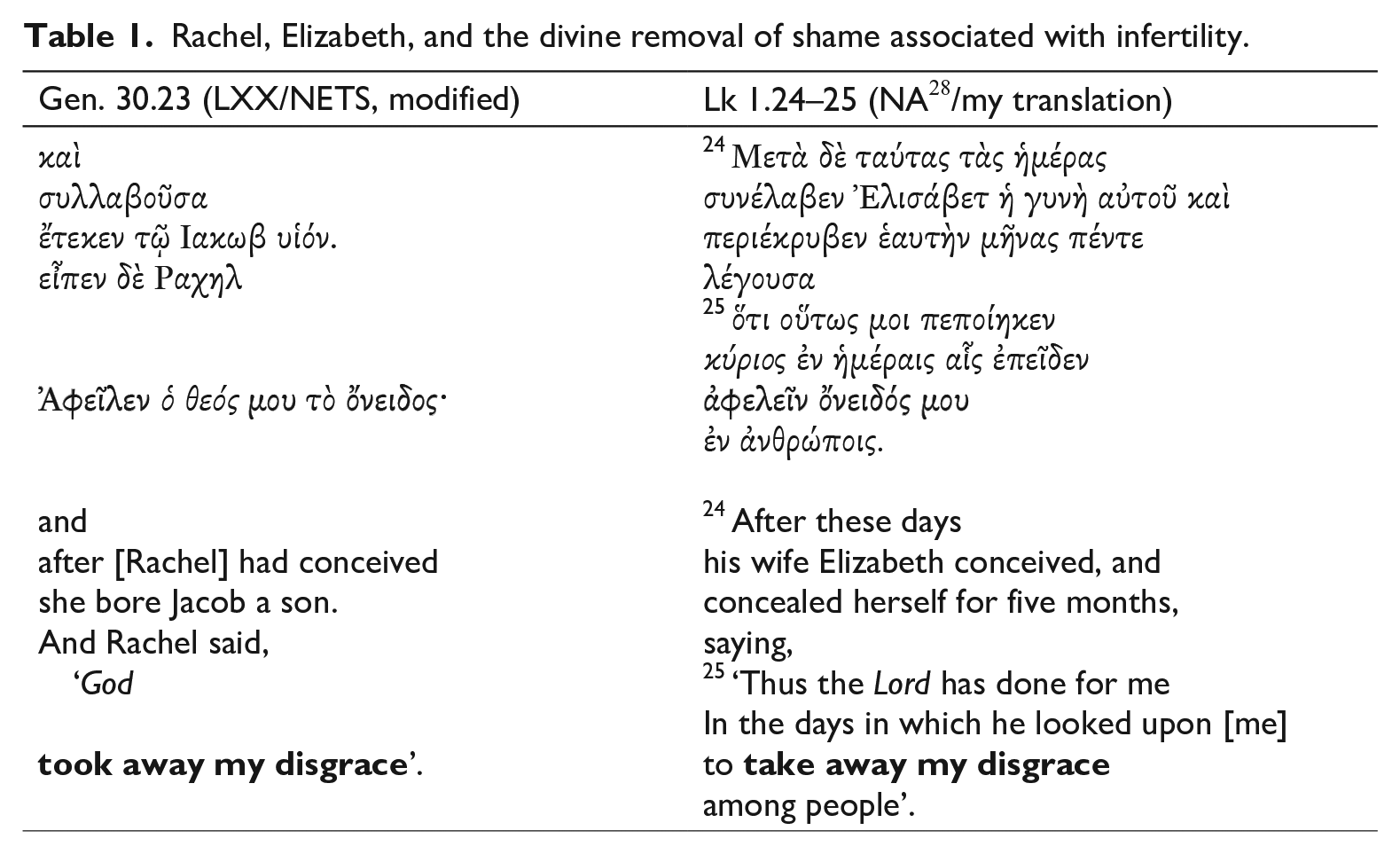
Consistent with her identity as a pious Jewish woman (Lk. 1.5–6), Elizabeth’s interpretation of her situation recalls Rachel’s scriptural precedent.
Intersectional analysis furthers our understanding of this oft-noted intertextual connection by drawing attention to what the link implies about the effect of childlessness on Elizabeth’s social-emotional life. Like Rachel, Elizabeth is (to use today’s categories) a woman-identifying female who is married to a descendant of Abraham but has been unable to bear children. Upon being healed of her infertility, 15 Elizabeth echoes the words of a somewhat similarly situated woman who had experienced involuntary childlessness as approximating death (Gen. 30.1). For readers aware of the wider narrative evoked by Elizabeth’s words in Lk. 1.25, the allusion underscores the social-emotional toll of Elizabeth’s past ‘barrenness’.
Nor is such clarification of the social-emotional impact of infertility superfluous: as Candida R. Moss and Joel S. Baden point out, the experience of being unable to have a biological child can carry a range of social and emotional consequences (2015). In certain settings, the ‘nonnormative characteristic’ of Elizabeth’s inability to bear children might be experienced (to borrow categories from disability studies) as merely an ‘impairment’, without significant social consequences. 16 Indeed, in some contexts, Elizabeth’s reproductive ‘impairment’ might even be advantageous—enabling her easily to avoid unwanted pregnancies, for example (see Moss and Baden 2015: 4). 17 However, Elizabeth’s echo of Rachel’s words reminds readers that, in the world portrayed by Luke’s Gospel, the physical difference of being unable to bear a child carries with it significant social downsides for a pious, married Jewish woman such as Elizabeth. 18 Childlessness restricts her ability to participate in the structures of meaning and support available to women in her culture, rendering her infertility a ‘disability’ as understood in social and cultural models of disability. 19 By drawing attention to these further implications of Elizabeth’s echo of Rachel, intersectional analysis adds social-emotional depth to intertextual analysis of Elizabeth’s characterization.
Deferring for the moment the question of how evocations of Rachel’s story might also guide the interpretation of Lk. 1.24, I turn now to Sarah, a second scriptural figure whose experiences Elizabeth’s recall—and, in a sense, complete. Though Elizabeth’s situation mirrors Rachel’s in some ways, intersectional analysis of Elizabeth’s characterization will also note points of difference between these women, including with regard to age. Genesis never portrays Rachel as elderly. 20 In contrast, in addition to being deemed ‘barren’ due to prolonged unwanted childlessness (Lk. 1.7, 36), Elizabeth is repeatedly characterized as an older adult (1.7, 18, 36). Her advanced age not only increases the seeming hopelessness of her situation but also recalls another scriptural matriarch, Sarah, who remained involuntarily childless into old age. 21 This widely recognized intertextual link proves important, among other reasons, for appreciating the narrative-theological import of emotional responses to the birth of John the Baptist in Luke 1.
Consistent with the angel Gabriel’s prophecy that many would rejoice at his birth (1.14), baby John’s arrival prompts Elizabeth’s neighbors and relatives to ‘rejoice with’ her over the mercy the Lord has shown her (1.58). The verb Luke uses here, συγχαίρω, occurs just once in the Greek translation of the OT/HB. In the Hebrew text, Sarah speaks of laughter in connection with Isaac’s birth and naming: ‘God has brought laughter (צְחֹ֕ק) for me; everyone who hears will laugh with me (יִֽצְחַק־לִֽי)’ (Gen. 21.6). 22 Her reference to ‘laughter’ (צְחֹ֕ק) not only creates wordplay with Isaac’s name (יִצְחָק) but also ironically recalls the earlier (doubting) laughter of Abraham (Gen. 17.17) and Sarah (18.12–15) when God insisted that they would have a child in old age. This laughter-related play on words does not work in Greek, however, and in the LXX, the second half of Sarah’s statement instead mentions joy: ‘The Lord has made laughter for me, for anyone who hears will rejoice with (συγχαρεῖταί) me’ (21.6, NETS, modified). The verbal echo of Gen. 21.6 (LXX) in Lk. 1.58, depicted in Table 2, suggests a fulfillment of Sarah’s expectations in the life of the similarly situated Elizabeth.
Joy over childbirth at an ‘advanced maternal age’
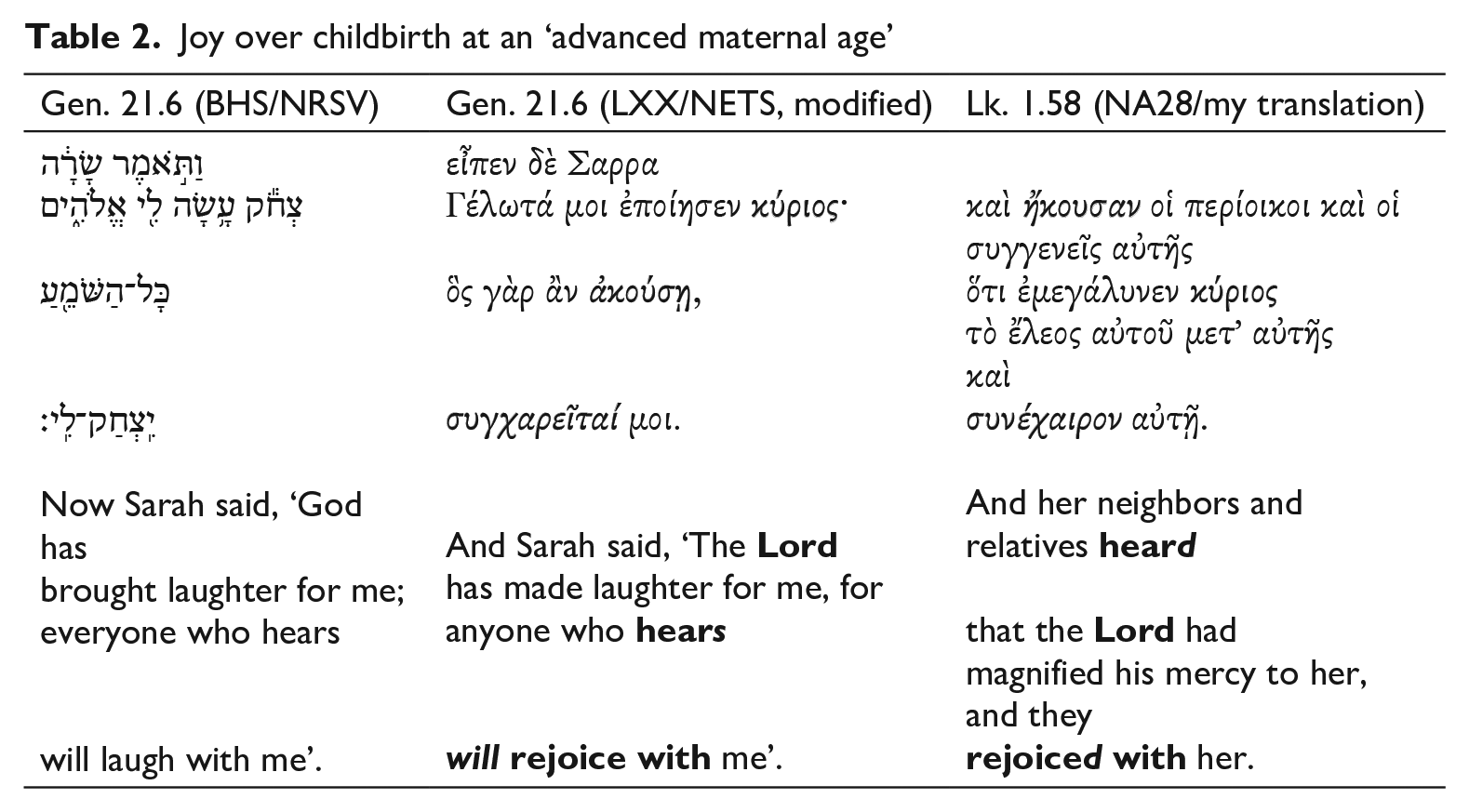
The elderly mother Sarah anticipated, and Elizabeth now experiences, the community joining her jubilation over a long-awaited child whose birth had once seemed impossible (cf. Gen. 18.14; Lk. 1.37). This intersectionally reinforced intertextual connection to the matriarch of Israel serves Luke’s narrative-theological purposes by underscoring social-emotional continuity between Israel’s scriptural traditions and Luke’s own account of ‘the things fulfilled among us’ (see 1.1). 23
The two examples discussed thus far already suggest that intersectional and intertextual analysis are mutually illuminating approaches to interpretation. On the one hand, for those who hear it, Elizabeth’s echo of Rachel clarifies the social-emotional import of infertility and procreation in Elizabeth’s context. On the other hand, attending to emotional resonances between Elizabeth’s story and Sarah’s helps readers to grasp more fully Luke’s emphasis on his narrative’s continuity with and fulfillment of the OT/HB.
Development of Scriptural Trajectories Regarding Women in Community with Each Other
Luke’s infancy narrative also highlights discontinuity—or, better said, development—relative to Israel’s Scriptures, as God’s faithfulness erupts in surprising ways in the lives of Elizabeth and others. In this regard, too, intersectional-intertextual analysis of Elizabeth’s portrayal proves instructive, as I will show through examination of Luke’s allusive depiction of women in community with each other in the Visitation (Lk. 1.39–56).
Before I move into specifics, however, a preliminary note of caution is in order, lest my argument or Luke’s narrative be misconstrued as anti-Jewish. 24 In the examples that I will discuss, Luke does sometimes evoke particular OT/HB characters as foils for positively portrayed characters in his own narrative. However, at least two considerations mitigate against charging him with anti-Judaism on this score. First, those OT/HB characters whose behavior he implicitly calls into question are often portrayed ambiguously by the OT/HB itself, so that questioning these characters is a way of reading with (not against) Israel’s scriptural traditions. Second, the Lukan characters who provide positive counterexamples reflect—that is, both continue and expand upon—positive models that are also found within the OT/HB. Hence my insistence above that ‘discontinuity’ is not the best way to name the relationship between Luke’s allusive narrative and the OT/HB. Far from rejecting the OT/HB, Luke’s characterization of Elizabeth responds to the complexity of the OT/HB, picking up some threads and developing them further while setting aside other threads (again, threads the OT/HB itself arguably portrays as morally ambiguous). Thus, Luke 1 operates within, not over against, the dynamic Jewish tradition in which Elizabeth is so clearly rooted. Concrete examples will help to clarify this point, to which I return at the conclusion of the present section.
As others have noted, Elizabeth’s Spirit-filled blessing of Mary in Lk. 1.42 evokes scriptural passages such as Judg. 5.24, 25 in which Deborah and Barak celebrate Jael’s treacherous murder of Sisera, commander of an opposing army (Judg. 4.18–22). Comparison of the passages shows significant, albeit brief, overlap in wording (Table 3).
Woman-to-woman blessing over participation in the divine deliverance of God’s people 26
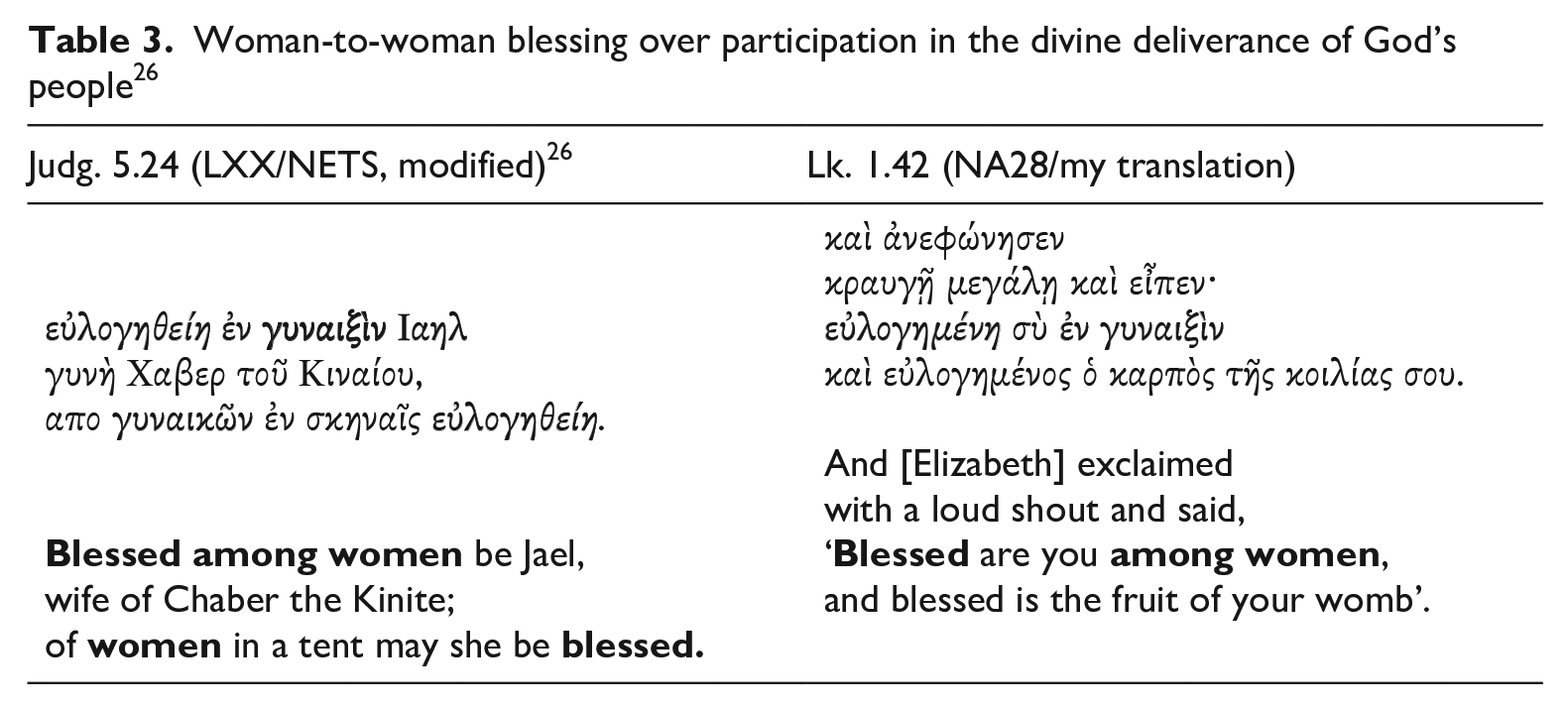
Situational similarities reinforce the connection suggested by shared key terms. Each passage involves a woman (Deborah/Elizabeth) blessing another woman (Jael/Mary) for her participation in the divine deliverance of God’s people (see Judg. 4.23; 5.4, 31; Lk. 1.51–5).
However, as scholars such as Richard Bauckham (2002: 59) and Brittany E. Wilson (2006: esp. 443–45) have persuasively argued, Elizabeth’s benediction is not a simple reenactment of this biblical pattern. Deborah (and Barak) bless(es) Jael for the violent vanquishing of Israel’s enemy (Judg. 5.25–7; see also 4.17–22). In contrast, Elizabeth blesses Mary as the mother of Jesus (Lk. 1.42) 27 and for her faith in the divine word (1.45), 28 by which Mary cooperates ‘through nonviolent means’ with God’s action to set things right in the world (Wilson 2006: 437–38; see also 447–56). 29 Here a woman blesses a woman for (re)productive, rather than destructive, participation in God’s saving work (Wilson 2006: 447). In this instance, then, intersectional-intertextual analysis of Elizabeth’s characterization highlights not only continuity but also development relative to precedents established in Israel’s Scriptures.
Consistent with what was said previously, Luke’s implicit critique of Deborah and Jael need not be seen as a criticism of the book of Judges, much less an example of anti-Jewish supersessionism. As many have observed, Judges emphasizes the moral ambiguity of its protagonists, highlighting the fallibility of even those through whom God brings deliverance. Often, Judges draws attention to these shortcomings implicitly (e.g., through narrating the negative consequences of behavior) rather than through explicit moralizing commentary. In the case of Deborah and Jael, one narrative cue that might suggest these characters’ limitations is the conclusion of the song in which Deborah (with Barak) blesses Jael. When Deborah imagines Sisera’s mother eagerly awaiting her son’s return, unaware of his violent death at the hand of Jael (5.28–31), Deborah seems to relish the thought of Sisera’s mother’s impending grief. However, the narrator does not explicitly condone this response. To the contrary, Judge’s earlier description of Deborah herself as ‘a mother in Israel’ (Judg. 5.7) 30 might even be seen as obliquely highlighting the problematic lack of empathy displayed in her song. Thus, in keeping with its larger narrative pattern of showcasing imperfect heroes, Judges itself may create space for recognizing Deborah’s Schadenfreude as shortsighted. Viewed in this light, Luke’s depiction of Elizabeth and Mary can be seen not as a condemnation of the book of Judges but rather as a response to that narrative’s tacit call for something more than the disastrous policy of everyone doing what is right in their own eyes (Judg. 21.25). 31
Nor is this the only way in which Luke’s portrayal of Elizabeth and her relationship with Mary creates allusion-with-difference in relation to OT/HB antecedents: the Visitation also both evokes—and in some cases diverges from—scriptural patterns involving women in community in the context of (in)fertility. In the annunciation to Zechariah earlier in Luke 1, Gabriel’s naming of Elizabeth (1.13) recalls the Lord’s specification in Genesis 17 that Sarah (not Hagar) will bear the child of promise (Gen. 17.15–21). 32 However, unlike Sarah—and also unlike Rachel (Gen. 29.15–30.24) and Hannah (1 Samuel 1), other once-barren mothers whose stories reverberate in the background of Luke 1—Elizabeth has no rival as Zechariah’s wife. The agonistic relationship between would-be mothers in several OT/HB narratives is absent. 33
This is not simply because Elizabeth is alone in being pregnant. Mary is soon pregnant too, and some ground for rivalry between them might seem to exist. Beyond the narratively implied superiority of Mary’s son to Elizabeth’s, 34 there is the bitter fact that Elizabeth endured infertility and the associated social pain for most of a lifetime. Mary (though her pregnancy carries its own social awkwardness) 35 did not experience decades of stigmatization as one ‘called barren’ (1.36).
Nevertheless, much as Luke 1 obviates any impression of rivalry between John and Jesus, this chapter portrays their mothers in a relationship of mutual support rather than competition. Though Elizabeth registers the superiority of Mary’s child and the social inversion this creates between elder and younger mothers (1.42–5), 36 Elizabeth expresses no resentment toward Mary—even though the latter got pregnant, one might say, much more easily (Seim 1994a: 200; 2002: 97). As Turid Karlsen Seim puts it, the recurring scriptural ‘motifs of jealousy and rivalry between women . . . appear to be missing’ in Luke 1, replaced with a ‘harmonious’ relationship (2002: 96–7). 37 Whereas experiences of (in)fertility foster hostility between several scriptural matriarchs, pregnancy brings these Lukan women together in joyful community. 38
Underscoring the contrast, Mary’s song, which otherwise echoes Hannah’s in several respects, 39 does not carry forward Hannah’s vindictive relishing of the fruitful woman’s desolation (Table 4). 40
Excerpts from Hannah’s song and Mary’s song
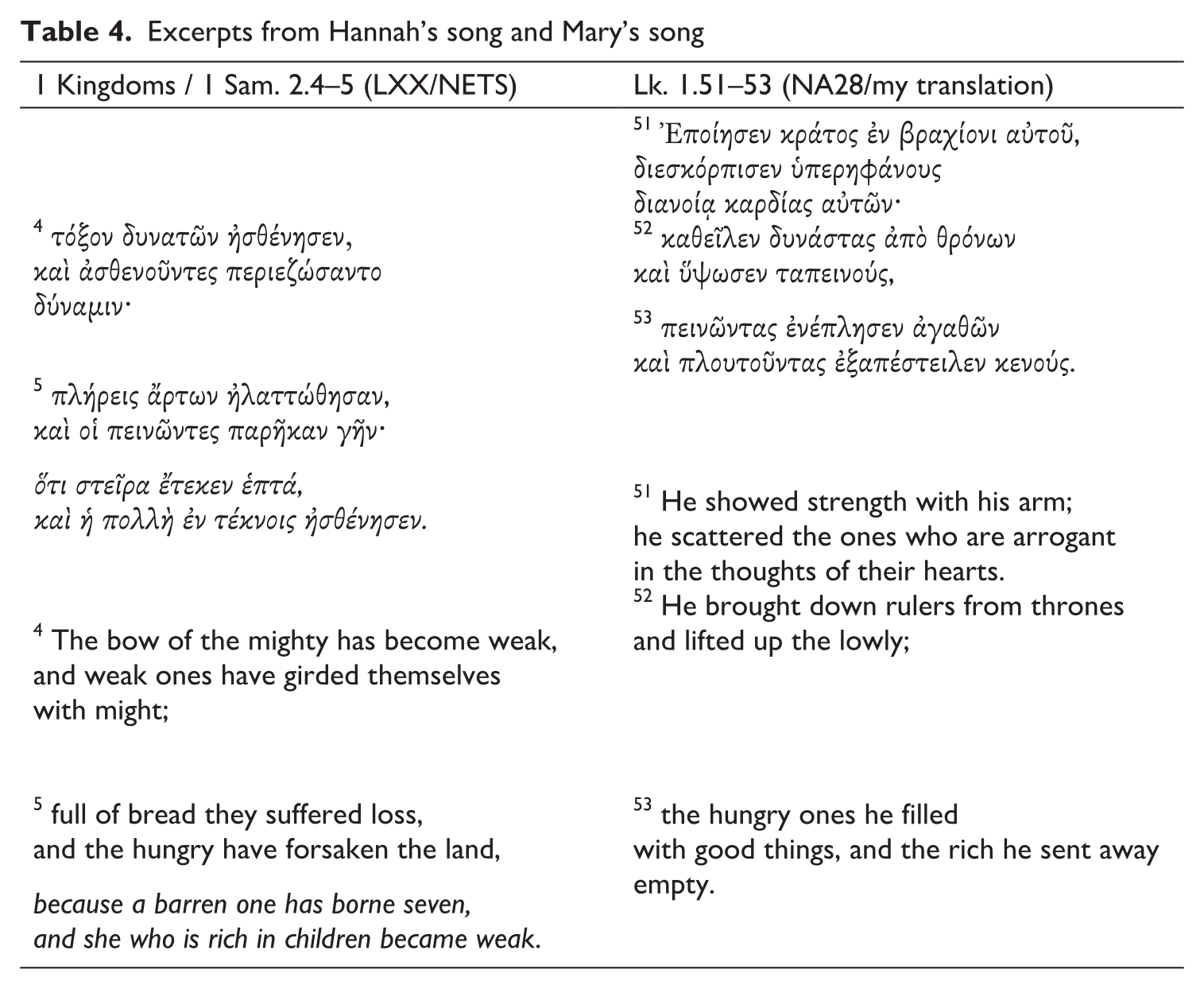
Elizabeth and Mary, having both received the gift of an unexpected child from the Lord, respond not by fixating on their relative statuses but by each embracing the role she has been given in salvation history, in solidarity with the other. 41 Their relationship illustrates how the new thing being brought about by the God of Israel will break down barriers of several sorts among God’s people—including divisions related to (in)fertility. 42
As with Judges 5, however, so also with rivalry among would-be mothers: the OT/HB does not necessarily endorse the pattern from which Elizabeth and Mary depart. For instance, though Sarah’s rivalry with Hagar is reported in Genesis, one could argue that Genesis invites, or at least allows for, questioning these women’s ways of relating. True, Abraham eventually drives Hagar out at Sarah’s urging and even with God’s authorization. Nevertheless, Genesis’s depiction of God’s continued care for Hagar and her child (Gen. 21.1–21) may prompt readers to recognize the limitations of the options that occur to Sarah. Hence, if Luke portrays Elizabeth and Mary as interacting in a more faithful way than did Sarah and Hagar, this need not be viewed as a rejection of Genesis (or Judaism); rather, it is a response to interpretive possibilities created by Genesis itself.
Further, as mentioned previously, even where Lukan characters provide a ‘corrective’ to the behavior of some OT/HB characters, Luke can be seen as building on alternative patterns found already within Israel’s scriptural traditions. Elizabeth and Mary’s collaborative interactions around childbirth are not without OT/HB antecedents, as seen, for example, in the relationship between Ruth and Naomi, whose story Elizabeth and Mary also evoke (e.g., Troost 1996: esp. 192–96; Taschl-Erber 2011: 253). This intertextual connection is reinforced by intersectional analysis. Not only shared biological sex but also differences in age/generation link the two pairs of women (see Bauckham 2002: 52; Levine and Witherington 2018: 38). Ruth and Naomi, like Elizabeth and Mary, cooperate in the context of procreation. Interestingly, though Ruth and Naomi’s relationship contrasts with the contentious pattern seen in the relationship between Rachel and Leah, the narrative of Ruth explicitly evokes—and quietly reconfigures—the story of these earlier matriarchs. When witnesses to Boaz’s commitment to Ruth allude to Rachel and Leah, the sisters are portrayed not as reproductive rivals but rather as collaborators in ‘building up’ Israel (Ruth 4.11). The mending of past patterns achieved through the witnesses’ renarration of Genesis continues into the narrative present when Ruth bears Boaz a child: the new mother and her mother-in-law join in the mothering of Obed in a noncompetitive way that is affirmed by the women of their community (Ruth 4.13–17; Bauckham 2002: 52). If Naomi and Ruth offer an initial innerbiblical ‘corrective’ to the rivalry of Leah and Rachel in Genesis, 43 Luke 1 can be seen as affirming and extending this alternative model.
Luke’s characters do further develop this alternative version of the trope, but this should be seen as a participation in—not a rejection of—an ongoing conversation begun within Israel’s Scriptures. As Athalya Brenner notes when analyzing scriptural variations on type-scenes involving women and their son(s), versions of this trope without woman-to-woman rivalry typically do not include multiple sons; instead, ‘only one son and heir is produced according to this structure’ (1986: 266). Naomi and Ruth can collaborate because (by the end of the narrative) there is only one son for them to support together. 44 In contrast, the Lukan infancy narrative relates the birth of two sons, albeit not to the same father, 45 without rivalry between their respective mothers. The mothers’ relationship in Luke 1 thus not only stands in contrast to ‘the more common biblical depictions of [women] rivals in the same household’ (Levine and Witherington 2018: 38) but also marks the further unfolding of an alternative scriptural pattern for women’s collaborative interactions with each other in contexts related to procreation. 46
Through Luke’s allusive characterization of Elizabeth in relationship to Mary, then, troubling aspects of some earlier scriptural women’s ways of relating find what might be called a ‘corrective’. These developments allow divine deliverance to unfold without God’s people resorting to anxious practices of violence or rivalry. However, as should by now be clear, even in these cases of ‘correction’, Luke writes within (not over against) the Jewish scriptural traditions to which he alludes. The complexity of characterization in OT/HB texts, along with the tendency to implicit narrative evaluations rather than overt moralizing in many narrative portions of the OT/HB, creates ambiguity about whether characters ought or ought not to have acted in thus-and-such a way. Luke’s contrastive allusions—cases where his narratively affirmed characters depart from patterns set by (some) OT/HB antecedents—work with this ambiguity in a way that is a response to, not a rejection of, the scriptural text. Moreover, at least in some cases, Lukan developments build on alternative patterns present already within the OT/HB.
In short, intersectional-intertextual analysis draws attention to how Luke 1 incorporates aspects of earlier patterns involving women, divine deliverance, and/or (in)fertility while omitting the motifs of human violence and of conflict between (would-be) mothers that are found in—though not necessarily lauded by—some of the OT/HB narratives that reverberate in the background of the Visitation. 47 The examples treated previously illustrate how, in addition to highlighting parallels between Lukan characters’ embodied lives in community and various OT/HB antecedents, the integrative approach proposed here can also draw attention to pointed divergences from scriptural intertexts—including divergences that carry forward alternative trajectories found within the OT/HB itself.
Methodological (and Practical Theological) Conclusions
But to what end? It is admittedly quite possible to notice the allusions discussed in this article without explicitly reflecting on how these links are forged through the overlapping of roles and identities—parental status, sex, age, and so forth. Nevertheless, as I have shown, a self-consciously intersectional analysis of the web of scriptural echoes in Elizabeth’s characterization does enrich understanding of those intertextual links (e.g., by fostering sensitivity to the social-emotional overtones of allusive plot developments). Moreover, as I have already hinted and will further explore in this conclusion, intersectional analysis can help exegetes to use intertextual analysis in ways that elucidate the New Testament’s relevance to contemporary justice concerns. At the same time, as I will also demonstrate, intertextual analysis provides a safeguard against inadvertently allowing contemporary concerns to obscure our interpretation of a passage.
Because intersectional analysis encourages attention to the particularity and complexity of characters within the text, this approach can fuel readers’ scriptural imaginations 48 as we consider how intertextual connections might matter for our own complex contexts. Reflecting on the allusions embedded in Luke’s multifaceted portrayal of Elizabeth, some readers might feel prompted to ask: How does the faithful-but-surprising work of God in Christ call us into new ways of relating to each other—even and especially in the context of those aspects of our embodied social location that have led to stigmatization and suffering, as was the case for Elizabeth in her experience of infertility as a married Jewish woman?
From one perspective, 49 Mary’s unconventional pregnancy presents an opportunity for Elizabeth to transfer her recently removed shame to a kinswoman whose child threatens to overshadow Elizabeth’s own long-awaited son. However, Elizabeth chooses to collaborate with—and even honor the greater exaltation of—her kinswoman, rather than entering into competition with this other mother-to-be. In doing so, Elizabeth becomes a foil not only for several OT/HB women (see earlier) but also for patterns of relating still seen within and among marginalized groups in modern contexts. For instance, as now widely recognized, early feminists focused on advancing the rights of upper- and middle-class white women, often overlooking the situations of women who experience the intersection of sexism with racism, poverty, and/or other forms of marginalization. 50 Elizabeth’s cooperative relationship with Mary, through its development of (some rather than other) OT/HB trajectories, shows us a better way for marginalized people to relate to each other in contexts of shared but variously experienced vulnerability. It is a way of relating rooted not in a sense of scarcity but rather in trust in the God who, as Mary celebrates in the scripturally evocative Magnificat, attends to the needs of the marginalized.
Exactly what these women’s example means for concrete practice will vary from context to context. My point at present is simply that intersectional analysis can sharpen our practical theological reflection on the import of intertextual connections, including in relation to pressing questions around justice today. Importantly, the exegetical and pastoral benefit of the integrative approach proposed here is not unidirectional. Supplementing intersectional analysis with intertextual analysis helps readers recognize the NT’s address to current concerns without allowing contemporary priorities and assumptions to distort exegesis. An illustration will clarify this point.
Elizabeth conceals herself for the first five months of her pregnancy (Lk. 1.24)—by all accounts, a puzzling detail. We do not have evidence of such concealment being a widespread practice during pregnancy in the first century, 51 nor does Luke offer any explanation beyond Elizabeth’s cryptic, allusive words in 1.25 (see earlier). In light of Elizabeth’s echo of Rachel’s story—in which a married woman’s childlessness is experienced as disgrace (Gen. 30.23)—we might infer that Elizabeth’s self-concealment relates to the fact that her pregnancy is more evident to others five months in. As Amy-Jill Levine and Ben Witherington III suggest, by the time Elizabeth comes out of hiding, her pregnancy is far enough along that ‘her announcement [of it] will come with the proof shown by her body’ (2018: 32). 52 Now clearly showing, she can affirm that God has taken away her disgrace publicly—or, as she puts it, ‘among people’ (Lk. 1.25).
Not all readers of Luke have interpreted Elizabeth’s actions along these lines, however. Pondering Elizabeth’s self-concealment, multiple church fathers entertain the possibility that her hiding might have been motivated by embarrassment over her geriatric pregnancy, which betrayed inappropriate lustiness in old age. Ambrose of Milan, for example, reasons as follows in his Exposition of the Holy Gospel according to Saint Luke: Saint Elisabeth, who undoubtedly desired sons, hid herself for five months. What was the reason for this concealment if not modesty? For there is a prescribed age for each duty, and what is fitting at one time is unseemly at another, and a change of age often changes the nature of every act (2003: 38 [par. 43]).
53
Significantly, for Ambrose, the ‘modesty’ Elizabeth supposedly exercises is not tied only to her female sex or her pregnant status. Instead, her special need for modesty arises from the intersection of these identity categories and experiences with her advanced age. She is embarrassingly old to be (having sex and so) getting pregnant! The reason Elizabeth eventually comes out of hiding, according to Ambrose, is her realization that she carries a prophet and her consequent recognition that this pregnancy is a result of God’s gift, not of her own out-of-season desire (2003: 39 [par. 46]; see also Just 2006: 11).
Ambrose is not alone in suggesting such an interpretation. In his commentary on Tatian’s Diatesseron, Ephrem the Syrian considers a similar exegetical possibility, alongside other potential explanations for Elizabeth’s hiding: ‘Elizabeth hid herself because of Zechariah’s grief. Or alternatively, she hid herself because she was ashamed {on account of the fact that she had resumed intercourse; so it was} because of her old age that Elizabeth hid herself’ (1993: 52 [§24], emphasis original). 54 The latter proposal is again what we might call (proto-)intersectional. At least implicitly, it considers Elizabeth’s age, sex, and parental status together as key to making sense of her behavior.
These early interpreters’ proto-intersectional analysis is informed by a culture that disapproved of older women’s sexual activity. 55 An intertextually sensitive intersectional analysis, however, discourages the view that Elizabeth hid out of embarrassment over her late-life pregnancy. By evoking the story of Sarah in his characterization of Elizabeth, Luke de facto rules out the relevance of qualms about older women having sex. Interestingly, in the commentary cited previously, Ephrem goes on to self-correct in light of precisely this biblical precedent. Observing that the elderly Sarah does not seem to have hidden herself while pregnant, 56 Ephrem concludes that there must be some other way of accounting for Elizabeth’s temporary self-concealment, probably related to the timing of events involving Jesus and Mary (1993: 52; see also Just 2006: 11).
If the logic of Luke’s plot (which portrays Elizabeth’s barrenness as a problem to be solved, the resolution of which brings joy) 57 were not enough to make the point, scriptural echoes confirm it. In Luke’s narrative world, Elizabeth’s ‘geriatric’ pregnancy is seen as a good, without any stigma attaching to the later-life sexual activity to which her pregnancy bears tacit witness. Attending to the allusiveness of Elizabeth’s characterization helps Ephrem to mitigate the distortive effects of cultural assumptions about women, old age, and sexual activity that he and many patristic readers bring to the text. 58
This foray into the early reception of Lk. 1.24–5 has important methodological implications. Whether one considers patristic exegetes or the most cutting-edge biblical scholars today, any interpreter’s intersectional analysis of a NT character will be informed by that reader’s preunderstandings about age, sex, ability, and other intersecting markers of identity and difference. Alongside strategies such as historical research, literary analysis, and theological reflection, 59 intertextual analysis can provide a further check on the aptness of our working assumptions relative to a given New Testam passage, refining and hopefully enriching the exegetical fruits of intersectional analysis.
Intersectional analysis continues to gain ground in biblical studies, not least because of its potential for illuminating how passages address questions about marginalization, justice, and inclusivity. Meanwhile, intertextual analysis of the OT/HB in the NT marches on as well, often in the technical vein that my student found frustratingly irrelevant to such practical theological questions. As illustrated through the foregoing study of Elizabeth, integrating these two methodologies through intersectional-intertextual analysis may prove beneficial both for exegesis in the narrow sense and for addressing practical theological concerns in exegetically responsible ways.
Footnotes
1.
The present article is a modified version of a chapter from an ongoing book project, under contract with Baker Academic. I thank Amy Whisenand Krall and Celia I. Wolff for their comments on past versions of this study, which was also presented in an earlier form to the Multidisciplinary Approaches to the Gospels Group at the Institute for Biblical Research 2021 Annual Meeting. I express my appreciation to Wheaton College for a G.W. Aldeen Faculty Development Grant, which funded a course release in fall 2022 to facilitate work on the larger project. I am grateful also for the helpful feedback of two anonymous reviewers for JSNT.
2.
Spencer (1992), Melcher (2011), and others have undertaken what one could call intersectional-intertextual analyses of the Scripture-reading Ethiopian eunuch in Acts 8, the passage that most obviously invites this integrative approach.  offers an intersectional reading of 1 Timothy and selected scriptural women—including Hagar, who occurs in both Testaments—though Kartzow does not foreground intertextual analysis.
3.
As will become evident even through this single case study, some intertextual connections lend themselves to this integrative approach more readily than do others; moreover, the integration of intertextual analysis with intersectional analysis may need to take different forms depending on the nature of the intertextual connection. I hope to delve further into these complexities in the book project mentioned in note 1.
4.
Most relevant at present: I am a white woman in my late thirties, recently married and hoping to have some biological children, though whether that will happen remains to be seen. I am a Christian, live in the United States, and currently teach at a Catholic seminary.
5.
On how these several descriptors relate to honor and shame, see Embudo (2017: 118–20). Some of these descriptors may also be relevant for discerning Elizabeth’s socioeconomic status. Green argues that priestly heritage may elevate Elizabeth’s social status to some extent (e.g., Green 1992: 462; 1997: 64), while Bauckham argues that Elizabeth’s ‘barrenness’ outweighs other factors in determining her social status (: 72). An intersectional approach to analyzing her character can take both factors into account and consider their interaction (i.e., how does priestly lineage affect the social experience of a person deemed ‘barren’—and vice versa?).
6.
As commentators often note, Elizabeth’s unwanted-and-eventually-overturned childlessness recalls multiple OT/HB women’s experience—a scriptural pattern so strong that ‘[t]he narration of barrenness itself becomes grounds for anticipating the gift of a child’ (Green 1997: 66, emphasis original). Even so, Elizabeth’s characterization is at odds with another scriptural thread that portrays procreation as a blessing or reward (e.g., Deut. 28.1–4; Ps 127.3–5). This latter pattern suggests that childlessness might be ‘a sign of punishment’, yet Luke insists on Elizabeth’s righteousness (1.5–7; Green 1997: 65–6). Her allusive characterization sets in relief the tension between two scriptural tropes—neither of which, of course, encompasses the experiences of all first-century Jewish women (: 27).
7.
I find helpful Richard B. Hays’s seven ‘tests’ for judging the probability of proposed intertextual connections (1989: 29–32; : 34–45), but because the allusions discussed here are generally recognized by scholars, I will not provide extended defenses for detecting them. Since the relative obviousness of an intertextual connection is not central to my purposes, I will use ‘echo’, ‘allusion’, etc., interchangeably for variety in diction rather than differentiating between them as technical terms.
8.
See also, e.g., Green (1994: 76–7; 1997: 56–7) and Pao and Schnabel (2007: 251–53). As Bauckham observes, Luke’s scriptural allusions not only relate his Gospel to various OT/HB passages ‘but also bring many such [OT/HB] texts into relationship with one another in traditional or fresh ways’ (2002: 56). Scholarship on Luke’s engagement with the OT/HB is extensive. For a helpful overview of scholarly conversations on this topic—including a history of the discussion since the mid-20th century, succinct treatments of debates around questions like whether Luke foregrounds prophecy fulfillment and/or typology, and a wide-ranging treatment of recent studies that focus on Luke’s engagement with particular scriptural books—see Metcalf (2023). In addition to the studies already mentioned, a useful summary analysis of Luke’s intertextual practice can be found in : esp. 57–9).
9.
Foregrounding ‘gynocentricity’ rather than intersectionality, Bauckham similarly claims that Luke 1’s ‘relationship to Israel’s history and God’s purposes is conveyed by the chapter’s peculiarly dense intertextual relationship with the Hebrew Bible/Old Testament’, such that ‘in order to understand the part played by the women in [Luke 1] we must . . . supplement the notion of gynocentricity with that of intertextuality’ (2002: 55). On the shift to ‘gynocentric’ conceptions of time in Lk. 1.24–57, see also Kahl (2002: 79–80, 87) and Taschl-Eber (: 238–46).
10.
Though I will here treat only a selection of relevant allusions, it is worth noting that Elizabeth and Zechariah’s story also evokes that of other OT/HB couples who struggle with infertility, such as Sampson’s parents (Judg. 13). For a more wide-ranging discussion, see E. A. Johnson (2000), who offers an extended study of Luke’s infancy narrative in relation to traditions about (in)fertility in Israel’s Scriptures and their early Jewish reception. See also : esp. 100–7).
11.
On the emotional overtones of Luke 1 and their effects on readers, see also Kuhn (2009: esp. 63–95). ‘Emotion’ in biblical literature is of course a burgeoning field of research. Space does not permit extensive engagement with that important conversation here, but see especially Spencer (2017), as well as Elliott (2005) and Kuhn (2009). For fuller discussion of these and other works in the broader conversation, see : esp. 15–20).
12.
Throughout this article, Greek translations of Israel’s Scriptures follow Rahlfs-Hanhart (Editio altera). Unless otherwise noted, English translations of this material follow the New English Translation of the Septuagint. Greek text for the NT is taken from the NA28; unless otherwise noted, English translations are my own.
13.
In tables, bolding indicates shared language to which I would draw attention; italics highlight small differences within similarities.
14.
Elizabeth’s echo of Rachel is often highlighted (e.g., E. A. Johnson 2002: 108; Seim 2002: 96–7; Taschl-Erber 2013: esp. 108–9); Wolter also suggests comparison with 4 Ezras 9.45 (: 1.71–2).
15.
Not before: López suggests that Elizabeth’s pronouncement in 1.25 implicitly calls into question the social conventions that had led to her disgrace as a ‘barren’ woman (2019: 1296), but David Watson correctly observes that her ‘reproach is taken away only after she becomes pregnant’ (: 306, emphasis original). As Seim argues, ‘Elizabeth’s story recapitulates’ what might be called ‘conventional patriarchal values’ involving women’s procreation (2002: 100). It is ‘Mary’s story’ that first upends these values (Seim 2002: 100), though that trajectory continues in passages such as Lk. 11.27–8 (see, e.g., Seim 1994a: esp. 205–8; Watson 2017: 306–7).
16.
17.
It is perhaps worth noting that, given high rates of (infant and) maternal mortality, Elizabeth’s infertility may even have helped her to have a better chance, medically speaking, at reaching an advanced age.
18.
19.
On infertility as a ‘disability’, see Moss and Baden (2015: 4). Rebecca Raphael describes infertility as ‘the defining female disability in the Hebrew Bible (and in other ancient Near Eastern literature)’ (qtd in : 306).
20.
Indeed, Rachel dies while still of childbearing age—and dies specifically as a result of childbirth (Gen. 35.16–19), a grim reminder that giving birth, however socially important childbearing was for women’s status in both the OT/HB and the first-century world, was also medically perilous. On whether/how age plays into variations on OT/HB annunciation-type scenes, see also : 115).
21.
Links between Elizabeth and Sarah are often highlighted (e.g., Kuhn 2009: 69; Moss and Baden 2015: 158). For an extended discussion of how Elizabeth and Mary evoke Sarah and the trope of ‘Große Mütter, größere Söhne’, see : 103–6, quotation from 101).
22.
Unless otherwise noted, Hebrew text follows the BHS; translations of Hebrew follow the NRSV.
23.
On Zechariah and Elizabeth’s allusive characterization and Luke’s emphasis on theological continuity, see, for example, Green (1994) and Newberry (2021). On ‘narrative continuity’ as a key theme in Luke’s allusions to Israel’s Scriptures, see also : 277, italics original).
24.
This is a particularly important concern to address in relation to the present article, given that both intertextual analysis and practical theological interpretation have sometimes fallen into anti-Judaism (e.g., by developing supersessionist readings of allusions or by maligning first-century Judaism in an effort to emphasize Jesus’s concern for women or the marginalized). My argument here does not require negative views either of the OT/HB or of Judaism (then or now). It merely highlights how Luke’s characterization of Elizabeth (and Mary) plays off of the complexity that attends characters’ portrayal within the OT/HB—a feature of these Scriptures of which both Jewish and Christian readers have been long aware.
25.
Wilson offers an extended defense of the plausibility of detecting allusions to Jael and Judith in Lk. 1:42 (2006: esp. 438–42) and also discusses the possible evocation of Deut. 28.4 (452–53). On these and other scriptural parallels to Elizabeth’s blessing of Mary, see also Pikaza (1996: 400–11); Bauckham (2002: 55–9); Litwak (2005: 110); Taschl-Erber (2013: 130–33); Gadenz (2018: 49); and Levine and Witherington (2018: 38–40), among others. The work of Taschl-Erber merits special note. Across several publications (2011, 2013, ), Taschl-Erber analyzes connections between the women of the Lukan infancy narrative and OT/HB women, with particular attention to possible liberationist readings. Taschl-Erber uses ‘Interfiguralität’ (interfigurality) to name the ways in which Lukan women evoke these earlier scriptural figures (e.g., 2013: 98; 2014: 158, citing Wolfgang G. Müller).
26.
27.
On how Lk. 11.27–28 and Lk. 8.19–21 relativize the importance of (even) Mary’s biological motherhood, see, for example, Seim (1994b: 732–33, 756). The recognition that Luke portrays Mary as blessed for her faithful receptivity, more than her biological motherhood as such, is found already among patristic (e.g., Augustine, Holy Virginity, par. 3 [1999: 69]; see also Clark, 1996: 62–3) and Reformation (e.g., Edward Leigh 1650: 98; see also Kreitzer 2015: 24) commentators. For a reading that addresses feminist concerns about Mary’s elevation through motherhood via a gynocentric view of maternity, see also : 64–6).
28.
With Wolter (2016: 1.89–90) and contra : 41), I deem it most likely that the ὅτι clause in Lk. 1.45 is dependent on πιστύειν and should be rendered ‘that’: Elizabeth pronounces Mary blessed for her belief/trust in God’s word, not merely because of the coming fulfillment of God’s word to her.
29.
Reading Luke 1 through Genesis 3 and Revelation 12, some see Mary’s victory as a violent crushing of Satan; however, such a reading misses the fact that God is the one enacting overthrow in Mary’s case, as underscored through the emphasis on divine agency in the Magnificat (Wilson 2006: 437 n. 4, 449). This is not to deny Mary’s importance; as Bauckham emphasizes, though Mary differs from some of scriptural precedents with respect to the manner of her participation in God’s deliverance, her connection to figures such as Jael still underscores ‘that Mary’s motherhood is celebrated not as a purely domestic and familial matter, but as her active role in a great act of God for the salvation of his people’ (: 59).
30.
This description of Deborah, probably a reference to her ‘military leadership of Israel’, is highlighted by : 443–44), who further notes that Jael’s initial hospitality toward Sisera can be seen as a form of ‘mothering’ (443)—a possibility reinforced by Deborah’s description of Sisera falling at Jael’s feet (Judg. 5.27) in ‘a twisted parody of birth’ (445).
31.
A similar dynamic might be discerned in relation to Lk. 1.42’s echo of Judith 13.18 regarding the role of violence in women’s participation in God’s work of deliverance. As notes, passages such as Judith 9.7–8 suggest a war-critical theology (‘eine kriegskritische Theologie’, 167) that, though not fully carried through within the book of Judith, finds fuller expression in the Lukan infancy narrative (168).
32.
33.
34.
On the ‘step-parallelism’ through which Luke 1–2 narratively implies John’s subordinate role relative to Jesus, see Brown (1993: 248–53) and Kuhn (2001). On the relationship between this aspect of Luke 1–2 and the Greco-Roman ‘rhetorical convention of sygkrisis’, see also : esp. 58–69, quotation from 58).
35.
As Isaak notes, while pregnancy frees the married Elizabeth from shame, ‘the opposite is true for an unmarried woman’ such as Mary (: 1233). Luke does not emphasize this point as strongly as does Matthew (Mt. 1.19; Seim 1994a: 204; 2002: 101), though the possibility of social awkwardness is at least implicit. I focus here on the potential for rivalry between pregnant women that is suggested by the canonical context, but as González emphasizes (2010: 22–3), Mary’s unwed motherhood could raise concerns about another source of intra-women tension: the righteous Elizabeth (1.6) might be expected to look down on the suspiciously pregnant Mary—another potential conflict that never materializes in Luke 1.
36.
For example, Brenner 1986: 269–70. On the unexpected reversal in which ‘the elder is acknowledging the younger’, see, for example, Chen (2017: 23); see also Green (1992: 469). Bauckham objects to interpretations that emphasize a reversal of status between the mothers, both because he sees Elizabeth’s status as determined primarily by her (past) barrenness (not her priestly connections, which in any case might not have amounted to much status advantage if not accompanied by wealth, power, etc.) and because he views the connections of both women to Hannah as having an equalizing effect (: 71–2). Without denying that Elizabeth experiences a gracious reversal of her own, I agree with those who view the Visitation as indicating an exaltation of Mary over Elizabeth, reversing their prior relative statuses based on age and perhaps family connections.
37.
See also, for example, Reid (1996: 73–4) and : 100–5).
39.
Connections between the Magnificat and Hannah’s song are often noted (e.g., Bauckham 2002: 60–4; Schaberg and Ringe 2012: 504; Taschl-Erber 2013: 119–23). For an extended analysis of connections between Luke 1–2 and 1 Samuel 1–2, see : 70–92, with special attention to the Magnificat on 87–92).
40.
Admittedly, the omission of a parallel to Hannah’s comment about the reversal of mothers may be accounted for, at least in part, by differences in sociocultural (see Fischer 2015: 76–7) and/or narrative-theological (see : 63) contexts. Perhaps it is also relevant that—unlike Hannah’s fecund rival, Peninnah (1 Sam. 1.2)—neither Elizabeth nor Mary was ‘rich in children’ prior to Luke 1 (cf. 1 Sam. 2.5b).
41.
So also, Seim (2002: 97). Scholars who perceive ‘solidarity’ in the Visitation include Horsley (1989: 88); González (2010: 22); and Taschl-Erber (2013: 133–42; ‘Solidargemeinschaft’, 133), among others. : 74) sees these women’s cooperation as part of a larger pattern in Lukan women’s discipleship (e.g., Lk. 8.1–3; 23.56; 24.9), contrasting with rivalry among male disciples (e.g., 22.24).
42.
Zooming out to consider Luke-Acts as a whole, one finds resources also for addressing the potential for rivalry and division in cases where longed-for biological motherhood never does come to pass—a situation surely not unfamiliar to Luke’s readers, then or now. For instance, as noted previously, Lk. 8.19–21 and 11.27–8 relativize the importance of (even) Mary’s biological motherhood, opening up space for an ascetic model of discipleship grounded in faith and obedience rather than biological fertility (see esp. Seim 2002; as well as Seim 1994b: 732–33, 756). On Lk. 23.28–31, which also relativizes the value of biological motherhood but for distinctive reasons, see, for example, Seim (2002: 91–2) and (with particular emphasis on the relevance of warfare imagery) .
43.
To be clear, this is not a case of the book of Ruth correcting the book of Genesis but rather a case of characters in Ruth providing a corrective for characters within Genesis, which makes no pretense of idealizing its characters. Just as the book of Ruth should not be seen as rejecting Genesis or Judaism, so also the interpretation of Luke 1 advanced here does not imply an anti-Jewish rejection of the OT/HB. For an ‘analysis of the revisionist character of the Book of Ruth’ grounded in ‘the ways in which this text rereads the story of Leah and Rachel’, see Pardes (1992: 98–117) (quotation from 99). Pardes suggests that, ‘[i]n evoking Leah and Rachel as the two cobuilders of the house of Israel, the Book of Ruth both highlights the brief moments in which the two matriarchs manage to cooperate and calls into question the emphasis put on rivalry’—in their story and in relation to several other scriptural women (1992: 101, emphasis original). Still other patterns of women relating around childbirth can be found in the OT/HB, such as when one woman bears a child ‘for’ another, without the narrative providing clear indication of the tenor of any subsequent relationship between the women (e.g., Rachel and Bilhah in Gen. 30.3; see also the discussion of Bilhah’s and Zilpha’s status in : 94–6).
44.
See also the several women who together preserve baby Moses in Exodus 2 (e.g., Bauckham 2002: 52; : 96–8).
45.
Perhaps the lack of rivalry between Mary and Elizabeth is partly accounted for by the fact that, as others have noted, they do not have the same husband, nor is either ‘barren’ when they encounter each other within the narrative (see, e.g., Seim 2002: 97; 1994a: 199–200; Brenner-Idan, 2015: 102). Be that as it may, their divergence from the competitive paradigm remains noteworthy, especially given the prominent role of procreative rivalry between several OT/HB women—some of whom, as discussed previously, Luke 1 clearly calls to mind.
46.
It should also be noted that not all Lukan characters overcome the temptation to rivalry. Indeed, in the course of discussing how Mary and Elizabeth fit into complex scriptural patterns of women’s relationships, Levine and Witherington find examples of intrahousehold rivalry not only in the OT/HB but also in ‘Luke’s account of Martha and Mary’ and of the sons in the ‘Parable of the Prudent and Prodigal Sons’ (: 38). Of course, in neither of those pairs is the rivalry specifically related to maternity.
47.
Returning to Robert Alter’s classic study of biblical type-scenes, Luke’s portrayal of Elizabeth and Mary might be classified as a ‘transfigured version of’ biblical conventions surrounding women’s relationships in contexts of (in)fertility. As Alter observes, ‘transfigured’ iterations of a type are one of the rhetorical possibilities created by the very existence of type-scenes within a culture’s literary repertoire (1978: 365). See also Hays’s discussion of how Luke sometimes forges intertextual connections that ‘enact ironic reversals’ through ‘the reversal of scriptural topoi’ (2016: 276). Similarly, Green characterizes Luke’s engagement with the Abraham traditions as an example of parody, ‘in the sense of “repetition with critical distance that allows ironic signalling of difference at the very heart of similarity”’ (1994: 77, quoting Hutcheon, Poetics). Others characterize the allusiveness of the Lukan infancy narrative differently. Brenner, for example, sees these chapters as establishing ‘a new tradition of a super-hero’s birth’ (1986: 269; see also 270–71). Bauckham views Elizabeth’s fertility as the climax of OT/HB patterns, while Mary’s virginal conception marks the beginning of ‘the new creation’ (2002: 58). For an extended study of barrenness and conception in the OT/HB, NT, and postbiblical Jewish traditions, see also (on how earlier traditions are taken up into and reconfigured by Luke’s infancy narrative, see esp. 100–7).
48.
51.
Contra Reid (1996: 63). Though Jewish sources suggest there were some contexts in which a woman might limit public appearances, self-concealment does not appear to have been tied to pregnancy (Green 1994: 81). Wolter suggests a partial parallel to the behavior of Melchizedek’s elderly and erstwhile ‘barren’ mother during her pregnancy, as reported in 2 Enoch 71.3 (: 1.71). However, Melchizedek’s mother is embarrassed not merely because she has conceived in old age but also because she has become pregnant when her husband was not having intercourse with her, raising questions about her fidelity (2 Enoch 71.1–8). In contrast, Zechariah goes home to Elizabeth before she conceives (Lk. 1.23–4), and there is no narrative indication of doubts regarding the identity of the child’s father (see esp. 1.59).
52.
Another possible explanation for concealment arises from pragmatic considerations regarding a (humanly speaking) high-risk pregnancy. Perhaps Elizabeth did not want to share her news until she was far enough along for miscarriage to be less likely (see, e.g., Levine and Witherington [2018: 32]; Spencer [2019: 38]; Takatemjen [2015: 1332]—all of whom also consider other possible explanations). However, while it is medically plausible that Elizabeth would have worries about pregnancy loss, John Calvin persuasively suggests that her comment in 1.25 makes clear that ‘her hope was not tentative or uncertain’; he concludes that she hid herself so that her pregnancy, revealed ‘suddenly’ and when ‘unmistakable’, would have the best possible effect on others’ faith (1972: 19; see also Kreitzer 2015: 13). For a recent survey and evaluation of proposed interpretations of Elizabeth’s self-concealment, see Powell (2019: 489–92). Powell concludes that Elizabeth’s self-concealment ‘is a response to her belief that she had fallen pregnant’; further, this response evinces faith, insofar as Elizabeth conceals herself before she (as a postmenopausal woman who could not rely on a missed period as an early indication of conception) had clear evidence of pregnancy (2019: 495, emphasis original). Powell’s interpretation helpfully attends both to the particularities of Elizabeth’s embodiment and to the narrative’s emphasis on her faith. It remains unclear, though, why concealing herself would be a manifestation of faith in the realization of the promised pregnancy, if concealment was not typical in pregnancy. In any case, whatever other explanation(s) one accepts, Elizabeth’s self-concealment serves narrative purposes, allowing for ‘Mary’s ignorance of Elizabeth’s change of circumstances’ prior to Gabriel’s announcement in 1.36 (: 19).
53.
See also Just (2006: 11). Ambrose repeats this judgment multiple times: Elizabeth ‘blushed for her age at giving birth’, and she was ‘shamed on account of her age’—even if Ambrose does see this shame as tempered by the removal of the ‘reproach’ of barrenness (: 39 [par. 45]).
54.
In a note on this passage, translator Carmel McCarthy explains the brackets as follows: ‘The Syriac text here is unclear, and the translation has been reconstructed from the Armenian version’ (in Ephrem 1993: 52 n. 3); see also : 11).
55.
At least part of the difficulty seems to have been that sexual intercourse was assumed to be nonprocreative for postmenopausal women, rendering their sex acts suspect for those who emphasized the connection between appropriate sexual activity and procreation. Augustine, for example, holds that ‘conjugal chastity’ (i.e., appropriate sexual restraint within marriage) ‘abstains during menstruation and pregnancy, nor has it union with one no longer able to conceive on account of age’—though he concedes that sex within marriage (if not ‘contrary to nature’) remains ‘pardonable’ even when it violates this ideal (1957: 3.21.43). See, also, Augustine’s discussion of the goods of marriage in relation to older couples in On the Excellence of Marriage, par. 3 (1999: 35), as well as Clark (1996: 45–6); Burke (1990: 547, 552–58); and Richie (2014: esp. 20–1). Interestingly, ancient interpreters are not alone in associating Elizabeth’s self-concealment with shame, possibly exacerbated by her advanced age at the time of pregnancy. Daube sees the act of concealment as itself an expression of shame, which he deems inherently tied to sexuality (1982: 363). He leaves open the question of how much Elizabeth’s age plays a role here (Daube 1982: 363). As Seim points out in rejecting Daube’s suggestion, shame cannot account for Elizabeth’s self-concealment: to the contrary, Elizabeth specifically refers in this context to the removal of her shame (: 98 n. 24; Lk. 1.25).
56.
Ephrem reasons, ‘But see, [Moses] did not write in relation to Sarah that she hid herself, when at the age of ninety she carried Isaac, nor with regard to Rebecca who was pregnant with twins’ (1993: 52 [§ 24], bracketed insertion original; see also : 11). Rebecca’s inclusion here suggests that Ephrem is processing discomfort with pregnancy as such (more visible with twins?), not only pregnancy in older age.
57.
Indeed, as Amy Lindeman Allen points out (2019: 41), Elizabeth’s community rejoices over John’s birth in 1.58, without yet being aware of his particular vocation (cf. 1.65–6). The joy prompted by John’s birth (1.14, 58)—together with Elizabeth’s comment about the removal of shame in 1.25—makes clear that Elizabeth’s past childlessness was a tragedy for Luke. Reid acknowledges as much (1996: 61–2) but also maintains that ‘Luke would have us see [Elizabeth] . . . as a woman who [prior to John’s birth] has been freer to devote her attentions to God since she has been unfettered by the duties of motherhood’ (1996: 59). Luke’s broader emphasis on ascetic discipleship (see, e.g., ) lends some plausibility to Reid’s proposal, but the infancy narrative does not explicitly foreground such a ‘silver lining’ to Elizabeth’s infertility. (If that were Luke’s point, one might expect γὰρ or ὅτι to join 1.7 with 1.6 rather than a simple καί.)
58.
To be sure, even today, evaluations of older women’s sexuality continue to be affected by the intersection of ageism and sexism, though competing cultural narratives may mitigate this effect in some cases.
59.
In the case of Elizabeth, for example, historical research might explore first-century Jewish valuations of (even) late-life pregnancy; literary analysis might consider narrative tensions and their resolution in Luke 1, and theological reflection might focus on the role of Elizabeth’s ‘geriatric’ pregnancy in illustrating God’s power and thereby providing a confirmatory sign for Mary (1.37).