



Abstract
In this article, I argue that the phrase ‘doers of the word’ in Jas 1.22 is derived from the Hebrew expression הרותה ישוע or the Aramaic one אתירוא ידבע. Both phrases possess an identical meaning that remained stable over time, functioning almost as technical terms. The first one is found in some Pesharim from Qumran while the second appears in the Targumim. In both corpora, the phrase is consistently found in contexts of judgment (often implying a division within the elect people between those who remained faithful to God and those who did not) and bears strong ethical overtones. Most of these passages are eschatologically oriented and present the ‘doers of the law’ as closely related to the Messiah. I suggest that the expression found in James still carries the overtones of the original phrase it translates.
Introduction
In his famous metaphor of the mirror, James urges his audience to become ‘doers of the word’ (ποιηταὶ λόγου) and not hearers only. 1 The expression is somewhat unexpected in James’s relatively good Greek, as it is clear that the word ποιητής does not bear its proper meaning. In classical Greek, the phrase would mean something like a poet or an orator. 2 The use of ποιητής in the sense of someone who carries out a command shows influence from Biblical Greek. Most commentators agree that the expression is a Semitism derived from expressions like ‘doing Torah’, or ‘doing the words of Torah’, which are found several times in the Hebrew scriptures, but the derivation is usually taken to be a generic one. 3
Benjamin Wold (2020) recently pointed out, however, that we know of no exact Hebrew equivalent of the Greek phrase that James uses, and he proposed a completely different background. In an article in which he shows that the Hebrew expression ‘wisdom of the hands’ (חכמת ידים) describes someone who acts wisely, particularly in the context of exercising authority, he proposes that James simply refers to a common topos in Jewish sapiential literature. The command to become ‘doers of the word’ should simply be seen as an expression emphasizing that conceptual knowledge is not sufficient because godly wisdom is always practical.
Wold’s proposal is interesting and has the merit of offering a completely novel reading. His claim that Jewish sapiential tradition knew of an idiom distinguishing between conceptual and practical wisdom is important and convincing. However, the claim that James makes use of this topos rests on thin evidence. The eight occurrences of the expression ‘wisdom of the hands’ (or similar ones) discussed by Wold prove that the idiom existed, but the number remains too low to claim that it was widespread. 4 More importantly, there is no lexical parallel at all between ‘wisdom of the hands’ (חכמת ידים) and ‘doers of the word’ or ‘word-doers’ (ποιηταὶ λόγου). The two expressions insist on the necessity of wisdom being transcribed into concrete action and so possess a conceptual connection, but the claim that ‘word-doers’ is semantically equivalent to ‘wise of hands’ remains conjectural. Only the context of the expression can help us decide.
Wold offers three arguments in favor of his position. First, he proposes that the expression ποιηταὶ λόγου is best translated ‘word-doers’ (rather than ‘doers of the word’) because the absence of the article implies that the emphasis falls on the idea of doing. 5 Second, he challenges the scholarly consensus taking ‘doers of the word’ as equivalent to ‘doers of the Torah’ and insists that there is no clear Semitic equivalent to either expression. 6 Third, he sees the term ‘word’ (λόγος) in James’s context as very close to ‘wisdom’ (σοϕία). 7
In response to his argument, the following points can be made. Wold lays a heavy emphasis on the lack of the article, but the anarthrous nature of the expression does not eliminate the possibility of reading the expression as meaning ‘doers of the word’, nor does it imply that the content of λόγος is left indeterminate. The lack of the article in James’s expression may well imply that the stress falls on the importance of doing, as Wold insists, but it does not preclude the possibility that λόγος functions as parallel to Torah. Even if the stress falls on the importance of acting, the concrete actions James has in mind are still defined by ‘the word’. Whether the stress falls on doing or on the word does not alter the meaning of the expression in radical ways. The idiom forms a whole that cannot be divided. Moreover, Wold’s assertion disregards the way the article generally functions. In genitive phrases, we should expect that ‘both the head noun and the genitive noun normally have or lack the article’. 8 According to Wallace, ‘the article often carries little semantic weight’ in these genitive phrases. 9 In this case, since ποιηταὶ also lacks the article, the lack of article before λόγου can be expected.
For Wold, λόγος does not refer to Torah but rather to a wisdom that is ‘identified with the order of creation’ (Wold 2020: 85). 10 This is not impossible, but Wold fails to offer a convincing challenge to the majority view that sees ‘the word’ as related to the Torah in some sense. He gives the impression that the expression ‘word-doers’ is equated to ‘Torah-doers’ simply because ‘hearing’ and ‘doing’ were juxtaposed and because of the claim that ‘doing Torah’ was a common Hebrew phrase. 11 He strangely omits to mention, however, that the pericope makes a clear parallel between the λόγος and the ‘perfect law of freedom’ (εἰς νόμον τέλειον τὸν τῆς ἐλευθερίας, Jas 1.25).
The image of the mirror in Jas 1.22–25 clearly functions as an illustration of the necessity of putting the word into practice, where word and law are closely associated with one another. 12 James invites his readers to become ‘word-doers’ (ποιηταὶ λόγου) and not to remain mere auditors (ἀκροατής, Jas 1.22). He contrasts a ‘word-auditor’ (ἀκροατὴς λόγου, 1.23)—someone looking at her own reflection in a mirror and forgetting what she looks like as soon as she goes away (Jas 1.24)—with someone who looks at the ‘perfect law of freedom’, does not forget it, and so becomes a ‘work-doer’ (ποιητὴς ἔργου, Jas 1.25). Hence, the text makes it very clear that those who do not practice the ‘perfect law of freedom’ are ‘word-auditors’ who fail to become ‘word-doers’. To put things differently, doing the ‘word’ or doing the ‘perfect law of freedom’ are identical. In short, Wold’s contention that the word λόγος cannot take the specific meaning of the word (i.e. the Torah) rests on thin ground. Grammar teaches us that the lack of the article has little semantic weight and the parable of the mirror invites the reader to draw a parallel between λόγος and Torah.
The decisive argument against the importance of the lack of article, however, comes from counter-examples. Key to Wold’s argument is his assertion that ‘the term ποιητὴϛ νόμου does not occur in 1 Macc 2.16 nor anywhere else in the LXX nor elsewhere in extant Greek literature from antiquity’. 13 This is simply not true. For one thing, the expression ποιηταὶ νόμου is a variant reading of ποιηταὶ λόγου in Jas 1.22, the very verse that Wold discusses! 14 This proves without a doubt that some ancient readers read Jas 1.22 as referring to doing Torah despite the lack of article. We also find the phrase ποιηταὶ νόμου in Jas 4.11 (in the anarthrous form) in a context that makes it clear that James speaks of Torah. Finally, the phrase also appears in conjunction with ἀκροαταὶ νόμου in Rom. 2.13, again in reference to Torah. All these expressions also lack the article and still define the ποιητὴϛ νόμου as a ‘doer of Torah’. This comparison makes clear that the lack of article in ποιηταὶ λόγου does not rule out the possibility that λόγος functions as a definite noun and stands for Torah. The lack of the article is clearly not as significant as Wold makes it to be. 15
The lack of article may well stress that the emphasis in the expression ‘word-doers’ falls on the importance of concrete action, but this does not remove the fact that the ‘word’ has implicit content attached to it. The rest of James’s epistle proves that he has in mind a very specific set of attitudes, like caring for the poor and honoring them and like refraining from empty boasting or from seeking self-promotion. What needs to be practised is quite clear to James, and the fact that he derives this set of practices from the Jewish scriptures is obvious as well. 16 Practice, in itself, is not intrinsically good. All depends on the practices themselves. Jesus’s diatribes against the practices of the Pharisees in the gospels are well known, and James also warns against some practices that were widely accepted (see Jas 2.1–4, 4.13–17). Hence, even though the expression ‘word-doers’ insists on doing, the precise meaning of the phrase still hangs on the ‘word’ (λόγος) that needs to be practiced, which is identical to the ‘perfect law of freedom’, as we saw previously.
Wold’s last point is the most important one for my purpose, especially his point that nobody proposed a specific Semitic idiom behind the expression found in Jas 1.22. In my view, he goes too far in his challenge of the scholarly consensus since expressions like ‘doing the law’ or ‘doing the words God pronounced’ are repeatedly found in Scripture, both in Hebrew and in Greek. 17 Although these expressions are not exactly equivalent to what we find in James, there is an unmistakable relationship between them. Assuming, then, that James’s surprising Greek expression is a Semitism based on that specific use of the verb ποιέω in the LXX and NT is quite straightforward. Hence, Wold offers us no strong reason for dismissing the possibility that the wording comes from the expressions mentioned previously. 18 But his challenge is salutary in that it reminds us not to be too quickly satisfied with this solution. A clear Semitic expression equivalent to ‘word-doers’ or ‘doers of the word’ would help us to better understand what James means exactly.
Last summer, while Wold’s article was still fresh in my mind, I happened to read through the Targum of Isaiah and was struck to encounter the expression ‘doers of Torah’ repeatedly. This piqued my interest so that I looked for all the occurrences of the phrase and discovered that the Aramaic phrase ‘doer of the Torah’ (עָבְדֵי אוֹרָיתָא) possesses quite a specific and remarkably stable meaning through the Targum.
In what follows, I want to propose that the phrases ποιηταὶ λόγου (Jas 1.22) and ποιηταὶ νόμου (Jas 4.11) are indeed Semitisms but that they come from a fixed expression that already possessed a fairly clear meaning. To put it differently, the phrase ‘doers of the word/law’ was not penned because of a vague influence of Hebrew. Rather, some at least among James’s original audience would hear the phrase as the Greek rendition of a fixed expression that they knew and that is attested multiple times (in Aramaic) in the Targumim and is already attested (in an equivalent Hebraic form) in the Dead Sea Scrolls.
Obviously, the Targumim were written later than James’s letter, at least in their final form. I am not suggesting anything like a direct influence. However, they are useful here because they provide us with a sample of the Aramaic phrase ‘doers of Torah’ large enough that its connotation becomes unmistakable. With this in mind, we can move back in time and see that a similar Hebrew phrase, occurring six times in the scrolls (עושי התורה), appears in contexts similar to those in which the Aramaic phrase is added in the Targumim and with comparable connotations. There are good chances, therefore, that the expression we find in the scrolls and in the Targumim possessed a clear and fixed meaning in the first century already, even though the written references to it are scarce.
I will restrict my analysis to the specific expression ‘doer(s) of the Torah’ (עָבְדֵי אוֹרָיתָא), which uses the participle as a substantive, and put aside those that are constructed with the verb עבד in the infinitive. The reasons for this are twofold. First, it makes it possible to discuss all the instances of the phrase. Second, and more importantly, substantive participles or nouns sometimes convey a more restricted meaning than the verb from which they are derived. In modern English, nobody would refer to a mother and her son loving each other as lovers. The range of meaning of this term is much more restricted and connotative than the verb ‘to love’. 19 The same is true in ancient languages. If we want to ascertain whether the expression ‘doer of Torah’ has a specific connotation or not, we have to restrict our discussion to the exact expression, being aware that the verbal expression ‘to do the law’ may (or may not) convey a broader range of meaning.
The ‘Doers of Torah’ in the Targumim
The phrase ‘doer(s) of the Torah’ appears once in Targum Onkelos and 10 times in Targum Jonathan (all but one are found in the Targum Isaiah). These are the two earliest Targumim we possess and their rendering remains relatively close to the Hebrew text (see, e.g., Chilton and Flesher 2011: 109, 200). To be sure, there are exceptions, especially when psalms, prayers, or songs are inserted within a narrative sequence (like Deborah’s or Hannah’s songs, . . .), but, overall, the translation tends to remain close to the Hebrew text. 20 As we will see, however, all the occurrences of the phrase that we are studying appear in passages that manifest a much freer translation than usual. Hence, translators were not bound by the text at these points and were thus free to use any expression they liked. This then means that any pattern that we may find in the use of a given idiom is of greater significance than if the same idiom was just rendering a common Hebrew phrase.
Since the number of occurrences is small enough, I will propose a short analysis of every verse. Because the phrase is added to the text and is never a translation of a Hebrew phrase, its meaning must be derived from its direct context. Both what is said about the ‘doer(s) of the Torah’ and the other transformations to the Hebrew text are important for understanding how the meturgeman understood a specific passage. This is a methodology commonly applied in targumic studies to define a specific term. 21 Since they were meant to be recited in worship, they always translate the text in a way that makes sense of the whole literary unit. Thus, the whole oracle needs to be considered in order to assess the meaning of the ‘doer(s) of the Torah’. Information is almost always derived from the neighboring verses but, in two cases, the reader may feel that the context drawn upon is too distant to be relevant. However, I will draw from more distant context only when the literary unit makes it possible. Luckily, the phrase appears in oracles that possess clear boundaries.
Gen. 49.11

The only occurrence of the phrase in Targum Onkelos is found in the famous blessing of Judah by his father Jacob (Gen. 49.8–12). The Targum interprets all the imagery of the poem as a prophecy about the future kings who will come out from Judah’s tribe and, ultimately, about the Messiah mentioned explicitly in Tg. Gen. 49.10. 25 The messianic reading of this passage is quite typical of the time, but our interest here lies only in what we can learn about the connotation that the expression ‘the doers of Torah’ possesses here, not about messianism in general (see the work of Oegema 1998: 294–99).
The rendition of verses 8 and 9 in the Targum stresses that Judah is singled out for his willingness to admit his mistakes (v. 8) and for his refusal to use violence against his brother Joseph (v. 9). This indicates that one of the Messiah’s defining characteristics will be his restraint in using violence against the innocent. Hence, the context implies that the instruction given by this messianic figure to the ‘doers of Torah’ (v. 10) centers around the ethical implications of the Law and the way the Law shapes human relationships. This is further substantiated by the parallelism of the verse that leads to the identification of ‘the doers of Torah’ and ‘the righteous ones’. Even if one sees here a reference to two different groups, the point remains that ‘doers of the Law’ are closely associated with the Messiah. They learn Torah directly from him and live in accordance with the Messiah’s teaching. Hence, one could say that ‘the doers of Torah’ functions as a generic pointer to the faithful Israelites who let the ethical commands of the Law shape their lives during messianic times.
Isa. 4.2–3
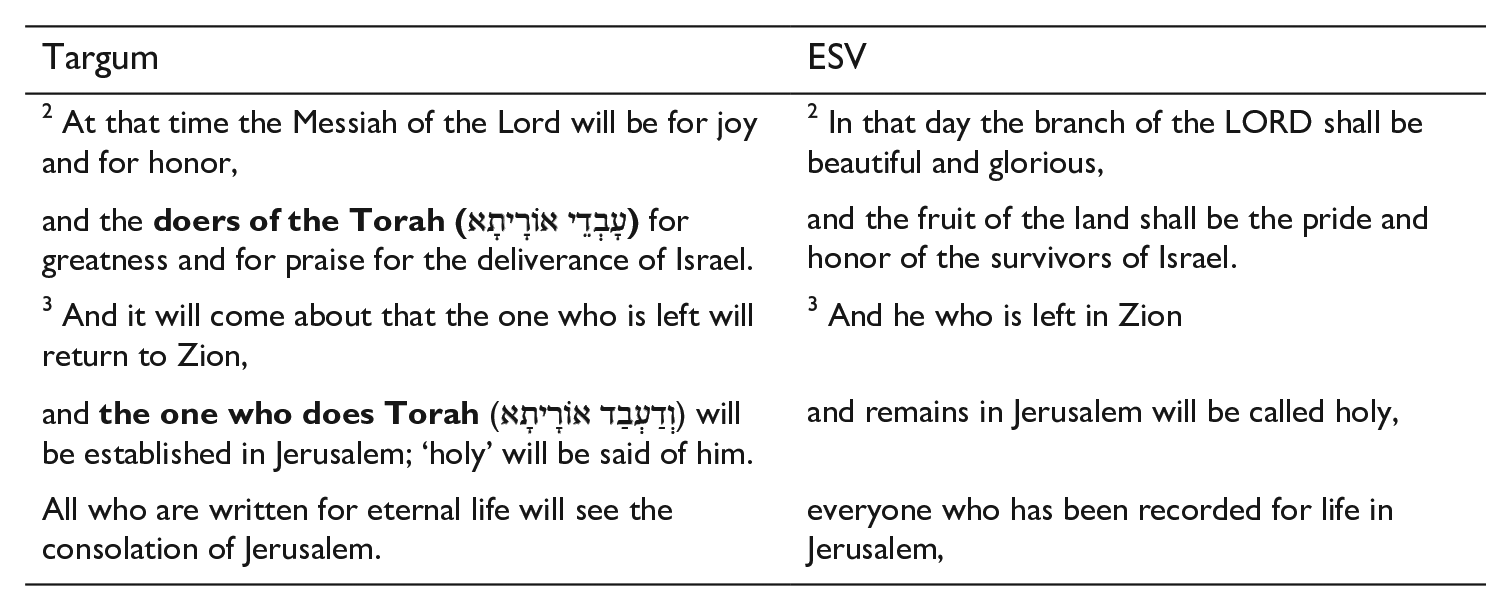
As with the previous text, the TJ offers here an explicit messianic reading arising from the internal dynamic of the text. Isa. 4.2–6 offers a final word of hope after several oracles of judgment in chapters 2 and 3 and shows that, although judgment will come, it will not be YHWH’s last word. The passage describes the eschatological restoration of Zion (see Isa. 4.5–6) by merging bridal imagery and symbols of past deliverance. The expressions ‘eternal life’ and ‘consolation of Jerusalem’ are expanded in the Targum, thus developing further the eschatological dimension already present in the text (Chilton and Flesher 2011: 184). These two verses close the oracle and describe God’s protection over the city in terms evoking the crossing of the sea and his glorious presence at Mount Sinai (and, more generally, during their wandering in the desert).
26
Then, the image of a canopy evokes the idea of God marrying his people. The word ‘branch’ (
More remarkable is the transformation that this messianic interpretation forces on the rest of the passage. The Hebrew expression ‘the fruits of the land’ (
The TJ interprets other expressions as being personal. ‘Jerusalem’s bloodstains’ (
Isa. 9.5–6
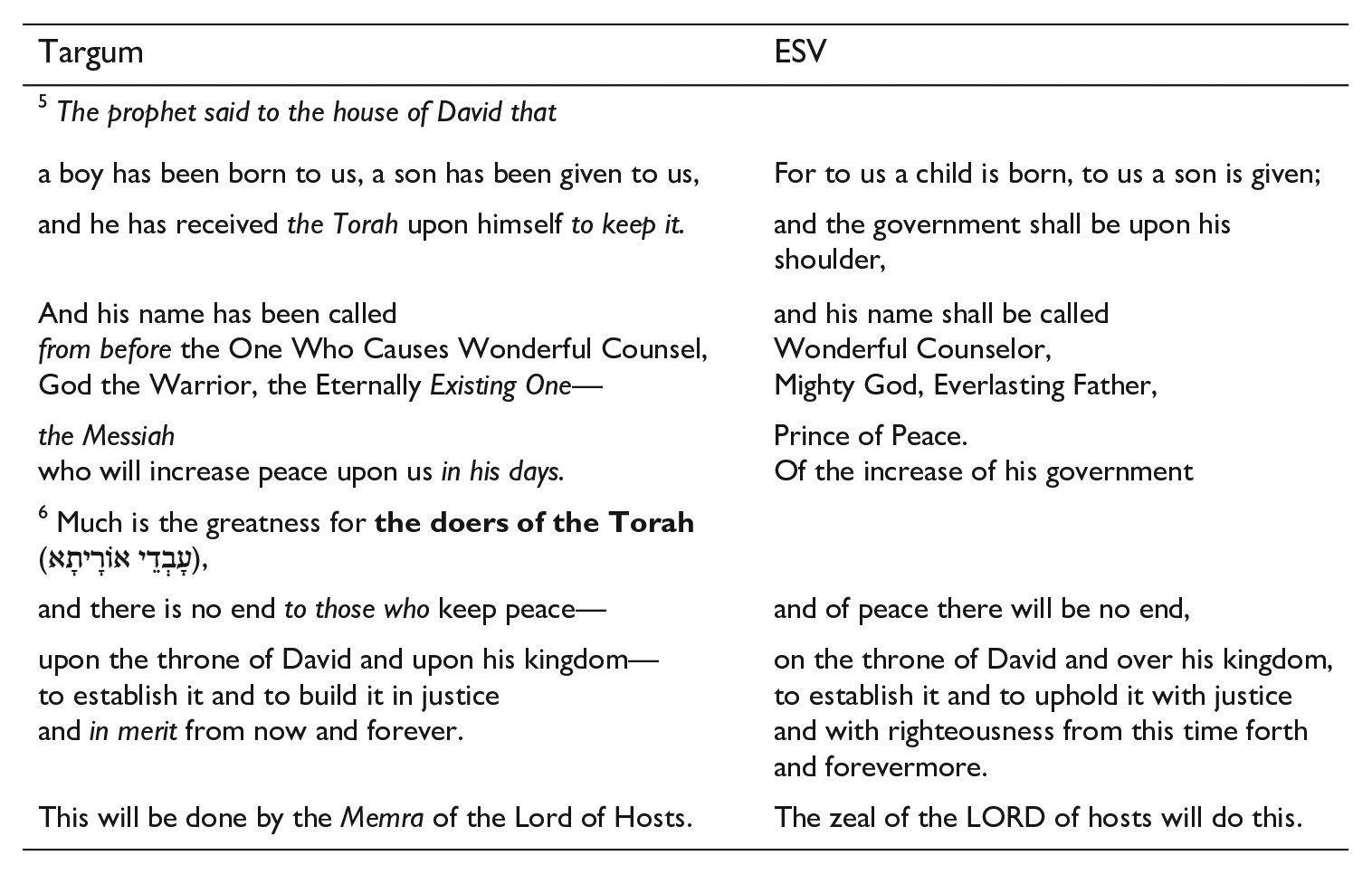
Again, the TJ renders the hope of a future restoration of the nation with an explicit messianic interpretation. 31 The logic behind the interpretation is the same as we have seen in the previous text, and there is no need to comment at length. The same connection between the Messiah—who brings peace upon the people—and the ‘doers of Torah’ is found again. The Messiah receives Torah so as to keep it himself but also so that he can teach it to others. His kingdom is one of peace and justice, and ‘the doers of Torah’ are identified again with those who keep peace. We find once more a close association between them and the Messiah, as well as a strong insistence on the ethical and social implications of Torah.
Isa. 13.11–12
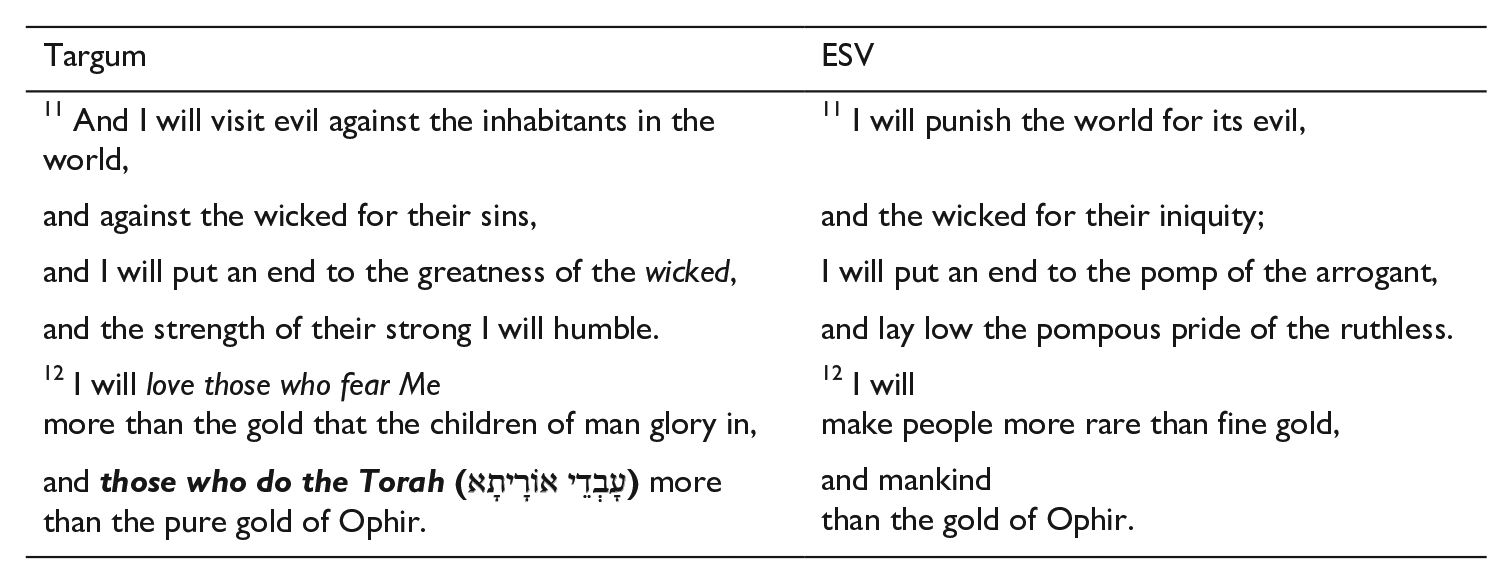
The logic of the translation is different from in the previous passages, but the meaning of ‘the doers of Torah’ is still recognizable. This pericope is set in the midst of a judgment over the king of Babylon (see Isa. 13.1) presented as the archetypical sinner. In that sense, the judgment depicted in this passage becomes a symbol of the ultimate judgment (see Isa. 13.13; Seitz 1993: 132–34).
In the MT, Isa. 13.12 provides an image of the comprehensiveness of God’s judgment announced in verse 11 against all those who are evil or arrogant. Judgment will be so thorough that human beings will be as rare as gold. In other terms, humanity will almost be wiped out. From the call to wail in verse 6 up to verse 16, the whole passage strings together a variety of metaphors for the suffering of the people and the havoc within the created order.
The TJ, however, ‘corrects’ the one-sidedness of the Hebrew text. As in many other oracles of judgment, the TJ distinguishes between the wicked and the righteous by focusing on the value of gold rather than on its rarity. Hence, the meturgeman inserts the idea of the revelation of the righteous as an important aspect of divine judgment. In this context, those who escape judgment, the ‘doers of Torah’, are said to be more valuable than the finest gold. Implicitly, they are also presented as humble and of low status since they are contrasted with the arrogant and the powerful of Isa. 13.11.
Isa. 26.19
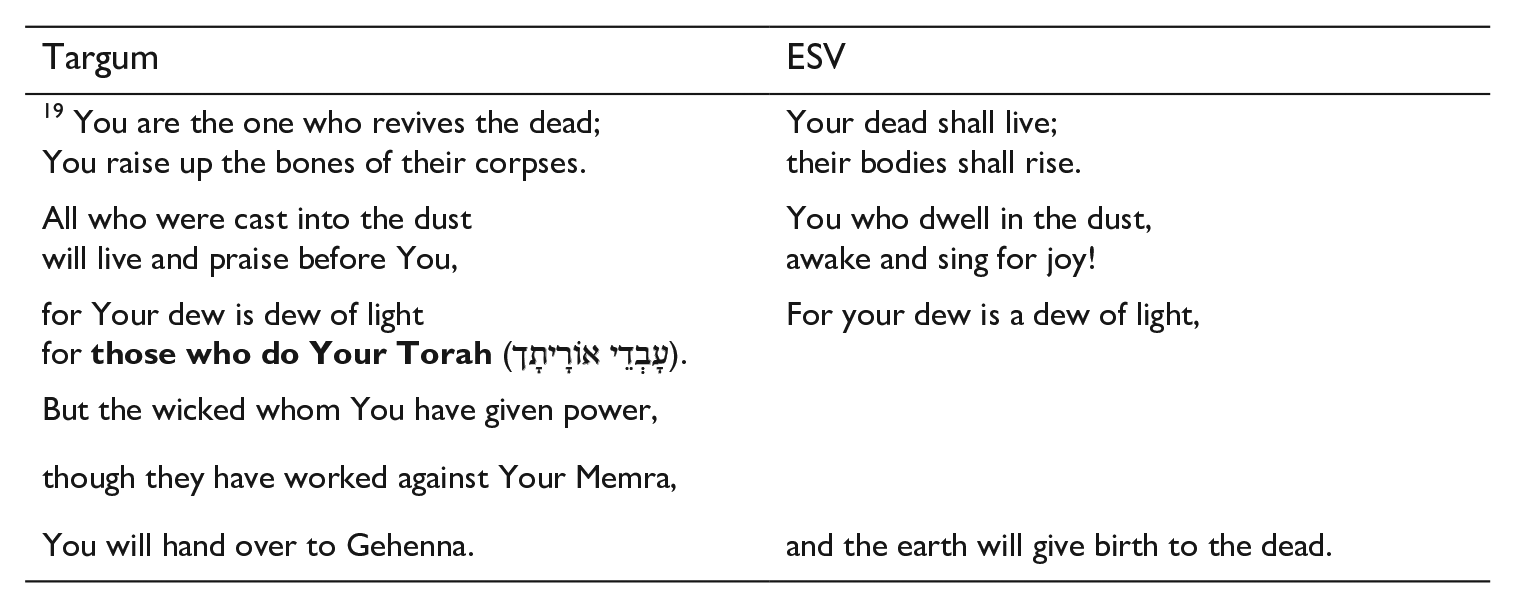
The same logic is visible in this passage. The Targum insists on the fact that God’s judgment means salvation to some and destruction to others, now by adding a warning rather than a blessing. 32 The context stresses God’s sovereignty: human beings are not able to bring salvation (v. 18), only God can save Israel from the consequences of her sins (v. 17). However, the TJ adds a long warning about the fate of the wicked. God’s ‘dew of light’ is restricted to ‘the doers of Torah’, while the wicked are sent to Gehenna. Hence, the Targum contrasts the fate of the righteous and the wicked where the Hebrew only speaks of resurrection, thus strengthening the opposition between the two. 33
Isa. 31.9
The next passage describes the defeat of the Assyrian army and of its leaders.
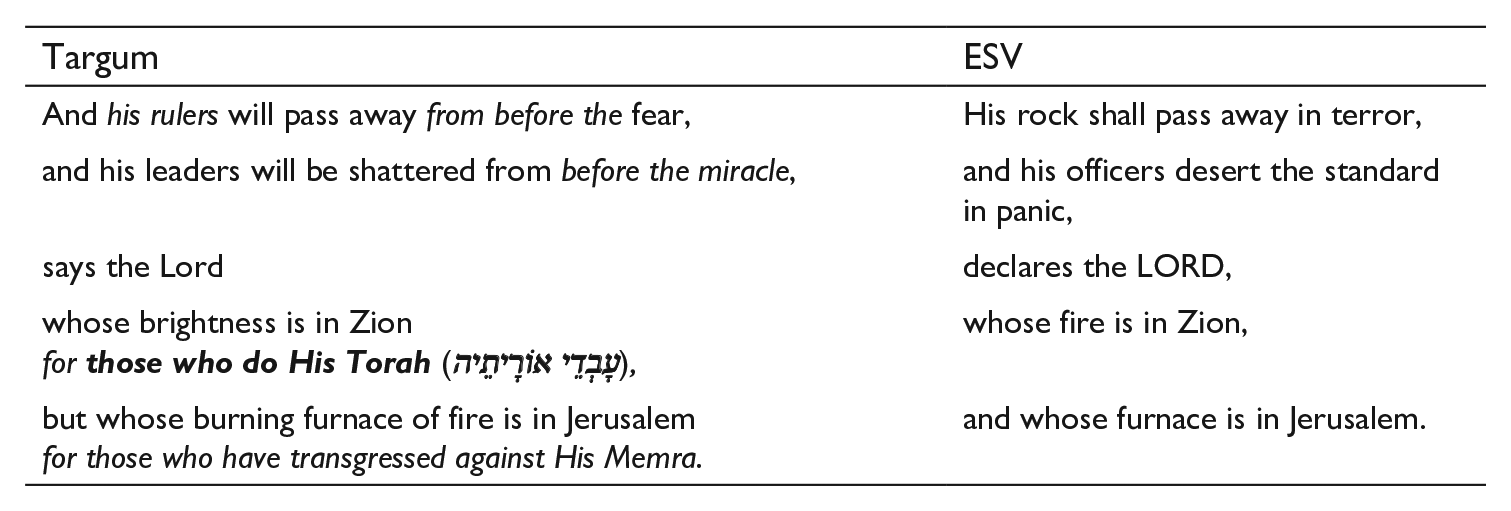
As with Isa. 26.19, this verse offers a statement of judgment and restoration. God is presented as bringing solace to those who are faithful but judgment to those who are not. The judgment is here pronounced against the Assyrian rulers, but it also concerns all those who, within Israel, trust in their own political schemes rather than in God (see Isa. 31.1, 6–7). Again, the division of the people into two groups is not clear in the Hebrew text. The Targum makes it clearer by translating ‘the fire which is in Zion’ positively and the ‘furnace in Jerusalem’ negatively, and then specifying the beneficiaries to make the distinction between the two groups unmistakable.
The oracle centers on correct instruction, and this sets the context for God’s judgment. One of its aims is the demise of the wicked who hinder the people from receiving instruction (TJ Isa. 32.6–7) so that the righteous ones (i.e. the ‘doers of Torah’ from Isa. 31.9) may teach Torah (TJ Isa. 32.2–5). 34 The ‘doers of Torah’ are thus granted an important teaching role and are even the means to the restoration of the people, building a kingdom grounded in truth and in which oppression has no place (Isa. 32.1, 6–8). In short, ‘the doers of His Torah’ represent the righteous within the people who are again contrasted with the wicked in a context of judgment. The expression is not meant eschatologically here, but the aspect of correct teaching, practiced and transmitted, is central.
Isa. 38.16–17a
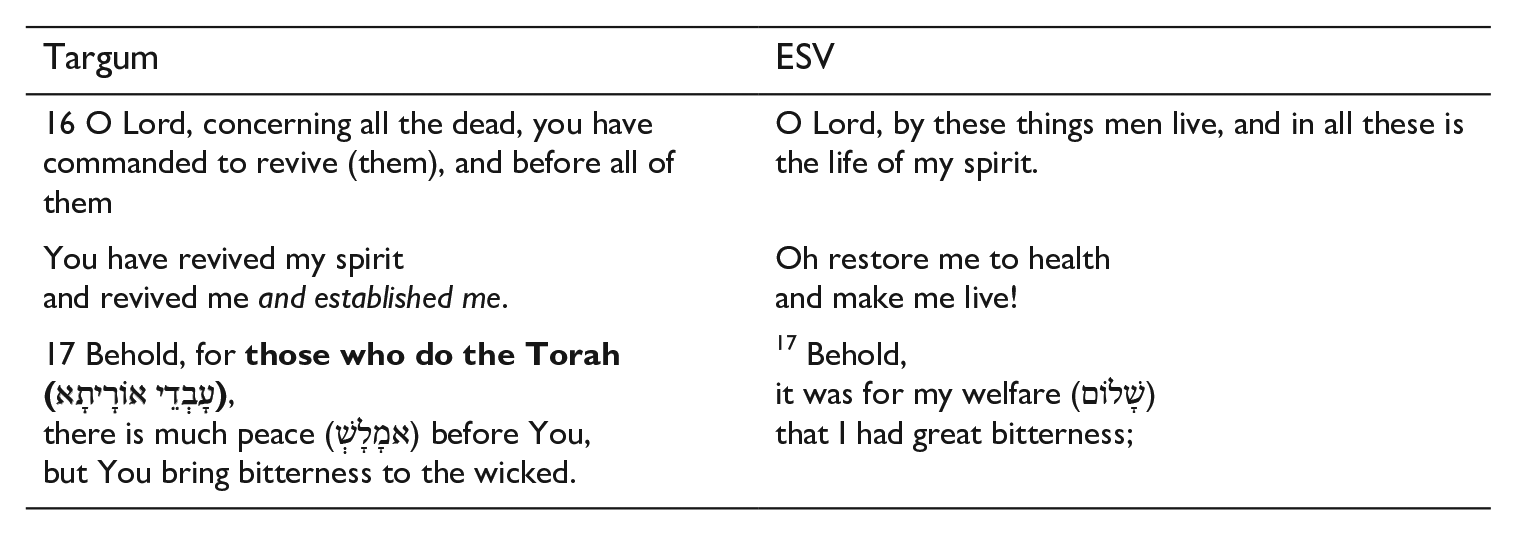
These verses are part of Hezekiah’s prayer in which he expresses his praise to God after being healed (see Isa. 38.9). The TJ gives an eschatological twist to a simple request for healing (Isa. 38.16) and a statement of restoration (Isa. 38.17). The meturgeman sees in Hezekiah’s coming back to life after his sickness a sign that God will revive human beings more generally. Moreover, he inserts his view of judgment by dividing between the painful parts and the happy ones, attributing only the latter to ‘the doers of Torah’ and promising destruction for the wicked. The division between the righteous and the wicked so characteristic of Targum theology appears once more. Implicit in the statement is the idea that Hezekiah’s plea was heard and granted because he himself was a doer of Torah. More precisely, he was numbered among the ‘establishers of Torah’ (Isa. 37.32: מְקִימֵי אוֹרָיתָא) and so became a sign for all to consider.
Isa. 42.21
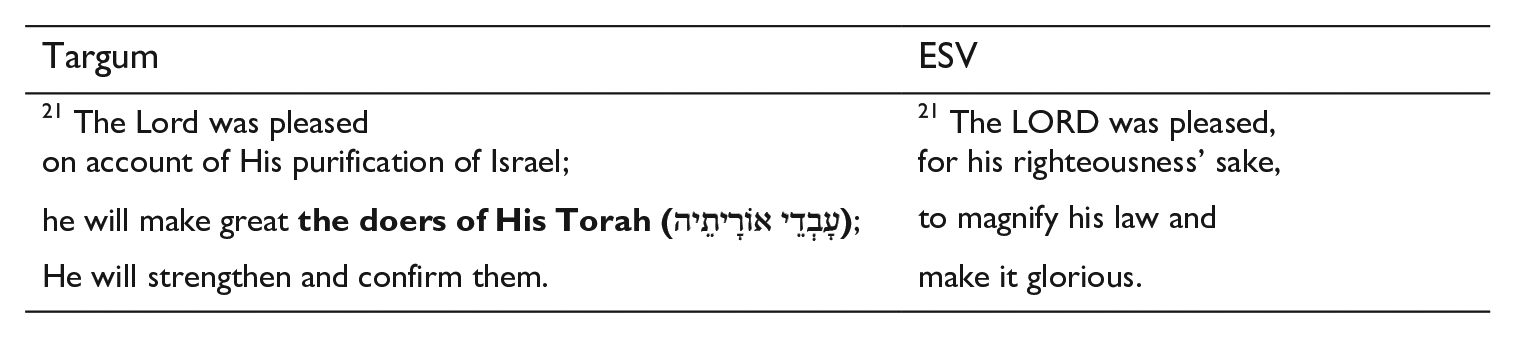
This passage is situated just after the first servant’s song in Isaiah. God establishes his servant in order to restore the people and to bring it back into the land. In the TJ, those who are blind and deaf are clearly branded as the wicked, even though the MT only speaks about ‘my people’ (Isa. 42.18–19). The passage then becomes an invitation to repent (vv. 14, 16, 18–19) in order to be healed from spiritual deafness and blindness (v. 18), as well as a denunciation of those who reject instruction (v. 20).
The ‘doers of His Torah’ are thus contrasted with the Jews who refused to heed the message of the prophet (vv. 14, 18, 24) and who, consequently, live in shame. They find themselves in the midst of a people who is deaf and blind; ‘who saw many things but did not observe them’; and who, despite having open ears, ‘did not hearken to instruction’ (v. 20). They represent the only ones who acted upon the message of the prophet. The idea of correct instruction is, therefore, essential again.
Although the passage is not fully eschatological, some of the language used in the preceding oracle hints at an eschatological restoration. In v. 16, the language of a new ‘way’ and of making level the uneven ground is meant to remind the reader of the promises of Isa. 40.3–4, and Tg. Isa. 42.11 speaks of the dead praising God ‘when they come out of their tombs’. 35
Isa. 53.9–10
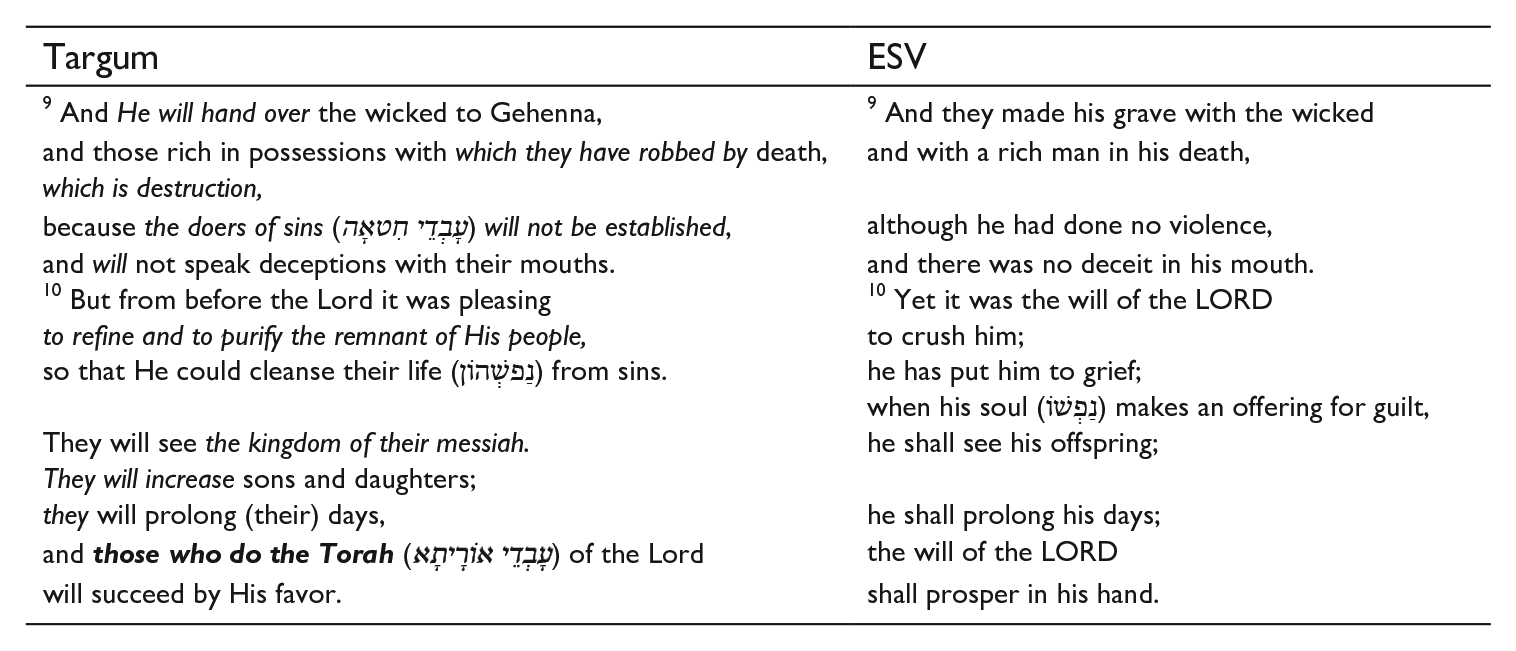
This servant’s song and its messianic interpretation in the Targum have already been studied in depth. 36 We are concerned here only with the fact that the ‘doers of Torah’ are again mentioned in close connection with the Messiah. They have been purified from sins and constitute the messianic kingdom (Tg. Isa. 53.10). Moreover, their purification is a direct consequence of the Messiah’s prayer (Tg. Isa. 53.4, 11–12) and of their obedience to his teaching (Tg. Isa. 53.5, 11). The connection is rendered even more striking by the attribution of some characteristics of the servant to ‘the doers of Torah’ (see the switch from the singular to the plural). They are also opposed to the ‘doers of sins’ from Tg. Isa. 53.9 and so stand out by their rejection of violence, robbery, and lies.
As in the other passages we surveyed, these verses stress the division within the people between the righteous and the wicked, insist on the ethical elements of the law, and on the connection between the ‘doers of Torah’ and the Messiah.
Isa. 57.1–3
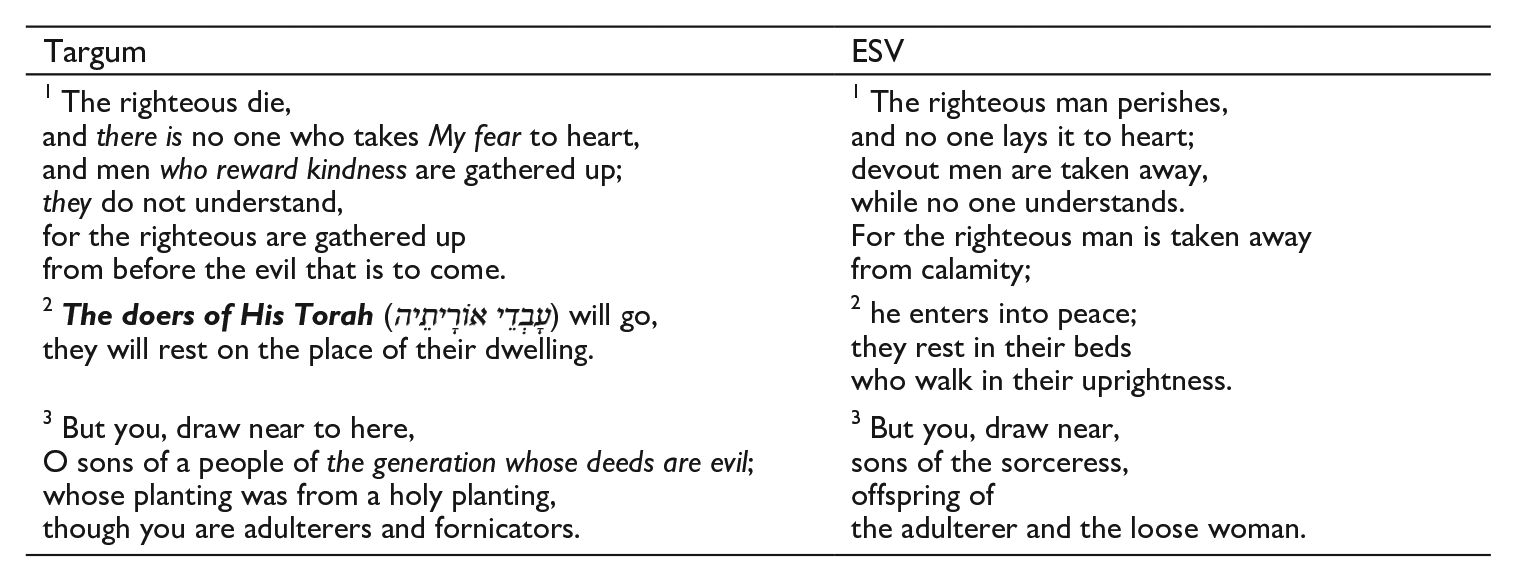
The connotation of the phrase at the opening of this chapter is not immediately obvious beyond the fact that ‘the doers of Torah’ are set in parallel with ‘the righteous’ (twice) and ‘the men who reward kindness’. When one looks at the chapter as a whole, however, things get clearer. Isaiah 57 chastises the people for failing to live up to God’s standards and for talking of repentance without any genuine return to him (Isa. 57.10). Yet, in the midst of such a faithless generation, the prophet still promises peace to those who trust him (Isa. 57.13, 14–19). This restoration, however, will mark a clear separation between those who accept God’s restoration (Isa. 57.16–19) and the wicked (Isa. 57.20–21).
The meturgeman does not modify the meaning of the chapter in any significant ways, but he rewords some of the phrases within it, which make us able to retrace some of his thoughts. In that larger context, two other verses shape the meaning of ‘the doers of Torah’ present in Tg. Isa. 57.2. That verse contains the only occurrence of the exact phrase, but a similar verbal expression appears in two other verses in the chapter. In Tg. Isa. 57.9, the meturgeman transforms the Hebrew text to say that Israel prospered ‘when [she] performed the Torah’. 37 Then, in Tg. Isa. 57.19, the famous saying ‘Peace, peace, to the far and to the near’ is rendered in such a way that ‘the far’ and ‘the near’ are delineated with more precision: ‘peace will be done for the righteous who kept My Torah from the beginning 38 and peace will be done for those who repent, who have come back to My Torah recently’. As in the Hebrew version, however, both categories are contrasted with the ‘wicked’ of verses 19–20 who will not be able to enjoy the promised peace.
In light of this, ‘the doers of Torah’ mentioned in verse 2 are those who remained blameless even when the majority of the people had forsaken the covenant. As such, they are not only a perfect antithesis to those who have the law but do not practise it (i.e., the wicked), they can also be compared positively to those who repent.
Hos. 6.6
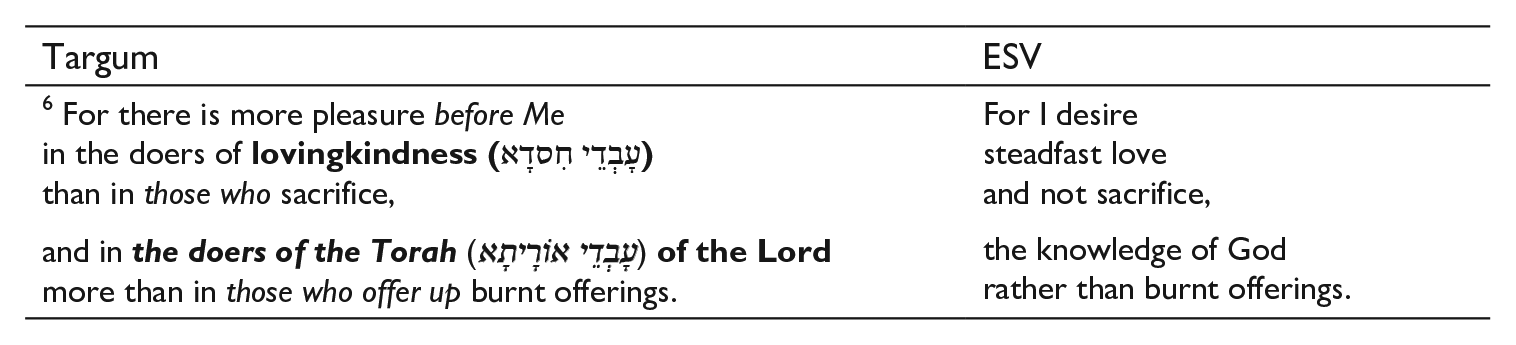
The Targum modifies the Hebrew text in two ways. First, it transforms the expression so as to avoid saying that God loves a certain behavior. He loves specific people—namely, those who practice lovingkindness and Torah. This is typical of the Targumim and could be expected. The translation of the phrase ‘knowledge of the Lord’ by the phrase ‘doing Torah’ is more surprising. It renders the phrase more explicit in what it implies. In Hosea, doing Torah has to be understood as the practice of the ethical or social elements of the Law. The examples found in the following verses—which mention robbing, shedding innocent blood (v. 8), and murdering (v. 9)—make this clear. Moreover, since lovingkindness and doing Torah are opposed to sacrifices and burnt offerings, doing Torah cannot be meant as a reference to cultic practices. When cultic elements appear (in v. 10), it is precisely because idolatry leads people to lose sight of the ethical imperative of worshipping YHWH.
In short, this text presents ‘the doers of Torah’ as the Jews who have integrated the social demands of Torah into their everyday life. They are those who let Torah shape their interaction with their neighbors, thus becoming people marked by lovingkindness who refuse violence and deal kindly with their fellow Jews.
Summary
If we now take a step back to contemplate together all the different occurrences of the expression ‘doers of Torah’, a consistent picture emerges. The expression is never found as the translation of words present in the MT. It is always freely inserted in the text. And yet, all these texts have much in common and the phrase functions in a surprisingly similar way in all of them. As we saw, the phrase appears in eleven passages. Nine of these passages contain the idea of a distinction between the righteous ones and the wicked, 39 nine are set in a context of judgment, 40 and eight point to the eschaton. 41 Moreover, the context very often speaks about proper instruction 42 and almost always bears an emphasis on the ethical element of Torah. 43 Finally, ‘the doers of Torah’ are sometimes depicted as closely associated with the Messiah. 44 In short, ‘the doers of Torah’ refers to a group of Jews who remain faithful to God at the end of times and who are opposed to a rejected group. The expression functions as a fixed expression, or even as a technical term: it is the community of those who remain faithful to God up to the end, who let their life be shaped by the ethical demands of the law, and who are distinguished from other Jews who think they belong to God’s people but who do not.
Now, of course, this does not yet mean that the expression was already in use in the first century or that it has the same meaning outside of the Targumim. It is here that the Dead Sea Scrolls come into play.
Evidence from the Dead Sea Scrolls
Although the Aramaic expression עָבְדֵי אוֹרָיתָא never appears in the manuscripts of Qumran, we do find a Hebrew equivalent (עושי התורה) six times within the pesharim. 45 What makes this particularly interesting is that the phrase bears comparable connotations as those I have highlighted from the Targumim. If this was all the evidence we had, the sample would be too small to draw clear conclusions on its meaning with confidence. However, since a clear meaning emerged from a larger sample in the Targumim and fits the context in which the expression appears in the DSS, it strongly suggests that the phrase existed in Hebrew before the turn of the era and that its meaning was sufficiently explicit to assure a remarkable stability over time.
The expression עושי התורה is found in three different pesharim: once in the pesher of Micah, three times in the pesher of Habbakuk, and twice in the pesher of Ps. 37. 46 There is no need to comment each of these texts separately, but a quick overview is telling.
1QpHab 7.9–8.3, 11.17–12.5 47
7.9 ‘If it tarries, be patient, it will surely come true and not
10 be delayed’ (Hab 2.3b). This refers to those loyal ones,
11
12 loyal service even when the Last Days seem long to them, for
13 all the times fixed by God will come about at their proper time as He ordained
14 that they should by his inscrutable insight. ‘See how bloated, not smooth,
15 [his soul is!’ (Hab 2.4a).] This means that [their punishment] will be twice as much for them
16 [and they will not] find favor when they come to judgment […]
17 […] [‘As for the righteous man, by loyalty to him one may find life’ (Hab. 2.4b).]
2 God will rescue from the place of judgment, because of their suffering and their loyalty
3 to the Teacher of Righteousness. . . .
2 The passage refers to the Wicked Priest, that he will be paid back
3 for what he did to the poor, for ‘Lebanon’ refers to
4 the party of the Yahad, and ‘beasts’ refers to the simple-hearted of Judah
5
The Habakkuk pesher sees the whole book of Habakkuk as a description of the circumstances of the community and the strife between its leader and the Jerusalem priesthood. Hence, the author projects some events of his own time onto the words of the prophet and thereby heightens their eschatological connotation. 49 In his composition, the author describes the members of the righteous community as ‘doers of the law’, where no linguistic parallel from the prophecy invites that specific appellation.
Most translators understand the ‘doers of the law’ in 1QpHab 8.1 as standing for the ‘righteous man’ (צדיק in 1QpHab 7.17), which is read as a collective noun (e.g., Brownlee 1979: 126). Hartog notes that ‘the righteous man’ could also refer to the ‘teacher of righteousness’ and proposes that this reading makes more sense in the context. 50 If he is correct, then the ‘doers of the law’ represent the group of people who put their faith in ‘the teacher of righteousness’, and the expression matches quite well its meaning in the four passages we discussed in which the ‘doers of the law’ are closely associated with obedience to the Messiah. 51 In any case, whether one accepts Hartog’s reading or not, all three references present ‘the doers of the law’ as righteous people who accept instruction from the teacher of righteousness and who are declared righteous because of it.
Hence, the dynamic we observed in the Targumim between the teaching Messiah and ‘the doers of the law’ is also at work here. They also designate a group of Jews who remain faithful to God at a time when many other Jews do not, at least according to the teacher. Moreover, the expression is eschatologically connoted since this passage is set ‘in the Last Days’ (7.12; see also Hab. 2.3a cited and interpreted in 1QpHab 7.6–8) and warns about the impending judgment multiple times.
4Q171 f1-2, 2.14, 22 52
Psalm 37 is an acrostic psalm that offers a poetic reflection on the fate of the wicked and of the righteous, inviting the latter not to fear the scheme of evil people because God defends them. The interpretation given in 4Q171 remains faithful to the central theme of the psalm, even though it re-contextualizes it into the experience of the community (Keener 2012). Hence, the context of the division between the righteous and the wicked that we observed in places where the expression ‘doers of the law’ appears in the Targumim happens to be the central theme of this text. Two verses are of particular interest to us.
12 ‘The wicked plots against the righteous and gnashes [his teeth against him. But the Lo]rd laughs at him, for he knows
13 his day is coming’ (Ps. 37.12–13). This refers to the cruel Israelites in the house of Judah who
14 plot to destroy
21 ‘Better is the little the righteous has than the great abundance of the wicked’ (Ps. 37.16). [… This refers to]
22
The righteous are twice depicted as ‘those who obey Torah’ (once in the plural, once in the singular), always in a context of eschatological judgment and a division between the Jews who remain faithful to the ethical teaching of the law and those who are rejected by God because of their violence.
1Q14 (= 1QpMic) f8 10.5–9 53
5 . . . ‘And what are Judah’s high places?
6 [Behold, they are Jerusalem.’ (Mic. 1.5). This refers t]o the Teacher of Righteousness who himself
7 [shall teach the law to his par]ty and to all those who are willing to be added to the chosen of
8 [God,
9 [Judgment …]
This text is more damaged than the other ones and must be treated with more caution, but I include it here for the sake of completeness. Again, we find that ‘the doers of Torah’ are those who are being taught the law adequately (10.7) and who will be saved on the day of judgment (10.8-9), in a context implying a division between the Jews who remain faithful and those who do not. Hence, it simply confirms what has already been said.
Summary
The expression does not occur often enough to give new insight and its use seems to be quite stereotypical. However, it is significant that the expression is only found in contexts that closely match those in which the Aramaic equivalent appears in the Targum.
In all six cases, the text contrasts the righteous with the wicked, speaks about the eschatological judgment, and describes a division within the people of Israel in the last days. The ‘doers of Torah’ are those who belong to the community (yahad) and obey the ‘teacher of righteousness’. Hence, they are consistently opposed to other Jews who, in the eyes of the writer, did not remain faithful to the covenant. 54 We also note that the three biblical texts (Habakkuk, Micah, Psalm 37) on which these pesharim are based have in common that they denounce social injustice and violence and picture God as siding with the oppressed. 55
In short, the main features of the phrase in the Targumim are also present in Hebrew expressions found in Qumran. Three of them—a distinction between the righteous and the wicked, the context of judgment, an eschatological perspective—are essential to the term in Qumran. The last one—the importance of ethical behavior—is present but loses its centrality. The only significant difference between the two corpora is that the pesharim describe members of a sectarian party within Judaism whereas the Targumim speak of faithful Jews within the people who are not separated by other means than their behavior and thoughts.
The six occurrences of עושי התורה in the Qumran scrolls thus prove that the phrase existed before the turn of the era and that it already designates those who will be deemed righteous in the last days. Hence, the eschatological import of the phrase and its use as a quasi-technical term for the righteous is attested before the first century.
Aramaic, Hebrew, and Greek Expressions
If any specific expression lies behind the phrase ‘doer of the word’ (ποιητής λόγου) in Jas 1.22, the Hebrew expression עושי התורה and its Aramaic translation עָבְדֵי אוֹרָיתָא is the best candidate. As I have shown, this expression possesses a clear meaning by the first century already, and this meaning remained so stable that its connotations were still recognizable a few centuries later. Thus, I propose that it is quite possible that James’s first audience—to be precise: those among his audience who understood Hebrew or Aramaic—was familiar with the expression and got its overtones.
Three obvious objections can be raised against my proposal. First, the number of references (11 in the Targums and 6 in the DSS) may seem too small to establish such a stable meaning, especially since the pesharim are a very specific genre and that the Targumim got their final form at a much later date. Obviously, more occurrences would be welcome. Yet, the cluster of themes common to most of the passages in which the idiom appears is striking and can hardly be treated as a coincidence. This is especially true since the phrase is always inserted into a text that does not contain any equivalent in the MT. Since the text of the Targumim was achieved through a long process of discussion and so represents ‘the authoritative views current at the time and not . . . the expression of purely individual exegesis’ (Stenning 1949: viii), the phrase must have possessed a sufficiently clear meaning for the meturgeman. 56
A second would be that, even if one grants the existence of the idiom and its meaning, one may wonder whether Greek speakers would be able to recognize it in another language. This is a genuine issue. It is impossible to know whether or not a given expression would be recognized once translated. However, this is taking the problem by the wrong end, I believe. The fact is that the idiom ‘doers of the law’ existed in Hebrew, in Aramaic, and in Greek. That they all arose independently in a context in which many interpreters of Scripture were familiar with two of these languages at least seems very unlikely to me. The most reasonable assumption is then that these idioms must be related in some ways. Hence, the likelihood that the existing Hebrew phrase influenced James—consciously or not—is quite high. If this is so, then understanding the specific connotations of the Hebrew phrase is essential. The phrase ‘doers of the law’ probably did not have any specific connotation for many readers, but it does not follow that these were absent and it remains at least possible (in my view very likely) that some readers recognized the expression. This is no mathematical proof, but such evidence should not be neglected when available.
And finally, there is the problem that James does not speak in Jas 1.22 of ‘doers of the law’ (ποιηταὶ νόμου, as in Jas 4.11) but of ‘doers of the word’ (ποιηταὶ λόγου). This is probably the weightiest objection. Two things, however, help us make sense of the shift from νόμος to λόγος. First, the two words are almost synonymous in the context of Jas 1.21–25. The passage aims at reminding the reader that religious knowledge is not worth anything if it is not put into practice. The ‘word’ James speaks about is a life-giving word—literally a ‘birthing’ word (Jas 1.18)—and a saving word (Jas 1.21). That word is no mere human chatter, it is a word with intent and power. As we saw previously, the image of the mirror implies that ‘the word’ and ‘the law’, although they may not be exact synonyms, are clearly not different realities either. Both function in this context as a word coming from God, which, when received correctly (Jas 1.21), brings life and salvation. This word may be heard through other means than the Torah, but there is no possible doubt that the Torah is part of that word. In all probability, James assumes that listening to the Torah is the best and most common way to hear the word. In practice, then, there is no functional difference between ‘doers of the word’ and ‘doers of the law’, both expressions would mean the same thing.
Second, the TJ shows some variation to the expression עָבְדֵי אוֹרָיתָא. In four places in which God’s word or decree plays a prominent role in the context, one finds the phrase ,,עָבְדֵי מֵימְרֵיה which is best translated ‘doers of my word’. 57 The expression is found in Tg. Isa. 40.10, 13, 62.11, and Tg. Joel 2.11. I have not discussed these four occurrences for lack of space, but the context and meaning of the phrase is identical to the eleven others we discussed from the Targumim. This goes to show that, depending on the dominant theme of the context, the phrase ‘doers of the law’ was susceptible to be slightly modified into ‘doers of the word’ while maintaining its overall meaning. If this was acceptable in Aramaic, why would it be impossible in Greek?
Implications
Accepting that the phrase ποιηταὶ λόγου in Jas 1.22 is a Greek translation of עושי התורה or עבדי אוריתא does not revolutionize one’s understanding of the passage, but it implies that James’s first audience heard his call to become ‘doers of the word’ with a much greater urgency than it is often assumed. They would know that the phrase implies a context of judgment, strengthening the eschatological import of the salvation mentioned in Jas 1.21 and the macarism of Jas 1.25. Becoming a doer of the word was not an invitation for those who wanted to go the extra mile and become extraordinarily zealous for their faith. In that context, the only two options were to be counted among the doers of the word or to renounce taking part in God’s kingdom altogether.
Moreover, the ethical aspect of that word would not come as a surprise. The importance of holding one’s tongue in check might be a little surprising, but people would know that to be ‘a doer of the law’ meant to pay close attention to the ethical commands more than anything else.
Quite clearly, my argument also has implications for Jas 4.11–12 (where the phrase ποιητὴς νόμου appears) and Rom. 2.12–13 (where ποιηταὶ νόμου also appears in opposition to the ἀκροαταὶ νόμου). If ‘doers of the law’ was indeed a fixed expression, as I suggest, then these passages also likely refer to the same expression. More research is needed to assess how much and in what ways these two passages are affected by noting this background. The proposal made in this article may also contribute to shedding some new light on the ideas or expressions that were formed in Qumran but that found their way into other streams of Jewish thought or early Christianity. This might be a topic for further research.
Footnotes
Funding
The author(s) disclosed receipt of the following financial support for the research, authorship, and/or publication of this article: The author wishes to thank the Swiss National Science Foundation (SNFS) for funding the research project that gave rise to this article. This article is available open source thanks to the agreement between the Consortium of Swiss Academic Libraries has with Sage Publishing.
1.
For the sake of simplicity, I will refer to the author of the letter simply as ‘James’ without entering here the debate on the authorship of the letter.
2.
See Ropes (1916), Mussner (1964: 104), Cantinat (1973: 107), Dibelius (1975: 114), Laws (1980: 85), Johnson (1995: 206), Hartin (2003: 98), McCartney (2009: 119 n. 13, 125), Davids (2013: 96),  : 325).
3.
‘To do Torah’ is found in Ezra 7.10, Neh. 9.34, and 2 Chron. 14.4. ‘To do (all) the words of the law’ (הַתּוֹרָה עֲשׂוֹת אֶת־כָּל־דִּבְרֵי ) is found in Deut. 17.19, 27.26, 28.58, 29.29, 31.12, 32.46. ‘To do according to (all) the words of the law’ (עֲשׂוֹת אֶת־כָּל־דִּבְרֵי הַתּוֹרה) is found in Josh. 1.7 and Ezra 10.3. Similar expressions (‘to do the commands of the law’, ‘do what is written in the book of the law’, etc.) also exist, but it would be pointless to list them all here. : 325) points to other texts that combine עשׂה and דבר.
4.
The expression is found in Ezra 7.25; Sir. 9.17; 4Q424 frag. 3, line 7; and five times in 4QInstruction.
9.
10.
Wold (2020: 85). Cf. the understanding of the ‘implanted word’ by : 139–54).
12.
13.
14.
The variant is found most importantly in C2 and in some later minuscules (436, 1852). Another variant reading in Jas 1.25 (found in minuscule 33) is also interesting: ‘οὐκ ἀκροατὴς ἐπιλησμονῆς γενόμενος ἀλλὰ ἀκροατὴς νόμου καὶ ποιητὴς ἔργου’. In this variant, the ‘forgetful hearer’ is contrasted with the ‘hearer of the law’.
15.
One could also point to another related expression ἐργάτης λόγου (also anarthrous) found in the Apostolic Constitution 7.28: ‘Every true prophet or teacher that comes to you is worthy of his maintenance, as being a labourer in the word of righteousness (ὡς ἐργάτης λόγου δικαιοσύνης)’ (ANF). Here, also, the lack of an article does not turn the expression into a vague ‘word-doers’ in which λόγος would have no specific content.
16.
James repeatedly invokes the scriptures: he appeals to the command to love one’s neighbor of Lev. 19.18 (Jas 2.8) and to the ten commandments (Jas 2.11); turning one’s belief into concrete action is motivated by an appeal to Abraham and Rahab (Jas 2.21–25); multiple references to Genesis back up the discussion on proper speech (Jas 3.7–9); etc.
17.
Expressions like ‘to do my [Jesus’s] word’ (ποιεῖν τὸν λόγον μου) of ‘to do God’s word(s)’ (ποιεῖν τὸν λόγον / τοὺς λόγους τοῦ θεοῦ), sometimes with minor variations, are found in Ex. 19.8, 24.3, 35.1; Lev. 8.36; Deut. 1.18, 12.28; Lk. 6.47, 8.21. Phrases akin to ‘to do the law’ (τὸν νόμον ποιεῖν) or ‘to do the words of the law’ (ποιεῖν τοὺς λόγους / τὰ ῥήματα τοῦ νόμου) are found in Deut. 28.58, 29.8, 29.28, 31.12, 32.46; 2 Kgs 17.37; 1 Chron. 22.12; 2 Chron. 14.3; Ezra 7.26; Neh. 9.34; Jn 7.19, Gal. 5.3. ‘To do the commandments of the law’ is found in Deut. 30.10; Josh. 1.8, 22.5, 23.6; Ezra 7.10; Neh. 10.30; 1 Macc. 13.48. The list is not exhaustive.
18.
Unfortunately, Wold (2020: 83–85) does not always do justice to those he criticizes. He sees the expression ‘doers of the law’ (עושי התורה) found in ‘1QpHab VIII 1’ and ‘1QpPsa (4Q171 1 2 ii 14, 22)’ as the closest parallel to what we find in Jas 1.21 and claims that his opponents failed to refer to it, which is incorrect. McKnight (2011: 147 n82) mentions 1QpHab 8.1 in his commentary, and Allison (2013: 325 n64) refers to these references and a few other ones (1QpHab 7.11, 12.4–5). : 114) can hardly be criticized for failing to mention these references since he wrote decades before the discovery of the manuscripts in Qumran (Dibelius’s commentary was originally published in 1921).
19.
22.
The Targum plays with the Hebrew words and tries to base its interpretation on their sound. The ‘foal’ (עַיִר) of the first cola is read as if the word means ‘a city’ (עִיר) and is translated with a more poetic synonym (קִרְיָה). The fact that the vine is a common image for Israel may have influenced the interpretation. However, since the two texts are so different, there is no point in making a word-by-word comparison between them.
23.
The donkey’s ‘colt’ (literally, son: בְּנִי) is read in such a way that it evokes people building (יִבנוֹן from the verb בָּנָה) the temple.
24.
Aberbach and Grossfeld (1982: 289) think that the ‘doers of Torah’ may refer to Torah scholars traveling on donkey’s back during teaching trips. This interpretation, however, seems far-fetched. There is no reason to restrict this designation, and so it is best understood as referring to all Jews remaining faithful to God’s commands as expressed in Torah. See also : 164–65).
25.
26.
For the cloud acting as a protection for the people, see Exod. 14.19–20, 24–25. At the giving of the law, some texts speak of the cloud only (Exod. 19.9, 16, 18) while others speak of both cloud and fire (Exod. 24.15–18, Deut. 4.11, 5.22). For the cloud and fire accompanying the people during their time in the wilderness, see Exod. 13.21–22, 40.38; Num. 9.15–16, 14.14; Deut. 1.33; Neh. 9.12, 19; Ps. 105.39. These images were well-known and largely expanded on early Judaism.
27.
The term צֶמַח also refers to a future ruler in Jer. 23.5, 33.15; Zech. 3.8, 6.12. Isa. 4.2 expresses in different words the hope also expressed in Isa. 11.1–2. The exact expression ‘the branch of the Lord’ (צֶמַח יְהוָה) appears only here. Commentators are divided on whether צֶמַח possesses a messianic connotation here or not. Because of the parallelism with the expression ‘fruit of the land’, some think it has no messianic connotation. See, e.g., Clements (1980: 54); : 203). Blenkinsopp also notes, however, that ‘Early interpretations of this verse in both Jewish and Christian circles found a messianic allusion here, notwithstanding’.
28.
A similar interpretation is also found in Tg. Isa. 11, but it uses different words and will not be analyzed here.
29.
30.
By using the same word for beauty (MT: תִּפְאֶרֶת; TJ: לתוּשׁבְחָא) in Isa. 3.16 and Isa. 4.2, the text hints at the fact that true beauty is not a matter of rich ornaments but that of acts of mercy.
32.
This is already visible in Isa. 26.5.
33.
This double-edged view of the judgment is stressed again a few verses later. In Isa. 27.4–5, the meturgeman introduces a conditional statement (‘if the house of Israel sets before themselves to do the Torah . . . ’ לְמַעְבַד אוֹרָיתָא, peal inf. constr.) as he translates a fully positive comment.
34.
35.
There is no Hebrew equivalent for this.
36.
The same dynamics we saw in the first servant song is also at play in this passage, where the TJ also attributes all the unpleasant things to the wicked. See Ådna (2004: 189–224) and : 81–98) for a broader study of these passages in the TJ.
37.
כַד עְבַדת לִיך אוֹרָיתָא, peal perfect.
38.
שְׁלָמָא יִתעְבֵיד לְצַדִיקַיָא, ithpeel imperfect.
39.
All but TO Gen. 49.11 and Tg. Isa. 9.6.
40.
All but TO Gen. 49.11 and Tg. Isa. 38.17.
41.
All but Tg. Isa. 31.9, 38.19, and Tg. Hos. 6.6.
42.
All but Tg. Isa. 4.2, 13.12, and 38.17.
43.
All but Tg. Isa. 38.17 and 42.21.
44.
This appears four times, in TO Gen. 49.11 and Tg. Isa. 4.2, 9.6, and 53.10.
45.
I have used as a research tool the text prepared by Martin G. Abegg for the Accordanceⓒ software in the module ‘Qumran Non-biblical MSS’. Two of these six occurrences depend on accepting the reconstruction of the Hebrew text in places the manuscripts are no longer clearly legible.
When Hebrew words are given, their source will be given in the footnotes. All the English translations in this section come from the Accordanceⓒ software module ‘Qumran Non-biblical English’, which offers the same text as Wise, Abegg, and Cook (1996).
46.
1Q14(= 1QpMic) f8 10.7, a pesher on Micah 1.5–6, 1QpHab 7.11 and 8.2, a pesher on Hab. 2.3–4, and 4QpPsa (=4Q171) f1-2, 2.14, 22, a pesher on Ps. 37.12–13 and 16.
47.
The Hebrew text is taken from Horgan (2002b: 157–86). According to : 157), the manuscript is from the early Herodian period.
48.
The reconstruction is debated, but most scholars believe the singular is a scribal error and stands for the plural. See discussion in Horgan (1979: 53) and : 196–97).
49.
For an introduction to 1QpHab, see Bernstein (2000: 647–50) or : 252–53).
51.
To be sure, the ‘teacher of righteousness’ is no messianic figure, but TO Gen. 49.11, Tg. Isa. 4.2, 9.6, and 53.10 all picture a ‘teaching messiah’ who brings salvation partly by his (proper) teaching. Similarly, 4QpHab also presents the ‘teacher of righteousness’ as being instrumental to the salvation of the community through his teaching ministry. Thus, the importance of proper teaching appears in these few passages, even though the teacher is a different figure.
52.
The Hebrew text is that prepared by Allegro (1968: 43–49). According to : 6), the manuscript is dated to the Herodian period.
53.
The Hebrew text is that prepared by Barthélemy and Milik (1955: 77–80). : 133) dates the manuscript to around 30 BCE.
54.
Although the fact is not crucial, it is interesting that the plural noun עושי is one of the proposed etymology for the term ‘Essene’. This would make good sense if one accepts the phrase עושי התורה as a self-description for members of the groups, as most do. Even though this remains speculative, it would help explain how the phrase got such a stable meaning. See Goranson (1984: 483–98) and Brownlee (1979: 119, 196–97, 204). Vermes (1960) offers the best review of the different proposals for the origin of the word Essenes. Vanderkam (2012: 100–104) and : 169ff) are two examples of scholars championing the derivation of עשׂה.
55.
This fact remains, even though the ethical dimension of the original text is sometimes spiritualized and so downplayed (particularly in the Habakkuk pesher). 1QpMic is too fragmentary to reach any conclusion, but 1QpHab and 4Q171 interpret terms like ‘the poor’ as describing those who belong to the community, thus diminishing somewhat the ethical import of the message. The ethical component of Ps. 37 still comes out quite clearly in 4Q171, but it is more consistently downplayed in 1QpHab. The injustice denounced by the prophet is read as a reference to those who opposed the Teacher of Righteousness and the references to the poor (as in 1QpHab 12.3) lose much of their social meaning since they are not understood in socioeconomic terms but in religious ones. In short, the ‘doers of the Law’ keeps its eschatological connotation but does not retain all of its ethical content. Maybe this is not particularly surprising since the pesharim are designed to justify the community’s existence and to assert the authority of its founder.