




Abstract
The claim that the historical Jesus was a violent revolutionary has seen a revival in recent years with the work of Dale Martin and Fernando Bermejo-Rubio. Central to their case is the datum that Jesus’s disciples were armed at the time of his arrest in anticipation of their active participation in an end-time battle. However, whilst it can be established that it is likely that the disciples did carry bladed implements that could be used as weapons, when the literary and material-cultural evidence is scrutinised more closely, it is unreasonable to infer that these were intended to be used for apocalyptic ends or that the disciples or anyone else would see them as evidence of military intent.
1. The Question
This essay is prompted, in part, by the revival of the claim that the historical Jesus was a violent revolutionary of some kind, intent on overthrowing the Roman authorities and their collaborators by force of arms. This largely moribund argument, the so-called Seditious Jesus Hypothesis, 1 has been given new life by scholarly contributions of Dale Martin (2014, 2015) and Fernando Bermejo-Rubio (2013a, 2013b, 2014, 2015, 2018a, 2018b) as well as others. 2 The high-profile work of Reza Aslan, Zealot: The Life and Times of Jesus of Nazareth (2013), also added considerably to its reemergence, at least at a popular level—even if, on closer inspection, the claims about the historical Jesus in that book fall somewhat short of what might be reasonably assumed from its title. 3
The revival of this hypothesis may come as a surprise to some in the study of the historical Jesus. Jesus and the Politics of His Day (Bammel and Moule 1984), published nearly forty years ago, is often considered the definitive treatment of the subject and one that, in the judgement of many in the field, dealt the thesis of a seditious Jesus ‘a fatal blow’ (McKnight 1999: 229, n. 70), countering the work of S. G. F. Brandon (1967), Robert Eisler (1929, 1931), and other advocates of this position from earlier generations. 4 The Seditious Jesus Hypothesis is hardly a new thesis. After all, it has been something discussed within biblical scholarship since at least the publication of Hermann Reimarus’s Fragments (1774) 5 and in radical, polemical, and proto-critical literature for some centuries before that. 6
However, in this paper I do not intend to revisit the critical issues raised by the Seditious Jesus Hypothesis in toto, 7 nor do I intend to engage comprehensively with the work of Martin and Bermejo-Rubio—although their contributions should not be passed over too quickly, as they bring to the discussion fresh perspectives on familiar material that needs serious consideration. Rather, what interests me here is narrower: can we reasonably infer anything apocalyptic 8 from the datum that Jesus’s disciples were armed at the time of his arrest?
The datum that Jesus’s disciples were armed at the time of his arrest has played a major part in the arguments of those scholars who believe that the historical Jesus was a violent insurrectionist since the beginning of critical scholarship (e.g., Reimarus 1879: 88). In more recent years, it has also been central to the cases made by Martin and Bermejo-Rubio.
9
For Martin, for example, it is the possession of weapons by Jesus’s followers that explains why the Romans put him to death (Martin 2014: 20). For Bermejo-Rubio, it contributes to a discernible pattern in our sources that reveals Jesus was a violent seditionist, and the fact that Jesus’s disciples were armed is something to which he regularly returns in building his case (Bermejo-Rubio 2014: 10).
10
And such scholars believe the datum is best interpreted apocalyptically. For Martin, ‘Jesus’s apocalyptic expectations must be brought into any scenario that would explain why his disciples were armed in Jerusalem’ (Martin 2014: 4, fn. 2). More specifically, Jesus was expecting the inbreaking of apocalyptic events. If he had come to believe that he himself was the Messiah (something I think is possible but not certain), he was expecting an angelic army to break through the sky, engage the Romans and their Jewish clients in battle, overthrow the Jewish leaders and Roman overlords, and establish the kingdom of God on earth, all under his own leadership as God’s Anointed. If Jesus thought of himself as a prophet and precursor of the Messiah, he would have expected that army to be led by the Messiah. In either case, he would expect that he and his followers would participate in the battle, along with the much more numerous angels, just as some documents from the Dead Sea Scrolls indicate that those Jews thought they would participate in an apocalyptic battle. (Martin 2014: 6–7)
11
Bermejo-Rubio makes comparable claims. For example, The several sayings on the swords are to be explained as indications of the leader to his followers to be well prepared for an eventual battle in the messianic war, as Jesus was expecting an impending final conflict. (Bermejo-Rubio 2014: 56)
12
Before turning to the problem of whether this datum in fact has any apocalyptic implications, it is worth noting the value of some elements of Martin and Bermejo-Rubio’s wider arguments. For example, their proposals take the figure of Jesus the visionary seriously—a vital element of apocalyptic thought—as someone who expects and experiences heavenly interventions and transformations. Although I am one of those who finds some terms too culturally freighted to be of much analytic use in the study of the historical Jesus, including the word ‘shaman’, there is much to recommend the picture presented in Pieter Craffert (2008). 13 The historical Jesus was remembered as a man mediating and traversing between worlds, realities, and times, as we can see, for example, in the traditions surrounding the temptations, the baptism, and transfiguration (Mt 4.1–11; Mk 1.12–13; Lk 4.1–13; Mt 3.16; Mk 1.10; Lk 3.21; Mt 17.1–8; Mk 9.2–8; Lk 9.28–36). Someone like that was obviously more than capable of thinking that the literal appearance of heavenly hosts was possible.
The approach of Martin and Bermejo-Rubio also appears to solve a very real problem faced by proponents of the seditionist thesis. By arguing that Jesus may have expected divine forces to assist him, they provide a plausible explanation for why he could have thought he would have been able to take Jerusalem and free Judea from the Romans and their collaborators with so few followers (Bermejo-Rubio 2014: 47; Martin 2014: 4). If we take Jesus’s apocalyptic worldview seriously, as most do elsewhere in the study of historical Jesus, we have to allow for the possibility that he might quite reasonably think a ‘rag-tag bunch of peasants, fishermen, and manual labourers’ (Martin 2014: 4) could defeat the Roman Empire militarily. As Bermejo-Rubio rightly complains, [O]ne should realize how unfortunate it is that over-simplistic alternatives are offered in this matter: either Jesus’ path to kingship leads via the battlefield and the gaining of power, or he was an idyllic pacifist. (Bermejo-Rubio 2014: 44)
We do not need to believe, as A. E. Harvey has argued, that Jesus could only have thought of himself as a kingly or military leader if he had ‘sufficient support to be capable of offering a real threat to the Roman government’, something that would require him to command ‘a private army or at the very least, a considerable retinue of armed men’ (Harvey 1976: 3). Subsequent examples from history demonstrate that apocalyptic convictions often trump conventional military calculations. 14
2. The Historicity of the Datum
But before we proceed any further, it is necessary to establish the historicity of the datum we wish to examine. There are good reasons to believe that the tradition that Jesus’s followers were armed at the time of his arrest has some grounding in historical events. According to the criteria of authenticity—criteria that in some form and combination, however attenuated, still shape most historical judgments about Jesus for those willing to make them—the datum fulfils the criteria of (1) multiple attestation, (2) embarrassment, and (3) dissimilarity. 15
(1) All four gospels contain the tradition that Jesus’s followers possessed weapons at the time of his arrest. One is used to attack the high priest’s slave (Mt 26.51; Mk 14.47; Lk 22.49–50; Jn 18.10) and, in Luke, we are told that they have at least two (Lk 22.38). 16
(2) The notion that Jesus’s disciples were armed is clearly embarrassing for the gospel writers, as it is in awkward tension with their prevailing presentation of Jesus as someone who was nonviolent. 17 Despite his regular declarations of judgment and impending annihilation, 18 the fictive violence evident in many of his parables, 19 and his choice of metaphors (e.g., Mt 10.34), 20 Jesus does not practise or advocate physical violence by humans against other humans 21 in the earliest traditions that we have about him (demons and pigs were less fortunate). 22 Instead, he commanded his followers to love their enemies 23 and to respond to those inflicting direct, physical violence and that which was indirect but reflected systemic and colonial oppression, 24 with active nonresistance and nonviolence, 25 or indifference. 26 Indeed, the rhetorical question Jesus posed in the synoptic tradition to those who sought to arrest him—‘Have you come out with swords and clubs to arrest me as though I were a bandit?’ 27 —would only have any purchase if the distinction between himself and a violent criminal was unarguable to everyone, even his opponents, and seems to reflect the dominant impression, 28 in the earliest memories of him, that he was nonviolent.
The embarrassment is also evident in the traditions surrounding the arrest itself. The behaviour of the follower who responded to Jesus’s arrest with violence, 29 using a sword to cut or cut off the ear of the high priest, is rebuked by Jesus (Mt 26.52–54; Lk 22.51; Jn 18.11). 30 The Lukan Jesus goes even further to distance himself from the assault by miraculously restoring that which his disciple had severed. 31
(3) The tradition that Jesus’s followers were armed is also clearly dissimilar to early church praxis. For a major current within the early church, Jesus modelled nonresistance in his own life, 32 providing an exemplar for at least the first few generations of his followers who likewise refused to shed blood—although the story of the early church and violence is not, of course, always a ‘tidy’ or ‘edifying’ one’, as George Kalantzis (2012: 6) puts it. 33
In addition to these indications that the datum has a reasonable claim to historicity, alternative explanations of its origins do not seem plausible. For example, it is improbable that it originated in the creative reflection on the Hebrew Bible, an example of what John Dominic Crossan terms ‘prophecy historicized’, 34 or what some New Testament scholars problematically label ‘midrash’. 35 Although Luke does try to explain the presence of weapons as fulfilling Isa. 53.12—‘And he was reckoned with transgressors’ (Lk 22.37) 36 —the verse does not fit the context in which it appears particularly well; it works much better in relation to the crucifixion where it is found in some manuscripts of Mark’s gospel (Mk 15.28) 37 and employed to interpret Jesus being hung between two bandits (Mk 15.27). The other gospels neither quote nor allude to any scriptural text in relation to Jesus’s disciples being armed. Instead, Matthew and Mark contain a general remark about how Jesus’s arrest is in fulfilment of scripture (Mt 26.54, 56; Mk 14.49), and in John, Jesus is presented as fulfilling an earlier prophecy he himself has made. 38
Indeed, if the disciples—or better, Jesus himself—had possessed only one sword, rather than two, the notion that the tradition was invented would be rather more plausible, as it could have invited rather more symbolic associations. After all, there are a number of individual swords, both literal and metaphorical, that have a particular significance in the Hebrew Bible and early Jewish history. These include a sword belonging to the messiah, that, according to the Damascus Document, he will use to exacts vengeance on those who reject God’s commandments on the day of visitation.
CD 19.10–11: These shall escape in the age of the visitation; but those who remain will be delivered up to the sword when comes the messiah of Aaron and Israel.
39
But there are other swords too. Swords belonging to monarchs, such as the sword the king of Babylon that Ezekiel prophesied would punish Judah and Jerusalem (Ezek. 21.19). There are the recycled swords of enemies—such as the sword of Goliath kept by the priest Ahimelech and given to David (1 Sam. 21.9) or the sword taken from the dead Seleucid commander Apollonius and used by Judas Maccabeus (1 Macc. 3.12). There are swords that are wielded by angels, such as the sword of the angel of the Lord who appeared before Balaam’s donkey (Num. 22.22–35), 40 or that held by the angel that Joshua saw just before the fall of Jericho (Josh. 5.13–15). Or swords that appear in visions, such as the golden sword given by Jeremiah to Judas Maccabeus, the recounting of which roused the Jews to defeat Nicanor (2 Macc. 15.16). 41 There are future swords, such that used by God to defeat Gog (Ezek. 38.21), and metaphorical swords, such as the sharp sword that is the mouth of God’s servant in Isaiah (Isa. 49.2). We even have a single sword by itself, ‘flaming and turning to guard the way to the tree of life’ in Genesis (Gen. 3.24). 42 And, of course, most significantly, we have the Sword of the Lord (Deut. 32.41; Pss. 7.12, 17.13, 45.3; Isa. 27.1), a recurrent theme in the Hebrew Bible, by which God executes judgment and retribution against Israel (e.g., Ezek. 11.8, 21.1–17), her enemies (e.g., Jer. 47.6), and, on occasion, all flesh (Isa. 66.16).
Such swords could have been symbolically identified with one sword, as is clearly the case in the depiction of Jesus in the Book of Revelation where he strikes down the nations with a sword that issues from his mouth (Rev. 1.16, 2.12, 16, 19.15, 21), recalling the metaphorical sword of Isaiah (Isa. 49.2).
43
However, in this case, at the arrest of Jesus, the disciples managed to rustle up at least two (Lk 22.38), a number that is so devoid of symbolic potential or biblical resonances
44
that it is a detail that probably originated in actual events, rather than the fecund imagination of those immersed in scripture.
45
Indeed, it is possible that the disciples had even more than that. As Martin quite rightly notes: Mark tells us that ‘one of those standing there drew a sword and struck the slave of the high priest and cut off his ear’ (Mk 14.47). Note that if Mark’s version were the only one we possessed, we would probably assume not that just one or two of Jesus’ disciples were armed, but that most or all of them were. (Martin 2014: 4–5)
46
But likewise, there is nothing symbolically significant about an indeterminate number of weapons, so no grounds for being suspicious that the tradition is the result of the scriptural imagination of the early Christians.
Nor does it seem reasonable to think that the tradition that the disciples were armed was a detail created by the early followers of Jesus to illustrate Jesus’s own saying, that ‘the one who lives by the sword will die by the sword’, a novel suggestion made by Bart Ehrman (2016: 169–70). 47 This aphorism is only found in Matthew’s account (Mt 26.52), and it is hardly, therefore, a characteristic saying of Jesus that might have generated a narrative in all four gospels.
Even if one finds talk of the criteria of authenticity passé or in need of wholesale revision, 48 and the language of ‘authenticity’ itself perplexing, 49 the tradition that Jesus’s followers were armed at the time of his arrest seems likely. 50
3. The Implications of the Datum
Having established that it is likely that Jesus’s disciples did have weapons when he was arrested, we can now turn to what can be reasonably inferred from this. Does the armed status of Jesus’s disciples necessarily indicate that the historical Jesus believed that his disciples would soon take part in an apocalyptic battle under his leadership, as Martin and Bermejo-Rubio maintain? There are two major problems with inferring this: (1) there is a poor fit between the datum and apocalyptic and prophetic expectations at the time and (2) the unsuitable nature of the weapons that the disciples are likely to have possessed.
3.1. Apocalyptic and Prophetic Expectations
In justifying their belief that Jesus thought that he and his followers would take part in an eschatological battle alongside a host of angels, both Martin and Bermejo-Rubio point to the War Scroll (1QM) to establish a plausible context for such an idea (Bermejo-Rubio 2013a: 30–31; 2014: 47; Martin 2014: 7, fn. 7). 51 Martin also directs the reader to Richard Horsley’s influential work Bandits, Prophets, and Messiahs: Popular Movements at the Time of Jesus (1999), ‘[f]or other texts that assume a battle starring heavenly armies’ (Martin 2014: 7, fn. 7), 52 without further comment. In addition, Bermejo-Rubio identifies some prophetic texts that he believes would have led Jesus to think that ‘at the end of time there would be a final battle and one should be prepared for it’ (Bermejo-Rubio 2014: 46). However, such evidence is not convincing.
(1) There are a number of difficulties in using the War Scroll to interpret the datum that Jesus’s disciples were armed.
First, although the War Scroll is often taken as evidence that some Jews believed that they would take part in an end-time battle against their oppressors, such an inference is problematic. It suffers from the same problem that faces any claim about what some Jews may or may not have believed based upon material from the Dead Sea Scrolls. Although the War Scroll is ‘unique amongst surviving early Jewish apocalyptic texts for its prescriptive character, its effort not just to narrate the eschatological war but to prepare its readers for how to fight it’ (Weitzman 2009: 215), it is reasonable to question just how salient its ideas were outside the rather eccentric and unrepresentative Dead Sea Scrolls community, if we can even talk of such a thing. Indeed, as Andrew Chester has noted, it is even questionable how significant such beliefs were within the Dead Sea Scrolls community itself over the three hundred years or so of its existence, and whether ideas of this kind were latent or active (Chester 2007: 340).
Second, although the War Scroll certainly depicts an end-time battle, this is not led by a messiah or a prophet, roles that Jesus is assumed to have thought he held in the reconstructions of Martin and Bermejo-Rubio. 53 Where the ‘anointed ones’ (plural) are mentioned, they are described as seers who have seen ‘the things ordained’, not warriors. 54 4Q285, a text that is closely associated with the War Scroll (although not specifically mentioned by Martin or Bermejo-Rubio) does portray a messianic figure directly involved in an end-time conflict, 55 but there is no mention of any heavenly armies coming to his assistance in this text 56 (a similar scenario is also found in 2 Baruch). 57 Indeed, 4Q285 also mentions the protagonists using ships to defeat the enemies of Israel, 58 not swords.
Third, the military equipment described at great length in the War Scroll bears little resemblance to whatever the disciples may have possessed in Gethsemane. Although it is the case that ‘swords are part of the eschatological weaponry (1QM 5.7.11–14)’ (Bermejo-Rubio 2014: 47, fn. 164), the weapons used in the highly stylised, ritualised, and lengthy 59 conflict found in the War Scroll do not easily equate to whatever could be purchased with a cloak (Lk 22.36). Not for the disciples the swords inlaid with gold and decorated with precious stones found in the War Scroll, 60 nor the shields, spears, javelins, trumpets, standards, rams’ horns, armour, or any of the other equipment that marked out the army of the Sons of Light and on which the author of the War Scroll dwells. Nor do Jesus and his disciples resemble, in terms of numbers, the multiple battalions of infantry and thousands of cavalry that form the eschatological army. Nor do they show evidence of the training and tactics that characterised the Sons of Light. 61
(2) The evidence that Martin derives from Horsley 62 to establish that some Jews believed that there would be an apocalyptic battle in which they would participate does not indicate this. Horsley refers to two heavenly portents mentioned in Josephus’s Jewish War, events that occurred before the outbreak of the revolt: a star that resembled a sword and stood over the Jerusalem for a year, 63 and, on another occasion, chariots ‘seen high in the air all around the country and armed battalions rushing through the clouds and encircling the cities’. 64 Although both these portents are military in character, they remained resolutely in the sky; they did not touch down, in reality or in anyone’s imagination, to assist in the subsequent fighting. 65
(3) The prophetic literature marshalled by Bermejo-Rubio is also irrelevant. He repeatedly references Joel 4.9–10 [sic] and Zech. 14.1–5. 66 However, it is the nations who are called to arms (in order to undergo judgement) at the end of Joel (3.9–10), not the Lord’s people, and in Zech. 14.1–5 it is the Lord alone who does the fighting. 67
Although overlooked by both Martin and Bermejo-Rubio, it should be added that the ‘Animal Apocalypse’ (1 En. 85–90) and the ‘Apocalypse of Weeks’ (1 En. 93.1–10; 91.11–17), both found in 1 Enoch, appear to indicate that at least some first-century Jews might have believed the righteous would join in an act of eschatological violence (1 En. 90.18–19, 34; 91.12) and merits attention. However, in both cases the righteous are given a sword by God, and they use it to execute judgment. They do not arm themselves in order to engage in warfare.
Finally, it should be noted that the Matthean Jesus’s words in Mt 26.53—‘Do you think that I cannot appeal to my Father, and he will at once send me more than twelve legions of angels?’ 68 —whilst demonstrating that at least one first-century Jew, probably the author of Matthew’s gospel, believed that the Messiah could control heavenly armies and initiate fighting at will, 69 this tradition makes no mention of human participation in any such conflict. 70
3.2. The Nature of the Disciples’ Weapons
The datum that Jesus’s followers, at the time of his arrest, were armed, is also likely to be unimportant for a rather more mundane reason. Put simply, it was hardly surprising that at least some, if not all, of Jesus’s followers possessed a μάχαιρα (the word universally rendered ‘sword’ in English translations of the New Testament), as these were ubiquitous, and it is unlikely that such an implement would have been viewed by the disciples or anyone else, as evidence of military intent on their part.
Some might find this observation far from novel. For example, it is customary in commentaries to explain the presence of μάχαιραι amongst the disciples in Gethsemane as explicable because such things were regularly carried on journeys for self-defence against animals and bandits. Josephus notes, for example, that the Essenes were armed to protect themselves from robbers when they travelled.
71
The physician and medical author Galen provides us with a vivid example of the need for such protection when travelling in the Roman Empire: On one occasion we saw the skeleton of a bandit lying on rising ground by the roadside. Some traveller repelling his attack had killed him. None of the local inhabitants would bury him, but in their hatred of him were glad enough to see his body consumed by the birds which, in a couple of days, ate his flesh, leaving the skeleton as if for medical demonstration.
72
However, the context here is rather different, as Martin has rightly observed: the issue is not whether µάχαιραι could be carried for the purposes of travel, 73 but how Roman authorities would react to someone in possession of such a thing ‘in a city’ (Martin 2015: 335). According to Martin, for his disciples to possess µάχαιραι in this location was a deliberate and seditious act on the part of Jesus. Indeed, it was the reason for his execution by the Romans: ‘Jesus was crucified because his followers were armed in Jerusalem and he was perceived by the authorities as a brigand and rebel’ (Martin 2014: 20).
But it is questionable that Jesus’s disciples would be considered armed with ‘swords’ if they possessed μάχαιραι. Paula Fredriksen has suggested that the usual translation of μάχαιρα as a ‘sword’ owes itself to the use of the term gladius in Latin translations of the Bible, and gladius was the term used for the short sword customarily carried by Roman soldiers in this period. Instead, she notes that the term can legitimately be translated ‘knife’—as we can see, for example, when μάχαιρα is used in the LXX to translate the Hebrew term מַאֲכֶלֶת in Gen. 22.6 and 10, the knife that Abraham was prepared to use to sacrifice Isaac (and may also have used to cut the wood that he placed him upon; Gen. 22.3). Given that it was Passover, Fredriksen believes that it was unsurprising that the disciples possessed such things (Fredriksen 2015: 323). 74
Martin has objected that μάχαιρα is normally used in the New Testament and related literature to mean a ‘sword used in battle’, saying [T]here is not one occurrence of the word in the NT that clearly means ‘knife’, and certainly not ‘sacrificial knife’. And every use of the term could quite plausibly be a reference to a sword used in battle. The primary if not only meaning of μάχαιρα in the NT is ‘sword’, and there is no certain attestation of an instance anywhere in the NT of a better translation being ‘knife’, much less ‘sacrificial knife’. (Martin 2015: 337)
But here there appears to be a misunderstanding of the nature of bladed implements in use in the early Roman Empire and their ubiquity. It is wrong to assume that the options before us are either a ‘knife’ or a ‘sword used in battle’, to employ Martin’s phrase.
The term µάχαιρα is far more imprecise than Martin allows. It is a catchall term. Originally used to refer to a knife in Homer, including a sacrificial knife, 75 it subsequently became used for any bladed implement, albeit with a single, cutting edge, before its meaning widened even further to include bladed implements with two edges, and ultimately the gladius, that had a tapered point for stabbing and was intended for thrusting rather than cutting. 76
There was, in fact, a considerable range of bladed implements regularly carried throughout the Empire. 77 These could be tools specific to the trade of the person possessing them, such as those used in construction, agriculture, or fishing, but could also include bladed implements of a more general kind, with a range of possible uses, from slaughtering animals and preparing food to hacking wood for fires, 78 and these would be found in most urban and rural settings. 79 We can see depictions of their production and sale on altars and tombs from the period. 80 Such multipurpose knives could be potential weapons, much as machetes, pangas, and kukuris can have this function even if that is not their primary use. 81 Indeed, the cultellus, a common, multipurpose knife that resembled a machete or panga, was found throughout the Roman Empire and examples could be a comparable length to the Roman gladius (White 2010: 71). 82 The point here is that these bladed implements were often far more substantial than is usually implied by the English word ‘knife’ and would be described in the early Empire as µάχαιραι.
Indeed, there is substantial written and visual evidence that carrying such bladed implements for convenience as well as personal protection in cities was not illegal 83 nor uncommon in everyday life throughout the Empire. This can be seen, perhaps most famously, in the depiction of a riot between the inhabitants of Pompeii and Nuceria that broke out in the amphitheatre of Pompeii in 59 CE and led to a number of deaths and injuries. 84 According to Tacitus, local rivalries escalated from name-calling to the throwing of rocks, and finally the use of weapons by both sides. 85 It does not appear that the riot was preplanned and both the home and away fans seem to have had easy access to bladed objects. Interestingly, a fresco from a house in Pompeii (Figure 1), clearly commissioned by someone proud of what transpired, now located in the Museo Archeologico Nazionale, Naples, gives us a visual representation of the riot. 86
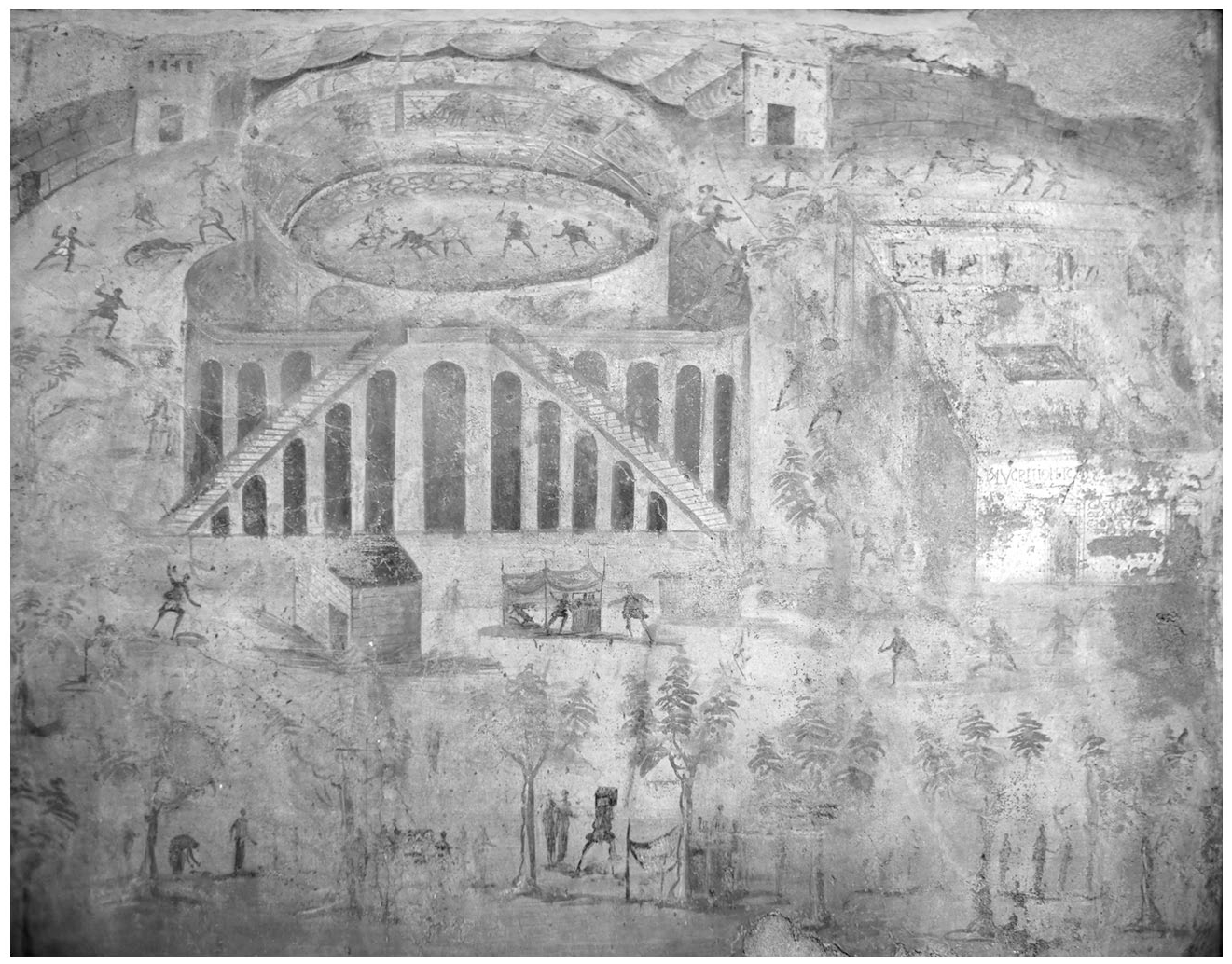
Riot in the Amphitheatre, fresco, first century CE, from Pompeii, Museo Archeologico Nazionale. Creator: Andrew McCabe. Licence: CC BY-NC 2.0.
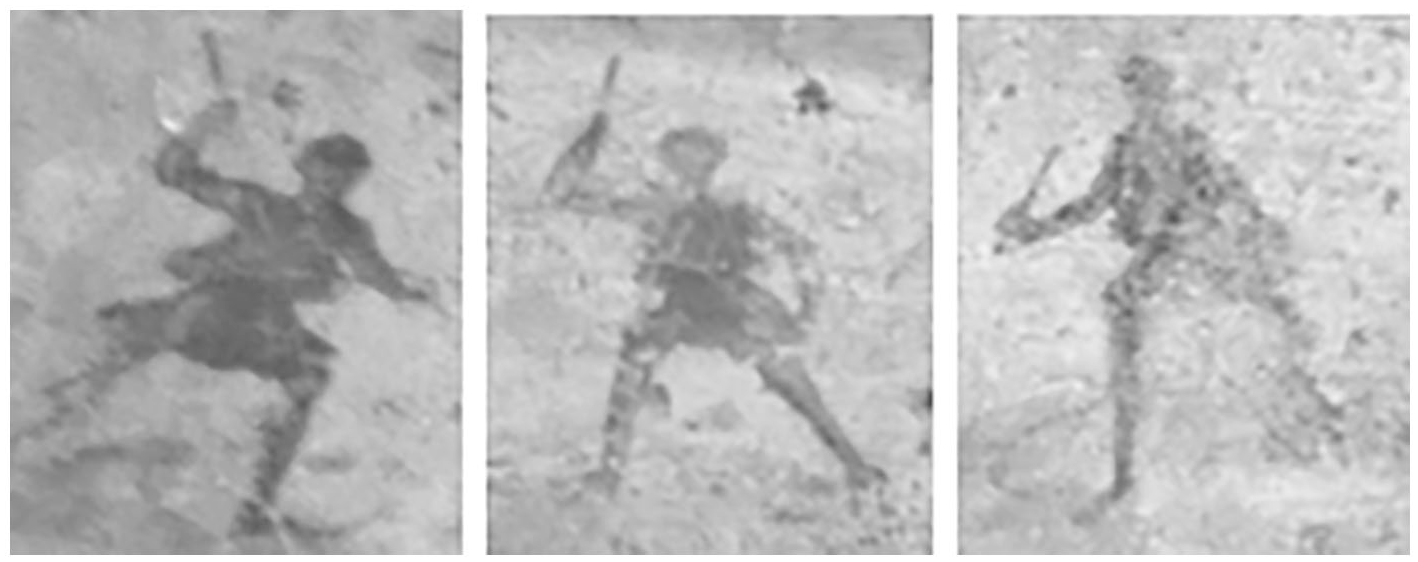
Armed rioters from the fresco.
Those armed are depicted as brandishing weapons longer than daggers and about the length of a forearm, roughly two-thirds the length of a gladius blade that, by the middle of the first-century CE, was usually about 55 cm or less. 87 The weapons do not appear to be swords and the rioters were not soldiers. Indeed, unsurprisingly for a city far from the borders of the Empire, excavations at Pompeii and Herculaneum have turned up very few military weapons 88 but plenty of bladed implements of various sizes and kinds.
It is clear that μάχαιρα was a catchall term and could be used for anything from a small knife to a military sword, but there were plenty of other bladed implements, readily accessible and widely employed, that could be considered μάχαιραι and would fall between the two extremes. And these implements were not necessarily originally made to be weapons but had the potential to be used as such, should the situation require it. It is therefore unsurprising that some of Jesus’s disciples possessed such objects.
Indeed, although clothing was relatively expensive in antiquity (hence the regular admonition to clothe the naked), 89 it is unlikely that a ‘sword used in battle’, to use Martin’s phrase, could be purchased for the equivalent of a peasant’s cloak, as Lk 22.36 seems to assume. 90 It seems more likely that something else other than a military weapon was intended when µάχαιρα was employed in this context.
The likelihood that the weapons possessed by Jesus’s followers were of this ad hoc kind, rather than those used by the professional military, may also explain why Jesus’s followers hardly put up much of a fight. 91 We should not exaggerate the resistance that they showed or were expected to show. 92 Indeed, in Mk 14.47 and Jn 18.10, unlike Mt 26.51 and Lk 22.50, only the earlobe (τὸ ὠτάριον) not the ear (τὸ οὖς) of the high priest’s slave is cut off. 93 And although those carrying out the arrest, according to all four gospels, were armed (Mt 26.47; Mk 14.43; Jn 18.3; Mt 26.55; Mk 14.48; Lk 22.52), it is only John who introduces soldiers at this point, indicating that it was unlikely that they were thought a military threat of any kind. 94
4. Conclusion
So, in conclusion, the datum that Jesus’s followers were armed in Gethsemane cannot be taken as something that indicates that the historical Jesus believed that he would lead his followers in an apocalyptic battle of some kind. It is far too equivocal to support such an interpretation. The tradition most likely indicates that the disciples of the historical Jesus were not armed in any meaningful, military sense. Rather, some of them had bladed implements that could be employed as weapons but were unlikely to have been originally made, purchased, or indeed carried for that reason. 95
Of course, it is still possible that even with such poor ‘weapons’, the disciples might have expected to fight the Romans and collaborators, driven not by apocalyptic fervour and the belief that heavenly armies would appear to support them, but inspired by nonapocalytpic stories of Israel’s past when its heroes had vanquished its enemies against insurmountable odds, and with inadequate weapons, such as Samson, who slew a thousand Philistines using the jawbone of a donkey (Judg. 15.15), or David, who despatched the heavily armed Goliath with a slingshot (1 Sam. 17.48–51). 96 However, if that were the case, we would expect some evidence that such models were important to Jesus and his followers in our sources. Indeed, the disciples’ possession of their ‘weapons’ was so unremarkable, both to them and others, that our earliest source, Mark, ‘never explains why they are armed and it does not appear to be significant either before or after Gethsemane’ (Zeichmann 2018: 71)—something true of all the other gospels too. The actions of the disciple in striking one of the arresting party is most likely to have been exactly the kind of impulsive act depicted in the gospel accounts, and hardly unexpected when a bladed implement is something many habitually carried. In answer to our original question, we cannot reasonably infer anything apocalyptic from the datum that Jesus’s disciples were armed at the time of his arrest about the convictions of Jesus or his closest followers, nor does it seem reasonable to infer any military intent on their part. 97
Finally, it is important to add that, nonetheless in my judgment the apocalyptic Jesus paradigm remains by far the most persuasive way of making sense of the historical figure, despite its critics, and the transformations that have taken place in our understanding of apocalypticism and the study of the historical Jesus since it was first established by Johannes Weiss. 98 However, apocalypticism has a tendency to be all-consuming, both figuratively and literally, and can result in more plausible and mundane explanations of material being overlooked. When you have an apocalyptic hammer, it is important to realise that not everything is a nail.
Footnotes
1
For this label, see Nickel (2021: 116). The terminology owes itself to Bermejo-Rubio, notably Bermejo-Rubio (2013a,  ).
).
2
Such as Garber (2005) and Montserrat Torrens (2007). See also .
3
4
For proponents of the Seditious Jesus Thesis before Brandon, see Bammel (1984). There were other influential criticisms of the Seditious Jesus Thesis, largely provoked by Brandon, notably Hengel (1971), Cullmann (1970), Hengel (1973) and Klassen (1970). There have been others subsequently too. For example, Joseph (2014: 23–50) and : 116–60).
6
Despite the title of Albert Schweitzer’s influential work (Schweitzer 1906), there are good reasons for recognising the significance of contributions before Reimarus. See, for example, Birch (2019) and .
8
For the purposes of this essay, I take ‘apocalyptic’ to mean exhibiting characteristics found within those Jewish texts customarily identified as ‘apocalyptic’ since the category was established by Friedrich Lücke (1832)—for example, 1 and 2 Enoch, Daniel, 4 Ezra, 2 and 3 Baruch, Apocalypse of Abraham, Jubilees, Testament of Levi 2–5, Apocalypse of Zephaniah, Testament of Abraham. I am conscious that there are significant problems with this, not least because none of these texts refer to themselves or were referred to by anyone else in antiquity, in this way (Smith 1983: 19), and also, given the subject of this essay, eschatology is not necessarily a characteristic of such texts. For a helpful discussion of the issues, see .
9
For a helpful critique of their respective positions, see Nickel (2021: 148–50). For criticisms of Martin’s thesis, see Fredriksen (2015) and Downing (2015), and Martin‘s response ().
12
See also Bermejo-Rubio (2013a: 30) and Bermejo-Rubio (2013b: 148). A similar position can be found in the work of .
13
Others in New Testament studies have found the term ‘shaman’ analytically helpful. See for example, Ashton (2000). It has proved more popular in the study of ancient Greek religion, especially in relation to figures significant in the Pythagorean and Orphic traditions. See Ogden (2009: 9–16) and Ustinova (2004). For changes in the uses of the term, see .
14
See, for example, the attack by Jan Matthys and a handful of followers against the forces besieging the Anabaptists in Münster in 1534, driven, at least in part, by an apocalyptic belief in divine intervention. For events at Münster, see Haude (2000), De Bakker et al. (2009) and Klötzer (2007), though see the useful critique by Driedger (2018). The Fifth Monarchist uprising of 6 January 1661, when 50 millenarians from a radical Puritan sect tried to seize London in the name of ‘King Jesus’, provides another example. For a contemporary account of the uprising, see Anon. (1661). For treatments of Fifth Monarchism and its insurrections, see Farr (2016), Burrage (1910), Shilston (2012), Capp (1972) and .
15
For a classic statement of the criteria of authenticity, see Meier (1991: 167–95), Meier (2016: 12–21) and Holmén (2008: 43–54). For major contributions to the subsequent debate about their viability, see Porter (2000), Allison (2010b), Theissen and Winter (2002), Hägerland (2015), Stein (1980), Wedderburn (2010: 161–82), Bernier (2016), Keith and Le Donne (2012) and .
16
There are many significant contributions to the exegesis of the pericope within which the information is contained (Lk 22.35–38), such as Schlatter (1916), Lampe (1984) and Matson (2018). For helpful surveys of scholarship, see Moore (2009: 4–60) and .
17
Of course, such an estimation depends, to a large extent, on what definition of violence is employed, whether an interpreter opts for a minimalist or comprehensive conception of violence, to use the distinction of Vittorio Bufacchi (2005). Whether violence should be understood as limited to, for example, ‘the exercise of physical force so as to kill or injure, inflict direct harm or pain on, human beings’ (Geras 1990: 22), or whether it should include anything that violates personhood (e.g., Brown 1987: 8), or anything avoidable that impedes human somatic or mental realisation (Galtung 1969: 168), or perhaps harm caused to nonhuman victims, such as the environment (e.g., Glazebrook 2001). The judgment on whether Jesus was violent or not is not necessarily dependent upon whether one finds the seditionist thesis compelling. See, for example, the more expansive studies of Ellens (2004), Avalos (2015: 90–128) and .
18
For examples of final judgment sayings traditions, see: Mk 3.28–29 // Mt 12.31–32, Lk 12.10// Gos. Thom. 44; Mk 4.24, Mt 7.1–2, Lk 6.37-38; Mk 4.25, Mt 13.12, Lk 18.18 // Mt 25.29, Lk 19.26 // Gos. Thom. 41; Mk 6.11 // Mt 10.14, Lk 9.5; Mk 8.35 // Mt 10.39, Lk 17.33 // Jn 12.25; Mk 8.38 // Mt 10.32–33, 16.27, Lk 12.8–9; Mk 9.42 // Mt 18.6, Lk 17.1–2; Mk 9.43–48, Mt 5.29–30, 18.7-9; Mk 10.17-22, Mt 19.16–22, Lk 18.18–23; Mk 10.23–25, Mt 19.23–24, Lk 18.24–25; Mk 10.26–30, Mt 19.25–30, Lk 18.26–30; Mk 11.25, Mt 6.14–15; Mk 13.13, Mt 24.13, Lk 21.18–19; Mk 13.20, Mt 24.22; Mk 14.21, Mt 26.24, Lk 22.22; Lk 6.43–44; Mt 7.16–20; Mt 7.21–23, Lk 6.46, 13.25–27; Mt 7.24–27, Lk 6.46–49; Mt 11.21–24, Lk 10.12–15; Mt 10.40, Lk 10.16 // Jn 13.20; Mt 12.41–42, Lk 11.31–32; Mt 23.29–36, Lk 11.47–51; Mt 24.45–51, Lk 12.42–46; Mt 8.11–12, Lk 13.28–29; Mt 19.28, Lk 22.28–30; Mt 5.20; Mt 5.22; Mt 12.36; Mt 13.24-30, 36–43 // Gos. Thom. 57; Mt 13.47–50; Mt 15.13; Mt 18.3; Mt 18.23–32; Mt 21.43; Mt 22.11–14; Mt 25.1–13; Mt 25.14–30 // Lk 19.11–27 // Gos. Thom. 41; Mt 25.31–46; Lk 13.1–5; Lk 13.6–9; Lk 16.19–31; Jn 5.29; Jn 12:48; Gos. Thom. 49; Gos. Thom. 59; Gos. Thom. 70.2. This list is adapted from : 1).
20
Jesus’s words in Mt 10.34 (‘Do not think that I have come to bring peace to the earth; I have not come to bring peace, but a sword’) were probably intended to be figurative given the Lukan rendering of the saying (Lk 12.51) that uses the word ‘division’ (ὁ διαμερισμός) rather than ‘sword’ (ἡ μάχαιρα). It is possible that they were interpreted by one early pagan critic of Christianity as a call to violence, although we only have Macarius’s response, which is entirely concerned with a figurative interpretation of the saying (Macarius Magnes, Apocriticus 2.7). See Cook (2002: 181) and : 32–33).
21
Aside from Jesus’s words in Mt 10.34 (Lk 12.51), the possible exception to this is the incident in the temple (Mt 21.12–17; Mk 11.15–19; Lk 19.45–48; Jn 2.13–22). It is hard to see how Jesus could have driven out the moneychangers, animal sellers, and, in the versions found in Mt and Mk, their customers, without direct force of some kind (Mt 21.12; Mk 11.15; Lk 19.45; Jn 2.15). The detail of the whip in Jn 2.15 is especially telling. The use of the accusative masculine plural πάντας [‘them all’] may indicate that John believed it was used primarily against the merchants, although see Croy (2009). For a useful discussion of exegetical debates about the interpretation of Jn 2.15, see Avalos (2015: 110–26). As has argued, Jesus’s action in the temple may well have endangered the livelihoods of slaves and other vulnerable people who relied upon business in the temple for their living, adding to the ‘violence’ of the incident, for those with a more capacious definition of the term.
22
See, for example, the narrative of the possessed man at Gerasene: Mt 8.28–34; Mk 5.1–20; Lk 8.26–39.
23
Mt 5.44; Lk 6.27, 35. The idea of loving enemies is found in other Jewish traditions that predate the historical Jesus (see, for example, 2 Kgs 6.15–23). However, the commandment to love one’s enemies does appear to be distinctive and is likely to have originated with Jesus. See Klassen (1999) and Piper (1979). For the subsequent reception of this injunction in early Christianity, see .
24
For example, Horsley (2013: 54–79), Wink (1992) and .
25
E.g., Mt 5.38–41, Lk 6.29–30. Nonretaliation and nonviolence are also found in Jewish traditions that predate the historical Jesus as well as those that were contemporaneous with him. See Zerbe (1993a, 1993b) and Daube (1972). Such a position can itself be critiqued as exacerbating other forms of violence. As Peter Gelderloos observes in his trenchant criticism of nonviolence in the contemporary world: ‘Nonviolence hides structural violence or the violence of the State, yet it is this kind of violence, and not riots or liberation struggles, that harms far more people around the world’ (: 12).
26
See, for example, Jesus’s lack of response to slavery, which ‘existed as an institutionalized system in Roman Palestine […] just as it did in Roman Italy’ (Hezser 2005: 9). Geoffrey de Ste Croix is probably correct to maintain that ‘Jesus accepted slavery as a fact of his environment’ (de Ste Croix 1975: 19). We can see this in parables ascribed to him, which regularly featured slaves but do not contain any direct condemnation of slavery itself (Mk 13.33–37, Lk 12.35–38; Mt 24.45–51, Lk 12.42–46; Mt 25.14–30, Lk 19.12–27; Lk 15.11-32; Mt 18.23-38; Lk 17.7–10; Lk 16.1–8; Gos. Thom. 64, 65; Mt 20.1–16). Crossan (1974) has provided a subversive reading of such material, but see the critiques by Glancy (2002: 102–29) and Harrill (2011). Jesus’s silence on the matter when faced with a slave-owning centurion (Mt 8.5–13, Lk 7.1–10) could also be taken as indicative of his indifference. See, for example, its use in the abolitionist debates in the nineteenth century, e.g., : 230–31, 240–42).
27
Mt 26.55, Mk 14.48, Lk 22.52. All four gospels also record that those who came to arrest Jesus were themselves armed (Mt 26.47, 55; Mk 14.43, 48; Lk 22.52; Jn 18.3). John alone speaks of the soldiers and temple guards carrying ὅπλα—which is usually translated as ‘weapons’ (NRSV) but can also mean tools or implements. All the others speak of μάχαιραι.
28
For the concept of ‘impression’ and the historicity of early Jesus traditions, see Meggitt (2007: 24–25; 2017: 131–32). The idea is expressed by Dale Allison, ‘in the matter of Jesus, we should start not with the parts but with the whole, which means with the general impression that the tradition about him, in toto, tends to convey’ (: 198).
29
Some have argued that it is not necessarily the case that the assailant was a disciple, as in Mark we are only told that ‘one of those who stood near’ that drew his sword (Mk 14.47), allowing for the possibility that the assault was carried out by someone else, either a bystander or one of the arresting party who had a change of heart or was dangerously clumsy. See, for example, Boring (2006: 402), Gundry (2004: 860), Brown (1994: 266–67), Hooker (2001: 351), and : 400). These theories seem unlikely for two reasons. First, aside from the enigmatic young man who subsequently ran away naked (Mk 14.51–52), there is no hint, at this point in the narrative, that there is anyone with Jesus other than the disciples—there are no bystanders. Second, the assailant is identified as a disciple in the other accounts (Mt 26. 45, 51; Lk 22.45, 50), with John specifically naming him as Simon Peter (Jn 18.10)—a detail that may be legendary but in general terms corroborates the picture that the man launching the attack was a disciple.
30
Interestingly, the act of violence is seen by a later pagan critic as in direct contradiction to Jesus’s teaching (Macrius Magnes, Apocriticus 3.20). See Cook (2002: 194–95) and : 92).
31
Mark contains no such rebuke. It is probably going too far to say, as Willard Swartley does, that ‘it does not require a rebuke—the act of violence rebukes itself’ (Swartley 2006: 113). It is possible that violence itself is not the issue in Jesus’s condemnation. As Michel Desjardins argues, ‘violence per se does not appear to be condemned, only violence not in accord with God’s plan’ (Desjardins 1997: 23). Indeed, according to , it is possible to read ἐᾶτε ἔως τούτου in Lk 22.51 as Jesus commanding the disciples to permit Jesus’s arrest according to God’s plan rather than a rebuke by a ‘pacifist’ Jesus of a violent act.
32
See, for example, Mt 26.47–56, Mk 14.43–52, Lk 22.47–53, Jn 18.1–11; Mt 27.11–14, Mk 15.2–5, Lk 23.2–5, Jn 18.33–38; Lk 23.34; Rom. 15.2–3; 1 Pet. 2.21–23.
33
Kalantzis (2012: 6). For useful discussions of early Christian responses to violence and the use of arms, see Cadoux (1919), Hornus (1980), Harnack (1963), Helgeland et al. (1987), Huttunen (2020: 138–228), Hunter (1992), and .
34
Crossan argues that one has to view the details of the Passion Narrative—aside from the information that Jesus was crucified—as being entirely either ‘prophecy historicized’ or ‘history remembered’. For Crossan’s theory of ‘prophecy historicized’, see Crossan (1996: 1–12; 1998: 521–23). For criticisms of the concept, see Evans (1996) and . However, it is important to note that Crossan’s own work is concerned with explaining the details provided in the Passion Narrative after the disciples have fled.
35
For a useful survey of the debates around the term ‘midrash’, see Bakhos (2005). For a critique of its use in New Testament scholarship, see .
37
Although it should be noted that the textual evidence for its presence in Mark is weak and fulfilment formulas are rare in that gospel.
38
Jn 18.9, quoting Jn 17.12: ‘I did not lose a single one of those whom you gave me.’
39
40
Balaam also wished he had a sword, so he could kill the recalcitrant donkey (Num. 22.29), only for the angel to reveal that the donkey saved Balaam’s life by heeding the angel’s weapon (Num. 22.33).
41
There are also swords that will be destroyed in the future (Hos. 2.18; Isa. 2.4; Mic. 4.3; Ezek. 39.9) and swords yet to be forged (Joel 3.10).
42
The reflexive stem indicates that the sword is self-animated and not wielded by the cherubim. See Lichtenstein (2015) contra .
43
See also Pss. 52.2, 57.4.
45
46
See also Brandon (1967: 341) and : 77).
47
48
Especially following the important contributions found in Keith and Le Donne (2012). However, see the helpful critique of prevailing pessimism by .
49
For a survey of the development of the concept of ‘authenticity’, see Le Donne (2012). Jonathan Bernier provides a significant critique of ‘authenticity’ from the perspective of critical realism (of the Bernard Lonergan kind) but also argues persuasively for the usefulness of the criteria in establishing the likely origins of data about Jesus that can be reasonably inferred from the sources. See, for example, : 75, fn. 5).
50
51
In addition to 1QM, fragments that appear related to the War Scroll include 4Q491–497; 4Q471; 4Q285; 11Q14.
53
54
1QM 11.7–8.
56
4Q285 frg. 4–5. Angels are mentioned as present within the community (4Q285 frg. 3), a common motif in the DSS. As Weissenberg notes, ‘For the Qumran movement, the presence of the angels was reality; they were a community living in communion with angels’ (Weissenberg 2018: 492). However, in 4Q285 these angels are not described as an army unlike 1QM 7.6 (García Martinez 1996: 124) though cf. : 82).
57
See 2 Bar. 39–40, 70–72. See also 4 Ezra 12.31–33; 13.9–11, 37–38.
58
4Q285, frg. 4.5–10. As Philip Alexander notes, ‘Verse 9 seems to imply that Israel pursues the enemy onto the sea, defeats them in a sea battle and returns to dry land’ (Alexander and Vermes 2000: 237). See also Alexander (2000: 344). For further on this eschatological naval battle, see .
59
The War Scroll expects the eschatological battle to last forty years. 1QM 2.6–16.
60
E.g., 1QM 5.1–18.
61
E.g., 1QM 6.1–17.
62
Martin (2014: 7, n. 7) citing : 182–83).
63
Josephus, War 6.288–289.
64
Josephus, War 6.297–299.
65
Visions of heavenly armies and wars were not unusual in antiquity. See, for example, the heavenly armies that did battle just as Antiochus Epiphanes began his second invasion of Egypt, according to 2 Macc. 5.1–4. See also Julius Obsequens, Liber Prodigiorum 43; Nazarius, Panegyrici Latini 4(10).14–15. For other such apparitions, see : 11–46).
67
It is possible that the example of the Egyptian prophet indicates some might have interpreted this differently. His choice of the Mount of Olives to muster his armed followers might reflect beliefs based on the eschatological expectation found in Zech. 14.4. However, (a) the Egyptian prophet also appears to have been inspired by the non-eschatological story of the fall of Jericho (Joshua 6.20–21); (b) it is not clear from the accounts provided by Josephus whether his followers would play an active military role in what was expected to transpire. See Josephus, War 2.261–263, Ant. 20.169–170, Acts 21.38.
68
For angels taking on a military role, see Gen. 32.1–2; 2 Kgs 6.15–17; Ps. 34.7; Dan. 10.13, 12.1; Jude 9; 2 Macc. 3.22–28; 1QM 7.6, 12.8, 13.10; 2 Bar. 63.5–7. For the notion that angels would appear in response to prayer, see 2 Macc. 15.22–23.
69
Revelation could be taken by some as evidence of the presence of such an idea. It has, after all, been called ‘a kind of War Scroll of Christianity’ (Black 1984: 293). However, (a) Revelation postdates the historical Jesus and is indicative of subsequent developments, and therefore not an indicator of Jesus’s religious context; (b) texts such as Rev. 7.2–14 and 14.1–5 indicate, as Richard Bauckham has argued, that the eschatological, messianic army of the faithful is not directly involved in military conflict but rather contributes to the victory over evil only by following Jesus’s model of suffering witness. See .
70
Bermejo-Rubio (2014: 94) suggests that this tradition may reflect the original expectation of the historical Jesus that legions of angels would in fact join him. However, this verse is ‘consonant with Matthean thought and style’, as : 276–77) has demonstrated, and it is most likely a Matthean creation.
71
Josephus, War 2.125. For other examples of carrying weapons on journeys, see Horace, Satires 2.1.39–46; Petronius, Satyricon 62; Apuleius, Metamorphoses 2.18; Philogelos 56. For the dangers of violence from robbers, see Celsus, De medicina pr. 43. See Fuhrmann (2011: 52, fn. 26). For a discussion of the problem of where the swords may have come from, see : 268–71).
72
Galen, De anatomias administrationibus 1.2 (Galen 1956: 3). For the peril posed to the traveller by bandits in the Roman Empire, see Blumell (2007) and .
73
Something that appears to lie behind Jesus’s exhortation to the disciples in Lk 22.35–38. See Lk 9.3 (10.4).
74
75
Homer, Iliad 11.844, 18.597, 19.252.
76
For the development of the μάχαιρα, see Gordon (1958) and . For example, the term μάχαιρα could be used in the LXX to describe a two-edge weapon about 16 inches/41 cm (1 cubit) long, sufficiently small that it could be concealed under clothing (Judg. 3.16).
77
78
For example, John Chrysostom (Hom. Matt. 84.1) interpreted the μάχαιραι as butchers’ knives used for preparing the Passover meal. See further : 469–70, fn. 30). For additional evidence of μάχαιραι used for everyday and nonmilitary purposes, see Aristophanes, Knights 489; Claudius Aelianus, On the Nature of Animals 4.19; Diogenes Laertius, 8.17, 18; Euripides, Cyclops 403; Herodotus, 2.61, 6.75; Hipponax 128(W); Homeric Hymns 3.535; Pindar, Olympian Odes 1.49; Plato, Republic 353a; Plutarch, Dion 9.3.
79
For example, see White (2010: 69–103). Examples of such knives are found in most museums with Roman collections. For an example, see Museum of London, no. 26747. (accessed 8 November 2022).
80
See, for example, the altar-ossuary of two knife makers, from the Via Nomentana, Rome, found in the Musei Vaticani (cat. 9277), and the funerary relief of a metalworker, from the Tomb of Verii, Tomb 29, Necropoli di Porto, Isola Sacra, Ostia. Both are dated to the second century CE. See : 160, illus. 36 and 37).
81
82
For an example of a cultellus being used to inflict a fatal wound in Rome, see Varro, De re rustica 1.69.2. Interestingly, such knifings are described as everyday occurrences in (late republican) Rome (1.69.3).
83
There are some problems with the evidence marshalled by Martin to argue otherwise (Martin 2014: 7–8). See Downing (2015: 327–31) and [I]t must be doubted if the law absolutely forbade the carrying of arms in public, since Ulpian (h.t. 10 pr.) is reported as saying that it was an offence under the law to be armed dolo malo in contione . . . aut ubi iudicium publice exercebitur, and it is hard to see why these specific conditions should be named at all if the mere carriage of arms in public was criminal per se. Similarly, under the lex Cornelia de sicariis it was an offence to go about armed hominis occidendi furtive faciendi causa (Dig. 48.8.1 pr.); here again what made the bearing of a weapon criminal was intent. (Brunt 1975: 262–63): 314–15). For example, Dig. 48.6.1. forbids the accumulation (coergerit) of weapons, not their possession, and even then allows for exceptions, including those who deal in weapons (Dig. 48.6.2.), a trade that would be redundant if there was not a ready market for their wares. It also expressly allows the possession of weapons for self-defence (Dig. 48.6.11). As Peter Brunt remarks about the material from the Digest:
The example from Petronius that Martin uses to bolster his case for the illegality of wearing a sword in a city (Sat. 82) reflects this basic premise. When read in context, as Downing noted, it was the intent of the raving Encolpius, not the possession of the weapon itself, that was most likely the reason he was disarmed (Downing 2015: 330). However, Martin’s main point, that the Romans would have considered the presence of armed men in Jerusalem (especially at the time of a major festival) a seditious threat, seems a reasonable one. Josephus’s observation that the sicarii concealed their daggers under their clothes (War 2.255) probably indicates that the open display of weapons was not allowed: ‘it might reasonably be inferred that it was an offence in that province [Judaea] to bear arms openly’ (: 266). Indeed, such sensitivities might have led the disciples to conceal the μάχαιραι they possessed under their clothing; the words in Lk 22.38 (κύριε, ἰδοὺ μάχαιραι ὧδε δύο) would not make a great deal of sense otherwise.
85
Tacitus, Annals 14.17.
86
Museo Archeologico Nazionale, Naples (inv. nr. 112222), Da Pompeii, Casa della Rissa nell’Anfiteatro (1, 3, 23). The image of the fresco is widely reproduced. See, for example, Lusnia (2020: 656) or https://tinyurl.com/2p996d6e (accessed 8 November 2022). The Latin word that Tacitus used to describe the weapons employed by the rival mobs is ferrum, a term that can mean not only iron but a bladed weapon, given that blades were mostly manufactured from iron. For a discussion of the fresco, see Lusnia (2020: 656–57), Fröhlich (1991: 241–47), Clarke (2006: 152–58), and .
87
For the gladius, see Miks (2007), Bishop (2016), D’Amato (2014), and Hazell (1981). Many gladiators of this period used a gladius—hence their name—but these tended to be even shorter (Nossov 2009: 100), something evident from the myriad of mass-produced, popular-cultural representations of them on everything from oil lamps to drinking cups (Brown 2021: 446). See also Coulston (1998). Cavalry used a longer, slashing sword, called the spatha (gr. ῥομφαία), a weapon that did not become common among infantry until the late second century CE (Dixon and Southern 1992). The ῥομφαία was the weapon of choice of Jesus in Revelation (Rev. 1.16, 2.12, 2.16, 19.15, 21) and also favoured by Death and Hades (Rev. 6.18). For the spatha/ῥομφαία, see .
88
See Ortisi (2006) and Ulbert (1969). Although Pompeii has given its name to a form of the gladius that became dominant by the late first century. See James (2011: 150) and : 65–68).
89
2 Chron. 28.15; Isa. 58.7; Ezek. 18.7, 16; Tob. 4.16; 2 Esd. 2.20; Lk 3.11; Mt 25.36, 38, 43; Jas 2.15–16. It was sufficiently valuable that others might sue you for it (Mt 5.40) and robbers strip you of it (Lk 10.30).
90
91
The Johannine Jesus seems keen to emphasise this in his exchange with Pilate. See Jn 18.36.
92
Although probably a polemical tradition, according to the anonymous Jewish critic recorded by Celsus, far from expecting an armed conflict, Jesus was in Gethsemane in order to hide from his opponents and attempting to escape (Origen, Cels. 2.9).
93
This might have been an attempt to mutilate rather than a serious attempt to use force of arms to resist those seeking to arrest Jesus. If so, it is possible it was a gesture intended to symbolically disqualify the high priest from his office. See . For the possible consequences of such an injury, see Lev. 21.18; Josephus, Ant. 14.365–367; War 1.269–270.
94
For the author of the Fourth Gospel, it is not an armed crowd that came to arrest Jesus, but a σπεῖρα of Roman auxiliaries (Jn 18.3); see Zeichmann (2018: 94), with their officer (Jn 18.12), as well as Jewish officials (Jn 18.3, 12). The term σπεῖρα could be used to refer to a cohort, about a tenth of a legion, between 480–600 men (Polybius, Historiae 11.23). However, it was also applied rather more loosely, to any detachment of soldiers (e.g., 2 Macc. 8.23; Judith 14.11). Luke’s account includes ‘captains of the temple’ among the crowd. See Lk 22.52 (Lk 22.4). Although it is difficult to determine who these officials were, and they may be a Lukan creation, they are not military figures. For their identity, see Zeichmann (2012; : 81).
95
The capacity for objects that were not originally made as a weapon to act as one is something recognised Roman law: ‘In the term ‘weapons’ [tela] all objects from which injury can result to a man’s health are included’ (Dig. 48.6.11.1; cf. 48.6.9; trans. : 331]). A similar definition is operative in many contemporary legal systems. See, for example, the definition of an ‘offensive weapon’ in the Prevention of Crime Act (1953) found in English and Welsh law.
96
Although, slingshots were weapons regularly used in battle. See 2 Kgs 3.25. It should also be noted that in most similar examples in Jewish tradition of a hero succeeding against the odds, they still use military swords, e.g., Joshua (Josh. 5.13–6.27), Gideon (Judg. 7.1–8.21), Jonathan (1 Sam. 14.1–15), and the Maccabees (1 Macc. 3.10–26; 2 Macc. 12.13–16).
97
The distinction I have drawn between everyday objects that could be used as weapons and weapons used by soldiers may be supported by information we have about the Essenes. Essenes could arm themselves for the purposes of travel (Josephus, War 2.125), but they were famous for refusing to have anything to do with military weapons (Philo, Prob. 78).
98
Although there remains a lack of consensus on this, see the useful contribution by Fletcher-Louis (2010a). For a helpful introduction to debates about the ‘paradigm’, see Kloppenborg and Marshall (2005) and Miller (2001). For a recent example of the application of this paradigm, see .