




Abstract
A striking feature of the current state of Synoptic Problem studies is the almost universal acceptance of Markan Priority. If Mark was indeed used by both Matthew and Luke, this reduces the number of simple solutions to the Synoptic Problem to just two: Luke used Matthew or Matthew used Luke. Studies promoting the latter option, the Matthean Posteriority Hypothesis (MPH), have recently begun to attract wider critical attention. This article examines the three critical responses published sivnce 2017 and asks which of the problems so far identified presents the most serious problem for the MPH.
The Synoptic Problem is sometimes presented as an impossibly complex puzzle that will probably never be solved. 1 The triumph of Markan Priority may, however, render this assessment unnecessarily pessimistic. 2 If Mark was used by both Luke and Matthew, then just one, relatively simple, question remains: did Matthew use Luke or did Luke use Matthew? Admittedly, if neither of these options convinces, then the situation rapidly becomes more complex. Logically, however, it makes sense to focus on the simple solutions first – only moving to more complex ones when, and if, this should become an unavoidable necessity. 3
Up until recently the option that Matthew used Luke (the Matthean Posteriority Hypothesis, MPH) has received much less attention than the option that Luke used Matthew (the Farrer Hypothesis, FH). Indeed, the former was hardly mentioned in mainstream discussion before 2015. 4 Now, however, the MPH is starting to gain support and, consequently, to attract focussed criticism from supporters of both the FH and the widely held Two Document Hypothesis (2DH). The arrival of this criticism is significant because it is reasonable to expect that the highly qualified experts who have delivered it will immediately flush out the MPH’s worst and most obvious problems. The purpose of this essay, therefore, is to scrutinise the criticisms levelled at the MPH thus far. If one or more has real substance, then the Synoptic Problem’s reputation for insolvability might deserve to remain intact. If, however, the worst problem with the MPH is insubstantial, a proverbial gnat rather than a camel, then an important piece of progress will have been made: whatever other details might also apply, Mark was used by Luke, and both Mark and Luke were used by Matthew. 5
Candidates for the MPH’s worst problem
It must be admitted that we are still in the early days of criticism of the MPH. It is possible, therefore, that problems beyond those so far identified may yet come to light. As things currently stand, however, just three highly qualified scholars have offered focussed criticism of the hypothesis. So, it is to their objections that I now respond. 6
Downing: Matthew Misses Some Luke-Mark Verbatim Agreements
Gerald Downing is a respected pioneer in the study of how ancient compositional practices relate to the Synoptic Problem. One practice he observes is that ancient authors tended to accept dual testimony. For example, Tacitus says: ‘Where the authorities are unanimous, I shall follow them’, and Arrian: ‘Whenever Ptolemy son of Lagus and Aristobulus have both given the same accounts . . . it is my practice to record what they say as completely true’. 7 In Downing (2004) he uses this observation to critique the FH. 8 There he argues, for example, that it is surprising that FH Luke, whose principal sources were Mark and Matthew, chose to plough a fresh furrow in his presentation of the Passion and Resurrection when his two main sources so substantially agree in these elements. When, however, Downing (2017) attempts to repurpose this argument to combat the MPH he runs into a difficulty. There are almost no occasions where Luke and Mark tell a similar story that Matthew then omits or substantially reworks. 9 Downing must, therefore, fall back on a more extreme position. This causes him to suggest that, whenever Luke and Mark agree verbatim for thirty characters or more (which amounts, in most cases, to a sequence of between three and sixteen words), it would be absurd to imagine that MPH Matthew could do anything other than precisely replicate these strings of agreement in his own gospel. 10 The fact that MPH Matthew fails to do so on more than forty occasions leaves Downing convinced that Matthew cannot have used Luke. What this logic requires, however, is that ancient authors were in the habit of scouring their sources to find every place where they agreed verbatim for thirty characters or more, so as to be sure to reproduce exactly the same sequence in their own work. Even if such an outcome were desirable, 11 the labour required would have been prohibitive. Downing inadvertently demonstrates as much when he includes an exercise designed to show how hard it would have been to spot such strings of agreement so as to exclude them. 12 Presumably the same difficulty would have applied for an author who wanted to spot such strings so as to include them.
Downing’s article was the first focussed peer-reviewed critique of the MPH. As such, it might be expected to identify the most obvious problem with Matthew’s use of Luke. It is striking, therefore, that Downing’s objection rests on a claim about the habits of ancient authors that Downing himself inadvertently goes on to undermine. 13
Andrejevs: Matthew Omits Details About Peter
Olegs Andrejevs (2022a) adopts a method that, at first sight at least, is clear and simple. If Matthew shows a consistent redactional tendency in his use of Mark, then it is reasonable to expect the same tendency in his use of Luke. If this does not happen, it is a problem for the MPH. The first step toward applying this method is to identify a suitable tendency that, ideally, should be distinctive, consistent, and unlikely to come under the influence of some other, more dominant, tendency. Andrejevs selects Matthew’s tendency to improve upon Mark’s presentation of the Twelve and, in particular, Peter: Matthew’s intended portrayal of the Twelve can be characterized as positive . . . one finds Matthew at great pains to smooth out the jagged edges in the Markan portrayal of the Twelve . . . No apostolic character, however, receives as much development by way of exclusive new content in Matthew’s gospel as Peter. The key Matthean additions featuring Peter are 14:28–31; 16.17–19; and 17:24–27. All three are new episodes (or, in the case of Matthew 14:28–31 and 16.17–19, in-episode developments) developing Peter’s portrayal and his unique relationship with Jesus. To say that these sequences elevate Peter’s portrayal to new heights would be an understatement.
14
From this starting point, Andrejevs moves to argue that if Matthew behaves in this way in relation to Mark he should also, if he knows Luke, behave in this way in relation to Luke. At this stage, however, Andrejevs omits an important piece of groundwork. Robert Gundry identifies five places where Matthew’s redaction of Mark does not enhance Peter’s status: 15
Mk 1.35–38: ‘Simon and the ones with him’ hunt down Jesus. Matthew omits this episode altogether.
Mk 5.35–43: Jesus does not allow anyone ‘except for Peter and James and John the brother of James’, to enter Jairus’s house and the room where he heals Jairus’s daughter (cf. Lk 8.49–56). Mt 9.23–25 does not mention these exceptions.
Mk 11.21: Peter remembers the cursing of the fig tree and notes its fulfilment. Mt 21.18–22, on the other hand, removes Peter’s distinctive role.
Mk 13.3–4: Peter, James, John, and Andrew engage in a private conversation with Jesus about signs of the End. By contrast, Mt 24.3 generalises this to ‘the disciples’.
Mk 16.7: The young man at Jesus’s tomb tells the women, ‘But go tell his disciples and Peter, “He [Jesus] is going ahead of you to Galilee”’. Mt 28.7, by contrast, omits ‘and Peter’. 16
These additional examples are important because Matthew here changes Mark in ways parallel to some of the eight actions Andrejevs finds implausible in MPH Matthew’s use of Luke: 17
The Call of Peter. Mt 4.18–22 rejects the account in Lk 5.1–11 in favour of the account of the call of Simon, Andrew, James, and John in Mk 1.16–20.
Jairus’s Daughter and the Woman with a Haemorrhage. Mt 9.20–22 fails to insert the additional detail, from Lk 8.45, that it was Peter who said, ‘Master, the multitudes surround you and press in on you’.
Get Behind Me Satan. Mt 16.22–23 preserves and expands Mark’s account of Jesus’s rebuke in Mk 8.32–33, even though this is completely omitted in Lk 9.18–22.
For Whom Is the Parable? Mt 24.43–51 omits Lk 12.41, where Peter asks, ‘Lord, are you telling this parable for us or for all?’.
Preparing the Passover. Mt 26.17–20 includes neither Mk 14.13, ‘he sent two of his disciples’, nor Lk 22.8, ‘Jesus sent Peter and John’.
Satan Demands to Sift Simon. Mt 26.30–35 does not insert Lk 22.31–32 into his reworked version of Mk 14.26–31.
Peter’s Declaration. Mt 26.33 follows Mk 14.29, ‘Even though they all fall away, I will not’, in preference to Lk 22.33, ‘Lord, I am ready to go with you to prison and to death’.
Report of Resurrection Appearance to Simon. Matthew includes neither the Road to Emmaus nor the following encounter, reported in Lk 24.34, where the eleven declare, ‘The Lord has risen indeed, and has appeared to Simon!’.
I take these in reverse order.
Number 8. From Mt 26.1 onwards MPH Matthew abandons attempts to conflate Luke and Mark and follows instead the narrative provided by Mark, which places the resurrection appearances in Galilee rather than Jerusalem. 18 It is unsurprising, therefore, that MPH Matthew fails to include a Lukan resurrection appearance located in Jerusalem. Furthermore, if Matthew had removed a specific mention of Simon, this would have been in keeping with the removal of a specific mention of Peter in Matthew’s version of Mk 16.7.
Numbers 7 and 6. These instances also fall in the latter stages of Matthew’s gospel, where he follows Mark to the almost complete exclusion of Luke. 19
Number 5. As Gundry’s list illustrates, Matthew’s abbreviation of Mark sometimes comes at the cost of references to Peter and the disciples. It is unremarkable, therefore, that this also happens here.
Number 4. Peter’s question, ‘Lord, are you telling this parable for us or for all?’ (Lk 12.41), interrupts the flow of Jesus’s speech as he continues from one parable to another. This line is certainly not essential to the narrative. Given Matthew’s similar treatment of nonessential details in Mark, this omission is unremarkable.
Number 3. Andrejevs includes this example because Matthew does not follow Luke’s decision completely to remove Mark’s account of Jesus’s angry reaction to Peter. This failure to omit an element of Mark is, however, in keeping with Matthew’s wider tendency; he is much more conservative than Luke in his handling of Mark, retaining, albeit often in shortened form, almost every Markan episode. Matthew chooses instead to soften the portrayal of Peter by casting his rebuke as an expression of concern: ‘God forbid, Lord! This shall never happen to you’ (Mt 16.22).
Number 2. A relevant feature of Jairus’s Daughter and the Woman with a Haemorrhage (Mt 9.18–26//Mk 5.21–43//Lk 8.40–56) is that, whereas Mark and Luke place the woman in control, Matthew transfers control to Jesus. Thus, in Mark’s and Luke’s versions, Jesus does not decide to heal, and he does not know whom he is healing. Rather, it is the woman’s act of touching his clothing that initiates the healing. Matthew creates a different dynamic. Thus, in his account, Jesus knows immediately that this specific woman has sought healing (Mt 9.21–22a) and, once he has engaged her directly, he says the words that only then cause her to be healed (Mt 9.22b). Matthew’s decision to spare Jesus the indignity of being confused about who touched him removes the opportunity for Peter to say, ‘Master the multitudes surround you and press on you!’ (Lk 8.45). 20
So far, therefore, the omissions Andrejevs observes are all consistent with Matthew’s wider tendencies. This brings me to his example Number 1, which is by far the most important. Luke 5.1–11 supplies considerable detail about the call of Peter, all of which Matthew omits. Allowing, for the sake of argument, Andrejevs’s premise that Matthew wishes to present Peter in a positive light, this omission is surprising. It would be less so, however, if Matthew’s action could be seen as somehow benefitting another, more important, agenda. Of supreme importance to Matthew is the teaching of Jesus. Focussing attention on his Great Sermon might reasonably be expected, therefore, to take precedence over including additional details about Peter. It is significant, therefore, that Matthew arranges everything between the Temptations and the Sermon to maximise the latter’s impact. As Jesus returns from the wilderness he is a figure on his own (Mt 4.11–17). Next, he becomes leader of the first four disciples (Mt 4.18–22). Then, as he travels through Galilee, his ever-growing fame generates an ever-growing following until, as he sits down on the Mount, he is surrounded by a great crowd from Galilee, the Decapolis, Jerusalem, and from beyond the Jordan (Mt 4.23–25). Inserting the Call of Peter into this fast-paced build up to the Sermon would be like applying the brakes to an accelerating train.
I began by saying that Andrejevs’s method is clear and simple. If Matthew shows a consistent redactional tendency in his use of Mark, then it is reasonable to expect that same tendency in his use of Luke. Andrejevs’s case is weakened, however, by his selection of a Matthean tendency that, when all the data is considered, is less clearcut than he supposes. What is required then is the selection of a tendency that is more central to Matthew’s project and thus more consistent in its expression. So, for example, if Matthew failed to include a Lukan detail about Jesus’s teaching on the Law, this would indeed be a startling omission. That Matthew fails to include every Lukan detail about Peter and the Twelve is, by contrast, unremarkable, because such omissions also occur in Matthew’s use of Mark. Further, Matthew’s failure to include more substantial episodes is explicable given his more pressing objectives—such as ensuring that nothing detracts from the dignity and prestige of Jesus and his teaching.
A question to consider, before leaving this section, is whether MPH Matthew’s treatment of Peter and the Twelve in Luke is a likely candidate for the MPH’s most serious problem.
Goodacre: Why Not Matthew’s Use of Luke?
Mark Goodacre is currently the leading advocate of the Farrer Hypothesis. In a recent essay, he gathers a selection of arguments, some of which have appeared scattered in his previous publications. In short, Goodacre (2022) helpfully provides a compendium of what the most prominent proponent of the FH sees as the worst problems with the MPH.
Matthew’s Redactional Fingerprints Reappear in Luke. Goodacre’s first argument has a strong logical basis. If it can be demonstrated that Matthew’s original creativity is reproduced by Luke, then it is essentially impossible that Matthew used Luke. Unfortunately, however, it can be remarkably difficult to demonstrate that a particular phrase originated with one evangelist and not the other.
For his first example, Goodacre chooses a feature of The Question About the Resurrection (Mt 22.23–33//Mk 12.18–27//Lk 20.27–40). This happens to be a passage where Matthew and Luke are both relatively faithful to Mark but where, amongst the various changes they make to Mark, they agree on a single word, ὕστερον (in Mt 22.27//Mk 12.22//Lk 20.32).
Goodacre notes that ὕστερον is a word favoured by Matthew. It is a fairly unusual word but nevertheless crops up seven times in Matthew and only once in Luke. 21 The first instance is in Mt 4.2, a passage shared with Luke but where Luke does not use it. The next two occasions, Mt 21.29, 32, are in a passage of Special Matthew, so it is not possible to tell if Matthew introduced the term or took it from his source. The next instance is one where Matthew changes Mark’s ἔσχατον to ὕστερον—something that will happen again in Mt 22.27. This is suggestive because it shows that Matthew is indeed, as Goodacre notes, capable of changing ἔσχατον to ὕστερον. How then did ὕστερον get into both Mt 22.27 and Lk 20.32?
There are at least two options. According to Goodacre, FH Matthew enjoyed the word ὕστερον and so independently elected to use it on seven occasions in his text. Also, according to Goodacre, FH Luke used his sources in ‘blocks’. 22 That is to say, he focussed on one source at time, while also drawing in occasional reminiscences of other sources. FH supporters are agreed that, in the passage currently under examination, Luke focusses on a block of Mark. What Goodacre’s theory requires, therefore, is that while working from Mark, FH Luke, like a frog catching a fly (or a gnat?), picks out the single word ‘ὕστερον’ from Matthew, while leaving aside all Matthew’s other changes to that pericope. At the same time, this theory requires FH Luke to resist this same ὕστερον morsel on the six other occasions when it is available in Matthew. This is a possible explanation of the data but it is not the only one. An alternative is that MPH Luke, following his practice of reworking Mark relatively freely, chose to use ὕστερον to replace the synonym ἔσχατον. Subsequently, MPH Matthew, who liked the word ὕστερον, noticed it in Lk 20.32 and so chose to duplicate it in Mt 22.27. 23
The former scenario requires FH Luke to behave out of character in two respects. First, he must go out of his way specifically to include a Matthean word that he otherwise always ignores. Second, to include this single word he must deviate from his more usual practice of focussing on one source at a time. The latter has MPH Matthew behaving in character throughout. First, he adopts a word of which he is evidently fond. Second, he is consistent in combining elements from related passages in Mark and Luke. 24
Given that there is no difficulty in supposing that Luke independently elected to substitute ὕστερον for the synonym ἔσχατον, 25 and given the fragility of arguments based on a single word, it is remarkable that Goodacre chooses to include this point at all. An inference that might be drawn is that more broadly based and substantial arguments are in short supply.
Goodacre’s second example occurs in Mt 14.13//Mk 6.33//Lk 9.11. He provides a synopsis to illustrate the point that Matthew and Luke agree against Mark in sharing: οἱ ὄχλοι (‘the crowds’), an aorist participle (ἀκούσαντες / γνόντες), and ἠκολούθησαν αὐτῷ (‘they followed him’). Goodacre goes on to argue that the term οἱ ὄχλοι (‘the crowds’) shows Matthew’s hand on the basis not only that it is twice as common in Matthew as in Luke (33/2/15) but also that Matthew introduces it redactionally four times in this passage (Mt 14.14, 14.15, 14.19a, 14.19b). Finally, Goodacre points out that, outside of Mk 14.13//Lk 9.11, the combination of ἀκολουθέω with ὄχλοι comes only in Matthew (5/0/1). On this basis he argues that these terms are highly likely to be the fruit of Matthew’s original creativity; the recurrence in Lk 9.11 is thus due to Luke’s use of Matthew. 26
It is certainly the case that Matthew enjoys the idea of crowds and of crowds following Jesus. This is consistent with Matthew’s general tendency to increase Jesus’ prestige, when compared with his prestige in Mark and Luke. 27 For Goodacre’s argument to carry weight, however, it is necessary to argue that ‘the crowds followed him’ is an image that could not have occurred to Luke without the inspiration provided by Matthew. If, on the other hand, it is not too extraordinary that Luke should have coined this phrase independently, then Matthew’s decision to reuse it at Mt 14.13 is unremarkable.
A broader problem with Goodacre’s approach is that his method can be used to generate improbable results. Take, for example, the distinctive phrase: ‘ἀμὴν λέγω ὑμῖν’(31/13/6). According to Goodacre’s logic, this phrase originated with Matthew and was then copied by both Luke and Mark. Incidentally, if we start by accepting Markan Priority, this example suggests that Matthew has a habit of multiplying phrases found in his sources, whereas Luke prefers to generate greater variety.
Before leaving this passage, it is worth pausing to notice that, when ‘followed by the crowds’ is viewed in context, a more obvious and reliable method for determining the direction of dependence becomes available (see Synopsis 1).
Feeding the Five Thousand.
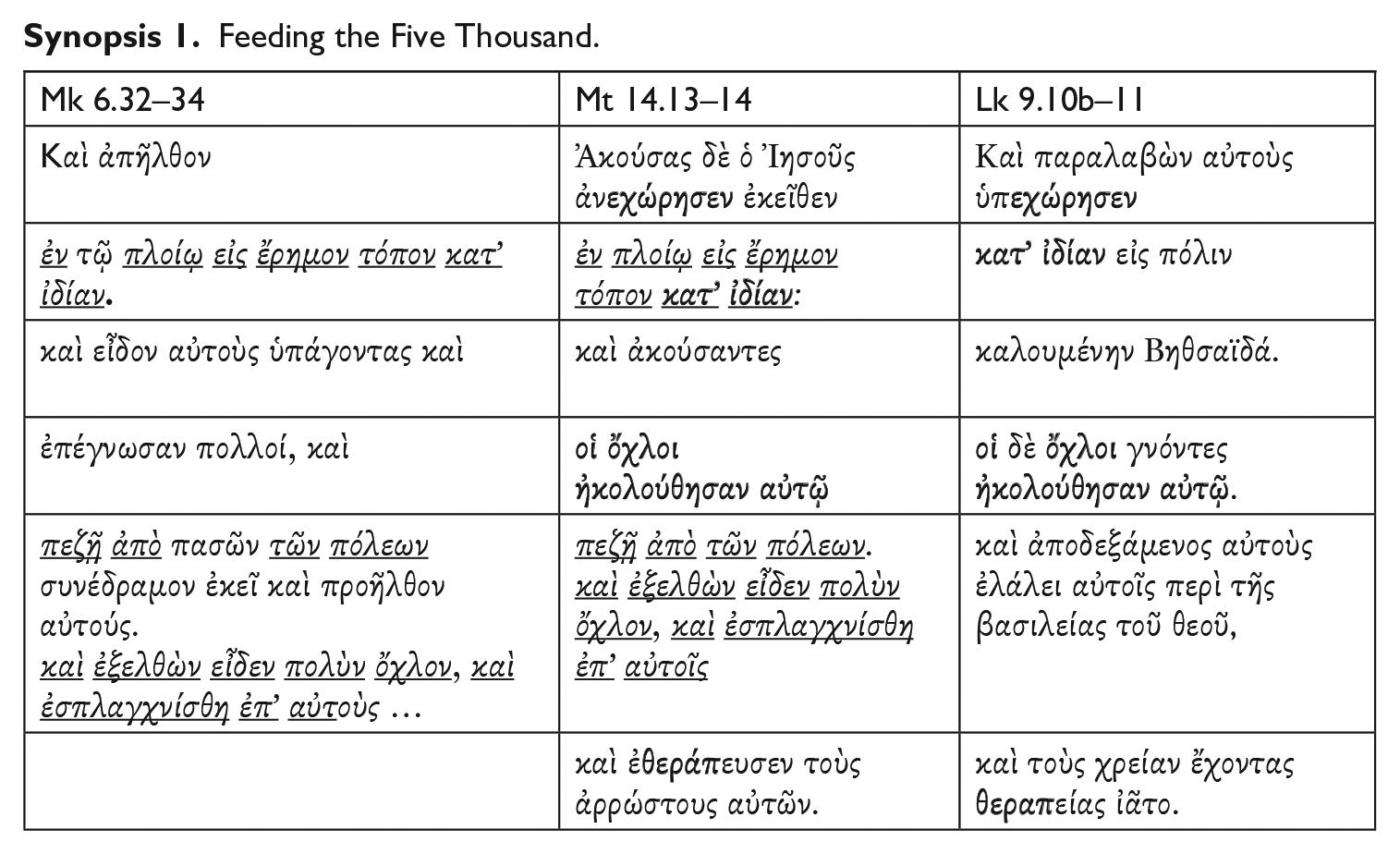
Synopsis 1 shows Matthew = Mark agreements in italic underline, and Matthew = Luke agreements in
Goodacre presents these first two examples as providing ‘a clear indication that it was Luke who used Matthew and not the reverse’ (2022: 79). Goodacre sometimes uses the adjective ‘clear’ with more freedom than the data, strictly speaking, can support. 30
Goodacre’s third example comes from The Preaching of John the Baptist, a passage that supporters of the MPH also recognise as important. In characteristic style Goodacre presents the situation as favouring the FH: ‘The Preaching of John the Baptist . . . shows clear signs of having been crafted by Matthew and not by Luke’ (2022: 80). To defend this statement, Goodacre points to distinctive features of the style and language of this passage that also recur later in Matthew. On this basis he argues that Matthew is responsible for Mt 3.7–10. It follows, accordingly, that Luke’s almost verbatim copying of the same passage in Lk 3.7–9 must be because of Luke’s use of Matthew and not the reverse.
Here Goodacre applies the same logic as previously. Thus, multiple uses of a particular motif signal originality, whereas few uses of the same motif signal dependence on that original. Before accepting this logic, however, it is worth pausing to consider the way Matthew treats Mark. Does Matthew, for example, ever take a distinctive idea expressed on one occasion in Mark and then express it on more than one occasion in his own gospel? Also, does Matthew ever show an interest in equating the preaching of John with the preaching of Jesus? Mt 3.2 and 4.17 offer a response to both questions. In the latter, Matthew rearranges Mark’s initial proclamation of Jesus to read: ‘Repent for the Kingdom of Heaven is at hand’ (Mt 4.17//Mk 1.15). Exactly these words are then also used to replace Mark’s, rather different, version of John the Baptist’s initial proclamation (Mt 3.2). Is it possible, therefore, that something similar happens in MPH Matthew’s use of Lk 3.7–9? Thus, Matthew creates a continuity between the preaching of John the Baptist and of Jesus by repeating motifs initially found in Lk 3.7–9 across the remainder of his gospel. 31
One further detail of Goodacre’s presentation deserves attention before moving on. As with his synopsis of Mt 14.13//Mk 6.33//Lk 9.11, Goodacre’s version of Mt 3.7–10//Lk 3.7–9 begins partway through the first verse. Thus, he omits the fact that Matthew has the ‘Pharisees and Sadducees’ coming for Baptism, whereas Luke has ‘the multitudes’. As Tobias Hägerland (2019: 203–5) has pointed out, this appears to be a case where Matthew has changed Luke’s account to fit his hostility to the Pharisees and Sadducees. Having done so, however, he later finds himself having to accept that the audience is as Luke initially had it. This suggests, if anything, that it is Matthew who has used Luke. 32
Overall, therefore, which explanation for the data is more plausible? Or, to put this another way, what, if anything, is implausible about Matthew’s use of Luke? Under the MPH, Matthew seeks to create a uniformity of tone and message across his gospel and so picks up distinctive phrases from his sources and reuses them. Matthew also attempts, in characteristic fashion, to present John’s ire as specifically directed towards the Pharisees and Sadducees—only to find himself subsequently caught out by the way Luke continues to address the multitudes.
Goodacre promotes these three examples as providing particularly good evidence that Luke used Matthew. Perhaps, therefore, they are the worst problems for the MPH.
Fatigue
According to Goodacre, his next argument also delivers a clear result: One of the clearest indicators of literary priority is provided by the phenomenon of ‘literary fatigue’, where an author inadvertently betrays the use of a source by making characteristic changes at the beginning of a passage only to revert to the source’s wording later in the same passage. (2022: 84)
I mentioned an instance of this phenomenon, as observed by Tobias Hägerland, in the preceding section. Ignoring this counterexample, Goodacre (2022: 84–85) states: ‘Among several cases of editorial fatigue in material shared by Matthew and Luke, the direction of dependence is always from Matthew to Luke.’ One of the best examples, he suggests, is the Parable of the Talents/Pounds (Mt 25.14–30//Lk 19.11–27). It is certainly the case that Luke’s version of this parable differs markedly from Matthew’s.
In Matthew’s neat and economical version there is a man who, before going on a journey, gives three servants five talents, two talents, and one talent respectively. The one who receives five talents doubles it, the one who receives two talents doubles it, and the one who receives one hides it. The two who multiply their stake are given charge of ‘much’, whereas the other is comprehensively condemned.
Luke’s version, by contrast, is not so tidy. A nobleman, who is going to a far country to receive a kingdom and then return, calls his ten servants. He gives them a pound each and tells them to trade till he returns. We are told the additional detail that this nobleman’s citizens hated him and sent an embassy after him saying, ‘We do not want this man to reign over us’. When he returns, the nobleman calls his servants, presumably all ten of them, to give an account. The first announces that he has made ten more pounds, the second that he has made five more pounds, and another that he hid the pound and made no profit at all. We are not told what happened to the other seven. Those who made a profit are given charge of ten cities and five cities respectively—perhaps in the nobleman’s recently acquired kingdom? The one who hid his pound has it taken from him and given to the one who has ‘ten pounds’—despite the protests of the bystanders. Then the nobleman attends to the execution of those who did not want him to reign over them.
Assuming, for sake of argument, that one has directly adapted the other, which one is most likely the source and which the product? According to Goodacre (2022: 86), ‘Luke can be seen to be secondary to and dependent on Matthew, and not the reverse’. The evidence he cites is as follows. In Luke’s retelling, there are ten servants where previously there were only three. According to Goodacre (2022: 85): This is a characteristic Lucan move. Luke often has the ratio 10:1 in his Gospel: the woman had ten coins and lost one (Luke 15:8); there were ten lepers, and one came back thankful (17:11–19); of the two debtors, one owed 500 denarii, and the other owed 50. (Luke 7:41)
However, to qualify as ‘a characteristic Lucan move’ we need at least one example of Luke taking something from a source and reshaping it to include ten. There is none. It is not even the case that Luke has a monopoly on parables featuring groups of ten: Matthew alone has the Parable of the Ten Virgins.
Goodacre continues that the rewards for Luke’s servants are cities, and he finds it remarkable that these cities are not mentioned when the single pound is given to the one who has ten pounds (Lk 19.24). Strictly speaking, the servant in question has charge of ten cities and made ten pounds in addition to his one pound. However, from the point of view of the audience, this servant becomes a distinct character when he mentions his ten pounds. This identifying marker is thus sufficient, without a fuller description.
For Goodacre’s argument to present a problem for the MPH, he needs to show that a curiosity in Luke’s version necessarily betrays the influence of Matthew’s version. The most pronounced curiosity of Luke’s version, however, is the inclusion of the extraneous details about the nobleman and his detractors. It is hard to see where these could have come from if not from the parable’s original context—as known to Luke in another source. 33 If Luke did replicate this parable from some other setting, then MPH Matthew’s actions make perfect sense. He eliminates every distracting and unnecessary feature in Luke’s version.
Knowledge of Matthew’s Literary Structure
Goodacre begins his next argument with the unexceptionable observation that Matthew uses a particular form of words at the end of each of his five great discourses:
Mt 7.28–29: ‘And it came to pass that when Jesus had completed these words, the crowds were amazed at his teaching . . .’
Mt 11.1: ‘After Jesus had finished instructing his twelve disciples . . .’
Mt 13.53: ‘When Jesus had finished these parables . . .’
Mt 19.1: ‘When Jesus had finished saying these things . . .’
Mt 26.1: ‘When Jesus had finished saying all these things . . .’
He then continues: ‘Given that this is so clearly marked as a Matthean structural phenomenon, it is striking that there is an echo of the first of these in Luke, at the same point, straight after the Great Sermon’ (2022: 87): Lk 7.1: ‘
This parallel, Goodacre claims, ‘points to Luke’s knowledge of Matthew’s structure; the evangelist is picking up his source text’s favourite literary segue’ (2022: 88). This argument repeats the logic that a motif used frequently in one source and once in another is necessarily the original work of the former (and repeated by the latter). Once again, however, this is not the only way to read the data.
Let us suppose that Matthew, as he created his expanded version of Mark, reached Mk 1.21, where Jesus enters the synagogue at Capernaum and begins to teach.
They went to Capernaum; and when the sabbath came, he entered the synagogue and taught.
Matthew, wishing to supply the content of the teaching that Mark omits, turns to Luke’s Sermon on the Plain. The immediate coda to Luke’s Sermon is, ‘When Jesus had finished all these sayings in the hearing of the people, he entered into Capernaum’ (Lk 7.1). It would make sense, therefore, for Matthew to create the conclusion to this Sermon by conflating the coda to Mark’s sermon with the coda to Luke’s sermon, thus:
Having created this closing formula for his first Discourse, it is no surprise that Matthew uses something similar to close his succeeding Discourses.
Once again, therefore, data that Goodacre reads as only compatible with Luke’s use of Matthew turns out to be straightforwardly compatible with Matthew’s use of Luke. Moreover, this example compounds a pattern already noted above: Matthew has a habit of taking a single motif from a source that he then replicates across his gospel.
Matthew’s Failure to Include Congenial Political Details
Goodacre’s concluding argument (2022: 88–89) uses another application of Andrejevs’s method, as noted previously. In this case, the redactional tendency Goodacre observes is that Matthew tends to clarify and add political detail as he reworks Mark. It is to be expected, therefore, that where Luke offers this type of information, MPH Matthew should be keen to include it. The fact that Matthew does not always do so suggests to Goodacre that Matthew does not know Luke. He cites three examples.
First, Goodacre notes that, in Mt 14.3, Matthew repeats Mark’s apparent error in the use of the name ‘Philip’ (Mk 6.17), rather than correcting it from Lk 3.19—where the name is omitted. The tendency Goodacre notes in Matthew, however, is not that he gets political details right but that they are among the details he likes to include. Thus, faced with a choice between Mark’s version, where Philip is named, and Luke’s version, where he is not, we might expect Matthew to choose the version that supplies the greatest detail. In choosing Mark’s version, that is what he does.
Second, Goodacre notes, without further comment, that Matthew does not include Luke’s trial before Herod (Lk 23.6–12). If this were essential to the narrative, then this observation might carry some weight. However, the omission of this episode is consistent with Matthew’s broader tendency to omit nonessential narrative detail.
Third, Goodacre points out that, even though Matthew has an interest in political details, he uses the bland ‘in those days’ (Mt 3.1) to introduce John’s ministry rather than Luke’s more precise and expansive introduction: In the fifteenth year of the reign of Tiberius Caesar, Pontius Pilate being governor of Judea, and Herod being tetrarch of Galilee, and his brother Philip tetrarch of the region of Ituraea and Trachonitis, and Lysanias tetrarch of Abilene, in the high-priesthood of Annas and Caiaphas, the word of God came to John the son of Zechariah in the wilderness. (Lk 3.1–2)
Goodacre interprets Matthew’s failure to draw on Luke at this point as evidence that Matthew did not know Luke.
Before looking at Matthew’s treatment, or nontreatment, of Lk 3.1–2, it is worth noting that Matthew is not in need of such details to situate his narrative in time and place. Just a few verses earlier, he dates Jesus’s family’s return from Egypt to ‘when Herod died’ (Mt 2.19). Matthew also includes the detail that Archelaus reigned in Judea (Mt 2.22) to explain why the family settled in Nazareth rather than returning to Bethlehem. The question remains, however, as to why Matthew uses ‘in those days’ in preference to the rich detail in Lk 3.1–2.
A striking feature of Luke 1–2 is the proportion of text devoted to John the Baptist. Almost one-third is concerned with his annunciation and birth. Matthew, by contrast, fails to mention these events at all. From this we might suspect that Matthew, alongside his interest in elevating the status of Jesus, wished to downplay the prominence of John. Against this background it is noticeable that Lk 3.1–2 serves as a fanfare to announce the start of the ministry of John, not the ministry of Jesus. It is in character, therefore, that Matthew decides to give John a relatively low-key introduction. The question that remains is whether Matthew makes alternative use of the information in Lk 3.1–2 to serve the story of Jesus. Under the MPH, this is what happens. Thus, at Mt 26.3 and 26.57, Matthew supplements Mark with the additional Lukan detail that Caiaphas was High Priest—Luke’s inclusion of Annas being curious in the first place. Similarly, at Mt 27.2, 11, 14, 15, 21, and 28.14, he supplements Mark with the Lukan detail that Pilate was ‘the governor’. He also notes that Herod was tetrarch (in Galilee) in Mt 14.1. The other figures to whom Luke refers are not relevant to the story of Jesus and, as already noted, Matthew tends to omit unnecessary narrative detail.
Luke’s and Matthew’s Relative Dates
Before making a final choice of the worst problem for the MPH, it is worth mentioning one further consideration. At the start of his essay, Mark Goodacre offers some reflections on, as he puts it, ‘why Luke’s Gospel is so often thought to be chronologically third, even by those maintaining its independence from Matthew’ (2022: 74). As Goodacre himself would admit, however, his ruminations are far from conclusive. If this were not the case, the Synoptic Problem would have been solved long ago. It may be, nonetheless, that progress in the dating of Matthew and or Luke Acts will ultimately provide a significant breakthrough one way or another. This is not, however, how things currently stand.
Gnats or Camels?
It is now time to decide which of the preceding options is the worst problem for the MPH. Is it that MPH Luke is required to replace ἔσχατον with the synonym ὕστερον without reference to Matthew? Is it that MPH Luke is required to describe Jesus as being followed by crowds, independent of being inspired to do so by Matthew? Is that MPH Matthew is required to take and multiply motifs he finds in Luke—in the same way that he also takes and multiplies motifs he finds in Mark? Is it that MPH Matthew is required to take a structural marker he finds first in Luke and then reproduce that marker at the end of each of his subsequent Discourses? Is it that MPH Luke is required to copy the Parable of the Pounds from an unknown context that makes sense of its extraneous details, whereas MPH Matthew tidies up and rationalises those details to create the Parable of the Talents? Is it that MPH Matthew is required to rebalance Luke’s fanfare for the arrival of John the Baptist—in a way consistent with Matthew’s wider rebalancing of the relative prominence of Jesus and John? Is it that MPH Matthew is required to prioritise the build-up to the Sermon on the Mount at the expense of the Call of Peter? Is it that MPH Matthew fails to scour his copies of Luke and Mark so as to be sure to include every occasion where they agree exactly for a sequence of thirty characters or more? Or, finally, is it some problem not yet published? Whichever problem you regard as most severe, I now invite you to measure it against well-known difficulties with the FH 34 and 2DH; 35 difficulties recognised, in some instances, by their own advocates. 36
If my opening premise is correct, two of the three Markan Priority hypotheses should present problems that are more like indigestible camels, whereas one should only require, if anything, the swallowing of gnats. If the MPH presents only gnats, then perhaps the seemingly intractable Synoptic Problem, at a basic level at least, is solved. 37
Footnotes
1
2
3
Unfortunately, a piece of false logic persuaded early students of the Synoptic Problem that Matthew could not have used Luke. These scholars observed that sometimes Luke and sometimes Matthew has the more original form of a given saying and they interpreted this as only explicable if Matthew and Luke made independent use of another source (e.g., Streeter 1924: 183). The limitations of this logic are discussed in  : 208–9). Generations of scholars have used this reasoning to support the view that there was no need to give serious attention to the possibility that Matthew used Luke. Those who also satisfied themselves, for additional reasons, that Luke did not use Matthew consequently adopted a position in which Matthew and Luke independently used Q—the Two Document Hypothesis (2DH). The 2DH has long held a dominant position in the discussion.
4
5
Complications beyond this basic starting point might include different recensions of these gospels and their use of additional sources.
6
Paul Foster (2003: 333–36) also engages the MPH. For a brief response, see : 131–32).
8
9
Only four incidents referred to in Mark and Luke have no parallel in Matthew: the Healing of the Demoniac in the Synagogue (Mk 1.23–28//Lk 4.33–37); Withdrawal and Preaching (Mk 1.35–38//Lk 4.42–44); A Stranger Works Miracles (Mk 9.38–40//Lk 9.49–50); and the Widow’s Mite (Mk 12.41–44//Lk 21.1–4). The total extent of these apparently unaccounted for episodes is sixteen verses. Matthew does sometimes rework the dual witness provided by Mark and Luke but the closest he comes to ploughing a fresh furrow is the doubling of demoniacs and blind men—a move that makes sense as an attempt to reconcile two slightly divergent reports.
11
All the evidence suggests that such an outcome was not desirable. While discussing Josephus’s priorities in handling Aristeas, : 48), notes: ‘Pelletier makes it clear that Josephus’ prime intention is to paraphrase, ‘to change whatever he can (p. 222)”’. Similarly, Downing (1980: 49), ‘[Pelletier] urges (I find, convincingly) that mostly [Josephus makes] changes for change’s sake . . . Josephus seems to have felt as free to change the Septuagintal Greek as the non-canonical Aristeas.’
12
: 330–31): In this exercise, Downing attempts to reproduce the challenge faced by Matthew by setting two continuous majuscule texts side by side. In reality, of course, the challenge would have been far greater because ancient authors had no means of directly juxtaposing two columns from different documents.
17
Andrejevs (2022a: 242). This list, to which I have added descriptive detail, derives from the discussion in : 121).
18
Garrow (2016: 223–25) and : 20–21) consider the broader question of why MPH Matthew decided not to integrate Luke with Mark from Mt 26.1 onwards.
19
21
Goodacre notes ten uses in the New Testament, seven of which occur in Matthew. Other authorities note thirteen NT instances. The word is also used by, for example, Homer, Aristotle, Arrian, Josephus, and Papias.
22
23
24
This tendency is illustrated in the discussion below.
25
This type of ‘change for change’s sake’ is typical of Josephus’s practice (cf. note 11 above). Downing (1980: 48) writes: ‘Even with individual words Josephus will sometimes for (a) substitute synonym (b)’. Furthermore, as : 63) notes: ‘Luke is a subtle and versatile writer with a large vocabulary and a tendency to vary his synonyms’.
27
29
This phenomenon, sometimes referred to as requiring FH Luke to ‘unpick’ Matthew’s additions to Mark was first discussed in Downing (1964). In this influential article, Downing discusses this phenomenon in relation to: the Beelzebul Controversy (Mt 12.22–45//Mk 3.20–29//Lk 11.14–26); the Baptism and Temptation (Mt 3.1–4.11//Mk 1.1–13//Lk 3.1–22); the Sending out of the Twelve (Mt 9.35–10.16//Mk 6.13–19//Lk 10.1–12); and apocalyptic material (Mt 24.4–26//Mk 13.5–37//Lk 21.8–36). explores the extent of this phenomenon and enlarges the number of possible examples.
30
Goodacre uses ‘clear’ and ‘clearly’ on nine other occasions in this essay (2022: 74, 75, 80, 82 [twice], 84 [twice], 85, 87). A similar use of ‘clear’ occurs in Goodacre (2001: 164) where, with reference to a well-known Minor Agreement (Mt 26.68//Lk 22.64), he writes: ‘Matthew typically explicates and simplifies the ironic scene by adding a five word question, “Who was it who smote you?”, and he is followed by Luke, as clear a sign as one could want that Luke knows Matthew’. Goodacre is, nevertheless, aware of a factor that might compromise that clarity: ‘The MA τίς ἐστιν ὁ παίσας σε; is then, if anything, a little more Lukan in style than it is Matthean’ (Goodacre 1996: 106, see also 107). An argument based on ‘τίς ἐστιν ὁ παίσας σε’ does not feature in .
31
This example is cited, alongside others, by Robert K. MacEwen (2018) in his Logos Academic Blog response to Mark Goodacre’s presentation, ‘Why Not Matthew’s Use of Luke?’ at the Annual Meeting of the Society of Biblical Literature 2018 ().
32
Under the 2DH, of course, Matthew has here fatigued in his use of Q.
33
Joachim Jeremias (1963: 59) proposes a specific political context for Luke’s version of the parable: ‘In these features we may possibly have a second, originally independent, parable about a claimant for the throne, reflecting the historical situation of 4 B.C. At that time Archelaus journeyed to Rome to get his kingship of Judaea confirmed; at the same time a Jewish embassy of fifty persons also went to Rome to resist his appointment’. See also : 105–27).
34
Advocates of the 2DH have sought to demonstrate that Luke’s use of Matthew, as proposed under the FH, requires Luke to treat Matthew in ways that are highly improbable. The study of ancient compositional practices has been important to this line of argument—for example, Gerald Downing (1988), Robert Derrenbacker (2005), and Alan Kirk (2016). For a more recent criticism of the FH, which aligns the 2DH with the MPH, see : 94–121)
35
Supporters of the FH have sought to show that Matthew’s and Luke’s independent use of Mark and Q, as proposed under the 2DH, requires implausible levels of coincidence. See, for example, Goodacre (2016: 82–100) and : 117–55). A still more fundamental problem for the 2DH is that it rests on two axioms: Luke could not have used Matthew and Matthew could not have used Luke. As the present essay has sought to demonstrate, the latter remains unproven.
36
Eric Eve (2021: 3): ‘the present study will confine itself to comparing the viability of the Farrer Hypothesis with that of its principal competitor, the Two Document Hypothesis. Sometimes the argument may thus turn not so much on whether the FH can provide a totally watertight explanation of every potential difficulty, but whether it can provide one at least as plausible as that offered by the 2DH; a potential difficulty for the FH cannot select in favour of the 2DH if it is an equal or worse difficulty for the 2DH’. Eve’s conclusion strikes the same tone: ‘Whichever theory one adopts [out of the two considered], there will be some data that stubbornly refuses to fit as neatly and convincingly as one would like’ (: 201). The section ‘Unpicking or “minor disagreements”’ (2021: 131–43) includes five occasions (pp. 136, 138 (twice), 140, 141) where Eve notes that neither the 2DH nor the FH provide a wholly satisfactory explanation for the data.
37
The Synoptic Problem has been part of the landscape of New Testament studies for so long that the idea of actually solving it may seem somehow ‘wrong’—like killing the goose that lays the golden egg. It is not the case, however, that solving the Problem will mark the end of a fruitful period of discussion. Quite the opposite. Solving the Problem will provide a starting point for multiple channels of new research.