



Abstract
Ancient oratory ordinarily begins with an effort of captatio benevolentiae – the rhetorical strategy of praising and lauding the audience to make them well-disposed toward the speaker, attentive and receptive to your message – especially before controversial claims or challenging demands. In First Thessalonians, such efforts are manifest not only in the introduction in ch. 1, but throughout the narration in chs. 2–3, which implies that the senders are preparing for a particularly sensitive topic. The first exhortation to appear after these efforts cease, the exhortation to sexual holiness in 1 Thess. 4.3-8, must therefore represent the primary purpose of the letter. The euphemistic language used in this request makes it difficult to understand what kind of πορνεία (‘sexual immorality’) Paul, Silvanus and Timothy are arguing against, but the most likely interpretation is that they want the Thessalonian Christians to stop using their slaves and former slaves for sexual purposes.
1. Paul, Greco-Roman Rhetoric and captatio benevolentiae
There is no need to argue that Paul, 1 or his co-authors Silvanus and Timothy, had any particular rhetorical education in order to analyze First Thessalonians in rhetorical terms. Rhetorical patterns and techniques were common in all areas of Greco-Roman learned culture and could have been picked up by Paul through rhetorical handbooks or by mere observation. 2 The same is true for any educated reader or hearer in antiquity, who would have been able to recognize certain rhetorical patterns in Paul’s letters regardless of whether they were put there consciously or not. 3
As many ancient epistolary writings, First Thessalonians may be viewed as a piece of oratory encapsulated within a letter. 4 Apart from the manifest epistolary features of the letter opening (1.1) and closing (5.25-28) – among which we might note a request that τὴν ἐπιστολήν (‘the letter’) should be read aloud (5.27) – we may therefore expect it to follow rhetorical conventions. 5 The first half of the letter (1.2–3.13) is largely narrative in character – recounting the senders’ previous interactions with the recipients – while the second half (4.1–5.24) primarily contains hortatory material, urging the Thessalonians to live a holy life and let themselves be sanctified by God. 6
Throughout the narrative half, Paul and his co-authors incessantly praise and laud the recipients. The senders acclaim the Thessalonians as steadfast (1.3), hard-working (1.3) and powerful (1.5) believers, who are respected not only in their own country, but everywhere (1.7-10). When the writers describe how they tirelessly have preached the gospel among the Thessalonians (2.2) without burdening them with undue hospitality (2.9), cared for them like a nursing mother for her children (2.7) and longed for them when separated (2.17), every statement contributes to build up the perceived value of the recipients – the senders’ hope, joy, glory and crown of boasting (2.19-20) – who are worthy of all this labor. In addition, the senders affirm that recent news from the Thessalonians has renewed their joy (3.9), life (3.8) and courage (3.7), and even burst out in thanksgiving for the recipients’ strong hearts, abundant love and blameless holiness (3.12-13). The emotionally charged language of these reports, the intense expressions of affection, the recurrent thanksgiving and the repeatedly expressed joy are all efforts of captatio benevolentiae, 7 aimed at establishing good will among the audience in preparation for the letter’s main point. 8
A certain amount of such efforts is expected of any ancient oratory. Plato and Aristotle both assert that a speech must have an introduction (προοίμιον) aimed at making the audience well disposed toward the speaker, a narration (διήγησίς) laying out the facts of the matter, an argumentation (πίστωσις) presenting the evidence and a recapitulation (ἐπάνοδος) or conclusion (ἐπίλογος) summarizing the main points. 9 Rhetorical handbooks, including those by Cicero and Quintilian, all emphasize that the aim of the introduction is to make the listener friendly (benevolum) toward the speaker, attentive (attentum) to his words and receptive (docilem) to his message. 10 The main claim of the speech, its proposition, is generally expected either immediately after the introduction – when the hearer’s attention is at maximum – or just after the narration, when the facts are made clear and the argumentation is about to begin. Cicero and Quintilian discuss whether the proposition should be considered a top-level division of the speech or merely the first part of the argumentation. 11 Aristotle argues that a narration is only necessary in a forensic speech and should in other cases be replaced by a simple statement of the claim to be proven. 12 For, he states, ‘it is indispensable to state your point, and then to prove it’. 13
In extant speeches, the amount of captatio benevolentiae is calibrated to the present needs of the speaker. 14 When Cicero addresses the people of Rome in his first purely political initiative, he cannot rely on his previous reputation as a successful lawyer, but needs to get the citizens of Rome to accept him in a political arena that he, so far, has ignored.
Although I have always regarded your well-attended assembly, fellow citizens, as by far the most delightful, and this place as the most dignified for political initiative, and the most honored venue in which to speak, I have until now been prevented from this approach to glory – which has always been available to every man of the highest quality – not by my own choice, but by the life I had taken up since the beginning of my public life. Since I previously, because of my age, did not yet dare to approach this place of authority and status, and since I held that nothing less than a perfected result of the art, carefully elaborated by diligence, may be brought here, I thought it best to devote all my time to my friends in need.
15
Having largely, up to this point, ignored the citizens’ assembly, Cicero asserts that this negligence has not been a measure of disrespect, but quite the opposite: a desire not to take up their time until his practice in the courts has sharpened his rhetorical ability to its full potential. Thereby, he turns his previous lack of attention to his present audience into veiled praise and prepares them for his main argument – that Pompey should command the Roman forces in the coming war, since he is the only Roman commander feared by the Persians. 16
When Paul is trying to establish himself as a Christian authority in Rome, a city he has never visited, it is not surprising that he spends about 140 words (Rom. 1.8-15 in NA 28 ) praising the faith of a community he has never met, before presenting his gospel. Nor is it strange that Paul and Sosthenes use around 80 words (1 Cor. 1.4-9) praising the Corinthians’ rich knowledge and abundant spiritual equipment before addressing a topic as sensitive as the conflict within the community. But in First Thessalonians, the senders are already well known among the recipients, and their reassurance that recently deceased Christians are not excluded from the resurrection on the last day (1 Thess. 4.13–5.11) – commonly presented as the primary purpose of the letter – should be a welcome and uplifting message, hardly a subject sensitive enough to explain why they spend half the letter, about 800 words in NA 28 , on captatio benevolentiae. On the contrary, such unusual efforts in making the audience well-disposed indicate that the senders are preparing for a particularly sensitive topic. 17 In the following section, the rhetorical structure of the letter will be analyzed in order to identify passages that could, possibly, motivate such great efforts to please the letter’s recipients.
2. The Rhetorical Structure of First Thessalonians
Since First Thessalonians’ flattering of the audience is not limited to its introduction, there is no sharp boundary where narration begins. Unless one prefers to speak of an unbroken first half of the letter, 18 the most logical point to locate the boundary is at the subtle shift in focus from the recipients’ achievements to the accomplishments of the senders between 1.10 and 2.1. 19 The reference to the present (ἄρτι δέ) in 3.6 signals that the narration is approaching its end, and the future tense of the prayer in 3.11-13 nicely caps it. By reinforcing the importance of love, holiness and blamelessness, the prayer serves as a transition to the exhortations beginning in 4.1. 20
The shift from praise to instruction is sharp. While nothing has been demanded of the Thessalonians in chs. 1–3, the second half of the letter begins in 4.1 with the emphasized exhortation formula ἐρωτῶμεν ὑμᾶς καὶ παρακαλοῦμεν (‘we ask you and urge you’). The first few exhortations are given indirectly, as reminders of Jesus’ commands (παραγγελίας) in 4.2, of God’s will (θέλημα) in 4.3a, of what the senders already have told the recipients (προείπαμεν), warned them about (διεμαρτυράμεθα) and commanded them (παρηγγείλαμεν) in 4.6 and 4.11. Later exhortations are given in a simpler and more direct language. The imperative mood is never used in the first half of the letter, but debuts with a παρακαλεῖτε (‘encourage’) in 4.18, reappears in 5.11 and becomes dominant in a series of short and succinct exhortations from 5.13 onwards (Vanhoye 1990: 75). This variation in form suggests that the first few instructions are given in anticipation of some resistance, while the latter ones are expected to be more easily accepted. 21
In their various exhortations, the senders urge the recipients to avoid sexual impurity (πορνεία), to love one another, to live decently, to encourage each other with the hope of Christ’s return, to stay sober and vigilant in anticipation of Christ, to acknowledge those among them who work hard in leadership, to keep peace with one another, to hold on to what is good and to avoid evil. Scholars disagree as to how these exhortations are structured. 22 One possibility is to see three pairs of similar themes: (a) sexual morality and love of the community (4.1-8; 4.9-12), 23 (b) resurrection of the dead and Christ’s second coming (4.13-18; 5.1-11) 24 and (c) recognition of leaders and care for those who need guidance (5.12-13; 5.14-22). In addition to the thematic interconnections, such a structure is supported by linguistic transition markers within the argumentation. At the beginning of 4.1, the phrase λοιπὸν οὖν (‘Finally, then …’) is a pronounced opening marker, signaling the beginning of a larger segment. At 4.9, the phrase περὶ δέ (‘But concerning’) is less pronounced, but still introduces a new subject for consideration. At 4.13, the renewed address ἀδελφοί (‘brothers and sisters’) gives emphasis to the introduction of a new subject, οἵ κοιμωμένοι (‘those who are asleep’). At 5.1, περὶ δέ is once again used, in conjunction with ἀδελφοί, to introduce the second coming of Christ. Both 5.12 and 5.14 repeat the address ἀδελφοί, which, by this point, is an established pattern of beginning a new exhortation. The repeated exhortations to mutual encouragement in 4.18 and 5.11 also contribute to a sense of closure at these points, in preparation for new topics. 25
Several parallels between the prayers in 3.11-13 and 5.23-24 work together to create an inclusio for the argumentation. In 3.13, the senders pray that the recipients may be rendered blameless (ἀμέμπτος) in holiness (ἐν ἁγιωσύνῃ) in order to be counted among the holy ones (οἵ ἁγίοι) of Jesus at his parousia. Likewise, in 5.23, God is asked to sanctify (ἁγιάζω) the Thessalonians so that they are blameless (ἀμέμπτος) when Christ arrives. These two requests put the exhortations in 4.1–5.22 in a context of divine grace: The Thessalonians are urged to strive for a holiness that is, ultimately, a gift from God. This context is especially pronounced in the first exhortation, which explicitly states that it is God’s will that the recipients shall live in sexual holiness. 26 The holiness theme is, thus, common not only to the two prayers, but also to the first exhortation, and is one of the main contributors to the structure of the second half of the letter.
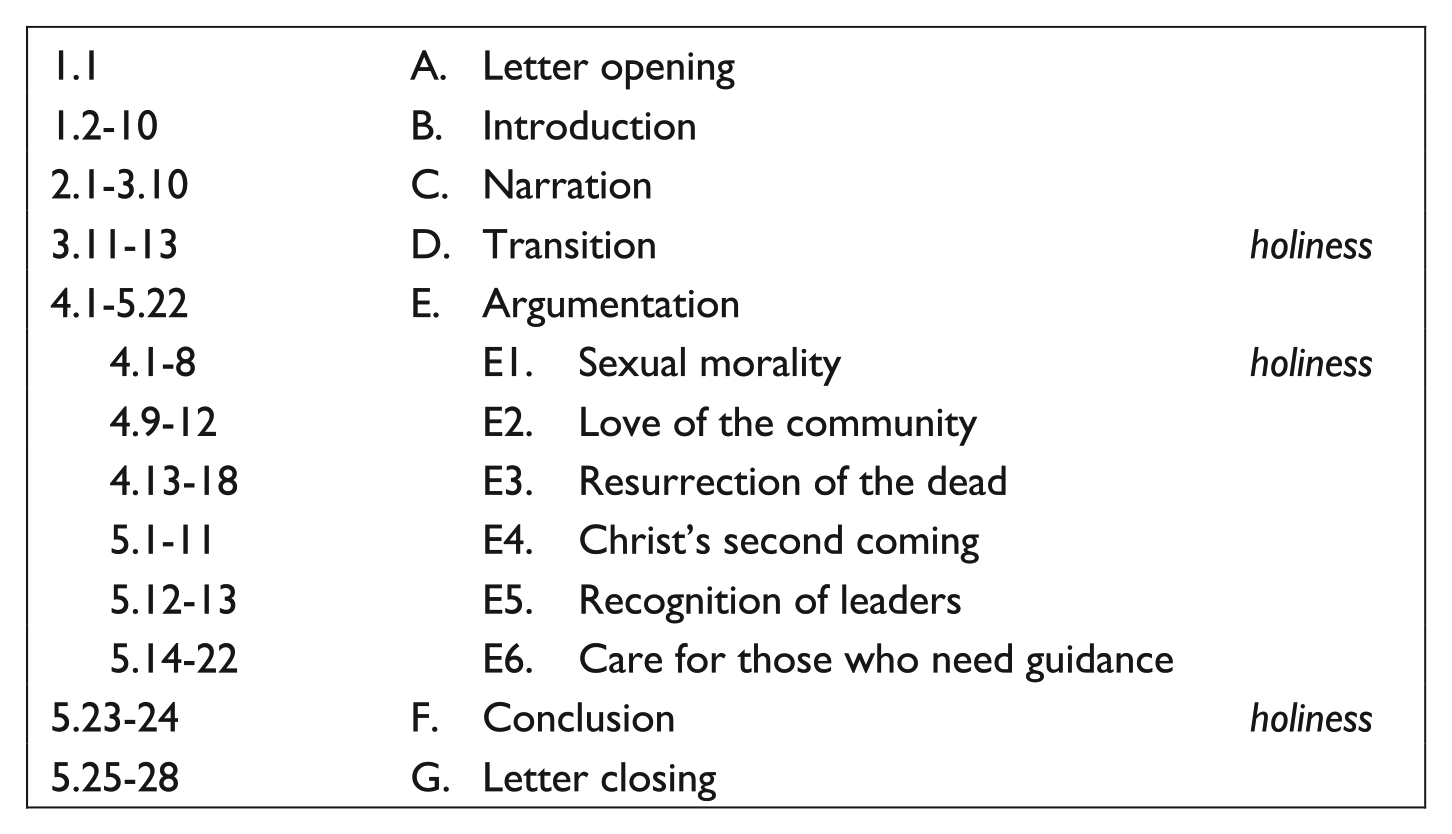
As exhibited by this rhetorical structure – which is summarized in the table above – the letter comprises six hortatory passages (E1–E6), possibly organized in three pairs, framed by the theme of holiness recurring in the transition (D), the first exhortation (E1), and the conclusion (F), and preceded by the introduction and narration (B–C), both of which are dominated by the efforts to establish good will among the audience. Since none of the identified elements is a proposition, a passage that clearly states the purpose or purposes of the oration, it is an open question where, in the identified structure, the immediate concern that motivated Paul to compose First Thessalonians is addressed. As several such passages have been proposed in previous scholarship, the next section will describe these alternatives and evaluate their ability to explain the letter’s pronounced captatio benevolentiae.
3. Proposed Purposes of First Thessalonians
According to the common view that First Thessalonians is primarily aimed at resolving the eschatological issues referenced in 4.13–5.11, the clearest statement of the letter’s purpose appears in the introduction to the third exhortation (E3).
Brothers, we do not want you to remain ignorant concerning those who have fallen asleep, so that you grieve just like the others, those who have no hope (1 Thess. 4.13).
Bruce C. Johanson (1987: 161-64, 187-90) argues that everything prior to this point has been aimed at strengthening the credibility of the senders, in order to address the issue that the Thessalonians – who have not been taught about a resurrection – have become worried by recent deaths in the community. Charles A. Wanamaker (1990: 60-63) suggests that Timothy has reported that the Thessalonians have erroneous eschatological views, which the letter is intended to correct. David Luckensmeyer and Bronwen Neil (2016: 32-35) take the many references to suffering and death (1.6; 2.14-15; 3.3; 4.13-16) to imply that the letter is aimed at consoling the Thessalonians in a troubling time. Ezra JaeKyung Cho (2020: 137-40, 242-45) adds that this is also the aim of funeral orations, with which the letter shares many rhetorical features, including a prolonged narration.
Johanson’s argument seems, strangely enough, to include the exhortations to sexual holiness (E1) and love of the community (E2) within the extended captatio benevolentiae, despite the clear shift from praise to instruction in 4.1. 27 Wanamaker dismisses the prominently placed exhortations E1 and E2 as not offering any serious correction of the Thessalonians’ behavior and focuses on 4.13–5.11 as addressing the only major issue in the congregation. Luckensmeyer, Neil and Cho are absolutely correct that there is an element of consolation in First Thessalonians – especially in 4.13–5.11 (E3–E4), where the recipients twice (4.18; 5.11) are exhorted to console one another – but this element does not extend to the whole of the letter. While parts of the introduction and narration, and shorter exhortations such as those in E4–E5, fit well within a consolatory structure of lamentation, consolation and exhortation (as argued by Luckensmeyer and Neil 2016: 38, 42-44) or a funerary structure of exordium, narration, consolation-exhortation and peroration with prayer (as preferred by Cho 2020: 65-68, 130-32), the aim of consolation has no explanatory value for the most prominently placed exhortations in E1–2, which rather take away from the letter’s consolatory function. 28 If worries for recently deceased Thessalonians constituted the most important reason for writing this letter, it is remarkable that Paul introduces this subject only as one topic among many with a περί in 4.13, deals with it in only six verses and then moves on to the next issue with a περὶ δέ in 5.1 (cf. Selby 1999: 402-403). And most importantly, neither of the models presented here manages to illuminate why a comforting and uplifting affirmation of eternal life should necessitate extraordinary efforts to establish good will among the recipients.
An intriguing strand of modern scholarship discusses how Paul utilizes all of his persuasive power to perform the simple task of confirming that the Thessalonians are on the right path. Gary S. Selby (1999: 386-87, 397-98) emphasizes how Paul evokes a symbolic worldview, where the Thessalonians are God’s elected people, who await Christ’s sudden return from heaven, a backdrop against which he consoles his readers in face of persecution and suffering, while also warning them of the dire consequences of ignoring the ethical requirements of their Christian faith. Even so, Selby (1999: 387) fails to identify any ‘clear issue or problem’ in the letter and concludes that Paul mainly exhorts his readers to continue their present behavior. 29 Gerd Lüdemann (2012: 86-87) declares that Paul is strongly determined to use rhetorical force to confirm that the Thessalonians have escaped the coming wrath by aligning themselves with Christ and his holiness. Thomas H. Olbricht and Stanley N. Helton (2016) argue that the logical argumentation of First Thessalonians merely serves to confirm that the Thessalonian community is a Christian church, adhering to basic Christian teachings. These scholars rightly recognize Paul’s intense commitment to prevent his recipients from deviating from the path to salvation but fail to identify the focal point of these efforts, which is more specific than the general danger of potentially straying from sound Christian teachings. If the aim was merely to confirm the Thessalonians’ present worldview and exhort them to continue their present behavior, there would be no need to urge them to do even more (περισσεύειν μᾶλλον) in 4.1 and 4.10, and no need for prolonged efforts of captatio benevolentiae.
Similarly, Wilhelm Wuellner claims that the fullest statement of the letter’s thesis appears at the end of the introduction (B).
For from you has the word of the Lord resounded not only in Macedonia and Achaia – everywhere (ἐν παντὶ τόπῳ) has your faith in God become known, so that there was no need for us to say anything. For by themselves they tell us how you welcomed us, and how they turned to God from the idols and came to serve the living and true God, and to await his son from the heavens, whom he raised from the dead: Jesus, our deliverer from the coming wrath (1 Thess. 1.8-10).
Wuellner (1990: 128-29, 133-34) argues that the hyperbolic ἐν παντὶ τόπῳ (‘everywhere’) emphasizes the universal character of the Thessalonians’ experience, and claims that the purported lack of need to say anything is an ironic preparation for the main point: Paul’s assertion that humanity is threatened by the ultimate judgment and needs to repent and serve Christ. 30 Wuellner is correct in identifying these verses as a rhetorically emphasized passage informing us about the senders’ worldview, and his suggested proposition is in a position – at the transition point from the introduction to the narration – where ancient orators frequently stated their main claims. Unfortunately, his suggested purpose fails to illuminate the rest of the letter. While the return of Christ is the subject of 4.13–5.11, which includes a statement that he will deliver the believers from wrath in 5.9, the rest of the exhortations are not based on an assumption that an association with Jesus is enough to keep the believer from trouble. On the contrary, the senders warn in 4.6 that those who commit πορνεία (‘sexual immorality’) will meet Christ as an avenger (ἔκδικος). If the exigency of the letter was the need to reaffirm the correct worldview, as Wuellner contends, such counterproductive exhortations would be left out, or at least be presented in a less prominent position than at the outset of the argumentation. And most importantly, if the overall purpose of the letter was simply to confirm that the Thessalonians are doing as they have been told, there would be no need for extended efforts to establish good will.
Frank W. Hughes maintains that 3.11-13 (D) has the triple duty of a transition from narration to exhortation, a proposition stating the purpose of the letter and a partition summarizing the main points of the ensuing argumentation. 31
May God our Father himself and our Lord Jesus guide our path to you. And may the Lord increase your love and make it abundant for each other and for everyone – just as ours does for you – so that your hearts are strengthened to be blameless in holiness before our God and Father when our Lord Jesus comes with all of his holy ones (1 Thess. 3.11-13).
Hughes (1990: 103-106, 113; 2016: 88-91) points to Cicero’s definition of a partition as either a list of points in which the speaker agrees or disagrees with his opponents or a brief and methodical presentation of the matters that are to be discussed in the argumentation. 32 Hughes maintains that 1 Thess. 3.11-13 fulfills the second alternative in Cicero’s definition, since the increased love corresponds to the exhortations to love the community in 4.9-12, the blameless heart foreshadows the exhortations concerning sexual morality in 4.1-8 and the coming of Jesus corresponds to the teachings about the parousia in 4.13–5.3. Although Hughes identifies a passage in which several of the themes of the ensuing argumentation are present and argues convincingly that this passage fulfills Cicero’s definition of a partition, he presents no evidence that it also serves as a proposition. This well-wishing prayer, where the work of making the Thessalonians holy and blameless lies entirely with God, makes no demands of the recipients that would necessitate the letter’s prominent captatio benevolentiae. Rather, this passage constitutes the last stage of the preparation required before Paul and his co-authors can proceed to the demand they have been aiming to make throughout the introduction, narration and transition: that the Thessalonians strive for holiness by avoiding πορνεία.
4. The Exhortation to Sexual Holiness
So far, we have established that a disproportionately large portion of First Thessalonians is dominated by efforts to make the recipients well-disposed toward the senders, attentive and receptive to their message. These efforts at captatio benevolentiae may be explained as preparation for the primary purpose of the letter, which we should find addressed at the end of the narration, where these efforts cease. The passage where this occurs, and which therefore should be the main candidate for where to find the primary purpose of First Thessalonians, is the first exhortation (E1). 33
For this is the will of God: that you should be made holy (ὁ ἁγιασμὸς ὑμῶν) and refrain from sexual immorality (πορνεία), that every one of you should learn to hold (κτάομαι) your own instrument (σκεῦος) in holiness (ἁγιασμός) and honor – not in the passion of desire (ἐπιθυμία) like the Gentiles who do not know God. No one should wrong (ὑπερβαίνειν) or take advantage (πλεονεκτεῖν) of his brother or sister (ἀδελφὸν) in these matters, for the Lord is the avenger of all such deeds, as we have already let you know and warned you about. God did not call us to be impure (ἐπὶ ἀκαθαρσίᾳ), but to be in holiness (ἐν ἁγιασμῷ), and the one who rejects this is therefore not rebelling against a human being, but against God, who is giving you his Holy Spirit (1 Thess. 4.3-8).
Not only does this passage represent the first exhortation given at the point where the continuous efforts of captatio benevolentiae cease, it is also presented in a rhetorically highlighted way, uses euphemistic language suggesting a sensitive topic, and addresses an issue that remains a major theme throughout the letter: the need for the Thessalonians to attain holiness before the return of Christ.
The passage starts and ends by appealing to the highest possible authority: God himself. It refers no fewer than three times to the holiness (ἁγιασμὸς) that this authority expects of believers (cf. Schnelle 2012: 194; Hoppe 2016: 233) and that the senders twice pray that the Thessalonians will be given in time for Christ’s imminent return (D/3.13, F/5.23). Without this holiness, they will be subject to God’s wrath (Selby 1999: 409-10) – a point first made in the introduction (B/1.10), restated in the narration (C/2.16) and repeated both here (4.6) and in E4 (5.9). The Thessalonians’ conduct, which initially is presented as a source of pride for the senders (1.6-7; 2.14; 2.19-20; 3.8), is in 3.10 stated to be in need of some correction (cf. Luckensmeyer and Neil 2016: 34) and is in 4.1 and 4.10 simply insufficient, as the recipients are openly asked to do more. While two of the hortatory sections are concerned with how the Thessalonians’ conduct impacts their present-day interactions with their earthly neighbors (E2) and with each other (E5), the exhortations in E1, E3 and E4 all share the eschatological perspective of avoiding the wrath of the eschaton (cf. Jewett 1986: 97). The last time this theme occurs is in the conclusion (F), a position where a good Greco-Roman orator summarizes his argument and restates his main claim. The motif that lack of holiness on the Thessalonians’ part may lead to divine wrath at Christ’s return is thus a strong factor of coherence throughout the whole letter. 34
Several of the euphemistic expressions in 1 Thess. 4.3-8 have been discussed for centuries without a consensus emerging. 35 The Thessalonians are to avoid a kind of sexual immorality (πορνεία) that potentially wrongs or takes advantage 36 of a brother or sister (ἀδελφός). They are to avoid it by handling or acquiring (κτάομαι) an instrument (σκεῦος) of unspecified nature. If they succeed in this avoidance, they will eventually attain holiness (ἁγιασμός) and honor, in contrast to Gentiles who fall into the passion of desire (ἐπιθυμία). The euphemisms imply that the issue at hand is so delicate that the senders felt a need to soften their language and make the passage difficult to understand for readers without knowledge of Paul’s previous teachings and warnings (cf. 4.6). 37
The term πορνεία and its cognates most naturally refer to prostitution, where πόρνη denotes a female prostitute, πόρνος a male one, πορνεῖον a brothel and πορνοτόφος a pimp. 38 Jewish and Christian authors, however, often expand the term to include a wide array of other unapproved sexual practices, 39 including marrying outside of one’s own Judean tribe (Tob. 4.12) or having sex for other reasons than for procreation (Wheeler-Reed, Knust and Martin 2018: 387-90, 395-98; Reno 2021: 175-77). They also use πορνεία as a metaphor, most commonly for idol worship, 40 but also for unrighteous economic transactions. 41 Paul’s use of πορνεία in other contexts is not specific enough to provide much guidance. 42 To decide on its sense in this passage is therefore impossible without first considering the context.
The ἀδελφός, who is introduced as a potential victim of this sexual practice, is unlikely to be a biological sibling. Given that the senders recurrently address the recipients as ἀδελϕοί (1 Thess. 1.4; 2.1; 2.9; 2.14; 2.17; 3.7; 4.1) and designate Timothy as an ἀδελϕός (3.2), the word can here be regarded as a well-established term for a fellow Christian (Wanamaker 1990: 147; Caragounis 2002: 138-39; Nsiah 2018: 58-59). The use of the masculine ἀδελφόν rather than the feminine ἀδελφήν does not exclude the possibility that the abused person is a woman – Christian women have been included in the masculine plural address ἀδελφοί throughout the letter – but does include the possibility that the victim is a man. 43 Possibly, the distinction between wronging (ὑπερβαίνω) and taking advantage (πλεονεκτέω) suggests that a man is considered to be wronged even if his wife is the one being sexually abused.
The verb κτάομαι most commonly denotes buying or acquiring something, but may also be used for possessing, holding or keeping. 44 In conjunction with εἰδέναι (‘to know’, ‘to learn’) the implication is clearly not toward a one-time acquisition, but a repeated or continuous action, as convincingly argued by Caragounis (2002: 145-47). 45 The contrast made to the Gentiles – who hold their σκεῦοι in the passion of desire – suggests that the practice was commonly accepted among ordinary Greco-Romans, while it was frowned upon by Jews and Christians. It would certainly contribute to the need for captatio benevolentiae if the practice Paul is condemning is generally considered uncontroversial in Greco-Roman culture.
The noun σκεῦος may refer to an instrument or vessel of any description and is therefore well suited for use as a euphemism. Three well-established senses, all of which fit this context, are the human body (the vessel of the soul or of the Holy Spirit), 46 the reproductive organs (the utensils for sex) 47 and a man’s wife (the vessel for his sperm). 48 The first two interpretations would fit well within a discussion of any sexual practice, with no significant difference between them. The third would point more specifically to marital infidelity or unaccepted sexual practices within marriage, but also makes the letter much more androcentric than it otherwise appears to be (Schmidt 2010: 254-55). Paul’s and Timothy’s later use of the term to denote clay vessels in contexts that metaphorically reference the weakness of the human body (Rom. 9.21-23; 2 Cor. 4.7) demonstrates that they are aware of the metaphorical possibilities of the term but that use is not specific enough to limit the sense in which they may use it here.
The ἁγιασμός (‘holiness’) for which the Thessalonians are to strive is connected to τιμή (‘honor’) but contrasted to ἐπιθυμία (‘desire’) and seems thus to denote an avoidance of dishonorable sexual practices. Collins’s (1983: 51) idea that the dishonorable sexual practice is adultery with married women fits this contrast but would not put Paul in much of an opposition to common Greco-Roman thought and does not begin to explain the need for captatio benevolentiae. A number of scholars suggest that the senders are denouncing all sexual activities motivated by desire, including those between husband and wife (Konradt 2001: 135; Zimmermann 2011: 387; Wheeler-Reed et al. 2018: 394-95; Reno 2021: 181-82). This suggestion certainly fulfils the criterion of a generally accepted sexual practice based on desire rather than honor but does not involve a male ἀδελφός who is wronged by a male Christian. Furthermore, it requires that Paul had a radical change of mind before discussing sex within marriage in 1 Cor. 7.3-5. There, he and Sosthenes present sex not as an activity to avoid, but one to which both spouses are entitled, and from which they should abstain only temporarily, after due deliberation, by mutual agreement and for the purposes of prayer. When speaking about mixed marriages in 1 Cor. 7.12-16, they even argue that a non-Christian spouse is sanctified (ἡγίασται) by his or her marriage to a Christian (cf. Zimmermann 2011: 383-89), an argument that is incompatible with viewing sex within marriage as contrary to holiness.
It is possible that the senders are referring to the sexual use of prostitutes, a commonly accepted practice in Greco-Roman society that Paul and Sosthenes later would condemn in 1 Cor. 6.12-20. But this possibility does not explain the choice of the masculine ἀδελφόν over the feminine ἀδελφήν, since most prostitutes were enslaved women, whose male pimps were in no way wronged by the sexual use of their property. The specific case of a male prostitute is not out of the question, but not common enough to be probable.
The most likely possibility is that the senders are referring to another sexual practice that was generally accepted among Greco-Roman Gentiles: sexual use of one’s slaves and former slaves. That a slave-owner could freely use his domestic slaves – women and men, including teens – to satisfy his sexual desires is presumed knowledge in a large array of ancient texts. 49 When the freeborn heroine of Chariton’s first-century novel Callirhoe is sold into slavery and still tries to reject her new master’s sexual advances, the master’s steward points out the obvious: ‘You are her master and have power over her. Willingly or unwillingly, she will do what you want.’ 50 Horace (65 BCE–8 CE) remarks that, just as a thirsty man does not wait for a golden goblet to drink, a horny man does not hesitate to satisfy his needs with any slave-girl or slave-boy who happens to be ready at hand. 51 The elder Seneca (c. 54 BCE–39 CE) jokes that, while extramarital sex is a vice for a freeborn, it is a necessity for a slave, and a duty for a freedman – clarifying that the manumission of a slave did not always put an end to her or his master’s sexual demands. 52
It is plausible that some slave-owners would have joined the Christians in Thessalonica, bringing their slaves and freedmen into the community. If their households functioned like other Greco-Roman households, some of these slaves and former slaves would regularly be forced to serve their masters’ sexual desires. There was no shame in using slaves sexually, but the practice was certainly driven by desire, and there was more honor in living with a wife and legitimate children. Since freed slaves could get married, the senders could consider sexual abuse of a former slave to be wrongdoing against her husband as well, which would explain the choice of ἀδελφόν rather than ἀδελφήν. Even if Christian leaders consistently objected to the practice, it stands to reason that they experienced some resistance in convincing slave-owners to give up a way of satisfying their sexual desires that was taken for granted in the wider society. If Paul, Silvanus and Timothy anticipated such resistance, it is logical that they would approach the topic carefully and hesitantly, commending the recipients for performing well in accordance with Christian ideals and presenting their demand as an additional step down the same path. The most probable interpretation of 1 Thess. 4.3-8 is therefore that Paul, Silvanus and Timothy are exhorting Christians to abstain from using their slaves and former slaves for sex. 53
5. Conclusion
In this article I have argued that a significant rhetorical feature of First Thessalonians is the prolonged efforts to make the recipients well-disposed toward the senders, attentive and receptive to their message, which occurs not only in the introduction in 1.2-10, but also throughout the narration and transition in 2.1–3.13. Such extended efforts of captatio benevolentiae are not likely to be made idly, but in preparation for a subsequent topic that is sensitive enough not to be approached lightly. The primary purpose of the letter should therefore be identified as the one addressed in the rhetorically highlighted and euphemistically expressed exhortation to sexual holiness in 4.3-8.
This result is supported by observation of the letter’s recurrent references to the need to attain holiness before the return of Christ, in order to avoid divine wrath. This point is made at the end of the introduction (1.10), touched upon in the narration (2.16), expanded upon in the first exhortation (4.3-8), restated in the fourth exhortation (5.9-10) and summarized in prayer form in the letter’s rhetorical conclusion (5.23-24). The sensitive topic of the first exhortation is clearly central to the rhetorical structure of First Thessalonians.
The many euphemisms in 1 Thess. 4.3-8 make it difficult to discern what kind of πορνεία the senders ask the recipients to abstain from, but the language would fit best with a recurrent sexual practice that was generally accepted in Greco-Roman society, but which early Christian leaders found unacceptable, at least when it would wrong or take advantage of a fellow Christian. One sexual practice that was so universally taken for granted that it would motivate extraordinary efforts at captatio benevolentiae to demand the recipients to reject it is the free sexual access of slave-owners to their human property – a practice that could even be extended to include one’s freed former slaves. It is therefore likely that the primary purpose of First Thessalonians is to exhort the recipients to abstain from sexual use of their slaves and former slaves. 54
Footnotes
1.
2.
The most important proponent for the view that Paul, especially, enjoyed a thorough rhetorical education is Vegge (2006). The most developed argument for the view that Paul’s rhetorical technique derived from informal social practice is Schellenberg (2013). Paul’s own way of downplaying his rhetorical skill has been identified by  as an instance of the rhetorical strategy dissimulatio artis, which implies that Paul was more rhetorically proficient than is apparent at first glance.
3.
Variously worded defenses for the use of rhetorical theory in New Testament interpretation are given by Kennedy (1984: 8-12), Johanson (1987: 34), Hughes (1990: 94-96), Kloppenborg (1993: 265), Mitchell (2006: 620-21), Kim (2017: 4-5) and, most recently, by Cho (2020: 1-11). For more thorough reflections on how rhetorical theory can interact with epistolographic studies in understanding Paul’s letters, see Classen 2009 and . Thurén rightly emphasizes the importance of identifying functional rhetoric in Paul, not merely formal conventions.
4.
5.
Johanson (1987: 59-67), Wanamaker (1990: 49-50, 67-71, 205), Holmstrand (1997: 48, 68-74) and Witherington (2006: 16-17, 20-21, 47-51, 175-80) all identify 1.1 as a letter opening and the last three or four verses as a letter closing. Pace Jewett (1986: 71-78) and Wuellner (1990: 128-35), who incorporate the letter opening and closing within their rhetorical introductions and conclusions. Wuellner’s characterization of 5.25-28 as ‘Final Pathos Appeal’ appears misguided, considering that the appeal to pathos is considerably stronger in the immediately preceding passage, 5.23-24. : 108-16) inconsistently subordinates his ‘Epistolary prescript’ (1.1) to the rhetorical structure, but keeps the ‘Epistolary Conclusion’ (5.23-28) separate.
6.
The radical shift to paraenesis at 4.1, dividing the letter into two halves, is recognized by Collins (1983: 28-31), Johanson (1987: 161), Vanhoye (1990: 75), Lambrecht (2000a: 136), Schmidt (2010: 124-25, 212-13), Lüdemann (2012: 34) and : 499-500).
7.
Pace Schmidt (2010: 208-209), who argues against the presence of captatio benevolentiae in 1.2–3.11, since the unusual length of the feature would be an unresolved issue. The unusual amount of captatio benevolentiae in the first half of First Thessalonians is also acknowledged by Berger (1974: 219-24), Johanson (1987: 157-60), Lambrecht (2000b: 177-78), Hoppe (2016: 57) and : 184-85). Schreiber (2007b: 268-69) recognizes it only in 1.2-10, where it can be expected. Schnelle (2012: 184) misrepresents the first three chapters of First Thessalonians as determined only by the theme of eschatological suffering of the just and ignores Paul’s efforts at captatio benevolentiae. Olbricht and Helton (2016: 233) note that ‘the letter is essentially praise’, and Cho (2020: 143-44) remarks that the normal length of a wish prayer and thanksgiving would be two verses.
8.
9.
10.
Cicero, Inv. 1.15/20-21 (LCL 386: 40-42); Quintilian, Inst. 4.1.5 (LCL 125: 180). (Cf. Martin 1974: 25, 63-64; Hughes 1990: 97; Winter 1991: 505; : 132-35).
11.
Cicero, Inv. 1.35/60 (LCL 386: 102-104); Quintilian, Inst. 4.4.1 (LCL 125: 292).
12.
Aristotle, Rhet. 3.13 (LCL 193: 424-26).
13.
Aristotle, Rhet. 3.13.1 (LCL 193: 424): ἀναγκαῖον γὰρ τό τε πρᾶγμα εἰπεῖν περὶ οὗ, καὶ τοῦτ᾽ ἀποδεῖξαι.
14.
15.
Cicero, Leg. man. 1.1 (LCL 198: 14): ‘Quamquam mihi semper frequens conspectus vester multo iucundissimus, hic autem locus ad agendum amplissimus, ad dicendum ornatissimus est visus, Quirites, tamen hoc aditu laudis, qui semper optimo cuique maxime patuit, non mea me voluntas adhuc, sed vitae meae rationes ab ineunte aetate susceptae prohibuerunt. Nam cum antea per aetatem nondum huius auctoritatem loci attingere auderem statueremque nihil huc nisi perfectum ingenio, elaboratum industria adferri oportere, omne meum tempus amicorum temporibus transmittendum putavi’.
16.
Cicero, Leg. man. 2.5 (LCL 198: 18). Cf Gildenhard and Hodgson 2014: 9-12. For more examples of captatio benevolentiae in ancient oratory, see : 507-14.
17.
Witherington (2006: 101) states that the rhetorical function of material in ch. 3 ‘is to get the audience into a reverential mode, which helps in making them receptive to the exhortations that will follow in 1 Thessalonians 4–5’. Hoppe (2016: 57, cf. 86, 89) argues that Paul prepares the ground for the influence he intends to have on the lives of the recipients from 3.9 onwards. : 14-15, 65) helpfully emphasizes how decisive the urgent need of the rhetorical situation is for shaping a letter.
18.
Schmidt (2010: 110-19) argues, based on thematic and linguistic criteria, that 1.2–3.13 is one structural unit. : 159) claims that ‘narrative and exordial characteristics are so closely integrated in realizing the persuasive strategies of captatio benevolentiae in 1.2–3.13 as a whole that any attempt to divide it into the discrete functional text-sequences of exordium and narratio must be judged as artificial and inappropriate’.
19.
With Wanamaker (1990: 49-50, 73-84, 90-91), Hughes (1990: 97-98, 109), Kloppenborg (1993: 266), Selby (1999: 393) and Lambrecht (2000a: 149). Wuellner (1990: 117-18) argues that 1.1-10 is a special, intensified form of introduction, an insinuatio, which was used when facing especially difficult audiences. The attempts by Jewett (1986: 73, 77), Witherington (2006: 25-29, 73-74), and Cho (2020: 8) to locate the start of the narration at 1.6 or 1.4 are especially unsatisfactory, since they place 1.8-10 within the narration, even though the aim to please the recipients is especially pronounced in these three verses (cf. : 86). Jewett’s claim for a shift to past experiences at 1.6 also overlooks the aorist ἐγενήθη in 1.5.
20.
Jewett (1986: 77-78) convincingly maintains that 3.11-13 functions as a transitus rather than a partitio and is endorsed by Johanson (1987: 160), Wanamaker (1990: 140) and : 182-83). Hughes’s suggestion (1990: 103-104) that 3.11-13 is ‘the partitio or propositio of the letter’ will be discussed below.
21.
22.
Selby (1999: 393-94) enumerates six hortatory sections on the theme of sexual purity (4.1-8), brotherly love (4.9-12), the fate of the dead (4.13-18), the time of Christ’s return (5.1-11), miscellany (5.12-21) and a concluding benediction (5.22-23). Lambrecht (2000b: 164-72) distinguishes between paraenesis in 4.1-12, eschatology in 4.13–5.11 and renewed paraenesis in 5.12-22, a division which Schmidt (2010: 119-24) finds to be largely accepted among scholars. Nsieh (2018: 48-55) also recognizes the major division between the exhortations to desirable Christian living in 4.1-12 and eschatological motivation in 4.13–5.11. Hughes (1990: 104-106, 113-16) identifies three proofs, concerning ‘how it is necessary to walk and to please God’ (4.1-8), ‘concerning brotherly love’ (4.9-12) and ‘concerning those who have fallen asleep’ (4.13–5.3) He claims 5.4-11 to be a peroratio and dismisses 5.12-22 as ‘traditional material’ (p. 106). Jewett (1986: 75-78) maintains that the argumentation contains five proofs concerning marriage ethics (4.1-8), communal ethics (4.9-12), the dead in Christ (4.13-18), the end times (5.1-11) and congregational life (5.12-22). He argues that the phrase περὶ δέ is used in three instances (4.9; 4.13; 5.1) to introduce ‘topics about which the Thessalonians had expressed concerns’ (p. 78). : 50, 140-204) speaks of an ethical exhortation (4.1-12), an instruction concerning the parousia and assumption (4.13-18), an eschatological expectation and paraenesis (5.1-11) and a series of general exhortations (5.12-22).
23.
24.
25.
These markers are previously identified by Holmstrand (1997: 61-68, 72-74, 82-84). The Neueinsatz at 4.13 is also pointed out by : 327).
26.
Collins (1983: 37) argues that the ἁγιασμός of 4.3 represents the process by which the believer strives toward the ἁγιωσύνη that it is God’s prerogative to give. Langevin (1990: 248-56) connects the concluding prayer to the themes of God’s election of the believers (1.4), God’s will for their sanctification (4.3-7) and God’s teaching of love (4.9), before concluding that the main function of the prayer is to stress that the sanctification of the Thessalonians will, ultimately, be the consequence of God’s grace, not of their work. : 134-35) identifies 5.23-24 as a recapitulation stressing that the Thessalonians’ eventual perfection is ensured not by their own faithfulness, but by God’s.
28.
Although : 45-47) should be commended for comparing this Pauline letter to consolatory epistles by Seneca (Ep. 63, 93, 99), the structural parallels on which they build their argument are not always clear. The laudatio they identify in 1 Thess. 1.2-10 has no clear counterpart in Seneca. Their lamentatio in 2.1-16 does not even mention the sufferings of the recipients until the last two verses. The self-consolation in Seneca seems to be intermingled with actual consolation rather than dominating a whole section as the self-consolation in 2.17–3.13. Furthermore, there is no suggestion of how the exhortatio in 4.1-12 may have contributed to the letter’s consolatory function.
29.
: 389-90) proposes three areas of potential anxiety in the Thessalonian community: (1) the continued persecution of the Christians in Thessalonica, (2) the death of several people within the community and (3) a feeling that Paul had abandoned them. While all three of these are likely to be actual historical concerns, all three are handled rather briefly and effectively, and none of them necessitate the prolonged efforts to establish good will that dominate the first half of the letter.
30.
Wuellner claims that the view that 1.9-10 serves as a basis for the whole letter has been previously suggested by Munck (1963). But Munck’s aim is, as noted by : 396 n. 14), to question the view that 1.9-10 is a summary of Paul’s previous missionary preaching in Thessalonica, not to find a statement of purpose for the letter as a whole.
31.
32.
Cicero, Inv. 1.22/31 (LCL 386: 62); cf. Quintilian, Inst. 4.5.1 (LCL 125: 298).
33.
With Jewett (1986: 105): ‘The placement of 1 Thess. 4.1-8 as the first proof following the extraordinarily long narratio section indicates its significance for the congregation’; with Caragounis (2002: 150), who remarks that the position of this paraenesis ‘implies that it has a special place of importance’; with Nsiah (2018: 63), who argues that Paul here, after establishing the authority of his exhortations, begins to address specific issues relating to the community, beginning with proper sexual conduct; pace : 161), who claims that even 4.1-12 serves to strengthen the credibility and authority of the senders in preparation for the exhortations in 4.13–5.11.
34.
35.
Abundant references to previous discussions are available in Konradt 2001: 128-31, Caragounis 2002: 133-35 and : 252-76.
36.
Pace Schmidt (2010: 291) the verb πλεονακτεῖν is in this context too vague to speak of πλεονεξία (‘greed’) as a separate problem in this paragraph (cf. : 46-47).
37.
38.
Gen. 38.15; Lev. 21.7; 21.14; Judg. 11.1; 16.1; Hos. 1.2; P.Oxy. 3.528; Herodotos, Hist. 1.93-94 (LCL 117: 122); Philo, Mos. 1.55/300 (LCL 289: 430; cf. Wheeler-Reed et al. 2018: 383-87; : 287).
40.
41.
42.
In First Corinthians, πορνεία seems to be a broad concept including prostitution (6.13-20) and the unprecedented case of a man living with his stepmother (1 Cor. 5.1). The 23,000 people who died (10.8) refers to Num. 25.1-9, where some Israelite men join Moabite women for both idolatry and sex, and since Paul prohibits Christians from divorcing their non-believing spouses in 7.12-13, the idolatry seems to be the main problem. In Second Corinthians and Galatians, the word is simply enumerated with other sins.
44.
This durative sense of the verb is clearly attested in Herodotus, Hist. 1.155; 7.161 (LCL 117: 196; 119: 474); Let. Aris. 229 (SC 89: 204); Philo, Cher. 119 (LCL 227: 78); Mt. 10.9 (Cf. Caragounis 2002: 145). In Plato, Leg. 829c (LCL 192: 128), κτάομαι is even used for mastering poetry and music. Konradt (2001: 133-35) convincingly argues that Plato’s sense (‘beherrschen’) does not fit the context in 1 Thess. 4.4, but erroneously holds that the more neutral sense of ‘keep, hold’ necessitates that we take σκεῦος to mean ‘wife’, rather than ‘body’ or ‘genitals’, and limit the understanding of Paul’s exhortation to sexual practices within marriage. : 110) erroneously claims that the durative sense is unattested.
45.
Cf. Schmidt 2010: 256-57 and : 382-83.
46.
Herm. Mand. 5.1.2 (33.2); Barn. 7.3 (cf. Konradt 2001: 132; Caragounis 2002: 134-35; Schmidt 2010: 257-61; : 381-82).
47.
1 Kgdms 21.6 LXX uses τὰ σκεύη μου (‘my equipment’) as a euphemism for David’s genitalia. Aelian, Nat. an. 17.11 (García Valdés, Llera Fueyo and Rodríguez-Noriega Guillén 2009: 410-18), notes that one possible symptom of a spider bite is that the patient’s ‘instrument’ becomes erect (καὶ ὀρθοῦται τὸ σκεῦος αὐτοῖς). In Plautus, Poen. 863 (LCL 260: 108), Syncerastus claims to be doing what adulterers caught in the act tend not to do – bringing their ‘utensils’ back safe and sound (refero uasa salua) (cf. Wanamaker 1990: 152-53; Smith 2001: 94-95, 103-105; Konradt 2001: 130-31; : 66-70). There is no reason to exclude female sexual organs from consideration here, as the euphemism fits those equally well.
48.
A similar Hebrew expression is attested in 4Q416 2 II, 21 (Konradt 2001: 131-32; Schmidt 2010: 252-76; Witherington 2006: 113-16; : 382).
49.
This is acknowledged by many scholars, including Osiek (2003: 262-64), Williams (2010: 31-36), Marchal (2011: 751-53) and Glancy (2015: 216). Glancy (2015) convincingly argues that available evidence suggests that most Greek-speaking Jews would accept sexual use of domestic slaves as well. Her claim that ‘we have no evidence that Paul challenged that sexual norm’ (: 229) is made without considering First Thessalonians.
50.
51.
Horace, Sat. 1.2.114-19 (LCL 194: 28; cf. Williams 2010: 33; : 755).
53.
54.
For valuable feedback to this article, I thank the anonymous reviewers and my colleagues at Uppsala University and Stockholm School of Theology, especially Jonas Holmstrand, James A. Kelhoffer, Marianne Wifstrand Schiebe and Thomas Kazen.