




Abstract
This article challenges the historical existence of the ‘Johannine community’ – a hypothesized group of ancient churches sharing a distinctive theological outlook. Scholars posit such a community to explain the similarities of John to 1, 2 and 3 John as well as the epistles’ witness to a network of churches. Against this view, this article calls attention to evidence of literary contact between the four texts and the presence of dubious authorial claims in each. Taken together, these features cast John, 1 John, 2 John and 3 John as unreliable bases for historical reconstruction, whose implied audiences and situations are probably fabrications. The article proceeds to develop a new history of the Johannine texts. Those texts represent a chain of literary forgeries, in which authors of different extractions cast and recast a single invented character – an eyewitness to Jesus’ life – as the mouthpiece of different theological viewpoints.
For over fifty years, scholars have assumed that the Gospel and Epistles of John were written within a particular kind of social matrix: a single, close-knit network of churches sharing a distinctive theological outlook (the ‘Johannine community’ or ‘Johannine Christianity’). Popularized in works by J. Louis Martyn, Raymond Brown and Wayne Meeks, the hypothesis drew inspiration from the earlier discovery of a sectarian community and literature at Qumran. 1 By the late 1980s, it had become ‘a paradigm’ for Johannine studies – ‘knowledge generally received and held to be valid’ in ‘standard works, such as commentaries and textbooks’, as well as the framework for hundreds of studies (Smith 1990: 293 n. 30).
More recently, however, this hypothesis has found itself under attack and, to some extent, in retreat.
2
A small but vocal set of critics has taken aim at the lack of any external evidence for the existence of a Johannine community and the uncertain methods used to reconstruct its history: Like the quest of the historical Jesus, the quest of the historical Johannine community has produced a wide variety of results, but, unlike the former quest, that of the Johannine community has yet to produce criteria of authenticity and critical methodological reflection. The undisciplined way in which it treats the Gospel as evidence of the history of the community, along with the complexity of possible combinations of different analyses of sources and redactions with different views of the community, make its results unfalsifiable and infinitely variable. Since the Johannine community … left no mark either on the non-Johannine literature in the New Testament or on other early Christian sources, there is no external evidence that can act as a control on imaginative reconstruction. Even Martyn’s appeal to one piece of external evidence – the supposed promulgation of the Birkat ha-Minim … has been very largely abandoned by proponents of the dominant approach (Bauckham 2007: 13-14).
Despite these criticisms, however, the idea of a Johannine community has proven remarkably resilient. Speaking for the present majority, a recent introduction to John insists that even if ‘we are not able to reconstruct its history with the same rigor and precision as recent scholars have attempted’, the ‘reconstruction of a Johannine community rests on a much more secure foundation than do the other theoretical gospel communities’ (Skinner 2015: 44).
That more secure foundation is the existence of three additional ‘Johannine’ texts besides the gospel – namely, 1, 2 and 3 John. ‘Whatever one may say about the Gospel’, Martinus de Boer (2018: 213) writes, ‘the Epistles have for many provided a firm foundation for the conclusion that there was a Johannine community’. Along similar lines, Adele Reinhartz (2003: 17) – a critic of the hypothesis – concedes that ‘the letters of John seem to demand the existence of such a community’. On the one hand, the very existence of multiple texts sharing ‘Johannine’ ideas and idioms but written by different hands implies a pool of connected writers – a pool upon which the image of a ‘community’ is easily mapped. Secondly, the epistles seem to attest that community in their references to ‘churches’ linked by a ‘network of visits and letters’ (Lieu 2014: 123; e.g. 3 Jn 6, 9, 10).
In this article, I will argue that these lines of evidence might be compelling if not for two issues affecting the Johannine corpus – issues widely overlooked in discussions of whether a Johannine community as such existed. Those issues are literary contact and disguised authorship. Today, a majority of scholars assume genetic links between most or all the Johannine texts (Hakola 2015: 84; Parsenios 2014: 13). ‘By far the most commonly held’ view posits that the epistles presuppose the gospel, clarifying its teachings ‘in a newly developed situation of schism’ (Sproston North 2001: 11). Many scholars also question the authorial claims of these texts, so that each of the four is counted as a pseudepigraphon in at least some studies. 3 My argument is simple: if all four Johannine works fall into a single literary lineage, and if false authorial claims pervade that lineage, then it is not safe to reconstruct a Johannine community from these texts. The features of the epistles that would seem to ‘demand’ the existence of such a community – their similarities to the gospel and their references to a network of churches – can instead be explained by two devices of pseudepigraphal writing: imitation of style and verisimilitude. 4
Consider the relationship between the undisputed and disputed Paulines. These texts also share linguistic features despite having been written by multiple authors. Since scholars recognize the deutero-Paulines as pseudepigrapha, however, they credit this overlap to direct contact and imitation: the deutero-Paulines reuse genuine Pauline expressions to bolster their false authorial claims.
5
Similarly, the deutero-Paulines presuppose concrete situations and address specific communities or individuals (e.g., the Colossians, Timothy). Since these letters ‘were probably not sent … as part of a continuing relationship of direct and indirect communication’ (Lieu 2014: 129), however, recent studies caution against incorporating these details into historical reconstructions. The same details are more likely verisimilitudes – literary fictions mimicking features of Paul’s genuine correspondence: [O]n the assumption of pseudonymity, a pseudepigrapher poses as the apostle Paul in order to write a letter to the Colossians, who, in turn, are fictional addressees masking an unknown actual group of recipients, about a situation which may well prove to be as much a construct as the author (Paul) and the recipients (the Colossians) … [one must] take into account the pseudepigraphal attempt to achieve a ‘reality effect’ by employing tropes and concerns from authentic Pauline letters to lend the forged writing an air of verisimilitude (Lincicum 2017: 172).
What holds true for the deutero-Paulines should also hold true for the Johannines – texts that already show signs of literary contact and disguised authorship. These documents are not the independent products of a single community of like-minded churches. Rather, they are successive pseudepigrapha, which present themselves as the work of the same invented figure: a nameless eyewitness to the life of Jesus, recognized by his distinctive idiolect. This figure was invented by the author of John as an authenticating device for his gospel and was later co-opted by the author(s) of the epistles in support of other agendas. 6 In this case, the narrative world built around that figure – a community of house-churches linked by emissaries – should be seen for what it is: a literary invention. We have no external evidence for the network envisioned by the epistles because no such network existed.
Literary Contact in the Johannine Corpus
As Raimo Hakola (2015: 7-8) notes, ‘the coexistent similarities and subtle differences in the style and theology [of] the Fourth Gospel and the Johannine Epistles … formed a crucial building block in the emergence of the theory of a specific Johannine group or school’. The subtle differences between the gospel and epistles dismantled the traditional view that they shared a common author. 7 In turn, the affinities between the same texts ‘set them apart from other surviving early Christian literature’, suggesting their origin in a discrete community with distinctive beliefs and language patterns (de Boer 2018: 212 n. 6).
There is, however, another way to explain those similarities. One can credit them to direct contact and literary borrowing. Writers in different social and geographic contexts can achieve similar convergences if one is familiar with the work of the other and chooses to incorporate that work’s language and ideas in his or her own text.
The idea that the four texts are related in this way is hardly outside the mainstream of Johannine scholarship. On the contrary, ‘the vast majority of scholars assume that one of the Johannine texts is the model for the others’ (Parsenios 2014: 13). But scholars have failed to connect this observation to the question of the community’s existence. If these texts show signs of literary contact, their similarities would neither require nor demonstrate the existence of a Johannine community. Scholars do not insist that Mark and Matthew were written within a single community; literary borrowing provides a sufficient explanation for their overlap.
Verbal Similarities
Since literary borrowing entails the reuse of language, its most obvious evidence is similarity of expression. With respect to the Johannines, ‘it is difficult to find … works more similar in expression’. 8 At least 37 expressions (phrasal or clausal strings) are highly characteristic of the Johannines and present in at least John and 1 John. Of these, 26 appear nowhere else in the NT. 9 These expressions include:
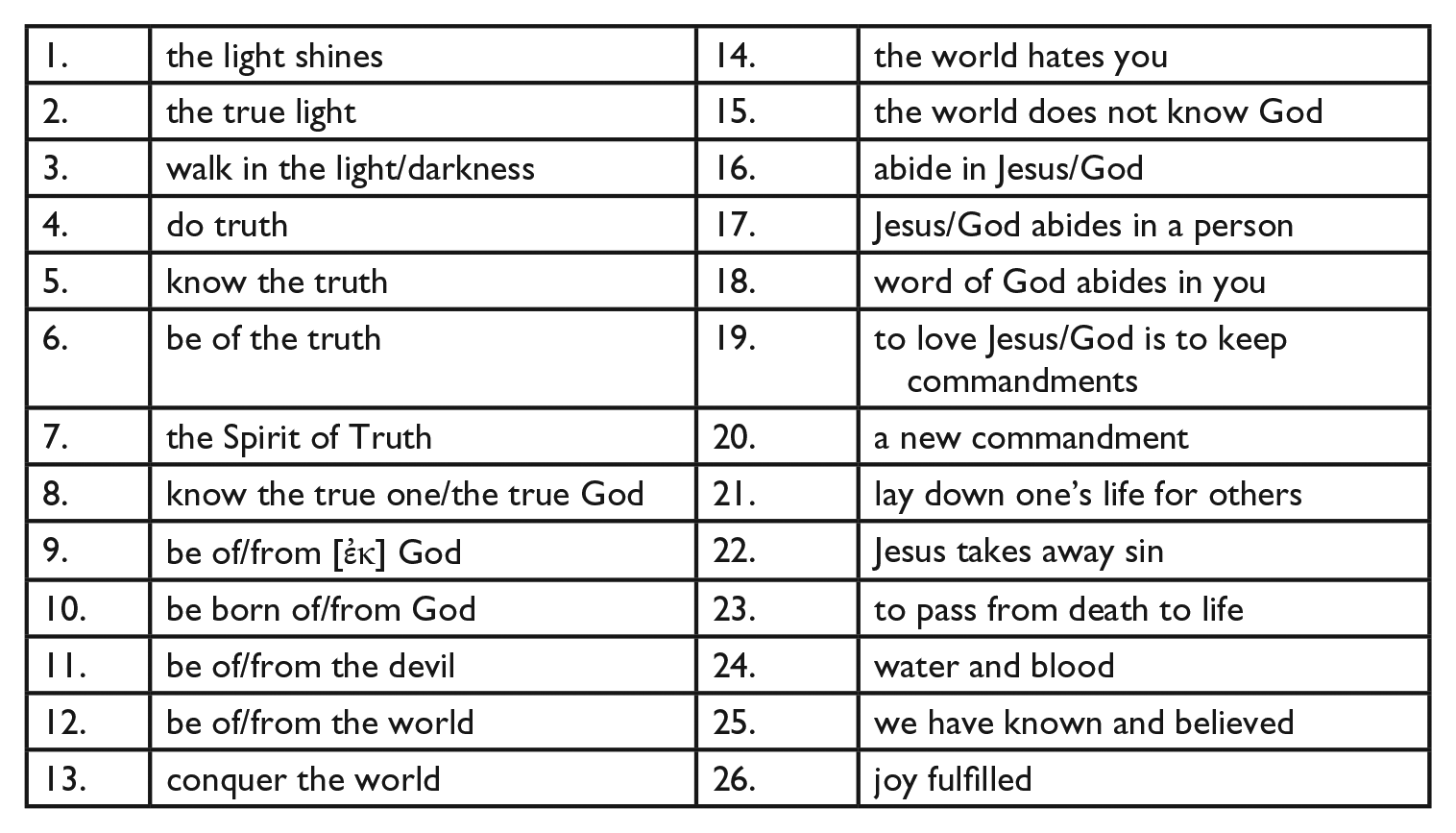
Given their brevity, the epistles are especially dense with these parallels. In 1 John – a text with only 105 verses – one finds over 70 points of contact to the language of the gospel. 10 Taken together, 2 and 3 John – 28 verses in total – have 54 points of contact with the gospel and 74 with 1 John (Marty 1925: 202-203). 11 In a discussion of any other ancient texts, such an extensive network of linguistic correspondences would be considered strong evidence of a literary relationship.
When scholars make a case against literary contact, they do so by stressing the differences between the language of the Johannines above their similarities. Judith Lieu (2008: 17) argues that ‘there is no compelling evidence of a direct literary relationship between 1 John and the Gospel’ since ‘the consistent subtle differences of wording, inference, context, and combination even where close parallels appear suggest that both writings draw independently on earlier formulations’. Similarly, Hakola (2015: 90) insists that ‘clear differences in how common idioms and themes are developed’ point away from ‘direct literary dependence’ between the texts.
The problem with this objection is that ‘the absence of agreement … says nothing about the presence of agreement’ when assessing literary relationships (Goodacre 2012: 36). A literary relationship exists between texts whether one is 5% derivative from the other or 95% derivative. Indeed, ‘only one direct-connect parallel is required to demonstrate literary dependence between two documents’ (Zamfir and Verheyden 2016: 260). This is especially true since plagiarists and imitators are known to incorporate language selectively and to rework whatever language they do choose to incorporate at different rates. 12 In short, the only positive evidence one can offer against literary dependence is the absence of similarity – not the presence of differences.
Similarities in Form
As extensive and dense as these linguistic parallels are, an even stronger case for literary contact between the Johannines can be made from their formal similarities – that is, from their shared body features and compositional techniques. Taken together or individually, ‘these larger structural bonds … make it extremely difficult to imagine how a “Johannine tradition” does not rely on literary dependence in some form’ (Parsenios 2014: 12).
John and 1 John
John and 1 John share two peculiar structural features. The first is the use of a stylistic prologue or proem at the beginning of the text (Jn 1.1-18; 1 Jn 1.1-4). The presence of these passages is surprising enough; they are not required by the genre of either text (narrative gospel/bios[?] and tractate). More to the point, these passages ‘though by no means identical … stand together against anything else in the NT, sharing a large number of common features in a short space’ (Painter 2002: 69):
They introduce the term ἀρχή in their first clauses.
They refer to Jesus as the λόγος.
They identify the λόγος with ‘life’ (ζωή).
They affirm that Jesus was ‘with the Father’ (πρὸς τὸν πατέρα) in the beginning.
They adopt a first-person plural narratorial voice.
They position the narrator among those who ‘have seen’ (ἑωράκαμεν) Jesus.
They share other key terms (e.g. μαρτυρῶ 13 ).
With each point of overlap, the possibility of coincidence – even within a common social milieu – becomes remote.
Secondly, both texts incorporate statements of purpose, in which the author indicates his rationale for writing. Tellingly, these statements are also very close in language. In both, the narrator links the task of writing to the idea that one may possess ‘life’ by believing in the ‘name’ of the ‘Son of God’: But these have been written that you may believe that Jesus is the Christ, the Son of God, and that by believing, you may have life in his name. (Jn 20.31) I write these things to you who believe in the name of the Son of God, that you may know that you have eternal life. (1 Jn 5.13)
As George Parsenios (2014: 12-13) concludes: This kind of close association suggests more than a coincidence arising from a common tradition. If the various terms and phrases that the texts share were randomly scattered throughout the works, then their similarities might be merely coincidental … More than a common tradition seems to be at work when two texts not only use the same words but also use them in the same places.
John and 3 John
We might not expect points of contact between the gospel and 3 John, seeing as the latter text is small enough to fit on a single papyrus sheet and adheres tightly to a standard epistolary form. And yet, one such point of contact exists. Both texts include an affidavit, in which the narrator testifies to a fact and affirms the truth of his testimony. That these two affidavits are also very close in wording leaves ‘no doubt’ of ‘a relationship between these texts’ (Klauck 1992: 19): He who has seen has testified – his testimony is true, and he knows that he speaks the truth … (Jn 19.35; cf. 21.24) We also testify, and you know that our testimony is true. (3 Jn 12)
1 John and 2 John
1 John and 2 John contain nearly identical material – the latter being an abridgment of the former. This close relationship is crystallized at a single formal parallel. In both texts, the narrator directly addresses his readers and declares that he is ‘writing’ a ‘new commandment’, while simultaneously insisting that this commandment is, in fact, one they have ‘heard’ ‘from the beginning’: Brethren, I am writing you no new commandment, but an old commandment which you had from the beginning … which you have heard. (1 Jn 2.7) And now I ask you, Lady, not as one writing you a new commandment, but one we have had from the beginning … as you have heard from the beginning … (2 Jn 5-6)
2 and 3 John
No Johannine scholar questions a genetic relationship between 2 and 3 John – by far the most similar texts in the collection. Both documents are (a) roughly the same length, (b) addressed by the same sender (‘the Elder’), (c) introduced with prescripts that agree nearly verbatim (2 Jn 1; 3 Jn 1) and (d) concluded by formulaic apologies for the letter’s brevity, with a stated intention to visit (2 Jn 12-13; 3 Jn 13-15). Either both are works of a common author, or one is modeled on the other.
Direction of Influence
If the Johannine texts stand in a single, if branching, lineage, where does this lineage begin? Which text came first and served as a model for the others? Here again, scholars have had trouble disentangling their answers from the community hypothesis; many existing proposals order the texts against existing reconstructions of the Johannine group’s history. The most popular identifies the gospel with an initial, formative period of the community’s development given its interest in Jews and the synagogue but dates the epistles, which lack these interests, to a later time. 14
If we set aside this dubious approach and focus strictly on the textual data, we still have reasons to assign the gospel priority. Consider the first site of overlap between John and 1 John: their opening lines. The gospel has strong, independent motivations for using the phrase ἐν ἀρχῇ in its first clause. The expression is one of several parallels to LXX Gen. 1 in the prologue – a passage Boyarin (2001: 243-84) characterizes as a midrash on the creation account. The term ἀρχή also appears in the first clause of Mark – a generic template for John, with which the text’s author was likely familiar: ‘the beginning [ἀρχὴ] of the gospel of Jesus Christ’ (1.1). 15 By contrast, no such motivations exist for the phrase’s appearance in 1 John. In this case, 1 John probably takes up the expression in imitation of the gospel (Parsenios 2014: 13). Certain lines in 1 John also seem to presuppose the gospel (Köstenberger 2009: 93). The text’s passing reference to ‘water and blood’ in 5.6-8 is opaque to readers not familiar with the gospel (cf. 19.34). So too is the text’s confusing characterization of the mandate to love as ‘no new commandment’ but also a ‘new commandment’ (2.7-8; cf. Jn 13.34).
If the gospel predates 1 John, it should also predate 2 or 3 John. Given their brevity, it is prima facie unlikely that either was a source for the Johannine tradition. The two, after all, contain only a limited number of expressions found in John or 1 John. The fact that both texts enter the historical record at a late date and are disputed from their first mention also suggests their later composition and derivative character. 16
Lieu (2008: 239) builds a persuasive case for 2 John’s ‘close literary dependence’ on 1 John from its severely abbreviated argumentation – the result of an author trying to compress the contents of 1 John onto a single sheet. Individual arguments in 2 John can be ‘difficult to understand … without reference to the passage in 1 John’ to which they correspond, presupposing knowledge of that text (Lieu 2008: 252). The same compression also produces grammatical difficulties, including a perplexing sentence structure at vv. 5-6 and an abrupt shift from plural to singular at v. 7.
3 John also contains evidence of its later composition. Towards the end of the epistle, the sender claims to have previously ‘written something to the church’ (v. 9). If, as many scholars believe, that letter corresponds to one of 3 John’s extant companions – probably 2 John – it should date to the latest stratum of Johannine texts. 17
False Authorial Claims
The claim that the four Johannines stand in a single, branching lineage undermines an important argument for the community hypothesis. But ‘the clearest case for a specific initial community’ is developed from another feature of the epistles – namely, their references to ‘a cluster of churches with an identifiable set of locally generated problems’ (Blomberg 2010: 117). The letters speak of interrelated but distinct ‘churches’ or ‘houses’ (3 Jn 6, 9-10; 2 Jn 10), whose leaders maintain contact through letters and personal visits (3 Jn 9-10). The texts also envision ruptures within the communities, resulting in rival factions (1 Jn 2.18-19; 2 Jn 7, 10).
Beneath this argument for the community, however, lies a crucial, if often unstated, assumption – namely, that the narrative world of these letters faithfully represents the external world in which they were produced. But the epistles are the kind of texts for which this assumption is problematic – that is, texts with suspect authorial claims. In a recent challenge to the practice of reconstructing history from the deutero-Paulines, David Lincicum (2017: 172) writes that ‘when pseudepigraphy is taken into consideration, arguably any appeal to the ostensive reference of text to world is complicated’, and ‘the communicative triad of author, addressee and situation becomes opaque’.
Pseudepigraphy is usually taken as troubling the first point of the triad (the author, per definitionem), sometimes the second (the addressees) but rarely the third (the situation). But arguably the complications introduced by pseudepigraphy have not penetrated study of the New Testament as they might have done … if we judge a text pseudepigraphal, to discern reality from appearance is severely problematized … since all the ostensive elements of epistolarity are fictionalized in a pseudepigraphal letter (or at least the burden of proof falls to the interpreter who wants to suggest that one element of the triad of author–recipient–situation is not fictionalized while the others are). (Lincicum 2017: 172)
If these cautions apply to works like Ephesians and 2 Timothy – works addressed to recipients attested elsewhere in the historical record (e.g., Acts. 19.1; Rom. 16.21) – they should be all the more applicable to the Johannine epistles, whose audiences are not externally corroborated. In the case of these texts, we have every reason to conclude that ‘pseudonymity of author most naturally carries with it pseudonymity of audience and hence of the situation implied’ (Lieu 2014: 129).
At present, this critique has made only a limited impact on the study of the epistles. Lieu (2014: 129) questions the practice of reconstructing the shape of the Johannine community from 2 John on the grounds that it is pseudepigraphal. Since she assumes the independence of the other Johannine works, however, she concludes that ‘the idea of “the Johannine community”’ ‘cannot be avoided’ (2014: 139). As I see it, it is time to extend this critique further, aiming it not only against the witness of individual texts to a Johannine community but against the very premise that such a community existed. Lieu limits her critique to 2 John because she sees its pseudepigraphy as exceptional. It is not. Rather, disguised authorship is a core and consistent feature of the Johannine corpus – one that contaminates its entire witness to a ‘Johannine community’.
Authorial Claims in John
As Richard Bauckham (2017: 358) observes, John is the only gospel of the canonical four to claim ‘not only to be based on eyewitness accounts but to have been actually written by an eyewitness’. 18 Bauckham builds his case from the closing verses of ch. 21, a passage most commentators regard as a later addition to the text. 19 Nevertheless, the same case can be made from previous chapters.
Unsurprisingly, the gospel begins constructing its implied author as an eyewitness to the life of Jesus in its opening lines – a natural site for authorial self-representation. Those lines contain a rare instance of first-person speech by the narrator: And the Word became flesh and dwelt among us, and we have seen his glory – glory as of the Father’s only son … (1.14)
This plural ‘we’ may represent (a) an exclusive or editorial plural (‘we, not you’), in which the narrator reads himself into a body of individuals distinct from the readers, (b) an inclusive or associative plural (‘you and I’) or (c) a nosism (‘I’) (von Harnack 1923: 96-113; Jackson 1999: 12).The syntax supports the first of these options. Read in its host sentence, the ‘we’ of 1.14 is anaphoric, referring back to those plural individuals ‘among’ whom Jesus lived in the previous clause: ‘the Word became flesh and dwelt among us [ἐν ἡμῖν] and we have seen [ἐθεασάμεθα] his glory’ (1.14). By linking the coming of Jesus in the flesh to the narrator’s sight of his glory, the syntax implies that the narrator actually saw Jesus in the flesh. This coheres with later claims that Jesus manifested his glory to others through his miraculous ‘signs’: ‘Jesus performed this, the first of his signs, at Cana in Galilee, and revealed his glory; and his disciples believed in him’ (2.11; cf. 11.40). In the claim ‘we have seen his glory’, then, the text constructs its narrator – and, in turn, implied author – as an eyewitness to these signs.
The text consolidates this eyewitness cast as it gradually identifies its narrator with a particular in-text figure: an enigmatic, male ‘disciple whom Jesus loved’.
20
This disciple, unknown from the Synoptics, is depicted as an intimate companion of Jesus through the climactic, final events of his life (Litwa 2018: 345). He reclines beside Jesus through the Farewell Discourse (13.23-26), he is the only male disciple to stand beside Jesus at the crucifixion (19.26-27; cf. 16.32) and he is the first to believe at the empty tomb (20.2).
21
In the second of these scenes, the narrator inserts a parenthetical affidavit:
22
He who has seen has testified … so that you may believe. (19.35)
This affidavit, in turn, parallels the narrator’s conclusion to the gospel, suggesting he is the witness of 19.35 and, in turn, the only male disciple at the crucifixion (Lincoln 2005: 480; Attridge 2003: 72): These are written so that you may believe … (20.31)
At a later date, the link between these characters was made explicit. In an effort to authenticate his addition to the book, the author of ch. 21 imitated the text’s original conclusion at 20.3, adding language from the affidavit in 19.35: [The ‘disciple whom Jesus loved’ (v. 20)] is the disciple who is testifying to these things and has written these things; and we know that his testimony is true. But there are also many other things that Jesus did … (21.24-25)
This second conclusion – a bricolage of earlier statements by the narrator – captures the original text’s authorial claim: John was ‘written’ by an eyewitness. 23
An Invented Author
Although the gospel constructs its implied author as an eyewitness to Jesus, we have every reason to doubt this claim. Even if the gospel preserves ‘primitive, undeveloped material’ of historical value (Anderson 2009: 382), that material accounts for only a fraction of its contents. A larger percentage of the text is of suspect historicity, including entire discourses whose style, tone and contents differ so radically from the sayings of Jesus preserved in Paul and the Synoptics as to indicate ‘creativity … on a large scale’ (Lincoln 2007: 187). That these discourses are the author’s fabrications is clear from the fact that ‘when Jesus, the literary character, speaks, he speaks the language of the author and his narrator’ (Culpepper 1983: 40). In certain passages, ‘it is impossible to tell when Jesus … stops speaking … and when or if the narrator speaks’, most notably 3.13-21, 31-36 (Culpepper 1983: 41). In short, Jesus’ voice has been commandeered by the author, who makes him the mouthpiece of an intricate system of ideas foreign to the Synoptics, including the need to be ‘born from above’, ‘abide’ in God, and ‘walk in the light’.
Embellishment is compatible with eyewitness testimony (Hengel and Schwemer 2007: 490-91). But fabrication of the scope and kind seen in John – hundreds of verses of invented discourse material, amounting to a systemic refiguration of Jesus’ teachings – is another matter altogether. This kind of refiguration evokes gospels like Thomas and Mary – texts that extensively colonize Jesus’ voice to introduce novel theologies. That John’s theology meets our standards of orthodoxy should not obscure its use of the same strategy.
Tellingly, Thomas also claims eyewitness credibility; so too does the Gospel of Peter. ‘Introducing an eyewitness was a standard historiographical convention’ in antiquity, ‘used to authenticate revisionary works that otherwise might have been questioned for their novelty in form and content’ (Litwa 2018: 355). For this reason, ‘first-person speech and eyewitness accounts’ are encountered frequently in literary forgeries – so much so as to be ‘virtually characteristic’ of them (Speyer 1971: 51). John’s eyewitness claim may serve to authenticate its own fabrications.
We cannot isolate John’s eyewitness claims from its extensive fabrications, treating them as independent issues. On the contrary, those claims are embedded within the text’s invented materials, sharing the same idiom with a mutually reinforcing effect:

More to the point, the eyewitness claimed by the text is probably a fabrication in his own right. Since the literary turn in Johannine studies (1980s–), an increasing number of writers have argued that the ‘disciple whom Jesus loved’ may be a mere literary device or invention. 24 The text casts the eyewitness as Jesus’ most intimate disciple – a figure moving in his inner circle and outranking even Peter in access to him (Jn 13.23-24). And yet, the identity of this figure is unknown, concealed under ‘studied anonymity’ (Attridge 2003: 79). All efforts to identify him with a known disciple of Jesus result in ‘a dead end’; the text ‘systematically defeats any attempt to identify who that witness was’ (Attridge 2003: 78). 25 He is unattested in other early sources. Every Synoptic parallel that could corroborate his presence at a given moment in Jesus’ life does not – not the Synoptic crucifixion scenes (cf. Mk 15.40-41; Mt. 27.55-56; Jn 19.26-27) nor Luke’s description of Peter’s visit to the tomb (Lk. 24.12; cf. Jn 20.2-10). No less problematically, the eyewitness has a highly artificial texture. ‘Unlike the other Johannine characters … he is the ideal disciple, the paradigm of discipleship’, who ‘has no misunderstandings’ (Culpepper 1983: 121).
As David Litwa (2018: 359) writes, the similarities between John’s eyewitness and those found in ancient pseudepigrapha ‘force the critical reader to reflect on why scholars even today argue strongly for the historicity of the Beloved Disciple … while easily discounting the historicity of similar eyewitness claims’. Ancient pseudepigrapha also read their eyewitnesses into narrative as idealized characters, thereby establishing their trustworthiness: [In the Life of Apollonius] Damis, for instance, is Apollonius’ closest disciple who sticks by him and even suffers arrest in Rome … A basic similarity can be detected in John. Although Jesus loves all his disciples, the Beloved Disciple is the most intimate. Unlike Jesus’ other followers, the Beloved Disciple does not abandon Jesus after he is arrested. Rather, he follows Jesus into the courtyard of his enemy (John 18.15). Presumably it was even more dangerous to stand at the foot of the cross (John 19.26). (Litwa 2018: 356)
The identification of these in-text characters with the implied author may also unfold as gradually as in John – surfacing in isolated fragments of first-person speech. 26 Similarly, these eyewitnesses may be obscure or anonymous. 27 In pseudepigrapha, anonymity serves a particular purpose: it ensures that the eyewitness remains ‘beyond empirical verification’, and ‘to a certain degree, unfalsifiable as well’ (Litwa 2018: 358). 28 Even details like those encountered in Jn 21 – discussions of the eyewitness’s death – appear in other texts as verisimilitudes. 29
The author had every incentive to invent such an eyewitness. Besides supporting the credibility of his fabrications, the device would have positioned his text more competitively in a crowded field of gospels. Mark and Matthew do not claim to be eyewitness accounts. Luke, in turn, expressly distinguishes himself from ‘those who … were eyewitnesses’ (1.2). ‘If’ the author of John ‘knew the Synoptic Gospels (as seems likely to many), he may have used the eyewitness convention to outperform his perceived competitors’ (Litwa 2018: 355).
Authorial Claims in 1 John
In the early twentieth century, scholars largely rejected the view that John and 1 John share a common author. But that view rests on a valid observation – one easily overlooked by critics trained to read these texts as the work of different hands. Whatever one may say about the real author of these texts, the two construct a common implied author. Both texts position themselves as works of an anonymous eyewitness to the life of Jesus, recognizable by his distinctive idiolect.
Unsurprisingly, the construction of this duplicate implied author begins in a passage I have already highlighted as a site of deliberate imitation of the gospel: the text’s opening lines. Like the gospel prologue, that passage (a) is written in an exclusive first person plural (‘we’) and (b) presents the text’s implied author as one who has ‘seen’ Jesus. To complete the effect, the text (c) incorporates language from the narrator’s affidavit in 19.35: That which was from the beginning, which we have heard, which we have seen with our eyes, which we have looked upon, which our hands have touched – concerning the word of life … we have seen and testify and proclaim to you the eternal life which was with the Father and was made manifest to us. That which we have seen and heard we also proclaim to you, so that you may have fellowship with us … And we are writing this that our joy may be complete. (1.1-4)
In later passages, the narrator extends his use of this ‘we’ but juxtaposes it with a second form: a singular ‘I’ (‘My little children, I am writing this to you …’ [2.1]; ‘Beloved, I am writing you …’ [2.7; cf. 2.11-14, 21, 26; 5.13]). Far from distancing the text’s implied author from his counterpart in the gospel, this alternation strengthens the link between the two. It echoes the diverse and changing ways the latter speaks in his text – both as a plural ‘we’ in the prologue and as the singular Beloved Disciple in later chapters. 30
The text consolidates this link by placing the distinctive teachings and speech patterns of the gospel on its narrator’s lips. The narrator reminds his readers of the ‘new commandment’ and the ‘water and blood’. He implores his readers to be ‘born of God’ and ‘abide in him’. And near the conclusion of his text, he repeats his now-routine purpose for writing: he writes to assure his readers of ‘eternal life … in the name of the Son of God’. Line by line, the text constructs its implied author as a familiar voice: the voice of the gospel.
Rewriting an Eyewitness Claim
Despite these obvious links, many Johannine scholars fail to connect the authorial claims of John and 1 John. 31 They fail to do so because of the scholarly assumptions before them – namely, that the texts have different authors and that a complex community history lies behind their formation. Certain writers, including Brown (1982: 136), go so far as to deny that 1 John claims an eyewitness as its author, arguing that 1.1-4 only implies the author’s ‘vicarious participation’ in the eyewitness experience of others. Bart Ehrman’s critique of this view rings true: ‘When more critical commentators – Brown, Lieu, Schnackenburg, and others – reject the idea that the author is claiming to be an eyewitness to the fleshly reality of Jesus in his public ministry, it is almost always because they are convinced that in fact he was not an eyewitness’ (Ehrman 2012: 423). Each ‘fails to consider the possibility that the author wants to portray himself as an eyewitness in order to validate his claims about the real fleshly existence of Jesus … following established patterns of forged writing from antiquity’ (Ehrman 2012: 422 n. 32, 423).
Nevertheless, even those scholars who recognize the literary deceit at play can find it difficult to disentangle their conclusions from the premise that John and 1 John have different authors. In the same discussion, Ehrman identifies 1 John as an ‘anonymous’ text, which does not construct its implied author as any ‘specific’ persona (Ehrman 2012: 419, 425). In fact, 1 John co-opts a very specific identity: it positions itself as an exhortation penned by the same author who wrote John – an author who, however enigmatic, was accepted as a flesh-and-blood figure by those who embraced the gospel.
Authorial Claims in 2 and 3 John
What is true of 1 John is true of the other epistles. Although 2 and 3 John construct their implied author(s) in a more developed cast than the implied author of 1 John, styling him ‘the Elder’, they do nothing to deter their readers from conflating these figures. On the contrary, they invite that move. For this reason, even today, most critical commentators speculate that the three letters were penned by a single author. 32
2 John lays claim to the eyewitness by condensing one of his supposed literary products: 1 John. The letter presumes the same situation as 1 John, citing the threat of ‘antichrists’ who ‘have gone out into the world’ and who deny ‘the coming of Jesus Christ in the flesh’ (v. 7; cf. 1 Jn 2.18-19; 4.1-3). It also constructs an implied author with the same ideological position and idiolect as the implied author of 1 John. In short, it presents itself as his work.
3 John continues this program. By presenting itself as a letter from ‘the Elder’ and deploying his familiar formulae and greetings, the text introduces itself as the work of the same hand as 2 John. But 3 John reaches further back in the Johannine tradition. Near the end of the letter, ‘the Elder’ emulates the affidavit of the gospel’s narrator, positioning himself as the same figure: ‘We also testify, and you know that our testimony is true’ (3 Jn 12). This statement – the only instance of a first person plural in the epistle – evokes the narratorial voice of John and 1 John. 33 In turn, the claim ‘you know our testimony is true’ may allude to the gospel on another level, reminding the text’s real readers of their existing trust in the author.
An Invented Community
Scholars imagine the Johannine community as a network of churches, whose representative writers had direct or indirect interpersonal links to one another. In most reconstructions, the Beloved Disciple was the founder and visible leader of the community. But if John is pseudepigraphic and its implied author – the Beloved Disciple – a mere literary invention, that image becomes untenable. We would no longer be able to reconstruct that disciple as a historical figure. 34
If the gospel is a contaminated source for historical reconstruction, so too are the epistles. By claiming an invented figure as their implied author, these letters expose themselves for what they are: extensions of a fabrication and fabrications in their own right. A strictly literary character does not have flesh-and-blood associates (3 Jn 1, 12). He does not write letters (3 Jn 13), send emissaries (3 Jn 9) or make personal visits (2 Jn 12). The world of the epistles, as complex and concrete as it may seem, is a Potemkin village, no more substantial than its cognates in known forgeries.
In fact, the world of the Johannines is less substantial than these cognates – a fact that suggests its artificiality. Built as they are on the memory of a historical figure, letters such as Ephesians and 3 Corinthians imagine Paul addressing real, named communities with which he had contact (Acts 19.1; 1 Cor. 16.8). Similarly, the Pastorals portray Paul corresponding with known associates (Gal. 2.1; 1 Cor. 4.17). The Johannines, by contrast, do not reference a known location or figure. John claims an unattested, nameless figure as its author. In 1 John, the same figure remains nameless and addresses no one by name. This anonymity is even more striking in 2 John given its epistolary format. In that text, the author assumes a title suitable for any early Christian leader but specific to none: ‘the Elder’. 35 In turn, he addresses an equally untraceable and enigmatic ‘elect lady’, sending greetings from ‘the children’ of her ‘elect sister’. The epistle, in short, constructs a world beyond time and space.
3 John takes a different tack by assuming the guise of a personal letter to a named recipient – a strategy with distinct benefits for a pseudepigrapher. 36 Since the text’s invented author is fabricated, however, the names in the letter are probably a tease. We are no more likely to find 3 John’s ‘Gaius’ or ‘Demetrius’ than 2 Timothy’s ‘Carpus’, let alone the coat in Carpus’s possession (4.13).
Conclusion
Did the Johannine community exist? In this article, I have argued that this question cannot be addressed apart from evidence of literary contact between all four Johannine texts and the pseudepigraphic character of the same works. Taken together, these features cast John, 1 John, 2 John and 3 John as unreliable bases for historical reconstruction, whose implied audiences and situations are probably fabrications. Whatever social matrices stand behind these texts, those matrices are not the network depicted in the epistles – the network on which the hypothesized ‘Johannine community’ is patterned.
If we can no longer reconstruct the external world of the Johannines from their narrative worlds, a new history of these texts must be written. That history should begin with a single individual: an author who drew on various sources, including the Synoptics, to compose a new gospel. His knowledge of the Synoptics indicates he lived no earlier than the end of the first century. The conclusion to his gospel, in turn, suggests his aim. He wrote to advance the idea that ‘eternal life’ – a state linked to the ‘age to come’ in the Synoptics (Mk 10.30; Mt. 25.46; Lk. 18.30) – is available ‘now’ to those who believe (20.31). He characterizes the transition to this ‘eternal life’ as a spiritual resurrection (5.24-25). Notions of a spiritual resurrection appear in two Pauline pseudepigrapha (Col. 3.1-3; Eph. 2.1-7) but are condemned in other works (2 Tim. 2.17-18; possibly 1 Cor. 15.12), suggesting their controversial character. 37 To lend his views greater credibility, our author adopted a strategy familiar from the Gospels of Thomas and Mary: he constructed a narrative in which Jesus himself articulates his views.
Although our author was probably attached to a local Christian assembly, we have no way of knowing whether he developed his ideas within that assembly or within another. He might have synthesized them through experiences in several contexts and networks; his gospel reveals a range of influences. We also have no idea how many others in his immediate social circle shared his views. Perhaps he held them in common with a handful of others; perhaps his formulation of these views was distinctive. It is entirely possible that his views were unpopular and the focus of considerable debate among his peers. The recognition that our author was embedded in a specific social matrix does not entail a congregation of ‘Johannine Christians’ in lockstep around him, as in the community hypothesis. 38 In fact, we cannot even assume that our author’s local congregation was the first to encounter his text. Like other literary works, ancient pseudepigrapha could surface in a variety of ways and locations, even at some remove from the author (Starr 1987: 216). Our author could have deposited his text in a literary collection or library; he could have sent it under false pretenses to one or more individuals able to copy it; or he could have personally carried it to a community in which he was unknown.
Wherever the author planted his text, we have every reason to suspect that he anticipated and hoped for ‘broader dissemination in Christian circles … from the outset’ through ‘further, secondary distribution’ (Gamble 1995: 101, 106-107). Mark, a template for his project, was already in wide circulation, as were Matthew and Luke. To extend his text’s reach, our author positioned it as the memoir of an unknown disciple of Jesus. 39 In so doing, he effaced his own contributions, vanishing into history.
His strategy succeeded. The text was shared widely and repeatedly copied, amplifying its authority. Though it met resistance in some quarters, it carved out a dedicated readership beside Mark and other gospels. 40 Those communities that accepted the text accepted its authorial claims as a matter of course, embracing its enigmatic implied author as a historical figure – as much the object of speculation as of reverence.
That figure’s rising popularity triggered a second phase of ‘Johannine’ authorship. Falsely authored letters were common in antiquity, not least in Christian circles (Speyer 1971: 79-82). Writers seeking to advance their own views co-opted the identities of Jesus’ earliest followers and composed letters in their names. As the enigmatic disciple of John was woven into the same collective memory as Peter, Paul and Jude, his identity became a viable mask for other would-be pseudepigraphers. In all likelihood, they assumed this mask fairly quickly. The anonymity of 1, 2 and 3 John suits a period when the disciple had not yet been conflated with a known associate of Jesus. Imitating the disciple’s voice, these pseudepigraphers, one or more in number, recast him as an expert witness to Jesus’ coming ‘in the flesh’. They wrote in a consistently ‘Johannine’ idiom not because they had adopted it in their daily speech, but to achieve their pseudepigraphal aims.
Since the terms ‘community’ or ‘school’ imply interpersonal links and/or authorizing agencies, they are not appropriate for the full set of Johannine writers. Having concealed their identities, these authors probably never met, or never met as such. The differences between their works also suggest their different extractions, if not also geographical locations. 41 Instead, we should identify these writers as a succession of pseudepigraphers – a chain – developing the same historicizing fiction. In its ultimate form, that fiction would depict a shadowy disciple of Jesus writing within a no less shadowy network of churches.