



Abstract
In contrast to the dominant paradigm of liberal feminist democracy, which operates from a top-down approach and emphasises individual empowerment, this article explores the alternative framework of radical feminist democracy. This alternative model is grounded in collective action from grassroots movements and aims to centre the voices of subaltern women who have often been marginalised in mainstream discourse that focuses on the role of women in democracy. The primary objective of this article is to contribute to the development of a concept of decolonial feminist democracy that is rooted in specific contexts and experiences, particularly those of subaltern women. It seeks to understand how decolonial democratic values are transmitted intergenerationally, particularly through the relationships between mothers and children. To achieve this, we analyse a significant social protest event in Ecuador: the June 2022 Strike led by the Indigenous movement. Through in-depth interviews with adult and young Indigenous women leaders who played key roles in this mobilisation, the article explores various aspects including gender roles, democratic practices within the Indigenous movement and perspectives on feminism. The findings highlight a form of community democracy and the interconnected struggle against neoliberalism, colonialism, patriarchy and extractivism, which Indigenous women actively engage in both on the streets and within their communities. Furthermore, the research uncovers evidence of the intergenerational transmission of democratic values, particularly the ethos of resistance.
introduction
Existing general scholarly discourse lacks substantial exploration of the intersection between feminism, democracy and the Indigenous movement. Consequently, recent Indigenous protests in Latin America, despite their profound significance, have received scant attention within fields such as feminism and democracy studies. This gap is particularly evident from an intersectional and decolonial feminist standpoint, which emphasises the importance of considering gender, ethnicity, social class and geographical context in comprehending the roles of Indigenous women in democracy and broader democratic frameworks. To address this deficiency, there is a pressing need for the development of a radical feminist democracy model conceptualised through a decolonial lens. Such a framework prioritises the agency of subaltern women in actively challenging extractivism, patriarchy, capitalism and colonialism.
In light of the constraints imposed by conventional democratic frameworks, subaltern women are increasingly embracing alternative democratic practices that align more closely with their lived realities. These practices entail assuming leadership roles in decision-making processes within their communities, households, workplaces and social movements, thus embracing the principles of radical democracy. As articulated by Douglas Lummis (1996), radical democracy encompasses a diverse array of approaches to organising and interpreting power that extend beyond traditional mechanisms of representation. This ideology encompasses various theories of democracy, including Joan Tronto’s (2013) integration of care work with democratic dialogue; Carol Pateman’s (2012) advocacy for participatory democracy among women; Chantal Mouffe’s (2014) proposition of a radically feminist democracy that rejects the identity politics of certain feminist movements in favour of solidarity with other struggles; Jane Mansbridge’s (1998) bridging of women’s personal experiences with political discussions on democratic community; and Silvia Rivera Cusicanqui’s (1990) suggestion to revisit community-based democracy or ayllu (extended family) democracy in Indigenous contexts. However, the primary focus of our article centres on community democracy since we focus on reviewing democracy from the Indigenous cosmovision.
In community democracy, authority is vested in the form of an assembly, characterised by the equitable participation of all members. Through collective deliberation, pivotal decisions are reached through consensus, with community leaders not receiving any form of remuneration. This system is rooted in a commitment to ancestral communal norms, upheld by tradition, mandating all individuals to contribute unpaid services for the collective welfare (Villoro, 2020).
This model of democracy ‘differs from liberalism in three key ways: a critical rejection of individualism, the notion of community and the valuation of the community as the basis of morality’ (Buendía, 2003, p. 98). These principles address a fundamental flaw inherent in procedural liberal democracy: the absence of individual incentive for direct political involvement. As expounded by decolonial philosopher Kwasi Wiredu (2007), the tenets of ‘community democracy’ or ‘consensual democracy’ underscore the significance of collective dedication to the common good and active engagement of all community members. These principles advocate for consensus-driven decision-making processes that prioritise collective welfare and preclude the emergence of entrenched leadership, thereby exemplifying a profound commitment to equality, solidarity and social justice.
There are many examples of feminist, intersectional, decolonising and radical democracy in Latin America that highlight the significant participation of Indigenous women in various movements. In Mexico, Indigenous women within the Zapatista movement have advocated a non-capitalist economic model and community democracy (Hernández Castillo, 2002). Moving to the Andean region, Indigenous women’s movements in Peru and Bolivia have been at the forefront of denouncing marginalisation and asserting their rights (Rousseau and Hudon, 2016). Further south, Mapuche women in Chile are organising against both state and intra-community gender violence and resisting extractivist encroachments on their lands (Silva-Tapia and Fernández Ossandón, 2022). The persistence of state violence against subaltern women involved in these movements cannot be overlooked. Intersectional feminists, such as Anahi Durand Guevara (2023), have documented police brutality against Indigenous women during recent uprisings in Peru, while Rosario Fernández and Claudia Moreno (2019) have detailed similar patterns of repression during uprisings in Chile.
In Ecuador, the involvement of women, particularly Indigenous women, in protests against extractivism and climate change holds immense significance. Research conducted by Andrea Sampértegui (2022) and Diana Vela-Almeida et al. (2020), as well as Tanmatra Bhanti (2018), among others, underscores the strong resistance of Indigenous women against extractivist efforts. Moreover, these studies shed light on the coercive presence of state authorities, manifested through the deployment of public force during these protests (Sampértegui, 2022). Additionally, grassroots democracy is increasingly evident within various feminist collectives across Ecuador. These include Afro-Ecuadorian feminist groups like Mujeres de Asfalto, as well as collectives comprising women from marginalised neighbourhoods, such as Mujeres de Frente. Rooted in Black, decolonial and Marxist feminism, these organisations underscore the inherent intersectionality of feminist democratic practices in Ecuador and exemplify a significant commitment to radical feminist democracy across Latin America.
Recognising social struggle as an enduring practice within the Ecuadorian Indigenous movement, it becomes imperative to explore its sustained nature over decades. Consequently, in this article, we introduce into the discourse on decolonial democracy the concept of intergenerational knowledge transmission. This phenomenon holds particular relevance in Ecuador, where the latest Ecuadorian Youth Survey highlights the significant influence of mothers from rural and lower-middle-class sectors on the political choices of young Ecuadorian women. 1 While numerous studies have underscored the transmission of Western democratic and liberal values within families, suggesting that children often inherit specific political leanings from their parents (Percheron and Jennings, 1981; Abramson, 1983; Castillo, 2000), the intergenerational transmission of decolonial democratic values remains unexplored. Indeed, certain decolonial feminist studies and voices from the Global South have identified the lack of awareness and disregard for the crucial role of women in transmitting the culture and practices of Afro-descendant, Indigenous and peasant communities as a significant issue (Cardona, 2018).
Indigenous mothers undeniably occupy a pivotal role in the preservation of traditions and ancestral wisdom (Child, 2012). This invaluable knowledge is passed down through generations via oral narratives and communal experiences, deeply entrenched in the interactions between Indigenous mothers, grandmothers and their children (Sellers, 2014). Indeed, the recognition and validation of the wisdom, resistance and knowledge of women ancestors form the cornerstone of decolonial community feminisms (Cabnal, 2010). However, while there is limited research on the transmission of ancestral knowledge among Indigenous women, studies by Viviana Rodríguez and Cory Duarte (2020), Juan Manuel Crespo et al. (2014) and others have begun to shed light on this important aspect.
It is pertinent to highlight that Indigenous cosmology does not adhere to conventional temporal boundaries of linear time with beginnings and endings where the past is behind us and the future ahead, as it is within Western temporal frameworks. Instead, it espouses a concept of interconnectedness across temporal dimensions with ideas of reciprocity between generations. In the worldview of Andean Indigenous communities, time is perceived as circular or spiral where the events repeat in a continuous cycle (Cabnal, 2010; Paredes, 2015). This perspective underscores the notion of dialogue and the exchange of collective knowledge between two generations within Indigenous communities. This interchange results in a fusion, wherein the temporal dimensions of mother to child and youth to adult intertwine across generations. This intricate connection bears resemblance to Julia Kristeva’s (1981) feminist conceptualisation of time, which advocates for a non-linear temporal paradigm. Kristeva (ibid.) proposes an alternative temporal dimension as a communal space where different feminist waves collaboratively build a shared resistance repository. Similarly, Jennifer Purvis (2004) advocates for moving beyond linear, masculine time constructs.
With these ongoing debates in consideration, the present article focuses on examining a significant case: the social protest known as the June 2022 Strike, which witnessed a substantial participation of Indigenous women actively engaging in the struggle. This social mobilisation holds particular relevance as it provides novel insights into our understanding of democracy and how it relates to gender, intergenerational relations and power dynamics. Therefore, the objective of this article is to explore radical feminist democracy through the lens of Indigenous women leaders affiliated with the Confederation of Indigenous Nationalities of Ecuador (CONAIE).
context of Ecuador and the June 2022 Strike
Ecuador, situated in South America, is recognised as a plurinational and intercultural state, a designation enshrined in its Constitution since 2008. The nation has a rich diversity of ethnicities, with a significant Indigenous presence. According to the most recent census conducted in 2024, the majority (77.5 per cent) of Ecuador’s population identify as mestizo (‘person of mixed race’, referring to the intertwining of Indigenous and white European experiences as a product of colonisation), and approximately 7.7 per cent of the population identify as Indigenous. 2
Ecuador is home to fourteen nationalities and seventeen Indigenous peoples, predominantly residing in rural areas. A distinctive aspect of Indigenous political organisation is the reliance on communal assemblies and entities such as CONAIE. Comprising exclusively Indigenous members (Altmann, 2012), CONAIE operates at the national level, serving as a prominent platform for Indigenous advocacy and representation.
CONAIE has a rich political legacy characterised by its resistance against extractivist and colonial capitalism. This movement and political organisation have led numerous national mobilisations, driven by their advocacy for social justice for the Indigenous sector and the marginalised majority of the country. Prior to 2019, one of the most significant national protests occurred in 1990, primarily centred on demands for land and territorial rights. Street demonstrations and, under specific circumstances, national strikes have been recurrent features of their social action repertoire.
In 2019, Ecuador witnessed a surge of popular expression and power, notably the October outburst known as the ‘Paro de Octubre de 2019’. This event was unprecedented in the country’s history, uniting a diverse coalition, blending resistance based on both class and ethnicity. Amidst significant human casualties, with over ten fatalities and hundreds injured (Human Rights Watch, 2020), CONAIE successfully brokered direct dialogue with then President Lenin Moreno. Consequently, Moreno suspended his proposed gas-price hike, which had sparked public outcry and mobilisation. However, despite assurances from the right-wing government, these promises remained unfulfilled. Subsequently, with the onset of the COVID-19 pandemic and bolstered support from capitalist factions, Moreno’s administration concluded its term. Following this, Guillermo Lasso, a prominent figure in Ecuador’s banking sector, secured victory in the presidential elections’ second round (11 April 2022). Nevertheless, amid dissatisfaction with Lasso’s tenure, particularly after his first year in office, the Indigenous movement initiated calls for a renewed national strike.
CONAIE, alongside various social organisations, asserted that the adoption of the social measure stemmed from the perceived incapacity and reluctance of the national government. Following two rounds of dialogue with the executive and the submission of a proposal aimed at alleviating the country’s economic and fiscal turmoil, CONAIE collectively assessed the government’s responses as inadequate. Consequently, it formulated an agenda comprising ten key demands, which encompassed matters of national significance. These demands ranged from fuel pricing and debt renegotiation to labour rights, the safeguarding of strategic sectors from privatisation, allocations for healthcare, education and security and issues specific to Indigenous peoples and nationalities. Among these were calls for equitable pricing, moratoriums on extractive activities, protection of collective rights and the regulation of agricultural product pricing. 3
The June 2022 Strike, widely recognised in Ecuador as ‘Paro de Junio’, spanned eighteen days, during which the entire nation experienced a standstill due to the potent mobilisation led by the Indigenous movement. The culmination of the strike saw negotiations between the national government and CONAIE, facilitated by the strength of the social protest. However, amidst the intensity of the demonstrations, the protest inflicted a heavy toll, resulting in nine fatalities and over 150 individuals enduring severe assaults (Montaño, 2022).
methods, data and methodology
Decolonial and community feminisms serve as the guiding frameworks for this case analysis. Decolonial feminisms insist that women are not a homogenous category and that we must return to prioritising subaltern worlds and giving voice to marginalised women (Curiel, 2022). These feminisms invite us to review feminist democracy from a specific time, from specific spaces in which subaltern women and their proposals are the protagonists to create their own concepts that are useful for the struggle of our peoples. In this sense, community feminism is not only a political theory but also a call to action (Guzmán, 2015).
Our methodology challenges modern Western notions of impartiality, the dichotomy between reason and emotion, the binary understanding of gender, the pursuit of objectivity and the distance between subjects and objects of study. Thus, as we embark on our methodological approach, it is imperative to consider some fundamental questions such as: Who is the author? Where does the writing originate? And who are the participants in this research? Following the insights of Ochy Curiel (2022), we acknowledge the importance of situating ourselves within feminist social struggles. Curiel (ibid.) emphasises the significance of lived experience as a source of knowledge, advocating for marginalised women to actively engage in investigating their own realities and processes. While Curiel does not restrict individuals who have not directly experienced oppression from exploring the realities of others, she underscores the epistemic privilege inherent in allowing subalternised women to transition from objects to subjects of knowledge production. This shift is essential for remedying the imbalance in knowledge production as a result of the coloniality of knowledge. Additionally, Curiel prompts us to critically examine the extent to which we impose gender dynamics in the research process.
As a means of bridging the gap between researchers who may not directly experience certain struggles and the communities they study, Angélica Cruz Contreras (2018) suggests that sharing voices is feasible, provided that individuals acknowledge their privileges, their oppressions and their commitment to articulating feminism. In line with this notion, our study is conducted collaboratively by three women: Gabriela Gallardo Lastra, a mestiza Ecuadorian feminist activist and PhD researcher situated between the Netherlands, Mexico and Ecuador; Katy Machoa, an Indigenous woman and leader from Ecuador affiliated with CONAIE; and Mónica López López, a Spanish feminist academic and professor at the University of Groningen, In adopting this collaborative approach, we engage in a collective process of reflection, writing and feeling, thereby fostering a sense of unity represented by the collective ‘we’ in our research. It is important to clarify that we, as researchers, are not impartial observers; rather, we are individuals with decolonial feminist commitments. These commitments are not merely acknowledged; they actively shape the way we collect and co-produce the data.
This research aligns with Curiel’s (2022) critique of intersectionality. As such, we have chosen not to employ race, class and sexuality as separate analytical categories in this study. Instead, our focus is on establishing connections between these various facets within the framework of the capitalist, patriarchal, modern and colonial system. Rather than simply describing individuals as Indigenous, poor or women, our aim is to delve deeper into the ramifications of coloniality, capitalism, extractivism and patriarchy, while also highlighting the resistance efforts against these systems.
The participants in this study consist of thirteen Indigenous women leaders from various Indigenous nationalities in Ecuador. They represent diverse age groups and originate from different communities across both the highlands and the Ecuadorian Amazon. Selection criteria for interviewees were based on their visibility as leaders within their communities and CONAIE, as well as their active roles in organising and participating in the June 2022 Strike in Ecuador.
Given the study’s focus on exploring the intergenerational transmission of democratic practices, we opted to interview both adult and young women leaders. As such, we extended invitations to some of the youngest leaders within CONAIE. Table 1 provides details regarding their ages, Indigenous nationalities and respective roles. It is worth noting that the variations in age reflect differences in roles, with some individuals serving as mothers while others are positioned as daughters or young women. Katy Machoa, who is actively involved in the Indigenous women’s struggle and co-author of this research, facilitated contact for the interviews. To ensure the safety and anonymity of the Indigenous women leaders, pseudonyms comprising numerical codes and descriptions of their positions have been employed (see Table 1).
Description of interviewed Indigenous women leaders
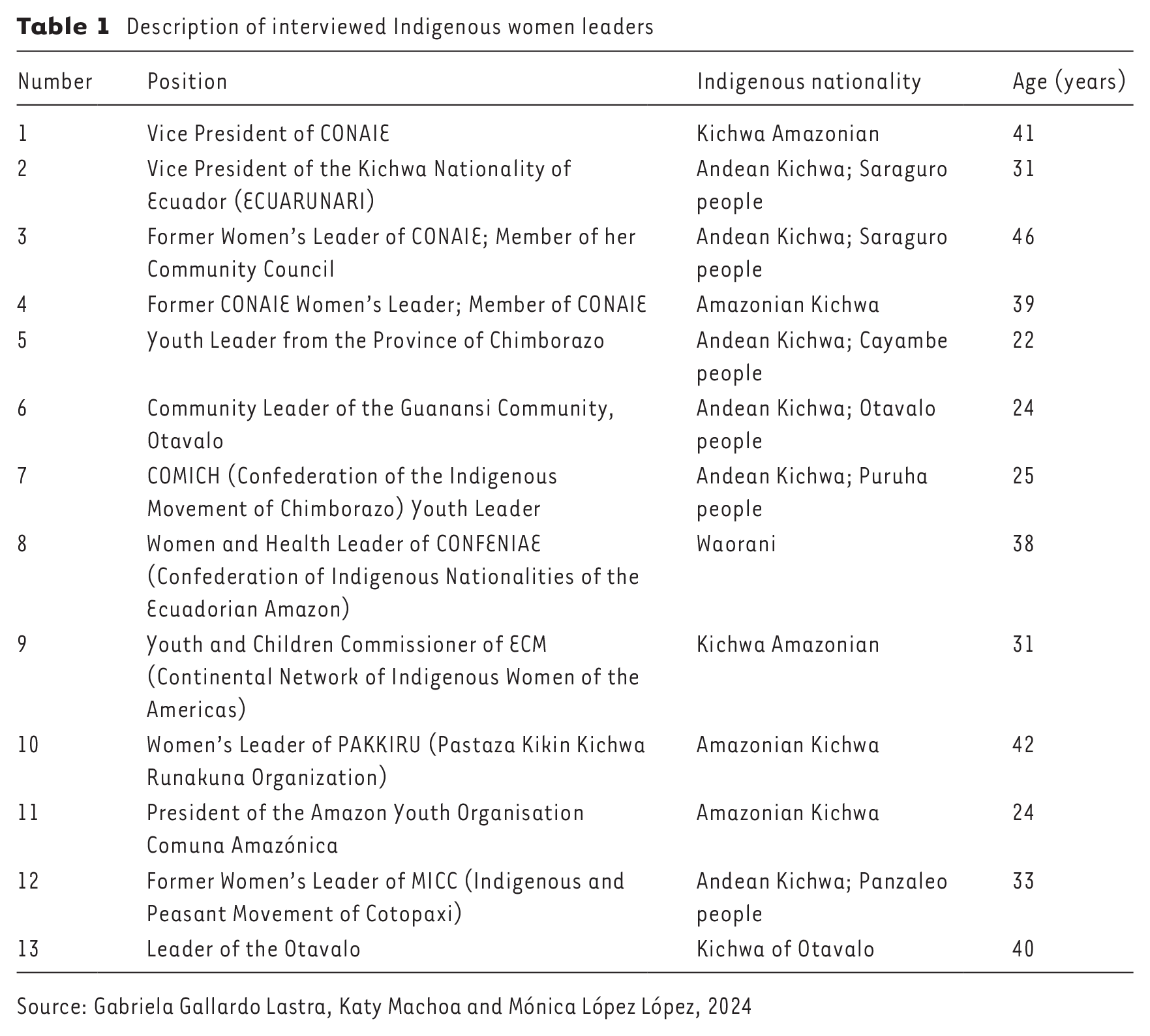
Source: Gabriela Gallardo Lastra, Katy Machoa and Mónica López López, 2024
The analysis of the collected information proceeded in two stages. Initially, we focused on identifying themes derived inductively. This approach involved a bottom-up examination of the data, emphasising an empathetic hermeneutic where data selection was guided by the significance or relevance to the participants. Subsequently, we employed a theoretical thematic analysis, following the framework outlined by Victoria Clarke and Virginia Braun (2021), wherein the obtained information was contextualised within the theoretical themes under discussion. Finally, we applied a hermeneutic of suspicion at the analytical level, interrogating the data within pre-existing theoretical frameworks, such as those pertaining to liberal feminist democracy or community feminist democracy. That is, we examined existing concepts in feminist democracy literature sceptically, which allowed us to incorporate new ideas or to confront pre-existing theories with the data we obtained. This approach allowed us to revisit and explore the deeper implications of theory with our data.
The analysis identified three key themes. First, it delves into the current organisational structure of the Indigenous movement and elucidates the significant roles undertaken by Indigenous women leaders within this framework. Second, it initiates a discourse on gender roles within social protest contexts and explores the perspectives of women leaders regarding feminism. Last, it highlights the transmission of democratic knowledge through intergenerational resistance, which facilitated the occurrence of the June 2022 Strike and similar protests.
results
towards a decolonial, communal and feminist democracy
As an initial exploration into the concept of feminist community democracy, we inquired into the perspectives of Indigenous women leaders regarding the functioning of democracy within the Ecuadorian Indigenous movement and, more specifically, its operation within CONAIE during the organisation of the June 2022 Strike.
The Indigenous women leaders interviewed emphasised the significance of the community as the primary political sphere in their lives. Community assemblies were highlighted as integral to both individual and collective organisation. According to all interviewees, these assemblies are inclusive spaces where individuals of all genders, ages and backgrounds participate in deliberation without exclusion based on gender identity, sexual orientation, socioeconomic status or other categories. As articulated by one of the Indigenous leaders (Leader 13), ‘it is not the power of men or women, it is the joint work so that everything goes well’. The former MICC Women’s Leader (Leader 12) underscored the collective nature of her organisation, stating: ‘we are an organised people, in which we are there for each other, we are not here to leave the leaders alone, the leaders are the head, but the strength is in the communities and organisations’. Furthermore, Leader 9 highlighted the omnipresence of nature in these community gatherings: ‘there is a kind of presence of nature, as it is never absent from the community assemblies’.
In connection to this discourse, it is noteworthy that there is a rejection of representative democracy. For instance, as stated by CONAIE’s first vice president (Leader 1), ‘the current government is only interested in citizens from the middle class upwards but is not interested in representing those from the middle class downwards’. According to one of the youngest leaders (Leader 11) interviewed, this highlights the evident differential treatment that the Ecuadorian presidency and national government promote between social classes.
However, the women interviewed also underscored that the role of women in their community democracy is frequently overlooked. The vice president of the Nationality of Andean Kichwa (Leader 2) pointed out that ‘the role of women in politics has not been significant due to the historical patriarchal construction of democracy’. She further added that the involvement of Indigenous women in social protests is typically not highlighted. Moreover, the internal dynamics of the organisation (CONAIE) pose numerous barriers to the advancement of women leaders. Two women (Leaders 8 and 9) highlighted the presence of gendered political violence within CONAIE and emphasised that women, who are primarily responsible for caregiving roles, encounter impediments that hinder their participation on an equal footing with Indigenous men. Consistent with prior research on Indigenous women’s leadership in Ecuador, tensions persist between women leaders and their male counterparts in CONAIE (Radcliffe, 2008; Romero, 2011).
Regarding the June 2022 Strike, all the Indigenous women leaders who participated in this research affirmed that from the call to the selection of the ten demands, there were meetings in each community. According to Leader 1, the decision to hold a national protest in the form of a strike and the selection of the ten demands was agreed upon from the bottom up. She also described that it was first discussed through the community assemblies, then what was agreed upon was passed on to the regional assemblies and finally, the decisions reached the Governing Council of CONAIE. Along the same lines, Leader 2 emphasised that decision-making within the Indigenous movement is not solely the responsibility of the Governing Council but that there are various decision-making spaces and that none is more important or hierarchical than the other: ‘In the sense of community, there are no marked issues of injustice or inequality, there is no gender differentiation. Decisions are absolutely collective. A community is not the president of the community’.
When asked whether the ten demands encompassed the demands of Indigenous women, two different perspectives emerged. One subset of participants argued that the demands encapsulated the basic general needs that affect all Indigenous and subaltern individuals; consequently, they argued that there was no need to include gender-specific demands. Another faction of participants conversely argued that essential demands specific to women, such as addressing gender-based violence, had been overlooked. According to the Health Leader of CONFENIAE (Leader 8), Indigenous women’s issues were not explicitly included because it remains difficult to address women’s issues within Indigenous organisations. These topics make some male leaders uncomfortable and a patriarchal culture persists throughout the Indigenous movement, thereby often rendering women’s issues invisible.
The eighteen-day strike underscored the significant personal sacrifices made by women. The interviewees highlighted that engaging in this counter-hegemonic democracy during the June 2022 Strike meant risking their lives and those of their families. They described enduring hardships such as travelling from their communities to the capital of Ecuador for days, carrying their children or sleeping on the floor, among other sacrifices. Leader 8 recounted living in constant fear of losing her life during the strike, even experiencing lingering fear for days after the events due to the sounds of gunshots and war tanks. Another young leader (Leader 5) described hours of terror, being kept on their knees in the rain by police and military forces. Furthermore, some leaders endured extensive travel times, such as more than thirteen hours by bus to reach the city of Quito. Given these challenges, the Women’s Leader of PAKKIRU (Leader 10) expressed the belief that neither the government nor privileged individuals would truly understand the hardships they faced, including sleeping on the floor with their children in pursuit of their rights.
In response to then Ecuadorian President Guillermo Lasso’s allegations that the Indigenous mobilisation was financed by drug traffickers, 4 Leader 2 asserted that such claims merely underscore the deeply ingrained coloniality within Ecuadorian culture. Similarly, Leader 9 expressed outrage, stating: ‘This is the extent of racism; even when we’re sleeping on the streets, the privileged believe that Indigenous people are capable of disrupting their activities and risking their lives for mere handouts’.
These interviews highlight the June 2022 Strike as a consensual action that underscores the active participation of Indigenous women in advocating for direct democracy, particularly as traditional representative democracy loses credibility. In these communities, democracy appears to be fortified by protest acts that not only challenge right-wing governance but also question the very nature of representative democratic structures. Hence, it is understandable that the Indigenous movement views democracy as a colonial construct, where the state falls short in catalysing social change, particularly in terms of decolonial transformation (Walsh, 2020). This underscores a significant imbalance in the state’s deployment of public force against Indigenous communities, employing patriarchal methods of violence (Segato, 2014) as seen in this case and others in the region. Therefore, the democratic debate should broaden to explore how two contrasting models of democracy—community democracy and liberal representative democracy—intersect and compete (Coronel and Cadahia, 2018).
social protest under the lens of decolonial feminism
The interviews highlight that the term ‘feminism’ remains distant for many subaltern women, as mentioned by all the Indigenous women leaders interviewed. While a significant number of those interviewed do not identify themselves as feminists, particularly among the older generation, some younger leaders do embrace the term. However, those who consider themselves feminists often express a sense of belonging to an Indigenous women’s feminism that is still evolving. For instance, one of the younger Indigenous leaders (Leader 11) said that her feminism is rooted in healing rather than hatred, aiming to support women who have endured violence from a young age. Similarly, the representative of the Youth and Children Commission of the Kichwa Amazonian nationality (Leader 9) shared that her personal experiences of gender-based violence fuel her identification with feminism. Nonetheless, all interviewees felt that mainstream or white feminism fails to adequately address the intersecting oppressions faced by Indigenous women. Leader 2 underscored the importance of integrating class, ethnicity and gender within feminist frameworks. Likewise, Leader 7 emphasised that Indigenous feminism must consider the intertwined impacts of racism, classism and patriarchy. Thus, for the Indigenous feminists of CONAIE, white feminism without intersectionality does not fit, which has also been noted by community feminists such as Julieta Paredes (2015, p. 110), who explains that ‘the matrix of European feminism is individualism, modernity, private property, democracy, civil rights, Manichaeism, and the linear conception of time, among others’.
The interviews underscore a prevailing emphasis on complementarity between genders within Indigenous cosmology. Leader 6 explicitly rejected a divisive binary vision between men and women, advocating instead for equality and a non-divisive approach. Similarly, the historical leader of the Saraguro people (Leader 3) asserted that collectivity and complementarity guide Indigenous peoples and nationalities, with no inherent superiority attributed to individuals based on gender. Likewise, Leader 10 contended that in the struggle for justice, everyone is considered equal, irrespective of gender. This interpretation transcends divisions and embraces a relationship of complementarity rooted in pre-Hispanic traditions. Paredes (2015) highlights that community feminism, rooted in the concept of Pachamama (Mother Earth), naturally dissolves binary relationships. In this interpretation, Pachamama is Mother Nature, who encompasses everything, including men, women and intersex individuals, as well as animals, plants and minerals. These entities share the same essence and complement each other regardless of their identity and without hierarchies between genders or between human and nature (Guzmán and Triana, 2019).
The analysis of gender roles in the preparation and execution of the June 2022 Strike yielded varied perspectives among the women leaders interviewed. For some interviewees, gender roles were not evident in the protest as activities were not segregated based on gender. At the same time, these leaders noted instances where Indigenous women actively participated on the frontlines, while male leaders assumed roles traditionally associated with caregiving and logistics. For example, Leader 7 recounted her frontline involvement and experience of being assaulted by the police. Additionally, Leader 7 highlighted the participation of young women in the Indigenous guard, emphasising the absence of gender-specific roles in her community’s involvement: ‘definitely, speaking from the experience of my community, there were no roles such as women in the kitchen and men in the struggle … we all have capacity, and we all collaborate in everything’.
In contrast to the perspective of gender roles not being evident in the June 2022 Strike, another group of participants highlighted a division of gender roles during the protest. According to their accounts, women were predominantly responsible for caregiving and logistical tasks, while men often took on frontline positions due to the perceived danger involved. For instance, Leader 8 described how women were tasked with cooking, distributing food and organising sleeping arrangements, while men assumed frontline positions in the protest. Similarly, Leader 3 noted that women primarily acted as caretakers, ensuring that men and young people refrained from consuming alcohol. Leader 2 acknowledged the presence of gender roles but emphasised that activities were distributed based on their significance rather than on strict gender divisions. Despite this perspective, these leaders emphasised the crucial role of carework activities, carried out predominantly by women, in sustaining the June 2022 Strike for its eighteen-day duration.
Indigenous women in the transmission of democratic resistance knowledge
In this final section, we explore the complex perception surrounding the involvement of children and youth in protests, highlighting both its role in transmitting ancestral knowledge of resistance and the concerns regarding children’s rights through a decolonial lens. Additionally, we delve into how the practice of radical democracy is intertwined across generations within Indigenous communities, forming a dynamic interplay between older and younger members.
In the midst of the June 2022 Strike, then President Lasso criticised the fact that Indigenous parents had brought their children with them to the protests:
Many of those children who had no reason to be present at the protests, I call on international organisations, human rights organisations and especially UNICEF, which is called to protect the rights of children and adolescents, to ask themselves: what are children doing in a social protest? We must not forget that children and women are used as cannon fodder to protect violent activities. 5
This critique echoes similar sentiments expressed during the October 2019 Strike, when international organisations like UNICEF also opposed the participation of children and young people in social demonstrations: UNICEF recalls that, in the presence of children and adolescents in social demonstrations, it is the responsibility of all government entities to guarantee their physical and psychological integrity at all times and to avoid violent reactions that affect or violate their rights. UNICEF urges adults participating in social demonstrations not to expose children and adolescents to situations that may violate their rights. (UNICEF, 2019)
In response to these statements, the participants in this study branded these comments as colonial, racist and classist. They were also outraged by the taking up of this upper-class and white perspective, which refuses to recognise alternative modes of childcare as legitimate and good, especially those that depart from what is ‘normal’ Western parenting. The leaders shared their reasons for the fact that children and young people were part of the protest.
First, according to the Indigenous women leaders interviewed, they brought their children to the protest because they had nowhere else to leave them. This was because, as Leader 8 explained, all the people who make up the Indigenous movement participated in the protest, ceasing all of their daily activities, as Leader 8 indicated. The women interviewed made it clear, in a tone of indignation, that, unlike white or mestiza women, they ‘do not have maids’, nannies or access to public nurseries. Leader 3, who is also a mother, noted that while Indigenous women have to do double duty working and taking care of their children, white and upper-class women even have someone to look after their dogs, which makes it difficult for them to understand community and subaltern life. Leader 4 said that the fact that women have nowhere to leave their children is also a result of neoliberal policies that have and continue to cut back on services that provide care, such as public education and childcare centres. Leader 10 explained that since they have no one else to care for their children, she and each of her fellow Indigenous women leaders are always responsible and in charge of protecting their children; therefore, she continued, it is common for them to carry their babies to work on the farm, to go for walks or to protest. Leader 12 pointed out that ‘it is a worldview of our own in which we have to keep our children by our side all the time’. Leader 13 also observed that this particular way of expressing the mother–child relationship is misunderstood by white-mestiza society: ‘Society often questions, “Why would they decide to bring their children to the protest? Why are they being so irresponsible?!”. But they don’t know that feeling of struggle that one has as a mother fighting for one’s children, the struggle is not meaningless’.
The second reason for bringing their children to the protests that the women interviewed shared, though less often cited, was that the practice of bringing new generations to protests is a form of intergenerational transmission of knowledge and values—decolonial values that originate from grassroots movements, such as the importance of resistance, as well as democratic values such as the important of voting. This transmission entails learning how to protest in the streets, how to organise among all protesters, what roles to take on, how to defend oneself, how to care for others and how to sustain a protest, among other aspects. These practices are passed down orally among Indigenous people in action.
According to the younger women interviewed, there is no better way to learn than by observing their mothers and fathers actively participate in the fight. This aligns with María Lugones’ (2014) concept of ‘learning from other resisters’. Hence, one of the youngest leaders (Leader 7) emphasised that the most effective way to comprehend the workings of the Indigenous movement and to advocate for rights is by participating in protests; it represents a clear intergenerational historical legacy: I am going to say this with great sadness and also with great satisfaction, living what my mother lived through. My mother has always told us that during the Inti Raymi uprising in 1990, she left carrying my brother, who was three months old […] Thanks to the struggles we have been able to get into university and schools. It is a historical legacy that we must fight for.
Similarly, another leader who is 22 years old (Leader 5) said that, far from being forced to attend protests, young people choose to participate in protests: their own strong conviction drives them to participate actively from a very young age. This involvement extends to participating in mingas
6
and protests as part of their upbringing and socialisation within Indigenous communities. Along the same line, another young leader (Leader 6) said that children and young people also want to participate in protests because they desire to fight for their rights and because they feel the same needs and lack of material resources as their elders: In this sense we too, as women, young people, Indigenous people, children, without any fear, without fear of raising our voice, have been there because we know what we are going through, because we are living there and we know our reality and even more so here in the countryside.
Regarding sharing knowledge and skills and intergenerational exchange, another young woman (Leader 11) highlighted the differences between adults and young people. She observed that during the June 2022 Strike, adults dedicated time to teaching political strategies and correcting young people to prevent the use of violence: ‘As a young person, you have so much adrenaline because of the anger that you want to destroy and burn everything, so the experienced leaders said no to violence and no to the destruction of material things’. On the contribution of young people, she described how young people had the strength to stay awake at night or to be more active, and that this was why the Indigenous guard was mainly made up of young people. In other words, young people’s participation in protest activities and interventions demonstrates the mutual influence of political knowledge and practices between two generations, as well as the expansion of their political staging. This can be seen as generational time, following Kristeva’s (1981) framework—that is, the protest space connects the temporalities of two generations, which births a third space of temporality wherein the parallel coexistence of two generations in the same historical time is possible.
The adult and elder women leaders interviewed, both with and without children, also shared how they had learned to fight from the time they were little, when their mothers took them along to the strikes or protests in the cities. According to the historical leader of the Saraguro people (Leader 3), young people and children cannot be denied the possibility to go when they also ask to go. She also exhorted that all the rights and advances for the peoples and nationalities have been achieved by fighting in the streets: ‘No government in two hundred years has given them anything, everything has been under pressure, under blood’. Another woman leader who is also a mother (Leader 12) said that the historic struggle must be maintained in a trans-generational manner: ‘so that warrior blood is not lost. […] We can leave, but the struggle continues’. Likewise, the vice president of ECUARUNARI (Leader 2) described how women are transmitters of historical memory and in the construction of political subjects who are the guaguas (babies): We, women, take on the responsibility of carrying our babies, even though it can be a risk because … I am a mother, I know that it is a risk for my daughter to be in a space of mobilisation, but it is also an opportunity for my daughter to understand these scenarios and to start building these relationships that exist within the spaces of mobilisation and to understand the reasons why people mobilise […] These spaces help to build ties from the grassroots level, and this ratifies and allows us to sustain the Indigenous movement. I can’t imagine how the Indigenous movement can be sustained without preparing the generations in such adverse scenarios.
In summary, Indigenous women practice and transmit the principles of radical democracy across generations, learning them through the act of protest. This process underscores how the knowledge and practices of resistance blend the contributions of multiple generations along the circular temporalities of an Indigenous cosmology without hierarchy.
conclusions
This article aims to enhance the understanding of decolonial feminist democracy by exploring the experiences of Indigenous women leaders. It investigated how the Ecuadorian Indigenous movement fosters grassroots organising, community-based democracy and the intergenerational transmission of decolonial democratic values. The study also examined gender dynamics within social protest and discussed feminist identities. To achieve these goals, interviews were conducted with both young and adult female leaders from CONAIE, employing an open dialogue approach. The primary findings of this research are summarised below.
In discussions surrounding democracy, Indigenous leaders advocated for a distinct form of governance: community democracy. This model is rooted in grassroots principles and characterised by decision-making within assemblies that welcome the involvement of all members of Indigenous communities, including women, youth, elders and even nature itself. However, it is crucial to acknowledge, as emphasised by some women leaders interviewed in this study, that patriarchal structures persistently hinder their full participation in this democratic model. They identified this ongoing challenge as an issue that requires attention. Nonetheless, an analysis of this recent national social protest led by the Ecuadorian Indigenous movement reveals that decision-making and organisation were distinctly communal, underscoring the communal essence of their democratic participation.
This study also underscores the diversity of viewpoints among the women leaders concerning gender roles in social protests and their attitudes towards feminism. Some leaders commented on the gendered distribution of labour in the social protests, with women largely carrying out caregiving tasks such as cooking, managing logistics and caring for Meanwhile, others refuted these claims, asserting that in the context of protests, gender identities become irrelevant and all individuals, regardless of gender, encounter the same vulnerabilities and modes of resistance. In this regard, the streets serve as spaces for both individual and collective resistance, sustained by fear, pain and indignation but also by hope and strength.
Participants varied in their alignment with the term ‘feminism’. Some rejected it, while others embraced a unique Indigenous feminism distinct from mainstream white feminism. Despite this divergence, there was a shared belief in moving beyond the gender binary towards gender complementarity, fostering mutual support in community engagement. At the same time, the Indigenous women leaders interviewed did not overlook the struggle against patriarchy, which they interweave with other forms of oppression like neoliberalism, extractivism and colonialism. Their perspective encompassed an intersectional and grassroots-orientated feminism.
In essence, this research underscores that while not all women leaders closely align with feminism, they all play significant roles in shaping a form of decolonial feminist democracy. Unlike mainstream feminism’s focus on individual empowerment, subaltern women emphasise collective resistance. While representative feminist democracy aims to enhance women’s representation within existing power structures, Indigenous women advocate for policies that challenge both patriarchy and capitalism. Thus, decolonial feminist democracy advocates for the rights of all persons and the preservation of nature, embodying a comprehensive and inclusive approach to societal transformation.
Furthermore, this case study has shown that the national protest and its eighteen-day duration by Ecuador’s Indigenous movement in 2019 was not a random event, but rather a reflection of the activitists’ deep-rooted historical knowledge and traditions of resistance, maintained and transmitted through collective memory. This preservation is greatly aided by the intergenerational passing of wisdom from mothers to children during mobilisation efforts, highlighting the core principles of decolonial and radical democracy. It emphasises the belief that achieving rights and social justice requires significant sacrifice, active engagement and unwavering community dedication. Furthermore, this case study underscores that the current Ecuadorean Indigenous movement’s approach to democracy is inherently intergenerational, characterised by a circular and interconnected temporality that fosters collaboration between two generations. This synergy facilitates mutual learning and contributions between youth and adults, encouraging dynamic dialogue across age groups. Similar dynamics can be observed in other social movements, such as the intergenerational dialogue within the feminist movement (Kristeva, 1981). In addition to showing that the collective organisation of subaltern democracy in Ecuador is intergenerational, this case study shows that it is also rooted in intersectional frameworks. It points to the importance of future research that focuses on gender roles in social protest within the Indigenous movement as exploring commonalities and particularities of radical democracy proposed by the Indigenous and the feminist movements would provide further valuable insights.
In conclusion, this research highlights the presence of an alternative conception of democracy emerging from grassroots movements, challenging conventional notions of representative democracy. Representative democracy often employs patriarchal violence as a tool to suppress dissent, even resulting in the loss of lives, particularly those of Indigenous women, among groups protesting against it. In contrast, this alternative model directly contends with gendered hierarchies and confronts colonialism inherent in liberal democracy, critiquing its tendency to stratify citizens into hierarchical tiers, systematically privileging those deemed to be of higher status and directing state repression towards marginalised groups.
The experiences that the Indigenous women leaders shared with us in this study are part of an Ecuadorian Indigenous movement, which is also connected to a broader Latin American decolonial and popular feminist movement, that advocates for a radical community democracy. Their stories, observations and reflections illustrate how these movements prioritise defending the rights of all, including Indigenous and subaltern citizens, and embraces the rights of nature. Moreover, their words and actions show us how prioritising and taking action based on these values can lead to a community and intergenerational feminist democracy that shifts ‘the personal is political’ to ‘the communal is political’.
Footnotes
Acknowledgements
We would like to express our sincere gratitude to CONAIE for its support and inspiration. To the Indigenous women leaders who resist and fight, your courage weaves the legacy for those who came before and lights the way for those who will follow. Thank you for your unwavering strength. We also extend our gratitude to the University of Groningen for funding the doctoral studies of one of the authors, enabling this research to be conducted as part of her doctoral thesis.
funding
This article was in part made possible thanks to funding from the University of Groningen.
1

3
4
5
Ibid.
6
A millenary institution of the Indigenous of the Andes, which consists of the reciprocal provision of free services among members of the community.
author biographies
Gabriela Gallardo Lastra is a PhD candidate in Social, Behavioural Sciences and Development Studies at the University of Groningen (The Netherlands) and the University of Zacatecas (Mexico). She holds an MSc in development studies from the International Institute of Social Studies at Erasmus University Rotterdam (The Netherlands).
Katy Machoa holds an MSc in Latin American Studies from Simon Bolivar Andean University (Ecuador). She is a former CONAIE Women’s Leader (2014–2017) and an activist for human rights and the rights of nature. She currently promotes political training processes with women from rural areas and qualitative research.
Mónica López López holds a PhD in Psychology and is an Associate Professor at the University of Groningen (The Netherlands), where she is also an academic coordinator of the Gender and Diversity Summer School. She is an expert in qualitative methods, interviewing, participatory approaches, youth studies and gender studies.