



Abstract

Take a deep breath … breathing is no longer easy.
Infections in airways, the body has felt it;
Stressfulness, sleeplessness, exhaustion, anxiety.
In late May 2023, the writing was withdrawn,
with regret and apologies.
yet, we were awaited … given more time, soft and hard deadlines
They remained encouraging; they’ve been looking forward to
our conversations that document our experiences and observations.
That’s what the Feminist Review Collective (FR) does. We struggle
but also forgive and stay around, even when some of us fall behind.
After we decided to drop our project, the conversation continued.
That’s what we do in FR;
We never stop checking in. Sometimes we wait, patiently … updating one another regarding how things go, without pulling and pushing.
Just checking in.
in July 2022, when Madhulika was thinking of a collective response to crisis and care ‘across diverse educational spaces’ during the COVID-19 pandemic (Troiani and Dutson, 2021).
It was envisioned as a ‘patchwork of reflections on pedagogies, practices, survival strategies, and challenges that followed as we (educators and learners) grappled with the logic of lockdowns and online teaching under the capitalist education system’ (22 July 2022, Madhulika). 1
She asked: what kind of crisis did we witness unfolding within the university space (or educational spaces at large) with uncertainty looming large outside?
How can we, by using our biographical and anecdotal moments in our educational contexts, possibly think of feminist futures and forms of care while being enmeshed in inequalities of gender, race, caste and class that marked educational spaces?
Po-Han joined, who was—resonantly—
thinking critically about how ‘educational materials and spaces are evaluated against the indicators and benchmarks, which assume all students to wish to be “productive” and thus “useful” and “responsible” citizens, downplaying the role of care, sociality, solidarity, and collectivity that were part of the vibrant dynamics in universities’ (13 December 2022, Po-Han).
a Zoom call, several emails, a virtual co-working space and so on …
made Madhulika’s monologue into a dialogue.
yet, things happened, although a critical conversation about the functioning of higher education had just been undertaken;
parents fell ill; we got sick; loved pets passed away; school schedules got out of control,
with new tasks, new requirements at work, new modes of teaching
Inconveniencing us all.
In front of family obligations and schoolwork, the dialogue paused.
To carry it out seemed luxurious.
And we were talking about how universities could drain, exhaust and reward one all at once.
We always remember to tell each other to take care,
but what does it mean?
to all FR members in January 2023
It was nicknamed a ‘penpal project’ on feminist critical pedagogy.
In our invitation, we asked: How could we engage with the academic workplace—spatially and temporally—‘differently’ (23 January 2023, Po-Han and Madhulika)?
The project was initially imagined to be one of a more typical academic style.
but we failed, due to the deprivation of time and energy in doing so systematically;
or we resisted actualising it in a ‘conventional’ way?
we weren’t sure
if we did this intentionally or accidentally.

Collage of snippets of emails between Madhulika, Po-Han, Kyoung and Jenny
then, a response to our invitation arrived,
that was from Kyoung, who appreciated the ‘jump in at any point’ option.
‘it’s both sweet and makes a critical intervention regarding different temporalities’ (28 January 2023, Kyoung).
when processing unexpected ‘old FR stuff’;
that made one reluctant to bring it to the ‘new FR space’ (28 January 2023, Kyoung).
When one found a study group on gender studies which gradually became a ‘support group’, a ‘shelter’, during the pandemic (30 January 2023, Po-Han).
the pandemic represents a weird moment;
when exceptions have become ‘normalised’.
‘pre-covid routines and mindsets took back the main stage’, and
these include the usefulness of investing energy in something, say,
commitment to a study group, organising and facilitating a writing workshop …
and efficiency in getting things done
While ‘the new normal’ continued the challenges left by covid (hybrid teaching, extra care for students, disruption of work/life balance, research funding cuts).
The carefully built and curated ‘feminist counterpublic’ (Felski, 1989) must be protected from the university’s appropriation.
The study group somehow survived, after negotiating with the institution, which could not care less about gender issues:
up to date, for some members, it still exists as a shelter,
not least when #MeToo moments arrived in different locations. 2
in another exchange, Po-Han talked about a course involving field trips he’s been coordinating.
He reflected on the unlearning process inspired by Pangcah cosmology, mythology, epistemology and their approaches to deconstructing the life/death binary. 3
The course, becoming very popular among students,
was ‘rebranded’
upon the university’s request, as part of its social responsibility initiative,
within a limited timeframe that stressed out everyone involved,
with how Pangcah community members’ ‘consents’ were obtained based on their trust in his team.
It has compromised ‘the mutual respect, reciprocity, and intimacy between the course coordinating team and the communities’ (6 February 2023, Po-Han).
confused,
frustrated,
and finding no way to resist the temptation/pressure of making everything one’s done a ‘quantifiable contribution’ against the indicators/benchmarks of university evaluations.
witnessing ‘how the idea of “university” has transformed in India’;
Somehow similar to what’s happened in Taiwan …
‘in the bid for a more controlling, powerful university, a lot is being lost’ (13 February 2023, Madhulika).
When we were handling, very carefully and sadly,
the rising cases of student suicide (17 February 2023, Madhulika and Po-Han, in separate emails).
‘that’s indeed worrying and alarming, while mental health support and resources are underfunded and understaffed’ (17 February 2023, Po-Han).
The traumatised, the dramatised, the sensationalised, the invisiblised, the stigmatised …
the non-transparent, black-box approach has mystified the ways of addressing students’ concerns, doubts and helplessness
frontline faculty and staff members are very tired, CAN’T YOU SEE/HEAR?
when the university desires to become a competitive, ‘global university’:
international connections and co-authorship,
more English-taught courses to attract more international students in Asia (Bamberger, Morris and Yemini, 2019).
The rest desires to become the West;
they said it’s a better place
the hierarchy between the sites of knowledge production, forming a higher education supply chain
all of these expectations, which are not explicitly written as criteria for evaluation and promotion,
‘can be “felt” in daily conversations, have created unnecessary competition between people’, and thus ‘stressed junior faculty members out’ (17 February 2023, Po-Han).
Jenny shared with the group a couple of vignettes—also a discomfort relating to marking and grading and care for students that has been ‘somewhat complex to negotiate over the last few years’ (24 March 2023, Jenny).
In a module that was entirely distance learning,
most students had a full-time job, and parental and other care responsibilities.
while it was an intense course, many did not use the office hours available to communicate with tutors
… among them,
some were affected by disasters in their home countries,
the existing mechanisms have not sufficiently taken these into account
considering the assessments they are required to submit, and
how much students can realistically participate in their studies.
Along with various activities, a long essay was required. For late assignments,
no deferred deadlines were permitted
yet, ‘mitigating circumstances’ after submitting work could be applied.
They should be EVIDENCED, however.
But, ‘what about circumstances for which there cannot be proof’ (24 March 2023, Jenny)?
e.g., daily and unexpected power cuts in Ethiopia, displacement due to disastrous earthquakes in Syria …
to prove the incident or the impact? both are ridiculous,
‘the lack of compassion frustrating in the process of having to submit work and then apply’ and worrying about being unable to provide ‘sufficient evidence’ that they have been affected (24 March 2023, Jenny).
Expressing an appreciation for the submissions of the affected students, shown in comments and reflected in marks
was … picked up and criticised for being ‘too generous’.
an automated system wants automated responses;
a ‘relational’ perspective on teaching/learning/marking [that relocates individuals back to their social relationships, circumstances, and environments (Su and Wood, 2023)] is just all too human.
Humanness should be bracketed,
for perceived ‘fairness’,
for preventing potential complaints and grievances from students.
‘the admin’s pursuit of convenience and the rigour/rigidity in the name of fairness on the superficial (and sometimes pretentious) level at the cost of compassion and care loses what education should aim for’ (24 March 2023, Po-Han).
the hierarchy between all the actors in the educational context is embodied and performed—the habitus
that makes one feel powerless to watch people hear (but not listen to)
and make decisions that one would hope for otherwise.
That’s what happens when one treats students as consumers;
however,
they are subject to a particular power structure built by
university policies and enmeshed with
the power to conceal …
how things work and are worked out (Raaper, 2019).
Often, we got another no to our nos.
Po-Han reflected on a situation where he couldn’t refuse a training session for a student debate activity;
on the shock at ‘the precariousness of Vietnamese scholars and professionals as well as the culture of corruption underneath the “performances of friendliness”’ (15 April 2023, Po-Han),
returning from a business trip in Ho Chi Minh City;
also, on the news about the complex power play, sexual harassment and academic extractivism by a very influential figure in decolonial studies, his followers and gatekeepers and ‘cult-like dynamics’ (Viaene, Laranjeiro and Tom, 2023)
… whistleblowing through a book chapter,
when the authors/survivors found themselves in a ‘no-to-no’ situation back then.
all too familiar … the toxic practices are done by certain critical scholars,
so were seen in the recent #MeToo accounts,
‘abusers become experts in creating strategic enablers through manipulation, such as playing with their labour vulnerabilities’ (ibid., p. 218).
Recall the allegations against some so-called ‘star professors’, who and whose supporters have attempted to discredit the victim’s story.
The institutions fail to provide a safe space,
fail to offer protection for potential victims and
fail to be responsive and accountable.
‘the walls spoke when no one else would’.
—some graffities shouted in public.
The university quickly erased and covered these messages
to protect the name and fame, therefore protecting the predators.

Questions emerging as a response to the abuse of power
perpetrated culture of silencing should be revealed; it has omitted
the injustices done to many, who were once passionate about working in academia.
the silence has been too loud to be heard;
it has to be broken:
thus, ‘you are speaking, and I am keenly and with gratitude, listening’ (19 April 2023, Kyoung).
Kyoung responded,
and that’s what FR does, when all the interlocutors in this conversation are in different cities: solidarity through open and non-judgemental communication.
that’s what we do—listen to each other’s concerns
then, check in.
Po-Han wrote to Madhulika concerning her diagnosis, fatigue and capacity. It was in
late April 2023.
‘No apology is needed’ (24 April 2023, Po-Han). this is probably also the most-heard reminder between FR members.
Why do we always apologise?
… we are sorry
for not being capable of taking on more tasks, while
seeing others have done much to keep the balls rolling—yes, multiple balls;
for not jumping in earlier to share work, while
being aware of how others have been overloaded and overwhelmed too;
we apologise for not making it to the meetings,
for delaying responses to emails,
for ‘procrastination’
for not being ‘productive’ enough, and yet,
we also constantly remind each other: ‘don’t be! everyone has very different schedules and responsibilities, and is in very different situations and positions’ (24 April 2023, Po-Han),
and can be stuck somewhere that needs check-ins and listening.
We trust we are understood, as like
how we understand one another, despite
all the challenges we’ve faced in our personal lives and as in a collective;
there were moments one felt overwhelmed and had to step back …
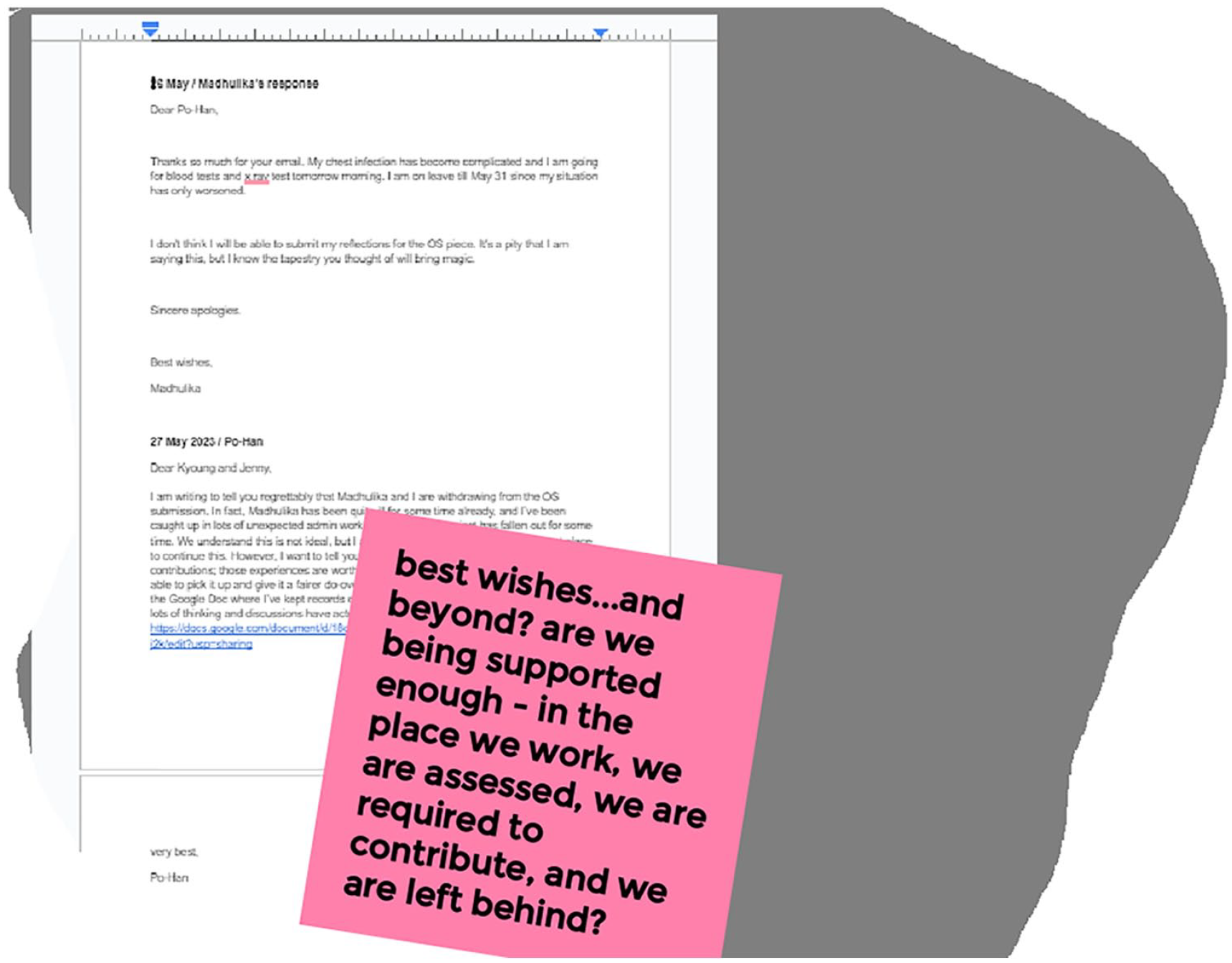
Reflections on the communication between the authors
Dear Kyoung and Jenny, Madhulika and I are withdrawing our project for health reasons and for lack of capacity. we are not in our best place to continue this. (27 May 2023, Po-Han and Madhulika)
And we were ‘invited’ back,
when Kyoung was gently and kindly checking in …
with a new deadline, ‘no pressure though, but wanted to let you know in case this might work for you after all’ (14 June 2023, Kyoung).
and, Po-Han began to draft this Open Space piece,
even though he and Madhulika weren’t sure if he/they would finish it in time.
Footnotes
1
The text became multivocal when new members joined the conversation through an email thread (and sometimes via FR’s Slack channel, a workspace where all FR Collective members exchange ideas); this and all quotations attributed to Madhulika, Po-Han, Kyoung and Jenny are from these spaces.
2

3
The Pangcah people, also known as the Amis, are an Indigenous Austronesian ethnic group in Taiwan that were traditionally matrilineal until the Japanese colonial regime implemented otherwise (1895–1945). They are one of the sixteen officially recognised Indigenous groups in Taiwan.
Author biographies
Madhulika Sonkar is an Assistant Professor at the Department of Humanities and Social Sciences, IIT Delhi, India. She is a member and editor of Feminist Review. Her research and teaching are located at the intersections of sociology of education, gender studies, and anthropology of childhood and youth.
Po-Han Lee is an Assistant Professor at the National Taiwan University Global Health Program and a member and editor of Feminist Review. Recently, he co-edited with Sohini Chatterjee the book Plural Feminisms: Navigating Resistance as Everyday Praxis (London: Bloomsbury, 2023), a collection of autoethnographies of diverse locales and positionalities.
Kyoung Kim is a member and managing editor of Feminist Review.
Jennifer Ung Loh is a member and editor of Feminist Review, a casual academic/independent scholar and a potter.