



Abstract
During the COVID-19 pandemic, scholars around the world warned about increasing gender inequalities within academia. In this context, we created Red Feminista de las Ciencias Sociales to support initiatives among women researchers in Chile. Our objective is to appeal for gender equality in academia and to promote structural changes that guarantee dignified feminist academia in the social sciences. This article draws on various self-training and discussion activities developed by the Red Feminista between mid-2021 and mid-2022 to discuss the role of women in academia, with implications for other marginalised groups in Chile and possibly other countries where inequality in academia is also a reality. Based on our discussions, we propose strategies to promote a decentralised, decolonised and feminist social science academia that guarantees gender equality as a fundamental human right and as a crosscutting axis in producing knowledge and access to it. We organise these strategies into four pillars: 1) equity and justice in the production of knowledge, 2) dignified work conditions in the production of knowledge, 3) a work environment free from harassment and 4) the democratisation of access to knowledge. Whilst these aspects have been studied in other countries, this article addresses the specific context of Chile. We argue that it is possible to reflect on feminisms (in plural) within academia and propose practical strategies for establishing new dynamics through collaborative work.
‘Why did you let me through the doors in the first place if you were just gonna turn around and force me out?’
Introduction
The COVID-19 pandemic affected people’s lives in different ways. For female scholars, striking a balance between house duties, providing care and fulfilling academic responsibilities brought to the fore mental health issues and precarity. This issue particularly affected women, who were affected in a multiplicity of areas of their daily life (Lewis, 2020): they experienced an increase in their burdens around work, unpaid care work and community activities (McLaren et al., 2020). Acknowledging these issues, different support initiatives among women researchers were created both in the Global North and South. In Chile, we 1 created ‘Red Feminista de las Ciencias Sociales’ (which translates in English to ‘Feminist Network of the Social Sciences’), 2 which was officially launched in August 2021. The project started with an online meeting between four Chilean women to discuss the challenges we were experiencing while working in academia during the pandemic. We were living in different countries and parts of Chile and shared a similar academic profile but different social trajectories (in terms of identities and social origins). We discussed the need to create a collaborative network to make visible the structural challenges for people occupying marginalised positions in the social sciences, especially women, the LGBTQ+ community and indigenous people, as well as to support their work.
As in other countries, the pandemic made more visible inequalities that already existed in Chile. The neoliberal model adopted during the dictatorship (1973–1989), which removed the state’s social obligations to citizens and strengthened market competition and individual efforts to achieve social outcomes (Sepúlveda, 2023), affected the academic landscape by perpetuating heteropatriarchal and colonial ideologies, shaping the experiences and opportunities of individuals in academia (Ortiz, 2017). Chilean academia has historically been dominated by male perspectives, with men usually holding positions of power and authority. This power dynamics has resulted in the marginalisation of women and other gender minorities, limiting their access to leadership roles, academic recognition and research opportunities. Gender biases also manifest in the curricula, which reinforces stereotypes and maintains unequal power relations within the academic community. Also, Eurocentric knowledge paradigms and ideologies continue to shape the curriculum and teaching methodologies, often overlooking or devaluing indigenous knowledge and perspectives (Gitau, 2022). The remnants of colonialism can also be seen in the prioritisation of Western research over local, context-specific studies, further perpetuating epistemic injustices. Thus, the most prestigious professional positions in Chile are occupied by people linked to the aristocracy of European origin, while indigenous people remain excluded (PNUD, 2017). Denisse Sepúlveda and Camila Pérez (2022) show the obstacles faced by indigenous women in accessing academia and in validating their research perspectives on indigenous topics. 3
As Jane Gallop (1992) argues, there are two options for academics who identify as feminists: being a feminist within academia or an academic within feminism. Considering this frame, since the launch of Red Feminista, we led open online meetings with women academics from a diversity of backgrounds and cities in Chile. These women were in different ways related to the Chilean academy (incorporating feminism within academia and being academics within feminism). Through these meetings, the network expanded and became a self-managed organisation, now known as Red Feminista. After many different activities and events, it was decided that its main aim was to make visible the inequalities mentioned above.
Red Feminista emerged from the many national major protests that have taken place in recent years, including the Feminist May of 2018; the performance work of LASTESIS, notably their performance of ‘Un violador en tu camino’ in 2019; 4 and the social uprising and feminist movements throughout 2019. These political events have played a pivotal role in promoting discussion about gender inequalities in different aspects of life. The events resulted in women being more active in feminist associations, and academic institutions being more open to problematising issues such as gender discrimination and harassment. For example, the first law to prevent sexual harassment in academic environments was approved in 2022. 5
This article draws on various self-training and discussion activities during the second term of 2021 and the first term of 2022, developed by Red Feminista de las Ciencias. Based on our discussions, we propose strategies to promote a decentralised, decolonial and feminist academia in the social sciences, to guarantee gender equality as a fundamental human right and an overarching axis in producing knowledge and access to it. These proposals are the product of Red Feminista’s internal collaborative work, which is open to all its members, 6 and have been built in dialogue with previous research. This article primarily discusses women in academia, with implications for other marginalised groups in Chile. We expect that the proposed strategies will help academic entities in both the Global North and Global South to develop concrete actions that promote work environments which include feminist perspectives. This document is an open contribution to the community to generate reflections that can gradually translate into concrete practices that help build feminist academia. 7
Reflections about feminism in academia
Many women scholars from different perspectives and in various contexts have raised awareness about and critiqued gender biases and inequalities in academia, arguing that gender biases help to perpetuate a work environment that is not always supportive of women’s careers (Morley and Walsh, 1995; Shayne, 2014; Alatas and Sinha, 2017; Cole and Hassel, 2017; Thwaites and Pressland, 2017; Shelton, Flynn and Grosland, 2018). Although there is some Chilean scholarship on this issue (Ortiz, 2017; Herrera Oesterheld and Vera Fuente-Alba, 2021; Guizardi, Gonzálvez and Stefoni, 2022; Sepúlveda and Pérez, 2022), more work needs to be done to bring to the fore the experiences of minoritised and marginalised people in academia in different regions of the country. This lack of studies may explain the gap in the discussion around what constitutes feminist academia. This article seeks to contribute to reducing this gap in current scholarship.
The application of feminist perspectives to academia offers advantages to all those engaged in academic pursuits. For example, building less competitive work environments may create more collaboration between researchers as well as lower stress levels. There is also evidence that courses on gender and ‘women’s studies’ are valued by students (Lowe and Lowe Benston, 1984). However, there is still a lot to do to strengthen feminism in academia. For example, despite some social sciences and humanities departments having a high proportion of women, occupations with more prestige and better conditions (i.e. professorships) tend to be occupied by men (Béteille, 1995). Recent studies have also revealed gender inequalities in the curricula, showing that literature written by women has been systematically excluded from courses and departments (Lengermann and Niebrugge, 2019; Govinda et al., 2021).
A number of issues affecting women in academia are noteworthy. Studies have shown that gender inequality is rooted in the malestream, which treats binaries such as rationality/emotionality, masculinity/femininity and male/female as central to academic life (Stanley, 1995). Against this backdrop, women who work on gender studies and activism seem to increasingly encounter problematic, anxiety-provoking and even dangerous work environments (Brown Packer, 1995; Favaro, 2022; Heijstra and Pétursdóttir, 2023). Thus, many women scholars have to contend with different forms and levels of violence during fieldwork, teaching, researching and working in their offices, among other environments and situations (Guizardi, Gonzálvez and Stefoni, 2022).
Another big issue for women in academia is their invisibilisation, including lack of recognition, underrepresentation and censorship (Suissa and Sullivan, 2021). For instance, Syed Farid Alatas and Vineeta Sinha (2017) have documented how Eurocentrism and androcentrism in teaching sociological theory have led to the neglect of non-Western literatures and female voices. Mary Jo Deegan’s edited volume Women in Sociology: A Bio-Bibliographical Sourcebook (1991) highlights women sociologists who have not received proper recognition for their work, such as Harriet Martineau, Matilda White Riley and Beatrice Webb. Likewise, Natalya Din-Kariuki (2015) analyses how women have had to confront several barriers in academia, such as misogyny, being typically outnumbered by male colleagues and being denied networking, mentorship and dissemination opportunities. Furthermore, women academics struggle with high expectations and diminishment of their positional status and authority within the work environment (Mackay, 2021).
A feminist agenda cannot be constructed without an intersectional viewpoint. As Din-Kariuki (2015, p. 3) argues, ‘gender intersects with other aspects of identity’, which suggests that women are marginalised in multiple ways, including black women, queer women, disabled women and/or poor women. In other words, there is a need to visualise research conducted by indigenous women and women of colour from the Global South, as well as other marginalised individuals who have been ostracised by precarious contracts (Deschner, Dorion and Salvatori, 2020). This also applies to researchers with disabilities / functional diversity, who are routinely stigmatised and discriminated against in academic circuits (Herrera Oesterheld and Vera Fuente-Alba, 2021).
Thus far, we have highlighted studies that address internal aspects of academia. However, an important feminist practice is recognising academia’s embeddedness within ‘other’ areas of the lived condition, such as family, leisure time and quality of life. Motherhood, for example, has been established as a ‘risk’ for an academic trajectory (Shayne, 2014). Personal life (for example, intimate relationships, families, leisure) is frequently disregarded in academic trajectories, making it almost entirely invisible (Ortiz, 2017). These issues have been accompanied by what has been called the ‘motherhood penalty’ (Correll, Benard and Paik, 2007) and prejudices about women being mothers and not professionals (Rodino-Colocino et al., 2017). However, consideration of motherhood and academia should highlight what mothers can bring to work, such as efficiency, negotiation competencies and solution skills (Hodge, 2017). Motherhood can also help women be more aware of critical issues in working conditions and raise them properly for institutions to find solutions (Sharma, 2017). The literature about the issues concomitant with motherhood for those in academia has grown, bringing to the fore struggles and gender biases within the system (O’Brien Hallstein and O’Reilly, 2012; Parker, 2012; Castañeda and Isgro, 2013; Minello, Martucci and Manzo, 2020).
The difficulties experienced by women and other marginalised groups in academia often lead them to face the dilemma of either staying in a hostile work environment or leaving academia altogether because it is a space contrary to their principles and needs (Ortiz, 2017). Sherry Sabbarwal (2000) discusses how the professionalisation of feminism has resulted in deep uncertainties for women academics, who have to deal with paradoxes in their everyday work lives. Sabbarwal (ibid.) also establishes four dilemmas as examples of these paradoxes: 1) as professionals, feminist academics are positioned as experts teaching younger generations, while at the same time feminism critiques patterns of domination; 2) feminist academics often try to keep an environment of ‘sisterhood’, while the professional setting is highly competitive; 3) feminist academics fight to eradicate elitist privileges, while many work in prestigious jobs with high positions and salaries; and 4) feminism is about change, liberation and emancipation, although this is not always possible in academia because of the constraints of topics, theories and methodologies when undertaking research. The discussion about the relationship between professionalism and feminism has also been problematised through the relationship between academia and political activism (Wiegman, 2002).
As we will argue later, gender inequalities can be, at least in part, countered with micro- and macro-level feminist practices; ‘small acts within the everyday are powerful political moments, which challenge accepted and ingrained ways of being and working, as well as having a potential ripple effect’ (Twaites and Pressland, 2017, p. 15). Creating collaborative spaces for mutual learning and sisterhood is thus essential for a more feminist academia (Deschner, Dorion and Salvatori, 2020). As Aline Vogt (2020, p. 7) points out, ‘We need to think about the kind of institution our generation wants to inherit. […] To me personally, it means to be political. It means to believe in change and not to accept the world how it is. And it means not only to be an academic, but to be a feminist as well’. This article tries to advance these collaborative reflections by women in the Chilean social sciences.
Red Feminista de las Ciencias in Chile
Red Feminista de las Ciencias is a non-profit and voluntary feminist network of women, the LGBTQ+ community and indigenous people who work in the social sciences in Chile. Red Feminista aims to promote equality by reducing gender inequality, competitiveness and precariousness in social science research spaces to improve science productivity. We seek to be a critical and constructive space for the academic world. Our organisational structure is flexible and horizontal, adapting to and taking care of the different needs and requests of the people who make up Red Feminista. We aspire to create an inclusive and plural cooperation space where gender differences, age, area of residence, ethnicity and sexual orientation are not obstacles to participation in the network.
Red Feminista establishes minimum agreements between the participants to promote a space of respect whereby women in all their academic stages, from undergraduate students to consolidated academics in the field, can organise and collaborate. We are committed to promoting a space for denouncing violence, harassment and the invisibility of women in academia. In Chile, we have systematised information regarding the current situation in the social sciences to problematise it from the feminist perspectives of democratisation and dignity. In 2022, the Chilean national agency for research and development, Agencia Nacional de Investigación y Desarrollo de Chile (ANID), developed DATACIENCIA, 8 a data science project that systematises statistical information on academic knowledge production. This project highlights some critical trends. For example, of the total number of published academic authors in Chile from 2008 to 2021, 63 per cent are men and 37 per cent are women, revealing a significant gender imbalance in this area. 9 DATACIENCIA’s reports also reveal that of the fifty most productive authors in the social sciences with a Chilean institutional affiliation (i.e. ordered according to the number of publications in the Chilean publishing domain), only nine are women.
In general, the discussion of gender in academia in Chile has focused, and continues to focus, on the need to increase the number of women in this area and to ensure supportive pre- and post-natal conditions (Ortiz, 2017). Whilst this can be seen as progress, the inequalities experienced by women and other marginalised groups are much more profound and require more work; for instance, Sepúlveda and Pérez (2022) highlight the obstacles faced by indigenous women in accessing academia and in validating their research perspectives on indigenous topics. More needs to be done to address the lack of specific information on the participation and experience of indigenous people, sexual dissidents and trans and non-binary people in academia in Chile.
Some methodological decisions
We understand that social exclusion is a complex phenomenon, and we see it not only as related to conditions such as gender, social class or ethnicity but also as a structural disadvantage resulting from the link between these conditions. Accordingly, we adopt decolonial and intersectional feminist perspectives and a feminist methodology (Ramazanoglu and Holland, 2002). In other words, discrimination factors such as gender, social class or ethnicity do not operate independently but are interrelated (Shelton, Flynn and Grosland, 2018). Therefore, we understand that building dignified and feminist academia in the social sciences entails improving the inclusion and working conditions of people and communities that have historically had subordinate positions in producing knowledge. Furthermore, building a dignified and feminist academia entails democratising access to knowledge, making it useful for the communities that are involved in its production and potentially impacted by it, among other groups outside academia that do not usually benefit from research.
We target these strategies to serve as a proposal for concrete actions that can help any academic entity promote a work environment that includes a feminist perspective in its practices. Another potential use is as material in social science courses addressing gender issues as part of their syllabus. Finally, this material is an open contribution to the academic community to generate reflections that gradually translate into concrete practices that contribute to the construction of feminist academia. This work primarily discusses women in academia, with implications for other marginalised groups in Chile. We acknowledge that women, LGBTQ+ people and indigenous communities are affected, even though there may be differences in their struggles. As our research used a bottom-up approach, these differences were not identified, although we would like to acknowledge that they do exist and that more research is needed to ascertain them.
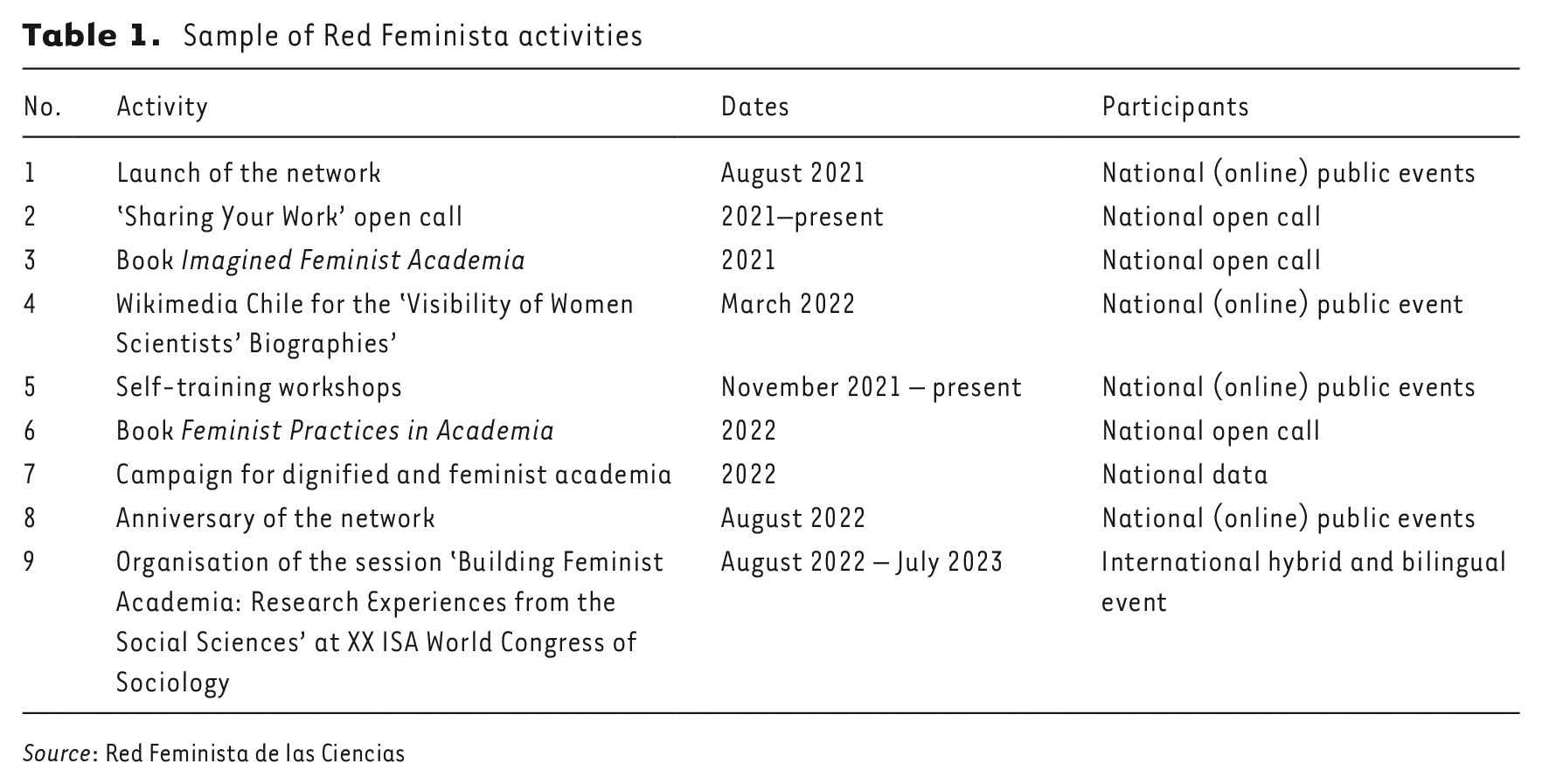
Since mid-2021, Red Feminista has been organising several self-training and discussion activities on what feminist academia could be like, as well as identifying and discussing the current practices that perpetuate competitiveness, exclusion and precariousness in the social sciences and that contribute to the marginalisation of women, dissidents and indigenous people, among others. For instance, one initiative we organised was the ‘Relatos anónimos en 100 palabras’ (‘Anonymous Short Story Collections on “Imagined Feminist Academia” and “Feminist Practices in Academia”’), an open call for anonymous stories of up to one hundred words, to learn about the ideas, experiences and reflections that are generated around feminisms and the academy of social sciences. Another Red Feminista project was ‘Usando Wikipedia para visibilizar a mujeres científicas’ (‘The Visibility of Women Scientists’ Biographies’), created with Wikimedia Chile; part of the events commemorating #8M, this project consists of a series of ten short videos that respond to questions such as ‘Why is it relevant to increase the presence of women’s biographies on Wikipedia?’, ‘What are notability guidelines?’ and ‘How to upload and edit biographies?’. 10 A third Red Feminista project involved self-training online workshops oriented at promoting collaboration networks and giving visibility to women social scientists.
Based on the reflections and materials that emerged from these and other activities organised by Red Feminista (see Table 1), 11 we collectively wrote a document around the question ‘What is feminist academia?’. The writing process was led by Red Feminista’s coordinators and then several members were invited to comment and edit the document. In the next section of this article, we review and summarise this work and present four fundamental pillars for taking action to build a dignified and feminist academia. Each of these pillars includes key feminist principles and concrete strategies. We encourage university entities and research organisations to adopt and disseminate these practices.
Sample of Red Feminista activities
Source: Red Feminista de las Ciencias
What could feminist academia look like in Chile? a collectively developed proposal
The global growth of feminist social movements has prompted those in the social sciences to incorporate feminist and human rights approaches to analyse research and how it can contribute to reproduce or challenge gender inequalities and notions of knowledge and knowledge production. In this sense, some educational institutions have carried out actions such as incorporating university protocols and regulations with a gender perspective. However, they are specific initiatives that are not implemented in all universities or academic entities.
In this context, this article attempts to contribute to promoting interactional and structural changes to build a dignified and feminist academia, which guarantees gender equality as a fundamental human right and a transversal axis in producing and accessing knowledge. We focus our enquiry on women academics who work in the social sciences in Chile. We do this based on the experience of Red Feminista de las Ciencias. As a network, we have been developing self-training and discussion activities on topics such as what feminist academia would look like. Through these initiatives, we collectively identified four pillars of action that we consider critical to advance a feminist and dignified academia in the social sciences. These are: 1) equity and justice in the production of knowledge, 2) dignified work conditions in the production of knowledge, 3) a work environment free from any harassment and 4) democratisation of access to knowledge. These are aspects already highlighted in global conversations, although not all of them have been incorporated in Chilean academia hence why we propose them within this context.
Many of the initiatives suggested in the four pillars are actions that some feminist researchers worldwide have already envisioned. For instance, CEFA has worked to promote union support for those women starting careers at universities in the UK. Meanwhile, in its vision, the WILPF Academic Network aims to promote a world free from violence, and envisions a mutual benefit relationship between research, activism and teaching. The GC Academia Network is another a group of academics pushing conversations about sex-based rights and discrimination towards women and girls in higher education. In addition, Gearing Roles is a project aiming to improve gender equality in research institutions in the European Union. Finally, RLadies promote gender diversity and collaborations between people, specifically in the R community. In mentioning these examples, we aim to acknowledge that similar proposals have been organised. The reflections emerging in this article are situated within this growing international concern to promote a dignified and feminist academia. 12
Next, we discuss in detail the four pillars and the principles they encompass, giving examples of strategies to put them into practice.
Equity and justice in the production of knowledge
University entities, organisations and state agencies in charge of science and technology policies 13 must contribute to ending inequalities (for example, gender, class, territorial and ethnic gaps) in academic activities. They also have to ensure the participation of subjects and communities historically occupying subordinate positions in knowledge production, such as women, the LGBTQ+ community and indigenous people. To do this, it is necessary to ensure compliance with the following principles:
1) Supporting decentralisation in allocating research funds to promote an equitable distribution throughout the national territory and research centres.
2) Promoting the representativeness of the social diversity of the people who inhabit the Chilean territory in the professional bodies that conduct research (for example, in terms of gender, social class, region, ethnicity and disability, among others).
3) Ensuring gender parity in knowledge production, distribution and dissemination.
Here we provide some examples of strategies to develop more equity and justice in the production of knowledge. It may be helpful to implement mechanisms that promote the social diversity of academic bodies, such as gender equity or the creation of Diversity, Equity and Equality committees in the entities involved in producing knowledge. It is also necessary to define institutional incentives so that research teams are formed with parity regarding gender, territory, age and ethnicity, among other aspects. Research institutions should review and critically reflect on whether there is a feminisation of certain types of work, for example a tendency to assign creative tasks to men and administrative ones to women. These reviews should be accompanied by establishing criteria of gender parity for the promotion of leadership positions in academia and in bidding for external and internal funds. In addition, it is crucial to encourage that academic disclosure and authorship of scholarly articles be carried out in line with a criteria of gender parity (for example, women as first authors) when appropriate. Meanwhile, it is important to establish institutional mechanisms for disseminating the work undertaken by women academics and people who, due to their academic position, have less visibility. This can be done, for example, through periodic publications on the institution’s social networks. Finally, it would be helpful to develop compulsory courses addressing gender issues, to include readings by women authors in all courses, and to organise symposiums and talks focused on gender issues in the social sciences.
Dignified work conditions in the production of knowledge
Since the 1970s, Chile has been under a neoliberal system that has undermined working conditions and workers’ rights, a phenomenon also affecting other countries. In this context of labour precariousness, universities and research organisations must ensure decent working conditions, promoting support and care for workers’ physical and mental health. This is particularly key concerning people who have care responsibilities or are in work situations of greater vulnerability, as is usually the case of women and those who work in research assistant positions.
It is necessary to ensure compliance with the following principles:
1) Guaranteeing working conditions that include terms of access to social security and prioritisation of jobs with contracts instead of informal working conditions.
2) Establishing indicators for evaluating the progress of the scientific apparatus that consider the life circumstances of researchers, which can affect their work productivity (for example, lower productivity due to mental health circumstances and care work).
3) Guaranteeing working conditions that allow the decent development of the people who make up knowledge production and teaching spaces by defining hourly loads, wages and contractual requirements that are compatible with care work, training, cultural expansion, leisure and social participation.
4) Guaranteeing that the various roles within the processes of knowledge production are valued based on their contribution to those processes, ensuring respect for the collective nature of the generation of knowledge. This involves administrative tasks, technical assistance, information gathering and analysis, design, interpretation and academic dissemination, among others.
5) Ensuring the right to academic freedom and research while safeguarding human rights (academic freedom cannot allow hate speech).
6) Abandoning practices based on patriarchal leadership and competition that reinforce hierarchies, public humiliation and covert violence in dealing with people in subordinated positions.
We suggest the following strategies as examples of initiatives to improve working conditions. Institutions may reserve funds from the university, organisation, institution or research project’s budget for self-care items and establish institutional mechanisms to respect the right-to-rest times, such as not sending emails or making phone calls outside working hours. In addition, institutions may establish as the primary contact mechanism with researchers their email or other work communication platforms (for example, Slack), requesting telephone numbers only for exceptional situations.
We argue that it is also important to provide work facilities for those with care responsibilities regardless of gender (for example, remote working and nurseries for teachers or students in charge of children), as well as prioritising the scheduling of meetings, seminars and conferences at times compatible with parenting. Likewise, labour agreements and contracts must clearly establish the type of work that will be requested, under what conditions and the working schedule. They must also indicate what mechanisms the institution provides to support the worker if the agreements are not being fulfilled (for example, if tasks not previously agreed are requested).
Academic institutions must develop clear and effective mechanisms to promote compliance with the commitments established with the workers, especially those in more precarious positions (for example, with work agreements and without a contract). For this, instruments aimed at protecting the rights of the research team’s members must be made available to the project managers (for example, a document that precisely stipulates the activities to be developed, what they imply and the expected amount of work).
All work should be duly remunerated, and authorship in publications should not count as remuneration. In this sense, it would be helpful to provide workshops and training opportunities orientated to developing skills to foster responsible, caring and fair interactions within research teams, for example regarding the authorship of publications. It is the institutions’ responsibility to ensure that authorship is defined based on the distribution of tasks (for example, that the person who does most of the work is the first author). Additionally, institutions should have clear and effective mechanisms to protect workers if their right to participate in political or other activities outside working hours is violated.
Institutions should consider the hours dedicated to teaching preparation, research dissemination and academic extension when evaluating scholarly performance so that this evaluation considers not only the length of the event or class but also the time involved in its preparation. Similarly, it would be helpful to provide incentives to support teaching and research activities among those researchers who have had extended maternity or medical leave, to counteract the professional difficulties often experienced by people who have care responsibilities. Along the same lines, it is important to consider the implementation of childcare support strategies for academic activities such as congresses or seminars and the provision of economic support during these activities to pay for care (just as institutions pay for travel and living expenses to attend conferences).
A work environment free from any harassment
University entities and research organisations must ensure an environment free from power abuse and sexual harassment at all levels (administrative, academic, student, etc.). It is necessary to ensure compliance with the following principles:
1) Guaranteeing that workspaces are free of any type of harassment.
2) Preventing and punishing situations of harassment at all levels involved in academic work.
Possible strategies for strengthening these principles are, first of all, constrained by the legal framework in each country. However, it is still possible to think of specific actions to be developed in academia, such as establishing a ‘no-tolerance’ policy for any type of harassment. Also, institutions should have clear mechanisms to support and protect the persons who have suffered harassment, as well as to provide training and talks on consent and prevention of abuse and harassment to employers. In this regard, it is crucial that institutions establish clear protocols to protect the person who denounced harassment, which should be validated by their professional community. For example, institutions must not only define clear timelines and procedures for resolving harassment cases but also establish clear sanctions for people identified as perpetrators. Finally, it would be helpful to create and keep a stable committee in each department, faculty, institute or centre to deal with situations of harassment, as well as outlining mechanisms to ensure that the people in the committee are not involved in any way in cases of harassment in order to guarantee transparency in each situation.
Democratising access to knowledge
University entities and research organisations must ensure research conditions that favour democratic access to knowledge. Knowledge must be made available for wide use by academic communities, as well as by the communities involved in and potentially impacted by knowledge production. This also includes groups outside of academia who often do not benefit from research. We argue that it is necessary to ensure compliance with the following principles:
1) Encouraging research, science, technology and innovation with the clear purpose of favouring its impact on society and avoiding the production of the stigmatisation of specific groups of people.
2) Ensuring that knowledge is made available to citizens to accelerate innovation processes in different circuits and to improve the life quality of the people who inhabit the national territory.
3) Establishing mechanisms to regulate and supervise the exercise of academic extractivism and guarantee an ethic of care from the onset of the research processes. Researchers should commit to making their contribution benefit the communities and territories that they study.
4) Safeguarding the public role and social responsibility of the institutions from which research is produced, ensuring the democratisation of knowledge from an intercultural and human rights approach.
Some strategies recommended to develop the democratisation of and access to knowledge are, for example, aligning the institutional policy for the production and use of knowledge with the national Open Science policy (in the case of Chile, this is available on ANID’s website) and promoting open access policies to favour data replicability and collaboration between researchers and research teams. In addition, for open-access policies to work, it is important that institutions ensure the allocation of resources to pay for open access in academic journals. It is also necessary to facilitate the reuse of research data through interoperability standards to generate new knowledge and promote broad and public scrutiny of the results obtained by research, by encouraging the use of various academic and non-academic dissemination platforms (for example, videos, blogs, etc.).
Final reflections
The strategies discussed in this article aim to attend to some of the problems identified by previous studies by applying feminist perspectives to analyse academia and the social sciences, which emphasise first and foremost the importance of acknowledging the key role of feminism in revealing and questioning precarious work conditions and discriminatory practices involved in academic capitalism (Deschner, Dorion and Salvatori, 2020; Suissa and Sullivan, 2021; Favaro, 2022; Guizardi, Gonzálvez and Stefoni, 2022). These studies also highlight the need to transcend biases that perpetuate work environments not always supportive of women’s careers, for example by giving them visibility through teaching courses such as gender and women’s studies (Lowe and Lowe Benston, 1984; Govinda et al., 2021). In addition, previous feminist research argues that it is necessary to build less competitive work environments to create more collaboration between researchers and lower stress levels, as well as to overcome Eurocentrism, androcentrism and the neglect of non-Western sources and female voices in the social sciences (Deegan, 1991; Din-Kariuki, 2015; Alatas and Sinha, 2017). These studies also emphasise the crucial role of working for a feminist agenda that incorporates an intersectional approach (Din-Kariuki, 2015) and of considering the plurality of people in academia, with special attention to those occupying marginalised positions given their identity and contractual conditions, as is the case of emerging researchers (Tarrant and Cooper, 2017; Twaites and Pressland, 2017). Finally, previous research highlights the need to take into consideration the different trajectories and life aspects of people in academia, especially their multiplicity of roles and care responsibilities (for example, motherhood) (Correll, Benard and Paik, 2007; Shayne, 2014; Ortiz, 2017; Rodino-Colocino et al., 2017; Guyotte, 2018).
In line with this research, the strategies we have presented problematise the inequalities in Chilean academia from feminist perspectives and contribute to reducing the lack of inclusion of research from the Global South on issues of feminism in academic settings. Our work primarily discusses women in the social sciences, with potential implications for other marginalised groups. The main objective of this article is to share a proposal of what feminist academia could look like in Chile, which we think might also be helpful for readers looking to reach a more feminist academia elsewhere. Thus, we expect readers to disseminate these strategies in their work environments wherever they consider them useful to contribute to reducing inequalities.
Since we followed a bottom-up data collection approach to produce situated knowledge focused on the role of women in Chilean academia, our recommendations have some limitations, such as a lack of attention to specific problems faced by the LGBTQ+ communities of comparative perspective. In the future, it would be interesting to adopt a broader perspective and to extend this research to other countries, both in the Global South and the Global North. Academia may be shaped by different inequalities in different contexts, having different consequences for the lived experiences of women and other marginalised groups. Thus, a comparative approach may be highly beneficial to characterise the diverse spectrum of regulations and practices that need to be changed. Also, as we mentioned at the beginning of this article, the way in which neoliberalism shapes academia and fosters inequalities in it was outside the scope of this article and might be something relevant to explore further from a feminist perspective.
The conditions of structural inequality in academia will not change overnight. Still, we must continue promoting its transformation so that the next generations of women, indigenous people, the LGBTQ+ community and other groups often occupying marginalised positions in academic institutions can benefit from a dignified and feminist academia. Based on the collective experience presented in this article, we argue that it is possible to reflect on feminisms within academia and to propose practical strategies for establishing new dynamics through the creation of collaborative spaces (Deschner, Dorion and Salvatori, 2020) that push for small acts within the everyday (Twaites and Pressland, 2017).
Footnotes
1
The authors use the term ‘we’ to highlight the collaborative and feminist research approach taken in this article. It follows the example of the book written by Shelton, Flynn and Grosland (2018), which promotes narrative-based writing to help blur the borders between academia and personal life.
3
To encourage this discussion, Red Feminista de las Ciencias Sociales created a podcast of conversations (in Spanish) with other women in academia, which can be found here: ‘Una academia feminista’, podcast, https://open.spotify.com/show/6g6ca6Z8hsztlDq4QvmM8T [last accessed 24 October 2023]. Also, Red Feminista developed a series of online activities through which we have discussed how neoliberalism influences practices within academia, which can be accessed on our YouTube channel: Red Feminista de las Ciencias Sociales,  [last accessed 24 October 2023].
4
5
Passed on 15 September 2021, the purpose of Regula acoso sexual, la volencia y la discriminación de género en el ámbito de la educacion superior (Regulates Sexual Harassment, Violence and Gender Discrimination in the Field of Higher Education) (2021) is to prevent sexual harassment and gender violence specifically inside academic settings: to ‘promote comprehensive policies aimed at preventing, investigating, punishing, and eradicating sexual harassment, violence, and gender discrimination, and protecting and compensating victims in the field of higher education, in order to establish safe environments free of harassment, sexual violence, violence and gender discrimination, for all people who participate in academic communities of higher education, regardless of their sex, gender, identity and sexual orientation’ (Lara, 2021). For more information, see Barbarita Lara’s (ibid.) post.
6
Membership is free and open to all those who want to be part of Red Feminista; currently, there are approximately 250 people in our database.
7
In this article, we use both the term ‘feminist academics’ and the term ‘women academics’. Since not all women identify as feminist, we sometimes prefer to use the term ‘women’ rather than ‘feminists’. When we are referencing an author, we use the term that they employ.
9
The data does not include specific figures for the authors within the social sciences.
10
See Red Feminista, ‘Visibility of Women Scientists’ Biographies’, videos, [last accessed 24 October 2023]. #8M refers to International Women’s Day, celebrated annually since 1975 on the 8th of March to bring attention to social, economic and political achievements of women, as well as to gender inequalities and violence.
11
12
See CEFA, https://cefawomen.co.uk [last accessed 24 October 2023]; WILPF Academic Network, https://www.wilpf.org/academic-network/ [last accessed 24 October 2023]; GC Academia Network, https://www.gcacademianetwork.org [last accessed 24 October 2023]; Gearing Roles, https://gearingroles.eu/project/ [last accessed 24 October 2023]; and RLadies, [last accessed 24 October 2023].
13
For example, in the case of Chile: Ministry of Science, Technology, Knowledge and Innovation (Ministerio de Ciencia, Tecnología, Conocimiento e Innovación de Chile) and ANID, the National Agency for Research and Development.
Author biographies
Francisca Ortiz is a postdoctoral researcher at the Millennium Institute for Care Research (MICARE) and Co-researcher of the Fondecyt Project No. 1230437 (2023–2027). She is a sociologist (Universidad Alberto Hurtado), MA in sociology (P. Universidad Católica de Chile) and has a PhD in sociology from The Mitchell Centre for Social Network Analysis, University of Manchester, UK. She is one of the founders of Red Feminista, and she currently is part of the Women in Network Science WiNS’s council. Her areas of interest are mixed methods, personal networks, relational sociology, social gerontology, science, gender and care justice.
Manuela Mendoza-Horvitz is a postdoctoral researcher at the Institute of Educational Sciences, Universidad de O’Higgins in Chile. She is an anthropologist (Universidad de Chile) with an MA in sociology (Pontificia Universidad Católica de Chile) and a PhD in sociology of education (University College London). Her academic interests focus on economic and educational sociology, including research methodologies, social inequality, educational segregation, intergroup relations, gender and class identity.
Denisse Sepúlveda is currently working at Pontificia Universidad Católica de Chile as a postdoctoral researcher. She worked at the University of Applied Sciences and Arts Western Switzerland as an associate researcher. She is a sociologist with an MA in gender and culture from the University of Chile and a PhD from the Sociology Department of the University of Manchester. Her interests are ethnicity, inequality, identities, gender and social stratification.
Julia Cubillos is a doctoral student in social sciences at FLACSO Argentina whose thesis focuses on gender violence in higher education institutions in Patagonia-Aysén. She is a sociologist (University of Chile) and has an MA in emotional education (Universidad Academia de Humanismo Cristiano). She works as an academic at the University of Aysén, where she teaches modules on psychology and social work. She currently directs the FIC project ‘Mainstreaming the Gender Perspective in Municipal Management’ in the Aysén Region. Her lines of research are childhood and youth, education and educational coexistence, with a gender perspective.
Valentina González Madariaga is a PhD candidate in sociology at Pontificia Universidad Católica de Chile (PUC). She is a doctoral researcher at the Millennium Institute for Care Research (MICARE). Valentina holds a BA in philosophy, an MA in social sciences from the Universidad de Chile, and an MA in Sociology from PUC. Her main academic interests include social stratification, dimensions of gender-based inequalities in caregiving and studying life course trajectories using quantitative and qualitative methods.
Natalia Jofré Poblete is a social anthropologist from the University of Chile, with diplomas in gender studies and feminist theory, as well as in community, peasant and popular feminisms in Abya Yala. She identifies as a decolonial ecofeminist and is an activist within the LGBTIQA+ community. Presently, she leads a personal project called @LiberAxión, dedicated to disseminating information about Abya Yala feminisms with a focus on both individual and collective well-being. Throughout her career as an anthropologist, her primary areas of research and engagement have revolved around gender, sexualities, neighbourhood identity, intangible cultural heritage, civic participation and collaborative, interdisciplinary community-based research projects.
Camila Moyano Dávila is an associate professor at the School of Family Sciences at Finis Terrae University. She is a sociologist; has a doctorate in Social Sciences from the University of Lausanne, Switzerland; and she completed her postdoctorate at the Educational Justice Center of the Pontifical Catholic University of Chile. Her research topics are longitudinal qualitative methodologies, intersectionality in education and the socio-material productions of communication applications in education.
Pía Rodríguez-Garrido is a postdoctoral researcher at the Health Sciences Institute of the University of O’Higgins in Chile. Additionally, she is a young researcher at the Millennium Institute for Care Research (MICARE) and the Millennium Nucleus for Disability and Citizenship Studies (DISCA). She is a member of the Women, Health, and Ethics Study Group at the University of Barcelona in Spain and the Social Studies Laboratory on Birth Nascer.pt at the Lisbon University Institute in Portugal. Her research focuses on sexual and reproductive rights, gender and health studies, critical disability studies, care, motherhood and birth studies, situated feminist epistemologies and qualitative research. She is currently leading a Fondecyt postdoctoral project on motherhood, disability and rurality in Chile.
Shirley Samit Oroz is a PhD student in sociology at the University of Barcelona. Her research analyses speeches by Andean women in social organisations in the north of Chile. She is a historian from the University of Tarapacá and has an MA in gender and culture from the University of Chile. She currently participates in different research organisations that address issues of feminism, interculturality, media and decoloniality from Spain and Chile.
Francisca Soto is an educational psychologist (Pontificia Universidad Católica de Chile - PUC). She works in student affairs at the Faculty of Agronomy and Natural Systems (PUC). She works in projects and interventions related to academic performance and student well-being.
Isidora Vásquez is a researcher at the Latin American Center for Rural Development (Rimisp) and research assistant in several studies regarding the Chilean education system. Her academic interests are social inclusion, educative justice, public education and local governance.