



Abstract
The digitalisation of cultural heritage creates expectations for improved research methods and more diverse and inclusive memory institutions. However, it is difficult to take advantage of the opportunities the quantification might give owing to deficient and inadequate metadata. The diversity of standards and wilfulness in different historical archive practices creates problems when aggregating data from various sources. The ambition to create more diverse and inclusive memory institutions, compensating for the historical lack of justice, also creates the risk of excluding important contexts from the digital collections. To develop research methods that take this archival wilfulness into account, in this study I have used speculative design to explore images from Europeana, the digital archive that aggregates data from memory institutions all over Europe. Instead of seeing this archive as something lacking in terms of shared standards and inclusive vocabularies, I suggest we see Europeana as a queer collection of wilful archival practices, by showing the desires and imaginations represented in the archival context. By contrasting the visual content of an image with the metadata that describes the image, the norms and desires in the archival practice come into focus, as the metadata points out what at the time was considered interesting about an image, and the reason the photograph was taken. Images described as ‘Swedes’, for example, rarely show pictures of Swedes in Sweden. Swedes are described as Swedes when they are outside Sweden. It is the exotic and foreign that are categorised. Most importantly, the person who controls the camera is not in the picture, but the choice of perspective and the metadata description of the image tell us something about the photographer’s and archivist’s will and desires. By visually reversing the perspective and making visible both norms and deviations, I show how one can approach this digital heritage with a methodology of feminist wonder.
Introduction
A queer life might be how we get in touch with things at the very point at which they, or we, are worn or worn down—those moments when we break or break down, when we shatter under the weight of history. The sounds of an old piano evoking the sound of an invalided old woman: could this evocation vibrate with affection? Could a queer heart beat with passion for what is wavering and quavering? (Ahmed, 2019, p. 197)
This article takes as its theoretical point of departure this question about affection: how can we feel affection for a tarnished past that mostly feels like a burden? After three years of research on the digitalisation of memory institution collections and archival systems, I feel exhausted and burdened by the weight of this incomplete and disordered system called history. Memory collections sometimes feel like the legacy of a distant relative that you inherited, a worn-out suitcase with obscure items and images from a bygone era, unstructured and with few words of explanation.
Memory institutions, like museums, libraries and archives, are filled with these worn-out ‘suitcases’ with items someone thought valuable enough to save, items someone had the power to save and place in a collection. Today, we might see the memory institutions as characterised by patriarchal and colonial orders. The norms and ideas from different eras are literally programmed in their bureaucratic structures. At the same time, the contemporary memory institutions are seen as the bearers of democratic values and are tasked with presenting a heterogeneous and inclusive picture of history (Gil-Fuentetaja and Economou, 2019). 1 These are paradoxical roles: on the one hand the storage of a collection characterised by inequality, and on the other a place for community and diversity. The institutions balance these roles through special efforts to create exhibitions that focus on historically repressed narratives, presenting alternative interpretations of the collections. This can, for example, be about highlighting special parts of the material to show a story that better represents a diverse population (Guttormsen and Swensen, 2016). It can be about making queer readings (Steorn, 2012; Marshall, Murphy and Tortorici, 2015), or to decolonise the collections (Buijs, 2016; Manyanga and Chirikure, 2017), bringing out conflicts and the hidden sides of history (Swensen, 2017).
But the basic problem remains. We only have the suitcase—a worn-out suitcase representing a patriarchal and colonial gaze, a curiosity cabinet in which someone with resources gathered a collection of things to marvel at. It is a challenge to understand how people in other times lived their lives based on this scant and quirky material. With the digitisation of the cultural heritage, the information gaps are being brought up again, and new hope is being raised that digitalisation can provide us with methods to find new clues about history in the data we already have.
One of the digital infrastructures is Europeana, the database that brings together the digitised collections of European memory institutions in one digital archive. Here large quantities of data are aggregated into one large database to support accessibility and innovation. There is an interesting negotiation going on here, when different wilful collections are to merge under one archival standard (Capurro and Plets, 2020). More than half of Europeana’s records consist of digitised images. This digitisation is particularly interesting, as the images themselves contain no description but require a lot of manual work to be described in metadata, the data about the data. In this article, I have therefore chosen to explore the possibilities and limitations of the Europeana platform when it comes to the quantification of images and image descriptions, with the intention to develop new research methods.
The digitalisation of memory institution collections
Digitalisation brings with it new opportunities to expand and problematise history, using diverse methods like crowdsourcing and data analytics. This enables new ways to describe the cultural heritage, illustrating data in diagrams and graphs instead of in prose (Staley, 2015), combining close and distant reading (Cuijuan, Lihua and Wei, 2021), using network graphs to display relationships in collections (Tinati, Luczak-Roesch and Hall, 2016). This digital humanities has also been criticised for using methods that reinstate a notion of objective and hard science through neoliberal tools, uncluttered by more critical perspectives (Boyles, 2018; Gairola, 2022). Not least, the importance of metadata in the reproduction of patriarchal and colonial discourses has been problematised (Roberto, 2011; Kahn, 2020; Krabbe Meyer and Odumosu, 2020). Digitisation also poses ethical dilemmas when it comes to particularly sensitive material, where maybe not everything should be easily searchable and reused in new contexts (Kahn, 2020).
A problem is therefore what should be digitised. Today, only a fraction of what is in most collections has been digitised, despite major investments to make cultural heritage more accessible by digital means (Poll, 2010). What is digitised is governed by policies, coincidences and what can be obtained. This policy is also about resources (Manikowska, 2019): someone must select and produce what is to be digitised. Special scanners and cameras are needed. Large amounts of data need to be stored for unpredictable times and in systems that must be replaced at regular intervals as the technology ages.
Metadata is central for searchability. Images cannot be interpreted by algorithms in the same way as text but rely heavily on metadata to be searchable. Crowds of people are needed to describe images with metadata, and as these descriptions are difficult to automate, they must be done manually. But original descriptions of the individual items may be scarce, especially library and archive items; rather, they are understood by their position in the analogue collection. The analogue metadata that was made when the material was first archived is to a large extent characterised by the standards, norms and values of its time, and might need to be updated to be comprehensible and inoffensive.
Metadata is characterised by the purpose and history of institutions. The interest and agendas of the metadata producers differ (Christen and Anderson, 2019; Loukissas, 2019). This is especially true for descriptive metadata which is the main route for making image collections accessible (Loukissas, 2019). The time of collection and the time of metadata description can also differ, and the depositor and metadata producer may also be different persons with different intentions (Burke et al., 2020). Since the time of collecting and archiving, the archive system may have been revised—with new metadata standards introduced—and old metadata categories abandoned by new generations of archive managers.
Quantifying archival data is therefore not a trivial task, as it is about coordinating large amounts of data provided by institutions situated in different political and economic contexts, coming from different archival traditions and translated between multiple languages.
However, the lack of digitising resources and the lack of adequate metadata also opens the possibility of thinking in alternative ways when the archives are to be structured digitally, when it is no longer shelves and drawers that set limits on how things are sorted. Digitalisation of the cultural heritage gives a renewed opportunity both to disrupt the archive and modes of knowledge production and to reimagine archival structures, opening up for a reconstruction of history by allowing other types of interpretations and logics (Digital Women’s Archive North [DWAN], 2017; Christen and Anderson, 2019). The project addressed in this article is an attempt to develop methods for such reimagination of archival structures and interpretations using existing archival material in Europeana.
Reimagining archival structures and interpretations
Archiving practices have been at the core of feminist activism since the early twentieth century (Vriend, 2011), from creating collections focused on women’s lives and feminist history, to developing more inclusive vocabulary and standards like the women’s thesaurus in the 1970s (Drabinski, 2013). The last few decades have seen increased interest in the idea of the archive and its role in feminist, queer and diasporic contexts (Swaby and Frank, 2020). Feminist, queer and decolonial perspectives on digital archiving practices also point out multiple strategies to make memory institution more inclusive, from creating a more diverse cultural heritage to changing the structures of archival practice (Dever, 2017; Risam, 2019).
First, this is about adding more diverse and inclusive data: expanding the collections of memory institutions by adding the histories of previously marginalised groups, or creating new institutions dedicated to certain groups (Tagliavini, 2011). Adding data is not just about more information but is also about describing history in other forms (Christen and Anderson, 2019), such as collecting data through oral history projects (Wetli, 2019). Adding data can also be about curating what is being digitised, made visible and contextualised in special exhibitions (Gil-Fuentetaja and Economou, 2019).
Second, a way to add more data is to encourage participation in memory institutions, for example by using crowdsourcing tools (Hansson and Dahlgren, 2022), or creating community archives (Sneha, 2022). This idea of a more participatory memory institution, which engages and directly involves the audience, has thus been revived with digital media (Bailey-Ross et al., 2017). Participatory technologies such as social media, blogs, wikis or crowdsourcing tools are believed to contribute to a renegotiation of cultural heritage. This idea positions the memory institution as a place where participants not only construct their own meaning but also directly develop the content and purpose of the institution (Ciolfi et al., 2018; Gil-Fuentetaja and Economou, 2019). Not least, decolonial perspectives have questioned the hierarchies embedded in the systems between those who categorise and those who are categorised (Kidd, 2014; Sneha, 2022).
Inclusion and diversity is also about metadata, criticising the categorisation itself and creating more adequate and inclusive terminologies, as well as problematising the performativity of metadata (Olson, 2007). While categorisation can reproduce norms, it can also be used as a way to measure racism or sexism, as quantification of metadata can point out inequalities and discrepancies (Boyles, 2018).
Finally, a more diverse and inclusive cultural heritage is about changing archival structures, questioning the colonial structures and practices of collecting and cataloguing (Christen and Anderson, 2019). Here, the concept ‘queer’, meaning non-normative expressions of sexuality or gender, shows the difficulty of locking identity to uniform categories, and challenges the idea that classification and subject language can ever be finally corrected (Drabinski, 2013). Queer perspectives have been an important part of the history of technology, from Alan Turing to Sandy Stone, as an ambition to literally reprogramme systems for social interaction (Keeling, 2014). Thus, a queer perspective can be used in different ways in archival projects, from creating archives for queer identities, to questioning hegemonic narratives and creating opportunities to add different interpretations and narratives (Ruberg, Boyd and Howe, 2019).
While these feminist, decolonial and queer perspectives provide a necessary problematisation of digital humanities, they also share digital humanities’ utopian idea of technology to solve the problem of an oppressive and excluding history: that it is a matter of adding, recategorising, reprogramming, to create a new and inclusive and diverse reality—a queer-feminist-decolonised futurism where all identities and perspectives are welcome and the hierarchical orders of archives are dissolved to enable ‘the complex and often contradictory tangle of intersectional investigation’ (Ruberg, Boyd and Howe, 2019, p. 114). There seems to be a consensus that the history represented in memory institutions is problematic and incomplete and therefore needs to be patched up to better express the idea of a democratic, inclusive and polyphonic space. In Sara Ahmed’s (2012b, p. 8) words, one can formulate it thus: that ‘institutions that have historically been sites of exclusion “will become” inclusive; those that have historically been white “will become” diverse’. Digitalisation will thus be used to correct old historical injustices, by giving more people access to the cultural heritage and by making the archives more inclusive, non-hierarchical and multidimensional. The historical injustices are problems to be solved.
An alternative to this problem-oriented approach, where history is ‘straightened out’ and improved to create a more inclusive and diverse history, is the idea of a queer ‘history of will’ and an archive of wilfulness (Ahmed, 2012a): queer, meaning strange or wilful; queer as a verb, meaning to destabilise, subvert and to unearth the queer desire beneath the surface (Ruberg, Boyd and Howe, 2019); wilful, meaning a will and desire of one’s own, unlike the general hegemonic will. It is a sliding scale between will and wilfulness. What was once the general will may appear as something queer in another context. A queer history of will focuses on the sliding between will and wilfulness in the archival practice; the function and dysfunction of the production apparatus that constitutes the memory institution.
Memory institutions can be seen as impregnable monuments, representing the will of an invincible ruling class distinguished by its invisibility (Ahmed, 2007). Their archival practice functioned as a ‘straightening device’ (ibid., p. 159), as a way to straighten out and form history in a way that is acceptable and recognisable for its time, following the will of the archive. Memory institutions control the interpretation of objects in their collections by establishing standards and vocabularies (Capurro and Plets, 2020).
On the other hand, one can see a digital archive like Europeana as something that is rather fragile and dysfunctional, something that can easily be confused and distorted by human or technical errors, and thus points to the wilfulness of the material conditions of the original archive, museum collection or library; something in the hands of the crowd of actors doing the archive. Consider here the wilfulness of all those who contribute to the archive, the image producers, archivists, scholars or the general public (Burke et al., 2020); people who are more or less competent to follow the norms of the time and the standards of the archive; people who lack the time or passion for filling in forms; people born with a strong urge to express their own will. Each description of an image in the archive is someone’s subjective interpretation of the image and a result of someone’s mood and understanding of the archival practice at hand. Consider the wilfulness of language where the meaning of concepts shifts slowly, and gets lost in translations between languages and technical protocols (Butler, 2019).
Thus, on the one hand, these collective actions perform a strong shared will. On the other hand, if we look at the details, this construction is full of flaws and glitches. Therefore, instead of focusing on the overall structure, there is a creative potential in focusing on the deviations and misspellings. It is through small actions that structures are built and eroded.
In the following section, I present my methods for exploring Europeana, an archive that, on the one hand, manifests the will to straighten out wilful archival practices in different collections and unite them in one system and, on the other hand, is characterised by the diversity and wilfulness of these different collections.
A methodology of feminist wonder
My research practice is situated at the intersection between computer science and fine art, where more exploratory methods like speculative design and fictional scenarios have gained popularity. These methods are particularly suitable for exploring the limits and opportunities of technology and the embedded norms within (Linehan et al., 2014; Carey et al., 2020). Art is also largely about estranging everyday life, making the ordinary extraordinary through exaggerations and distortions, and with attention to the (sometimes painful) details. In her text ‘Feminist wonder’, Sara Ahmed (2014a) points out how it is precisely this, the excitement to see the situation beyond our preconceptions about it, which is a central passion in a feminist practice driven by affect, curiosity, wonder and desire to destabilise and modify the structures. I therefore call this approach a methodology of feminist wonder, as I use feminist theories and speculative design to aim towards a state of wonder.
It is important here to point out that wonder and astonishment is not about happiness or distancing oneself from the ordinary, but to get in touch with how it is made (ibid.). Even in situations of crisis, and perhaps especially then, we can see the ordinary as something strange and be amazed at what we otherwise take for granted. My interest in technology is rooted in its potential to create crises, as the designer’s intentions and the users’ reality are rarely in sync, which creates troubles and requires a revision of the perceptions and norms that are taken for granted. The feminist aspect of a feminist methodology of wonder is to connect the personal experience with the political, using these painful glitches to disturb and destabilise unequal orders.
Material
I begin with the constraints of the Europeana interface, exploring the archive using my curiosity as a guiding principle, to imagine possible adaptions of the interface. Europeana is a web portal funded by the European Union. It displays cultural heritage material from over 4,000 different institutions. In October 2022, it contained more than 50 million items, of which 28.7 million were images. Europeana has its own metadata standard called the Europeana Data Model (EDM) (Europeana, 2017). EDM is designed to enable a variety of data providers to use their own standards and vocabulary, but subordinate to this model. While many institutions base their standards on similar metadata schemes such as Dublin CORE, there is still a diversity of standards in use, based on the particular needs and traditions of the different collections (Dahlgren and Hansson, 2020). Europeana thus provides the framework for the information, and it is the memory institutions that provide the data. The system also adds additional data generated through automatic data enrichment (Capurro and Plets, 2020). With a few exceptions where crowdsourcing is used to enrich the collections, most of the metadata is controlled by the memory institutions. Europeana is thus designed not primarily as a repository, but rather as an aggregator of digital resources owned by cultural heritage institutions. The element stored in Europeana is the metadata describing the object, a low-resolution image of the item and a link to the post with the full resolution digital object situated in the system of the memory institutions. The institutions participate through different aggregators, which may be on a national level, who aggregate the material and make it available to Europeana.
I look foremost at the Swedish part of Europeana which contains 4.4 million items from more than forty institutions—chiefly museums—and is aggregated through the Swedish National Heritage Boards digital infrastructure K-samsök. According to their official web page, there are no limits or requirements on the number of artefacts that institutions can contribute to K-samsök, 2 but there is a recommended minimum (Capurro and Plets, 2020).
Methods
I have used the public search interface of Europeana employing basic syntax in combination with Boolean search and date range, to investigate large quantities of different metadata categories and keywords. Then I have looked more closely at forty-eight of the items, collecting the metadata and images for further exploration.
The first method I developed in this exploratory process, Metadata Inversion, takes inspiration from the visual arts practice of un-seeing; sketching methods to deceive one’s pre-understanding by, for example, using mirrors or grid patterns to see what is not the most obvious in the composition (Hansson, 2013). By drawing out the negative, more abstract surfaces instead of the central figure, one can, for example, deceive the gaze. In this study I simply compare what I can see in the images with what the metadata describe. Then I mark out what is described, to visually emphasise what is not described, thus making the ordinary stand out as strange.
The second method, which I call Metadata Exception, uses the means for quantification available in Europeana to compare how different metadata categories and keywords are represented and distributed between collections and countries. This quantification, at first intended to visualise potential inequalities and trends, most often failed. Instead, what were revealed were the anomalies in the metadata descriptions, and the many exceptions from the standard which made quantitative comparisons difficult.
These two methods direct attention away from the content of the archive and towards the actual making of the archive, and thus indicate how the materiality of the archive is connected to time-bound discourses. The development of these methods is explained in more detail in the following section, where I describe the process and results achieved by using these methods.
Results
Metadata inversion: to see ‘the will’ of the archive by removing what is categorised
Following a feminist methodology of wonder, I started my exploration of Europeana in the area where I grew up in a northern coastal part of Sweden, which I have strong bonds to. Here my grandparents settled at the beginning of the twentieth century in a town that was created around Östrand’s pulp mill. When I was growing up, the factory was automated and the town in decline. I moved as soon as I could. This area was industrialised mostly due to the colonisation of the northern parts of Sweden to extract raw materials such as timber and iron ore. This colonialisation restricted the lands of the indigenous people, the Sámi, and was justified by biologically racist ideas about the inferiority of this people—a people the government actively tried to erase through brutal integration projects. This was not something we learned about in school. But even if this dark colonial history is not yet part of the Swedish self-image, the Sámi people are—owing to this racist scientific past—well documented, and this past is also something that memory institutions now choose to digitise. At a first glance, this sits well with ambitions to create a more polyphonic cultural heritage, including representation of a diverse population. But I also feel disturbed by this material, perhaps because it reminds me of the ignorance I still have about the past. A past that obviously is intertwined with my own past, which I thought I could leave behind. Despite the discomfort, or perhaps because of it, I became obsessed with the material, and tried in various ways to sort it and get some kind of control over it.
In December 2021, 5,361 items were tagged as ‘samer’ (Sámi people) in Europeana (the majority in the Swedish part of Europeana), compared to ‘svenskar’ (Swedish people) who only consisted of 668 items. Thus, it can be said that, considered as a category, this indigenous population is not in the minority but well represented, and found in over thirty Swedish institutions’ digital archives. But when looking more closely at the items described as Swedes and Sámi people, they show an interesting pattern. Those items that are categorised as Swedes are to a large extent from countries other than Sweden, that is, Swedes in foreign environments such as emigrants to the USA (Figure 1). Swedes are also represented in maritime and military contexts and international sports contexts (Figures 2–3). ‘Swedes’ are also to a much greater extent men.
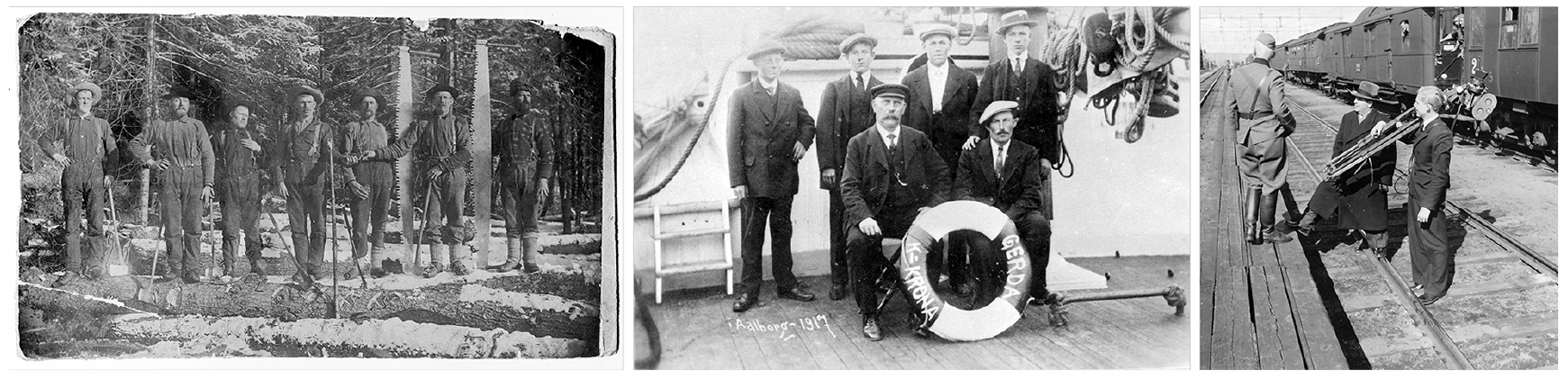
Description provided in Europeana accompanying image: ‘Emigration. Svenskar i Amerika. “Sju smålänningar”, Montana’ (‘Emigration. Swedes in America. “Seven persons from Småland”, Montana’)
Thus, the categorisation of Swedes is gender-coded and takes place in relation to something foreign and different, where Swedes are not at home or are compared with other groups. Here one can thus see the high numbers of the category Sámi people in the Swedish archives not as a sign that they were well integrated or represented in society, or were there for the purpose of inclusion, but as a sign that they were seen as foreign and exotic. The categorisation signifies that it is collectible, a trophy, from an excursion into the foreign—that is, the often-mountainous areas in the peripheral northern parts of Sweden. What is also notable is that what is categorised in the Swedish part of Europeana is the Sámi people, not their land. As of December 2021, there were only 156 items tagged ‘Sápmi’, which is the Sámi peoples’ name for their land. However, there are plenty of images from the area, but they are not categorised as Sápmi. So even though the Sámi people are relatively well represented in the archives at the same time, as collectibles, the Sápmi area is rarely acknowledged. Most of the items labelled ‘Sámi people’ were produced before 1950. The acknowledgements of Sápmi in the archive originate from the exhibition ‘Sápmi: on being Sami in Sweden’ at the Nordic Museum in Stockholm in 2007. This exhibition was produced together with a Sámi reference group, which was reflected in the choice of images and metadata descriptions (Westergren and Silvén, 2008). However, almost a year after my first investigation, in October 2022, over a thousand items are tagged ‘Sápmi’; this is because the Museum of World Culture, one of the newer Swedish memory institutions with an ambition to problematise colonialisation, made their digital collection available in Europeana 2022, showing the changing discourse.
To deepen the study, I decided to narrow down to images from Sundsvall, which was one of the cities that developed fast during industrialisation. I am also particularly curious about this place as I went to high school here. Here I only found one item categorised as ‘svenskar’ but twenty-seven as ‘samer’. Some of the items tagged Sámi show local celebrities dressed as Sámi people at a party in 1955, at Hotel Knaust, one of the city’s most prestigious establishments (Figures 4–6). I am drawn to the pictures because they remind me of the pictures of my grandparents when they were middle-aged. I imagine they could be at the next table, smiling broadly at the camera.
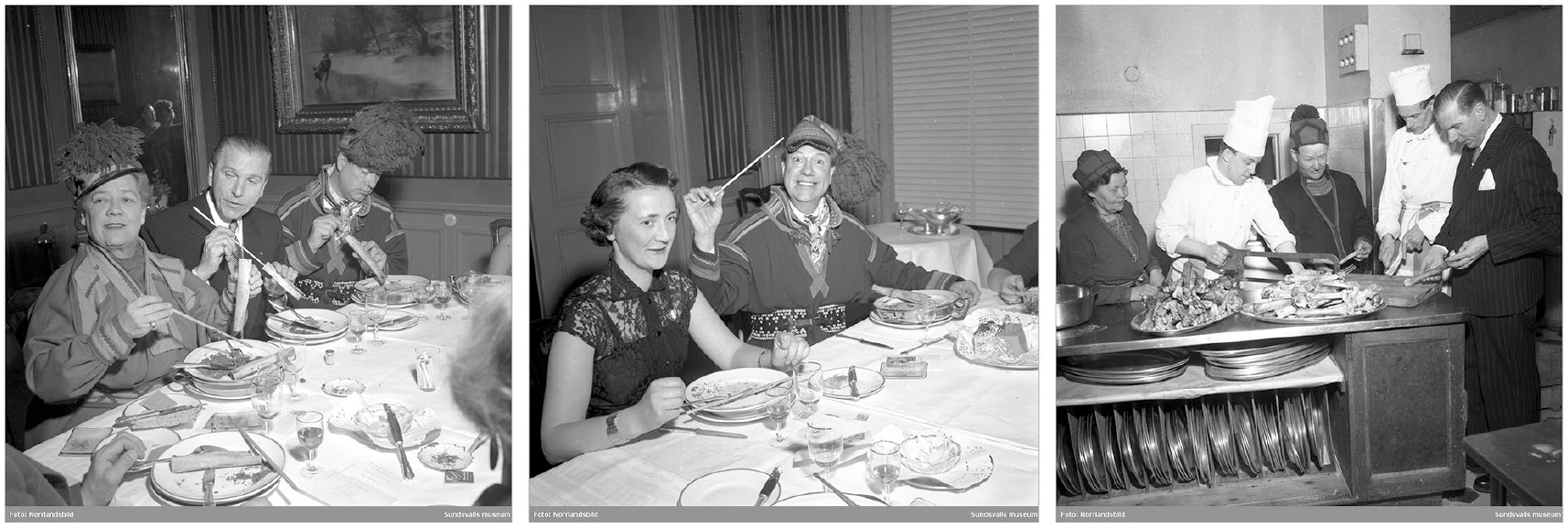
Description provided in Europeana accompanying images: ‘Renbensfest på Knaust. Stora benpipor tillagas och sågas upp i köket och avnjuts sedan med hjälp av långa pinnar. En del av gästerna bär samiska dräkter, bland annat schlagerdrottningen Kai Gullmar på första bilden. Vid sin sida har hon källarmästare Gunnar Wilöf’ (‘Reindeer party at Knaust. Large bone pipes are cooked and sawn up in the kitchen and then enjoyed with the help of long sticks. Some of the guests wear Sámi costumes, including the schlager queen Kai Gullmar in the first picture. She has cellar master Gunnar Wilöf by her side’)
Today, dressing up as a Sámi at a party would probably be seen as offensive, as so-called ‘blackface’ is in the United States. But unlike white and black Americans, the difference between Sámi and Swedes is not obvious, and without contextual data it would probably be difficult to read the situation. Here, the caption clearly describes that people with Swedish-sounding names have dressed up:
Reindeer party at Knaust. Large bone pipes are cooked and sawn up in the kitchen and then enjoyed with the help of long sticks. Some of the guests wear Sámi costumes, including the schlager queen Kai Gullmar in the first picture. She has cellar master Gunnar Wilöf by her side.
In one of the pictures, from the kitchen, two people appear to have more authentic Sámi costumes (Figure 6). They are not named.
The pictures raise questions about how categorisation takes place and who is allowed to categorise whom. Here, all the pictures in the collection, regardless of whether they are genuine Sámi people or dressed up, have been categorised as Sámi people. It seems here that it is enough to dress as a Sámi to be one. But the authentic Sámi has no name. It is not clear when or by whom the metadata was produced, other than at which institution the data was obtained.
Other images tagged Sámi people are almost completely devoid of personal names and most images contain only lean contextual information, if any, such as the first picture in the list of ‘samer’ which is from the square in Sundsvall and dates to the period 1891–1910 (Figure 7). Metadata is scarce in this item. An aesthetic exploration of the metadata by marking out what is described in the image clearly shows how the metadata excludes almost all people in the image, as the only thing described is ‘samer’ and the place ‘Sundsvalls torg’ (Figure 8).
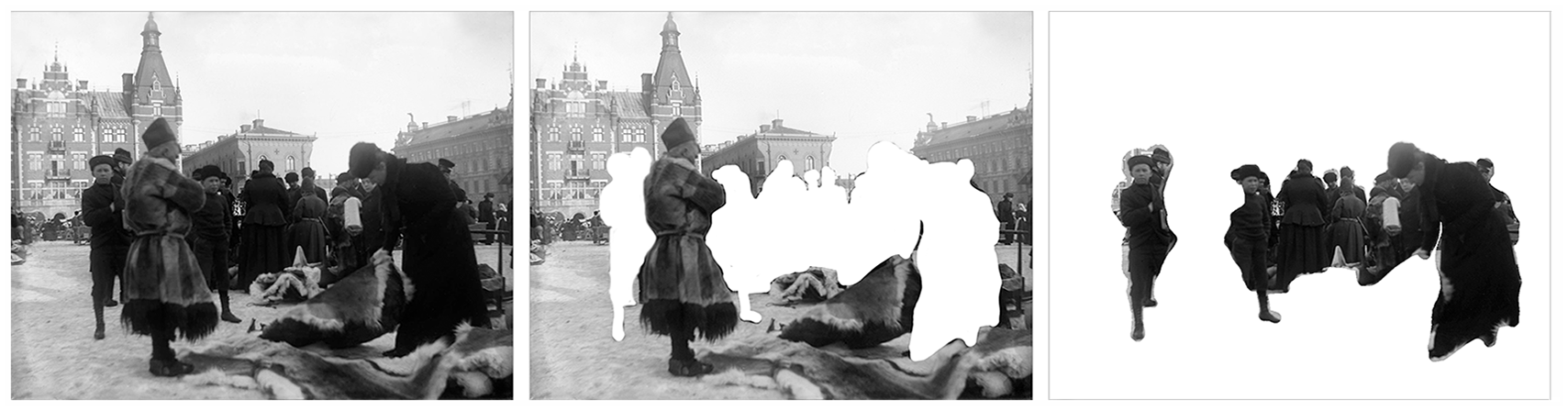
Description provided in Europeana accompanying images: ‘Samer säljer sina produkter på Stora Torget i Sundsvall’ (‘Sámi people sell their products on the main square in Sundsvall’)
If I invert this, and thus erase everything that is described from the pictures, then I get a perhaps more interesting result (Figure 9). The result of Figure 9 shows what the person who wrote the metadata probably considered to be unimportant or uninteresting, maybe because it did not signify something special or unusual but only represented the norm.
I examine another dozen or so images tagged Sámi in the same way. By erasing what is described in the text, the backgrounds emerge (Figures 10–12). These backgrounds and uncategorised persons seem like exotic strange places and people to us today, but when the picture was taken or described in the archive, they were perhaps not interesting enough to be described, or they were simply so well-known that they were taken for granted.
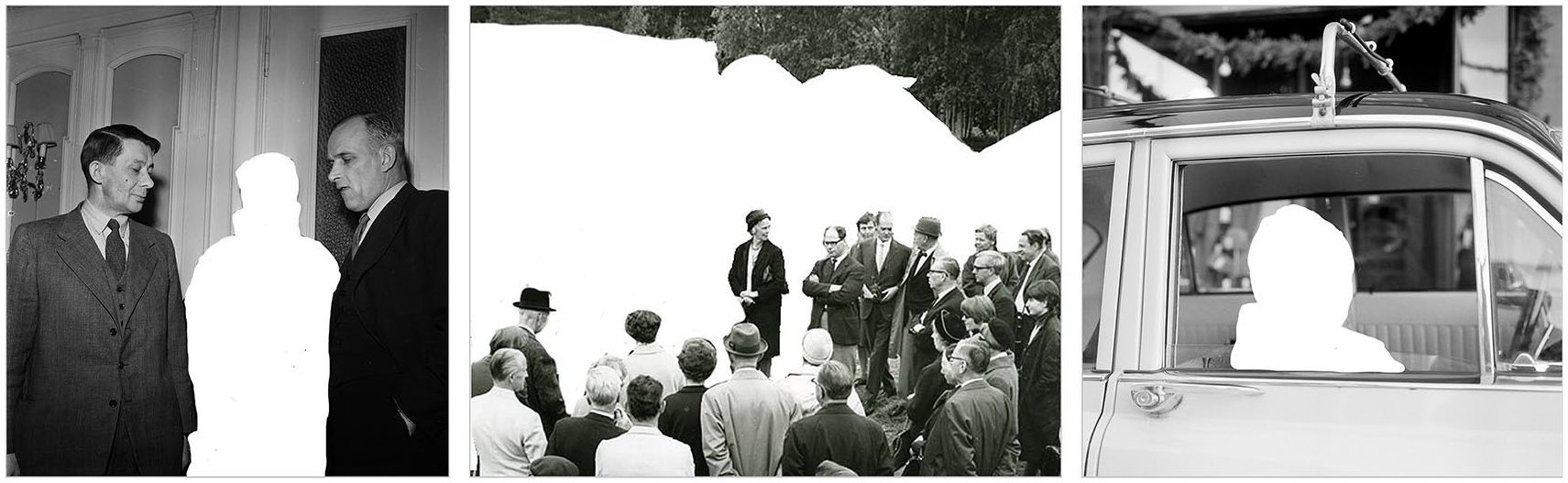
Images in which parts described in the Europeana metadata tagged ‘samer’ (‘Sámi’) have been removed by the author
By literally erasing what is described in the pictures, I can thus capture what has been made invisible. And it is not the deviant that is then highlighted; instead it is probably ‘the normal’ for the time that remains.
I continue to use this method on a number of different types of images. Interestingly, this method works to show ‘normality’ even in less politically charged cases, such as in the image where the descriptive metadata consists of ‘children’ + ‘toy’ (see Figures 13–14). Here, what is photographed and categorised in the context may not be directly foreign, but something the photographer or the person who archived it experienced as special and perhaps cute in the middle of public life, two children on a toy horse. When I remove what I assume signifies ‘children’ and ‘toy’ from the picture, we see a situation that is common for this time, women in skirts and hats shopping for nylons in a store. Today, this appears to be a much more exotic situation in a Swedish perspective, and it shows how norms for femininity have moved rapidly only during my lifetime. My mother was twenty years old in this year. Suddenly I feel protective when I think of my young mother growing up in this scary world populated by women in nylons and poplin dresses. In Sweden today, women in nylon stockings are rather an anomaly and nylon stockings something you wear when you dress up for a masquerade or for formal occasions.
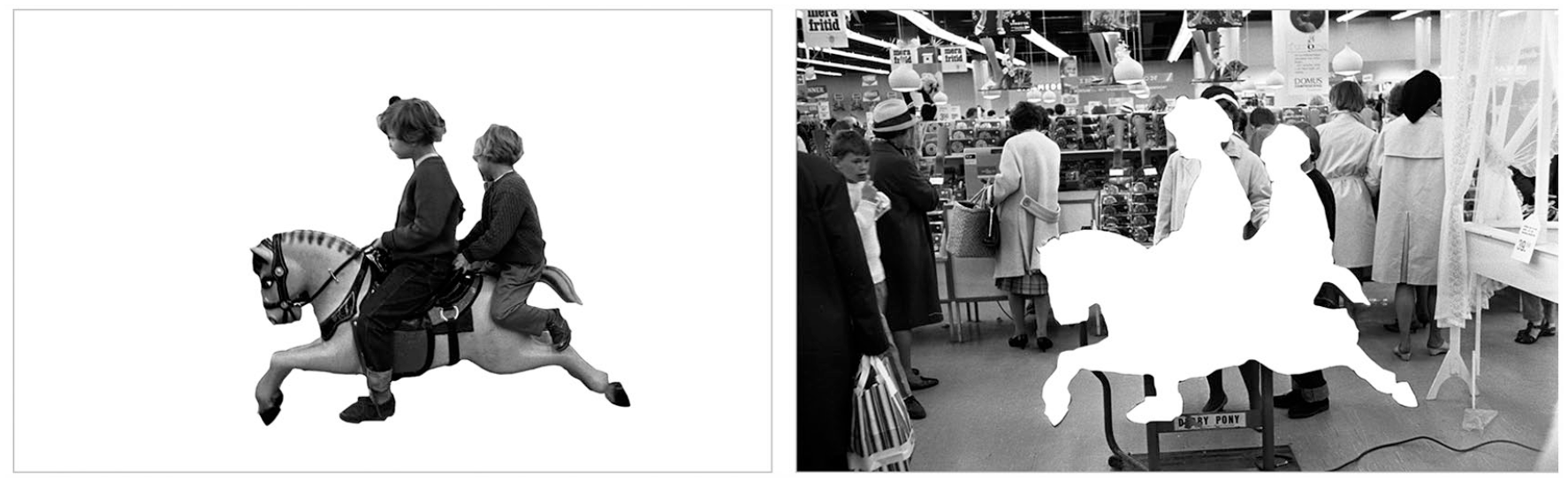
Image tagged ‘Orubricerat 25 maj 1966’ (‘Untitled May 25, 1966’) in Europeana that has been modified by the author
When I search for children in Swedish Europeana, it turns out that ‘children’ have been categorised in more than 90,000 entries, unlike ‘adults’ who are tagged in fewer than 3,000 images. This probably does not mean that children were seen as foreign and strange in Swedish society, but perhaps that they were not really considered as suitable subjects. It seems to be mainly unnamed people who are put into categories.
At the same time, metadata is something that changes in step with the archival practices of different times, which is why we cannot take it for granted that the metadata has sprung from the same spirit of the time as the archived object. For example, it is not possible to find many, for our time politically incorrect, descriptions of different ethnic groups of people in Swedish Europeana. There are very few racist descriptions of bodies despite lots of images from a time when differences in appearance were considered important to measure.
While most bodies are not defined by their appearance, gender categories such as ‘man’ and ‘woman’ are added to a large proportion of images, even where the men and women in the images are mainly portrayed because they are famous. Here, the archivist has thus considered it important to mark the sex of the people portrayed, probably in order to enable comparative studies, but has avoided other descriptions of these bodies, such as hair, height or skin colour. This corresponds to ideas that were institutionalised in a Swedish context in the beginning of the 2000s where differences between the sexes were considered important to point out and measure, while avoiding other categorisations of bodies.
Thus, the descriptive metadata in these examples does not point out everything the images show, but it is special aspects of the images that are highlighted in this way, while others are ignored. Just as with the distant relative with the suitcase filled with obscure images, the images and metadata that describe them do not always show the historical reality in which they were created, nor are they necessarily something that describes the majority society. Instead, this can be seen as an expression of the self-image of the one who created or selected them, where one’s own normality can, for example, be confirmed through collections of the foreign, exotic and cute. It can also be seen as an expression of wonder at what is new, different or unknown. The metadata also reflects the spirit of the times, pointing out what is considered important and desirable.
Metadata exceptions: to see the wilfulness in the archive through quantification
Categorisations lump together all items with the same epithets, moving the item from the collection it came from to other collections, like the ‘cute cat’ collection or ‘Swedish children’ collection. This fragmentation of the image attributes thus enables a comparison of large quantities that share the same attributes. This is also one of the opportunities with digitalisation that are highlighted as the means to create new research methods in the humanities. By, for example, collecting objects with intersecting attributes such as ‘children’, ‘toy’ and time, potential stories about how childhood and play have been defined and transformed over time can be constructed with a few simple searches (Figures 15–17).
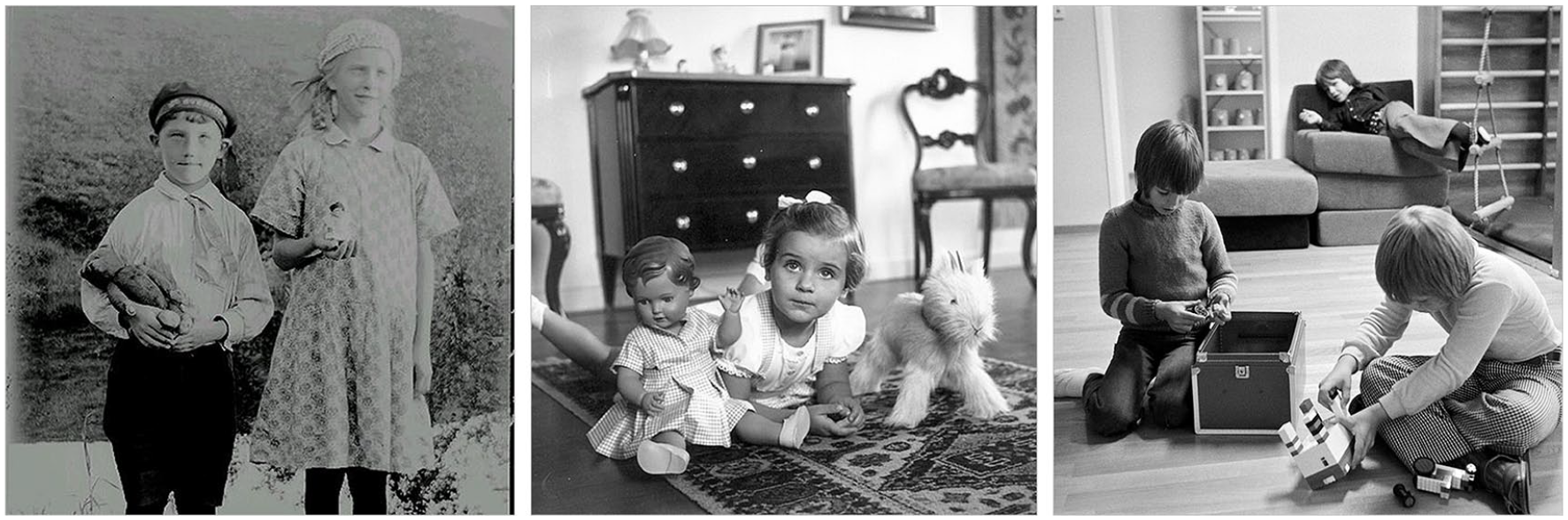
Items tagged with ‘child’ and ‘toy’ from three different years (1920, 1953, 1974) in Swedish Europeana
In other words, this is a streamlined historicisation where easily defined attributes can potentially be sorted into a neatly structured narrative. Attributes such as time, place and quantity also enable a visualisation of what is, and is not, in the archives (Figure 18). I am attracted by the opportunity to gain overview and control. The numbers and grid patterns give it a sense of being scientific and precise.
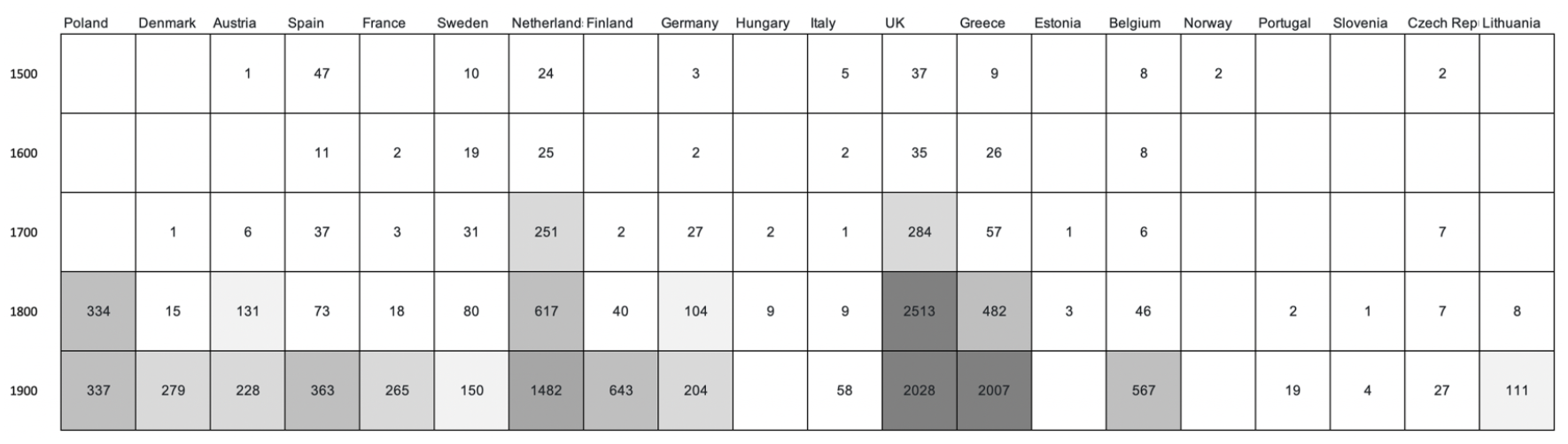
Search result for the word ‘children’ and time period in Europeana (e.g., ‘children’ and ‘1500’), sorted on hosting country and number of items per 100,000 items
But the attempt fails. When looking more closely at the results in Figure 18, the result is clearly not about the number of items found when searching in the database for children, but the number of items found when searching for items marked with the English category ‘children’ in different countries’ museum collections. I do not know why they are tagged in this way but assume that it is due to resources and wilful archive practices that the content of the archives sometimes is, and sometimes is not, translated into English. Not unexpectedly, there are many ‘children’ in the UK but a little unexpectedly also many items tagged ‘children’ in Greece and the Netherlands. Thus, the quantification points to the exceptions and anomalies, rather than giving us a clear answer as to how many images of children we can find in the collections of Europeana. To actually find out the number of items marked as ‘children’ in all represented languages would of course be best, but it still doesn’t describe images of children, just the tagging of images.
I keep combining different kinds of metadata, hoping to find something to count on without too much variance but without any success—even with simple categories. A quantification of ‘barn’ (children) and place in Swedish archives shows how something as easy as place is rarely described or is described with consistency. In a search for children in Swedish Europeana on ‘barn’ and ‘1900’, half of the pictures come from a single museum in Malmö, a city in the south of Sweden. When we take a closer look at the pictures, the place is rarely described and then not as location metadata but in picture descriptions such as ‘Caribbean, Haiti’. When location is described as metadata, it may contain conflicting locations such as ‘Sverige … Malmö Municipality Malmo Malmö[,] Malmön Fågelbrolandet Malmøya[,] Kingdom of Sweden Sweden[,] Kingdom of Norway Norway Sverige’, which describes four completely different places, three in Sweden and one in Norway. 3 The date in this particular image is set as 1998, although the photo type and costume of the people on the image clearly situate it one hundred years earlier. Thus, not even fairly simple descriptions such as place, time and ‘children’ are easy to grasp using quantification of metadata, as they are not uniformly described and require a time-consuming qualitative analysis of the images included in the data set. Here the quantification of metadata doesn’t reveal hidden historical narratives, but rather reveals the large number of exceptions from the standard. The quantification thus shows the complexity of the descriptive metadata and the amount of discrepancy and deviation.
What is metadata-described and not in the archive is thus largely governed by the norms and archive policies of different times and collections. Some people are categorised especially because they were seen as strange or in the absence of a name, in categories such as ‘Sámi people’ and ‘child’. The deviant and cute is still something we point out, marvel at and which is given the most ‘likes’ in our modern archives in the flow of images on social media.
Conclusion and discussion
In conclusion, in this speculative exploration of parts of Europeana I have developed and applied two methods for analysing the archive. The first, metadata inversion, is literally about marking out what is described by image metadata, in order to see assumed ‘unimportant’ data according to the imagined persons and standards that describe the images. The second method, metadata exceptions, uses visualisation of quantification of metadata to show the distribution of metadata between diverse collections, and the potential exceptions and wilfulness of the archival practices.
These visual methods thus direct the gaze away from the described objects and towards the metadata and the actual production context of which it is a part. These methods turn our gaze to the ones who created the collection, to the void that represents the body that held the camera. This body, distinguished by its invisibility, represents the dominant gaze in a certain time and place (Ahmed, 2007). Such focus on the invisible centre around which the other appears as a deviant or an object of desire leads to other types of questions, such as: what types of items are desirable and circulated? What incentives create more demand for certain metadata categories rather than others? What are the material constraints and demands that govern metadata collections?
Today, it is considered desirable for memory institutions to be ‘democratizing, inclusive and polyphonic spaces’. 4 This idea is performed by compensating in various ways for the historical lack of diversity and justice when choosing what to digitise and how to describe the items in online collections. Embedded in this ambition are also values such as transparency and innovation, and the desire to create new research opportunities. The problem in this scenario is the wilful institutions and archivists who simply do not submit to a uniform standard.
In this article, I have shown that the lack of a coherent standard and shared vocabulary should not only be seen as a problem to be solved but can actually be an asset—a failure that enriches and points to the conflicting viewpoints in the material, showing the wilfulness in the collections in Europeana. I also show that the metadata does not necessarily describe what the images portray but can be about what was considered odd or special in the images. Thus, descriptive metadata can just as well be about desires and imaginations as about descriptions of the image elements. For example, the growing use of ‘Sápmi’ in descriptions of Sámi people shows the changing discourse around colonialisation, where the political acknowledgment of the land area Sápmi previously was unimaginable by the majority society.
Sara Ahmed (2012a) suggests a ‘willfulness archive’, an effort to compile an archive of wilfulness. The potential of such a project is easily observable: if the overarching will of institutions has historically evolved as a way of straightening and correcting history in an acceptable and recognisable way for its time, then a queer history of will can reveal what is ‘already bent’ (Ahmed, 2014b, p. 7), by archiving the diverse wills of the archive. A queer history of will is thus far from straightening out what is bent and putting the story on the right track, in a way that is acceptable and recognisable to our time. Instead, it is more about living with what we have, accepting and learning to love a history that is incomplete, conflicted, fragmented and more about desire towards the other than representation of bodies.
In this perspective, instead of being ashamed of the old relative and her suitcase, I can look at this old corpus with affection and wonder. This queer look is about directing the gaze beyond the most obvious in the image and thinking about what is not described: to marvel at everything we take for granted, and the patterns and images that are created when we work with the archive in different creative ways. The visual methods such as the ones I present here can support such a methodology of ‘feminist wonder’ (Ahmed, 2014a), a way to distort and twist the archive, to deceive our own norms and pre-understandings and to see the surfaces the archive is made of.
However, this does not necessarily mean that we should give up trying to introduce the will of our time to the archive, like desires for big data to bring unexpected and puzzling ways of looking at history. Instead of merging multiple standards into one, digital media enables us to have multiple layers of standards and vocabularies. It is also the spirit of Europeana’s metadata model (EMD) to be inclusive of the diversity of archiving practices and standards of the participating institutions. But to be able to really use Europeana as a queer archive of will, to see how categories and discourses move and change between contexts and times, we need to look more carefully at the interface design. Today Europeana does not acknowledge in any detail when (and by whom) metadata is written. Usually there is a time stamp for when the post was created, and one for when it was last changed, but nothing in between. A more detailed provenance, showing the development of metadata over time, acknowledging the crowd of people involved in the process, would enable a rich resource for archival research.
Footnotes
Funding
The author disclosed receipt of the following financial support for the research, authorship and/or publication of this article: The research for this article was conducted within the project The Politics of Metadata (grant number 2018-01068) funded by the Swedish Research Council.
Notes
Author Biography
Karin Hansson is an associate professor of media technology at Södertörn University. Dr Hansson has written extensively on norms and values in technology-based participation from a feminist and democracy perspective. She is currently project leader of the research project #MeToo Activism in Sweden: Development, Consequences, Strategies and is also part of the Metadata Culture working group at Stockholm University.