




Abstract
In this article, the authors take up the historical figure of Dr Betty Paërl, who has surprisingly turned up in very different kinds of specialised archives. The white mathematics professor was located in IHLIA LGBT+ Heritage, the largest queer heritage collection in Europe, as a notable SM sexpert and spokesperson on transgender politics, and also found during archival research into the anti-(neo)colonial struggles of Suriname against the Dutch. Upon closer inspection of the materials, the authors find the recurrent image/item of the whip that presses them to carefully think through how the archive of Dr Paërl casts light on a history that Katherine McKittrick calls being ‘in the shadow of the whip’. The article aims to combine an analysis of these versions of the whip in different visual and discursive registers to detect the liberatory politics underlying her activisms. To do so, the authors develop the intersectional model of the kaleidoscope employed by Dutch Black, migrant and refugee (BMR) feminist theorists to grasp the shifting patterns of power that Paërl battled and embodied as an activist of the anticolonial struggle, for sex workers’ rights, for kinky sex and for transgender people. This is all the more important in the historical study of transgender visual materials that most often arrive in archives via medical and police photography or pornographic materials. The historical researcher, the article argues, should be wary of (re)producing a static vision that would reduce transgender figures to sex and gender politics, or eclipse a vision of trans politics that dilates beyond sexuality.
Keywords
Introduction
Considering that trans* history tends to highlight archived material related to stigmatising discourses of sexology and policing, in this article we wish to widen the analysis of transgender heritage beyond the lens of abnormal or criminal forms of ‘sex’ to focus on intersections with racial and colonial liberation struggles. 1 To do so, we delve into the late Dutch colonial archive and track how its legacies permeate the BDSM archive as housed within a queer heritage collection. The reason for examining these two strange bedfellows is that they came together while researching the various archival deposits of Dr Betty Paërl, born in 1936 in Amsterdam to Dutch parents with Dutch and Polish heritage. This project began in the course of conducting research at the IHLIA LGBT+ Heritage archive in Amsterdam, the largest holding of its kind in Europe. Co-author Isenia came across sources produced by or starring trans woman, Dominatrix and sexpert writer from the Netherlands Dr Betty Paërl (b. 1936), which spanned from 1983 until 2001. 2 Only after consulting other archives for additional information on this historical figure, starting with the Black Archives in Amsterdam housed then within Society Our Suriname (Vereniging Ons Suriname), did we find out that earlier in the 1970s and 1980s, she was a mathematics professor who also had published extensive anticolonial writings and made documentaries dedicated to the political and economic liberation of Suriname. 3 We were surprised to find a white person so deeply involved in this historically Black organisation. Similarly, Paërl’s inclusion within IHLIA represents a seam of unusual materials that are of a personal and activist nature—rather than just medical information on or for trans people; the diverse articles, documentaries, television interviews and portrait photography highlight her radical SM sex politics. Her files show that she was responsible for bringing the work of P. Califia (Patrick Califia transitioned in 1999) and a politicised American leather dyke culture into Dutch lesbian and broader queer BDSM communities. 4 Although IHLIA neglects to collect her earlier anticolonial writings like Dutch Power in the Third World (Paërl, 1971) and political documentaries from the 1970s, these are easily found in other specialist public collections within the Netherlands—if you think to look there.
Our analysis of Paërl’s selective placement in these seemingly non-reconcilable archives builds upon a growing literature dedicated to thinking through the particular modes of inclusion and exclusion operative within archives by queer and trans studies in general and specifically in the Netherlands. 5 We see that specialist archives can function to offer granular detail but risk excluding other information and perspectives and also occlude analysis of how power structures such as white- and cis-centrism operate in similar ways across different types of collections. We aim to contribute to this important conversation on accessing sources for transgender heritage by combining analysis of materials from different repositories that pertain to overthrowing colonialism, transgender lived experience and BDSM sexual practice. Further, we conclude this article with reflections on how our analysis uses and extends various conceptions of intersectionality, such as Kimberlé Crenshaw’s (1989) traffic intersection but most especially the kaleidoscope as articulated in Dutch Black, migrant and refugee feminist theory, which works to sharpen our understanding of their methodological differences for critical and historiographic feminist writing. The Black, Migrant and Refugee Women’s Movement in the Netherlands is a group of activists and scholars who took an intersectional approach in the 1980s to criticise discriminatory Dutch policies and to critique the majority white Dutch women’s movement. Scholars in the movement, like Gloria Wekker, offered theoretical concepts informed by non-white perspectives. For instance, ‘subjectivity’, which Wekker (1996, p. 333) develops from an Afro-Surinamese working-class universe, is described as ‘more profitably conceived of as a kaleidoscopic, ever-moving sequence than as a unique, bounded, static essence’. We contend that an intersectional archive might be achieved through reading these materials together, meaning our interpretation will look at these separate ‘scenes’ of Paërl’s life at the same moment to grasp their complex interactions and intersections. Doing so produces a three-dimensional kaleidoscopic image—kinky*trans*colonial—of her archival instantiation.
In invoking the visual technology of the kaleidoscope, we want to draw out the action of doing decolonial archival praxis that foregrounds the activities of remixing and rearranging, both a necessity because of missing sources and to critique what is available (Ghaddar and Caswell, 2019). With a kaleidoscopic view of Paërl’s extended analysis of the power hierarchies and exchanges embodied in the whip, we can mobilise a specialised LGBT+ archive to gain insights into the intersection of gender and sexual liberation with colonial liberation movements. This methodology considers identity categories as a kaleidoscopic, constantly moving, assembled sequence rather than a singular, limited, static essence, which serves to open up the analysis of a single oppression to offer multiple overarching and contrasting perspectives. We bring together in new constellations materials located in the collections of the Atria Knowledge Institute (on gender equality and women’s history), the Netherlands Institute for Sound and Vision (for Dutch broadcasting), Eye Film Museum (Dutch and international film collection) and the International Institute of Social History (dedicated to social movements). The reality of these materials being far-flung, not available in any one database, nor cross-listed, is not just a practical or technical problem, but could present to the researcher a narrow kind of ‘tunnel vision’ understanding of her activism and philosophies, in short, her worldview. While in no way claiming to reconstruct this worldview, our attempt at presenting Paërl’s own activist views on hierarchies of power is to shed light on the liberatory politics underlying her activisms that are informed by Marxist understandings of labour, class and workers owning the means of production. Archived images, particularly when sexual in nature, can potentially flatten out a subject by seeming to disconnect that politicised body from other modes of being political. Here we follow the recurrent image of a whip in her source materials to demonstrate the ways it works to reconnect these politicised bodies of the neocolonised, the Dominatrix, the kinky trans dyke.
The Whip: Producing A Temporal Drag with a Resounding Crack
Following the whip allows us to speculate on the activist interweavings and connections in one person’s life that may open up the archive to new questions. Upon closer inspection of the materials, noting the recurrent image/item of the whip pressed us to carefully think through how the archival legacy gathered around the figure of Dr Betty Paërl casts light on a history that Katherine McKittrick (2014) calls being ‘in the shadow of the whip’. McKittrick’s (ibid., pp. 21–22) consideration of how Black studies has to work in the shadow of the whip, that is, the legacy of slavery that underlies the historical present, shows both the difficulty of getting out from under racial-sexual violence and how we can examine the imagery and language of racial suffering in liberating ways. These shadows of the whip can be traced around the world by looking at how different empires have racialised the Other. Or, as Wekker shows in the Dutch context, how a dominant discourse in the Netherlands sees the Dutch as colourblind, innocent and free from racism. However, the imperial racial economy continues to underline the dominant forms of knowledge, interpretation and feeling in the Netherlands (Wekker, 2016). This shows the global shadows of the whip. As a white woman, Paërl does not live in threat of the whip, but she lives in the same affective atmosphere in which the whip is wielded. While we cannot change past events, Paërl’s kaleidoscopic archive suggests that props, materials, documents and affects can be remixed and narratively resequenced. Paërl’s distinct, and seemingly antagonistic, archival strands prompt us to discern how the item/image of the ‘whip’, with its overdetermined reference to the brutality and inhuman core of slavery and colonialism, seemingly becomes transformed into a BDSM whip, which connotes pleasurable sensations and the excitement of being subjectively undone. Might Paërl’s whips produce other modes of imaging and imagining racially charged sex and gender relations that are non-exploitative? Can a whip have justice as its target?
Through engaging with Paërl’s diverse materials, we conceive of a kaleidoscopic archive that shifts and changes depending on the angle of the researcher’s gaze. While we might have technical access to the materials in that they are retrievable, the burdened, trauma-laden symbol of the whip may produce what Charles Jeurgens (2021) describes as ‘emotional access’ issues. As a scholar of archive infrastructures, Jeurgens places emphasis on the capacity for emotional sensitivity to documents that attach to difficult histories and trauma testimony. Thus, access is not only a question of technical accessibility as digitising projects often promise but also about the emotional capabilities and knowledge that one brings into the encounter with the archive. For us, this raises the query, what kind of emotional proximity is capable of grasping the whip’s appearance in the context of punishment and pleasure, to hold these dynamics of power in which one is crushing and the other liberating?
The meaning of the whip and even the sensitivity to its intersections has a relation to the researcher’s positionality. In our case, we are both queer and non-binary researchers with personal experience of sex work, one positioned as Black and in direct relation to Dutch colonialism in the Caribbean and one positioned as white, from a settler colony and a part of BDSM communities. As a research duo, being attentive to the literal and symbolic form of the whip allowed us to supplement each other’s expertise with reading the archive for sexual, gender and racial politics. We agree with Nydia A. Swaby and Chandra Frank’s observation in their introduction to a Feminist Review special issue, titled ‘Archival Experiments, Notes and (Dis)Orientations’ (2020, p. 5), that ‘[t]here is a lacuna when it comes to a more rigorous engagement with the role of race within feminist and queer approaches [to archives]’. In response to this lacuna and to the editors of the edited volume Caleidoscopische Visies: de Zwarte, Migranten- en Vluchtelingen-Vrouwenbeweging in Nederland (Botman, Jouwe and Wekker, 2001) who argue for racialising whiteness, we highlight how whiteness intersects in the different iterations of the whip, in who holds it, who receives its blows and in what kind of power exchange. The whip may be multiple, but it remains a robust placeholder for domination. The kaleidoscope’s ability to hold multiplicity and change as well as offering an experimental approach to archival studies inspires us to pursue fleshing out this visual metaphor.
In what follows, the whip references the brutal, punishing form of plantation slavery that organised the Dutch colony of Suriname (1651–1975) and subsequent neocolonial practices on business plantations following the abolition of slavery, which Paërl fought against. The whip is also a tool of the SM (sadomasochistic) dungeon that she fought for as a space of gender and sexual freedom. The cat o’ nine tails travels from being the instrument of punishment on ships and plantations to the Dom’s collection of sex toys that can be seen in Paërl’s filmed and photographed professional dungeon space and heading newsletters for Slechte Meiden (Bad Girls) in which she published. From trans-Atlantic slavery to the 1980s SM political moment, how might the whip’s centrality recast the potential animating role of anticolonial liberation movements for the sex liberation movement?
Tracking the whip’s many appearances allows us to draw lines across periods and scenes of activism in a manner that Elizabeth Freeman (2010, p. 167) has described as temporal drag, ‘the visceral effect of past history on present bodies and perhaps even vice versa’. Thus in the scene of lesbian BDSM communities, we see how the erotic charge of the whip as a means to stimulate and organise relations between bodies requires the reservoir of racial and class inequalities that drag forward into its future manifestations. Here we build on McKittrick’s (2014) insight that archival documentation of Black life often relies on the image of the unfree and violated body to the extent that we live ‘in the shadow of the whip’ (Hodge, cited in ibid., p. 21). In this sense, the whip may be nearly impossible to get away from as a loaded traumatic history; hence defining a role for it in the search for freedoms might be the only way through. The amalgamated vision of the whip dispersed in various archives is, therefore, a strategy to read the Paërl sex archives ‘not as a measure of what happened, but as indicators of what else happened’, to quote McKittrick’s (2014, p. 23) liberatory vision of evidence. In this case, we seek to invoke this history in a way that is ‘ethically honoring but not repeating anti-black violence’ while at the same time describing what the archive was unable to capture, ‘that which cannot be seen or heard or read but is always there’ (ibid., pp. 20, 22). For us, the challenge is how to hear the resounding crack of these whips across the archives while differentiating how they have a particular symbolic role in the aftermath of slavery, that field of distortion called ‘the wake’ by Christina Sharpe (2016).
The Whip of Suriname: On Colonial Independence Writings and Films
Dr Betty Paërl was awarded her PhD in mathematics at the University of Amsterdam in the turbulent political year of 1968 at age 32. Soon she became an active member of the Suriname Committee, founded in 1970 by Surinamese and Dutch people in the Netherlands to promote solidarity with the Surinamese and Antillean people at home and abroad who were living in the shadow of the neocolonial whip. 6 The committee tried to achieve its goal by providing information about the former colony’s problems through publishing the Suriname Bulletin and brochures, producing films and holding lectures and training. It is in this context that Paërl wrote four books (under her previous first name): Nederlandse Macht in de Derde Wereld (Dutch Power in the Third World) (1971), Klassenstrijd in Suriname (Class Struggle in Suriname) (1972) and Nationalisme of Klassenstrijd (Nationalism or Class Struggle) (1973) and was one of the editors of De Uitbuiting van Suriname (The Exploitation of Suriname) (Kross et al., 1970). In her anticolonial activities, what is remarkable is that Paërl collaborated with her then-wife Hetty Paërl, also a white Dutch woman. Betty wrote the research-based texts while Hetty took charge of the book illustrations that would summarise the grotesqueness of companies such as Billiton-Shell. The collaboration translated as well into their three super 8mm political documentary films about pre-independence Suriname (completed in 1973), in which Betty operated the camera while Hetty recorded sound (Brokopondo, 1973; Rietkappers [Cane Cutters], 1973; Mariënburg maakt zich vrij [Marienburg Clears the Way], 1973). Paërl’s work on Suriname underlines that, although Suriname acquired self-government in 1954, in which case Suriname was officially no longer a colony but still part of the Dutch Kingdom, other neocolonial constructions arose after 1954, mainly due to the relationship with Dutch businesses. Paërl was likewise cautious about Suriname’s approaching independence in 1975. She believed that Suriname’s independence was only the start of a longer process. She said in an interview: ‘the [Surinamese] committee has no illusions that independence will change much in the fate of the Surinamese people’ (Paërl, quoted in Vrije Stem, 1974). According to Paërl (ibid.), as long as large foreign companies exploit the country’s mineral resources, the Surinamese people have little use for independence.
Paërl’s publication Class Struggle in Suriname (1972) is what she qualifies as being a report that extends her earlier book, The Exploitation of Suriname (Kross et al., 1970), with new findings, focusing on providing background and assessing the strength and limitations of the September 1971 strike. This strike aimed to improve the socioeconomic position of employees of different businesses in Suriname. Inside the book is a separate folded A2 format poster designed by Hetty, which is titled ‘PROTEST: aluminium companies are exploiting Suriname. The Netherlands is complicit’ (see Figure 1). The upper part of the poster is filled with a large cartoon drawing by Hetty of a corpulent ship that is personified in the form of a monstrous ‘fat cat’ businessman. Several Dutch companies such as Billiton-Shell (gas and oil), KNSM (shipping) and Bruynzeel (timber), as well as those for produce, sugar and bauxite (aluminium), are drawn on the deck and in the belly. The ship-figure’s multiple claws, which refer to a predator hunting its victims, are grabbing up resources to be exported to the Netherlands. Dutch companies in the form of this grotesque monster resemble puppet players with a significant impact on Suriname’s socioeconomic context. These pamphlets, books and films by the Paërls were also linked to actual political actions in the Netherlands and the strengthening of Suriname’s local movements. For instance, in Figure 2, the absurdly swollen ship businessman reappears in a poster for a protest in Amsterdam in support of bringing charges against the Dutch companies that enrich themselves in Suriname.
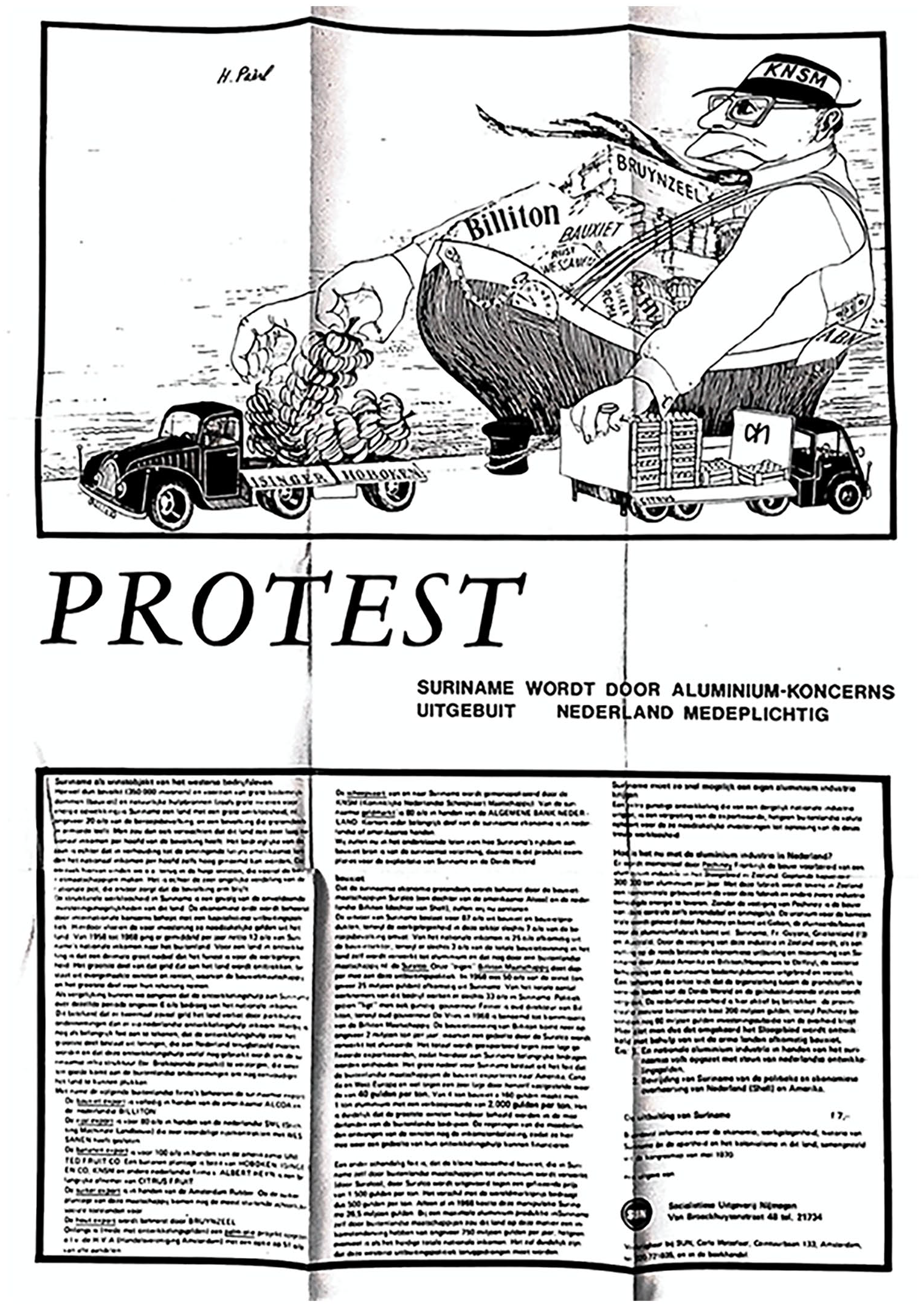
Headline reads ‘PROTEST: aluminium companies are exploiting Suriname. The Netherlands is complicit
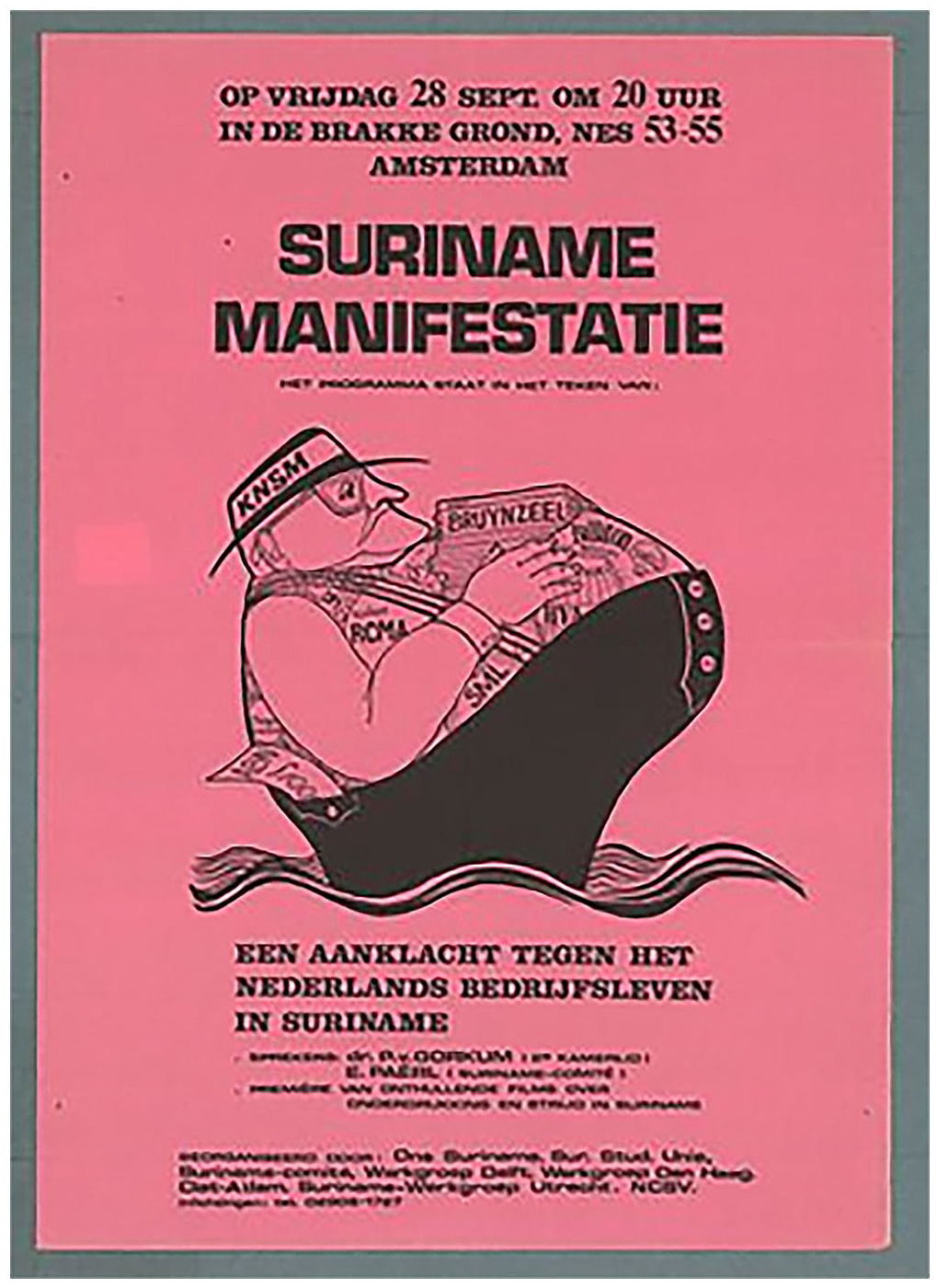
Poster reads ‘SURINAME MANIFESTATION. An indictment of the Dutch business community in Suriname’
At the time that Paërl (1972, p. 7) was writing, the September strike of 1971 was one of Suriname’s most massive strikes for economic independence so far. She states that even though Suriname is one of the largest bauxite producers globally—where mining for the Western aluminium industry has taken place since the 1920s—the country is inundated with poverty, housing scarcity and unemployment. Paërl (ibid., p. 63) writes that the contradictions between the Global South and the ‘Western’ countries over commodity prices point above all to the class struggle that took place in the Global South worldwide after the Second World War. Since Western countries keep raw materials prices down to their advantage, the Global South cannot profit; however, Paërl transcends the limited Marxist view of class above race by observing that after the 1971 strike, we should critically examine the immigration of Surinamese people to the Netherlands. Due to strict Dutch admissions policies, people of colour were inhibited from settling on the mainland of the Kingdom, creating a second-class citizenry based on former colonial status and colour (ibid., p. 39).
According to Paërl, striking is necessary to achieve ‘the liberation of the Surinamese workers and farmers from poverty, exploitation, and [economic] dependence’ (ibid., p. 5). The book is an indictment against foreign investors such as Billiton-Shell, the Surinamese government and the Dutch government for reproducing exploitative colonial structures. In her analysis, she wrote about meeting with a 77-year-old Maroon chief 7 who ‘gave us, the Dutch’, and here we read ‘Dutch’ as people like herself, racialised as white, the following message: ‘If you go back to the Netherlands, tell your queen [at that time Queen Juliana] that the freedom we were given, in the abolition of slavery, is not real freedom. We are still being whipped’ (ibid., p. 15, emphasis ours). According to Paërl, these ‘whippings’ for the labour masses in Suriname are twofold: firstly, by a local exploiter, who pays too low wages to earn a living, and secondly, by a foreign exploiter, who keeps raw material prices down, which enables the large multinationals to make a profit off the backs of the labourers. Incensed by the continued violence of such economic ‘whippings’, the next step that we can surmise was for the Paërls to screen a film that would demonstrate through visual evidence the brutal impact of neocolonialist extractivism.
We learned from archived newspaper clippings that in 1973, three political documentaries by Betty and Hetty were shown during the International Student Film Festival, Cinestud, in Amsterdam, the Netherlands (Gessel, 1973). From the programme’s published description, we know that the Paërls’ super 8mm films resulted from around three months of travel. Their starting point was the Surinamese committee’s engagement with the Marienburg sugar plantation workers and with the Maroons living in the Brokopondo district. It seems that her experience with filmmaking being a revolutionary tool led Paërl (1980a) to write a handbook on sound film for a broad audience in 1977, in which she also described the professional editing of super 8mm film with the advent of the super 8mm mounting table. Earlier and afterwards, she translated a German sound film handbook to Dutch (Blitz, 1977) and edited a Dutch translation of a German pocketbook for super 8mm films (Unbehaun, 1978). With this level of technical insight, perhaps Paërl did feel in part like someone whose political vision was enhanced by a recording film camera, which allowed her to give sound and vision to the ongoing injustice of Dutch profit-driven companies whipping exploited, disposable workers. Her written and audiovisual work documents the continued circulation of the whip within Suriname—the visceral effect of the whip’s lashes on enslaved people experienced for so-called transgressions is felt again in the punishing economic whip’s lashes in late colonial times when Dutch companies exploited the local population and their land. The freedom that should come with liberation from white slaveowners has been usurped by white neocolonisers. In this sense, the books and films of the Paërls are more than what Neil L. Whitehead (quoted in Sigal, Tortorici and Whitehead, 2020, p. 2) describes as ‘ethno-pornography’, in which ‘the positionality and cultural gaze of Western academics [… are] heavily inflected with a form of epistemological rectitude, an intellectual BDSM, through which the pleasures of classification and analysis become akin to the corporeal binding of the ethnological subject’. Underlying this idea of ethno-pornographic study according to Whitehead is a concept of ‘penetrating the unknown to encounter the virgin’ (ibid.). However, given that the Paërls are white Dutch and filming Black people in a former colony, their documentaries of Suriname were not intended to discover an unspoiled and unheard-of terrain to classify an exotic ethno-folk, but rather to highlight a longstanding under-the-radar concern about the beast of colonisation and to call people to action, including those in the former metropole. Along these lines, through the Paërls we can critique Whitehead’s too easy analogy of ethnography to pornography and show how BDSM can be more than a caricature of colonial epistemology. Indeed, as we will explain, BDSM is not simply akin to colonial dynamics, and although both require a polarisation of power, we should not readily collapse the exchange of power in kinky sex with that of colonial times.
The Whip of BDSM: On Sexual Liberation Writings, Radio and Films
How Paërl went from publishing on anticolonial struggles to sexual liberation is a circuitous, many-forked path involving precarious labour, political witch-hunting, interracial solidarity and her own search for a thrill. From consulting the digitalised Dutch newspaper archive Delpher, we know that in 1975, while teaching mathematics at the University of Amsterdam, a national newspaper article reported that Paërl’s contract might not be renewed (de Volkskrant, 1975). Typically, temporary contracts of university employees were converted into permanent contracts after two years. At the time, Paërl had already been in temporary employment for ten years (Sprenger, 1975). A writer commenting on Paërl’s case believes that the legal and socioeconomic position of ‘highly specialised’ workers like her was particularly vulnerable:
Almost all of these workers are highly specialised people who have dedicated their careers to an educational and scientific purpose rather than a practical job. If they are unemployed, they end up – to put it bluntly – in a labour market where, in various subjects, many practically unemployed academics (especially young graduates) are their competitors. (ibid.)
It was rumoured that Paërl’s political views expressed in critical writings were the reason for her possible termination. The Suriname Committee, the Association of Academics in Science Education and Society Our Suriname wrote a protest letter with other organisations against her termination. In the end, her contract was renewed though we do not know for how many hours (see Trouw, 1975). 8 We were both excited to find such passionate interracial solidarity being practised, as the Surinamese groups were primarily non-white while Paërl is white (her parents were Dutch and her mother had Polish roots). 9 Despite ongoing contractual precarity, Paërl pursued social, legal and medical gender transition from 1978 to 1980. As a trans woman with a keen Marxist class analysis in defence of worker’s rights, Paërl found income as well as political, intellectual and sexual stimulation in the dungeon.
In an article from 1986, she explained that she first went into sex work in 1980 for a ‘thrill’ and after that for financial reasons (Schut and Paërl, 1986, p. 17). As a sex worker, she worked in several brothels and then transitioned to dungeons to specialise exclusively in SM-sex work. Paërl quips: ‘In every brothel, you are somehow tyrannised by your boss, and you are bored to death’ (ibid., p. 17). We hear in her description of this power dynamic that the tyrannical brothel boss holds a threatening whip over the workers. As a professional journalist and SM dominatrix, who holds her own whip literally and figuratively as her own boss, she made a career enacting and analysing power exchanges, which we see as a continuation of her treatises on how power pulses between dominant and subordinate poles, like Dutch and Surinamese networks of control. We are especially interested in her translation from English to Dutch of P. Califia’s (1983) writings on women in SM, especially leather dykes in the political movement of out and proud kinky lesbian feminism. Here translation operates not only in terms of different languages but also in terms of the translating from different settings: Paërl (Califia, 1983) seems to translate the political insight from Califia’s theory of BDSM that conscious and consensual ‘power exchange’ can change larger social systems to her own theorisation of colonial liberation and sexual liberation. As Califia (2000) has argued, the staging of authority can have a disruptive power. BDSM recognises our political system’s ‘secret, sexual nature’ and reclaims it, recouping the power through its public staging (ibid., p. 166). In other words, within Califia’s writing, she finds the explosive potential of grasping (the meaning of) the whip that signifies dominance: to change the colonial system through fighting exploitative capitalism, the heteronormative system through sexual rebellion and also the gender system through feminism and transsexuality. 10 Concretely, she notes in her article ‘The perverse feminism of Pat Califia’ (Paërl, 1984b) in the journal Homologie that Califia’s symbol for the Power Exchange newsletter was ‘the black-white, man-woman’ in the yin and yang combined with a whip (the cat o’ nine tails), such as pictured here on the announcement of Califia’s lecture in the Netherlands (see Figures 3 and 4). The ancient Chinese philosophy of yin and yang conceives of dualism as being not contrary but actually interdependent and interconnected, a non-binary and non-polar approach that meshes with Paërl’s practice of racial solidarity, gender identity and sexual role-play. With the whip, Paërl’s research interests in overthrowing the patriarchal-imperial orders meet with a resounding crack of insight into how to fuse kinky-trans-decolonial liberation politics.
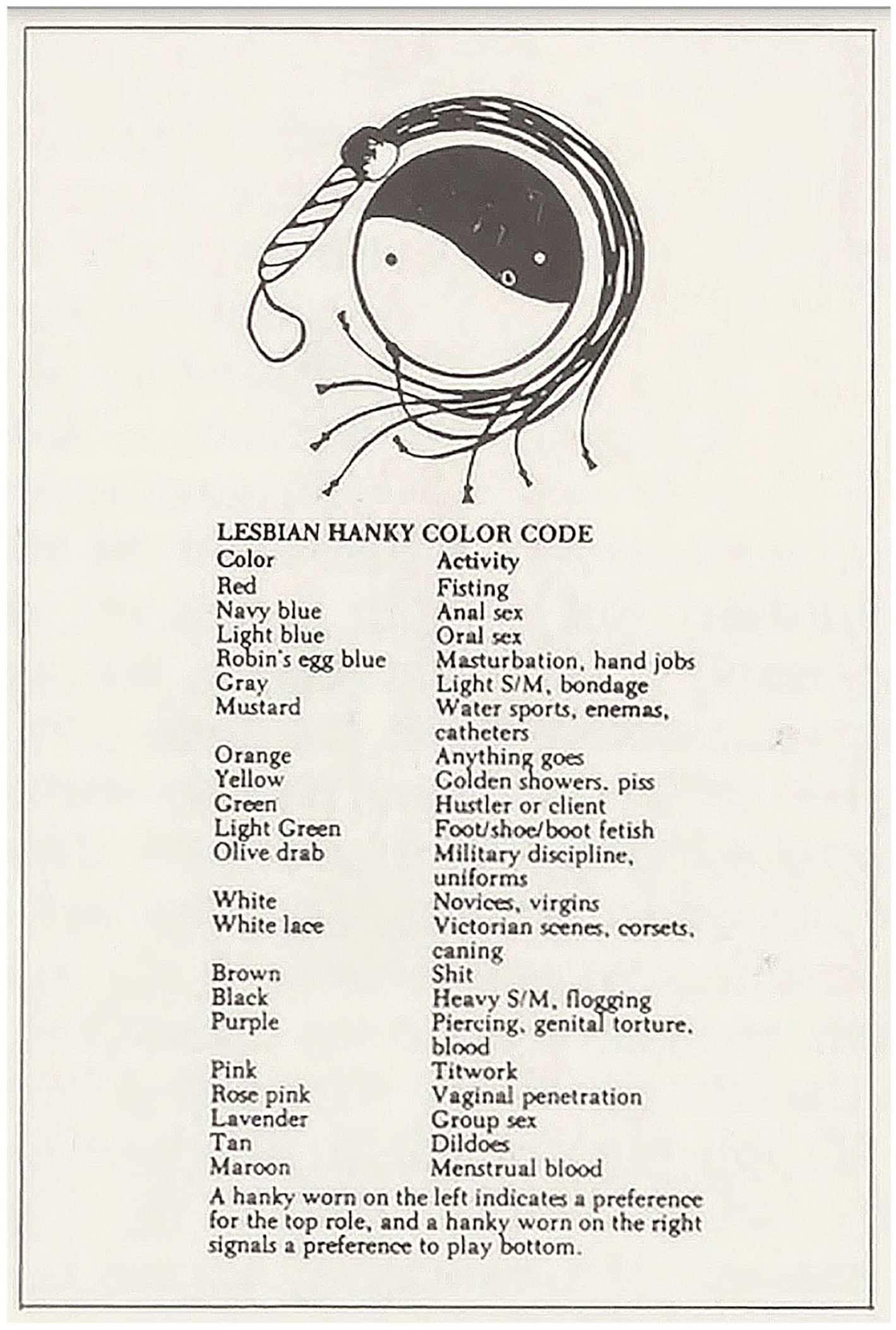
Image that accompanies Paërl’s article, ‘Het perversfeminisme van Pat Califia’ (‘The perverse feminism of Pat Califia’) (1984b) published in Homologie
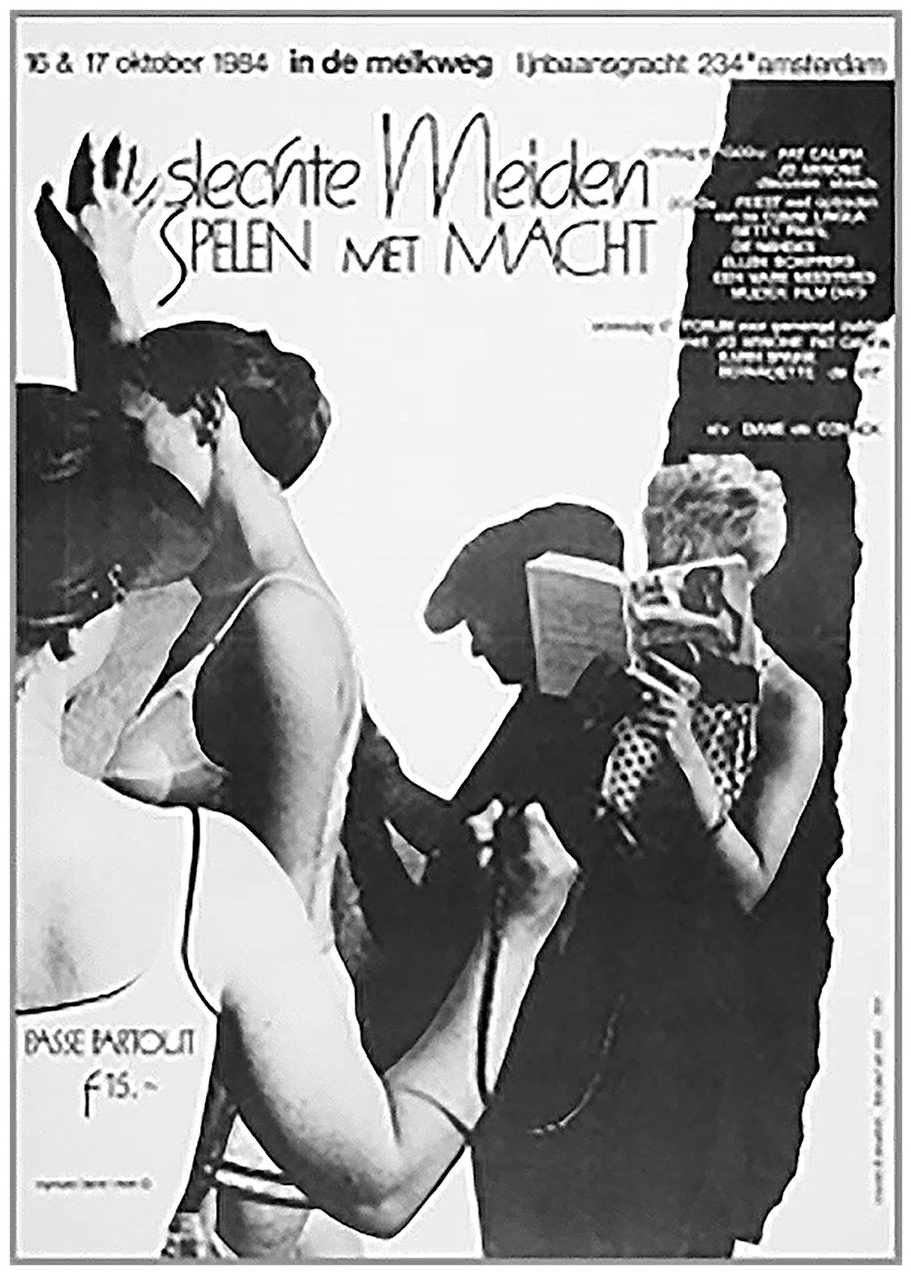
Poster for the event ‘Slechte Meiden spelen met Mach’t’ (‘Bad Girls Play with Power’); see the whip held in the right hand of the woman in the foreground
Couched in the emblem of the whip, Paërl’s articles reflect a deep engagement with a Marxist analysis of capitalism applied to postcolonial independence movements and then to sex workers’ rights. Let us recall her quip about the tyranny of brothel bosses and how her commentary has echoes of the Black Maroon leader calling out the white Dutch queen’s ongoing tyranny: ‘We are still being whipped’. Hence, the right to practise sex work is not real freedom if the means of production is not in the hands of the workers. Her political analysis of the transfer of the whip effectively intertwined the ills of discrimination based on racial and sexual prejudice. Paërl writes in a newspaper article entitled ‘Een pleidooi voor de werkers in de seksindustrie’ (‘A plea for the workers in the sex industry’) (1984a) that it is often argued that prostitution and pornography are oppressive and humiliating to women. Paërl (ibid., p. 4) argues that she will not deny this fact, but that prostitution is no exception: ‘There are elements of women’s oppression throughout the structure of our patriarchal society’. For example, she argues that in the food industry, too, women are oppressed as low-wage waiting staff; in this respect, she does not think it is any different from the sex industry. She cites Califia (quoted in ibid., emphasis ours) as an example: ‘sex work is the only profession that is open to all women, that pays them better than men, that enables them to be their own bosses and that allows them to retain ownership of their means of production’ (ibid., p. 4). This statement underlines how workers’ rights are fundamental to Paërl’s vision of racial equality that must be achieved through decolonial struggle.
One sex scene from the Paërl collection in the Netherlands Institute for Sound and Vision archive demonstrates how her sex work experiences were ‘in the shadow of the whip’ of slavery, and were enacted to transfer the charge of power to the whip she wielded on a racist Dutch settler coloniser. During a radio interview in 1985, Paërl described a BDSM session with an older wealthy white South African bank director that included a whipping (Verkeerde verhalen, 1992). This client turned out to be openly racist, and Paërl started to think about whether or not she should throw the man out of her house. But, she says:
the money is sweet. Though I was not fond of the idea very much, I thought I’d take him anyway. I let him kneel, and with a plastic glove, I inspect his intimate parts. […] I let him take a place in front of the mirror. […] Still, I had built up quite a lot of aggression because of his racism, so I began to strike him more firmly than I typically would with the whip. Even when he was gradually starting to dislike it, I continued. […] After that, I let him sit in the sling on his back with his legs apart, and I gave him an enema. […] I filled his [anus] with water. […] He found it very exciting in the beginning, but he started to get quite full. His cock was incredibly stiff, and at one point, he said it was enough. Then I turned off the tap. Usually, I made the client go to the toilet to clean themselves … But I took a bucket out of the kitchen and kept it in front of his ass and said: drain yourself now. I really wanted to humiliate him. And all of a sudden, he did drain himself. And I saw his cock getting stiffer and stiffer, and I said to him: ‘you’re lying there shitting like a pig.’ When I said he was shitting like a pig, he came. (ibid.)
The design of the SM room, as described earlier by Paërl in the radio interview, is vital to how the whip as placeholder for domination-sadism circulated during this scene. In addition to the red lamp, the sling and the sex toys, there are large mirrors on one side of the room, which, as Paërl explains, are mainly for the submissive-masochist. This person always finds it exciting when tied up and seeing themselves in the mirror hopelessly powerless (ibid.). The double vision provided by the mirror’s reflection in this scene emphasises the imaginary and split nature of the whip: gripped by the racist banker who initiated the scene and commandeered by Paërl who controlled the scene’s dynamics of punishment, humiliation and even retribution within the layer of the scene’s race play. We do not see Paërl handling the whip in this recounting on the radio, but we hear the whip’s sound. The multivalency of its symbolism and uses recalls Christina Sharpe’s (2009) notion of ‘monstrous intimacies’, which describes how colonial violence and the atrocities of chattel slavery are reproduced through sexual acts and desires post slavery. As we imaginatively see while listening in on the retelling of the scene with the white banker, the political dynamics that may be latent or disavowed in other nonsexual encounters are brought out and made undeniable within SM—this charges SM with significant analytical power for recovering and exposing the colonial archive, its brutality and its wayward desires. In the tongues and hands of Califia and Paërl, the whip both parodies and disrupts societal and racial power codes.
We wonder, however, what it means for a white trans woman to seek revenge on behalf of Black people under the yoke of colonialism and slavery? Although this scene occurs between two white-identified people, Blackness enters the scene in the relations arranged around the whip, as it circulates from the South African who supported Apartheid (1985 was a turbulent year of emergency), to Betty aligned with the racial underclass. The whip manifests the phantasm of racial hierarchy and enables his embodied ‘bad boy’ fantasy to be staged. It seems significant though that he wants to be ‘inspected’ and surveyed, a role that Betty takes up as an overseer, meting out punishment for his infractions. In her commentary and narration, we hear her embarrassment in having become involved with someone whose politics are diametrical to hers; but as she says, ‘the money is sweet’, and while the power dynamic shifts only temporarily, something (money/pleasure) has been redistributed. In the retelling, her unease also shifted in that she admits to also getting a kick out of the scene, a thrill that came in part through being able to zero in on what his true desire was—to be punished and humiliated for his colonialist fantasies. Though racial liberation is limited in the space of BDSM, we contend that Paërl’s retelling in the radio interview enacts a kaleidoscopic shift that remixes the scene of subjection in which a Black body suffers, to the agony at the heart of whiteness. 11
The Whip of Transsexuality: On Gender Liberation and the Mathematical Modelling of Gender ‘Catastrophe’
We were initially drawn to researching Paërl because she appeared to be a mediagenic opinion-maker and openly transsexual in the early days of medically supported transitioning when a key condition for treatment was sanctioned silence about one’s transsexual history (Stone, 1991). Today, it also seems poignant that the curiosities and hostilities she experienced interfacing with the media and gender clinic have changed very little. In light of the more recent resurgence of a ‘gender critical’ backlash against trans women, who claim a version of radical feminism, we were encouraged to understand how Paërl was working with feminist theories of social construction that understood women and trans women as an underclass group seeking liberation from a socially enforced system of sex/gender. Again, Paërl’s Marxist analysis of liberation from an exploitative system (gender) locates the whip unjustly held by patriarchal bosses. Here we might refer to the phrase of ‘whipping girl’ coined by Julia Serano (2007) in her book by the same name to describe the status of trans feminine persons who are scapegoated for their embrace of femininity. Serano (ibid., pp. 3–6) wagers that anti-trans sentiment expressed against transsexual women is a form of misogyny, one specific to them as having ‘chosen’ to live as women but also apparent in antagonism against gay sissies and femme dykes. The whipping girl phrase comes from the idiom of the whipping boy who is blamed or punished for the faults of others. Given the hostile environment that trans people continue to face, it is imperative that we consider how her activism around gender liberation can help us understand how trans people are distorted by the framing of the cisgender gaze propped up by an ideology of biological essentialism that divides classes into the hierarchy of male/female. Further, in terms of her bringing a Marxist analysis to trans experience, she also argued for trans people being in control of their own means of production, not tyrannised by the medical bosses, which is resonant with contemporary gender self-determination discourses.
Paërl addressed hostile and dismissive views of her transsexual experience, battling them in the print media as well as in recorded interviews. In 1980, in the national newspaper de Volkskrant, Paërl (1980b) responded to a book review written by Jeanne Doomen (1980, p. 15) of Janice Raymond’s The Transsexual Empire (1979) published by the same newspaper one month earlier. In that now widely condemned book, transsexual women are characterised as a male conspiracy invented by patriarchal medical science to allow ‘men’ who have been ‘converted’ into women to conquer the realm of women. The idea of the whipping girl (scapegoating trans femininity for the ills of patriarchy) is embedded into the ideological assumptions of this book. Paërl (1980b) writes that she feels that it is sad that the reviewer, Doomen, has taken an utterly arbitrary book from several books on transsexuality that have appeared in recent years. According to Paërl, the book is a joke. The choice shows that the reviewer ‘simply … knows nothing about transsexuality’ (ibid., p. 13). Paërl points out that a distinction is rightly made between femininity and biological womanhood within the women’s movement. She also states that she fully supports the fight for women’s socioeconomic position as the feminist movement advocates. However, she condemns any ‘subjugation of the man if he is riveted onto his male role pattern’ (ibid., emphasis ours). In this case, we read ‘man’ in inverted commas as a conscious act to dispute the essentialist category of man artificially created in the book by Raymond.
She interrogates the logic of a trans antagonistic feminism that deviates from liberating men as well as women from patriarchy: ‘doesn’t a man who feels like a woman also have a fundamental right to be themselves? To develop as a woman, if he believes that this is his identity?’, Paërl (ibid., p. 13) asks controversially, bringing feminism to task, ‘hasn’t the [Dutch] women’s movement invented the slogan master of its own womb [baas in eigen buik]?’. This translates to the theory of bodily autonomy that is central to feminist arguments for the right to birth control, abortion and sexual pleasure. ‘Isn’t it equally true’, she continues, ‘that men are in charge of their bodies and members? That medical interventions (hormones and the sex change operation) may be necessary, for a person to regain their social and mental stability as a human being?’ (ibid.). She contends that some in the women’s movement have double standards when it comes to being the boss of themselves: if the medical intervention (abortion) is necessary for a woman on sociopsychological grounds, then this is justified in feminist struggle for autonomy, but if medical intervention is required for men on sociopsychological grounds, then this is rejected. These men are then dehumanised into mere ‘subjects’ of ridicule. Paërl concludes that this feminist sleight of hand conceals the enormous human suffering behind transgender people. 12 Following her critique of white feminist logic that continues today in trans-exclusionary discourses, we assert that the dehumanisation and demonisation of trans feminine women by adherents to Raymond’s brand of ‘feminism’ implicitly racialises and takes the whip to women of trans experience.
In this sense, Paërl’s criticism of Raymond’s internal contradictions that fuel the transphobic vitriol within so-called feminist circles is much more comprehensive. She argues that the group of transgender people and cross-dressers is more extensive than people think and that the group is intimately related to a much broader problem. Indeed, it is additionally the question of femininity in men, in this case also in self-identifying men, and the dissatisfaction of many men with the social roles imposed on them, who must invariably be on the offensive as breadwinners, that we can understand today under the ideals of toxic masculinity. In contrast, she offers that many men have a more passive, receptive, nurturing emotionality (Paërl, 1981). She argues that transgender people are allies of all minority groups who suffer discrimination because of the entrenched norms of this ‘patriarchal-hetero-bourgeois (middle-class-white, etc.) society’ (ibid., p. 6). Her thinking is a prelude to the self-determination politics articulated today in transgender theory that insists on broadening the critique of tyrannical gender norms imposed on all genders, to understanding the degendering effect of slave-making, and to enacting abolitionist intersectional politics (see Bey, 2017; Snorton, 2017; Jackson, 2020). Further, in discussing the right to access one’s own means of production, she places the plight of transgender people in the local context in which, at the time, only ten people in the Netherlands could access treatment for a physical transition per year at the Free University’s Gender Clinic, and the waiting times were upwards of four years. Paërl herself circumvented this system and went to London for her medically assisted transition, an opting out of submitting to tyrannical medical bosses that may also imply that her class privilege or network enabled her to do so.
Combining not only a decolonial Marxist liberation perspective on gender but also a mathematical modelling of trans experience, Paërl explains in the TV documentary URBANIA: Een Stadstripiek (Urbania: A City Comic Trilogy) (2001) her theory of trans experience through a modelling of ‘catastrophe’. We find her mathematical diagram to be instructive for how a ‘small’ difference in visibility, given the social polarisation of gender, can bring large consequences. Her example, and likely her own experience from what we have found in archived sources, is that a presumed ‘man’ wearing lipstick can be hounded by colleagues, lose her wife and be ripped from her child. This fold theory of gender demonstrates how one is never safely anchored in a neutral field of behaviour, and it offers a diagram for conceptualising the ills of all kinds of polarising debates that can have catastrophic consequences for those caught up in the field of power. Her diagram points to the shifting sands of the social order, itself ever moving, that can throw up experiences of liberation as well as catastrophe. With Paërl, we learned how important it is to think comparatively about methods for waging liberatory struggles against violent, oppressive authorities: those bosses whose whips must be seized.
Conclusion: A Kinky-Trans-Decolonial Kaleidoscope
Intersectional theories have produced visual metaphors to model the relationships between intersecting categories of differences and their vectors of power differentials that generate oppressed identities and marginalised forms of subjectivity. Jennifer C. Nash (2011, p. 455) has even referred to intersectionality as an ‘irresistibly visual metaphor’, as if it were made to be seen. In the Dutch Black, Migrant and Refugee Women’s Movement, the notion of the kaleidoscope (shifting shapes) complements the more well-known traffic intersection (point of collision) developed by Crenshaw (1989). As an intersection, the spatial perspective metaphor reminds us how when one faces multiple modes of discrimination due to identities such as university labourer, sex worker and transsexual, someone standing on the intersection can be hit from many sides, as Paërl was, even with her white privilege (ibid., pp. 151–152). Towards practising an intersectional historiography, we have sought here to merge seemingly conflicting archival materials about one figure to be able to identify shifting commonalities and divergences. In this sense, our analysis has been sensitive to the kaleidoscopic feminist rejection of ‘calibrated patterns’ and championing of ‘dynamic, diverse and multicoloured’ visions (Botman and Jouwe, 2001, p. 16). Our metaphorical use of the kaleidoscopic archival analysis attends to and critiques the way archives are often organised according to a static tunnel vision, reflecting the logic of which objects are or are not preserved, and in which spaces, which often follows the calibrated patterns of guiding ideologies (Frank, 2019).
Undoubtedly, the queer collection of archival materials on Dr Betty Paërl shows that she has made significant contributions to Dutch LGBT+ history; however, in this space her sexuality activism risks being disconnected from her racial equality activism. For example, next to IHLIA’s holdings of her writing in various magazines and digitalised newspaper articles on Delpher, we learned how she also contributed financially to Amsterdam’s gay monument, erected in 1987. It was the first in the world dedicated to the gays and lesbians killed by the Nazis’ eugenics programme and remains a commemoration site for all LGBT+ victims of persecution. A newspaper article that covered a benefit event for the gay monument given in the Royal Dutch Concert Hall reported that celebrities performed and auctioned off services (Het Parool, 1986). Paërl auctioned herself as an escort for a lady for an hour-long soft-SM session. Although the gay monument has no visible connections with other liberation cultures or anticolonial struggles, through the figure of Paërl and her whip we might begin to imagine a coalitional politics, what liberation can look like beyond sexual rights. Therefore, we argue that we need to practise looking with the kinky-trans-decolonial archival vision of Paërl, an enhanced kaleidoscopic view into the archive of past activism, to project our future liberation. When we move with the shifting recurrence of the whip, our research doings and thinkings lift up and away from linear time: an anti-modern move to see we have been here before. From this perspective gained through decolonial archival praxis, not only is the horizon of liberation in a future, but we can start to see how it was with us all along.
Following Edward Said’s (1993) and Wekker’s (2016) understanding of the ‘cultural archive’ of colonialism that consists of concepts and images rather than a physical location, this article has sought to demonstrate how an intersectional approach to a complex historical figure like Paërl can be enacted through following the multifaceted image/item of the whip rather than an identity category or social issue. With a kaleidoscopic view on Paërl’s expanded analysis of power hierarchies and exchange emblematised in the whip, we can mobilise a specialised LGBT archive to gain insight into the intersection of gender and sexual liberation with colonial liberation movements. Her aural, visual and written remnants support telling new kinds of stories about the Dutch cultural archive of colonialism with highly active white allies. Further, we aim to raise the alarm that when the specific interest is only in Paërl’s importance to queer history as a sexual rights pioneer—that is, to a singular flattened figuration—one loses a great deal of her worldview’s analytical depth developed in relation to anticolonial self-determination movements.
A key finding for us is that these various archival sources together speak to and against the so-called incompatibility of SM and feminism, on the one hand, and SM and a critique of colonialism and anti-racism activism, on the other hand. Together with Rinaldo Walcott, we offer that these archival documents complicate ‘desire, history, pleasure and pain’, with reference to the brutal realities of chattel slavery that are not behind us, but also to the ‘desire, history, pleasure and pain’ that erupt in Paërl’s pro-Domme scene with a white South African banker (‘a shitting pig’ in her language), in her temporary loss of contact with her son and in what she explains mathematically through the ‘catastrophe’ model of gender transition. 13 A kaleidoscopic intersectional approach to these turbulent pasts can vex the present visual field and its stabilised image, perhaps bringing into sharp relief what Sharpe (2016) calls ‘the wake’ that names the distortions in the visual and affective field caused by the after-effects of slavery. Sharpe develops the terminology of the wake from the disturbed waters left by Middle Passage ships, offering a robust conceptual framework for Black life in the diaspora in the still ongoing aftermath of Atlantic slavery. For her, the wake is ‘a problem of and for’ thinking in the midst of ongoing violence and negation (ibid., p. 5). Rather than providing a clear answer to the relationship between Paërl’s whiteness, the wake and the whip, we open up these intersections with a series of questions: what does it mean for a white trans woman doing critical anticolonial work in the post-slavery era; must we lessen our ties to Black violence; or how can we seek ways to move forward without forgetting it? We are not suggesting that her activism is entirely unproblematic (as the radio sex pig scene shows). But perhaps an analysis of lives lived in and amongst many forms of struggle will show us how such activism should or should not be done. We like, for example, the very descriptive way in which she writes against an ‘epistemological rectitude’ in her descriptions of neocolonial practices in Suriname, more as a critical commentator than as an ethnographic narrator, while at the same time reflecting on her own position (the scene with the Maroon chief where she writes about the Dutch and invokes the ‘we’). Finally, an intersectional kaleidoscopic vision on the whip throughout Paërl’s archival record can show us ways of being multiply Black, white, sexual, queer, trans, free.
Footnotes
1
The questions we raise and the topic of this article were first presented at the Inward Outward symposium Critical Archival Engagements with Sounds and Films of Coloniality on 24–25 January 2020. We would like to thank Jessica de Abreu, co-curator of the exhibition ‘100 Years Society Our Suriname’ and co-founder of the Black Archives in Amsterdam, for highlighting the role that Betty Paërl played in the anti-neocolonial struggle in the Netherlands. Co-author Isenia was part of the research team of the aforementioned exhibition. All translations from Dutch to English in this article are ours.
2
Although Paërl is still alive at the time of writing, unfortunately we were unable to interview her due to her poor health. This reminds us of the importance of practising the transfer of intergeneratioal knowledge for those who are to pass on living memory. This is the core of the activities organised by the Black Queer Archives based in the Netherlands.
4
For example, see the following texts: ‘Zij imiteren precies de hetero’s: spelen met rollen en omkeringen’ (Califia, 1983); ‘Vrouw-zijn is een maatschappelijke constructie’ (Paërl, Califia and Arnone, 1984); ‘SM is een vorm van seksuele rebellie: het pervers-feminisme van Pat Califia’ (Paërl, 1984b).
5
See Rawson (2009). For this criticism in relation to LGBT groups of colour in the Netherlands and the archive, see Colpani, Isenia and Pieter (2019). We can trace the critique of specialised gendered and sexual minorities’ institutional archives and their lack of racialised, trans and minoritised voices to how the state financed ‘women’ and so-called LGBT issues in various dispersed ministries. So-called women’s issues, as  , p. 59) discusses, are addressed in different ministries: for example, in the case of women’s issues, within both the Directorate for the Coordination of Emancipation Affairs and the Directorate for the Coordination of Minority Affairs. In practice, this fragmentation means that the emancipation of exclusively white women is the concern of the former, and the emancipation of women of colour is the concern of the latter.
6
At that time, Suriname was still part of the Kingdom of the Netherlands. In 1975, Suriname was officially declared independent.
7
The Maroons are enslaved people of African descendants who fled to the jungle in Suriname and grew settlements outside of captivity for generations.
8
Yet, she was eventually fired in 1988 after having worked at the university for eighteen years. The reason was the discontinuation of her department of Andragology, which studied social problems at an interdisciplinary level. Paërl indicates, ‘Worst of all, I think that my unemployment benefit is not guaranteed, which means that there is a possibility that I may end up on welfare assistance. And this despite having worked at the university for 18 years’ (Het Parool, ).
9
See the Arolsen Archives, an international centre on Nazi persecution, for an ‘incarceration document’ of Betty’s father. Betty’s (dead)name is mentioned alongside her mother’s: Arolsen Archives, ‘Dokumente mit Namen ab PACHTER, Bernard’, https://collections.arolsen-archives.org/en/archive/1-2-4-2_1242016/?p=1&doc_id=130350527 [last accessed 27 April 2021].
10
We use the terms ‘transsexuality’ and ‘transsexual’ as very historically specific terms. We acknowledge that we should consider them arising in the context of pseudoscientific discourse in which trans people have been pathologised (Hayward, 2008; Hayward and Gossett, 2017; Gill-Peterson, 2018; Steinbock, 2019, p. viii). They are the terms, however, that Betty used and were the main vocabulary for both medical descriptions and self-identifying community groups of the day.
11
12
We have struggled with this translation, so want to make it available in full for readers here: ‘Sommigen uit de vrouwenbeweging meten blijkbaar met twee maten: als voor een vrouw op social-psychologische gronden een medisch ingrijpen (abortus) noodzakelijk is, dan is dit goed om strijd voor te voeren; maar als voor mannen op sociaal-psychologische gronden medisch ingrijpen noodzakelijk is, dan wordt dit verworpen. Dan worden deze mannen gedehumaniseerd tot “wezens” en belachelijk gemaakt als “heren”’ (Paërl, 1980b, p. 13).
13
Author Biographies
Wigbertson Julian Isenia is an assistant professor of anthropology at the University of Amsterdam. He co-edited the special issue of Journal for Dutch Gender Studies ‘Sexual Politics between the Netherlands and the Caribbean: Imperial Entanglements and Archival Desires’ (2019).
Eliza Steinbock is Associate Professor of Gender and Diversity Studies at Maastricht University. They published Shimmering Images: Trans Cinema, Embodiment and the Aesthetics of Change (Durham: Duke University Press, 2019), winner of Best First Book from the Society for Cinema and Media Studies.