




Abstract
On International Women’s Day 2019, feminists involved in the Women’s Strike UK organised political ‘stay and play’ events across London—in Walthamstow, Tooting, Haringey, Clapton and Deptford—and in Cardiff—called ‘My Mum is on Strike’ (MMIOS). These were events where children could be collectively cared for while their mums, carers and parents could have a chance to chat about what it means to care for children in 2019. More than 500 people attended across our six venues, making it a roaring success and beyond our wildest dreams as organisers. 1
In left political culture, at this point in history, it can be rare to find a record of successes. We wanted to record ours because we know how important historical inspiration is, how important it is to see what worked elsewhere. We offer this to those reading in the near and distant futures who may, like us, dream of a world where the caring for children is celebrated; where mums and carers are valued for the socially transformative work they do; where everyone gets a break sometimes; and where we eat, play, love and fight together. This article explores how MMIOS came to be, our historical and theoretical inspirations, why it was successful and the collective’s future imaginary. MMIOS aimed to make public and visible ‘reproductive labour’: the gendered labour that parents and carers do in the home (Duffy, 2007). Reproductive labour is totalising, hard to reveal and, indeed, hard to strike from; therefore, to continue our project of making it visible, we have interspersed this article with vignettes, illustrating what ‘interrupts’ our writing process. The two authors of this article are writing together in Claire’s kitchen, a space we are sharing with her three children. These vignettes reveal both the relentlessness and the fun of reproductive labour, 2 and the way it is a site of strong emotions for both authors. This article’s form is indebted to those who allow life to jut up through political theory, transforming it (e.g. Anzaldua, 2012 [1987]; Nelson, 2015).
MMIOS was partly inspired by the radical history of the industrial strikes that prompted the first International Women’s Day. In 1909, Theresa Malkiel, a young Jewish refugee who fled antisemitism in Russia, was working in a New York garment factory (Green, 2000; McGill, 2018). She began organising for a strike, as the conditions that the workers—almost entirely female immigrants—endured were unsafe, the working days were long and neither the wages nor breaks were adequate. To meet the demands of the more privileged, these conditions are replicated in the factories of the Global South and, indeed, in particular workplaces in the Global North today (Ngai, 2005; Oxfam America, 2016). As part of her agitations, Malkiel organised the first International Women’s Day: a gathering of 2,000 people in February 1909, where women’s right to suffrage was explicitly connected to better conditions—at work and in life (Markowitz, 1993; Green, 2000; McGill, 2018).
Gene, aged 5, an enthusiast for sharks and their welfare, has made a poster (Figure 1) that says, ‘help us not have shark fin soup’.‘What’s that?’‘It’s for one of those things you two go on where you yell coz you had enough of bad things.’‘Do you mean a demonstration?’‘Yes! Please help us not to have shark fin soup!’ he chants.It is infectious and so we and his two brothers chant along.
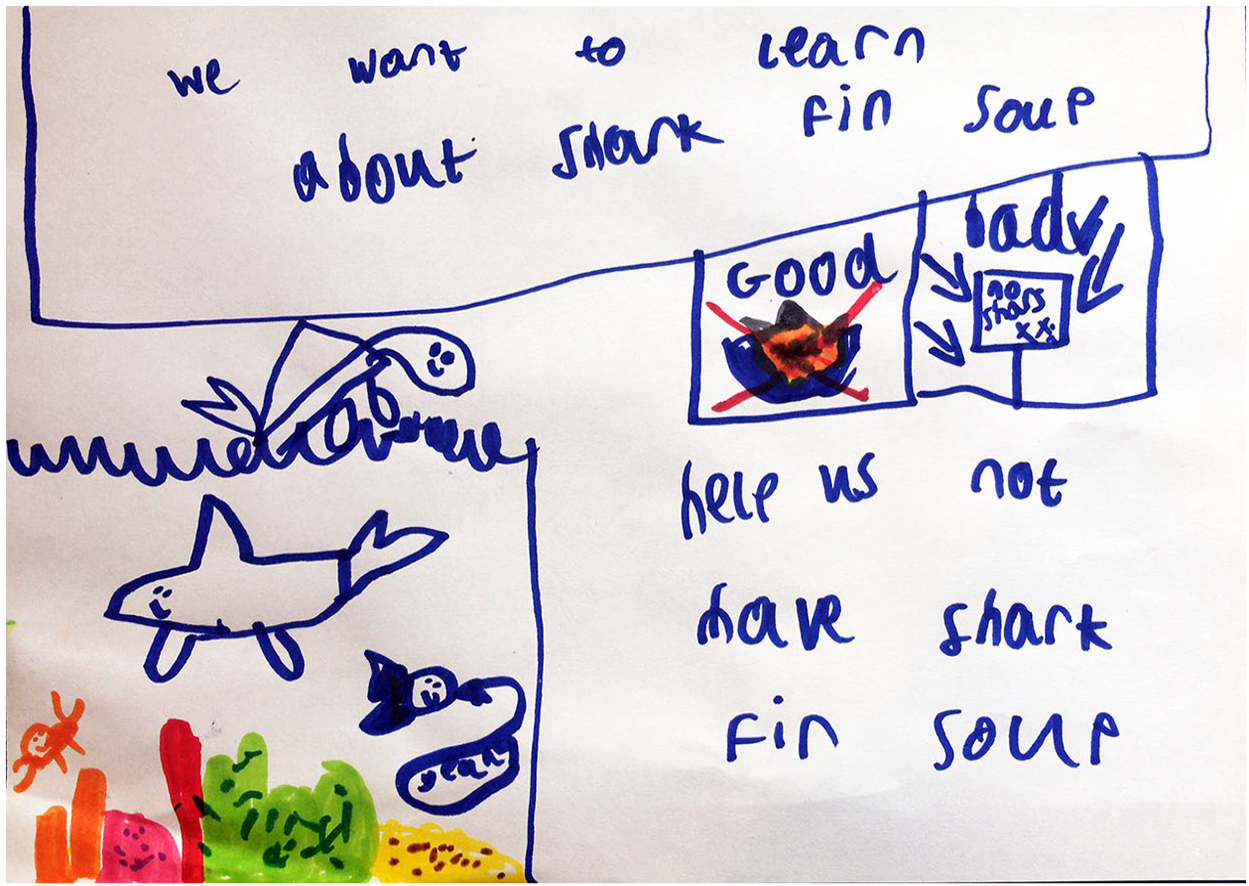
No Shark Fin Soup!, Gene Cousens, 2019
In Malkiel’s case, to strike meant to walk off the job and shut down the factory. In this case, we were acutely aware that even if we walked off the job, our kids, militant in their demands for fun, would still need feeding, chatting to, playing with and caring for. Different spheres demand different tactics. Therefore, MMIOS drew on the provocative writings of the Wages for Housework Collective, operating throughout the Global North in the 1970s, with particular hubs in Italy, London and New York (Dalla Costa and James, 1975; Federici, 1975; Weeks, 2011; Toupin, 2018). Their work was orientated around the role of women in the home and the family, which they called the ‘social factory’ (Dalla Costa and James, 1975, p. 11). The social factory was important because of the way it reproduced workers. The theory suggests that those engaged in waged work—at the time, mostly men—would come home and be cared for in multiple, even infinite, ways by women. This unpaid, gendered labour would enable them to return to paid work the next day. The role of women in the social factory cracked open the role of women under capitalism more broadly and shook hegemonic Marxist ideas about what labour produces value and what kind of agency can change material conditions (Farris, 2015).
Through the lens provided by Wages for Housework, the authors went back and read Malkiel’s fictionalised account of the strike, Diary of a Shirtwaist Striker (1990 [1910]). As Kathleen Green (2000, p. 205) contends, this book has been dismissed as ‘naïve propaganda’ but it inspired a thirteen-week strike and helped to reform North American labour laws (Markowitz, 1993; McGill, 2018). What was also revealed was the way that shirtwaist strikers often provided the only wage for their family but also faced the burden of the ‘second shift’ (Hochschild, 1989; Hochschild and Machung, 2003 [1993], p. 11). These working women returned from the industrial factory, only to enter the social factory where they shouldered the responsibility for nearly all the reproductive labour (Malkiel, 1990 [1909]). Many of these women were mothers. They reproduced themselves and their partners who were often out of work. Through making meals; cleaning up; having sex; and caring for kids, elders and siblings, women made sure their partners could return to work or, as many of them were out of work, continue their search for employment the following day. They socialised their children to become future workers, and shaped the girls into mothers too. This work was and is unpaid because it is considered an inherent expression of what it means to be a woman. Accordingly, women are supposed to feel so suited to this labour that they don’t even see it as work (Rose, in Emre, 2018).
Gene continues: ‘Aunty Rosa! Today at school, they taught us that song “I like the flowers, I like the daffodils!”, and I sang them the one you taught me about not liking nuclear reactors and plutonium. They said, “Thanks for the Greenpeace version of this song, Gene”. Everyone liked it; I was proud!’
Gene also performed this song at MMIOS (he was on strike from school). Rosa is glad she passed this song on to Gene; she learnt this from her mum, who has a great repertoire of workers’ songs, and it was also sung on the way to Greenham Common, in the very earliest moments of this long-lasting peace camp. In this way, Rosa’s mum and other women who agitated for peace are here with us too.
Rosa also taught this song to the many children that came through her classroom in her five years working as a special educational needs teacher. ‘But it was not all singing,’ she says: ‘there was a lot of wiping sticky tables, wiping sticky faces, wiping floors, wiping noses. The most profound thing about that job was that it changed my desire to have children. When I was twenty-six, I would see a child and I would feel nauseous, how much I wanted my own. But then I started working with children all day and how much I gave to them, how much they needed—exacerbated of course by austerity and funding cuts—transformed my desire to have children. I don’t want my own kids, not at the moment.’ We stop writing, to sing a little.
In order for mums to go on strike, it was also clear that centralising a demand for wages for housework would not suffice either, as the formation of the social factory looks different in Britain today. As Maud Anne Bracke (2013, p. 631) reminds us, Wages for Housework was developed in the context of 1970s Italy, where women’s participation in paid work bucked trends across the Global North and decreased. As Bianchi et al. (2012) have found through analysis of forty years of household surveys, gendered work in the family has changed, but the unequal distribution of this work along the lines of gender remains. Even though women have increasingly entered the paid workforce, mothers spend at least as much time interacting with their children today as mothers did decades ago (ibid.). The way that women care for children has changed; it simply isn’t the case that most children run around the neighbourhood unsupervised all weekend as generations before us claim to have done in the 1950s (Rosin, 2014). Children, particularly of the middle classes, are entertained, usually by women who curate, plan, manage and deliver age-appropriate child-centred ‘leisure’ activities on top of working what is sometimes a forty-hour working week (Chung and van der Lippe, 2018). Working-class parents hold at least some of the same ideals but are generally less controlling—out of necessity and, Hanna Rosin (2014) argues, out of what may be a greater respect for ‘just getting on with it’. In her work All Joy and No Fun, which considers the managerialism that contemporary motherhood sometimes entails, Jennifer Senior (2014) suggests that many parents are making themselves miserable and even ill by believing they always have to maximise their children’s happiness and success.
Another important aspect of social reproduction in middle-class homes that has accelerated is the outsourcing of domestic tasks to women of colour (Ehrenreich, 2003; Teeple Hopkins, 2017; Seals Allers, 2018; Toupin, 2018). Richer women employ poorer women to care for children and to clean up after them. This verticality is one not only of class but also of race. Black feminist mothers are asking white women to rethink what ‘work–life balance’ means for women of colour, and to reflect on how white women achieved this: upon whose backs do white women ‘balance’ (Seals Allers, 2018)? Louise Toupin (2018, p. 5), in her history of Wages for Housework, suggests this direct exploitation of women by women is ‘something new’. Certainly, this dynamic, sometimes referred to as ‘global care chains’ (Hochschild, 2000), has increased, with thousands of women travelling across the world, often leaving their own children, to work for other people’s. But, as Black women and women of colour activist-scholars remind us, there is a ‘long and discouraging’ history of white women exploiting poorer women of colour—in our kitchens, as part of colonial projects, indeed in feminist communities (Carby, 1982; Hill-Collins, 2000; Amos and Parmar, 2005; Lorde, 2015 [1983], p. 90; Jones, 2019). This exploitation doesn’t make reproductive labour visible nor transform its relentless relation; it just pushes it on to someone with less access to structural power and buys into a long history of white women exploiting women of colour, which must be refused as an answer.
Yet, despite these changes to the landscape of the social factory, the collective chose to call the event ‘My Mum is on Strike’ because the idea of motherhood continues to operate as a collective projection, so even if you’re not a mother but you are a woman (cis, trans or intersex), the idea of mother—a powerful figure in the social imaginary—shapes the ways that you can be. Merve Emre (2018), considering the work of Jacqueline Rose, explains that motherhood is ‘the place in our culture where we lodge, or rather bury, the reality of our own conflicts, of what it means to be fully human’. The mother is supposed to be endlessly devoted to her tasks. Her payment is the ‘unbridled happiness’ that motherhood brings. But, the attendees at the MMIOS event were confident to ask, what happens when happiness in love is not enough? What happens when mothers have material demands, psychological needs and desires outside of what the nuclear family currently allows?
Claire is reflecting on other forms of childcare that the left provide: ‘this weekend I went to a two-day-long meeting of a far-left group, and put my three kids in the childcare that was provided. I think they mostly had a good time; they did fun things like play in the park with other kids and eat popcorn at the movies. I spent the whole time feeling guilty that I was in a room thinking about social reproduction and feminist struggle instead of hanging out with them. I wondered if they wished they didn’t have a feminist for a mother, and had one of those (probably fictional) “super mums” that always prioritised them and what they’d like to do on the weekend after a long week at nursery. It’s hard to remember that doing things that give me hope makes me a better parent.’
Those organising My Mum is on Strike decided that what striking meant in this format was for carers to bring their kids, and for them to be placed at the centre of the strike. Reproductive work is both gruelling and tiring but, unlike much paid work, it also holds a prefigurative kernel. It is essential labour that must be done. Communities must be formed around care, around love, around collectivising social reproduction. As the women’s strike poster, making good use of the famous photo of Stuart Hall at the crèche of the first British women’s liberation conference in 1970, 3 says, ‘The revolution begins with care’ (Figure 2) (Degooyer, 2017; Women’s Strike, 2019). The problem, then, is not with the nature of reproductive labour, but with its distribution. So, in this spirit, children would be with us in the room. They would be cared for by people who didn’t shoulder this burden—men and people who don’t usually spend much time with kids. There were activities set up with kids in mind. The collective provided lunches that parents and kids could take away. Parents had a chance to chat about what it meant to strike as those who shouldered the burden of care. Inspired by histories of feminist consciousness-raising, carers at the MMIOS events would break up into small groups and discuss four questions: 1) What is your favourite part of being a mum or carer? 2) What is your least favourite part about being a mum or carer? 3) What would the world be like without mothers? 4) What kind of world are we striking for? This was our version of the strike.
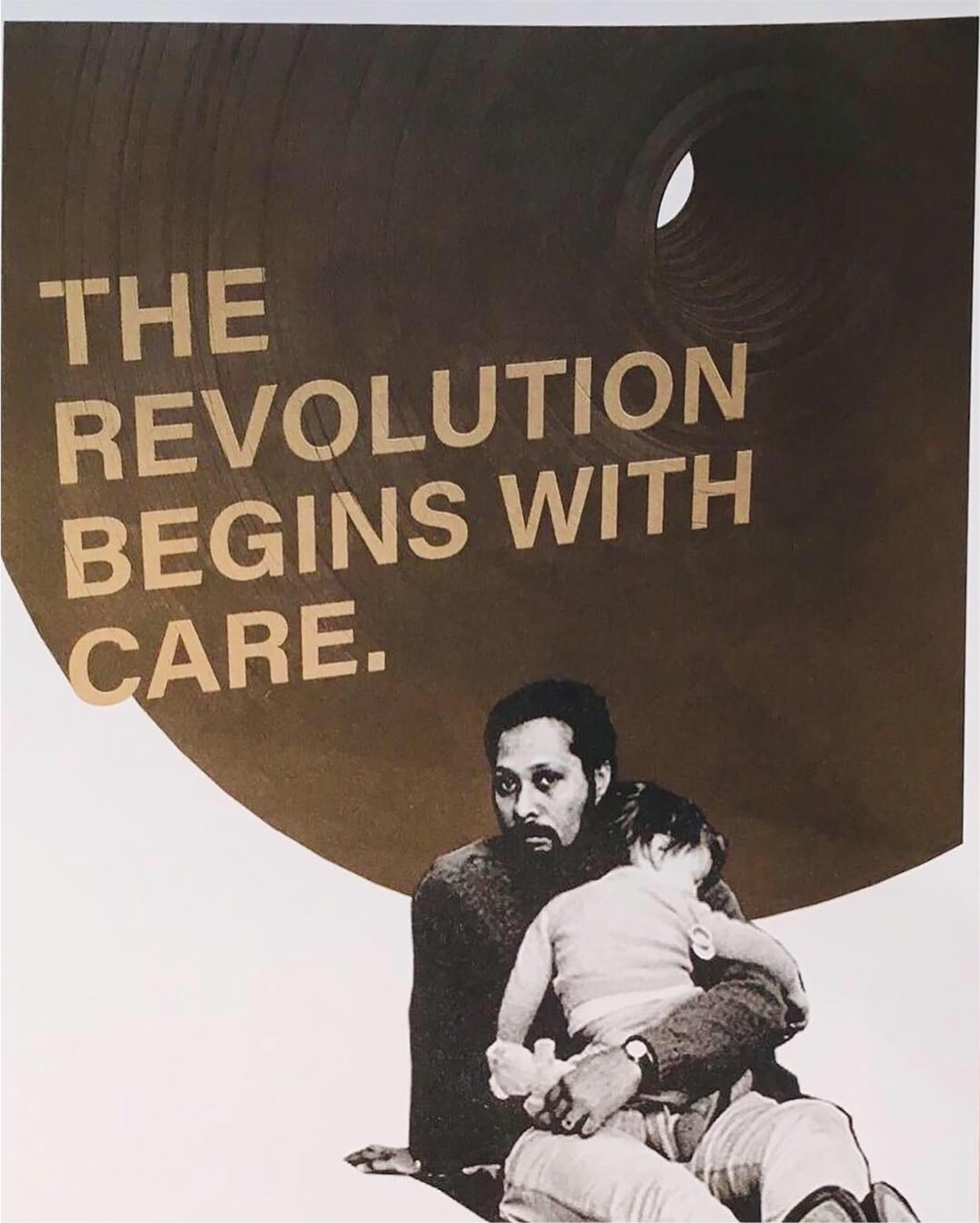
The Revolution Begins with Care, Women’s Strike Assembly, Women’s Strike UK, 2019
To organise My Mum is on Strike, we used a combination of both older and newer organising techniques. Organisers spent time putting up posters in their local areas and leaving leaflets in local libraries. Posters were put up on the community noticeboards in Sainsbury’s and the local Quaker meeting house, at the park and near nurseries and primary schools. The organisers had posters in their pushchairs at all times, so they could put them up in the street, at the tube, in phone boxes and in cafes. We also put the event on Facebook and on Hoop, a social networking app that lists activities for kids. MMIOS was hosted in community centres: the William Morris Community Centre Hall in Walthamstow, Tooting Community Centre in South London and the Trinity Centre in Cardiff. It was held in a parent-run nursery on the Vanguard Estate in Deptford, at the Round Chapel Hall in Hackney, at the Kurdish Community Centre in Haringey—the locations varied depending on what the people organising the events had access to. Each venue had a play area with many tables of activities, a kitchen area and a circle of chairs for the carers (English, 2019).
Those of us organising the Walthamstow event woke up early and, with kids in tow, went to our local working-class community centre, the William Morris, where we set up activities for kids including scented playdough and cutters, a ball pool, a tunnel, radical stencils and paints, bubbles and lots of craft stuff. Lunches of curry and rice that parents and kids could take away were cooked by our mostly male comrades. We were very worried that no one would come and it would just be us, especially considering that we had left a phone number on the leaflet and posters and not a single person had phoned or texted. But at 9.55, parents—mostly women, but some men too—began to pile in. They came with babies and toddlers, and soon there were 100 people. People breastfed, drank tea, played with their own and other people’s children and chatted. We thought it would be a less raucous affair, and we planned on having small group discussions around the consciousness-raising questions we had devised (listed above) while the men looked after the kids in the same room—but it was too loud and wild and busy and noisy for that. We learned that the singing circle was the best way to bring everyone together in a calm and (somewhat) quiet way, and next time we would start with this, so that we could then turn it into a sharing circle where carers could say what they hoped to gain from the event. 4
Claire, reflecting on the MMIOS event: ‘In retrospect I guess we needed a few more organisers. I’d volunteered to run the consciousness-raising activity on the day, where everyone could sit in a circle and reflect on why exactly it was that they were attracted to the idea of “striking” from motherhood—but suddenly I needed to look after my 3-year-old. Dylan just wasn’t coping with how overcrowded and hot the venue had become. He was following me, trying to crawl onto my lap, and suddenly I knew I couldn’t run an activity—I just needed to sit with him and hold him and let him feel his feelings. I had to abandon running the activity altogether in the end. Dylan is much more affected by hectic environments, whereas Gene was really thriving. He had the volunteers making a comic about a character called Super Gene the Eco Warrior, delighting everyone with questions about how to make a feminist superhero. Rory, quietly content, was using the stencils, glue and glitter with one hand, and munching carrot sticks and hummus with the other, showcasing toddler multitasking at its best.’
MMIOS was a loud, raucous, busy success because the problem of raising kids, of parenting, at this moment in history in Britain is a crisis. As explored above, this is true in the social factory, but it is also true in our nurseries. Childcare fees have risen three times faster than wages in the past decades, and 31 per cent of low-income working parents are forced into debt to pay for childcare (Trade Union Council, 2018). At the same time, nursery staff—who are predominantly women, very often women of colour—are overworked and underpaid. Alongside this, the lack of flexible, affordable childcare in the UK entrenches economic, social and educational inequalities: schools estimate a 40 per cent attainment gap by the age of five, linked to socio-economic background (ibid.). According to the Family and Childcare Trust, only half of local authorities in England and Wales have enough childcare for working parents, forcing many women to remain in the home, essentially locking them out of the workplace (ibid). Eighty-four per cent of early years provision in the UK is now delivered by profit-hungry, private firms. Political debate has focused on how many free hours the government is funding, but we also need to ask where those funds are going and to what kind of organisations (ibid.). With this in mind, one of the other MMIOS organisers is running a series of events about what it might mean to run a collective nursery project outside of the limits and constraints placed by the state.
As well as envisioning collective nurseries, we are inspired by other, contemporary uses of the strike—particularly the youth climate strikes that use the tool of the strike in the school: a setting which, like the family, is engaged with social reproduction, rather than production. Just as young children had a significant role to play in My Mum is on Strike, so older children are leaders in the movement for climate justice. They are showing us how it is done and have demanded that we join them (Thunberg et al., 2019).
By late January 2020, four venues were already preparing to run the My Mum is on Strike stay-and-play events again, this time making use of the ‘charity status’ of many of the venues to create a free community larder full of donated food from the surplus waste of commercial supermarkets. The rise in the use of food banks is a feminist issue, so this year, alongside the crisis of care, the events will attempt to expose the way that so many women have to manage the food shortages that lead to hungry children and food bank use. 5
Since writing this article, we have continued to try and make politics fun, for our own kids and the kids of other people. Gene’s highlight of the year was at the Climate March in September 2019, standing on the wall outside Westminster, leading hundreds of other children in the chant ‘Whose future? Our future!’ to demand a future based on care—for us, our communities and the planet.