



Abstract

Marthe Brossier, a royal commission and Michel Marescot (1539–1605)
In 1599, in a small town in the Loire Valley in France, a young girl with extreme behavioural and verbal outbursts was examined by a medical commission dispatched by Henri IV. It had been alleged that Marthe Brossier was possessed by demons, so she had been subjected to daily exorcisms intended to cast out the demons and restore the girl to health. The exorcisms were performed by priests, often in front of large audiences who came to see the victim’s shocking behavioural displays. The King’s medical commission took Marthe to a private location where her responses to the exorcisms could be closely examined, without distractions.

A possessed woman brought before the bishop, found in The Life of Saint Wolfgang. The early modern period in Europe saw early examples of placebo-controlled trials in which a woman would be exposed to genuine and sham religious objects to determine whether she was truly possessed by demon or not. The Life of Saint Wolfgang (Vita divi Wolfgangi praesulis eximii), Printed in Landshut by Johann Weißenburger in 1516 (VD16 L 868). Digitised image from: Munich, Bayerische Staatsbibliothek, Rar. 1743. Copyright: CC0 1.0 Universell (CC0 1.0) Public Domain Dedication; Attribution-Non Commercial-ShareAlike 4.0 Internation (CC BY-NC-SA 4.0). The image can be used for noncommercial use without further permission.
The backdrop to the King’s medical commission was the violent conflict between Catholics and Protestants in France where demonic possessions were often being used for political purposes. Marthe belonged to a Catholic community and she had become (in)famous because her demons made aggressive claims about Protestants, asserting that they all belonged to Satan. As a powerful tool for the Catholic clergy, Marthe posed a risk to political stability and this prompted the King to send his agents to investigate the truth about her possession. The commission, led by the physician Michel Marescot (1539–1605; known for naming the larynx, pharynx and hyoid bone), performed what was, in effect, a placebo-controlled trial. 1
The rationale for an exorcism is that a demon cannot tolerate direct contact with divine objects. The exposure to religious paraphernalia would thus cause the demon great pain and force it to leave the possessed person (Figure 1). Marescot and his commission had brought items that would allow them to compare Marthe’s reactions to genuine religious objects and to comparable sham objects. For example, these might include using unconsecrated water in a bottle normally used for holy water, or unconsecrated bread (wafers, or hosts) drawn from a box that usually contained only consecrated bread. After a 40-day trial, the physicians concluded that Marthe could not have been genuinely possessed by a demon as she reacted similarly when exposed to both genuine and sham religious objects. The commission thus concluded that the allegation that she was possessed was false, and this finding was communicated to Henri IV (Figure 2). 1

Key passage from Marescot's Discours veritable sur le faict de Marthe Brossier de Romorantin, pretendue demoniaque (A true discourse, upon the matter of Martha Brossier of Romorantin pretended to be possessed by a devil). This is the report from the royal commission on the case of Marthe Brossier weitten by Michel Marescot. Among the trick-trials was one conducted by a Bishop using a sham relic (an ordinary iron key wrapped up the way you would do with a true relic) presenting it to Marthe and telling her that inside was a piece of the true Cross (on which Christ was crucified). Printed in Paris by Mamert Patisson in 1599. Source: Paris, Bibliothèque nationale de France, département Arsenal, 8-H-12866, P.41.
Jean Gerson (1363–1429), a sceptic academic
Jean Gerson, Chancellor of the University of Paris, was an influential figure and ‘public intellectual’ in medieval Europe (Figure 3). 2 Much ink has been spent commenting on Gerson’s theological impact; yet the scepticism in his texts reaches beyond theology and concerns philosophy as much as the natural sciences. This can be sensed in three texts that he wrote. 3 –5 As an early adopter of scientific scepticism, Gerson promoted critical debate about controllable criteria for assessing human experience. Late medieval religious culture was marked by increased reports of divine revelations, often by women, which had wide-reaching social and political consequences.

Jean Gerson (1363–1429), French scholar, educator, reformer, and Chancellor of the University of Paris. Gerson's skepticism can be sensed in three of his texts: 1402 De distinction verarum revelationum a falsis. [On distinguishing true from false revelations]. 1415 De probatione spirituum. [On testing the spirit] 1423 De examinatione doctrinarum. [On the examination of doctrines]. The portrait is a 1714 engraving by Bernard Picart. Source: http://www.artsy.net/artwork/bernard-picart-jean-gerson.
Gerson was preoccupied with finding ways to distinguish genuine divine revelations from trickery. His texts (Figure 3) do not simply convey a wish to expose deceptive individuals, however. Rather, they provide clear instructions for being a rational sceptic, an objective that becomes particularly obvious in his untranslated text On the examination of doctrines (De examinatione doctrinarum, Gerson, 1423). 5 It is here that Gerson provides a template for the concept of the placebo control by stressing the importance of the identical appearance of two bread wafers placed on the altar. Gerson states that we cannot see the real substance of the consecrated bread and observes that two bread wafers may have identical appearance but have different internal properties, the consecrated bread carrying the body of Christ, the other merely a piece of bread. The difference is essential, according to Gerson, as one should pay attention to the actual condition of the wafer and not blindly adore it based on the assumption that it has been consecrated. ‘Hence, a caution is derived for the laypeople standing around the altar that they should not adore the host apart from when it is elevated [that is, after it has been consecrated] and thereafter’.
However, for Gerson, it is also the procedure that matters. A priest should assist the believer in understanding that the bread has been genuinely consecrated. There are striking similarities with contemporary medicine when Gerson argues for ‘caution’ when assuming that unconsecrated bread held by the priest implies that it is consecrated. It looks the same and the believer does not know whether the bread has been turned into the body of Christ – just like the placebo pill is designed to look like the genuine treatment.
The similarity of genuinely consecrated or unconsecrated objects, and their comparable healing effects experienced by those who worship them, served as an early template for the placebo concept. Gerson stands in a tradition of scholastic theologians and philosophers, like Thomas Aquinas and Bonaventure, who wrote extensively about the nature of the consecrated (or unconsecrated) bread, the visual similarity of holy and sham relics and their comparable significance. Yet, how did the medieval ideas about genuine and sham religious objects become a tool in the hands of physicians in early modern France? The route seems likely to have gone through witch hunts and the Inquisition.
Gerson’s call for a rigorous and methodical examination of divine revelations
Gerson was a scientific sceptic and held a prominent role at the Council of Konstanz (in current Germany) in 1415. When there, he called for a rigorous and methodical examination of divine revelations. In his text, On the Proving of Spirits (De probatione spirituum), 4 he calls explicitly for ‘testing of spirits’ (probare vero spiritus), a systematic method of careful examination by a skilled expert, that would ‘distinguish always and infallibly the revelations that are genuine from those who are false or illusory’. He asks that a possessed person undergo rigorous controls because, in his view, a simple sign was not enough to draw conclusions about divine revelations; ‘one sign, or even a few signs if they are not correlated, is not reliable’. 6 Gerson’s concerns may have remained primarily focused on matters of faith; nonetheless, his intellectual legacy reached the early modern period and came to influence enlightenment philosophers and sounded a bell for a newly emerging scepticism. 7
In terms of concrete methodology, Gerson’s thinking indirectly influenced witch trials in early modern Europe and some of his texts (e.g. De probatione spirituum). These came to be seen as guidebooks in helping inquisitors and other churchmen to distinguish between holy women and those possessed by the devil, 8 with life-or-death consequences for those accused. Whether or not Gerson had intended this kind of disastrous effect of his proposals is a different question altogether, although, in view of his other writings, quite unlikely. Yet, there are several associations between Gerson’s work and subsequent witch hunt manuals. Key documents in the witch hunt era built on Gerson’s work and referenced him. Johannes Nider (1380–1438), author of one of the first systematic books on witches, the Formicarius, had met Gerson and was inspired by his work. Furthermore, the most influential book on witch trials, the Malleus maleficarum or The Hammer of Witches (1486/87) by Heinrich Kramer,9, 10 refers to the Formicarius and so harks back to Gerson’s work.
Gerson, Nider and Kramer have been mentioned together as the inventors of a witchcraft stereotype that lasted for centuries. 11 We are unaware of any direct links between Gerson and the Malleus. However, we discovered that Gerson’s text De probatione spirituum was repeatedly printed together with the Malleus, for example, in 1580 and 1588 by Nikolaus Basse in Frankfurt (Figures 4 and 5), and in 1584 and 1595 in Lyon by Jeanne Giunta and Pierre Landry. The Malleus thus served as a vehicle for the distribution of Gerson’s works across Europe. By the late 16th century, Gerson’s ideas about distinguishing true from false revelations were disseminated as part of compendia for witch-hunters, among which the Malleus featured as the most successful treatise of its kind.

Index from the 1580 print of the Malleus Maleficarum, printed in Frankfurt. Jean Gerson is the third item in the list of texts (Ioannis de Gerson. De probatione spirituum). Image Credit: Halle (Saale), Universitäts- und Landesbibliothek Sachsen-Anhalt/University and State Library Saxony-Anhalt, Kq 600 Public Domain Mark 1.0. Source: http://dx.doi.org/10.25673/opendata2-3965 (urn: nbn:de:gbv:3:1-477145-p0006-6)
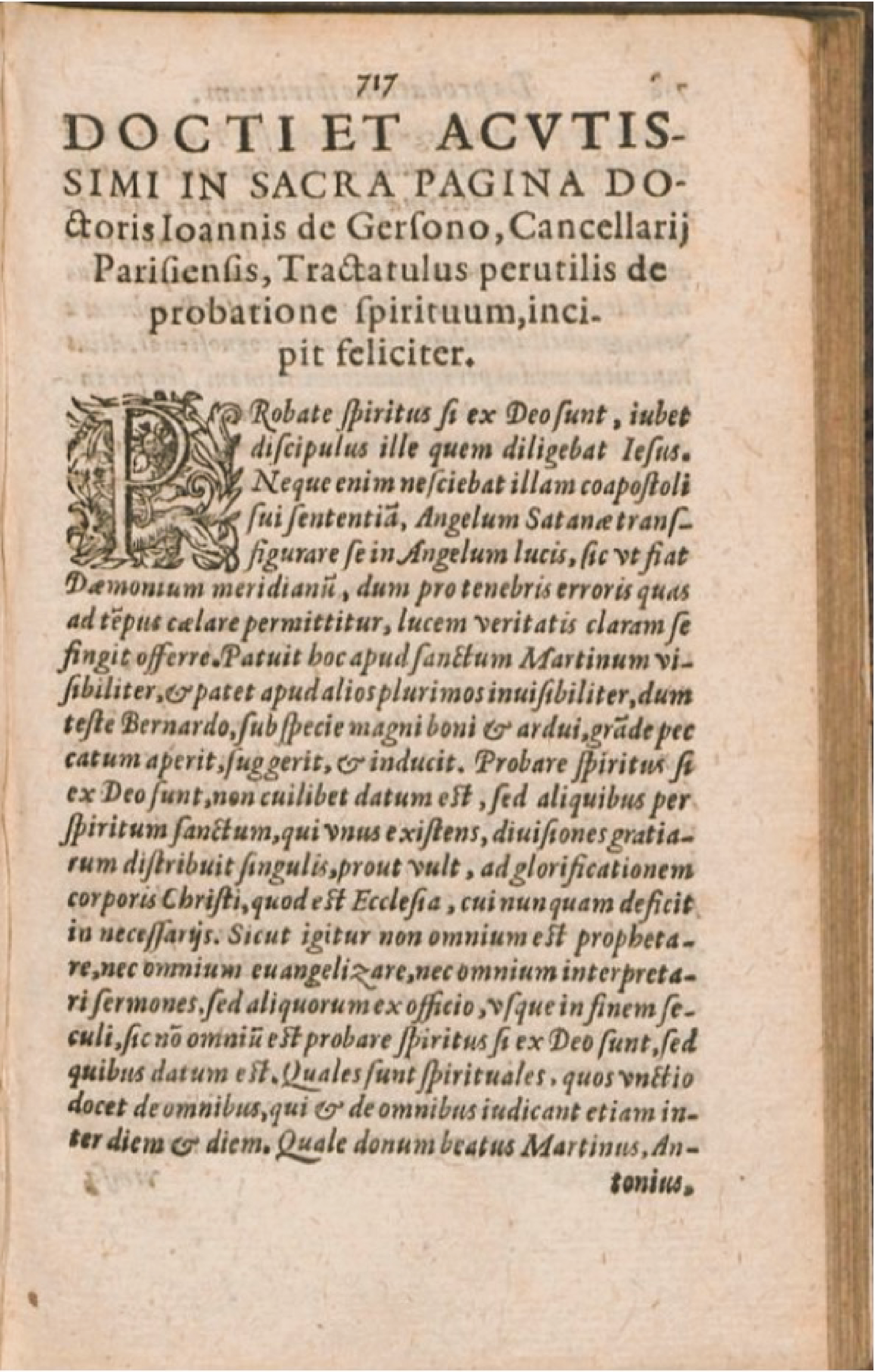
First page of the Gerson book De Probatione Spiritum included in the Frankfurt Malleus print from 1580. Image Credit: Halle (Saale), Universitäts- und Landesbibliothek Sachsen- Anhalt/University and State Library Saxony-Anhalt, Kq 600, P. 717. Public Domain Mark 1.0. Source: http://dx.doi.org/10.25673/opendata2-3965 (urn: nbn:de:gbv:3:1-477145-p0747-1).
What is said in the Malleus regarding placebo controls? A sort of template for placebo controls was widely expanded in passages describing the essential difference between two identically looking religious objects, one genuine and one sham. The visual similarity between the two was considered so important that it could be used as a tool to reveal demons who ‘always instruct the sorceress to create the devices for their evil will through […] divine objects (those consecrated to God)’. One reason for demons and eventually witches to do this is that the devil may, ‘in the guise of an apparent good thing, more easily deceive simple people’ and lead them ‘to think that with the divine objects they have received conveys some sort of divine power from God, whereas it is merely the case that greater sins have been committed’. The greater sin about which the reader is warned is to adore the bread before its consecration. To adore something that is not actually imbued with divine power was deemed idolatrous. 9
Revealing witches and demons thus required knowledge about the distinction between genuine and sham religious objects. In the Malleus, Kramer states that a witch’s aversion to the holy object would give her the unique ability to distinguish consecrated bread from unconsecrated bread and thus reveal her unholy identity. However, the function of a sham object is described as a double-edged sword. Kramer makes a direct reference to exorcism trials and says that one ought to take precautions to assess what has been consecrated or not consecrated. If a religious object used in a trial was genuinely consecrated, very good; if not, it could be charged with superstitious and heretical significance and be a tool for the witch or demon.
Two hundred years after Jean Gerson had published his ideas about how to make fair comparisons in witch trials, the use of concealment and placebo controls was ‘repurposed’ – from the identification of witches to the identification of charlatans. Anton Mesmer’s claims for the therapeutic value of his ‘animal magnetism’ 12 were debunked by Antoine Lavoisier, Benjamin Franklin and others.13–16 In 1800, John Haygarth used placebo controls to assess the veracity of Elisha Perkins’ therapeutic claims for this treatment for rheumatism.17,18 At the end of the 18th century, these scientists were acutely aware of the earlier placebo-controlled exorcism trick-trials used by inquisitors in early modern Europe. 19 The veracity of genuine relics, consecrated bread and dramatic exorcisms of demons became a contested issue in the early modern era.
As far as we are aware, the writings of Jean Gerson are the earliest written sources describing methodological controls with comparators (such as trick-trials or placebo-controlled trials). The ‘trick-trials’ used to scrutinise alleged demonic possessions in 16th-century France, 1 and the debunking of mesmerism 13 and of Perkins’ Tractors are early examples of placebo-controlled trials. A search for the origins of placebo-controlled trials takes us back to one of the bleakest aspects of the transition from medieval to early modern Europe – witch hunts and the Inquisition.
Gerson’s writings influenced the witch trials and investigations of possessed women. While the authors of the mesmerism commission were unlikely to have read Gerson, they were acutely aware of the history of trick trials and its impact on French history. They saw no need to explain their experimental methodology of using a simulacra. The ‘trick trial’ was a visible part of a turbulent period of French history. From this auspicious start, begun by Lavoisier, Franklin and their colleagues in 1784, 13 placebo controls made from starch, sugar and later microcrystalline cellulose (an industrially produced white powder gained from refined wood pulp) spread to millions of people in clinical trials seeking to discern truth from falsehood. 20
Reflections
The search for the origin of the placebo-controlled trial takes us back to the Middle Ages. It was then that early ideas about controlled trials were formulated to distinguish true from false divine revelations, and when scepticism was demanded before venerating liturgical bread that may have been unconsecrated. The scientific methods proposed by Gerson and some of his contemporary scholars have been largely overlooked in favour of attention to Reformation and Enlightenment thinkers. Tracing scientific ideas and works of medieval scholars promises further insights into the links between intellectual and medical history.
Future analyses exploring the legacy of medieval thought and practices will engender new areas of study to which the gender dimension certainly belongs. Women were in the majority among those who were deemed in need of assessment because of alleged divine revelations or possession by a demon. Gerson played a pivotal role in the long history of the placebo-controlled trial. It was he who in On Distinguishing True from False Revelations (De distinctione verarum visionem a falsis) used the following numismatic image to illustrate the placebo principle: ‘But sometimes the false coin can be so close in appearance to the true one that its counterfeit can only be detected by the most learned people’. 7