



Abstract

In 1952, when Queen Elizabeth II came to the throne, the UK had one of the longest life expectancies (as measured from birth) in the world, ranking seventh globally behind countries such as Norway, Sweden and Denmark. 1 Indeed, for many in Britain, the 1950s were a good time to be alive. The country was recovering from the devastation of the war, and Harold Macmillan, Prime Minister in the second half of the decade, famously told the people that they had ‘never had it so good’. 2 Of course, not everyone was so lucky, with Blake’s ‘dark satanic mills’ still dominating many communities experiencing deep poverty. But compared with many other countries, the prospects seemed good. A survey in the city of York found that poverty had almost disappeared there by 1950, although of course it was not entirely gone. 3 However, in marked contrast to the unemployment of the 1930s, the country was actively recruiting people from the Commonwealth to fill the many job vacancies. 4
Objectively, Macmillan’s comments seemed justified. One of the best measures of the progress of nations is the health of their people, and with life expectancy at an all-time high and, globally, higher than in many other countries, the UK was faring well. It can, of course, be unfair to compare countries without taking account of their initial circumstances. Most obviously, given a biological limit to longevity, countries that have already achieved long life expectancy have less scope to improve. However, while this may be an issue now, it was much less relevant in 1952 when life expectancy (both sexes) in the UK was only 69.5 years. The UK also benefitted from the legacy of wealth that came from possessing the largest empire the world has ever known. However, other major colonial powers, such as France, were also advantaged.
This favourable situation would not last. By the early 1960s, the UK was slipping down the global rankings in life expectancy (Figure 1). After particularly marked falls in the 1970s and 2010s, it had fallen to 36th place in 2020 (red dot) during the COVID-19 pandemic, just above the Maldives, Chile, Costa Rica and Thailand. In 2021, the UK’s life expectancy rank rose seven places to 29th (orange dot), possibly linked to the arrival of vaccines against COVID-19 earlier in Britain than in the countries just above it. By rolling the vaccine out first to older people, who were especially likely to die from COVID-19, this may have provided a transient advantage before other countries caught up, but this is not yet clear. However, given the current challenges faced by the UK, there is no room for complacency. While life expectancy has increased in absolute terms over recent decades, other, now much more similar countries, are experiencing larger increases. It is hard to believe that the UK is facing diminishing marginal returns on its investment in health, while those other countries are at a point in the curve where returns are still much higher.
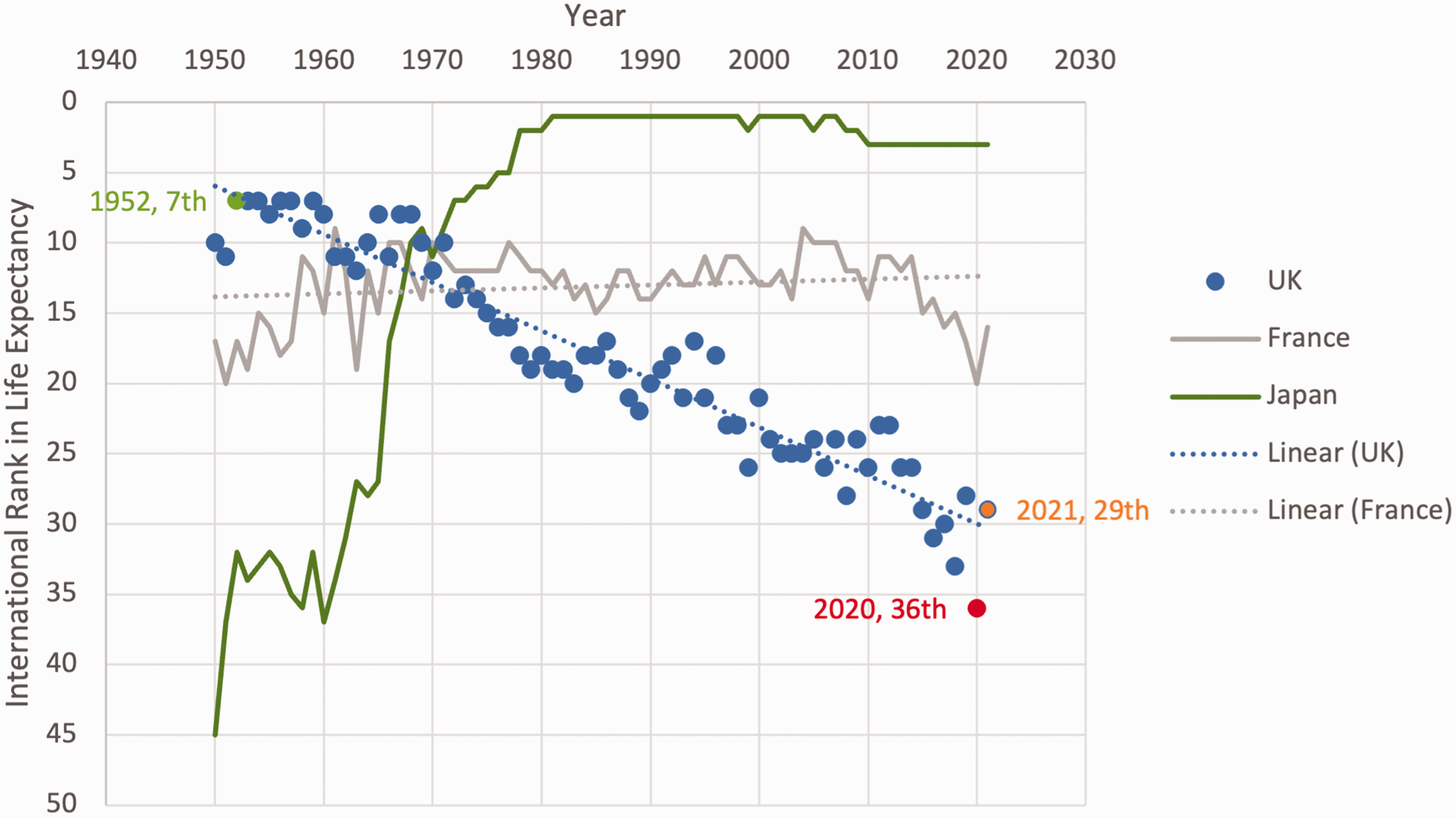
UK rank in international life expectancy, 1950–2021, Source: UN Data, 2022. 1
Some changes would have been expected in the decades from the 1950s until the present day. The post-war period saw remarkable economic progress in some parts of the world, such as Singapore, Hong Kong, South Korea and Taiwan giving rise to the term ‘Asian tigers’. So, is what happened in the UK simply a matter of other regions catching up? Certainly, this is part of the explanation, but not all. We can illustrate this by looking at two other trendlines in Figure 1. Japan has made remarkable progress, coming from 45th position in the early 1950s to occupy one of the top three positions since the 1980s, and regularly holds the top position in global rankings. Yet, France, which in many ways is very comparable to the UK (including, as noted above, benefitting from having a global colonial empire), started well below the UK and has now surpassed it.
France and Japan, along with the UK, Canada, USA, Germany and Italy, are members of the ‘Group of Seven’ (G7). The G7 is a collection of countries with advanced economies that represent about half of global economic output. 5 Figure 2 shows the rankings of the G7 countries at each decade from 1950 to 2020. Along with France and Japan, Germany and Italy have now surpassed the UK. In fact, the only G7 country to do worse than the UK is the USA. What has gone wrong?

Countries of the G7’s international life expectancy rankings, 1950–2020. Source: UN data, 2022. 1 Note: The data shown are the annual data for the corresponding year – not an average for the decade.
As always, the first question is whether we can trust the data. Vital registration has improved immensely over this time, especially in low- and middle-income countries. However, while caution would be needed in analysing the causes of deaths seven decades ago, with a few exceptions (such as in Korea during the war in the early 1950s), the countries at the top of the rankings have long-established systems for collecting demographic data. 6
As far as we know, while these data are publicly available, the presentation, as rankings over seven decades, is new. This long-term perspective, with estimation of trends, overcomes the problem of short-term fluctuations of examining annual data. This is a particular problem in smaller countries but, even in larger ones, natural disasters or epidemics, for example, can produce quite substantial changes.
The relative decline of the UK portrayed in Figures 1 and 2 is stark. Yet, it may not be a surprise to scholars from some disciplines, such as political scientists and economic historians. In the international arena, Dean Acheson’s 1962 observation that the UK had ‘lost an empire and has not yet found a role’ drew attention to the UK’s loss of international influence after Suez. 7 Since 2016, when it voted to leave the European Union, the UK has found itself increasingly isolated, despite coining the slogan ‘Global Britain’. For a long time it retained considerable soft power, taking advantage of the increasingly ubiquitous English language, but squandered this in the 2010s by disinvesting in its vehicles, such as the BBC and the British Council. 8 Economically, while it came out of World War II in a much better position than the nations it helped to defeat, a combination of complacency and lack of vision meant that it failed to achieve Germany’s Wirtschaftswunder, or ‘miracle on the Rhine’ 9 and similar developments elsewhere. It was ill-prepared for the oil crisis of 1973, and by the end of the decade, the manufacturing industry was reduced to 3-day working. 10 With its large financial sector, it was also vulnerable when the 2008 financial crisis hit, exacerbated by a misguided policy of austerity that shut off the transient initial recovery, resulting in the average UK household having lower incomes in 2012 than in France or Germany, 11 paving the way for a decade in which health and the economy stagnated.12,13
Income inequalities rose greatly in the UK during and after the 1980s and that rise also saw an increase in the variation in life expectancy between different social groups. One reason why the overall increase in life expectancy has been so sluggish in the UK is that in recent years it has fallen for poorer groups, falling slightly overall between 2014 and 2018. According to the OECD, the UK is now the second most economically unequal country in Europe after Bulgaria. 14 Perhaps we should not be surprised to see that inequality reflected in such wide health inequalities and a declining overall position?
Given this history, we can begin to understand why the UK has done so badly. But it poses an obvious question. What comes next? The third Prime Minister of 2022, Rishi Sunak, inherited a country in crisis that was partly of his making as a former Chancellor of the Exchequer. Commentators are asking whether large numbers of people will have to choose between ‘heating and eating’ even after some bills have been capped. Yet, despite the scale of the crisis, the UK government treaded water during the summer and autumn of 2022, with the ruling party immersed in two destructive leadership campaigns. While politicians invoke global factors, especially the effects of the pandemic and the invasion of Ukraine, the reality is that, as in the 1950s, the country suffers from major structural and institutional weaknesses. Despite being much less reliant on Russian gas than countries such as Germany, energy prices have risen much faster, in part reflecting ill-advised closure of storage capacity and failure to regulate the market. Although, in theory, the country was second best prepared for a pandemic in the world, it experienced one of the highest death rates in 2020, with multiple policy failures. 15
It is not the case that ‘things can only get better’. There are many examples of once prosperous countries that experienced a long decline, such as Argentina in the 20th century. 16 Worryingly, at some point, countries can enter a vicious downward spiral, with worse health feeding into economic decline and vice versa. Meanwhile, a growing body of research is cataloguing how declining health threatens democracy itself.17,18
The UK is at a crossroads. The cost-of-living crisis means that ‘business as usual’ is no longer an option. But politicians have choices, and we can only hope they make the right ones, although events in and since October 2022 have so far provided little reassurance. As they move forward the data we present should give pause for thought.
In early 2023, both the establishment newspaper The Times and the fringe Morning Star ran near identical headlines: ‘A&E delays are “killing up to 500 people a week”’. 19 In the short term, the government has an acute crisis to address. In the medium term, there is an economic malaise that makes it harder to address the short-term problems. At some point, it might be realised that proceeding along a particular path is slowly but surely resulting in the UK falling down the ranks. The headlines may be now, but the real causes would appear to have been decades in the making.
