



Abstract

Inequalities in health by ethnicity persist in the UK, and there is a history of health research failing to address the needs of ethnic minorities. The COVID-19 pandemic has further highlighted ethnic health disparities 1 and emphasised the need for a greater ethnic minority contribution to all aspects of research. Ethnic minority patient and public involvement needs to go beyond just inclusion in research design, but to encompass active involvement in setting research questions, helping shape study design, being co-applicants, actively informing study implementation, data analysis and interpretation, and dissemination of findings.2,3 A prerequisite for this is the development of a wider patient and public involvement community which is reflective of our growing population diversity.
The tokenistic nature of patient and public involvement
To date, patient and public involvement in research has often been ‘tokenistic’, from the perspective of both researchers and participants. 4 As funding bodies increasingly request inclusion of patient and public involvement in grant applications, researchers often include patient and public involvement for the primary purpose of improving the success of the bid and recruiting participants, without placing sufficient value on patient and public involvements as an important part of the complete research process. Subsequently, patient and public involvement is rarely designed to address the needs of all groups or the entire research process, and it often attracts particularly motivated community members, which can limit diversity and equitable representation from seldom-heard communities. As well as increasing representation of ethnic minorities, enabling more evenly distributed power dynamics, with all stakeholders being accountable, is needed to reduce tokenism. Involvement should be anchored on respect for participants, including ethnic minorities, and their ability to make contributions at all stages of research.5,6
Working with ethnic minority communities
A fundamental point to consider when engaging ethnic minorities in patient and public involvement activities is the need to understand the diversity within ethnic minority groups (e.g. South Asian consists of Pakistani, Bangladeshi, Indian, etc.). There is wide heterogeneity among ethnic minorities that reflect differences in culture, language, genetics, health status and service use. These factors are also reflected slightly differently across different age groups and migration status. 7 To adequately capture the broad range of communities among ethnic minorities, researchers have recently advocated for the improvement of ethnicity categorisation in health and social care research. 8
How to conduct patient and public involvement (PPI) with ethnic minorities.
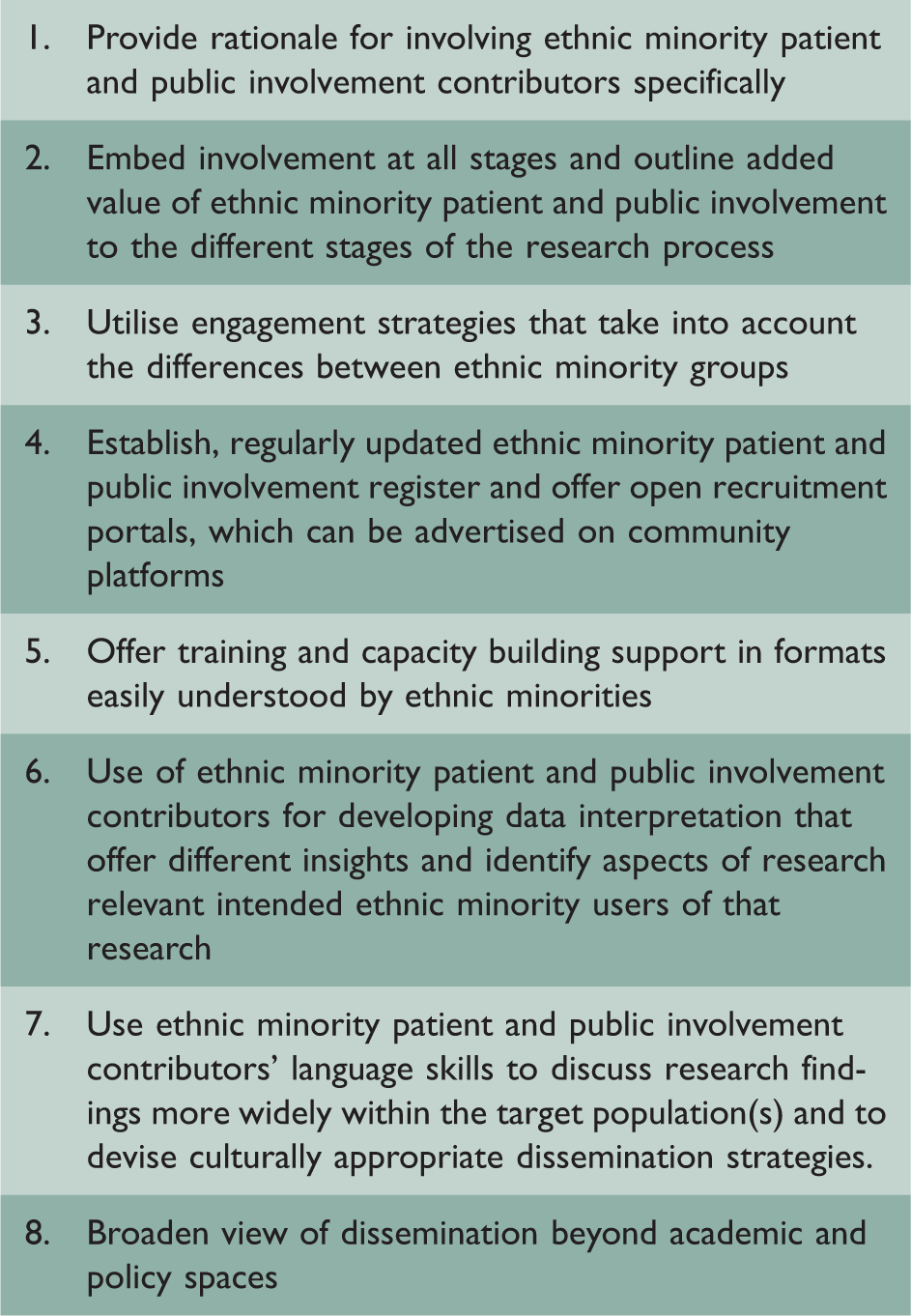
The role of ethnic minority community members in patient and public involvement groups and panels should not simply be for the direct and back translation of the research agenda to plain English, but should also reflect culturally relevant translation which is only achievable through focused engagement. 10 For instance, the patient information sheet (PIS) needs to have content validity through focus groups and consultations with community representatives. Including ethnic minorities in this process would ensure cultural, religious and social considerations related to these groups are adequately considered. In addition, co-design approaches to adapt and develop suitable engagement strategies should also be valued, as some ethnic minorities feel over-researched but neglected in research planning, and see little benefit from this to their communities. 11
Increased representation is needed
Adequate representation of all ethnic groups needs to be an integral part of research.12,13 This is particularly important for patient and public involvement related to applied health research, as this should reflect the population that the research is designed to benefit. Scientific journals, funders, policymakers and stakeholders should actively encourage and support the presentation of ethnic minority patient and public involvement evidence in research planning and dissemination using guidelines for assessing study quality and impact. 14 Inclusion of ethnic minority patient and public involvement, which should comprise both environmental and social planning, may increase researcher and resource burden. Therefore, a commitment to ethnic minority patient and public involvement will need to be reflected in resources requested in research funding applications, as additional funds would be required for professional translation into different languages, 15 and funders need to be receptive to this. Ethnic minority patient and public involvement is also vital at the dissemination stage of research outputs. Having patient and public involvement opinions on research outputs enhances credibility, transparency and validity among the target population.
Recommendations for increased engagement and evidence of ethnic minority contribution in patient and public involvement (PPI).

Footnotes
Declarations
Competing Interests
KK is director of the Centre for Black Minority Health, University of Leicester, and is a trustee of the charity South Asian Health Foundation and co-chair of their Diabetes Working Group. KK is Chair of the SAGE Ethnicity subgroup and member of Independent SAGE.
Funding
KK is supported by the National Institute for Health Research (NIHR) Applied Research Collaboration East Midlands (ARC EM) and the NIHR Leicester Biomedical Research Centre (BRC). WE and AR are supported by NIHR ARC EM.
Ethics approval
Not applicable.
Guarantor
KK
Contributorship
All authors conceived the idea for the article and the recommendations that form the basis for the article. WE, AR and KK led on drafting, editing and revising the content. All other authors contributed to editing the content, and all authors approved the final version and are accountable for all aspects of this work.
Acknowledgements
None.
Provenance
Not commissioned; editorial review.
