




Abstract

At first sight, there seems little of clinical interest when a worshipper is seen praying before an image of Christ, a crucifix, or a saint or other holy person. But that overlooks what sometimes lies behind the devotions of these worshippers. Aided by the power of imagery, supplicants pray for succour, healing, a cure or even deliverance, in the face of pain and suffering – that ‘Halfway between the worlds of emotions and the realm of sensations’. 1 And though the observations here revolve around Christianity, the same considerations could similarly apply to supplicants of other faiths who too are seeking solace through the agency of a sacred image.
The power of imagery can be viewed from the age-old transcendental or spiritual perspective. However, it is the scientific perspective which is increasingly persuasive, since, as notably even the art historian affirms, today ‘we … use science – not religion – as the basic term of explanation’. 2 It will be argued here that both these perspectives have validity and converge in mechanisms which have in common a neuropsychological basis with therapeutic implications.
The nature of the ‘therapeutic’ image
A ‘therapeutic’ sacred image can take many forms: sufferers have prayed before pictures and statues, and also more substantial artefacts such as relics and shrines; sufferers have also created the image in their imagination: There is almost a superfluity of Western evidence for the potency and efficacy of objects and substances that have been in contact with a saint or with his tomb or shrine … or by almost anything that has been in contact with them.
2
Three famous accounts illustrate the variety of images harnessed in the alleviation of different forms of pain. First, Saint Gregory of Tours in the sixth century AD wrote of the shrine of Saint Martin: How could anyone doubt the miracles performed by [him], when they see the present evidence for the powers at his shrine, when they see the lame made to walk, the blind given sight, demons put to flight, and the curing of every other kind of disease? … A little bit of dust from the shrine is of more use than any medicine; [even when] consultations with soothsayers are utterly worthless.
2
But when it came to heavenly things…my mind was so stupid that I could never imagine them at all, until the Lord showed them to me in another way. I had so little ability for picturing things in my mind that if I did not actually see a thing I could not use my imagination, as other people do, who can make pictures to themselves … It was for this reason that I was so fond of pictures … and would delight in looking at pictures of Him …
4
Spanning two millennia, these three admittedly anecdotal accounts illustrate not only the healing power of images but also their different forms: for Saint Martin, it is holy dust (but not the ministrations of a ‘soothsayer’); for Saint Teresa, an actual picture; and for Mary Baker Patterson, a picture imagined.
Whether non-believers too can engage in the same way with such images is unclear, but for religious believers, at least those espousing the western Christian tradition, a meaningful image appearing in the right circumstances can indeed alleviate suffering. Whether adherents to other cultures and faiths, including those religions which forbid the worship of images, can engage in the same way is less clear but seems likely – witness the healing effects of worship at sacred shrines in ancient Greece.
What accounts for the images’ healing properties? Two approaches suggest themselves: the transcendental and the scientific. The transcendental has existed since time immemorial; the scientific – more specifically the neurological – has emerged relatively recently and notably since the placebo phenomenon became increasingly recognised and studied.
Sacred images viewed from the transcendental perspective
Viewed from the variously termed transcendental, supernatural or spiritual perspective, there ‘seems to be a universal, almost hard-wired belief that there is “something beyond”’,
6
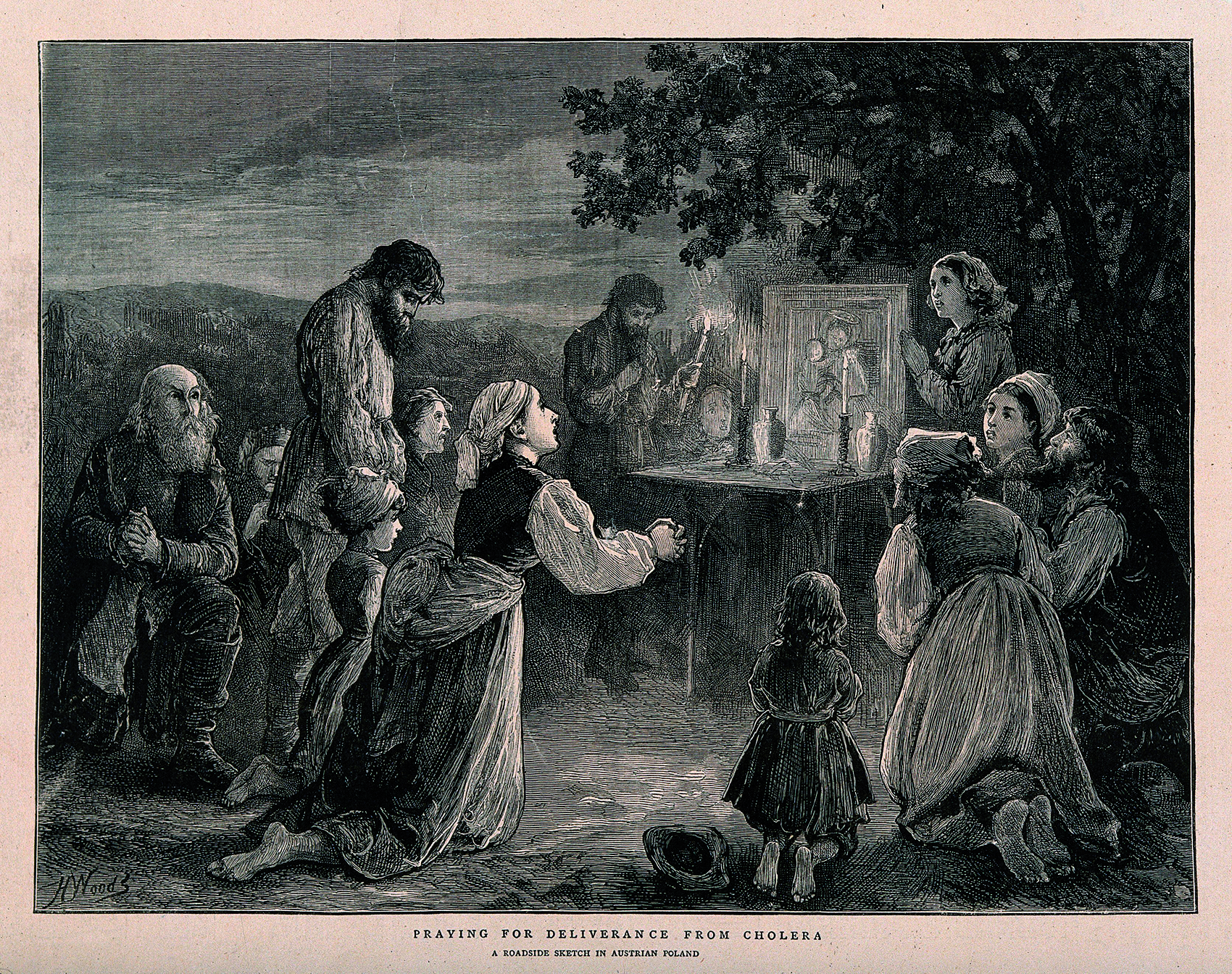
an eternal and universal belief that there is something, somebody or an indescribable entity beyond one’s experience and beyond analysis which can intercede and help alleviate pain and suffering. Prayer before a sacred image can be private (Figure 1) or communal (Figure 2), and the healing power of sacred images needs no further explanation for those for whom such religious belief is fundamental, even if sometimes difficult to define. Thus, throughout history, ‘For many sick people, beliefs are beneficial to easing the distress and uncertainty of being unwell’
7
; indeed, belief can be considered the basis for all religions and religious rituals including prayer, of which prayer before a sacred image comprises a particular and overt example.
The sacred image imagined: Cure of a child by prayer to the Virgin Mary and Child, 1869. (Oil painting by Romea (?), Wellcome Collection.). ‘Praying for deliverance from cholera; a roadside sketch in Austrian Poland’. (Wood engraving by Henry Woods, 1873, Wellcome Collection).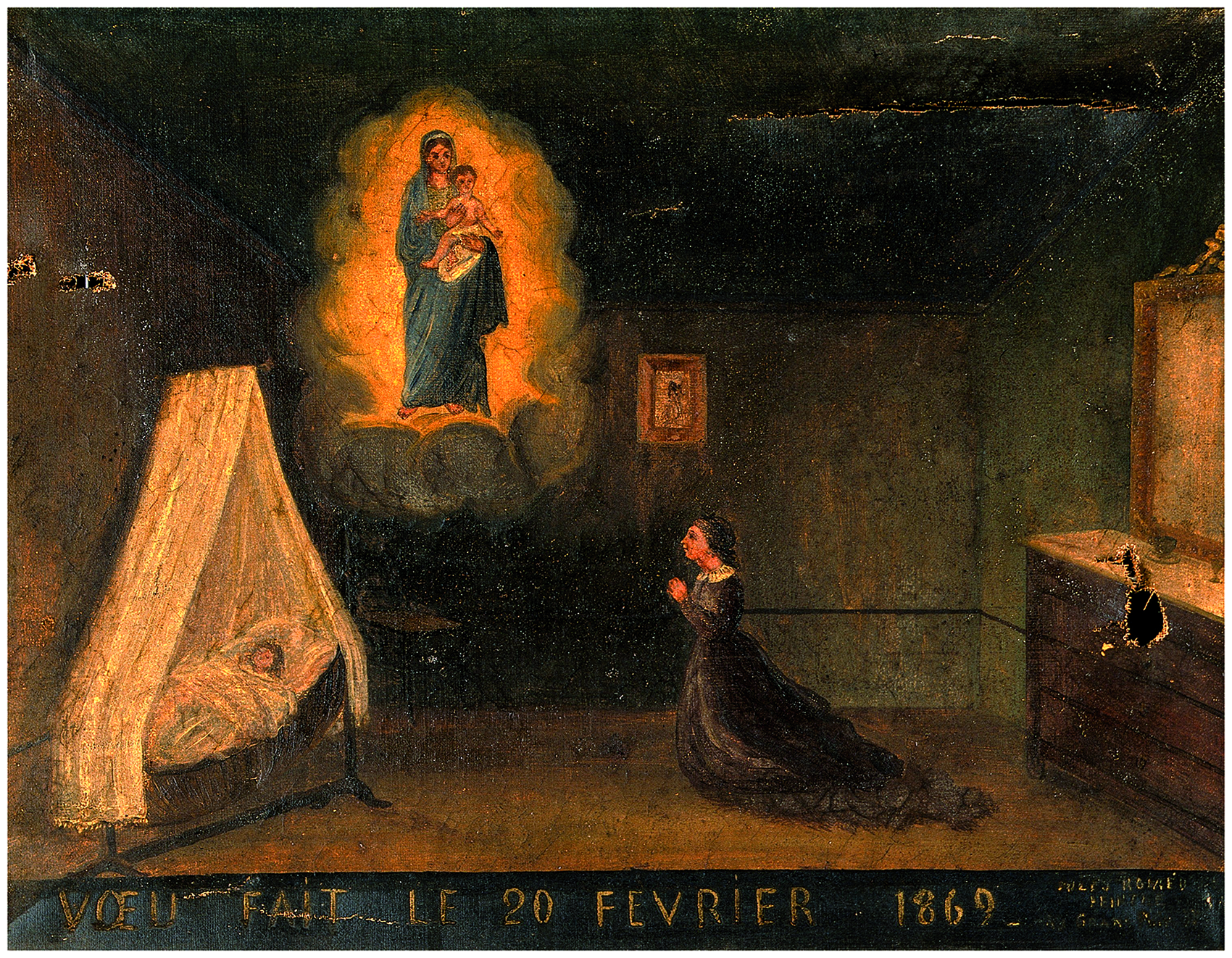
Sacred images viewed from the neuroscientific perspective
Although this transcendental approach appeals to perhaps many sufferers, nowadays the neuroscientific approach is more often adopted, the placebo response providing an alternative and compelling explanation which has gained widespread acceptance. As summarised by Wall, ‘If you have strong reason to expect a pain to disappear, it may disappear. This is called a placebo response … [It] is the fulfilment of an expectation’. 8 In the present context, the placebo response embodies what Harrington characterised as ‘a powerful mind-body phenomenon with a specific “real” biology all its own, one that medicine should study and exploit’ 9 – an expression which points to an important amalgam of the spiritual and the corporeal, and ‘therapeutic’ sacred images may represent an unexpected trigger for the placebo response.
But first these images need to be ‘processed’. When images provide neither solely fundamental visual information nor even an aesthetic experience but a therapeutic response, it is not only the neurophysiological processes involved in vision – for example those subserving the perception of colour, motion and shape – which are important. Rather, ‘therapeutic’ sacred images need to trigger placebo responses through mechanisms linked to expectancy, motivation and reward. There is convincing evidence that the predominant neurotransmitters implicated in the placebo response likely include opioids, dopamine and cannabinoids acting within a number of cerebral circuits.10,11 Hardly surprisingly, apart from a functional magnetic resonance imaging study dealing with a somewhat tenuously related topic, 12 there appear to be no data either on the neurotransmitters or the cerebral circuitry involved when viewing let alone praying before sacred images. However, dopamine may be of particular importance, since its release can occur in another domain which, like prayer, is similarly abstract and also personal in its impact: music. Here too reward circuits are implicated during – and even with the anticipation of – music which is emotionally charged. 13
The transcendental and neuroscientific perspectives converge: the role of hope
Whether ‘therapeutic’ sacred images are viewed from the transcendental or the neurological perspective may to some extent reflect the different approaches of the subjective humanistic and objective scientific disciplines and their adherents, and it is acknowledged that those who adhere to a transcendental approach might not be in sympathy with one that is neurobiological and purely mechanistic. Yet, what is striking is that there exists an entity common to both perspectives and linked to expectation: hope – thereby chiming with Bressan and colleagues’ claim that ‘Hope is a therapeutic tool’. 14 Indeed, the definition of ‘hope’ in the Oxford English Dictionary, ‘Expectation of something desired; desire combined with expectation’, reiterates precisely the two elements experienced by every supplicant: not only the desire for relief from suffering but also the belief and expectation that relief may be forthcoming.
But ‘hope’ here is far from just a banal term for a vague aspiration. Just as the placebo response is now known to have an extensive biological basis, and ‘spirituality may at least partially be relevant for explaining placebo responses’, 11 there is evidence from functional MRI studies that hope too may have a biological basis, 15 leading to Bressan et al. concluding that ‘Therapeutic benefits are biologically plausible if hope is viewed as a kind of placebo effect’ 14 ; furthermore, their paper’s subtitle ‘Don’t be afraid to use it’ urges clinicians to harness hope as a therapeutic instrument.
Conclusion
Thus, hope may be a pivotal feature underpinning the efficacy of the sacred image in alleviating pain as well as other distressing conditions, just as hope is a pivotal feature underpinning the efficacy of the doctor–patient consultation; the efficacy of medicines and the intervention of the surgeon and the ministrations of the priest and the shaman. In all their diverse forms, sacred images before which the sufferer prays for help comprise yet another powerful resource to which the sufferer can turn. Exploring further how the mechanisms by which hope mediates this and other pain-alleviating resources may prove to be a fruitful and therapeutic endeavour.
