




Abstract
In Part 1 of this article 1 I considered some general matters about translating into English passages on ‘empirical’ and ‘dogmatic’ medicine in Celsus’s De medicina and dealt with the first of three quotations. I now consider the second and third quotation.
Quotation 2
This is the most problematic of the marked sections.
Spencer
They do not deny that experience is also necessary; but they say it is impossible to arrive at what should be done unless through some course of reasoning. … Again they say that it makes no matter whether by now most remedies have been well explored already … if, nevertheless, they started from a reasoned theory; and that in fact this has also been done in many instances.
The whole text of this passage in the Loeb edition is:
Neque vero infitiantur experimenta quoque esse necessaria, sed ne ad haec quidem aditum fieri potuisse nisi ab aliqua ratione contendunt: non enim quidlibet antiquiores viros aegris inculcasse, sed cogitasse quid maxime conveniret, et id usu explorasse, ad quod ante coniectura aliqua duxisset. Neque interesse, an nunc iam pleraque explorata sint …* si a consilio tamen coeperunt. Et id quidem in multis ita se habere.
*Marx provides the text below for the lacuna, but does not reveal its source.
“deesse apparat ‘si quotannis tamen nova remedia inveniuntur, neque dicendum esse antiquiores experimentis esse usos …’”, Marx 7 (p. 20). Spencer, 8 in the Loeb edition renders the interpolation: ‘if new remedies nevertheless are found every year, nor must we say that the ancients went by experience …’
The main problem with this quotation is that it is not easy to understand, and Spencer’s version, though it ‘translates’ the Latin words, does not make much sense.
The Loeb edition (based on Marx’s Latin text) indicates that text is missing at the asterisk. Marx supplies text here which he marks ‘deesse apparat’ (appears to be missing) – see above. Unfortunately, he does not seem to indicate his source for the apparently missing text which, one supposes, was not available to Fonzio in the 15th century since, as will be seen from Figure 1, the editio princeps does not include the missing text nor mark any lacuna after ‘explorata sint’. The interpolation emphasises that, here, Celsus is denying that all ancient physicians were necessarily Empirics. The editio princeps has ‘inficiantur’ for ‘infitiantur’, but this is simply a variant without significance.
A page from the first printed edition (editio princeps) of Celsus’s De medicina, published in Florence in 1478, from the copy in the Library of the Royal College of Physicians of Edinburgh. The pages are unnumbered; this is page sig. a2 recto. Quotation 2, referred to in this article, is marked by the added grey background. Note that there is no lacuna (gap) after … 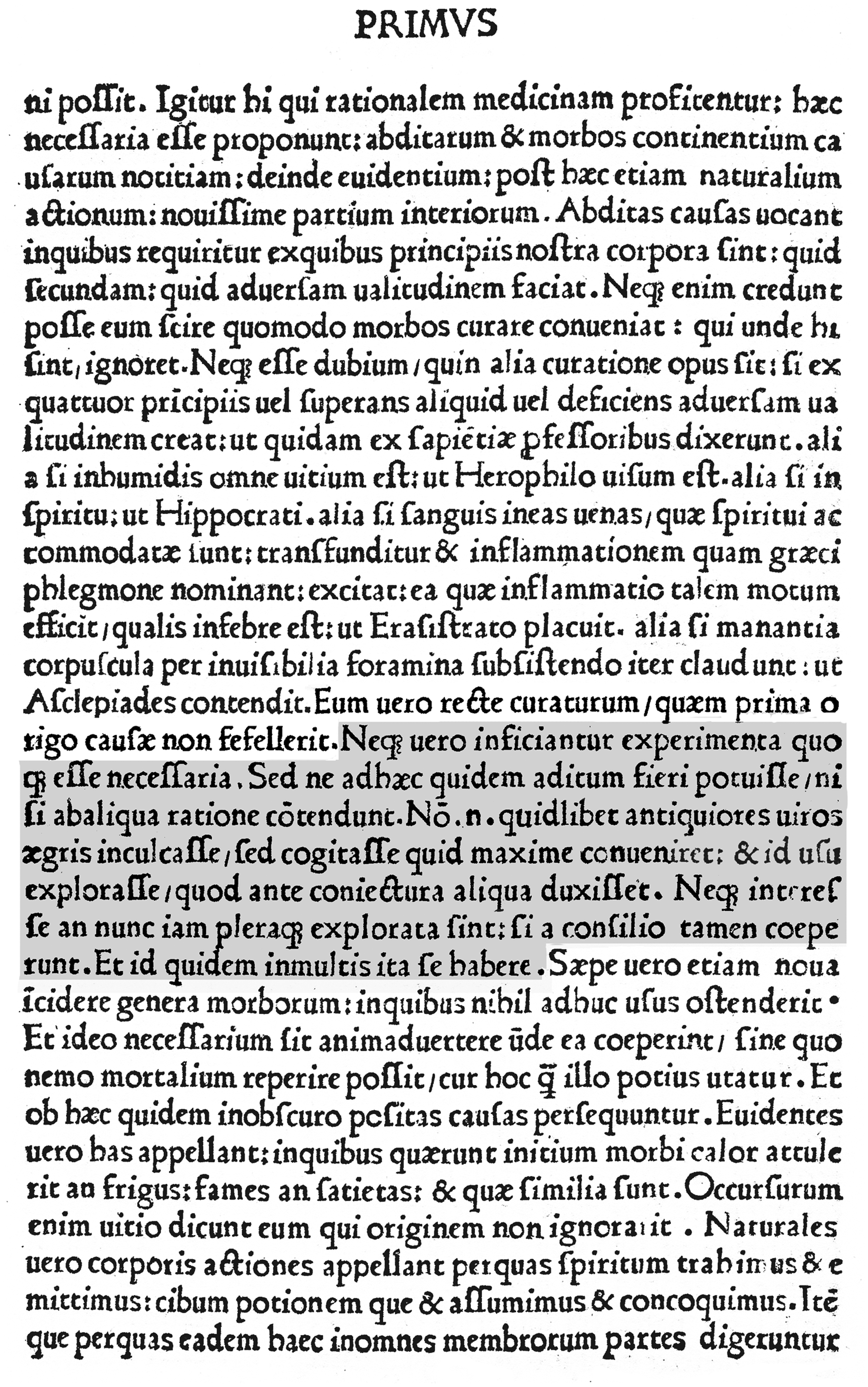
It would be well to emend the English translation to include Marx’s additional text since it fills an obvious lacuna and makes Celsus’s current point more forcefully as well as making more sense. The last phrase – ‘and that in fact this has also been done in many instances’ – seems to make little sense even after the addition of the text presumed to be missing. Note that, in the Latin, the phrase stands as a new sentence and it would be best to respect this. But I suspect there is still something wrong with the Latin text.
I suggest, as a translation of Marx’s text – without any claim that its meaning is clear!:
IMLD
They do not deny that experience is also necessary; but they say it is impossible to arrive at what should be done unless through some course of reasoning. …
They say that it makes no matter whether by now most remedies have been well explored already. If, however, new remedies are found every year; we must not say that the ancients went by experience if, nevertheless, they started from a reasoned theory; and that in fact this has also been done in many instances.
Grieve’s 18th-century translation is considerably different and is worth examining. Here is his version of the whole passage:
Greive
Nor do they deny experience to be necessary, but affirm, it cannot be obtained without some theory; for that the more antient practitioners did not prescribe any thing, at hazard, for the sick, but considered what was most suitable, and examined that by experience, to which they had before been led by some conjecture. That it is of no moment in this argument whether most remedies were discovered by experiment, provided they were at first applied with some rational view: and that this holds in many cases;
This version has the merit of making a good deal more sense than Spencer’s. But, how compatible is it with the Latin? Greive used an 18th-century recension of the Latin text by Almeloveen. 11 Examining this we find ‘an initio pleraque explorata sint’ in place of ‘an nunc iam pleraque explorata sint’. It is from this that Greive derives ‘provided they were at first applied with some rational view’ rather than Spencer’s ‘by now well explored’ – a completely different statement. Greive’s presentation of the argument that Celsus is setting out, about the beliefs of the Dogmatics, seems convincing but, I fear, it relies on a great deal of expansion for which there is little basis in the Latin.
The comparison of Spencer and Greive is quite instructive. Spencer sticks rather closely to the source text, ignores the lacuna (though it is marked as apparent in his source text), and the result is not very coherent. Greive, working from a very slightly, but very significantly, different text – but with the unindicated lacuna – seems to use the source text as a rough framework on which he builds a coherent account of what he takes to be Celsus’s account of the belief of the Dogmatics.
Let us now insert Marx’s missing text into Almeloveen’s version (the one Greive used) and see what we can make of the result.
Neque vero infitiantur experimenta quoque esse necessaria, sed ne ad haec quidem aditum fieri potuisse nisi ab aliqua ratione contendunt: non enim quidlibet antiquiores viros aegris inculcasse, sed cogitasse quid maxime conveniret, et id usu explorasse, ad quod ante coniectura aliqua duxisset nunc iam
Marx’s proposed interpolation in bold italic; Almeloveen’s variants underlined and the words he omits struck out.
IMLD’s attempt at translating this
They do not deny that experience is also necessary; but they say it is impossible to arrive at what should be done unless through some course of reasoning: for the ancients did not treat the sick at random, but, after consideration of what would be most appropriate, tried out that method to which some theory had led them previously. Nor did they consider it important if many [such] things had first been explored even when [if] new remedies are discovered, nor [did they] claim that the ancients based their actions [only] on experience. And certainly matters have often been thus.
This turns out not too dissimilar to Greive’s translation. Of course, what we have done is to take Marx’s edited text – his estimate of the ‘best’ text as composed from the sources available to him – and emend it by injection of the phrase that he believed to have been omitted (one wonders why he did not include it himself) and then reject a few words in favour of those from an earlier editor’s recension. Is this procedure legitimate? In one sense it is what all editors do to make their best text. But, in another sense, it is no such thing. Learned recensions are generally produced by professional palaeographers and classicists selecting from a variety of sources on the basis of enormous experience of similar texts and using various criteria – well-defined or not. I make no pretension to the expertise of such editors. What I have done is much more crude; I have had a single motive – to try to arrive at a version of which I can make some sense – and I have only examined the Latin texts used by Spencer for the Loeb edition of 1935 and by Greive for his edition of 1756. My only excuse for this cherry-picking is that it has produced a text for the passage which seems to support a translation that I believe makes better sense than Spencer made of the passage, but without quite as much invention as Greive used. May the shade of Celsus forgive me if I have traduced his meaning.
Quotation 3
Tum requirunt etiam, quare venae nostrae modo summittant se, modo attollant; quae ratio somni, quae vigiliae sit; sine quorum notitia neminem putant vel occurrere vel mederi morbis inter haec nascentibus posse.
Spencer
Moreover, they also inquire why our blood-vessels now subside, now swell up; what is the explanation of sleep and wakefulness: for without knowledge of these they hold that no one can encounter or remedy the diseases which spring up in connection with them.
Greive
They also inquire how it happens, that our arteries rise and fall, from what causes proceed sleep and watching; without the knowledge of which, they conceive it impossible for any person either to oppose the beginnings of diseases, that depend on these particulars, or cure them when formed.
This time, Almeloveen’s text, the one used by Greive, does not differ from Marx except in being punctuated differently and in having ‘submittant’ for ‘summittant’, which mean the same. Spencer and Greive are translating the same Latin text.
Greive, in a footnote elsewhere, remarks on Celsus’s use of ‘venae’ for all blood vessels, saying that, in some places, he clearly means arteries. This seems likely to be correct. In most (but not all) of this passage, Greive both stays closer to the Latin and better expresses its content than the later translators. His ‘watching’ is equivalent to ‘wakefulness’ – an 18th-century idiom now largely lost.
The first problem is how to translate ‘occurrere’. Spencer’s ‘encounter’ is unhelpful. Greive’s ‘oppose’ is much better – but is that what Celsus meant? Greive then adds ‘beginnings of diseases’ which is not explicit in the Latin but which, presumably, he somehow extracts from the text. ‘Occurrere’ also has a sense of ‘coming across’ or ‘discovering’, and ‘nascentibus’ of ‘beginning’, though in its context in this passage it is more ‘arising’ rather than ‘beginning’- see below. The penumbra is quite large here.
At first sight, if we were to change ‘watching’ to ‘wakefulness’ and ‘oppose’ to ‘recognise’ in Greive’s version it would make an excellent translation – for me at least. But deeper analysis reveals more problems.
Once again, careful reading of Lewis and Short is useful:
For ‘occurrere’, in addition to all the meanings used by previous translators, we find: To obviate, or seek to obviate, to meet, resist, oppose, counteract: and then: To cure or attempt to cure, to relieve, remedy.
Turning then to ‘mederi’ – which more obviously means to heal or cure – we find Lewis and Short give a number of examples of uses in this sense, and in no other senses. So we have two verbs acting on the ‘morbis’ – the diseases – one of which is unequivocal in meaning ‘to cure’, the other of which has a range of possible meanings.
Returning to our text, we have:
… neminem putant vel occurrere vel mederi morbis inter haec nascentibus posse.
And we notice that Celsus opposes the two verbs ‘…
But Spencer’s ‘encounter’ does not help the English reader to understand Celsus’s meaning, so I would stretch the meaning a little and say ‘recognise’. My interpretation is that Celsus regards knowledge of fundamental structure and mechanisms as necessary, both to recognise disorders and then to treat them.
I did not see any problem in the interpretation of ‘nascentibus’, but Greive’s translation raises one. For me, ‘inter haec nascentibus’ is unequivocal, namely, ‘taking their origin among these’ or ‘arising from these’ where ‘these’ are the causes of the disturbances of the vessels or of sleep or wakefulness. Greive has transposed ‘nascentibus’ to the diseases and translated it as their beginnings. I don’t think the grammar will allow this. ‘Morbis’ is dative because ‘mederi’ usually ‘takes’ its object in that case, and ‘nascentibus’ agrees with it. But ‘inter’ requires the accusative, so its object must be ‘haec’. Greive seems to be taking ‘nascentibus’ as the ‘object’ of ‘occurrere’ (in the dative, which the word-form would allow, and ‘occurrere’ can ‘take’, giving ‘cure the beginnings’; but ‘morbis’ – the form is either dative or ablative – really should not be rendered as though it were the genitive ‘morbi’ ‘of diseases’. And ‘when formed’ is just not present in the Latin. In this case, though one can see how he got to the position, I think Greive is at least perverse – or perhaps just plain wrong.
After all this, how shall we translate the passage?
IMLD’s attempt
They also enquire how our blood-vessels sometimes become prominent and sometimes fall away and what are the causes of sleep and waking; without knowledge of these matters no one can recognise or cure diseases arising from these causes.
I thought about going a little further and rendering ‘attollant’ as ‘become engorged’ rather than ‘become prominent’. But, by doing this, I would risk wishing on Celsus ideas that, in our time, have implications about the circulation of the blood. I decided not to yield to temptation.
Quotation 3 second part
Praeter haec, cum in interioribus partibus et dolores et morborum varia genera nascantur, neminem putant his adhibere posse remedia, qui ipsas ignoret. Ergo necessarium esse incidere corpora mortuorum, eorumque viscera atque intestina scrutari; longeque optime fecisse Herophilum et Erasistratum, qui nocentes homines a regibus ex carcere acceptos vivos inciderint, considerarintque etiamnum spiritu remanente ea, quae natura ante clausisset, eorumque positum, colorem, figuram, magnitudinem, ordinem, duritiem, mollitiem, levorem, contactum, processus deinde singulorum et recessus, et sive quid inseritur alteri, sive quid partem alterius in se recipit:
Spencer
Moreover, as pains, and also various kinds of diseases, arise in the more internal parts, they hold that no one can apply remedies for these who is ignorant about the parts themselves; hence it becomes necessary to lay open the bodies of the dead and to scrutinise their viscera and intestines. They hold that Herophilus and Erasistratus did this in the best way by far, when they laid open men whilst alive — criminals received out of prison from the kings — and while these were still breathing, observed parts which beforehand nature had concealed, their position, colour, shape, size, arrangement, hardness, softness, smoothness, relation, processes and depressions of each, and whether any part is inserted into or is received into another.
Greive
Besides, as pains, and various other disorders, attack the internal parts, they believe no person can apply proper remedies to those parts, which he is ignorant of, and therefore, that it is necessary to dissect dead bodies, and examine their viscera and intestines; and that Herophilus and Erasistratus had taken far the best method for attaining that knowledge who procured criminals out of prison, by royal permission, and dissecting them alive, contemplated, while they were even breathing, the parts, which nature had before concealed; considering their position, colour, figure, size, order, hardness, softness, smoothness, and asperity; also the processes and depressions of each, or what is inserted into, or received by another part.
Other than the length and complexity of Greive’s sentence, which mirrors the Latin text, I have no quarrel with this, though, this time, I think Spencer is more accurate. I observe only that the English translators, perfectly sensibly, take ‘longeque optime’ to mean ‘the best by far’: but it could also mean ‘took the best method, a long time ago’. It probably does not matter much which version we choose. But one should point out that Herophilus and Erasistratus lived some 300 years before Celsus – who may, perhaps, have had access to some of their works now lost. Celsus is, emphatically, not commenting on contemporary practice in his world of the first century AD.
In conclusion
All translations are suspect, all are imperfect; some traduce their source. Not only is translation not an exact science, it should be a negotiation, as proposed by the late-lamented Umberto Eco. 12 The negotiation required is between the source-text with its conventions and allusions and the language of the translation in which those allusions, as well as the meaning of the words, should be mirrored so that they affect the reader of the translation in the same way as the original text acted upon its readers. The negotiator, of course, is to be the translator. But, at a distance of some two millennia between author and translator, who shall judge whether the negotiation was just?
I hope that this rather rambling discussion has shown why I agree with Greive that Celsus is not easy to translate into English. At the very least it should, I hope, be persuasive that there is no such thing as ‘THE English translation’. If it also helps to make Celsus’s ideas any clearer that will be a bonus.