



Abstract

Recognition of shared interests and the origins of a friendship
I came to know Doug Altman during the 1980s when we were both members of the editorial team at the British Journal of Obstetrics and Gynaecology (BJOG). I was working at the National Perinatal Epidemiology Unit at that time; Doug was at the Division of Medical Statistics at the Medical Research Council’s Clinical Research Centre. Our meeting at the BJOG was the beginning of what became a very close friendship.
Doug and I shared an interest in trying to improve the quality of the manuscripts submitted to the BJOG. We commissioned three papers providing reporting guidelines for those submitting reports of controlled trials, assessments of screening and diagnostic tests and observational studies – early examples of an interest that would become manifested in Doug’s creation of the EQUATOR Network (Enhancing the QUAlity and Transparency Of health Research).
We also discovered that we had both become interested in the scientific quality of reviews of research evidence, and the potential for statistical synthesis of estimates derived from several similar studies. I had used this approach in a review of four randomised comparisons of different ways of monitoring fetuses during labour, 1 the results of which prompted a very large further controlled trial which confirmed the results of the meta-analysis. 2
Doug’s interest in the scientific quality of reviews of research evidence had been stimulated by two papers published in the late 1970s by Richard Peto.3,4 These led Doug to prepare a seven-page typescript entitled ‘Evaluating a series of clinical trials of the same treatment’ for presentation at the 1981 meeting of the International Epidemiological Association in Edinburgh. 5 Over the next two years, Doug extended the material in the seven-page typescript to a 40-page typescript with the same title. 6
Doug’s pioneering conceptualisation of systematic reviews and the role of meta-analysis
Doug’s 1983 paper is important in the history of systematic reviews because of his prescience of what is important in the science of research synthesis. Unfortunately, it has been hidden from view because it was never formally published. I think Doug first showed me ‘the almost final version of his 1983 paper (complete with handwritten corrections)’ at the end of 1986. He said he intended to finalise and submit it for publication, but that did not happen. As he admitted more than two decades later, ‘I wish I had published my ideas back in 1983’ (Altman, 7 reprinted in Egger et al.17). Since 2011, the typescripts of both papers5,6 have been available in the James Lind Library, and the shorter paper, with an accompanying commentary by Doug, is also available in the Cochrane Methods supplement to the Cochrane Database of Systematic Reviews. 8
In both these papers, Doug touched on issues that would become more widely recognised as important by the 1990s. In particular, he made clear that techniques of statistical synthesis – ‘meta-analysis’ – were but one element in a science of research synthesis, and usually not the most important. He made clear that although statistical synthesis could address those elements of between-study variability due to random variation, it could not deal with other sources of variability – differences in entry criteria, study populations, the methods used to generate comparison groups, baseline differences between treatment groups, degrees of blindness achieved and variations in and deviations from treatment protocols. Doug comments at the beginning of a nine-page section on ‘Combining the data’ in the longer paper that: Since the main purpose of the paper is to discuss the whole issue of whether or not to combine trials rather than to carry out a comparison of the available methods, not all of the possible statistical methods will be described. (Altman,
6
p. 14) Although the problem of possible publication bias may appear to be a major restriction on the validity of combining the results from several trials, it is important to realise that any such bias applies to the interpretation of individual studies, although this is always ignored and each study’s results taken at face value. (Altman,
6
p. 25) In view of the non-statistical problems in the combination of results from different trials, the choice of statistical method is unlikely to matter greatly, but methods which make use of the raw data are definitely preferable to the combination of probabilities. The pooled estimate of relative risk should be presented with its confidence interval. (Altman
6
, p 33) [it] is important to consider whether the results of a series of studies of the same treatment should be accumulated on a regular basis in order to monitor the current state of knowledge about those treatments. Further trials might then be dependent on the combined significance of already completed trials but using a stricter level of statistical significance (say P < 0.001) than is usually applied in single trials. Even without such information trials should perhaps not be given ethical committee approval unless the researchers had analysed the results of published trials in the way suggested in order to demonstrate that there was still uncertainty about the efficacy of the treatment, and the range of uncertainty encompassed clinically relevant benefit. Further, power calculations for a new trial could be conditional on the results of published trials. (Altman,
6
p. 27)
The origins of ‘Systematic reviews in Health Care: Meta-analysis in context’
Following wider recognition of the need to improve the scientific quality of reviews,9–11 the opening of the Cochrane Centre in Oxford in October 1992 helped to generate interest in the science of research synthesis. 12 I was delighted that Richard Smith, editor of the British Medical Journal (BMJ), recognised this and proposed an all-day meeting run jointly by the BMJ and The Cochrane Centre. I was very glad that he accepted that the title of the meeting would refer to Systematic Reviews, and not to Meta-analysis, as had been proposed originally. The meeting was held at the Royal Institution on 7 July 1993. Eight presentations covered the development of systematic reviews: doubts about them and the challenge of finding relevant studies; rationale and practicalities; and assessing, updating, and disseminating systematic reviews.
Based on the presentations made at the meeting, a series of articles about systematic reviews began in the 3 September 1994 issue of the BMJ. In his ‘Editor’s Choice’ column, Richard Smith noted that systematic review was ‘one of the most valuable tools in assessing new treatments and technologies’.
13
He was even more supportive in his Editors’ Choice column a few weeks later: Systematic reviews provide the highest quality evidence on treatment … The author of a systematic review poses a clear question, gathers all relevant trials (whether published or not), weeds out the scientifically flawed, and then amalgamates the remaining trials to reach a conclusion. Every stage in the process is crucial, and an article in the journal by Kay Dickersin and her colleagues shows how a careful Medline search for randomised controlled trials will not detect all such trials even in the journals indexed in Medline.
14
Contents and contributors to Chalmers and Altman 1995.15.
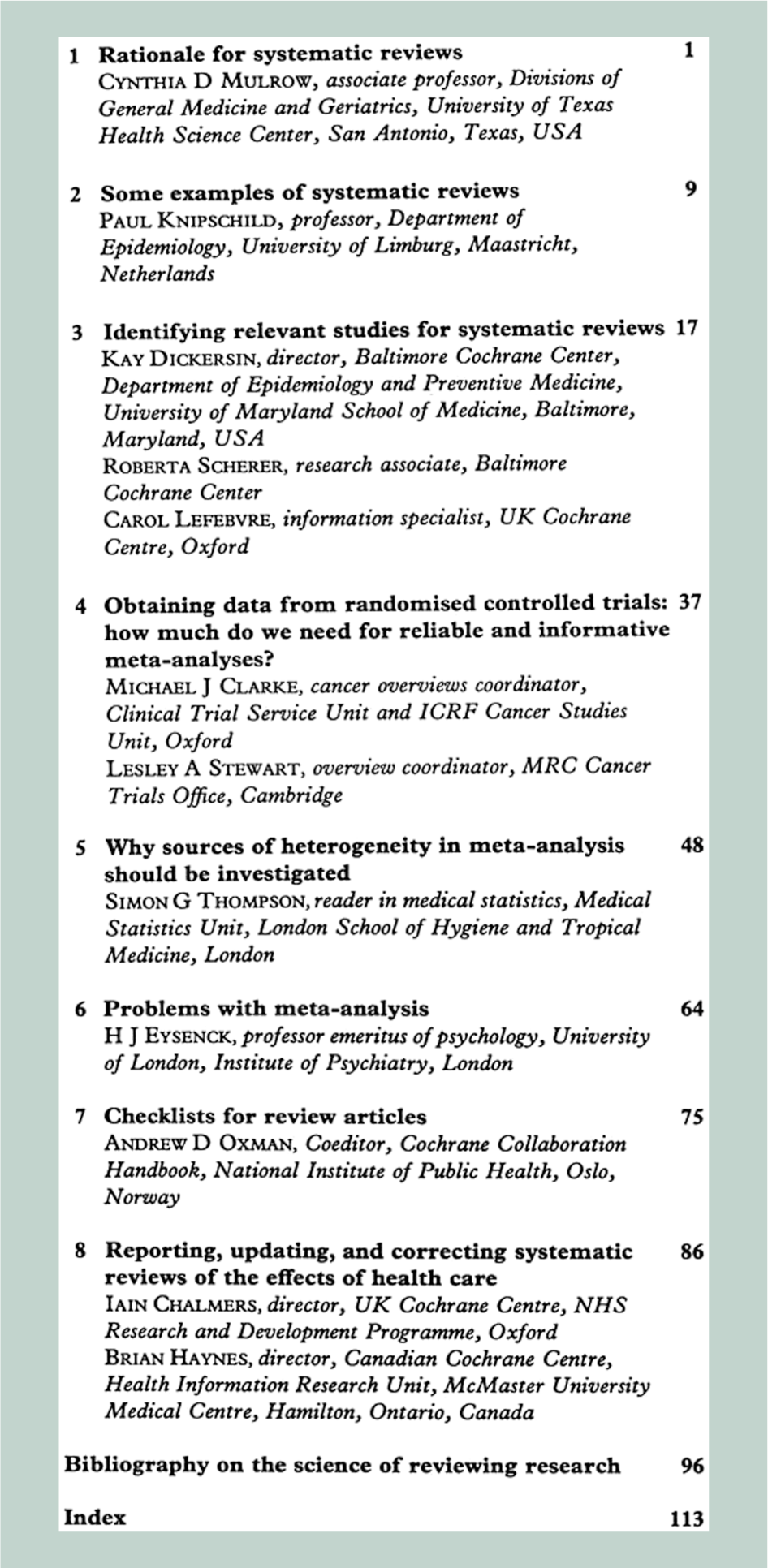

Doug’s and my Preface in the book provided an opportunity to explain why we had used the term ‘systematic review’ rather than the more technical neologism ‘meta-analysis’: A word about terminology: both the 1993 meeting and the book based on the proceedings have very deliberately used the term ‘systematic review’ rather than some of the alternatives which are in use. Use of the term ‘systematic review’ implies only that a review has been prepared using some kind of systematic approach to minimising biases and random errors, and that the components of the approach will be documented in a materials and methods section. Other terms – particularly ‘meta-analysis’ – have caused confusion because of the implication that a systematic approach to reviews must entail quantitative synthesis of primary data to yield an overall summary statistic (meta-analysis). As we hope this book will help to make clear, this is not the case. In addition to those circumstances in which statistical synthesis (meta-analysis) of results of primary research is not advisable, there will be others in which it is quite simply impossible. It is just as important to take steps to control biases in reviews in these circumstances as it is to do so in circumstances in which meta-analysis is both indicated and possible.
15
As time went on we have realized that there are many hidden problems, nuances, extensions, and so on. And there have been big changes in strategy. The biggest impact probably came from the early realization that the statistical analysis is a relatively simple part of a rather complex set of actions which we now label as a systematic review.
8