




Abstract

Introduction
The University Group Diabetes Program was an investigator-initiated secondary prevention trial funded by grants from the National Institute of Arthritis & Metabolic Diseases. Its purpose was to assess whether any of the commonly used agents for people with type 2 diabetes were useful in preventing morbidity associated with the condition.
The trial started in 1960 (first patient enrolled February 1961) and ended in 1981 (last follow-up examination done August 1975). The first publication of results came in 1970 and was prompted by a decision to stop using tolbutamide (Orinase®) in the trial because of evidence of ill-effects. In all, the study produced eight major publications.1–8
Before the smoke settled, there were Congressional hearings, audits, court cases and a request under the Freedom of Information Act for raw data from the trial which eventually wound its way to the U.S. Supreme Court.
As prevention trials go, the University Group Diabetes Program was relatively small – only 1027 patients about evenly divided across five treatment groups – but what it lacked in size it made up by being in the forefront of secondary prevention trials. In the end, the principal trouble with the trial was that it produced results the world did not want to hear. When that happens, the assumption is that there is something wrong with you and your trial because, surely, the world cannot be wrong.
The controversy surrounding the University Group Diabetes Program has been covered by Harry Marks, initially in his doctoral thesis, subsequently in his book The progress of experiment: Science and therapeutic reform in the United States, 1900–1990. 9 Details of the study and the controversy are featured in Chapters 7 and 49, respectively, of the first and second editions of my textbooks,10,11 in Chapter 5 of Aaron Mauck’s PhD dissertation, 12 in Chapter 4 of Jeremy Greene’s book, Prescribing by Numbers, 13 and in a paper by Blackburn and Jacobs. 14 See also trialsmeinertsway.com for a detailed account of the trials and tribulations of the University Group Diabetes Program and UGDPmorabilia.htm for University Group Diabetes Program memorabilia.
This essay is from the perspective of an investigator in the Coordinating Center (deputy director) of the trial.
The UGDP
The project that was to become the University Group Diabetes Program was born of a question to Max Miller (University Group Diabetes Program study chair) by a Congressman in the late 1950s. The Congressman’s daughter had just been diagnosed with type 2 diabetes and placed on Orinase® (tolbutamide) for control of her blood sugar. The Congressman wanted to know if blood sugar control was beneficial in reducing the complications of diabetes. Miller’s answer was that no one knows because there have not been any trials to address the question. The answer came as a shock to the Congressman. The question galvanised a small cadre of people to set about organising the University Group Diabetes Program.
The University Group Diabetes Program was an investigator-initiated multicentre randomised trial funded by the National Institutes of Health. It started with five clinical centres and ultimately grew to 12. The Coordinating Center was located at the University of Minnesota in Minneapolis when the trial started and later at the University of Maryland.
The following were the aims of the trial:
Evaluation of the efficacy of hypoglycaemic treatments in the prevention of vascular complications in a long-term, prospective, cooperative clinical trial; Study of the natural history of vascular disease in maturity onset, non-insulin-dependent diabetes; and Development of methods applicable to cooperative clinical trials.
1
The name of the trial has only four words and just 33 characters and hence is reasonably compact as names for trials go. University Group communicates something about where the study is done (though not all sites were university-affiliated) and that it is multicentre. Diabetes communicates focus, and Program denotes an activity that is planned to achieve a specified end. The acronym UGDP was largely immune from mischief, except by critics who referred to the study as the GD UP.
The downside of the name is that it is like the name of a child where you are left guessing if it refers to a boy or girl. Program as a currency word is nondescript. The preferred word is Trial but that word, at least when the study was formed, was viewed as anxiety-inducing for patients and was avoided.
The study treatments
When the University Group Diabetes Program started, people with diabetes were characterised as having ‘juvenile diabetes’ or ‘adult-onset diabetes’; juvenile because of early onset and usually insulin-dependent; adult-onset because of onset in the 20s and beyond and usually not insulin-dependent. Those terms in the late 1970s gave way to type 1 and type 2 diabetes.
In 1960, the predominant treatment for type 2 diabetics was tolbutamide, marketed as Orinase® by the Upjohn Company of Kalamazoo, Michigan. The evidence was that the drug was effective in controlling blood sugar and was therefore assumed to be beneficial long-term in reducing morbidity and mortality, but without any long-term trials to test this assumption.
University Group Diabetes Program investigators wanted to test tolbutamide long-term to see whether the control of blood sugar conferred benefits in reducing morbidity and mortality associated with the condition. They wanted to do the testing against a placebo administered in a double-masked fashion, where neither patients nor study personnel knew whether persons were receiving tolbutamide or a matching placebo. They also wanted to test the efficacy of insulin long-term. The insulin treatments were not masked.

Randomisations were stratified by clinic, arranged in permuted blocks of 16, ensuring that after every 16th enrollment, there were exactly the same number of persons assigned to each of the four treatment groups in each clinic.
After the start of enrollment, phenformin (DBI-TD) came on the market (marketed originally by USV Pharmaceutical Corporation and subsequently by Ciba Geigy). As is often the case with new drugs, they are regarded as better and safer than existing drugs. Such was the case with phenformin in 1960. The hype caused some in the University Group Diabetes Program to argue for the drug to be added to the trial. Proponents of the drug argued that failure to include it would render the University Group Diabetes Program irrelevant, assuming phenformin lived up to its promise.
Investigators could not have known, when making their arguments in 1962, that they would stop using phenformin because of ill-effects before the trial was finished and that the drug would ultimately have the ‘distinction’ of being the first and only drug removed from the market by the ‘imminent hazard provisions’ power vested in the Secretary of Health, Education and Welfare, because of deaths from lactic acidosis.
In 1962, the only question was how to add phenformin.
One option was to design a separate trial involving just phenformin and a matching placebo, creating, in effect, two trials – one with the original four treatment regimens and another involving just two treatment groups.
The other option was to add new clinics to the existing structure and modify the randomisation design to allow assignment to phenformin and its matching placebo. This was the option ultimately chosen.
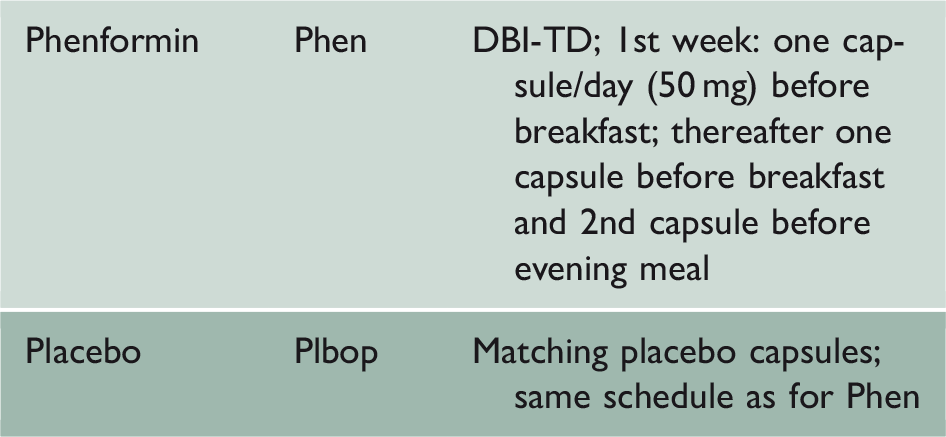
Anybody who has done a placebo-controlled trial knows that obtaining matching placebo tablets is almost impossible. Invariably, when compared side by side, the drug and placebo pills will have different sheens and subtle colour differences. Indeed, one of the reasons why pills are often crushed and placed in capsules is because of the difficulty of matching appearances and shapes. If pills have company logos on them, it is illegal to produce placebos with those markings. Fortunately, in the case of the University Group Diabetes Program, tolbutamide tablets and matching placebo were provided by Upjohn with an almost perfect match. Phenformin and matching capsules were provided by the manufacturer. Insulin was provided by Eli Lilly.
Study sites, enrollment and randomisation design

The randomisation scheme as described below is taken verbatim from Gilbert et al.
15
The UGDP study was arranged as a balanced design, stratified by blocks of 16 or 14 successive patients within clinics but without other restrictions on the pattern of assignment of treatment to subjects. Initially, during 1961 in each of seven clinics, the four treatments – variable-dose insulin (IVAR), standard-dose insulin (ISTD), tolbutamide, and placebo were allocated randomly to patients in blocks of 16 – four subjects to each of the four treatments in random order. In 1962–1963, phenformin was added to the treatments at five new clinics as well as at one of the original seven and, in order to achieve overall parity in the total number of patients assigned to each treatment, the block size was fixed at 14, with each block containing six subjects receiving phenformin, and two receiving each of the four other treatments.
For purposes of administrative efficiency, individual patients receiving tolbutamide or placebo were not assigned uniquely identified medication but were supplied as follows: For the tolbutamide assignments, numbers 1 to 24 were split at random into two groups of 12, one group of numbers being assigned to placebo and the remainder to bottles that would be used for tolbutamide. Each of the first 24 subjects receiving placebo or tolbutamide in a given clinic was allotted a separate bottle number, the sequence then being repeated. Bottles 25 through 48 were used for patients assigned to tolbutamide in the clinics that also used phenformin.
As a consequence of this arrangement for the distribution of medication, sometimes two and at most three subjects in a given clinic were supplied with identical bottle numbers. The administrative advantage of this scheme is that each clinic could be given an initial supply of 48 uniquely labeled medications and could order additional supplies, as need arose, without burdening the central pharmacy with responsibility for more than 800 separately labeled medications.
The orally given medications in the tolbutamide study were in tablet form. The introduction of phenformin in the second part of the study required a change in the method of administration, since phenformin is supplied as granule-filled capsules. In this part of the study all control medication for new patients was given as capsules. Tolbutamide was still supplied as tablets but, unknown to the participating clinics, placebo in the form of tablets was not given in the phenformin clinics. New bottle numbers (49 to 72) were used for the capsules, but the same method of resupply was employed.
In executing this plan, lists of ordered treatment assignments were prepared in advance for each clinic by the Coordinating Center. Random permutations of 16 from the tables given by Cochran and Cox were used for the treatment allocations in the first six clinics, and the Rand tables were employed for those clinics in which phenformin was administered. The assignments were entered in a log book, and space was left on each list for entry of the name and identifying number of the patient and the date of assignment. To facilitate initiation of treatment, assignment requests could be made by the clinic to the Coordinating Center and filled by telephone, in which case a limited number of individuals had authority to record the name of the patient on the appropriate line of the log book, and report back the preselected therapy as shown on the list, that is, either ISTD or IVAR or a bottle number. Confirmatory letters were exchanged subsequently. Alternatively, the assignment requests might come by mail, and the response be reported in like manner. All treatment assignments were made in the sequence laid out in the randomization list.
Once treatments were assigned, therapy was initiated by the clinic. Insulin therapies, not being “blind,” required no further consideration. In the case of orally given medication, however, the treatment was identified only by a bottle number.
Data collection schedule
The data collection schedule consisted of a qualifying baseline visit including a 3-hour glucose tolerance test. To be eligible, patients had to have a sum blood glucose tolerance test (fasting, 1 -, 2 - and 3-hour values) of ≥500 mg/100 mL. The second visit one month later was when randomisation took place. After randomisation, patients were counted as enrolled even if they never returned for follow-up visits. All patients were maintained on antidiabetic diets during the enrollment period, and thereafter, if enrolled.
After enrollment, patients were seen every three months. Each visit involved a general physical examination and an organ-specific examination; eye examination in quarter 1, heart examination in quarter 2, kidney examination in quarter 3 as well as peripheral vascular and neurological examination in quarter 4 and a sum glucose tolerance test. The sequence was repeated for each subsequent year of follow-up.
Results
The summary conclusions, as contained in study publications, are reproduced below. The tolbutamide and phenformin treatments were stopped because of ill-effects. The two insulin treatments made it to the end of the trial.
Tolbutamide result 2
All UGDP investigators are agreed that the findings of this study indicate that the combination of diet and tolbutamide therapy is no more effective than diet alone in prolonging life. Moreover, the findings suggest that tolbutamide and diet may be less effective than diet alone or diet and insulin at least insofar as cardiovascular mortality is concerned. For this reason, use of tolbutamide has been discontinued in the UGDP.
Phenformin result 4
This study provided no evidence that phenformin was more efficacious than diet alone or than diet and insulin in prolonging life for the patients studied. In fact, the observed mortality from all causes and from cardiovascular causes for patients in the phenformin treatment group was higher than that observed in any of the other treatment groups. In addition, there was no evidence that phenformin was more effective than any of the other treatments in preventing the occurrence of nonfatal vascular complications associated with diabetes. For these reasons, the use of phenformin has been terminated in the UGDP.
Insulin results 8
Mortality rates among the treatment groups were comparable. The differences in the occurrence of nonfatal vascular complications among the patients in these three treatment groups were small and only one of the drug-placebo differences was considered significant by the study criterion, and that was the insulin-standard versus placebo comparison for the occurrence of elevated serum creatinine levels (8.3% versus 18.5%, p value = 0.005). The occurrence of serious microvascular complications was surprisingly low. The latter finding as well as the slow progression of macrovascular complications underscores the differences in the course and the nature of the two principal types of diabetes mellitus, the rather stable and non-ketosis-prone maturity-onset type (type II) and the relatively unstable insulin-dependent juvenile-onset type (type I).
Summary

* * * * *
Food and Drug Administration audit
The Food and Drug Administration telegraphed its intention to revise the label for sulfonylurea drugs warning about cardiovascular risks associated with use soon after the tolbutamide results were published. The proposed relabelling riled the diabetic community because it was seen as heavy handed and precipitous in view of reservations regarding the validity of the University Group Diabetes Program results. 16
Since the labelling focused on a cause of death, critics raised questions as to the accuracy of cause of death classification. The process of classification is detailed in the initial publication of the University Group Diabetes Program. 1
Eventually, the Food and Drug Administration succumbed to pressures to audit University Group Diabetes Program death reports. The audit took place in the summer of 1977. The entire audit report is available on trialsmeinertsway.com/UGDPmemorabilia.htm.
The objective of the audit was to compare causes of death submitted by the participating clinical centres to the University Group Diabetes Program Coordinating Center with the causes of death assigned by the University Group Diabetes Program mortality review team and those published by the University Group Diabetes Program. It was not the intention of auditors to make a judgement on the cause of death but rather to determine if there were obvious discrepancies or errors in listing the cause of death. The auditors’ conclusion was:
There appeared to be no such major discrepancies between the information available on these deaths and the cause of death assigned by the UGDP review team, although it is recognized that assignment of cause of death is a judgment and differences of opinion could arise when the information is reviewed by different individuals.
Court battles (see online Appendix for chronology)
The fun began with publication of the tolbutamide results in a supplement to Diabetes in November 1970. Unbeknownst to us investigators, the supplement also included a statement about the results from the AMA Council on Drugs; a statement by Charles C Edwards, Commissioner of the Food and Drug Administration; and an editorial by Henry Ricketts, associate editor of Diabetes, reading in part:
The mortality study is at least suggestive enough to put a damper on what appears to be the indiscriminate use of all oral hypoglycemic agents in the treatment of mild or moderate, adult- onset diabetes. Although tolbutamide, for practical reasons, has been the only sulfonylurea drug investigated by UGDP, the chance that other compounds of this family may be similarly involved cannot be dismissed despite differences in molecular structure.
Initially efforts of the Care of the Diabetic centred on blocking label changes for tolbutamide proposed by the Food and Drug Administration. The committee’s efforts then expanded to blocking removal of phenformin from the market and to obtaining access to raw data from the trial.
The Care of the Diabetic regarded the University Group Diabetes Program as flawed and reasoned that if they were to gain access to its raw data they would be able to reanalyse and show where we went wrong. They wanted data forms that had been transmitted to the Coordinating Center from study clinics and computer tapes used in the Coordinating Center’s analyses.
At about the same time, William Safire of the New York Times filed a request for Henry Kissinger’s telephone notes from 21 January 1969 through 12 February 1971. That request was followed by another for all telephone notes while Kissinger was Secretary of State from both the Military Audit Project (28 December 1976) and the Reporters Committee for Freedom of the Press (13 January 1977).
Safire’s request was denied on grounds that Kissinger was National Security Adviser during the time period covered in the request and that advisers to the President are not considered to be governmental agencies under the Freedom of Information Act. However, the court of appeals did order the State Department to produce Kissinger’s telephone notes for the other two requests.
The Care of the Diabetic’s request and the two for Kissinger’s telephone notes were heard at the same time by the Supreme Court (argued 31 October 1979 and decided 3 March 1980). The ruling in the Kissinger case was 4 to 2 against the requestors.
The ruling in the University Group Diabetes Program was 7 to 2 that
Written data generated, owned, and possessed by privately controlled organization as grantee of funds from HEW, held not accessible as ‘agency records’ under Freedom of Information Act when HEW never obtained data.
The opinion in the University Group Diabetes Program hinged primarily on the fact that the National Institutes of Health did not ask for data when the trial was ongoing. The ruling might well have been different if the trial had been done under contract with the National Institutes of Health and subjected to closer monitoring by the agency.
Supplemental Material
JCB884869 Supplmentary Appendix - Supplemental material for The trials and tribulations of the University Group Diabetes Program 1: the trial and the controversies
Supplemental material, JCB884869 Supplmentary Appendix for The trials and tribulations of the University Group Diabetes Program 1: the trial and the controversies by Curtis Meinert in Journal of the Royal Society of Medicine
Footnotes
Declarations
References
Supplementary Material
Please find the following supplemental material available below.
For Open Access articles published under a Creative Commons License, all supplemental material carries the same license as the article it is associated with.
For non-Open Access articles published, all supplemental material carries a non-exclusive license, and permission requests for re-use of supplemental material or any part of supplemental material shall be sent directly to the copyright owner as specified in the copyright notice associated with the article.
