




Abstract
Introduction
Where the spirit does not work with the hand there is no art
Leonardo da Vinci (Vinci 1452 – Amboise 1519)
Leonardo di ser Piero da Vinci was born out of wedlock to a Florentine legal notary, Messer Piero Fruosino di Antonio da Vinci, and a peasant, Caterina. He was an Italian Renaissance polymath artist and inventor whose talents included architecture, music, anatomy, engineering, sculpture, geometry and painting. Scholars have called him the archetype of ‘Renaissance man’ and a universal genius.
One of the most intriguing and still controversial debates for art historians has been his handedness. Analyses of the shading and hatching in drawings attributed to da Vinci show that the shading and hatching slopes from upper left to lower right, leaving few doubts about his left-handedness.1,2 However, a review of all historical biographical documents about da Vinci and his works concluded that he used his right hand when creating work other than drawing and writing.3,4 Although the numerous documents in mirror-writing with his left hand confirmed that he was likely more skilled in using his left hand than the common right-handed artists, it is claimed that he never painted using his left hand. 3
Several historical sources have suggested that da Vinci sustained a right hemiparesis in the last years of his life. Some authors suppose that this was due to a stroke that has been related to his vegetarian diet,3,5 whereas other scholars suggest the possibility of Dupuytren's disease.
3
During a visit to da Vinci in 1517, the personal assistant of the Cardinal Luigi d'Aragona, Antonio de Beatis, wrote a detailed note in his diary. After Leonardo showed three masterpieces to his guests, de Beatis recorded: … One cannot indeed expect any more good work from him, as a certain paralysis has crippled his right hand … . And although Messer Leonardo can no longer paint with the sweetness which was peculiar to him, he can still design and instruct others.
6
Material
To contribute to this discussion, the authors focuses on a portrait (Figure 1) of da Vinci drawn with red chalk in the sanguine technique (so-called because the reddish-brown colour resembles that of dried blood). It is attributed to a 16th-century Lombard artist active in Milan, identified as Giovan Ambrogio Figino (1548–1608) due to a light ink inscription in the lower left corner on the back of the sheet. The inscription also included a sentence that was very difficult to decipher, regarding the source from which the artist would have drawn this portrait: ‘Figino da un marmo’ (Figino from a marble). There are no details about the marble bust with the effigy of Leonardo. The handwriting of the ancient inscription is the same as that found in the original drawings of the Venetian collection by Figino. Again, in the center of the back of the paper the name of the sitter is recorded in black pencil as ‘L. Vincij Effigies’ (the image/effigy of L. Vinci).
Portrait of Leonardo da Vinci, unknown date (16th century), Giovan Ambrogio Figino, red chalk or sanguine drawing, 41.6 × 28.2 cm (16.3 × 11.1 in.) [from the Museum of Gallerie dell'Accademia, Gabinetto dei Disegni e Stampe, n. 834, Venice, Italy; reprinted with permission of Ministero dei Beni e delle Attività Culturali e del Turismo].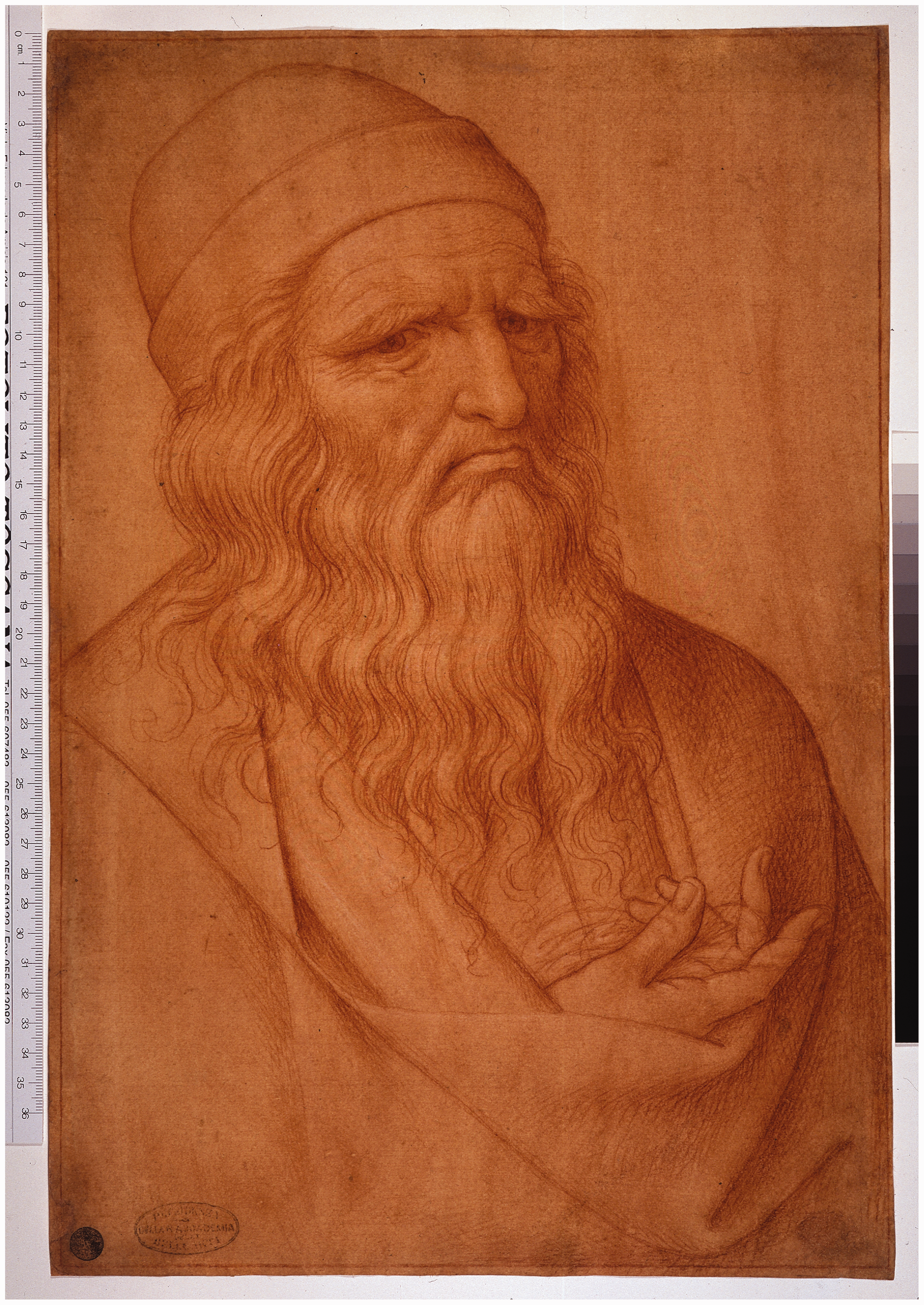
The second figure (Figure 2) is a 1505 engraving portraying a man playing a lira da braccio (a typical Renaissance string instrument similar to a medieval fiddle). The work is attributed to Marcantonio Raimondi, a contemporary artist of Leonardo working in Northern Italy. Only recently the sitter has been identified as Leonardo da Vinci.
Leonardo playing instrument (Previously Orpheus Charming the Animals), c. 1505, Marcantonio Raimondi, engraving, 21.4 × 17.3 cm (8.4 × 6. 8 in.) [from the Cleveland Museum of Art, Cleveland, Ohio, USA; reprinted with permission].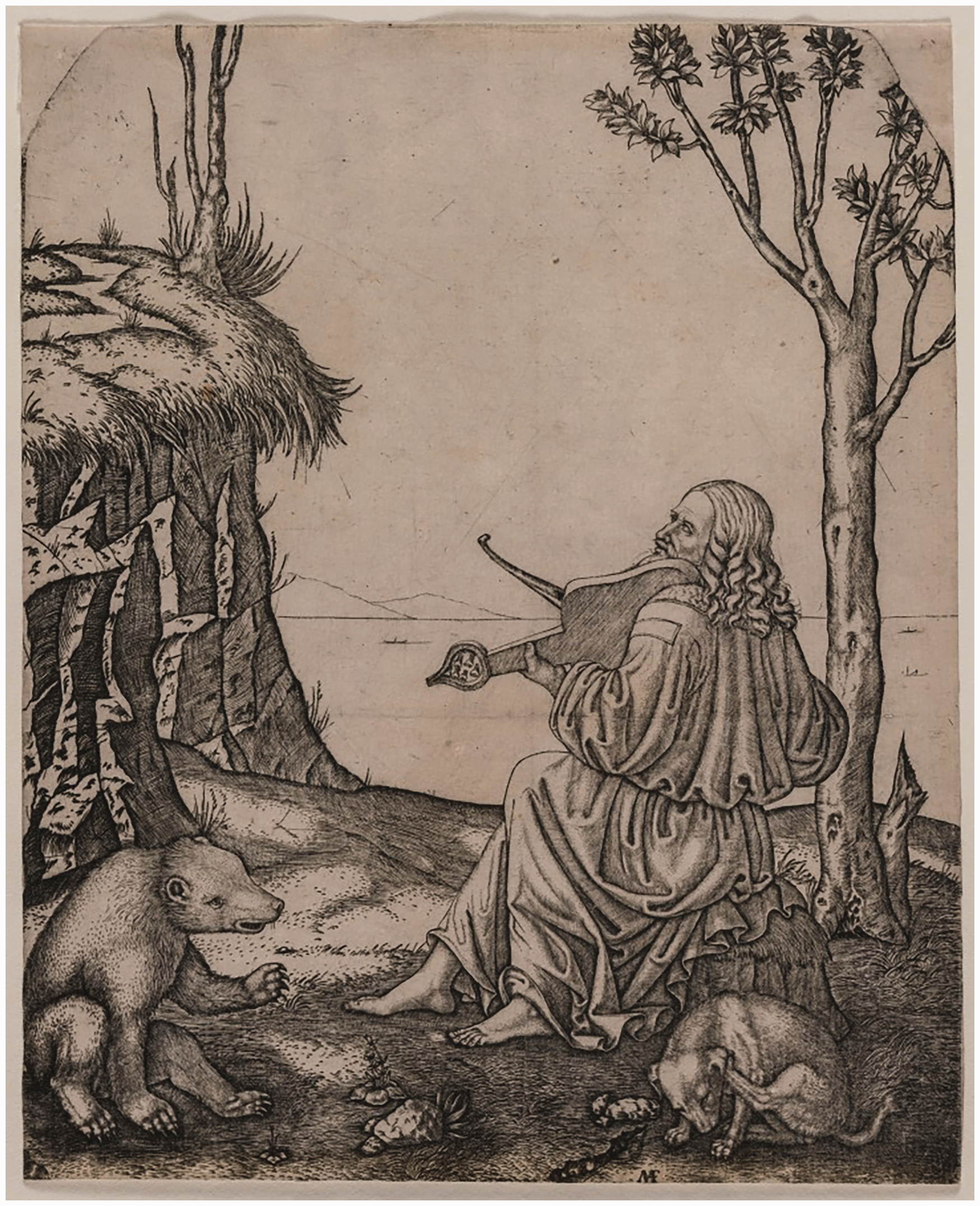
Medical diagnosis
The drawing represents an elderly da Vinci, showing all the signs of age. Interestingly, it is a rare rendering of da Vinci's right arm in folds of clothing as if it was a bandage, with his right-hand suspended in a stiff, contracted position. Most authors agreed that da Vinci suffered a right hand paralysis caused by a stroke,3,5 although the hand shown in Figure 1 does not depict the typical clenched hand seen in post-stroke muscular spasticity. A central upper limb paralysis is characterised by spasticity, predominantly affecting the antigravity muscles. The arm tends to assume a flexed and pronated position with a prevalent involvement of the deep and superficial digital flexors. Nevertheless, in Figino's portrait the wrist and the thumb are respectively flexed and adducted in spasticity, making a diagnosis of stroke less likely. This picture analysis suggests an alternative diagnosis such as an ulnar palsy, commonly known as claw hand, which is characterised by a hyperextension at the metacarpo-phalangeal joints and flexion at the proximal and distal inter-phalangeal joints of the fourth and fifth fingers.6,7 Another alternative diagnosis could be focal dystonia (as task-specific dystonia).
The engraving seems to pay tribute to the incomparable ability and musical skills of da Vinci, who is pictured playing the instrument (Figure 2). Even though the right arm and hand are not visible, we should presume that he is portrayed in optimal medical condition.
Discussion
As stated in de Beatis’ diary, 8 investigation of da Vinci's late production showed that he continued drawing: for example, the Virgin Mary from ‘The Virgin and Child with St. Anne’; studies of cats, horses, dragons and St. George; on the nature of water; anatomical studies; drawings of the Deluge and various machines. 4 Indeed, it is likely that the hemiparesis affecting the right upper limb would not have impaired his left-handed ability to sketch, leaving da Vinci with enough strength to sit down and draw. 3 On the other hand, his painting skill was hampered, as he was unable to hold palettes and brushes. According to most authors, the origin of da Vinci's right-hand impairment was related to a stroke. With the present investigation, the authors attempted to formulate different retrospective hypotheses of medical diagnosis.
The 1505 engraving by Raimondi, in which da Vinci is represented playing a lira da braccio (Figure 2), is useful in our investigation. Maybe Raimondi used a portrait as a reference or met da Vinci in person; either way the engraving is a celebration of da Vinci's skill with the instrument. The hypothesis is supported by a 1550 book by Vasari which argues: And Leonardo brought with him that instrument [lira] which he had made with his own hands, in great part of silver, in order that the harmony might be of greater volume and more sonorous in tone, with which he surpassed all the musicians who had come together there to play. Besides this, he was the best improviser in verse of his day.
5
We should therefore presume that until 1505 da Vinci's right hand was working well, but that by the late years of his career he started to suffer some kind of impairment. This makes the diagnosis of Dupuytren's disease unlikely.
The right hand in Figure 1 does not show the typical clenched hand caused by stroke-related muscular spasticity; instead, the claw hand seen makes ulnar palsy more plausible. Lying in the cubital tunnel at the elbow joint, the ulnar nerve is predisposed to trauma and entrapment neuropathy.6,7 Rarely, ulnar nerve compression occurs at the wrist within Guyon's canal. Cubital tunnel and Goon's canal syndromes with ulnar neuropathy are most commonly related to chronic causes, including chronic bony deformity, ganglion cysts and other soft-tissue tumors, synovitis and nerve enlargement. Acute traumatic neuropathy, although rare and under-reported, is described and may also have been sustained by da Vinci.
Vasari described the artist as old and physically exhausted, suffering from several diseases ‘Finally, having grown old, he remained ill many months …’.
7
Leonardo succumbed to a paroxysm when the King of France was visiting him … he was seized by a paroxysm, the messenger of death; for which reason the King having risen and having taken his head, in order to assist him and show him favor, to the end that he might alleviate his pain, his spirit, which was divine, knowing that it could not have any greater honor, expired in the arms of the King, in the seventy fifth year of his age.
9
Isolated arm paralysis due to an ischemic stroke is usually due to an athero-thromboembolic pathogenesis. Hypercholesterolemia is a well-known risk factor and is common in vegetarians with a large consumption of dairy products. A monoparesis is the clinical manifestation of partial anterior circulation syndrome according to Bamford classification. 11 However, in the absence of both prevention antiplatelet therapy and control of cardiovascular risk factors, it could have led to short-term recurrences with the involvement of other and more extensive cerebral areas. This would have the clinical consequence of severe motor and cognitive impairment, which was not reported in da Vinci's clinical history. Indeed, in his diary de Beatis described only a ‘certain paralysis’ that ‘has crippled his right hand ’, but there is no information about eventual facial paralysis frequently occurring after a stroke. The sudden seizure due to the undefined illness described by Vasari would most likely refer to a vascular event of a cardiac or cerebral nature. Focal seizures caused by cortical ischemic lesions would be associated with obvious prodromes not reported in historical documentation. The sudden and unpredictable event makes the cardiogenic etiopathogenesis (a syncope) more likely, and during such an event da Vinci might have sustained acute trauma of his right upper limb, developing ulnar palsy.
Conclusion
Analyses of a biography and of two drawings of da Vinci seem to confirm that he suffered a disease in his late career that affected his ability to hold palettes and brushes to paint with his right hand; although this did not affect his ability to sketch with his left hand. According to a 16th-century painting, da Vinci's right hand impairment is most likely related to an acute post-traumatic ulnar neuropathy rather than a stroke, even if an acute cardiovascular event may have been the cause of death. Indeed, Da Vinci's hand impairment was not associated with cognitive decline, which may explain why he left numerous paintings incomplete, including the Mona Lisa, during the last years of his career as painter while he continued teaching and drawing.