



Abstract

This article is in our series on Winston Churchill's illnesses
Introduction
On the morning of 2 September 1945, Churchill flew from London to Milan in Field Marshal Alexander's Dakota, a flight of five and a half hours, for a working holiday. 1 Alexander was Supreme Commander of the Mediterranean Forces. Churchill was to stay as Alexander's guest in Villa d'Este, a villa on the shore of Lake Como, and the nominal Headquarters of the 2nd Military District (Commander, General Heydeman). 1 Churchill was accompanied by his daughter Sarah, Lord Moran his personal physician, Elizabeth Leighton his secretary, his new Detective Sgt Davies and his valet Frank Sawyers. On 3 September, Churchill had gone painting. The first painting was a success, according to Sarah Churchill – ‘a luminous lake and boats, backed by beetling Cragg, with a miniature toy village caught in the sunlight at its foot’. 2
Lord Moran recorded on 5 September 1945 (though this must relate to 3 September 1945 if Edwards and Churchill are correct; see below) in his published record, The struggle for survival: This morning he sent for me. He had discovered a swelling in his groin. He was keyed up and waited anxiously while I made my examination. When I told him he was ruptured, he seemed relieved it wasn't anything worse, but he immediately fired at me a stream of questions. Was an operation necessary? Would it be strangulated? Would it get worse? How long would it be before he got used to a truss? Why should he get a rupture at his age, when he hardly took exercise? Brigadier Edwards (Figure 1), the consulting surgeon for the Army in Italy, said he would get him a truss in Milan, and now all is set fair again. Besides, Winston has been painting well today, so tonight he is all smiles.
3
Harold C Edwards CBE ©NPG 170454. A Fairchild plane was put at my disposal. We reached Milan early afternoon on the 4th, having refuelled in Rome. There I was met and taken to Villa d'Este, a beautiful house on the shore of Lake Como. The journey had taken seven hours, and throughout it, I had been in a fever heat of anxiety as to what I might find. I was under the impression that Churchill was seriously ill. Arrived at the house, I was met by Lord Moran (Figure 2) who told me that Churchill was out painting. What a relief! What had happened was that Churchill had suddenly developed an inguinal hernia.
4
Lord Moran © Yousuf Karsh, Camera Press London. got up from the bed to shake hands and to thank me for coming, looking directly into my eyes, but not smiling. He started to answer a few questions about himself, but he was far more interested in showing Lord Moran and me the results of his labours with the brush. There were two canvases, quite large, perhaps 4 ft × 3 ft. Both were in watercolour – one which was near completion, painted at Lake Lugano and one here at Como. The latter had been done today at three hours sitting. It seemed a lot of painting for three hours.…Finally, after perhaps 20 minutes, we returned to the physical infirmity of Winston Churchill – and this time to some purpose. He was very patient with my examination, and having finished it, and made by diagnosis, I was subjected to a cross-examination – which was surely a search for knowledge and performed in a kindly way – which for detail and directness would have done credit to a member of the Court of Examiners [of the Royal College of Surgeons of England]. It was then that I had an insight into that extraordinary brain (I had much more reason later in the evening to admire it more fully). It was fortunate for me that I knew the subject well. When we had finished he thanked me for my kindness in coming to see him.
4
advised Churchill against a hernia operation he went to Milan with his army technician to get a truss made. They found a surgical outfitter opposite the Cathedral and tried to order a truss for delivery the next morning. The owner said it that was quite impossible. Father (a Brigadier) explained that unfortunately, he would therefore have to commandeer the shop so that his technician could make the truss himself. Ah, said the owner, is it for the famous man staying on Lake Como? Then it will be ready first thing in the morning.
4


On 5 September 1945, Churchill wrote to his wife, Clementine, from Lake Como, explaining what had happened. Darling a tiresome thing has happened to me. When I was v[er]y young, I ruptured myself & had to wear a truss. I left it off because I went to Harrow & have managed 60 years of rough-and-tumble. Now however in the last 10 days it has come back. There is no pain, but I have had to be fitted w[ith] a truss wh[ich] I shall have to wear when not in bed for the rest of my life – Charles [Lord Moran] got a military surgeon from Rome who flew & has been w[ith] us for the last 3 days.
5
Mrs Churchill responded on 11 September: My darling I'm so distressed about the truss – I hope it is comfortable & does not worry you. Did you strain yourself or stretch unduly – And will you now be able to do your exercises which are so potent a preventative of indigestion?
5
Methods
Information regarding Churchill's hernia repair in 1947 was available from various sources. Foremost were those of Churchill's personal physician, Lord Moran3,7,8 and Sir John Parkinson, the cardiologist, who assessed Churchill prior to operation. By courtesy of the present Lord Moran and the Library at the Wellcome Collection, we have had access to his grandfather's original papers. However, permission to include information not previously in the public domain was not granted. Sir John Parkinson's family generously gave us permission again to include details from his medical report on Churchill. Churchill's daughters, Mary (Lady Soames) 5 and Sarah, 2 added further details, as did Brigadier Harold Edwards CBE RAMC,9,10 Professor AWF Edwards FRS, 9 Martin Gilbert (Churchill's main biographer),1,11 Dr Richard Gordon (anaesthetist and author), 12 Professor John Connolly (vascular surgeon), 13 Mr Martin Birstingl (vascular surgeon) 13 and Ronald Golding (Churchill's detective). 14
September 1945–June 1947: poor control of the hernia by truss and the need for surgery
Moran recorded in his book in an entry dated June 1947 that the search for an effective truss had gone on ever since [1945], with small success. Lately, the hernia has got much larger, it is increasingly difficult to control with the truss, and is hardly ever out of his [Churchill's] mind. He seems to look on it as a particularly humiliating hint – anyway to those who can read – of the impermanence of things. The very integument which confines his vital organ has, he protests, given way; it can, of course, be patched, stitched and strengthened to hold for a little longer, but only for a time.
7
Referral to Sir Thomas Dunhill
Moran invited Dunhill (Figure 3) to operate on Churchill.
7
This referral has surprised some who considered that Dunhill might not have been the best choice.
16
It is true that Dunhill had retired from the staff at St Bartholomew's Hospital in 1935 on his 60th birthday, thereafter engaging in what was for some years a very flourishing private practice at 54 Harley Street. By 1949, however, Dunhill had only three patients left: George VI, Queen Mary and Churchill. In 1949, Queen Mary gave Dunhill a beautiful silver porringer (‘With much gratitude and best wishes Mary R’), which is now in the possession of the Royal Australasian College of Surgeons.
17
Sir Thomas Dunhill GCVO ©NPG 167313.
Within a few years of appointment in 1920 to the professorial surgical unit at St Bartholomew's Hospital, London, Dunhill had established himself as the leading thyroid surgeon in England and in Sir Geoffrey Keynes' opinion was ‘a general surgeon in the true sense, exceptionally competent at all forms of surgery, whether abdominal or orthopaedic’, 18 and was considered by many as the best general surgeon at St Bartholomew's Hospital. In 1939, Dunhill was awarded an Honorary FRCS (Eng), the first time this Honorary Fellowship had been bestowed on a surgeon who was in active practice.
Research at the Churchill College Archive in Cambridge has confirmed that Dunhill treated Churchill at least from 1941 and Moran was still referring Churchill to Dunhill in 1953.
8
Dunhill saw Churchill professionally in early 1941 and the Prime Minister sent him a four-volume set of his Marlborough: His life and times in gratitude. Dunhill replied on 21 May 1941: Dear Prime Minister You have given me a very great pleasure. I never dreamed that I should possess a set of the ‘Marlborough’ volumes inscribed by you. To meet and serve you was its own reward-and the two sentences spoken by you this morning have made me chuckle many times since. Believe me, Mr Prime Minister. Your obedient servant Thomas P Dunhill
19
Dear Mr Prime Minister You have given me an entertaining and most useful instrument. The first try has been quite successful, even with corners usually difficult. As my eye lights on the soap, brush and hitherto faithful Gillette, I say ‘good bye to all that’. May I give you my fervent wishes in your great job and tell you how honoured I have been to help a little. Believe me Sir Your obedient servant Thomas Dunhill
22
Although it has been suggested that this operation was a prostatectomy, 16 there is no evidence that Churchill was away from wartime duties for a major operation in 1943, although he suffered episodes of pneumonia in February 26 and December 27 of that year. Beasley (personal communication) speculates that the operation would probably have been something ‘undignified’, such as an anal fistula. The statement below from Moran (‘whenever I have called him in to see Winston’ 7 ) also supports the view that Moran had referred Churchill previously to Dunhill.
There is correspondence between Churchill and Dunhill that suggests that further surgical opinions were provided and minor surgical procedures were undertaken by Dunhill. On 10 April 1946, Dunhill wrote to Churchill: Thank you for your letter. It is entirely due to you that I, as an individual, and we as a nation exist. I count it a great privilege to have been permitted to contribute in some small way to this end by keeping you fit and it is that I simply could not accept renumeration. I realise you may wish to feel independent. May I therefore suggest that you give me one of your books. I would value that for I have so thoroughly enjoyed those I have read.
28
On 30 September 1946 after a holiday in Switzerland, Churchill wrote to Dunhill: I have been meaning for some time to send you some of my books as a mark of my thanks and appreciation of all the care and attention you have shown me in my ailments. I am having a copy of the Malakand Field Force bound for you, which may take some weeks. Meanwhile I send you the books of my pre-war speeches and of the Secret Session Speeches I made during the war, which I hope may interest you. Pray accept these books from me with my best wishes. I am so glad you are restored.
32
Moran wrote later rather patronisingly about Dunhill: Rather funks an operation on a man of his [Churchill's] age and eminence. He is a simple soul, though a fine craftsman, and regards Winston with awe and reverence as the man who saved this country from defeat. He won't hear of any question of payment whenever I have called him in to see Winston; he sees him at any time of day which suits the patient, scratching all his other appointments without a word, and he cut his summer visit to Norway by nearly a fortnight to fit in with Winston's arrangements. It is an attractive side to his character, but I am not sure it is a sound attitude for doctor towards a patient. The only safe role is to treat Winston exactly like any other patient.
7
… which is another way of saying that he was a great physician, who would use a knife only when he must. For many years I used to go to him when in difficulties and I do not recall that he ever led me wrong. Others who put themselves in his hands felt like that about Dunhill: from the moment he spoke to them in his earnest, subdued way they felt secure in his care. They were right, for his judgement was immaculate.
33
Sir Geoffrey Keynes, a long-time colleague of Dunhill, has written: Lord Moran has insisted that Dunhill was not only an exquisite human carpenter, but also had a quite outstanding gift for observation. He was a naturalist practising the art of surgery, which is another way of saying that he was a natural physician who would only use his instruments when he knew he must. In this way he gained the confidence of his medical colleagues and his patients alike. Through association with Lord Dawson of Penn he attended a Royal patient and so came to be appointed Surgeon to the Royal Household, Sergeant Surgeon to King George VI, and extra surgeon to the present Queen. Though he was the least pushful and self-seeking of men, he came to be greatly trusted in the highest quarters. He was a perfectionist in ordinary life as in surgery.
35
Preparation for the operation
Churchill's Engagement Card for May 1947 indicates that ‘Moran, Dunhill and surgeon [presumably Paterson Ross]’ assessed Churchill on 9 May 1947.
36
Although Moran does not mention this in his published record, Sir John Parkinson (Figure 4), the eminent cardiologist, who had assessed Churchill on several occasions previously, also saw him with Moran on 3 June 1947 at his consulting room at 1 Devonshire Place. The consultation was proposed as a preliminary to the hernia operation and not because of any cardiac symptoms. Churchill complained of an occasional slight ache above the left breast lasting for an hour or two after some nervous upset (the last time after a discussion with his son, Randolph), and unrelated to exertion.
Sir John Parkinson © Elva Carey.
In a letter to Moran, Parkinson wrote, He looked to me younger and better than in February 1944 when the war was still in progress. The heart sounds are normal and no murmurs are heard. The blood pressure is 140/80. Radioscopy shows a heart of normal shape and size. The right dome of the diaphragm is flattened as if from an old plural adhesion, and yet the diaphragm moves fairly well. The electrocardiogram is normal and almost identical with previous ones; T2 is indeed somewhat larger than in 1944. A single auricular extrasystole is recorded in Lead I and Lead IV.R [aVR] is still normal.
Moran was also in discussion with Dunhill: I had at last to put a blunt question to Dunhill: was there any real chance that he [Churchill] will be able to live the rest of his life without an operation? Dunhill thought it was most improbable, and I decided forthwith to push Winston to a decision, so that the operation might be done while the going was good. If he must have it done, now is the time. So, after months of indecision, a date has been fixed.
7
At last they screwed up their courage to tell him that in men over 70 statistics proved that pulmonary complications were seven times more common in smokers than non-smokers. Winston declared positively he could give up smoking whenever he liked; he would certainly not smoke for a fortnight before the operation if that was what the doctors wanted. It is true that he did make a feeble and abortive attempt to keep his word; then he decided to cut down the number of cigars to half; finally, he contrived to see Dunhill alone, and soon persuaded him to say that if Winston didn't mind the extra risk he, Dunhill, didn't.
7
Despite Dunhill's reputation as a surgeon, it is improbable that he had performed an inguinal hernia repair in recent years. Wisely, he made arrangements to practise with Professor James Paterson Ross (Figure 5), Head of the Professorial Surgical Unit at St Bartholomew's Hospital, London. In the summer of 1947, St Bartholomew's Hospital had still not had its bomb damage repaired from the Second World War, and the Hospital was still evacuated to ‘a sprawling redbrick, slate roof Victorian lunatic asylum’
12
at Hill End, St Albans, 15 miles away.
Sir James Patterson Ross Bt KCVO (Courtesy of Barts Health NHS Trust Archives and Museum SBHX8/977).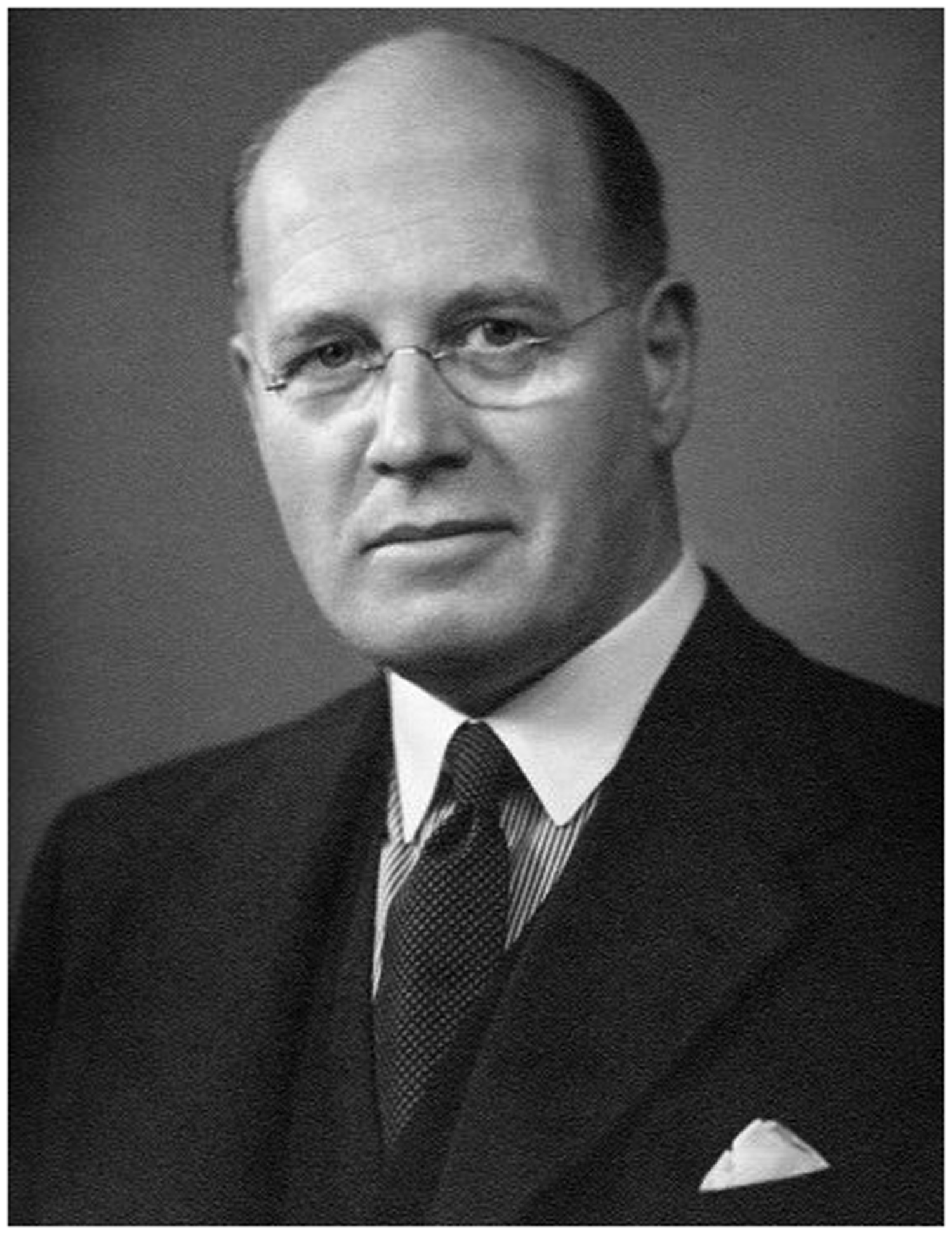
The house surgeon to Paterson Ross in 1947 was Mr Martin Birstingl FRCS. 13 He recalls that Paterson Ross told him to put two inguinal hernias on the list because Dunhill wanted to come and see ‘how we are doing them nowadays’. 13 Ross did the first operation and it went fairly well. Then Dunhill started the second hernia, slowly and in a rather tense atmosphere, which further degenerated when he began the repair and his third suture neatly pierced the femoral vein and the wound filled with blood”. 13
Dr Richard Gordon, author and sometime anaesthetist, also recalls that one morning that June, when I was a young doctor administering anaesthetics, a pleasant-looking grey-haired visitor appeared in our operating theatre corridor, accompanying the professor of surgery. A nurse whispered that he was Sir Thomas Dunhill KCVO CMG Sergeant Surgeon to the reigning King George VI and former surgeon to King George V, now retired from Barts and aged 71 … To our surprise, he shortly scrubbed up and assisted the professor with the repair of an inguinal hernia. I was flummoxed. Why was the Kings surgeon – or even the professor – performing an operation of such boring straightforwardness it was usually left to the juniors? Sir Thomas repaired all the hospital's hernias for a week.
12
Moran went down to Chartwell on 8 June to see if anything was wanted, and had to submit to a close cross-examination. What anaesthetic would be given? Would it be injected into his veins? How long would it be before he went off? I said before he could count fifteen. Whereupon he at once asked: how did the anaesthetic cause unconsciousness? Would he be very uncomfortable afterwards, and if so for how long? Would he have much pain?
7
11 June 1947: Pre-operative assessment
Churchill arrived at the Fife Nursing Home, 23 Bentinck Street, London (Matron: Princess Arthur of Connaught, Duchess of Fife), using the cover name of Mr Spencer,
38
with two big volumes of Macaulay's essays as a solace.
7
Moran found Churchill immersed in them on the morning of the operation. They soothed him Churchill said. Churchill asked Moran to pass him the other volume, when he began to read from Macauley's review of Ranke's History of the Papacy.
7
He went on reading savouring the opulence of the language, so much of it pure Winston, while Thomas Dunhill leant over the end of the bed to catch the words, his lips parted with pleasure, not so much in Macauley's measurement of the achievement of the Catholic Church, as in pure joy at his fortune in hearing a great historic figure talk and pay tribute to another master of words. ‘A fine piece of English writing … a fine piece of word painting’.
7
11 June 1947: operation
The operation notes have not survived. Moran recorded, however, that Churchill was on the table for more than two hours. ‘Adhesions, the legacy of the operation for appendicitis years ago [1922], made technical difficulties’. The abdominal scar was 8 in. long. 15 ‘I could see that Dunhill, his assistant and the anaesthetist were engrossed in their job; but I was only an idle spectator … ’ 7
In fact, Dunhill's ‘assistant’ was none other than Paterson Ross and the anaesthetist was the distinguished Dr Christopher Langton Hewer, who has related with piquant relish that Ross was treated by Dunhill as though he was still a house surgeon! 39
Birstingl has written that ‘most people believe that although officially done by Dunhill, the actual surgeon was Ross’. 13 Professor John Connelly, then junior registrar to Paterson Ross in 1952–1953 recalls seeing a signed framed photograph of Churchill in his study. 13 Connelly was told that it was given because Patterson Ross assisted Dunhill at Churchill's hernia operation and undertook daily afternoon follow-up visits at Churchill's home (see below).
The official bulletin issued on 11 June stated: ‘Mr Churchill had an operation for hernia this morning. His condition after the operation is satisfactory’. The bulletin was signed by Thomas P Dunhill, J Paterson Ross, C Langton Hewer, KLS Ward (presumably Dr KLS Ward a GP covering Chartwell 40 ), and Moran. The Times reported that Churchill would be ‘absent from his duties as Leader of the Opposition for at least a month’. 41
11–16 June 1947: post-operative recovery
Mrs Langton Hewer sent flowers from her garden to Churchill on 12 June. May a humble admirer send you these few flowers from the garden in token of the great respect and affection we have for you. We thank God for giving you to our country and trust that you will shortly be restored to your full health.
42
How good of you to send me the ‘Legend’ [a ready reference for the forthcoming Churchill memoirs] which you have prepared with so much thought and care for my husband. I know he will be so much pleased. He is coming home tomorrow in an ambulance and will have to spend another fortnight in bed. He will find the ‘Legend’ by his bedside. The operation had been most successful and I believe that it will give him a new lease of life.
43
17 June–7 August 1947: home and recuperation
Churchill returned home to Chartwell (the Engagement Card states to 28 Hyde Park Gate 36 ) where he was looked after by Nurse Helen Blake. 11 Dunhill visited Churchill on 22 June 1947 and 23 June 1947. 36
On 1 July 1947, Dennis Kelly delivered a broadside to Churchill, even though he was still forced to remain in bed, over his habit of ‘rummaging’ among the documents. His concern was that the cataloguing and indexing of the archive for the war memoirs, which was almost complete, would be wrecked by Churchill. 11 Kelly proposed a solution which kept both parties content.
On the same day, Dunhill requested a copy of the poem about the Aurora Borealis, which Churchill had quoted to him, to put up in his fishing hut in Norway. 44 In the absence of Dunhill in Norway, Paterson Ross reviewed Churchill on 9 July 1947 and 17 July 1947. 36
On 12 July 1947, Dunhill wrote to Churchill from Norway: The black band and the poem arrived yesterday – a calendar month from the day of the operation. It was good of you to send them. I hope you have made progress and regained strength and agility – although I observed no lack of either after the first post-operation day. The band is a great comfort. No longer do I fear the Aurora Borealis turning itself about, and most inconsiderately becoming an unnecessarily bright sun at 2.30 am. The members of the party chuckle over Dan Leno's [stage name of George Wild Galvin (1860 –1904), a leading English music hall comedian] poem and are more amazed than ever at your versatility and charm. The salmon are giving good sport, and the mosquitos are not unduly penetrating …
45
As soon as Churchill was allowed out of bed, work on Churchill's war memoirs reached a high pitch of activity. Kelly has explained in detail the intense process involved: ‘The day began at 7 o'clock at night. I had to go straight up to his bedroom because he could hear the taxi arrive and was impatient for the latest proofs from London’.
11
At dinner, Churchill and Kelly ate at opposite ends of the table each with their own copy of the current text. Sherry with the soup; champagne with the main cause; port with the cheese; brandy with the coffee; each with our pen and scribbling pad, then back to his study … A woman secretary would arrive with the evening letters … Then down to the real work of the evening. Silent typewriter behind us to our right; long, hesitant, brilliant dictation; corrections with a red pen; retype.
11
Each chapter was drafted, printed, redrafted and reprinted at least half a dozen times, and circulated to a group of experts for criticism and comment … A chapter was usually between five and eight thousand words; the rule was ‘chronology is the key to narrative, but subjects break-in’; the commandment: ‘Say what you have to say as clearly as you can and in as few words as possible’.
Churchill summarised these various stages of literary production on 2 November 1949 when he was awarded the Sunday Times Annual Literary Award for 1949 and Commemorative Gold Medal following the publication of the first two books in his series on The Second World War: Whilst writing, a book is an adventure. To begin with it is a toy, then an amusement, then it becomes a mistress and then it becomes a master and then it becomes a tyrant and, in the last stage, just as you are about to be reconciled to your servitude, you kill the monster and fling him to the public.
48
about noon, I drove WSC [Churchill] up in a Jeep, by which Mr Churchill always used to get around the farm. We stopped at a field which was almost harvested, with just a small square of wheat in the middle. Mr Churchill clambered slowly out of the Jeep … Just as he got his feet on the ground, there was a shout from the others and the rabbit darted from the centre of the field. In a flash Mr Churchill raised his gun and fired one barrel. The rabbit keeled over dead. It was a wonderful shot, and the usual Churchill luck. The others had been waiting hours for the opportunity.
14
My dear Prime Minister It is very good of you to send me the final volume of your ‘Second World War’. I regard the series as a very valued possession as I have regarded my occasional associations with you as the purple patches in my life. May I wish Lady Churchill and you health and vigour to continue to carry on. Believe me, Sir Yours very sincerely Thomas P Dunhill
50
Churchill's doctors
Sir Thomas Dunhill GCVO CMG (1876–1957)
After matriculating at the University of Melbourne, Dunhill (Figure 3) studied pharmacy and was registered in June 1898, but he never practised.51–53 Instead, in 1899, he began to study medicine. Dunhill's undergraduate career was brilliant. He graduated in 1903 with three first-class honours and exhibitions in medicine and in obstetrics and gynaecology. In January 1906, Dunhill had been commissioned a captain in the Australian Army Medical Corps. On the outbreak of Second world War, he enlisted in the Australian Imperial Force as a major and was allotted to the 1st Australian General Hospital. In July 1918, he was appointed consulting surgeon to the Rouen area in France, and there he met and impressed many leading English surgeons, particularly George Gask (first professor of surgery in the University of London in 1919 based at St Bartholomew's Hospital). Dunhill was mentioned in dispatches three times and was appointed CMG in 1919. Dunhill returned to Australia in 1919. A brilliant and lucrative surgical career in Australia lay before him. In 1920, however, he accepted an invitation from Gask to join the professorial surgical unit at St Bartholomew's Hospital, London. Within a few years, he had established himself as the leading thyroid surgeon in England and the best general surgeon at St Bartholomew's. Dunhill was appointed surgeon to George V in 1928 and then successively to Edward VIII, George VI (becoming Sergeant Surgeon (senior surgeon in the Medical Household of the Sovereign of the United Kingdom) in 1949) and finally extra surgeon to Elizabeth II. He was appointed KCVO in 1933 and GCVO in 1949.
Mr Harold C Edwards CBE (1899–1989)
Edwards (Figure 1) served in the Royal Engineers during First World War (1917–1919) before studying medicine. 54 He qualified from King's College Hospital School of Medicine in 1923. After graduating, he spent the whole of his professional life at King's College Hospital, apart from further service in the army in Second World War. He was appointed honorary surgeon at the age of 28 (five years after qualification) and retired in 1964. His surgery was ‘punctilious, intense, and timeless; he cultivated in himself and among others a rigid discipline’. His main interest was gastroenterology, particularly duodenal ulcer, Crohn's disease and diverticular disease. He was Dean of the Medical School from 1947 to 1950.
Edwards was consultant surgeon to Southern Command, England (1942–1944) with the rank of Brigadier, and then to Central Mediterranean Forces (1944–1946). It was during this latter posting that he was called in to treat Churchill. He was awarded the CBE in 1945. Edwards was President of the British Society of Gastroenterology (1961) and the Association of Surgeons of Great Britain and Ireland (1962) and Vice-President of the Royal College of Surgeons (1968–1969).
Dr Christopher Langton Hewer (1896–1986)
Langton Hewer served in the RAMC towards the end of First World War and was appointed House Surgeon at St Bartholomew's Hospital in 1918, but thereafter concentrated on anaesthetics, being appointed to the Hospital staff in 1924 and retiring in 1961.55,56 He worked with Boyle on the development of his eponymous continuous flow machine, and during the Second World War, he was involved in the study of trichloroethylene as a battlefield alternative to ether and chloroform. His clinical skill was reflected in requests to anaesthetise members of the Royal Family, Winston Churchill and Bernard Shaw. The series Recent Advances in Anaesthesia first appeared in 1932 and continued under his editorship for 50 years. He was a founder member of the Association of Anaesthetists and also the first Editor of Anaesthesia in 1945, a position which he held for 20 years.
Lord Moran MC (1882–1977)
Charles Wilson was appointed Dean of St Mary's Medical School in 1920, a post he held until 1945. He became Churchill's doctor on 24 May 1940 and remained his personal physician until Churchill's death in 1965 (Figure 2). 57 He treated Churchill for chest pain in December 1941 in Washington, 58 for pneumonia in London in February 1943, 26 for pneumonia and atrial fibrillation in Carthage in December 194327 and for pneumonia in London in August 1944. 26 Moran subsequently treated Churchill in 1949 when he suffered his first stroke 59 and was primarily responsible for managing the further episodes of cerebrovascular disease in 1950–1952, 60 his second stroke in 195361 and Churchill's recovery from it 62 and the cerebellar infarction in June 1955 again with an excellent recovery, 63 and a left hemisphere stroke in October 1956. 64 In 1958, he treated Churchill for pneumonia, atrial fibrillation and jaundice. 65
Wilson was knighted in 1938, created Baron Moran of Manton in the County of Wiltshire in 1943 and was appointed Treasurer (1938–1941) then President of the Royal College of Physicians of London (1941–1950). 57
Sir John Parkinson (1885–1976)
Parkinson (Figure 4) was appointed Assistant Physician to the London Hospital in 1920, Physician in 1927, and Physician to the Cardiac Department in 1933. 66 He was President of the Association of Physicians of Great Britain and Ireland and of the British Cardiac Society. 66 Parkinson and Evan Bedford were foremost in correlating the symptoms and electrocardiographic signs of myocardial infarction.67,68 In 1930, Parkinson along with Louis Wolff and Paul White in America, described bundle-branch block associated with a short P-R period in healthy young people prone to paroxysmal tachycardia (the WPW syndrome).69 Parkinson had first assessed Churchill in February 194258 and did so again in 1953. 61 He was knighted in 1948. 66
Sir James Paterson Ross (1895–1980) Bt KCVO
Paterson Ross entered St Bartholomew's Hospital Medical School in 1912, with an entrance scholarship in science. 39 He was an outstanding student and was awarded the Treasurer's Prize and a junior scholarship in anatomy and physiology. His studies were interrupted during the First World War when he served as a sergeant dispenser to the 1st London General Hospital but was released and returned to St Bartholomew's Hospital in 1915. He qualified with the Conjoint Diploma in 1917 and, after three months as a house surgeon, entered the Royal Navy as a Surgeon-Lieutenant and was demobilised in 1919. After the war, Paterson Ross graduated in 1920 with distinctions in surgery and forensic medicine and was awarded the Gold Medal. At Bart's, he served as a demonstrator of physiology in 1920 and pathology, 1921–1922. Shortly after, he went to Boston, Massachusetts, for neurosurgical training under Dr Harvey Cushing. Returning to London in 1923, he joined Professor George Gask's newly established surgical professorial unit at Bart's. Together with Gask, he developed a special interest in surgery of the sympathetic nervous system, and Paterson Ross was awarded the Jacksonian Prize in 1931 for his essay on this subject. In the same year, he gave the first of three Hunterian Lectures; two others followed in 1933 and 1939. On Gask's retirement in 1935, Ross succeeded to the Professorial Chair at the age of 40 (Figure 5).
He was appointed civilian consultant surgeon to the Royal Navy and served as President of the Royal College of Surgeons of England, 1957–1960. In 1949, when King George VI had developed signs of serious ischaemic symptoms in one leg, at the suggestion of the then Sergeant Surgeon, Sir Thomas Dunhill, Paterson Ross and James Learmonth were called into consultation and then undertook a lumbar sympathetic ganglionectomy operation. Both surgeons were created KCVO in 1949. Ross was appointed Surgeon to HM Queen Elizabeth II in 1952 and a Baronet in 1960.
Discussion
We believe that this narrative, assembled from a number of contemporaneous medical and non-medical sources, provides a comprehensive account of Churchill's hernia repair in June 1947. Our account demonstrates several notable features.
First, the concern and reverence for Churchill's health. The medical and surgical personnel and expertise recruited by Moran and Dunhill were impressive, and it is clear that no one wished to be responsible for any mistake in the care of a man whose importance was ranked on a par with members of the Royal family.
Second, the good judgement and humility of the very distinguished surgeons concerned. They recognised their limitation in performing an apparently ‘simple’ operation.
Third, the skill of the anaesthetist Langton Hewer, and the post-operative care of Churchill, who was an overweight smoker then in his 70s, and well-known to be prone to the development of pneumonia.26,27,65
And fourth, Edwards's record of his consultation with Churchill on 3 September 1945 which revealed the characteristic intellectual clarity, penetration and relevance of Churchill's enquiry about the hernia and the treatment necessary for it. 4
How successful was the operation? Two US surgeons have commented in 2003, with reference to surgical techniques not available at the time of Churchill's operation: The results speak for themselves: tissue repair, probably under tension (no mesh, no preperitoneal approach, no laparoscopy), of a large and long-standing hernia in an obese patient who suffered from chronic obstructive lung disease, with no recurrence on prolonged followup.
16
Finally, it is clear that Dunhill established with Churchill a relationship not only of professional trust but also of personal understanding, mutual respect and friendship extending back to 1941. The witty correspondence between the two men, cited here, and Dunhill's presence on Churchill's list of personal friends leaves no doubt about this, and sets Dunhill apart from Churchill's many other medical advisers, with the possible exception of Professor Herbert Seddon.